
Antecedents of Trust in Organic Foods: The Mediating Role of Food Related Personality Traits

Abstract
:1. Introduction
2. Literature Review and Hypotheses Development
3. Methodology
4. Results
5. Mediation Analysis
6. Conclusions and Discussion
7. Implications
8. Limitations
Author Contributions
Funding
Conflicts of Interest
References
- Willer, H.; Lernoud, J. The World of Organic Agriculture. Statistics and Emerging Trends 2018; Research Institute of Organic Agriculture (FiBL), Frick and IFOAM—Organics International: Bonn, Germany, 2018. [Google Scholar]
- Loconto, A.M. “Organic 3.0 opportunities and risks in the market: Non 3rd party certified opportunities.” Global Market Overview–facts, trends and opportunities. In Proceedings of the BIOFACH 2017, Nuremberg, Germany, 15–18 February 2017. [Google Scholar]
- Hirschberg, C.; Rajko, A.; Schumacher, T.; Wrulich, M. The Changing Market for Food Delivery; Mckinsey: New York, NY, USA, 2016. [Google Scholar]
- Nielsen. New Eating Trends in China: The Healthier the Better. Available online: https://www.nielsen.com/cn/en/press-room/2016/New-Eating-Trends-in-China-the-Healthier-the-Better.html (accessed on 15 June 2018).
- Yin, S.; Wu, L.; Du, L.; Chen, M. Consumers’ purchase intention of organic food in China. J. Sci. Food Agric. 2010, 90, 1361–1367. [Google Scholar] [CrossRef] [PubMed]
- Yin, S. Information Asymmetry, Certification Effectiveness and Consumers’ Preference: A Case Study of Organic Food; China Social Sciences Press: Beijing, China, 2013. [Google Scholar]
- Weekly, T. Kweichow Moutai Has Been Exposed to Organic Falsification of Raw Materials for Brewing. Available online: http://westdollar.com/sbdm/finance/news/1344,20130314278934459.html (accessed on 12 June 2018).
- Wu, S.; Kuschk, P.; Brix, H.; Vymazal, J.; Dong, R. Development of constructed wetlands in performance intensifications for wastewater treatment: A nitrogen and organic matter targeted review. Water Res. 2014, 57, 40–55. [Google Scholar] [CrossRef] [PubMed]
- Zheng, Y.; Li, X.; Peterson, H.H. In pursuit of safe foods: Chinese preferences for soybean attributes in soymilk. Agribusiness 2013, 29, 377–391. [Google Scholar] [CrossRef]
- Gracia, A.; de Magistris, T. The demand for organic foods in the South of Italy: A discrete choice model. Food Policy 2008, 33, 386–396. [Google Scholar] [CrossRef]
- Roitner-Schobesberger, B.; Darnhofer, I.; Somsook, S.; Vogl, C.R. Consumer perceptions of organic foods in Bangkok, Thailand. Food Policy 2008, 33, 112–121. [Google Scholar] [CrossRef]
- Janssen, M.; Hamm, U. Governmental and private certification labels for organic food: Consumer attitudes and preferences in Germany. Food Policy 2014, 49, 437–448. [Google Scholar] [CrossRef]
- Ding, Y.; Veeman, M.M.; Adamowicz, W.L. The impact of generalized trust and trust in the food system on choices of a functional GM food. Agribusiness 2012, 28, 54–66. [Google Scholar] [CrossRef]
- Stefani, G.; Cavicchi, A.; Romano, D.; Lobb, A.E. Determinants of intention to purchase chicken in Italy: The role of consumer risk perception and trust in different information sources. Agribusiness 2008, 24, 523–537. [Google Scholar] [CrossRef]
- Teng, C.-C.; Wang, Y.-M. Decisional factors driving organic food consumption: Generation of consumer purchase intentions. Br. Food J. 2015, 117, 1066–1081. [Google Scholar] [CrossRef]
- Atuahene-Gima, K.; Li, H. When does trust matter? Antecedents and contingent effects of supervisee trust on performance in selling new products in China and the United States. J. Mark. 2002, 66, 61–81. [Google Scholar] [CrossRef]
- Fukuyama, F. Trust: The Social Virtues and the Creation of Prosperity; Free Press Paperbacks: New York, NY, USA, 1995. [Google Scholar]
- Yin, S.; Chen, M.; Chen, Y.; Xu, Y.; Zou, Z.; Wang, Y. Consumer trust in organic milk of different brands: The role of Chinese organic label. Br. Food J. 2016, 118, 1769–1782. [Google Scholar] [CrossRef]
- Rana, J.; Paul, J. Consumer behavior and purchase intention for organic food: A review and research agenda. J. Retail. Consum. Serv. 2017, 38, 157–165. [Google Scholar] [CrossRef]
- Magnusson, M.K.; Arvola, A.; Hursti, U.-K.K.; Åberg, L.; Sjödén, P.-O. Choice of organic foods is related to perceived consequences for human health and to environmentally friendly behaviour. Appetite 2003, 40, 109–117. [Google Scholar] [CrossRef]
- Padel, S.; Foster, C. Exploring the gap between attitudes and behaviour: Understanding why consumers buy or do not buy organic food. Br. Food J. 2005, 107, 606–625. [Google Scholar] [CrossRef]
- Pearson, D.; Henryks, J.; Jones, H. Organic food: What we know (and do not know) about consumers. Renew. Agric. Food Syst. 2011, 26, 171–177. [Google Scholar] [CrossRef]
- Asif, M.; Xuhui, W.; Nasiri, A.; Ayyub, S. Determinant factors influencing organic food purchase intention and the moderating role of awareness: A comparative analysis. Food Qual. Prefer. 2018, 63, 144–150. [Google Scholar] [CrossRef]
- Hamzaoui-Essoussi, L.; Sirieix, L.; Zahaf, M. Trust orientations in the organic food distribution channels: A comparative study of the Canadian and French markets. J. Retail. Consum. Serv. 2013, 20, 292–301. [Google Scholar] [CrossRef]
- Yue, L.; Liu, Y.; Wei, X. Influence of online product presentation on consumers’ trust in organic food: A mediated moderation model. Br. Food J. 2017, 119, 2724–2739. [Google Scholar] [CrossRef]
- Hobbs, J.E.; Goddard, E. Consumers and trust. Food Policy 2015, 52, 71–74. [Google Scholar] [CrossRef]
- Hartmann, M.; Frey, B.; Mayer, J.; Mäder, P.; Widmer, F. Distinct soil microbial diversity under long-term organic and conventional farming. ISME J. 2015, 9, 1177. [Google Scholar] [CrossRef] [PubMed]
- Grebitus, C.; Steiner, B.; Veeman, M. The roles of human values and generalized trust on stated preferences when food is labeled with environmental footprints: Insights from Germany. Food Policy 2015, 52, 84–91. [Google Scholar] [CrossRef] [Green Version]
- Rosen, J.D. A review of the nutrition claims made by proponents of organic food. Compr. Rev. Food Sci. Food Saf. 2010, 9, 270–277. [Google Scholar] [CrossRef]
- De Jonge, J.; Van Trijp, H.; Jan Renes, R.; Frewer, L. Understanding consumer confidence in the safety of food: Its two-dimensional structure and determinants. Risk Anal. 2007, 27, 729–740. [Google Scholar] [CrossRef] [PubMed]
- Hughner, R.S.; McDonagh, P.; Prothero, A.; Shultz, C.J.; Stanton, J. Who are organic food consumers? A compilation and review of why people purchase organic food. J. Consum. Behav. 2007, 6, 94–110. [Google Scholar] [CrossRef]
- Jahn, G.; Schramm, M.; Spiller, A. The reliability of certification: Quality labels as a consumer policy tool. J. Consum. Policy 2005, 28, 53–73. [Google Scholar] [CrossRef]
- Liu, R.; Pieniak, Z.; Verbeke, W. Consumers’ attitudes and behaviour towards safe food in China: A review. Food Control 2013, 33, 93–104. [Google Scholar] [CrossRef]
- Xie, B.; Wang, L.; Yang, H.; Wang, Y.; Zhang, M. Consumer perceptions and attitudes of organic food products in Eastern China. Br. Food J. 2015, 117, 1105–1121. [Google Scholar] [CrossRef]
- Chen, W. The effects of different types of trust on consumer perceptions of food safety: An empirical study of consumers in Beijing Municipality, China. China Agric. Econ. Rev. 2013, 5, 43–65. [Google Scholar] [CrossRef]
- Green, J.M.; Draper, A.K.; Dowler, E.A.; Fele, G.; Hagenhoff, V.; Rusanen, M.; Rusanen, T. Public understanding of food risks in four European countries: A qualitative study. Eur. J. Public Health 2005, 15, 523–527. [Google Scholar] [CrossRef] [PubMed]
- Brunel, O. Les stratégies d’ajustement au risque alimentaire. In Proceedings of the 19ème Congrès International de l’Association Française du Marketing, Gammarth, Tunisia, 8–11 May 2003; pp. 96–121. [Google Scholar]
- Delgado-Ballester, E.; Luis Munuera-Alemán, J. Brand trust in the context of consumer loyalty. Eur. J. Mark. 2001, 35, 1238–1258. [Google Scholar] [CrossRef]
- Gurviez, P.; Korchia, M. Proposition d’une échelle de mesure multidimensionnelle de la confiance dans la marque. Rech. Appl. Mark. (French Ed.) 2002, 17, 41–61. [Google Scholar] [CrossRef]
- Miller, L.M.S.; Cassady, D.L. The effects of nutrition knowledge on food label use. A review of the literature. Appetite 2015, 92, 207–216. [Google Scholar] [CrossRef] [PubMed] [Green Version]
- Apaolaza, V.; Hartmann, P.; Echebarria, C.; Barrutia, J.M. Organic label’s halo effect on sensory and hedonic experience of wine: A pilot study. J. Sens. Stud. 2017, 32, e12243. [Google Scholar] [CrossRef]
- Lee, H.-J.; Yun, Z.-S. Consumers’ perceptions of organic food attributes and cognitive and affective attitudes as determinants of their purchase intentions toward organic food. Food Qual. Prefer. 2015, 39, 259–267. [Google Scholar] [CrossRef]
- Ellison, B.; Duff, B.R.; Wang, Z.; White, T.B. Putting the organic label in context: Examining the interactions between the organic label, product type, and retail outlet. Food Qual. Prefer. 2016, 49, 140–150. [Google Scholar] [CrossRef] [Green Version]
- Sörqvist, P.; Haga, A.; Holmgren, M.; Hansla, A. An eco-label effect in the built environment: Performance and comfort effects of labeling a light source environmentally friendly. J. Environ. Psychol. 2015, 42, 123–127. [Google Scholar] [CrossRef]
- Apaolaza, V.; Hartmann, P.; D’Souza, C.; López, C.M. Eat organic–Feel good? The relationship between organic food consumption, health concern and subjective wellbeing. Food Qual. Prefer. 2018, 63, 51–62. [Google Scholar] [CrossRef]
- Hsu, S.-Y.; Chang, C.-C.; Lin, T.T. An analysis of purchase intentions toward organic food on health consciousness and food safety with/under structural equation modeling. Br. Food J. 2016, 118, 200–216. [Google Scholar] [CrossRef]
- Gifford, K.; Bernard, J.C. Influencing consumer purchase likelihood of organic food. Int. J. Consum. Stud. 2006, 30, 155–163. [Google Scholar] [CrossRef]
- Yiridoe, E.K.; Bonti-Ankomah, S.; Martin, R.C. Comparison of consumer perceptions and preference toward organic versus conventionally produced foods: A review and update of the literature. Renew. Agric. Food Syst. 2005, 20, 193–205. [Google Scholar] [CrossRef]
- Vermeir, I.; Verbeke, W. Sustainable food consumption: Exploring the consumer “attitude–behavioral intention” gap. J. Agric. Environ. Ethics 2006, 19, 169–194. [Google Scholar] [CrossRef]
- Cheung, R.; Lau, M.M.; Lam, A.Y. Factors affecting consumer attitude towards organic food: An empirical study in Hong Kong. J. Glob. Sch. Mark. Sci. 2015, 25, 216–231. [Google Scholar] [CrossRef]
- Thambiah, S.; Khin, A.A.; Muthaiyah, S.; Yen, Y.Y. Organic food consumption among Generation Y in Malaysia: A conceptual framework. J. Appl. Sci. 2015, 15, 570–575. [Google Scholar] [CrossRef]
- O’Fallon, M.J.; Gursoy, D.; Swanger, N. To buy or not to buy: Impact of labeling on purchasing intentions of genetically modified foods. Int. J. Hosp. Manag. 2007, 26, 117–130. [Google Scholar] [CrossRef]
- Chaniotakis, I.E.; Lymperopoulos, C.; Soureli, M. Consumers’ intentions of buying own-label premium food products. J. Prod. Brand Manag. 2010, 19, 327–334. [Google Scholar] [CrossRef]
- Tutunjian, D.; Boland, J.E. Do we need a distinction between arguments and adjuncts? Evidence from psycholinguistic studies of comprehension. Lang. Linguist. Compass 2008, 2, 631–646. [Google Scholar] [CrossRef]
- Khare, A.; Pandey, S. Role of green self-identity and peer influence in fostering trust towards organic food retailers. Int. J. Retail Distrib. Manag. 2017, 45, 969–990. [Google Scholar] [CrossRef]
- De Magistris, T.; Gracia, A. The decision to buy organic food products in Southern Italy. Br. Food J. 2008, 110, 929–947. [Google Scholar] [CrossRef]
- Arvola, A.; Vassallo, M.; Dean, M.; Lampila, P.; Saba, A.; Lähteenmäki, L.; Shepherd, R. Predicting intentions to purchase organic food: The role of affective and moral attitudes in the Theory of Planned Behaviour. Appetite 2008, 50, 443–454. [Google Scholar] [CrossRef] [PubMed]
- Dipeolu, A.; Philip, B.; Aiyelaagbe, I.; Akinbode, S.; Adedokun, T. Consumer awareness and willingness to pay for organic vegetables in SW Nigeria. Asian J. Food Agro-Ind. 2009, 10, 57–65. [Google Scholar]
- Paul, J.; Rana, J. Consumer behavior and purchase intention for organic food. J. Consum. Mark. 2012, 29, 412–422. [Google Scholar] [CrossRef]
- Aertsens, J.; Verbeke, W.; Mondelaers, K.; Van Huylenbroeck, G. Personal determinants of organic food consumption: A review. Br. Food J. 2009, 111, 1140–1167. [Google Scholar] [CrossRef] [Green Version]
- Anselmsson, J.; Vestman Bondesson, N.; Johansson, U. Brand image and customers’ willingness to pay a price premium for food brands. J. Prod. Brand Manag. 2014, 23, 90–102. [Google Scholar] [CrossRef]
- Sjostrom, T.; Corsi, A.M.; Driesener, C.; Chrysochou, P. Are food brands that carry light claims different? J. Brand Manag. 2014, 21, 325–341. [Google Scholar] [CrossRef]
- Ryan, J.; Casidy, R. The role of brand reputation in organic food consumption: A behavioral reasoning perspective. J. Retail. Consum. Serv. 2018, 41, 239–247. [Google Scholar] [CrossRef]
- Vabø, M.; Hansen, H. The relationship between food preferences and food choice: A theoretical discussion. Int. J. Bus. Soc. Sci. 2014, 5, 145–157. [Google Scholar]
- Eysenck, H. The classification of depressive illnesses. Br. J. Psychiatry 1970, 117, 241–250. [Google Scholar] [PubMed]
- McCrae, R.R.; Costa, P.T., Jr.; Ostendorf, F.; Angleitner, A.; Hřebíčková, M.; Avia, M.D.; Sanz, J.; Sanchez-Bernardos, M.L.; Kusdil, M.E.; Woodfield, R. Nature over nurture: Temperament, personality, and life span development. J. Personal. Soc. Psychol. 2000, 78, 173. [Google Scholar] [CrossRef]
- Costa, P.T., Jr.; McCrae, R.R. Domains and facets: Hierarchical personality assessment using the Revised NEO Personality Inventory. J. Personal. Assess. 1995, 64, 21–50. [Google Scholar] [CrossRef] [PubMed]
- Mischel, W. From personality and assessment (1968) to personality science, 2009. J. Res. Personal. 2009, 43, 282–290. [Google Scholar] [CrossRef]
- Rhodes, R.E.; Courneya, K.S.; Jones, L.W. The theory of planned behavior and lower-order personality traits: Interaction effects in the exercise domain. Personal. Individ. Differ. 2005, 38, 251–265. [Google Scholar] [CrossRef]
- Keller, C.; Siegrist, M. Does personality influence eating styles and food choices? Direct and indirect effects. Appetite 2015, 84, 128–138. [Google Scholar] [CrossRef] [PubMed]
- De Bruijn, G.-J.; Kremers, S.P.; Van Mechelen, W.; Brug, J. Is personality related to fruit and vegetable intake and physical activity in adolescents? Health Educ. Res. 2005, 20, 635–644. [Google Scholar] [CrossRef] [PubMed] [Green Version]
- Goldberg, L.R.; Strycker, L.A. Personality traits and eating habits: The assessment of food preferences in a large community sample. Personal. Individ. Differ. 2002, 32, 49–65. [Google Scholar] [CrossRef]
- Lunn, T.E.; Nowson, C.A.; Worsley, A.; Torres, S.J. Does personality affect dietary intake? Nutrition 2014, 30, 403–409. [Google Scholar] [CrossRef] [PubMed]
- MacNicol, S.A.; Murray, S.M.; Austin, E.J. Relationships between personality, attitudes and dietary behaviour in a group of Scottish adolescents. Personal. Individ. Differ. 2003, 35, 1753–1764. [Google Scholar] [CrossRef]
- Mõttus, R.; Realo, A.; Allik, J.; Deary, I.J.; Esko, T.; Metspalu, A. Personality traits and eating habits in a large sample of Estonians. Health Psychol. 2012, 31, 806. [Google Scholar] [CrossRef] [PubMed] [Green Version]
- Magee, C.A.; Heaven, P.C. Big-Five personality factors, obesity and 2-year weight gain in Australian adults. J. Res. Personal. 2011, 45, 332–335. [Google Scholar] [CrossRef]
- Tiainen, A.-M.K.; Männistö, S.; Lahti, M.; Blomstedt, P.A.; Lahti, J.; Perälä, M.-M.; Räikkönen, K.; Kajantie, E.; Eriksson, J.G. Personality and dietary intake–findings in the Helsinki Birth Cohort Study. PLoS ONE 2013, 8, e68284. [Google Scholar] [CrossRef] [PubMed]
- Byrnes, N.K.; Hayes, J.E. Personality factors predict spicy food liking and intake. Food Qual. Prefer. 2013, 28, 213–221. [Google Scholar] [CrossRef] [PubMed] [Green Version]
- Robino, A.; Mezzavilla, M.; Pirastu, N.; La Bianca, M.; Gasparini, P.; Carlino, D.; Tepper, B.J. Understanding the role of personality and alexithymia in food preferences and PROP taste perception. Physiol. Behav. 2016, 157, 72–78. [Google Scholar] [CrossRef] [PubMed]
- Saliba, A.J.; Wragg, K.; Richardson, P. Sweet taste preference and personality traits using a white wine. Food Qual. Prefer. 2009, 20, 572–575. [Google Scholar] [CrossRef]
- Pliner, P.; Hobden, K. Development of a scale to measure the trait of food neophobia in humans. Appetite 1992, 19, 105–120. [Google Scholar] [CrossRef]
- Tuorila, H.; Lähteenmäki, L.; Pohjalainen, L.; Lotti, L. Food neophobia among the Finns and related responses to familiar and unfamiliar foods. Food Qual. Prefer. 2001, 12, 29–37. [Google Scholar] [CrossRef]
- Bi, J.; Lehto, X.Y. Impact of cultural distance on international destination choices: The case of Chinese outbound travelers. Int. J. Tour. Res. 2018, 20, 50–59. [Google Scholar] [CrossRef]
- Kivela, J.; Crotts, J.C. Tourism and gastronomy: Gastronomy’s influence on how tourists experience a destination. J. Hosp. Tour. Res. 2006, 30, 354–377. [Google Scholar] [CrossRef]
- Chang, R.C.; Kivela, J.; Mak, A.H. Food preferences of Chinese tourists. Ann. Tour. Res. 2010, 37, 989–1011. [Google Scholar] [CrossRef]
- Wu, K.; Raab, C.; Chang, W.; Krishen, A. Understanding Chinese tourists’ food consumption in the United States. J. Bus. Res. 2016, 69, 4706–4713. [Google Scholar] [CrossRef]
- Ji, M.; Wong, I.A.; Eves, A.; Scarles, C. Food-related personality traits and the moderating role of novelty-seeking in food satisfaction and travel outcomes. Tour. Manag. 2016, 57, 387–396. [Google Scholar] [CrossRef]
- Mak, A.H.; Lumbers, M.; Eves, A.; Chang, R.C. The effects of food-related personality traits on tourist food consumption motivations. Asia Pac. J. Tour. Res. 2017, 22, 1–20. [Google Scholar] [CrossRef]
- Caber, M.; Yilmaz, G.; Kiliçarslan, D.; Öztürk, A. The effects of tour guide performance and food involvement on food neophobia and local food consumption intention. Int. J. Contemp. Hosp. Manag. 2018, 30, 1472–1491. [Google Scholar] [CrossRef]
- Chen, M.-F. Consumer attitudes and purchase intentions in relation to organic foods in Taiwan: Moderating effects of food-related personality traits. Food Qual. Prefer. 2007, 18, 1008–1021. [Google Scholar] [CrossRef]
- Schiffman, L.G.; Kanuk, L.L. Comportamiento del Consumidor; Pearson Educación: London, UK, 2005. [Google Scholar]
- Mulders, M.D.; Corneille, O.; Klein, O. Label reading, numeracy and Food&Nutrition involvement. Appetite 2018, 128, 214–222. [Google Scholar] [PubMed]
- Bell, R.; Marshall, D.W. The construct of food involvement in behavioral research: Scale development and validation. Appetite 2003, 40, 235–244. [Google Scholar] [CrossRef]
- Candel, M.J. Consumers’ convenience orientation towards meal preparation: Conceptualization and measurement. Appetite 2001, 36, 15–28. [Google Scholar] [CrossRef] [PubMed]
- Juhl, H.J.; Poulsen, C.S. Antecedents and effects of consumer involvement in fish as a product group. Appetite 2000, 34, 261–267. [Google Scholar] [CrossRef] [PubMed]
- Rozin, P.; Fischler, C.; Imada, S.; Sarubin, A.; Wrzesniewski, A. Attitudes to food and the role of food in life in the USA, Japan, Flemish Belgium and France: Possible implications for the diet–health debate. Appetite 1999, 33, 163–180. [Google Scholar] [CrossRef] [PubMed]
- Ayala, G.X.; Elder, J.P.; Campbell, N.R.; Engelberg, M.; Olson, S.; Moreno, C.; Serrano, V. Nutrition communication for a Latino community: Formative research foundations. Fam. Community Health 2001, 24, 72–87. [Google Scholar] [CrossRef] [PubMed]
- Marshall, D.; Bell, R. Relating the food involvement scale to demographic variables, food choice and other constructs. Food Qual. Prefer. 2004, 15, 871–879. [Google Scholar] [CrossRef]
- Doll, W.J.; Torkzadeh, G. The measurement of end-user computing satisfaction. MIS Q. 1988, 12, 259–274. [Google Scholar] [CrossRef]
- Chen, M.F. Consumer trust in food safety—A multidisciplinary approach and empirical evidence from Taiwan. Risk Anal. 2008, 28, 1553–1569. [Google Scholar] [CrossRef] [PubMed]
- Krystallis, A.; Chryssohoidis, G. Consumers’ willingness to pay for organic food: Factors that affect it and variation per organic product type. Br. Food J. 2005, 107, 320–343. [Google Scholar] [CrossRef]
- Siegrist, M. The influence of trust and perceptions of risks and benefits on the acceptance of gene technology. Risk Anal. 2000, 20, 195–204. [Google Scholar] [CrossRef] [PubMed]
- Bredahl, L.; Grunert, K.G.; Frewer, L.J. Consumer attitudes and decision-making with regard to genetically engineered food products—A review of the literature and a presentation of models for future research. J. Consum. Policy 1998, 21, 251–277. [Google Scholar] [CrossRef]
- Brislin, R.W. Back-translation for cross-cultural research. J. Cross-Cult. Psychol. 1970, 1, 185–216. [Google Scholar] [CrossRef]
- Hair, J.F.; Black, W.C.; Babin, B.J.; Anderson, R.E.; Tatham, R.L. Multivariate Data Analysis; Prentice Hall: Upper Saddle River, NJ, USA, 1998; Volume 5. [Google Scholar]
- Bagozzi, R.P.; Yi, Y. On the evaluation of structural equation models. J. Acad. Mark. Sci. 1988, 16, 74–94. [Google Scholar] [CrossRef]
- Chau, P.Y.; Hu, P.J.H. Information technology acceptance by individual professionals: A model comparison approach. Decis. Sci. 2001, 32, 699–719. [Google Scholar] [CrossRef]
- Baron, R.M.; Kenny, D.A. The moderator–mediator variable distinction in social psychological research: Conceptual, strategic, and statistical considerations. J. Personal. Soc. Psychol. 1986, 51, 1173. [Google Scholar] [CrossRef]
- Grolleau, G.; Caswell, J.A. Interaction between food attributes in markets: The case of environmental labeling. J. Agric. Resour. Econ. 2006, 36, 471–484. [Google Scholar] [CrossRef]
- Vega-Zamora, M.; Torres-Ruiz, F.J.; Murgado-Armenteros, E.M.; Parras-Rosa, M. Organic as a heuristic cue: What Spanish consumers mean by organic foods. Psychol. Mark. 2014, 31, 349–359. [Google Scholar] [CrossRef]
- Alvensleben, R.V.; Padberg, D. Consumer Behaviour; Agro-Food Marketing: Cambridge, UK; CAB International and International Centre for Advanced Mediterrean Agronomic Studies (CIHEAM): Texas, TX, USA, 1997; pp. 209–224. [Google Scholar]
- Roe, B.; Sheldon, I. Credence good labeling: The efficiency and distributional implications of several policy approaches. Am. J. Agric. Econ. 2007, 89, 1020–1033. [Google Scholar] [CrossRef]
- Żakowska-Biemans, S. Polish consumer food choices and beliefs about organic food. Br. Food J. 2011, 113, 122–137. [Google Scholar] [CrossRef]



| Construct | Factor Loadings | Items | α | CR | AVE |
|---|---|---|---|---|---|
| RI 1 | 0.70 | Organic labeling provides correct information on organic foods | 0.85 | 0.85 | 0.59 |
| RI 2 | 0.73 | Organic labeling provides timely information on organic foods | |||
| RI 3 | 0.79 | Organic labeling provides sufficient information | |||
| RI 4 | 0.79 | I am satisfied with the information that organic labeling provides | |||
| PK 1 | 0.83 | I’m personally very knowledgeable about organic foods | 0.86 | 0.86 | 0.61 |
| PK 2 | 0.70 | The average person in China is very knowledgeable about organic foods | |||
| PK 3 | 0.75 | The government is very knowledgeable about organic foods | |||
| PK 4 | 0.85 | science is very knowledgeable about organic foods | |||
| RT 1 | 0.83 | Food retailers have sufficient knowledge and skills to guarantee the safety to food products | 0.88 | 0.88 | 0.61 |
| RT 2 | 0.79 | Food retailers always comply with the regulations related to food safety | |||
| RT 3 | 0.75 | Food retailers are concerned about the safety and health of consumers | |||
| RT 4 | 0.77 | If I were to encounter any problems with food quality or safety, food retailers can handle the problems promptly and fairly | |||
| RT 5 | 0.77 | Food retailers are honest about the safety of food | |||
| MT 1 | 0.83 | Food producers have sufficient knowledge and skills to guarantee the safety to food products | 0.90 | 0.90 | 0.65 |
| MT 2 | 0.77 | Food producers always comply with the regulations related to food safety | |||
| MT 3 | 0.75 | Food producers are concerned about the safety and health of consumers | |||
| MT 4 | 0.83 | If food producers found to have hidden safety problems in food production, food producers can take the initiative to recall the products | |||
| MT 5 | 0.84 | Food producers are honest about the safety of food | |||
| FI 1 | 0.81 | Cooking or barbequing is not much fun | 0.92 | 0.92 | 0.64 |
| FI 2 | 0.83 | Talking about what I ate or am going to eat is something | |||
| FI 3 | 0.83 | I like to do When I travel, one of the things I anticipate most is eating the food there | |||
| FI 4 | 0.88 | I do most or all of the clean up after eating | |||
| FI 5 | 0.78 | I enjoy cooking for others and myself | |||
| FI 6 | 0.81 | I do most or all of my own food shopping | |||
| FI 7 | 0.79 | I care whether or not a table is nicely set | |||
| FN 1 | 0.79 | I am constantly sampling new and different foods | 0.90 | 0.90 | 0.66 |
| FN 2 | 0.77 | I do not trust new foods | |||
| FN 3 | 0.88 | If I do not know what is in a food, I won’t try it | |||
| FN 4 | 0.88 | I am afraid to eat things I have never had before | |||
| FN 5 | 0.81 | I will eat almost anything | |||
| T 1 | 0.83 | The food industry is very knowledgeable about organic foods | 0.87 | 0.87 | 0.63 |
| T 2 | 0.75 | I trust those who sell certified organic foods indeed sell quality organic foods | |||
| T 3 | 0.87 | I trust a quality organic food label or logo | |||
| T 4 | 0.73 | I trust the institutions certifying organic food products |
| Hypothesis | Statement | Estimate | Significance | Result |
|---|---|---|---|---|
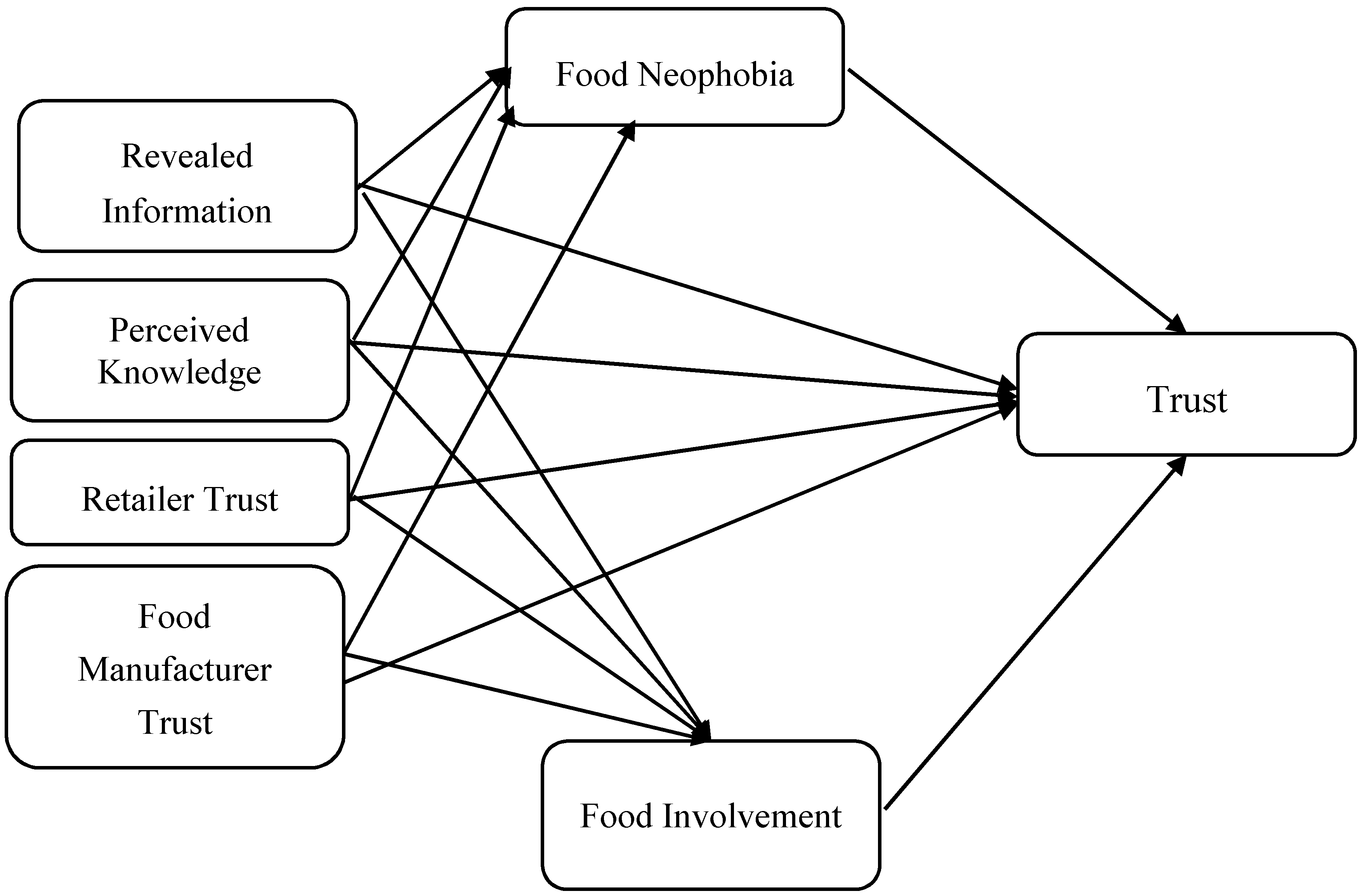
| H1 | The revealed information on the organic food label impacts positively on building trust of consumers on organic food products. | 0.21 | 0.001 | Supported |
| H2 | The perceived knowledge of consumers is positively related to trust building of consumers about organic food. | 0.16 | 0.001 | Supported |
| H3 | Retailer trust positively impact on building consumer trust in organic food products. | 0.22 | 0.001 | Supported |
| H4 | The food manufacturer trust significantly impacts on the trust building in organic food products. | 0.20 | 0.001 | Supported |
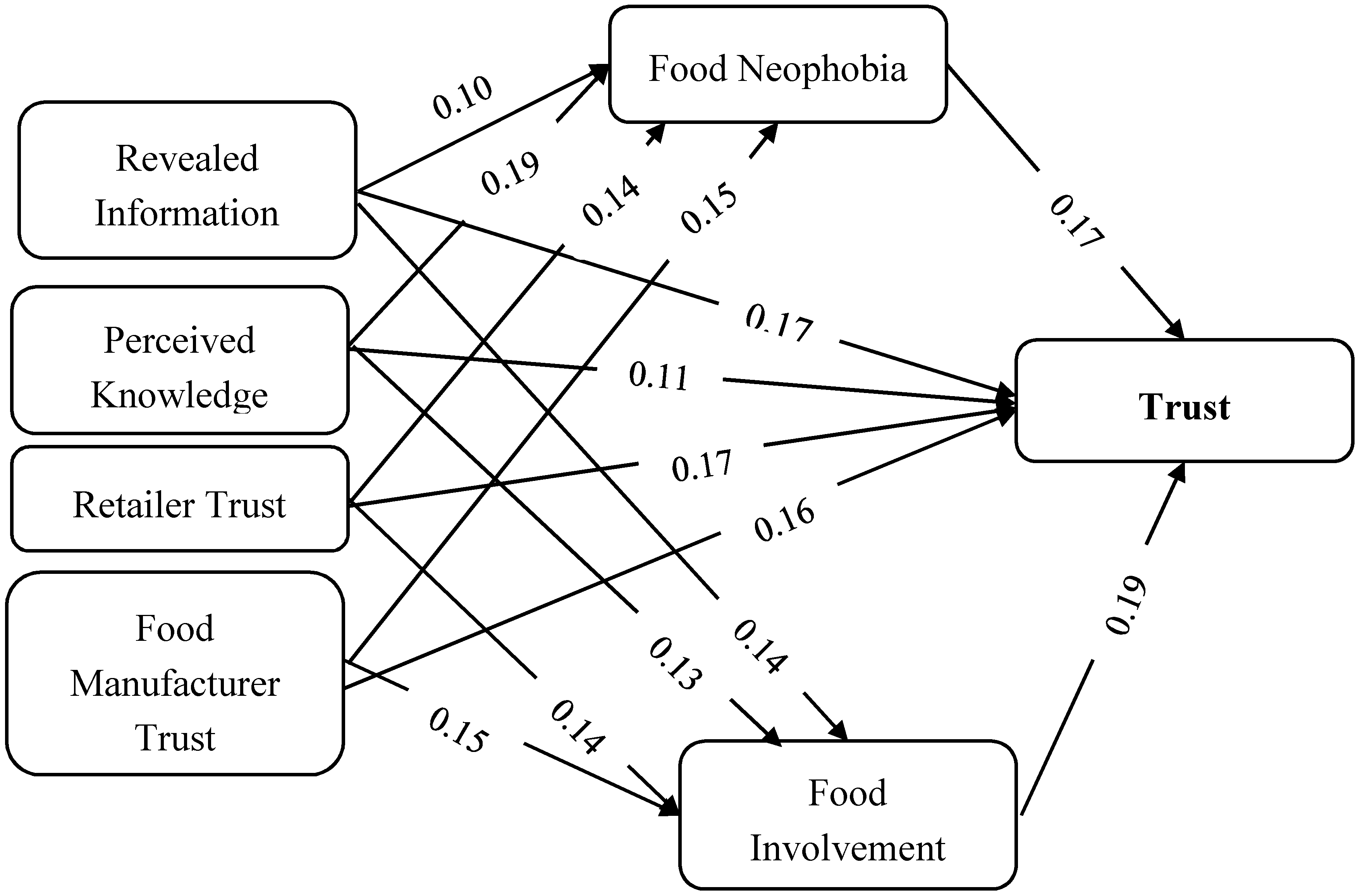
| H5, 6 | Food related personality traits partially mediate the relationship between revealed information and trust. | 0.16 | 0.001 | Supported |
| H5, 6 | Food related personality traits partially mediate the relationship between perceived knowledge and trust. | 0.10 | 0.014 | Supported |
| H5, 6 | Food related personality traits partially mediate the relationship between retailer trust and trust. | 0.17 | 0.001 | Supported |
| H5, 6 | Food related personality traits partially mediate the relationship between food manufacturer’s trust and trust. | 0.15 | 0.001 | Supported |
| Relationship | Direct without Mediator | Direct with Mediator | Indirect |
|---|---|---|---|
| Revealed Personality traits Trust | 0.21 *** | 0.16 *** | Partial Mediation |
| Perceived Personality traits Trust | 0.16 *** | 0.10 ** | Partial Mediation |
| Retailer Personality traits Trust | 0.22 *** | 0.17 *** | Partial Mediation |
| Food Manufacturer Personality traits Trust | 0.20 *** | 0.15 *** | Partial Mediation |
| Relationship | Significance Values |
|---|---|
| Revealed information → Food Neophobia → Trust | 0.035 |
| Revealed information → Food Involvement → Trust | 0.009 |
| Perceived Knowledge → Food Neophobia → Trust | 0.007 |
| Perceived Knowledge → Food Involvement → Trust | 0.10 |
| Retailer Trust → Food Neophobia → Trust | 0.003 |
| Retailer Trust → Food Involvement → Trust | 0006 |
| Food Manufacturer Trust → Food Neophobia → Trust | 0.005 |
| Food Manufacturer Trust → Food Involvement → Trust | 0.007 |
© 2018 by the authors. Licensee MDPI, Basel, Switzerland. This article is an open access article distributed under the terms and conditions of the Creative Commons Attribution (CC BY) license (http://creativecommons.org/licenses/by/4.0/).
Share and Cite
Ayyub, S.; Wang, X.; Asif, M.; Ayyub, R.M. Antecedents of Trust in Organic Foods: The Mediating Role of Food Related Personality Traits. Sustainability 2018, 10, 3597. https://doi.org/10.3390/su10103597
Ayyub S, Wang X, Asif M, Ayyub RM. Antecedents of Trust in Organic Foods: The Mediating Role of Food Related Personality Traits. Sustainability. 2018; 10(10):3597. https://doi.org/10.3390/su10103597
Chicago/Turabian StyleAyyub, Samia, Xuhui Wang, Muhammad Asif, and Rana Muhammad Ayyub. 2018. "Antecedents of Trust in Organic Foods: The Mediating Role of Food Related Personality Traits" Sustainability 10, no. 10: 3597. https://doi.org/10.3390/su10103597
APA StyleAyyub, S., Wang, X., Asif, M., & Ayyub, R. M. (2018). Antecedents of Trust in Organic Foods: The Mediating Role of Food Related Personality Traits. Sustainability, 10(10), 3597. https://doi.org/10.3390/su10103597