
Sustainable Development of Sweet Sorghum-Based Fuel Ethanol from the Perspective of Water Resources in China



 , and
, and
Abstract
:1. Introduction
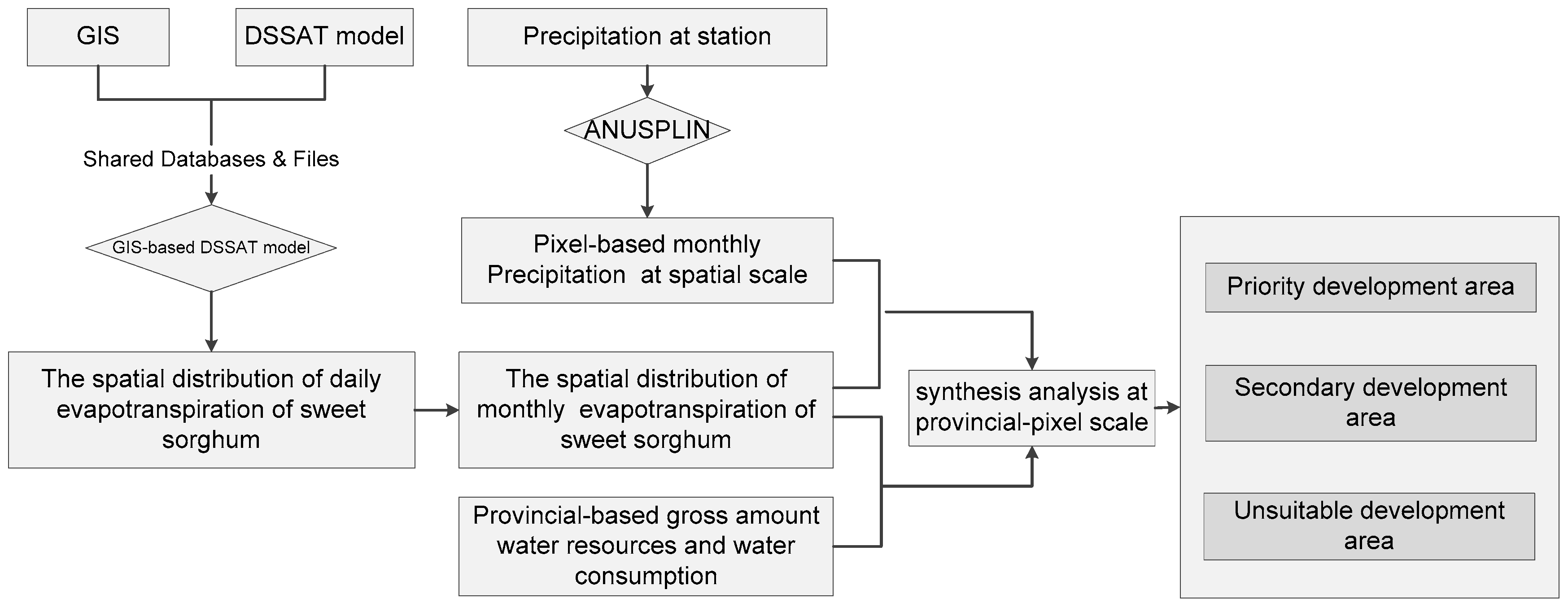
2. Materials and Methods
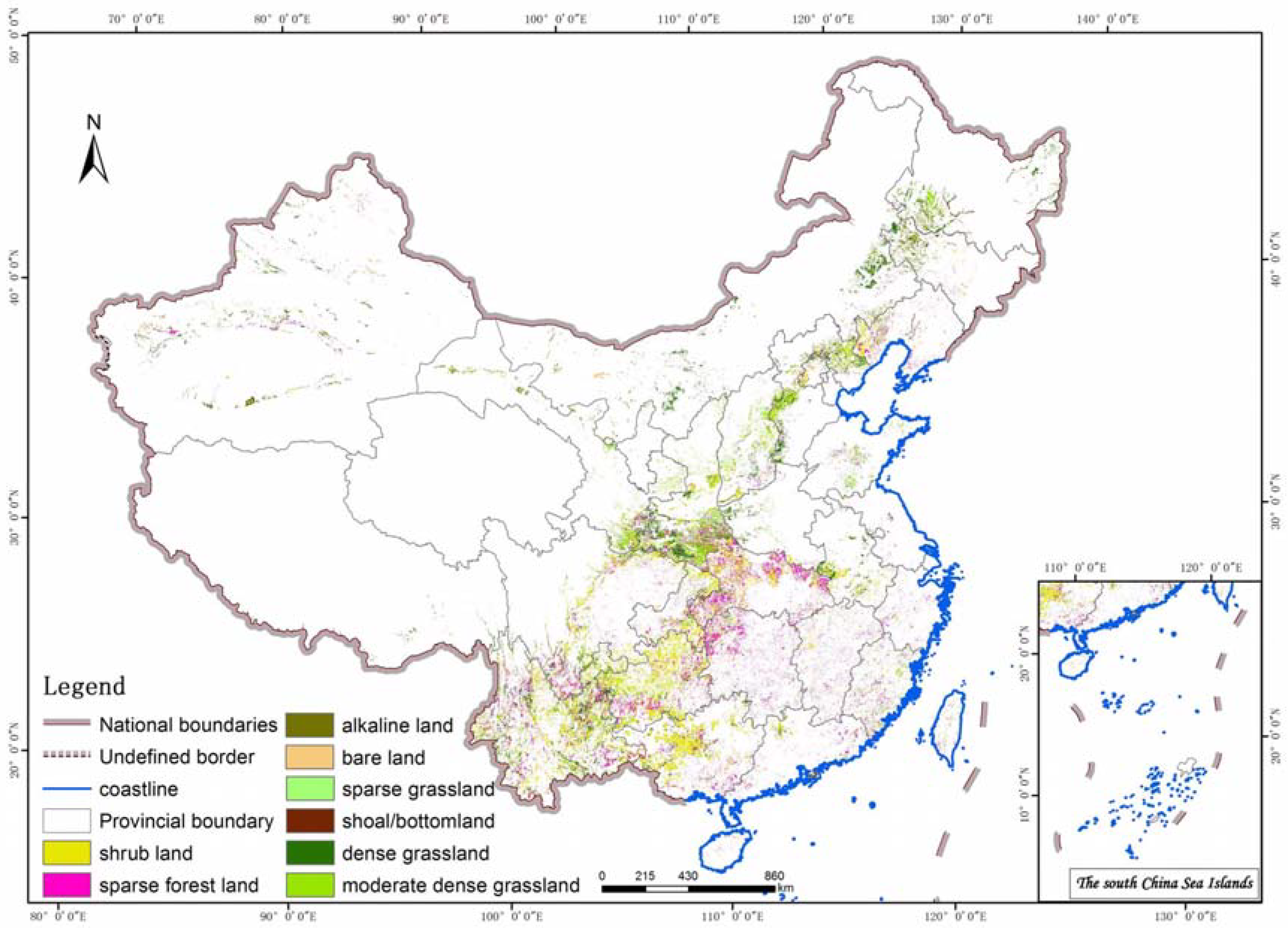
2.1. Spatial Distribution of Potential Original Marginal Land Suitable for Sweet Sorghum
2.2. Estimating Evapotranspiration (ET) with the DSSAT Model
2.3. Pixel-Based Monthly Meteorological Data with ANUSPLIN
3. Results
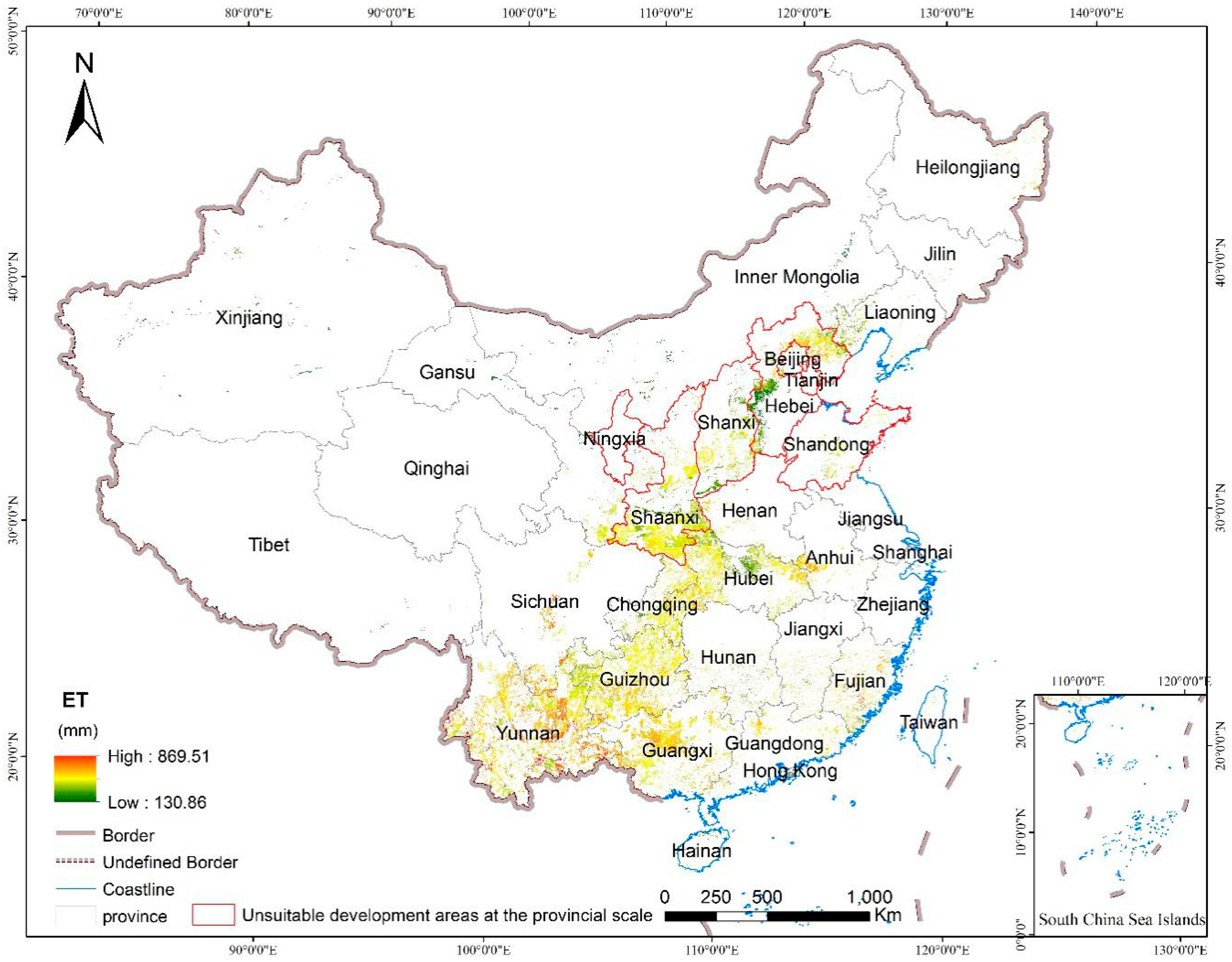
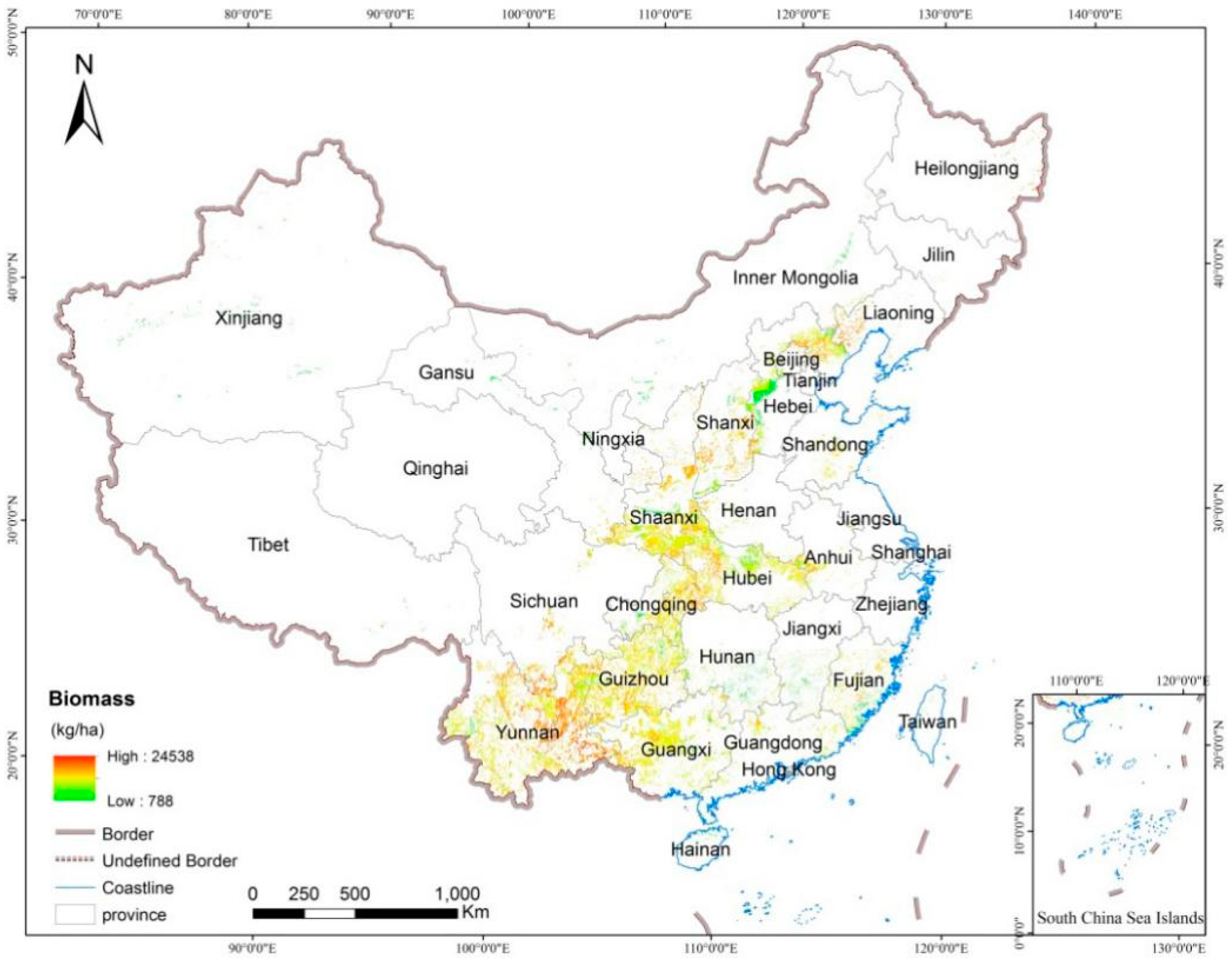
3.1. The Spatial Distribution of ET of Sweet Sorghum
3.2. The Marginal Land Suitable for Sweet Sorghum-Based Fuel Ethanol at the Provincial Scale
3.3. The Marginal Land Suitable for Sweet Sorghum-Based Fuel Ethanol at the Pixel Scale
3.4. The Marginal Land Suitable for Sweet Sorghum-Based Fuel Ethanol: Integrating Provincial and Pixel Scales
4. Discussion
4.1. Comparison with Other Studies
4.2. Possible Solution
5. Conclusions
Supplementary Materials
Author Contributions
Funding
Conflicts of Interest
References
- Edenhofer, O.; Seyboth, K.; Creutzig, F.; Schlömer, S. On the Sustainability of Renewable Energy Sources. Annu. Rev. Environ. Resour. 2013, 38, 169–200. [Google Scholar] [CrossRef]
- Deng, Y.Y.; Koper, M.; Haigh, M.; Dornburg, V. Country-level assessment of long-term global bioenergy potential. Biomass Bioenergy 2015, 74, 253–267. [Google Scholar] [CrossRef]
- Offermann, R.; Seidenberger, T.; Thrän, D.; Kaltschmitt, M.; Zinoviev, S.; Miertus, S. Assessment of global bioenergy potentials. Mitig. Adapt. Strateg. Glob. Chang. 2011, 16, 103–115. [Google Scholar] [CrossRef]
- Jinguang, H.U.; Cadham, W.J.; Dyk, S.V.; Saddler, J.N. Will biomass be used for bioenergy or transportation biofuels? What drivers will influence biomass allocation. Front. Agric. Sci. Eng. 2017, 4, 473–481. [Google Scholar]
- Coote, D.C.; Thiffault, E.; Brown, M. Chapter 9—Constraints and Success Factors for Woody Biomass Energy Systems in Two Countries with Minimal Bioenergy Sectors. In Mobilisation of Forest Bioenergy in the Boreal & Temperate Biomes; Elsevier: Amsterdam, The Netherlands, 2016; pp. 165–189. [Google Scholar]
- Scarlat, N.; Dallemand, J.F.; Monforti-Ferrario, F.; Nita, V. The role of biomass and bioenergy in a future bioeconomy: Policies and facts. Environ. Dev. 2015, 15, 3–34. [Google Scholar] [CrossRef]
- Hamza, V.M.; Gomes, A.J.L.; Ferreira, L.E.T. Status Report on Geothermal Energy Developments in Brazil. Nat. Gas 2005, 27, 10–16. [Google Scholar]
- The 13th Five-Year Plan for Renewable Energy Development; National Development and Reform Commission: Beijing, China, 2016.
- Almodares, A.; Hadi, M.R. Production of bioethanol from sweet sorghum: A review. Afr. J. Agric. Res. 2009, 4, 772–780. [Google Scholar]
- Tesso, T.T.; Claflin, L.E.; Tuinstra, M.R. Analysis of Stalk Rot Resistance and Genetic Diversity among Drought Tolerant Sorghum Genotypes. Crop Sci. 2005, 45, 645–652. [Google Scholar] [CrossRef]
- Gao, C.; Yan, Z.; Ding, Y.; Wu, Q. Application of sweet sorghum for biodiesel production by heterotrophic microalga Chlorella protothecoides. Appl. Energy 2010, 87, 756–761. [Google Scholar] [CrossRef]
- Almodares, A.; Taheri, R.; Chung, I.M.; Fathi, M. The effect of nitrogen and potassium fertilizers on growth parameters and carbohydrate contents of sweet sorghum cultivars. J. Environ. Biol. 2008, 29, 849–852. [Google Scholar] [PubMed]
- Goshadrou, A.; Karimi, K.; Taherzadeh, M.J. Bioethanol production from sweet sorghum bagasse by Mucor hiemalis. Ind. Crops Prod. 2011, 34, 1219–1225. [Google Scholar] [CrossRef]
- Zhang, C.; Xie, G.; Li, S.; Ge, L.; Qi, Y. Spatial suitability and its bio-ethanol potential of sweet sorghum in China. Acta Ecol. Sin. 2010, 30, 4765–4770. [Google Scholar]
- Beringer, T.; Lucht, W.; Schaphoff, S. Bioenergy production potential of global biomass plantations under environmental and agricultural constraints. Glob. Chang. Biol. Bioenergy 2011, 3, 299–312. [Google Scholar] [CrossRef] [Green Version]
- Jiang, D.; Zhuang, D.; Fu, J.; Huang, Y.; Wen, K. Bioenergy potential from crop residues in China: Availability and distribution. Renew. Sustain. Energy Rev. 2012, 16, 1377–1382. [Google Scholar] [CrossRef]
- Tuck, G.; Glendining, M.J.; Smith, P.; House, J.I.; Wattenbach, M. The potential distribution of bioenergy crops in Europe under present and future climate. Biomass Bioenergy 2006, 30, 183–197. [Google Scholar] [CrossRef]
- Yamamoto, H.; Fujino, J.; Yamaji, K. Evaluation of bioenergy potential with a multi-regional global-land-use-and-energy model. Biomass Bioenergy 2001, 21, 185–203. [Google Scholar] [CrossRef]
- Zhang, C.; Xie, G.; Li, S.; Ge, L.; He, T. The productive potentials of sweet sorghum ethanol in China. Appl. Energy 2010, 87, 2360–2368. [Google Scholar] [CrossRef]
- Zhuang, D.; Jiang, D.; Liu, L.; Huang, Y. Assessment of bioenergy potential on marginal land in China. Renew. Sustain. Energy Rev. 2011, 15, 1050–1056. [Google Scholar] [CrossRef]
- Dong, J.; Hao, M.; Fu, J.; Zhuang, D.; Huang, Y. Spatial-temporal variation of marginal land suitable for energy plants from 1990 to 2010 in China. Sci. Rep. 2014, 4, 5816. [Google Scholar] [CrossRef]
- Jiang, D.; Hao, M.M.; Fu, J.Y.; Huang, Y.H.; Liu, K.; Zhou, Y.; Kumar, L.; Mabee, W. Evaluating the bioenergy potential of cassava on marginal land using a biogeochemical process model in Guangxi, China. J. Appl. Remote Sens. 2015, 9, 097699. [Google Scholar] [CrossRef]
- Fu, J.; Dong, J.; Huang, Y.; Zhuang, D.; Wei, J. Evaluating the Marginal Land Resources Suitable for Developing Bioenergy in Asia. Adv. Meteorol. 2014, 2014, 45–49. [Google Scholar] [CrossRef]
- Zhang, X.; Fu, J.; Lin, G.; Jiang, D.; Yan, X. Switchgrass-Based Bioethanol Productivity and Potential Environmental Impact from Marginal Lands in China. Energies 2017, 10, 260. [Google Scholar] [CrossRef]
- Yan, X.; Jiang, D.; Fu, J.; Hao, M. Assessment of Sweet Sorghum-Based Ethanol Potential in China within the Water–Energy–Food Nexus Framework. Sustainability 2018, 10, 1046. [Google Scholar] [CrossRef]
- Jiang, D.; Hao, M.; Fu, J.; Tian, G.; Ding, F. Estimating the potential of energy saving and carbon emission mitigation of cassava-based fuel ethanol using life cycle assessment coupled with a biogeochemical process model. Int. J. Biometeorol. 2017, 1–10. [Google Scholar] [CrossRef] [PubMed]
- Hao, M.; Jiang, D.; Wang, J.; Fu, J.; Huang, Y. Could biofuel development stress China’s water resources? GCB Bioenergy 2017, 9, 1447–1460. [Google Scholar] [CrossRef]
- Yuan, Z.; Tol, R.S.J. Implications of desalination for water resources in China—An economic perspective. Desalination 2004, 164, 225–240. [Google Scholar] [CrossRef]
- Chen, H.; Ye, Z.; Gao, W. A desalination plant with solar and wind energy. In Proceedings of the IOP Conference Series: Materials Science and Engineering, Kuantan, Malaysia, 1–4 July 2013; pp. 2787–2793. [Google Scholar]
- Tian, M.H.; Ke, S.F. Virtual Water Content and Trade Analysis of Primary Woody Products in China. Int. For. Rev. 2012, 14, 380–390. [Google Scholar] [CrossRef]
- Gerbensleenes, W.; Hoekstra, A.Y.; Meer, T.H.V.D. The water footprint of bioenergy. Proc. Natl. Acad. Sci. USA 2009, 106, 10219–10223. [Google Scholar] [CrossRef] [PubMed] [Green Version]
- Su, M.H.; Huang, C.H.; Li, W.Y.; Chunto, T.; Huusheng, L.; Duic, N.; Urbaniec, K. Water footprint analysis of bioethanol energy crops in Taiwan. J. Clean. Prod. 2015, 88, 132–138. [Google Scholar] [CrossRef]
- Jones, J.W.; Hoogenboom, G.; Porter, C.H.; Boote, K.J.; Batchelor, W.D.; Hunt, L.A.; Wilkens, P.W.; Singh, U.; Gijsman, A.J.; Ritchie, J.T. DSSAT cropping system model. Eur. J. Agron. 2003, 18, 235–265. [Google Scholar] [CrossRef]
- Hoogenhoom, G.; Wilkens, P.W.; Thornton, P.K.; Jones, J.W.; Hunt, L.A. Advances in the development and application of DSSAT. J. Control. Release 1999, 117, 68–79. [Google Scholar]
- Kellyr, T.; Kendallc, D.J.; Amyl, K.; Williamd, B.; Joelo, P. Methodology for the use of DSSAT models for precision agriculture decision support. Comput. Electron. Agric. 2008, 64, 276–285. [Google Scholar] [CrossRef] [Green Version]
- Porter, C.H.; Jones, J.W.; Adiku, S.; Gijsman, A.J.; Gargiulo, O.; Naab, J.B. Modeling organic carbon and carbon-mediated soil processes in DSSAT v4.5. Oper. Res. 2010, 10, 247–278. [Google Scholar] [CrossRef]
- Zha, Y.; Xue-Ping, W.U.; Xin-Hua, H.E.; Zhang, H.M.; Gong, F.F.; Cai, D.X.; Zhu, P.; Gao, H.J. Basic Soil Productivity of Spring Maize in Black Soil Under Long-Term Fertilization Based on DSSAT Model. J. Integr. Agric. 2014, 13, 577–587. [Google Scholar] [CrossRef]
- Zhang, T.; Xie, X.; Huang, Z. Life cycle water footprints of nonfood biomass fuels in China. Environ. Sci. Technol. 2014, 48, 4137–4144. [Google Scholar] [CrossRef] [PubMed]
- Zhang, X.; Shao, J.A.; Luo, H. Spatial interpolation of air temperature with ANUSPLIN in Three Gorges Reservoir Area. In Proceedings of the International Conference on Remote Sensing, Environment and Transportation Engineering, Nanjing, China, 24–26 June 2011; pp. 3465–3468. [Google Scholar]
- Hong, Y.; Nix, H.A.; Hutchinson, M.F.; Booth, T.H. Spatial interpolation of monthly mean climate data for China. Int. J. Climatol. 2005, 25, 1369–1379. [Google Scholar] [CrossRef] [Green Version]
- Wu, W.; Tang, X.P.; Ma, X.Q.; Liu, H.B. A comparison of spatial interpolation methods for soil temperature over a complex topographical region. Theor. Appl. Climatol. 2016, 125, 657–667. [Google Scholar] [CrossRef]
- Ministry of Water Resources, the People’s Republic of China. China Water Resources Bulletin. 2016. Available online: http://www.mwr.gov.cn/sj/tjgb/szygb/ (accessed on 17 September 2018).
- Yan, L.Z.; Lin, Z.; Wang, S.Q.; Lin, H. Potential yields of bio-ethanol from energy crops and their regional distribution in China. Trans. Chin. Soc. Agric. Eng. 2008, 24, 213–216. [Google Scholar]
- Kou, J.P.; Bi, Y.Y.; Zhao, L.X.; Gao, C.Y.; Tian, Y.S.; Wei, S.Y.; Wang, Y.J. Investigation and evaluation on wasteland for energy crops in China. Renew. Energy Resour. 2008, 26, 3–9. [Google Scholar]


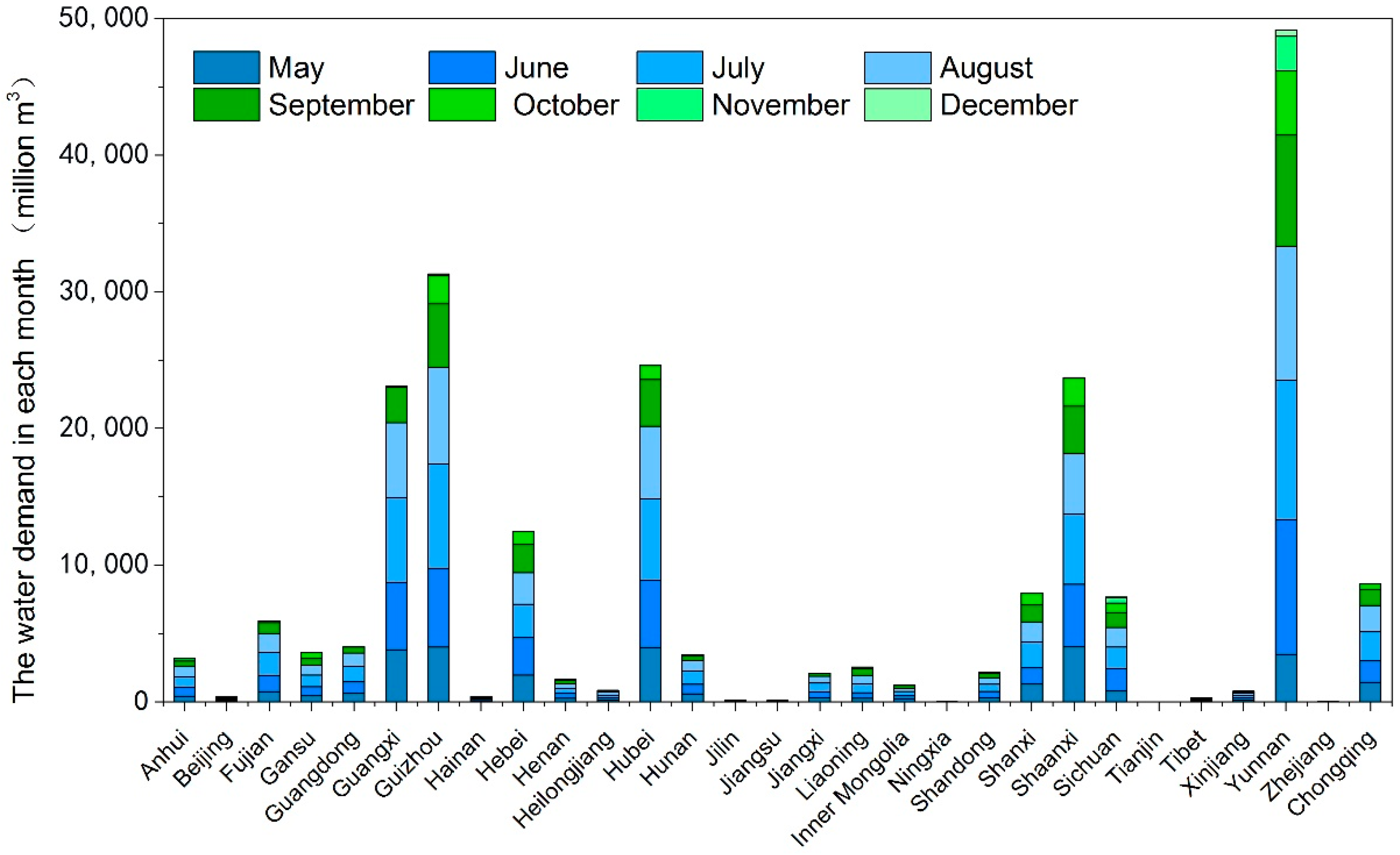


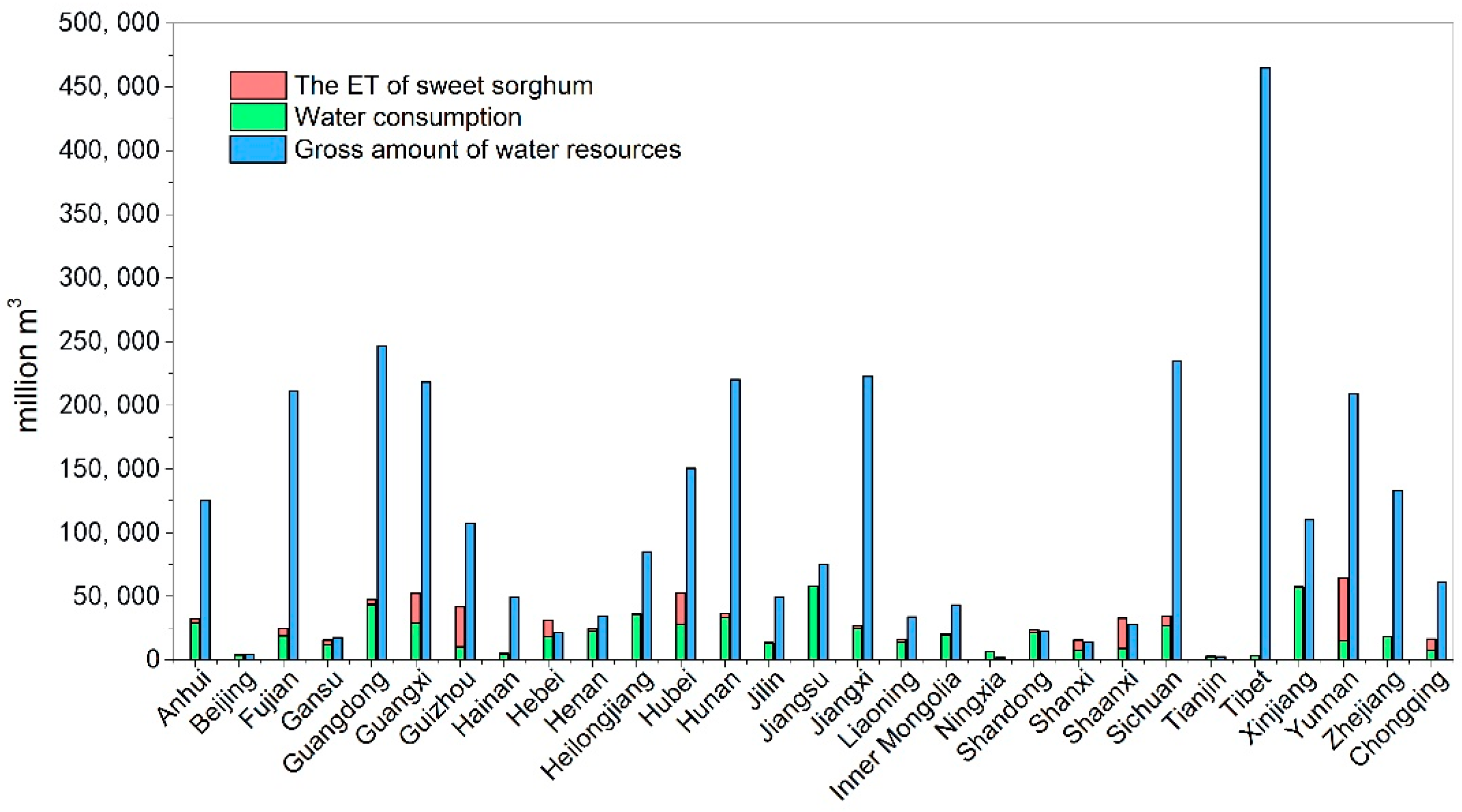
| Province | The Water Consumption of Sweet Sorghum Cultivation (million m3) | Province | The Water Consumption of Sweet Sorghum Cultivation (million m3) |
|---|---|---|---|
| Anhui | 3183 | Jiangxi | 2059 |
| Beijing | 409 | Liaoning | 2530 |
| Fujian | 5925 | Inner Mongolia | 1221 |
| Gansu | 3607 | Ningxia | 35 |
| Guangdong | 4024 | Shandong | 2207 |
| Guangxi | 23,204 | Shanxi | 8020 |
| Guizhou | 31,325 | Shaanxi | 23,777 |
| Hainan | 385 | Sichuan | 7706 |
| Hebei | 12,465 | Tianjin | 20 |
| Henan | 1601 | Tibet | 300 |
| Heilongjiang | 889 | Xinjiang | 791 |
| Hubei | 24,551 | Yunnan | 49,298 |
| Hunan | 3420 | Zhejiang | 49 |
| Jilin | 143 | Chongqing | 8690 |
| Jiangsu | 121 | Total | 221,952 |
| Province | The Biomass of Sweet Sorghum (million kg) | Province | The Biomass of Sweet Sorghum (million kg) |
|---|---|---|---|
| Anhui | 8065 | Jiangxi | 3992 |
| Beijing | 1089 | Liaoning | 9292 |
| Fujian | 13,288 | Inner Mongolia | 2246 |
| Gansu | 5570 | Ningxia | 45 |
| Guangdong | 9329 | Shandong | 6439 |
| Guangxi | 58,034 | Shanxi | 24,380 |
| Guizhou | 82,815 | Shaanxi | 64,719 |
| Hainan | 378 | Sichuan | 18,587 |
| Hebei | 31,393 | Tianjin | 59 |
| Henan | 4279 | Tibet | 828 |
| Heilongjiang | 2642 | Xinjiang | 733 |
| Hubei | 65,434 | Yunnan | 137,093 |
| Hunan | 6896 | Zhejiang | 119 |
| Jilin | 375 | Chongqing | 2157 |
| Jiangsu | 325 | Total | 580,018 |
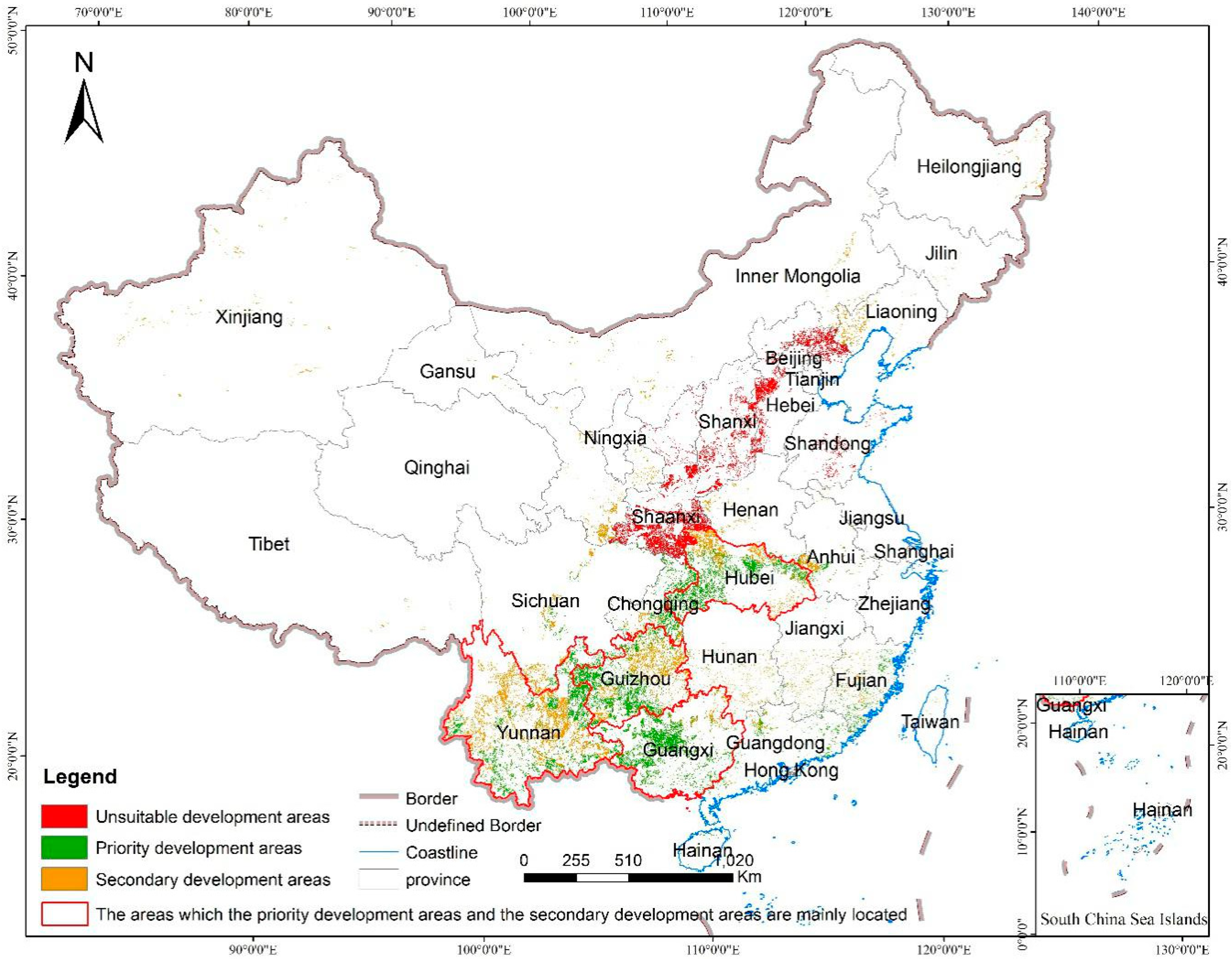
| Province | Priority Development Area (km2) | Secondary Development Area (km2) | Unsuitable Development Area (km2) |
|---|---|---|---|
| Anhui | 2302 | 3170 | 0 |
| Beijing | 0 | 0 | 814 |
| Fujian | 6592 | 3801 | 0 |
| Gansu | 161 | 7428 | 0 |
| Guangdong | 5489 | 1531 | 0 |
| Guangxi | 35,971 | 3793 | 0 |
| Guizhou | 32,776 | 22,881 | 0 |
| Hainan | 825 | 40 | 0 |
| Hebei | 0 | 0 | 25,152 |
| Henan | 425 | 2558 | 0 |
| Heilongjiang | 0 | 1526 | 0 |
| Hubei | 29,948 | 15,566 | 0 |
| Hunan | 1296 | 5473 | 0 |
| Jilin | 5 | 279 | 0 |
| Jiangsu | 76 | 192 | 0 |
| Jiangxi | 716 | 3262 | 0 |
| Liaoning | 2 | 5228 | 0 |
| Inner Mongolia | 0 | 3493 | 0 |
| Ningxia | 0 | 0 | 102 |
| Shandong | 0 | 0 | 4218 |
| Shanxi | 0 | 0 | 15,898 |
| Shaanxi | 0 | 0 | 44,941 |
| Sichuan | 4215 | 8566 | 0 |
| Tianjin | 0 | 0 | 34 |
| Tibet | 2 | 424 | 0 |
| Xinjiang | 0 | 3164 | 0 |
| Yunnan | 36,075 | 46,694 | 0 |
| Zhejiang | 64 | 18 | 0 |
| Chongqing | 12,679 | 3091 | 0 |
| Sum | 169,619 | 142,178 | 91,159 |
© 2018 by the authors. Licensee MDPI, Basel, Switzerland. This article is an open access article distributed under the terms and conditions of the Creative Commons Attribution (CC BY) license (http://creativecommons.org/licenses/by/4.0/).
Share and Cite
Hao, M.; Fu, J.; Jiang, D.; Yan, X.; Chen, S.; Ding, F. Sustainable Development of Sweet Sorghum-Based Fuel Ethanol from the Perspective of Water Resources in China. Sustainability 2018, 10, 3428. https://doi.org/10.3390/su10103428
Hao M, Fu J, Jiang D, Yan X, Chen S, Ding F. Sustainable Development of Sweet Sorghum-Based Fuel Ethanol from the Perspective of Water Resources in China. Sustainability. 2018; 10(10):3428. https://doi.org/10.3390/su10103428
Chicago/Turabian StyleHao, Mengmeng, Jingying Fu, Dong Jiang, Xiaoxi Yan, Shuai Chen, and Fangyu Ding. 2018. "Sustainable Development of Sweet Sorghum-Based Fuel Ethanol from the Perspective of Water Resources in China" Sustainability 10, no. 10: 3428. https://doi.org/10.3390/su10103428
APA StyleHao, M., Fu, J., Jiang, D., Yan, X., Chen, S., & Ding, F. (2018). Sustainable Development of Sweet Sorghum-Based Fuel Ethanol from the Perspective of Water Resources in China. Sustainability, 10(10), 3428. https://doi.org/10.3390/su10103428