
Trends in Comorbidity for Patients with Venous Thromboembolism in a General Hospital: 2018 to 2022
 ,
,
Abstract
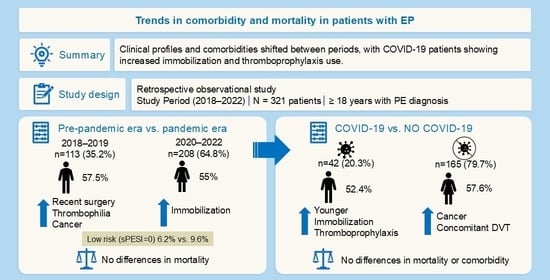
1. Introduction
2. Materials and Methods
3. Results
3.1. Study Population
3.2. Comorbidities and Survival
3.3. Sociodemographic and Clinical Characteristics, Risk Factors, Comorbidities, and Survival During the 2020–2022 Period
4. Discussion
5. Conclusions
Author Contributions
Funding
Institutional Review Board Statement
Informed Consent Statement
Data Availability Statement
Acknowledgments
Conflicts of Interest
Abbreviations
| VTE | venous thromboembolism |
| PE | pulmonary embolism |
| DVT | deep vein thrombosis |
| CTPA | computed tomography pulmonary angiography |
| ESC | European Society of Cardiology |
| PESI | Pulmonary Embolism Severity Index |
| sPESI | simplified Pulmonary Embolism Severity Index |
| SEIMC | Sociedad Española de Enfermedades Infecciosas y Microbiología Clínica (Spanish Society of Infectious Diseases and Clinical Microbiology) |
| RT-PCR | reverse transcription polymerase chain reaction |
| SD | standard derivation |
| CI | confidence interval |
| COPD | chronic obstructive pulmonary disease |
| OSA | obstructive sleep apnea |
| DM | diabetes mellitus |
| TOD | target organ damage |
| SAD | systemic autoimmune disease |
| CKD | chronic kidney disease |
| mMRC | modified Medical Research Council |
References
- de Miguel-Diez, J.; Albaladejo-Vicente, R.; Lopez-De-Andres, A.; Hernández-Barrera, V.; Jiménez, D.; Monreal, M.; Carabantes-Alarcon, D.; Zamorano-Leon, J.J.; Jimenez-Garcia, R. Changing trends in hospital admissions for pulmonary embolism in Spain from 2001 to 2018. J. Clin. Med. 2020, 9, 3221. [Google Scholar] [CrossRef]
- Jiménez, D.; De Miguel-Díez, J.; Guijarro, R.; Trujillo-Santos, J.; Otero, R.; Barba, R.; Muriel, A.; Meyer, G.; Yusen, R.D.; Monreal, M. Trends in the Management and Outcomes of Acute Pulmonary Embolism Analysis from the RIETE Registry. J. Am. Coll. Cardiol. 2016, 67, 162–170. [Google Scholar] [CrossRef]
- Chwan Ng, A.C.; Chung, T.; Yong, A.S.C.; Wong, H.S.P.; Celermajer, D.S.; Kritharides, L. Long-term cardiovascular and noncardiovascular mortality of 1023 patients with confirmed acute pulmonary embolism. Circ. Cardiovasc. Qual. Outcomes 2011, 4, 122–128. [Google Scholar] [CrossRef] [PubMed]
- Lee, J.W.; Cha, S.I.; Jung, C.Y.; Choi WIl Jeon, K.N.; Yoo, S.S.; Kim, C.-H.; Park, J.-Y.; Jung, T.-H. Clinical course of pulmonary embolism in lung cancer patients. Respiration 2009, 78, 42–48. [Google Scholar] [CrossRef] [PubMed]
- Stein, P.D.; Matta, F.; Alrifai, A.; Rahman, A. Trends in case fatality rate in pulmonary embolism according to stability and treatment. Thromb. Res. 2012, 130, 841–846. [Google Scholar] [CrossRef]
- Ng, A.C.C.; Chow, V.; Yong, A.S.C.; Chung, T.; Kritharides, L. Prognostic impact of the charlson comorbidity index on mortality following acute pulmonary embolism. Respiration 2013, 85, 408–416. [Google Scholar] [CrossRef]
- Golpe, R.; Pérez-De-Llano, L.A.; Castro-Añón, O. Prognostic value of the charlson comorbidity index in pulmonary embolism. Respiration 2013, 85, 438. [Google Scholar] [CrossRef]
- Polo Friz, H.; Orenti, A.; Gelfi, E.; Motto, E.; Primitz, L.; d’Oro, L.C.; Giannattasio, C.; Vighi, G.; Cimminiello, C.; Boracchi, P. Predictors of medium- and long-term mortality in elderly patients with acute pulmonary embolism. Heliyon 2020, 6, e04857. [Google Scholar] [CrossRef] [PubMed]
- Konstantinides, S.V.; Meyer, G.; Becattini, C.; Bueno, H.; Geersing, G.J.; Harjola, V.-P.; Huisman, M.V.; Humbert, M.; Jennings, C.S.; Jiménez, D.; et al. 2019 ESC Guidelines for the diagnosis and management of acute pulmonary embolism developed in collaboration with the European Respiratory Society (ERS): The Task Force for the diagnosis and management of acute pul-monary embolism of the. Eur. Heart J. 2020, 41, 543–603. [Google Scholar] [CrossRef]
- Uresandi, F.; Monreal, M.; García-Bragado, F.; Domenech, P.; Lecumberri, R.; Escribano, P.; Zamorano, J.L.; Jiménez, S.; Ruiz-Artacho, P.; Lozano, F.; et al. National consensus on the diagnosis, risk stratification and treatment of patients with pulmonary embolism. Arch. Bronconeumol. 2013, 49, 534–547. [Google Scholar] [CrossRef]
- Berenguer, J.; Borobia, A.M.; Ryan, P.; Rodríguez-Baño, J.; Bellón, J.M.; Jarrín, I.; Carratalà, J.; Pachón, J.; Carcas, A.J.; Yllescas, M.; et al. Development and validation of a prediction model for 30-day mortality in hospitalised patients with COVID-19: The COVID-19 SEIMC score. Thorax 2021, 76, 920–929. [Google Scholar] [CrossRef] [PubMed]
- Jiménez, D.; García-Sanchez, A.; Rali, P.; Muriel, A.; Bikdeli, B.; Ruiz-Artacho, P.; Le Mao, R.; Rodríguez, C.; Hunt, B.J.; Monreal, M. Incidence of VTE and Bleeding Among Hospitalized Patients With Coronavirus Disease 2019: A Systematic Review and Meta-analysis. Chest 2021, 159, 1182–1196. [Google Scholar] [CrossRef]
- Burn, E.; Duarte-Salles, T.; Fernandez-Bertolin, S.; Reyes, C.; Kostka, K.; Delmestri, A.; Rijnbeek, P.; Verhamme, K.; Prieto-Alhambra, D. Venous or arterial thrombosis and deaths among COVID-19 cases: A European network cohort study. Lancet Infect. Dis. 2022, 22, 1142–1152. [Google Scholar] [CrossRef]
- Tudoran, C.; Velimirovici, D.E.; Berceanu-Vaduva, D.M.; Rada, M.; Voiţă-Mekeres, F.; Tudoran, M. Increased Susceptibility for Thromboembolic Events versus High Bleeding Risk Associated with COVID-19. Microorganisms 2022, 10, 1738. [Google Scholar] [CrossRef]
- Connors, J.M.; Levy, J.H. COVID-19 and its implications for thrombosis and anticoagulation. Blood 2020, 135, 2033–2040. [Google Scholar] [CrossRef] [PubMed]
- Alonso-Beato, R.; Demelo-Rodríguez, P.; Ordieres-Ortega, L.; López-Rubio, M.; Lago-Rodríguez, M.O.; Oblitas, C.M.; Walther, L.A.A.-S.; Galeano-Valle, F. Short and long-term outcomes of COVID-19–associated venous thromboembolism: A propensity score–matched cohort study. Intern Emerg. Med. 2025, 20, 1835–1846. [Google Scholar] [CrossRef]
- Cui, L.Y.; Cheng, W.W.; Mou, Z.W.; Xiao, D.; Li, Y.Y.; Li, Y.J.; Li, W.T.; Chen, Z.M. Risk factors for pulmonary embolism in patients with COVID-19: A systemic review and meta-analysis. Int. J. Infect. Dis. 2021, 111, 154–163. [Google Scholar] [CrossRef]
- Suh, Y.J.; Hong, H.; Ohana, M.; Bompard, F.; Revel, M.P.; Valle, C.; Gervaise, A.; Poissy, J.; Susen, S.; Hékimian, G.; et al. Pulmonary Embolism and Deep Vein Thrombosis in COVID-19: A Systematic Review and Meta-Analysis. Radiology 2021, 298, E70–E80. [Google Scholar] [CrossRef] [PubMed]
- Demelo-Rodriguez, P.; Farfán-Sedano, A.I.; Pedrajas, J.M.; Llamas, P.; Sigüenza, P.; Jaras, M.J.; Quintana-Diaz, M.; Fernández-Capitán, C.; Bikdeli, B.; Jiménez, D.; et al. Bleeding risk in hospitalized patients with COVID-19 receiving intermediate- or therapeutic doses of thromboprophylaxis. J. Thromb. Haemost. 2021, 19, 1981–1989. [Google Scholar] [CrossRef] [PubMed]



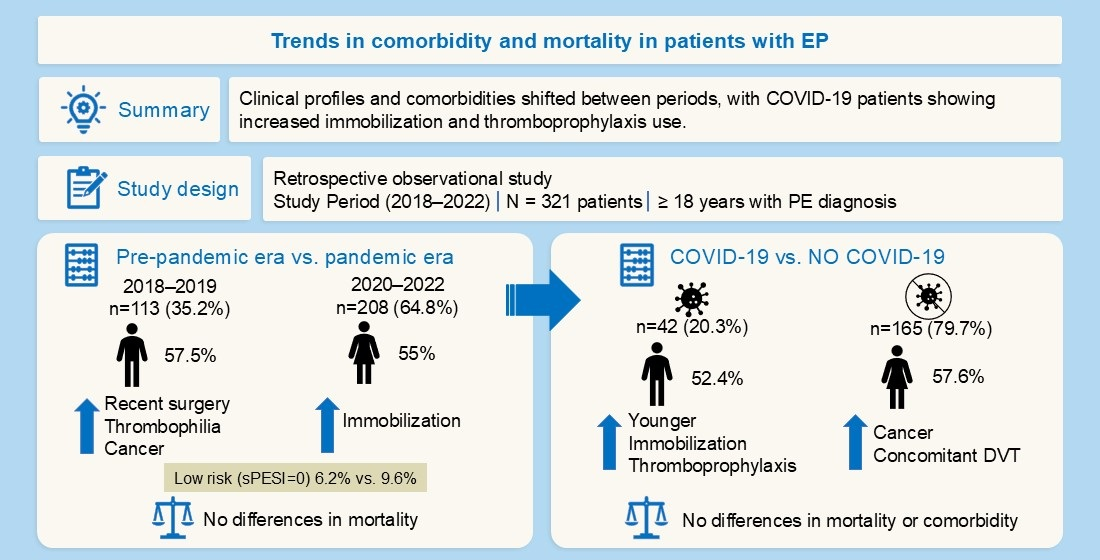
| 2018–2019 n (%) 113 (35.2) | 2020–2022 n (%) 208 (64.8) | Total n = 321 | p | ||
|---|---|---|---|---|---|
| Age (years), mean (SD) | 73.8 (±13.4) | 72.3 (±15.8) | 76 (±15.8) | 0.3 | |
| Sex, n (%) | |||||
| Male | 65 (57.5) | 93 (44.7) | 158 (49.2) | 0.02 * | |
| Female | 48 (42.5) | 115 (55.3) | 163 (50.8) | ||
| Age < 70 years | 32 (28.3) | 77 (37) | 109 (34) | 0.1 * | |
| Smoking status, n (%) | |||||
| Never smoker | 71 (63.4) | 139 (67.1) | 210 (65.8) | 0.4 * | |
| Former smoker | 28 (25) | 40 (19.3) | 68 (21.3) | ||
| Current smoker | 13 (12.9) | 28 (13.5) | 41 (12.9) | ||
| Oral contraceptive use, n (%) | 3 (2.7) | 5 (2.4) | 8 (2.5) | 1 ** | |
| Sedentary occupation, n (%) | 20 (17.8) | 21 (10.1) | 41 (12.8) | 0.05 * | |
| Cancer history, n (%) | 39 (34.5) | 59 (28.5) | 98 (30.6) | 0.3 * | |
| In remission | 11 (32.4) | 18 (32.1) | 29 (32.2) | 0.4 * | |
| Localized | 9 (26.5) | 9 (16.1) | 18 (20) | ||
| Advanced | 14 (41.2) | 29 (51.8) | 43 (47.8) | ||
| Hormone therapy, n (%) | 7 (6.2) | 8 (3.9) | 15 (4.7) | 0.3 * | |
| Tumor surgery, n (%) | 17 (15) | 27 (13) | 44 (13.8) | 0.6 * | |
| Chemotherapy, n (%) | 21 (18.6) | 28 (13.5) | 49 (15.3) | 0.2 * | |
| Radiotherapy, n (%) | 18 (15.9) | 12 (5.8) | 30 (9.4) | 0.003 * | |
| Immunotherapy, n (%) | 3 (1.7) | 3 (1.4) | 6 (1.9) | 0.6 ** | |
| Thrombophilia, n (%) | 16 (14.5) | 12 (5.8) | 28 (8.8) | 0.009 * | |
| Recent surgery, n (%) | 20 (17.9) | 18 (8.6) | 38 (11.8) | 0.02 ** | |
| Major orthopedic surgery | 2 (1.8) | 9 (4.3) | 11 (3.4) | ||
| Abdominal surgery | 13 (11.6) | 8 (3.8) | 21 (6.6) | ||
| Thoracic surgery | 2 (1.8) | 0 | 2 (0.6) | ||
| Intracranial surgery | 0 | 1 (0.5) | 1 (0.3) | ||
| Other | 3 (2.7) | 0 | 3 (0.9) | ||
| Long-distance travel, n (%) | 3 (2.7) | 2 (1) | 5 (1.6) | 0.3 ** | |
| Family history of PE, n (%) | 1 (4.4) | 9 (4.3) | 14 (4.4) | 1 ** | |
| Previous VTE, n (%) | 22 (19.5) | 31 (15) | 53 (16.6) | 0.3 * | |
| Prolonged immobility, n (%) | 17 (15.2) | 62 (30) | 79 (24.8) | 0.004 * | |
| 2018–2019 n (%) 113 (35.2) | 2020–2022 n (%) 208 (64.8) | Total 321 | p | ||
|---|---|---|---|---|---|
| Syncope, n (%) | 19 (16.8) | 24 (11.6) | 43 (13.4) | 0.1 * | |
| Chest pain, n (%) | 43 (38.1) | 52 (25.1) | 95 (29.7) | 0.01 * | |
| Hemoptysis, n (%) | 3 (2.7) | 2 (1) | 5 (1.6) | 0.2 ** | |
| Acute heart failure, n (%) | 14 (12.4) | 10 (4.9) | 24 (7.5) | 0.01 * | |
| Hemodynamic instability, n (%) | 17 (15) | 18 (8.7) | 35 (10.9) | 0.07 * | |
| Dyspnea (mMRC ≥ 3), n (%) | 83 (73.2) | 135 (65.2) | 218 (67.9) | 0.2 * | |
| Incidental PE, n (%) | 15 (13.4) | 15 (7.2) | 30 (9.4) | 0.07 * | |
| Concomitant DVT, n (%) | 55 (49.1) | 87 (42) | 142 (44.5) | 0.2 * | |
| Recurrent PE, n (%) | 14 (12.4) | 19 (9.2) | 33 (10.3) | 0.4 * | |
| Thromboprophylaxis, n (%) | 3 (2.7) | 35 (16.9) | 38 (11.9) | <0.001 ** | |
| Bleeding, n (%) | |||||
| Gastrointestinal | 4 (3.5) | 4 (1.9) | 8 (2.5) | 0.1 ** | |
| Urological | 1 (2.7) | 1 (0.5) | 4 (1.3) | ||
| Intracranial | 4 (3.5) | 3 (1.4) | 7 (2.2) | ||
| Hematoma | 7 (6.2) | 4 (1.9) | 11 (3.4) | ||
| PESI, n (%) | |||||
| 1 | 5 (4.5) | 21 (10.1) | 25 (8.1) | 0.3 * | |
| 2 | 15 (13.4) | 33 (15.9) | 48 (15) | ||
| 3 | 24 (21.4) | 48 (23.1) | 72 (22.5) | ||
| 4 | 26 (23.2) | 37 (17.8) | 63 (19.7) | ||
| 5 | 42 (37.5) | 68 (32.7) | 110 (34.4) | ||
| sPESI | |||||
| 0 | 7 (6.2) | 20 (9.6) | 24 (8.4) | 0.003 ** | |
| 1 | 20 (17.7) | 68 (32.7) | 88 (27.4) | ||
| 2 | 52 (46) | 58 (27.9) | 110 (34.3) | ||
| 3 | 28 (23) | 40 (19.2) | 66 (20.6) | ||
| 4 | 6 (5.3) | 21 (10.1) | 27 (8.4) | ||
| 5 | 2 (1.8) | 1 (0.5) | 3 (0.9) | ||
| 2018–2019 n (%) 113 (35.2) | 2020–2022 n (%) 208 (64.8) | Total 321 | p | ||
|---|---|---|---|---|---|
| COVID-19 pneumonia, n (%) | 0 | 42 (20.3) | 42 (13.1) | <0.001 ** | |
| COPD, n (%) | 15 (13.3) | 29 (14) | 44 (13.8) | 0.8 * | |
| Asthma, n (%) | 1 (0.9) | 15 (7.2) | 16 (5) | 0.01 ** | |
| Pulmonary fibrosis, n (%) | 2 (1.8) | 4 (1.9) | 6 (1.9) | 0.9 ** | |
| OSA, n (%) | 15 (13.3) | 31 (15) | 46 (14.4) | 0.6 * | |
| Gastroesophageal Reflux Disease, n (%) | 9 (8) | 13 (22) | 22 (6.9) | 0.5 * | |
| Peripheral artery disease, n (%) | 4 (3.9) | 5 (2.4) | 9 (2.8) | 0.5 ** | |
| Pulmonary hypertension, n (%) | 18 (15.9) | 31 (15) | 49 (15.3) | 0.8 * | |
| Dyslipidemia, n (%) | 46 (40.7) | 88 (42.5) | 134 (41.9) | 0.7 * | |
| Hypertension, n (%) | 72 (63.7) | 127 (61.4) | 199 (62.2) | 0.6 * | |
| DM, n (%) | 27 (23.9) | 50 (24.2) | 77 (24.1) | 0.9 * | |
| DM with TOD, n (%) | 2 (1.8) | 4 (1.9) | 6 (1.9) | 0.9 ** | |
| Hemiplegia, n (%) | 3 (2.7) | 3 (1.4) | 6 (1.9) | 0.4 ** | |
| Ischemic heart disease, n (%) | 10 (8.8) | 15 (7.2) | 25 (7.8) | 0.6 * | |
| SAD, n (%) | 0 | 8 (3.9) | 8 (2.5) | 0.03 ** | |
| Peptic ulcer disease, n (%) | 2 (1.8) | 6 (2.9) | 8 (2.5) | 0.5 ** | |
| Dementia, n (%) | 21 (18.6) | 22 (10.6) | 43 (13.4) | 0.04 * | |
| Stroke, n (%) | 6 (5.3) | 12 85.8) | 18 (5.6) | 0.8 * | |
| Moderate-to-severe CKD, n (%) | 7 (6.2) | 18 (8.7) | 25 (7.8) | 0.4 * | |
| Mild liver disease, n (%) | 5 (4.4) | 6 (2.9) | 11 (3.4) | 0.4 * | |
| Moderate-to-severe liver disease, n (%) | 2 (1.8) | 6 (2.9) | 8 (2.5) | 0.5 ** | |
| Obesity, n (%) | 23 (20.4) | 33 (15.9) | 56 (17.5) | 0.3 * | |
| Severe mental illness | 5 (4.4) | 18 (8.7) | 23 (7.2) | 0.1 * | |
| Schizophrenia, n (%) | 2 (1.8) | 1 (0.5) | 3 (0.9) | 0.8 ** | |
| Bipolar disorder, n (%) | 2 (1.8) | 4 (1.9) | 6 (1.9) | ||
| Major depression, n (%) | 1 (0.9) | 9 (4.3) | 10 (3.1) | ||
| Intellectual disability, n (%) | 0 | 4 (1.9) | 4 (1.3) | ||
| Active infection, n (%) | 13 (11.5) | 48 (23.2) | 61 (19.1) | 0.01 * | |
| COVID-19 n (%) 42 (20.3) | No COVID-19 n (%) 165 (79.7) | p | ||
|---|---|---|---|---|
| Age (years), mean (SD) | 71.3 (±16.1) | 72.4 (±15.7) | 0.3 | |
| Sex, n (%) | ||||
| Male | 22 (52.4) | 70 (42.4) | 0.2 * | |
| Female | 20 (47.6) | 95 (57.6) | ||
| Age < 70 years | 21 (50) | 56 (33.9) | 0.05 * | |
| Smoking status, n (%) | ||||
| Never smoker | 32 (76.2) | 107 (64.8) | 0.3 ** | |
| Former smoker | 6 (14.3) | 34 (20.6) | ||
| Current smoker | 3 (9.5) | 24 (14.5) | ||
| Oral contraceptive use, n (%) | 0 | 5 (3) | 0.3 ** | |
| Sedentary occupation, n (%) | 5 (11.9) | 15 (9.1) | 0.5 * | |
| Cancer history, n (%) | 2 (4.8) | 57 (34.5) | <0.001 ** | |
| In remission | 1 (50) | 17 (31.5) | 0.7 ** | |
| Localized | 0 | 9 (16.1) | ||
| Advanced | 1 (50) | 28 (51.9) | ||
| Hormone therapy, n (%) | 0 | 8 (4.8) | 0.1 ** | |
| Tumor surgery, n (%) | 2 (4.8) | 25 (15.2) | 0.07 ** | |
| Chemotherapy, n (%) | 1 (2.4) | 27 (16.4) | 0.01 ** | |
| Radiotherapy, n (%) | 0 | 12 (7.3) | 0.07 ** | |
| Immunotherapy, n (%) | 0 | 3 (1.8) | 0.5 ** | |
| Thrombophilia, n (%) | 1 (2.4) | 11 (6.7) | 0.4 ** | |
| Recent surgery, n (%) | 0 | 18 (10.9) | 0.1 ** | |
| Major orthopedic surgery | 0 | 9 (5.5) | 0.1 ** | |
| Abdominal surgery | 0 | 8 (3.9) | ||
| Thoracic surgery | 0 | 0 | ||
| Intracranial surgery | 0 | 1 (0.5) | ||
| Other | 0 | 0 | ||
| Long-distance travel, n (%) | 0 | 2 (1.2) | 0.9 ** | |
| Family history of PE, n (%) | 1 (2.4) | 8 (4.8) | 0.6 ** | |
| Previous VTE, n (%) | 3 (7.1) | 28 (17.1) | 0.1 ** | |
| Prolonged immobility, n (%) | 32 (76.2) | 30 (18.2) | <0.001 * | |
| COVID-19 n (%) 42 (20.3) | No COVID-19 n (%) 165 (79.7) | p | |
|---|---|---|---|
| Syncope, n (%) | 2 (4.8) | 22 (13.3) | 0.1 ** |
| Chest pain, n (%) | 7 (16.7) | 45 (27.3) | 1 * |
| Hemoptysis, n (%) | 0 | 2 (1.2) | 0.6 ** |
| Acute heart failure, n (%) | 1 (2.4) | 9 (5.5) | 0.6 ** |
| Hemodynamic instability, n (%) | 5 (11.9) | 13 (7.9) | 0.3 * |
| Dyspnea (mMRC ≥ 3), n (%) | 35 (83.4) | 100 (60.6) | 0.004 * |
| Incidental PE, n (%) | 2 (4.8) | 13 (7.9) | 0.7 ** |
| Concomitant DVT, n (%) | 8 (19) | 79 (48.3) | 0.001 * |
| Recurrent PE, n (%) | 1 (2.4) | 18 (10.9) | 0.1 ** |
| Thromboprophylaxis, n (%) | 31 (73.8) | 4 (2.4) | 0.001 ** |
| Bleeding, n (%) | |||
| Gastrointestinal | 1 (2.4) | 3 (1.8) | 0.6 ** |
| Urological | 0 | 1 (0.6) | |
| Intracranial | 1 (2.4) | 2 (1.2) | |
| Hematoma | 2 (2.8) | 2 (1.2) | |
| sPESI | |||
| Low risk (sPESI = 0) | 1 (2.4) | 19 (11.5) | 0.07 ** |
| High risk (sPESI ≥ 1) | 41 (97.6) | 146 (88.5) | |
| COVID-19 n (%) 42 (20.3) | No COVID-19 n (%) 165 (79.7) | p | ||
|---|---|---|---|---|
| COVID-19 pneumonia, n (%) | 6 (14.3) | 23 (13.9) | 0.9 * | |
| COPD, n (%) | 3 (7.1) | 12 (7.3) | 0.9 ** | |
| Asthma, n (%) | 2 (4.8) | 2 (1.2) | 0.1 ** | |
| Pulmonary fibrosis, n (%) | 1 (2.4) | 12 (7.3) | 0.4 ** | |
| OSA, n (%) | 0 | 5 (3) | 0.2 ** | |
| Gastroesophageal Reflux Disease, n (%) | 3 (7.1) | 28 (17) | 0.1 ** | |
| Peripheral artery disease, n (%) | 20 (47.6) | 68 (41.2) | 0.4 * | |
| Pulmonary hypertension, n (%) | 23 (54.8) | 104 (63) | 0.3 * | |
| Dyslipidemia, n (%) | 14 (33.3) | 36 (21.8) | 0.1 * | |
| Hypertension, n (%) | 0 | 4 (2.4) | 0.5 ** | |
| DM, n (%) | 0 | 3 (1.8) | 0.9 ** | |
| DM with TOD, n (%) | 5 (11.9) | 10 (6.1) | 0.1* | |
| Hemiplegia, n (%) | 6 (14.3) | 19 (11.5) | 0.6 * | |
| Ischemic heart disease, n (%) | 2 (4.8) | 6 (3.6) | 0.6 ** | |
| SAD, n (%) | 1 (2.4) | 5 (3) | 0.6 ** | |
| Peptic ulcer disease, n (%) | 3 (7.1) | 19 (11.5) | 0.4 ** | |
| Dementia, n (%) | 0 | 12 (7.3) | 0.1 ** | |
| Stroke, n (%) | 3 (7.1) | 15 (9.1) | 0.4 ** | |
| Moderate-to-severe CKD, n (%) | 1 (2.4) | 5 (3) | 0.6 ** | |
| Mild liver disease, n (%) | 0 | 6 (3.6) | 0.3 ** | |
| Moderate-to-severe liver disease, n (%) | 7 (16.7) | 26 (15.8) | 0.8 * | |
| Obesity, n (%) | 3 (7.1) | 15 (9.1) | 0.6 ** | |
| Schizophrenia, n (%) | 0 | 1 (0.6) | 0.6 ** | |
| Bipolar disorder, n (%) | 0 | 4 (2.4) | ||
| Major depression, n (%) | 2 (4.8) | 7 (4.2) | ||
| Intellectual disability, n (%) | 1 (2.4) | 3 (1.8) | ||
| Active infection, n (%) | 30 (71.4) | 18 (10.9) | <0.001 ** | |
Disclaimer/Publisher’s Note: The statements, opinions and data contained in all publications are solely those of the individual author(s) and contributor(s) and not of MDPI and/or the editor(s). MDPI and/or the editor(s) disclaim responsibility for any injury to people or property resulting from any ideas, methods, instructions or products referred to in the content. |
© 2026 by the authors. Licensee MDPI, Basel, Switzerland. This article is an open access article distributed under the terms and conditions of the Creative Commons Attribution (CC BY) license.
Share and Cite
Jiménez Reyes, L.; Jareño Esteban, J.J.; Fernández Bermejo, L.A.; Gutiérrez Ortega, C.; de Miguel-Díez, J. Trends in Comorbidity for Patients with Venous Thromboembolism in a General Hospital: 2018 to 2022. Clin. Pract. 2026, 16, 113. https://doi.org/10.3390/clinpract16060113
Jiménez Reyes L, Jareño Esteban JJ, Fernández Bermejo LA, Gutiérrez Ortega C, de Miguel-Díez J. Trends in Comorbidity for Patients with Venous Thromboembolism in a General Hospital: 2018 to 2022. Clinics and Practice. 2026; 16(6):113. https://doi.org/10.3390/clinpract16060113
Chicago/Turabian StyleJiménez Reyes, Luisa, José Javier Jareño Esteban, Lara Almudena Fernández Bermejo, Carlos Gutiérrez Ortega, and Javier de Miguel-Díez. 2026. "Trends in Comorbidity for Patients with Venous Thromboembolism in a General Hospital: 2018 to 2022" Clinics and Practice 16, no. 6: 113. https://doi.org/10.3390/clinpract16060113
APA StyleJiménez Reyes, L., Jareño Esteban, J. J., Fernández Bermejo, L. A., Gutiérrez Ortega, C., & de Miguel-Díez, J. (2026). Trends in Comorbidity for Patients with Venous Thromboembolism in a General Hospital: 2018 to 2022. Clinics and Practice, 16(6), 113. https://doi.org/10.3390/clinpract16060113