1. Introduction
Urinary tract infections (UTIs) are one of the most frequent human diseases, whose high prevalence is a global health problem. Between the ages of 15 and 50 years, UTIs are virtually non-existent in men, while in women the prevalence may reach 3% [
1]. Around 40–50% of women will experience more than one UTI during their lifetime. This situation is particularly frequent in young women due, in more than 80% of cases, to
Escherichia coli. Recurrent UTI (rUTI) is defined as 2 or more UTIs in a 6-month period or 3 or more UTIs in 12 months [
2]. Each episode has a considerable impact on the quality of life, as it is associated with approximately 6 days of persistence of symptoms. Proper diagnosis and effective therapy of rUTIs are crucial due to the considerable cost that these infections impose on both people and society. In recent years, increasing attention has been directed toward the role of the urinary microbiome and the so-called gut–bladder axis. Contrary to the long-held belief that urine is sterile, advanced molecular techniques have demonstrated that the bladder harbors a distinct microbial community [
1,
2]. Alterations in the composition and diversity of the urinary and intestinal microbiota have been associated with susceptibility to rUTIs. The gut is considered a primary reservoir of UPEC, and intestinal colonization often precedes ascending urinary infection. Disruption of microbial homeostasis in the gut–vaginal–bladder axis may therefore play a central role in recurrence pathogenesis [
1,
2].
After effective management of the acute UTI episode, preventive strategies are essential to diminish the frequency and morbidity of rUTIs. All guidelines concur that there is adequate evidence to recommend D-mannose and cranberry supplements for these individuals, however data supporting the use of probiotics and lactobacillus products are insufficient [
3].
E. coli is the predominant bacteria responsible for uncomplicated urinary tract infections, accounting for around 85% of cases [
4]. The infection of the bladder by Ur pathogenic
E. coli (UPEC) has been thoroughly characterized.
Escherichia coli infects the bladder through the urethra and adheres to the bladder epithelium, promoting bacterial colonization and invasion. Antimicrobials constitute the primary recommended treatment for rUTI [
3]. Multiple solutions are suggested; nevertheless, it is concerning because UPEC is exhibiting increased resistance to numerous antimicrobials utilized for the treatment of UTIs. Global resistance to ciprofloxacin and other fluoroquinolones is growing rapidly warranting caution in their extensive use for treating UTIs [
5,
6].
The concerning rise in bacterial resistance to antibiotics represents a worldwide danger to future infection treatment and necessitates the development of alternate prevention and treatment models for rUTI. Despite growing interest in microbiome-targeted therapies, clinical data supporting the use of specific probiotic strains in rUTI prevention remain limited, particularly in well-defined populations such as premenopausal women [
2]. Given the increasing burden of antimicrobial resistance and the need for effective non-antibiotic preventive strategies, further investigation of targeted probiotic interventions is warranted.
Escherichia coli Nissle 1917 (EcN) is a non-pathogenic probiotic strain that has been thoroughly investigated for its therapeutic effects on gastrointestinal diseases, including inflammatory bowel disease, infections, and metabolic disorders [
7]. Its distinctive genetic composition, absence of traditional virulence factors, and multiple mechanisms of action—including antimicrobial peptide synthesis, competitive exclusion, and immunomodulation—distinguish it from harmful
E. coli strains. EcN demonstrates metabolic plasticity, biofilm formation capability, and interact with host immunity, these characteristics are essential to its probiotic function [
8]. EcN was isolated by Prof. Alfred Nissle from the excrement of a German soldier in 1917. This is a nonpathogenic Gram-negative strain that does not exhibit recognized virulence factors, including α-hemolysin and P-fimbrial adhesins [
9]. Instead, this strain demonstrates significant antagonistic activity against many pathogenic enterobacteria. Our study aims to assess the efficacy of EcN in preventing rUTI in premenopausal women, with a focus on its effect on the frequency of symptomatic UTI recurrences.
2. Materials and Methods
2.1. Study Design
This single-center study was performed at the Lower Genital Tract Disease Unit, V. Buzzi Hospital in Milan, Italy (beginning of the research the 1 October 2024), and involved premenopausal women aged 18 to 50 years with an acute UTI and a history of uncomplicated rUTI, defined as three or more documented UTI episodes in the past year or two episodes in the last six months. The diagnosis of an acute urinary tract infection (UTI) was established based on the detection of ≥10
3 colony-forming units (CFUs)/mL in clean voided midstream urine, in accordance with European Association of Urology guidelines [
10], together with the presence of two or more lower urinary tract symptoms (LUTS): dysuria, nocturia, urgency, frequency, suprapubic pain, or hematuria. Patients were excluded if they were pregnant, breastfeeding, or attempting to conceive; exhibited symptoms of upper urinary tract infection and systemic inflammatory response; had a history of urinary tract anomalies, interstitial cystitis, or diabetes; had previously undergone antibiotic prophylaxis for urinary tract infections; or had received probiotic treatment or immunotherapy within two weeks prior to the study. All participants provided written informed consent prior to their involvement in the study. The ethics committee review board of V. Buzzi Hospital, Milan, Italy, granted approval for this study’s conduct. This study was performed in compliance with the Helsinki Declaration as amended in 2013.
2.2. Treatments and Procedures
The initial urinary tract infection was treated with Fosfomycin 3 g administered once daily for two consecutive days, according to EAU guidelines in case of recurrences, followed by the analysis of control urine samples 7–10 days after the end of therapy. Patients with fewer than 103 CFU/mL and resolution of LUTS were classified as cured and were randomized in a 1:1 ratio into two groups for a 6-month prophylaxis phase.
Group 1 received oral EcN (Mutaflor® Ardeypharm GmbH, Herdecke, Germany and EcN, Cadigroup, In Italy) at a dosage of 320 mg (2.5 × 10⁹ CFU per capsule), administered twice daily for four weeks, followed by once daily for eight weeks. Group 2, the control group, received no prophylactic treatment. A clean voided midstream urine sample for culture was obtained when a participant reported symptoms indicative of a UTI during prophylaxis. A criterion of 103 CFU/mL or greater was employed to define recurrent infection. In instances of recurrence, prophylaxis was discontinued, and antibiotic therapy was initiated. Patients experiencing more than two recurrences were excluded from the study, whereas those with one or two recurrences were allowed to continue prophylaxis. Three visits were scheduled: the inclusion and initial visit (day 0), a control visit following the completion of treatment with EcN (day 90), and a final follow-up visit (day 180, three months post-therapy).
2.3. Endpoints
The primary endpoint of the study was the incidence of recurrent urinary tract infection (rUTI) during the six-month observation period (180 days), including both the treatment phase and the post-treatment follow-up.
Participants were categorized into three predefined response groups based on the number of documented recurrences during the study period:
- −
Responders were defined as patients who remained free from symptomatic UTI recurrence from baseline through day 180. Absence of recurrence was defined as no occurrence of urinary symptoms suggestive of infection (including suprapubic pain, urinary frequency, urgency, dysuria, or urethral discomfort) and no microbiologically confirmed UTI during the study period.
- −
Partial responders were defined as patients who experienced no more than one documented UTI recurrence during either the EcN treatment phase or the subsequent 90-day post-treatment follow-up.
- −
Non-responders were defined as patients who developed two or more recurrent UTI episodes during the treatment phase or within the 90-day follow-up period.
At the end of the 180-day study period, the proportion of participants who remained UTI-free was calculated. In addition, all adverse events potentially related to the intervention were systematically recorded and evaluated for severity and causality.
2.4. Statistical Analysis
Continuous variables were summarized using conventional descriptive statistics, such as mean and range, and comparisons were performed using Student’s t-test. Categorical variables were analyzed through the chi-square test. Statistical significance was defined as a p-value < 0.05. The sample size estimation was informed by previously reported data indicating an average of four UTI recurrences per year, with the study hypothesizing a reduction to 1.5 episodes in the EcN-treated cohort. On the basis of an alpha error of 0.05, a statistical power of 80%, and an assumed standard deviation of two recurrence events over a six-month interval, it was calculated that 20 participants per group (40 in total) would be necessary to detect a difference of 2.5 episodes.
3. Results
A total of 40 women participated in this study, with 20 using EcN and 20 serving as the control group without any prophylaxis. The baseline characteristics of the two groups were similar for most variables, including age, body mass index (BMI), length of menstrual cycles, use of hormonal contraceptives, and parity (see
Table 1).
A mean of 4.38 ± 1.34 culture-positive UTIs had been encountered by each patient in the 12 months prior to EcN treatment, without significant difference among the two groups. During the acute phase of cystitis, the predominant isolated bacterium was Escherichia coli, accounting for 86.6% of cases. This was followed by Enterococcus faecalis at 12.2%, and Proteus mirabilis at 1.2%. No significant differences were observed among the groups regarding isolated microorganisms. All patients were declared free of urinary tract infection following Fosfomycin treatment and prior to the commencement of prophylaxis.
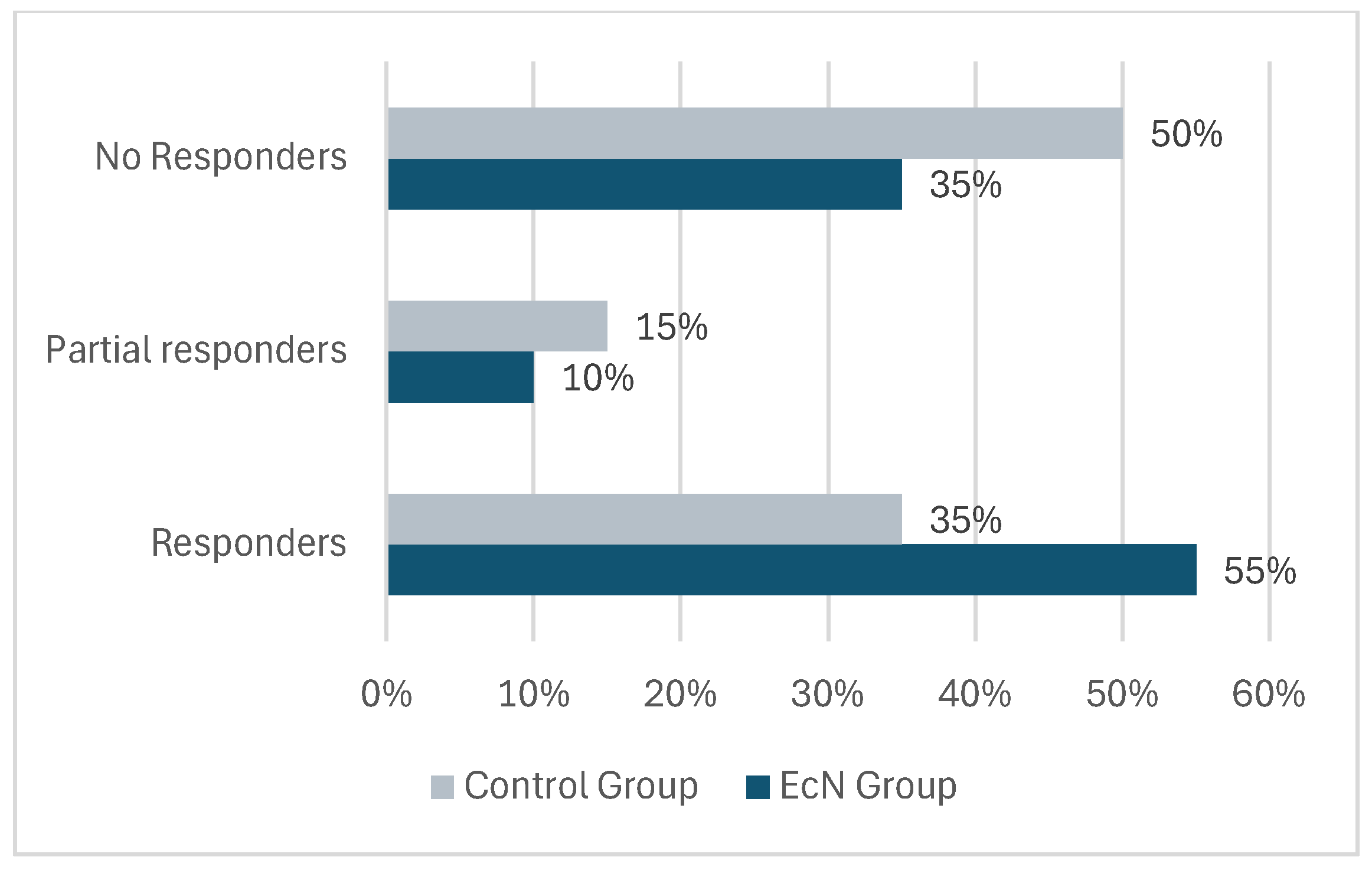
The incidence of UTI episodes throughout the study was markedly greater in the control group than in the EcN Group (
Figure 1).
In the six months following the initiation of EcN (three months of treatment plus three months of follow-up), 11 patients (55%) were UTI-free and therefore considered as responders, 2 patients (10%) reported only one UTI episode (partial responders), and the remaining 7 patients (35%) presented two or more UTIs (no responders). Instead, in the control group that did not receive any prophylaxis treatment, only 7 patients (35%) were classified as responders, while 3 patients (15%) and 10 patients (50%) were classified as partial or non-responders, respectively.
When looking at whether patient traits affected the reduction in UTIs with EcN, there were no significant differences related to age, BMI, regular sexual activity, menstrual periods, or use of hormonal contraceptives. No adverse events were reported during treatment, and no patients withdrew from the study.
4. Discussion
Our data indicate that EcN therapy is helpful in preventing recurrent UTIs. In fact, 55% of patients reported no UTIs in the six months following treatment, and 10% reported only one episode of UTI. This result was significantly greater than in a control group without any prophylaxis, in which only 35% were UTI-free after six months of follow-up. These promising outcomes indicate that EcN could serve as a viable alternative to traditional antibiotic prophylaxis, potentially reducing the reliance on antibiotics and lowering the risk of resistance. Various preventative strategies exist for reducing rUTIs, and different approaches can be integrated to enhance relapse reduction and enhance long-term antimicrobial-sparing approaches. Indeed, although antibiotic prophylaxis is supported by substantial evidence of its effectiveness, the possible risks associated with adverse events and the development of resistance warrant cautious consideration [
1]. Cranberry and mannose are prevalent non-antimicrobial therapies utilized in clinical practice. Proanthocyanidins, naturally occurring compounds in cranberries, are believed to inhibit bacterial adherence to the bladder epithelium, while mannose may saturate
E. coli Type 1 fimbriae, which are implicated in bacterial pathogenicity and biofilm formation, significant virulence factors in pathogenic
E. coli strains [
11,
12]. The urinary microbiome is correlated with rUTIs [
13]. Particularly, alterations leading to the depletion of typically protective Lactobacillus spp. appear to elevate the risk of urinary tract infections. The vaginal tract is believed to contribute to UTI pathogenesis by acting as a possible reservoir for pathogenic bacteria ascending from the gastrointestinal tract. Research indicates that women with recurrent urinary tract infections exhibit a reduced presence of lactobacilli and are more frequently colonized by vaginal
E. coli [
13]. Significant discrepancies in the support of non-antibiotic preventive treatments were noted among the guidelines. Although some trials provide effectiveness data on the use of mannose and cranberry for the prevention of rUTI, the evidence remains contradictory for making a definitive recommendation for these products [
3]. Moreover, all guidelines concur that there is still inadequate evidence to support probiotics and Lactobacillus products in women with rUTI.
EcN has been extensively utilized as an adjuvant in the management of various intestinal disorders, including inflammatory bowel disease, irritable bowel syndrome, diarrhea, persistent constipation, and ulcerative colitis [
14].
To our knowledge, this study is the first to specifically assess the effectiveness of EcN in the prevention of uncomplicated rUTI. The multifaceted effects of EcN on the pathophysiological mechanisms of rUTIs explain our positive results.
Numerous studies have indicated that the antibacterial efficacy of this strain is mostly attributed to a direct antimicrobial impact resulting from the secretion of two particular bacteriocins: microcin H47 and microcin M [
8]. The EcN strain interacts extensively with the epithelium and the mucosal immune system, eliciting immunomodulatory and anti-inflammatory effects, while also enhancing the epithelial permeability barrier and fostering beneficial biofilm development [
8,
15].
Research indicated a correlation between the abundance of
E. coli in the stomach and bladder during recurrent UTI episodes [
16], suggesting a connection between these populations in both locations. This element can further clarify the effectiveness of EcN in preventing rUTIs, drawing on the extensive literature regarding its use for intestinal issues. This understanding may pave the way for new treatment protocols that incorporate EcN as a preventative measure for rUTIs, potentially reducing the reliance on antibiotics and enhancing patient outcomes.
EcN has demonstrated efficacy in competing with
E. coli and other enteropathogens, and it seems to be a safe therapeutic treatment that does not generate enterotoxins or cytotoxins linked to pathogenic
E. coli strains. Furthermore, no differences were seen in the intestinal tissue analysis between treated and control rats, indicating that EcN did not demonstrate any genotoxic activity [
17].
This study has several limitations that should be acknowledged. First, the relatively small sample size and single-center design may limit the generalizability of our findings; in addition, the follow-up period of six months, although sufficient to assess short-term recurrence, may not capture long-term outcomes or seasonal variations in UTI incidence. Moreover, the open-label design without placebo control may have introduced performance bias, although this risk was mitigated by the use of urine culture to confirm recurrence rather than relying solely on LUTS onset. Further research is needed to address these limitations and to validate the findings across larger, more diverse populations. Future studies should also consider incorporating a placebo group to strengthen the evidence for EcN’s effectiveness.
5. Conclusions
Individuals with rUTI require thorough assessment to optimize treatment strategies and minimize unnecessary antibiotic use. Management may encompass both antibiotic and non-antibiotic prophylactic strategies. Nonetheless, we underscore the significance of investigating non-antibiotic prophylactic alternatives such as EcN. Our prospective trial demonstrated that prophylaxis with E. coli Nissle 1917 (EcN) was effective in reducing the recurrence of urinary tract infections, with a significantly higher proportion of UTI-free patients compared with the untreated control group after six months of follow-up.
Future research should aim to identify patient subgroups that may benefit most from this intervention. Such studies should incorporate microbiome-focused sub-analyses to elucidate the mechanisms underlying EcN’s protective effects and to identify patient-specific microbial signatures predictive of treatment response. In addition, long-term studies with larger cohorts are warranted to confirm these findings and assess the sustainability of EcN prophylaxis over time. Moreover, comparative trials between EcN and other non-antibiotic strategies could contribute to defining tailored, antibiotic-sparing prevention strategies for rUTI.
Author Contributions
Conceptualization; Data curation; Formal analysis; Methodology; Writing—original draft; Writing—review & editing, F.M.; Conceptualization; Data curation; Formal analysis; Investigation, C.F. and D.R.; Conceptualization; Methodology; Writing—review & editing, V.S. All authors have read and agreed to the published version of the manuscript.
Funding
This research received no external funding.
Institutional Review Board Statement
The study was conducted in accordance with the Declaration of Helsinki and approved by the Institutional Ethics Committee) of V. Buzzi Hospital (protocol code 335/24—date of approval 19 September 2024).
Informed Consent Statement
Written informed consent was obtained from all subjects involved in the study.
Data Availability Statement
The data presented in this study are available on request from the corresponding author due to privacy.
Conflicts of Interest
The authors declare no conflicts of interest.
Abbreviations
The following abbreviations are used in this manuscript:
| UTI | Urinary tract infection |
| rUTI | Recurrent urinary tract infection |
| UPEC | Uropathogenic E. coli |
| EcN | Escherichia coli Nissle 1917 |
| CFUs | Colony-forming units |
| LUTS | Lower urinary tract symptom |
| BMI | Body mass index |
References
- Suskind, A.M.; Saigal, C.S.; Hanley, J.M.; Lai, J.; Setodji, C.M.; Clemens, J.Q. Incidence and management of uncomplicated recurrent urinary tract infections in a national sample of women in the United States. Urology 2016, 90, 50–55. [Google Scholar] [CrossRef] [PubMed]
- Advani, S.D.; Thaden, J.T.; Perez, R.; Stair, S.L.; Lee, U.J.; Siddiqui, N.Y. State-of-the-Art Review: Recurrent Uncomplicated Urinary Tract Infections in Women. Clin. Infect. Dis. 2025, 80, e31–e42. [Google Scholar] [CrossRef]
- Kwok, M.; McGeorge, S.; Mayer-Coverdale, J.; Graves, B.; Paterson, D.L.; Harris, P.N.A.; Esler, R.; Dowling, C.; Britton, S.; Roberts, M.J. Guideline of guidelines: Management of recurrent urinary tract infections in women. BJU Int. 2022, 130, 11–22. [Google Scholar] [CrossRef] [PubMed]
- Silverman, J.A.; Schreiber, H.L., 4th; Hooton, T.M.; Hultgren, S.J. From physiology to pharmacy: Developments in the pathogenesis and treatment of recurrent urinary tract infections. Curr. Urol. Rep. 2013, 14, 448–456. [Google Scholar] [CrossRef] [PubMed]
- Schito, G.C.; Naber, K.G.; Botto, H.; Palou, J.; Mazzei, T.; Gualco, L.; Marchese, A. The ARESC study: An international survey on the antimicrobial resistance of pathogens involved in uncomplicated urinary tract infections. Int. J. Antimicrob. Agents. 2009, 34, 407–413. [Google Scholar] [CrossRef] [PubMed]
- Bonkat, G.; Müller, G.; Braissant, O.; Frei, R.; Tschudin-Suter, S.; Rieken, M.; Wyler, S.; Gasser, T.C.; Bachmann, A.; Widmer, A.F. Increasing prevalence of ciprofloxacin resistance in extended-spectrum-β-lactamase-producing Escherichia coli urinary isolates. World J. Urol. 2013, 31, 1427–1432. [Google Scholar] [CrossRef] [PubMed]
- Scaldaferri, F.; Gerardi, V.; Mangiola, F.; Lopetuso, L.R.; Pizzoferrato, M.; Petito, V.; Papa, A.; Stojanovic, J.; Poscia, A.; Cammarota, G.; et al. Role and mechanisms of action of Escherichia coli Nissle 1917 in the maintenance of remission in ulcerative colitis patients: An update. World J. Gastroenterol. 2016, 22, 5505–5511. [Google Scholar] [CrossRef] [PubMed]
- Sonnenborn, U. Escherichia coli strain Nissle 1917-from bench to bedside and back: History of a special Escherichia coli strain with probiotic properties. FEMS Microbiol. Lett. 2016, 363, fnw212. [Google Scholar] [CrossRef] [PubMed]
- Ou, B.; Yang, Y.; Tham, W.L.; Chen, L.; Guo, J.; Zhu, G. Genetic engineering of probiotic Escherichia coli Nissle 1917 for clinical application. Appl. Microbiol. Biotechnol. 2016, 100, 8693–8699. [Google Scholar] [CrossRef] [PubMed]
- European Association of Urology (EAU). Guidelines on Urological Infections, 2014 (Updated 6 June 2014). Available online: https://uroweb.org/guidelines/urological-infections (accessed on 19 February 2026).
- Ermel, G.; Georgeault, S.; Inisan, C.; Besnard, M. Inhibition of adhesion of uropathogenic Escherichia coli bacteria to uroepithelial cells by extracts from cranberry. J. Med. Food 2012, 15, 126–134. [Google Scholar] [CrossRef] [PubMed]
- Lenger, S.M.; Bradley, M.S.; Thomas, D.A.; Bertolet, M.H.; Lowder, J.L.; Sutcliffe, S. D-mannose vs other agents for recurrent urinary tract infection prevention in adult women: A systematic review and meta-analysis. Am. J. Obstet. Gynecol. 2020, 223, 265.e1–265.e13. [Google Scholar] [CrossRef] [PubMed]
- Stapleton, A.E. The vaginal microbiota and urinary tract infection. Microbiol. Spectr. 2016, 4, 10–1128. [Google Scholar] [CrossRef] [PubMed]
- Wassenaar, T.M. Insights from 100 Years of Research with Probiotic E. coli. Eur. J. Microbiol. Immunol. 2016, 6, 147–161. [Google Scholar] [CrossRef] [PubMed]
- Lasaro, M.A.; Salinger, N.; Zhang, J.; Wang, Y.; Zhong, Z.; Goulian, M.; Zhu, J. F1C fimbriae play an important role in biofilm formation and intestinal colonization by the Escherichia coli commensal strain Nissle 1917. Appl. Environ. Microbiol. 2009, 75, 246–251. [Google Scholar] [CrossRef] [PubMed]
- Chen, S.L.; Wu, M.; Henderson, J.P.; Hooton, T.M.; Hibbing, M.E.; Hultgren, S.J.; Gordon, J.I. Genomic diversity and fitness of E. coli strains recovered from the intestinal and urinary tracts of women with recurrent urinary tract infection. Sci. Transl. Med. 2013, 5, 184ra160. [Google Scholar] [CrossRef] [PubMed]
- Dubbert, S.; Klinkert, B.; Schimiczek, M.; Wassenaar, T.M.; Bünau, R.V. No genotoxicity is detectable for Escherichia coli strain nissle 1917 by standard in vitro and in vivo tests. Eur. J. Microbiol. Immunol. 2020, 10, 11–19. [Google Scholar] [CrossRef] [PubMed]
| Disclaimer/Publisher’s Note: The statements, opinions and data contained in all publications are solely those of the individual author(s) and contributor(s) and not of MDPI and/or the editor(s). MDPI and/or the editor(s) disclaim responsibility for any injury to people or property resulting from any ideas, methods, instructions or products referred to in the content. |