

Efficacy and Safety of Intranasal Esketamine in Treatment-Resistant Depression with Comorbid Autism Spectrum Disorder: Three Case Reports
 , , and
Abstract
1. Introduction
2. Methods
2.1. Study Design, Setting, and Goal
2.2. Participants
2.3. Intervention
2.4. Outcomes
- -
- Montgomery–Asberg Depression Rating Scale (MADRS): a highly used 10-item questionnaire. MADRS is often selected to monitor depressive symptoms and define the severity of MDD during follow-up; its validity as clinical predictor has been confirmed in TRD [17].
- -
- Psychache Scale (PS): a 13-item scale used to assess the profile of psychological pain. Some questions demand a frequency rating (from “never” to “always”), while other ones demand an agreement rating (from “strongly disagree” to “strongly agree”). Correlation between unbearable psychache and SI in patients affected with MDD was described [18].
- -
- Columbia-Suicide Severity Rating Scale (C-SSRS): a structured test to evaluate suicidal ideation and/or behavior. It is composed of 10 categories, of which the majority call for a binary response yes/no (e.g., suicidal attempts yes/no). When suicidal thoughts and/or behavior were present, the sub-scale, which measures the intensity of ideation (1–5), was reported and considered as a follow-up tool. C-SSRS was used to monitor SI during the observation period in our case reports, but its score is unfit to compare SI in different patients [19].
- -
- Quality of Life Enjoyment and Satisfaction Questionnaire (Q-LES-Q): a subjective investigation about quality of life, which includes different domains (school, work, housework, social relationships, physical state, leisure time, general activities). Every sub-score can be associated with a percentage of satisfaction: the average of these eight percentages defines the global quality of life perceived by patients. Q-LES-Q (58 items) and Q-LES-Q Short Form (16 items) are used as predictors of disability and quality of life in MDD [20].
- -
- Reading the Mind in the Eyes Test (RMET): a specific test which measures the theory of mind and the ability to recognize mental states in other people. It consists of 36 different photographs: for each, the patient should indicate what person in the picture is feeling/thinking. It has been noticed that autistic people underperform on this test as compared to the neurotypical population [21].
- -
- Reflective Functioning Questionnaire 8 items (RFQ-8): a brief, easy-to-administer screening to evaluate mentalization, coming from a 54-item test [22]. It is focused on reflective functioning, intended as the ability to recognize our feelings and our mental states before acting. This test is organized as a Likert-type scale, with responses from “completely agree” (7) to “completely disagree” (1). Higher scores in RFQ-8 show a lower ability in mentalization.

| DOMAIN | SCALE | ABBREVIATION | SCORE |
|---|---|---|---|
| Depression | Montgomery–Asberg Depression Rating Scale | MADRS | 0–60 |
| Psychological pain | Psychache Scale | PS | 13–65 |
| Suicidality | Columbia-Suicide Severity Rating Scale | C-SSRS | If present, assess “Ideation” subscale 1–5 |
| Social Cognition | Reading the Mind in the Eyes Test | RMET | 0–36 |
| Mentalization | Reflective Functioning Questionnaire (8 items) | RFQ-8 | 1–7 |
| Quality of Life | Quality of Life Enjoyment and Satisfaction Questionnaire | Q-LES-Q | 0–100% |
2.5. Data Collection and Statistical Analysis
2.6. Ethical Considerations
3. Results
3.1. Patient 1
3.2. Patient 2
3.3. Patient 3
4. Discussion
4.1. Summary of Findings and Interpretation
4.2. Comparison to Literature
4.3. Strengths and Limitations
4.4. Future Research Directions
5. Conclusions
Supplementary Materials
Author Contributions
Funding
Institutional Review Board Statement
Informed Consent Statement
Data Availability Statement
Acknowledgments
Conflicts of Interest
References
- Malhi, G.S.; Mann, J.J. Depression. Lancet 2018, 392, 2299–2312. [Google Scholar] [CrossRef] [PubMed]
- World Health Organization. Depressive Disorders (Depression). Available online: www.who.int/news-room/fact-sheets/detail/depression (accessed on 29 August 2025).
- McIntyre, R.S.; Alsuwaidan, M.; Baune, B.T.; Berk, M.; Demyttenaere, K.; Goldberg, J.F.; Gorwood, P.; Ho, R.; Kasper, S.; Kennedy, S.H.; et al. Treatment-resistant depression: Definition, prevalence, detection, management, and investigational interventions. World Psychiatry 2023, 22, 394–412. [Google Scholar] [CrossRef] [PubMed] [PubMed Central]
- Berk, M.; Köhler-Forsberg, O.; Turner, M.; Penninx, B.W.J.H.; Wrobel, A.; Firth, J.; Loughman, A.; Reavley, N.J.; McGrath, J.J.; Momen, N.C.; et al. Comorbidity between major depressive disorder and physical diseases: A comprehensive review of epidemiology, mechanisms and management. World Psychiatry 2023, 22, 366–387. [Google Scholar] [CrossRef] [PubMed] [PubMed Central]
- Lai, M.C.; Kassee, C.; Besney, R.; Bonato, S.; Hull, L.; Mandy, W.; Szatmari, P.; Ameis, S.H. Prevalence of co-occurring mental health diagnoses in the autism population: A systematic review and meta-analysis. Lancet Psychiatry 2019, 6, 819–829. [Google Scholar] [CrossRef] [PubMed]
- Santomauro, D.F.; Hedley, D.; Sahin, E.; Brugha, T.S.; Naghavi, M.; Vos, T.; Whiteford, H.A.; Ferrari, A.J.; Stokes, M.A. The global burden of suicide mortality among people on the autism spectrum: A systematic review, meta-analysis, and extension of estimates from the Global Burden of Disease Study 2021. Psychiatry Res. 2024, 341, 116150. [Google Scholar] [CrossRef] [PubMed]
- McDonald, R.G.; Cargill, M.I.; Khawar, S.; Kang, E. Emotion dysregulation in autism: A meta-analysis. Autism 2024, 28, 2986–3001. [Google Scholar] [CrossRef]
- Dell’Osso, L.; Massoni, L.; Battaglini, S.; De Felice, C.; Nardi, B.; Amatori, G.; Cremone, I.M.; Carpita, B. Emotional dysregulation as a part of the autism spectrum continuum: A literature review from late childhood to adulthood. Front. Psychiatry 2023, 14, 1234518. [Google Scholar] [CrossRef] [PubMed]
- Mazefsky, C.A.; Herrington, J.; Siegel, M.; Scarpa, A.; Maddox, B.B.; Scahill, L.; White, S.W. The role of emotion regulation in autism spectrum disorder. J. Am. Acad. Child. Adolesc. Psychiatry 2013, 52, 679–688. [Google Scholar] [CrossRef] [PubMed] [PubMed Central]
- de la Torre-Luque, A.; Essau, C.A.; Lara, E.; Leal-Leturia, I.; Borges, G. Childhood emotional dysregulation paths for suicide-related behaviour engagement in adolescence. Eur. Child. Adolesc. Psychiatry 2023, 32, 2581–2592. [Google Scholar] [CrossRef] [PubMed]
- Wang, L.; Wang, B.; Wu, C.; Wang, J.; Sun, M. Autism Spectrum Disorder: Neurodevelopmental Risk Factors, Biological Mechanism, and Precision Therapy. Int. J. Mol. Sci. 2023, 24, 1819. [Google Scholar] [CrossRef]
- Ruggieri, V. Autismo. Tratamiento farmacológico [Autism. Pharmacological treatment]. Medicina 2023, 83, 46–51. (In Spanish) [Google Scholar] [PubMed]
- Siafis, S.; Çıray, O.; Wu, H.; Schneider-Thoma, J.; Bighelli, I.; Krause, M.; Rodolico, A.; Ceraso, A.; Deste, G.; Huhn, M.; et al. Pharmacological and dietary-supplement treatments for autism spectrum disorder: A systematic review and network meta-analysis. Mol. Autism 2022, 13, 10. [Google Scholar] [CrossRef]
- Fedgchin, M.; Trivedi, M.; Daly, E.J.; Melkote, R.; Lane, R.; Lim, P.; Vitagliano, D.; Blier, P.; Fava, M.; Liebowitz, M.; et al. Efficacy and Safety of Fixed-Dose Esketamine Nasal Spray Combined with a New Oral Antidepressant in Treatment-Resistant Depression: Results of a Randomized, Double-Blind, Active-Controlled Study (TRANSFORM-1). Int. J. Neuropsychopharmacol. 2019, 22, 616–630. [Google Scholar] [CrossRef] [PubMed] [PubMed Central]
- Vasiliu, O. Esketamine for treatment-resistant depression: A review of clinical evidence (Review). Exp. Ther. Med. 2023, 25, 111. [Google Scholar] [CrossRef] [PubMed] [PubMed Central]
- Anashkina, A.A.; Erlykina, E.I. Molecular Mechanisms of Aberrant Neuroplasticity in Autism Spectrum Disorders (Review). Sovrem. Tekhnologii Med. 2021, 13, 78–91. [Google Scholar] [CrossRef] [PubMed] [PubMed Central]
- Serretti, A.; Kasper, S.; Bartova, L.; Zohar, J.; Souery, D.; Montgomery, S.; Ferentinos, P.; Rujescu, D.; Kautzky, A.; Attanasio, F.; et al. Clinical predictors of treatment resistant depression. Eur. Neuropsychopharmacol. 2025, 98, 26–34. [Google Scholar] [CrossRef] [PubMed]
- Yeşiloğlu, C.; Tamam, L.; Demirkol, M.E.; Namli, Z.; Karaytuğ, M.O.; Şenbayram Güzelbaba, Ş. The relationship of coping skills with psychache in patients with depressive disorder. Medicine 2023, 102, e34339. [Google Scholar] [CrossRef] [PubMed] [PubMed Central]
- Tabares, J.V.; Butner, J.E.; Bryan, C.J.; AHarris, J. Mokken Scale Analysis of Lifetime Responses on the Columbia Suicide Severity Rating Scale’s Severity of Ideation Subscale. Assessment 2021, 28, 1624–1634. [Google Scholar] [CrossRef] [PubMed] [PubMed Central]
- Wang, J.Y.; Yuan, M.L.; Zhang, W. Changes and Prediction of Social Functional Disability and Quality of Life in Patients with Major Depressive Disorder over the Course of 1-Year Medication. Sichuan Da Xue Xue Bao Yi Xue Ban 2022, 53, 904–910. (In Chinese) [Google Scholar] [CrossRef] [PubMed] [PubMed Central]
- Sato, W.; Uono, S.; Kochiyama, T.; Yoshimura, S.; Sawada, R.; Kubota, Y.; Sakihama, M.; Toichi, M. Structural Correlates of Reading the Mind in the Eyes in Autism Spectrum Disorder. Front. Hum. Neurosci. 2017, 11, 361. [Google Scholar] [CrossRef] [PubMed] [PubMed Central]
- Fonagy, P.; Luyten, P.; Moulton-Perkins, A.; Lee, Y.W.; Warren, F.; Howard, S.; Ghinai, R.; Fearon, P.; Lowyck, B. Development and Validation of a Self-Report Measure of Mentalizing: The Reflective Functioning Questionnaire. PLoS ONE 2016, 11, E0158678. [Google Scholar] [CrossRef] [PubMed]
- Wajs, E.; Aluisio, L.; Holder, R.; Daly, E.J.; Lane, R.; Lim, P.; George, J.E.; Morrison, R.L.; Sanacora, G.; Young, A.H.; et al. Esketamine Nasal Spray Plus Oral Antidepressant in Patients With Treatment-Resistant Depression: Assessment of Long-Term Safety in a Phase 3, Open-Label Study (SUSTAIN-2). J. Clin. Psychiatry 2020, 81, 19m12891. [Google Scholar] [CrossRef] [PubMed]
- Popova, V.; Daly, E.J.; Trivedi, M.; Cooper, K.; Lane, R.; Lim, P.; Mazzucco, C.; Hough, D.; Thase, M.E.; Shelton, R.C.; et al. Efficacy and Safety of Flexibly Dosed Esketamine Nasal Spray Combined with a Newly Initiated Oral Antidepressant in Treatment-Resistant Depression: A Randomized Double-Blind Active-Controlled Study. Am. J. Psychiatry 2019, 176, 428–438, Erratum in Am. J. Psychiatry 2019, 176, 669. https://doi.org/10.1176/appi.ajp.2019.1768correction1. [Google Scholar] [CrossRef] [PubMed]


| PATIENT 1 (G.) | PATIENT 2 (E.) | PATIENT 3 (A.) | |
|---|---|---|---|
| GENDER AND AGE | Female, 25 y | Male, 20 y | Female, 25 y |
| JOB | Student Writer assistant | Farm worker | Student |
| AUTISM SEVERITY | Level 2 | Level 2 | Level 1 |
| INTELLECTUAL DISABILITY | No (IQ 107) | No (IQ 137) | No (IQ 130) |
| FAMILIAR ANAMNESIS | Major depressive disorder (mother) Panic disorder (father) | Bipolar Disorder (mother) | Negative |
| MEDICAL COMORBIDITIES | No | Sever obesity, hypertension | No |
| HOSPITALIZATIONS | Suicidal ideation (2021) | Suicidal attempt (2023) Suicidal ideation (2024) | No |
| SUICIDAL ATTEMPTS | No | 1 (setting fire) | No |
| SELF-HARMING | Yes (cutting, cigarette burns) | No | No |
| DRUG USE | No | Alcohol (occasional) | No |
| ORAL PHARMACOTHERAPY | Sertraline 200 mg/day Aripiprazole 15 mg/day | Venlafaxine 300 mg/day Lurasidone 74 mg/day | Escitalopram 20 mg/day Methylphenidate 50 mg/day |
| ESKETAMINE POSOLOGY | 84 mg | 84 mg | 84 mg |
| ESKETAMINE DURATION | 6 months | 15 months (ongoing) | 9 months (ongoing) |
| HOSPITALIZATIONS DURING ESKETAMINE | No | No | No |
| SUICIDAL ATTEMPTS DURING ESKETAMINE | No | No | No |
| SELF-HARMING DURING ESKETAMINE | Yes (1 episode) | No | No |
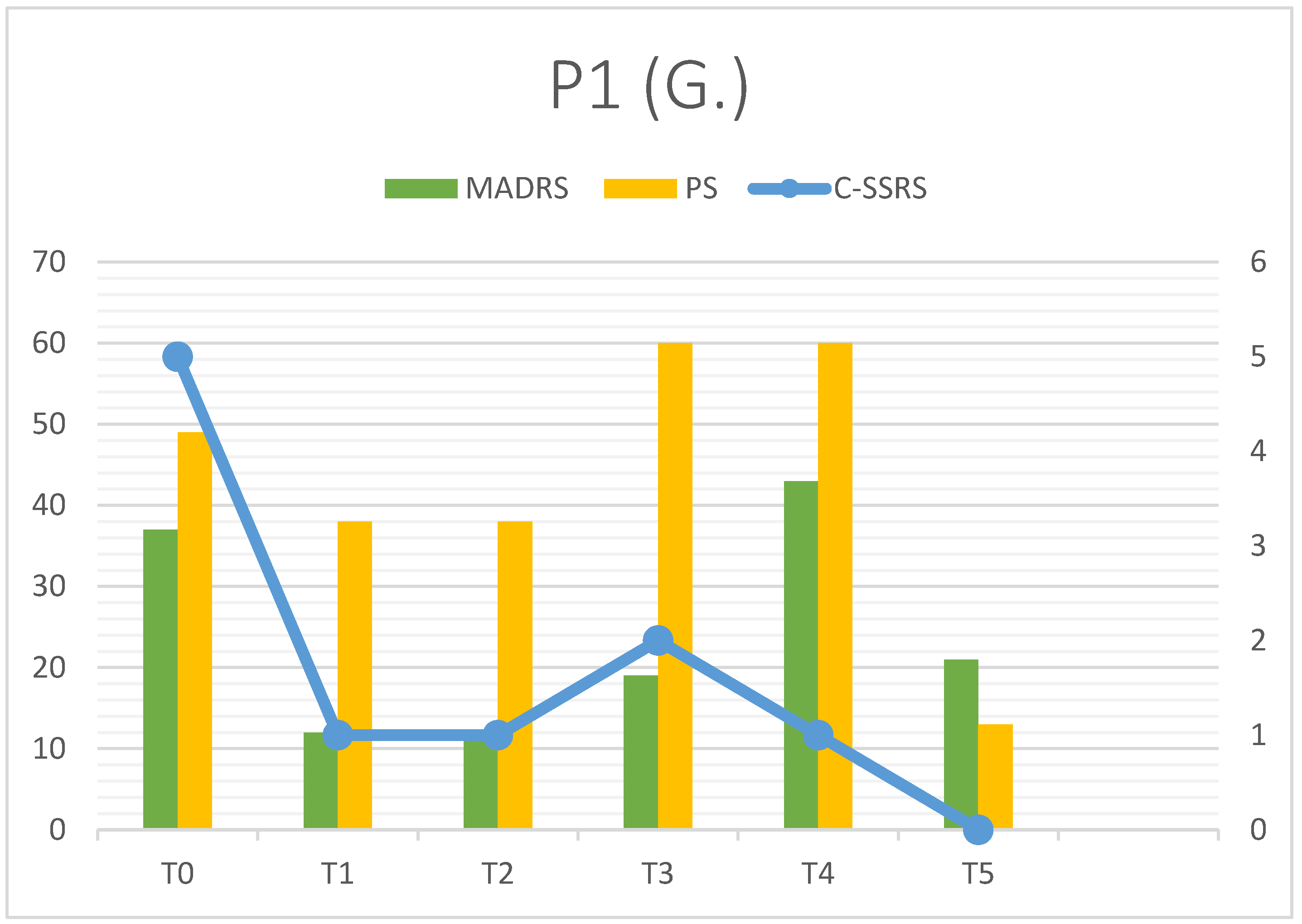
| P1 | MADRS | C-SSRS | PS | RFQ-8 | RMET | Q-LES-Q (%) |
|---|---|---|---|---|---|---|
| T0 | 37 | 5 | 49 | 4.125 | 27 | 28 |
| T1 | 12 | 1 | 38 | 4.25 | 31 | - |
| T2 | 12 | 1 | 38 | 4.25 | 30 | - |
| T3 | 19 | 2 | 60 | 4.5 | 32 | - |
| T4 | 43 | 1 | 60 | 3.125 | 34 | - |
| T5 | 21 | 0 | 13 | 2.75 | 34 | 73 |
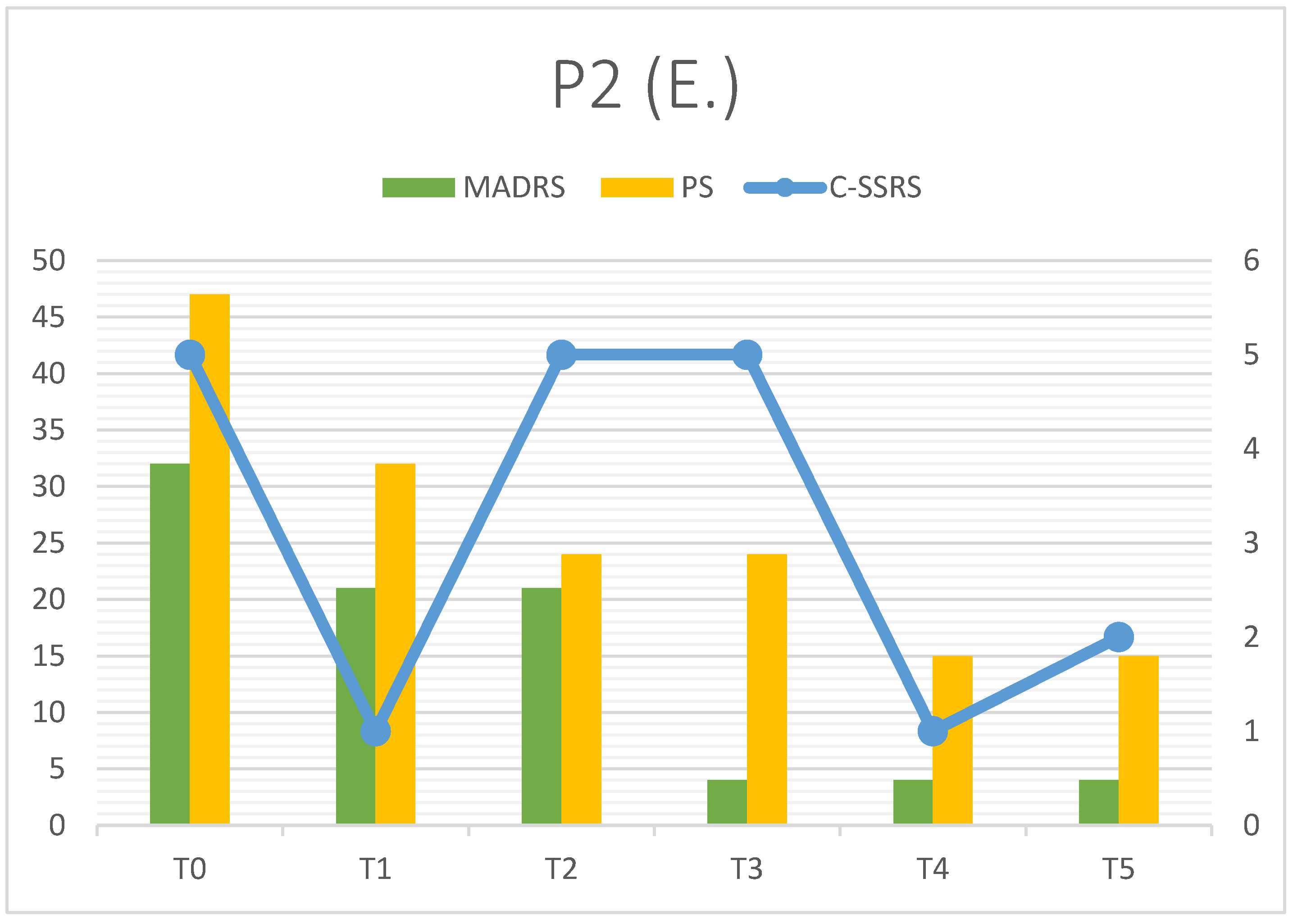
| P2 | MADRS | C-SSRS | PS | RFQ-8 | RMET | Q-LES-Q (%) |
|---|---|---|---|---|---|---|
| T0 | 32 | 5 | 47 | 2.5 | 26 | 25 |
| T1 | 21 | 1 | 32 | 2.25 | 22 | - |
| T2 | 21 | 5 | 24 | 2 | 23 | - |
| T3 | 4 | 5 | 24 | 2 | 23 | - |
| T4 | 4 | 1 | 15 | 2 | 23 | - |
| T5 | 4 | 2 | 15 | 2 | 23 | 71 |
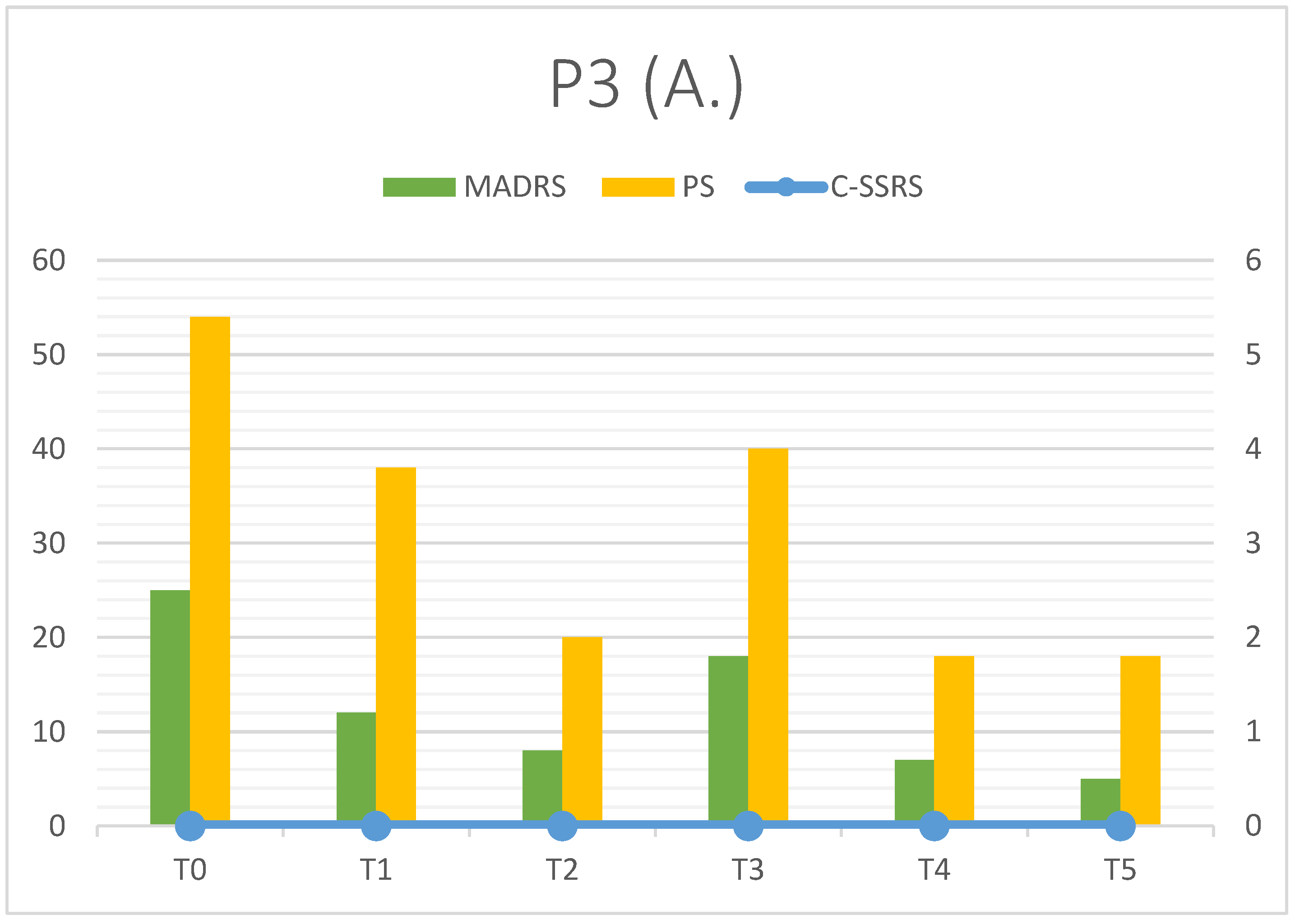
| P3 | MADRS | C-SSRS | PS | RFQ-8 | RMET | Q-LES-Q (%) |
|---|---|---|---|---|---|---|
| T0 | 25 | 0 | 54 | 2 | 26 | 35 |
| T1 | 12 | 0 | 38 | 3 | 27 | - |
| T2 | 8 | 0 | 20 | 4 | 25 | - |
| T3 | 18 | 0 | 40 | 3 | 26 | - |
| T4 | 7 | 0 | 18 | 4 | 28 | - |
| T5 | 5 | 0 | 18 | 4 | 29 | 80 |
Disclaimer/Publisher’s Note: The statements, opinions and data contained in all publications are solely those of the individual author(s) and contributor(s) and not of MDPI and/or the editor(s). MDPI and/or the editor(s) disclaim responsibility for any injury to people or property resulting from any ideas, methods, instructions or products referred to in the content. |
© 2026 by the authors. Licensee MDPI, Basel, Switzerland. This article is an open access article distributed under the terms and conditions of the Creative Commons Attribution (CC BY) license.
Share and Cite
Guffanti, A.; Leonardi, M.; Brondino, N.; Dell’Osso, B.; Martiadis, V.; Olivola, M. Efficacy and Safety of Intranasal Esketamine in Treatment-Resistant Depression with Comorbid Autism Spectrum Disorder: Three Case Reports. Clin. Pract. 2026, 16, 61. https://doi.org/10.3390/clinpract16030061
Guffanti A, Leonardi M, Brondino N, Dell’Osso B, Martiadis V, Olivola M. Efficacy and Safety of Intranasal Esketamine in Treatment-Resistant Depression with Comorbid Autism Spectrum Disorder: Three Case Reports. Clinics and Practice. 2026; 16(3):61. https://doi.org/10.3390/clinpract16030061
Chicago/Turabian StyleGuffanti, Alessandro, Matteo Leonardi, Natascia Brondino, Bernardo Dell’Osso, Vassilis Martiadis, and Miriam Olivola. 2026. "Efficacy and Safety of Intranasal Esketamine in Treatment-Resistant Depression with Comorbid Autism Spectrum Disorder: Three Case Reports" Clinics and Practice 16, no. 3: 61. https://doi.org/10.3390/clinpract16030061
APA StyleGuffanti, A., Leonardi, M., Brondino, N., Dell’Osso, B., Martiadis, V., & Olivola, M. (2026). Efficacy and Safety of Intranasal Esketamine in Treatment-Resistant Depression with Comorbid Autism Spectrum Disorder: Three Case Reports. Clinics and Practice, 16(3), 61. https://doi.org/10.3390/clinpract16030061