
Early Trajectories of Suicidality in Adolescents and Young Adults: A Retrospective Study from a Community Mental Health Facility in Northern Italy

 ,
, 
Abstract
1. Introduction
1.1. Suicide as a Global Public Health Priority
1.2. Developmental Context: Adolescence and Emerging Adulthood
1.3. Psychiatric Disorders and Suicidal Behavior in Youth
1.4. Developmental Psychopathology Across Different Diagnostic Categories
1.5. The Italian Community Psychiatric Service Context
1.6. Study Rationale and Objectives
- What are the specific demographic and clinical characteristics of youth who attempt suicide in Italian community psychiatric settings?
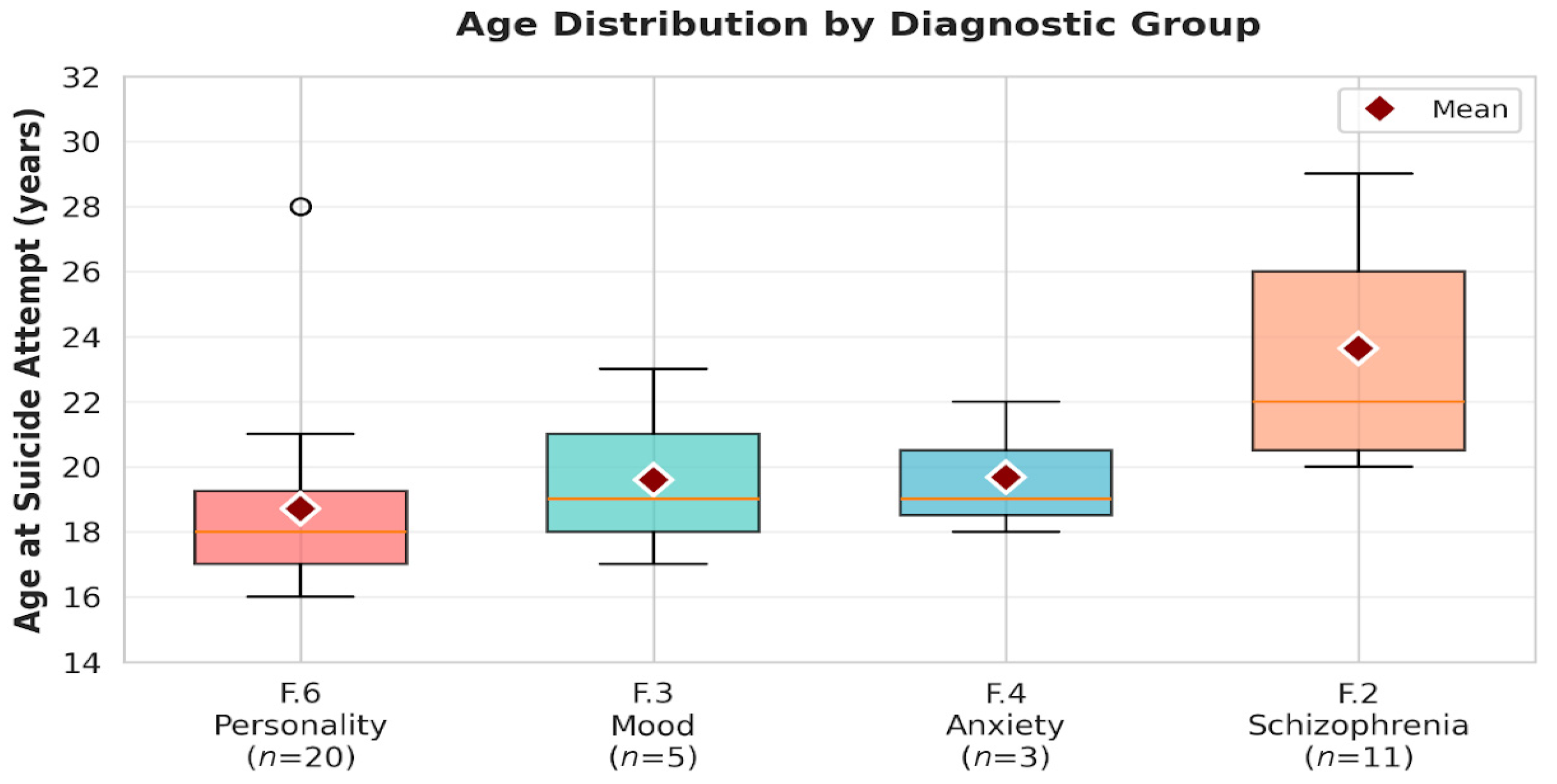
- Does age at first suicide attempt differ across major diagnostic categories, reflecting disorder-specific developmental trajectories?
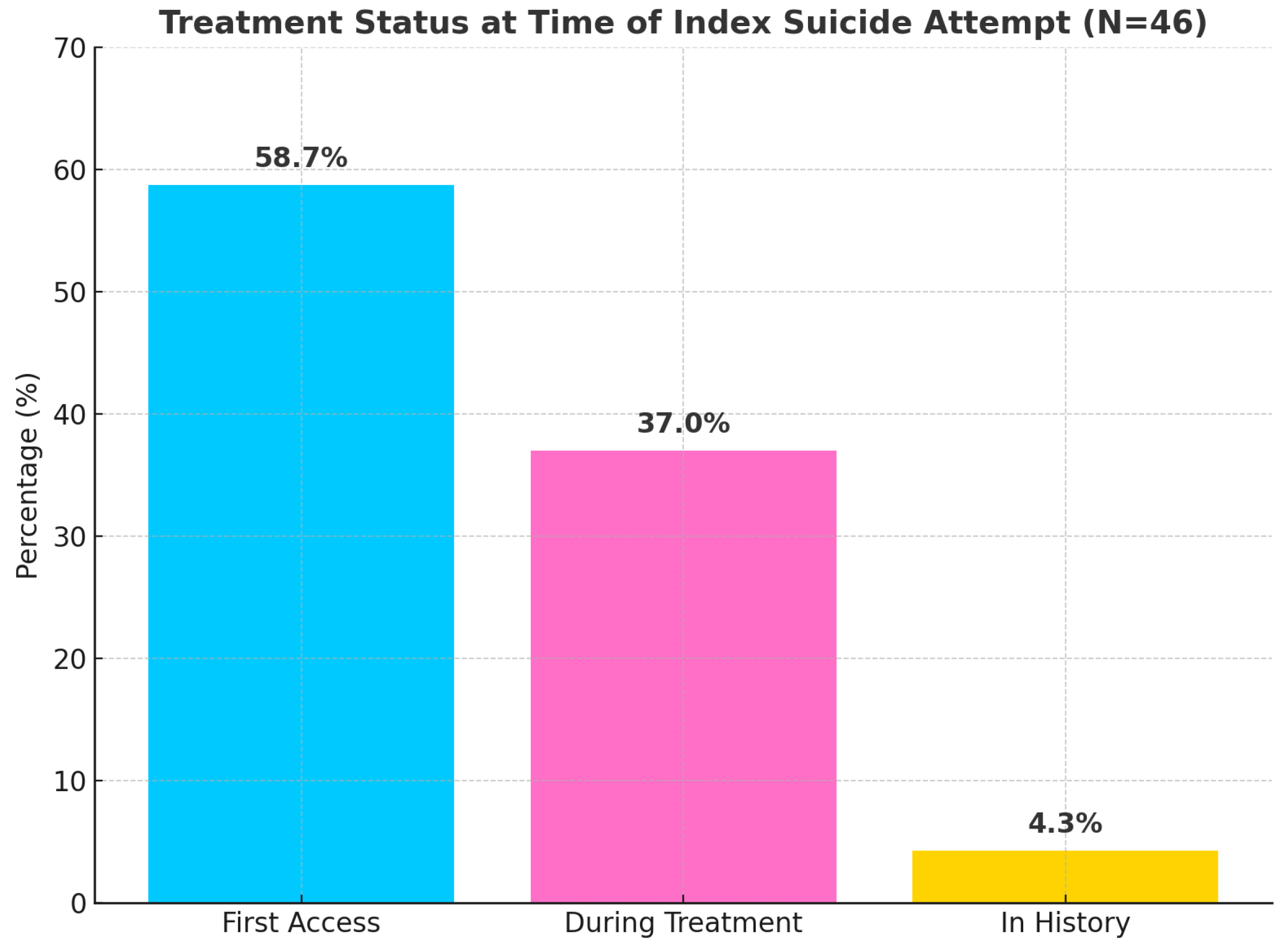
- What proportion of youth who attempt suicide are already engaged in psychiatric treatment versus presenting for first contact following the attempt?
- What are the most common methods of suicide attempt in this population?
- Characterize the demographic, diagnostic, and clinical features of youth suicide attempters in a community psychiatric setting.
- Examine differences in age at index suicide attempt across major diagnostic categories (personality disorders, schizophrenia spectrum disorders, and mood disorders).
- Describe treatment status, substance use patterns, and methods of suicide attempt in this population.
2. Materials and Methods
2.1. Study Design and Setting
2.2. Participants and Inclusion Criteria
2.3. Data Source and Variables
- Gender.
- Age at index suicide attempt.
- Educational attainment.
- Primary and secondary/comorbid diagnoses (based on ICD-10 criteria and extracted from clinical records. Diagnosis was made by the attending psychiatrist in charge of each patient).
- Mood symptoms (presence of depressive or manic symptoms documented at any point of the clinical history).
- Substance misuse (defined as documented use of alcohol or illicit drugs meeting criteria for harmful use or dependence).
- Family psychiatric history (defined as documented psychiatric disorder in first-degree relatives).
- Method of suicide attempt.
- Repeated suicide attempt (defined as documentation of more than one suicide attempt).
- Treatment status at time of index suicide attempt (first access to service/already under psychiatric treatment/first attempt prior to current treatment episode).
- Pharmacological treatment at time of index attempt.
- -
- F2×: Schizophrenia spectrum and other psychotic disorders.
- -
- F3×: Mood disorders (depressive and bipolar disorders).
- -
- F4×: Anxiety, stress-related, and somatoform disorders.
- -
- F6×: Personality disorders.
- -
- F8×: Developmental disorders.
2.4. Statistical Analysis
3. Results
3.1. Sample Characteristics
3.1.1. Demographics
3.1.2. Diagnostic Distribution
- 1.
- Personality disorders (F6×): n = 27 (50.9% of those with diagnosis)
- -
- F60.31 (Borderline personality disorder): n = 7
- -
- F60 (Personality disorder, unspecified): n = 15
- -
- F60.9 (Personality disorder, unspecified): n = 1
- -
- Other F6 codes: n = 4
- 2.
- Schizophrenia spectrum disorders (F2×): n = 14 (26.4%)
- -
- F20 (Schizophrenia): n = 2
- -
- F20.3 (Undifferentiated schizophrenia): n = 1
- -
- F21 (Schizotypal disorder): n = 1
- -
- F29 (Unspecified psychotic disorder): n = 1
- -
- F2 (Schizophrenia spectrum, unspecified): n = 10
- 3.
- Mood disorders (F3×): n = 8 (15.1%)
- -
- F32.2 (Severe depressive episode without psychotic features): n = 1
- -
- F32 (Depressive episode): n = 1
- -
- F33.2 (Recurrent depressive disorder, severe episode): n = 1
- -
- F39 (Mood disorder, unspecified): n = 1
- -
- F3 (Mood disorder, unspecified): n = 1
- -
- Other F3 codes: n = 3
- 4.
- Anxiety and stress-related disorders (F4×): n = 3 (5.7%)
- -
- F41.1 (Generalized anxiety disorder): n = 1
- -
- Other F4 codes: n = 2
- 5.
- Developmental disorders (F8×): n = 1 (1.9%)
- -
- F84.5 (Asperger syndrome): n = 1
3.1.3. Comorbidity and Associated Features
3.2. Characteristics of Index Suicide Attempt
3.2.1. Method of Suicide Attempt
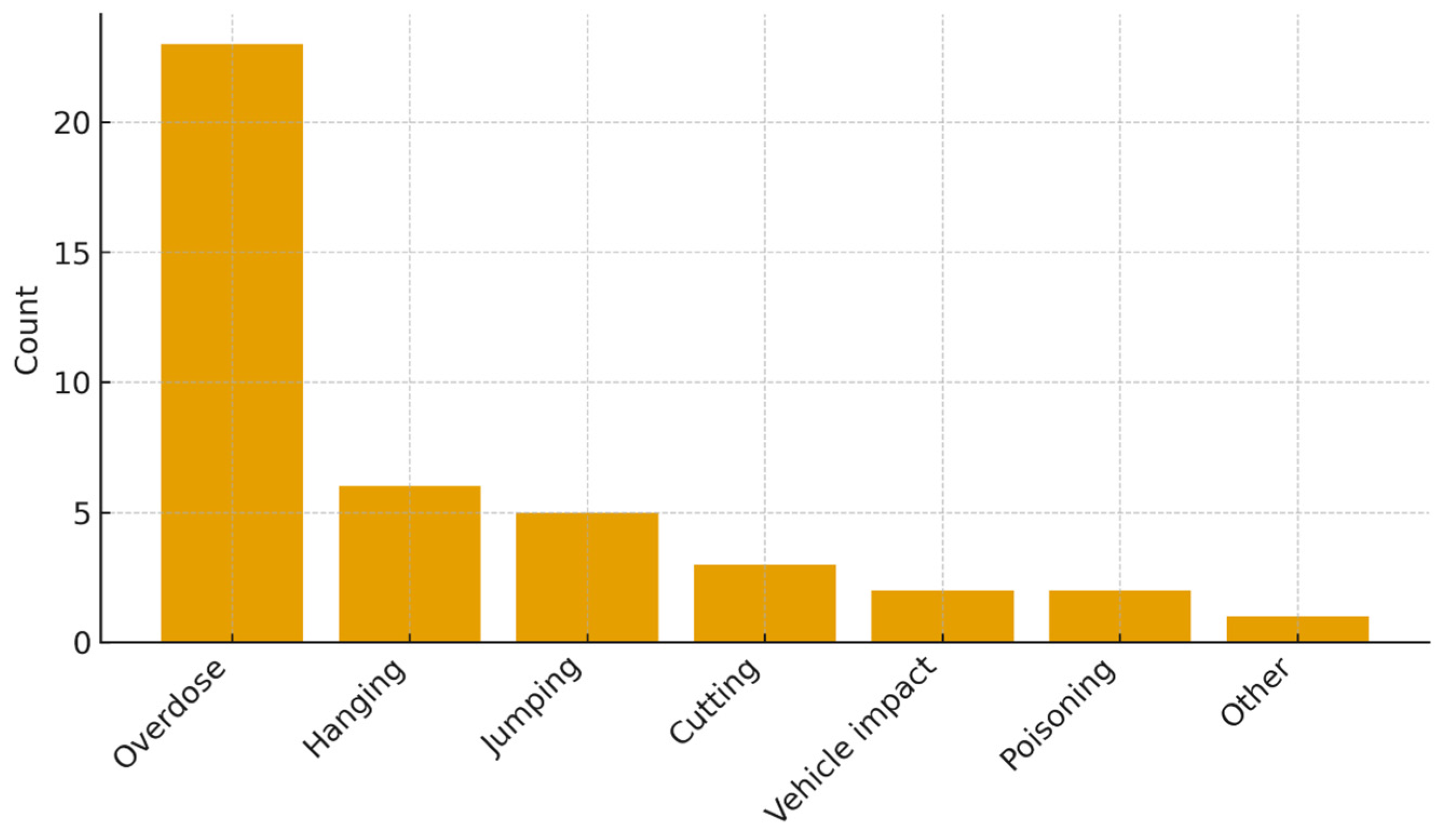
- Medication overdose: n = 23 (54.8%).
- Hanging/suffocation: n = 6 (14.3%).
- Jumping from height: n = 5 (11.9%).
- Cutting/stabbing: n = 3 (7.1%).
- Train/vehicle impact: n = 2 (4.8%).
- Poisoning (non-medication): n = 2 (4.8%).
- Other: n = 1 (2.4%).
3.2.2. Repeat Suicide Attempts
3.2.3. Treatment Status at Time of Index Attempt
3.2.4. Pharmacological Treatment at Time of Index Attempt
- No pharmacological treatment: n = 13 (39.4%).
- Antipsychotic medication: n = 9 (27.3%).
- -
- Specific agents: risperidone n = 2, olanzapine n = 3, aripiprazole n = 4.
- Polypharmacy (≥2 psychotropic medications): n = 6 (18.2%).
- -
- Common combinations: antipsychotic + mood stabilizer (n = 4), antipsychotic + antidepressant (n = 1), antidepressant + mood stabilizer (n = 1).
- Antidepressant monotherapy: n = 3 (9.1%).
- -
- Specific agents: SSRIs n = 3.
- Mood stabilizer monotherapy: n = 2 (6.1%).
- -
- Specific agents: lithium n = 1, valproate n = 1.
3.3. Age at Index Suicide Attempt by Diagnostic Category
- Personality Disorders (F6×, n = 20):
- -
- M = 18.70 years, SD = 2.56.
- -
- Range: 16–28 years.
- -
- Median: 18.0 years.
- Schizophrenia Spectrum Disorders (F2×, n = 11):
- -
- M = 23.64 years, SD = 3.50.
- -
- Range: 20–29 years.
- -
- Median: 23.0 years.
- Mood Disorders (F3×, n = 5):
- -
- M = 19.60 years, SD = 2.41.
- -
- Range: 17–23 years.
- -
- Median: 19.0 years.
Assumption Testing
3.4. Gender Patterns
4. Discussion
4.1. Disorder-Specific Trajectories
- For personality disorders: Prevention and early intervention efforts should target mid-to-late adolescence (ages 15–20), focusing on identifying youth with emerging emotional dysregulation, self-harm, and interpersonal difficulties. School-based screening, training of school counselors and pediatricians, and accessible DBT programs for adolescents may be particularly valuable [64].
- For schizophrenia spectrum disorders: Prevention efforts should target the late adolescent to early adult period (ages 20–25), focusing on early detection of prodromal symptoms, rapid access to first-episode psychosis programs, and intensive support during the critical period following diagnosis [65]. Suicide risk assessment should be integrated into all early psychosis interventions.
- For mood disorders: Although our sample size was small (n = 5), patients with mood disorders showed an intermediate pattern (M = 19.60 years), suggesting that prevention efforts should span mid-adolescence through early adulthood, with attention to both early-onset and later-onset depression and bipolar disorder [66].
4.2. Treatment Status and Pathways to Care
4.3. Methods of Suicide Attempt and Lethality
4.4. Comorbidity: Substance Use and Mood Symptoms
4.5. The Gender Paradox in Suicidal Behavior
- Clinical Population vs. General Population: Our sample comprised individuals referred to psychiatric services following suicide attempts. Males who attempt suicide may be more likely to use lethal methods, resulting in death rather than survival and referral to outpatient services. Consequently, community mental health samples may show more balanced gender ratios than general population epidemiological studies.
- Severity and Intent: Males presenting to services following attempts may represent a selected subgroup with particularly serious intent or high-lethality attempts, whereas the broader population of male attempters (including those with lower intent or lethality) may be less likely to access services.
- Age Range: The 16–29 age range studied may show different gender patterns than older adult populations. Some research suggests that gender differences in attempt rates are most pronounced in adolescence and narrow somewhat in young adulthood [45].
- Regional and Cultural Factors: Patterns of help-seeking behavior and suicide attempt rates may vary across regions and cultures. Our Northern Italian sample may reflect local patterns that differ from international norms.
4.6. Clinical and Public Health Implications
4.6.1. Developmentally Informed Prevention Strategies
4.6.2. Integration of Suicide Risk Assessment into Routine Care
4.6.3. Evidence-Based Psychotherapeutic Interventions
4.6.4. Pharmacological Considerations
4.7. Strengths and Limitations
4.7.1. Strengths
4.7.2. Limitations
4.7.3. Recommendations for Future Research
5. Conclusions
- Systems-level interventions are needed to facilitate earlier access to care before youth reach suicidal crisis, including school-based services, telehealth options, and youth-friendly service models.
- Means restriction strategies (safe medication storage, and reduced pack sizes of analgesics) should be implemented at both individual and policy levels.
Author Contributions
Funding
Institutional Review Board Statement
Informed Consent Statement
Data Availability Statement
Conflicts of Interest
References
- World Health Organization. Suicide. 2023. Available online: https://www.who.int/data/gho/data/themes/mental-health/suicide-rates (accessed on 5 December 2025).
- Forte, A.; Vichi, M.; Ghirini, S.; Orri, M.; Pompili, M. Trends and ecological results in suicides among Italian youth aged 10–25 years: A nationwide register study. J. Affect. Disord. 2021, 282, 165–172. [Google Scholar] [CrossRef]
- Laido, Z.; Voracek, M.; Till, B.; Pietschnig, J.; Eisenwort, B.; Dervic, K.; Sonneck, G.; Niederkrotenthaler, T. Epidemiology of suicide among children and adolescents in Austria, 2001–2014. Wien. Klin. Wochenschr. 2016, 129, 121–128. [Google Scholar] [CrossRef]
- Kokkevi, A.; Rotsika, V.; Arapaki, A.; Richardson, C. Increasing self-reported suicide attempts by adolescents in Greece between 1984 and 2007. Chest 2010, 46, 231–237. [Google Scholar] [CrossRef]
- Ivey-Stephenson, A.Z.; Demissie, Z.; Crosby, A.E.; Stone, D.M.; Gaylor, E.; Wilkins, N.; Lowry, R.; Brown, M. Suicidal Ideation and Behaviors Among High School Students—Youth Risk Behavior Survey, United States, 2019. Morb. Mortal. Wkly. Rep. (MMWR) 2020, 69, 47–55. [Google Scholar] [CrossRef]
- Gualtieri, S.; Lombardo, S.; Sacco, M.A.; Verrina, M.C.; Tarallo, A.P.; Carbone, A.; Costa, A.; Aquila, I. Suicide in Italy: Epidemiological Trends, Contributing Factors, and the Forensic Pathologist’s Role in Prevention and Investigation. J. Clin. Med. 2025, 14, 1186. [Google Scholar] [CrossRef]
- Chartier, M.J.; Bolton, J.M.; Ekuma, O.; Mota, N.; Hensel, J.M.; Nie, Y.; McDougall, C. Suicidal Risk and Adverse Social Outcomes in Adulthood Associated with Child and Adolescent Mental Disorders. Can. J. Psychiatry 2021, 67, 512–523. [Google Scholar] [CrossRef]
- World Suicide Prevention Day 2016: Relazionarsi, Comunicare, Assistere. Available online: https://www.epicentro.iss.it/mentale/GM2016 (accessed on 5 December 2025).
- Mars, B.; Heron, J.; Klonsky, E.D.; Moran, P.; O’connor, R.C.; Tilling, K.; Wilkinson, P.; Gunnell, D. Predictors of future suicide attempt among adolescents with suicidal thoughts or non-suicidal self-harm: A population-based birth cohort study. Lancet Psychiatry 2019, 6, 327–337. [Google Scholar] [CrossRef] [PubMed]
- Orri, M.; Vergunst, F.; Turecki, G.; Galera, C.; Latimer, E.; Bouchard, S.; Domond, P.; Vitaro, F.; Algan, Y.; Tremblay, R.E.; et al. Long-term economic and social outcomes of youth suicide attempts. Br. J. Psychiatry 2021, 220, 79–85. [Google Scholar] [CrossRef] [PubMed]
- Thompson, M.P.; Kingree, J.B.; Lamis, D. Associations of adverse childhood experiences and suicidal behaviors in adulthood in a U.S. nationally representative sample. Child Care Health Dev. 2018, 45, 121–128. [Google Scholar] [CrossRef] [PubMed]
- Dube, S.R.; Anda, R.F.; Felitti, V.J.; Chapman, D.P.; Williamson, D.F.; Giles, W.H. Childhood Abuse, Household Dysfunction, and the Risk of Attempted Suicide Throughout the Life Span: Findings from the Adverse Childhood Experiences Study. JAMA 2001, 286, 3089–3096. [Google Scholar] [CrossRef]
- Arnett, J.J. Emerging adulthood: A Theory of Development from the Late Teens through the twenties. Am. Psychol. 2000, 55, 469–480. [Google Scholar] [CrossRef]
- O’Connor, R.C.; Nock, M.K. The psychology of suicidal behaviour. Lancet Psychiatry 2014, 1, 73–85. [Google Scholar] [CrossRef]
- Klonsky, E.D.; May, A.M.; Saffer, B.Y. Suicide, Suicide Attempts, and Suicidal Ideation. Annu. Rev. Clin. Psychol. 2016, 12, 307–330. [Google Scholar] [CrossRef]
- Wetherall, K.; Cleare, S.; Eschle, S.; Ferguson, E.; O’COnnor, D.B.; O’CArroll, R.E.; O’COnnor, R.C. From ideation to action: Differentiating between those who think about suicide and those who attempt suicide in a national study of young adults. J. Affect. Disord. 2018, 241, 475–483. [Google Scholar] [CrossRef] [PubMed]
- Klassen, J.A.; Hamza, C.A.; Stewart, S.L. An Examination of Correlates for Adolescent Engagement in Nonsuicidal Self-Injury, Suicidal Self-Injury, and Substance Use. J. Res. Adolesc. 2017, 28, 342–353. [Google Scholar] [CrossRef] [PubMed]
- Gobbi, G.; Atkin, T.; Zytynski, T.; Wang, S.; Askari, S.; Boruff, J.; Ware, M.; Marmorstein, N.; Cipriani, A.; Dendukuri, N.; et al. Association of Cannabis Use in Adolescence and Risk of Depression, Anxiety, and Suicidality in Young Adulthood. JAMA Psychiatry 2019, 76, 426–434. [Google Scholar] [CrossRef]
- Borges, G.; Bagge, C.L.; Orozco, R. A literature review and meta-analyses of cannabis use and suicidality. J. Affect. Disord. 2016, 195, 63–74. [Google Scholar] [CrossRef] [PubMed]
- Pereira, A.S.; Willhelm, A.R.; Koller, S.H.; de Almeida, R.M.M. Risk and protective factors for suicide attempt in emerging adulthood. Cien. Saude Colet. 2018, 23, 3767–3777. [Google Scholar] [CrossRef] [PubMed]
- Preti, A.; Rocchi, M.B.L.; Sisti, D.; Camboni, M.V.; Miotto, P. A comprehensive meta-analysis of the risk of suicide in eating disorders. Acta Psychiatr. Scand. 2010, 124, 6–17. [Google Scholar] [CrossRef]
- Andrewes, H.E.; Hulbert, C.; Cotton, S.M.; Betts, J.; Chanen, A.M. Relationships between the frequency and severity of non-suicidal self-injury and suicide attempts in youth with borderline personality disorder. Early Interv. Psychiatry 2017, 13, 194–201. [Google Scholar] [CrossRef]
- Barbeito, S.; Vega, P.; Sánchez-Gutiérrez, T.; Becerra, J.A.; González-Pinto, A.; Calvo, A. A systematic review of suicide and suicide attempts in adolescents with psychotic disorders. Schizophr. Res. 2021, 235, 80–90. [Google Scholar] [CrossRef]
- Solmi, M.; Radua, J.; Olivola, M.; Croce, E.; Soardo, L.; Salazar de Pablo, G.; II Shin, J.; Kirkbride, J.B.; Jones, P.; Kim, J.H.; et al. Age at onset of mental disorders worldwide: Large-scale meta-analysis of 192 epidemiological studies. Mol. Psychiatry 2022, 27, 281–295. [Google Scholar] [CrossRef]
- Fumero, A.; Marrero, R.J.; Pérez-Albéniz, A.; Fonseca-Pedrero, E. Adolescents’ Bipolar Experiences and Suicide Risk: Well-being and Mental Health Difficulties as Mediators. Int. J. Environ. Res. Public Health 2021, 18, 3024. [Google Scholar] [CrossRef]
- Soloff, P.H.; Lynch, K.G.; Kelly, T.M.; Malone, K.M.; Mann, J.J. Characteristics of Suicide Attempts of Patients With Major Depressive Episode and Borderline Personality Disorder: A Comparative Study. Am. J. Psychiatry 2000, 157, 601–608. [Google Scholar] [CrossRef]
- Broadbear, J.H.; Dwyer, J.; Bugeja, L.; Rao, S. Coroners’ investigations of suicide in Australia: The hidden toll of borderline personality disorder. J. Psychiatr. Res. 2020, 129, 241–249. [Google Scholar] [CrossRef]
- Paris, J. Personality disorders begin in adolescence. J. Can. Acad. Child Adolesc. Psychiatry 2013, 22, 195–196. [Google Scholar] [PubMed]
- Glenn, C.R.; Klonsky, E.D. Nonsuicidal self-injury disorder: An empirical investigation in adolescent psychiatric patients. J. Clin. Child Adolesc. Psychol. 2013, 42, 496–507. [Google Scholar] [CrossRef] [PubMed]
- Thompson, E.C.; Nail, M.; Yen, S. Suicide Risk and Psychotic Experiences: Considerations for Safety Planning with Ado-lescents. Rhode Isl. Med. J. 2013, 105, 26–30. [Google Scholar]
- Pompili, M.; Serafini, G.; Innamorati, M.; Lester, D.; Shrivastava, A.; Girardi, P.; Nordentoft, M. Suicide risk in first episode psychosis: A selective review of the current literature. Schizophr. Res. 2011, 129, 1–11. [Google Scholar] [CrossRef]
- Palmer, B.A.; Pankratz, V.S.; Bostwick, J.M. The Lifetime Risk of Suicide in Schizophrenia. Arch. Gen. Psychiatry 2005, 62, 247–253. [Google Scholar] [CrossRef]
- Alaräisänen, A.; Miettunen, J.; Räsänen, P.; Fenton, W.; Koivumaa-Honkanen, H.-T.J.; Isohanni, M. Suicide rate in schizophrenia in the Northern Finland 1966 Birth Cohort. Chest 2009, 44, 1107–1110. [Google Scholar] [CrossRef]
- Pompili, M.; Amador, X.F.; Girardi, P.; Harkavy-Friedman, J.; Harrow, M.; Kaplan, K.; Krausz, M.; Lester, D.; Meltzer, H.Y.; Modestin, J.; et al. Suicide risk in schizophrenia: Learning from the past to change the future. Ann. Gen. Psychiatry 2007, 6, 1–22. [Google Scholar] [CrossRef]
- Beautrais, A.L. Risk Factors for Suicide and Attempted Suicide among Young People. Aust. N. Z. J. Psychiatry 2000, 34, 420–436. [Google Scholar] [CrossRef]
- Nock, M.K.; Green, J.G.; Hwang, I.; McLaughlin, K.A.; Sampson, N.A.; Zaslavsky, A.M.; Kessler, R.C. Prevalence, Correlates, and Treatment of Lifetime Suicidal Behavior Among Adolescents. JAMA Psychiatry 2013, 70, 300–310. [Google Scholar] [CrossRef]
- Lee, J.W.; Kim, B.-J.; Lee, C.-S.; Cha, B.; Lee, S.-J.; Lee, D.; Seo, J.; Lee, Y.-J.; Lim, E.; Choi, J.-W. Association Between Suicide and Drinking Habits in Adolescents. J. Korean Acad. Child Adolesc. Psychiatry 2021, 32, 161–169. [Google Scholar] [CrossRef] [PubMed]
- Ganz, D.; Sher, L. Suicidal behavior in adolescents with comorbid depression and alcohol abuse. Minerva Pediatr. 2009, 61, 333–347. [Google Scholar] [PubMed]
- Coêlho, B.M.; Andrade, L.H.; Guarniero, F.B.; Wang, Y.-P. The influence of the comorbidity between depression and alcohol use disorder on suicidal behaviors in the São Paulo Epidemiologic Catchment Area Study, Brazil. Braz. J. Psychiatry. 2010, 32, 396–408. [Google Scholar] [CrossRef] [PubMed]
- Laurini, O.; Strugarek, P.; Rahioui, H. Borderline personality: Revisiting its classification as a neurodevelopmental disorder. Front. Psychiatry 2025, 16, 1587778. [Google Scholar] [CrossRef]
- Zanarini, M.C.; Frankenburg, F.R.; Ridolfi, M.E.; Jager-Hyman, S.; Hennen, J.; Gunderson, J.G. Reported Childhood Onset of Self-Mutilation Among Borderline Patients. J. Pers. Disord. 2006, 20, 9–15. [Google Scholar] [CrossRef]
- Kaurin, A.; Dombrovski, A.Y.; Hallquist, M.N.; Wright, A.G.C. Momentary interpersonal processes of suicidal surges in borderline personality disorder. Psychol. Med. 2020, 52, 2702–2712. [Google Scholar] [CrossRef]
- Gogtay, N.; Vyas, N.S.; Testa, R.; Wood, S.J.; Pantelis, C. Age of Onset of Schizophrenia: Perspectives From Structural Neuroimaging Studies. Schizophr. Bull. 2011, 37, 504–513. [Google Scholar] [CrossRef]
- Berardelli, I.; Sarubbi, S.; Rogante, E.; Hawkins, M.; Cocco, G.; Erbuto, D.; Lester, D.; Pompili, M. The Role of Demoralization and Hopelessness in Suicide Risk in Schizophrenia: A Review of the Literature. Medicina 2019, 55, 200. [Google Scholar] [CrossRef]
- Miola, A.; Tondo, L.; Salvatore, P.; Baldessarini, R.J. Factors associated with onset-age in major affective disorders. Acta Psychiatr. Scand. 2022, 146, 456–467. [Google Scholar] [CrossRef] [PubMed]
- Sampogna, G.; Del Vecchio, V.; De Rosa, C.; Giallonardo, V.; Luciano, M.; Palummo, C.; Di Vincenzo, M.; Fiorillo, A. Community Mental Health Services in Italy. Consort. Psychiatr. 2021, 2, 86–92. [Google Scholar] [CrossRef]
- Yen, S.; Peters, J.R.; Nishar, S.; Grilo, C.M.; Sanislow, C.A.; Shea, M.T.; Zanarini, M.C.; McGlashan, T.H.; Morey, L.C.; Skodol, A.E. Association of Borderline Personality Disorder Criteria With Suicide Attempts. JAMA Psychiatry 2021, 78, 187–194. [Google Scholar] [CrossRef] [PubMed]
- A Jones, A.; Hard, G.; Gray, J.; Apsley, H.B.; Santos-Lozada, A.R. The Role of Substance Use Disorders on Suicidal Ideation, Planning, and Attempts: A Nationally Representative Study of Adolescents and Adults in the United States, 2020. Subst. Abus. 2023, 17, 11782218231216233. [Google Scholar] [CrossRef] [PubMed]
- Limas, E.A.; Vaughan, E.L. Associations Between Substance Use Disorders and Suicidal Ideation: An Investigation of Latino Emerging Adults. Emerg. Adulthood 2018, 7, 21–30. [Google Scholar] [CrossRef]
- Tsirigotis, K.; Gruszczynski, W.; Tsirigotis-Woloszczak, M. Gender differentiation in methods of suicide attempts. Med. Sci. Monit. 2011, 17, PH65–PH70. [Google Scholar] [CrossRef]
- Zakharov, S.; Navratil, T.; Pelclova, D. Suicide attempts by deliberate self-poisoning in children and adolescents. Psychiatry Res. 2013, 210, 302–307. [Google Scholar] [CrossRef]
- Paris, J. Half in Love with Easeful Death: The Meaning of Chronic Suicidality in Borderline Personality Disorder. Harv. Rev. Psychiatry 2004, 12, 42–48. [Google Scholar] [CrossRef]
- Paris, J. Chronic Suicidality Among Patients With Borderline Personality Disorder. Psychiatr. Serv. 2002, 53, 738–742. [Google Scholar] [CrossRef]
- Onay, Z.; Sidis, A.; Robinson, L.; Deane, F.P. Young people’s pathways to a specialist suicide prevention service and the influence of caregiver prior suicidality and mental health treatment. Early Interv. Psychiatry 2024, 18, 642–651. [Google Scholar] [CrossRef] [PubMed]
- Horowitz, L.M.; Roaten, K.; Pao, M.; Bridge, J.A. Suicide prevention in medical settings: The case for universal screening. Gen. Hosp. Psychiatry 2020, 63, 7–8. [Google Scholar] [CrossRef]
- Canetto, S.S.; Sakinofsky, I. The gender paradox in suicide. Suicide Life Threat. Behavior. 1998, 28, 1–23. [Google Scholar] [CrossRef]
- Canetto, S.S. Women and suicidal behavior: A cultural analysis. Am. J. Orthopsychiatry 2008, 78, 259–266. [Google Scholar] [CrossRef]
- E Rhodes, A.; Boyle, M.H.; A Bridge, J.; Sinyor, M.; Links, P.S.; Tonmyr, L.; Skinner, R.; Bethell, J.M.; Carlisle, C.; Goodday, S.; et al. Antecedents and sex/gender differences in youth suicidal behavior. World J. Psychiatry 2014, 4, 120–132. [Google Scholar] [CrossRef]
- Larrivée, M.-P. Borderline personality disorder in adolescents: The He-who-must-not-be-named of psychiatry. Dialogues Clin. Neurosci. 2013, 15, 171–179. [Google Scholar] [CrossRef]
- Glenn, C.R.; Klonsky, E.D. Reliability and validity of borderline personality disorder in hospitalized adolescents. J. Can. Acad. Child Adolesc. Psychiatry 2013, 22, 206–211. [Google Scholar] [PubMed]
- Paris, J. Stepped Care: An Alternative to Routine Extended Treatment for Patients With Borderline Personality Disorder. Psychiatr. Serv. 2013, 64, 1035–1037. [Google Scholar] [CrossRef] [PubMed]
- Shearin, E.N.; Linehan, M.M. Dialectical behavior therapy for borderline personality disorder: Theoretical and empirical foundations. Acta Psychiatr. Scand. 1994, 89, 61–68. [Google Scholar] [CrossRef]
- Shenoy, S.; Praharaj, S.K. Risk factors associated with suicide attempts in patients with schizophrenia: An observational study from South India. Middle East Curr. Psychiatry 2023, 30, 1–9. [Google Scholar] [CrossRef]
- Boustani, M.; Mazzone, E.; Hodgins, J.; Rith-Najarian, L. Dialectical Behavior Therapy Programming for Adolescents: A Systematic Review and Meta-Analysis of Clinical and Implementation Outcomes. J. Clin. Child Adolesc. Psychol. 2024, 1–16. [Google Scholar] [CrossRef]
- Toll, A.; Pechuan, E.; Bergé, D.; Legido, T.; Martínez-Sadurní, L.; El-Abidi, K.; Pérez-Solà, V.; Mané, A. Factors associated with suicide attempts in first-episode psychosis during the first two years after onset. Psychiatry Res. 2023, 325, 115232. [Google Scholar] [CrossRef]
- Rihmer, Z.; Gonda, X.; Döme, P.; Serafini, G.; Pompili, M. Suicid risk in mood disorders—Can we better prevent suicide than predict it? Psychiatr. Hung. 2018, 33, 309–315. [Google Scholar]
- Pettit, J.W.; Buitron, V.; Green, K.L. Assessment and Management of Suicide Risk in Children and Adolescents. Cogn. Behav. Pr. 2018, 25, 460–472. [Google Scholar] [CrossRef] [PubMed]
- Gould, M.S.; Marrocco, F.A.; Kleinman, M.; Thomas, J.G.; Mostkoff, K.; Cote, J.; Davies, M. Evaluating Iatrogenic Risk of Youth Suicide Screening Programs. JAMA 2005, 293, 1635–1643. [Google Scholar] [CrossRef] [PubMed]
- Quinlivan, L.; Westhead, J.; Graney, J.; Su, F.; Steeg, S.; Nielsen, E.; Curtis, E.; Wildbore, E.; Mughal, F.; Elliott, R.; et al. Umbrella review of psychosocial and ward-based interventions to reduce self-harm and suicide risks in in-patient mental health settings. BJPsych Open 2025, 11, e196. [Google Scholar] [CrossRef]
- Hodgekins, J.; Clarke, T.; Cole, H.; Markides, C.; Ugochukwu, U.; Cairns, P.; Lower, R.; Fowler, D.; Wilson, J. Pathways to care of young people accessing a pilot specialist youth mental health service in Norfolk, United Kingdom. Early Interv. Psychiatry 2016, 11, 436–443. [Google Scholar] [CrossRef]
- Linehan, M.M.; Comtois, K.A.; Murray, A.M.; Brown, M.Z.; Gallop, R.J.; Heard, H.L.; Korslund, K.E.; Tutek, D.A.; Reynolds, S.K.; Lindenboim, N. Two-Year Randomized Controlled Trial and Follow-up of Dialectical Behavior Therapy vs Therapy by Experts for Suicidal Behaviors and Borderline Personality Disorder. Arch. Gen. Psychiatry 2006, 63, 757–766. [Google Scholar] [CrossRef]
- Tarrier, N.; Taylor, K.; Gooding, P. Cognitive-Behavioral Interventions to Reduce Suicide Behavior. Behav. Modif. 2008, 32, 77–108. [Google Scholar] [CrossRef] [PubMed]
- Bateman, A.; Fonagy, P. Effectiveness of Partial Hospitalization in the Treatment of Borderline Personality Disorder: A Randomized Controlled Trial. Am. J. Psychiatry 1999, 156, 1563–1569. [Google Scholar] [CrossRef] [PubMed]
- Hawton, K.; Townsend, E.; Deeks, J.; Appleby, L.; Gunnell, D.; Bennewith, O.; Cooper, J. Effects of legislation restricting pack sizes of paracetamol and salicylate on self poisoning in the United Kingdom: Before and after study. BMJ 2001, 322, 1203–1207. [Google Scholar] [CrossRef] [PubMed]
- Podlogar, M.C.; Rogers, M.L.; Stanley, I.H.; Hom, M.A.; Chiurliza, B.; Joiner, T.E. Anxiety, depression, and the suicidal spectrum: A latent class analysis of overlapping and distinctive features. Cogn. Emot. 2017, 32, 1464–1477. [Google Scholar] [CrossRef] [PubMed]
- Stanley, B.; Brown, G.; Brent, D.A.; Wells, K.; Poling, K.; Curry, J.; Kennard, B.D.; Wagner, A.; Cwik, M.F.; Klomek, A.B.; et al. Cognitive-Behavioral Therapy for Suicide Prevention (CBT-SP): Treatment Model, Feasibility, and Acceptability. J. Am. Acad. Child Adolesc. Psychiatry 2009, 48, 1005–1013. [Google Scholar] [CrossRef]
- Del Matto, L.; Muscas, M.; Murru, A.; Verdolini, N.; Anmella, G.; Fico, G.; Corponi, F.; Carvalho, A.; Samalin, L.; Carpiniello, B.; et al. Lithium and suicide prevention in mood disorders and in the general population: A systematic review. Neurosci. Biobehav. Rev. 2020, 116, 142–153. [Google Scholar] [CrossRef]
- Smith, K.A.; Cipriani, A. Lithium and suicide in mood disorders: Updated meta-review of the scientific literature. Bipolar Disord. 2017, 19, 575–586. [Google Scholar] [CrossRef]
- Meltzer, H.Y.; Alphs, L.; Green, A.I.; Altamura, A.C.; Anand, R.; Bertoldi, A.; Bourgeois, M.; Chouinard, G.; Islam, M.Z.; Kane, J.; et al. Clozapine Treatment for Suicidality in SchizophreniaInternational Suicide Prevention Trial (InterSePT). Arch. Gen. Psychiatry 2003, 60, 82–91. [Google Scholar] [CrossRef]
- Lenzer, J. Antidepressants double suicidality in children, says FDA. BMJ 2006, 332, 626. [Google Scholar] [CrossRef][Green Version]
- Hong, J.P.; Malek, A.Z.A.; Li, C.; Paik, J.; Sulaiman, A.H.; Madriaga, G.; Zhuo, J.; Siggins, S.; Fu, D.; Ju, P. Efficacy and safety of esketamine nasal spray in addition to standard of care in patients with major depressive disorder who have active suicidal ideation with intent: A subgroup analysis of the Asian cohort of ASPIRE I (a randomized, double-blind, placebo-controlled study). Asia-Pacific Psychiatry 2023, 15, e12548. [Google Scholar] [CrossRef]
- Brown, G.K.; Jager-Hyman, S. Evidence-Based Psychotherapies for Suicide Prevention. Am. J. Prev. Med. 2014, 47, S186–S194. [Google Scholar] [CrossRef]



| Test | Statistic | p-Value | Effect Size | Interpretation |
|---|---|---|---|---|
| ANOVA (Omnibus) | F = 14.82 | p < 0.001 | η2 = 0.32 | Large effect |
| Welch ANOVA | F_w = 13.77 | p < 0.001 | — | Consistent with ANOVA |
| Kruskal-Wallis | H = 12.91 | p < 0.001 | — | Consistent (non-parametric) |
| PD vs SSD | Tukey | p < 0.001 | d = 1.54 | Large effect |
| PD vs MD | Tukey | p = 0.21 | d = 0.35 | Small effect |
| MD vs SSD | Tukey | p = 0.004 | d = 1.21 | Large effect |
| Characteristic | n (%) or M (SD) |
|---|---|
| Demographics | |
| Age at index attempt (years) a | 20.20 (3.46), range 16–29 |
| Gender | |
| Female | 33 (52.4%) |
| Male | 29 (46.0%) |
| Missing | 1 (1.6%) |
| Primary Psychiatric Diagnosis (ICD-10) b | |
| Personality Disorders (F6×) | 27 (50.9%) |
| - F60.31 Borderline PD | 7 (13.2%) |
| - F60/F60.9 PD unspecified | 16 (30.2%) |
| - Other F6 codes | 4 (7.5%) |
| Schizophrenia Spectrum (F2×) | 14 (26.4%) |
| Mood Disorders (F3×) | 8 (15.1%) |
| Anxiety/Stress-Related (F4×) | 3 (5.7%) |
| Developmental Disorders (F8×) | 1 (1.9%) |
| Clinical Features | |
| Mood symptoms present c | 24 (38.1%) |
| Substance misuse d | 16/37 (43.2%) |
| Family psychiatric history e | 4 (6.3%) |
| Index Suicide Attempt Characteristics | |
| Method of attempt f | |
| Medication overdose | 23 (54.8%) |
| Hanging/suffocation | 6 (14.3%) |
| Jumping from height | 5 (11.9%) |
| Cutting/stabbing | 3 (7.1%) |
| Train/vehicle impact | 2 (4.8%) |
| Poisoning (non-medication) | 2 (4.8%) |
| Other | 1 (2.4%) |
| Repeat attempts g | 11/41 (26.8%) |
| Treatment Status at Time of Attempt h | |
| First access to services | 27/46 (58.7%) |
| During active treatment | 17/46 (37.0%) |
| In history | 2/46 (4.3%) |
| Pharmacological Treatment at Time of Attempt i | |
| None | 13/33 (39.4%) |
| Antipsychotic | 9/33 (27.3%) |
| Polypharmacy | 6/33 (18.2%) |
| Antidepressant | 3/33 (9.1%) |
| Mood stabilizer | 2/33 (6.1%) |
Disclaimer/Publisher’s Note: The statements, opinions and data contained in all publications are solely those of the individual author(s) and contributor(s) and not of MDPI and/or the editor(s). MDPI and/or the editor(s) disclaim responsibility for any injury to people or property resulting from any ideas, methods, instructions or products referred to in the content. |
© 2026 by the authors. Licensee MDPI, Basel, Switzerland. This article is an open access article distributed under the terms and conditions of the Creative Commons Attribution (CC BY) license.
Share and Cite
Olivola, M.; Civardi, S.C.; Carnevali, S.; Anniverno, R.; Durbano, F.; Dell’Osso, B.M. Early Trajectories of Suicidality in Adolescents and Young Adults: A Retrospective Study from a Community Mental Health Facility in Northern Italy. Clin. Pract. 2026, 16, 12. https://doi.org/10.3390/clinpract16010012
Olivola M, Civardi SC, Carnevali S, Anniverno R, Durbano F, Dell’Osso BM. Early Trajectories of Suicidality in Adolescents and Young Adults: A Retrospective Study from a Community Mental Health Facility in Northern Italy. Clinics and Practice. 2026; 16(1):12. https://doi.org/10.3390/clinpract16010012
Chicago/Turabian StyleOlivola, Miriam, Serena Chiara Civardi, Silvia Carnevali, Roberta Anniverno, Federico Durbano, and Bernardo Maria Dell’Osso. 2026. "Early Trajectories of Suicidality in Adolescents and Young Adults: A Retrospective Study from a Community Mental Health Facility in Northern Italy" Clinics and Practice 16, no. 1: 12. https://doi.org/10.3390/clinpract16010012
APA StyleOlivola, M., Civardi, S. C., Carnevali, S., Anniverno, R., Durbano, F., & Dell’Osso, B. M. (2026). Early Trajectories of Suicidality in Adolescents and Young Adults: A Retrospective Study from a Community Mental Health Facility in Northern Italy. Clinics and Practice, 16(1), 12. https://doi.org/10.3390/clinpract16010012