Article

Determination of Various Drugs of Abuse in Oral Fluid by a Fabric Phase Sorptive Extraction–LC-MS/MS Method

1
Department of Forensic Medicine & Toxicology, Faculty of Medicine, School of Health Sciences, University of Ioannina, University Campus, 45500 Ioannina, Greece
2
Department of Chemistry, School of Sciences, University of Ioannina, 45500 Ioannina, Greece
*
Author to whom correspondence should be addressed.
J. Xenobiot. 2026, 16(3), 77; https://doi.org/10.3390/jox16030077
Submission received: 28 March 2026 / Revised: 28 April 2026 / Accepted: 30 April 2026 / Published: 3 May 2026
(This article belongs to the Section Nanotoxicology and Nanopharmacology)

Abstract

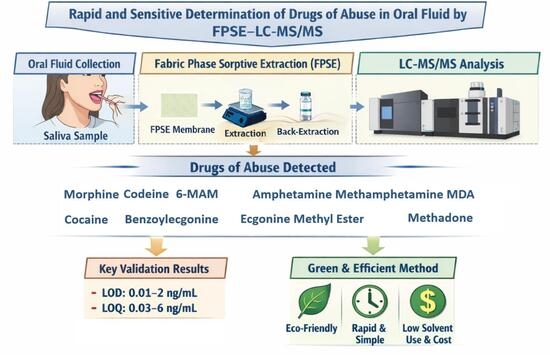
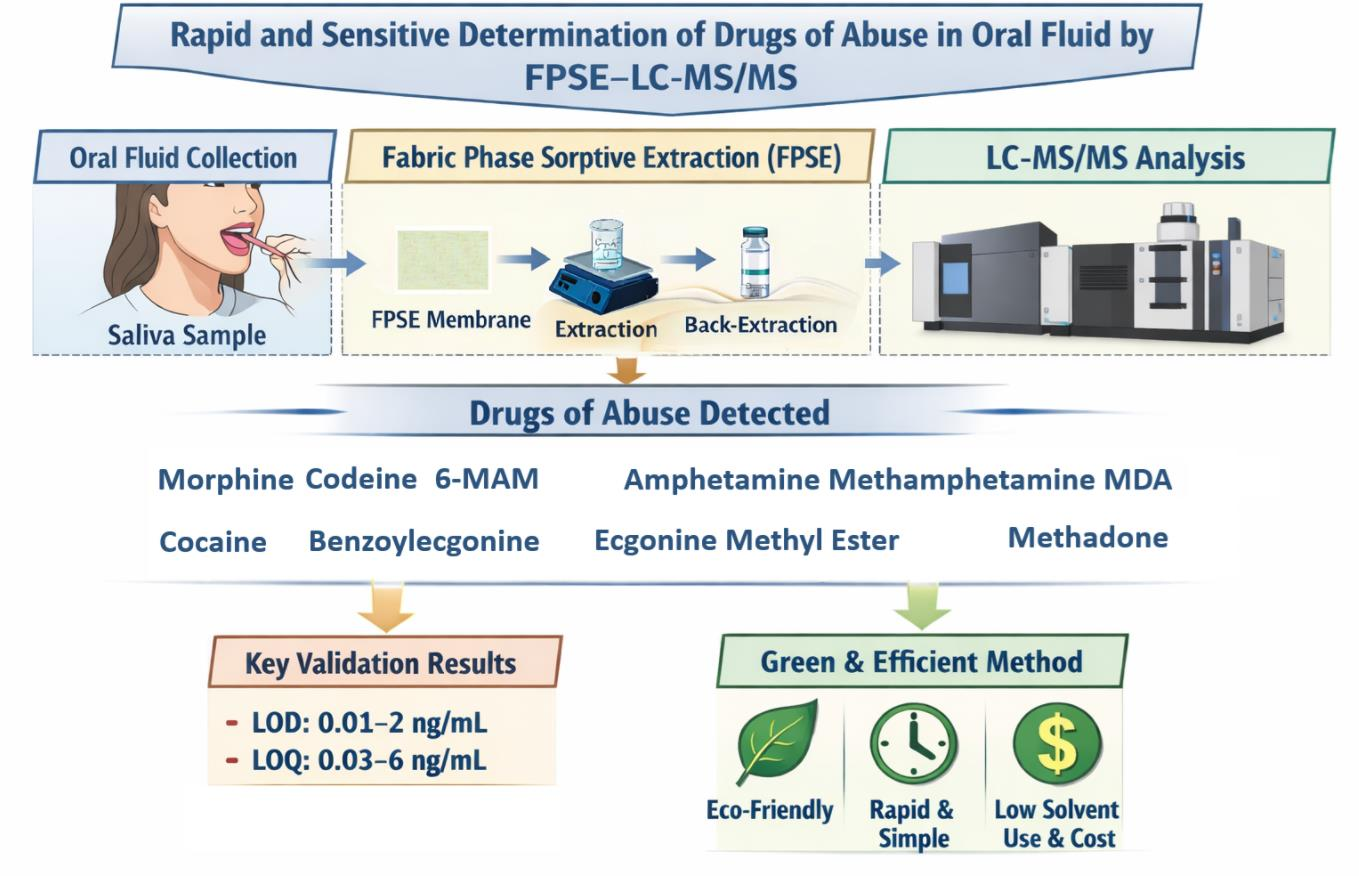
Toxicological testing for drugs of abuse (DOAs) is an essential tool for healthcare practitioners and law enforcement agencies. Oral fluid (OF) is an alternative biological fluid for detecting recent DOA intake and is widely employed in forensic investigations. In the current study, a relatively novel and “green” fabric phase sorptive extraction (FPSE) procedure for sample preparation was coupled to liquid chromatography–tandem mass spectrometry (LC–MS/MS) to provide simplicity, cost-effectiveness, rapidity, low solvent consumption, and high analytical performance for the quantitative determination of ten commonly encountered DOAs and metabolites: amphetamine, benzoylecgonine, cocaine, codeine, ecgonine methyl ester, methadone, methamphetamine, 3,4-methylenedioxyamphetamine, 6-monoacetylmorphine, and morphine. The FPSE procedure was optimized by testing different filters, pH, extraction time, and solvents. The validated method demonstrated excellent linearity for all analytes, selectivity, acceptable precision, and high sensitivity (ranges for limits of detection (LODs) and quantification (LOQs) were 0.01–2 ng/mL and 0.03–6 ng/mL, respectively). Autosampler and short-term freeze stability exceeded 95% and 90% for all analytes, respectively. Overall, the combination of FPSE with LC–MS/MS provided a sensitive, selective, and environmentally friendly innovative analytical approach for the determination of DOA in OF and is suitable for both screening and confirmatory forensic and clinical applications.

Graphical Abstract

1. Introduction

The phenomenon of substance abuse poses a major threat to society and public health, contributing to significant levels of morbidity and mortality. The worldwide availability of illegal drugs affects people both directly, through use, and indirectly, through the effects on families and communities. Among the various biological specimens used for toxicological analysis and public health monitoring of drugs of abuse (DOAs) in the community, oral fluid (OF) is considered to be the most appropriate non-conventional specimen to assess recent use [1]. OF is slightly acidic (pH 6.2–7.6) and is secreted by the salivary glands into the oral cavity [2,3]. Due to its pH being slightly lower than that of blood, weak basic compounds, such as many DOAs, will be present in OF in higher concentrations compared to blood [1,4]. Furthermore, OF is easily collected with almost no risk of sample adulteration or substitution, enhancing the reliability of analytical results [5].
Fabric Phase Sorptive Extraction (FPSE) is an environmentally friendly, sensitive and effective method of extracting a broad range of analytes from various substrates [6]. FPSE incorporates the advantages of classical extraction procedures such as solid-phase extraction (SPE) and solid-phase microextraction (SPME) by using natural (or synthetic) fibrous substrates covered with hybrid organic–inorganic sol–gel coatings [6,7,8]. Compared to conventional extraction techniques, FPSE offers reduced solvent consumption and simplified workflows, aligning with current trends in green analytical chemistry [6,7,8,9]. However, its application in forensic toxicology remains limited, with previous studies mainly focusing on a small number of analytes or specific classes of novel psychoactive substances [9,10]. On the other hand, the determination of various DOAs in OF based on the liquid chromatography–tandem mass spectrometry (LC-MS/MS) method is widely applied and reported in the literature [1,11,12,13,14,15].
The current contribution reports an incremental extension of the FPSE-LC-MS/MS approach from a single analyte [9] to a multi-analyte OF panel of common DOAs and metabolites, enabling reliable detection of low-level drug exposure and recent drug use to fulfill and substantially surpass current regulatory sensitivity requirements, while also demonstrating promising performance for clinical and forensic applications.

2. Experimental Section

2.1. Chemicals and Reagents

Analytical standards and compounds were purchased as follows: 6-MAM, Codeine, Morphine, 3,4 methylene-dioxy-amphetamine (MDA), Ecgonine methyl ester (EME): LGC Standards Ltd. (Luckenwalde, Germany). Methadone, amphetamine, methamphetamine, cocaine, benzoylecgonine (ΒΕ): Cayman Chemical Company. MDMA-d5: LGC GmbH (Luckenwalde, Germany). Morphine-d3: Cerilliant Corporation (Round Rock, TX, USA). Ammonium acetate (99%) was purchased from Fluka™ Analytical Standards (Steinheim, Germany) and Dichloromethane was purchased from Fisher Scientific (part of ThermoFisher Scientific) (Waltham, MA, USA). Acetonitrile, methanol, water (all UHPLC-MS grade), and formic acid (99%) were obtained from CARLO ERBA Reagents GmbH (Cornaredo, Italy). Ultra-pure water was supplied by an Aquatron Water Still A4000D purification system from Bibby Sterilin Limited (Staffordshire, UK). Whatman microfiber glass filters (110 mm) and Whatman cellulose filter papers (125 mm), which were used for FPSE, were purchased from General Electric (Boston, MA, USA). The organic polymer polyethylene glycol (PEG 300) came from Sigma-Aldrich (Athens, Greece). Trimethoxymethylsilane (MTMS), trifluoroacetic acid (TFA), acetone, sodium hydroxide (NaOH), and hydrochloric acid (HCl) were supplied by Merck (Darmstadt, Germany). High-performance liquid chromatography (HPLC) grade requirements were fulfilled for all solvents and reagents utilized for LC–MS/MS analyses.

2.2. Standard and Working Solutions

Individual stock solutions of all ten analytes were prepared in methanol at a concentration of 1 mg/mL; working solutions were prepared at 100, 10, and 1 μg/mL by dilution with methanol. The IS working solutions were prepared in methanol at a concentration of 10 μg/mL. All solutions were kept at −20 °C until analysis. A pooled drug-free sample of OF (as confirmed by gas chromatography–mass spectrometry) was spiked accordingly to prepare the calibration standards (concentration levels for each substance are shown in 2.9). The lowest calibration level for each analyte was set at or above the corresponding LOQ. Quality control samples were prepared at 6, 20, and 60 ng/mL in methanol.

2.3. Pre-Treatment of Fabric for Sol–Gel Coatings

The preparation of Whatman cellulose and microfiber glass filters, including sequential soaking in ultra-pure water, NaOH, and HCl, followed by drying and sol–gel coating with PEG 300/MTMS/TFA catalyst, as well as subsequent rinsing, cutting, and storage, was carried out as described in our previously published work [9].

2.4. Preliminary Optimization Experiments

Preliminary experiments were conducted to optimize the FPSE procedure by testing two types of Whatman filters (microfiber glass filter (FG) and cellulose filter (WC)) at three different extraction times—10, 20, and 30 min—and at acidic (5), neutral (7), and alkaline (9 and 12) pH. The tested back-extraction solvents were methanol, acetonitrile, and their mixture of 50:50 v/v. The back-extraction time was tested in three different time intervals (5, 10, and 15 min). The elution of analytes was tested by sonication and vortexing. Each parameter was tested individually while keeping all other conditions constant.

2.5. Sample Collection and Storage

OF was collected from five individual donors and confirmed to be drug-free by GC–MS analysis using a simple expectoration method. OF was allowed to pool in the lower part of the oral cavity, and participants expelled it into a test tube (pre-weighed) at 60 s intervals. Then, OF was vortexed for 30 s and sonicated for 60 s, and 10 mL aliquots were stored in plastic tubes at 5 °C until analysis, with a maximum storage period of two weeks.

2.6. FPSE Procedure

First, 100 μL of acetonitrile was added to 1 mL of OF for protein precipitation and then vortexed for 30 s, sonicated for 60 s, and centrifuged at 15,000 rpm for 15 min. The supernatant was subjected to extraction using the selected optimal coated filter for a predetermined time under stirring at 300 rpm and the optimized pH, followed by desorption using 150 μL back-extraction solvent.

2.7. LC Conditions

A Dionex UHPLC system (Thermo Scientific, Waltham, MA, USA) coupled to a Q-Trap 5500+™ mass spectrometer (Sciex, Darmstadt, Germany) equipped with an electrospray ionization (ESI) Turbo V source operating in positive mode and in multiple reaction monitoring (MRM) mode was used for chromatographic separation on an Accupore C18 analytical column (50 mm × 3 mm, 2.6 μm) equipped with a precolumn cartridge (2.1 mm × 0.2 μm) (Thermo Scientific, MA, USA), both operated at 30 °C. The injection volume was 5 μL; before and after each injection, the injector’s needle was rinsed with 200 μL methanol. The autosampler temperature was 5 °C. Mobile phases consisted of 10 mM ammonium acetate (pH 3.5, adjusted with 0.1% formic acid) (eluent A) and 0.1% formic acid/acetonitrile UHPLC-MS grade (eluent B). The gradient program at a flow rate of 0.5 mL/min was as follows: 0–0.1 min 2% eluent B; 0.1–0.25 min to 14% eluent B; 0.25–2.5 from 14% to 45% eluent B; 2.5–3.5 from 45% to 100% eluent B; 3.5–4.5 min maintained at 100%; 5.00 min back to initial conditions. The total run time was 6.5 min.

2.8. MS/MS Conditions

ESI inlet conditions were as follows: gas 1, nitrogen (55 psi); gas 2, nitrogen (55 psi); nitrogen as the curtain gas at 20 psi; ion-spray voltage of 5500 V, positive mode; ion-source temperature of 550 °C. The scheduled MRM algorithm in Sciex Analyst® software (v. 1.7.1, Sciex, Darmstadt, Germany) under automatic quantitative optimization mode was applied for the optimization of dwell times and other acquisition settings, while data processing was carried out using SciexOS software (v. 1.6, Sciex, Darmstadt, Germany). Table 1 demonstrates the selected MS parameters.

2.9. Method Validation

The guidelines of the American Academy of Forensic Sciences were followed for method validation [16].

2.9.1. Selectivity, Carryover, Sensitivity, and Linearity

Selectivity experiments were conducted as follows: Blank OF samples were extracted without the addition of IS (morphine-d3), and with IS. Additionally, blank OF samples were fortified with the following 39 substances (50 ng/mL) to exclude any external interference: agomelatine, alprazolam, a-hydroxyalprazolam, amitriptyline, amoxapine, bromazepam, bupropion, chlordiazepoxide, citalopram, clobazam, clomipramine, desipramine, desmethylcitalopram, diazepam, duloxetine, flunitrazepam, fluoxetine, fluvoxamine, imipramine, lorazepam, maprotiline, midazolam, mianserin, mirtazapine, n-desmethylflunitrazepam, n-desmethyltrimipramine, nitrazepam, nordazepam, nortriptyline, o-desmethylvenlafaxine, oxazepam, paroxetine, prazepam, protriptyline, sertraline, temazepam, triazolam, trimipramine, and venlafaxine.
Blank OF samples were analyzed immediately after the analysis of triplicate high-concentration samples (100 ng/mL) to evaluate potential carryover (signal-to-noise ratio exceeding 3:1 was regarded as evidence of carryover for the respective analytes).
Sensitivity was expressed by the LOD and LOQ, defined as the lowest concentration giving a signal-to-noise (S/N) ratio of three and ten, respectively (determined by analyzing three fortified OF samples at decreasing concentrations from 10 to 0.001 ng/mL).
Five replicates at different concentration levels of the ten substances spiked in the blank OF were applied to test linearity. For each analyte, the lowest calibration point was selected to be equal to the corresponding LOQ. For BE, cocaine and methadone, the calibration concentrations were 0.03, 1, 4, 8, 20, 30, 40, 50, and 60 ng/mL. For amphetamine and methamphetamine, the concentrations were 1, 4, 6, 8, 20, 30, 40, 50, and 60 ng/mL. For 6-MAM and codeine, the concentrations were 3, 6, 8, 20, 30, 40, 50, and 60 ng/mL. For EME and morphine, the concentrations were 4, 6, 8, 20, 30, 40, 50, and 60 ng/mL. For MDA, the concentrations were 6, 8, 20, 30, 40, 50, and 60 ng/mL.

2.9.2. Matrix Effect, Accuracy, Precision, and Stability

Matrix effects and extraction efficiency estimations were performed using the post-extraction addition method at three concentrations, low, medium, and high-quality control (LQC/MQC/HQC), in five replicates each group [17]. Group 1 consisted of neat standards, Group 2 of pooled blank OF samples spiked post-extraction, and Group 3 of pooled OF samples spiked prior to extraction. Matrix effects were assessed by comparing Group 2 with Group 1 at the LQC and HQC (10 x LOQ) levels. The evaluated LQC/HQC concentrations were 1/10 ng/mL for amphetamine and methamphetamine; 0.03/30 ng/mL for cocaine, methadone, and BE; 4/40 ng/mL for EME and morphine; 3/30 ng/mL for codeine and 6-MAM; and 6/60 ng/mL for MDA.
Accuracy and precision experiments were conducted over five consecutive days with three replicates of each low, med (5 × LOQ), and high concentration (LQC/MQC/HQC, respectively), spiked daily with corresponding calibrants as follows: the evaluated LQC/MQC/HQC concentrations were 1/5/10 ng/mL for amphetamine and methamphetamine; 0.03/3/30 ng/mL for cocaine, methadone and BE; 4/20/40 ng/mL for EME and morphine; 3/15/30 ng/mL for codeine and 6-MAM; and 6/30/60 ng/mL for MDA. The accuracy of the method was evaluated as percentage recovery, defined as the percentage difference between the mean of all calculated concentration values at each level and the respective nominal concentration.
Intra-day precision was evaluated using five repetitions daily, while inter-day precision was assessed over five consecutive days. Precision (coefficient of variation %CV) had an acceptable cutoff of ≤20% at all concentration levels.
LQC and HQC samples were used to assess short-term and long-term stability at −20 °C, and on autosampler at 5 °C. Samples were analyzed in triplicate after 24 h (short-term stability) and after one week (long-term stability).

3. Results

3.1. Method Development

Analyte chromatographic separation and MS performance were optimized by evaluating the peak area, peak symmetry, signal-to-noise ratio (S/N), and resolution of respective chromatograms obtained under various tested conditions. An indicative chromatogram of a blank OF spiked with all analytes and ISs is shown in Figure 1.
The FPSE procedure was optimized by evaluating the influence of experimental parameters on analyte recovery. In general, differences among the tested conditions were not statistically significant (p > 0.05); therefore, the parameter providing the highest overall performance was selected for further application. The desorption yields obtained with a cellulose microfiber filter (FG) coated with PEG300 were slightly greater than those with fiber glass (except for cocaine) (Figure S1) due to PEG300’s hydrophilic properties and water solubility. An extraction time of 30 min was found to be the most effective for eight out of ten analytes; the exceptions were cocaine and EME, for which the selected time was comparable to 20 min (Figure S2). Neutral pH provided optimal results for most compounds; for amphetamine, this was comparable to pH 9, and for EME, the optimal pH was 9 (Figure S3). Methanol proved to be the most efficient eluent compared to acetonitrile and their mixture, while for codeine, acetonitrile was slightly better, and for EME, the mixture of solvents applied was better (Figure S4). A back-extraction time of 10 min was selected as working better for most analytes (Figure S5). Additionally, the elution of analytes by either ultrasound or vortex showed no significant differences (Figure S6).

3.2. Method Validation Results

The validation parameters are summarized in Table 2. The method was found to be selective for the compounds of interest with no endogenous interferences or interferences from co-eluting compounds, including those run as part of the method or from the additional 39 analytes evaluated. Linearity was excellent for all analytes, since all analytes produced R2 > 0.990 when using five replicates of seven- to nine-point calibration curves and linear through-zero fit. The ranges of LODs and LOQs were 0.01 ng/mL to 2 ng/mL and 0.03 to 6 ng/mL, respectively. Selectivity experiments revealed no matrix interferences or carryover between runs. Matrix effects were acceptable (response < ±30%) for all analytes. Ion suppression was observed for all analytes except methadone, which showed ion enhancement at low and high concentrations. Intra-day and inter-day precision showed acceptable variability at all tested concentration levels. Accuracy (expressed as recovery %) showed consistent results across low, medium, and high concentrations for most analytes. Only two drugs (EME and morphine) had average recoveries < 15%; nevertheless, these compounds had acceptable responses at the LQC sample analysis (S/N > 10). All analytes showed adequate scores in the autosampler stability and the short-term freeze stability.

4. Discussion

In the current study, the application of the relatively novel and “green” FPSE procedure for sample preparation, followed by LC–MS/MS analysis, provided a rapid, simple, and cost-effective approach, achieving high sensitivity and selectivity in the detection of ten common DOAs in OF and demonstrating promising performance for both screening and confirmatory analyses. The current work is an incremental extension of the previous brorphine paper [9], extending the FPSE-LC-MS/MS approach from a single analyte to a multi-analyte oral-fluid panel of common drugs of abuse and metabolites. A limitation of this study is the absence of authentic positive oral fluid samples, primarily due to practical and regulatory constraints, as oral fluid is not routinely collected or used for toxicological analysis in Greece. This restricts the evaluation of the method under real-case conditions.
The efficiency and selectivity of extraction in FPSE depend strongly on the choice of the fabric substrate and coating chemistry [8] in relation to the hydrophilicity/hydrophobicity of the target analytes. Cellulose and polyester substrates are used when solvent desorption is applied, whereas glass fibers are preferred for thermal desorption [18]. Due to the high polarity of most target analytes (having an n-octanol/water partition coefficient with logKow = 0.14–3.93 [19,20]), a polar polymer such as PEG coated onto a hydrophilic cellulose substrate was expected to exhibit improved elution efficiency. Furthermore, the porous sol–gel coating in combination with the high active surface area of the FPSE medium and the permeable cellulose substrate synergistically reduces the required time to reach extraction equilibrium. In addition, the low viscosity of OF allows rapid analyte diffusion [9]. The extended extraction time provided improved peak symmetry and reproducibility and was selected as optimal. The weak basic nature of most analytes (pKa = 8.18–9.9) [20,21], except for BE (pKa values 3.15 and 9.5 and an amphoteric behavior [22]), resulted in optimal results under neutral-pH conditions. Our results showed that most analytes exhibited higher elution efficiencies with methanol (polarity index 0.46 [23]).
The selected desorption conditions were optimal for eight out of ten analytes; methadone and methamphetamine behaved differently, possibly due to differences in polarity, size, and tertiary structure that affected the interactions with the PEG-based FPSE sorbent. Short desorption times resulted in incomplete analyte elution, whereas extended times did not further improve recovery and may have led to partial re-entrapment of the analytes in the FPSE medium. The selected low elution volume is in accordance with green chemistry practices [24,25]. Vortex-assisted desorption was preferred over ultrasound to avoid any possible alterations in the structural, physical, and chemical state of the substances that could be caused by thermal energy released in the ultrasonic bath.
Overall, the combination of FPSE’s equilibrium-based extraction, the analytes’ solubility and their ionization properties were the critical parameters affecting the recovery of analytes from OF, highlighting the significance of analyte–sorbent–solvent interactions in FPSE-based workflows. Specifically, the low recoveries could be the result of the limited water solubility of morphine [26,27] and BE (practically insoluble in water), while for EME, its low methanol solubility results in insufficient desorption from the FPSE membrane [28]. Nevertheless, the recoveries of all analytes were adequate to fulfill linearity, precision, and detectability criteria [29,30]. Although they had low recovery values, EME and morphine yielded acceptable analyte concentrations that allowed for detection at the lower levels recommended by international agencies for screening and confirmation purposes [31,32]. Finally, the use of fewer internal standards than the respective analytes can be acceptable to the forensic scientific community given that the presented methodology is adequately validated [30].
The current methodology for the determination of common DOA in OF demonstrates competitive sensitivity and offers notable advantages in simplicity and sustainability compared to other analytical protocols based on LC-MS/MS analysis with either conventional extraction techniques [1] or innovative and more elaborate approaches [12,13,14,15]. These LC–MS/MS approaches relied on extraction techniques such as QuEChERS salts (LOQs: 0.1–1.5 ng/mL) [12], microextraction by packed sorbent (LOQs: 0.5–5 ng/mL) [14], or dilute-and-shoot protocols (LOQs: 0.5–4.9 ng/mL) [1], achieving LOQs comparable to those obtained in the present study. However, they typically involved more elaborate sample preparation workflows. Moreover, a methodology using an elaborate liquid–liquid extraction with LC–MS/MS reported sub-ng/mL level LOQs (0.02–0.09 ng/mL) of analytes, albeit at the expense of increased solvent use, automation requirements, and procedural complexity [15].
On the other hand, FPSE is simple and cost-effective with low solvent consumption, meaning it can be characterized as a “green” methodology [6,7,8,9]. Nevertheless, its application in forensic toxicology is limited to selected novel psychoactive substances [9,10]. It is worth noting that the incorporation of the FPSE procedure prior to LC-MS/MS analysis for the sensitive detection of a multi-analyte OF panel of common DOAs and metabolites, as presented herein, broadens the potential application of FPSE in the field of forensic toxicology, adequately fulfilling the respective analytical requirements.
On the other hand, the GC–MS-based methodologies for DOA in OF generally present higher LOQs (2.9–20.6 ng/mL) than the current method, which may limit their applicability for low concentration or early detection scenarios [33]. It is worth mentioning that FPSE to OF analysis is reported in a limited number of studies, either on single compounds or restricted drug classes, such as novel psychoactive substances (brorphine [9] or fentanyl analogs [10]), rather than broad multi-analyte panels.
Last but not least is the alignment of the present method to international OF testing criteria from a regulatory and practical perspective; while it exceeds the performance of commonly used screening tools, the LOQs obtained for the tested analytes were substantially lower than the screening and confirmation cut-off concentrations recommended by international agencies [31,32].
Consequently, the proposed method highlights FPSE as a viable and sustainable alternative to conventional extraction techniques, fulfilling and substantially surpassing current regulatory sensitivity requirements by enabling the reliable detection of low-level drug exposure and recent drug use.

5. Conclusion

The proposed methodology combines high sensitivity and selectivity with simplified sample preparation and environmentally friendly operation, highlighting FPSE as a sustainable alternative to conventional extraction techniques that is fully compliant with international guidelines and demonstrates promising performance for clinical and forensic applications.

Supplementary Materials

The following supporting information can be downloaded at: https://www.mdpi.com/article/10.3390/jox16030077/s1, Figure S1: Influence of coating material on the ten DOA yield; Figure S2: Influence of extraction on the ten DOA yield; Figure S3: Influence of pH on the ten DOA yield; Figure S4: Influence of solvent on the ten DOA yield; Figure S5: Influence of back-extraction time on the ten DOA yield; Figure S6: Influence of back extraction medium on the ten DOA yield.

Author Contributions

Conceptualization, V.S. and V.A.B.; methodology, D.F., T.V. and V.A.B.; validation, D.F., T.V., V.S., A.O. and V.A.B.; investigation, D.F.; data curation, D.F.; writing—original draft preparation, D.F., T.V.; writing—review and editing, V.A.B. and A.O.; supervision, V.S. and V.A.B.; project administration, V.A.B. All authors have read and agreed to the published version of the manuscript.

Funding

This research received no external funding.

Institutional Review Board Statement

This study was approved by the Committee of Ethics and Deontology of the Research of the University of Ioannina, Approval Code 25971/2025, on 18 June 2025.

Informed Consent Statement

Informed consent was obtained from all subjects involved in the study.

Data Availability Statement

The original contributions presented in this study are included in the article/Supplementary Materials. Further inquiries can be directed to the corresponding author.

Conflicts of Interest

The authors declare no conflicts of interest.

References

  1. Malaca, S.; Busardò, F.P.; Gottardi, M.; Pichini, S.; Marchei, E. Dilute and shoot ultra-high performance liquid chromatography tandem mass spectrometry (UHPLC–MS/MS) analysis of psychoactive drugs in oral fluid. J. Pharm. Biomed. Anal. 2019, 170, 63–67. [Google Scholar] [CrossRef]
  2. de Almeida, P.D.V.; Grégio, A.M.T.; Machado, M.Â.N.; de Lima, A.A.S.; Azevedo, L.R. Saliva composition and functions: A comprehensive review. J. Contemp. Dent. Pract. 2008, 9, 72–80. [Google Scholar] [CrossRef] [PubMed]
  3. Aps, J.K.M.; Martens, L.C. Review: The physiology of saliva and transfer of drugs into saliva. Forensic Sci. Int. 2005, 150, 119–131. [Google Scholar] [CrossRef]
  4. Bosker, W.M.; Huestis, M.A. Oral fluid testing for drugs of abuse. Clin. Chem. 2009, 55, 1910–1931. [Google Scholar] [CrossRef]
  5. Tamama, K. Advances in drugs of abuse testing. Clin. Chim. Acta 2021, 514, 40–47. [Google Scholar] [CrossRef] [PubMed]
  6. Kazantzi, V.; Anthemidis, A. Fabric sol–gel phase sorptive extraction technique: A review. Separations 2017, 4, 20. [Google Scholar] [CrossRef]
  7. Kabir, A.; Furton, K.G.; Malik, A. Innovations in sol-gel microextraction phases for solvent-free sample preparation in analytical chemistry. TrAC Trends Anal. Chem. 2013, 45, 197–218. [Google Scholar] [CrossRef]
  8. Kabir, A.; Samanidou, V. Fabric phase sorptive extraction: A paradigm shift approach in analytical and bioanalytical sample preparation. Molecules 2021, 26, 865. [Google Scholar] [CrossRef]
  9. Florou, D.; Vlachou, T.; Sakkas, V.; Boumba, V. Application of fabric phase sorptive extraction (FPSE) engaged to tandem LC-MS/MS for quantification of brorphine in oral fluid. J. Xenobiot. 2022, 12, 356–364. [Google Scholar] [CrossRef]
  10. Ares-Fuentes, A.M.; Lorenzo, R.A.; Fernández, P.; Fernández, A.M.; Furton, K.G.; Kabir, A.; Carro, A.M. Determination of synthetic opioids in oral fluid samples using fabric phase sorptive extraction and gas chromatography-mass spectrometry. J. Chromatogr. A 2022, 1663, 462768. [Google Scholar] [CrossRef]
  11. Desrosiers, N.A.; Huestis, M.A. Oral fluid drug testing: Analytical approaches, issues and interpretation of results. J. Anal. Toxicol. 2019, 43, 415–443. [Google Scholar] [CrossRef]
  12. Ferrari, E., Jr.; Bitencourt, V.S.; de Souza, Á.B.M.; Caldas, I.D. Target analysis of psychoactive drugs in oral fluid by QuEChERS extraction and LC-MS/MS. J. Pharm. Biomed. Anal. 2024, 244, 116139. [Google Scholar] [CrossRef]
  13. Borges, G.R.; Santos, B.P.D.; de Gouveia, G.C.; Dalanhol, C.S.; Scherer, J.N.; Eller, S.; de Oliveira, T.F. Determination of drugs of abuse in oral fluid using dried oral fluid spot assisted by 24-well plate and LC–MS/MS. Bioanalysis 2025, 17, 595–605. [Google Scholar] [CrossRef]
  14. Montesano, C.; Simeoni, M.C.; Curini, R.; Sergi, M.; Sterzo, C.L.; Compagnone, D. Determination of illicit drugs and metabolites in oral fluid by microextraction on packed sorbent coupled with LC-MS/MS. Anal. Bioanal. Chem. 2015, 407, 3647–3658. [Google Scholar] [CrossRef]
  15. Tan, J.; Rylski, A.; Bergqvist, A.; Stephanson, N.N. Automated and fully validated high-throughput LC-MS/MS assay for analyzing multiple drugs of abuse in oral fluids using novel features in sample preparation and chromatographic conditions. J. Mass Spectrom. 2025, 60, e5132. [Google Scholar] [CrossRef] [PubMed]
  16. American Academy of Forensic Sciences. Standard Practices for Method Validation in Forensic Toxicology; American Academy of Forensic Sciences: Colorado Springs, CO, USA, 2019; Available online: http://www.asbstandardsboard.org/wp/content/uploads/2019/11/036_Std_e1.pdf (accessed on 11 May 2022).
  17. Matuszewski, B.K.; Constanzer, M.L.; Chavez-Eng, C.M. Strategies for the assessment of matrix effect in quantitative bioanalytical method based on HPLC-MS/MS. Anal. Chem. 2003, 75, 3019–3030. [Google Scholar] [CrossRef]
  18. Lakade, S.S.; Borrull, F.; Furton, K.G.; Kabir, A.; Fontanals, N.; Marcé, R.M. Comparative study of different fabric phase sorptive extraction sorbents to determine emerging contaminants from environmental water using liquid chromatography–tandem mass spectrometry. Talanta 2015, 144, 1342–1351. [Google Scholar] [CrossRef]
  19. Bones, J.; Thomas, K.V.; Paull, B. Using Environmental Analytical Data to Estimate Levels of Community Consumption of Illicit Drugs and Abused Pharmaceuticals: pKa and Log P Data, Supplementary Material ESI; RSC Publishing: Cambridge, UK, 2007. [Google Scholar]
  20. Zhao, L. Quantitative Determination of Drugs of Abuse in Human Whole Blood by LC/MS/MS Using Agilent Captiva EMR—Lipid Cleanup, Application Note 5991-9251EN; Agilent Technologies: Santa Clara, CA, USA, 2016; Available online: https://www.agilent.com (accessed on 20 February 2026).
  21. van Nuijs, A.L.; Tarcomnicu, I.; Bervoets, L.; Blust, R.; Jorens, P.G.; Neels, H.; Covaci, A. Analysis of drugs of abuse in wastewater by hydrophilic interaction liquid chromatography–tandem mass spectrometry. Anal. Bioanal. Chem. 2009, 395, 819–828. [Google Scholar] [CrossRef]
  22. DrugBank Online. Benzoylecgonine. Available online: https://go.drugbank.com/drugs/DB01515 (accessed on 20 February 2026).
  23. Reichardt, C. Solvents and Solvent Effects in Organic Chemistry, 3rd ed.; Wiley-VCH Verlag: Weinheim, Germany, 2003. [Google Scholar] [CrossRef]
  24. Anastas, P.T.; Warner, J.C. Green Chemistry: Theory and Practice; Oxford University Press: New York, NY, USA, 2000. [Google Scholar]
  25. Gałuszka, A.; Migaszewski, Z.; Namieśnik, J. The 12 principles of green analytical chemistry and the SIGNIFICANCE mnemonic of green analytical practices. TrAC Trends Anal. Chem. 2013, 50, 78–84. [Google Scholar] [CrossRef]
  26. Alahyari, E.; Setareh, M.; Shekari, A.; Roozbehani, G.; Soltaninejad, K. Analysis of opioids in postmortem urine samples by dispersive liquid-liquid microextraction and high performance liquid chromatography with photo diode array detection. Egypt. J. Forensic Sci. 2018, 8, 13. [Google Scholar] [CrossRef]
  27. Reyes-Garcés, N.; Bojko, B.; Pawliszyn, J. High-throughput quantification of prohibited substances in plasma using thin film solid phase microextraction. J. Chromatogr. A 2014, 1374, 40–49. [Google Scholar] [CrossRef]
  28. Wishart, D.S.; Feunang, Y.D.; Guo, A.C.; Lo, E.J.; Marcu, A.; Grant, J.R.; Sajed, T.; Johnson, D.; Li, C.; Sayeeda, Z.; et al. DrugBank 5.0: A major update to the DrugBank database for 2018. Nucleic Acids Res. 2018, 46, D1074–D1082. [Google Scholar] [CrossRef] [PubMed]
  29. Wille, S.M.R.; Peters, F.T.; Di Fazio, V.; Samyn, N. Practical aspects concerning validation and quality control for forensic and clinical bioanalytical quantitative methods. Accredit. Qual. Assur. 2011, 16, 279–292. [Google Scholar] [CrossRef]
  30. Di Rago, M.; Pantatan, S.; Hargreaves, M.; Wong, K.; Mantinieks, D.; Kotsos, A.; Glowacki, L.; Drummer, O.H.; Gerostamoulos, D. High throughput detection of 327 drugs in blood by LC-MS-MS with automated data processing. J. Anal. Toxicol. 2021, 45, 154–183. [Google Scholar] [CrossRef]
  31. Cooper, G.; Moore, C.; George, C.; Pichini, S. Guidelines for European workplace drug testing in oral fluid. Drug Test. Anal. 2011, 3, 269–276. [Google Scholar] [CrossRef] [PubMed]
  32. United Nations Office on Drugs and Crime. Guidelines for Testing Drugs Under International Control in Hair, Sweat and Oral Fluid: Manual for Use by National Drug Analysis Laboratories; UNODC: Vienna, Australia; New York, NY, USA, 2014; Available online: https://www.unodc.org/documents/scientific/ST_NAR_30_Rev.3_Hair_Sweat_and_Oral_Fluid.pdf (accessed on 20 February 2026).
  33. Pujadas, M.; Pichini, S.; Civit, E.; Santamariña, E.; Perez, K.; de la Torre, R. A simple and reliable procedure for the determination of psychoactive drugs in oral fluid by gas chromatography–mass spectrometry. J. Pharm. Biomed. Anal. 2007, 44, 594–601. [Google Scholar] [CrossRef] [PubMed]
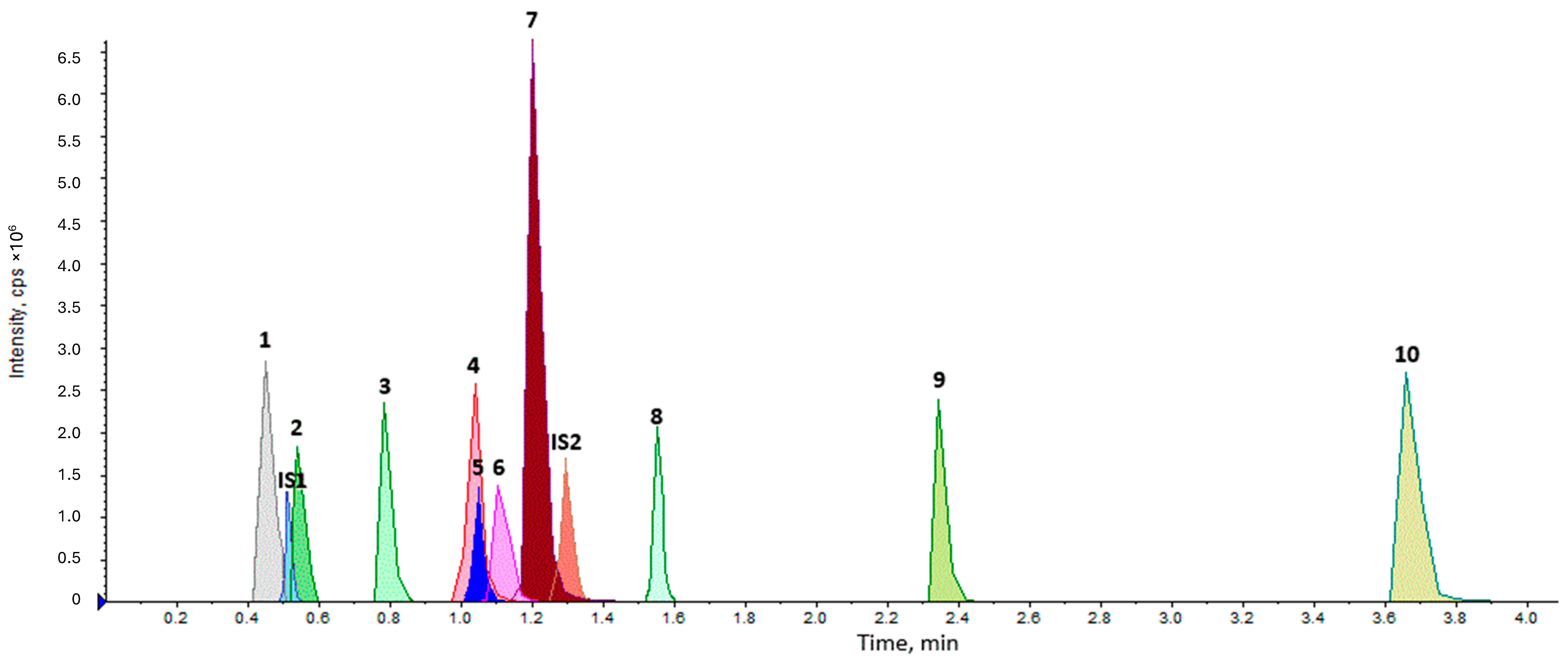
Figure 1. Total Ion Chromatograph (TIC) of the target compounds (1) EME, (2) Morphine, (3) Codeine, (4) Amphetamine, (5) 6-MAM, (6) MDA, (7) Methamphetamine, (8) BE, (9) Cocaine and (10) Methadone at a concentration of 50 ng/mL in OF and the internal standards (IS1) Morphine-d3 and (IS2) MDMA-d5 at a concentration of 50 ng/mL, as well.
Jox 16 00077 g001
Table 1. Analytical parameters selected for MRM: precursor (Q1) and product ions (Q3), retention times (RT), optimal declustering potential (DP), collision energy (CE), and collision cell exit potential (CXP). The entrance potential (EP) value for all analytes was 10. Qualifier ions are shown in bold under the Q3 column.
AnalytesQ1
(m/z)
Q3
(m/z)
ISDP (Volts)CE (Volts)CXP (Volts)
1Amphetamine 1 91IS1252512
Amphetamine 2136.0119.1 251320
Amphetamine 3 65 255110
2BE 1 168.2IS275258
BE 2290.1105 753712
BE 3 77 756332
3Cocaine 1 182.2IS2312712
Cocaine 2304.082.1 314112
Cocaine 3 77 316910
4Codeine 1 215.1IS11003514
Codeine 2300.1165 1005118
Codeine 3 183.1 1003916
5EME 1 182.1IS1802316
EME 2200.082 803514
EME 3 91.1 804312
66-MAM 1 165IS1954516
6-MAM 2328.0211 953716
6-MAM 3 193.1 953912
7MDA 1 163.1IS2251518
MDA 2180.0105 253112
MDA 3 133.1 252514
8Methamphetamine 1 91.1IS2362712
Methamphetamine 2150.1119.2 361510
Methamphetamine 3 65.1 364910
9Methadone 1 265.1IS2202116
Methadone 2310.1105 203312
Methadone 3 77.1 206712
10Morphine 1 201IS1613512
Morphine 2286.1165 615322
Morphine 3 152 617312
IS1Morphine-d3 1289.0155.1 1005118
Morphine-d3 2165 1004920
Morphine-d3 3181 1004720
IS2MDMA-d5 1 165.1 11914
MDMA-d5 2199.1107.1 13512
MDMA-d5 3 135.1 12714
Table 2. Validation parameters of the presented method. Concentrations and LQC, MQC, and HQC are as listed in Section 2.9.2.
AnalyteLOD, ng/mL LOQ, ng/mL Linear Range, ng/mLR2Recovery %
LQC MQC HQC
Matrix Effect %
LQC HQC
Intraday
Precision %
LQC MQC HQC
Inter-Day Precision %
LQC MQC HQC
Amphetamine0.411–600.992646464−23−22987121110
BE0.010.030.03–600.991303133−9−9681013104
EME144–600.991101111−24−20453863
Cocaine0.010.030.03–600.991716570−1−7876454
Codeine0.933–600.990736873−2−1366517104
Methadone0.010.030.03–600.999939287783567811
Methamphetamine0.411–600.994605961−24−24233676
Morphine144–600.997141516−10−2358101111
MDA266–600.997575356−11−91294752
6-MAM0.933–600.994636264−2424222667
Disclaimer/Publisher’s Note: The statements, opinions and data contained in all publications are solely those of the individual author(s) and contributor(s) and not of MDPI and/or the editor(s). MDPI and/or the editor(s) disclaim responsibility for any injury to people or property resulting from any ideas, methods, instructions or products referred to in the content.