
Rabbit Litter-Derived Carbon Materials for Organophosphate Pesticide Mitigation: Adsorption Performance, Neurotoxicity Reduction, and Genotoxicity Assessment

 ,
,  ,
,  ,
,  ,
,  , ,
, ,  ,
,  and
and 
Abstract
1. Introduction
2. Materials and Methods
2.1. Material Synthesis and Characterization
2.2. Adsorption Experiments
2.3. AChE Inhibition Assay
2.4. Blood Sample Preparation
2.5. Genotoxicity Testing
2.6. Statistics
3. Results and Discussion
3.1. Morphology and Elemental Composition
3.2. FTIR Analysis
3.3. Textural Properties
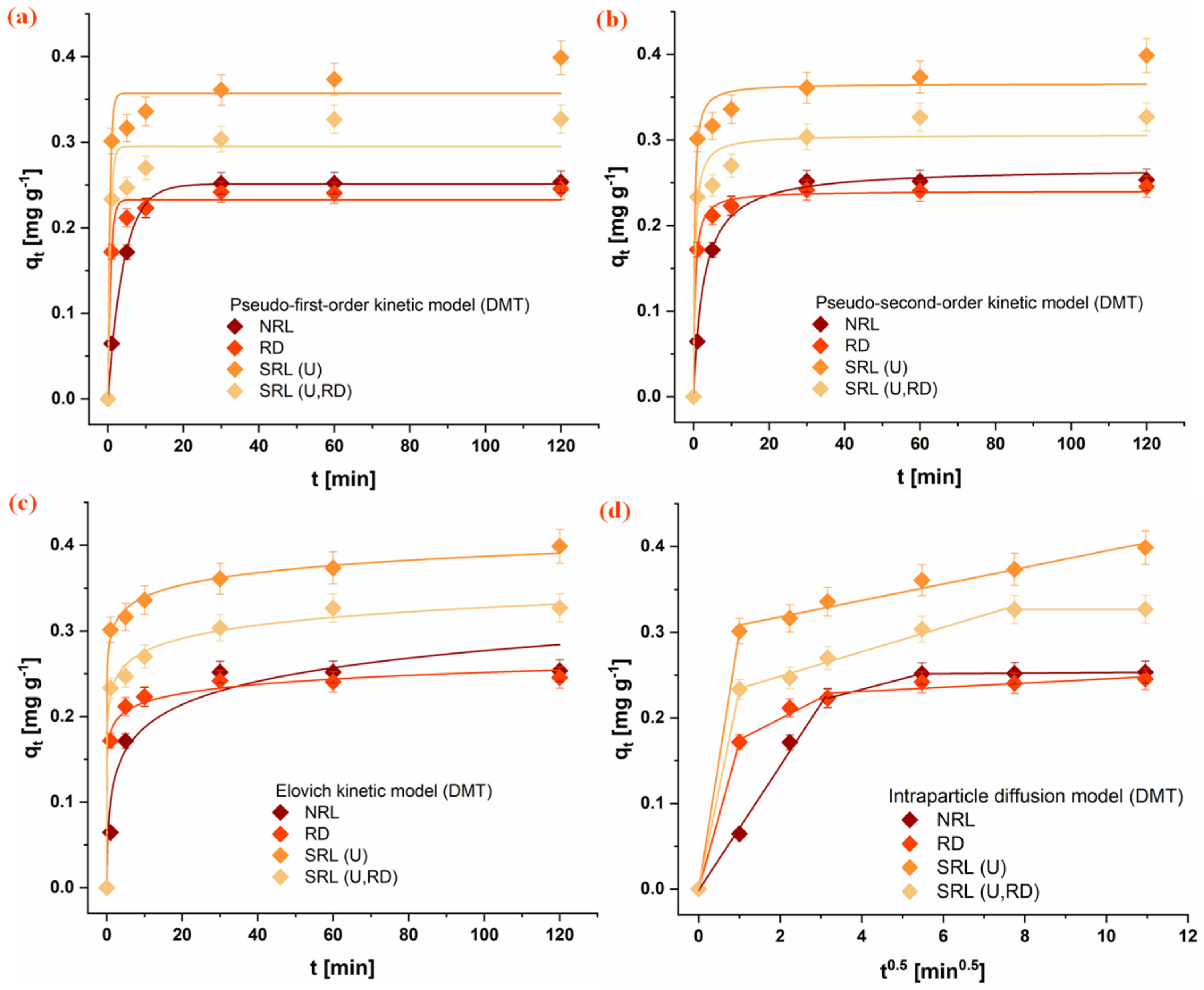
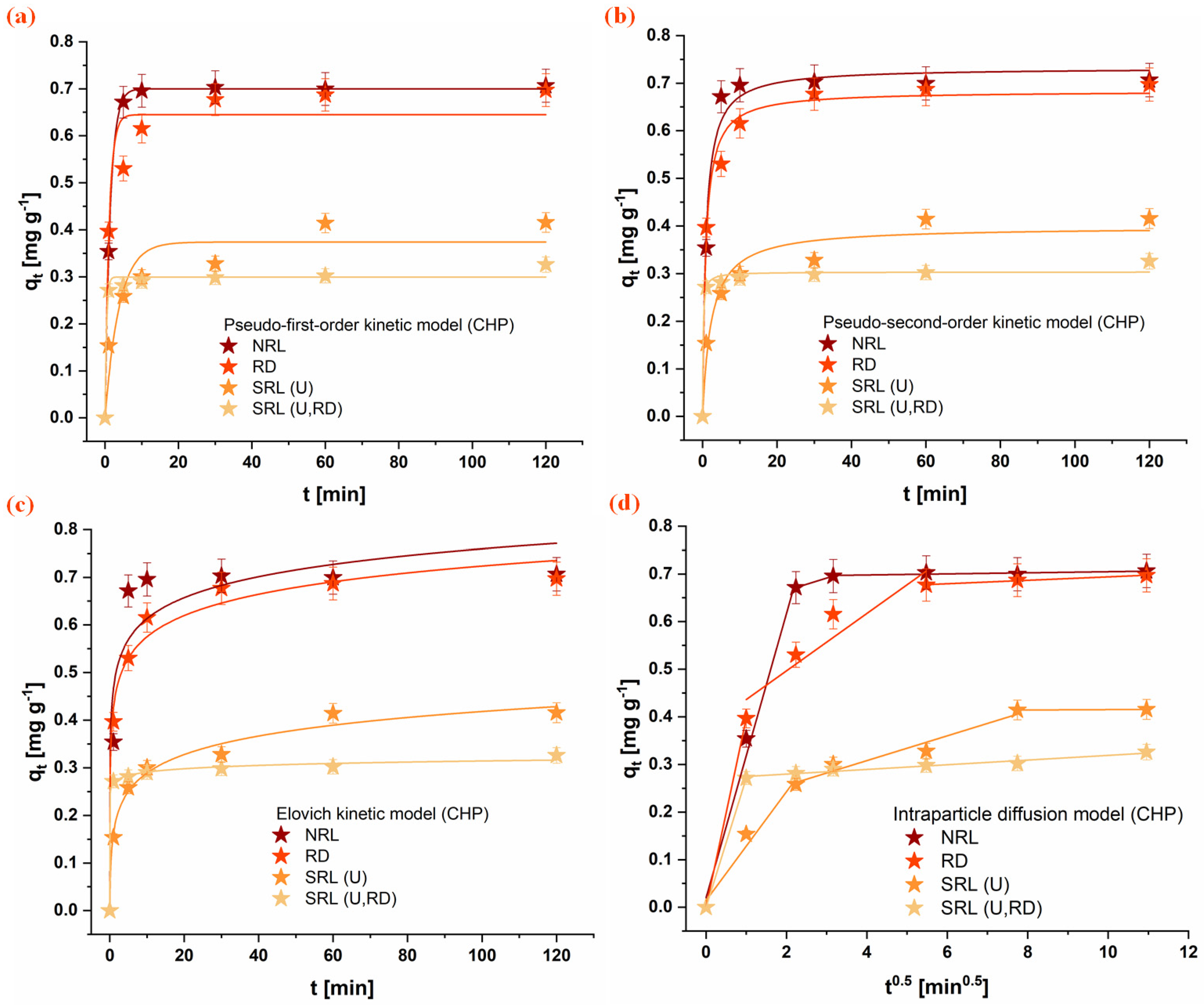
3.4. Adsorption Kinetics
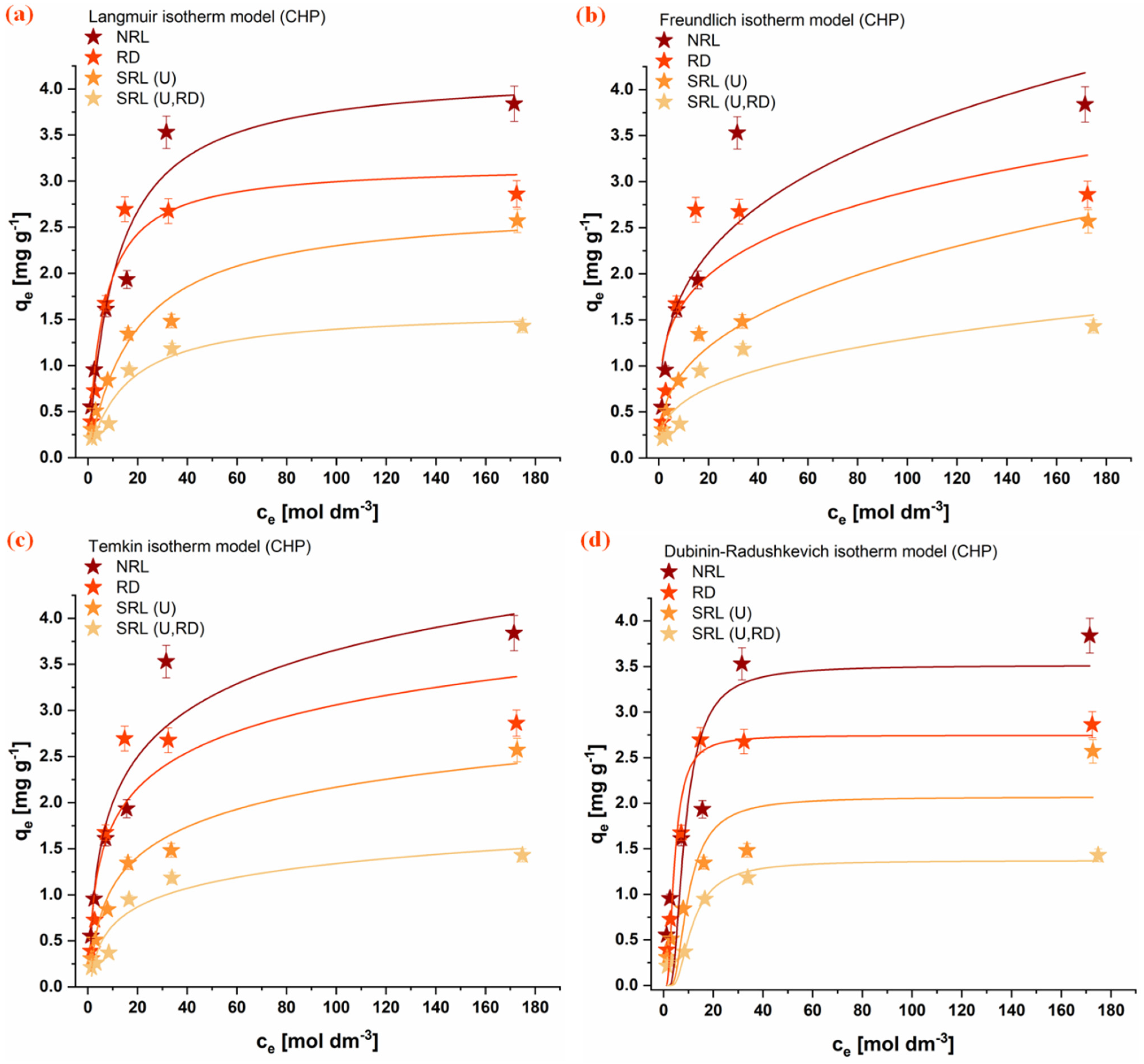
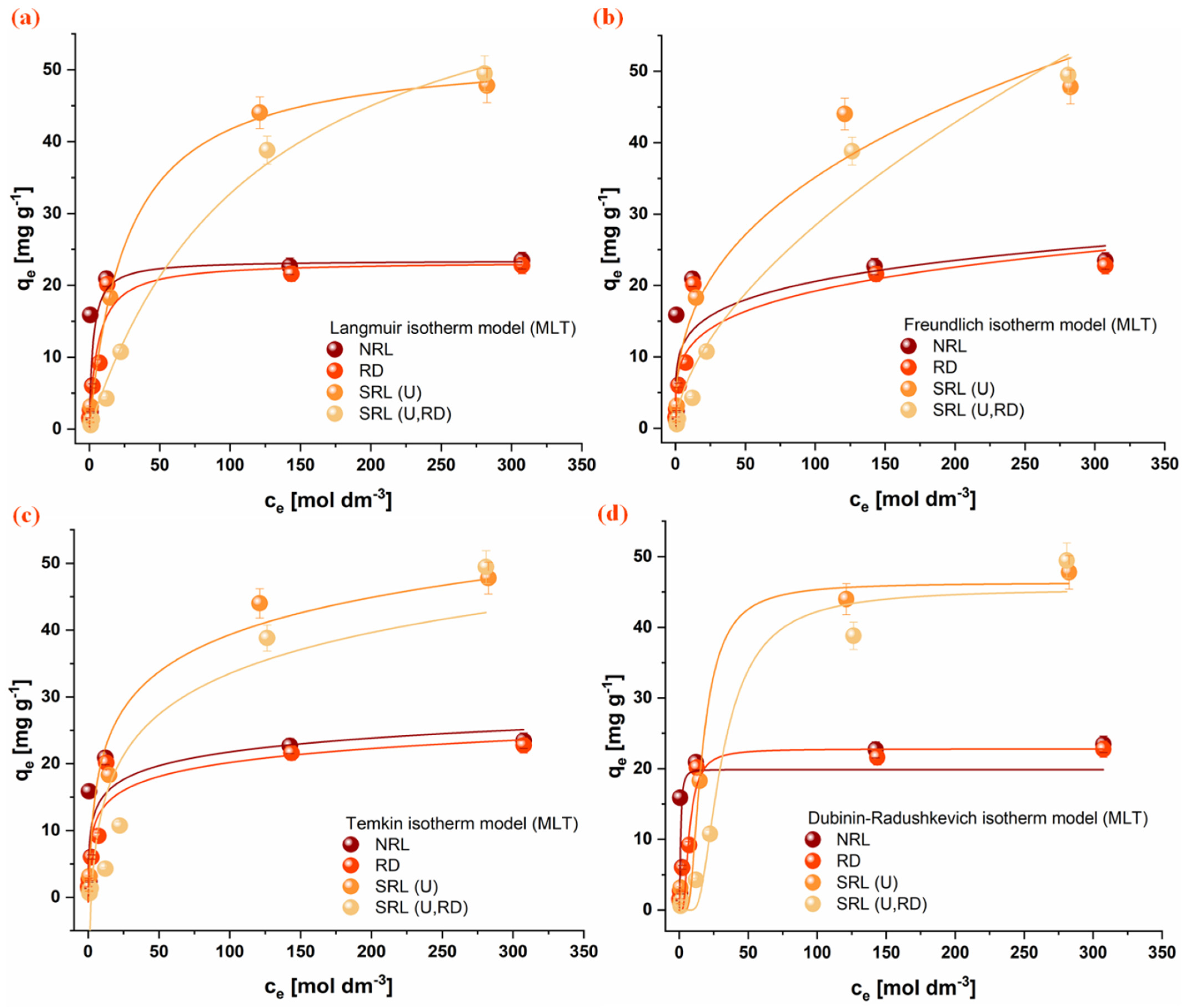
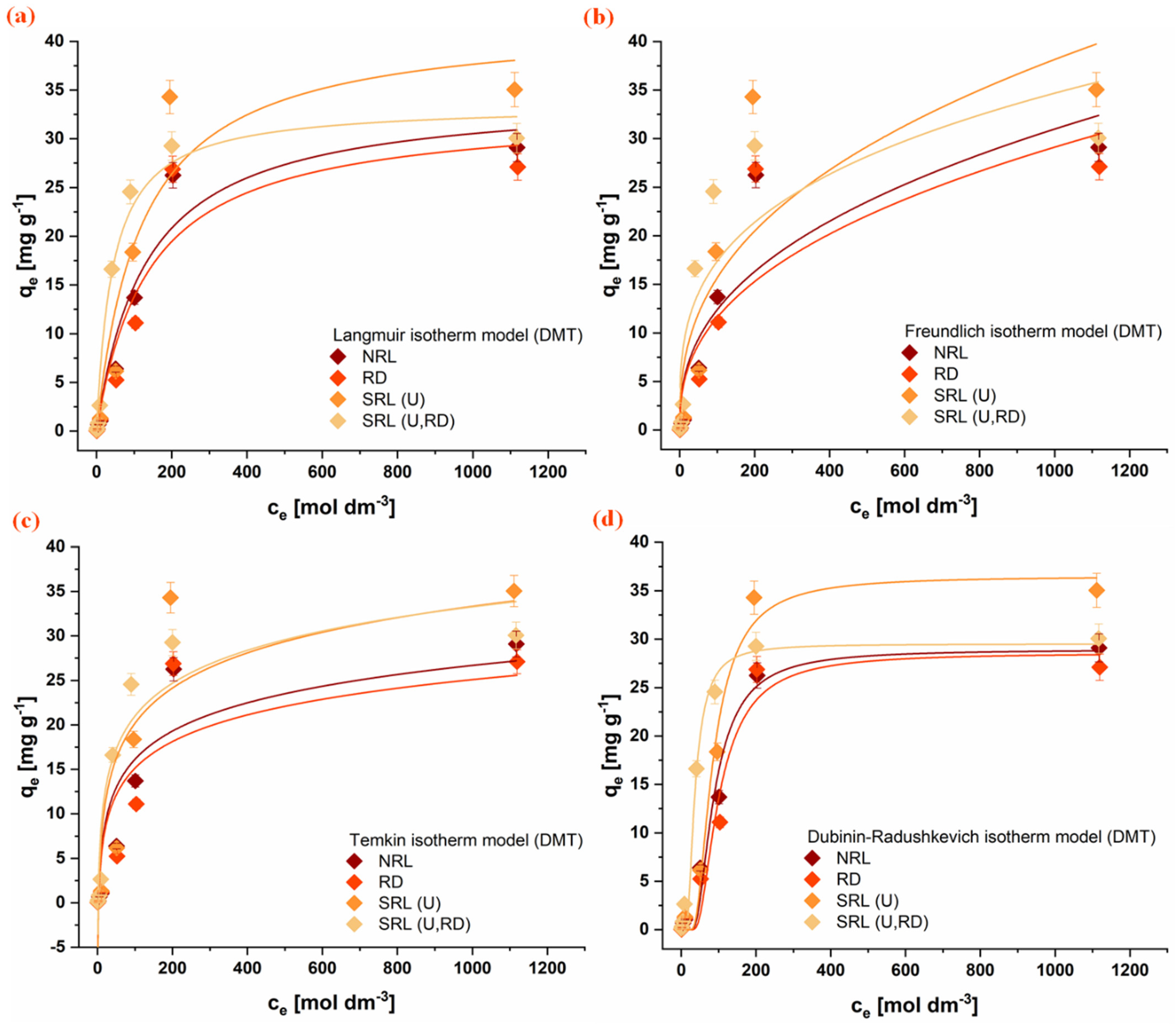
3.5. Adsorption Isotherms
3.6. Reduction in Neurotoxicity After Adsorption
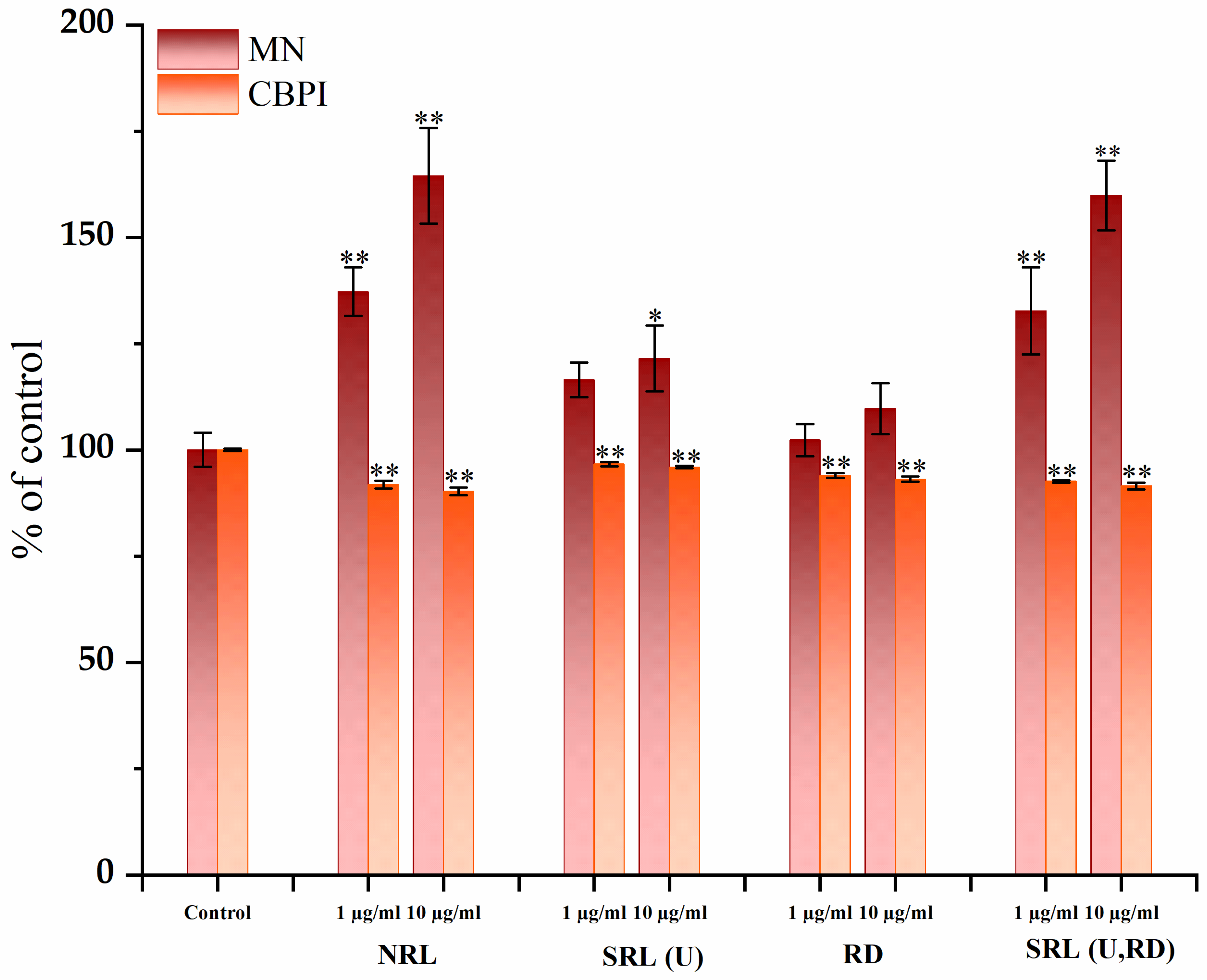
3.7. Genotoxicity Assessment of Carbon Materials
4. Conclusions
Supplementary Materials
Author Contributions
Funding
Institutional Review Board Statement
Informed Consent Statement
Data Availability Statement
Acknowledgments
Conflicts of Interest
References
- Saad, H.; Elfeky, S.A.; El-Gamel, N.E.A.; Abo Dena, A.S. Organophosphate pesticides: A review on classification, synthesis, toxicity, remediation and analysis. RSC Adv. 2025, 15, 40802–40822. [Google Scholar] [CrossRef] [Scilit]
- Singh, N.K.; Sanghvi, G.; Yadav, M.; Padhiyar, H.; Christian, J.; Singh, V. Fate of pesticides in agricultural runoff treatment systems: Occurrence, impacts and technological progress. Environ. Res. 2023, 237, 117100. [Google Scholar] [CrossRef] [Scilit]
- Ávila-Díaz, J.A.; González-Márquez, L.C.; Longoria-Espinoza, R.M.; Ahumada-Cervantes, R.; Leyva-Morales, J.B.; Rodríguez-Gallegos, H.B. Chlorpyrifos and Dimethoate in Water and Sediments of Agricultural Drainage Ditches in Northern Sinaloa, Mexico. Bull. Environ. Contam. Toxicol. 2021, 106, 839–843. [Google Scholar] [CrossRef] [Scilit]
- Ishag, A.E.S.A.; Abdelbagi, A.O.; Hammad, A.M.A.; Elsheikh, E.A.E.; Elsaid, O.E.; Hur, J.-H.; Laing, M.D. Biodegradation of Chlorpyrifos, Malathion, and Dimethoate by Three Strains of Bacteria Isolated from Pesticide-Polluted Soils in Sudan. J. Agric. Food Chem. 2016, 64, 45. [Google Scholar] [CrossRef] [Scilit]
- Ore, O.T.; Adeola, A.O.; Bayode, A.A.; Adedipe, D.T.; Nomngongo, P.N. Organophosphate pesticide residues in environmental and biological matrices: Occurrence, distribution and potential remedial approaches. Environ. Chem. Ecotoxicol. 2023, 5, 9–23. [Google Scholar] [CrossRef] [Scilit]
- Zhou, W.; Li, M.; Achal, V. A comprehensive review on environmental and human health impacts of chemical pesticide usage. Emerg. Contam. 2025, 11, 100410. [Google Scholar] [CrossRef] [Scilit]
- Xie, Q.; Xiao, Q.; Fan, X.; Mao, H.; Gao, Y.; Zhong, C.; Shi, M.; Yu, P.; Huang, J.; Deng, J.; et al. Neurotoxicity and Immunotoxicity of the Insecticide Isofenphos-methyl in Zebrafish (Danio rerio). J. Environ. Sci. 2026; in press. [CrossRef] [Scilit]
- Satyam, S.; Patra, S. Innovations and challenges in adsorption-based wastewater remediation: A comprehensive review. Heliyon 2024, 10, e29573. [Google Scholar] [CrossRef] [Scilit] [PubMed]
- Tewari, S.; Kaur, J.; Tandon, S.; Das, D.K. Recent advances in functionalized nanocarbon adsorbents for toxic pollutant removal: Challenges and future perspectives. Discov. Nano 2026, 21, 57. [Google Scholar] [CrossRef] [Scilit]
- Sathishkumar, R.; Prakash, R. A review on activated carbons (AC) for CO2 capture applications: Preparation, characterisation and surface modification methods. Fuel 2026, 405, 136521. [Google Scholar] [CrossRef] [Scilit]
- Katnić, Đ.; Porobić Katnić, S.; Lazarević-Pašti, T.; Milenković, M.; Terzić, T.; Marinović-Cincović, M.; Živojinović, D. Sterilized plum pomace biochar as a low-cost effective sorbent of environmental contaminants. J. Water Process Eng. 2023, 56, 104487. [Google Scholar] [CrossRef] [Scilit]
- Milankovic, V.; Terzić, T.; Brkovic, S.; Potkonjak, N.; Unterweger, C.; Bajuk-Bogdanović, D.; Pasti, I.; Lazarević-Pašti, T. Spent coffee grounds-derived carbon material as an effective adsorbent for removing multiple contaminants from wastewater: A comprehensive kinetic, isotherm, and thermodynamic study. J. Water Process Eng. 2024, 63, 105507. [Google Scholar] [CrossRef] [Scilit]
- Milankovic, V.; Terzić, T.; Brkovic, S.; Potkonjak, N.; Unterweger, C.; Pasti, I.; Lazarević-Pašti, T. The adsorption of chlorpyrifos and malathion under environmentally relevant conditions using biowaste carbon materials. J. Hazard. Mater. 2024, 480, 135940. [Google Scholar] [CrossRef] [Scilit]
- Molla, A.; Khatun, N.; Kim, D. Biomass-derived carbon materials as adsorbent materials for CO2, organic dyes, antibiotics, and heavy metals-a review. Biomass Futures 2026, 2, 100036. [Google Scholar] [CrossRef] [Scilit]
- Mohamad Nor, N.; Lau, L.C.; Lee, K.T.; Mohamed, A.R. Synthesis of activated carbon from lignocellulosic biomass and its applications in air pollution control—A review. J. Environ. Chem. Eng. 2013, 1, 658–666. [Google Scholar] [CrossRef] [Scilit]
- Terzić, T.; Milankovic, V.; Potkonjak, N.; Unterweger, C.; Pasti, I.; Lazarević-Pašti, T. Valorization of viscose textile waste for the adsorptive removal of organophosphate pesticides from water. J. Water Process Eng. 2025, 69, 106793. [Google Scholar] [CrossRef] [Scilit]
- Terzić, T.; Milankovic, V.; Unterweger, C.; Fuerst, C.; Breitenbach, S.; Pasti, I.; Lazarević-Pašti, T. Highly Porous Cellulose-Based Carbon Fibers as Effective Adsorbents for Chlorpyrifos Removal: Insights and Applications. C 2024, 10, 58. [Google Scholar] [CrossRef] [Scilit]
- Zieliński, B.; Miądlicki, P.; Przepiórski, J. Development of activated carbon for removal of pesticides from water: Case study. Sci. Rep. 2022, 12, 20869. [Google Scholar] [CrossRef] [Scilit]
- Li, W.-K.; Shi, Y.-P. Recent advances of carbon materials on pesticides removal and extraction based determination from polluted water. TrAC Trends Anal. Chem. 2024, 171, 117534. [Google Scholar] [CrossRef] [Scilit]
- Uddin, S. Removal of Pesticides Using Carbon-Based Nanocomposite Materials; Springer Nature: Singapore, 2021; pp. 365–385. [Google Scholar]
- Gupta, S.; Ronen, Z. Treatment of Xenobiotic Cyclic Nitramine Explosives in Wastewater. J. Xenobiot. 2025, 15, 188. [Google Scholar] [CrossRef] [Scilit]
- Štefanac, T.; Grgas, D.; Landeka Dragičević, T. Xenobiotics-Division and Methods of Detection: A Review. J. Xenobiot. 2021, 11, 130–141. [Google Scholar] [CrossRef] [Scilit]
- Subbulakshmi, G.; Debbarma, A.; Sinha, A.; Panda, S. Bio remediation of xenobiotic compound: Reclamation approach for environmental sustainability—A review. Mater. Today Proc. 2021, 47, 1108–1113. [Google Scholar] [CrossRef] [Scilit]
- Lionetto, M.G.; Caricato, R.; Calisi, A.; Giordano, M.E.; Schettino, T. Acetylcholinesterase as a biomarker in environmental and occupational medicine: New insights and future perspectives. BioMed Res. Int. 2013, 2013, 321213. [Google Scholar] [CrossRef] [Scilit]
- Chen, Y.; Yang, Z.; Nian, B.; Yu, C.; Maimaiti, D.; Chai, M.; Yang, X.; Zang, X.; Xu, D. Mechanisms of Neurotoxicity of Organophosphate Pesticides and Their Relation to Neurological Disorders. Neuropsychiatr. Dis. Treat. 2024, 20, 2237–2254. [Google Scholar] [CrossRef] [Scilit]
- Bhattacharya, K.; Mukherjee, S.P.; Gallud, A.; Burkert, S.C.; Bistarelli, S.; Bellucci, S.; Bottini, M.; Star, A.; Fadeel, B. Biological interactions of carbon-based nanomaterials: From coronation to degradation. Nanomed. Nanotechnol. Biol. Med. 2016, 12, 333–351. [Google Scholar] [CrossRef] [Scilit]
- Awasthi, S.; Srivastava, A.; Kumar, D.; Pandey, S.K.; Mubarak, N.M.; Dehghani, M.H.; Ansari, K. An insight into the toxicological impacts of carbon nanotubes (CNTs) on human health: A review. Environ. Adv. 2024, 18, 100601. [Google Scholar] [CrossRef] [Scilit]
- Lindner, K.; Ströbele, M.; Schlick, S.; Webering, S.; Jenckel, A.; Kopf, J.; Danov, O.; Sewald, K.; Buj, C.; Creutzenberg, O.; et al. Biological effects of carbon black nanoparticles are changed by surface coating with polycyclic aromatic hydrocarbons. Part. Fibre Toxicol. 2017, 14, 8. [Google Scholar] [CrossRef] [Scilit]
- Koike, E.; Kobayashi, T. Chemical and biological oxidative effects of carbon black nanoparticles. Chemosphere 2006, 65, 946–951. [Google Scholar] [CrossRef] [Scilit] [PubMed]
- Sigmund, G.; Jiang, C.; Hofmann, T.; Chen, W. Environmental transformation of natural and engineered carbon nanoparticles and implications for the fate of organic contaminants. Environ. Sci. Nano 2018, 5, 2500–2518. [Google Scholar] [CrossRef] [Scilit]
- Rouquerol, J.; Rouquerol, F.; Sing, K. Adsorption by Powders and Porous Solids: Principles, Methodology and Applications; Academic Press: Cambridge, MA, USA, 2013. [Google Scholar]
- Rouquerol, J.; Llewellyn, P.; Rouquerol, F. Is the BET Equation Applicable to Microporous Adsorbents? Stud. Surf. Sci. Catal. 2007, 160, 49–56. [Google Scholar] [CrossRef] [Scilit]
- Rouquerol, J.; Llewellyn, P.; Rouquerol, F. Characterization of Porous Solids VII; Elsevier: Amsterdam, The Netherlands, 2007. [Google Scholar]
- HorvÁTh, G.; Kawazoe, K. Method for Calculation of Effective Pore Size Distribution in Molecular Sieve Carbon. J. Chem. Eng. Jpn. 1983, 16, 470–475. [Google Scholar] [CrossRef] [Scilit]
- Barrett, E.P.; Joyner, L.G.; Halenda, P.P. The Determination of Pore Volume and Area Distributions in Porous Substances. I. Computations from Nitrogen Isotherms. J. Am. Chem. Soc. 1951, 73, 373–380. [Google Scholar] [CrossRef] [Scilit]
- Ellman, G.L.; Courtney, K.D.; Andres, V., Jr.; Feather-Stone, R.M. A new and rapid colorimetric determination of acetylcholinesterase activity. Biochem. Pharmacol. 1961, 7, 88–95. [Google Scholar] [CrossRef] [Scilit]
- Law on Health Care, Official Gazette of the Republic of Serbia, No. 25/2019-40. Available online: https://pravno-informacioni-sistem.rs/eli/rep/sgrs/skupstina/zakon/2019/25/2/reg (accessed on 20 April 2026).
- ISO 10993-3; Biological Evaluation of Medical Devices—Part 3: Tests for Genotoxicity, Carcinogenicity and Reproductive Toxicity. International Organization for Standardization: Geneva, Switzerland, 2014.
- OECD. Test No. 487: In Vitro Mammalian Cell Micronucleus Test; OECD Publishing: Paris, France, 2023. [Google Scholar]
- Fenech, M. The cytokinesis-block micronucleus technique: A detailed description of the method and its application to genotoxicity studies in human populations. Mutat. Res. 1993, 285, 35–44. [Google Scholar] [CrossRef] [Scilit]
- Surrallés, J.; Xamena, N.; Creus, A.; Catalán, J.; Norppa, H.; Marcos, R. Induction of micronuclei by five pyrethroid insecticides in whole-blood and isolated human lymphocyte cultures. Mutat. Res./Genet. Toxicol. 1995, 341, 169–184. [Google Scholar] [CrossRef] [Scilit] [PubMed]
- Yuan, S.-J.; Wang, J.-J.; Dong, B.; Dai, X.-H. Biomass-Derived Carbonaceous Materials with Graphene/Graphene-Like Structures: Definition, Classification, and Environmental Applications. Environ. Sci. Technol. 2023, 57, 17169–17177. [Google Scholar] [CrossRef] [Scilit] [PubMed]
- Bukka, V.V.R.; Sarin, P. Effects of Particle Size Reduction on the Pore Structure and Accessibility in Natural Porous Materials. Energy Fuels 2024, 38, 9578–9587. [Google Scholar] [CrossRef] [Scilit]
- Al Lafi, A.G.; Khuder, A. Removal of Cr(VI) from aqueous solutions by activated carbon and its composite with P2W17O61: A spectroscopic study to reveal adsorption mechanism. Heliyon 2025, 11, e41862. [Google Scholar] [CrossRef] [Scilit]
- Milanković, M.; Mravik, Ž.; Vasiljević, B.; Bajuk-Bogdanović, D.; Uskoković-Marković, S.; Jovanovic, Z. Chemical Titrations and Temperature-Programmed Desorption Study of the Surface Chemistry of Graphene Oxide and 12-Tungstophosphoric Acid Nanocomposite. Processes 2026, 14, 825. [Google Scholar] [CrossRef] [Scilit]
- Subba Reddy, Y.; Rotte, N.K.; Sudhakar, B.K.; Ramakrishna Chand, N.; Naik, R.J.; Mandal, S.; Ravi Chandra, M. Biomass-derived sustainable mesoporous activated carbon as an efficient and recyclable adsorbent for the adsorption of hazardous dyes. Hybrid Adv. 2024, 6, 100218. [Google Scholar] [CrossRef] [Scilit]
- Milanković, V.; Tasić, T.; Brković, S.; Potkonjak, N.; Unterweger, C.; Pašti, I.A.; Lazarević-Pašti, T. Transforming Food Biowaste into Selective and Reusable Adsorbents for Pesticide Removal from Water. Materials 2024, 17, 5499. [Google Scholar] [CrossRef] [Scilit]
- Thommes, M.; Kaneko, K.; Neimark, A.V.; Olivier, J.P.; Rodriguez-Reinoso, F.; Rouquerol, J.; Sing, K.S.W. Physisorption of gases, with special reference to the evaluation of surface area and pore size distribution (IUPAC Technical Report). Pure Appl. Chem. 2015, 87, 1051–1069. [Google Scholar] [CrossRef] [Scilit]
- Rahman, M.; Shafiullah, A.Z.; Pal, A.; Islam, M.A.; Jahan, I.; Saha, B. Study on Optimum IUPAC Adsorption Isotherm Models Employing Sensitivity of Parameters for Rigorous Adsorption System Performance Evaluation. Energies 2021, 14, 7478. [Google Scholar] [CrossRef] [Scilit]
- Tran, H.N.; You, S.-J.; Hosseini-Bandegharaei, A.; Chao, H.-P. Mistakes and inconsistencies regarding adsorption of contaminants from aqueous solutions: A critical review. Water Res. 2017, 120, 88–116. [Google Scholar] [CrossRef] [Scilit]
- Wang, J.; Guo, X. Adsorption kinetic models: Physical meanings, applications, and solving methods. J. Hazard. Mater. 2020, 390, 122156. [Google Scholar] [CrossRef] [Scilit] [PubMed]
- Ali, I.; Burakova, I.; Galunin, E.; Burakov, A.; Mkrtchyan, E.; Melezhik, A.; Kurnosov, D.; Tkachev, A.; Grachev, V. High-Speed and High-Capacity Removal of Methyl Orange and Malachite Green in Water Using Newly Developed Mesoporous Carbon: Kinetic and Isotherm Studies. ACS Omega 2019, 4, 19293–19306. [Google Scholar] [CrossRef] [Scilit]
- Choma, J.; Szczęśniak, B.; Kapusta, A.; Jaroniec, M. A Concise Review on Porous Adsorbents for Benzene and Other Volatile Organic Compounds. Molecules 2024, 29, 5677. [Google Scholar] [CrossRef] [Scilit]
- Mogashane, T.M.; Motlatle, M.A.; Mkhohlakali, A.C.; Mokoena, L.V.; Tshilongo, J. Biochar-Based Adsorption of Polycyclic Aromatic Hydrocarbons in Contaminated Soils: Advances, Mechanisms, and Bibliometric Analysis. Results Eng. 2026, 30, 110374. [Google Scholar] [CrossRef] [Scilit]
- Yang, K.; Jiang, Y.; Yang, J.; Lin, D. Correlations and adsorption mechanisms of aromatic compounds on biochars produced from various biomass at 700 °C. Environ. Pollut. 2018, 233, 64–70. [Google Scholar] [CrossRef] [Scilit]
- Dziejarski, B.; Serafin, J.; Hernández-Barreto, D.F.; Naumovska, E.; Sreńscek-Nazzal, J.; Klomkliang, N.; Tam, E.; Krzyżyńska, R.; Andersson, K.; Knutsson, P. Tailoring highly surface and microporous activated carbons (ACs) from biomass via KOH, K2C2O4 and KOH/K2C2O4 activation for efficient CO2 capture and CO2/N2 selectivity: Characterization, experimental and molecular simulation insights. Chem. Eng. J. 2025, 524, 169677. [Google Scholar] [CrossRef] [Scilit]
- Bhatia, S.K.; Liu, F.; Arvind, G. Effect of Pore Blockage on Adsorption Isotherms and Dynamics: Anomalous Adsorption of Iodine on Activated Carbon. Langmuir 2000, 16, 4001–4008. [Google Scholar] [CrossRef] [Scilit]
- Hong, J.; Kim, H.; Chae, C.; Kim, D.H.; Lee, S.O.; Kim, I. Sulfamethazine adsorption using livestock manure-derived biochar: Significance of oxygen concentration during biochar generation. Biomass Bioenergy 2025, 200, 107970. [Google Scholar] [CrossRef] [Scilit]
- Lee, S.; Kim, M.; Park, G.; Jung, S.; Kwon, E. Animal manure biochar for the removal of hazardous pollutants from wastewater. Biochar X 2025, 1, e003. [Google Scholar] [CrossRef] [Scilit]
- Hadroug, S.; Khiari, B.; Jellali, S.; El-Bassi, L.; Al-Wardy, M.; Hamdi, W.; Jeguirim, M. Animal manure derived biochars synthesis, characterization and use for wastewater treatment and in agriculture: A recent review. Sci. Total Environ. 2025, 985, 179751. [Google Scholar] [CrossRef] [Scilit]
- Kumar, R.; George, L.; Jun, Z.; Mukherji, S. Photocatalytic activity of graphene oxide-TiO2 nanocomposite on dichlorvos and malathion and assessment of toxicity changes due to photodegradation. Chemosphere 2022, 308, 136402. [Google Scholar] [CrossRef] [Scilit]





| Sample | C (at.%) | O (at.%) | Al (at.%) | Cl (at.%) | Ca (at.%) | Mg (at.%) | Si (at.%) | P (at.%) | S (at.%) | Na (at.%) | K (at.%) | N (at.%) |
|---|---|---|---|---|---|---|---|---|---|---|---|---|
| NRL | 93.9 | 4.4 | 0.7 | 0.4 | 0.1 | 0.2 | 0.1 | 0.1 | 0.1 | 0.1 | ND | ND |
| SRL (U) | 92.9 | 5.3 | ND | 1.0 | 0.1 | 0.1 | ND | ND | 0.2 | 0.2 | 0.1 | ND |
| RD | 98.3 | ND | ND | 0.5 | 0.5 | ND | 0.2 | 0.2 | 0.2 | ND | 0.2 | ND |
| SRL (U,RD) | 88.8 | 4.8 | 0.3 | 1.2 | 0.1 | 0.2 | 1.7 | 0.1 | 0.2 | 0.3 | 0.2 | 2.1 |
| Sample | SBET (m2 g−1) | CBET | Vtot (cm3 g−1) | Vmic (cm3 g−1) | dmic (nm) | dmes (nm) |
|---|---|---|---|---|---|---|
| NRL | 487 | 4888 | 0.205 | 0.189 | 0.54 | 16.2 |
| SRL (U) | 10 | 24 | 0.017 | 0.004 | 1.21 | 7.7 |
| RD | 128 | 95 | 0.061 | 0.045 | 0.87 | 4.5 |
| SRL (U,RD) | 14 | 46 | 0.018 | 0.005 | 1.02 | 33.6 |
| CHP | MLT | DMT | |||||||||||
|---|---|---|---|---|---|---|---|---|---|---|---|---|---|
| NRL | RD | SRL (U) | SRL (U,RD) | NRL | RD | SRL (U) | SRL (U,RD) | NRL | RD | SRL (U) | SRL (U,RD) | ||
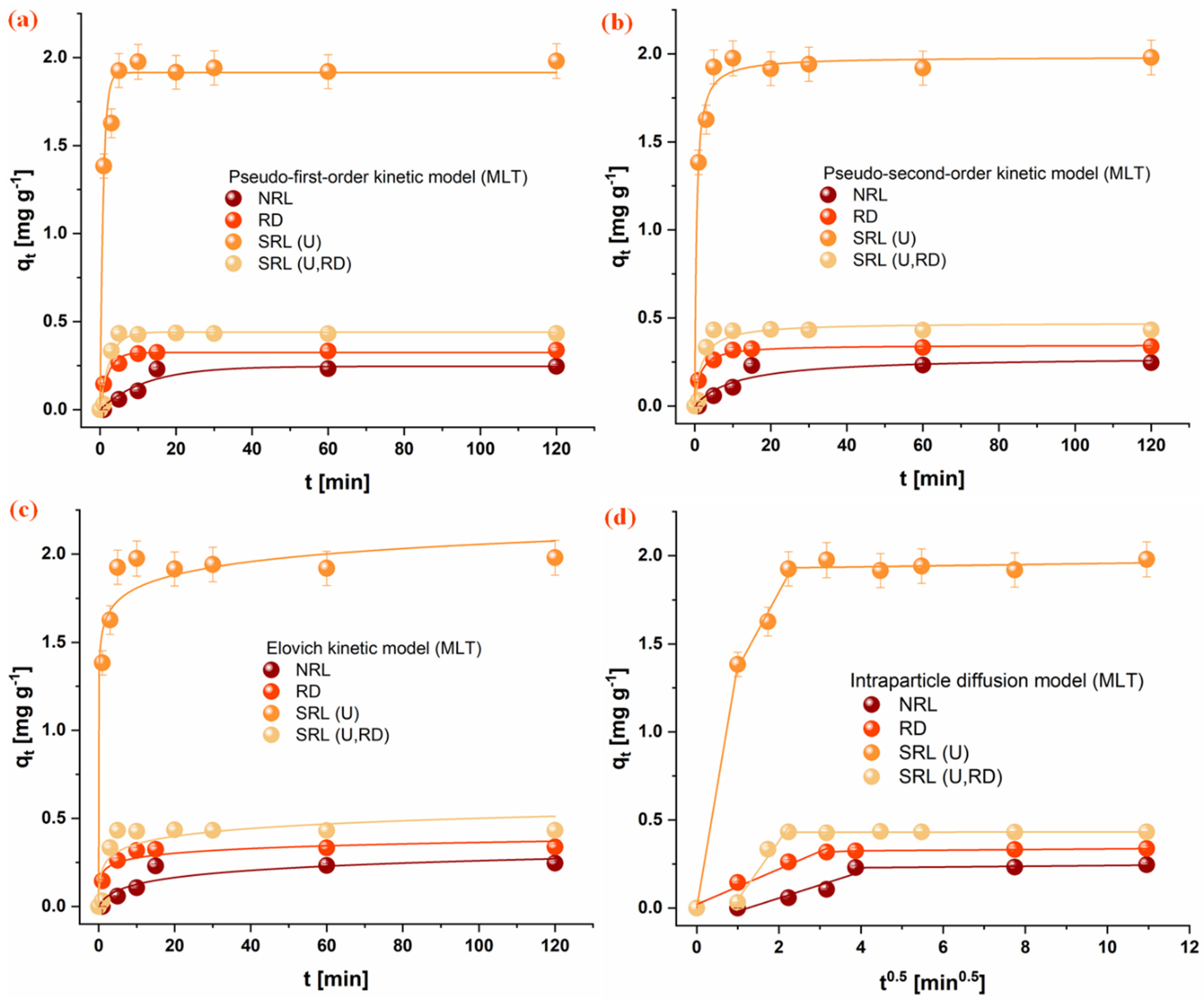
| pseudo-first-order kinetic model | qe (mg g−1) | 0.700 ± 0.001 | 0.645 ± 0.006 | 0.37 ± 0.02 | 0.300 ± 0.002 | 0.247 ± 0.009 | 0.325 ± 0.003 | 1.91 ± 0.04 | 0.441 ± 0.008 | 0.251 ± 0.001 | 0.233 ± 0.002 | 0.357 ± 0.005 | 0.295 ± 0.008 |
| k1 (min−1) | 0.698 ± 0.001 | 0.897 ± 0.004 | 0.258 ± 0.001 | 2.37 ± 0.03 | 0.082 ± 0.008 | 0.461 ± 0.002 | 1.17 ± 0.03 | 0.380 ± 0.009 | 0.237 ± 0.001 | 1.33 ± 0.03 | 1.85 ± 0.05 | 1.56 ± 0.08 | |
| χ2 | 2.44 × 10⁻⁵ | 0.004 | 0.002 | 0.002 | 0.001 | 0.004 | 0.009 | 0.002 | 3.42 × 10⁻⁵ | 0.002 | 0.008 | 0.001 | |
| R2 | 0.999 | 0.943 | 0.888 | 0.982 | 0.914 | 0.979 | 0.977 | 0.928 | 0.997 | 0.979 | 0.955 | 0.922 | |
| pseudo-second-order kinetic model | qe (mg g−1) | 0.732 ± 0.002 | 0.683 ± 0.002 | 0.398 ± 0.006 | 0.303 ± 0.001 | 0.28 ± 0.02 | 0.347 ± 0.001 | 1.98 ± 0.02 | 0.47 ± 0.04 | 0.267 ± 0.001 | 0.240 ± 0.001 | 0.366 ± 0.004 | 0.306 ± 0.006 |
| k2 (mg min−1 g−1) | 1.52 ± 0.01 | 1.71 ± 0.02 | 1.06 ± 0.05 | 24.2 ± 0.2 | 0.32 ± 0.03 | 2.09 ± 0.01 | 1.14 ± 0.02 | 1.1 ± 0.5 | 1.39 ± 0.01 | 9.59 ± 0.02 | 10.4 ± 0.7 | 8.08 ± 0.05 | |
| χ2 | 0.001 | 0.009 | 0.001 | 0.002 | 0.001 | 8.28 × 10⁻⁵ | 0.004 | 0.004 | 6.71 × 10⁻⁵ | 4.39 × 10⁻⁵ | 0.005 | 0.006 | |
| R2 | 0.986 | 0.986 | 0.953 | 0.987 | 0.885 | 0.995 | 0.9896 | 0.868 | 0.994 | 0.994 | 0.970 | 0.951 | |
| Elovich kinetic model | α (mg g−1 min−1) | 98.0 ± 0.9 | 47.6 ± 0.2 | 0.950 ± 0.002 | (2.78 ± 0.01) × 109 | 0.04 ± 0.01 | 5.25 ± 0.08 | (2.34 ± 0.04) × 105 | 1.7 ± 0.8 | 0.464 ± 0.008 | (2.26 ± 0.01) × 103 | (3.39 ± 0.01) × 104 | (4.99 ± 0.01) × 102 |
| β (g mg−1) | 15.7 ± 0.9 | 15.5 ± 0.3 | 17.8 ± 0.2 | 98.4 ± 0.1 | 16 ± 1 | 26.2 ± 0.9 | 9.35 ± 0.04 | 16 ± 8 | 25.6 ± 0.09 | 65.7 ± 0.1 | 48.9 ± 0.1 | 44.7 ± 0.1 | |
| χ2 | 0.007 | 0.001 | 0.003 | 3.64 × 10⁻⁵ | 0.002 | 0.126 | 0.017 ± 0.005 | 0.009 | 0.008 | 6.68 × 10⁻⁵ | 4.96 × 10⁻⁵ | 8.92 × 10⁻⁵ | |
| R2 | 0.905 | 0.984 | 0.986 | 0.997 | 0.838 | 0.924 | 0.960 | 0.718 | 0.922 | 0.991 | 0.997 | 0.993 | |
| Intraparticle diffusion kinetic model | C1 (mg g−1) | 0.020 ± 0.002 | 0 | 0.014 ± 0.005 | 3.93 × 10⁻¹⁷ | 0.09 ± 0.01 | 0.021 ± 0.004 | 7.85 × 10⁻¹⁷ | 0.281 ± 0.007 | 0.002 ± 0.001 | 9.81 × 10⁻¹⁸ | 0 | 0 |
| kid1 (mg g−1 min−0.5) | 0.300 ± 0.003 | 0.400 | 0.114 ± 0.006 | 0.272 | 0.07 ± 0.01 | 0.100 ± 0.005 | 1.384 | 0.330 ± 0.007 | 0.073 ± 0.008 | 0.172 | 0.301 | 0.233 | |
| R2 | 0.983 | / | 0.943 | / | 0.83766 | 0.95858 | / | 0.93575 | 0.9909 | / | / | / | |
| C2 (mg g−1) | 0.613 | 0.38 ± 0.08 | 0.204 ± 0.005 | 0.270 ± 0.004 | 0.22 ± 0.09 | 0.288 | 0.933 ± 0.005 | 0.431 ± 0.008 | 0.18 ± 0.04 | 0.150 ± 0.009 | 0.300 ± 0.006 | 0.220 ± 0.002 | |
| kid2 (mg g−1 min−0.5) | 0.026 | 0.06 ± 0.02 | 0.026 ± 0.002 | 0.005 ± 0.001 | 0.002 ± 0.001 | 0.010 | 0.430 ± 0.005 | (1.96 ± 0.09) ×10−4 | 0.03 ± 0.01 | 0.024 ± 0.009 | 0.010 ± 0.004 | 0.014 ± 0.003 | |
| R2 | / | 0.824 | 0.928 | 0.946 | 0.702 | / | 0.945 | 0.925 | 0.869 | 0.907 | 0.957 | 0.979 | |
| C3 (mg g−1) | 0.69 ± 0.01 | 0.658 ± 0.002 | 0.411 | / | / | 0.319 ± 0.001 | 1.93 ± 0.09 | / | 0.250 | 0.22 ± 0.05 | / | 0.326 | |
| kid3 (mg g−1 min−0.5) | 0.001 ± 0.001 | 0.004 ± 0.001 | 4.14 × 10⁻⁴ | / | / | 0.002 ± 0.001 | 0.003 ± 0.001 | / | 3.41 × 10⁻⁴ | 0.002 ± 0.001 | / | 9.36 × 10⁻⁵ | |
| R2 | 0.895 | 0.983 | / | / | / | 0.993 | 0.914 | / | / | 0.850 | / | / | |
| CHP | MLT | DMT | |||||||||||
|---|---|---|---|---|---|---|---|---|---|---|---|---|---|
| NRL | RD | SRL (U) | SRL (U,RD) | NRL | RD | SRL (U) | SRL (U,RD) | NRL | RD | SRL (U) | SRL (U,RD) | ||
| Freundlich isotherm model | n | 3.4 ± 0.5 | 4 ± 1 | 2.77 ± 0.04 | 3.0 ± 0.8 | 5 ± 2 | 4.3 ± 0.9 | 2.67 ± 0.06 | 1.69 ± 0.04 | 2.5 ± 0.7 | 2.5 ± 0.6 | 2.6 ± 0.8 | 3.3 ± 0.7 |
| KF ((mg g−1)(dm3 g−1)1/n) | 0.92 ± 0.07 | 1.0 ± 0.3 | 0.409 ± 0.005 | 0.28 ± 0.09 | 8 ± 3 | 6.6 ± 0.9 | 6.26 ± 0.07 | 1.86 ± 0.04 | 2.0 ± 0.8 | 1.8 ± 0.8 | 2.6 ± 0.8 | 4.4 ± 0.8 | |
| χ2 | 0.339 | 0.459 | 0.023 | 0.056 | 39.989 | 18.773 | 29.020 | 16.616 | 25.628 | 30.893 | 53.684 | 46.638 | |
| R2 | 0.812 | 0.607 | 0.966 | 0.792 | 0.579 | 0.781 | 0.941 | 0.963 | 0.823 | 0.773 | 0.768 | 0.746 | |
| Langmuir isotherm model | qmax (mg g−1) | 4.19 ± 0.07 | 3.18 ± 0.08 | 2.74 ± 0.01 | 1.61 ± 0.06 | 23 ± 9 | 23.4 ± 0.6 | 52.9 ± 0.1 | 71.8 ± 0.1 | 34.6 ± 0.5 | 33 ± 2 | 42.1 ± 0.9 | 33.5 ± 0.3 |
| KL (dm3 mg−1) | 0.088 ± 0.006 | 0.161 ± 0.009 | 0.053 ± 0.005 | 0.064 ± 0.007 | 0.3 ± 0.1 | 0.165 ± 0.009 | 0.037 ± 0.001 | 0.008 ± 0.001 | 0.008 ± 0.002 | 0.007 ± 0.002 | 0.008 ± 0.004 | 0.023 ± 0.002 | |
| χ2 | 0.127 | 0.087 | 0.030 | 0.016 | 33.139 | 6.733 | 0.912 | 2.636 | 7.725 | 13.838 | 20.425 | 4.802 | |
| R2 | 0.930 | 0.925 | 0.955 | 0.940 | 0.651 | 0.921 | 0.998 | 0.994 | 0.947 | 0.898 | 0.912 | 0.974 | |
| Temkin isotherm model | Kt (dm3 mg−1) | 1.59 ± 0.09 | 2.3 ± 0.9 | 0.997 ± 0.004 | 0.96 ± 0.02 | 15 ± 7 | 8.0 ± 0.6 | 1.33 ± 0.03 | 0.44 ± 0.08 | 0.34 ± 0.08 | 0.33 ± 0.09 | 0.34 ± 0.09 | 0.51 ± 0.01 |
| bt (J g mol−1 mg−1) | 3440 ± 9 | 4000 ± 2000 | 5260 ± 4 | 8500 ± 100 | 800 ± 300 | 800 ± 40 | 308 ± 3 | 300 ± 50 | 500 ± 80 | 500 ± 200 | 400 ± 100 | 460 ± 10 | |
| χ2 | 0.180 | 0.249 | 0.022 | 0.031 | 34.483 | 13.120 | 14.864 | 80.548 | 25.803 | 31.162 | 48.670 | 18.584 | |
| R2 | 0.901 | 0.787 | 0.967 | 0.886 | 0.637 | 0.847 | 0.970 | 0.820 | 0.822 | 0.771 | 0.790 | 0.899 | |
| Dubinin-Radushkevich isotherm model | qDR (mg g−1) | 4 ± 2 | 2.75 ± 0.07 | 2.1 ± 0.9 | 1.4 ± 0.2 | 20 ± 10 | 23 ± 3 | 46.3 ± 0.1 | 45.5 ± 0.4 | 28.9 ± 0.3 | 28.6 ± 0.5 | 36.5 ± 0.2 | 29.5 ± 0.1 |
| KDR (mol2 J−2) | (10 ± 5) × 10−6 | (2.80 ± 0.08) × 10−6 | (1.3 ± 0.9) × 10−5 | (1.7 ± 0.1) × 10−5 | (3 ± 2) × 10−7 | (7.4 ± 0.4) × 10−6 | (3.5 ± 0.2) × 10−5 | (1.22 ± 0.03) × 10−4 | (9.39 ± 0.03) × 10−4 | (1.23 ± 0.06) × 10−3 | (8.81 ± 0.02) × 10−4 | (1.66 ± 0.02) × 10−4 | |
| E (J mol−1) | 200 ± 100 | 423 ± 6 | 200 ± 100 | 170 ± 10 | 100 ± 60 | 260 ± 30 | 120 ± 10 | 64.1 ± 0.3 | 23.1 ± 0.2 | 20.1 ± 0.5 | 24 ± 3 | 54.8 ± 0.1 | |
| χ2 | 0.555 | 0.085 | 0.220 | 0.030 | 55.219 | 10.978 | 5.337 | 14.348 | 3.405 | 5.770 | 2.893 | 1.817 | |
| R2 | 0.693 | 0.928 | 0.674 | 0.888 | 0.418 | 0.872 | 0.989 | 0.968 | 0.977 | 0.958 | 0.988 | 0.990 | |
| OP | Material | Residual OP Concentration (mol dm−3) | Removal Efficiency (%) | AChE Inhibition (% of Control) |
|---|---|---|---|---|
| CHP | before adsorption | 1 × 10⁻⁵ | 0 | 40 ± 3 |
| CHP | NRL | 8.46 × 10⁻⁶ | 15 | 22 ± 2 |
| CHP | RD | 8.24 × 10⁻⁶ | 18 | 20 ± 3 |
| CHP | SRL(U) | 8.82 × 10⁻⁶ | 12 | 25 ± 3 |
| CHP | SRL(U,RD) | 9.14 × 10⁻⁶ | 9 | 29 ± 2 |
| MLT | before adsorption | 1 × 10⁻⁵ | 0 | 35 ± 3 |
| MLT | NRL | 9.29 × 10⁻⁶ | 7 | 33 ± 1 |
| MLT | RD | 8.99 × 10⁻⁶ | 10 | 31 ± 2 |
| MLT | SRL(U) | 4.19 × 10⁻⁶ | 58 | 11 ± 1 |
| MLT | SRL(U,RD) | 8.77 × 10⁻⁶ | 12 | 30 ± 4 |
| DMT | before adsorption | 1 × 10⁻⁵ | 0 | 20 ± 3 |
| DMT | NRL | 8.90 × 10⁻⁶ | 11 | 12 ± 2 |
| DMT | RD | 8.95 × 10⁻⁶ | 11 | 12 ± 3 |
| DMT | SRL(U) | 8.37 × 10⁻⁶ | 16 | 10 ± 1 |
| DMT | SRL(U,RD) | 8.58 × 10⁻⁶ | 14 | 11 ± 1 |
| Sample | Incidence of Micronuclei MN/1000 BN | Incidence of Micronuclei MN/1000 BN (mean ± S.D.) | CBPI | CBPI (mean ± S.D.) | |
|---|---|---|---|---|---|
| Control | 11.70 | 11.20 ± 0.45 a | 1.88 | 1.88 ± 0.01 a | |
| 11.06 | 1.88 | ||||
| 10.84 | 1.89 | ||||
| NRL | 1 µg/mL | 16.03 | 15.37 ± 0.64 c | 1.71 | 1.73 ± 0.02 de |
| 15.33 | 1.74 | ||||
| 14.75 | 1.74 | ||||
| 10 µg/mL | 19.59 | 18.43 ± 1.26 d | 1.68 | 1.70 ± 0.02 d | |
| 18.61 | 1.71 | ||||
| 17.09 | 1.71 | ||||
| SRL (U) | 1 µg/mL | 13.57 | 13.04 ± 0.45 abc | 1.81 | 1.82 ± 0.01 b |
| 12.82 | 1.82 | ||||
| 12.75 | 1.83 | ||||
| 10 µg/mL | 14.58 | 13.61 ± 0.87 bc | 1.81 | 1.81 ± 0.01 b | |
| 13.35 | 1.81 | ||||
| 12.90 | 1.80 | ||||
| RD | 1 µg/mL | 11.76 | 11.46 ± 0.43 ab | 1.77 | 1.77 ± 0.01 c |
| 11.64 | 1.76 | ||||
| 10.97 | 1.78 | ||||
| 10 µg/mL | 12.99 | 12.29 ± 0.67 ab | 1.74 | 1.75 ± 0.01 ce | |
| 12.23 | 1.76 | ||||
| 11.65 | 1.76 | ||||
| SRL (U,RD) | 1 µg/mL | 15.61 | 14.87 ± 1.14 c | 1.75 | 1.74 ± 0.01 ce |
| 15.44 | 1.74 | ||||
| 13.55 | 1.74 | ||||
| 10 µg/mL | 18.81 | 17.91 ± 0.92 d | 1.72 | 1.72 ± 0.02 de | |
| 17.94 | 1.71 | ||||
| 16.97 | 1.74 | ||||
Disclaimer/Publisher’s Note: The statements, opinions and data contained in all publications are solely those of the individual author(s) and contributor(s) and not of MDPI and/or the editor(s). MDPI and/or the editor(s) disclaim responsibility for any injury to people or property resulting from any ideas, methods, instructions or products referred to in the content. |
© 2026 by the authors. Licensee MDPI, Basel, Switzerland. This article is an open access article distributed under the terms and conditions of the Creative Commons Attribution (CC BY) license.
Share and Cite
Lazarević-Pašti, T.; Terzić, T.; Leskovac, A.; Petrović, S.; Milanković, V.; Radivojević, N.; Krstić, J.; Kokanov Stanković, K.; Jocic, A.; Brković, S.; et al. Rabbit Litter-Derived Carbon Materials for Organophosphate Pesticide Mitigation: Adsorption Performance, Neurotoxicity Reduction, and Genotoxicity Assessment. J. Xenobiotics 2026, 16, 75. https://doi.org/10.3390/jox16030075
Lazarević-Pašti T, Terzić T, Leskovac A, Petrović S, Milanković V, Radivojević N, Krstić J, Kokanov Stanković K, Jocic A, Brković S, et al. Rabbit Litter-Derived Carbon Materials for Organophosphate Pesticide Mitigation: Adsorption Performance, Neurotoxicity Reduction, and Genotoxicity Assessment. Journal of Xenobiotics. 2026; 16(3):75. https://doi.org/10.3390/jox16030075
Chicago/Turabian StyleLazarević-Pašti, Tamara, Tamara Terzić, Andreja Leskovac, Sandra Petrović, Vedran Milanković, Nevena Radivojević, Jugoslav Krstić, Katarina Kokanov Stanković, Ana Jocic, Snežana Brković, and et al. 2026. "Rabbit Litter-Derived Carbon Materials for Organophosphate Pesticide Mitigation: Adsorption Performance, Neurotoxicity Reduction, and Genotoxicity Assessment" Journal of Xenobiotics 16, no. 3: 75. https://doi.org/10.3390/jox16030075
APA StyleLazarević-Pašti, T., Terzić, T., Leskovac, A., Petrović, S., Milanković, V., Radivojević, N., Krstić, J., Kokanov Stanković, K., Jocic, A., Brković, S., & Pašti, I. (2026). Rabbit Litter-Derived Carbon Materials for Organophosphate Pesticide Mitigation: Adsorption Performance, Neurotoxicity Reduction, and Genotoxicity Assessment. Journal of Xenobiotics, 16(3), 75. https://doi.org/10.3390/jox16030075