
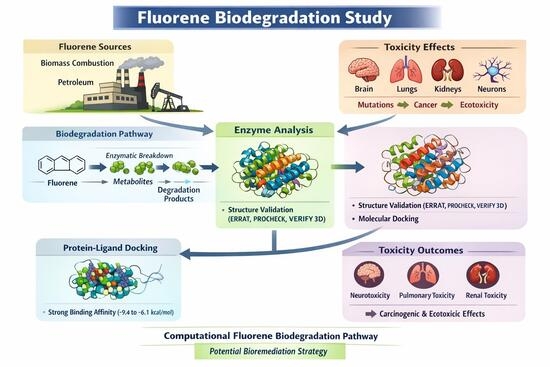
In Silico Approach for Fluorene Biodegradation, and the Impacts of Derivatives on the Environment and Health



Abstract
Share and Cite
Ali, S.R.; Anwar, Y.; Ali, H.M. In Silico Approach for Fluorene Biodegradation, and the Impacts of Derivatives on the Environment and Health. J. Xenobiotics 2026, 16, 70. https://doi.org/10.3390/jox16020070
Ali SR, Anwar Y, Ali HM. In Silico Approach for Fluorene Biodegradation, and the Impacts of Derivatives on the Environment and Health. Journal of Xenobiotics. 2026; 16(2):70. https://doi.org/10.3390/jox16020070
Chicago/Turabian StyleAli, Syed Raju, Yasir Anwar, and Hani Mohammed Ali. 2026. "In Silico Approach for Fluorene Biodegradation, and the Impacts of Derivatives on the Environment and Health" Journal of Xenobiotics 16, no. 2: 70. https://doi.org/10.3390/jox16020070
APA StyleAli, S. R., Anwar, Y., & Ali, H. M. (2026). In Silico Approach for Fluorene Biodegradation, and the Impacts of Derivatives on the Environment and Health. Journal of Xenobiotics, 16(2), 70. https://doi.org/10.3390/jox16020070