
Article

SPE–UHPLC–MS/MS Method for Simultaneous Quantification of 50 Pesticide Biomarkers Across Nine Current-Use Chemical Classes in Human Urine

Institute for Exposomic Research, Department of Environmental Medicine, Icahn School of Medicine at Mount Sinai, New York, NY 10029, USA
*
Author to whom correspondence should be addressed.
J. Xenobiot. 2026, 16(2), 67; https://doi.org/10.3390/jox16020067
Submission received: 25 February 2026 / Revised: 31 March 2026 / Accepted: 6 April 2026 / Published: 13 April 2026
(This article belongs to the Topic Environmental Toxicology and Human Health—2nd Edition)

Abstract

A comprehensive ultra-high-performance liquid chromatography-tandem mass spectrometry (UHPLC-MS/MS) method was developed for the simultaneous quantification of 50 pesticide biomarkers across nine current-use chemical classes in human urine. These classes include organophosphorus insecticides (which encompass dialkyl phosphates and specific metabolites), pyrethroid insecticides, fungicides, neonicotinoid insecticides, herbicides, insect repellents, organochlorine pesticide metabolites, and plant growth regulators. The method employs solid-phase extraction (SPE) for sample preparation, requiring only 0.2 mL of urine. Chromatographic separation was optimized using a Hypersil Gold AQ column, achieving a total run time of 18 min. Mass spectrometric detection utilized polarity switching in electrospray ionization mode with multiple reaction monitoring. Method validation demonstrated satisfactory linearity (R2 > 0.99), high sensitivity with limits of detection ranging from 0.01 to 0.88 ng/mL, and extraction efficiencies between 85% and 113%. Precision and accuracy were within acceptable ranges, with relative standard deviations generally below 15%. The method’s robustness was confirmed through participation in external quality assessment schemes. Application to real samples revealed significant inter-individual variability in pesticide biomarker concentrations, with total measured biomarker levels ranging from 89 to 1242 ng/mL across the 10 individuals analyzed. This method offers comprehensive coverage of current-use pesticide chemical classes, including 30 biomarkers from the U.S. National Health and Nutrition Examination Survey (NHANES) biomonitoring program, and demonstrates improved sensitivity and broader analyte coverage compared to existing methods. The developed assay provides a valuable tool for large-scale biomonitoring studies and environmental health research.

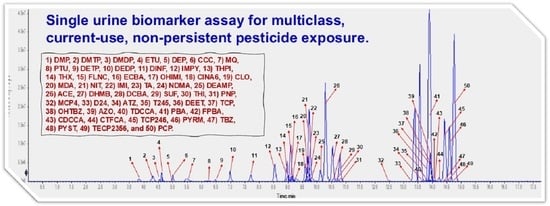
Graphical Abstract

1. Introduction

Pesticides are ubiquitous environmental contaminants used extensively in agriculture, gardening, and pest control [1]. Their widespread application has led to frequent detection of pesticides and their metabolites in human biological samples, raising concerns about potential health impacts [1]. Human exposure to pesticides occurs through inhalation, ingestion, and dermal contact, after which these compounds are typically metabolized in the liver and excreted via urine [1]. Urine has become the preferred matrix for human biomonitoring (HBM) of pesticide exposure due to its non-invasive collection, availability in larger quantities than blood, and role as the main excretion route for many pesticides and their metabolites [1].
Numerous epidemiological studies have linked pesticide exposure to adverse health outcomes, particularly in vulnerable populations such as pregnant women and children [1]. Neurotoxic pesticides like organophosphates, pyrethroids, carbamates or thiocarbamates (fungicides), and neonicotinoids can disrupt normal neuronal functions [2], while others like triazoles (fungicides), herbicides, organochlorine pesticides, and insect repellents may interfere with the endocrine system [3,4], and plant growth regulators show reproductive and developmental toxicity [5]. These health concerns underscore the critical need for comprehensive HBM methods to assess human exposure to multiple pesticide classes simultaneously.
Traditionally, HBM methods have focused on one or two pesticide classes [6]. However, there is growing interest in multitarget methods capable of characterizing several pesticide classes and their metabolites in a single analysis [6]. This approach allows for a more comprehensive assessment of human exposure to multiple pesticide types and classes [7,8,9,10,11]. Recent studies have optimized methodologies to include 13 to 39 different pesticides, encompassing both currently used and banned compounds, from 3 to 5 pesticide classes (Table 1). The method by Bustamante et al. [12] covers 23 analytes in 4 classes, while Marin-Saez et al. [13] analyze 39 analytes in 5 classes. Larose et al. [14], Gao et al. [15], and Zhu et al. [16] cover 13, 26, and 31 analytes, respectively, in 3 to 5 pesticide classes.
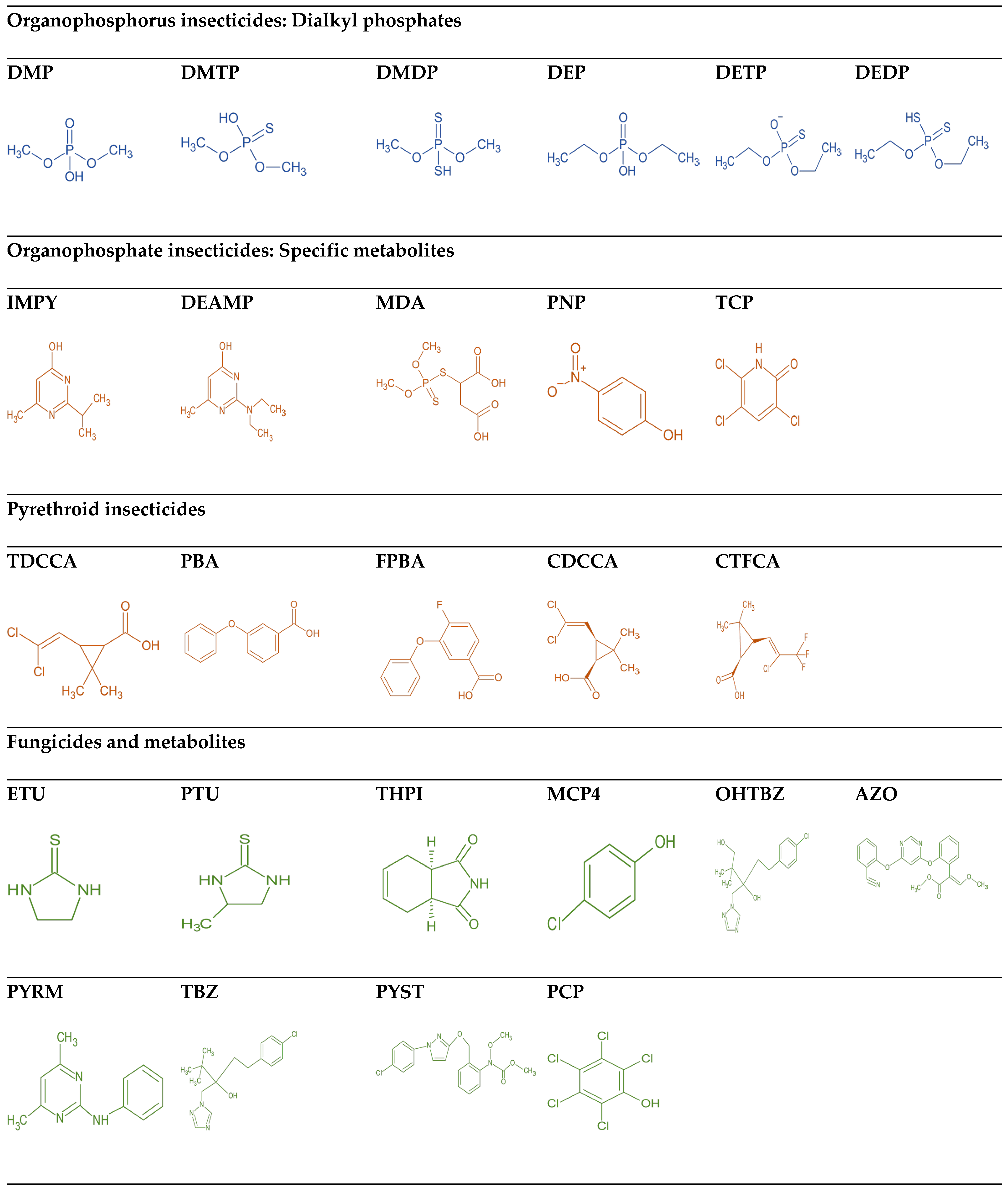
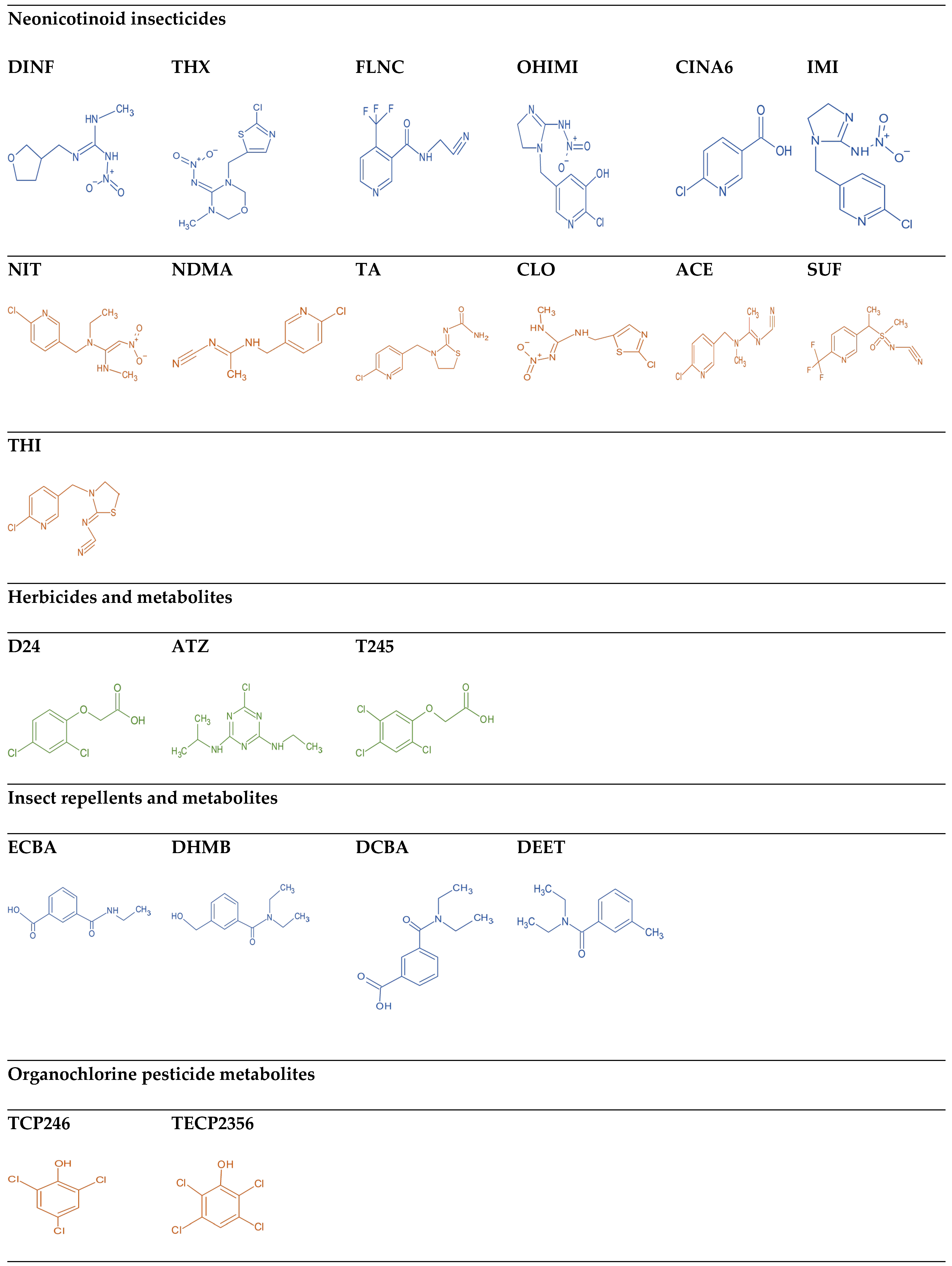
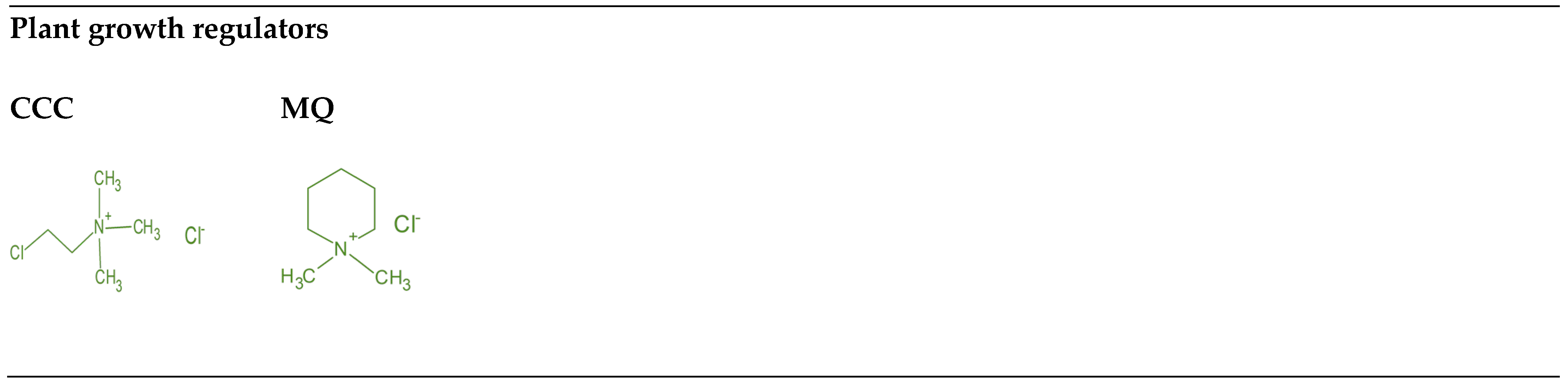
Using ultra-high-performance liquid chromatography (UHPLC) and tandem mass spectrometry (MS/MS), the current study aims to develop and optimize a multiclass pesticide urinary assay that covers a range of biomarkers of exposures to current-use pesticides from nine chemical classes currently of interest in the National Health and Nutrition Examination Survey (NHANES) biomonitoring and others of emerging health concern (Figure 1, Table 2). This includes organophosphorus insecticides (dialkyl phosphates and specific metabolites), pyrethroids, fungicides, neonicotinoids, herbicides, insect repellents, organochlorine pesticides, and plant growth regulators. Target selection criteria for non-NHANES biomarkers were predefined as follows: (1) evidence of contemporary agricultural or residential use (current-use status), (2) published or suspected human exposure and toxicological concern in recent biomonitoring studies, and (3) availability of analytical reference standards or participation in proficiency testing to enable quantification. These criteria align with other multiclass method development efforts that prioritize analytes balancing public-health relevance and analytical feasibility [12,15,17]. The term ‘emerging health concerns’ herein refers specifically to compounds meeting at least two of these criteria but not yet included in routine national surveys.
Sample preparation is a crucial step in our method, employing solid-phase extraction (SPE) to efficiently extract and concentrate pesticide biomarkers from urine samples. This approach allows for effective handling of multiple components with varying chemical properties, enhancing the method’s sensitivity and selectivity. The optimized SPE procedure, using Oasis HLB 96-well plates, enables high-throughput sample processing essential for large-scale biomonitoring studies. Our method demonstrates high sensitivity, accuracy, and precision while allowing for high sample throughput to support large-scale biomonitoring studies and environmental health research. The resulting method will serve as a valuable tool for facilitating more accurate health risk assessments and informing public health policies aimed at reducing pesticide-related health risks. Such high-throughput, low-volume assays are particularly well-suited for large-scale epidemiologic studies and pediatric cohorts, where limited sample volumes and high participant numbers necessitate sensitive, rapid analyses [18,19,20,21,22]. Comparable multiclass SPE-LC-MS/MS methods have been shown to support population biomonitoring with similar sample-volume efficiencies and throughput, reinforcing the utility of the present assay for exposomic applications [13,15,17].
Table 2. Pesticides, parent compounds and urinary metabolites, by abbreviations, parent chemicals, and metabolites by chemical class.
#Chemical ClassParent ChemicalBiomarker (Analyte) Full NameCAS No.AbbreviationNHANES aNIST SRM bPT cReference(s) d
1Organophosphorus insecticides: Dialkyl phosphates (Non-specific metabolites)Organophosphate insecticides (multiple)Dimethylphosphate813-78-5DMPYes-G-EQUASHeffernan et al., 2016 [23]
Dimethylthiophosphate59401-04-6DMTPYes-G-EQUAS
Dimethyldithiophosphate756-80-9DMDPYes-G-EQUAS
Diethylphosphate598-02-7DEPYes-G-EQUAS
Diethylthiophosphate5871-17-0DETPYes-G-EQUAS
Diethyldithiophosphate298-06-6DEDPYes-G-EQUAS
2Organophosphorus insecticides: Specific metabolitesParathion, methyl parathion4-nitrophenol100-02-7 PNPYes-G-EQUASHeffernan et al., 2016 [23]; Noren et al., 2020 [24]
Chlorpyrifos, chlorpyrifos-methyl3,5,6-trichloro-2-pyridinol6515-38-4TCPYes-G-EQUAS
Malathion2-[dimethoxyphosphorothioyl) sulfanyl] succinic acid1190-28-9MDAYes--
Diazinon2-isopropyl-4-methyl-pyrimidinol2814-20-2IMPYYes--
Pirimiphos2-(diethylamino)-6-methylpyrimidin-4-ol42487-72-9DEAMP---
3Pyrethroid insecticidesPermethrin, cypermethrin, cyfluthrintrans-dichlorovinyl-dimethylcyclopropane carboxylic acid59042-50-1TDCCAYes-G-EQUASHeffernan et al., 2016 [23]; Noren et al., 2020 [24]
cis-dichlorovinyl-dimethylcyclopropane carboxylic acid59042-49-8CDCCAYes-G-EQUAS
Permethrin, cypermethrin, deltamethrin, resmethrin, fevalerate, phenothrin, cyphenothrin and lambda-cyhalothrin.3-phenoxybenzoic acid3739-38-6PBAYes-G-EQUAS
Cyfluthrin4-fluoro-3-phenoxybenzoic acid77279-89-1FPBAYes-G-EQUAS
Bifenthrin, lambda-cyhalothrin3-(2-chloro-3,3,3-trifluoroprop-1-enyl)-2,2-dimethylcyclopropanecarboxylic acid72748-35-7 CTFCA--G-EQUAS
4Fungicides and metabolitesPentachlorophenolPentachlorophenol87-86-5PCPYes-G-EQUASNoren et al., 2020 [24]
Chlorobenzene4-chlorophenol106-48-9MCP4---
TebuconazoleHydroxy tebuconazole212267-64-6OHTBZ---
Mancozeb and several ethylene bis-dithiocarbamate (EBDC) fungicidesEthylene thiourea96-45-7ETUYes--
PropinebPropylene thiourea2122-19-2PTUYes--
PyrimethanilPyrimethanil53112–28–0PYRM---
TebuconazoleTebuconazole107534-96-3TBZ---
Captancis-1,2,3,6-tetrahydrophthalimide1469-48-3THPI---
AzoxystrobinAzoxystrobin131860-33-8AZO---
PyraclostrobinPyraclostrobin175013-18-0 PYST---
5Neonicotinoid insecticidesAcetamiprid, imidacloprid, nitenpyram, thiacloprid6-chloronicotinic acid 5326-23-8CINA6--G-EQUASWrobel et al., 2023 [25]
AcetamipridAcetamiprid135410-20-7ACEYes-G-EQUAS, OSEQAS
N-desmethyl-acetamiprid190604-92-3NDMAYes-G-EQUAS, OSEQAS
ImidaclopridImidacloprid138261-41-3IMIYes-G-EQUAS, OSEQAS
5-hydroxyimidacloprid380912-09-4OHIMIYes-OSEQAS
ClothianidinClothianidin210880-92-5CLOYes-OSEQAS
ThiaclopridThiacloprid111988-49-9THIYes-OSEQAS
Thiacloprid-amide676228–91–4TA---
ThiamethoxamThiamethoxam153719–23–4THX--OSEQAS
SulfoxaflorSulfoxaflor946578–00–3SUF--OSEQAS
NitenpyramNitenpyram150824-47-8NIT--OSEQAS
FlonicamidFlonicamid158062-67-0FLNC---
DinotefuranDinotefuran165252-70-0DINF--OSEQAS
6Herbicides and metabolites2,4-dichlorophenoxyacetic acid 2,4-dichlorophenoxyacetic acid94-75-7D24Yes-OSEQASHeffernan et al., 2016 [23]
2,4,5-trichloro phenoxyacetic acid2,4,5-trichlorophenoxyacetic acid93-76-5T245Yes--
AtrazineAtrazine1912–24–9ATZYes--
7Insect repellents and metabolitesN,N-diethyl-meta-toluamideN,N-diethyl-meta-toluamide134-62-3DEETYes--Heffernan et al., 2016 [23]
3-(diethylcarbamoyl) benzoic acid72236-23-8DCBAYes--
3-(ethylcarbamoyl) benzoic acid126926-33-8ECBAYes--
N,N-diethyl-3-(hydroxymethyl) benzamide72236-22-7DHMB---
8Organochlorine pesticide metabolitesTrichlorophenol2,4,6-trichlorophenol88-06-2TCP246Yes--Schmied-Tobies et al., 2021 [26]
Tetrachlorophenol2,3,5,6-tetrachlorophenol935-95-5TECP2356---
9Plant growth regulatorsChlormequat Chlormequat7003-89-6 CCC---Noren et al., 2020 [24]
Mepiquat Mepiquat15302-91-7MQ---
a included in at least one of the NHANES cycles conducted between 1999 and 2018. b availability of a mass fraction value for the pesticide biomarker of interest in the National Institute of Standards and Technology (NIST) Standard Reference Material (SRM) 3672: Organic Contaminants in Smokers’ Urine and/or 3673: Organic Contaminants in Non-Smokers’ Urine. c offered in the proficiency testing (PT) programs like the G-EQUAS [https://app.g-equas.de/web/ (accessed on 25 February 2026)] and/or the OSEQAS [https://www.inspq.qc.ca/en/ctq/eqas/oqesas/description, (accessed on 25 February 2026)]. d articles that reference the parent chemical of pesticides and their corresponding urinary biomarkers. #: Numbers.

2. Materials and Methods

2.1. Chemicals and Reagents

Our method utilizes 50 reference standards and 26 isotope-labeled internal standards (IL-ISTD) for the quantification of pesticide biomarkers. The IL-ISTD were carefully selected to represent the physicochemical properties of our target analytes. Reference standards and IL-ISTD of pesticides and metabolites were acquired from multiple sources, including AA Blocks (San Diego, CA, USA), Enamine (Monmouth Jct., NJ, USA), Cambridge Isotope Laboratories (Tewksbury, MA, USA), Sigma-Aldrich (St. Louis, MO, USA), and Toronto Research Chemicals (North York, ON, Canada). Table 2 and Table S1 provide detailed information on these reference standards and IL-ISTD. Working and intermediate stock solutions of all reference standards and IL-ISTD were prepared in acetonitrile at concentrations of 1 mg/mL and 1 µg/mL, respectively, and stored at −20 °C. All solvents used, including water, acetonitrile, and methanol, were of LC/MS grade, and all other chemicals and reagents were of the highest grade available, obtained from Fisher Scientific (Hampton, NH, USA). For solid-phase extraction (SPE) sample cleanup, an Oasis HLB hydrophilic-lipophilic balanced reversed-phase 96-well plate was purchased from Waters Corporation (Milford, MA, USA). Sample and extract collection and handling were performed using a 96-deep well plate (DWP) with a 2 mL well volume from Eppendorf (Hauppauge, NY, USA). To achieve complete deconjugation of exposure biomarkers of interest, the ALS enzyme BGALA-RO-glucuronidase/arylsulfatase from Helix pomatia was obtained from Sigma-Aldrich, as optimized, and detailed in Jagani et al. [18] A detailed mapping of analytes to isotope-labeled internal standards is provided in Table 3 (matched IL-ISTD vs surrogate). Analytes lacking matched isotopically labeled standards were quantified using surrogate IL-ISTDs selected based on physicochemical similarity (retention time and polarity) and comparable MS/MS fragmentation patterns, an approach used in prior multiclass urinary pesticide and environmental-chemical methods to balance coverage and cost [15,17].

2.2. Biological Material

Urine samples for blanks were obtained from Lee Biosolutions, Inc. (Maryland Heights, MO, USA). These samples were collected from healthy children and adults of both genders. Additionally, synthetic urine was sourced from UTAK (Valencia, CA, USA). The urine QC pool was created by combining urine samples obtained from anonymous volunteers. Each sample was individually screened for the analytes of interest in this study before mixing. This process ensured the formation of an unspiked QC urine pool that contains analytes at the lower limit of quantification (LLOQ) levels. This study was conducted in accordance with ethical guidelines and received approval from the Icahn School of Medicine at Mount Sinai (IRB-16-00742) for developing analytical methods using de-identified human specimens that contain no personally identifiable information (PII) or protected health information (PHI).

2.3. Chromatographic Conditions

The chromatographic program and mass spectrometric conditions were adapted and modified from Jagani et al.’s report on multiclass analysis of environmental chemical biomarkers in urine [18]. An ExionLC system equipped with a Hypersil Gold AQ analytical column (150 mm × 4.6 mm, 3 μm particle size) and guard column (10 mm × 4.0 mm, 3 μm) from Thermo Scientific (Waltham, MA, USA) was used for the separation of 50 pesticides and their metabolites. The LC system was maintained at 40 °C with a flow rate of 0.5 mL/min. The mobile phase consisted of 0.1% acetic acid in water (A) and a 1:1 ratio of acetonitrile to methanol (B). The gradient elution program was as follows: 0–1.0 min: 5% B; 1.0–6.0 min: linear gradient to 50% B; 6.0–8.0 min: 50% B; 8.0–11.0 min: linear gradient to 95% B; 11.0–14.0 min: 95% B; 14.0–14.2 min: return to 5% B; 14.2–18.0 min: re-equilibration at 5% B. The total LC separation run time was 18.0 min.

2.4. Mass Spectrometric Conditions

Mass spectrometric analysis was performed using a SCIEX 7500 Triple Quad system, a Qtrap-ready mass spectrometer (SCIEX, Framingham, MA, USA). The source temperature was set at 350 °C, with nitrogen used as the curtain gas, ion source gas 1, and ion source gas 2. The flow rates were set at 50 psi for curtain gas, 30 psi for ion source gas 1, and 60 psi for ion source gas 2. These optimized gas flow rates and pressures contributed to the method’s high sensitivity and reproducibility. A 10-μL injection volume of the SPE extract was introduced onto the LC column. Data acquisition was conducted simultaneously using electrospray ionization (ESI) in both negative ion and positive ion modes, allowing for comprehensive coverage of pesticide biomarkers with diverse chemical properties. Analyte-specific parameters (declustering potential, entrance potential, collision exit potential, and collision energy) were individually optimized by direct infusion of each compound into the mass spectrometer using a syringe. Detailed MS/MS conditions for each native and labeled analyte are provided in Table 3. Data acquisition, analysis, and processing were performed using SCIEX OS 3.3 software.

2.5. Sample Preparation

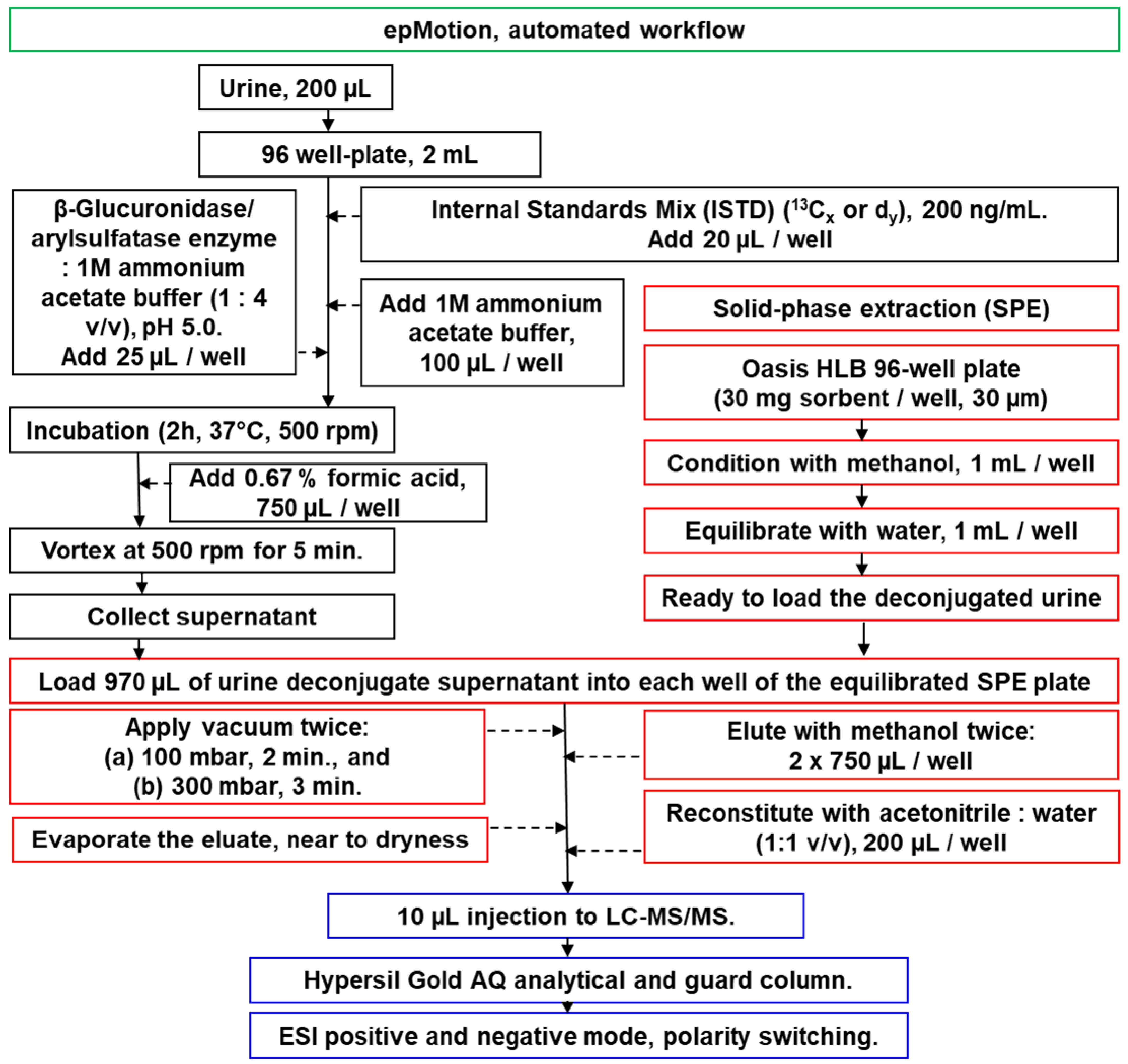
The sample preparation method for analyzing pesticides and metabolites was adapted and modified from Jagani et al. [18] An automated workflow using epMotion 5075vtc (Eppendorf, Hauppauge, NY, USA) was employed for sample preparation (Figure 2). Urine samples (200 µL) were aliquoted into a 96-well plate (2 mL capacity). A mixture of β-glucuronidase/arylsulfatase enzyme and 1M ammonium acetate buffer (1:4 v/v, pH 5.0) was prepared that gives an enzyme-specific activity of about 100,000 units/mL for β-glucuronidase and 47,500 units/mL for sulfatase. To each well, 20 µL of IL-ISTD mix (13C or deuterium-labeled, 200 ng/mL) and 25 µL of enzyme-buffer mixture were added, followed by 100 µL of 1M ammonium acetate buffer. The plate was incubated at 37 °C for 2 h (500 rpm) on a Mixmate vortexer (Eppendorf, Hauppauge, NY, USA). After incubation, 750 µL of 0.67% formic acid was added, and the plate was vortexed (500 rpm, 5 min). The supernatant (970 µL) was loaded onto a preconditioned and pre-equilibrated Oasis HLB 96-well SPE plate (30 mg sorbent/well, 30 µm). Vacuum was applied twice (100 mbar, 2 min; 300 mbar, 3 min). Analytes were eluted with methanol (2 × 750 µL/well), evaporated near to dryness using a SPE Dry 96 evaporator (Biotage, LLC; Charlotte, NC, USA), and reconstituted with acetonitrile: water (1:1 v/v, 200 µL/well). 10 µL was injected into the LC-MS/MS system equipped with a Hypersil Gold AQ column, using both negative and positive ESI modes with polarity switching.

2.6. Method Validation

Method validation was performed using a pooled urine sample prepared by mixing urine samples collected from anonymous volunteers. This pooled sample served as the basis for our quality control (QC) samples. The concentrations of each analyte in the QC urine pool were characterized (Table 3) and classified as LLOQ or unspiked QC. Low to higher-level QC pools were prepared by spiking the QC urine pool with native standards at three levels (1, 10, and 100 ng/mL). Recovery, linearity, accuracy, precision, limit of detection (LOD), and limit of quantification (LOQ) were determined for all 50 analytes.
LOD and LOQ were calculated as 3S and 10S, respectively, where S is the standard deviation from three replicate analyses of the unspiked QC urine pool, analyzed in ten separate batches. Accuracy was assessed by calculating the extraction efficiencies (EE) of spiked analytes in the two higher-level QC pools using the formula: EE (%) = [measured conc. (ng/mL) * 100]/[QC pool baseline conc. + spiked conc. (ng/mL)]. Precision was evaluated using the coefficient of variation (CV) at each level. Inter-batch accuracy was reported as the relative error (RE) of an expected concentration. Measurement uncertainty (precision) was expressed as the relative standard deviation (RSD).
The method was further validated through participation in proficiency testing (PT) programs conducted by the German External Quality Assessment Scheme for analyses of biological materials (G-EQUAS) [http://www.g-equas.de/ (accessed on 25 February 2026)] and the Canadian External Quality Assessment Scheme for Organic Substances in Urine (CTQ-OSEQAS) [https://www.inspq.qc.ca/en/ctq/eqas/oqesas/description, (accessed on 25 February 2026)]. Finally, to demonstrate its practical application, the validated method was applied to 10 urine samples collected from adult volunteers.
The Mount Sinai laboratory is part of the NIEHS’s Children’s Health Exposure Analysis Resource (CHEAR) consortium [27], which focuses on exposure analysis using both traditional biomonitoring methods and untargeted analysis of the exposome. This consortium has now become the Human Health Exposure Analysis Resource (HHEAR) [28]. The laboratory follows the QA/QC and method validation protocols outlined here [29]. The CHEAR and HHEAR programs are referenced to indicate alignment with established laboratory network practices for quality assurance in human biomonitoring.

3. Results and Discussion

3.1. Analyte Coverage and Pesticide Classes

The developed method encompasses a comprehensive panel of 50 pesticide biomarkers across 9 current-use chemical classes (Table 2). This broad coverage allows for simultaneous assessment of exposure to multiple pesticide classes, providing a more complete picture of overall pesticide exposure (Table 1). The pesticide classes include organophosphorus insecticides (dialkyl phosphates and specific metabolites), pyrethroid insecticides, fungicides, neonicotinoid insecticides, herbicides, insect repellents, organochlorine pesticide metabolites, and plant growth regulators. Of the 50 biomarkers, 30 are currently included in the NHANES biomonitoring program, indicating their relevance for population-level exposure assessment (Table 2).

3.2. Optimization of Chromatographic Separation

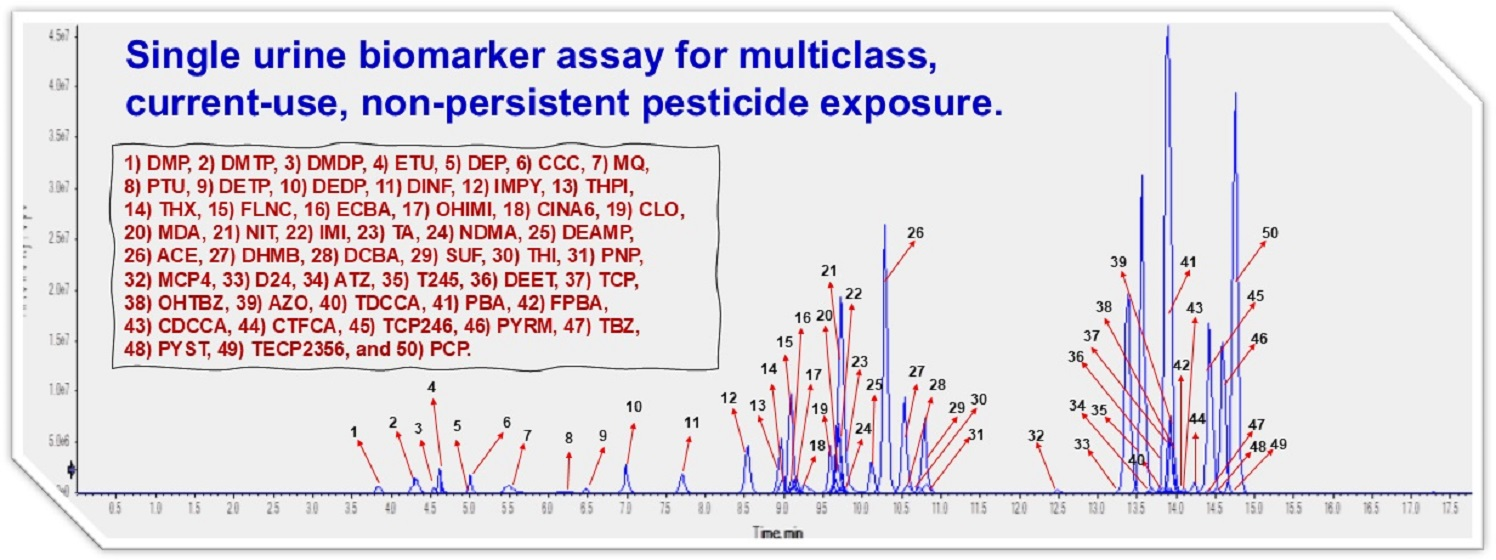
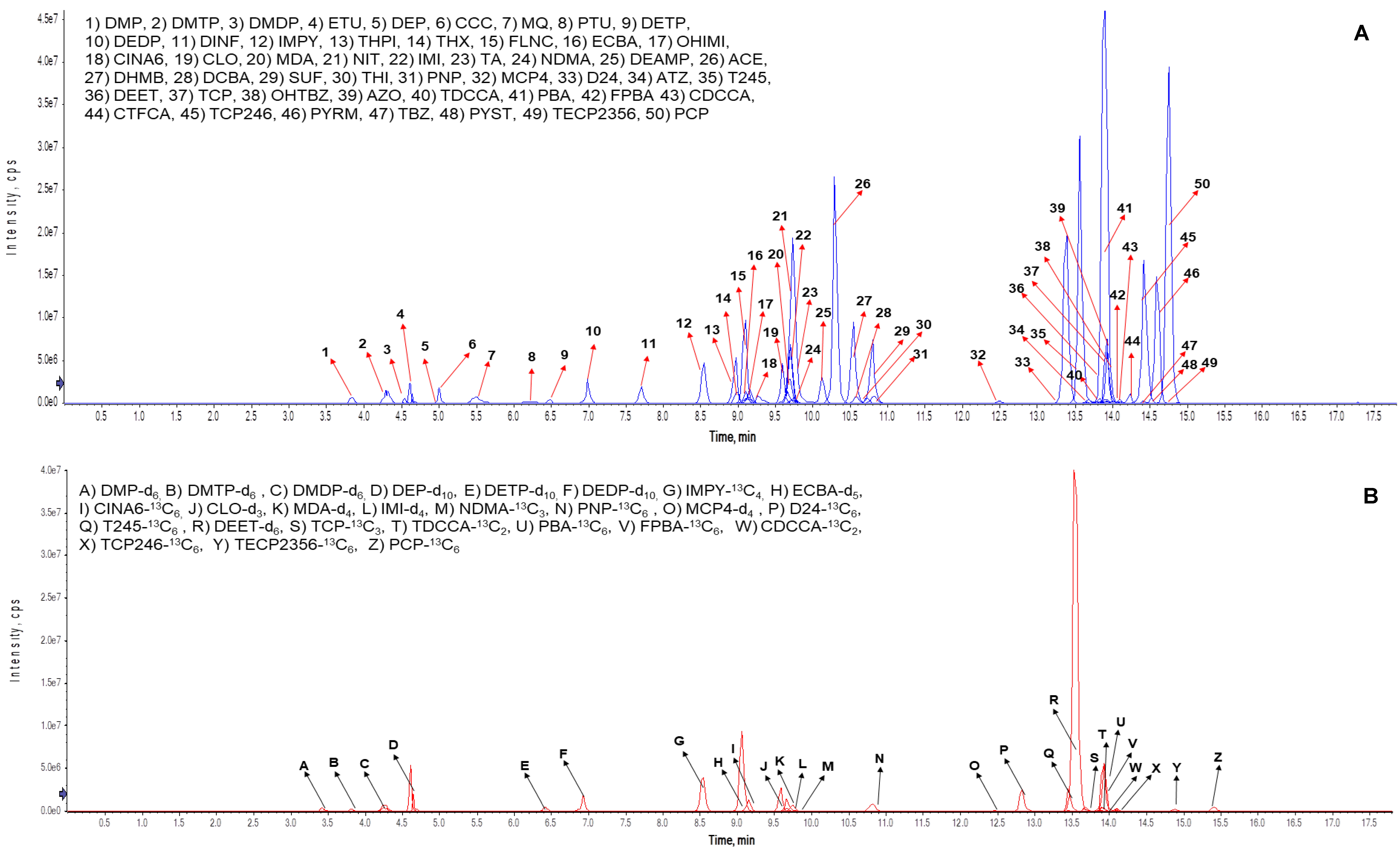
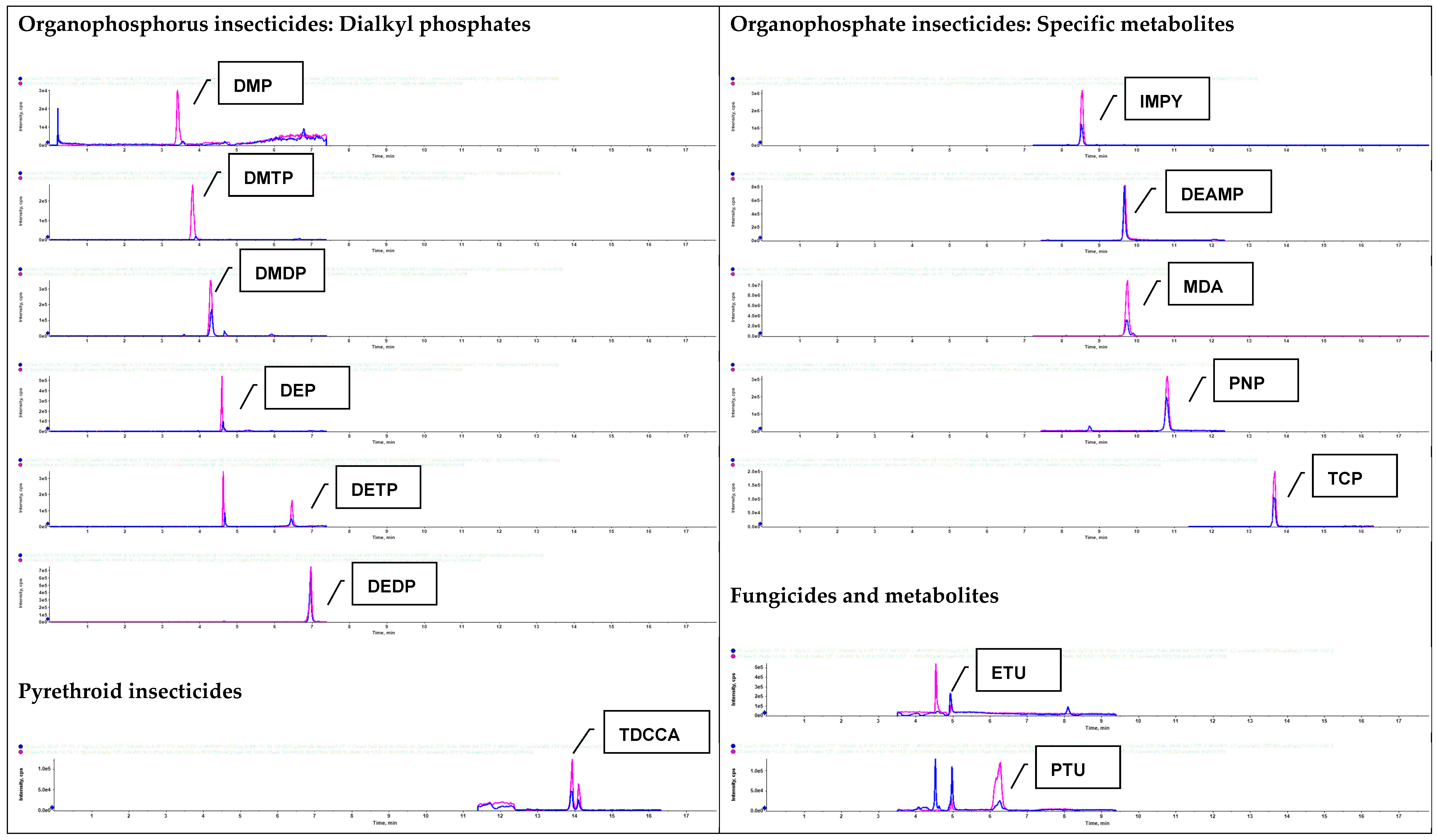
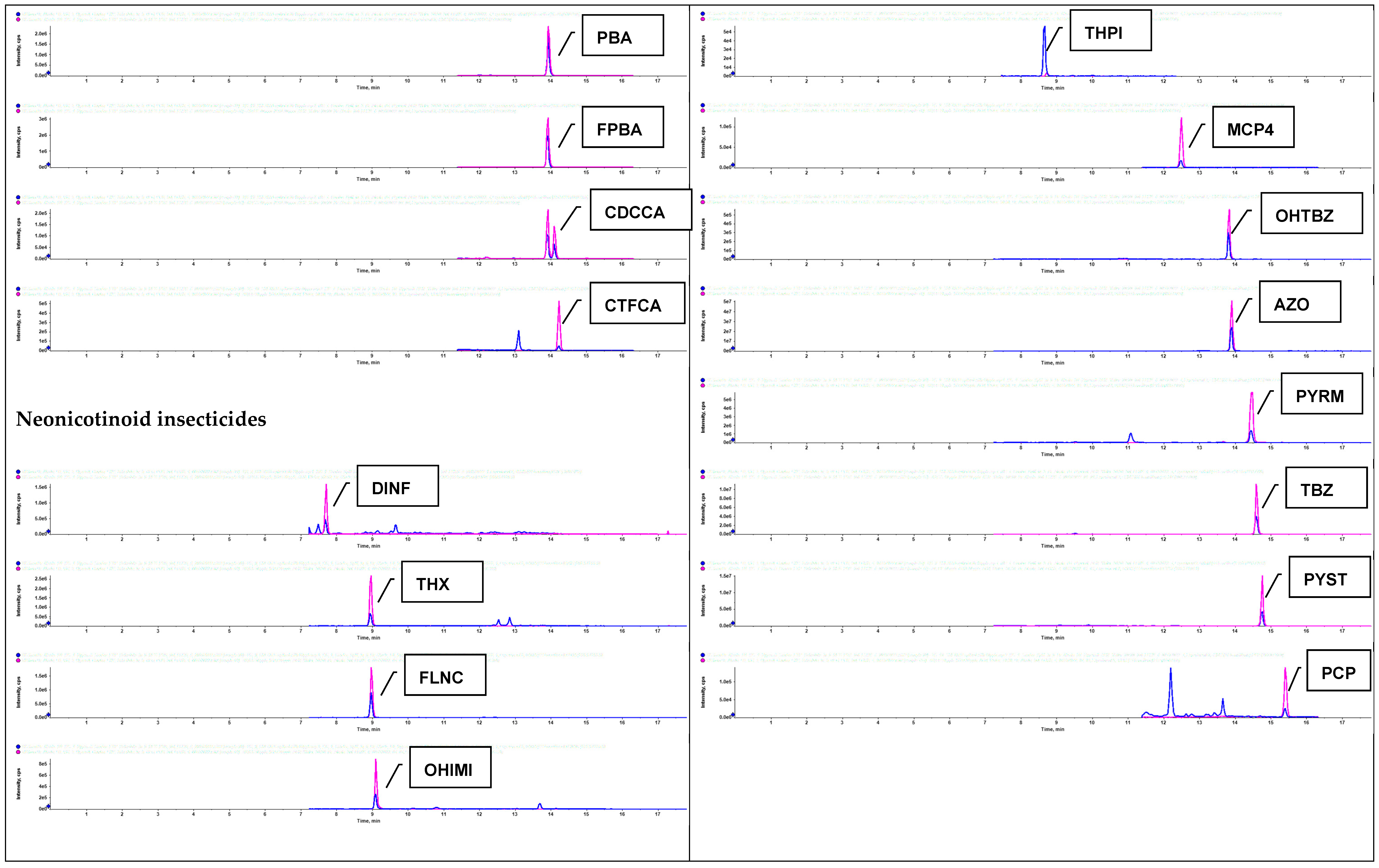
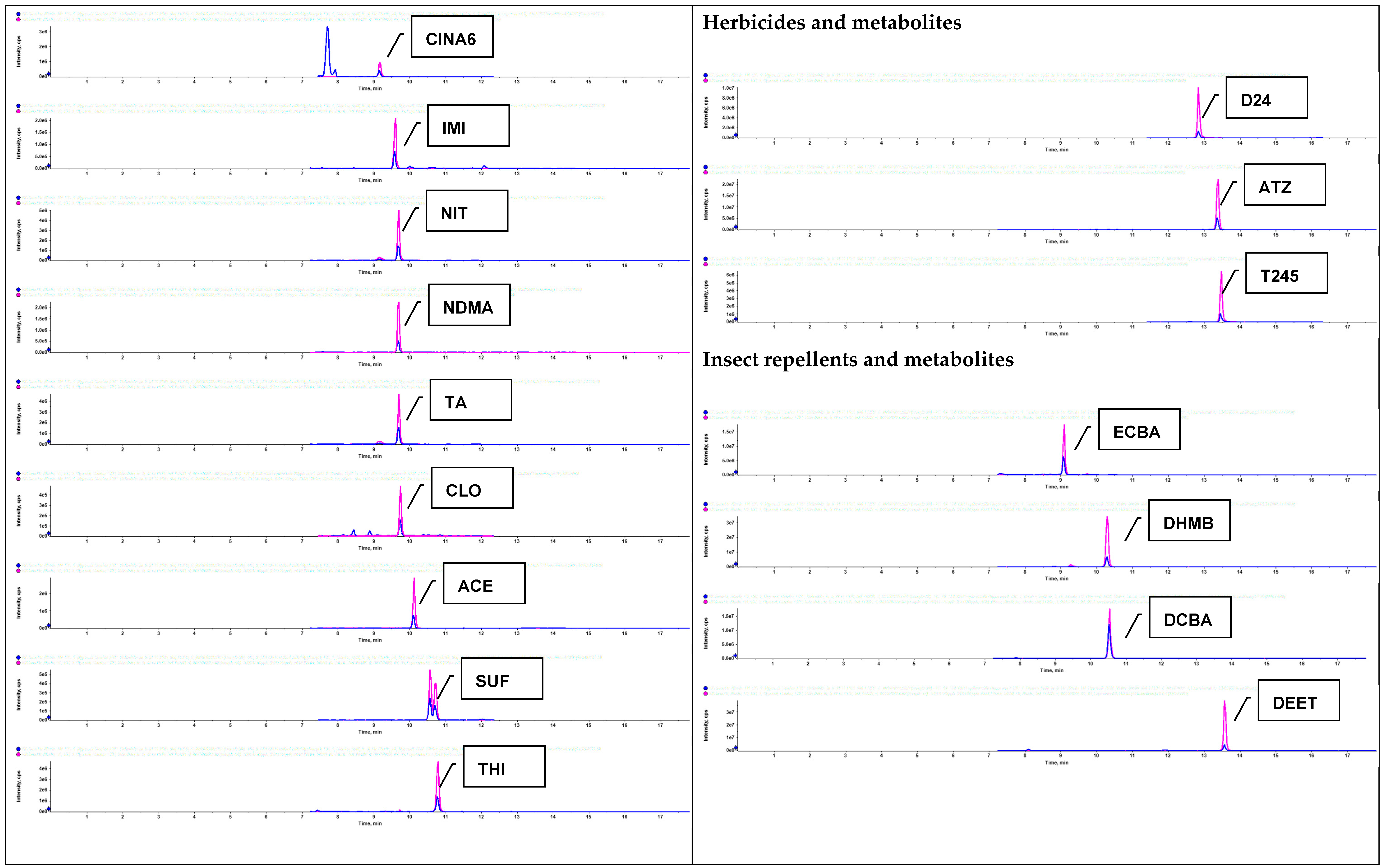
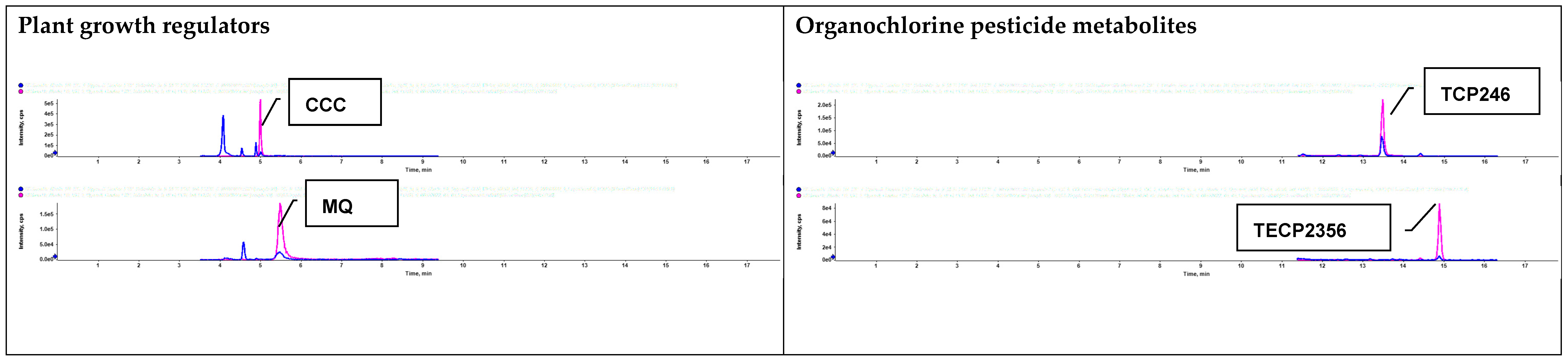
Several reversed-phase columns were evaluated during method development. Chromatographic separation was optimized using a Thermo Scientific Hypersil Gold AQ column (150 mm × 4.6 mm, 3 μm), which provided excellent separation for the diverse range of pesticide classes (Figure 3). In contrast, Gao et al. [15] opted for a Phenomenex Kinetex XB-C18 column (100 mm × 2.1 mm, 1.7 μm), and Mercier et al. [17] opted for a Waters Acquity UPLC HSS T3 column (150 mm × 2.1 mm, 1.8 μm). While these different columns all achieved effective separation of pesticide biomarkers, our choice of the Hypersil Gold AQ column was optimal for our specific set of 50 analytes across 9 chemical classes. The mobile phase composition and gradient elution program were carefully optimized to achieve effective separation of metabolites of both polar (organophosphorus) and non-polar (organochlorine) pesticides. Mobile phases are generally similar across studies, with slight variations in additives and organic solvents. A binary gradient consisting of 0.1% acetic acid in water (A) and 1:1 ratio of acetonitrile to methanol (B) was found to provide the best overall performance. Our method achieved a total run time of 18 min, comparable to other recent studies, with retention times ranging from 3.38 min for dimethyl phosphate (DMP, a dialkyl phosphate) to 15.41 min for pentachlorophenol (PCP, a fungicide), striking a balance between comprehensive analyte coverage and high-throughput analysis (Figure 4). Other recent studies have found that run times range from 9.0 min [16] to 22.0 min [12]. The optimization of the mobile phase composition gradient elution program was crucial for balancing the need for adequate separation of early-eluting polar compounds with the elution of more hydrophobic analytes later in the run. This approach allowed for effective resolution of structurally similar isomers, like the two pyrethroid metabolites trans-3-(2,2-dichlorovinyl)-2,2-dimethylcyclopropane carboxylic acid (TDCCA) and cis-3-(2,2-dibromovinyl)-2,2-dimethylcyclopropane carboxylic acid (CDCCA) [30], while minimizing matrix effects (Figure 4).
Retention times (average ± SD, n = 30) for all target analytes are presented in Table 3, with standard deviations (SD) of less than 1.0. Resolution (Rs) was calculated for structurally similar compound pairs to confirm baseline or acceptable chromatographic separation (Rs ≥ 1.5 considered baseline). Critical isomer separations - specifically CDCCA and TDCCA—achieved Rs > 1.5 under the described gradient and column conditions; representative extracted-ion chromatograms (EIC) illustrating isomer separation and co-elution checks are provided in Figure 4. Peak shape was quantified by symmetry factors (tailing factors), which were typically between 0.8 and 1.2 for most analytes; reproducibility of retention times across batches (n = 10 days) showed %RSD ≤ 1 for most compounds. These chromatographic performance assessments follow approaches described in prior multiclass urinary methods and ensure reliable discrimination of isomers and consistent peak integration for quantification [11,13,15].

3.3. Mass Spectrometric Detection

Mass spectrometric detection was performed using a triple quadrupole mass spectrometer by implementing a polarity switching approach in the ESI mode, allowing for the detection of both positive and negative ions within a single run. This technique is also employed by other leading researchers in the field, such as Marin-Saez et al. [13] and Zhu et al. [16] Scheduled Multiple reaction monitoring (MRM) mode was used for quantification and to ensure selectivity and specificity (Table 3). This technique optimizes sensitivity and selectivity by monitoring specific time windows for each analyte and minimizes potential interference across mass spectrometry channels when analyzing multiclass target analytes sequentially. Precursor ion m/z values ranged from 103.1 for ethylene thiourea (ETU) to 404.1 for azoxystrobin (AZO), both fungicides. Product ion m/z values spanned from 35.0 for several compounds to 372.1 for AZO. The optimization of compound-specific parameters, including precursor and product ion selection, collision energies, and cone voltages, was crucial for achieving maximum sensitivity for each target compound (Table 3).

3.4. Sample Preparation and Extraction

SPE has emerged as a preferred method for extracting pesticides from urine due to its efficiency and ability to handle multiple components with varying chemical properties [18]. Sample preparation employed a SPE approach using Oasis HLB 96-well plates (Figure 2). This format allows for high-throughput sample processing, which is essential for large-scale biomonitoring studies. Several SPE sorbents were evaluated, including C18, polymeric reversed-phase, and mixed-mode ion-exchange materials. The experimental setup and findings were previously discussed [18]. Oasis HLB was selected as the optimal sorbent due to its broad applicability to compounds with diverse physicochemical properties. This choice is consistent with several published methods for multiclass pesticide analysis in urine. Prior to extraction, samples underwent enzymatic deconjugation to cleave conjugated metabolites, allowing for the determination of total (free + conjugated) concentrations of organophosphorus and pyrethroid pesticides [31]. We optimized the enzyme activity and incubation conditions to ensure complete deconjugation without degrading the target analytes, as previously described [18]. Enzymatic deconjugation is employed in all methods, with similar enzyme activities (Table 1). We also confirmed that the enzymatic deconjugation step did not have any effects on the pesticides that are primarily excreted in aglycone-free forms, such as phenoxy acid herbicides [32], neonicotinoids [25,33], and dialkyl phosphates [34]. All methods, including the current one, utilize a single urine aliquot for sample preparation. The current method requires the smallest urine volume (0.2 mL) compared to others (0.25–1.0 mL), making it particularly suitable for studies with limited sample availability (Table 1).

3.5. Method Validation

Method validation was conducted in accordance with the guidelines set forth by the NIEHS’s Human Health Exposure Analysis Resource (HHEAR) consortium [29]. These guidelines are consistent with the bioanalytical method validation standards established by the Food and Drug Administration (FDA) [35,36].

3.5.1. Linearity and Calibration

Linearity was assessed using matrix-matched calibration curves prepared in pooled urine at concentrations ranging from 0.1 to 100 ng/mL. The method showed excellent linearity across all analytes, with coefficients of determination (R2) values ranging from 0.988 (ETU) to 0.999 for propylene thiourea (PTU), both fungicides, indicating strong linear relationships between analyte concentration and instrument response (Table 3). All reported R2 values are statistically significant (p < 0.001), indicating strong linear relationships between analyte concentration and instrument response across the calibration range. This high degree of linearity contributes to the method’s accuracy and reliability for quantifying pesticide biomarkers across a wide concentration range. For pesticide analytes above the upper limit of linearity of 100 ng/mL, which are uncommon in the general population, urine sample dilution or a smaller aliquot (≤0.1 mL) or extending the calibration curve up to 1000 ng/mL is suggested.
Calibration curves were constructed using ordinary least squares linear regression with weighting applied to improve performance at the low end; a 1/x weighting was selected for most analytes and 1/x2 applied where low-concentration residuals indicated heteroscedasticity. Model selection and weighting were informed by inspection of residuals and by back-calculated concentration bias criteria across the calibration range. Residuals were examined for systematic deviation at low and high concentrations, and lack-of-fit was assessed qualitatively to ensure no curvature or concentration-dependent bias was present. Use of 1/x weighting and residual inspection is a recommended practice in multiclass LC–MS/MS biomonitoring to improve quantitation at low environmental concentrations and has been applied in comparable urinary pesticide methods [11,13,15]. Reported R2 values supplement these diagnostics but do not substitute for residual evaluation and weighting strategies adopted to ensure accurate quantification across the calibration range.

3.5.2. Sensitivity, LOD, and LOQ

The developed method has high sensitivity, with limits of detection (LODs) ranging from 0.01 (21/50 analytes) to 0.88 ng/mL for N,N-diethyl-meta-toluamide (DEET, an insect repellent), with the majority (47/50) ≤ 0.5 ng/mL LOD. The limits of quantification (LOQs) ranged from 0.02 (14/50 analytes) to 2.92 ng/mL (DEET), with the majority (29/50) ≤ 1.0 ng/mL LOQ (Table 3). Herbicides consistently showed the lowest LODs and LOQs at 0.01 and 0.02 ng/mL, respectively. The highest LOD and LOQ were observed for DEET, an insect repellent, at 0.88 and 2.92 ng/mL, respectively. Organophosphorus insecticides showed LODs ranging from 0.01 to 0.25 ng/mL and LOQs from 0.02 to 0.84 ng/mL. These values are generally comparable to or better than those reported in recent literature. For instance, Bustamante et al. [12] reported LODs of 0.012–0.058 ng/mL, while Marin-Saez et al. [13] reported a wider range of 0.1–100 ng/mL. Gao et al. [15] report lower LOQs (0.1–16 pg/mL), but for fewer analytes. The high sensitivity of our method allows for the detection and quantification of pesticides at environmentally relevant concentrations, even at the lower end of the calibration range.
To further substantiate the reported LODs and LOQs at the low end of the calibration range, we combined instrument-based signal-to-noise (S/N) assessment with replicate low-level measurements and calibration extrapolation. LODs were defined by S/N ≥ 3 and LOQs by S/N ≥ 10, and were corroborated by replicate injections (n ≥ 10) at concentrations bracketing the LOQ for representative low-LOQ analytes (e.g., selected neonicotinoids and dialkyl phosphate biomarkers). This approach follows commonly applied practices in urinary pesticide biomonitoring where LOQs are established by the lowest concentration meeting S/N, accuracy (±20% at LOQ) and precision (RSD ≤ 20%) criteria and are subsequently confirmed in matrix by evaluating peak morphology and recovery [11]. For compounds where routine multi-batch validation was performed at 1 and 10 ng/mL, the lower LOQs reported were supported by matrix-matched calibration points, surrogate isotope-labeled internal standard compensation, and single-batch low-level assessments (extracted replicates and S/N verification) that met the LOQ acceptance criteria. Similar combined strategies for LOQ confirmation have been described for multiclass urinary pesticide methods [12,15]. These additional low-level checks demonstrate that the reported LOQs are achievable and reproducible in matrix even when routine multi-batch QC was centered at 1 and 10 ng/mL.
For analytes with LOQs higher than the 1 ng/mL routine QC level (e.g., ethylene thiourea, DEET, chlormequat), the reported LOQs reflect compound-specific matrix effects or signal suppression that prevented acceptable accuracy/precision at concentrations below those LOQs despite achieving detectable peaks at lower concentrations. This determination was based on targeted evaluation of recovery, matrix effect and precision at incremental low concentrations and on signal suppression observed in extracted urine, which is a recognized cause of elevated LOQs in multiclass urinary methods [11]. Where matrix effects or suppression were pronounced, the lowest concentration meeting predefined acceptance criteria for accuracy and precision was designated as the LOQ; this approach is consistent with previous multiclass pesticide biomonitoring methods that report higher LOQs for analytes affected by strong matrix suppression and recommend additional cleanup or alternative preparation for improvement [11,15]. For transparency, these analyte-specific LOQs are therefore reported as the lowest concentrations at which accuracy and precision acceptance criteria were met in extracted matrix, rather than the lower routine QC level.
The chromatogram displayed for DEET (Figure 4) corresponds to a solvent-based standard and therefore can exhibit a clearer peak at 1 ng/mL than an equivalent concentration in extracted urine. The LOQ reported for DEET (2.92 ng/mL) was established based on matrix-matched evaluations in extracted urine where matrix suppression led to poorer accuracy/precision at 1 ng/mL; therefore, the matrix-based LOQ is higher than the solvent standard appearance. This distinction between solvent and matrix responses is a common observation in urinary pesticide analyses and underlies the requirement to establish LOQs in matrix (not solvent) to ensure reliable quantification in real samples [11,15]. Accordingly, the LOQ reflects the lowest concentration in urine matrix satisfying S/N, recovery and precision acceptance criteria, whereas the solvent chromatogram is presented only to illustrate retention and transition selectivity.
Quantification limits below the stated calibration minimum (0.1 ng/mL) were established by combining signal-to-noise determinations, analyte-specific extracted-matrix assessments, and surrogate isotope-labeled internal standard correction to evaluate accuracy and precision at sub-calibration concentrations. For analytes with reported LOQs below 0.1 ng/mL, the instrumental response remained linear when examined at sub-0.1 ng/mL levels in matrix during targeted low-level checks, and the LOQ assignment was based on the lowest matrix concentration meeting the LOQ acceptance criteria (S/N, accuracy and precision). This pragmatic approach—using matrix-matched calibration for the primary curve while confirming sub-calibration LOQs by targeted matrix checks and IL-ISTD compensation—has precedent in urinary pesticide biomonitoring where low environmental concentrations are encountered and where matrix-matched confirmation is used to validate sub-range LOQs [12,15]. If required for reporting, extended calibration points can be included for selected analytes with sub-0.1 ng/mL LOQs in future targeted analyses.

3.5.3. Accuracy and Precision

Accuracy and precision were evaluated at four levels: LLOQ (unspiked QC urine pool), low QC (1 ng/mL spike), medium QC (10 ng/mL spike), and high QC (100 ng/mL spike). Both intra-day (n = 3) and inter-day (n = 10 days) assessments were conducted. Accuracy, represented as extraction efficiency (EE%), was assessed using QC urine samples spiked at various levels, analyzed in triplicate across 10 batches (n = 30). For the purpose of discussion, we focused on the unspiked QC urine pool (LLOQ) as well as the low and mid QC spikes of 1 ng/mL and 10 ng/mL, which represent typical environmental exposure levels. EE% ranged from 85% to 107% at 1 ng/mL and 89% to 113% at 10 ng/mL, demonstrating good accuracy across the concentration range (Table 3). The lowest EE% at 1 ng/mL was observed for AZO (85%), a fungicide, while the highest was for 3-(diethylcarbamoyl)benzoic acid (DCBA, 107%, a DEET metabolite). This recovery range is among the best reported in recent literature, with other studies showing wider ranges such as 78–99% [12], 70–120% [13], and 24–119% [15]. RE% values were generally within ±15% for both concentration levels, indicating good accuracy. Precision, assessed using RSD% and CV%, was generally acceptable. At 1 ng/mL, RSD% and CV% were typically below 15%, while at 10 ng/mL, these values improved to below 10% for most analytes. Accuracy and precision data for the high QC level (100 ng/mL) were generated during method validation. At 100 ng/mL, mean relative error and relative standard deviation for the evaluated analytes met typical bioanalytical acceptance criteria (absolute RE ≤ 15% and RSD ≤ 15%) consistent with performance observed for multiresidue urinary assays reported in the literature [11,15]. These high-level QC results confirm the method’s trueness and precision across the full validated calibration range and support the upper calibration limit reported.
Validation experiments were conducted following a structured multi-day design to characterize intra- and inter-day performance. For each concentration level (low, mid, high), three replicates were analyzed per batch across ten independent batches on separate days (totaling ten days) to assess intra- and inter-day precision and accuracy, consistent with accepted biomonitoring validation practices [29]. Acceptance criteria were aligned with established biomonitoring and bioanalytical guidance: accuracy within ± 15% (±20% at the LOQ) and precision (RSD) ≤ 15% (≤20% at the LOQ), consistent with common regulatory and biomonitoring practices [15,17]. Calibration was performed using matrix-matched calibration curves (extracted blank urine) for analytes demonstrating measurable matrix effects, whereas solvent-based calibration was reserved only for analytes showing negligible matrix bias; this hybrid approach is consistent with other multi-class urinary methods to balance accuracy and practicality [18,19]. Carryover was evaluated by injecting solvent blanks after the highest calibration standard; no analyte showed carryover above 20% of the LOQ. Dilution integrity was assessed by spiking urine at concentrations above the upper calibration limit, diluting 5- and 10-fold with extracted blank urine, and confirming accuracy and precision within acceptance criteria, demonstrating reliable quantification after dilution. These validation procedures mirror practices used in recent multiclass urinary pesticide assays to ensure robust performance across batches and days [12,17].

3.5.4. Matrix Effects

The use of isotope-labeled IL-ISTD for each analyte class helped compensate for potential matrix effects, as evidenced by the consistent performance across different concentration levels in QC urine samples. Quantitative assessment of matrix effects was performed using post-extraction spiking experiments to calculate matrix/solvent slope ratios and by monitoring representative post-column infusion experiments for analytes across chemical classes. For post-extraction spiking, extracted blank urine was spiked at five concentration levels and compared to equivalent standards in solvent to calculate percent signal suppression/enhancement matrix effect (%) = 100 × [(slopematrix/slopesolvent) − 1)]. Representative ion suppression/enhancement values demonstrated that most analytes exhibited slope ratios within ±20% while a limited subset showed stronger suppression and were therefore quantified using matrix-matched calibration or corrected by isotope-labeled surrogates. Post-column infusion experiments confirmed zones of transient suppression correlated with early-eluting polar metabolites and major urine matrix components, but interference at target analyte retention times was <5% for native analytes and <0.5% for internal standards, indicating acceptable selectivity. Where post-column infusion showed localized suppression at retention times of co-eluting urinary components, analyte quantification was confirmed by isotope-dilution correction or matrix-matched calibration to ensure accurate results. This combined strategy (post-extraction spiking and targeted post-column infusion) follows accepted multiclass biomonitoring practice to detect and mitigate matrix effects in complex urine matrices [14,15,17].
Developing a multiclass pesticide assay is challenging due to the lack of isotopically labeled IL-ISTD for all target compounds. In cases where analyte-specific isotope-labeled internal standards were not available, representative isotopically labeled surrogates were selected based on physicochemical similarity (polarity and retention behavior), major fragmentation pathways, and their ability to track extraction recovery and ionization variability. To get around this, we chose 26 IL-ISTD that were representative of the physicochemical properties of our target analytes. We then used these as surrogate-labeled standards and thoroughly evaluated matrix effects and extraction recoveries. Based on recovery and QC data (peak-area normalization with representative IL-ISTDs), analytes quantified with matched IL-ISTDs showed RSDs typically <10% at low QC levels while analytes quantified with surrogate IL-ISTDs exhibited slightly higher variability (RSDs up to 20%). This surrogate approach has been successfully applied in other multi-class urinary pesticide methods to control bias while balancing practicality [12,15]. Validation data indicate that analytes quantified with surrogate IL-ISTDs exhibited modestly higher variability, with average additional imprecision of ~4–8% and bias up to an additional ~6% at low QC levels compared with matched-IL-ISTD analytes; these effects were mitigated by careful surrogate selection and matrix-matched calibration [16,29,37]. While labeled standards for each analyte are ideal, our results demonstrate that careful optimization and validation can still achieve effective multi-class methods, even in the absence of analyte-specific labeled IL-ISTD for some. This approach allows reliable quantification while managing costs and practicality. To further validate our method’s sensitivity and selectivity, we analyzed chromatographic peaks near the retention time of each analyte, focusing on samples at or near the lower limit of quantification. This analysis confirmed that potential interfering components were below 5% for all native analytes and below 0.5% for all internal standards, ensuring reliable detection target analytes at low concentrations, even at the lowest calibration point, and quantification across the calibration range.

3.5.5. Stability

To provide empirical support for storage and handling recommendations, we evaluated stability using low- and mid-quality control spikes (1 and 10 ng/mL) with five replicate aliquots for each condition. Samples were tested after bench storage at room temperature for 24, 48, and 72 h, after three freeze-thaw cycles, and during long-term storage at −80 °C, with measurements taken at 6, 12, and 24 months. Mean recoveries across conditions remained within 80–100% of initial concentrations, and relative standard deviations were ≤20% for both quality control levels, indicating acceptable stability for typical biomonitoring workflows. Similar comprehensive stability assessments and reporting practices have been employed in recent multiclass urinary pesticide methods to substantiate claims of long-term storage stability [15,17]. The assertion of long-term stability for storage at −80 °C (3–4 years) is based on real-time data for a subset of analytes present in the G-EQUAS and OSEQAS proficiency testing program materials from previous years, for which archived aliquots were available. These aliquots showed recoveries within 70–110% of the reference values, with relative standard deviations ≤20% for the panel of representative analytes. These quantitative results support the conclusion that target analytes are stable under the tested conditions and provide essential data for longitudinal biomonitoring studies.

3.5.6. Selectivity

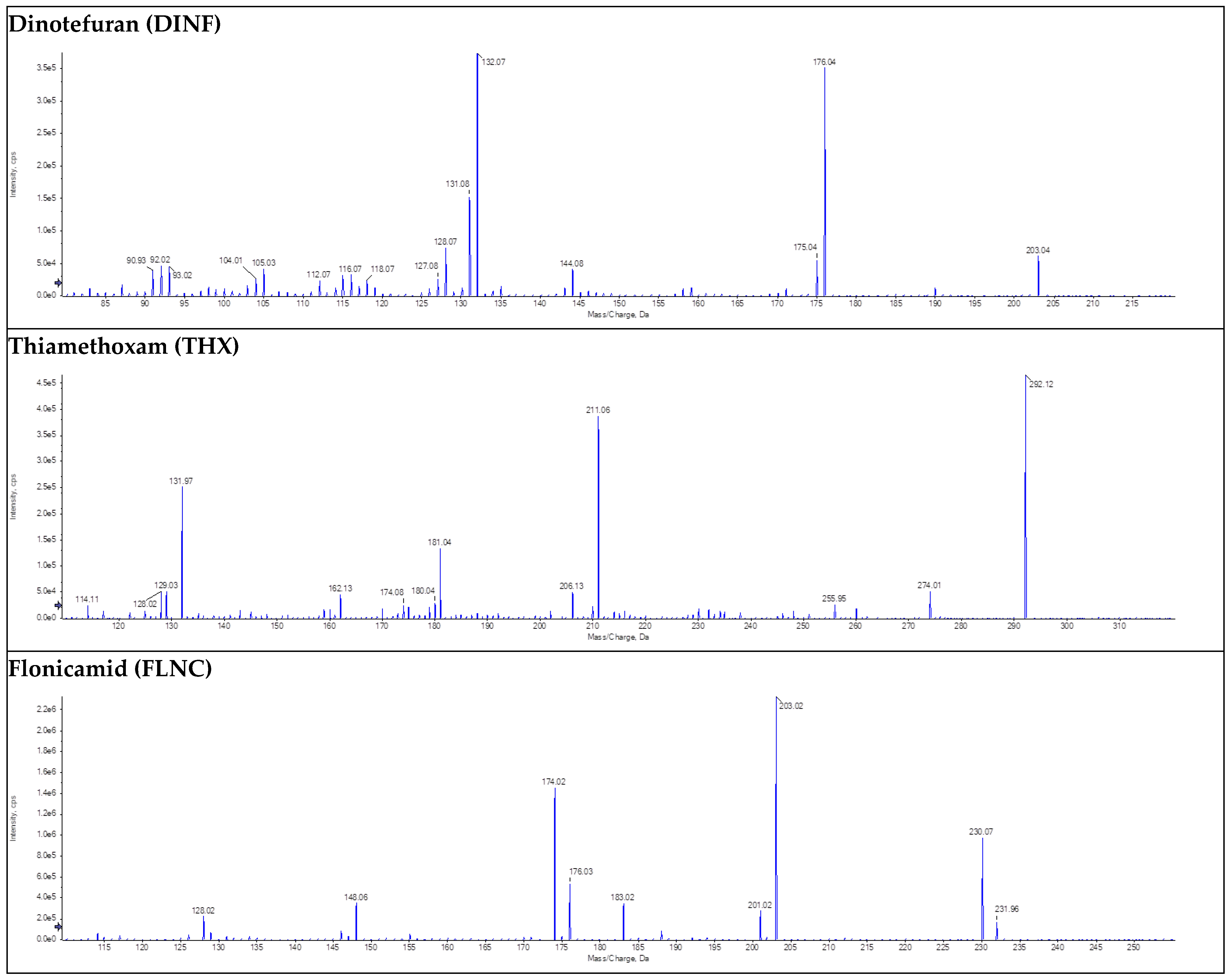
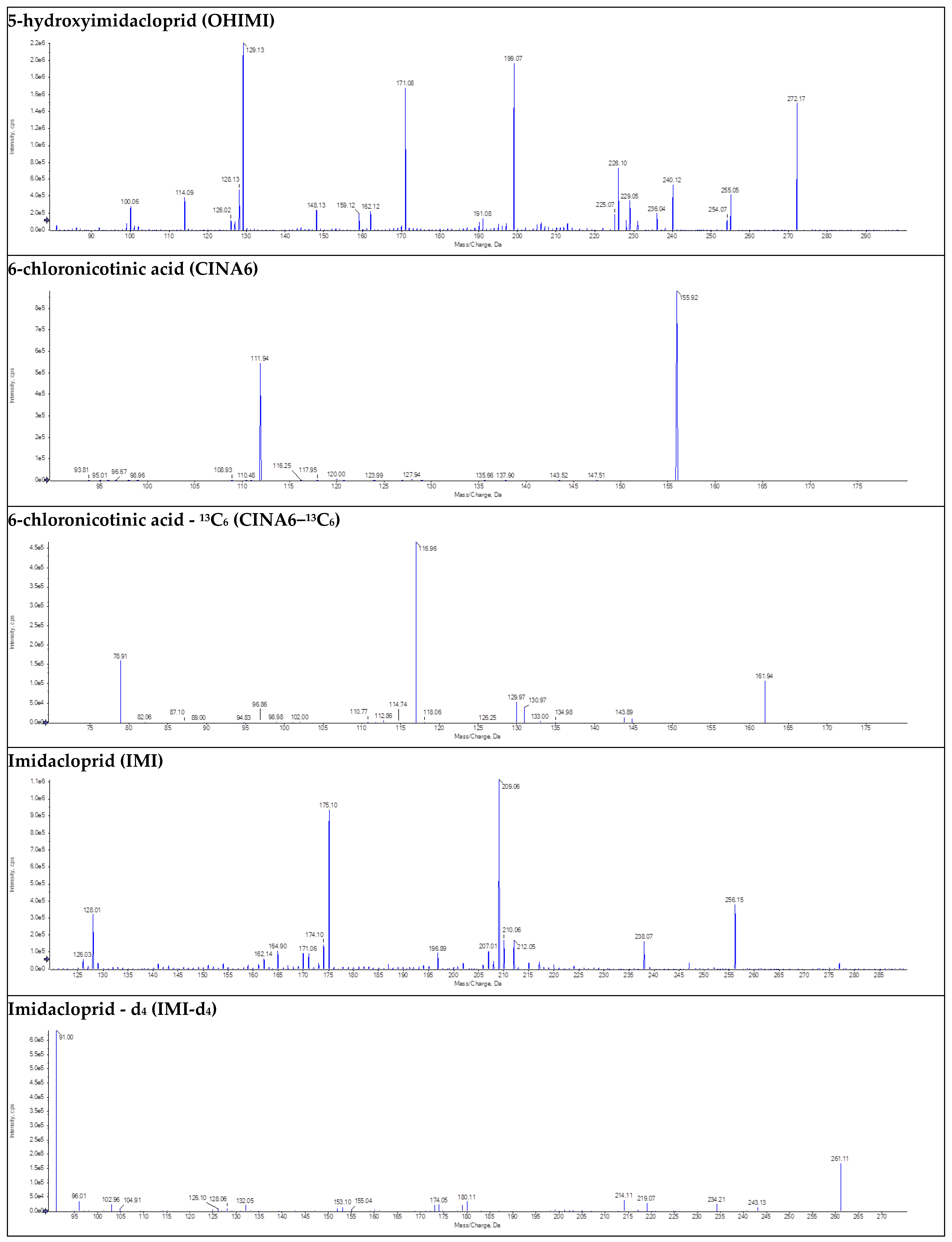
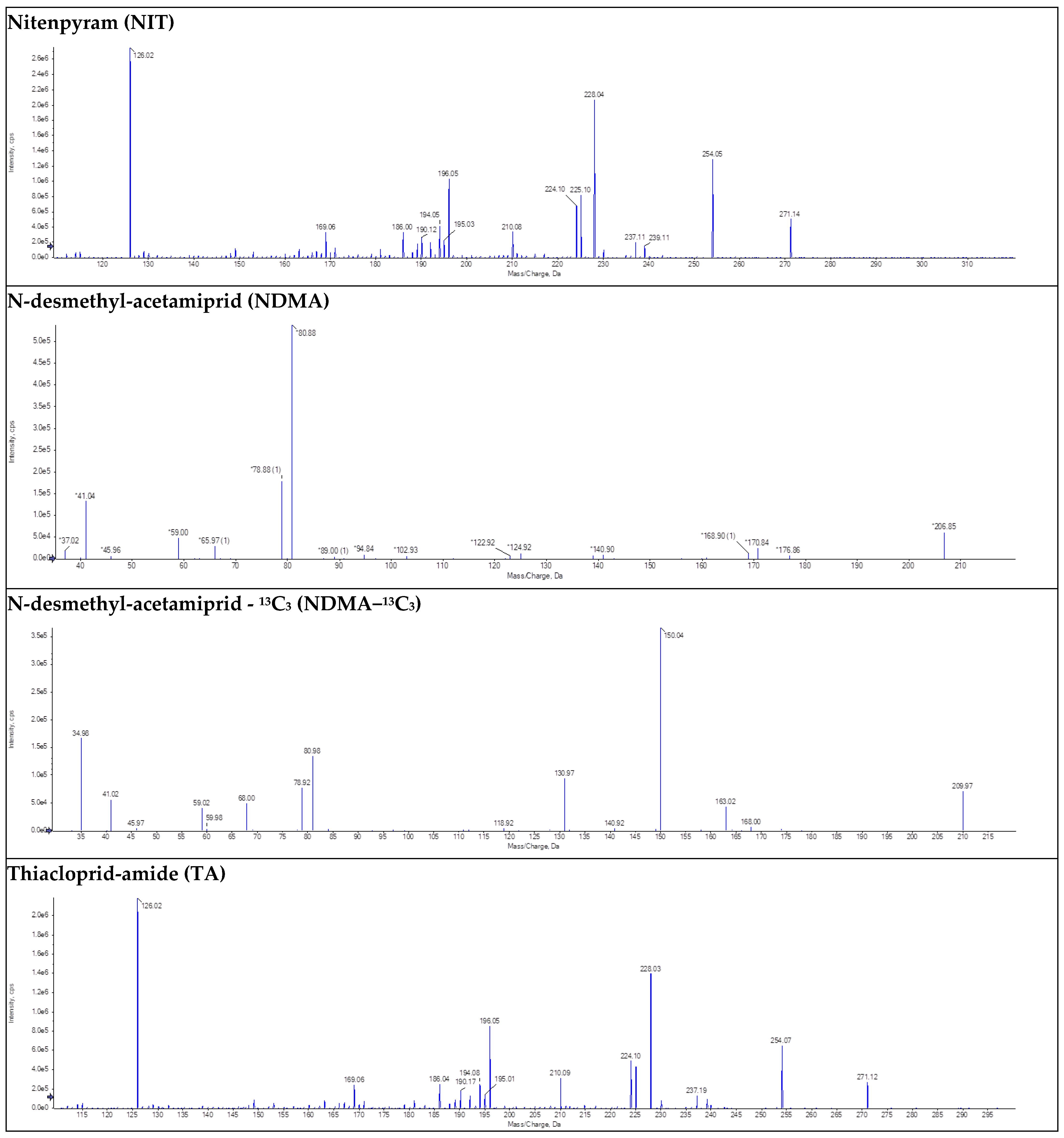
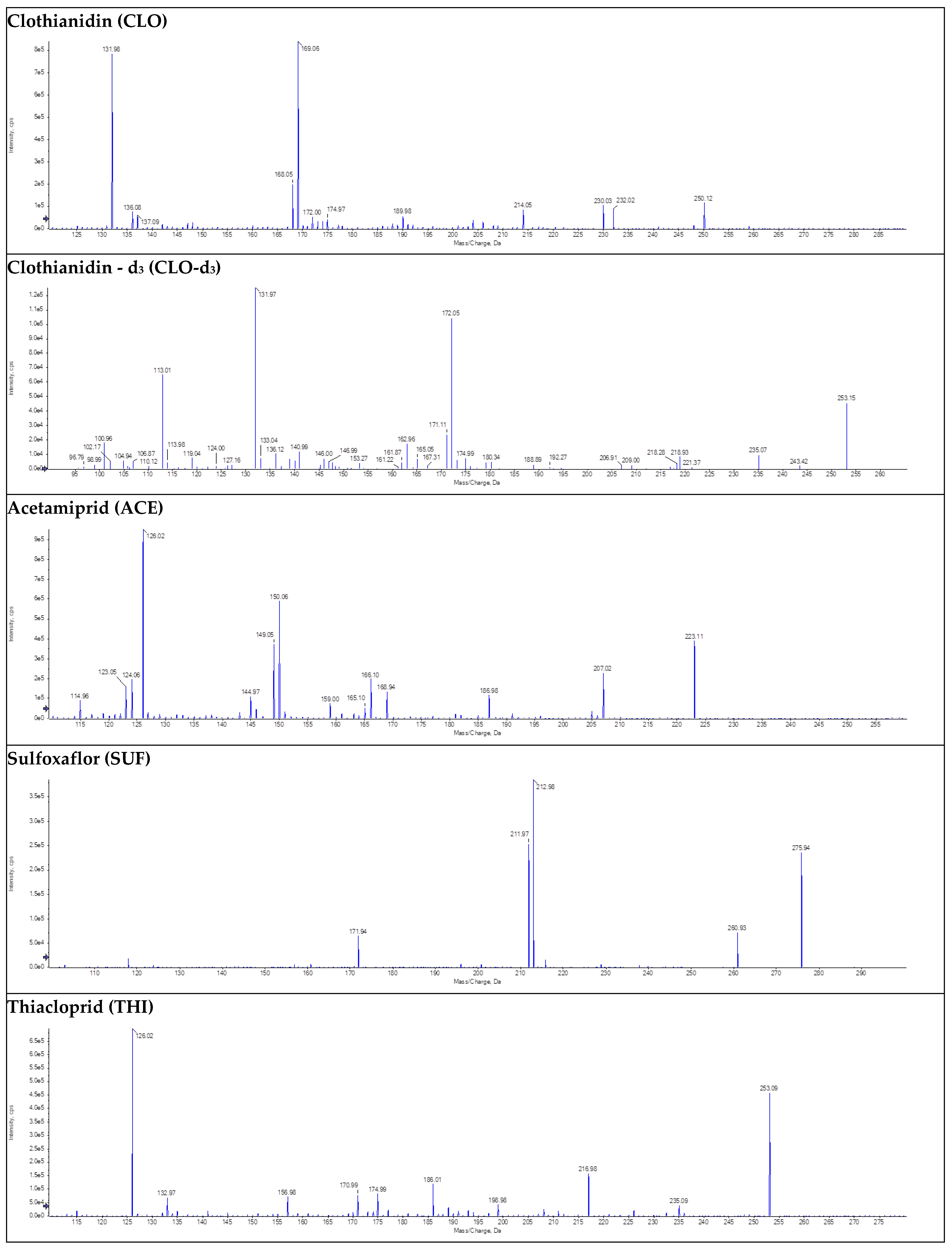
Method selectivity was confirmed by analyzing blank urine samples from multiple sources, with no interfering peaks observed at the retention times of the target analytes. Mass spectrometric detection utilized polarity switching in electrospray ionization mode with multiple reaction monitoring, ensuring high selectivity. The mass spectrum for neonicotinoid insecticides, representing one class of pesticides, is shown in Figure 5. Additional spectra of the precursor and fragmentation ions for each reference standard and internal standard (IL-ISTD) across all pesticide classes examined are available in the Supplementary Materials (Figure S1). These data demonstrate the robustness and specificity of our method for analyzing multiple classes of pesticides in urine.
A quantitative matrix effect (ME) evaluation was performed using the post-extraction addition approach. Matrix factor (MF) values were calculated for each analyte as the peak area in post-extraction spiked urine divided by the peak area in neat solvent at equivalent concentration; the IS-normalized MF (analyte MF divided by corresponding internal standard MF) was also calculated to evaluate compensation by labeled surrogates. Experiments were conducted in five independent urine sources at two concentration levels (1 and 10 ng/mL) in triplicate (n = 3 per source). Reported MF values ranged from moderate suppression to slight enhancement for some compounds; however, IS-normalized MF values were within 0.70–1.15 for most analytes, indicating effective compensation by the selected isotopically labeled internal standards. This approach and use of surrogate IL-ISTDs to correct matrix effects are consistent with prior multi-class urinary pesticide methods [11,15,17].

3.5.7. External Validation and Proficiency Testing

The robustness and reliability of our method were further demonstrated through participation in external quality assessment schemes. Specifically, 18 of the pesticide biomarkers included in our method are part of the G-EQUAS PT program (Table 2). Additionally, the OSEQAS PT program includes 11 pesticide biomarkers from our method (Table 2). This external validation provides confidence in the method’s performance and ensures comparability with other laboratories.

3.5.8. Regulatory Alignment and Deviations

Method validation elements (accuracy, precision, sensitivity, selectivity, stability, and recovery) were carried out following principles consistent with recent FDA biomarker recommendations for bioanalytical methods, including evaluating accuracy across at least three concentration levels and determining intra- and inter-assay precision [29,36]. Key parameters such as accuracy (RE within ± 15% for QC levels), precision (RSD <15%), and stability testing were consistent with standard biomonitoring method practices reported in the literature. Two practical deviations from specific FDA 2025 draft elements are noted: (1) analyte-specific isotopically labeled internal standards were unavailable for all targets; representative IL-ISTDs were used as surrogates after thorough matrix effect and recovery evaluation, an approach reported in other multiclass urine methods when full isotopically labeled coverage is not feasible [15,17]; and (2) while extensive within-laboratory reproducibility was assessed, full multi-laboratory reproducibility requires ring-trial participation [29]. These deviations are explicitly reported so readers may interpret regulatory applicability in the context of resource and standard availability. Full alignment with all formal regulatory checklists will be pursued in method transfer and interlaboratory validation stages.

3.6. Method Strenghts

The present method enhances analyte coverage compared to recent multi-analyte urinary assays while simultaneously reducing the required sample volume and improving analytical sensitivity. For instance, Marin-Saez et al. reported 30 analytes using a 1.0 mL urine aliquot [13], whereas our assay quantifies 50 analytes with a reduced sample volume of 0.20 mL, resulting in an 8-fold increase in analytes per milliliter processed. Gao et al. identified 26 pesticide-related analytes [15]; thus, our target list represents an approximate 92% increase in analyte coverage relative to their study while maintaining similar chromatographic run times and solvent compositions. Furthermore, methods that utilize online SPE or isotope-dilution strategies have achieved LODs, but at the expense of increased instrument complexity or larger sample volumes [12,13,15,25,38]. By integrating off-line 96-well Oasis HLB SPE with UHPLC-MS/MS and representative isotopically labeled surrogates, our method achieves LODs ranging from 0.01 to 0.88 ng/mL while utilizing minimal urine volume—this is particularly advantageous for studies limited by sample availability (e.g., pediatric cohorts). Additionally, it achieves limits of detection that are comparable to, or even lower than, those reported in the literature, which typically range from 0.02 to 0.64 ng/mL for 10 pesticides in 0.30 mL of urine [25] and from 0.1 to 0.6 ng/mL for 16 pesticides in 0.2 mL of urine [38], both employing isotope-dilution online SPE-LC-MS/MS.

3.7. Method Limitations

While the method demonstrates favorable recovery and selectivity metrics, limitations warrant consideration. First, although surrogate isotopically labeled internal standards were used to mitigate matrix effects, targeted assessment beyond global recovery—such as class-specific matrix suppression/enhancement mapping across diverse urine pools—was not exhaustively performed; similar multiclass studies emphasize the value of expanded matrix effect characterization when sample matrices vary widely [15,17]. Second, several emerging pesticides and metabolites were excluded due to the unavailability of certified reference materials or authentic standards at the time of method development; this pragmatic constraint has been noted in other multiclass efforts and guides prioritized future expansion [12,15]. Third, the demonstrated throughput (96-well SPE format with ~18 min LC cycle) supports moderate high-throughput studies, but scaling to >1000 individual samples requires dedicated automation, instrument multiplexing, and additional QC resources to maintain data quality—limitations observed in population studies that adopt online SPE, or isotope-dilution approaches to increase throughput [12,13,15,19,25,37,38]. Finally, integration with HHEAR or other laboratory networks will require harmonized QA/QC protocols, participation in interlaboratory comparison/round-robin test/external quality assessment schemes, and alignment of calibration and reporting units, as recommended for biomonitoring harmonization [29].

3.8. Method Applicability and Relevance

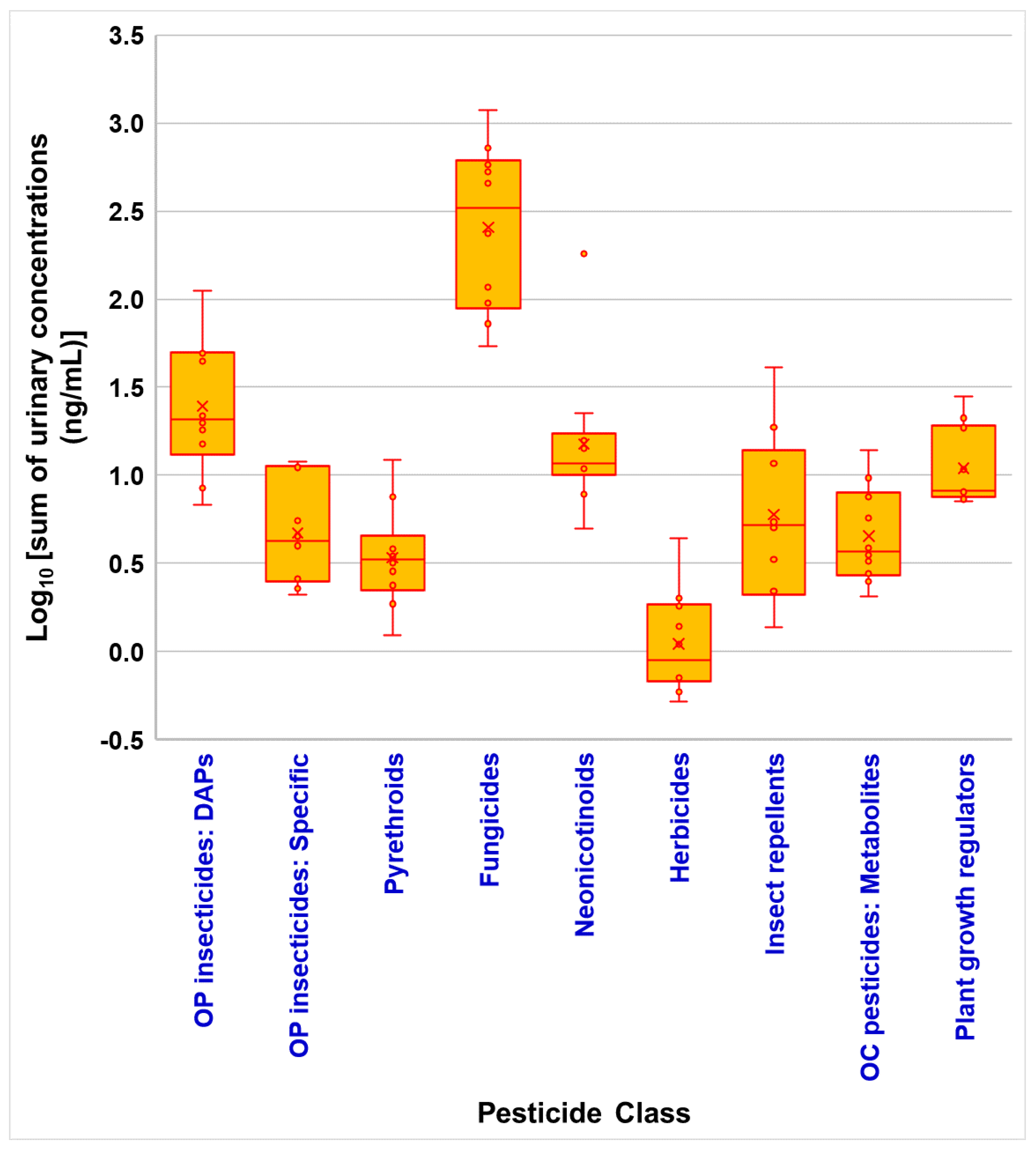
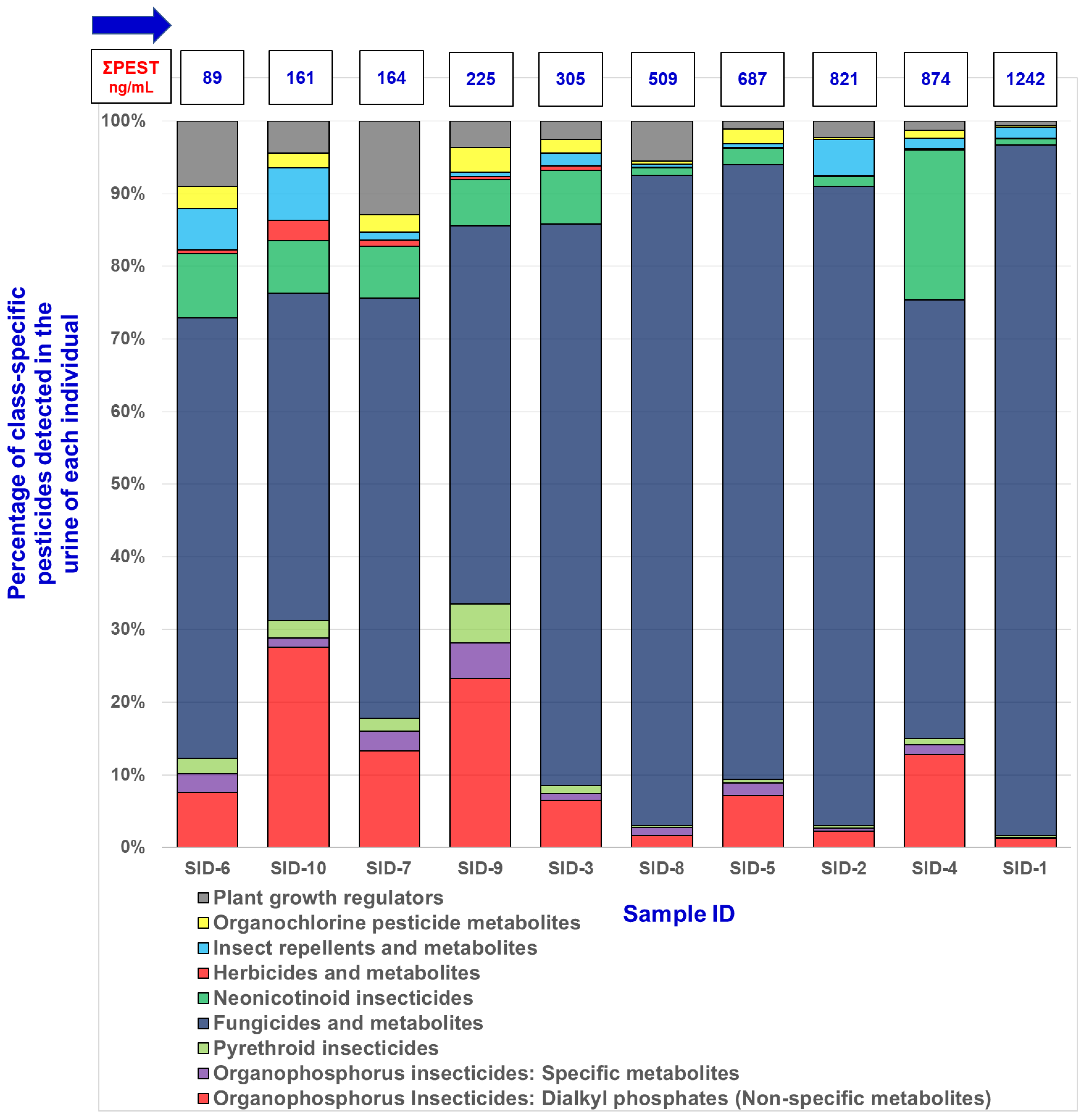
To demonstrate the practical utility of our developed method, we applied it to the analysis of urine samples from 10 individuals with sample ID (SID)-1 to SID-10. The method successfully quantified biomarkers from nine different pesticide classes, showcasing their capability for comprehensive pesticide exposure assessment. Figure 6 presents the arithmetic sum concentrations of pesticide compounds and their metabolites categorized by chemical class. This approach was chosen to provide a clear overview of total pesticide burden across different classes and samples, facilitating the assessment of overall exposure patterns. While molar sums would account for molecular weight differences, concentration sums offer a more direct representation of the measured values, which is particularly useful for comparing results across different studies and biomonitoring programs.
For the pilot application, analyte-specific detection frequencies and concentration ranges are reported to demonstrate method applicability despite the limited sample size. Detection frequency (percent of samples above LOD) for each analyte is presented in Table 4, and concentration ranges (min–max; median) with creatinine-unadjusted values. For key biomarkers, PBA was detected in 10/10 samples with concentrations from 0.21 to 3.64 ng/mL, TCP in 10/10 with 0.07–6.60 ng/mL, IMI in 9/10 with 0.00–0.43 ng/mL, CDCCA in 9/10 with 0.01–2.25 ng/mL, TDCCA in 4/10 with 0.00–2.20 ng/mL, and ACE in 3/10 with 0.00–0.47 ng/mL (Table 4). Where relevant, measured concentrations are compared with published biomonitoring datasets such as NHANES and contemporary multiclass urinary studies, noting that direct comparisons consider differences in sample populations, sample collection timing, and analytical LODs [1,15,23,24,26,37]. The comparison shows that observed ranges for the pilot cohort fall within or near ranges reported in population studies for several common biomarkers, supporting the method’s applicability for population biomonitoring; however, broader epidemiological inference will require larger cohorts.
Total pesticide concentrations varied widely among the samples, ranging from 89 ng/mL in SID-6 to 1242 ng/mL in SID-1, representing a nearly 14-fold difference (Figure 7). This substantial variation highlights the potential for significant inter-individual differences in pesticide exposure or metabolism. For sample extracts yielding analyte signals above the upper limit of quantification (100 ng/mL), a protocol of on-board dilution (10-fold or appropriate dilution factor) with blank followed by re-analysis was applied and concentrations were back-calculated to original sample levels; diluted analyses were repeated in duplicate to confirm results. This dilution-and-reanalysis approach follows established practice for multiresidue urinary assays when target analytes exceed the calibration range and ensures quantification remains within validated limits [11,38]. The summed group concentrations presented in Figure 6 and Figure 7 were therefore computed from validated individual analyte concentrations (either from original or diluted analyses).
Fungicides and metabolites exhibited the highest concentrations, ranging from 54 ng/mL to 1180 ng/mL, dominating the total pesticide burden. Organophosphorus insecticides, particularly dialkyl phosphates, showed a wide range of concentrations from 6.8 ng/mL to 111 ng/mL, while specific metabolites were generally lower. Herbicides and metabolites consistently showed the lowest concentrations, from 0.5 ng/mL to 4.4 ng/mL. The observed variability underscores the potential for this method to discern different exposure scenarios or metabolic profiles among individuals (Figure 7), providing valuable insights into the complex nature of pesticide exposure in human populations [23,24,26]. To provide population context, reported total-biomarker sums in our small convenience set were compared qualitatively with reference biomonitoring data. While direct summation approaches differ across studies, population surveys such as NHANES and multi-country assessments report median or percentile ranges for individual pesticide metabolites that generally lie below the upper range observed here for some individuals [1,12,15,23,24,26,37]. Comparable multiclass studies emphasize that isolated high summed concentrations in small samples may reflect episodic exposures or dietary/occupational sources and should be interpreted cautiously without larger, representative sampling [23,29]. We therefore report these observations as preliminary and recommend larger population-level comparisons, harmonized analyte selection, and unit normalization approaches (e.g., creatinine adjustment) for definitive interpretation [23,37].

4. Conclusions

In conclusion, a key strength of the developed method is the comprehensive coverage of pesticide classes and their metabolites, including both legacy and emerging pesticides in current use, in a single analysis. Although several prior urine methods have targeted multiple pesticide classes, the present assay expands analyte coverage and practical applicability for population studies by combining (i) simultaneous quantification of a larger set of neonicotinoid and fungicide metabolites alongside organophosphates and pyrethroids, and (ii) an SPE-based sample preparation compatible with only 0.2 mL urine, thereby enabling high-throughput analysis with small sample volumes [15,18,20]. Nevertheless, limitations remain, such as (i) comprehensive isotopically labeled internal standards are not universally available for all target analytes, which necessitated the use of representative surrogate IL-ISTDs and careful matrix-effect evaluation; and (ii) certain extreme polarity analytes may require tailored extraction or complementary techniques for improved recovery.
The current method analyzes 50 pesticide biomarkers across 9 pesticide classes, representing a significant improvement over existing literature. Its performance characteristics, including a wide linear range, low LODs and LOQs, high recoveries, and minimal matrix effects, make it a valuable tool for pesticide exposure assessment and biomonitoring studies. The method’s comprehensive coverage and alignment with established biomonitoring programs ensure its relevance for both research and regulatory applications in the field of environmental health and toxicology. Future work could focus on expanding the range of detectable compounds, particularly to include emerging pesticides and their metabolites from within this study’s chemical classes, such as adding dicamba to the herbicides class [14], expanding the neonicotinoids chemicals list [25], monitoring the USEPA’s recently banned pesticide dimethyl tetrachloroterephthalate (DCPA) [39] or its metabolite, or adding new and related classes such as fluorine-containing pesticides that are of emerging concern as “forever pesticides” [40]. In addition, using a suspect screening method like the pseudo-MRM technique [41] or a neutral loss scan [42] on a triple quadrupole mass spectrometer, as in a hybrid quantitative-qualitative assay, could be added to the targeted MRM method, allowing for the identification and semi-quantification of unexpected exposure biomarkers to new pesticides.
In summary, the validated SPE-UHPLC-MS/MS assay demonstrates robust performance for urinary biomonitoring of 50 pesticide biomarkers with limits of detection comparable to recent multiclass methods (LODs down to low-sub ng/mL), extraction efficiencies typically between 85–113%, calibration linearity across 0.1–100 ng/mL, acceptable precision (RSDs generally <15%), and demonstrable mitigation of matrix effects using representative isotopically labeled internal standards, supported by quantitative matrix factor data. Stability testing under the reported conditions indicated analyte integrity for routine handling and long-term storage at −80 °C, enabling use in large-scale studies. The method’s capability to quantify a broad range of pesticide classes in small urine volumes supports its applicability to population biomonitoring and exposure assessment, consistent with approaches used in recent multiclass urinary pesticide and exposomic methods.

Supplementary Materials

The following supporting information can be downloaded at: https://www.mdpi.com/article/10.3390/jox16020067/s1. Table S1. Pesticide chemical class, native and isotope-labelled analyte name, analyte code, CAS number, vendor, and catalog number for studied pesticides and metabolites. Figure S1: Mass spectra for the study analytes across all pesticide classes.

Author Contributions

Conceptualization, S.S.A.; methodology, R.J., J.C., H.P., S.T., D.P. and S.S.A., writing—original draft preparation, R.J., J.C. and S.S.A.; and writing—review and editing, R.J., J.C., H.P., S.T., D.P. and S.S.A. All authors have read and agreed to the published version of the manuscript.

Funding

This work received partial funding from the National Institutes of Health/National Institute of Environmental Health Sciences for S.S.A., who served as a coinvestigator on the following awards: P30 ES023515 (Mount Sinai Center on Health and Environment Across the LifeSpan (HEALS); Principal Investigator, Robert O. Wright), U2CES026561 (Mount Sinai HHEAR Targeted Analysis Laboratory; Principal Investigator, Robert O. Wright), and U2CES030859 (Mount Sinai HHEAR Untargeted Analysis Laboratory; Principal Investigator, Manish Arora).

Institutional Review Board Statement

This study was conducted in accordance with ethical guidelines and received approval from the Icahn School of Medicine at Mount Sinai (IRB-16-00742 approved on 12 December 2016). It aimed to develop analytical methods utilizing de-identified human specimens, which do not include personally identifiable information (PII) or protected health information (PHI).

Informed Consent Statement

Study participant consent was waived due to all urine samples used for quality controls, as well as for method development and validation, are sourced from anonymous donors through the specified biospecimen vendor.

Data Availability Statement

The original contributions presented in this study are included in the article/Supplementary Materials. Further inquiries can be directed to the corresponding author.

Acknowledgments

We gratefully acknowledge Mary S. Wolff (Department of Environmental Medicine, Icahn School of Medicine at Mount Sinai, New York, NY, USA) for consultation on the perspectives and analytical aspects of biomonitoring exposures to pesticides.

Conflicts of Interest

The authors declare no conflicts of interest.

Abbreviations

The following abbreviations are used in this manuscript:
ACEAcetamiprid
ATZAtrazine
AZOAzoxystrobin
CCCChlormequat
CDCCAcis-dichlorovinyl-dimethylcyclopropane carboxylic acid
CHEARChildren’s Health Exposure Analysis Resource
CINA66-chloronicotinic acid
CLOClothianidin
CTFCA3-(-2-chloro-3,3,3-trifluoroprop-1-enyl)-2,2- dimethylcyclopropanecarboxylic acid
CTQ-OSEQASCanadian External Quality Assessment Scheme for Organic Substances in Urine
CVCoefficient of variation
D242,4-dichlorophenoxyacetic acid
DCBA3-(diethylcarbamoyl) benzoic acid
DEAMP2-(diethylamino)-6-methylpyrimidin-4-ol
DEDPDiethyldithiophosphate
DEETN,N-diethyl-meta-toluamide
DEPDiethylphosphate
DETPDiethylthiophosphate
DHMBN,N-diethyl-3-(hydroxymethyl) benzamide
DINFDinotefuran
DMDPDimethyldithiophosphate
DMPDimethylphosphate
DMTPDimethylthiophosphate
ECBA3-(ethylcarbamoyl) benzoic acid
ETUEthylene thiourea
FLNCFlonicamid
FPBA4-fluoro-3-phenoxybenzoic acid
G-EQUASGerman External Quality Assessment Scheme for analyses of biological materials
HBMHuman biomonitoring
HHEARHuman Health Exposure Analysis Resource
IL-ISTDIsotope-labeled internal standards
IMIImidacloprid
IMPY2-isopropyl-4-methyl-pyrimidinol
LLOQLower limit of quantification
LODLimit of detection
LOQLimit of quantification
MCP44-chlorophenol
MDA2-[dimethoxyphosphorothioyl) sulfanyl] succinic acid
MQMepiquat
MRMMultiple reaction monitoring
NDMAN-desmethyl-acetamiprid
NHANESNational Health and Nutrition Examination Survey
NITNitenpyram
OHIMI5-hydroxyimidacloprid
OHTBZHydroxy tebuconazole
PBA3-phenoxybenzoic acid
PCPPentachlorophenol
PHIProtected health information
PIIPersonally identifiable information
PNP4-nitrophenol
PTProficiency testing
PTUPropylene thiourea
PYRMPyrimethanil
PYSTPyraclostrobin
QCQuality control
RERelative error
SPESolid-phase extraction
SUFSulfoxaflor
T2452,4,5-trichlorophenoxyacetic acid
TAThiacloprid-amide
TBZTebuconazole
TCP3,5,6-trichloro-2-pyridinol
TCP2462,4,6-trichlorophenol
TDCCAtrans-dichlorovinyl-dimethylcyclopropane carboxylic acid
TECP23562,3,5,6-tetrachlorophenol
THIThiacloprid
THPIcis-1,2,3,6-tetrahydrophthalimide
THXThiamethoxam
UHPLC-MS/MSUltra-high-performance liquid chromatography-tandem mass spectrometry

References

  1. Hakme, E.; Poulsen, M.E.; Lassen, A.D. A Comprehensive Review on Pesticide Residues in Human Urine. J. Agric. Food Chem. 2024, 72, 17706–17729. [Google Scholar] [CrossRef]
  2. Kaur, R.; Choudhary, D.; Bali, S.; Bandral, S.S.; Singh, V.; Ahmad, M.A.; Rani, N.; Singh, T.G.; Chandrasekaran, B. Pesticides: An alarming detrimental to health and environment. Sci. Total Environ. 2024, 915, 170113. [Google Scholar] [CrossRef]
  3. Roy, D.N.; Goswami, R.; Pal, A. The insect repellents: A silent environmental chemical toxicant to the health. Environ. Toxicol. Pharmacol. 2017, 50, 91–102. [Google Scholar] [CrossRef]
  4. Seralini, G.-E.; Jungers, G. Endocrine disruptors also function as nervous disruptors and can be renamed endocrine and nervous disruptors (ENDs). Toxicol. Rep. 2021, 8, 1538–1557. [Google Scholar] [CrossRef]
  5. Wang, X.; Hao, W. Reproductive and developmental toxicity of plant growth regulators in humans and animals. Pestic. Biochem. Physiol. 2023, 196, 105640. [Google Scholar] [CrossRef]
  6. Birolli, W.G.; Lanças, F.M.; dos Santos Neto, Á.J.; Silveira, H.C.S. Determination of pesticide residues in urine by chromatography-mass spectrometry: Methods and applications. Front. Public Health 2024, 12, 1336014. [Google Scholar] [CrossRef] [PubMed]
  7. Baker, S.E.; Serafim, A.B.; Morales-Agudelo, P.; Vidal, M.; Calafat, A.M.; Ospina, M. Quantification of DEET and neonicotinoid pesticide biomarkers in human urine by online solid-phase extraction high-performance liquid chromatography-tandem mass spectrometry. Anal. Bioanal. Chem. 2019, 411, 669–678. [Google Scholar] [CrossRef] [PubMed]
  8. Behniwal, P.K.; She, J. Development of HPLC-MS/MS method for the simultaneous determination of metabolites of organophosphate pesticides, synthetic pyrethroids, herbicides and DEET in human urine. Int. J. Environ. Anal. Chem. 2017, 97, 548–562. [Google Scholar] [CrossRef]
  9. Olsson, A.O.; Baker, S.E.; Nguyen, J.V.; Romanoff, L.C.; Udunka, S.O.; Walker, R.D.; Flemmen, K.L.; Barr, D.B. A Liquid Chromatography−Tandem Mass Spectrometry Multiresidue Method for Quantification of Specific Metabolites of Organophosphorus Pesticides, Synthetic Pyrethroids, Selected Herbicides, and DEET in Human Urine. Anal. Chem. 2004, 76, 2453–2461. [Google Scholar] [CrossRef] [PubMed]
  10. Davis, M.D.; Wade, E.L.; Restrepo, P.R.; Roman-Esteva, W.; Bravo, R.; Kuklenyik, P.; Calafat, A.M. Semi-automated solid phase extraction method for the mass spectrometric quantification of 12 specific metabolites of organophosphorus pesticides, synthetic pyrethroids, and select herbicides in human urine. J. Chromatogr. B Anal. Technol. Biomed. Life Sci. 2013, 929, 18–26. [Google Scholar] [CrossRef]
  11. Shin, Y.; Lee, J.; Park, E.; Lee, J.; Lee, H.S.; Kim, J.H. A Quantitative Tandem Mass Spectrometry and Scaled-Down QuEChERS Approach for Simultaneous Analysis of Pesticide Multiresidues in Human Urine. Molecules 2019, 24, 1330. [Google Scholar] [CrossRef]
  12. Bustamante, C.M.; Bravo, N.; Ruiz, P.; Grimalt, J.O.; Garí, M. Method optimization for a simultaneous determination of neonicotinoid, carbamate/thiocarbamate, triazole, organophosphate and pyrethroid pesticides and their metabolites in urine using UPLC-MS/MS. J. Chromatogr. A 2024, 1730, 465054. [Google Scholar] [CrossRef]
  13. Marín-Sáez, J.; Hernández-Mesa, M.; Gallardo-Ramos, J.A.; Gámiz-Gracia, L.; García-Campaña, A.M. Assessing human exposure to pesticides and mycotoxins: Optimization and validation of a method for multianalyte determination in urine samples. Anal. Bioanal. Chem. 2024, 416, 1935–1949. [Google Scholar] [CrossRef]
  14. Larose, J.; Bienvenu, J.-F.; Bélanger, P.; Gaudreau, É.; Yu, Y.; Guise, D.M. New sensitive LC-MS/MS method for the simultaneous determination of 13 phenolic and carboxylic acid pesticide biomarkers in human urine, including dicamba. Chemosphere 2023, 344, 140349. [Google Scholar] [CrossRef] [PubMed]
  15. Gao, B.; Poma, G.; Malarvannan, G.; Dumitrascu, C.; Bastiaensen, M.; Wang, M.; Covaci, A. Development of an analytical method based on solid-phase extraction and LC-MS/MS for the monitoring of current-use pesticides and their metabolites in human urine. J. Environ. Sci. 2022, 111, 153–163. [Google Scholar] [CrossRef]
  16. Zhu, H.; Chinthakindi, S.; Kannan, K. A method for the analysis of 121 multi-class environmental chemicals in urine by high-performance liquid chromatography-tandem mass spectrometry. J. Chromatogr. A 2021, 1646, 462146. [Google Scholar] [CrossRef] [PubMed]
  17. Mercier, F.; Rouillon-Bartoletti, C.; Dimeglio, A.; Gilles, E.; Lecorgne, A.; Bonvallot, N.; Le Bot, B. Simultaneous determination of selected pesticides and/or their metabolites in urine by off-line solid phase extraction and ultra high performance liquid chromatography/hybrid quadrupole time-of-flight mass spectrometry. Microchem. J. 2022, 180, 107539. [Google Scholar] [CrossRef]
  18. Jagani, R.; Pulivarthi, D.; Patel, D.; Wright, R.J.; Wright, R.O.; Arora, M.; Wolff, M.S.; Andra, S.S. Validated single urinary assay designed for exposomic multi-class biomarkers of common environmental exposures. Anal. Bioanal. Chem. 2022, 414, 5943–5966. [Google Scholar] [CrossRef] [PubMed]
  19. Jagani, R.; Chovatiya, J.; Pulivarthi, D.; Meher, A.K.; Patel, D.; Patel, H.; Teraiya, S.; Andra, S.S. Multiclass Assays for Measuring Environmental Chemical Mixture Exposure: Analytical Methodologies and Applications in Exposomics Research. Metabolites 2025, 15, 742. [Google Scholar] [CrossRef]
  20. Kunde, H.; Ioannou, E.I.; Chovatiya, J.; Jagani, R.; Charisiadis, P.; Arora, M.; Andra, S.S.; Makris, K.C. An exposomics analysis of 125 biomarkers of exposure to food contaminants and biomarkers of oxidative stress: A randomized cross-over chrononutrition trial of healthy adults. Environ. Int. 2025, 202, 109682. [Google Scholar] [CrossRef] [PubMed]
  21. Zhou, T.; Abrishamcar, S.; Christensen, G.; Eick, S.M.; Barr, D.B.; Vanker, A.; Hoffman, N.; Donald, K.A.; Wedderburn, C.J.; Andra, S.S.; et al. Associations between prenatal exposure to environmental phenols and child neurodevelopment at two years of age in a South African birth cohort. Environ. Res. 2025, 264, 120325. [Google Scholar] [CrossRef] [PubMed]
  22. Hauptman, M.; Jackson-Browne, M.S.; Busgang, S.; Andra, S.S.; Patti, M.A.; Henderson, N.B.; Curtin, P.; Teitelbaum, S.L.; Acosta, K.; Maciag, M.; et al. Urinary biomarkers of environmental exposures and asthma morbidity in a school inner city asthma study. Int. J. Hyg. Environ. Health 2024, 262, 114430. [Google Scholar] [CrossRef] [PubMed]
  23. Heffernan, A.L.; English, K.; Toms, L.; Calafat, A.M.; Valentin-Blasini, L.; Hobson, P.; Broomhall, S.; Ware, R.S.; Jagals, P.; Sly, P.D.; et al. Cross-sectional biomonitoring study of pesticide exposures in Queensland, Australia, using pooled urine samples. Environ. Sci. Pollut. Res. Int. 2016, 23, 23436–23448. [Google Scholar] [CrossRef] [PubMed]
  24. Norén, E.; Lindh, C.; Rylander, L.; Glynn, A.; Axelsson, J.; Littorin, M.; Faniband, M.; Larsson, E.; Nielsen, C. Concentrations and temporal trends in pesticide biomarkers in urine of Swedish adolescents, 2000–2017. J. Expo. Sci. Environ. Epidemiol. 2020, 30, 756–767. [Google Scholar] [CrossRef]
  25. Wrobel, S.A.; Bury, D.; Belov, V.N.; Klenk, J.M.; Hauer, B.; Hayen, H.; Martino-Andrade, A.J.; Koch, H.M.; Brüning, T.; Käfferlein, H.U. Rapid quantification of seven major neonicotinoids and neonicotinoid-like compounds and their key metabolites in human urine. Anal. Chim. Acta 2023, 1239, 340680. [Google Scholar] [CrossRef]
  26. Schmied-Tobies, M.I.H.; Murawski, A.; Schmidt, L.; Rucic, E.; Schwedler, G.; Apel, P.; Göen, T.; Kolossa-Gehring, M. Pentachlorophenol and nine other chlorophenols in urine of children and adolescents in Germany—Human biomonitoring results of the German Environmental Survey 2014–2017 (GerES V). Environ. Res. 2021, 196, 110958. [Google Scholar] [CrossRef]
  27. Wright, R.O.; Teitelbaum, S.; Thompson, C.; Balshaw, D. The child health exposure analysis resource as a vehicle to measure environment in the environmental influences on child health outcomes program. Curr. Opin. Pediatr. 2018, 30, 285–291. [Google Scholar] [CrossRef]
  28. Viet, S.M.; Falman, J.C.; Merrill, L.S.; Faustman, E.M.; Savitz, D.A.; Mervish, N.; Barr, D.B.; Peterson, L.A.; Wright, R.; Balshaw, D.; et al. Human Health Exposure Analysis Resource (HHEAR): A model for incorporating the exposome into health studies. Int. J. Hyg. Environ. Health 2021, 235, 113768. [Google Scholar] [CrossRef] [PubMed]
  29. Kannan, K.; Stathis, A.; Mazzella, M.J.; Andra, S.S.; Barr, D.B.; Hecht, S.S.; Merrill, L.S.; Galusha, A.L.; Parsons, P.J. Quality assurance and harmonization for targeted biomonitoring measurements of environmental organic chemicals across the Children’s Health Exposure Analysis Resource laboratory network. Int. J. Hyg. Environ. Health 2021, 234, 113741. [Google Scholar] [CrossRef]
  30. Personne, S.; Marcelo, P.; Pilard, S.; Baltora-Rosset, S.; Corona, A.; Robidel, F.; Lecomte, A.; Brochot, C.; Bach, V.; Zeman, F. Determination of maternal and foetal distribution of cis- and trans-permethrin isomers and their metabolites in pregnant rats by liquid chromatography tandem mass spectrometry (LC-MS/MS). Anal. Bioanal. Chem. 2019, 411, 8043–8052. [Google Scholar] [CrossRef]
  31. Barr, D.B.; Olsson, A.O.; Bravo, R.; Needham, L.L. Comprehensive Approach for Biological Monitoring of Pesticides in Urine Using HPLC-MS/MS and GC-MS/MS. In Pesticide Protocols; Martínez Vidal, J.L., Frenich, A.G., Eds.; Humana Press: Totowa, NJ, USA, 2006; pp. 61–78. [Google Scholar]
  32. Aylward, L.L.; Morgan, M.K.; Arbuckle, T.E.; Barr, D.B.; Burns, C.J.; Alexander, B.H.; Hays, S.M. Biomonitoring data for 2,4-dichlorophenoxyacetic acid in the United States and Canada: Interpretation in a public health risk assessment context using Biomonitoring Equivalents. Env. Health Perspect 2010, 118, 177–181. [Google Scholar] [CrossRef] [PubMed]
  33. Harada, K.H.; Tanaka, K.; Sakamoto, H.; Imanaka, M.; Niisoe, T.; Hitomi, T.; Kobayashi, H.; Okuda, H.; Inoue, S.; Kusakawa, K.; et al. Biological Monitoring of Human Exposure to Neonicotinoids Using Urine Samples, and Neonicotinoid Excretion Kinetics. PLoS ONE 2016, 11, e0146335. [Google Scholar] [CrossRef]
  34. Bravo, R.; Caltabiano, L.M.; Weerasekera, G.; Whitehead, R.D.; Fernandez, C.; Needham, L.L.; Bradman, A.; Barr, D.B. Measurement of dialkyl phosphate metabolites of organophosphorus pesticides in human urine using lyophilization with gas chromatography-tandem mass spectrometry and isotope dilution quantification. J. Expo. Sci. Environ. Epidemiol. 2004, 14, 249–259. [Google Scholar] [CrossRef]
  35. Health, U.D.O.; Services, H. Bioanalytical Method Validation, Guidance for Industry. 2018. Available online: https://www.fda.gov/files/drugs/published/Bioanalytical-Method-Validation-Guidance-for-Industry.pdf (accessed on 25 February 2026).
  36. Quadrini, K.J.; Aubrecht, J.; King, N.M.P.; Fernandez-Metzler, C.; Ni, Y.G.; Sauer, J.-M.; Stevenson, L.; Piccoli, S.P. Special consideration: Commentary on the 2025 FDA Bioanalytical Method Validation for Biomarkers. Bioanalysis 2025, 17, 899–900. [Google Scholar] [CrossRef] [PubMed]
  37. Li, A.J.; Kannan, K. Urinary concentrations and profiles of organophosphate and pyrethroid pesticide metabolites and phenoxyacid herbicides in populations in eight countries. Environ. Int. 2018, 121, 1148–1154. [Google Scholar] [CrossRef]
  38. Wambua, D.; Roman, W.; Vidanage, I.; Vidal, M.; Calafat, A.M.; Ospina, M. Online solid phase extraction high-performance liquid chromatography–Isotope dilution–Tandem mass spectrometry quantification of organophosphate pesticides, synthetic pyrethroids, and selected herbicide metabolites in human urine. Chemosphere 2023, 340, 139863. [Google Scholar] [CrossRef] [PubMed]
  39. USEPA. EPA Issues Emergency Order to Stop Use of Pesticide Dacthal to Address Serious Health Risk. 2024. Available online: https://www.epa.gov/newsreleases/epa-issues-emergency-order-stop-use-pesticide-dacthal-address-serious-health-risk-4 (accessed on 25 February 2026).
  40. Donley, N.; Cox, C.; Bennett, K.; Temkin, A.M.; Andrews, D.Q.; Naidenko, O.V. Forever Pesticides: A Growing Source of PFAS Contamination in the Environment. Env. Health Perspect. 2024, 132, 75003. [Google Scholar] [CrossRef]
  41. Yu, C.; Stevenson, G.; De Araujo, J.; Crough, R. Application of in-source fragmentation to the identification of perfluoropentanoic acid and perfluorobutanoic acid in environmental matrices and human serum by isotope dilution liquid chromatography coupled with tandem mass spectrometry. Chemosphere 2023, 340, 139756. [Google Scholar] [CrossRef] [PubMed]
  42. Sangiorgi, E.; Curatolo, M.; Assini, W.; Bozzoni, E. Application of neutral loss mode in liquid chromatography–mass spectrometry for the determination of corticosteroids in bovine urine. Anal. Chim. Acta 2003, 483, 259–267. [Google Scholar] [CrossRef]
Figure 1. The chemical structures of the studied pesticides and metabolites, categorized by their chemical classes.
Jox 16 00067 g001aJox 16 00067 g001bJox 16 00067 g001c
Figure 2. A flowchart optimized for urine cleanup and analysis enables the extraction, separation, and quantification of 50 pesticide chemicals and their metabolites from a single urine aliquot in one assay, while also allowing for customization to include additional analytes or classes of pesticides.
Jox 16 00067 g002
Figure 3. Representative extracted ion chromatograms (EIC) of multiclass pesticide analytes: (A) native standard solution and (B) stable isotope-labeled internal standard solution.
Jox 16 00067 g003
Figure 4. Representative LC-MS/MS MRM ion chromatograms of various classes of pesticides and their metabolites obtained from a single injection of an extract from a representative urine sample (blue line) alongside a 1 ng/mL standard solution (red line).
Jox 16 00067 g004aJox 16 00067 g004bJox 16 00067 g004cJox 16 00067 g004d
Figure 5. The mass spectrum of individual neonicotinoid insecticides illustrates their molecular characteristics and fragmentation patterns. Similar precursor and fragmentation ion spectra for each reference standard and IL-ISTD for all pesticide classes studied are in the Supplementary Materials.
Jox 16 00067 g005aJox 16 00067 g005bJox 16 00067 g005cJox 16 00067 g005d
Figure 6. Distribution of pesticide biomarkers in urine samples from 10 adult volunteers. Box plot shows the distribution of pesticide concentrations by chemical class. The box represents the 25th and 75th percentiles, with the median indicated by the line inside the box and the mean by an X. Whiskers show the minimum and maximum values, with outliers plotted as individual points.
Jox 16 00067 g006
Figure 7. Percentage composition of pesticide biomarkers by chemical class for each individual sample represented as a stacked bar chart. Sample IDs (SID) are arranged in ascending order of total pesticide concentration (ΣPEST), from SID-6 with the lowest ΣPEST of 89 ng/mL to SID-1 with the highest ΣPEST of 1242 ng/mL. ΣPEST represents the sum of all measured pesticide biomarker concentrations in each sample. The use of arithmetic sum concentrations allows for a more direct comparison of exposure levels across different pesticide classes and individuals, which is particularly useful for biomonitoring studies and risk assessment. This approach provides a straightforward representation of the total pesticide burden, facilitating easier interpretation of exposure patterns across the study population.
Jox 16 00067 g007
Table 1. Multiclass or multiresidue triple quadrupole LC/MS analytical methods that have been selected and recently published for non-persistent pesticides and metabolites in human urine after 2020.
Study #Number of Pesticide ClassesPesticide ClassNumber of Pesticide Biomarkers in Each ClassTotal Number of Pesticide AnalytesNumber of Sample Preparation Steps (Number of Urine Aliquots)Urine Aliquot Volume (mL)Sample Preparation: Enzymatic DeconjugationSample CleanupLC Column (Particle Size, Inner Diameter, and Length)LC Mobile PhasesLC Run Time (min.)Mass SpectrometryLODs/LOQs (ng/mL)Recovery RangeReference
19Organophosphorus insecticides: Dialkyl phosphates (Non-specific metabolites)65010.2ALS enzyme BGALA-RO-glucuronidase/arylsulfatase from Helix pomatia (β-glucuronidase
activity ≈100,000 units/mL and sulfatase activity ≈47,500
units/mL)
Solid-phase extraction (SPE): Oasis HLB 96-well plate (30 mg sorbent per well, 30 µm)Hypersil Gold AQ analytical column (3 μm, 4.6 × 150 mm) and guard column (3 µm, 4.0 × 10 mm)A: 0.1% acetic acid in water, and
B: 1:1 of acetonitrile and methanol
18.0SCIEX 7500 Triple Quad and Qtrap-ready. ESI positive and negative mode with polarity switching.LOD: 0.01–0.88
LOQ: 0.02–2.92
85–113%This study
Organophosphate insecticides: Specific metabolites5
Pyrethroid insecticides 5
Fungicides and metabolites10
Neonicotinoid insecticides13
Herbicides and metabolites3
Insect repellents and metabolites4
Organochlorine pesticide metabolites2
Plant growth regulators2
24Organophosphate insecticides: Specific metabolites52311.0β-glucuronidase
type H-1 solution from Helix pomatia (specific activity of ~500
units/mg)
SPE with Oasis HLB 3 cm3Betasil C18 column (3 μm, 2.1 × 100 mm) A: HPLC grade water with 5% methanol and 1% CH3COOH, and B: acetonitrile22.0Waters XEVO-TQ-S Triple Quad MS. ESI positive and negative mode in time segments.LOD: 0.012–0.05878–99%Bustamante et al., 2024, [12]
Pyrethroid insecticides 2
Fungicides and metabolites5
Neonicotinoid insecticides11
35Organophosphorus Insecticides: Dialkyl phosphates (Non-specific metabolites)83011.0β-Glucuronidase from Helix pomatia (6000 units/mL)Salting-out liquid–liquid extraction (SALLE)Hypersil Gold AQ column (1.9 µm, 2.1 × 100 mm)A: Water with ammonium formate (4 mM) and 0.2% (v/v) formic acid, and B: methanol with ammonium formate (4 mM) and 0.2% (v/v) formic acid16.0AB SCIEX API 3200 Triple Quad MS. ESI positive and negative mode with polarity switching.LOD: 0.01–2570–120% (SALLE)Marin-Saez et al., 2024, [13] *
Organophosphate insecticides: Specific metabolites5
Pyrethroid insecticides3
Fungicides and metabolites6
Neonicotinoid insecticides8
43Organophosphate insecticides: Specific metabolites51310.25β-Glucuronidase from Helix Pomatia, type H-1 (β–glucuronidase of 6300 units/mL and sulfatase of 103 units/mL)SPE with Strata-X extraction cartridges (30 mg/3 mL)BEH C18 column with VanGuard FIT (1.7 μm, 2.1 × 100 mm)A: 0.035% acetic acid in water, and B: 0.035% acetic acid in methanol17.5AB SCIEX Tripe Quad 7500 MS. ESI positive and negative mode in time segments. with polarity switching.LOD: 0.0038–0.091; dicamba LOD: 0.179–95.4%; MDA: 34.9%Larose et al., 2023 [14]
Pyrethroid insecticides5
Herbicides and metabolites3
55Organophosphate insecticides and metabolites62611.0β-glucuronidase, from Helix pomatia. type HP-2 (β-glucuronidase
activity ≥ 100,000 units/mL and sulfatase activity ≤ 7500 units/mL)
SPE with Oasis HLB cartridges (3 mL/60 mg, 30 μm)Kinetex XB-C18 reversed-phase column (1.7 μm, 2.1 × 50 mm)A: water with 5 mmol/L ammonium formate, and B: methanol with 5 mmol/L ammonium formate15.0Agilent 6495 Triple Quad MS with iFunnel technology. ESI positive and negative mode with dynamic MRM (d-MRM) mode. LOQ: 0.1–16 pg/mL80–119%; MDA: 24%Gao et al., 2022 [15]
Pyrethroid insecticides11
Neonicotinoid insecticides4
Fungicides and metabolites2
Other pesticides (fipronil and metabolites)3
65Organophosphate insecticides: Specific metabolites2311
One aliquot but two injections:
1st injection includes 7 pesticides.
2nd injection includes 24 pesticides.
0.5β-glucuronidase/arylsulfatase enzyme from Helix pomatia (β-glucuronidase activity ≈ 100,000 units/mL; sulfatase activity ≈ 47,500 units/mL)SPE with ABS Elut NEXUS (60 mg, 3 mL)1st: Ultra AQ C18
column
(3 μm, 2.1 × 100 mm).
2nd: Betasil C18 column (5 μm, 2.1 × 100 mm).
1st:
A: 0.1% acetic acid in water, and B: 0.1% acetic acid in methanol.
2nd:
A: water, and B: acetonitrile.
Two injections:
1st: 12.0
2nd: 9.0
AB SCIEX QTRAP 5500 + Triple Quad MS. ESI positive and negative mode with polarity switching.LOD: 0.008–0.277–156%Zhu et al., 2021 [16] *
Pyrethroid insecticides 4
Fungicides and metabolites7
Neonicotinoid insecticides13
Herbicides and metabolites4
Other pesticides (sulfoxaflor)1
* In the described analytical methodology, in addition to biomarkers of exposure to pesticides, Marin-Saez et al. (2024) [13] included mycotoxins, while Zhu et al. (2022) [16] incorporated metabolites of plasticizers, environmental phenols, and polycyclic aromatic hydrocarbons. #: Numbers.
Table 3. Mass spectrometric and method validation parameters.
Pesticide Class and Analyte NameAnalyte CodeLabeled Analyte CodeESI ModePrecursor Ion (m/z)Product Ion (m/z)DT (ms)EP (V)CE (eV)CXP (V)RT (min)R2LOD (ng/mL)LOQ (ng/mL)QC Urine Pool,
Mean Conc. *, ng/mL
1 ng/mL Spike in QC Urine Pool
(n = 30, 3 Replicates × 10 Batches)
10 ng/mL Spike in QC Urine Pool
(n = 30, 3 Replicates × 10 Batches)
EE % ± SDRE %RSD %CV %EE % ± SDRE %RSD %CV %
Organophosphorus insecticides: Dialkyl phosphates (generic metabolites)
DimethylphosphateDMPDMP-d6- ve124.95109.9325−10−20−213.380.9990.050.153.0796 ± 11−441194 ± 14−6615
DimethylthiophosphateDMTPDMTP-d6- ve140.93125.9025−10−20−213.900.9980.250.842.62101 ± 11111193 ± 10 −6710
DimethyldithiophosphateDMDPDMDP-d6- ve156.90141.8825−10−20−214.290.9930.030.121.14100 ± 6006101 ± 5115
DiethylphosphateDEPDEP-d10- ve152.98124.9525−10−20−214.650.9980.030.123.36103 ± 14661499 ± 13−2213
DiethylthiophosphateDETPDETP-d10- ve168.95140.9325−10−20−216.430.9950.060.200.7694 ± 10−6610109 ± 8998
DiethyldithiophosphateDEDPDEDP-d10- ve184.93110.8625−10−20−216.920.9990.060.190.30102 ± 822898 ± 7−227
Organophosphorus insecticides: Specific metabolites
4-nitrophenolPNPPNP−13C6- ve137.96107.9825−10−38−1610.820.9980.040.131.1299 ± 9−119100 ± 3003
3,5,6-trichloro-2-pyridinolTCPTCP−13C3- ve195.7834.9925−10−25−513.680.9940.010.020.46105 ± 115411100 ± 3003
2-[dimethoxyphosphorothioyl) sulfanyl] succinic acidMDAMDA-d4- ve272.90140.9325−10−14−159.650.9970.070.230.30100 ± 10−1110100 ± 5005
2-isopropyl-4-methyl-pyrimidinolIMPYIMPY−13C4+ ve153.1384.04251023108.540.9990.020.050.23105 ± 115511101 ± 6116
2-(diethylamino)-6-methylpyrimidin-4-olDEAMPDEET-d6+ ve182.11154.12251025109.900.9980.010.040.3698 ± 160016101 ± 110011
Pyrethroid insecticides
trans-dichlorovinyl-dimethylcyclopropane carboxylic acidTDCCATDCCA−13C2- ve208.8735.0025−10−40−513.910.9970.110.362.47103 ± 12111295 ± 17−3317
cis-dichlorovinyl-dimethylcyclopropane carboxylic acidCDCCACDCCA−13C2- ve206.8635.0025−10−28−514.100.9950.020.061.07102 ± 11221192 ± 8−888
3-phenoxybenzoic acidPBAPBA−13C6- ve212.9992.9725−10−38−813.920.9930.010.032.30102 ± 822898 ± 7−227
4-fluoro-3-phenoxybenzoic acidFPBAFPBA−13C6- ve230.8092.9725−10−38−813.920.9920.020.080.15103 ± 8338110 ± 1110911
3-(-2-chloro-3,3,3-trifluoroprop-1-enyl)-2,2-dimethylcyclopropanecarboxylic acidCTFCAFPBA−13C6- ve240.93204.9125−10−14−1714.230.9970.050.172.92106 ± 12441297 ± 14−2214
Fungicides and metabolites
PentachlorophenolPCPPCP−13C6- ve264.7635.0025−10−38−1615.410.9990.040.130.7292 ± 12−991299 ± 130013
4-chlorophenolMCP4MCP4-d4- ve126.9534.9925−10−40−1112.410.9970.210.701.3393 ± 13−881397 ± 15−3315
Hydroxy tebuconazoleOHTBZIMI-d4+ ve325.1870.022510201013.830.9930.010.030.5295 ± 10−551098 ± 14−2214
Ethylene thioureaETUCLO-d3+ ve103.0044.05251025104.550.9880.802.6618.79103 ± 16−331695 ± 18−6618
Propylene thioureaPTUCLO-d3+ ve117.0558.06251025106.220.9990.080.2812.6599 ± 7−22791 ± 9−10119
PyrimethanilPYRMIMPY−13C4+ ve200.11107.052510301014.480.9920.010.020.0498 ± 8 −228101 ± 8118
TebuconazoleTBZIMPY−13C4+ ve308.1770.032510301014.600.9980.050.170.3799 ± 14−2214104 ± 9449
cis-1,2,3,6-tetrahydrophthalimideTHPIPBA−13C6- ve149.9595.8725−10−25−158.720.9980.020.06134.61104 ± 644692 ± 10−8810
AzoxystrobinAZOECBA-d5+ ve404.19372.172510201013.900.9880.010.020.0585 ± 16−15161196 ± 10−4510
PyraclostrobinPYSTECBA-d5+ ve388.21194.072510201014.750.9940.010.020.0589 ± 15−111215113 ± 913129
Neonicotinoid insecticides
6-chloronicotinic acid CINA6CINA6−13C6- ve155.92111.9425−10−14−139.150.9930.080.250.17104 ± 944998 ± 10 −2210
AcetamipridACECLO-d3+ ve223.11126.022510231010.120.9930.010.020.06105 ± 125512106 ± 7667
N-desmethyl-acetamipridNDMANDMA−13C3- ve206.8541.0525−10−44−199.740.9940.010.020.7496 ± 5−44598 ± 6−226
ImidaclopridIMIIMI-d4+ ve256.15209.06251023129.700.9950.010.020.6094 ± 9−669105 ± 105510
5-hydroxyimidaclopridOHIMIDEET-d6+ ve272.17225.07251025109.100.9950.020.070.79104 ± 14331497 ± 12−3312
ClothianidinCLOCLO-d3+ ve250.12169.06251019109.600.9940.010.040.83102 ± 811896 ± 6−336
ThiaclopridTHIIMPY−13C4+ ve253.09126.022510271010.750.9980.010.040.29101 ± 7227103 ± 6336
Thiacloprid-amideTAIMPY−13C4+ ve271.12126.02251040109.700.9930.020.050.0394 ± 13−6613108 ± 4884
ThiamethoxamTHXIMPY−13C4+ ve292.12211.06251018108.960.9940.020.060.8897 ± 8−33889 ± 13−111113
SulfoxaflorSUFPBA−13C6- ve275.94212.9825−10−20−1510.580.9940.010.020.42104 ± 933998 ± 5−225
NitenpyramNITIMI-d4+ ve271.14126.02251040109.690.9940.010.040.0488 ± 16−121216108 ± 9889
FlonicamidFLNCIMI-d4+ ve230.07203.02251020108.980.9920.010.020.44103 ± 633699 ± 4−114
DinotefuranDINFIMI-d4+ ve203.04132.07251020107.490.9950.020.088.8189 ± 10−7710103 ± 122212
Herbicides and metabolites
2,4-dichlorophenoxyacetic acidD24D24−13C6- ve218.89160.9025−10−18−2712.850.9950.010.020.58100 ± 5−115103 ± 7337
2,4,5-trichlorophenoxyacetic acidT245T245−13C6- ve255.00196.8625−10−20−1713.470.9960.010.020.1897 ± 7−337102 ± 8228
AtrazineATZIMI-d4+ ve216.12174.072510251013.380.9940.010.020.2295 ± 8−44897 ± 15−3315
Insect repellents and metabolites
N,N-diethyl-meta-toluamideDEETDEET-d6+ ve192.09119.06251023413.580.9930.882.920.99103 ± 142214101 ± 101110
3-(diethylcarbamoyl) benzoic acidDCBADEET-d6+ ve222.12149.05251023410.550.9960.010.0227.35107 ± 15551599 ± 110011
3-(ethylcarbamoyl) benzoic acidECBAECBA-d5+ ve194.08149.05251025169.090.9920.010.0311.7094 ± 6−66696 ± 8−338
N,N-diethyl-3-(hydroxymethyl) benzamideDHMBDEET-d6+ ve208.12135.05251027410.280.9970.010.020.15105 ± 135513105 ± 115511
Organochlorine pesticide metabolites
2,4,6-trichlorophenolTCP246TCP246−13C6- ve194.86158.8825−10−30−1114.410.9930.080.250.37100 ± 100010102 ± 152215
2,3,5,6-tetrachlorophenolTECP2356TECP2356−13C6- ve230.7835.0025−10−50−1114.880.9960.040.131.6197 ± 18−2218109 ± 179917
Plant growth regulators
Chlormequat CCCCLO-d3+ ve122.0958.07251025104.910.9920.521.7312.8991 ± 10−14151092 ± 20−1120
Mepiquat MQCLO-d3+ ve114.1298.07251025105.580.9990.050.1612.77101 ± 711796 ± 18−3318
Labeled internal standard
Dimethylphosphate - d6DMP-d6-- ve130.9878.9225−10−30−103.38------------
Dimethylthiophosphate - d6DMTP-d6-- ve146.9596.8925−10−30−103.90------------
Dimethyldithiophosphate - d6DMDP-d6-- ve162.92144.8925−10−30−104.29------------
Diethylphosphate - d10DEP-d10-- ve162.9378.9225−10−30−104.65------------
Diethylthiophosphate - d10DETP-d10-- ve179.0094.8725−10−20−106.43------------
Diethyldithiophosphate - d10DEDP-d10-- ve194.98110.8725−10−20−106.92------------
4-nitrophenol - 13C6PNP−13C6-- ve143.97113.9925−10−38−1610.82------------
3,5,6-trichloro-2-pyridinol - 13C3TCP−13C3-- ve199.0034.9825−10−42−513.68------------
2-[(dimethoxyphosphorothioyl) sulfanyl] succinic acid - 13C4MDA-d4-- ve276.84140.9225−10−14−159.65------------
2-isopropyl-4-methyl-pyrimidinol - 13C4IMPY−13C4-+ ve157.0988.03251025108.54------------
trans-dichlorovinyl-dimethylcyclopropane carboxylic acid - 13C2TDCCA−13C2-- ve209.9835.0025−10−38−113.91------------
cis-dichlorovinyl-dimethylcyclopropane carboxylic acid - 13C2CDCCA−13C2-- ve209.9835.0025−10−32−514.1------------
3-phenoxybenzoic acid - 13C6PBA−13C6-- ve219.0299.0025−10−38−813.92------------
4-fluoro-3-phenoxybenzoic acid - 13C6FPBA−13C6-- ve236.8099.0025−10−38−813.92------------
Pentachlorophenol - 13C6PCP−13C6-- ve270.7034.9025−10−56−1715.41------------
4-chlorophenol -d4MCP4-d4-- ve130.9834.9725−10−40−512.41------------
6-chloronicotinic acid - 13C6CINA6−13C6-- ve161.94116.9625−10−16−119.15------------
N-desmethyl-acetamiprid - 13C3NDMA−13C3-- ve209.9741.0225−10−48−199.74------------
Imidacloprid - d4IMI-d4-+ ve261.11214.11251025109.70------------
Clothianidin - d3CLO-d3-+ ve253.15172.05251019109.60------------
2,4-dichlorophenoxyacetic acid - 13C6D24−13C6-- ve225.00166.9225−10−20−1512.85------------
2,4,5-trichlorophenoxyacetic acid - 13C6T245−13C6-- ve259.01200.8725−10−24−2713.47------------
N,N-diethyl-meta-toluamide - d6DEET-d6-+ ve198.16119.04251025413.58------------
3-(ethylcarbamoyl) benzoic acid - d5ECBA-d5-+ ve199.11149.03251025109.09------------
2,4,6-trichlorophenol - 13C6TCP246−13C6-- ve201.0134.9925−10−50−514.41------------
2,4,5,6-tetrachlorophenol - 13C6TECP2356−13C6-- ve236.7835.0025−10−50−1114.88------------
* Abbreviations: DT = dwell time (ms), EP = entrance potential (V), CE = collision energy (V), CXP = collision cell exit potential (V).
Table 4. Urinary concentrations (median, minimum, maximum; ng/mL) measured in this study (n = 10), and comparable NHANES summary data for the 50 pesticide biomarkers across nine chemical classes.
Pesticide Class and Analyte NameAnalyte CodeConc. UnitThis Study (n = 10)NHANES (Creatinine Unadjusted)
LOD (ng/mL)% Detection (% n > LOD)Median (50th Percentile)Min.Max.Survey YearSample SizeLOD (µg/L or ng/mL)50th Percentile (95% CI)
Organophosphorus insecticides: Dialkyl phosphates (generic metabolites)
DimethylphosphateDMPng/mL0.051009.020.5331.202017–201828010.11.30
(1.10–1.49)
DimethylthiophosphateDMTPng/mL0.251002.861.537.792017–201828000.10.639
(0.565–0.743)
DimethyldithiophosphateDMDPng/mL0.031001.080.375.792017–201828040.10.105
(<LOD–0.120)
DiethylphosphateDEPng/mL0.031006.842.2871.582017–201828040.12.20
(1.96–2.41)
DiethylthiophosphateDETPng/mL0.061000.460.141.762017–201827960.10.120
(<LOD-0.142)
DiethyldithiophosphateDEDPng/mL0.061000.250.190.362017–201828040.1<LOD
Organophosphorus insecticides: Specific metabolites
4-nitrophenolPNPng/mL0.041000.990.445.892015–201630390.10.590
(0.540–0.640)
3,5,6-trichloro-2-pyridinolTCPng/mL0.011001.280.076.602015–201630330.11.20
(1.10–1.30)
2-[dimethoxyphosphorothioyl) sulfanyl] succinic acidMDAng/mL0.071000.540.243.832015–201630280.5<LOD
2-isopropyl-4-methyl-pyrimidinolIMPYng/mL0.021000.260.191.472015–201630380.1<LOD
2-(diethylamino)-6-methylpyrimidin-4-olDEAMPng/mL0.011000.210.075.87----
Pyrethroid insecticides
trans-dichlorovinyl-dimethylcyclopropane carboxylic acidTDCCAng/mL0.11400.050.002.202015–201630220.6<LOD
cis-dichlorovinyl-dimethylcyclopropane carboxylic acidCDCCAng/mL0.02900.260.012.25----
3-phenoxybenzoic acidPBAng/mL0.011000.880.213.642015–201630220.10.680
(0.610–0.740)
4-fluoro-3-phenoxybenzoic acidFPBAng/mL0.021000.090.041.282015–201630360.1<LOD
3-(-2-chloro-3,3,3-trifluoroprop-1-enyl)-2,2- dimethylcyclopropanecarboxylic acidCTFCAng/mL0.051001.630.953.10----
Fungicides and metabolites
PentachlorophenolPCPng/mL0.04800.420.001.642003–200423540.5<LOD
4-chlorophenolMCP4ng/mL0.211001.900.763.56----
Hydroxy tebuconazoleOHTBZng/mL0.011000.270.098.76----
Ethylene thioureaETUng/mL0.8010010.253.5813.582007–200825710.21<LOD
Propylene thioureaPTUng/mL0.089019.180.0023.722007–200825730.36<LOD
PyrimethanilPYRMng/mL0.011000.080.050.14----
TebuconazoleTBZng/mL0.051000.310.180.51----
cis-1,2,3,6-tetrahydrophthalimideTHPIng/mL0.02100317.3339.551149.70----
AzoxystrobinAZOng/mL0.0100.000.000.00----
PyraclostrobinPYSTng/mL0.01900.030.010.08----
Neonicotinoid insecticides
6-chloronicotinic acid CINA6ng/mL0.081000.270.141.61----
AcetamipridACEng/mL0.01300.000.000.472015–201624270.3<LOD
N-desmethyl-acetamipridNDMAng/mL0.011000.460.093.962015–201630120.2<LOD
ImidaclopridIMIng/mL0.01900.160.000.432015–201624050.4<LOD
5-hydroxyimidaclopridOHIMIng/mL0.021000.850.311.852015–201623120.4<LOD
ClothianidinCLOng/mL0.011000.500.106.232015–201624230.2<LOD
ThiaclopridTHIng/mL0.011000.250.220.342015–201624080.03<LOD
Thiacloprid-amideTAng/mL0.02100.000.000.27----
ThiamethoxamTHXng/mL0.021000.840.571.33----
SulfoxaflorSUFng/mL0.011000.410.271.30----
NitenpyramNITng/mL0.0100.000.000.00----
FlonicamidFLNCng/mL0.011000.290.210.43----
DinotefuranDINFng/mL0.021006.252.60169.40----
Herbicides and metabolites
2,4-dichlorophenoxyacetic acidD24ng/mL0.011000.610.304.072015–201630340.150.330
(0.290–0.360)
2,4,5-trichlorophenoxyacetic acidT245ng/mL0.01800.150.000.502009–201027470.1<LOD
AtrazineATZng/mL0.01800.120.000.802007–200825880.5<LOD
Insect repellents and metabolites
N,N-diethyl-meta-toluamideDEETng/mL0.88601.000.452.582013–201426670.083<LOD
3-(diethylcarbamoyl) benzoic acidDCBAng/mL0.011001.610.1021.222015–201629890.22.89
(1.94–4.31)
3-(ethylcarbamoyl) benzoic acidECBAng/mL0.011002.080.1017.682015–201623860.21.02
(0.652–1.47)
N,N-diethyl-3-(hydroxymethyl) benzamideDHMBng/mL0.01700.050.010.852013–201426590.089<LOD
Organochlorine pesticide metabolites
2,4,6-trichlorophenolTCP246ng/mL0.08900.560.001.452009–201027490.5<LOD
2,3,5,6-tetrachlorophenolTECP2356ng/mL0.041003.061.9313.15----
Plant growth regulators
Chlormequat CCCng/mL0.521004.273.4723.50----
Mepiquat MQng/mL0.051003.683.608.10----
Disclaimer/Publisher’s Note: The statements, opinions and data contained in all publications are solely those of the individual author(s) and contributor(s) and not of MDPI and/or the editor(s). MDPI and/or the editor(s) disclaim responsibility for any injury to people or property resulting from any ideas, methods, instructions or products referred to in the content.