
Content Validity of the CHANT’s French-Language Translation and Cultural Adaptation: A Modified E-Delphi Study

 ,
,  and
and
Abstract
1. Introduction
2. Materials and Methods
2.1. Design
2.2. Translation and Linguistic Adaptation Procedure
2.3. Data Collection
2.4. Sample
2.5. Statistical Analysis
3. Results
3.1. Sample Characteristics
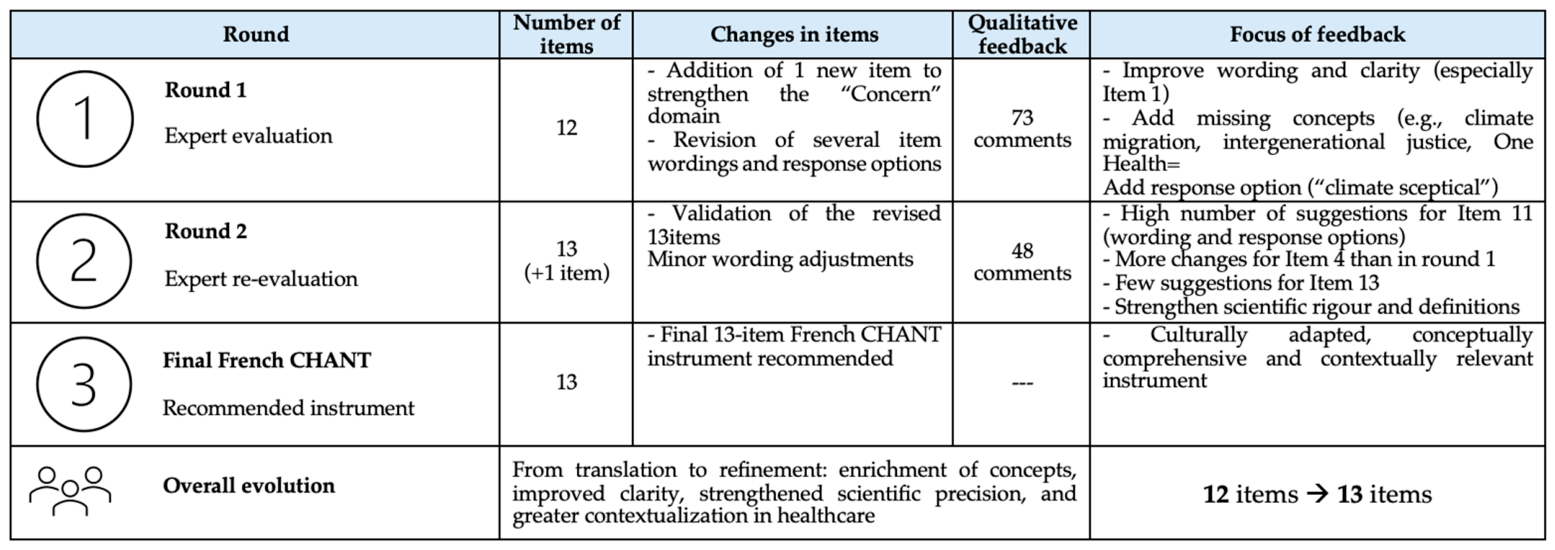
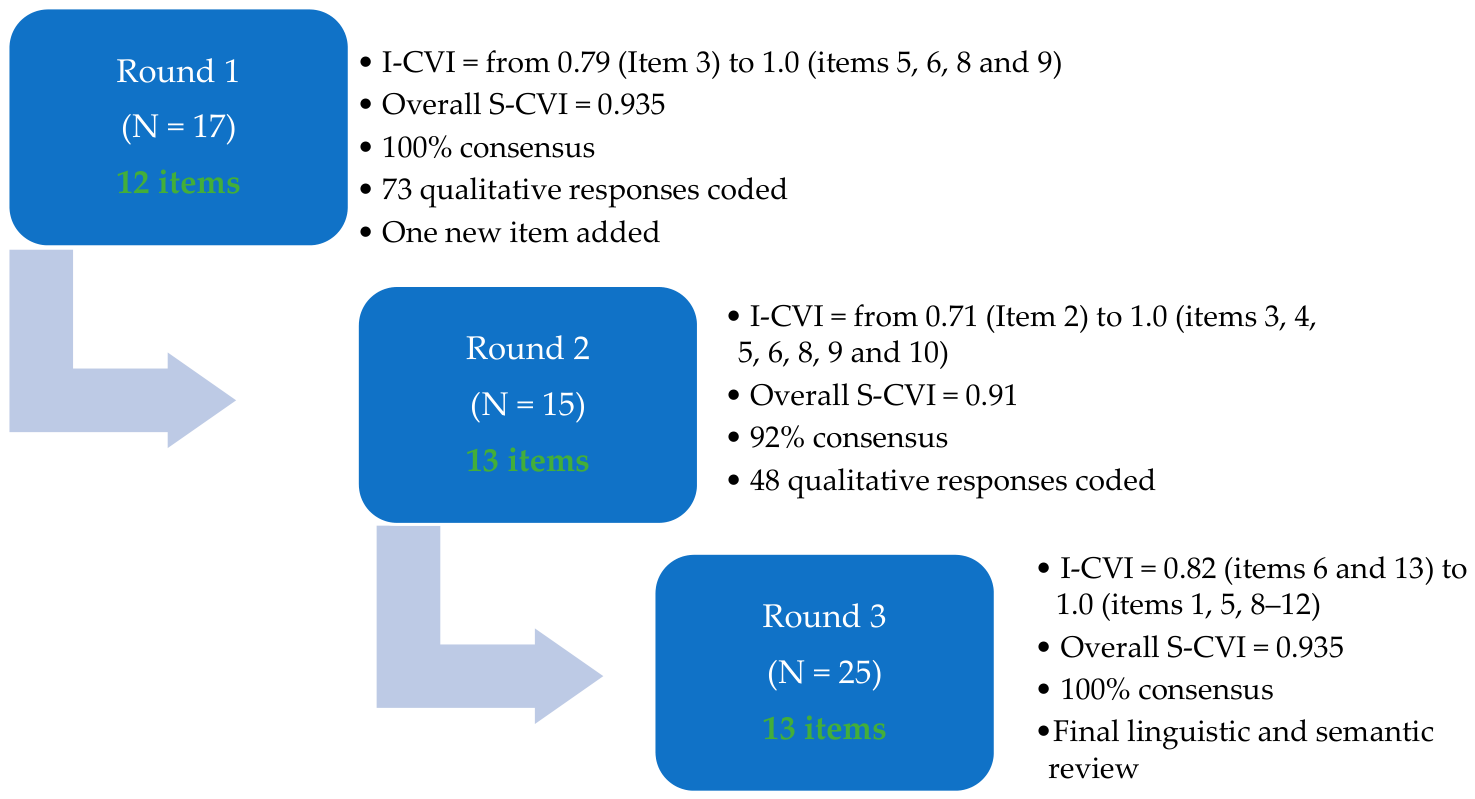
3.2. Research Question Results
4. Discussion
4.1. Implications for Practice
4.2. Implications for Education
4.3. Implications for Research
4.4. Strengths and Limitations
5. Conclusions
Supplementary Materials
Author Contributions
Funding
Institutional Review Board Statement
Informed Consent Statement
Data Availability Statement
Public Involvement Statement
Guidelines and Standards Statement
Use of Artificial Intelligence
Acknowledgments
Conflicts of Interest
References
- Butterfield, P.; Leffers, J.; Dias Vasquez, M. Nursing’s pivotal role in global climate action. BMJ 2021, 373, n1049. [Google Scholar] [CrossRef] [Scilit]
- The ICN Code of Ethics for Nurses|ICN—International Council of Nurses. Available online: https://www.icn.ch/resources/publications-and-reports/icn-code-ethics-nurses (accessed on 24 April 2025).
- Spínola, H. Entre a literacia e a cultura ambiental. In Literacia Científica: Ensino, Aprendizagem e Quotidiano; CIE-Uma: Málaga, Spain, 2021; pp. 27–40. [Google Scholar]
- Hilmi, M.I.; Lutfiansyach, D.Y.; Hufad, A.; Kamil, M.; Wahyudin, U. Eco-Literacy. In Proceedings of the First Transnational Webinar on Adult and Continuing Education (TRACED 2020); Atlantis Press: Dordrecht, The Netherlands, 2021; Volume 548, pp. 118–121. [Google Scholar]
- Thorne, S.; Canam, C.; Dahinten, S.; Hall, W.; Henderson, A.; Kirkham, S.R. Nursing’s metaparadigm concepts: Disimpacting the debates. J. Adv. Nurs. 1998, 27, 1257–1268. [Google Scholar] [CrossRef] [Scilit] [PubMed]
- Portela Dos Santos, O.; Melly, P.; Joost, S.; Verloo, H. Measuring Nurses’ Knowledge and Awareness of Climate Change and Climate-Associated Diseases: Protocol for a Systematic Review of Existing Instruments. Int. J. Environ. Res. Public Health 2023, 20, 6963. [Google Scholar] [CrossRef] [Scilit] [PubMed]
- Moniz Mde, A.; Daher, D.V.; Sabóia, V.M.; Ribeiro, C.R.B. Environmental health: Emancipatory care challenges and possibilities by the nurse. Rev. Bras. Enferm. 2020, 73, e20180478. [Google Scholar] [CrossRef] [Scilit] [PubMed]
- Baumann, S.L. Global Health Nursing. Nurs. Sci. Q. 2013, 26, 365. [Google Scholar] [CrossRef] [Scilit] [PubMed]
- Portela Dos Santos, O.; Melly, P.; Joost, S.; Verloo, H. Climate Change, Environmental Health, and Challenges for Nursing Discipline. Int. J. Environ. Res. Public Health 2023, 20, 5682. [Google Scholar] [CrossRef] [Scilit] [PubMed]
- Portela Dos Santos, O.; Pereira Alves, P.J.; Verloo, H. The CHANT’s Conceptual and Psychometric Validity in Switzerland: A Descriptive Three-Round Multicentre e-Delphi Study. Nurs. Rep. 2025, 15, 141. [Google Scholar] [CrossRef] [Scilit] [PubMed]
- Anåker, A.; Nilsson, M.; Holmner, Å.; Elf, M. Nurses’ perceptions of climate and environmental issues: A qualitative study. J. Adv. Nurs. 2015, 71, 1883–1891. [Google Scholar] [CrossRef] [Scilit] [PubMed]
- Xiao, J.; Fan, W.; Deng, Y.; Li, S.; Yan, P. Nurses’ knowledge and attitudes regarding potential impacts of climate change on public health in central of China. Int. J. Nurs. Sci. 2016, 3, 158–161. [Google Scholar] [CrossRef] [Scilit]
- Portela Dos Santos, O.; Perruchoud, É.; Pereira, F.; Alves, P.; Verloo, H. Measuring Nurses’ Knowledge and Awareness of Climate Change and Climate-Associated Diseases: Systematic Review of Existing Instruments. Nurs. Rep. 2024, 14, 2850–2876. [Google Scholar] [CrossRef] [Scilit] [PubMed]
- Winquist, A.; Schenk, E.C.; Cook, C.; Demorest, S.; Burduli, E. Climate, Health, and Nursing Tool (CHANT): A confirmatory factor analysis. Public Health Nurs. 2023, 40, 306–312. [Google Scholar] [PubMed]
- Schenk, E.C.; Cook, C.; Demorest, S.; Burduli, E. Climate, Health, and Nursing Tool (CHANT): Initial survey results. Public Health Nurs. 2021, 38, 152–159. [Google Scholar] [CrossRef] [Scilit] [PubMed]
- Schenk, E.C.; Cook, C.; Demorest, S.; Burduli, E. CHANT: Climate, Health, and Nursing Tool: Item Development and Exploratory Factor Analysis. Annu. Rev. Nurs. Res. 2019, 38, 97–112. [Google Scholar] [CrossRef] [Scilit] [PubMed]
- Jünger, S.; Payne, S.A.; Brine, J.; Radbruch, L.; Brearley, S.G. Guidance on Conducting and REporting DElphi Studies (CREDES) in palliative care: Recommendations based on a methodological systematic review. Palliat. Med. 2017, 31, 684–706. [Google Scholar] [CrossRef] [Scilit] [PubMed]
- Barrios, M.; Guilera, G.; Nuño, L.; Gómez-Benito, J. Consensus in the delphi method: What makes a decision change? Technol. Forecast. Soc. Change 2021, 163, 120484. [Google Scholar] [CrossRef] [Scilit]
- Hasson, F.; Keeney, S. Enhancing rigour in the Delphi technique research. Technol. Forecast. Soc. Change 2011, 78, 1695–1704. [Google Scholar] [CrossRef] [Scilit]
- Keeney, S.; Hasson, F.; McKenna, H.P. A critical review of the Delphi technique as a research methodology for nursing. Int. J. Nurs. Stud. 2001, 38, 195–200. [Google Scholar] [CrossRef] [Scilit] [PubMed]
- Wild, D.; Grove, A.; Martin, M.; Eremenco, S.; McElroy, S.; Verjee-Lorenz, A.; Erikson, P.; ISPOR Task Force for Translation and Cultural Adaptation. Principles of good practice for the translation and cultural adaptation process for patient-reported outcomes (PRO) measures: Report of the ISPOR Task Force for Translation and Cultural Adaptation. Value Health 2005, 8, 94–104. [Google Scholar] [CrossRef] [Scilit] [PubMed]
- Beaton, D.E.; Bombardier, C.; Guillemin, F.; Ferraz, M.B. Guidelines for the process of cross-cultural adaptation of self-report measures. Spine 2000, 25, 3186–3191. [Google Scholar] [CrossRef] [Scilit] [PubMed]
- Sablatzky, T. Delphi Method. Hypothesis 2022, 34, 1. [Google Scholar] [CrossRef] [Scilit] [PubMed]
- Nasa, P.; Jain, R.; Juneja, D. Delphi methodology in healthcare research: How to decide its appropriateness. World J. Methodol. 2021, 11, 116–129. [Google Scholar] [CrossRef] [Scilit] [PubMed]
- Keeney, S.; Hasson, F.; Mckenna, H. The Delphi Technique in Nursing and Health Research; Wiley-Blackwell: Hoboken, NJ, USA, 2010. [Google Scholar] [CrossRef] [Scilit]
- Polit, D.F.; Beck, C.T.; Owen, S.V. Is the CVI an acceptable indicator of content validity? Appraisal and recommendations. Res. Nurs. Health 2007, 30, 459–467. [Google Scholar] [CrossRef] [Scilit] [PubMed]
- Qu’est-Ce Que l’IFSEN?|IFSEN Formations. Available online: https://ifsenformations.fr/ifsen/quest-ce-que-lifsen/?utm_source (accessed on 24 June 2025).
- Portela Dos Santos, O.; Melly, P.; Hilfiker, R.; Giacomino, K.; Perruchoud, E.; Verloo, H.; Pereira, F. Effectiveness of Educational Interventions to Increase Skills in Evidence-Based Practice among Nurses: The EDITcare Systematic Review. Healthcare 2022, 10, 2204. [Google Scholar] [CrossRef] [Scilit] [PubMed]
- Atta, M.H.R.; AbdELhay, E.S.; AbdELhay, I.S.; Amin, S.M.; El-Monshed, A.H.; Abdelaliem, S.M.F.; Alabdullah, A.A.S.; Eweida, R.S. Effectiveness of a web-based educational program on climate change awareness, climate activism, and pro-environmental behavior among primary health care in rural areas: A randomized controlled trial. BMC Nurs. 2025, 24, 449. [Google Scholar] [CrossRef] [Scilit] [PubMed]
- Eweida, R.S.; O’Connell, M.A.; Zoromba, M.; Mahmoud, M.F.; Altheeb, M.K.; Selim, A.; Atta, M.H.R. Video-Based Climate Change Program Boosts Eco-Cognizance, Emotional Response and Self-Efficacy in Rural Nursing Students: Randomised Controlled Trial. J. Adv. Nurs. 2025, 81, 8371–8383. [Google Scholar] [CrossRef] [Scilit] [PubMed]
- Fernandez, M.E.; Walker, T.J.; Weiner, B.J.; Calo, W.A.; Liang, S.; Risendal, B.; Friedman, D.B.; Tu, S.P.; Williams, R.S.; Jacobs, S.; et al. Developing measures to assess constructs from the Inner Setting domain of the Consolidated Framework for Implementation Research. Implement. Sci. 2018, 13, 52. [Google Scholar] [CrossRef] [Scilit] [PubMed]
- Damschroder, L.J.; Reardon, C.M.; Widerquist, M.A.O.; Lowery, J. The updated Consolidated Framework for Implementation Research based on user feedback. Implement. Sci. 2022, 17, 75. [Google Scholar] [CrossRef] [Scilit] [PubMed]
- Kirk, M.A.; Kelley, C.; Yankey, N.; Birken, S.A.; Abadie, B.; Damschroder, L. A systematic review of the use of the Consolidated Framework for Implementation Research. Implement. Sci. 2016, 11, 72. [Google Scholar] [PubMed]
- Damschroder, L.J.; Aron, D.C.; Keith, R.E.; Kirsh, S.R.; Alexander, J.A.; Lowery, J.C. Fostering implementation of health services research findings into practice: A consolidated framework for advancing implementation science. Implement. Sci. 2009, 4, 50. [Google Scholar] [CrossRef] [Scilit] [PubMed]


| Round 1—Expert Evaluation | ||
| Questions asked about each item. Original CHANT (12 items) | ||
| Comprehensibility assessment | Relevance assessment | Qualitative feedback |
| We invite you to critically evaluate each item before rating it. Is this item comprehensible? | We invite you to critically evaluate each item before rating it. Is this item relevant? (Likert scale from 1 to 4). | We also invite you to provide written comments to help us improve the relevance of the items in relation to the domain targeted. All feedback will be considered in subsequent rounds. |
| 1 = comprehensible 2 = partially comprehensible 3 = not at all comprehensible | 1 = irrelevant 2 = somewhat relevant 3 = relevant 4 = highly relevant | Experts’ suggestions were made in free text. Experts could propose additional topics/items. |
| Round 2—Expert Re-Evaluation. Revised CHANT (13 items, including the newly added ‘concern’ item) | ||
| Presentation of all the Round 1 items to ensure a comprehensive overview of the CHANT and to highlight the modifications made following Round 1′s expert feedback and the consensus reached. An additional item was included after Round 1 based on the experts’ suggestions. | ||
| Comprehensibility assessment | Relevance assessment | Qualitative feedback |
| Items and response options | We invite you to critically evaluate each item before rating it. Is this item relevant? (Likert scale from 1 to 4). | We also invite you to provide written comments to help us improve the relevance of the items in relation to the domain targeted. All feedback will be considered in subsequent rounds. |
| 1 = comprehensible 2 = partially comprehensible 3 = not at all comprehensible | 1 = irrelevant 2 = somewhat relevant 3 = relevant 4 = highly relevant | Experts’ suggestions were made in free text. Experts could propose additional topics/items. |
| Round 3—Final Delphi Consensus. Final CHANT (13 items) | ||
| The final questionnaire was resubmitted to the experts, although no further comments were possible. | ||
| Comprehensibility assessment | Relevance assessment | |
| Items and response options | We invite you to critically evaluate each item before rating it. Is this item relevant? (Likert scale from 1 to 4). | |
| 1 = comprehensible 2 = partially comprehensible 3 = not at all comprehensible | 1 = irrelevant 2 = somewhat relevant 3 = relevant 4 = highly relevant | |
| Post-Delphi linguistic and semantic review | ||
| 1. After integrating all the comments from the international panel of experts, the research team developed a final consensus on the item statements and response options. 2. Final linguistic review and consensus decision on the semantic and cultural equivalence of the adapted French-language version. | ||
| Sociodemographic Variables | Round 1 Experts (n = 17) | Round 2 Experts (n = 15) | Round 3 Experts (n = 25) |
|---|---|---|---|
| Country of residence, n (%) | |||
| Switzerland | 13 (76.5%) | 13 (86.7%) | 14 (56%) |
| France | 2 (11.8%) | 2 (13.3%) | 10 (40%) |
| Belgium | 2 (11.8%) | 0 (0%) | 1 (4%) |
| Sex, n (%) | |||
| Male | 7 (41.2%) | 4 (26.7%) | 7 (28%) |
| Female | 10 (58.8%) | 11 (73.3%) | 18 (72%) |
| Profession | |||
| Nurse | 5 (29.4%) | 5 (33.3%) | 7 (28%) |
| Nursing student | 0 (0%) | 0 (0%) | 1 (4%) |
| Midwife | 0 (0%) | 2 (13.3%) | 0 (0%) |
| Physician | 3 (17.6%) | 3 (20.0%) | 7 (28%) |
| Allied health professional | 4 (23.5%) | 0 (0) | 1 (4%) |
| Health educator/clinical instructor | 1 (5.9%) | 1 (6.7%) | 3 (12%) |
| Sustainability/environmental specialist | 4 (23.5%) | 3 (20.0%) | 3 (12%) |
| Others | 0 (0%) | 1 (6.7%) | 3 (12%) |
| Level of education, n (%) | |||
| Bachelor’s degree | 4 (23.5%) | 9 (60.0%) | 6 (24%) |
| Master’s degree | 10 (58.8%) | 3 (20.0%) | 9 (36%) |
| PhD | 2 (11.8%) | 3 (20.0%) | 6 (24%) |
| Continuing education (specialisation) | 1 (5.9%) | 0 (0%) | 3 (12%) |
| Undergraduate | 0 (0%) | 0 (0%) | 1 (4%) |
| Age [years], med (IQR) | 40 (17.5) | 43 (23) | 42 (23) |
| Age [years], min–max | 26–73 | 22–74 | 20–67 |
| Questionnaire completion time [minutes], med (IQR) | 21.9 (21.4) | 25.47 (34.35) | 10.6 (21.2) |
| Round 1 I-CVI | Mean Relevance | Round 2 I-CVI | Mean Relevance | Round 3 I-CVI | Mean Relevance | ||
|---|---|---|---|---|---|---|---|
| Item 1 | 0.93 | 3.53 | Item 1 | 0.91 | 3.11 | 1 | 3.5 |
| --- | --- | --- | Item 2 | 0.71 | 3.33 | 0.84 | 3 |
| Item 2 | 0.93 | 3.13 | Item 3 | 1 | 3.67 | 0.89 | 3.3 |
| Item 3 | 0.79 | 3.07 | Item 4 | 1 | 3.67 | 0.89 | 3.3 |
| Item 4 | 0.93 | 3.43 | Item 5 | 1 | 3.67 | 1 | 3.67 |
| Item 5 | 1 | 3.79 | Item 6 | 1 | 3.22 | 0.82 | 3.56 |
| Item 6 | 1 | 3.31 | Item 7 | 0.90 | 3.22 | 0.88 | 3.67 |
| Item 7 | 0.92 | 3.64 | Item 8 | 1 | 3.44 | 1 | 3.44 |
| Item 8 | 1 | 3.38 | Item 9 | 1 | 3.67 | 1 | 3.63 |
| Item 9 | 1 | 3.36 | Item 10 | 1 | 3.56 | 1 | 3.78 |
| Item 10 | 0.86 | 3.14 | Item 11 | 0.90 | 3.67 | 1 | 3.56 |
| Item 11 | 0.87 | 3.36 | Item 12 | 0.94 | 3.44 | 1 | 3.56 |
| Item 12 | 0.86 | 3.07 | Item 13 | 0.90 | 3.22 | 0.82 | 3.22 |
| Round 1 | Round 2 | Round 3 | ||||||||
|---|---|---|---|---|---|---|---|---|---|---|
| 1 | 2 | 3 | 1 | 2 | 3 | 1 | 2 | 3 | ||
| Item 1 | 100% | 0% | 0% | Item 1 | 100% | 0% | 0% | 90% | 10% | 0% |
| --- | Item 2 | 90% | 10% | 0% | 100% | 0% | 0% | |||
| Item 2 | 78.6% | 21.4% | 0% | Item 3 | 100% | 0% | 0% | 95% | 5% | 0% |
| Item 3 | 78.6% | 21.4% | 0% | Item 4 | 100% | 0% | 0% | 68.4% | 31.6% | 0% |
| Item 4 | 71.4% | 28.6% | 0% | Item 5 | 90% | 10% | 0% | 84.2% | 15.8% | 0% |
| Item 5 | 92.9% | 0% | 7.1% | Item 6 | 100% | 0% | 0% | 81.3% | 18.7% | 0% |
| Item 6 | 92.9% | 7.1% | 0% | Item 7 | 80% | 0% | 20% | 94.4% | 5.6% | 0% |
| Item 7 | 85.7% | 7.1% | 7.1% | Item 8 | 100% | 0% | 0% | 82.4% | 17.6% | 0% |
| Item 8 | 85.7% | 7.1% | 7.1% | Item 9 | 100% | 0% | 0% | 93.8% | 6.2% | 0% |
| Item 9 | 71.4% | 21.4% | 7.1% | Item 10 | 100% | 0% | 0% | 100% | 0% | 0% |
| Item 10 | 78.6% | 21.4% | 0% | Item 11 | 90% | 10% | 0% | 94.8% | 5.2% | 0% |
| Item 11 | 85.7% | 14.3% | 0% | Item 12 | 90% | 10% | 0% | 94.1% | 5.9% | 0% |
| Item 12 | 92.9% | 7.1% | 0% | Item 13 | 100% | 0% | 0% | 94.4% | 5.6% | 0% |
| Item | Round | Re (n) | Add (n) | Experts’ Suggestions |
|---|---|---|---|---|
| 1 | 1 | 2 | 7 | Add concepts and definitions |
| 2 | 2 | 4 | Clarify gender-related impacts; add a response option; add scientific references | |
| 2 | 1 | 0 | 3 | Add a definition of One Health; add response options |
| 2 | 2 | 0 | Make minor wording refinements | |
| 3 | 1 | 6 | 3 | Clarify climate/weather distinction; add concepts of ‘landslide’ and ‘heatwave’ |
| 2 | 2 | 1 | Add a new concept | |
| 4 | 1 | 2 | 3 | Define the refinement; clarify the concept; provide illustrative example |
| 2 | 3 | 0 | Further simplify wording | |
| 5 | 1 | 4 | 3 | Add and revise concepts |
| 2 | 3 | 3 | Add concepts and response options | |
| 6 | 1 | 4 | 1 | Modify item wording |
| 2 | 3 | 0 | Simplify the item and response wording | |
| 7 | 1 | 4 | 2 | Add response options |
| 2 | 3 | 0 | Make minor wording modifications | |
| 8 | 1 | 5 | 0 | Make minor wording refinements |
| 2 | 3 | 2 | Add response options | |
| 9 | 1 | 6 | 0 | Make wording refinements |
| 2 | 1 | 2 | Add concepts | |
| 10 | 1 | 6 | 2 | Add concepts |
| 2 | 2 | 0 | Make minor wording refinements | |
| 11 | 1 | 4 | 2 | Add response options |
| 2 | 6 | 2 | Clarify response categories | |
| 12 | 1 | 2 | 2 | Add concepts |
| 2 | 2 | 1 | Add concept | |
| 13 | 2 | 1 | 0 | Split a response category |
| Total | 78 | 43 | ||
Disclaimer/Publisher’s Note: The statements, opinions and data contained in all publications are solely those of the individual author(s) and contributor(s) and not of MDPI and/or the editor(s). MDPI and/or the editor(s) disclaim responsibility for any injury to people or property resulting from any ideas, methods, instructions or products referred to in the content. |
© 2026 by the authors. Licensee MDPI, Basel, Switzerland. This article is an open access article distributed under the terms and conditions of the Creative Commons Attribution (CC BY) license.
Share and Cite
Portela dos Santos, O.; de Hepcée, F.; Alves, P.J.P.; Verloo, H. Content Validity of the CHANT’s French-Language Translation and Cultural Adaptation: A Modified E-Delphi Study. Nurs. Rep. 2026, 16, 244. https://doi.org/10.3390/nursrep16070244
Portela dos Santos O, de Hepcée F, Alves PJP, Verloo H. Content Validity of the CHANT’s French-Language Translation and Cultural Adaptation: A Modified E-Delphi Study. Nursing Reports. 2026; 16(7):244. https://doi.org/10.3390/nursrep16070244
Chicago/Turabian StylePortela dos Santos, Omar, Fanny de Hepcée, Paulo Jorge Pereira Alves, and Henk Verloo. 2026. "Content Validity of the CHANT’s French-Language Translation and Cultural Adaptation: A Modified E-Delphi Study" Nursing Reports 16, no. 7: 244. https://doi.org/10.3390/nursrep16070244
APA StylePortela dos Santos, O., de Hepcée, F., Alves, P. J. P., & Verloo, H. (2026). Content Validity of the CHANT’s French-Language Translation and Cultural Adaptation: A Modified E-Delphi Study. Nursing Reports, 16(7), 244. https://doi.org/10.3390/nursrep16070244