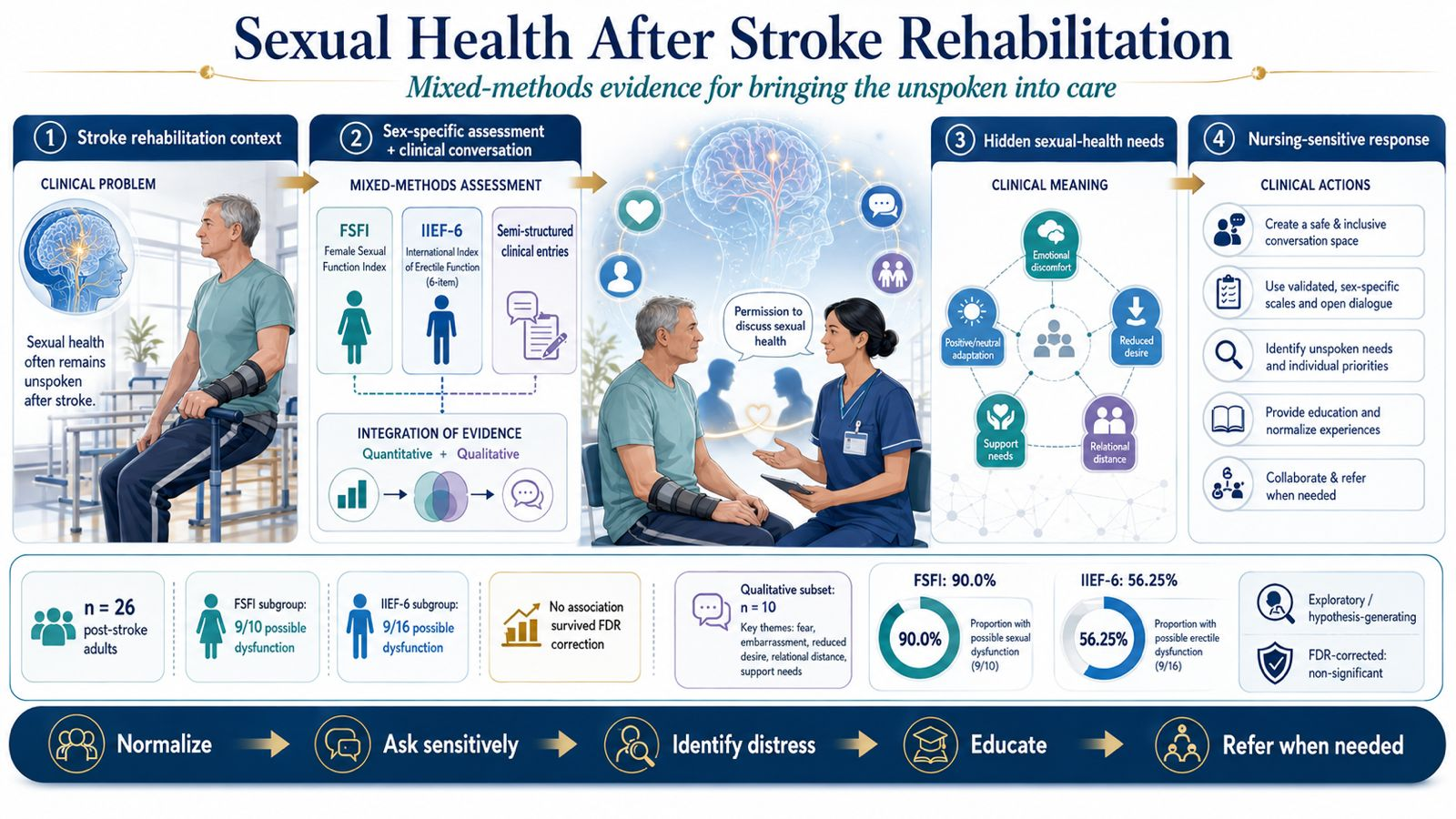

Sexual Functioning and Patient-Reported Concerns After Stroke: An Integrated Mixed-Methods Study in Clinical Rehabilitation


 ,
,  , and
, and 
Abstract
1. Introduction
2. Materials and Methods
2.1. Study Design
2.2. Setting and Participants
2.3. Sampling and Recruitment
2.4. Quantitative Measures
2.5. Qualitative Component
2.6. Procedure and Data Collection
2.7. Outcomes and Variables
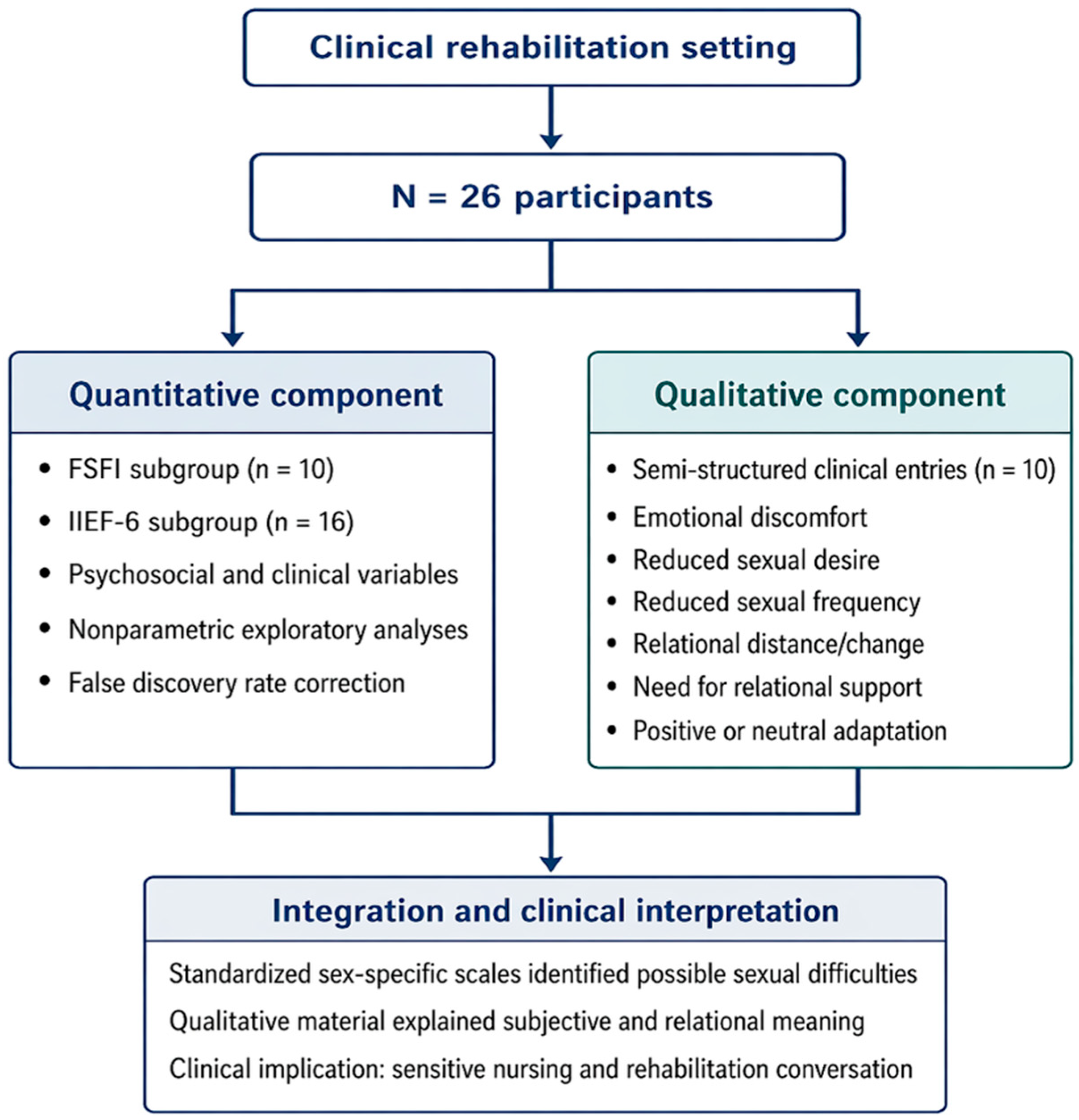
2.8. Statistical Analysis and Mixed-Methods Integration
2.9. Ethical Considerations and Declarations
3. Results
3.1. Sample Characteristics
3.2. Correlates of Female Sexual Function
3.3. Correlates of Male Erectile Function
3.4. Exploratory Group Comparisons
3.5. Qualitative Results
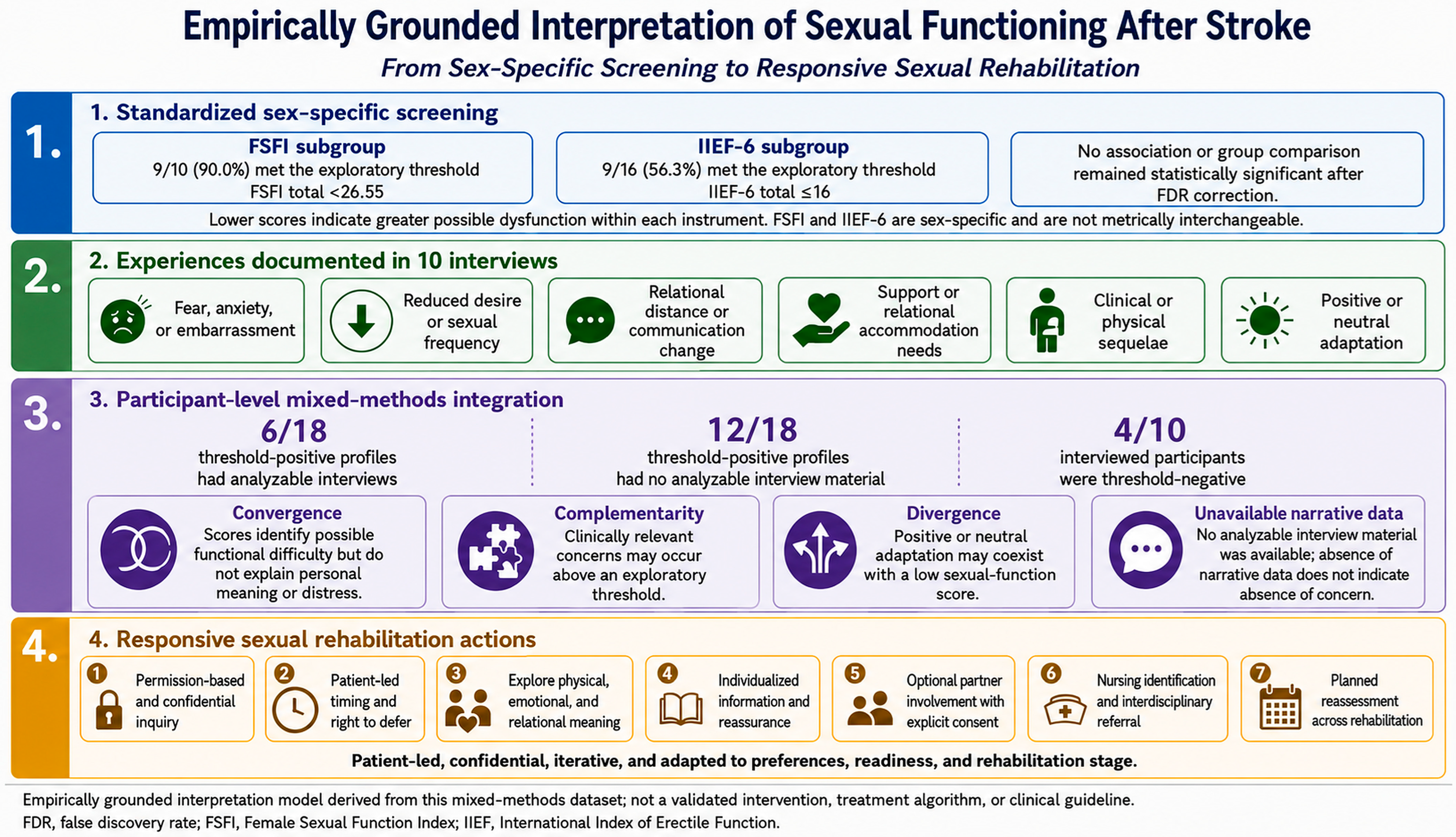
3.6. Integration of Quantitative and Qualitative Findings
4. Discussion
4.1. Clinical Meaning of Responsive Sexual Rehabilitation
4.2. Strengths and Limitations
5. Conclusions
Supplementary Materials
Author Contributions
Funding
Institutional Review Board Statement
Informed Consent Statement
Data Availability Statement
Public Involvement Statement
Guidelines and Standards Statement
Use of Artificial Intelligence
Acknowledgments
Conflicts of Interest
References
- GBD 2021 Stroke Risk Factor Collaborators. Global, regional, and national burden of stroke and its risk factors, 1990–2021: A systematic analysis for the Global Burden of Disease Study 2021. Lancet Neurol. 2024, 23, 973–1003. [CrossRef] [Scilit] [PubMed]
- Zhang, Z.; Deng, L.; Lv, X.N.; Li, Z.Q.; Li, Q. Post stroke sexual dysfunction—A current review. Neurol. Sci. 2025, 46, 605–615. [Google Scholar] [CrossRef] [Scilit] [PubMed]
- Na, Y.; Htwe, M.; Rehman, C.A.; Palmer, T.; Munshi, S. Sexual dysfunction after stroke—A biopsychosocial perspective. Int. J. Clin. Pract. 2020, 74, e13496. [Google Scholar] [CrossRef] [Scilit] [PubMed]
- Latella, D.; Grimaldi, A.; Calabrò, R.S. Sexual Functioning and Sexual Health in Female Patients following Stroke: A Scoping Review with Implications for Rehabilitation. J. Pers. Med. 2024, 14, 267. [Google Scholar] [CrossRef] [Scilit] [PubMed]
- Chaouche, N.; Delpierre, Y.; Chinier, E.; Soler, J.M.; Hadiji, N. Sexual disorders post-stroke: Description of a cohort of patients followed in rehabilitation. Fr. J. Urol. 2024, 34, 102568. [Google Scholar] [CrossRef] [Scilit] [PubMed]
- Schjørring, C.B.; Eddelien, H.S.; Butt, J.H.; Kruuse, C. High prevalence of erectile dysfunction in male patients with acute stroke was associated with age but not to modifiable cardiovascular risk factors. BMJ Neurol. Open 2024, 6, e000795. [Google Scholar] [CrossRef] [Scilit] [PubMed]
- Schneider, D.; Comley-White, N. Sexual Function and Quality of Life in Individuals Post Stroke. Physiother. Res. Int. 2025, 30, e70004. [Google Scholar] [CrossRef] [Scilit] [PubMed]
- Vikan, J.K.; Snekkevik, H.; Nilsson, M.I.; Stanghelle, J.K.; Geirdal, A.Ø.; Fugl-Meyer, K.S. Sexual Satisfaction and Associated Biopsychosocial Factors in Stroke Patients Admitted to Specialized Cognitive Rehabilitation. Sex. Med. 2021, 9, 100424. [Google Scholar] [CrossRef] [Scilit] [PubMed]
- Montalvan, V.; Ulrich, A.K.; Tirschwell, D.L.; Zunt, J.R. Assessing sexual dysfunction among stroke survivors and barriers to address this issue by physicians at a Latin American reference hospital. Clin. Neurol. Neurosurg. 2021, 205, 106642. [Google Scholar] [CrossRef] [Scilit] [PubMed]
- Contrada, M.; Cerasa, A.; Pucci, C.; Ciancarelli, I.; Pioggia, G.; Tonin, P.; Calabrò, R.S. Talking about Sexuality in Stroke Individuals: The New Era of Sexual Rehabilitation. J. Clin. Med. 2023, 12, 3988. [Google Scholar] [CrossRef] [Scilit] [PubMed]
- Akobundu, U.N.; Onwudinjo, O.; Obiekwe, S.J.; Akosile, C.O.; Nwankwo, M.J.; Daniel, J.A. Physiotherapists’ attitudes, practice and barriers to sexual issues among stroke survivors in South-East Nigeria. Top. Stroke Rehabil. 2025, 32, 248–259. [Google Scholar] [CrossRef] [Scilit] [PubMed]
- Low, M.A.; Power, E.; McGrath, M. Sexuality after stroke: Exploring knowledge, attitudes, comfort and behaviours of rehabilitation professionals. Ann. Phys. Rehabil. Med. 2022, 65, 101547. [Google Scholar] [CrossRef] [Scilit] [PubMed]
- Auger, L.P.; Grondin, M.; Aubertin, M.; Marois, A.; Filiatrault, J.; Rochette, A. Interventions used by allied health professionals in sexual rehabilitation after stroke: A systematic review. Top. Stroke Rehabil. 2021, 28, 557–572. [Google Scholar] [CrossRef] [Scilit] [PubMed]
- Stratton, H.; Sansom, J.; Brown-Major, A.; Anderson, P.; Ng, L. Interventions for sexual dysfunction following stroke. Cochrane Database Syst. Rev. 2020, 5, CD011189. [Google Scholar] [CrossRef] [Scilit] [PubMed]
- Prior, S.; Reeves, N.; Peterson, G.; Jaffray, L.; Campbell, S. Addressing the Gaps in Post-Stroke Sexual Activity Rehabilitation: Patient Perspectives. Healthcare 2019, 7, 25. [Google Scholar] [CrossRef] [Scilit] [PubMed]
- McGrath, M.; Lever, S.; McCluskey, A.; Power, E. How is sexuality after stroke experienced by stroke survivors and partners of stroke survivors? A systematic review of qualitative studies. Clin. Rehabil. 2019, 33, 293–303. [Google Scholar] [CrossRef] [Scilit] [PubMed]
- Auger, L.P.; Filiatrault, J.; Allegue, D.R.; Vachon, B.; Thomas, A.; Morales, E.; Rochette, A. Sexual Rehabilitation After a Stroke: A Multi-site Qualitative Study About Influencing Factors and Strategies to Improve Services. Sex. Disabil. 2023, 41, 503–529. [Google Scholar] [CrossRef] [Scilit] [PubMed]
- Auger, L.P.; Pituch, E.; Filiatrault, J.; Courtois, F.; Rochette, A. Implementation of a sexuality interview guide in stroke rehabilitation: A feasibility study. Disabil. Rehabil. 2022, 44, 4014–4022. [Google Scholar] [CrossRef] [Scilit] [PubMed]
- Ng, L.; Sansom, J.; Zhang, N.; Amatya, B.; Khan, F. Effectiveness of a structured sexual rehabilitation programme following stroke: A randomized controlled trial. J. Rehabil. Med. 2017, 49, 333–340. [Google Scholar] [CrossRef] [Scilit] [PubMed]
- Grenier-Genest, A.; Gérard, M.; Courtois, F. Stroke and sexual functioning: A literature review. NeuroRehabilitation 2017, 41, 293–315. [Google Scholar] [CrossRef] [Scilit] [PubMed]
- Creswell, J.W.; Plano Clark, V.L. Designing and Conducting Mixed Methods Research, 3rd ed.; SAGE Publications: Thousand Oaks, CA, USA, 2018. [Google Scholar]
- Creswell, J.W.; Creswell, J.D. Research Design: Qualitative, Quantitative, and Mixed Methods Approaches, 5th ed.; SAGE Publications: Thousand Oaks, CA, USA, 2018. [Google Scholar]
- Fetters, M.D.; Curry, L.A.; Creswell, J.W. Achieving integration in mixed methods designs-principles and practices. Health Serv. Res. 2013, 48, 2134–2156. [Google Scholar] [CrossRef] [Scilit] [PubMed]
- Guetterman, T.C.; Fetters, M.D.; Creswell, J.W. Integrating Quantitative and Qualitative Results in Health Science Mixed Methods Research Through Joint Displays. Ann. Fam. Med. 2015, 13, 554–561. [Google Scholar] [CrossRef] [Scilit] [PubMed]
- Rosen, R.; Brown, C.; Heiman, J.; Leiblum, S.; Meston, C.; Shabsigh, R.; Ferguson, D.; D’Agostino, R., Jr. The Female Sexual Function Index (FSFI): A multidimensional self-report instrument for the assessment of female sexual function. J. Sex Marital Ther. 2000, 26, 191–208. [Google Scholar] [CrossRef] [Scilit] [PubMed]
- Rosen, R.C.; Riley, A.; Wagner, G.; Osterloh, I.H.; Kirkpatrick, J.; Mishra, A. The international index of erectile function (IIEF): A multidimensional scale for assessment of erectile dysfunction. Urology 1997, 49, 822–830. [Google Scholar] [CrossRef] [Scilit] [PubMed]
- Hamilton, M. A rating scale for depression. J. Neurol. Neurosurg. Psychiatry 1960, 23, 56–62. [Google Scholar] [CrossRef] [Scilit] [PubMed]
- Ware, J., Jr.; Kosinski, M.; Keller, S.D. A 12-Item Short-Form Health Survey: Construction of scales and preliminary tests of reliability and validity. Med. Care 1996, 34, 220–233. [Google Scholar] [CrossRef] [Scilit] [PubMed]
- South, S.C.; Krueger, R.F.; Iacono, W.G. Factorial invariance of the Dyadic Adjustment Scale across gender. Psychol. Assess. 2009, 21, 622–628. [Google Scholar] [CrossRef] [Scilit] [PubMed]
- Hoge, R.D.; Andrews, D.A.; Faulkner, P.; Robinson, D. The Family Relationship Index: Validity data. J. Clin. Psychol. 1989, 45, 897–903. [Google Scholar]
- Calabrò, R.S.; Grisolaghi, J.; Quattrini, F.; Bramanti, P.; Magaudda, A. Prevalence and clinical features of sexual dysfunction in male with epilepsy: The first southern Italy hospital-based study. Int. J. Neurosci. 2013, 123, 732–737. [Google Scholar] [CrossRef] [Scilit] [PubMed]
- Calabrò, R.S.; Russo, M.; Dattola, V.; De Luca, R.; Leo, A.; Grisolaghi, J.; Bramanti, P.; Quattrini, F. Sexual Function in Young Individuals with Multiple Sclerosis: Does Disability Matter? J. Neurosci. Nurs. 2018, 50, 161–166. [Google Scholar] [CrossRef] [Scilit] [PubMed]
- Calabrò, R.S.; D’Aleo, G.; Sessa, E.; Leo, A.; De Cola, M.C.; Bramanti, P. Sexual dysfunction induced by intrathecal baclofen administration: Is this the price to pay for severe spasticity management? J. Sex. Med. 2014, 11, 1807–1815. [Google Scholar] [CrossRef] [Scilit] [PubMed]
- Kiger, M.E.; Varpio, L. Thematic analysis of qualitative data: AMEE Guide No. 131. Med. Teach. 2020, 42, 846–854. [Google Scholar] [CrossRef] [Scilit] [PubMed]
- Tong, A.; Sainsbury, P.; Craig, J. Consolidated criteria for reporting qualitative research (COREQ): A 32-item checklist for interviews and focus groups. Int. J. Qual. Health Care 2007, 19, 349–357. [Google Scholar] [CrossRef] [Scilit] [PubMed]
- von Elm, E.; Altman, D.G.; Egger, M.; Pocock, S.J.; Gøtzsche, P.C.; Vandenbroucke, J.P.; STROBE Initiative. Strengthening the Reporting of Observational Studies in Epidemiology (STROBE) statement: Guidelines for reporting observational, studies. BMJ 2007, 335, 806–808. [Google Scholar] [CrossRef] [Scilit] [PubMed]
- O’Cathain, A.; Murphy, E.; Nicholl, J. The quality of mixed methods studies in health services research. J. Health Serv. Res. Policy 2008, 13, 92–98. [Google Scholar] [CrossRef] [Scilit] [PubMed]
- Dusenbury, W.; Barnason, S.; Vaughn, S.; Leclaire, A.; Jaarsma, T.; Camicia, M. Sexual Health After a Stroke: A Topical Review and Recommendations for Health Care Professionals. Stroke 2025, 56, 1312–1322. [Google Scholar] [CrossRef] [Scilit] [PubMed]
- Hentzen, C.; Musco, S.; Amarenco, G.; Del Popolo, G.; Panicker, J.N. Approach and management to patients with neurological disorders reporting sexual dysfunction. Lancet Neurol. 2022, 21, 551–562. [Google Scholar] [CrossRef] [Scilit] [PubMed]
- Geller, D.; Wong, S. Sexuality and Stroke: The Importance of Considering Cognitive and Perceptual Impairments in Post-Stroke Sexual Functioning. Brain Sci. 2025, 15, 797. [Google Scholar] [CrossRef] [Scilit] [PubMed]
- Brandão, R.; Vasconcelos, P.; Pereira, R.; Quinta-Gomes, A.L. Stroke and sexual health: A systematic review of psychological interventions aimed at improving sexual health of stroke survivors. Sex. Disabil. 2025, 43, 5. [Google Scholar] [CrossRef] [Scilit]
- Gustafsson, L.; Arfaras, T. Sexuality early after stroke. Aust. Occup. Ther. J. 2022, 69, 511–513. [Google Scholar] [CrossRef] [Scilit] [PubMed]
- Robledo-Resina, I.D.M.; Romero-Morales, C.; Martín-Casas, P.; Villafañe, J.H.; Abuín-Porras, V. Relationship between Female Sexual Dysfunction and Trunk Stability Post-Stroke: A Cross-Sectional Study. Medicina 2024, 60, 324. [Google Scholar] [CrossRef] [Scilit] [PubMed]
- Calabrò, R.S. Post-stroke Sexual Dysfunction in Men: Epidemiology, Diagnostic Work-up, and Treatment. Innov. Clin. Neurosci. 2022, 19, 12–16. [Google Scholar] [PubMed]
- Zhao, S.; Wu, W.; Wu, P.; Ding, C.; Xiao, B.; Xu, Z.; Hu, Y.; Shen, M.; Feng, L. Significant Increase of Erectile Dysfunction in Men with Post-stroke: A Comprehensive Review. Front. Neurol. 2021, 12, 671738. [Google Scholar] [CrossRef] [Scilit] [PubMed]
- Dai, H.; Wang, J.; Zhao, Q.; Ma, J.; Gong, X.; Wang, L.; Bao, B.; Li, H.; Wang, B. Erectile dysfunction and associated risk factors in male patients with ischemic stroke: A cross-sectional study. Medicine 2020, 99, e18583. [Google Scholar] [CrossRef] [Scilit] [PubMed]
- Winder, K.; Seifert, F.; Köhrmann, M.; Crodel, C.; Kloska, S.; Dörfler, A.; Hösl, K.M.; Schwab, S.; Hilz, M.J. Lesion mapping of stroke-related erectile dysfunction. Brain 2017, 140, 1706–1717. [Google Scholar] [CrossRef] [Scilit] [PubMed]
- Meesters, J.J.L.; van de Ven, D.P.H.W.; Kruijver, E.; Bender, J.; Volker, W.G.; Vliet Vlieland, T.P.; Goossens, P.H. Counselled patients with stroke still experience sexual and relational problems 1–5 years after stroke rehabilitation. Sex. Disabil. 2020, 38, 533–545. [Google Scholar] [CrossRef] [Scilit]
- van den Broek, B.; Verrijt, L.; Rijnen, S.; van Heugten, C.; Bus, B. Factors Related to the Quality and Stability of Partner Relationships After Stroke: A Systematic Literature Review. Arch. Phys. Med. Rehabil. 2025, 106, 255–268. [Google Scholar] [CrossRef] [Scilit] [PubMed]
- Vikan, J.K.; Nilsson, M.I.; Bushnik, T.; Deng, W.; Elessi, K.; Frost-Bareket, Y.; Kovrigina, E.; Shahwan, J.; Snekkevik, H.; Åkesson, E.; et al. Sexual health policies in stroke rehabilitation: A multi national study. J. Rehabil. Med. 2019, 51, 361–368. [Google Scholar] [CrossRef] [Scilit] [PubMed]
- Richards, A.; Dean, R.; Burgess, G.H.; Caird, H. Sexuality after stroke: An exploration of current professional approaches, barriers to providing support and future directions. Disabil. Rehabil. 2016, 38, 1471–1482. [Google Scholar] [CrossRef] [Scilit] [PubMed]
- Heron, J.; Owen-Booth, B. An exploration of the role of occupational therapists in addressing sexuality with service users post stroke. Br. J. Occup. Ther. 2022, 85, 29–36. [Google Scholar] [CrossRef] [Scilit] [PubMed]
- Auger, L.P.; Allegue, D.R.; Morales, E.; Thomas, A.; Filiatrault, J.; Vachon, B.; Rochette, A. Co-designing a Program to Improve Post-stroke Sexual Rehabilitation: The Promise of Innovative Methods. Front. Rehabil. Sci. 2022, 3, 777897. [Google Scholar] [CrossRef] [Scilit] [PubMed]
- Auger, L.P.; Filiatrault, J.; Allegue, D.R.; Thomas, A.; Vachon, B.; Morales, E.; Zevnik, A.; Rochette, A. Sexuality after a stroke: Co-designing and pilot testing an evidence-based knowledge translation intervention to improve rehabilitation services. Disabil. Rehabil. 2025, 47, 6898–6908. [Google Scholar] [CrossRef] [Scilit] [PubMed]
- McGrath, M.; Low, M.A.; Power, E.; McCluskey, A.; Lever, S. Addressing Sexuality Among People Living with Chronic Disease and Disability: A Systematic Mixed Methods Review of Knowledge, Attitudes, and Practices of Health Care Professionals. Arch. Phys. Med. Rehabil. 2021, 102, 999–1010. [Google Scholar] [CrossRef] [Scilit] [PubMed]
- Åling, M.; Lindgren, A.; Löfall, H.; Okenwa-Emegwa, L. A Scoping Review to Identify Barriers and Enabling Factors for Nurse-Patient Discussions on Sexuality and Sexual Health. Nurs. Rep. 2021, 11, 253–266. [Google Scholar] [CrossRef] [Scilit] [PubMed]
- Tuncer, M.; Oskay, Ü.Y. Sexual Counseling with the PLISSIT Model: A Systematic Review. J. Sex Marital Ther. 2022, 48, 309–318. [Google Scholar] [CrossRef] [Scilit] [PubMed]
- Cicek Ozdemir, S.; Dogan Gangal, A.; Senturk Erenel, A. The Effect of Sexual Counseling Based on PLISSIT and EX-PLISSIT Models on Sexual Function, Satisfaction, and Quality of Life: A Systematic Review and Meta-Analysis. Arch. Sex. Behav. 2024, 53, 3485–3513. [Google Scholar] [CrossRef] [Scilit] [PubMed]
- Younas, A.; Pedersen, M.; Durante, A. Characteristics of joint displays illustrating data integration in mixed-methods nursing studies. J. Adv. Nurs. 2020, 76, 676–686. [Google Scholar] [CrossRef] [Scilit] [PubMed]
- Martín-Sanz, M.B.; Salazar-de-la-Guerra, R.M.; Cuenca-Zaldivar, J.N.; Salcedo-Perez-Juana, M.; Garcia-Bravo, C.; Palacios-Ceña, D. Person-centred care in individuals with stroke: A qualitative study using in-depth interviews. Ann. Med. 2022, 54, 2167–2180. [Google Scholar] [CrossRef] [Scilit] [PubMed]
- Li, X.; He, Y.; Wang, D.; Rezaei, M.J. Stroke rehabilitation: From diagnosis to therapy. Front. Neurol. 2024, 15, 1402729. [Google Scholar] [CrossRef] [Scilit] [PubMed]

| Domain Assessed | Instrument/Data Source | Main Variables or Domains Recorded | Study Role and Analytical Note |
|---|---|---|---|
| Sexual functioning (female) | Female Sexual Function Index (FSFI) | Desire, arousal, lubrication, orgasm, satisfaction, pain, and total score when applicable | Primary quantitative outcome for participants with female sexual function data; analyzed separately from male sexual function data |
| Sexual functioning (male) | IIEF-6 field recorded in the database | Total erectile function score | Primary quantitative outcome for participants with male erectile function data; not pooled with FSFI because the measures are not metrically interchangeable |
| Depressive symptoms | Hamilton Depression Rating Scale | Total score | Secondary quantitative outcome and correlate of sexual functioning |
| Health-related quality of life | 12-item Short Form Health Survey (SF-12) | Physical, mental, and total scores | Secondary quantitative outcome and correlate of sexual functioning |
| Relationship functioning | Dyadic Adjustment Scale | Consensus, satisfaction, shared activities, affective and sexual life, and total score | Secondary relational outcome |
| Family relationship functioning | Family Relationship Index | Cohesion, communication, conflict, and total score | Secondary family-context outcome |
| Clinical descriptors | Study database fields | Age, event and enrollment dates, neuroimaging or event description, etiology code, medication exposure, education, and relationship variables | Used for sample characterization and exploratory covariates |
| Qualitative experiences | Semi-structured interview guide and documented responses | Sexuality changes, intimacy, identity, attractiveness, communication, barriers, rehabilitation needs, and partner/caregiver contextual perceptions | Qualitative component; analyzed descriptively and thematically |
| Variable | N | Median [IQR] |
|---|---|---|
| Overall sample characteristics | ||
| Age (years) | 26 | 48.50 [40.50–57.50] |
| Relationship duration (years) | 26 | 9.00 [3.25–15.75] |
| Time from event to enrollment (months) | 26 | 3.99 [2.40–10.76] |
| Year of schooling | 26 | 13.00 [9.25–13.00] |
| DAS consensus on important issues | 26 | 52.00 [45.50–57.75] |
| DAS satisfaction with relationship status | 26 | 26.50 [19.50–28.75] |
| DAS shared activities | 26 | 12.00 [8.25–14.75] |
| DAS satisfaction with affective and sexual life | 26 | 11.50 [8.50–14.00] |
| DAS total | 26 | 104.50 [83.50–114.75] |
| FRI family cohesion | 26 | 4.00 [3.00–4.00] |
| FRI communication | 26 | 3.00 [2.25–4.00] |
| FRI conflict | 26 | 3.00 [2.00–4.00] |
| FRI total | 26 | 10.00 [7.25–11.00] |
| HAM-D | 26 | 12.50 [8.00–15.75] |
| SF-12 physical | 26 | 12.50 [11.00–15.00] |
| SF-12 mental | 26 | 19.00 [17.00–20.00] |
| SF-12 total | 26 | 31.00 [28.00–34.00] |
| Sex-specific sexual function measures | ||
| FSFI desire | 10 | 3.60 [2.10–3.60] |
| FSFI arousal | 10 | 0.90 [0.00–2.33] |
| FSFI lubrication | 10 | 1.65 [0.00–3.60] |
| FSFI orgasm | 10 | 1.80 [0.00–4.20] |
| FSFI satisfaction | 10 | 0.60 [0.00–2.40] |
| FSFI pain | 10 | 1.80 [0.00–5.90] |
| FSFI total | 10 | 11.40 [3.15–21.75] |
| IIEF-6 | 16 | 10.00 [1.75–24.25] |
| Theme | Meaning Unit and Theme Description | Supporting Clinical Material |
|---|---|---|
| Emotional discomfort | Fear, anxiety, embarrassment, or performance-related concern during sexual relations | “Fear and performance anxiety”; “Embarrassment” |
| Reduced sexual desire | Reduced sexual interest after stroke or during the post-stroke period | “Low sexual interest”; “Reduced sexual desire” |
| Reduced sexual frequency | Decrease in the frequency of sexual intercourse | “Lower frequency of sexual intercourse” |
| Relational distance/change | Changes in closeness, communication, or couple dynamics | “Greater distance”; “No longer takes the time to explain things…” |
| Need for relational support | Need for greater collaboration, understanding, or accommodation | “Need to be more collaborative” |
| Clinical/physical sequelae | Motor, autonomic, or functional consequences acting as contextual factors | “Motor difficulties”; “Constipation”; “Difficulty achieving and/or maintaining an erection” |
| Positive or neutral adaptation | Serenity, tranquility, well-being, or absence of reported sexual problems | “Serenity”; “Calmness”; “No problems reported” |
| ID | Scale | Total Score | Threshold Status | Within-Scale Rank | Interview | Documented Theme(s) | Integration Pattern | Case-Level Interpretation |
|---|---|---|---|---|---|---|---|---|
| P23 | FSFI | 1.2 | Threshold-positive (<26.55) | 1/10 (tie) | Yes | Relational distance/change; reduced sexual frequency; desire concern in pre-event/partner contextual fields; indifference | Convergence/complementarity | Very low score aligned with relational distance and reduced frequency; timing of the desire concern was uncertain and could not be attributed to stroke. |
| P24 | FSFI | 1.2 | Threshold-positive (<26.55) | 1/10 (tie) | Yes | Well-being/tranquility; no specific concern disclosed | Divergence | Very low score coexisted with positive or neutral adaptation; score alone could not establish distress or post-stroke onset. |
| P11 | FSFI | 3.0 | Threshold-positive (<26.55) | 3/10 | No | No analyzable interview response was available. | Narrative silence | Threshold-positive screening; unavailable narrative material prevented inference about meaning, distress, or support need. |
| P04 | FSFI | 3.6 | Threshold-positive (<26.55) | 4/10 (tie) | No | No analyzable interview response was available. | Narrative silence | Threshold-positive screening; unavailable narrative material prevented inference about meaning, distress, or support need. |
| P22 | FSFI | 3.6 | Threshold-positive (<26.55) | 4/10 (tie) | Yes | Reduced sexual frequency; embarrassment; reported relationship improvement/relational accommodation; tranquility/no specific problem | Divergence/complementarity | Very low score coexisted with tranquility and no disclosed problem; frequency and relational entries added context without establishing cause. |
| P10 | FSFI | 19.2 | Threshold-positive (<26.55) | 6/10 | No | No analyzable interview response was available. | Narrative silence | Threshold-positive screening; unavailable narrative material prevented inference about meaning, distress, or support need. |
| P19 | FSFI | 21.6 | Threshold-positive (<26.55) | 7/10 | Yes | Tranquility; no relationship/sexual change or specific concern disclosed | Divergence | Threshold-positive score coexisted with neutral adaptation and no disclosed concern; screening did not determine subjective distress. |
| P07 | FSFI | 21.8 | Threshold-positive (<26.55) | 8/10 | No | No analyzable interview response was available. | Narrative silence | Threshold-positive screening; unavailable narrative material prevented inference about meaning, distress, or support need. |
| P17 | FSFI | 24.0 | Threshold-positive (<26.55) | 9/10 | Yes | Reduced desire; reduced sexual frequency; serenity | Convergence/complementarity | Score aligned with documented desire and frequency concerns, while serenity showed that distress could not be inferred from the score alone. |
| P25 | FSFI | 28.0 | Threshold-negative (≥26.55) | 10/10 | Yes | Serenity; no specific concern disclosed; reported frequency change | Convergence/complementarity | Above-threshold score aligned with no disclosed problem; frequency history added contextual information. |
| P03 | IIEF-6 | 1 | Threshold-positive (≤16) | 1/16 (tie) | No | No analyzable interview response was available. | Narrative silence | Threshold-positive screening; unavailable narrative material prevented inference about meaning, distress, or support need. |
| P12 | IIEF-6 | 1 | Threshold-positive (≤16) | 1/16 (tie) | No | No analyzable interview response was available. | Narrative silence | Threshold-positive screening; unavailable narrative material prevented inference about meaning, distress, or support need. |
| P13 | IIEF-6 | 1 | Threshold-positive (≤16) | 1/16 (tie) | No | No analyzable interview response was available. | Narrative silence | Threshold-positive screening; unavailable narrative material prevented inference about meaning, distress, or support need. |
| P14 | IIEF-6 | 1 | Threshold-positive (≤16) | 1/16 (tie) | No | No analyzable interview response was available. | Narrative silence | Threshold-positive screening; unavailable narrative material prevented inference about meaning, distress, or support need. |
| P08 | IIEF-6 | 2 | Threshold-positive (≤16) | 5/16 (tie) | No | No analyzable interview response was available. | Narrative silence | Threshold-positive screening; unavailable narrative material prevented inference about meaning, distress, or support need. |
| P15 | IIEF-6 | 2 | Threshold-positive (≤16) | 5/16 (tie) | No | No analyzable interview response was available. | Narrative silence | Threshold-positive screening; unavailable narrative material prevented inference about meaning, distress, or support need. |
| P16 | IIEF-6 | 5 | Threshold-positive (≤16) | 7/16 | No | No analyzable interview response was available. | Narrative silence | Threshold-positive screening; unavailable narrative material prevented inference about meaning, distress, or support need. |
| P05 | IIEF-6 | 7 | Threshold-positive (≤16) | 8/16 | No | No analyzable interview response was available. | Narrative silence | Threshold-positive screening; unavailable narrative material prevented inference about meaning, distress, or support need. |
| P26 | IIEF-6 | 13 | Threshold-positive (≤16) | 9/16 | Yes | Relational communication change; reported frequency change; well-being/no specific concern | Divergence/complementarity | Threshold-positive score coexisted with well-being and no disclosed sexual concern; narrative material added relational and frequency context. |
| P18 | IIEF-6 | 22 | Threshold-negative (>16) | 11/16 | Yes | Serenity; no specific concern; reported frequency change | Convergence/complementarity | Above-threshold score aligned with no disclosed concern; narrative material provided adaptive context. |
| P21 | IIEF-6 | 24 | Threshold-negative (>16) | 13/16 | Yes | Fear/performance anxiety; erectile difficulty; reduced frequency; cardiopathy/low blood pressure as clinical context | Divergence/complementarity | Score above the conservative threshold did not exclude clinically relevant concern; interview material captured fear and episodic erectile difficulty. |
| P20 | IIEF-6 | 30 | Threshold-negative (>16) | 16/16 | Yes | Reduced sexual frequency; embarrassment; well-being/no post-event problem disclosed | Divergence/complementarity | High IIEF-6 score coexisted with frequency decline and embarrassment, illustrating information missed by dichotomization. |
Disclaimer/Publisher’s Note: The statements, opinions and data contained in all publications are solely those of the individual author(s) and contributor(s) and not of MDPI and/or the editor(s). MDPI and/or the editor(s) disclaim responsibility for any injury to people or property resulting from any ideas, methods, instructions or products referred to in the content. |
© 2026 by the authors. Licensee MDPI, Basel, Switzerland. This article is an open access article distributed under the terms and conditions of the Creative Commons Attribution (CC BY) license.
Share and Cite
Manuli, A.; Maggio, M.G.; Calderone, A.; Bonanno, L.; Tomasello, P.; Pucci, C.; De Francesco, M.; Pucciarelli, G.; Calabrò, R.S. Sexual Functioning and Patient-Reported Concerns After Stroke: An Integrated Mixed-Methods Study in Clinical Rehabilitation. Nurs. Rep. 2026, 16, 243. https://doi.org/10.3390/nursrep16070243
Manuli A, Maggio MG, Calderone A, Bonanno L, Tomasello P, Pucci C, De Francesco M, Pucciarelli G, Calabrò RS. Sexual Functioning and Patient-Reported Concerns After Stroke: An Integrated Mixed-Methods Study in Clinical Rehabilitation. Nursing Reports. 2026; 16(7):243. https://doi.org/10.3390/nursrep16070243
Chicago/Turabian StyleManuli, Alfredo, Maria Grazia Maggio, Andrea Calderone, Lilla Bonanno, Provvidenza Tomasello, Caterina Pucci, Morena De Francesco, Gianluca Pucciarelli, and Rocco Salvatore Calabrò. 2026. "Sexual Functioning and Patient-Reported Concerns After Stroke: An Integrated Mixed-Methods Study in Clinical Rehabilitation" Nursing Reports 16, no. 7: 243. https://doi.org/10.3390/nursrep16070243
APA StyleManuli, A., Maggio, M. G., Calderone, A., Bonanno, L., Tomasello, P., Pucci, C., De Francesco, M., Pucciarelli, G., & Calabrò, R. S. (2026). Sexual Functioning and Patient-Reported Concerns After Stroke: An Integrated Mixed-Methods Study in Clinical Rehabilitation. Nursing Reports, 16(7), 243. https://doi.org/10.3390/nursrep16070243