

Linking Work Environment to Turnover Intention: The Mediating Role of Moral Distress Among Emergency Nurses

 , , and
Abstract
1. Introduction
Conceptual Framework
2. Materials and Methods
2.1. Study Design
2.2. Population, Sample, and Setting
2.3. Instrument
2.4. Data Analysis
2.5. Data Collection
2.6. Ethical Considerations
3. Results
4. Discussion
4.1. Strengths and Limitations
4.2. Implications for Policy and Practice
5. Conclusions
Author Contributions
Funding
Institutional Review Board Statement
Informed Consent Statement
Data Availability Statement
Public Involvement Statement
Guidelines and Standards Statement
Use of Artificial Intelligence
Conflicts of Interest
Abbreviations
| JD-R | Job Demands-Resources |
| MMD-HP | Measure of Moral Distress for Healthcare Professionals |
| PES-NWI | The Practice Environment Scale of the Nursing Work Index |
References
- Ren, H.; Li, P.; Xue, Y.; Xin, W.; Yin, X.; Li, H. Global Prevalence of Nurse Turnover Rates: A Meta-Analysis of 21 Studies from 14 Countries. J. Nurs. Manag. 2024, 2024, 5063998. [Google Scholar] [CrossRef] [PubMed]
- Figueiredo, A.R.; Baixinho, C.; Lucas, P. Nursing practice environment influences on retention and turnover intention: An umbrella review. Collegian 2026, 33, 8–17. [Google Scholar] [CrossRef]
- El-Gazar, H.E.; Shawer, M.; Alkubati, S.A.; Zoromba, M.A. The role of psychological ownership in linking decent work to nurses’ vigor at work: A two-wave study. J. Nurs. Scholarsh. 2024, 56, 780–789. [Google Scholar] [CrossRef] [PubMed]
- Dukhaykh, S.; Bawzeer, S. From Stress to Burnout: Exploring the Protective and Predictive Factors for Nurses’ Well-Being. Healthcare 2026, 14, 1423. [Google Scholar] [CrossRef] [PubMed]
- Alshammari, S.A.; Sankarapandian, C.; Pasay An, E.; Alshammary, A.A.; Gonzales, A.; Gutierrez, J.; Alreshidi, M.S.; Alrashidi, N.A.; Pangket, P.; Cabansag, D.; et al. A predictive study of factors associated with burnout, compassion fatigue, and moral distress among emergency nurses. Sci. Rep. 2025, 15, 30596. [Google Scholar] [CrossRef] [PubMed]
- Jachmann, A.; Loser, A.; Mettler, A.; Exadaktylos, A.; Müller, M.; Klingberg, K. Burnout, Depression, and Stress in Emergency Department Nurses and Physicians and the Impact on Private and Work Life: A Systematic Review. J. Am. Coll. Emerg. Physicians Open 2025, 6, 100046. [Google Scholar] [CrossRef] [PubMed]
- Zoromba, M.A.; Atta, M.H.R.; Alkubati, S.A.; Elsayed, S.; Abdelhafez Hariedy, N.G.E.; Mohamed, A.A.A.; El-Gazar, H.E. Experiences of Workplace Violence and Coping Strategies Among Emergency Nurses in Egypt: A Descriptive Qualitative Study. Sage Open Nurs. 2025, 11, 23779608251363858. [Google Scholar] [CrossRef] [PubMed]
- Afenigus, A.D.; Sinshaw, M.A. Ethical dilemmas and decision-making in emergency and critical care nursing in Western Amhara region, Northwest Ethiopia: A multi-method qualitative study. BMC Nurs. 2025, 24, 295. [Google Scholar] [CrossRef] [PubMed]
- Bondjers, K.; Glad, A.K.; Wøien, H.; Wentzel-Larsen, T.; Atar, D.; Reitan, S.K.; Rosseland, L.A.; Zwart, J.A.; Dyb, G.; Stensland, S. Moral distress and protective work environment for healthcare workers during public health emergencies. BMC Med. Ethics 2024, 25, 103. [Google Scholar] [CrossRef] [PubMed]
- Alrashedi, H.; Alnomasy, N.; Saleh, K.A.; Lamine, H.; Alkubati, S.A. The mediating effect of moral distress on the relationship between work environment and depression among critical care nurses. BMC Nurs. 2025, 24, 1201. [Google Scholar] [CrossRef] [PubMed]
- Salari, N.; Shohaimi, S.; Khaledi-Paveh, B.; Kazeminia, M.; Bazrafshan, M.R.; Mohammadi, M. The severity of moral distress in nurses: A systematic review and meta-analysis. Philos. Ethics Humanit. Med. 2022, 17, 13. [Google Scholar] [CrossRef] [PubMed]
- Cerela-Boltunova, O.; Millere, I.; Nagle, E. Moral Distress, Professional Burnout, and Potential Staff Turnover in Intensive Care Nursing Practice in Latvia—Phase 1. Int. J. Environ. Res. Public Health 2025, 22, 1261. [Google Scholar] [CrossRef] [PubMed]
- Amin, S.M.; Abdallah, H.M.M.; Hamad, N.I.M.; Wanas, A.H.B.; Elhapashy, H.M.M.; Yehia, A.Y.M.; Alkubati, S.A.; Atta, M.H.R.; El-Sayed, A.A.I. The moral middle ground: How moral distress mediates the link between patient-centered communication and palliative caring competence among oncology nurses. Eur. J. Oncol. Nurs. 2025, 79, 103003. [Google Scholar] [CrossRef] [PubMed]
- Villagran, C.A.; Dalmolin, G.L.; Barlem, E.L.D.; Greco, P.B.T.; Lanes, T.C.; Andolhe, R. Association between Moral Distress and Burnout Syndrome in university-hospital nurses. Rev. Lat.-Am. Enferm. 2023, 31, e3747. [Google Scholar] [CrossRef] [PubMed]
- Getahun, M.S.; Gurara, A.M.; Bekele, N.T.; Kumbi, M.M.; Aboye, I.B.; Zeleke, M.D.; Leta, M.D.; Kebede, Y.T.; Fikreyesus Yami, M.; Negussie, Y.M. Moral distress and associated factors among nurses working in central Ethiopia: A cross-sectional study. Discov. Soc. Sci. Health 2024, 4, 15. [Google Scholar] [CrossRef]
- Drennan, V.M.; Ross, F. Global nurse shortages-the facts, the impact and action for change. Br. Med. Bull. 2019, 130, 25–37. [Google Scholar] [CrossRef] [PubMed]
- Alkubati, S.A.; Alshammari, E.; Albaqawi, H.; Alharbi, A.; Laradhi, A.O.; Albani, G.F.; Pasay-an, E.; Tlili, M.A.; Ali, A.Z. The mediating effect of resilience on the relationship between alarm fatigue and burnout among critical care nurses. Aust. Crit. Care 2025, 38, 101258. [Google Scholar] [CrossRef] [PubMed]
- Wu, S.; Sun, Y.; Zhong, Z.; Li, H.; Ding, B.; Deng, Q. The effect of moral distress on emergency nurses’ job burnout: The mediating roles of hospital ethical climate and moral resilience. Front. Public Health 2025, 13, 1562209. [Google Scholar] [CrossRef] [PubMed]
- Alkubati, S.A.; Alsaqri, S.H.; Alrubaiee, G.G.; Almoliky, M.A.; Al-Qalah, T.; Pasay-an, E.; Almeaibed, H.; Elsayed, S.M. The influence of anxiety and depression on critical care nurses’ performance: A multicenter correlational study. Aust. Crit. Care 2025, 38, 101064. [Google Scholar] [CrossRef] [PubMed]
- Galanis, P.; Moisoglou, I.; Katsiroumpa, A.; Vraka, I.; Siskou, O.; Konstantakopoulou, O.; Kaitelidou, D. Moral Resilience Reduces Levels of Quiet Quitting, Job Burnout, and Turnover Intention among Nurses: Evidence in the Post COVID-19 Era. Nurs. Rep. 2024, 14, 254–266. [Google Scholar] [CrossRef] [PubMed]
- Moisoglou, I.; Katsiroumpa, A.; Konstantakopoulou, O.; Papathanasiou, I.V.; Katsapi, A.; Prasini, I.; Chatzi, M.; Galanis, P. Workplace Gaslighting Is Associated with Nurses’ Job Burnout and Turnover Intention in Greece. Healthcare 2025, 13, 1574. [Google Scholar] [CrossRef] [PubMed]
- Demerouti, E.; Bakker, A.B.; Nachreiner, F.; Schaufeli, W.B. The job demands-resources model of burnout. J. Appl. Psychol. 2001, 86, 499–512. [Google Scholar] [CrossRef]
- Jameton, A. What Moral Distress in Nursing History Could Suggest about the Future of Health Care. AMA J. Ethics 2017, 19, 617–628. [Google Scholar] [CrossRef] [PubMed]
- Jameton, A. Nursing Practice: The Ethical Issues; Prentice-Hall: Englewood Cliffs, NJ, USA, 1984. [Google Scholar]
- Epstein, E.G.; Whitehead, P.B.; Prompahakul, C.; Thacker, L.R.; Hamric, A.B. Enhancing Understanding of Moral Distress: The Measure of Moral Distress for Health Care Professionals. AJOB Empir. Bioeth. 2019, 10, 113–124. [Google Scholar] [CrossRef] [PubMed]
- Fischer-Grönlund, C.; Brännström, M.; Isaksson, U. Psychometric testing of the Swedish version of the measure of moral distress for healthcare professionals (MMD-HP). BMC Med. Ethics 2023, 24, 35. [Google Scholar] [CrossRef] [PubMed]
- Lake, E.T. Development of the practice environment scale of the Nursing Work Index. Res. Nurs. Health 2002, 25, 176–188. [Google Scholar] [CrossRef] [PubMed]
- Kasmai Kiptulon, E.; Elmadani, M.; Mbaabu Limungi, G.; Szőllősi, A.; Adi Galgalo, D.; Murage, P.; Okari, P.; Maté, O.; Ujváriné Siket, A. Validation of the Psychometric Properties of the Practice Environment Scale of Nursing Work Index (PES-NWI) Questionnaire in the Context of Kenya’s Nursing Organizational Work Culture. Int. J. Afr. Nurs. Sci. 2024, 20, 100750. [Google Scholar] [CrossRef]
- Parker, D.; Tuckett, A.; Eley, R.; Hegney, D. Construct validity and reliability of the Practice Environment Scale of the Nursing Work Index for Queensland nurses. Int. J. Nurs. Pract. 2010, 16, 352–358. [Google Scholar] [CrossRef] [PubMed]
- Cammann, C.; Fichman, M.; Jenkins, G.D.; Klesh, J.R. Assessing the attitudes and perceptions of organizational members. In Assessing Organizational Change: A Guide to Methods, Measures, and Practices; Seashore, S.E., Lawler, E.E., Mirvis, P.H., Cammann, C.A., Eds.; John Wiley & Sons: Hoboken, NJ, USA, 1983; pp. 71–138. [Google Scholar]
- Al Maqbali, M.; Al Shehhi, M.; Al Hosani, F.; Hughes, C. Factors influencing job satisfaction and turnover intention among nurses in the UAE. PLoS ONE 2026, 21, e0344434. [Google Scholar] [CrossRef] [PubMed]
- Fasbender, U.; Van der Heijden, B.; Grimshaw, S. Job satisfaction, job stress and nurses’ turnover intentions: The moderating roles of on-the-job and off-the-job embeddedness. J. Adv. Nurs. 2019, 75, 327–337. [Google Scholar] [CrossRef] [PubMed]
- Jafari, V.; Moradi, M.A.; Ahanchi, M. An examination of the relationship between empowerment and organizational commitment (Case study Kurdistan province electric staff). Interdiscip. J. Contemp. Res. Bus. 2013, 4, 860–868. [Google Scholar]
- Alshammari, B.; Alanazi, N.F.; Kreedi, F.; Alshammari, F.; Alkubati, S.A.; Alrasheeday, A.; Madkhali, N.; Alshara, A.; Bakthavatchaalam, V.; Al-Masaeed, M.; et al. Exposure to secondary traumatic stress and its related factors among emergency nurses in Saudi Arabia: A mixed method study. BMC Nurs. 2024, 23, 337. [Google Scholar] [CrossRef] [PubMed]
- Al Omar, M.; Salam, M.; Al-Surimi, K. Workplace bullying and its impact on the quality of healthcare and patient safety. Hum. Resour. Health 2019, 17, 89. [Google Scholar] [CrossRef] [PubMed]
- El-Gilany, A.; Al-Wehady, A. Job satisfaction of female Saudi nurses. East. Mediterr. Health J. 2001, 7, 31–37. [Google Scholar] [CrossRef]
- Woo, T.; Ho, R.; Tang, A.; Tam, W. Global prevalence of burnout symptoms among nurses: A systematic review and meta-analysis. J. Psychiatr. Res. 2020, 123, 9–20. [Google Scholar] [CrossRef] [PubMed]
- Epstein, E.G.; Hamric, A.B. Moral distress, moral residue, and the crescendo effect. J. Clin. Ethics 2009, 20, 330–342. [Google Scholar] [CrossRef]
- Maunder, R.G.; Heeney, N.D.; Greenberg, R.A.; Jeffs, L.P.; Wiesenfeld, L.A.; Johnstone, J.; Hunter, J.J. The relationship between moral distress, burnout, and considering leaving a hospital job during the COVID-19 pandemic: A longitudinal survey. BMC Nurs. 2023, 22, 243. [Google Scholar] [CrossRef] [PubMed]
- Singhal, K.; Chukkali, S. The role of guilt-shame proneness and locus of control in predicting moral injury among healthcare professionals. Cogent Psychol. 2023, 10, 2264669. [Google Scholar] [CrossRef]
- McHugh, M.D.; Aiken, L.H.; Sloane, D.M.; Windsor, C.; Douglas, C.; Yates, P. Effects of nurse-to-patient ratio legislation on nurse staffing and patient mortality, readmissions, and length of stay: A prospective study in a panel of hospitals. Lancet 2021, 397, 1905–1913. [Google Scholar] [CrossRef] [PubMed]
- Ulrich, B.; Barden, C.; Cassidy, L.; Varn-Davis, N. Critical Care Nurse Work Environments 2018: Findings and Implications. Crit. Care Nurse 2019, 39, 67–84. [Google Scholar] [CrossRef] [PubMed]
- Ahmad, A.M.; Bani-Issa, W.; Refaat, F. Factors contributing to moral distress among intensive care nurses: A scoping review. F1000Research 2022, 11, 1574. [Google Scholar] [CrossRef]


| Variables | Categories | n | % | Mean ± SD | t/f (p-Value) |
|---|---|---|---|---|---|
| Age (years) | 30.33 ± 6.09 | ||||
| <30 | 109 | 58.0 | 8.85 ± 3.03 | −2.499 (0.013) | |
| ≥30 | 79 | 42.0 | 9.97 ± 3.04 | ||
| Gender | |||||
| Male | 103 | 54.8 | 8.99 ± 3.21 | −1.645 (0.102) | |
| Female | 85 | 45.2 | 9.72 ± 2.87 | ||
| Marital status | |||||
| Single | 121 | 64.4 | 9.01 ± 2.98 | 2.451 (0.089) | |
| Married | 55 | 29.3 | 10.09 ± 3.31 | ||
| Other | 12 | 6.4 | 8.91 ± 2.46 | ||
| Nationality | |||||
| Saudi | 153 | 81.4 | 9.11 ± 3.11 | −2.080 (0.042) | |
| Non-Saudi | 35 | 18.6 | 10.22 ± 2.78 | ||
| Children | |||||
| No | 128 | 68.1 | 9.06 ± 2.88 | −1.712 (0.088) | |
| Yes | 60 | 31.9 | 9.88 ± 3.41 | ||
| Educational level | |||||
| Bachelor | 127 | 67.6 | 9.17 ± 3.06 | −0.972 (0.333) | |
| Mateer | 61 | 32.4 | 9.63 ± 3.10 | ||
| Experience (years) | 6.13 ± 5.35 | ||||
| <5 | 100 | 53.2 | 8.65 ± 3.11 | −3.284 (0.001) | |
| ≥5 | 88 | 46.8 | 10.09 ± 2.86 |
| Variables | Range | Minimum | Maximum | Mean ± SD | MPS |
|---|---|---|---|---|---|
| Work environment | 2.50 | 1.50 | 4.00 | 2.84 ± 0.45 | 61.33 |
| Moral distress | 432.00 | 0.00 | 432.00 | 111.14 ± 82.66 | 25.73 |
| Turnover intention | 12.00 | 3.00 | 15.00 | 9.32 ± 3.07 | 52.67 |
| Variables | 1 | 2 | 3 | 4 | 5 | 6 | 7 | 8 | 9 | 10 | 11 | 12 |
|---|---|---|---|---|---|---|---|---|---|---|---|---|
| 1. Nurse Participation in Hospital Affairs | 1 | |||||||||||
| 2. Nursing Foundations for Quality of Care | 0.814 ** | 1 | ||||||||||
| 3. Nurse Manager Ability, Leadership, and Support of Nurses | 0.412 ** | 0.683 ** | 1 | |||||||||
| 4. Staffing and Resource Adequacy | 0.396 ** | 0.706 ** | 0.913 ** | 1 | ||||||||
| 5. Collegial Nurse-Physician Relations | 0.492 ** | 0.703 ** | 0.932 ** | 0.922 ** | 1 | |||||||
| 6. Work Environment (Total) | 0.770 ** | 0.935 ** | 0.869 ** | 0.864 ** | 0.888 ** | 1 | ||||||
| 7. System-Level Root Causes | −0.265 ** | −0.264 ** | −0.162 * | −0.128 | −0.166 * | −0.242 ** | 1 | |||||
| 8. Clinical Root Causes | −0.165 * | −0.191 * | −0.115 | −0.125 | −0.127 | −0.173 * | 0.914 ** | 1 | ||||
| 9. Team-Level: Integrity and Vulnerability | −0.332 ** | −0.343 ** | −0.207 ** | −0.166 * | −0.209 ** | −0.311 ** | 0.908 ** | 0.734 ** | 1 | |||
| 10. Team-Level: Team/Patient Interactions | −0.329 ** | −0.346 ** | −0.206 ** | −0.181 * | −0.208 ** | −0.313 ** | 0.921 ** | 0.792 ** | 0.973 ** | 1 | ||
| 11. Moral Distress (Total) | −0.284 ** | −0.294 ** | −0.179 * | −0.150 * | −0.183 * | −0.268 ** | 0.988 ** | 0.906 ** | 0.946 ** | 0.961 ** | 1 | |
| 12. Turnover intention | −0.413 ** | −0.452 ** | −0.322 ** | −0.293 ** | −0.316 ** | −0.435 ** | 0.326 ** | 0.243 ** | 0.362 ** | 0.336 ** | 0.331 ** | 1 |
| Path | B | β | SE | t | 95% CI for B | p-Value |
|---|---|---|---|---|---|---|
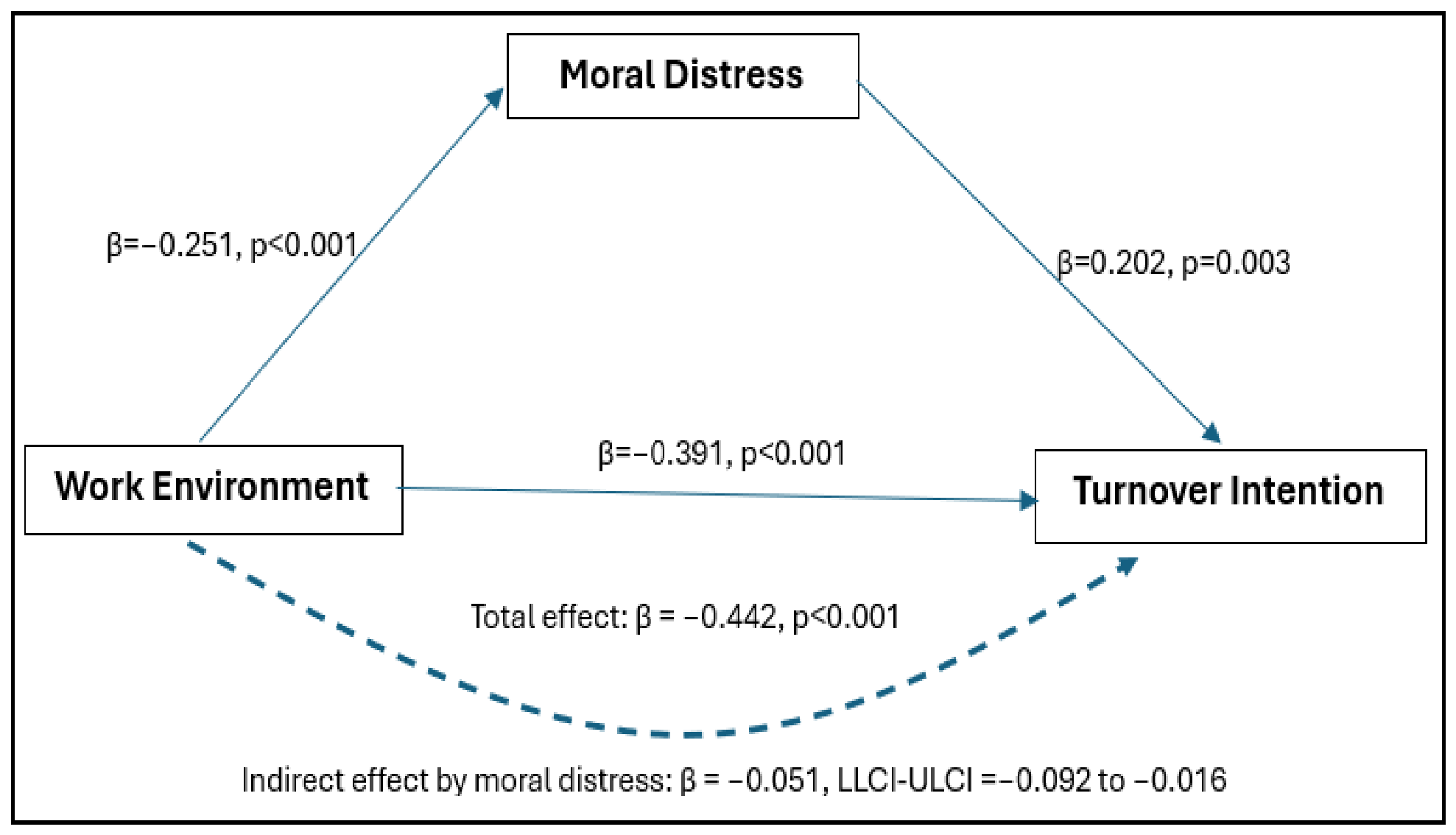
| Work Environment → Moral Distress | −45.293 | −0.251 | 12.713 | −3.563 | 70.376 to −20.210 | <0.001 |
| Model Summary R2 = 0.125, F = 6.535, p < 0.001 | ||||||
| Direct effect | ||||||
| Moral Distress → Nurse Turnover intention | 0.008 | 0.202 | 0.003 | 3.004 | 0.003 to 0.012 | 0.003 |
| Work Environment → Nurse Turnover intention | −2.629 | −0.391 | 0.445 | −5.907 | −3.507 to −1.751 | <0.001 |
| Age (Covariate) | −0.062 | −0.123 | 0.040 | −1.569 | −0.140 to 0.016 | 0.118 |
| Nationality (Covariate) | 0.419 | 0.053 | 0.571 | 0.734 | −0.708 to 1.545 | 0.464 |
| Experience (Covariate) | 1.380 | 0.224 | 0.469 | 2.942 | 0.455 to 2.306 | 0.004 |
| Model Summary R2 = 0.281, F = 14.236, p < 0.001 | ||||||
| Total effect | ||||||
| Work Environment → Nurse Turnover intention | −2.970 | −0.442 | 0.440 | −6.753 | −3.837 to −2.102 | <0.001 |
| Model Summary R2 = 0.245, F = 14.886, p < 0.001 | ||||||
| Indirect effect | β | BootSE | BootLLCI | BootULCI | ||
| Work Environment → Moral Distress → Nurse Turnover intention | −0.051 | 0.019 | −0.092 | −0.016 | ||
Disclaimer/Publisher’s Note: The statements, opinions and data contained in all publications are solely those of the individual author(s) and contributor(s) and not of MDPI and/or the editor(s). MDPI and/or the editor(s) disclaim responsibility for any injury to people or property resulting from any ideas, methods, instructions or products referred to in the content. |
© 2026 by the authors. Licensee MDPI, Basel, Switzerland. This article is an open access article distributed under the terms and conditions of the Creative Commons Attribution (CC BY) license.
Share and Cite
Alrashedi, H.; Almaslamani, O.; Alnomasy, N.; Saleh, K.A.; Lamine, H.; Alkubati, S.A. Linking Work Environment to Turnover Intention: The Mediating Role of Moral Distress Among Emergency Nurses. Nurs. Rep. 2026, 16, 208. https://doi.org/10.3390/nursrep16060208
Alrashedi H, Almaslamani O, Alnomasy N, Saleh KA, Lamine H, Alkubati SA. Linking Work Environment to Turnover Intention: The Mediating Role of Moral Distress Among Emergency Nurses. Nursing Reports. 2026; 16(6):208. https://doi.org/10.3390/nursrep16060208
Chicago/Turabian StyleAlrashedi, Habib, Omar Almaslamani, Nader Alnomasy, Khalil A. Saleh, Hamdi Lamine, and Sameer A. Alkubati. 2026. "Linking Work Environment to Turnover Intention: The Mediating Role of Moral Distress Among Emergency Nurses" Nursing Reports 16, no. 6: 208. https://doi.org/10.3390/nursrep16060208
APA StyleAlrashedi, H., Almaslamani, O., Alnomasy, N., Saleh, K. A., Lamine, H., & Alkubati, S. A. (2026). Linking Work Environment to Turnover Intention: The Mediating Role of Moral Distress Among Emergency Nurses. Nursing Reports, 16(6), 208. https://doi.org/10.3390/nursrep16060208