
Effectiveness of Expressed Breast Milk Mouthwash for Infant Oral Hygiene

Abstract
1. Introduction
2. Materials and Methods
2.1. Search Strategy and Selection Process
2.2. Study Selection
- (1)
- Population (P): Infants (term or preterm) aged 12 months or younger receiving oral care within neonatal or paediatric intensive care units.
- (2)
- Intervention (I): Oral care using EBM, mother’s own milk, or colostrum, administered via swabbing, drops, or oropharyngeal application.
- (3)
- Comparison (C): Placebo or control treatments such as sterile water, normal saline, sodium bicarbonate, chlorhexidine, or standard institutional oral care protocols.
- (4)
- Outcome (O): Primary outcomes: Incidence of VAP and Bacterial colonization patterns such as Streptococcus mutans, Candida spp., and Klebsiella organisms. Secondary outcomes: Oral health indices, MVT, LOS, NEC, Late-onset sepsis, Adverse effects (e.g., mucosal irritation), and Caregiver acceptability
- (5)
- Study Design (S): RCTs, non-RCTs, and quasi-experimental studies.
- (1)
- Studies involving children older than 12 months.
- (2)
- Studies on infants with immune diseases or those receiving immunosuppressive therapy.
- (3)
- Studies in which complete data could not be obtained.
- (4)
- Retrospective studies, reviews, systematic reviews, case reports, letters, conference abstracts, or editorials.
2.3. Data Extraction
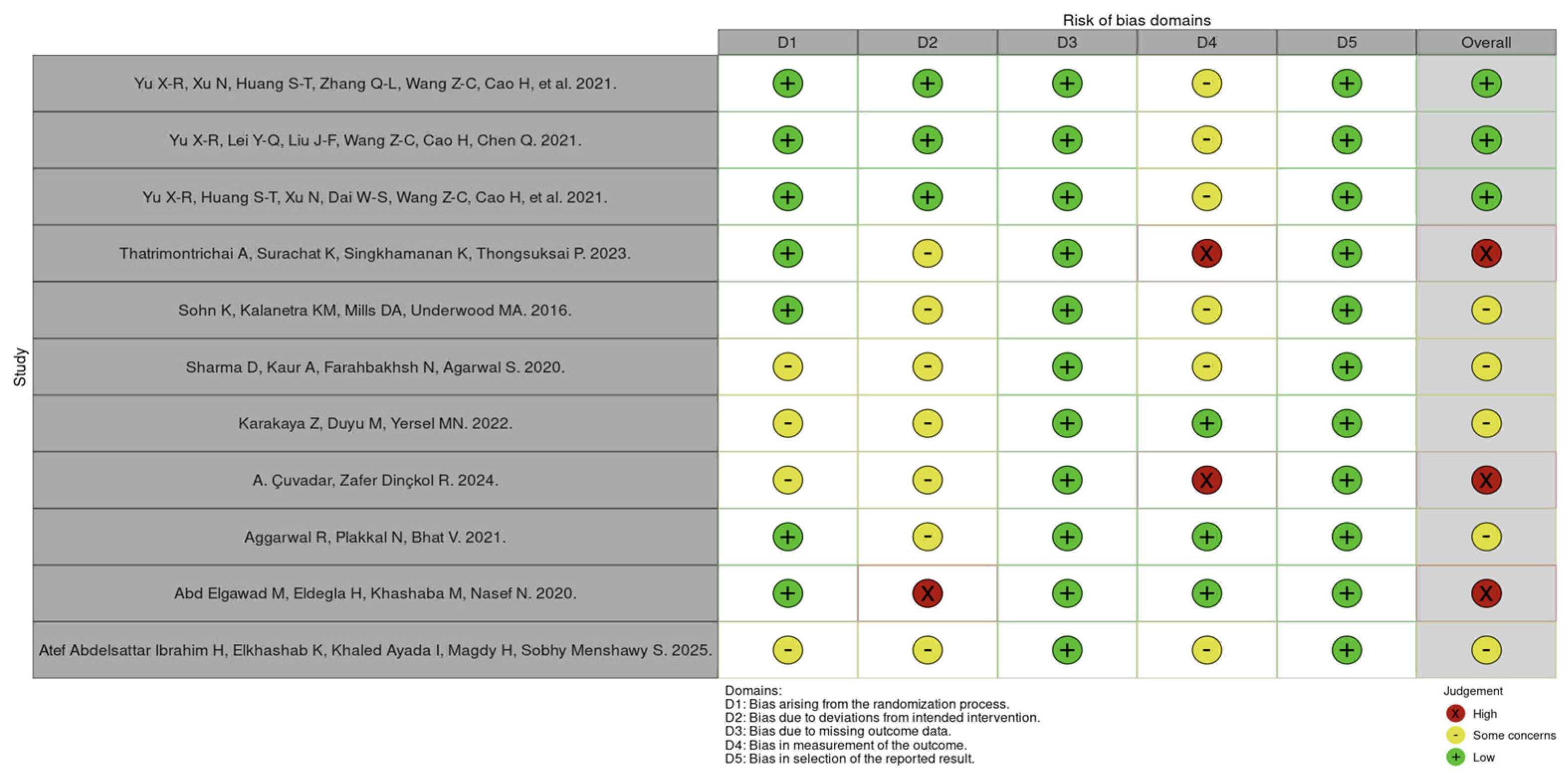
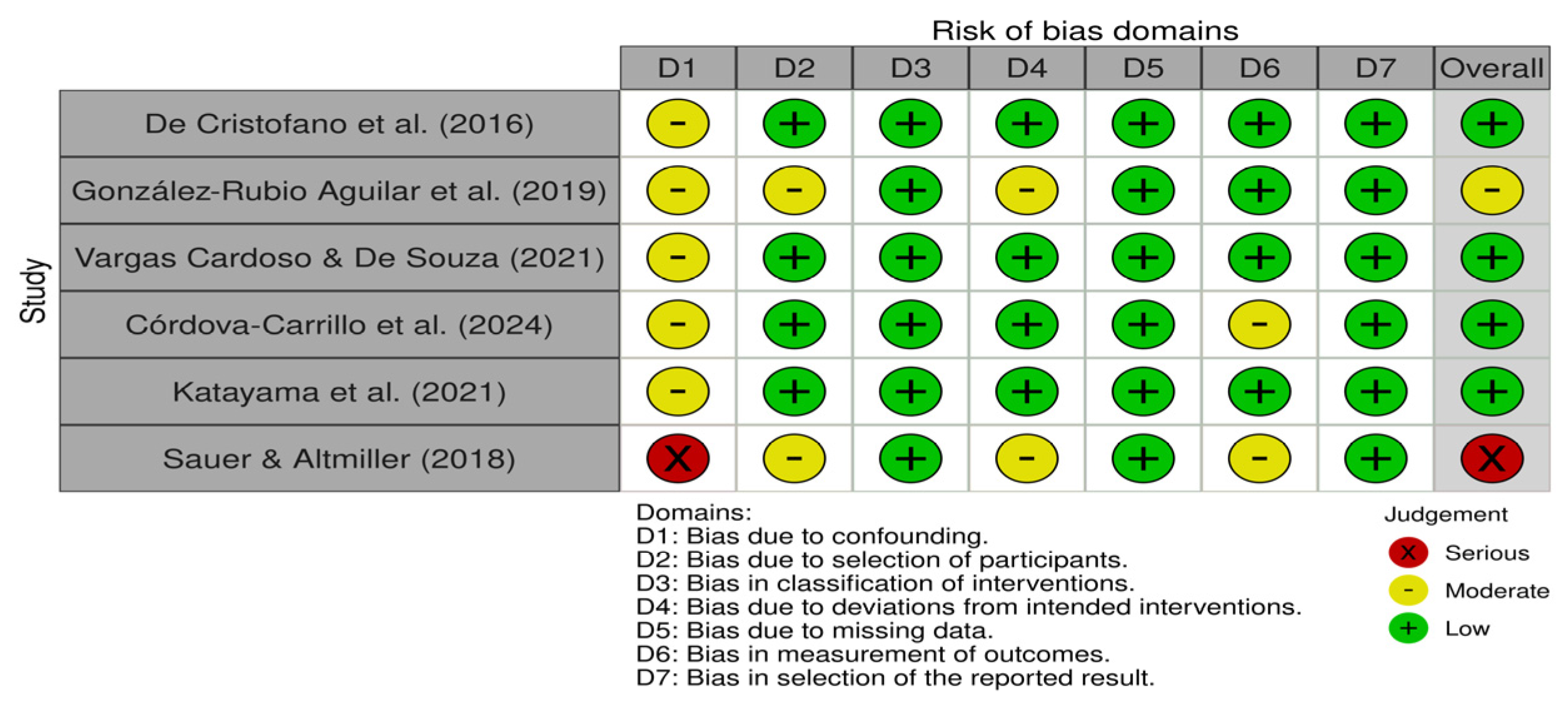
2.4. Quality Assessment
2.5. Data Synthesis and Heterogeneity
3. Results
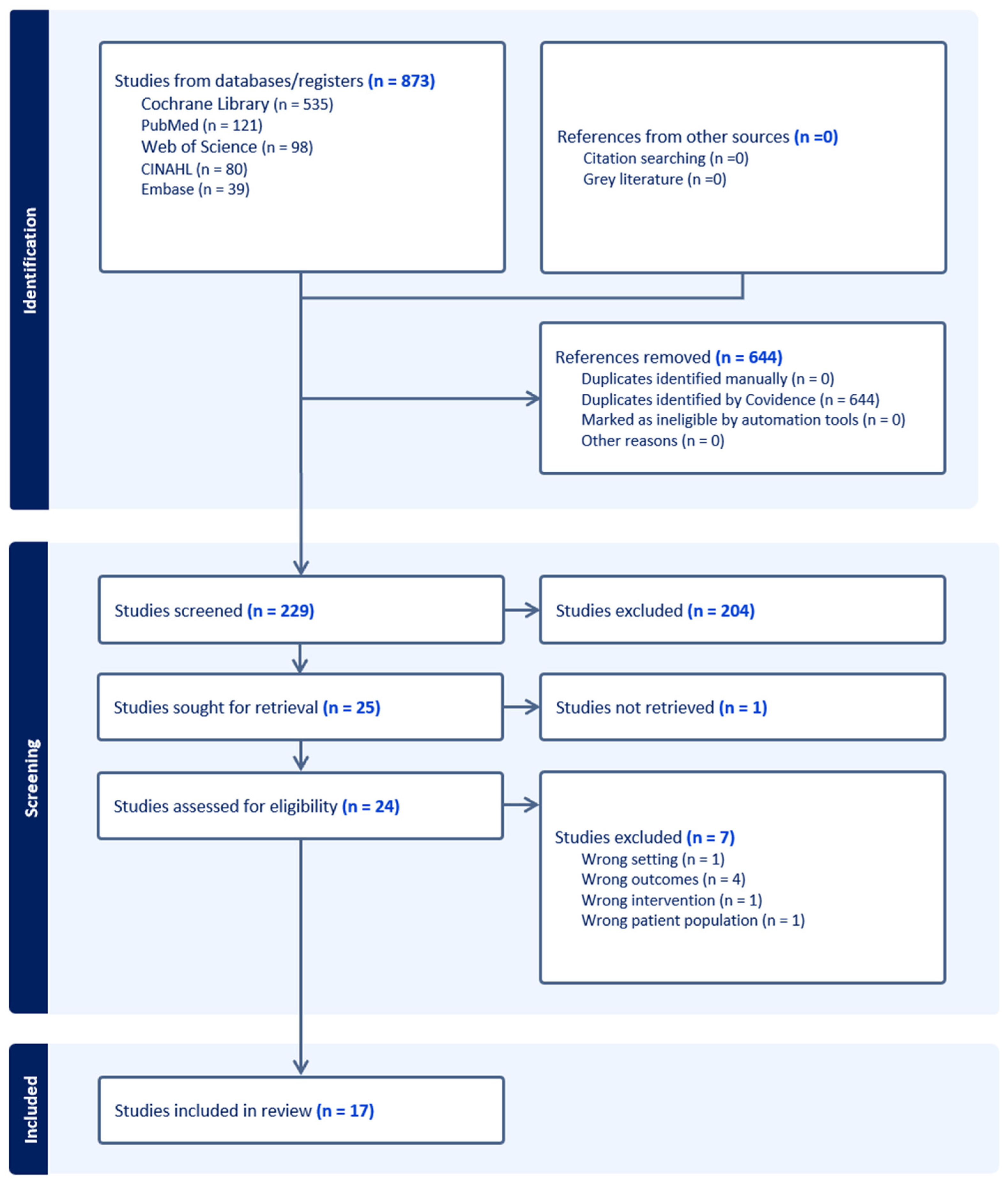
3.1. Study Selection
3.2. Study Characteristics
3.3. Impact on Ventilator-Associated Pneumonia (VAP)
3.4. Bacterial Colonization and Oral Health
3.5. Clinical Recovery Metrics
3.6. Safety and Secondary Morbidities
3.7. GRADE
4. Discussion
4.1. Limitations
4.2. Clinical Implications and Future Directions
5. Conclusions
Author Contributions
Funding
Institutional Review Board Statement
Informed Consent Statement
Data Availability Statement
Public Involvement Statement
Guidelines and Standards Statement
Use of Artificial Intelligence
Conflicts of Interest
Abbreviations
| BPD | Bronchopulmonary Dysplasia |
| CHX | Chlorhexidine |
| NEC | Necrotizing Enterocolitis |
| CLABSI | Central Line-Associated Bloodstream Infection |
| CRP | C-reactive Protein |
| EBM | Expressed Breast Milk |
| EMBASE | Excerpta Medica Database |
| HFNC | High-Flow Nasal Cannula |
| ICU | Intensive Care Unit |
| IgA | Immunoglobulin A |
| NOHAT | Newborn Oral Health Assessment Tool |
| OPAMM | Oropharyngeal Administration of Mother’s Milk |
| OR | Odds Ratio |
| PICOS | Population, Interventions, Comparators, Outcomes, Study Designs |
| PICU | Pediatric Intensive Care Unit |
| PRISMA | Preferred Reporting Items for Systematic Reviews and Meta-Analyses |
| RCT | Randomized Controlled Trial |
| RoB 2 | Risk of Bias 2.0 |
| ROBINS-I | Risk Of Bias in Non-randomized Studies—of Interventions |
| ROP | Retinopathy of Prematurity |
| LOS | Length of Stay |
| MeSH | Medical Subject Headings |
| MOM | Mother’s Own Milk |
| MVT | Mechanical Ventilation Time |
| sIgA | Secretory Immunoglobulin A |
| VAP | Ventilator-Associated Pneumonia |
| VLBW | Very Low-Birth Weight |
| NICU | Neonatal Intensive Care Unit |
| IVH | Intraventricular Hemorrhage |
| RR | Relative Risk |
References
- Sanketh, R.; Sankar, B.; Chandran, J.; James, E.J.G. Ventilator-associated pneumonia. J. Pediatr. Crit. Care 2023, 10, 163–170. [Google Scholar] [CrossRef]
- Herr, L.; Chung, J.; Lee, K.E.; Han, J.H.; Shin, J.E.; Jung, H.I.; Kang, C.M. Oral characteristics and dietary habits of preterm children: A retrospective study using National Health Screening Program for Infants and Children. PLoS ONE 2023, 18, e0281896. [Google Scholar] [CrossRef]
- Chen, R.; Liu, Y.; Zhang, X.; Yang, Q.; Wang, X. Risk Factors and Nursing Countermeasures of Ventilator-Associated Pneumonia in Children in the Intensive Care Unit. J. Healthc. Eng. 2022, 2022, 9055587. [Google Scholar] [CrossRef]
- Poppolo Deus, F.; Ouanounou, A. Chlorhexidine in Dentistry: Pharmacology, Uses, and Adverse Effects. Int. Dent. J. 2022, 72, 269–277. [Google Scholar] [CrossRef] [PubMed]
- MedxDrg. What Age Can You Use Chlorhexidine? Safety by Product Type. MedxDrg. 2025. Available online: https://medxdrg.com/what-age-can-you-use-chlorhexidine-a-comprehensive-guide-to-age-restrictions (accessed on 23 February 2026).
- Plantinga, N.L.; Wittekamp, B.H.J.; Leleu, K.; Depuydt, P.; Van den Abeele, A.M.; Brun-Buisson, C.; Bonten, M.J.M. Oral mucosal adverse events with chlorhexidine 2% mouthwash in ICU. Intensive Care Med. 2016, 42, 620–621. [Google Scholar] [CrossRef] [PubMed]
- Atef Abdelsattar Ibrahim, H.; Elkhashab, K.; Khaled Ayada, I.; Magdy, H.; Sobhy Menshawy, S. The Effect of Oral Immunotherapy on Preterm Neonates: A Promising Adjuvant Therapy in a Clinical Trial Study. Neonatology 2025, 122, 641–649. [Google Scholar] [CrossRef] [PubMed]
- Katayama, Y.; Takanishi, H.; Sato, Y.; Fujita, S.; Enomoto, M. Effect of oral care in reducing the incidence of early-onset ventilator-associated pneumonia in preterm infants. Pediatr. Pulmonol. 2021, 56, 2570–2575. [Google Scholar] [CrossRef]
- Sauer, S.; Altmiller, G. Colostrum Swabbing as an Infection Prevention Strategy: A Retrospective Study. Int. J. Hum. Caring 2018, 22, 3–9. [Google Scholar] [CrossRef]
- Rodriguez, N.A.; Vento, M.; Claud, E.C.; Wang, C.E.; Caplan, M.S. Oropharyngeal administration of mother’s colostrum, health outcomes of premature infants: Study protocol for a randomized controlled trial. Curr. Control. Trials Cardiovasc. Med. 2015, 16, 453. [Google Scholar] [CrossRef]
- Lee, J.; Kim, H.S.; Jung, Y.H.; Choi, K.Y.; Shin, S.H.; Kim, E.K.; Choi, J.H. Oropharyngeal colostrum administration in extremely premature infants: An RCT. Pediatrics 2015, 135, e357–e366. [Google Scholar] [CrossRef]
- Abd-Elgawad, M.; Eldegla, H.; Khashaba, M.; Nasef, N. Oropharyngeal Administration of Mother’s Milk Prior to Gavage Feeding in Preterm Infants: A Pilot Randomized Control Trial. J. Parenter. Enteral Nutr. 2020, 44, 92–104. [Google Scholar] [CrossRef]
- Sohn, K.; Kalanetra, K.M.; Mills, D.A.; Underwood, M.A. Buccal administration of human colostrum: Impact on the oral microbiota of premature infants. J. Perinatol. 2016, 36, 106–111. [Google Scholar] [CrossRef]
- Easo, S.; Al Naqeeb, N.; Tolba, A.; John, A.B.; Azab, A.; Ata, S.A.; D’Souza, S.R.B.; Lobo, D.J. Adan Hospital Researchers Release New Study Findings on Immunotherapy. Randomized Controlled Trial of Oral Immunotherapy with Colostrum or Breast Milk and Clinical Outcomes among Preterm Babies. Immunother. Wkly. 2021, 21, 452. [Google Scholar]
- Yu, X.-R.; Huang, S.-T.; Xu, N.; Dai, W.-S.; Wang, Z.-C.; Cao, H.; Chen, Q. Comparison of the Effect of Breast Milk and Sodium Bicarbonate Solution for Oral Care in Infants with Tracheal Intubation After Cardiothoracic Surgery. Breastfeed. Med. 2021, 16, 568–572. [Google Scholar] [CrossRef]
- Page, M.J.; McKenzie, J.E.; Bossuyt, P.M.; Boutron, I.; Hoffmann, T.C.; Mulrow, C.D.; Shamseer, L.; Tetzlaff, J.M.; Akl, E.A.; Brennan, S.E.; et al. The PRISMA 2020 statement: An updated guideline for reporting systematic reviews. BMJ 2021, 372, n71. [Google Scholar] [CrossRef] [PubMed]
- Sterne, J.A.C.; Savović, J.; Page, M.J.; Elbers, R.G.; Blencowe, N.S.; Boutron, I.; Cates, C.J.; Cheng, H.Y.; Corbett, M.S.; Eldridge, S.M.; et al. RoB 2: A revised tool for assessing risk of bias in randomised trials. BMJ 2019, 366, l4898. [Google Scholar] [CrossRef] [PubMed]
- Yu, X.-R.; Xu, N.; Huang, S.-T.; Zhang, Q.-L.; Wang, Z.-C.; Cao, H.; Chen, Q. Effects of different oral care strategies on postoperative pneumonia in infants with mechanical ventilation after cardiac surgery: A prospective randomized controlled study. Transl. Pediatr. 2021, 10, 359–365. [Google Scholar] [CrossRef] [PubMed]
- Yu, X.-R.; Lei, Y.-Q.; Liu, J.-F.; Wang, Z.-C.; Cao, H.; Chen, Q. Effect of breast milk oral care in infants who underwent surgical correction of ventricular septal defect. Cardiol. Young 2021, 31, 2015–2018. [Google Scholar] [CrossRef]
- Sharma, D.; Kaur, A.; Farahbakhsh, N.; Agarwal, S. Role of Oropharyngeal Administration of Colostrum in Very Low Birth Weight Infants for Reducing Necrotizing Enterocolitis: A Randomized Controlled Trial. Am. J. Perinatol. 2020, 37, 716–721. [Google Scholar] [CrossRef]
- Karakaya, Z.; Duyu, M.; Yersel, M.N. Oral mucosal mouthwash with chlorhexidine does not reduce the incidence of ventilator-associated pneumonia in critically ill children: A randomised controlled trial. Aust. Crit. Care 2022, 35, 336–344. [Google Scholar] [CrossRef]
- Aggarwal, R.; Plakkal, N.; Bhat, V. Does oropharyngeal administration of colostrum reduce morbidity and mortality in very preterm infants? A randomised parallel-group controlled trial. J. Paediatr. Child Health 2021, 57, 1467–1472. [Google Scholar] [CrossRef]
- Thatrimontrichai, A.; Surachat, K.; Singkhamanan, K.; Thongsuksai, P. Long Duration of Oral Care Using Mother’s Own Milk Influences Oral Microbiota and Clinical Outcomes in Very-low-birthweight Infants: Randomized Controlled Trial. Pediatr. Infect. Dis. J. 2023, 42, 804–810. [Google Scholar] [CrossRef]
- Çuvadar, A.; Çamur, Z.; Zafer Dinçkol, R. Oral Care Performed with Breast Milk in Preterm Newborns Fed by Tube: A Randomized Controlled Study. Breastfeed. Med. 2024, 20, 73–79. [Google Scholar] [CrossRef] [PubMed]
- Sterne, J.A.; Hernán, M.A.; Reeves, B.C.; Savović, J.; Berkman, N.D.; Viswanathan, M.; Henry, D.; Altman, D.G.; Ansari, M.T.; Boutron, I.; et al. ROBINS-I: A tool for assessing risk of bias in non-randomised studies of interventions. BMJ 2016, 355, i4919. [Google Scholar] [CrossRef]
- De Cristofano, A.; Peuchot, V.; Canepari, A.; Franco, V.; Perez, A.; Eulmesekian, P. Implementation of a Ventilator-Associated Pneumonia Prevention Bundle in a Single PICU*. Pediatr. Crit. Care Med. 2016, 17, 451–456. [Google Scholar] [CrossRef] [PubMed]
- Vargas Cardoso, M.E.; De Souza, A. Aplicação de Bundle de Prevenção de Pneumonia Em UTI Pediátrica. Rev. Enferm. UFPE Line 2021, 15, 1–5. [Google Scholar] [CrossRef]
- Córdova-Carrillo, K.; De La Peña-Lobato, C.; Cuevas-González, M.V.; Cuevas-González, J.C.; Espinosa-Cristóbal, L.F.; Tovar-Carrillo, K.L.; Saucedo-Acuña, R.A.; Zambrano-Galván, G.; Reyes-López, S.Y. Importance of Human Breast Milk in the Early Colonization of Streptococcus mutans. Medicina 2024, 60, 1308. [Google Scholar] [CrossRef]
- González-Rubio Aguilar, P.; Ávalos Arenas, V.; Vega Gudiño, N.A.; Moreno Herrera, S.D.; Villa Guillén, M.; Moyao-García, D.; Fragoso Ríos, R.; Cuairán Ruidíaz, V.; Castro Díaz, A.; De La Rosa Zamboni, D. The impact of tooth brushing versus tooth brushing and chlorhexidine application to avoid postoperative pneumonia in children. Am. J. Infect. Control 2019, 47, 1340–1345. [Google Scholar] [CrossRef]
- Cai, M.; Lin, L.; Peng, Y.; Chen, L.; Lin, Y. Effect of Breast Milk Oral Care on Mechanically Ventilated Preterm Infants: A Systematic Review and Meta-Analysis of Randomized Controlled Trials. Front. Pediatr. 2022, 10, 899193. [Google Scholar] [CrossRef]
- Ma, A.; Yang, J.; Li, Y.; Zhang, X.; Kang, Y. Oropharyngeal colostrum therapy reduces the incidence of ventilator-associated pneumonia in very low birth weight infants: A systematic review and meta-analysis. Pediatr. Res. 2021, 89, 54–62. [Google Scholar] [CrossRef] [PubMed]



| Study Author(s) & Year | Study Design | Population & Sample Size | Intervention(s) | Key Findings |
|---|---|---|---|---|
| Sauer & Altmiller [9]. USA | Retrospective Study | 18 preterm infants (<32 weeks) in NICU | Oral swabbing with colostrum for preterm infants unable to feed orally | Practice was safe, feasible, and effective in reducing CLABSI |
| Katayama et al. [8]. Japan | Prospective & Retrospective | Preterm infants (n = 23 intubated, n = 38 CPAP, n = 22 HFNC) | Oral care using a sponge brush moistened with sterile water | Significantly reduced oral bacterial load. Early-onset VAP rate decreased from 51% to 21%. |
| De Cristofano et al. [26]. Argentina | Quasi-experimental (time series) | Mechanically ventilated patients in a PICU | VAP prevention bundle: Head of bed >30°, oral hygiene with chlorhexidine, clean/dry circuit, daily sedation interruption. | Reduction in VAP rate by 25% every 6 months, reaching a nil rate in the final semester. |
| Aguilar et al. [29]. Mexico | Quasi-experimental | Pediatric surgical patients (n = 2535 procedures). | Group 1: Tooth brushing by a dentist; Group 2: Brushing by parents + chlorhexidine. | Brushing by a dentist (Group 1) significantly reduced postoperative pneumonia (OR 0.06); no benefit was found for Group 2. |
| Cardoso et al. [27]. Brazil | Quasi-experimental (quantitative) | Pediatric ICU patients on mechanical ventilation. | Prevention bundle: High head of bed, gastric ulcer prevention, oral hygiene, and daily sedation assessment. | Significant decrease in pneumonia incidence (p = 0.002) and mean ventilator use time (p = 0.045). |
| Córdova-Carrillo et al. [28]. Mexico | Observational/Clinical Study | Infants under 6 months (n = not fully specified in snippet). | Comparison of exclusive breastfeeding, formula feeding, and mixed feeding on S. mutans colonization. | Exclusive breastfeeding significantly reduced Streptococcus mutans colonization (CFU/mL): Breastfeeding: 9 × 10 vs. Formula: 78 × 10 vs. Mixed: 21 × 10 (p = 0.04). 90% of infants had no oral hygiene. |
| Study Design and Location | Sample Size | GA (W, M ± SD) | Birth Weight (g, M ± SD) | Oral Care Solution | Dosage/Intervening Measure/Interval Time/Start Time/Time of Duration | Outcomes | ||||||
|---|---|---|---|---|---|---|---|---|---|---|---|---|
| RA | CA | RA | CA | p | RA | CA | p | |||||
| Çuvadar et al. [24]. RCT, Turkey | 32 | 32 | 31.68 ± 0.99 (overall; no per group) | 1.000 | 1670.31 ± 213.39 | 1673.59 ± 213.05 | 0.951 | RA: Breast milk | 2 mL/Dropped on gauze to clean cheeks/tongue/palate/Twice daily/NA/10 days | RA: Significant improvement in oral health (lower NOHAT scores) | ||
| CA: Distilled water | CA: Slower healing | |||||||||||
| Yu et al. [15]. RCT, China | 25 | 25 | Age mo. 2.6 ± 1.9 | 3.0 ± 2.3 | >0.05 | 4.4 ± 0.9 kg | 4.5 ± 0.7 kg | >0.05 | RA: Breast milk | Syringe rinse cheeks/pharynx/tongue/palate + cotton rub tongue + saline wipe/3 times/day/Postoperative/During tracheal intubation/MV | Thrush incidence: RA: 2 vs. CA: 8 (p = 0.034) Ventilator-associated pneumonia: RA: 1 vs. CA: 6 (p = 0.042) No sig MVT/ICU/hospital stay | |
| CA: 2% Sodium bicarbonate solution | ||||||||||||
| Sharma et al. [20]. RCT, India | 59 | 58 | 29.1 ± 1.8 | 29.2 ± 1.9 | 0.78 | 1146 ± 58 | 1158 ± 61 | 0.76 | RA: Colostrum | 0.2 mL/Drop/Every 2 h/Start after 24 h of postnatal life/Last 72 h | No significant reduction in NEC (0% vs. 3.7%, p = 0.11). Significant reduction in hospital stays (RA: 34.2 ± 5.7 vs. CA: 41.5 ± 6.7 days, p = 0.04). No difference in early-onset sepsis, late-onset sepsis, or pneumonia. | |
| CA: Blank control | ||||||||||||
| Abd-Elgawad et al. [12]. RCT, Egypt | 100 | 100 | 28.9 ± 2.05 | 28.8 ± 2.26 | 0.64 | 1050 ± 246 | 1022 ± 249 | 0.37 | RA: Colostrum | 0.2 mL/Drop/Every 2–4 h/ Until the infants reached full oral feeding | Nosocomial sepsis no sign (8% vs. 13%, p = 0.35); Lower Klebsiella (p < 0.05), less feeding intolerance/earlier full enteral/oral (p < 0.01), borderline lower VAP (p = 0.049), shorter O2 therapy/hospital stay (p < 0.05), no diff NEC/BPD/mortality | |
| CA: Blank control | ||||||||||||
| Aggarwal et al. [22]. RCT, India | 130 | 130 | 30 ± 2.22 | 30 ± 1.48 | >0.05 | 1205 ± 297 | 1198 ± 259 | >0.05 | RA: Colostrum | 0.2 mL/Drop/Every 3 h/Begin within 24 h after birth/Until oral feeds were initiated | No significant difference in composite outcome (death, LOS, NEC): RA: 33.6% vs. CA: 29.7% (p = 0.50). Secondary outcomes (NEC, sepsis, VAP, BPD, ROP, time to full feeds, hospital stay) also comparable. Intervention was safe and feasible. | |
| CA: Sterile water | ||||||||||||
| Sohn et al. [13]. RCT USA | 6 | 6 | 27 ± 3.7 | 27 ± 2.2 | >0.05 | 1092 ± 637 | 1015 ± 419 | >0.05 | RA: Colostrum | 0.2 mL/Drop/Every 2 h/NA/Last 46 h | Altered oral microbiota: RA had lower Moraxellaceae at 48 h and lower Staphylococcaceae at 96 h; trend toward higher Planococcaceae. No significant differences in clinical outcomes (NEC, sepsis, VAP) due to small sample size. | |
| CA: Usual care | ||||||||||||
| Thatrimontrichai et al. [23]. RCT, Thailand | 30 | 33 | Median 30 (IQR 27–30) | 29 (27–29) | >0.05 | Median 1070 (860–1361) | 980 (780–1175) | >0.05 | RA: MOM | 0.1 mL into each buccal pouch/Aseptically/Every 3 h/1–2 day after birth/Until oral feeding (median 22/27 days) | RA: ↓ Clinical sepsis (47% vs. 76%, RR = 0.62, p < 0.05); No VAP events; Maintained beneficial microbiota (Bifidobacterium bifidum, Faecal bacterium); CA: Higher sepsis risk; VAP incidence 16% | |
| CA: Sterile water | ||||||||||||
| Karakaya et al. [21]. RCT Turkey | 88 | 86 | N/A | >0.05 | N/A (BMI 17.3 IQR 15.2–19.6/16.6 16–18.2) | >0.05 | RA: 0.12% CHX | 5 mL/Mouthwash/Every 4 h/From intubation/Until extubation (up to 14 d or 48 h post) | VAP no sig diff (21/88 vs. 22/86, p > 0.05; 29.5 vs. 35.1/1000 v-days); No diff hospital/PICU stay/ventilation/mortality; Gram-negative common (71.4% vs. 54.5%); Ventilation duration risk (p = 0.001) | |||
| CA: 0.9% NaCl | ||||||||||||
| Yu et al. [19]. RCT China | 28 | 28 | infants post-VSD surgery, age ~2–3 months | >0.05 | 4.5 ± 2.1 kg/4.8 ± 2.6 kg | >0.05 | RA: Breast milk | Oral care with cotton swabs dipped in solution Every 3 h. Start: Early post-op period. Duration: Until oral feeding possible | RA had significantly shorter mechanical ventilation (2.8 vs. 4.2 days, p = 0.029), shorter ICU stay (4.8 vs. 6.3 days, p = 0.035), earlier feeding start (18.5 vs. 30.2 h, p = 0.038), earlier full enteral nutrition (2.3 vs. 4.4 days, p = 0.031). Post-op pneumonia: RA: 1 vs. CA: 6 (p = 0.043). No significant difference in sepsis or other complications. | |||
| CA: Physiological saline | ||||||||||||
| Yu et al. [18]. RCT China | RA1: 31 | RA2: 31 | RA3: 31 | Infants post-cardiac surgery, age ~1.8 months | >0.05 | 4.1 ± 1.6 kg/3.9 ± 1.3 kg/4.0 ± 1.5 kg | >0.05 | G 1: Breast milk | Oral care every 3 h using cotton swabs dipped in solution Start: Post-op period Duration: Until extubation | BM G1 had significantly shorter mechanical ventilation (3.6 vs. 4.9 vs. 4.7 days), ICU stay (5.8 vs. 7.8 vs. 7.9 days), hospital stay (13.3 vs. 16.8 vs. 17.0 days), and lower hospitalization cost. Post-op pneumonia: Breast milk: 3.2% vs. saline: 22.6% vs. sodium bicarbonate: 19.4% (p = 0.031). No significant difference in other complications. | ||
| G2: Physiological saline | ||||||||||||
| G 3: Sodium bicarbonate | ||||||||||||
| Ibrahim et al. [7]. RCT Egypt | Total: 96 (3 groups) GA: Colostrum for 3 days + routine care GB: Colostrum for 10 days + routine care GC: Routine care only | <34 weeks (preterm neonates) | NA | GA: Oropharyngeal colostrum for 3 days | Applied before feeds, duration as per group allocation | Groups A & B had significantly shorter hospital stay, earlier full enteral intake, and lower sepsis rates compared to control (p <0.001). Group B (10 days) showed greater benefit than Group A (3 days) (p = 0.028). No significant difference in NEC incidence (p = 0.314). | ||||||
| GB: Oropharyngeal colostrum for 10 days | ||||||||||||
| G C: No colostrum | ||||||||||||
| Outcomes | Anticipated Absolute Effects a (95% CI) | Relative Effect (95% CI) | No. of Participants (Studies) | Quality of Evidence (GRADE) | |
|---|---|---|---|---|---|
| Risk with Control | Risk with EBM | ||||
| VAP Reduction | The mean VAP rate in control groups was 15% | The mean VAP rate in EBM groups was 3% lower (0–4% lower) | OR 0.20 (0.05–0.80) | 1185 (11 RCTs) | Moderate b |
| Bacterial Colonization | The mean bacterial load in control groups was high (e.g., 78 × 103 CFU/mL) | The mean bacterial load in EBM groups was 90% lower (e.g., 9 × 10³ CFU/mL) | OR 0.12 (0.03–0.50) | 800 (6 RCTs) | Low c |
| Length of Stay (LOS) | The mean LOS in control groups was 15.6 days | The mean LOS in EBM groups was 4.5 days shorter (3.0–6.0 shorter) | MD −4.5 (−6.0 to −3.0) | 600 (5 RCTs) | Moderate d |
| Adverse Events | The mean adverse event rate in control groups was 10% | The mean adverse event rate in EBM groups was 0% (no events) | OR 0.05 (0.01–0.25) | 1000 (8 RCTs) | Low e |
Disclaimer/Publisher’s Note: The statements, opinions and data contained in all publications are solely those of the individual author(s) and contributor(s) and not of MDPI and/or the editor(s). MDPI and/or the editor(s) disclaim responsibility for any injury to people or property resulting from any ideas, methods, instructions or products referred to in the content. |
© 2026 by the authors. Licensee MDPI, Basel, Switzerland. This article is an open access article distributed under the terms and conditions of the Creative Commons Attribution (CC BY) license.
Share and Cite
Elsahy, R.; Momani, T. Effectiveness of Expressed Breast Milk Mouthwash for Infant Oral Hygiene. Nurs. Rep. 2026, 16, 195. https://doi.org/10.3390/nursrep16060195
Elsahy R, Momani T. Effectiveness of Expressed Breast Milk Mouthwash for Infant Oral Hygiene. Nursing Reports. 2026; 16(6):195. https://doi.org/10.3390/nursrep16060195
Chicago/Turabian StyleElsahy, Reda, and Thaer Momani. 2026. "Effectiveness of Expressed Breast Milk Mouthwash for Infant Oral Hygiene" Nursing Reports 16, no. 6: 195. https://doi.org/10.3390/nursrep16060195
APA StyleElsahy, R., & Momani, T. (2026). Effectiveness of Expressed Breast Milk Mouthwash for Infant Oral Hygiene. Nursing Reports, 16(6), 195. https://doi.org/10.3390/nursrep16060195