The main objective of this study was to estimate the accounting cost of home care nursing in Italy and to identify the main cost drivers influencing expenditure in home care. To the best of our knowledge, this is the first national micro-costing study of home care nursing conducted in Italy. These results represent an illustrative scenario rather than a formal budget impact analysis, and results are sensitive to assumptions regarding hospitalization rates, survey responses and the availability of data on home care services in Italy. Providing empirically grounded cost estimates may support healthcare planning and resource allocation decisions within the Italian National Health Service.
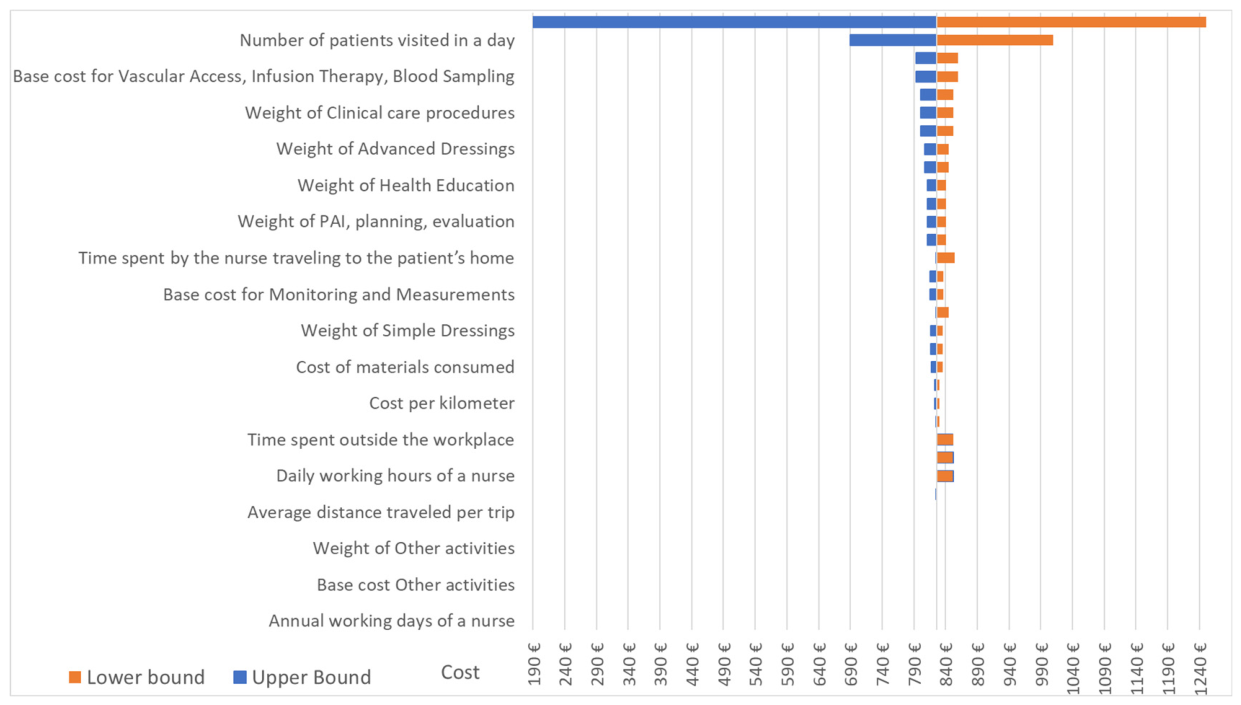
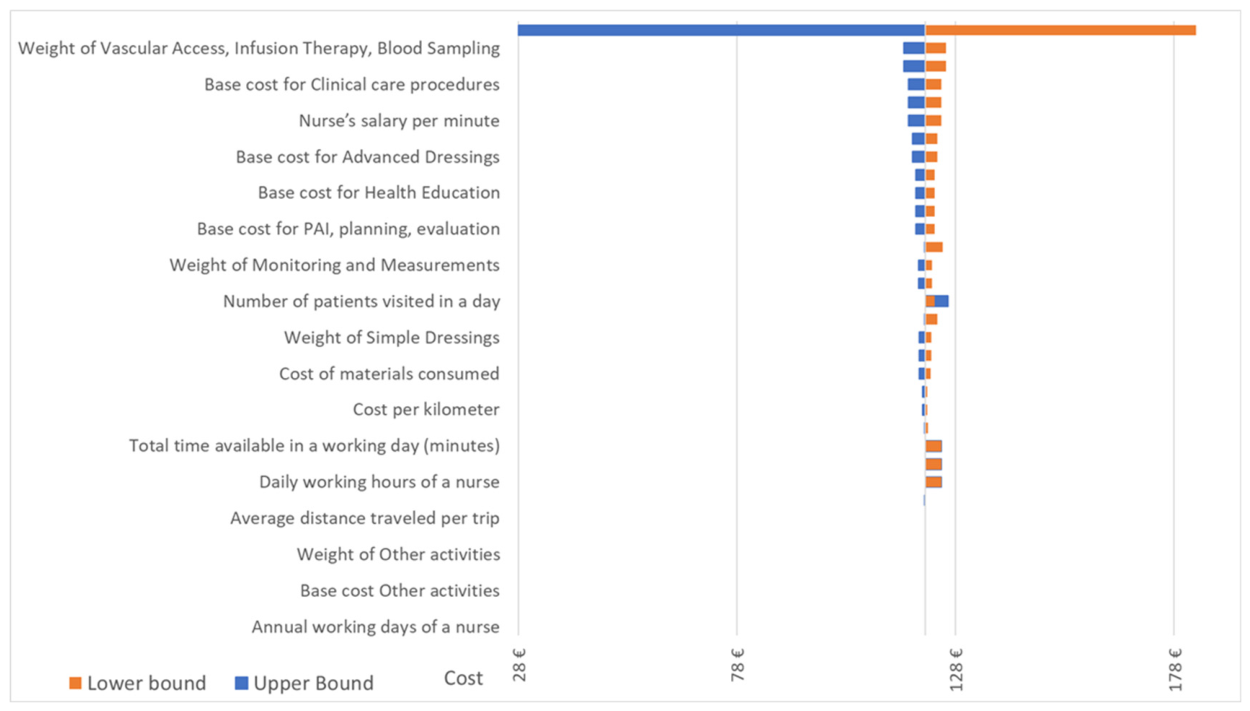
The analysis demonstrates a substantial discrepancy between accounting-based estimates and the more comprehensive valuation that includes nursing activities. The base-case scenario represents the minimal operational cost of home-care nursing activity (€27.78 per patient per day), while the extended scenario underscores the substantial economic value of nursing activities currently unaccounted for in reimbursement schemes (€120.81 per patient per day). At the organizational level, the inclusion of activities increases the estimated daily cost per nurse from €190.00 to €826.32, highlighting a structural underestimation of the economic contribution of home-care nursing within existing funding models. These findings mark the importance of developing an appropriate reimbursement framework for home-based nursing care that reflects both the direct operational costs and the clinical value of the activities delivered. Addressing the lack of an appropriate reimbursement framework is therefore essential to ensure the long-term viability and quality of home care delivered. The observation that a substantial proportion of visits include multiple concurrent activities, alongside a high volume of non-procedural tasks such as documentation, care planning, and patient education, further underscores the multidimensional nature of home care nursing and challenges simplified representations of home care as low-intensity care. It is essential to clarify that the base case and the extended scenario measure two conceptually distinct economic quantities and are therefore not directly additive. The base case (€27.78 per patient per day) is a bottom-up accounting cost capturing the resources actually consumed in delivering one home visit, valued at their respective input prices. The extended scenario (€120.81 per patient per day) is a value-attribution exercise that asks how much the same set of nursing activities would be reimbursed if paid through the existing outpatient tariff schedule; because outpatient tariffs are regulatory prices that bundle nursing labour, ancillary materials, equipment depreciation, and indirect overheads into a single price, they necessarily embed the cost of professional nursing time. The €120.81 figure should therefore be interpreted as the upper-bound regulatory value of the visit under the existing outpatient framework, not as the true production cost. The substantial gap between the two values reflects the absence of a dedicated reimbursement mechanism for home-based nursing care that would adequately remunerate its complexity, multidimensional nature, and contextual demands. The findings also indicate that activity intensity represents a major driver of costs in home care nursing. In the extended scenario, variations in the number and complexity of activities performed during a single visit may substantially influence overall cost estimates. Although the assumption of three activities per visit was empirically grounded in the observed data, home care visits ranged from lower-intensity encounters involving one or two activities to more complex visits including multiple concurrent interventions. These findings highlight the multidimensional nature of home care nursing and suggest that differences in care complexity should be considered when interpreting and transferring cost estimates across organizational contexts. These findings should be interpreted considering the broader international literature, which highlights both the growing relevance of home-based care and the limited availability of robust economic evaluations. Previous studies have shown that home care interventions are associated with improved patient adherence, satisfaction, and quality of life, and in some cases with reductions in healthcare utilization, although the economic evidence remains heterogeneous and strongly context-dependent. In this field, the present study contributes to filling an important gap by providing detailed, bottom-up cost estimates based on real-world data, an approach that remains relatively uncommon in the field. The most directly comparable international micro-costing studies on home-based nursing care to date are the Korean analyses by Ryu [
20], which estimated the cost per home care nursing visit using administrative and activity-based data. After conversion to 2024 euros and adjustment for purchasing power parity, the Korean estimates correspond to approximately €30–45 per visit, broadly consistent with our €27.78 base-case figure. Direct comparability is however limited by several factors: (i) the Korean studies were conducted in a privately insured payment-by-tariff system that already incorporates a dedicated reimbursement scheme for home nursing visits (unlike Italian Public Healthcare Systems); (ii) the scope of activities included in the Korean cost definitions differs from the AIDOMUS-IT activity classification (notably with respect to travel time, which is incorporated differently in the two systems); (iii) price levels and labour-cost structures differ substantially. With these considerations, the AIDOMUS-IT base case is in broad alignment with the Korean precedent, providing the first empirical evidence that the order of magnitude of home nursing visit costs in Italy is comparable to that observed in the closest international precedent. From a methodological perspective, the costing strategy adopted in this study is consistent with ingredient-based approaches used in other healthcare settings, in which total costs are derived from the aggregation of labour and material inputs required to deliver services. At the same time, international evidence emphasizes that the economics of home care are strongly influenced by organizational and workforce-related factors. More in detail, labour costs typically represent the largest component of total expenditure, and workforce availability, stability, and skill mix are key determinants of service sustainability. These considerations are consistent with the present findings, which highlight the role of variables such as caseload, visit duration, and care complexity in shaping cost estimates. A key aspect of this analysis concerns the use of outpatient service definitions and tariffs as a proxy for assessing nursing activities in the extended scenario. This approach has represented a pragmatic solution due to the absence of a dedicated reimbursement system for HCN in Italy. Such adoption introduces a few conceptual limitations. First, outpatient tariffs are designed to reflect discrete and procedure-based activities, whereas HCN involves integrated and context-dependent care dynamics delivered within a single visit. As a result, the use of outpatient tariffs may not fully capture the complexity, continuity, and organizational dimensions of home-based nursing care. These limitations are not only methodological but also have relevant system-level implications. The absence of dedicated reimbursement mechanisms for nursing activities risks systematically undervaluing the contribution of HCN within territorial health systems and may hinder the strategic development of community-based services. Furthermore, the strong influence of organizational variables such as caseload, visit duration, and care complexity suggests that workforce planning strategies may be as important as wage levels in determining the sustainability and efficiency of home care services. The economic analysis suggests that home care nursing services may represent a potentially efficient model of care. Given the ageing Italian population and the increasing prevalence of chronic diseases [
33], investment in home care represents a sustainable and strategic allocation of healthcare resources, as reported by international literature [
14,
34]. Previous studies suggest that home care may contribute to reducing unnecessary hospital readmissions, mitigating complications related to hospital stays, enhancing patient satisfaction, and supporting care continuity [
17], although these outcomes were not directly evaluated in the present study. The exploratory comparison suggests that the potential economic implications of home care may be substantial; however, these estimates are based on external data and simplifying assumptions and should be interpreted with caution [
35]. Future research should integrate health outcomes into economic evaluations to enable full cost-effectiveness analyses and better inform value-based decision making. Multicenter studies capturing broader regional variability are needed to assess the transferability of cost estimates across different organizational contexts. In addition, future prospective studies should explore the relationship between home care intensity, patient complexity and healthcare utilization, including hospital admissions and long-term care as patients’ outcomes. Further refinement of activity-based costing and standardized data collection frameworks would also strengthen comparability across studies and support evidence-informed reimbursement policies. Strengthening home-care capacity (through workforce expansion, digital support tools, improved logistics, and structured clinical pathways) should therefore be considered a national priority for cost containment, quality improvement, and long-term sustainability of the SSN. Moreover, the cost of home care compared to the related cost of hospital care if home care fails to be provided highlights a compelling economic argument: home-based nursing care is clinically valuable and patient-centred, and may have important economic implications for the SSN; however, the estimates provided in this study should be interpreted as illustrative and not as evidence of cost-effectiveness or budget impact.
Limitations
Some limitations should be considered. First, in the absence of an official fee schedule for home-based nursing services, unit costs were derived from the specialist outpatient medical tariff schedule. Although this approach provided a standardized reference, it may not accurately reflect the true economic value of nursing activities, leading to cost inaccuracies or overestimation. Second, material costs are characterized by substantial variability across local contexts, procurement systems, and organizational practices. The estimates used in this study should therefore be interpreted as indicative rather than definitive, and the transferability of these values to other settings may be limited. Third, the analysis relied on assumptions due to incomplete data availability. These assumptions were informed by expert consultation and available evidence, which may reduce but cannot eliminate the risk of bias. In particular, the economic model did not incorporate health outcomes and was therefore limited to a cost analysis rather than a full cost-effectiveness evaluation. Fourth, the estimated number of patients receiving home care may be underestimated, as available data referred primarily to individuals aged over 65 years. Fifth, the nursing sample may not perfectly represent the broader population of professionals involved in home care delivery, potentially affecting the generalizability of workload and cost estimates. Sixth, the time-and-motion observations used to estimate visit duration were conducted in a limited number of LHAs and may not fully capture the variability of organizational models and service delivery patterns across the entire Italian healthcare system. A further limitation concerns the allocation of material costs. Material consumption was collected and costed at the visit level, while each visit could include multiple nursing procedures. As a result, it was not always possible to attribute specific materials to individual procedures. This does not affect the estimation of the average material cost per visit but limits the interpretation of procedure-specific costs, including materials. These estimates should therefore be interpreted as visit-level averages rather than direct procedure-level material costs. On the other hand, extensive sensitivity analyses were conducted to test the robustness of the model assumptions. A wide variability range (±30%) was applied to all key parameters, increasing confidence in the stability of the results despite uncertainty in the underlying inputs. Another limitation is that this study adopted the perspective of the Italian National Health Service and therefore did not include indirect costs, such as caregiver burden, informal care time, or productivity losses. While this approach is appropriate for informing healthcare planning and resource allocation within the public system, it limits the interpretation of results from a broader societal perspective. Finally, the analysis does not account for specific organizational aspects such as unsuccessful interventions, extended follow-up pathways, or alternative remuneration models, which may influence cost structures in different settings.





 ,
,