Article

Promoting Well-Being in Community-Dwelling Older Adults: Effects of a Creative-Dance-Mediated Psychomotor Intervention on Life Satisfaction and Affect


1
Departamento de Desporto e Saúde, Escola de Saúde e Desenvolvimento Humano, Universidade de Évora, Largo dos Colegiais 2, 7004-516 Évora, Portugal
2
Departamento de Desporto e Saúde, Escola de Saúde e Desenvolvimento Humano, Comprehensive Health Research Centre (CHRC), Universidade de Évora, Largo dos Colegiais 2, 7004-516 Évora, Portugal
*
Author to whom correspondence should be addressed.
Nurs. Rep. 2026, 16(5), 174; https://doi.org/10.3390/nursrep16050174
Submission received: 9 April 2026 / Revised: 12 May 2026 / Accepted: 15 May 2026 / Published: 19 May 2026
(This article belongs to the Section Nursing Care for Older People)

Abstract

Background/Objectives: Dance-based programs have been shown to support psychological well-being in later life, yet evidence remains limited for dance-mediated psychomotor interventions. This study examined the effects of a 12-week creative-dance-mediated psychomotor intervention on life satisfaction and positive and negative affect in community-dwelling older adults. Methods: This 12-week non-randomized controlled trial involved 34 participants (74.6 ± 6.6 years), allocated by convenience to an experimental group (EG) or control group (CG). The EG participated in a creative-dance-mediated psychomotor intervention (3×/week; 60 min/session; 36 sessions), while the CG maintained usual daily activities. Life satisfaction was assessed using the Satisfaction With Life Scale (SWLS), and affective experience was assessed using the Positive and Negative Affect Schedule (PANAS) at baseline and post-intervention. Results: No adverse events occurred; attendance was 89.8%. Within-group comparisons showed significant improvements in the EG for SWLS (20.4%), PANAS positive affect (14.3%), and PANAS negative affect (−13.9%), p < 0.05. In the CG, a significant improvement was observed only for PANAS negative affect (−11.5%), p < 0.05. Post-intervention comparisons between groups revealed significant differences favoring the EG for SWLS (p = 0.018) and PANAS positive affect (p < 0.001), with no significant between-group differences at baseline. Conclusions: Over 12 weeks, the intervention was associated with higher life satisfaction and positive affect in the EG compared with the CG. These findings suggest that this intervention format is safe and feasible and may support psychological well-being in community-dwelling older adults.

1. Introduction

Older adults increasingly live longer, yet longevity alone does not guarantee good mental health and quality of life [1]. Subjective well-being is a core component of healthy aging and reflects how people evaluate and experience their lives [2]. It is commonly described in terms of life satisfaction and two affective dimensions: positive and negative affect [3,4]. Because these dimensions represent related but distinct aspects of well-being, assessing life satisfaction together with positive and negative affect provides a broader characterization of psychological well-being [5]. Importantly, evaluative measures such as life satisfaction can differ from experienced well-being, and these dimensions may show different associations with health and functioning in later life [6]. Furthermore, evaluative and affective components of well-being may show different age-related patterns [7].
Maintaining well-being may become more challenging in later life, as aging-related changes and contextual constraints may restrict participation in activities and reduce opportunities for social and emotional engagement [5]. As people age, social networks may become smaller and age-related transitions can increase vulnerability to social isolation and loneliness [8]. In community-dwelling older adults, interventions that are enjoyable, adaptable, and feasible may be particularly relevant, as sustained participation is often a prerequisite for meaningful benefits [9]. More broadly, social connection has been described as a determinant of health and longevity, and lacking social connection as a risk factor for adverse health outcomes [10].
Movement-based interventions have received increasing attention as potential strategies to support mental health in older adults, especially when they combine physical activity with social interaction and creative engagement [11]. Dance interventions are frequently described as multimodal activities integrating motor, cognitive, sensory, and social stimulation, and evidence from systematic reviews and meta-analyses suggests beneficial effects on psychological health and quality-of-life outcomes in older adults [12]. However, the evidence base remains variable in methodological quality and intervention characteristics (e.g., dance style, frequency and duration, and outcome selection), which limits direct comparisons across studies. Dance-based interventions may also achieve high adherence and completion rates, supporting sustained participation in community settings [12]. Beyond physical benefits, dance participation has been associated with improvements in mood and social interaction, which may be particularly relevant for affective well-being in older adults [13]. In line with this rationale, creative dance interventions in older adults have been associated with improvements in life satisfaction [14], and dance-based interventions have also been linked to favorable trends in affective outcomes, including higher positive affect and lower negative affect [15].
Psychomotor interventions are typically described as a therapeutic approach addressing three dimensions, motor, emotional–affective, and cognitive, through playful, goal-directed movement activities and bodily experiences [16,17]. This emotional–affective dimension may be particularly relevant when examining changes in positive and negative affect. Within movement-based approaches, creative dance offers a particularly promising option. When delivered as part of a psychomotor-based intervention, it encourages body awareness and movement exploration, alongside rhythm and spatial awareness and shared movement creation [17,18]. Importantly, this practice brings together core elements of psychomotor intervention and dance by integrating participant-generated movement, which can foster creativity, self-expression, and communication [14,16,19].
Despite growing interest in dance-based approaches for older adults, evidence remains limited regarding creative-dance-mediated psychomotor interventions and their effects on life satisfaction and affect. In particular, the literature does not consistently include a comparison group or report effect sizes, limiting causal inference [13]. To address this gap, this study examined changes in life satisfaction and positive and negative affect following a 12-week creative-dance-mediated psychomotor intervention.

2. Materials and Methods

2.1. Study Design and Setting

A controlled, single-blinded, non-randomized pre–post study with a quasi-experimental design was conducted over 12 weeks in Portugal. Recruitment and data collection took place between March 2019 and July 2020. The participants completed assessments at baseline and immediately after the intervention period. The study procedures were reported in accordance with the SPIRIT 2013 Statement, and the protocol was registered at ClinicalTrials.gov (NCT04311931).

2.2. Participants

Community-dwelling older adults were recruited through leaflets/flyers, verbal invitations, and brief presentations in community settings commonly attended by older people (e.g., senior universities and recreational/community centers). Eligible participants met the following criteria: (i) age ≥ 60 years; (ii) absence of cognitive impairment, screened with the Clock Drawing Test (score > 18) [20]; (iii) independent living in the community and independent mobility; (iv) no physical limitations that would compromise participation in the sessions; and (v) no participation in dance (or similar structured dance-based interventions) within the previous 12 months.
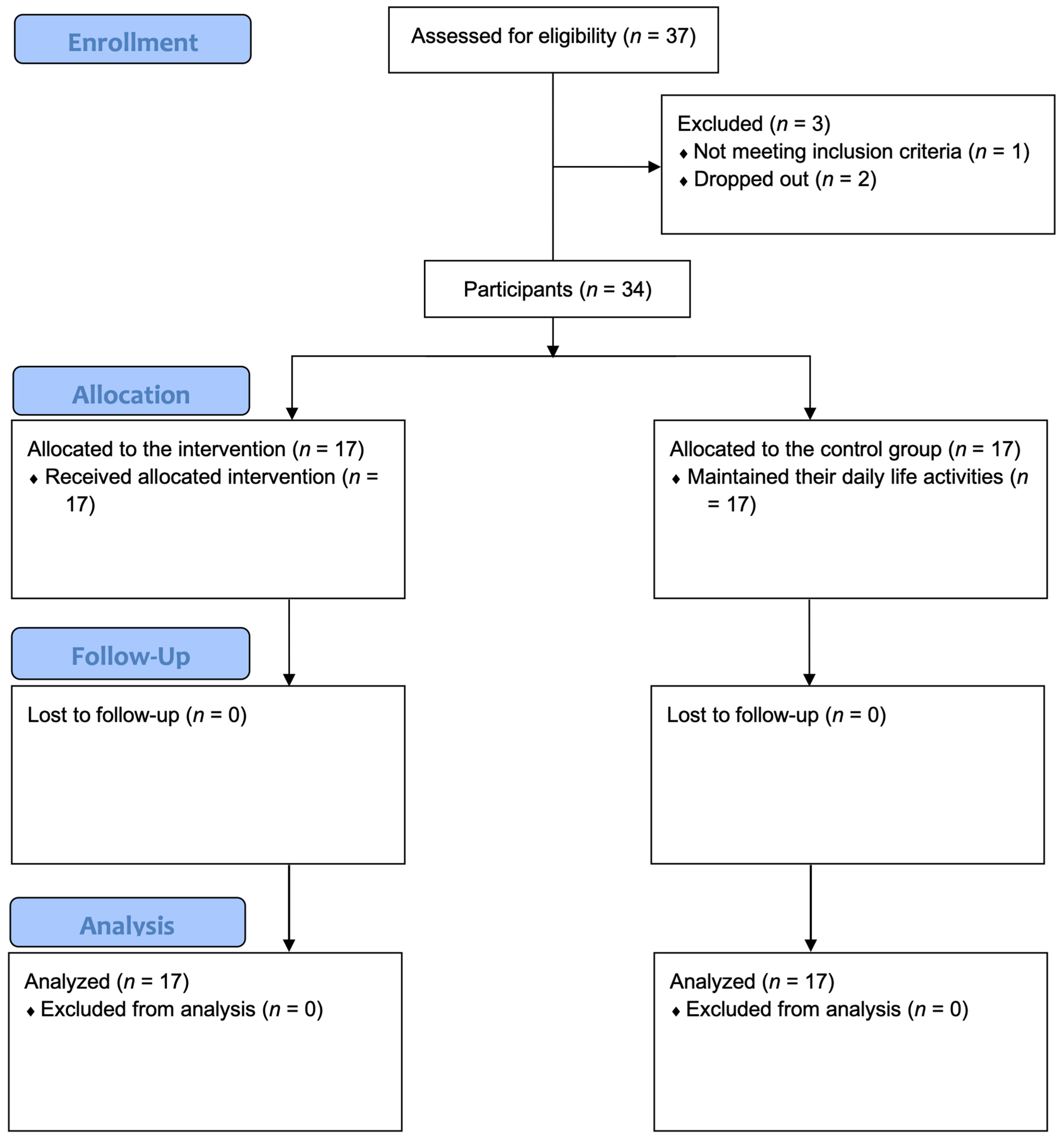
Allocation to the experimental group (EG) or control group (CG) was performed by convenience due to practical constraints typical of community-based interventions (e.g., participants’ availability and proximity to the intervention location). Because of the non-randomized, community-based nature of the study, allocation concealment was not feasible. To enhance comparability, allocation procedures aimed to balance groups at baseline on key characteristics such as age, sex, and educational level. A total of 37 volunteers were assessed for eligibility; three did not meet the inclusion criteria and were excluded. The remaining 34 participants were allocated to the EG (n = 17; 15 females, 2 males) or CG (n = 17; 16 females, 1 male). All participants completed the study (Figure 1). Given the community-based setting and feasibility constraints, no formal a priori sample size calculation was performed; the sample size reflects the number of eligible participants recruited within the study period.
The CG maintained usual routines during the study period and reported no participation in structured exercise programs or dance classes. After study completion, CG participants were offered the opportunity to attend a similar intervention. All the participants provided written informed consent prior to inclusion. The study was conducted in accordance with the Declaration of Helsinki and was approved by the University of Évora Ethics Committee (reference 16012).

2.3. Procedures

Assessments were performed individually at baseline and post-intervention by the same trained evaluator. The evaluator was blinded to the study objectives and participants’ group allocation. The participants and the intervention facilitator were not blinded to group allocation; however, the participants were not informed about the specific outcomes of interest or the expected direction of change. Data collection was conducted in a quiet laboratory room under standardized conditions and scheduled in the morning to minimize contextual variability. Self-report questionnaires were self-administered; when needed, the evaluator clarified item meaning without influencing responses.

2.4. Outcome Measures

2.4.1. Life Satisfaction

Life satisfaction was assessed using the Satisfaction With Life Scale (SWLS), a 5-item self-report measure of global life satisfaction [3,21]. The items were rated on a Likert scale ranging from 1 (“strongly disagree”) to 5 (“strongly agree”), and a total score was computed by summing responses. Total scores range from 5 to 25, with higher scores indicating greater life satisfaction.

2.4.2. Positive and Negative Affect

Affective experience was assessed using the Positive and Negative Affect Schedule (PANAS), a 20-item measure comprising two 10-item subscales: positive affect (PA) and negative affect (NA) [4,22]. The participants rated how they had felt during the last weeks on a 5-point Likert scale ranging from 1 (“not at all or very slightly”) to 5 (“extremely”). PA and NA scores were computed by summing their respective items. The subscale scores range from 10 to 50, with higher scores indicating higher positive affect (PA) or higher negative affect (NA); accordingly, lower NA scores reflect fewer negative affective states.

2.4.3. Complementary Measures

Sociodemographic characteristics were collected through a scripted interview. Cognitive status was assessed using the Clock Drawing Test (CDT) as an eligibility screening measure [20]; the CDT is a widely used screening tool for detecting cognitive impairment in otherwise healthy individuals [23], with scores ranging from 0 (worst) to 20 (best). Body weight and height were measured using calibrated SECA equipment, and body mass index (BMI) was calculated (kg/m2).

2.5. Psychomotor Intervention Mediated by Creative Dance

The participants allocated to the EG attended a psychomotor intervention mediated by creative dance delivered over 12 weeks (3 sessions/week, 60 min/session, 36 sessions). The sessions were group-based and conducted in the gerontopsychomotricity laboratory. The intervention was planned and led by the study’s second author, who holds an academic degree in dance and psychomotricity, and sessions were delivered using a consistent structure and progressive task progression throughout the intervention.
The intervention aimed to promote body awareness (e.g., breathing cues and awareness of body parts), as well as spatial and temporal awareness (e.g., directions, trajectories, levels, and changes in speed) and movement dynamics (e.g., variations in intensity and quality of movement). It also emphasized communication and interrelationships (paired and group-based interaction), using music as a mediator and incorporating both guided tasks and open-ended movement and expressive exploration. Progression was organized into three sequential blocks. During sessions 1–10, the emphasis was placed on attending to internal bodily sensations, with predominantly guided activities focused on breathing observation, postural awareness, and exploration of body parts, aiming to support familiarity with the setting, confidence in movement initiation, and early group cohesion. During sessions 11–20, activities increasingly targeted the temporal and rhythmic components of movement (e.g., slow/fast/pause, synchronization with the musical beat, and simple rhythmic patterns) alongside spatial exploration (e.g., formations, directions, and pathways), progressively increasing coordination and adaptation demands and supporting interpersonal interaction. During sessions 21–36, the intervention placed greater emphasis on creativity and improvisation, encouraging participants to create original movements and contribute to shared sequences, with an emphasis on autonomy, playful exploration, and social connection.
Each session followed the same structure: initial dialogue (≈5 min), global activation (≈10 min), main phase (≈20 min), choreographic phase (≈10 min), cool down (≈10 min), and final dialogue (≈5 min). In the initial dialogue, the participants briefly recalled what had been performed in the previous session, were informed about the aims of the current session, and were invited to report how they were feeling that day. To facilitate movement generation and communication, the facilitator used age-appropriate verbal imagery cues (i.e., simple prompts that were easy to translate into movement), and props such as scarves, balls, cones, and chairs were included to make verbal prompts more tangible and to diversify movement possibilities. The participants also created short movement “phrases” individually and in small groups (e.g., pairs or trios) and shared them with the group, supporting creativity, social interaction, and engagement. Within this phase, specific tasks were included to connect movement with affective experience (e.g., exploring and transforming tension into release, or creating movements emphasizing softness and fluidity), thereby supporting emotional expression and regulation through bodily experience. The choreographic phase involved recalling previously explored movements and co-creating new material to be incorporated into a final group choreography, reinforcing shared authorship and group identity. The cool-down phase included slower movements, breathing observation, stretching, and relaxation. In the final dialogue, the participants were invited to briefly reflect on their experience and to identify a salient sensation or take-home feeling from the session, supporting awareness of affective states in everyday life.
Music was used throughout the intervention and selected to match each session phase and participants’ preferences (e.g., classical/instrumental, Brazilian popular, and traditional Portuguese music). Attendance was monitored via an attendance sheet, and session participation was recorded at the end of each session.
A structured summary of the intervention components and progression is presented in Table 1.

2.6. Statistical Analysis

Data were analyzed using IBM SPSS Statistics (version 28.0) and JASP (version 0.96). Statistical significance was set at p < 0.05. The results are reported as mean ± standard deviation. Distributional assumptions were examined using the Shapiro–Wilk test, and homogeneity of variances was assessed using Levene’s test. As most variables did not meet parametric assumptions, non-parametric tests were applied. Within-group changes from baseline to post-intervention were assessed using the Wilcoxon signed-rank test, whereas between-group differences were examined using the Mann–Whitney U test.
Change over time was quantified as Δ (post − baseline) and, when reported, as percentage change (Δ% = [(post − baseline)/baseline] × 100). Effect size for non-parametric comparisons was calculated as r = Z/√N [24] and interpreted using Cohen’s thresholds (small = 0.10, medium = 0.30, large = 0.50) [25].
Given the small number of predefined outcomes and the study design, the results were interpreted alongside effect sizes, without formal multiple-comparison correction or covariate adjustment for potential allocation-related bias.
Missing data were examined using the MCAR test, indicating that missingness was compatible with a missing completely at random pattern. An intention-to-treat approach was applied, and missing values were imputed using the medium series method.

3. Results

At baseline, the experimental and control groups presented comparable sociodemographic characteristics, with no significant between-group differences in age (EG: 73.5 ± 5.9 years; CG: 75.7 ± 7.2 years), educational level (EG: 6.2 ± 2.9 years; CG: 5.3 ± 3.6 years), cognitive status (EG: 19.2 ± 0.4 points; CG: 19.2 ± 0.4 points), BMI (EG: 28.8 ± 3.4 kg/m2; CG: 27.5 ± 3.2 kg/m2), or sex distribution (p > 0.05). Thirty-four participants completed the study. Mean attendance across the 36 intervention sessions was 89.8%. No adverse events were reported.
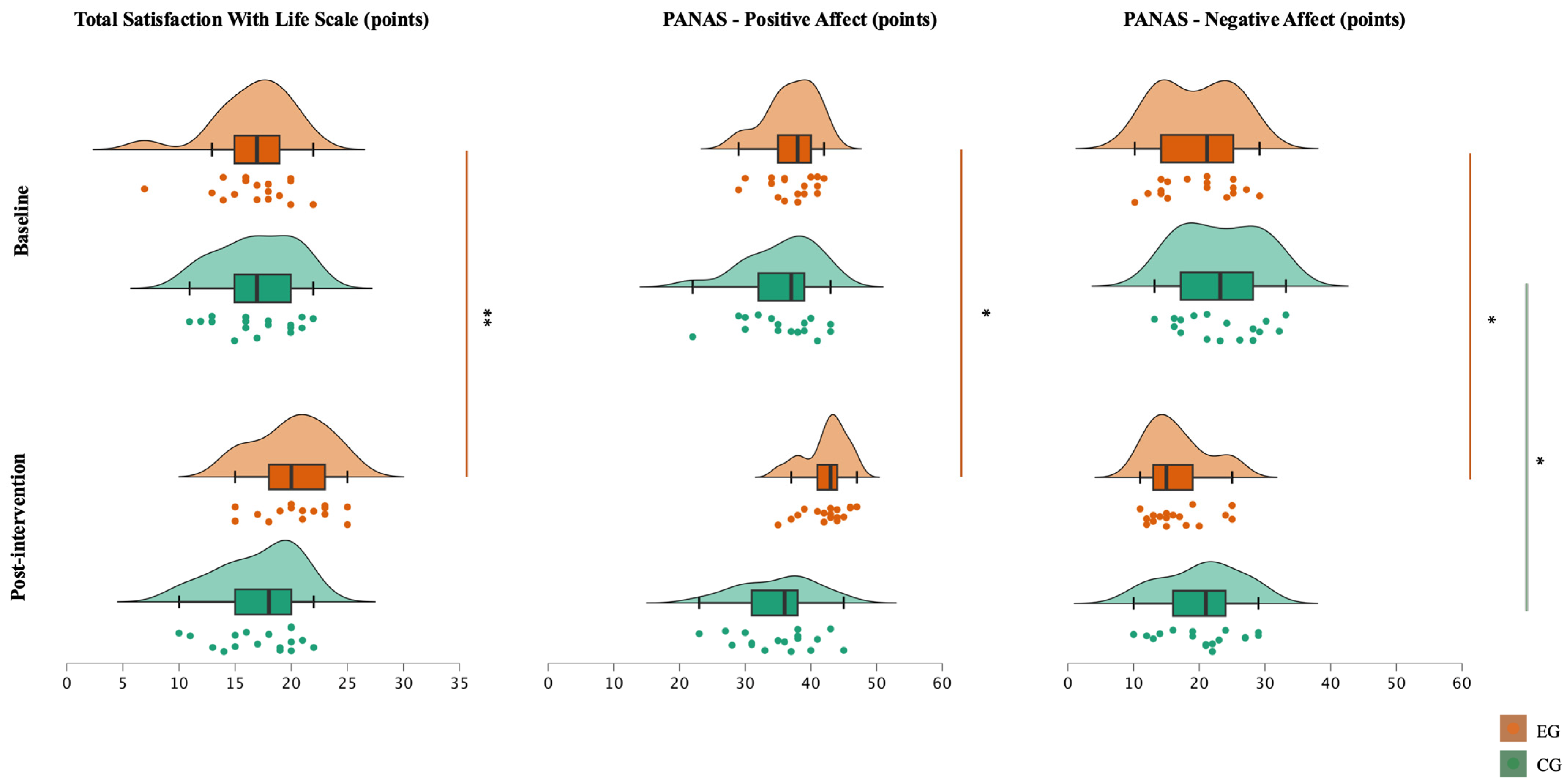
Descriptive data and between-group comparisons are presented in Table 2, and within-group changes are summarized in Figure 2. No significant between-group differences were observed at baseline for SWLS or PANAS outcomes. At post-intervention, the EG showed significantly higher life satisfaction (SWLS; p = 0.018; r = 0.41, medium) and positive affect (PANAS-PA; p < 0.001; r = 0.61, large) than the CG, corresponding to +17.9% higher SWLS and +21.0% higher PANAS PA in the EG at post-intervention. In contrast, post-intervention PANAS negative affect did not differ significantly between groups.
Within-group analyses indicated that the EG improved across all outcomes over the 12-week period (Figure 2): life satisfaction increased (SWLS; Δ% = + 20.4; p < 0.001; r = 0.62, large), positive affect increased (PANAS-PA; Δ% = +14.3; p = 0.001; r = 0.57, large), and negative affect decreased (PANAS-NA; Δ% = −13.9; p = 0.035; r = 0.36, medium). In the CG, negative affect also decreased significantly (PANAS-NA; Δ% = −11.5; p = 0.004; r = 0.50, large). Overall, post-intervention between-group differences were observed for SWLS and PANAS-PA, while PANAS-NA decreased in both groups.

4. Discussion

Overall, our findings suggest that a creative-dance-mediated psychomotor intervention may support psychological well-being in community-dwelling older adults. The EG improved in life satisfaction and in both affective dimensions, and post-intervention between-group differences favored the EG for life satisfaction and positive affect. This pattern is consistent with the notion that life satisfaction and affect represent distinct components of subjective well-being and may therefore respond differently to the same intervention [5].
Adherence is a key determinant of effectiveness in community-based interventions. In the present study, attendance across sessions was high (89.8%) and no adverse events or falls were reported, supporting feasibility and safety in this setting. This aligns with systematic evidence indicating that dance-based interventions can achieve strong adherence and completion, which is relevant for sustained participation in community contexts [9,12,13]. Comparable feasibility has also been reported in other 12-week dance trials in older adults; for example, a low-impact aerobic dance intervention reported similarly high attendance (~91%) and perceived psychological benefit [26].
The improvement in life satisfaction in the EG, together with the post-intervention between-group difference, suggests a positive effect on the life evaluation component of well-being. Improvements in life satisfaction have been reported following creative dance interventions in older adults [14]. Early community-based studies suggested potential well-being benefits of creative dance and movement programs [27], but directly comparable controlled studies with standardized outcomes remain limited [13]. Although effect-size metrics differ across studies, the improvement in life satisfaction observed here reached medium-to-large magnitudes, whereas prior creative dance trials have reported small-to-moderate effects for life satisfaction outcomes [14]. This difference may relate to variations in intervention content and delivery, including the therapeutic psychomotor approach used in the present intervention.
Positive affect increased in the EG and differed between groups at post-intervention, with a large effect size. This result aligns with systematic evidence indicating that therapeutic and other dance interventions can improve psychological outcomes in older adults [11,12,13]. Studies using PANAS measures have also reported favorable changes in affect in controlled designs. In a large quasi-experimental study with a comparison group, a 12-week dance/movement therapy intervention was associated with substantial improvements in PANAS positive mood relative to controls [28]. A meta-analysis update of controlled dance and dance/movement therapy studies reported overall medium effects on health-related psychological outcomes [29]. Although effect-size metrics differ across studies, the large post-intervention effect observed here for positive affect is broadly consistent with evidence that affect-related benefits can be moderate on average, while varying across interventions and designs [29]. In addition, dance places combined sensorimotor and cognitive demands, and training has been linked to changes in action perception, which may support broader psychological benefits [30]. Qualitative studies of creative dance also offer explanations for these changes, including enjoyment, social connection, creativity, and opportunities for autonomy [31].
From a practical perspective, improvements in life satisfaction and positive affect in the EG were not only statistically significant but also of moderate-to-large magnitude. Life satisfaction increased by approximately 20% and positive affect increased by approximately 14% over 12 weeks, suggesting potentially meaningful short-term improvements in perceived well-being. In real-world terms, higher SWLS and PA scores may reflect a more positive appraisal of daily life and more frequent positive emotional states. Larger trials are needed to confirm these effects and clarify thresholds for meaningful change in community-dwelling older adults.
Negative affect decreased significantly in both groups. In the EG, this reduction is compatible with the emotional–affective focus commonly described in psychomotor approaches and with creative dance formats emphasizing body awareness and embodied experience [16,17,18]. Negative affect also decreased in the CG, suggesting that time-related or participation-related influences may have contributed (e.g., increased self-reflection during assessments and repeated measurement). In addition, the CG started with higher negative affect, which may have allowed greater reductions over time, consistent with regression-to-the-mean effects. Because PANAS ratings referred to the “last weeks,” negative affect may have been sensitive to short-term fluctuations in daily stressors and routines. Seasonal timing may have played a minor role; however, evidence for robust seasonal shifts in mood and affect is mixed, with some studies reporting only small seasonal differences in PANAS scores and others emphasizing heterogeneity and inconsistent patterns across designs and outcomes [32,33]. Positive and negative affect can change independently, which may help explain why between-group differences were clearer for positive affect than for negative affect [34].
Overall, direct comparisons with previous studies remain constrained because relatively few studies have examined this specific intervention format with standardized psychological outcomes, and designs vary widely [13]. In addition, related psychomotor dance approaches have been described in older clinical populations (e.g., care-home settings), but differences in context and participant profiles limit direct comparison with community-dwelling samples [35].

Limitations

Some limitations should be considered when interpreting these findings, particularly regarding generalizability. The non-randomized design and convenience allocation may have introduced selection and allocation bias despite baseline comparability (e.g., participants with higher motivation may have been more likely to enter the intervention group), and unmeasured baseline differences cannot be excluded; therefore, causal inference is limited and findings should be interpreted as preliminary and non-causal. The modest sample size and predominance of female participants limit statistical power (particularly for small effects), which may increase the risk of Type II error, reduce the robustness of estimates, and constrain generalizability, particularly to older men. In addition, the CG did not receive an attention-matched intervention, so non-specific factors such as social interaction and expectancy effects may have contributed to the observed effects; future studies should include an active control condition. Outcomes relied on self-report measures, and assessments were limited to baseline and post-intervention, highlighting the need for follow-up measurements to examine durability.

5. Conclusions

Over 12 weeks, the creative-dance-mediated psychomotor intervention was associated with improvements in life satisfaction and positive affect in the intervention group, while negative affect decreased over time in both groups. These results provide preliminary support for this type of intervention, which integrates creativity, self-expression, and communication in socially engaging dance-based sessions, as a feasible approach to support psychological well-being in later life. Larger studies, ideally using randomized controlled designs and including follow-up assessments, are needed to confirm these findings.

Author Contributions

Conceptualization, P.M., A.C.-F. and C.P.; methodology, H.R., P.M., A.C.-F. and C.P.; formal analysis, H.R. and C.P.; investigation, H.R. and P.M.; writing—original draft preparation, H.R.; writing—review and editing, H.R., P.M., A.C.-F. and C.P.; supervision, A.C.-F. and C.P. All authors have read and agreed to the published version of the manuscript.

Funding

This research received no external funding.

Institutional Review Board Statement

The study was conducted in accordance with the Declaration of Helsinki, and approved by the University of Évora Ethics Committee (16012; 19 May 2016).

Informed Consent Statement

Informed consent was obtained from all subjects involved in the study.

Public Involvement Statement

No public involvement in any aspect of this research.

Guidelines and Standards Statement

This manuscript was drafted against the TREND Statement (Transparent Reporting of Evaluations with Nonrandomized Designs) for non-randomized evaluation research. The study protocol was reported in accordance with the SPIRIT 2013 Statement (Standard Protocol Items: Recommendations for Interventional Trials).

Use of Artificial Intelligence

The authors declare that generative AI was used in the preparation of this manuscript. Generative AI (ChatGPT, GPT-5.2 Thinking, OpenAI) was used to support the language editing and grammar in the manuscript.

Data Availability Statement

The data used and/or analyzed during the current study are available on request from the corresponding author due to ethical and privacy restrictions.

Acknowledgments

The authors would like to thank all participants for their time and commitment to this study.

Conflicts of Interest

The authors declare no conflicts of interest. The funders had no role in the design of the study; in the collection, analyses, or interpretation of data; in the writing of the manuscript; or in the decision to publish the results.

Abbreviations

The following abbreviations are used in this manuscript:
EGExperimental group
CGControl group
SWLSSatisfaction With Life Scale
PANASPositive and Negative Affect Schedule
PAPositive affect (PANAS subscale)
NANegative affect (PANAS subscale)
CDTClock Drawing Test
BMIBody mass index
SDStandard deviation

References

  1. Beard, J.R.; Officer, A.; de Carvalho, I.A.; Sadana, R.; Pot, A.M.; Michel, J.P.; Lloyd-Sherlock, P.; Epping-Jordan, J.E.; Peeters, G.; Mahanani, W.R.; et al. The World report on ageing and health: A policy framework for healthy ageing. Lancet 2016, 387, 2145–2154. [Google Scholar] [CrossRef]
  2. Diener, E. Subjective well-being. Psychol. Bull. 1984, 95, 542–575. [Google Scholar] [CrossRef]
  3. Diener, E.; Emmons, R.A.; Larsen, R.J.; Griffin, S. The Satisfaction With Life Scale. J. Personal. Assess. 1985, 49, 71–75. [Google Scholar] [CrossRef]
  4. Watson, D.; Clark, L.A.; Tellegen, A. Development and validation of brief measures of positive and negative affect: The PANAS scales. J. Personal. Soc. Psychol. 1988, 54, 1063–1070. [Google Scholar] [CrossRef]
  5. Steptoe, A.; Deaton, A.; Stone, A.A. Subjective wellbeing, health, and ageing. Lancet 2015, 385, 640–648. [Google Scholar] [CrossRef]
  6. Freedman, V.A.; Carr, D.; Cornman, J.C.; Lucas, R.E. Impairment Severity and Evaluative and Experienced Well-being Among Older Adults: Assessing the Role of Daily Activities. Innov. Aging 2017, 1, igx010. [Google Scholar] [CrossRef] [PubMed]
  7. Jivraj, S.; Nazroo, J.; Vanhoutte, B.; Chandola, T. Aging and subjective well-being in later life. J. Gerontol. B Psychol. Sci. Soc. Sci. 2014, 69, 930–941. [Google Scholar] [CrossRef] [PubMed]
  8. Dawson-Townsend, K. Social participation patterns and their associations with health and well-being for older adults. SSM Popul. Health 2019, 8, 100424. [Google Scholar]
  9. Lu, J.; Abd Rahman, N.A.; Wyon, M.; Shaharudin, S. The effects of dance interventions on physical function and quality of life among middle-aged and older adults: A systematic review. PLoS ONE 2024, 19, e0301236. [Google Scholar]
  10. Holt-Lunstad, J. Why Social Relationships Are Important for Physical Health: A Systems Approach to Understanding and Modifying Risk and Protection. Annu. Rev. Psychol. 2018, 69, 437–458. [Google Scholar] [CrossRef] [PubMed]
  11. Podolski, O.S.; Whitfield, T.; Schaaf, L.; Cornaro, C.; Kobe, T.; Koch, S.; Wirth, M. The Impact of Dance Movement Interventions on Psychological Health in Older Adults without Dementia: A Systematic Review and Meta-Analysis. Brain Sci. 2023, 13, 981. [Google Scholar] [CrossRef]
  12. Fong Yan, A.; Nicholson, L.L.; Ward, R.E.; Hiller, C.E.; Dovey, K.; Parker, H.M.; Low, L.F.; Moyle, G.; Chan, C. The Effectiveness of Dance Interventions on Psychological and Cognitive Health Outcomes Compared with Other Forms of Physical Activity: A Systematic Review with Meta-analysis. Sports Med. 2024, 54, 1179–1205. [Google Scholar] [CrossRef]
  13. Fonseca, I.; Rueda, M.; Cabanzo, C. The effect of dance interventions on well-being dimensions in older adults: A systematic review. Front. Sports Act. Living 2025, 7, 1594754. [Google Scholar] [CrossRef]
  14. Cruz-Ferreira, A.; Marmeleira, J.; Formigo, A.; Gomes, D.; Fernandes, J. Creative Dance Improves Physical Fitness and Life Satisfaction in Older Women. Res. Aging 2015, 37, 837–855. [Google Scholar] [CrossRef]
  15. Douse, L.; Farrer, R.; Aujla, I. The Impact of an Intergenerational Dance Project on Older Adults’ Social and Emotional Well-Being. Front. Psychol. 2020, 11, 561126. [Google Scholar] [CrossRef] [PubMed]
  16. Kwag, E.; Stuckenschneider, T.; Schneider, S.; Abeln, V. The effect of a psychomotor intervention on electroencephalography and neuropsychological performances in older adults with and without mild cognitive impairment. Psychogeriatrics 2021, 21, 528–539. [Google Scholar] [CrossRef]
  17. Giromini, F.; Lesage, B. Méthodes à médiation artistique. In Manuel D’enseignement de Psychomotricité; Giromini, F., Albaret, J., Scialom, P., Eds.; De Boeck: Paris, France, 2015. [Google Scholar]
  18. Marmeleira, J.F.; Pereira, C.; Cruz-Ferreira, A.; Fretes, V.; Pisco, R.; Fernandes, O.M. Creative dance can enhance proprioception in older adults. J. Sports Med. Phys. Fit. 2009, 49, 480–485. [Google Scholar]
  19. Clifford, A.M.; Shanahan, J.; McKee, J.; Cleary, T.; O’Neill, A.; O’Gorman, M.; Louw, Q.; Ni Bhriain, O. The effect of dance on physical health and cognition in community dwelling older adults: A systematic review and meta-analysis. Arts Health 2023, 15, 200–228. [Google Scholar] [CrossRef] [PubMed]
  20. Mendez, M.F.; Ala, T.; Underwood, K.L. Development of scoring criteria for the clock drawing task in Alzheimer’s disease. J. Am. Geriatr. Soc. 1992, 40, 1095–1099. [Google Scholar] [CrossRef] [PubMed]
  21. Laranjeira, C.A. Preliminary validation study of the Portuguese version of the satisfaction with life scale. Psychol. Health Med. 2009, 14, 220–226. [Google Scholar] [CrossRef]
  22. Galinha, I.C.; Pais-Ribeiro, J.L. Contribuição para o estudo da versão portuguesa da Positive and Negative Affect Schedule (PANAS): II—Estudo Psicométrico. Análise Psicológica 2005, 23, 219–227. [Google Scholar] [CrossRef]
  23. Aprahamian, I.; Martinelli, J.E.; Neri, A.L.; Yassuda, M.S. The Clock Drawing Test: A review of its accuracy in screening for dementia. Dement. Neuropsychol. 2009, 3, 74–81. [Google Scholar] [CrossRef]
  24. Fritz, C.O.; Morris, P.E.; Richler, J.J. Effect size estimates: Current use, calculations, and interpretation. J. Exp. Psychol. Gen. 2012, 141, 2–18. [Google Scholar] [CrossRef]
  25. Cohen, J. Statistical Power Analysis for the Behavioral Sciences; Lawrence Erlbaum Associates, Publishers: Hillsdale, NJ, USA, 1998. [Google Scholar]
  26. Hui, E.; Chui, B.T.; Woo, J. Effects of dance on physical and psychological well-being in older persons. Arch. Gerontol. Geriatr. 2009, 49, e45–e50. [Google Scholar] [CrossRef]
  27. Osgood, N.J.; Meyers, B.S.; Orchowsky, S. The Impact of Creative Dance and Movement Training on the Life Satisfaction of Older Adults: An Exploratory Study. J. Appl. Gerontol. 1990, 9, 255–265. [Google Scholar] [CrossRef]
  28. Pratiwi, G.D.; Lucya, V.; Lindayani, L. The effect of dance movement therapy on physical activity levels, mood, and emotional resilience among older adults in Indonesia. J. Keperawatan Padjadjaran 2025, 13, 2. [Google Scholar] [CrossRef]
  29. Koch, S.C.; Riege, R.F.F.; Tisborn, K.; Biondo, J.; Martin, L.; Beelmann, A. Effects of Dance Movement Therapy and Dance on Health-Related Psychological Outcomes. A Meta-Analysis Update. Front. Psychol. 2019, 10, 1806. [Google Scholar] [CrossRef] [PubMed]
  30. Kirsch, L.P.; Diersch, N.; Sumanapala, D.K.; Cross, E.S. Dance Training Shapes Action Perception and Its Neural Implementation within the Young and Older Adult Brain. Neural Plast. 2018, 2018, 5459106. [Google Scholar] [CrossRef] [PubMed]
  31. Martin-Wylie, E.; Urmston, E.; Redding, E. Impact of creative dance on subjective well-being amongst older adults: An arts-informed photo-elicitation study. Arts Health 2024, 16, 15–31. [Google Scholar] [CrossRef]
  32. Overland, S.; Woicik, W.; Sikora, L.; Whittaker, K.; Heli, H.; Skjelkvale, F.S.; Sivertsen, B.; Colman, I. Seasonality and symptoms of depression: A systematic review of the literature. Epidemiol. Psychiatr. Sci. 2019, 29, e31. [Google Scholar] [CrossRef]
  33. Winthorst, W.H.; Bos, E.H.; Roest, A.M.; de Jonge, P. Seasonality of mood and affect in a large general population sample. PLoS ONE 2020, 15, e0239033. [Google Scholar]
  34. Gordon, A.J. Focusing on Positive Affect in Dance/Movement Therapy: A Qualitative Study. Am. J. Danc. Ther. 2014, 36, 60–76. [Google Scholar]
  35. Guzman, A.; Freeston, M.; Rochester, L.; Hughes, J.C.; James, I.A. Psychomotor Dance Therapy Intervention (DANCIN) for people with dementia in care homes: A multiple-baseline single-case study. Int. Psychogeriatr. 2016, 28, 1695–1715. [Google Scholar] [PubMed]
Figure 1. A flow diagram of the study participants.
Nursrep 16 00174 g001
Figure 2. Density plots, box plots (median, interquartile range, minimum, and maximum), and jitter plots comparisons between the baseline and post-intervention evaluations; * significant differences within groups, p < 0.05; ** significant differences within groups, p < 0.001. EG: experimental group (n = 17); CG: control group (n = 17).
Nursrep 16 00174 g002
Table 1. Summary of the creative-dance-mediated psychomotor intervention.
DomainDescription
SettingGroup-based sessions in a gerontopsychomotricity laboratory.
Duration and frequency12 weeks; 3 sessions/week; 60 min/session; 36 sessions.
Goals (core targets)Body awareness; spatial/temporal awareness; movement dynamics; communication and interpersonal interaction.
ProgressionSessions 1–10: guided body awareness; 11–20: rhythmic/spatial emphasis; 21–36: creativity/improvisation and co-creation of shared sequences/final choreography.
Session structure (≈60 min)Initial dialogue (≈5 min); global activation (≈10 min); main phase (≈20 min); choreographic phase (≈10 min); cool down (≈10 min); final dialogue (≈5 min).
Main-phase strategiesParticipant-generated movement, verbal imagery cues, and affect-linked tasks.
Materials/propsScarves, balls, and chairs used to facilitate communication and diversify movement exploration.
MusicUsed throughout and selected to match each session phase and participants’ preferences.
Table 2. Descriptive results of the participants’ SWLSs and PANAS scales.
VariablesBaseline
(Mean ± SD)
Δ (Post-Baseline)
(Mean ± SD)
SWLS (points)
  EG16.7 ± 3.53.4 ± 2.6 a
  CG17.0 ± 3.4 0.1 ± 1.2
PANAS—Positive Affect (points)
  EG37.0 ± 3.85.3 ± 4.4 b
  CG35.6 ± 5.6−0.6 ± 3.8
PANAS—Negative Affect (points)
  EG19.4 ± 5.8−2.7 ± 4.7
  CG23.1 ± 6.2−2.6 ± 3.1
SWLS: Satisfaction With Life Scale; PANAS: Positive and Negative Affect Schedule scale; SD: standard deviation; EG: experimental group (n = 17); CG: control group (n = 17); a significant differences between EG and CG, p < 0.05; b significant differences between EG and CG, p < 0.001.
Disclaimer/Publisher’s Note: The statements, opinions and data contained in all publications are solely those of the individual author(s) and contributor(s) and not of MDPI and/or the editor(s). MDPI and/or the editor(s) disclaim responsibility for any injury to people or property resulting from any ideas, methods, instructions or products referred to in the content.