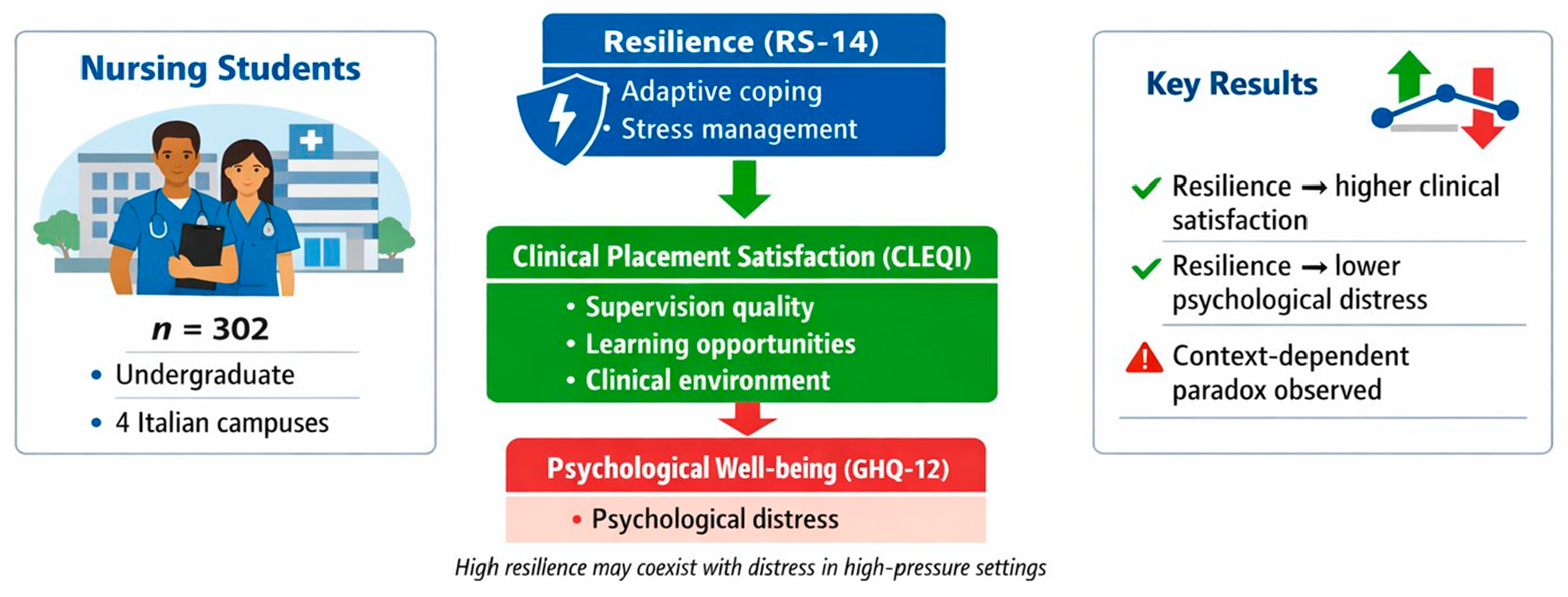

Resilience as a Predictor of Satisfaction and Well-Being in Nursing Clinical Education: A Cross-Sectional Study

 , , , ,
  ,
,  , , and
Abstract
1. Introduction
Aims
2. Materials and Methods
2.1. Study Design
2.2. Sample
2.3. Study Variables
2.4. Data Collection Instruments
2.4.1. Resilience Scale
2.4.2. 12-Item General Health Questionnaire
2.4.3. Clinical Learning Quality Evaluation Index
2.5. Inclusion and Exclusion Criteria
2.6. Strategies to Manage Risk of Bias
2.7. Statistical Analysis
2.8. Ethical Considerations
3. Results
3.1. Resilience Levels
3.2. Psychological Well-Being
3.3. Clinical Internship Satisfaction
3.4. Correlations Between Resilience, Clinical Satisfaction and Psychological Well-Being
4. Discussion
4.1. Implications for Nursing Education
4.2. Perspectives for Future Research and Practice
4.3. Strengths and Limitations
5. Conclusions
Supplementary Materials
Author Contributions
Funding
Institutional Review Board Statement
Informed Consent Statement
Data Availability Statement
Public Involvement Statement
Guidelines and Standards Statement
Use of Artificial Intelligence
Conflicts of Interest
Appendix A
Appendix A.1. Measurement Instruments—Italian-Language Questionnaire Battery

| Instrument | Abbrev. | Items | Response Scale | Reference |
|---|---|---|---|---|
| Resilience Scale | RS-14 | 14 | 7-point Likert (1–7) | Wagnild, 2009 [48]; Italian validation: Callegari et al., 2016 [20] |
| General Health Questionnaire | GHQ-12 | 12 | 4-point (bimodal scoring 0-0-1-1) | Goldberg & Williams, 1988 [49]; Italian validation: Piccinelli & Politi P, 1993 [21] |
| Clinical Learning Quality Evaluation Index | CLEQI | 22 | 4-point Likert (0–3) | Palese et al., 2019 [14] |
Appendix A.2. Resilience Scale (RS-14)—Italian Version
- Original authors: Wagnild GM (2009) [48]. A review of the Resilience Scale. Journal of Nursing Measurement, 17(2), 105–113. https://doi.org/10.1891/1061-3749.17.2.105.
- Italian validation: Callegari C. et al. (2016) [20]. Reliability and validity of the Italian version of the 14-item Resilience Scale. Psychol Res Behav Manag. 2016 Oct 3;9:277–284. doi: 10.2147/PRBM.S115657.
- Psychometric properties in this sample: Cronbach’s α = 0.92. Scoring: sum of all 14 items (range 14–98). Higher scores indicate greater perceived resilience. Cut-off categories: Very Low ≤ 56; Low 57–64; Moderate 65–73; Moderately High 74–81; Moderately High-High 82–90; High > 90.
- Instructions (Italian, as administered): “Indica il tuo grado di accordo con ciascuna delle seguenti affermazioni, scegliendo un valore da 1 (Fortemente in Disaccordo) a 7 (Fortemente d’Accordo)”.
- Instructions (English translation): “Indicate your level of agreement with each of the following statements, choosing a value from 1 (Strongly Disagree) to 7 (Strongly Agree)”.
| # | Italian Wording (as Administered) | English Translation (for Reference Only) |
|---|---|---|
| 1 | Di solito riesco a cavarmela in un modo o nell’altro | When I make plans, I follow through with them. |
| 2 | Mi sento orgoglioso/a per le cose che ho realizzato nella mia vita | I usually manage one way or another. |
| 3 | Di solito faccio le cose senza il minimo sforzo, seguendo i miei tempi | I am able to depend on myself more than anyone else. |
| 4 | Sono amico/a di me stesso/a | Keeping interested in things is important to me. |
| 5 | Sento di poter gestire molte cose allo stesso tempo | I can be on my own if I have to. |
| 6 | Sono determinato/a | I feel proud that I have accomplished things in my life. |
| 7 | Posso affrontare momenti difficili perché ne ho già fatto esperienza in precedenza | I usually take things in stride. |
| 8 | Ho auto-disciplina | I am friends with myself. |
| 9 | Mantengo interesse nelle cose | I feel that I can handle many things at a time. |
| 10 | Di solito trovo qualcosa per cui sorridere | I am determined. |
| 11 | Il credere in me stesso/a mi aiuta a superare i momenti difficili | I seldom wonder what the point of it all is. |
| 12 | In una situazione di emergenza c’è qualcuno su cui posso contare | I take things one day at a time. |
| 13 | La mia vita è piena di significato | I can get through difficult times because I’ve experienced difficulty before. |
| 14 | Quando mi trovo in situazioni difficili di solito trovo da solo/a un modo per uscirne | I have self-discipline. |
Appendix A.3. General Health Questionnaire (GHQ-12)—Italian Version
- Original authors: Goldberg DP & Williams P (1988) [49]. A User’s Guide to the General Health Questionnaire. Windsor: NFER-Nelson.
- Italian validation: Piccinelli, M. (1993) [21]. Struttura fattoriale della versione a 12 domande del General Health Questionnaire in un campione di giovani maschi adulti. Epidemiologia e Psichiatria Sociale. 1993;2(3):173–181. doi:10.1017/S1121189X00006990.
- Scoring method: Bimodal method (0-0-1-1): response options 1 and 2 = 0; options 3 and 4 = 1. Total score range: 0–12. Classification: Normal well-being (0–2); Mild distress (3–5); Moderate distress (6–8); Severe distress (9–12) [50]. Psychometric properties in this sample: Cronbach’s α = 0.85.
- Instructions (Italian, as administered): “Le seguenti domande riguardano la sua salute in generale nelle ultime settimane. Per favore, risponda a tutte le domande semplicemente segnando la risposta che, a suo giudizio, meglio descrive la sua situazione attuale. Si ricordi che vuole conoscere i problemi presenti o recenti, non quelli che ha avuto in passato”.
| # | Italian Wording (as Administered) | English Translation | Response Options (Italian/English) |
|---|---|---|---|
| 1 | Durante le ultime settimane, ti sei sentito/a: In grado di concentrarsi su ciò che stava facendo? | During the past few weeks, have you felt: Been able to concentrate on what you are doing? | 1. Più del solito/Better than usual 2. Come al solito/Same as usual 3. Meno del solito/Less than usual 4. Molto meno del solito/Much less than usual |
| 2 | Durante le ultime settimane, ti sei sentito/a: Di aver perso molto sonno tanto da preoccuparsi? | During the past few weeks, have you felt: Lost much sleep over worry? | 1. Per niente/Not at all 2. Non più del solito/No more than usual 3. Piuttosto più del solito/Rather more than usual 4. Molto più del solito/Much more than usual |
| 3 | Durante le ultime settimane, ti sei sentito/a: Di essere produttivo (aver fatto tante cose) nella maggior parte delle attività? | During the past few weeks, have you felt: Felt that you are playing a useful part in things? | 1. Più del solito/Better than usual 2. Come al solito/Same as usual 3. Meno del solito/Less than usual 4. Molto meno del solito/Much less than usual |
| 4 | Durante le ultime settimane, ti sei sentito/a: In grado di prendere decisioni nella maggior parte dei casi? | During the past few weeks, have you felt: Felt capable of making decisions about things? | 1. Più del solito/Better than usual 2. Come al solito/Same as usual 3. Meno del solito/Less than usual 4. Molto meno del solito/Much less than usual |
| 5 | Durante le ultime settimane, ti sei sentito/a: Costantemente sotto pressione? | During the past few weeks, have you felt: Felt constantly under strain? | 1. Per niente/Not at all 2. Non più del solito/No more than usual 3. Piuttosto più del solito/Rather more than usual 4. Molto più del solito/Much more than usual |
| 6 | Durante le ultime settimane, ti sei sentito/a: Di non essere in grado di superare le difficoltà? | During the past few weeks, have you felt: Felt that you couldn’t overcome your difficulties? | 1. Per niente/Not at all 2. Non più del solito/No more than usual 3. Piuttosto più del solito/Rather more than usual 4. Molto più del solito/Much more than usual |
| 7 | Durante le ultime settimane, ti sei sentito/a: In grado di ritagliarsi del tempo libero e goderne? | During the past few weeks, have you felt: Been able to enjoy your normal day-to-day activities? | 1. Più del solito/Better than usual 2. Come al solito/Same as usual 3. Meno del solito/Less than usual 4. Molto meno del solito/Much less than usual |
| 8 | Durante le ultime settimane, ti sei sentito/a: In grado di risolvere i suoi problemi? | During the past few weeks, have you felt: Been able to face up to your problems? | 1. Più del solito/Better than usual 2. Come al solito/Same as usual 3. Meno del solito/Less than usual 4. Molto meno del solito/Much less than usual |
| 9 | Durante le ultime settimane, ti sei sentito/a: Infelice o depresso/a? | During the past few weeks, have you felt: Been feeling unhappy and depressed? | 1. Per niente/Not at all 2. Non più del solito/No more than usual 3. Piuttosto più del solito/Rather more than usual 4. Molto più del solito/Much more than usual |
| 10 | Durante le ultime settimane, ti sei sentito/a: Come se avesse perso la fiducia in se stesso/a? | During the past few weeks, have you felt: Been losing confidence in yourself? | 1. Per niente/Not at all 2. Non più del solito/No more than usual 3. Piuttosto più del solito/Rather more than usual 4. Molto più del solito/Much more than usual |
| 11 | Durante le ultime settimane, ti sei sentito/a: Come se avesse minore stima di sé? | During the past few weeks, have you felt: Been thinking of yourself as a worthless person? | 1. Per niente/Not at all 2. Non più del solito/No more than usual 3. Piuttosto più del solito/Rather more than usual 4. Molto più del solito/Much more than usual |
| 12 | Durante le ultime settimane, ti sei sentito/a: Con uno stato emotivo nel complesso felice? | During the past few weeks, have you felt: Been feeling reasonably happy, all things considered? | 1. Più del solito/Better than usual 2. Come al solito/Same as usual 3. Meno del solito/Less than usual 4. Molto meno del solito/Much less than usual |
Appendix A.4. Clinical Learning Quality Evaluation Index (CLEQI)—Italian Version
- Authors: Palese, A. et al. (2019) [14]. Clinical Learning Quality Evaluation Index per la valutazione della qualità dell’apprendimento clinico degli studenti infermieri e raccomandazioni di utilizzo. Medicina e Chirurgia. 83, 3685–3693, 2019. DOI: 10.4487/medchir2019-83-3.
- Structure: 22 items organized across five factors (see below). Response scale: 4-point Likert (0 = Not at all/Per nulla; 1 = Somewhat/Abbastanza; 2 = Very much/Molto; 3 = Extremely/Moltissimo). Total score range: 0–66 (higher scores = greater satisfaction with clinical learning). Psychometric properties in this sample: Cronbach’s α = 0.93. Permission for use was obtained from the development team prior to data collection.
- Instructions (Italian, as administered): “Il questionario esplora la qualità dell’esperienza di tirocinio clinico. Per ciascuna affermazione, indichi quanto spesso ha sperimentato quanto descritto durante l’ultimo tirocinio.” (0 = Per nulla; 1 = Abbastanza; 2 = Molto; 3 = Moltissimo).
| Factor | Item | Italian Wording (as Administered) | English Translation (for Reference Only) |
|---|---|---|---|
| Factor 1—Quality of Clinical Supervisory Strategies (Items 1–6) | |||
| 1 | 1 | Il tutor ha esplicitato i ragionamenti che sottendevano le decisioni assistenziali | The clinical supervisor explained the reasoning underlying care decisions. |
| 1 | 2 | Il tutor mi poneva domande che mi aiutavano nel ragionamento clinico | The clinical supervisor asked me questions that helped my clinical reasoning. |
| 1 | 3 | Ho avuto la possibilità di condividere con il tutor le emozioni provate durante l’esperienza di tirocinio | I had the opportunity to share with the supervisor the emotions experienced during my clinical internship. |
| 1 | 4 | Il tutor ha mediato la mia relazione con i pazienti/famigliari quando la situazione era difficile | The clinical supervisor mediated my relationship with patients/families when the situation was difficult. |
| 1 | 5 | Il tutor era entusiasta di insegnarmi la pratica infermieristica | The clinical supervisor was enthusiastic about teaching me nursing practice. |
| 1 | 6 | Nella valutazione finale, il tutor è stato/a coerente con i feedback che mi ha fornito durante il tirocinio | In the final evaluation, the clinical supervisor was consistent with the feedback provided during the internship. |
| Factor 2—Learning Opportunities (Items 7–12) | |||
| 2 | 7 | Ho percepito fiducia nei miei confronti | I felt trusted. |
| 2 | 8 | Ho potuto sperimentarmi in autonomia nelle attività | I was able to practise activities autonomously. |
| 2 | 9 | Mi è stato affidato un adeguato livello di responsabilità | I was assigned an appropriate level of responsibility. |
| 2 | 10 | Ho avuto la possibilità di esprimere le mie opinioni e riflessioni critiche | I had the opportunity to express my opinions and critical reflections. |
| 2 | 11 | Mi sono sentito/a rispettato/a come studente | I was respected as a student. |
| 2 | 12 | Sono stato/a incoraggiato/a nei momenti di difficoltà | I was encouraged during difficult moments. |
| Factor 3—Safety and Quality of Care (Items 13–16) | |||
| 3 | 13 | Gli infermieri avevano buoni standard di pratica professionale | Nurses demonstrated good standards of professional practice. |
| 3 | 14 | Era garantita la sicurezza dei pazienti/residenti/ospiti | Patient/resident/guest safety was guaranteed. |
| 3 | 15 | I dispositivi di protezione individuali e di sicurezza erano accessibili | Individual protective devices and safety equipment were accessible. |
| 3 | 16 | Gli infermieri mostravano passione per la professione | Nurses showed passion for their profession. |
| Factor 4—Self-Directed Learning (Items 17–19) | |||
| 4 | 17 | Mi sono stati offerti incontri sui miei bisogni di apprendimento | I was offered meetings focused on my learning needs. |
| 4 | 18 | Sono stato/a sollecitato/a ad elaborare il mio piano di autoapprendimento | I was encouraged to develop my self-directed learning plan. |
| 4 | 19 | Sono stato/a sollecitato/a ad auto-valutarmi | I was encouraged to self-evaluate. |
| Factor 5—Quality of the Learning Environment (Items 20–22) | |||
| 5 | 20 | Questa sede è stata per me un buon ambiente di apprendimento | This clinical placement was a good learning environment for me. |
| 5 | 21 | Complessivamente sono soddisfatto/a della mia esperienza di tirocinio | Overall, I am satisfied with my clinical internship experience. |
| 5 | 22 | Vorrei tornare un giorno in questo contesto a lavorare | I would like to return to work in this setting one day. |
References
- Wan, X.; Huang, H.; Zhang, Y.; Peng, Q.; Guo, X.; Wu, S.; Li, Y.; Ding, Y.; Chen, C. The effect of prosocial behaviours on Chinese undergraduate nursing students’ subjective well-being: The mediating role of psychological resilience and coping styles. Int. J. Ment. Health Nurs. 2023, 32, 277–289. [Google Scholar] [CrossRef] [Scilit] [PubMed]
- Kunzler, A.M.; Helmreich, I.; König, J.; Chmitorz, A.; Wessa, M.; Binder, H.; Lieb, K. Psychological interventions to foster resilience in healthcare students. Cochrane Database Syst. Rev. 2020, 2020, CD013684. [Google Scholar] [CrossRef] [Scilit]
- Aryuwat, P.; Holmgren, J.; Asp, M.; Radabutr, M.; Lövenmark, A. Experiences of nursing students regarding challenges and support for resilience during clinical education: A qualitative study. Nurs. Rep. 2024, 14, 1604–1620. [Google Scholar] [CrossRef] [Scilit] [PubMed]
- Liu, J.; Yang, Y.; Chen, J.; Zhang, Y.; Zeng, Y.; Li, J. Stress and coping styles among nursing students during the initial period of the clinical practicum: A cross-section study. Int. J. Nurs. Sci. 2022, 9, 222–229. [Google Scholar] [CrossRef] [Scilit]
- McDermott, R.C.; Fruh, S.M.; Williams, S.; Hauff, C.; Graves, R.J.; Melnyk, B.M.; Hall, H.R. Nursing students’ resilience, depression, well-being, and academic distress: Testing a moderated mediation model. J. Adv. Nurs. 2020, 76, 3385–3397. [Google Scholar] [CrossRef] [Scilit]
- Wang, C.; Yan, S.; Jiang, H.; Guo, Y.; Gan, Y.; Lv, C.; Lu, Z. Socio-demographic characteristics, lifestyles, social support quality and mental health in college students: A cross-sectional study. BMC Public Health 2022, 22, 1583. [Google Scholar] [CrossRef] [Scilit]
- Al Omari, O.; Al Yahyaei, A.; Wynaden, D.; Damra, J.; Aljezawi, M.; Al Qaderi, M.; Al Ruqaishi, H.; Abu Shahrour, L.; Albashtawy, M. Correlates of resilience among university students in Oman: A cross-sectional study. BMC Psychol. 2023, 11, 2. [Google Scholar] [CrossRef] [Scilit]
- Sarı Öztürk, Ç.; Ceylan, Ç. Psychological resilience and spiritual well-being of undergraduate students in a pediatric nursing course. J. Adv. Res. Health Sci. 2023, 6, 179–185. [Google Scholar] [CrossRef] [Scilit]
- García-Izquierdo, M.; Meseguer de Pedro, M.; Ríos-Risquez, M.I.; Sánchez, M.I.S. Resilience as a moderator of psychological health in situations of chronic stress (burnout) in a sample of hospital nurses. J. Nurs. Scholarsh. 2018, 50, 228–236. [Google Scholar] [CrossRef] [Scilit]
- Cheng, W.L.S.; Young, P.M.C.; Luk, K.K.H. Moderating role of coping style on the relationship between stress and psychological well-being in Hong Kong nursing students. Int. J. Environ. Res. Public Health 2022, 19, 11822. [Google Scholar] [CrossRef] [Scilit]
- Ching, S.S.Y.; Cheung, K.; Hegney, D.; Rees, C.S. Stressors and coping of nursing students in clinical placement: A qualitative study contextualizing their resilience and burnout. Nurse Educ. Pract. 2020, 42, 102690. [Google Scholar] [CrossRef] [Scilit] [PubMed]
- Li, Z.S.; Hasson, F. Resilience, stress, and psychological well-being in nursing students: A systematic review. Nurse Educ. Today 2020, 90, 104440. [Google Scholar] [CrossRef] [Scilit] [PubMed]
- Tian, L.; Zhang, Y.; Li, X.; Li, X.; Li, Y.; Ma, L.; Wu, Y.; Li, Y. Research on the resilience of Chinese nursing students to workplace vertical violence in clinical practice. Nurse Educ. Pract. 2019, 40, 102624. [Google Scholar] [CrossRef] [Scilit] [PubMed]
- Palese, A.; Randon, G.; Altini, P.; Benaglio, C.; Bevilacqua, A.; Dal Ponte, A.; De Biasio, L.; Destrebecq, A.; Dimonte, D.; Adriana Fasci, A.; et al. Clinical Learning Quality Evaluation Index per la valutazione della qualità dell’apprendimento clinico degli studenti infermieri e raccomandazioni di utilizzo. Med. Chir. 2019, 83, 3685–3693. [Google Scholar] [CrossRef] [Scilit]
- Smedley, A.; Morey, P.; Race, P. Enhancing the Knowledge, Attitudes, and Skills of Preceptors: An Australian Perspective. J. Contin. Educ. Nurs. 2010, 41, 451–461. [Google Scholar] [CrossRef] [Scilit]
- Jokelainen, M.; Turunen, H.; Tossavainen, K.; Jamookeeah, D.; Coco, K. A Systematic Review of Mentoring Nursing Students in Clinical Placements. J. Clin. Nurs. 2011, 20, 2854–2867. [Google Scholar] [CrossRef] [Scilit]
- Levett-Jones, T.; Lathlean, J.; Maguire, J.; McMillan, M. Belongingness: A Critique of the Concept and Implications for Nursing Education. Nurse Educ. Today 2007, 27, 210–218. [Google Scholar] [CrossRef] [Scilit]
- Bassi, E.; Dal Molin, A.; Brugnolli, A.; Canzan, F.; Clari, M.; De Marinis, M.G.; Dimonte, V.; Ferri, P.; Fonda, F.; Lancia, L.; et al. Moving forward the Italian nursing education into the post-pandemic era: Findings from a national qualitative research study. BMC Med. Educ. 2023, 23, 452. [Google Scholar] [CrossRef] [Scilit]
- von Elm, E.; Altman, D.G.; Egger, M.; Pocock, S.J.; Gøtzsche, P.C.; Vandenbroucke, J.P. The STROBE statement: Guidelines for reporting observational studies. Int. J. Epidemiol. 2007, 36, 1495–1497. [Google Scholar] [CrossRef] [Scilit]
- Callegari, C.; Bertù, L.; Lucano, M.; Ielmini, M.; Braggio, E.; Vender, S. Reliability and validity of the Italian version of the 14-item Resilience Scale. Psychol. Res. Behav. Manag. 2016, 9, 277–284. [Google Scholar] [CrossRef] [Scilit]
- Piccinelli, M.; Politi, P. Struttura fattoriale della versione a 12 domande del General Health Questionnaire in un campione di giovani maschi adulti. Epidemiol. Psichiatr. Soc. 1993, 2, 173–181. [Google Scholar] [CrossRef] [Scilit]
- Piccinelli, M.; Bisoffi, G.; Bon, M.G.; Cunico, L.; Tansella, M. Validity and test-retest reliability of the Italian version of the 12-item General Health Questionnaire in general practice: A comparison between three scoring methods. Compr. Psychiatry 1993, 34, 198–205. [Google Scholar] [CrossRef] [Scilit] [PubMed]
- Faul, F.; Erdfelder, E.; Lang, A.G.; Buchner, A. G*Power 3: A flexible statistical power analysis program for the social, behavioral, and biomedical sciences. Behav. Res. Methods 2007, 39, 175–191. [Google Scholar] [CrossRef] [Scilit] [PubMed]
- StataCorp. Stata Statistical Software: Release 17; StataCorp LLC: College Station, TX, USA, 2021; Available online: https://www.stata.com (accessed on 31 July 2024).
- World Medical Association. World Medical Association Declaration of Helsinki: Ethical principles for medical research involving human subjects. JAMA 2013, 310, 2191–2194. [Google Scholar] [CrossRef] [Scilit]
- Park, S.; Choi, M.Y. Resilience of nursing students: A concept analysis study. Nurse Educ. Today 2025, 144, 106463. [Google Scholar] [CrossRef] [Scilit]
- Wei, H.; Dorn, A.; Hutto, H.; Webb Corbett, R.; Haberstroh, S.; Larson, K. Impacts of nursing student burnout on psychological well-being and academic achievement. J. Nurs. Educ. 2021, 60, 369–376. [Google Scholar] [CrossRef] [Scilit]
- Özer, D.; Şahin Altun, Ö. Nursing students’ mental health literacy and resilience levels: A cross-sectional study. Arch. Psychiatr. Nurs. 2024, 51, 222–227. [Google Scholar] [CrossRef] [Scilit]
- Lyu, F.F.; Ramoo, V.; Wang, Y.X. Career maturity, psychological resilience, and professional self-concept of nursing students in China: A nationwide cross-sectional study. J. Prof. Nurs. 2022, 42, 58–66. [Google Scholar] [CrossRef] [Scilit]
- Kumar, R.; Beniwal, K.; Bahurupi, Y. Pandemic fatigue in nursing undergraduates: Role of individual resilience and coping styles in health promotion. Front. Psychol. 2022, 13, 940544. [Google Scholar] [CrossRef] [Scilit]
- Hwang, E.; Kim, J. Factors affecting academic burnout of nursing students according to clinical practice experience. BMC Med. Educ. 2022, 22, 346. [Google Scholar] [CrossRef] [Scilit]
- Egan, L.A.; Park, H.R.P.; Lam, J.; Gatt, J.M. Resilience to stress and adversity: A narrative review of the role of positive affect. Psychol. Res. Behav. Manag. 2024, 17, 2011–2038. [Google Scholar] [CrossRef] [Scilit] [PubMed]
- Salem, G.M.M.; Hashimi, W.; El-Ashry, A.M. Reflective mindfulness and emotional regulation training to enhance nursing students’ self-awareness, understanding, and regulation: A mixed method randomized controlled trial. BMC Nurs. 2025, 24, 478. [Google Scholar] [CrossRef] [Scilit]
- European Agency for Special Needs and Inclusive Education. Inclusive Education and the Pandemic—Aiming for Resilience: Key European Measures and Practices in 2021; European Agency for Special Needs and Inclusive Education: Odense, Denmark, 2022. [Google Scholar]
- Dehghan-Bonari, M.; Alipour-Vaezi, M.; Nasiri, M.M.; Aghsami, A. A diagnostic analytics model for managing post-disaster symptoms of depression and anxiety among students using a novel data-driven optimization approach. Healthc. Anal. 2023, 4, 100238. [Google Scholar] [CrossRef] [Scilit]
- Merino-Godoy, M.Á.; Yot-Domínguez, C.; Conde-Jiménez, J.; Ramírez Martín, P.; Lunar-Valle, P.M. The influence of emotional burnout and resilience on the psychological distress of nursing students during the COVID-19 pandemic. Int. J. Ment. Health Nurs. 2022, 31, 1457–1466. [Google Scholar] [CrossRef] [Scilit] [PubMed]
- Lomuscio, S.; Capogna, E.; Sironi, S.; Sguanci, M.; Morales Palomares, S.; Cangelosi, G.; Ferrara, G.; Mancin, S.; Amodeo, A.; Destrebecq, A.; et al. Debriefing methodologies in nursing simulation: An exploratory study of the Italian settings. Nurs. Rep. 2024, 15, 7. [Google Scholar] [CrossRef] [Scilit]
- Cooper, A.L.; Brown, J.A.; Leslie, G.D. Nurse resilience for clinical practice: An integrative review. J. Adv. Nurs. 2021, 77, 2623–2640. [Google Scholar] [CrossRef] [Scilit]
- Cooper, A.L.; Brown, J.A.; Rees, C.S.; Leslie, G.D. Nurse resilience: A concept analysis. Int. J. Ment. Health Nurs. 2020, 29, 553–575. [Google Scholar] [CrossRef] [Scilit]
- Mancin, S.; Cangelosi, G.; Sguanci, M.; Matteucci, S.; Morenghi, E.; Lopane, D.; Cattani, D.; Cosmai, S.; Vinciguerra, G.; Parozzi, M.; et al. Integrating active learning methodologies into clinical nutrition education for nursing students: A quasi-experimental study. Nurs. Rep. 2025, 15, 77. [Google Scholar] [CrossRef] [Scilit]
- Lopane, D.; Mancin, S.; Cosmai, S.; Santagostino, A.M.; Scollo, S.; Chiari, C.; Cattani, D.; Provasoli, C.; Cangelosi, G.; Parozzi, M.; et al. Reflective writing to support nursing students’ ethical understanding of end-of-life care: A phenomenological study. J. Hosp. Palliat. Nurs. 2025, 27, 245–252. [Google Scholar] [CrossRef] [Scilit]
- Petrelli, F.; Cangelosi, G.; Scuri, S.; Davidici, C.; Lavoragna, F.; Debernardi, G.; Benni, A.; Veprini, A.; Nguyen, C.T.T.; Caraffa, A.; et al. Burnout syndrome: A preliminary study of a population of nurses in Italian prisons. Clin. Ter. 2020, 171, e304–e309. [Google Scholar] [CrossRef] [Scilit]
- Gómez-Urquiza, J.L.; Vargas, C.; De la Fuente, E.I.; Fernández-Castillo, R.; Cañadas-De la Fuente, G.A. Age as a Risk Factor for Burnout Syndrome in Nursing Professionals: A Meta-Analytic Study. Res. Nurs. Health 2017, 40, 99–110. [Google Scholar] [CrossRef] [Scilit]
- Stoian-Bălăşoiu, I.R.; Diaconescu, L.V.; Mihăilescu, A.I.; Stan, S.; Ciobanu, A.M.; Popa-Velea, O. Contributing Factors to Burnout in Healthcare Professionals—Does Emotional Intelligence Play a Protective Role? A Narrative Review. Healthcare 2025, 13, 2156. [Google Scholar] [CrossRef] [Scilit]
- Membrive-Jiménez, M.J.; Gómez-Urquiza, J.L.; Suleiman-Martos, N.; Monsalve-Reyes, C.; Romero-Béjar, J.L.; Cañadas-De la Fuente, G.A.; De la Fuente-Solana, E.I. Explanatory Models of Burnout Diagnosis Based on Personality Factors and Depression in Managing Nurses. J. Pers. Med. 2022, 12, 438. [Google Scholar] [CrossRef] [Scilit]
- Cao, X.; Li, J.; Gong, S. The relationships of both transition shock, empathy, resilience and coping strategies with professional quality of life in newly graduated nurses. BMC Nurs. 2021, 20, 65. [Google Scholar] [CrossRef] [Scilit]
- Dreifuerst, K.T. Using debriefing for meaningful learning to foster development of clinical reasoning in simulation. J. Nurs. Educ. 2012, 51, 326–333. [Google Scholar] [CrossRef] [Scilit]
- Wagnild, G. A review of the Resilience Scale. J. Nurs. Meas. 2009, 17, 105–113. [Google Scholar] [CrossRef] [Scilit]
- Goldberg, D. A User’s Guide to the General Health Questionnaire; NFER-Nelson: Windsor, UK, 1988. [Google Scholar]
- Goldberg, D.P.; Gater, R.; Sartorius, N.; Ustun, T.B.; Piccinelli, M.; Gureje, O.; Rutter, C. The validity of two versions of the GHQ in the WHO study of mental illness in general health care. Psychol. Med. 1997, 27, 191–197. [Google Scholar] [CrossRef] [Scilit] [PubMed]
| Variable | Category | n (%) |
|---|---|---|
| Gender | Female | 226 (74.83%) |
| Male | 71 (23.51%) | |
| Not specified | 5 (1.66%) | |
| Age Group | 18–20 years | 69 (22.85%) |
| 21–25 years | 172 (56.95%) | |
| 26–30 years | 30 (9.93%) | |
| >30 years | 28 (9.27%) | |
| Academic Background | First degree | 286 (94.70%) |
| Previous degree | 16 (5.30%) | |
| Repeated Academic Year | Yes | 43 (14.24%) |
| Campus | Year | n | Mean ± SD | Very Low | Low | Moderate | Moderately High | High |
|---|---|---|---|---|---|---|---|---|
| Milan | 1st | 47 | 71.0 ± 13.9 | 7 | 6 | 15 | 7 | 2 |
| 2nd | 50 | 68.1 ± 15.5 | 15 | 2 | 10 | 15 | 1 | |
| 3rd | 42 | 73.1 ± 11.2 | 5 | 3 | 12 | 12 | 2 | |
| Bergamo | 1st | 23 | 72.4 ± 9.4 | 1 | 2 | 11 | 6 | 0 |
| 2nd | 22 | 67.5 ± 20.3 | 4 | 1 | 8 | 4 | 1 | |
| 3rd | 25 | 73.1 ± 12.1 | 2 | 3 | 5 | 8 | 0 | |
| Castellanza | 1st | 26 | 70.1 ± 11.2 | 2 | 7 | 9 | 3 | 1 |
| 2nd | 27 | 67.8 ± 15.6 | 3 | 6 | 9 | 5 | 1 | |
| 3rd | 17 | 80.4 ± 9.9 | 0 | 1 | 3 | 4 | 4 | |
| Catania | 1st | 23 | 79.6 ± 13.3 | 1 | 3 | 4 | 6 | 7 |
| Campus | Year | n | Mean ± SD | Normal | Moderate Distress | Severe Distress |
|---|---|---|---|---|---|---|
| Milan | 1st | 47 | 16.8 ± 4.9 | 17 | 15 | 15 |
| 2nd | 50 | 17.3 ± 4.2 | 12 | 24 | 14 | |
| 3rd | 42 | 17.9 ± 4.3 | 8 | 24 | 10 | |
| Bergamo | 1st | 23 | 17.2 ± 4.1 | 6 | 9 | 8 |
| 2nd | 22 | 17.1 ± 5.5 | 8 | 7 | 7 | |
| 3rd | 25 | 15.9 ± 6.6 | 11 | 7 | 7 | |
| Castellanza | 1st | 26 | 17.7 ± 3.5 | 3 | 16 | 7 |
| 2nd | 27 | 19.1 ± 4.6 | 3 | 13 | 11 | |
| 3rd | 17 | 19.0 ± 4.3 | 1 | 9 | 7 | |
| Catania | 1st | 23 | 16.1 ± 5.4 | 8 | 9 | 6 |
| Campus | Year | n | Total Score (Mean ± SD) | SUP | LO | SQC | SDL | CE |
|---|---|---|---|---|---|---|---|---|
| Milan | 1st | 47 | 47.8 ± 13.3 | 2.20 ± 0.73 | 2.21 ± 0.76 | 2.26 ± 0.65 | 1.74 ± 0.78 | 2.35 ± 0.68 |
| 2nd | 50 | 42.7 ± 16.2 | 2.02 ± 0.82 | 2.02 ± 0.78 | 2.04 ± 0.72 | 1.63 ± 0.88 | 1.82 ± 0.92 | |
| 3rd | 42 | 47.5 ± 14.7 | 2.26 ± 0.69 | 2.36 ± 0.74 | 2.03 ± 0.57 | 1.87 ± 0.72 | 2.01 ± 0.92 | |
| Bergamo | 1st | 23 | 45.6 ± 13.2 | 1.99 ± 0.69 | 2.22 ± 0.65 | 2.17 ± 0.54 | 1.59 ± 0.84 | 2.30 ± 0.82 |
| 2nd | 22 | 40.4 ± 12.5 | 1.83 ± 0.62 | 1.88 ± 0.66 | 2.01 ± 0.73 | 1.58 ± 0.63 | 1.80 ± 0.78 | |
| 3rd | 25 | 47.5 ± 10.2 | 2.17 ± 0.62 | 2.34 ± 0.60 | 2.15 ± 0.53 | 1.87 ± 0.56 | 2.07 ± 0.80 | |
| Castellanza | 1st | 26 | 44.9 ± 16.4 | 2.02 ± 0.84 | 2.10 ± 0.76 | 2.31 ± 0.65 | 1.64 ± 0.81 | 2.00 ± 0.94 |
| 2nd | 27 | 36.8 ± 13.9 | 1.69 ± 0.74 | 1.78 ± 0.73 | 1.79 ± 0.62 | 1.32 ± 0.75 | 1.60 ± 0.84 | |
| 3rd | 17 | 51.9 ± 12.3 | 2.35 ± 0.66 | 2.51 ± 0.63 | 2.31 ± 0.53 | 2.04 ± 0.73 | 2.47 ± 0.68 | |
| Catania | 1st | 23 | 52.7 ± 12.7 | 2.32 ± 0.66 | 2.57 ± 0.50 | 2.49 ± 0.86 | 2.04 ± 0.85 | 2.43 ± 0.69 |
| Level | Proposed Action | Evidence Base |
|---|---|---|
| Curricular | MBSR protocols; DML debriefing; reflective writing | Dreifuerst, 2012 [47]; Lopane et al., 2025 [41] |
| Institutional | Enhanced supervision models; preceptor training; student-to-supervisor ratios | Palese et al., 2019 [14]; Jokelainen et al., 2011 [16] |
| Policy | Routine GHQ-12/burnout monitoring; CLEQI-based placement benchmarks | Merino-Godoy et al., 2022 [36]; present study |
Disclaimer/Publisher’s Note: The statements, opinions and data contained in all publications are solely those of the individual author(s) and contributor(s) and not of MDPI and/or the editor(s). MDPI and/or the editor(s) disclaim responsibility for any injury to people or property resulting from any ideas, methods, instructions or products referred to in the content. |
© 2026 by the authors. Licensee MDPI, Basel, Switzerland. This article is an open access article distributed under the terms and conditions of the Creative Commons Attribution (CC BY) license.
Share and Cite
Rodriguez Medrano, D.; Cisari, V.; Morenghi, E.; Cattani, D.; Cosmai, S.; Cangelosi, G.; Palomares, S.M.; Parozzi, M.; Mancin, S.; Petrelli, F.; et al. Resilience as a Predictor of Satisfaction and Well-Being in Nursing Clinical Education: A Cross-Sectional Study. Nurs. Rep. 2026, 16, 120. https://doi.org/10.3390/nursrep16040120
Rodriguez Medrano D, Cisari V, Morenghi E, Cattani D, Cosmai S, Cangelosi G, Palomares SM, Parozzi M, Mancin S, Petrelli F, et al. Resilience as a Predictor of Satisfaction and Well-Being in Nursing Clinical Education: A Cross-Sectional Study. Nursing Reports. 2026; 16(4):120. https://doi.org/10.3390/nursrep16040120
Chicago/Turabian StyleRodriguez Medrano, Denise, Viola Cisari, Emanuela Morenghi, Daniela Cattani, Simone Cosmai, Giovanni Cangelosi, Sara Morales Palomares, Mauro Parozzi, Stefano Mancin, Fabio Petrelli, and et al. 2026. "Resilience as a Predictor of Satisfaction and Well-Being in Nursing Clinical Education: A Cross-Sectional Study" Nursing Reports 16, no. 4: 120. https://doi.org/10.3390/nursrep16040120
APA StyleRodriguez Medrano, D., Cisari, V., Morenghi, E., Cattani, D., Cosmai, S., Cangelosi, G., Palomares, S. M., Parozzi, M., Mancin, S., Petrelli, F., Lopane, D., & Mazzoleni, B. (2026). Resilience as a Predictor of Satisfaction and Well-Being in Nursing Clinical Education: A Cross-Sectional Study. Nursing Reports, 16(4), 120. https://doi.org/10.3390/nursrep16040120