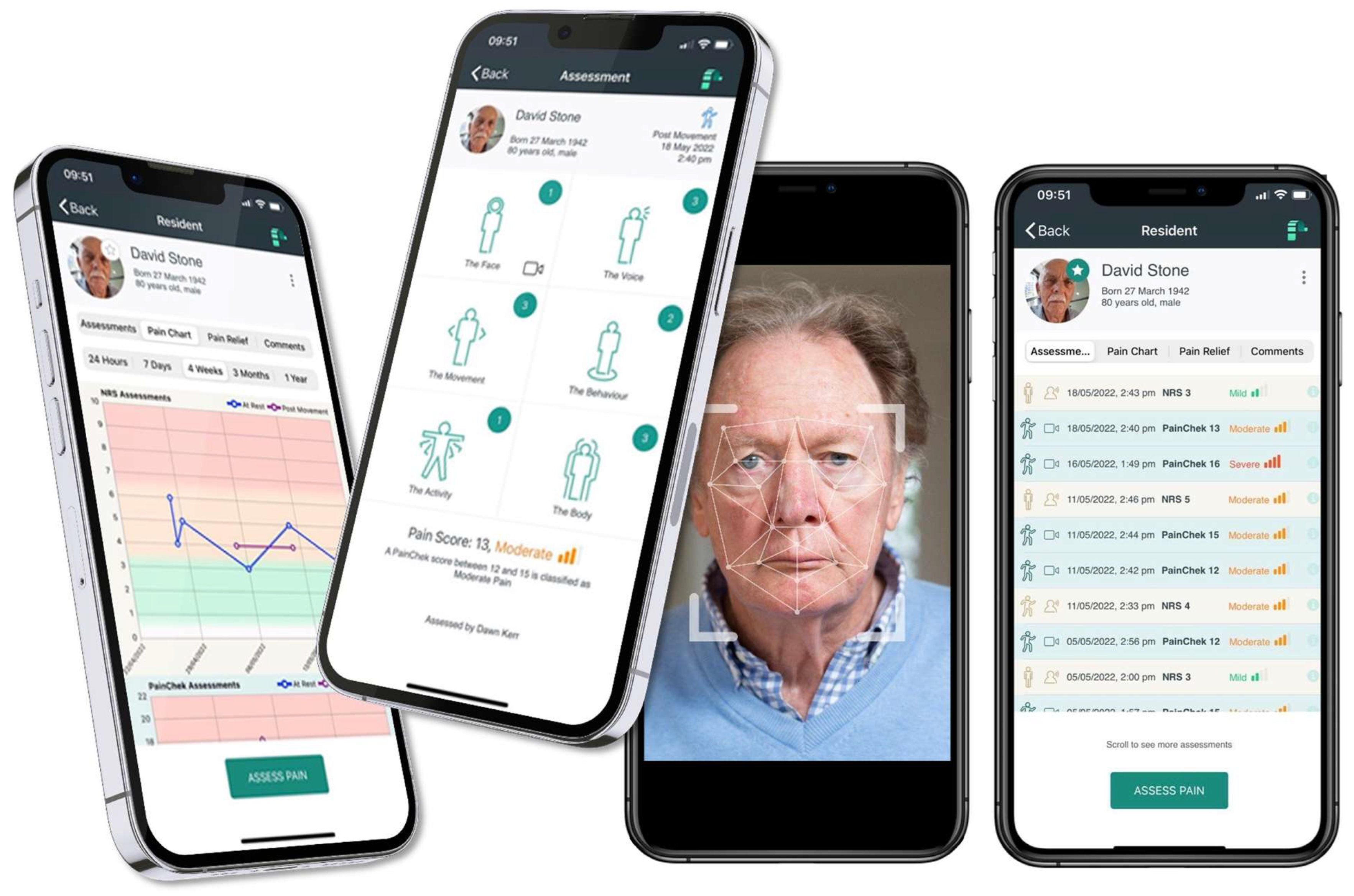

Digital Pain Assessment: Patient and Family Perspectives

 , , , , , , , , , ,
Abstract
1. Introduction
2. Materials and Methods
2.1. Design
2.2. Setting
2.3. Sample and Recruitment
2.4. Intervention
2.5. Data Collection
2.6. Data Analysis
2.7. Ethics
3. Results
3.1. Characteristics
3.2. Perceptions of the Technology-Driven Pain Assessment Application
3.3. Patient and Family Comments
4. Discussion
5. Limitations
6. Conclusions
Author Contributions
Funding
Institutional Review Board Statement
Informed Consent Statement
Data Availability Statement
Public Involvement Statement
Guidelines and Standards Statement
Use of Artificial Intelligence
Acknowledgments
Conflicts of Interest
References
- Claivaz, V.; Benmachiche, M.; Santoro, Z.; Hadorn, F.; Mabire, C. Pain in hospital: A real-word data analysis. Nurs. Open 2025, 12, e70126. [Google Scholar] [CrossRef]
- Damico, V.; Murano, L.; Cazzaniga, F.; Dal Molin, A. Pain prevalence, severity, assessment and management in hospitalized adult patients: A result of a multicenter cross sectional study. Ann. Ist. Super. Sanita 2018, 54, 194–200. [Google Scholar] [CrossRef]
- Becerra-Bolaños, Á.; Armas-Domínguez, A.; Valencia, L.; Jiménez-Marrero, P.; López-Ruiz, S.; Rodríguez-Pérez, A. Pain prevalence and satisfaction with pain management in inpatients: A cross-sectional study. Healthcare 2023, 11, 3191. [Google Scholar] [CrossRef]
- Wettstein, M.; Tesarz, J. Increasing pain prevalence and intensity among middle-aged and older adults: Evidence from the german ageing survey. J. Psychosom. Res. 2023, 168, 111233. [Google Scholar] [CrossRef]
- Booker, S.Q.; Herr, K.A.; Horgas, A.L. A paradigm shift for movement-based pain assessment in older adults: Practice, policy and regulatory drivers. Pain Manag. Nurs. 2021, 22, 21–27. [Google Scholar] [CrossRef]
- Deng, L.X.; Patel, K.; Miaskowski, C.; Maravilla, I.; Schear, S.; Garrigues, S.; Thompson, N.; Auerbach, A.D.; Ritchie, C.S. Prevalence and characteristics of moderate to severe pain among hospitalized older adults. J. Am. Geriatr. Soc. 2018, 66, 1744–1751. [Google Scholar] [CrossRef]
- Varndell, W.; Fry, M.; Elliott, D. Pain assessment and interventions by nurses in the emergency department: A national survey. J. Clin. Nurs. 2020, 29, 2352–2362. [Google Scholar] [CrossRef]
- Rababa, M.; Al-Sabbah, S.; Hayajneh, A.A. Nurses’ perceived barriers to and facilitators of pain assessment and management in critical care patients: A systematic review. J. Pain Res. 2021, 14, 3475–3491. [Google Scholar] [CrossRef] [PubMed]
- Gardner, P.; Gilbert, J.; Plummer, V.; Hills, D. Registered nurses’ knowledge, attitudes and practices of pain management for aged care residents with dementia: An integrative review. Contemp. Nurse 2024, 60, 496–515. [Google Scholar] [CrossRef] [PubMed]
- Fry, M.; Arendts, G.; Chenoweth, L. Emergency nurses’ evaluation of observational pain assessment tools for older people with cognitive impairment. J. Clin. Nurs. 2017, 26, 1281–1290. [Google Scholar] [CrossRef] [PubMed]
- Harmon, J.; Summons, P.; Higgins, I. Disjunction, tension and dissonance within nursing pain care provision for the older hospitalized person: A focused ethnographic insight. J. Adv. Nurs. 2021, 77, 3458–3471. [Google Scholar] [CrossRef] [PubMed]
- Tsai, Y.I.; Browne, G.; Inder, K.J. Documented nursing practices of pain assessment and management when communicating about pain in dementia care. J. Adv. Nurs. 2022, 78, 3174–3186. [Google Scholar] [CrossRef] [PubMed]
- Jonsdottir, T.; Gunnarsson, E.C. Understanding nurses’ knowledge and attitudes toward pain assessment in dementia: A literature review. Pain Manag. Nurs. 2021, 22, 281–292. [Google Scholar] [CrossRef] [PubMed]
- White, N.; Bazo-Alvarez, J.C.; Koopmans, M.; West, E.; Sampson, E.L. Understanding the association between pain and delirium in older hospital inpatients: Systematic review and meta-analysis. Age Ageing 2024, 53, afae073. [Google Scholar] [CrossRef] [PubMed]
- Mackie, B.R.; Mitchell, M.; Marshall, A.P. Patient and family members’ perceptions of family participation in care on acute care wards. Scand. J. Caring Sci. 2019, 33, 359–370. [Google Scholar] [CrossRef]
- Hämäläinen, J.; Kvist, T.; Kankkunen, P. Acute pain assessment inadequacy in the emergency department: Patients’ perspective. J. Patient Exp. 2022, 9, 23743735211049677. [Google Scholar] [CrossRef]
- Hadjiat, Y.; Arendt-Nielsen, L. Digital health in pain assessment, diagnosis, and management: Overview and perspectives. Front. Pain. Res. 2023, 4, 1097379. [Google Scholar] [CrossRef] [PubMed]
- Atee, M.; Hoti, K.; Chivers, P.; Hughes, J.D. Faces of pain in dementia: Learnings from a real-world study using a technology-enabled pain assessment tool. Front. Pain. Res. 2022, 3, 827551. [Google Scholar] [CrossRef]
- Huo, J.; Yu, Y.; Lin, W.; Hu, A.; Wu, C. Application of AI in multilevel pain assessment using facial images: Systematic review and meta-analysis. J. Med. Internet Res. 2024, 26, e51250. [Google Scholar] [CrossRef]
- PainChek®. Our Story. 2025. Available online: https://www.painchek.com/about/our-story/ (accessed on 18 August 2025).
- Babicova, I.; Cross, A.; Forman, D.; Hughes, J.; Hoti, K. Evaluation of the psychometric properties of Painchek® in UK aged care residents with advanced dementia. BMC Geriatr. 2021, 21, 337. [Google Scholar] [CrossRef]
- Berge, I.; Barenfeld, E.; Dahlin-Ivanoff, S.; Haak, M.; Lood, Q. Challenging oneself on the threshold to the world of research—Frail older people’s experiences of involvement in research. BMC Geriatr. 2020, 20, 410. [Google Scholar] [CrossRef] [PubMed]
- Lopes, F.; Rodrigues, M.; Silva, A.G. User-centered development of a mobile app for biopsychosocial pain assessment in adults: Usability, reliability, and validity study. JMIR Mhealth Uhealth 2021, 9, e25316. [Google Scholar] [CrossRef] [PubMed]
- Tran-Nguyen, K.; Berger, C.; Bennett, R.; Wall, M.; Morin, S.N.; Rajabiyazdi, F. Mobile app prototype in older adults for postfracture acute pain management: User-centered design approach. JMIR Aging 2022, 5, e37772. [Google Scholar] [CrossRef]
- Pu, L.; Barton, M.; Kodagoda Gamage, M.; Okada, M.; Todorovic, M.; Moyle, W. Pain Assessment and management in dementia care: Qualitative perspectives of people with dementia, their families, and healthcare professionals. J. Clin. Nurs. 2025, 34, 2933–2947. [Google Scholar] [CrossRef] [PubMed]
- Saunders, R.; Crookes, K.; Seaman, K.; Ang, S.G.M.; Bulsara, C.; Bulsara, M.K.; Ewens, B.; Gallagher, O.; Graham, R.M.; Gullick, K.; et al. Effectiveness of nurse-led volunteer support and technology-driven pain assessment in improving the outcomes of hospitalised older adults: Protocol for a cluster randomised controlled trial. BMJ Open 2022, 12, e059388. [Google Scholar] [CrossRef]
- PainChek®. Painchek® Universal Pain Management App: How It Works. 2025. Available online: https://www.painchek.com/product/how-it-works/ (accessed on 18 August 2025).
- Hsieh, H.-F.; Shannon, S.E. Three approaches to qualitative content analysis. Qual. Health Res. 2005, 15, 1277–1288. [Google Scholar] [CrossRef]
- PainChek®. Video Walkthroughs: Numerical Rating Scale (NRS) Walkthrough. 2025. Available online: https://www.painchek.com/support/video-walkthroughs/ (accessed on 9 September 2025).
- Kumaragurubaran, P.; Bodhare, T.; Bele, S.; Ramanathan, V.; Muthiah, T.; Francis, G.; Ramji, M. Perceptions and experiences of healthcare providers and patients towards digital health services in primary health care: A cross-sectional study. Cureus 2024, 16, e58876. [Google Scholar] [CrossRef]
- McNicol, L.; Hutchinson, A.; Wood, B.; Botti, M.; Redley, B. An exploration of patients’ experience of nurses’ use of point-of-care information technology in acute care. Patient Exp. J. 2018, 5, 76–89. [Google Scholar] [CrossRef]
- Vilstrup, D.L.; Madsen, E.E.; Hansen, C.F.; Wind, G. Nurses’ use of iPads in home care—What does it mean to patients?: A qualitative study. Comput. Inform. Nurs. 2017, 35, 140–144. [Google Scholar] [CrossRef]
- Herr, K.; Anderson, A.R.; Arbour, C.; Coyne, P.J.; Ely, E.; Gélinas, C.; Manworren, R.C.B. Pain assessment in the patient unable to self-report: Clinical practice recommendations in support of the ASPMN 2024 position statement. Pain Manag. Nurs 2024, 25, 551–568. [Google Scholar] [CrossRef]
- Fernandes, A. Patients’ experiences, expectations, and satisfaction with point-of-care electronic documentation. J. Inform. Nurs. 2017, 2, 6–13,18. Available online: https://www.proquest.com/scholarly-journals/patients-experiences-expectations-satisfaction/docview/1987348421/se-2 (accessed on 1 December 2025).
- Iwuchukwu, G.; Anttila, M.; Lantta, T.; Varpula, J.; Ameel, M. A mixed-methods systematic review on the impacts and implementation of collaborative electronic documentation on nurse-patient relationship. Comput. Inform. Nurs. 2025, 43, e01263. [Google Scholar] [CrossRef] [PubMed]
- Ribaut, J.; DeVito Dabbs, A.; Dobbels, F.; Teynor, A.; Mess, E.V.; Hoffmann, T.; De Geest, S. Developing a comprehensive list of criteria to evaluate the characteristics and quality of ehealth smartphone apps: Systematic review. JMIR Mhealth Uhealth 2024, 12, e48625. [Google Scholar] [CrossRef]
- Zhang, M.; Zhu, L.; Lin, S.-Y.; Herr, K.; Chi, C.-L.; Demir, I.; Dunn Lopez, K.; Chi, N.-C. Using artificial intelligence to improve pain assessment and pain management: A scoping review. J. Am. Med. Inform. Assoc. 2023, 30, 570–587. [Google Scholar] [CrossRef]
- Canfell, O.J.; Woods, L.; Meshkat, Y.; Krivit, J.; Gunashanhar, B.; Slade, C.; Burton-Jones, A.; Sullivan, C. The impact of digital hospitals on patient and clinician experience: Systematic review and qualitative evidence synthesis. J. Med. Internet Res. 2024, 26, e47715. [Google Scholar] [CrossRef]
- Hussein, A.; Moullin, J.; Stafford, A.; Hughes, J.; Quested, E. Identification of barriers and facilitators to the use of a new pain assessment mobile health application by family carers of people with dementia: A qualitative study. Ageing Int. 2024, 50, 5. [Google Scholar] [CrossRef]
- Cherif, E.; Bezaz, N.; Mzoughi, M. Do personal health concerns and trust in healthcare providers mitigate privacy concerns? Effects on patients’ intention to share personal health data on electronic health records. Soc. Sci. Med. 2021, 283, 114146. [Google Scholar] [CrossRef] [PubMed]
- PainChek®. Painchek’s Commitment to Security, Data Protection and Privacy. 2025. Available online: https://www.painchek.com/paincheks-commitment-to-security-data-protection-and-privacy/ (accessed on 18 August 2025).
- STROBE. STROBE Checklists. 2025. Available online: https://www.strobe-statement.org/checklists/ (accessed on 7 November 2025).

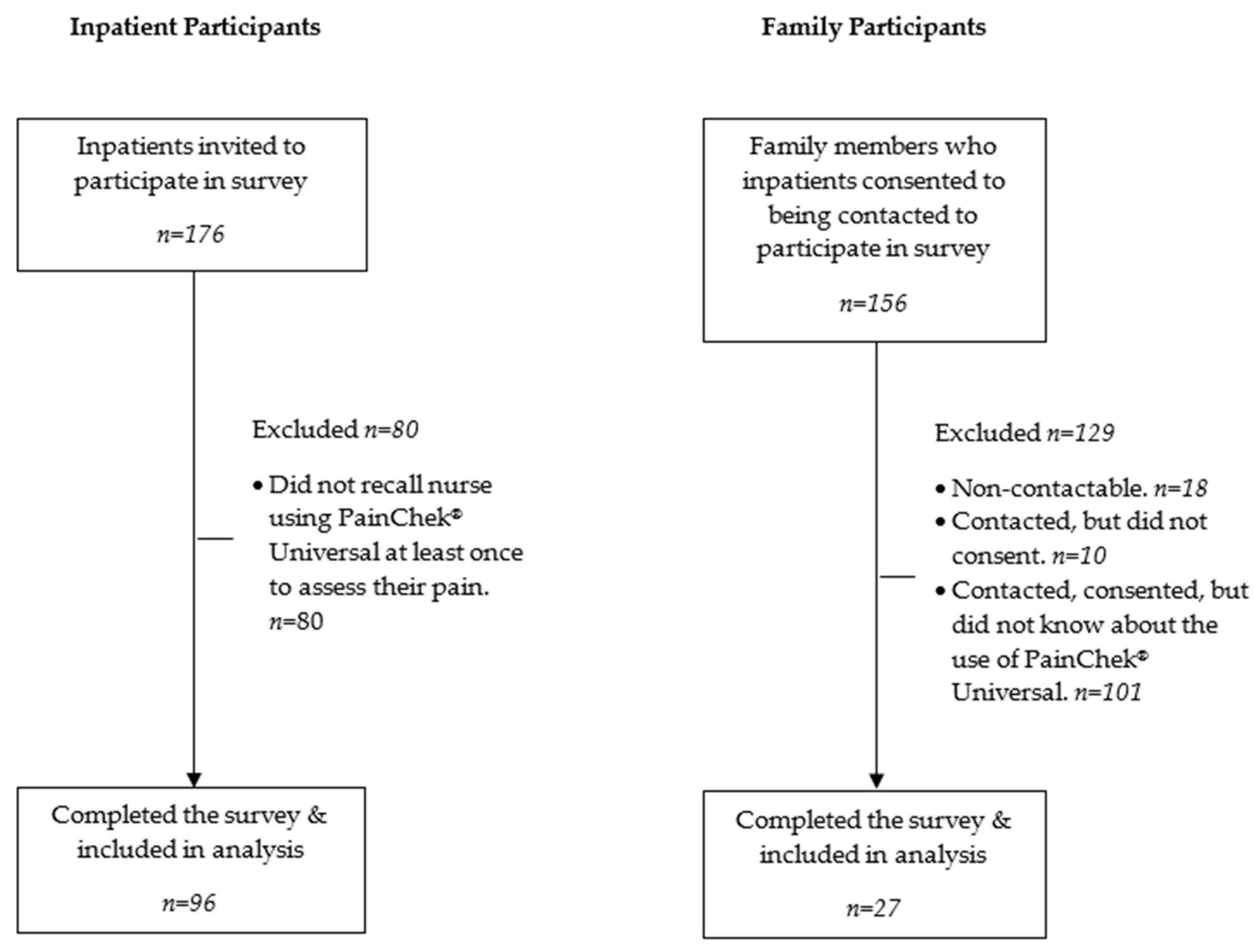

| Variable | Inpatients | Families |
|---|---|---|
| Total n | n = 96 | n = 27 |
| n (%) | ||
| Gender | ||
| Female | 60 (62.5) | 20 (74.1) |
| Male | 36 (37.5) | 7 (25.9) |
| Age | ||
| 40–49 y | 0 | 4 (14.8) |
| 50–59 y | 0 | 4 (14.8) |
| 60–69 y | 6 (6.3) | 10 (37.0) |
| 70–79 y | 25 (26.0) | 7 (25.9) |
| 80–89 y | 47 (49.0) | 1 (3.7) |
| >90 y | 13 (13.5) | 1 (3.7) |
| No response | 5 (5.2) | 0 (0.0) |
| Relationship to a patient | ||
| Child | - | 13 (48.1) |
| Spouse | - | 13 (48.1) |
| Other immediate family a/relative | - | 1 (3.7) |
| Statement No. | 1 Strongly Disagree | 2 Disagree | 3 Neutral | 4 Agree | 5 Strongly Agree | IC a | Median (IQR) b |
|---|---|---|---|---|---|---|---|
| n (%) | |||||||
| 1. I had no concerns with PainChek® Universal for assessing my pain (n = 91) | 1 (1.1) | 0 (0.0) | 6 (6.6) | 11 (12.1) | 73 (80.2) | 5 | 5.00 (5.0–5.0) |
| 2. I think PainChek® Universal was a positive addition to my assessments (n = 91) | 1 (1.1) | 1 (1.1) | 7 (7.7) | 16 (17.6) | 66 (72.5) | 5 | 5.00 (4.0–5.0) |
| 3. Using PainChek® Universal made it easier for nurses to complete pain assessments (n = 91) | 1 (1.1) | 0 (0.0) | 7 (7.7) | 13 (14.3) | 70 (76.9) | 5 | 5.00 (5.0–5.0) |
| 4. PainChek® Universal can provide a more accurate assessment (n = 90) | 3 (3.3) | 0 (0.0) | 11 (12.2) | 11 (12.2) | 65 (72.2) | 6 | 5.00 (4.0–5.0) |
| Statement No. | 1 Strongly Disagree | 2 Disagree | 3 Neutral | 4 Agree | 5 Strongly Agree | IC a | Median (IQR) b |
|---|---|---|---|---|---|---|---|
| n (%) | |||||||
| 1. I had no concerns with PainChek® Universal for assessing the patient’s pain (n = 26) | 0 (0.0) | 2 (7.7) | 0 (0.0) | 7 (26.9) | 17 (65.4) | 1 | 5.00 (4.0–5.0) |
| 2. I think PainChek® Universal was a positive addition to patient assessments (n = 25) | 0 (0.0) | 0 (0.0) | 0 (0.0) | 7 (28.0) | 18 (72.0) | 2 | 5.00 (4.0–5.0) |
| 3. Using PainChek® Universal made it easier for nurses to complete pain assessments (n = 18) | 0 (0.0) | 0 (0.0) | 1 (5.6) | 8 (44.4) | 9 (50.0) | 9 | 5.00 (4.0–5.0) |
| 4. PainChek® Universal can provide a more accurate assessment (n = 16) | 0 (0.0) | 0 (0.0) | 2 (12.5) | 10 (62.5) | 4 (25.0) | 11 | 4.00 (4.0–5.0) |
Disclaimer/Publisher’s Note: The statements, opinions and data contained in all publications are solely those of the individual author(s) and contributor(s) and not of MDPI and/or the editor(s). MDPI and/or the editor(s) disclaim responsibility for any injury to people or property resulting from any ideas, methods, instructions or products referred to in the content. |
© 2026 by the authors. Licensee MDPI, Basel, Switzerland. This article is an open access article distributed under the terms and conditions of the Creative Commons Attribution (CC BY) license.
Share and Cite
Saunders, R.; Crookes, K.; Nosaka, K.; Gallagher, O.; Hughes, J.; Bulsara, C.; Bulsara, M.K.; Ang, S.G.M.; Ewens, B.; Haydon, S.; et al. Digital Pain Assessment: Patient and Family Perspectives. Nurs. Rep. 2026, 16, 92. https://doi.org/10.3390/nursrep16030092
Saunders R, Crookes K, Nosaka K, Gallagher O, Hughes J, Bulsara C, Bulsara MK, Ang SGM, Ewens B, Haydon S, et al. Digital Pain Assessment: Patient and Family Perspectives. Nursing Reports. 2026; 16(3):92. https://doi.org/10.3390/nursrep16030092
Chicago/Turabian StyleSaunders, Rosemary, Kate Crookes, Kaoru Nosaka, Olivia Gallagher, Jeff Hughes, Caroline Bulsara, Max K. Bulsara, Seng Giap Marcus Ang, Beverley Ewens, Sue Haydon, and et al. 2026. "Digital Pain Assessment: Patient and Family Perspectives" Nursing Reports 16, no. 3: 92. https://doi.org/10.3390/nursrep16030092
APA StyleSaunders, R., Crookes, K., Nosaka, K., Gallagher, O., Hughes, J., Bulsara, C., Bulsara, M. K., Ang, S. G. M., Ewens, B., Haydon, S., Seaman, K., Graham, R., Scaini, D., Gullick, K., Gay, M., & Etherton-Beer, C. (2026). Digital Pain Assessment: Patient and Family Perspectives. Nursing Reports, 16(3), 92. https://doi.org/10.3390/nursrep16030092