
Validation of the Maximizing Tendency Scale in a Spanish Nursing Population

 ,
,  , , and
Abstract
1. Introduction
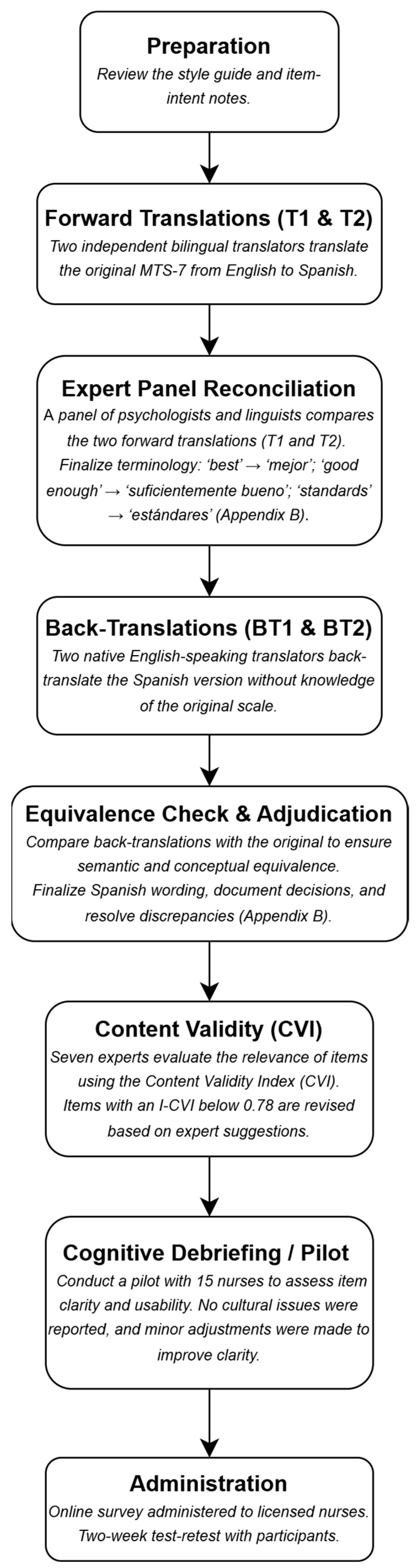
2. Materials and Methods
2.1. Design
2.2. Participants
2.3. Instrument
2.4. Procedure
2.5. Data Analysis
2.6. Ethical Statement
3. Results
3.1. Descriptive Data
3.2. Content Validity
3.3. Internal Consistency and Stability
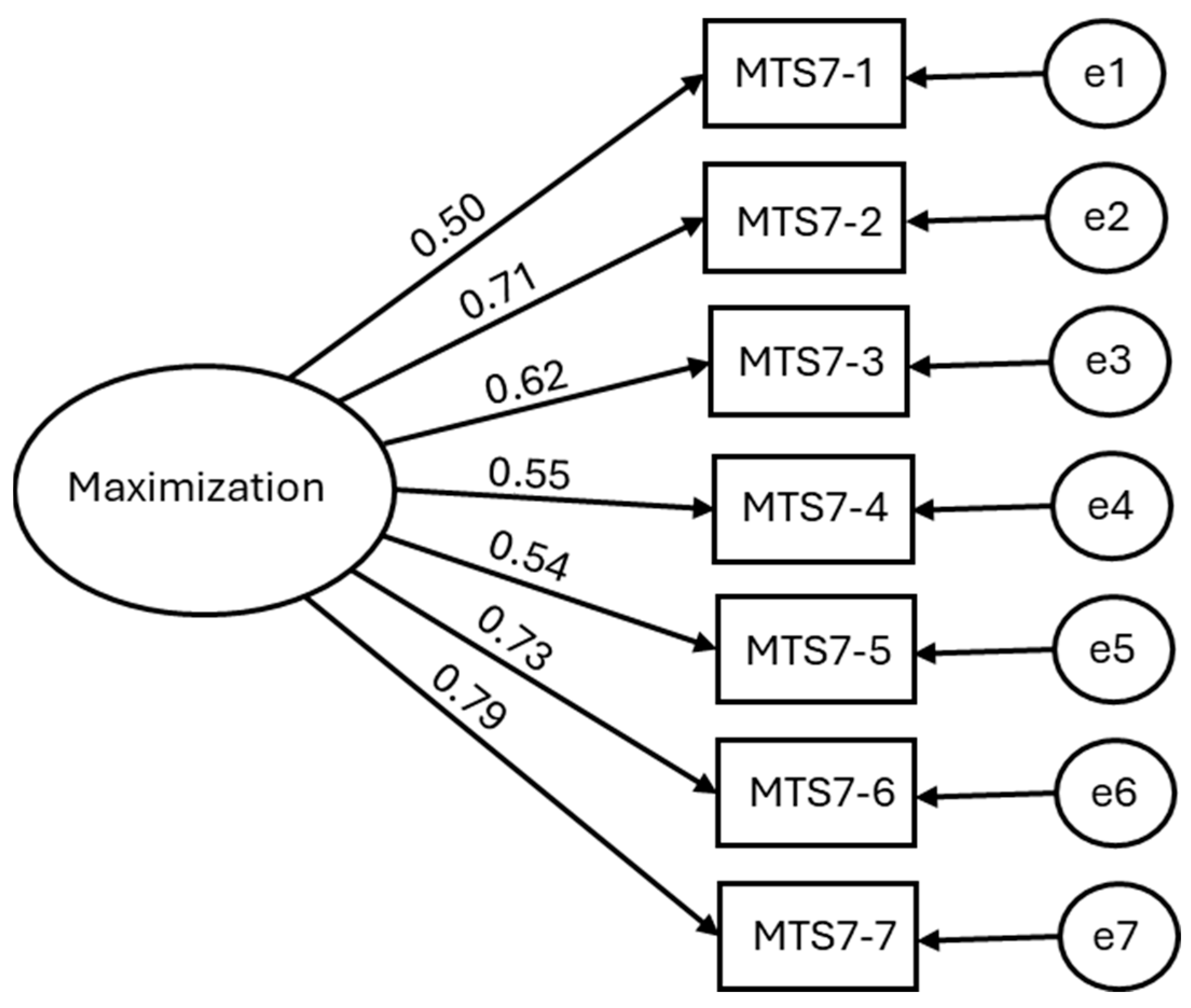
3.4. Construct Validity
4. Discussion
5. Conclusions
Supplementary Materials
Author Contributions
Funding
Institutional Review Board Statement
Informed Consent Statement
Data Availability Statement
Public Involvement Statement
Guidelines and Standards Statement
Use of Artificial Intelligence
Acknowledgments
Conflicts of Interest
Appendix A
MTS-7 Spanish
- Cueste lo que cueste, siempre intento elegir lo mejor.
- No me gusta tener que conformarme con lo “suficientemente bueno”.
- Soy un/a maximizador/a.
- Haga lo que haga, mantengo siempre los estándares más altos para mí mismo/a.
- Siempre aguardo a que se presente la mejor opción, tarde lo que tarde.
- Nunca me conformo con la segunda mejor opción.
- Nunca me conformo con menos.
Appendix B

| Item # | Original (EN) | Forward T1 (ES) | Forward T2 (ES) | Reconciled Spanish (Final) | Back-Trans 1 (EN) | Back-Trans 2 (EN) |
|---|---|---|---|---|---|---|
| 1 | No matter what it takes, I always try to choose the best. | Cueste lo que cueste, siempre intento elegir lo óptimo. | Cueste lo que cueste, siempre intento elegir lo mejor. | Cueste lo que cueste, siempre intento elegir lo mejor. | Whatever it takes, I always try to choose the best. | At all costs, I try to choose the best option. |
| 2 | I don’t like having to settle for ‘good enough’. | No me gusta tener que conformarme con lo ‘bastante bueno’. | No me gusta tener que conformarme con lo ‘suficientemente bueno’. | No me gusta tener que conformarme con lo ‘suficientemente bueno’. | I don’t like having to settle for something that is ‘good enough’. | I dislike settling for what is merely ‘good enough’. |
| 3 | I am a maximizer. | Soy un maximizador. | Soy un/a maximizador/a. | Soy un/a maximizador/a. | I am a maximizer. | I consider myself a maximizer. |
| 4 | Whatever I do, I always maintain the highest standards for myself. | Haga lo que haga, mantengo siempre los criterios más altos para mí mismo/a. | Haga lo que haga, mantengo siempre los estándares más altos para mí mismo/a. | Haga lo que haga, mantengo siempre los estándares más altos para mí mismo/a. | Whatever I do, I always keep the highest standards for myself. | In anything I do, I maintain the highest standards for myself. |
| 5 | I always hold out for the best option, no matter how long it takes. | Siempre espero a que aparezca la mejor opción, tarde lo que tarde. | Siempre aguardo a que se presente la mejor opción, tarde lo que tarde. | Siempre aguardo a que se presente la mejor opción, tarde lo que tarde. | I always wait for the best option to appear, no matter how long it takes. | I hold out for the best option, however long it takes. |
| 6 | I never settle for the second-best. | Nunca me conformo con la segunda mejor alternativa. | Nunca me conformo con la segunda mejor opción. | Nunca me conformo con la segunda mejor opción. | I never settle for the second-best option. | I do not accept the second-best. |
| 7 | I never settle for less. | Nunca me conformo con menos. | Nunca acepto menos de lo mejor. | Nunca me conformo con menos. | I never settle for less. | I never accept less. |
References
- Simon, H.A. Models of Man, Social and Rational: Mathematical Essays on Rational Human Behavior; Wiley: New York, NY, USA, 1957. [Google Scholar]
- Schwartz, B. Self-determination: The tyranny of freedom. Am. Psychol. 2000, 55, 79–88. [Google Scholar] [CrossRef] [PubMed]
- Schwartz, B.; Ward, A.; Monterosso, J.; Lyubomirsky, S.; White, K.; Lehman, D.R. Maximizing versus Satisficing: Happiness Is a Matter of Choice. J. Soc. Psychol. 2002, 83, 1178–1197. [Google Scholar] [CrossRef] [PubMed]
- Diab, D.L.; Gillespie, M.A.; Highhouse, S. Are Maximizers Really Unhappy? The Measurement of Maximizing Tendency. Judgm. Decis. Mak. 2008, 3, 364–370. [Google Scholar] [CrossRef] [Scilit]
- Besharat, A.; Ladik, D.M.; Carrillat, F.A. Are Maximizers Blind to the Future? When Today’s Best Does Not Make for a Better Tomorrow. Mark. Lett. 2014, 25, 77–91. [Google Scholar] [CrossRef] [Scilit]
- Kokkoris, M.D. When the Purpose Lies within: Maximizers and Satisfaction with Autotelic Choices. Mark. Lett. 2018, 29, 73–85. [Google Scholar] [CrossRef] [Scilit]
- Dahling, J.J.; Thompson, M.N. Detrimental Relations of Maximization with Academic and Career Attitudes. J. Career Assess. 2012, 21, 278–294. [Google Scholar] [CrossRef] [Scilit]
- Osiurak, F.; Faure, J.; Rabeyron, T.; Morange, D.; Dumet, N.; Tapiero, I.; Finkel, A. Déterminants de la procrastination académique: Motivation autodéterminée, estime de soi et degré de maximization. Predictors of academic procrastination: Self-determined motivation, self-esteem, and degree of maximization. Prat. Psychol. 2015, 21, 19–33. [Google Scholar] [CrossRef] [Scilit]
- Shortland, N.D.; Thompson, L.; Alison, L.J. Police Perfection: Examining the Effect of Trait Maximization on Police Decision-Making. Front. Psychol. 2020, 11, 1817. [Google Scholar] [CrossRef] [Scilit]
- Shortland, N.D.; Alison, L.J.; Moran, J. Conflict: How Soldiers Make Impossible Decisions; Oxford University Press: Oxford, UK, 2019. [Google Scholar]
- Shortland, N.D.; Alison, L.J.; Thompson, L. Military Maximizers: Examining the Effect of Individual Differences in Maximization on Military Decision-Making. Individ. Differ. 2020, 163, 110051. [Google Scholar] [CrossRef] [Scilit]
- Alison, L.J.; Power, N.; Heuvel, C.; Humann, M.; Palasinski, M.; Crego, J. Decision Inertia: Deciding between Least-Worst Outcomes in Emergency Responses to Disasters. J. Occup. Organ. Psychol. 2015, 88, 295–321. [Google Scholar] [CrossRef] [Scilit]
- Chang, E.C.; Lin, N.J.; Herringshaw, A.J.; Sanna, L.J.; Perera, F.C.G.; Perera, M.J.; Marchenko, V.V. Understanding the Link between Perfectionism and Adjustment in College Students: Examining the Role of Maximizing. Individ. Differ. 2011, 50, 1074–1078. [Google Scholar] [CrossRef] [Scilit]
- Cheek, N.N.; Schwartz, B. On the Meaning and Measurement of Maximization. Judgm. Decis. Mak. 2016, 11, 126–146. [Google Scholar] [CrossRef] [Scilit]
- Mikkelson, A.C.; Ray, C. Development of the Revised Relational Maximization Scale and Explorations of How Relational Maximization Relates to Personal and Relational Outcomes. J. Soc. Relatsh. 2020, 37, 2482–2509. [Google Scholar] [CrossRef] [Scilit]
- Nenkov, G.Y.; Morrin, M.; Ward, A.; Schwartz, B.; Hulland, J. A Short Form of the Maximization Scale: Factor Structure, Reliability and Validity Studies. Judgm. Decis. Mak. 2008, 3, 371–388. [Google Scholar] [CrossRef] [Scilit]
- Lai, L. Maximizing without Difficulty: A Modified Maximizing Scale and Its Correlates. Judgm. Decis. Mak. 2010, 5, 164–175. [Google Scholar] [CrossRef] [Scilit]
- Turner, B.R.; Rim, H.B.; Betz, N.E.; Nygren, T.E. The maximization inventory. Judgm. Decis. Mak. 2012, 7, 48–60. [Google Scholar] [CrossRef] [Scilit]
- Weinhardt, J.M.; Morse, B.J.; Chimeli, J.; Fisher, J. An Item Response Theory and Factor Analytic Examination of Two Prominent Maximizing Tendency Scales. Judgm. Decis. Mak. 2012, 7, 644–658. [Google Scholar] [CrossRef] [Scilit]
- Mikkelson, A.C.; Pauley, P.M. Maximizing relationship possibilities: Relational maximization in romantic relationships. J. Soc. Psychol. 2013, 153, 467–485. [Google Scholar] [CrossRef] [Scilit]
- Richardson, C.M.; Ye, H.J.; Ege, E.; Suh, H.; Rice, K.G. Refining the Measurement of Maximization: Gender Invariance and Relation to Psychological Well-Being. Individ. Differ. 2014, 70, 229–234. [Google Scholar] [CrossRef] [Scilit]
- Dalal, D.K.; Diab, D.L.; Zhu, X.; Hwang, T. Understanding the Construct of Maximizing Tendency: A Theoretical and Empirical Evaluation. J. Behav. Decis. Mak. 2015, 28, 437–450. [Google Scholar] [CrossRef] [Scilit]
- Misuraca, R.; Faraci, P.; Gangemi, A.; Carmeci, F.A.; Miceli, S. The Decision Making Tendency Inventory: A New Measure to Assess Maximizing, Satisficing, and Minimizing. Individ. Differ. 2015, 85, 111–116. [Google Scholar] [CrossRef] [Scilit]
- Newman, D.B.; Schug, J.; Yuki, M.; Yamada, J.; Nezlek, J.B. The Negative Consequences of Maximizing in Friendship Selection. J. Soc. Psychol. 2018, 114, 804–824. [Google Scholar] [CrossRef] [Scilit]
- Misuraca, R.; Fasolo, B. Maximizing versus Satisficing in the Digital Age: Disjoint Scales and the Case for “Construct Consensus”. Individ. Differ. 2018, 121, 152–160. [Google Scholar] [CrossRef] [Scilit]
- Iyengar, S.S.; Wells, R.E.; Schwartz, B. Doing Better but Feeling Worse: Looking for the “Best” Job Undermines Satisfaction. Psychol. Sci. 2006, 17, 143–150. [Google Scholar] [CrossRef] [Scilit] [PubMed]
- Moyano-Díaz, E.; Martínez-Molina, A.; Ponce, P.F. The Price of Gaining: Maximization in Decision-Making, Regret and Life Satisfaction. Judgm. Decis. Mak. 2014, 9, 500–509. [Google Scholar] [CrossRef] [Scilit]
- Moyano-Díaz, E.; Mendoza-Llanos, R. New Approaches to Maximization: Evidence of Correlations with Malaise and Well-Being in the Chilean Adult Population. Rev. CES Psicol. 2020, 13, 18–31. [Google Scholar] [CrossRef] [Scilit]
- Moyano-Díaz, E.; Mendoza-Llanos, R.Y. Maximizers Maximize Almost Everything: The Decision-Making Style Is Consistent in Different Decision Domains. Front. Psychol. 2021, 12, 663064. [Google Scholar] [CrossRef] [Scilit] [PubMed]
- Statman, M. Culture in Risk, Regret, Maximization, Social Trust, and Life Satisfaction. J. Invest. Consult. 2015, 16, 20–30. [Google Scholar]
- Hofstede, G. Culture’s Consequences: Comparing Values, Behaviors, Institutions and Organizations Across Nations, 2nd ed.; Sage: Thousand Oaks, CA, USA, 2001. [Google Scholar]
- Boateng, G.O.; Neilands, T.B.; Frongillo, E.A.; Melgar-Quiñonez, H.R.; Young, S.L. Best Practices for Developing and Validating Scales for Health, Social, and Behavioral Research: A Primer. Front. Public Health 2018, 6, 149. [Google Scholar] [CrossRef] [Scilit] [PubMed]
- Instituto Nacional de Estadística (INE). No de Enfermeros por Comunidades, Ciudades Autónomas y Provincias de Colegiación, Edad y Sexo, 2019. Available online: https://www.ine.es/jaxi/Tabla.htm?path=/t15/p416/a2019/l0/&file=s08002.px&L=0 (accessed on 8 October 2025).
- Benner, P.; Tanner, C. Clinical Judgment: How Expert Nurses Use Intuition. Am. J. Nurs. 1987, 87, 23–31. [Google Scholar] [CrossRef] [Scilit]
- Nibbelink, C.W.; Brewer, B.B. Decision-Making in Nursing Practice: An Integrative Literature Review. J. Clin. Nurs. 2018, 27, 917–928. [Google Scholar] [CrossRef] [Scilit] [PubMed]
- Toma, G.; Guetterman, T.C.; Yaqub, T.; Talaat, N.; Fetters, M.D. A Systematic Approach for Accurate Translation of Instruments: Experience with Translating the Connor–Davidson Resilience Scale into Arabic. Methodol. Innov. 2017, 10, 2059799117741406. [Google Scholar] [CrossRef] [Scilit]
- Beaton, D.E.; Bombardier, C.; Guillemin, F.; Ferraz, M.B. Guidelines for the Process of Cross-Cultural Adaptation of Self-Report Measures. Spine 2000, 25, 3186–3191. [Google Scholar] [CrossRef] [Scilit] [PubMed]
- Marzuki, M.F.M.; Yaacob, N.A.; Yaacob, N.M. Translation, Cross-Cultural Adaptation, and Validation of the Malay Version of the System Usability Scale Questionnaire for the Assessment of Mobile Apps. JMIR Hum. Factors 2018, 5, 10308. [Google Scholar] [CrossRef] [Scilit]
- Yusoff, M.S.B. ABC of Content Validation and Content Validity Index Calculation. Educ. Med. J. 2019, 11, 49–54. [Google Scholar] [CrossRef] [Scilit]
- Polit, D.F.; Beck, C.T. The Content Validity Index: Are You Sure You Know What’s Being Reported? Critique and Recommendations. Res. Nurs. Health 2006, 29, 489–497. [Google Scholar] [CrossRef] [Scilit]
- Lynn, M.R. Determination and Quantification of Content Validity. Nurs. Res. 1986, 35, 382–385. [Google Scholar] [CrossRef] [Scilit]
- Lilliefors, H.W. On the Kolmogorov–Smirnov Test for Normality with Mean and Variance Unknown. J. Am. Stat. Assoc. 1967, 62, 399–402. [Google Scholar] [CrossRef]
- Netemeyer, R.G.; Bearden, W.O.; Sharma. Scaling Procedures; Sage Publications Inc.: Thousand Oaks, CA, USA, 2003. [Google Scholar]
- Rousson, V.; Gasser, T.; Seifert, B. Confidence Intervals for Intraclass Correlation in Inter-Rater Reliability. Scand. J. Stat. 2003, 30, 617–624. [Google Scholar] [CrossRef] [Scilit]
- Field, A. Discovering Statistics Using IBM SPSS Statistics; Sage Publications: London, UK, 2024. [Google Scholar]
- Steiger, J.H.; Lind, J.C. Statistically-Based Tests for the Number of Common Factors. In Proceedings of the Annual Spring Meeting of the Psychometric Society, Iowa City, IA, USA, 28–30 May 1980; Volume 25, pp. 173–180. [Google Scholar]
- Kline, R.B. Principles and Practice of Structural Equation Modeling, 2nd ed.; Guilford Press: New York, NY, USA, 2005. [Google Scholar]
- Carmines, E.G.; McIver, J.P. Analysing Models with Unobserved Variables: Analysis of Covariance Structures. In Social Measurement: Current Issues; Bohrnstedt, G.W., Borgatta, E.F., Eds.; Sage: Beverly Hills, CA, USA, 1981; pp. 65–115. [Google Scholar]
- Hu, L.T.; Bentler, P.M. Cut-off Criteria for Fit Indexes in Covariance Structure Analysis: Conventional Criteria versus New Alternatives. Struct. Equ. Model. 1999, 6, 1–55. [Google Scholar] [CrossRef] [Scilit]
- Ullman, J.B. Structural equation modeling. In Using Multivariate Statistics, 4th ed.; Tabachnick, B.G., Fidell, L.S., Eds.; Allyn & Bacon: Boston, MA, USA, 2001; pp. 653–771. [Google Scholar]
- Byrne, B.M. Structural Equation Modeling with AMOS: Basic Concepts, Applications, and Programming; Erlbaum: Mahwah, NJ, USA, 2001. [Google Scholar]
- World Medical Association. World Medical Association Declaration of Helsinki: Ethical Principles for Medical Research Involving Human Subjects. JAMA 2013, 310, 2191–2194. [Google Scholar] [CrossRef] [Scilit]
- Dziuban, C.D.; Shirkey, E.C. When Is a Correlation Matrix Appropriate for Factor Analysis? Some Decision Rules. Psychol. Bull. 1974, 81, 358–361. [Google Scholar] [CrossRef] [Scilit]
- Kenny, D.A.; Kaniskan, B.; McCoach, D.B. The Performance of RMSEA in Models with Small Degrees of Freedom. Sociol. Methods Res. 2015, 44, 486–507. [Google Scholar] [CrossRef] [Scilit]
- DeVellis, R.F.; Thorpe, C.T. Scale Development: Theory and Applications, 5th ed.; Sage Publications: Thousand Oaks, CA, USA, 2021. [Google Scholar]
- Johansen, M.L.; O’Brien, J.L. Decision Making in Nursing Practice: A Concept Analysis. Nurs. Forum 2016, 51, 40–48. [Google Scholar] [CrossRef] [Scilit] [PubMed]
- Nibbelink, C.W.; Carrington, J.M. Nurse decision making in acute care: An integrative review. Comput. Inf. Nurs. 2019, 37, 151–160. [Google Scholar]
- Alison, L.; Shortland, N.; Herrod-Taylor, C.; Stevens, C.; Christiansen, P. Medical Maximization: The Effect of Personality on Triage Decision-Making. Soc. Sci. Med. 2024, 352, 117006. [Google Scholar] [CrossRef] [Scilit]
- Hagbaghery, M.A.; Salsali, M.; Ahmadi, F. The Factors Facilitating and Inhibiting Effective Clinical Decision-Making in Nursing: A Qualitative Study. BMC Nurs. 2004, 3, 2. [Google Scholar] [CrossRef] [Scilit]
- Browne, M.W.; Cudeck, R. Alternative Ways of Assessing Model Fit. Sociol. Methods Res. 1992, 21, 230–258. [Google Scholar] [CrossRef] [Scilit]

| Scale | Authors | No. of Items | Maximizing Dimensions * | Satisficing Dimensions * |
|---|---|---|---|---|
| Maximization Scale | Schwartz [2]; Schwartz et al. [3] | 13 | 1 | 0 |
| MS-6 | Nenkov et al. [16] | 6 | 3 | 0 |
| Maximizing Tendency Scale | Diab et al. [4] | 9 | 1 | 0 |
| Modified Maximizing Scale | Lai [17] | 5 | 1 | 0 |
| Maximization Inventory | Turner et al. [18] | 34 | 2 | 1 |
| Revised MS | Weinhardt et al. [19] | 7 | 3 | 0 |
| Revised MTS | Weinhardt et al. [19] | 6 | 3 | 0 |
| Relational Maximization Scale ** | Mikkelson & Pauley [20] | 15 | 1 | 0 |
| Refined Maximization Scale | Richardson et al. [21] | 10 | 3 | 0 |
| MTS-7 | Dalal et al. [22] | 7 | 1 | 0 |
| Decision Making Tendency Inventory | Misuraca et al. [23] | 29 | 2 | 2 |
| Scale of Friendship Maximization ** | Newman et al. [24] | 16 | 3 | 0 |
| Revised Relational Maximization Scale ** | Mikkelson & Ray [15] | 14 | 1 | 0 |
| Mean | SD | Scale Mean if Item Deleted | Scale Variance if Item Deleted | Corrected Item-Total Correlation | Cronbach’s Alpha if Item Deleted | |
|---|---|---|---|---|---|---|
| MTS7-1 | 4.32 | 0.80 | 22.04 | 13.64 | 0.415 | 0.765 |
| MTS7-2 | 4.15 | 0.77 | 22.21 | 12.91 | 0.586 | 0.736 |
| MTS7-3 | 3.59 | 0.89 | 22.77 | 12.96 | 0.467 | 0.756 |
| MTS7-4 | 3.95 | 0.86 | 22.41 | 13.08 | 0.463 | 0.757 |
| MTS7-5 | 3.37 | 0.89 | 22.99 | 13.43 | 0.381 | 0.773 |
| MTS7-6 | 3.39 | 1.05 | 22.97 | 11.44 | 0.590 | 0.730 |
| MTS7-7 | 3.59 | 0.94 | 22.76 | 11.84 | 0.619 | 0.724 |
| Loading ** | Communalities | |
|---|---|---|
| MTS7-1 | 0.58 | 0.34 |
| MTS7-2 | 0.74 | 0.55 |
| MTS7-3 | 0.62 | 0.39 |
| MTS7-4 | 0.61 | 0.37 |
| MTS7-5 | 0.52 | 0.27 |
| MTS7-6 | 0.74 | 0.55 |
| MTS7-7 | 0.76 | 0.58 |
Disclaimer/Publisher’s Note: The statements, opinions and data contained in all publications are solely those of the individual author(s) and contributor(s) and not of MDPI and/or the editor(s). MDPI and/or the editor(s) disclaim responsibility for any injury to people or property resulting from any ideas, methods, instructions or products referred to in the content. |
© 2025 by the authors. Licensee MDPI, Basel, Switzerland. This article is an open access article distributed under the terms and conditions of the Creative Commons Attribution (CC BY) license.
Share and Cite
Tejeiro, R.; Paramio, A.; Cruces-Montes, S.; Santos-Marroquín, J.; Romero-Moreno, A. Validation of the Maximizing Tendency Scale in a Spanish Nursing Population. Nurs. Rep. 2026, 16, 9. https://doi.org/10.3390/nursrep16010009
Tejeiro R, Paramio A, Cruces-Montes S, Santos-Marroquín J, Romero-Moreno A. Validation of the Maximizing Tendency Scale in a Spanish Nursing Population. Nursing Reports. 2026; 16(1):9. https://doi.org/10.3390/nursrep16010009
Chicago/Turabian StyleTejeiro, Ricardo, Alberto Paramio, Serafín Cruces-Montes, Judit Santos-Marroquín, and Antonio Romero-Moreno. 2026. "Validation of the Maximizing Tendency Scale in a Spanish Nursing Population" Nursing Reports 16, no. 1: 9. https://doi.org/10.3390/nursrep16010009
APA StyleTejeiro, R., Paramio, A., Cruces-Montes, S., Santos-Marroquín, J., & Romero-Moreno, A. (2026). Validation of the Maximizing Tendency Scale in a Spanish Nursing Population. Nursing Reports, 16(1), 9. https://doi.org/10.3390/nursrep16010009