
Monitoring Knowledge, Attitudes, and Practices on Restraint Use in Adult and Pediatric Intensive Care Units: The Multicenter Development and Validation of the CON-Ti-IT Questionnaire

 , ,
, ,  , and
, and
Abstract
1. Introduction
Aims and Research Questions
- (1)
- What key factors should be monitored in adult and pediatric ICUs to identify and control nurses’ restraints’ use?
- (2)
- Can a single questionnaire effectively assess nurses’ KAP on restraints in both adult and pediatric ICUs?
- (3)
- What are the most relevant items for a questionnaire assessing nurses’ KAP on restraints in adult and pediatric ICUs?
- (4)
- What is the most appropriate response format for accurately assessing nurses’ KAP on restraints?
2. Materials and Methods
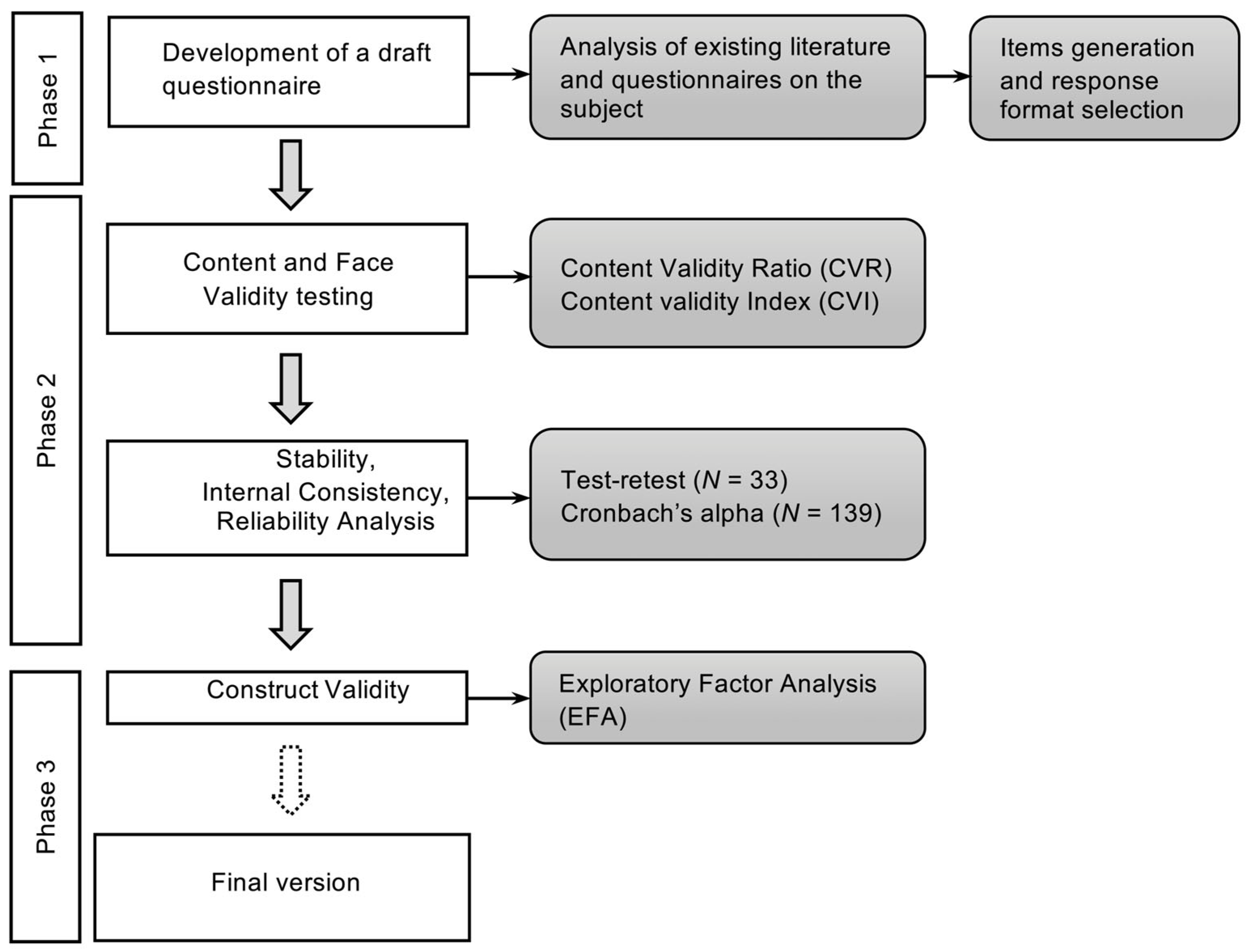
2.1. The Questionnaire Development and Validation Process
- (1)
- Development of a draft questionnaire.
- (2)
- Psychometric testing of the questionnaire.
- (3)
- Construct validity.
2.1.1. Phase 1—Development of a Draft Questionnaire
2.1.2. Phase 2—Psychometric Testing of the Questionnaire
Content and Face Validity
Reliability Analysis
Phase 3. Construct Validity
2.2. Participants
- (1)
- Test–retest: in a test for agreement between two test administrations using the Kappa statistic, a sample size of 33 nurses achieves 80% power to detect a true Kappa value of 0.85 in a test of H0: Kappa = 0.50 vs. H1: Kappa ≠ 0.50 when there are five categories with frequencies equal to 0.50, 0.30, 0.10, 0.05, and 0.05. This power calculation is based on a significance level of 0.05.
- (2)
- Cronbach alpha: a sample of 130 nurses was estimated assuming an internal consistency in which in the null hypothesis, the Cronbach alpha is equal to 0.55, and in the alternative hypothesis, Cronbach’s alpha is at least equal to 0.70. Power is set at 80%, the value of alpha at 0.05 and the number of items equal to 4.
2.3. Ethical Considerations
2.4. Data Analysis
3. Results
3.1. Phase 1: Development of a Draft Questionnaire by the Panel of Experts
- Analysis of existing literature and questionnaires on the subject
- b.
- Items construction and scale selection
3.2. Phase 2: Psychometric Testing of the Instrument
3.2.1. Content and Face Validity
3.2.2. Reliability
3.3. Phase 3. Construct Validity
4. Discussion
Relevance to Clinical Practice
5. Conclusions
Supplementary Materials
Author Contributions
Funding
Institutional Review Board Statement
Informed Consent Statement
Data Availability Statement
Public Involvement Statement
Guidelines and Standards Statement
Use of Artificial Intelligence
Acknowledgments
Conflicts of Interest
References
- Kavumpurath, J.; KC Mani, K.; Refaat, F.; Devaraj, N.; Abdul Rashid, A.; Ibrahim, N. An integrative review on physical restraint in adult critical care unit. F1000Research 2024, 12, 114. [Google Scholar] [CrossRef] [Scilit]
- Kirwan, L.; Coyne, I. Use of restraint with hospitalized children: A survey of nurses’ perceptions of practices. J. Child Health Care 2016, 21, 46–54. [Google Scholar] [CrossRef] [Scilit] [PubMed]
- Ikebe, R.; Kawaguchi, A.; Kawasaki, T.; Miura, N.; Matsuishi, Y.; Takeuchi, M.; Nittsu, T.; Fujiwara, N.; Shimoyama, S.; Nakayama, Y.; et al. Physical Restraints in Critically Ill Children: A Multicenter Longitudinal Point Prevalence Study. Crit. Care Med. 2021, 49, 1955–1962. [Google Scholar] [CrossRef] [Scilit]
- Acevedo-Nuevo, M.; González-Gil, M.T.; Martin-Arribas, M.C. Physical Restraint Use in Intensive Care Units: Exploring the Decision-Making Process and New Proposals. A Multimethod Study. Int. J. Environ. Res. Public Health 2021, 18, 11826. [Google Scholar] [CrossRef] [Scilit]
- Longo, M.A.; Miller-Hoover, S. Effective Decision Making in the Use of Pediatric Restraints. J. Pediatr. Nurs. 2016, 31, 217–221. [Google Scholar] [CrossRef] [Scilit] [PubMed]
- Perez, D.; Peters, K.; Wilkes, L.; Murphy, G. Physical restraints in intensive care—An integrative review. Aust. Crit. Care 2019, 32, 165–174. [Google Scholar] [CrossRef] [Scilit]
- Freeman, S.; Hallett, C.; McHugh, G. Physical restraint: Experiences, attitudes and opinions of adult intensive care unit nurses. Nurs. Crit. Care 2016, 21, 78–87. [Google Scholar] [CrossRef] [Scilit]
- Bosch Alcaraz, A.; Corrionero Alegre, J.; Gil Domínguez, S.; Luna Castaño, P.; Piqueras Rodríguez, P.; Belda Hofheinz, S.; Ángeles Saz Roy, M.; Zuriguel Pérez, E.; Fernández Lorenzo, R.; Mata Ferro, M.; et al. Intention to use physical restraint in paediatric intensive care units and correlated variables: A multicentre and cross-sectional study. Intensive Crit. Care Nurs. 2024, 83, 103690. [Google Scholar] [CrossRef] [Scilit]
- Ai, Z.-P.; Gao, X.-L.; Zhao, X.-L. Factors associated with unplanned extubation in the Intensive Care Unit for adult patients: A systematic review and meta-analysis. Intensive Crit. Care Nurs. 2018, 47, 62–68. [Google Scholar] [CrossRef] [Scilit] [PubMed]
- Berger, S.; Grzonka, P.; Amacher, S.A.; Hunziker, S.; Frei, A.I.; Sutter, R. Adverse events related to physical restraint use in intensive care units: A review of the literature. J. Intensive Med. 2024, 4, 318–325. [Google Scholar] [CrossRef] [Scilit]
- Franks, Z.M.; Alcock, J.A.; Lam, T.; Haines, K.J.; Arora, N.; Ramanan, M. Physical Restraints and Post-Traumatic Stress Disorder in Survivors of Critical Illness. A Systematic Review and Meta-analysis. Ann. Am. Thorac. Soc. 2021, 18, 689–697. [Google Scholar] [CrossRef] [Scilit] [PubMed]
- Kassew, T.; Dejen Tilahun, A.; Liyew, B. Nurses’ Knowledge, Attitude, and Influencing Factors regarding Physical Restraint Use in the Intensive Care Unit: A Multicenter Cross-Sectional Study. Crit. Care Res. Pract. 2020, 2020, 4235683. [Google Scholar] [CrossRef] [Scilit]
- Ertuğrul, B.; Özden, D. Physical Restraint Experiences of Family Caregivers of Patients With Stroke in Turkey: A Qualitative Study. Clin. Nurs. Res. 2022, 32, 499–509. [Google Scholar] [CrossRef] [Scilit] [PubMed]
- Bisogni, S.; Aringhieri, C.; McGreevy, K.; Olivini, N.; Lopez, J.R.G.; Ciofi, D.; Merlo, A.M.; Mariotti, P.; Festini, F. Actual implementation of sick children’s rights in Italian pediatric units: A descriptive study based on nurses’ perceptions. BMC Med. Ethics 2015, 16, 33. [Google Scholar] [CrossRef] [Scilit]
- Duwadi, S.; Budal, B.; Hua, Z. Reducing Physical Restraint Use in Critically Ill Patients. IJEHSR 2018, 6, 39. [Google Scholar] [CrossRef] [Scilit]
- He, S.; Meng, Y.; Liu, F.; Wang, X.; Qiu, H.; Zuo, Z. Nurses’ knowledge, attitude, and practice regarding the use of physical restraints in children in the intensive care setting in China: A cross-sectional multicentre study. Aust. Crit. Care 2023, 36, 515–520. [Google Scholar] [CrossRef] [Scilit]
- Cui, N.; Zhang, Y.; Li, Q.; Tang, J.; Li, Y.; Zhang, H.; Chen, D.; Jin, J. Quality appraisal of guidelines on physical restraints in intensive care units: A systematic review. Intensive Crit. Care Nurs. 2022, 70, 103193. [Google Scholar] [CrossRef] [Scilit]
- Ahmadi, M.; Bagheri-Saweh, M.I.; Nouri, B.; Mohamadamini, O.; Valiee, S. Effect of Interventional Educational Programs on Intensive Care Nurses’ Perception, Knowledge, Attitude, and Practice About Physical Restraints: A Pre-/Postclinical Trial. Crit. Care Nurs. Q. 2019, 42, 106–116. [Google Scholar] [CrossRef] [Scilit]
- Lao, Y.; Chen, X.; Zhang, Y.; Shen, L.; Wu, F.; Gong, X. Critical care nurses’ experiences of physical restraint in intensive care units: A qualitative systematic review and meta-synthesis. J. Clin. Nurs. 2023, 32, 2239–2251. [Google Scholar] [CrossRef] [Scilit]
- Eskandari, F.; Abdullah, K.L.; Zainal, N.Z.; Wong, L.P. Use of physical restraint: Nurses’ knowledge, attitude, intention and practice and influencing factors. J. Clin. Nurs. 2017, 26, 4479–4488. [Google Scholar] [CrossRef] [Scilit]
- Wagner, L.M.; Perivolaris, A.; Boaro, N.; Casselman, L.; Carreau, L.; Edgar, S. Promoting Safety: Alternative Approaches to the Use of Restraints; Registered Nurses’ Association of Ontario (RNAO): Toronto, ON, Canada, 2012.
- Anastasi, G.; Latina, R.; Longobucco, Y.; Stievano, A.; Bambi, S. Exploring Nurses’ and Nursing Students’ Attitudes Toward Coercive and Technological Measures in Mental Health: A Conceptual Framework and Study Protocol. Nurs. Rep. 2024, 14, 4129–4144. [Google Scholar] [CrossRef] [Scilit]
- Cui, N.; Long, M.; Zhou, S.; Zhang, T.; He, C.; Gan, X. Knowledge, Attitudes, and Practices of Chinese Critical Care Nurses Regarding Physical Restraint. J. Contin. Educ. Nurs. 2019, 50, 121–126. [Google Scholar] [CrossRef] [Scilit] [PubMed]
- Kavumpurath, J.; Devaraj, N.K.; Mani, K.; Ahmed, F.; Ibrahim, N.; Abdul Rashid, A. Development and reliability testing of a tool to assess knowledge, attitude, and practice regarding physical restrain. RMJ 2022, 47, 1. [Google Scholar] [CrossRef] [Scilit]
- Ertuğrul, B.; Özden, D. Nurses’ knowledge and attitudes regarding physical restraint in Turkish intensive care units. Nurs. Crit. Care 2021, 26, 253–261. [Google Scholar] [CrossRef] [Scilit]
- Regione Autonoma Friuli Venezia Giulia. Resolution No. 1904: Adoption of the Recommendation for Overcoming the Use of Restraints in Healthcare Facilities. 2016. Available online: https://arcs.sanita.fvg.it/media/uploads/files/Delibera_n_1904-2016.pdf (accessed on 1 November 2025).
- Mattiussi, E.; Piani, T.; De Marco, A.; Portolan, C.; Castriotta, L.; Danielis, M. The Use of Physical Restraints in Italian Intensive Care Units: Results From a Multicenter Observational Study. Dimens. Crit. Care Nurs. 2022, 41, 57–63. [Google Scholar] [CrossRef] [Scilit]
- Suliman, M.; Aloush, S.; Al-Awamreh, K. Knowledge, attitude and practice of intensive care unit nurses about physical restraint. Nurs. Crit. Care 2017, 22, 264–269. [Google Scholar] [CrossRef] [Scilit]
- Rattray, J.; Jones, M.C. Essential elements of questionnaire design and development. J. Clin. Nurs. 2007, 16, 234–243. [Google Scholar] [CrossRef] [Scilit]
- Gagnier, J.J.; de Arruda, G.T.; Terwee, C.B.; Mokkink, L.B. COSMIN reporting guideline for studies on measurement properties of patient-reported outcome measures: Version 2.0. Qual. Life Res. 2025, 34, 1901–1911. [Google Scholar] [CrossRef] [Scilit]
- Andrade, C.; Menon, V.; Ameen, S.; Kumar Praharaj, S. Designing and Conducting Knowledge, Attitude, and Practice Surveys in Psychiatry: Practical Guidance. Indian J. Psychol. Med. 2020, 42, 478–481. [Google Scholar] [CrossRef] [Scilit] [PubMed]
- Ayre, C.; Scally, A.J. Critical Values for Lawshe’s Content Validity Ratio: Revisiting the Original Methods of Calculation. Meas. Eval. Couns. Dev. 2014, 47, 79–86. [Google Scholar] [CrossRef] [Scilit]
- Lawshe, C.H. A quantitative approach to content validity. Pers. Psychol. 1975, 28, 563–575. [Google Scholar] [CrossRef] [Scilit]
- Polit, D.F.; Beck, C.T.; Owen, S.V. Is the CVI an acceptable indicator of content validity? Appraisal and recommendations. Res. Nurs. Health 2007, 30, 459–467. [Google Scholar] [CrossRef] [Scilit]
- Via-Clavero, G.; Claramunt-Domènech, L.; García-Lamigueiro, A.; Sánchez-Sánchez, M.M.; Secanella-Martínez, M.; Aguirre-Recio, E.; Sandalinas-Mulero, I.; Ortega-Guerrero, Á.; Yuste-Bustos, F.; Delgado-Hito, P. Análisis de una encuesta sobre conocimientos en contenciones mecánicas de las enfermeras de unidades de críticos. Enferm. Intensiv. 2019, 30, 47–58. [Google Scholar] [CrossRef] [Scilit]
- Altman, D.G. Practical Statistics for Medical Research; Chapman and Hall: London, UK, 1991. [Google Scholar]
- Field, A. Discovering Statistics Using IBM SPSS Statistics; SAGE Publications: Thousand Oaks, CA, USA, 2022. [Google Scholar]
- Taherdoost, H.; Sahibuddin, S.B.; Jalaliyoon, N. Exploratory Factor Analysis; Concepts and Theory. Adv. Appl. Pure Math. 2022, 27, 375–382. [Google Scholar]
- Dobrina, R.; Donati, D.; Giangreco, M.; De Benedictis, A.; Schreiber, S.; Bicego, L.; Scarsini, S.; Buchini, S.; KWOK, S.W.H.; Lam, S.C. Nurses’ compliance to standard precautions prior to and during COVID-19. Int. Nurs. Rev. 2024, 71, 20–27. [Google Scholar] [CrossRef] [Scilit]
- Jiang, H.; Li, C.; Gu, Y.; He, Y. Nurses’ perceptions and practice of physical restraint in China. Nurs. Ethics 2014, 22, 652–660. [Google Scholar] [CrossRef] [Scilit]
- Kor, P.P.-k.; Kwan, R.Y.C.; Liu, J.Y.-W.; Lai, C. Knowledge, Practice, and Attitude of Nursing Home Staff Toward the Use of Physical Restraint: Have They Changed Over Time? J. Nurs. Scholarsh. 2018, 50, 502–512. [Google Scholar] [CrossRef] [Scilit] [PubMed]
- Papaioannou, M.; Papastavrou, E.; Kouta, C.; Tsangari, H.; Merkouris, A. Investigating nurses’ knowledge and attitudes about delirium in older persons: A cross-sectional study. BMC Nurs. 2023, 22, 10. [Google Scholar] [CrossRef] [Scilit] [PubMed]
- McSherry, B.; Tellez, J.J. Current Challenges for the Regulation of Chemical Restraint in Health Care Settings. J. Law Med. 2016, 24, 15–19. [Google Scholar]
- Hupé, C.; Larue, C.; Gazemar, V.; Pépin, C.; Contandriopoulos, D. Quality Standards of Nursing Care for the Use of Chemical Restraints: A Realist Review. J. Nurs. Care Qual. 2020, 35, 270–275. [Google Scholar] [CrossRef] [Scilit]
- Kallerhult Hermansson, S.; Norström, F.; Hilli, Y.; Rennemo Vaag, J.; Bölenius, K. Job satisfaction, professional competence, and self-efficacy: A multicenter cross-sectional study among registered nurses in Sweden and Norway. BMC Health Serv. Res. 2024, 24, 734. [Google Scholar] [CrossRef] [Scilit]


| Variables | Content Validity | Test–Retest | Reliability |
|---|---|---|---|
| Sample size (n) | 9 | 33 | 139 |
| Sex, n (%) | |||
| Male | 0 (0) | 11 (33) | 36 (25.9) |
| Female | 9 (100) | 22 (7) | 103 (74.1) |
| Age groups, n (%) | |||
| ≤25 years | — | — | 15 (10.8) |
| 26–30 years | — | 10 (30) | 27 (19.4) |
| 31–35 years | — | 7 (21) | 37 (26.6) |
| 36–40 years | 1 (11.1) | 3 (9) | 8 (5.8) |
| 41–45 years | 2 (22.2) | 4 (12) | 14 (10.1) |
| 46–50 years | 1 (11.1) | 5 (15) | 14 (10.1) |
| 51–55 years | 4 (44.5) | 3 (9) | 13 (9.4) |
| ≥ 56 years | 1 (11.1) | 1 (3) | 11 (7.8) |
| Profession, n (%) | |||
| Nurse | 4 (44.4) | 33 (100) | 137 (98.6) |
| Pediatric nurse | 5 (55.6) | 0 (0) | 1 (0.7) |
| Not declared | — | 1 (0.7) | |
| Units, n (%) | |||
| ICU 1 (13 beds) | — | 17 (52) | 19 (13.7) |
| ICU 2 (6 beds) | — | 9 (27) | 27 (19.4) |
| ICU 3 (8 beds) | — | 2 (6) | 10 (7.2) |
| CIC 1 (10 beds) | — | 3 (9) | 3 (2.2) |
| CIC 2 (10 beds) | — | 1 (3) | 38 (27.3) |
| CIC 3 (8 beds) | — | 1 (3) | 3 (2.2) |
| RR 1 (20 beds) | — | — | 10 (7.2) |
| RR 2 (16 beds) | — | — | 28 (20.1) |
| Not declared | — | 1 | 1 (0.7) |
| Context, n (%) | |||
| Clinical | 2 (22.2) | 138 (99.3) | |
| Management | 7 (77.8) | — | |
| Not declared | — | 1 (0.7) | |
| Year since basic diploma/degree, n (%) | |||
| ≤ 5 years | — | 5 (15) | 30 (21.6) |
| 6–10 years | — | 13 (39) | 42 (30.2) |
| 11–15 years | 1 (11.1) | 1 (3) | 19 (13.7) |
| 16–20 years | 1 (11.1) | 4 (12) | 9 (6.5) |
| ≥ 21 years | 7 (77.7) | 10 (30) | 38 (27.3) |
| Not declared | — | — | 1 (0.7) |
| Item | Factor | F1 | F2 | F3 | F4 | |
|---|---|---|---|---|---|---|
| Scale 1—Practices | In my work in intensive care unit, I happen to: | |||||
| 1#—restrain a patient as they wake up from general anesthesia | Standard clinical practices | \ | ||||
| 2#—restrain a patient when they are in an altered mental state | Standard clinical practices | 0.77 | ||||
| 3#—restrain a patient when in a state of psychomotor agitation | Standard clinical practices | 0.72 | ||||
| 6#—restrain a patient to prevent the removal of a life-saving device (e.g., endotracheal tube) | Standard clinical practices | 0.80 | ||||
| 7#—restrain a patient to prevent the removal of devices (e.g., nasogastric tube, bladder catheter) | Standard clinical practices | 0.81 | ||||
| 11#—restrain a patient when the team deems it necessary | Standard clinical practices | 0.71 | ||||
| 12#—restrain a patient using wrist restraints | Standard clinical practices | 0.67 | ||||
| 14#—restrain a patient using pharmacological sedation | Standard clinical practices | 0.45 | ||||
| 17#—maintain restraint on a patient when it has been applied by another colleague | Standard clinical practices | 0.54 | ||||
| 8#—restrain a patient when constant observation cannot be guaranteed (e.g., during meetings/handovers) | Clinical practices in difficult contexts | 0.69 | ||||
| 9#—restrain a patient when the workload in intensive care is high (e.g., ongoing emergency) | Clinical practices in difficult contexts | 0.79 | ||||
| 10#—restrain a patient in case of inadequate nurse/patient ratio for the complexity (e.g., lack of staff) | Clinical practices in difficult contexts | 0.76 | ||||
| 13#—restrain a patient through the use of DIY devices (sheets/bandages/bandages) | Clinical practices in difficult contexts | 0.40 | ||||
| 4#—restrain a patient to prevent a fall from the bed | Fall Prevention | 0.64 | ||||
| 5#—restrain a patient to prevent a fall from the chair or armchair | Fall Prevention | 0.75 | ||||
| 15#—face resistance from colleagues when I want to remove the restraints applied to a patient | Sharing with colleagues | 0.71 | ||||
| 16#—find myself in disagreement with colleagues and other staff members regarding restraint | Sharing with colleagues | 0.70 | ||||
| Cronbach’s alpha for the factor | 0.91 | 0.79 | 0.81 | 0.75 | ||
| Average Cronbach’s alpha | 0.89 | |||||
| Scale 2- Attitudes | 18#—I would feel uncomfortable applying restraints to a patient even if it is to ensure their safety | Attitude towards restraint | 0.59 | |||
| 19#—In intensive care it is not possible to completely avoid restraint | Attitude towards restraint | −0.42 | ||||
| 22#—Nurses working in intensive care should never apply restraints | Attitude towards restraint | 0.67 | ||||
| 23#—The patient’s family does not have the right to oppose restraint when it is applied to ensure the patient’s safety | Attitude towards restraint | −0.31 | ||||
| 20#—The decision to restrain a patient should be shared with the rest of the team | Sharing the decision | 0.58 | ||||
| 21#—The patient’s family must be informed of the reasons that led to the restraint | Sharing the decision | 0.57 | ||||
| Cronbach’s alpha for the factor | 0.60 | 0.60 | ||||
| Average Cronbach’s alpha | 0.51 | |||||
| Scale 3—Knowledge | 29#—Restraint can cause serious complications | Serious consequences of restraint | 0.68 | |||
| 30#—Restraint can be a cause of death | Serious consequences of restraint | 0.70 | ||||
| 24#—The family can be trained to stay close to the patient in order to avoid restraint in intensive care | Educational aspects | 0.44 | ||||
| 27#—If restraint is applied, it must be documented in the chart indicating the reason, the start and end time and the method with the body area involved at each change in service | Educational aspects | −0.44 | ||||
| 28#—In intensive care, restraint ensures patient safety | Patient safety | 0.31 | ||||
| 31#—In a confused and agitated patient there are no valid alternatives to restraint | Patient safety | 0.32 | ||||
| 26#—Restraint can be applied when the patient is confused or agitated | nd | nd | nd | nd | nd | |
| 25#—Restraint in intensive care may be applied when constant observation of an agitated patient cannot be guaranteed | nd | nd | nd | nd | nd | |
| 32#—The nurse who applies restraint can be prosecuted by law | nd | nd | nd | nd | nd | |
| Cronbach’s alpha for the factor | 0.73 | 0.45 | 0.30 | |||
| Average Cronbach’s alpha | 0.47 | |||||
| Average Cronbach’s alpha of the questionnaire | 0.86 | |||||
Disclaimer/Publisher’s Note: The statements, opinions and data contained in all publications are solely those of the individual author(s) and contributor(s) and not of MDPI and/or the editor(s). MDPI and/or the editor(s) disclaim responsibility for any injury to people or property resulting from any ideas, methods, instructions or products referred to in the content. |
© 2025 by the authors. Licensee MDPI, Basel, Switzerland. This article is an open access article distributed under the terms and conditions of the Creative Commons Attribution (CC BY) license.
Share and Cite
Dittura, L.; Schreiber, S.; Guidi, V.; Giangreco, M.; Zamagni, G.; Venier, E.; Di Meola, R.; Balestreri, E.; Toso, G.; Sartorato, P.; et al. Monitoring Knowledge, Attitudes, and Practices on Restraint Use in Adult and Pediatric Intensive Care Units: The Multicenter Development and Validation of the CON-Ti-IT Questionnaire. Nurs. Rep. 2026, 16, 10. https://doi.org/10.3390/nursrep16010010
Dittura L, Schreiber S, Guidi V, Giangreco M, Zamagni G, Venier E, Di Meola R, Balestreri E, Toso G, Sartorato P, et al. Monitoring Knowledge, Attitudes, and Practices on Restraint Use in Adult and Pediatric Intensive Care Units: The Multicenter Development and Validation of the CON-Ti-IT Questionnaire. Nursing Reports. 2026; 16(1):10. https://doi.org/10.3390/nursrep16010010
Chicago/Turabian StyleDittura, Loredana, Silvana Schreiber, Valentina Guidi, Manuela Giangreco, Giulia Zamagni, Erica Venier, Raffaella Di Meola, Elisabetta Balestreri, Giorgia Toso, Patrizia Sartorato, and et al. 2026. "Monitoring Knowledge, Attitudes, and Practices on Restraint Use in Adult and Pediatric Intensive Care Units: The Multicenter Development and Validation of the CON-Ti-IT Questionnaire" Nursing Reports 16, no. 1: 10. https://doi.org/10.3390/nursrep16010010
APA StyleDittura, L., Schreiber, S., Guidi, V., Giangreco, M., Zamagni, G., Venier, E., Di Meola, R., Balestreri, E., Toso, G., Sartorato, P., Bertocchi, L., Buchini, S., & Dobrina, R. (2026). Monitoring Knowledge, Attitudes, and Practices on Restraint Use in Adult and Pediatric Intensive Care Units: The Multicenter Development and Validation of the CON-Ti-IT Questionnaire. Nursing Reports, 16(1), 10. https://doi.org/10.3390/nursrep16010010