
Review

Recent Advances in Thalassemia Management: From Curative Therapies to Artificial Intelligence

by
Mohamed Medhat Abdelwahab Gamaleldin
1,*,
Shaimaa Mahmoud Nashat Sayed Abdelhalim
1 and
Ivo Abraham
2,3,4,5
1
Pharmacy Department, College of Pharmacy, Nursing and Medical Sciences, Riyadh Elm University, Riyadh 11681, Saudi Arabia
2
Department of Pharmacy Practice & Science, R. Ken. Coit College of Pharmacy, University of Arizona, Tucson, AZ 85724, USA
3
Department of Family and Community Medicine, College of Medicine, University of Arizona, Tucson, AZ 85711, USA
4
Clinical Translational Sciences, The University of Arizona Health Sciences, Tucson, AZ 85721, USA
5
Matrix 45, LLC, Tucson, AZ 85743, USA
*
Author to whom correspondence should be addressed.
Thalass. Rep. 2026, 16(2), 7; https://doi.org/10.3390/thalassrep16020007
Submission received: 14 December 2025 / Revised: 6 March 2026 / Accepted: 16 April 2026 / Published: 22 April 2026
(This article belongs to the Collection Feature Papers in Thalassemia Reports)

Abstract

Thalassemia is an inherited hemoglobin disorder characterized by chronic hemolytic anemia and substantial long-term healthcare needs. In β-thalassemia major, patients typically require regular red blood cell transfusions with iron chelation to prevent transfusional iron overload. Although supportive care has markedly improved survival, it is associated with a high treatment burden and does not provide a cure. In recent years, curative and disease-modifying therapies have expanded the treatment landscape. Allogeneic hematopoietic stem cell transplantation (HSCT) offers a potentially curative option for selected patients, while autologous gene therapy and gene-editing approaches have shown the capacity to achieve transfusion independence in clinical studies. In parallel, pharmacologic advances—including luspatercept, a transforming growth factor-beta (TGF-β) ligand trap—have been shown to enhance erythropoiesis and reduce transfusion requirements, and emerging agents such as fetal hemoglobin inducers (e.g., thalidomide) and the oral pyruvate kinase activator mitapivat have demonstrated clinically meaningful hemoglobin improvements in selected populations. Adjunctive strategies, including antioxidants, are under investigation to mitigate oxidative stress, and applications of artificial intelligence are increasingly used to support screening, diagnosis, and longitudinal monitoring of iron overload. This review synthesizes recent advances in curative therapies, novel pharmacologic agents, supportive strategies, and AI-enabled tools and highlights priorities for future clinical development and implementation.

1. Introduction

Thalassemia comprises a group of autosomal recessive hemoglobin disorders caused by reduced or absent synthesis of α- or β-globin chains. In particular, β-thalassemia can result in severe anemia and, in its major form, a lifelong dependence on regular red blood cell transfusions. It is among the most common monogenic diseases globally: approximately 5% of the world’s population carries a globin gene variant, and an estimated 1.7% has α- or β-thalassemia trait [1]. The highest prevalence is observed in the Mediterranean region, the Middle East, South Asia, and Southeast Asia, a distribution that is largely attributed to historical selective pressure from malaria [2]. Without treatment, β-thalassemia major leads to profound anemia, bone marrow expansion, skeletal deformities, and premature death. Over recent decades, advances in supportive care—principally scheduled transfusion programs and iron chelation therapy—have transformed β-thalassemia major from a fatal childhood condition into a chronic, manageable disease for many patients [3].
Standard management of transfusion-dependent thalassemia (TDT) aims to maintain pre-transfusion hemoglobin concentrations of approximately 9–10 g/dL through periodic transfusions, thereby supporting normal growth and suppressing ineffective erythropoiesis. However, transfusion therapy inevitably results in transfusional iron overload because humans lack a physiological mechanism for active iron excretion. Progressive iron deposition in the liver, heart, and endocrine organs leads to complications including hepatic fibrosis, cardiomyopathy, and endocrine dysfunction [3,4]. Consequently, iron overload remains a major determinant of long-term morbidity and mortality in transfused patients. The introduction of iron chelators—deferoxamine, deferiprone, and deferasirox—has substantially improved outcomes by reducing total body iron and limiting end-organ injury [5]. These agents promote iron excretion through distinct pharmacologic profiles, and combination regimens may be used in selected patients to optimize iron removal. Nevertheless, iron-related organ damage persists in a proportion of patients due to delayed diagnosis, inadequate chelation intensity, adverse effects, or poor adherence, underscoring the need for more effective and tolerable strategies for iron-burden management.
Although lifelong transfusion and chelation remain the cornerstone of care, they are not curative and impose a considerable treatment burden. Allogeneic hematopoietic stem cell transplantation (HSCT) is currently the only established curative therapy, with the potential to restore normal hematopoiesis; however, its use is constrained by donor availability and is associated with significant short- and long-term risks, including graft-versus-host disease, infection, and regimen-related toxicity [6,7]. These limitations have accelerated development of therapies that can either cure thalassemia or meaningfully modify disease severity. In the past decade, gene therapy has progressed from proof-of-concept to clinical implementation, including regulatory approvals for gene-addition approaches, while gene-editing strategies are rapidly advancing through late-stage clinical evaluation. In parallel, novel pharmacologic therapies targeting ineffective erythropoiesis or fetal hemoglobin induction aim to reduce transfusion burden, and adjunctive approaches—such as antioxidant strategies—seek to mitigate downstream pathobiology. Beyond therapeutics, emerging applications of artificial intelligence are being explored to support screening, diagnosis, and longitudinal monitoring, with the goal of improving precision and efficiency of care.
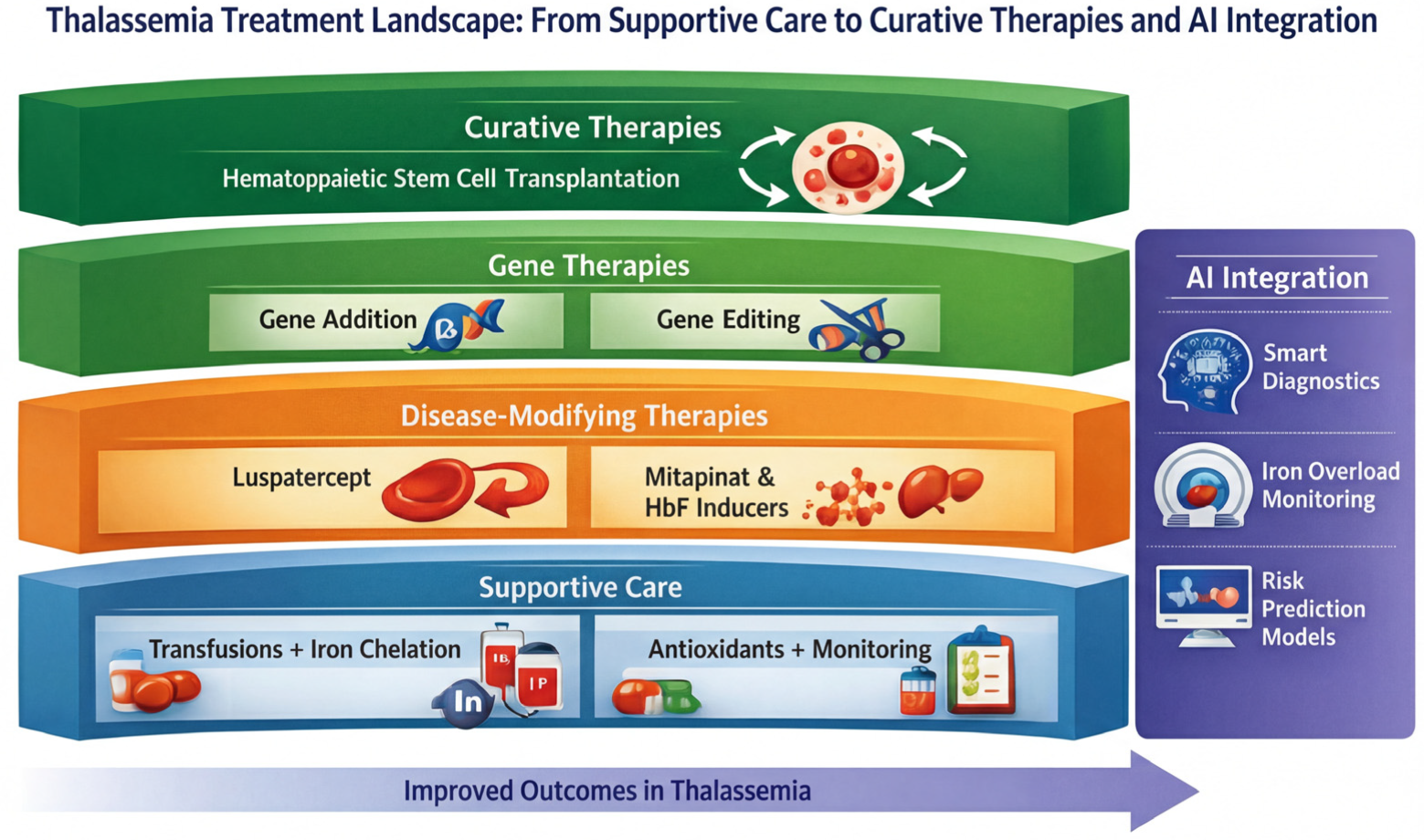
This review summarizes contemporary advances across the thalassemia treatment continuum. We first outline standard supportive care and its limitations, then discuss curative approaches (HSCT and gene-based therapies), emerging pharmacologic treatments (including luspatercept, thalidomide, and mitapivat), and evolving strategies to address iron overload and oxidative stress. We also review recent applications of artificial intelligence in thalassemia care. Table 1 summarizes established and emerging interventions organized by therapeutic intent and typical clinical fit, and Figure 1 provides a schematic overview of the treatment landscape—spanning supportive, disease-modifying, and curative strategies—and illustrates where artificial intelligence may augment clinical decision-making.

2. Artificial Intelligence: Innovative Trends in Thalassemia Care

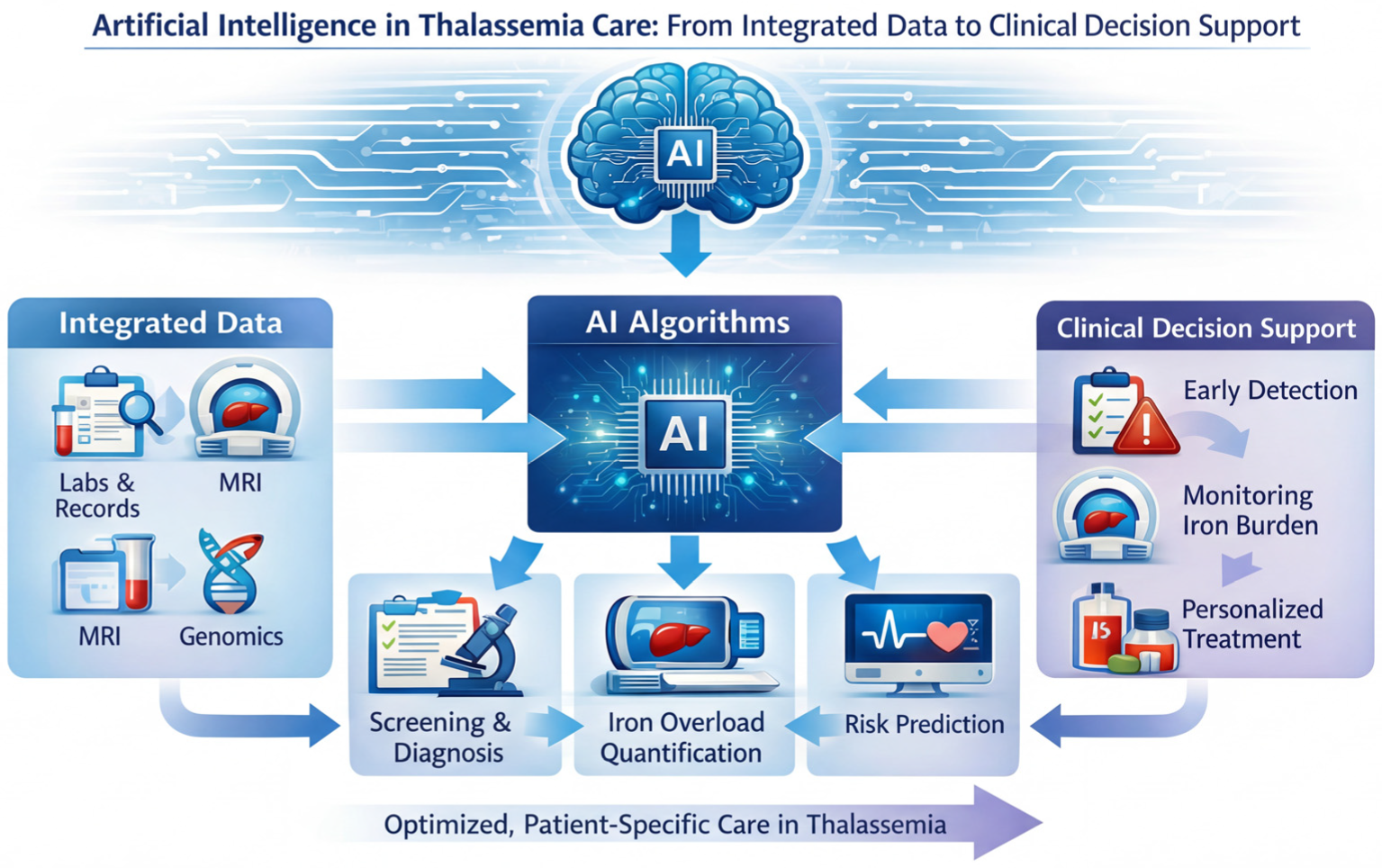
Rapid advances in artificial intelligence (AI) are creating new opportunities to improve thalassemia care across the continuum from screening and diagnosis to longitudinal monitoring and individualized treatment. AI and machine learning methods can integrate complex, multimodal datasets—including complete blood count indices, imaging-derived measures, and (when available) genomic information—to support clinical decision-making and enable more personalized management. In this section, we summarize key areas in which AI is being applied in thalassemia. Figure 2 presents an AI-enabled workflow linking multimodal clinical inputs to algorithmic tasks and downstream decision support within an appropriate governance framework.

2.1. Enhanced Diagnostics and Classification

Distinguishing thalassemia trait from other causes of microcytic anemia, particularly iron deficiency anemia, remains a common diagnostic challenge. Conventional indices such as the Mentzer index and red cell distribution width (RDW) are widely used but have only moderate diagnostic performance. Machine learning models that leverage multidimensional patterns in complete blood count (CBC) parameters have demonstrated improved discrimination. Several AI classifiers—using approaches such as neural networks, support vector machines, and random forests—have reported high accuracy for identifying thalassemia carriers. For example, diagnostic accuracies exceeding 90% for differentiating β-thalassemia trait from iron deficiency have been reported using multilayer perceptron neural networks trained on CBC features [8,9].
A representative tool, ThalPred, was developed using machine learning algorithms and a limited set of CBC parameters, reporting 93% sensitivity and 92% specificity for distinguishing thalassemia trait from iron deficiency anemia—outperforming conventional indices in that study [10,11,12]. Ensemble approaches combining multiple algorithms have also shown promise for detection of α-thalassemia carriers [13]. Such systems could be embedded within laboratory information platforms or deployed as standalone clinical decision-support tools, particularly in settings with limited access to confirmatory genetic testing. Accurate carrier detection has important implications for counseling, cascade testing, and prevention strategies.
Role of next-generation sequencing (NGS). While complete blood count–based indices and hemoglobin analysis remain central to screening, molecular confirmation is increasingly performed using targeted next-generation sequencing (NGS) panels and related assays. NGS can identify common and rare α- and β-globin variants, resolve ambiguous or discordant cases (including co-inheritance), and provide definitive carrier status for counseling and prevention programs. When combined with clinical and laboratory features, NGS outputs also serve as high-value inputs for AI models that aim to refine diagnostic classification and downstream risk stratification [3,4].
Image-based screening. Beyond numerical blood indices, AI methods are also being explored for image-based screening. Computer vision models applied to peripheral blood film images can identify morphological features associated with thalassemia, and early work has explored use of digital images to support screening in resource-limited settings. In addition, exploratory approaches have assessed whether image-based evaluation of physical signs (e.g., conjunctival pallor) may identify individuals who warrant further testing [11]. Although these strategies remain at an early stage, they may complement conventional screening pathways in high-prevalence regions.

2.2. Predictive Analytics for Transfusion Burden and Complications

AI-based predictive analytics may enable more proactive care by forecasting transfusion burden and anticipating complications. Machine learning models have been developed to predict outcomes such as transfusion requirements, risk of alloimmunization, and development of iron-related complications including cardiomyopathy. In principle, predictive models can incorporate clinical and biologic variables (e.g., baseline hemoglobin, spleen status, genotype, iron indices, and adherence patterns) to estimate how transfusion needs may evolve over time, thereby supporting earlier therapy optimization and monitoring adjustments.
Prediction of response to disease-modifying agents is another emerging area. Because responses to therapies such as luspatercept and hydroxyurea are heterogeneous, AI approaches may help identify predictors of benefit using clinical variables and—where available—higher-dimensional datasets such as gene expression or other biomarkers. Such tools could support individualized treatment selection, improve efficiency of therapy sequencing, and reduce exposure to ineffective interventions.

2.3. AI-Enabled Iron Overload Monitoring

One of the most mature and clinically relevant applications of AI in thalassemia is automated interpretation of imaging used to quantify iron burden. MRI is the reference standard for assessing organ iron deposition, yet interpretation—particularly liver R2/R2* and cardiac T2* measurements—can be time-consuming and subject to inter-observer variability. AI models have therefore been developed to automate segmentation and quantification workflows and to standardize reporting across sites.
For example, deep learning software has been developed to estimate liver iron concentration (LIC) from MRI acquired across multiple centers and scanner platforms [12]. In an independent test cohort of 1395 MRI scans, the AI approach showed close agreement with expert reference interpretation and achieved sensitivities and specificities exceeding 90% for clinically relevant LIC thresholds [12]. Such systems could improve throughput, reduce variability, and support wider dissemination of MRI-based iron quantification in centers without specialized radiology expertise in hemoglobinopathies.
Similarly, deep-learning models have been reported for automated LIC staging from multi-echo liver MRI [14]. HippoNet, a convolutional neural network framework, demonstrated strong performance for classifying iron burden categories and supporting standardized interpretation across sites [15,16]. In conventional practice, MRI-based LIC estimation using R2* relaxometry often relies on manual region-of-interest (ROI) placement, and variability can arise from differences in ROI strategy (e.g., multiple small ROIs versus whole-liver ROI); whole-liver ROI approaches have been reported to provide more consistent estimates in some settings [17]. Automated approaches may therefore reduce operator dependence and facilitate harmonized longitudinal follow-up.
Beyond quantification, AI may support risk stratification for iron-related complications. By analyzing longitudinal trajectories of ferritin, LIC, cardiac T2*, and related laboratory markers, machine learning models could potentially identify patients at increased short-term risk of cardiomyopathy or endocrine dysfunction and prompt earlier escalation of chelation intensity or cardiac surveillance. Although these predictive applications remain investigational, they represent a logical extension of automated measurement pipelines toward clinically actionable decision support.

3. Standard Management of Thalassemia

3.1. Transfusion Therapy

Chronic red blood cell transfusion is the cornerstone of care for patients with transfusion-dependent β-thalassemia major. Transfusion programs are typically initiated in early childhood when severe anemia becomes clinically apparent and are continued lifelong unless a curative intervention becomes feasible. The usual objective is to maintain a pre-transfusion hemoglobin concentration of approximately 9–10 g/dL, which suppresses ineffective erythropoiesis and mitigates symptoms of inadequate tissue oxygen delivery, including fatigue, skeletal changes, and impaired growth [18,19]. With contemporary transfusion and supportive protocols, survival has improved substantially, and many patients now reach mid-adulthood and beyond; historically, untreated children rarely survived past early adolescence [20].
Despite these gains, transfusion therapy carries important risks, including alloimmunization, transfusion reactions, and transmission of infectious agents [21,22]. Although these risks have been reduced through systematic measures—such as leukoreduction, improved compatibility testing, and stringent donor screening—ongoing vigilance remains essential [23]. In addition, the need for hospital-based transfusions every 2–5 weeks contributes significantly to treatment burden and negatively affects health-related quality of life. Recent refinements in transfusion practice aim to reduce transfusion-related morbidity while preserving effective suppression of ineffective erythropoiesis. These include broader use of leukoreduced components, extended red cell antigen matching (and, where available, genotyping) to reduce alloimmunization, and individualized transfusion intervals guided by clinical targets and iron-burden monitoring. Standardized dosing strategies and protocol-driven care pathways have also been emphasized to improve patient-centered outcomes [24,25].

3.2. Iron Chelation Therapy

The lifesaving benefits of chronic transfusion are accompanied by progressive iron accumulation because each unit of packed red blood cells contains approximately 200–250 mg of iron and humans lack a physiological mechanism for active iron excretion. Without adequate chelation, transfusional iron overload leads to iron deposition in the liver, heart, and endocrine organs, resulting in complications such as hepatic fibrosis/cirrhosis, siderotic cardiomyopathy with heart failure, and endocrine dysfunction (e.g., diabetes mellitus and hypogonadism). Historically, iron overload was a leading cause of death in β-thalassemia major, and survival to near-normal life expectancy was uncommon. Accordingly, iron chelation therapy is required for all patients receiving chronic transfusions [4,18].

3.3. Iron Chelators

Three chelators are in routine clinical use, each with distinct administration routes, pharmacologic profiles, and organ-specific effects.
Deferoxamine (DFO). Deferoxamine is a hexadentate chelator administered by subcutaneous infusion (or intravenously in selected circumstances), typically over 8–12 h on 5–7 nights per week. Introduced in the 1970s, DFO markedly improved survival, particularly by reducing cardiac iron toxicity. However, parenteral administration and the intensity of the infusion regimen can limit adherence and long-term acceptability.
Deferiprone (DFP). Deferiprone is an oral bidentate chelator introduced in the 1990s and is commonly administered three times daily. It is particularly effective for myocardial iron removal and is often used in combination with DFO in patients with high cardiac iron burden to achieve additive or synergistic iron clearance. Clinically important adverse effects include neutropenia/agranulocytosis risk and gastrointestinal intolerance.
Deferasirox (DFX). Deferasirox is an oral tridentate chelator introduced in the mid-2000s and is typically administered once daily. It is widely used because of its convenience and effectiveness for liver iron reduction. The film-coated tablet formulation (Jadenu® (Novartis, Basel, Switzerland)) is generally better tolerated than the dispersible tablet formulation (Exjade®). Notable adverse effects include renal dysfunction and hepatic enzyme elevation in a subset of patients, necessitating regular laboratory monitoring.
Because chelators differ in binding characteristics, tissue distribution, and tolerability, therapy should be individualized to iron burden, organ involvement, comorbidities, and patient preference. Combination regimens (e.g., DFO plus DFP) may be used in selected patients to intensify iron removal, particularly when cardiac iron burden is severe [19]. Aggressive and appropriately monitored chelation has enabled many patients to reach adulthood without iron-related cardiac failure or severe endocrine sequelae. Nonetheless, chelation remains challenging: adherence limitations—especially with DFO—and toxicities associated with oral chelators can compromise effectiveness, particularly in those with high iron burden. Strategies to optimize chelation intensity and explore complementary approaches (e.g., hepcidin mimetics to reduce iron absorption) remain active areas of investigation. Table 2 provides a practical comparison of commonly used chelators, highlighting administration, monitoring, and key safety considerations.

3.4. Supportive Care

Comprehensive management extends beyond transfusion and chelation and includes prevention and treatment of complications, nutritional support, and psychosocial care. Folate supplementation is commonly used to support erythropoiesis in the setting of chronic hemolysis. Endocrine complications—including hypogonadism, growth impairment, and hypothyroidism—require systematic screening and appropriate hormone replacement when indicated. Bone disease is common; calcium and vitamin D supplementation are frequently recommended, and bisphosphonates may be considered for established osteoporosis.
For patients with symptomatic hypersplenism, marked splenomegaly, or escalating transfusion requirements, splenectomy may be considered, although its use has declined because of increased risks of infection and thrombosis. Preventive strategies, including vaccination (e.g., hepatitis B) and monitoring for transfusion-transmitted infections, remain essential components of long-term care. Overall, the complexity and multisystem nature of thalassemia necessitate a multidisciplinary approach, particularly as survival improves and patients age into adulthood.
Despite major advances, standard therapy is not curative and imposes a substantial lifelong treatment burden. This underscores the importance of emerging interventions discussed in subsequent sections, especially those with the potential to achieve cure or meaningfully reduce transfusion dependence.

4. Curative Therapies

4.1. Allogeneic Hematopoietic Stem Cell Transplantation (HSCT)

Allogeneic hematopoietic stem cell transplantation (HSCT) involves infusion of hematopoietic stem cells from a healthy donor into a patient with thalassemia to establish durable donor-derived erythropoiesis and thereby achieve cure. First reported in the 1980s, HSCT has become an established curative modality, with the best outcomes observed in children and adolescents. In most centers, thalassemia-free survival exceeds 80–90% among patients receiving a Human Leukocyte Antigen (HLA)-matched sibling transplant [6]. In low-risk children—typically defined by absence of advanced iron overload and preserved organ function at the time of transplantation—overall survival and cure rates may exceed 90% [6]. Although success rates decline in older patients and those with higher baseline risk, advances in transplant technique and supportive care have improved outcomes across broader patient groups.
Early transplantation—ideally before clinically significant iron-related organ injury develops—is consistently associated with superior outcomes [6]. Patients presenting with hepatic fibrosis, poor iron control, or other comorbidities have higher risks of transplant-related mortality, graft failure, and complications. Prognostic scoring systems, such as the Pesaro criteria, help stratify risk using variables including liver size, iron burden, and chelation history. In parallel, improvements in conditioning regimens (e.g., treosulfan- or fludarabine-based approaches and individualized busulfan dosing) and more effective graft-versus-host disease (GVHD) prophylaxis have increased the safety of HSCT. The use of matched unrelated donors and alternative donor platforms (including haploidentical family donors and umbilical cord blood) has expanded access; however, outcomes remain less favorable than those achieved with HLA-matched sibling donors [20].
Despite its curative potential, HSCT is available to only a minority of patients worldwide. It has been estimated that fewer than 10% of transplant-eligible patients ultimately undergo HSCT [7]. The major constraint is limited availability of suitable HLA-matched donors, particularly in regions with smaller family sizes and limited donor registries. In addition, the infrastructure required for safe transplantation—including experienced transplant centers, supportive services, and long-term follow-up—is not universally accessible, especially in low-resource settings where thalassemia prevalence is high. HSCT also carries clinically important risks that must be weighed during decision-making, including GVHD, graft failure, and regimen-related toxicities (e.g., infertility, secondary malignancies, and organ injury). Nevertheless, for appropriately selected patients, successful HSCT offers durable freedom from transfusion dependence and its downstream complications.
In summary, allogeneic HSCT is a well-established curative option for thalassemia with excellent outcomes in carefully selected candidates, particularly those treated early and with optimal donor matching [6,7]. Ongoing efforts focus on improving safety and expanding donor availability—such as haploidentical transplantation with immune modulation—yet the limitations of HSCT continue to drive rapid development of alternative curative strategies, most notably gene-based therapies.

4.2. Gene Therapy

Gene Addition (Lentiviral) Therapy

Gene addition therapy for β-thalassemia is based on autologous modification of hematopoietic progenitor cells to enable sustained production of functional β-globin. This is typically accomplished through ex vivo transduction of patient-derived CD34+ hematopoietic stem and progenitor cells using a lentiviral vector carrying a functional β-globin gene and regulatory elements. After collection and laboratory processing, the transduced cells are reinfused following myeloablative conditioning—commonly busulfan-based—to facilitate engraftment [21,22]. The modified cells home to the bone marrow and generate erythroid progeny that express the introduced β-globin, thereby increasing hemoglobin levels and reducing transfusion requirements.
This strategy culminated in betibeglogene autotemcel (Zynteglo®), which delivers a βA-T87Q globin gene via a lentiviral vector. In August 2022, the U.S. Food and Drug Administration approved betibeglogene autotemcel for adult and pediatric patients with β-thalassemia who require regular red blood cell transfusions [23]. The European Medicines Agency approved the therapy earlier (2019). Clinical trial outcomes have been notable: in a pivotal phase III study, 20 of 22 evaluable patients (91%) with transfusion-dependent thalassemia and non-β00 genotypes achieved transfusion independence after treatment [24]. Responders maintained hemoglobin concentrations that were typically above 10 g/dL over extended follow-up [24]. Pediatric outcomes were broadly comparable to adult outcomes in these trials. In patients with more severe genotypes, response rates were lower but remained clinically meaningful, and ongoing studies are expanding eligibility criteria to include a wider range of genotypes.
For many patients, achieving transfusion independence represents a major clinical milestone that is often described as a “functional cure,” given elimination of chronic transfusion dependence and progressive transfusional iron loading. Some patients may still require temporary chelation or phlebotomy early after therapy to address pre-existing iron overload; over time, organ iron can decline as transfusions cease and iron removal continues. Patients who become transfusion-independent frequently report substantial improvement in quality of life (QOL).
Important limitations remain. Gene addition therapy is intensive and resource-demanding and resembles an autologous transplant workflow, requiring mobilization or marrow harvest, high-dose conditioning chemotherapy, specialized cell processing, and prolonged monitoring. Conditioning-related toxicities (e.g., mucositis, cytopenias, infection risk, and transient alopecia) are common, and long-term risks include infertility. From a vector-safety perspective, lentiviral platforms are engineered to minimize insertional activation of oncogenes, and to date, thalassemia studies have not reported clonal dominance or vector-associated malignancy; nonetheless, long-term follow-up remains essential. Not all patients achieve transfusion independence, and responses may be less robust in the most severe genotypes (including β00), in which some patients remain transfusion-reduced rather than transfusion-free. Although the FDA-approved indication is based on transfusion requirements, evidence in specific subpopulations continues to evolve, and ongoing work seeks to refine patient selection and optimize vector design and delivery to improve efficacy across genotypes.
In conclusion, lentiviral gene addition therapy offers a one-time intervention with the potential to eliminate lifelong transfusion dependence and reduce iron-related morbidity, but its implementation is constrained by complexity, cost, and specialized infrastructure. The 2022 FDA approval represents a major advance; however, broad access remains limited because therapy acquisition and delivery costs and the need for highly specialized centers are prohibitive in many settings. As real-world experience expands, costs may decline and may be partially offset by long-term reductions in transfusion- and complication-related healthcare utilization.

4.3. Gene Editing

In addition to gene addition, genome-editing approaches—particularly CRISPR/Cas9—have been developed for thalassemia with the goal of modifying endogenous gene regulation to ameliorate the underlying pathophysiology. Rather than introducing a new β-globin gene, these strategies edit the patient’s genome to restore a more favorable globin expression balance. A leading approach targets regulatory pathways that reactivate fetal hemoglobin (HbF), an observation supported by the clinical phenotype of hereditary persistence of fetal hemoglobin [25]. This has motivated therapeutic editing of BCL11A, a transcriptional repressor that suppresses HbF in erythroid cells [26]. By editing an erythroid-specific enhancer of BCL11A in autologous stem cells, CRISPR-based therapy can reduce BCL11A activity in erythroid progeny and thereby induce robust HbF expression in circulating red blood cells [27].
Exagamglogene autotemcel (exa-cel; formerly CTX001) is the most advanced clinical implementation of this concept. In early clinical experience, treated transfusion-dependent thalassemia (TDT) patients achieved transfusion independence following a single infusion of edited autologous cells [28]. In a subsequent cohort of 44 individuals with transfusion-dependent β-thalassemia, 42 (95%) achieved transfusion independence, while the remaining patients experienced substantial reductions in transfusion requirements. These outcomes have been reported in peer-reviewed clinical trial publications, including detailed endpoints on durability and safety in transfusion-dependent β-thalassemia [28]. Longitudinal follow-up from initially treated patients has shown sustained transfusion independence with persistently high HbF levels for more than three years [29]. Conceptually, this approach harnesses endogenous fetal globin expression rather than relying on transgene expression, offering a potentially genotype-agnostic mechanism because HbF can functionally substitute for deficient adult β-globin.
On 16 January 2024, the U.S. Food and Drug Administration approved exagamglogene autotemcel (CASGEVY™; exa-cel), a CRISPR/Cas9-edited autologous hematopoietic stem cell therapy, for patients aged 12 years and older with transfusion-dependent β-thalassemia. The clinical workflow parallels autologous gene therapy, including stem cell collection, myeloablative conditioning, and reinfusion. Reported adverse events are predominantly conditioning-related (e.g., cytopenias and infection risk). To date, no major safety signals attributable to off-target editing have been reported; however, long-term surveillance remains essential to evaluate durability and late adverse effects. Emerging trial data suggest benefits across a range of genotypes, including severe genotypes, consistent with the mechanistic premise that HbF induction can compensate for deficient adult β-globin [25].
The availability of both lentiviral gene addition and CRISPR-based gene editing represents a transformative shift in the therapeutic landscape for β-thalassemia. These approaches offer curative-intent alternatives for patients without suitable HLA-matched donors or for those unable to undergo allogeneic transplantation. Nonetheless, major implementation challenges remain—particularly access, affordability, and the need for specialized centers—especially in high-burden, resource-limited regions. Even so, the proof-of-concept is now well established: a single administration of genetically modified autologous stem cells can achieve durable transfusion independence in many patients with β-thalassemia. Continued innovation is expected to improve conditioning tolerability, expand applicability across genotypes and age groups, and potentially extend curative strategies to α-thalassemia.

5. Progress in Drug Development and Disease-Modifying Therapies

Several pharmacologic agents have been evaluated to improve anemia and reduce transfusion burden in thalassemia, particularly for patients who lack access to curative interventions. These therapies act through diverse mechanisms, including promotion of erythroid maturation, induction of fetal hemoglobin (HbF), and improvement of red cell metabolism. Below, we summarize the most clinically relevant advances in this area.

5.1. Luspatercept and Enhancement of Erythropoiesis

Luspatercept is an erythroid maturation agent that has expanded disease-modifying options for β-thalassemia. It is a recombinant fusion protein derived from activin receptor type IIB (ActRIIB) that functions as a ligand trap for selected transforming growth factor-beta (TGF-β) superfamily ligands involved in late-stage erythropoiesis [27]. By reducing aberrant SMAD2/3 signaling—implicated in ineffective erythropoiesis—luspatercept promotes terminal erythroid maturation and increases production of functional red blood cells. Ineffective erythropoiesis is a central feature of β-thalassemia and contributes to anemia, marrow expansion, and downstream complications; luspatercept addresses this pathophysiology by increasing the proportion of erythroid precursors that mature successfully.
Clinical trials have demonstrated that luspatercept can reduce transfusion requirements in adults with transfusion-dependent β-thalassemia. In the phase 3 BELIEVE trial, a significantly higher proportion of patients receiving luspatercept achieved at least a 33% reduction in transfusion burden compared with placebo (21% vs. 4.5% over 12 weeks), with some patients achieving reductions exceeding 50% [28]. In non–transfusion-dependent populations, luspatercept has been associated with hemoglobin increases on the order of 1–2 g/dL in clinical studies. These data supported approval of luspatercept in 2019 as the first pharmacologic agent shown to modify transfusion burden in β-thalassemia [29]. Luspatercept is administered subcutaneously every three weeks and is used primarily in adults with transfusion-dependent thalassemia (TDT) to reduce transfusion volume and, in selected patients with non–transfusion-dependent thalassemia (NTDT), to improve anemia-related symptoms.
In real-world practice, some patients experience meaningful extension of transfusion intervals, and a subset may achieve periods of transfusion independence, often accompanied by improvements in quality of life [30,31]. Reduced transfusion exposure may also lessen the rate of iron accumulation over time. Luspatercept is generally well tolerated; the most commonly reported adverse effects include bone pain, arthralgia, dizziness, and occasional hypertension. Evidence in pediatric populations remains limited, and ongoing studies are evaluating efficacy and safety in younger patients and in those with very high baseline transfusion requirements. Sotatercept (an ActRIIA-Fc fusion protein) was evaluated earlier in related pathways; however, development in this indication did not progress, and luspatercept demonstrated the most compelling efficacy in β-thalassemia.
Long-term follow-up indicates that responses can be durable, although not all patients respond and some may experience waning benefit over time. Predictors of response are not fully defined; lower endogenous erythropoietin levels and lower baseline transfusion burden have been associated with greater likelihood of benefit in some analyses. Future work will clarify optimal patient selection and evaluate rational combinations with other agents. Overall, luspatercept represents a substantial advance by offering a disease-modifying option that targets ineffective erythropoiesis beyond transfusion and chelation alone.

5.2. Induction of Fetal Hemoglobin: Thalidomide and Other Agents

An established disease-modifying strategy in hemoglobinopathies is pharmacologic induction of fetal hemoglobin (HbF). Because HbF can partially substitute for deficient adult β-globin, increasing HbF may improve anemia and reduce transfusion burden in β-thalassemia. This approach is well established in sickle cell disease and has been investigated in β-thalassemia intermedia and other non–transfusion-dependent phenotypes, where increases in HbF and total hemoglobin can translate into clinical benefit.
Hydroxyurea. Hydroxyurea is an oral agent that induces HbF and has been used for decades in β-thalassemia, particularly in non–transfusion-dependent thalassemia (NTDT). In selected NTDT patients, hydroxyurea has been associated with hemoglobin increases of approximately 1–2 g/dL and reduced transfusion requirements [32,33]. However, responses are heterogeneous and generally less robust than those observed in sickle cell disease. A proportion of patients demonstrate meaningful benefit, while others show minimal response, and hydroxyurea is therefore used variably by region—often as a second-line or adjunctive option in NTDT.
Thalidomide. Thalidomide, a teratogenic immunomodulatory agent, has emerged as one of the most potent oral HbF inducers reported in thalassemia studies. Proposed mechanisms include epigenetic modulation and activation of signaling pathways such as p38 MAPK, with downstream effects on γ-globin expression [34,35]. Across studies in transfusion-dependent thalassemia, thalidomide has been associated with substantial hematologic responses, including reductions in transfusion burden (often ≥50%) and/or clinically meaningful hemoglobin increases at doses commonly ranging from 50 to 100 mg/day. Meta-analytic data have reported high overall response rates, with a substantial proportion of patients achieving transfusion cessation in some cohorts [36,37]. In NTDT, response rates may be even higher, with reported mean hemoglobin increases on the order of ~2–3 g/dL in some analyses [29,38]. Collectively, these findings suggest that thalidomide can convert some patients from a transfusion-dependent to a less transfusion-intensive phenotype, although response definitions and study designs vary.
Individual studies further support these observations. Yassin et al. reported clinically meaningful hematologic improvement in multi-transfused β-thalassemia patients receiving thalidomide [39], and Li et al. reported hemoglobin increases and reduced transfusion needs in pediatric cohorts [40]. Consequently, in some settings—particularly where advanced therapies are not accessible—thalidomide has been adopted as a pragmatic option for selected patients with substantial transfusion burden.
Thalidomide use is limited by clinically important toxicities, including sedation, constipation, peripheral neuropathy, and an increased risk of thromboembolic events; hypothyroidism has also been reported [41,42]. It is contraindicated in pregnancy because of its well-established teratogenicity, and stringent risk-management measures (including pregnancy testing and effective contraception) are mandatory for patients of childbearing potential [43]. Although many adverse events are manageable with dose adjustments and interruptions, long-term safety in thalassemia remains incompletely characterized because most studies have relatively short follow-up (typically 1–2 years) [44,45].
Other HbF-directed agents. Other pharmacologic approaches have been explored, but results have generally been less consistent than those reported for thalidomide. For example, the DNA methyltransferase inhibitor decitabine, sometimes combined with erythropoietin, has demonstrated HbF induction in small studies, including in hemoglobin E/β-thalassemia [46,47]. However, intravenous administration and the risk of cytopenias limit widespread use. Histone deacetylase inhibitors have also been evaluated preclinically as γ-globin reactivators, though clinical translation remains limited.
In summary, thalidomide appears to be an effective and comparatively low-cost oral HbF inducer in selected thalassemia populations, which may be particularly relevant in resource-limited settings where transfusion optimization, HSCT, and gene-based therapies are less accessible. Ongoing controlled trials are needed to better define its risk–benefit profile, optimal dose and duration, and the patient subgroups most likely to benefit with acceptable toxicity. Future strategies may include development of safer analogues and rational combinations (e.g., with luspatercept or hydroxyurea) to enhance efficacy while minimizing adverse effects.

5.3. Pyruvate Kinase Activators (Mitapivat)

A complementary approach to improving anemia in thalassemia is to enhance red cell metabolic capacity and thereby improve erythrocyte survival. Thalassemic red blood cells exhibit metabolic and structural abnormalities that shorten lifespan and contribute to hemolysis. Mitapivat is an oral activator of red cell pyruvate kinase (PK), a key glycolytic enzyme that regulates adenosine triphosphate (ATP) generation. By increasing PK activity, mitapivat raises ATP levels, improves membrane stability, and may reduce hemolysis. Following its initial approval for pyruvate kinase deficiency, mitapivat has been investigated in other hemolytic anemias, including thalassemia.
In non–transfusion-dependent α- or β-thalassemia, the phase 3 ENERGIZE study reported that 42% of participants receiving mitapivat achieved a hemoglobin increase of ≥1 g/dL sustained for at least 12 weeks, compared with 2% in the placebo group (p < 0.0001) [48,49]. Among responders, the mean hemoglobin increase was approximately 1.7 g/dL. Patient-reported outcomes also suggested improvements in fatigue and exercise tolerance, including performance measures such as the 6-min walk distance [50,51]. Adverse events were generally mild to moderate, with headache, insomnia, and nausea reported most commonly, and serious adverse event rates were similar to placebo in the available reports [52].
Mitapivat has also been evaluated in transfusion-dependent thalassemia (TDT), including the ENERGIZE-T program. Early-phase data suggest that mitapivat may reduce transfusion requirements in a subset of patients, and some individuals have achieved substantial reductions or transient transfusion independence in preliminary studies [53,54]. Phase 3 results in TDT are awaited. Importantly, mitapivat does not directly address globin chain imbalance; rather, it targets downstream consequences of thalassemia, including red cell fragility and shortened survival. This mechanistic profile supports consideration of mitapivat as a complementary agent, potentially used alongside therapies that target ineffective erythropoiesis or HbF induction (e.g., luspatercept or thalidomide), pending confirmatory clinical trial data.
On 5 January 2026, the U.S. Food and Drug Administration approved mitapivat (Aqvesme) for the treatment of anemia in adults with α- or β-thalassemia, and it has also received regulatory authorization in Saudi Arabia for adult thalassemia indications [55]. Mitapivat therefore represents a first-in-class example of metabolic modulation as a therapeutic strategy in thalassemia. Ongoing studies will refine its optimal positioning, including use in combination regimens and evaluation in pediatric populations.

5.4. Other Emerging Drugs

Beyond the agents discussed above, several additional therapeutic classes are under investigation for thalassemia, targeting iron regulation, erythroid stress pathways, and broader modifiers of erythropoiesis:
Hepcidin mimetics and modulators. Dysregulated iron homeostasis—particularly suppressed hepcidin and increased intestinal iron absorption—is a key contributor to iron loading, especially in NTDT. Accordingly, agents that increase hepcidin activity or suppress ferroportin are being developed. Rusfertide (PTG-300) is a hepcidin mimetic with early-phase human pharmacokinetic and pharmacodynamic data; its clinical role in thalassemia remains investigational [56].
mTOR inhibitors. The mechanistic target of rapamycin (mTOR) pathway is implicated in cellular stress responses, and inhibition may influence ineffective erythropoiesis and globin chain toxicity. Pilot clinical data in β-thalassemia suggest that sirolimus may modestly increase γ-globin/HbF in selected patients, while preclinical studies support an autophagy-mediated reduction in toxic globin-chain accumulation; larger controlled studies are needed to establish efficacy and safety [57,58,59].
JAK2/STAT5 pathway modulation. Erythropoietin receptor signaling through JAK2/STAT5 is central to erythroid proliferation and differentiation. Although no established JAK2/STAT5-targeted therapy is currently approved for thalassemia, this axis remains of interest as a potential lever to modulate erythroid maturation and reduce ineffective erythropoiesis in select contexts [60].
Natural and preclinical agents. Several compounds with antioxidant and anti-apoptotic properties, such as quercetin, have been evaluated in preclinical models and cell-based systems. While these agents may influence hypoxia signaling and erythroid stress pathways, evidence remains insufficient to support routine clinical use, and translation will require rigorous clinical evaluation.
Combination strategies. Combination therapy is an emerging area of interest, motivated by the multifactorial biology of thalassemia. Rational combinations—such as pairing luspatercept with an HbF inducer (e.g., thalidomide) or combining mitapivat with agents targeting ineffective erythropoiesis—may yield additive benefit by addressing distinct mechanisms. Early reports and case series suggest potential utility, but randomized clinical trials are required to define efficacy, safety, and optimal sequencing.
Overall, the pharmacologic treatment landscape for thalassemia is expanding rapidly. As novel agents enter practice, cost and equitable access will be critical considerations, particularly in low-resource, high-burden regions. In this context, clinicians will increasingly need to individualize therapy based on disease phenotype, transfusion intensity, comorbidity profile, and local availability—balancing efficacy, safety, and feasibility to achieve meaningful improvements in anemia, transfusion burden, and long-term complications.

6. Iron Overload Management

Effective management of iron overload is a central determinant of long-term outcomes in thalassemia and directly influences the safety and success of all therapeutic modalities. Even as disease-modifying agents reduce transfusion requirements and curative approaches become more widely available, many patients enter these pathways with substantial pre-existing iron burden that must be addressed to prevent irreversible end-organ injury. This section summarizes contemporary approaches to iron overload management, including advances in chelation delivery, monitoring, and adjunctive strategies.

6.1. Chelation Therapy Updates

As outlined in standard management, the three principal chelators—deferoxamine (DFO), deferiprone (DFP), and deferasirox (DFX)—remain the foundation of iron removal in transfused patients. Recent progress has largely reflected optimization of existing therapies rather than introduction of new chelators. A notable advance has been the development of the film-coated deferasirox formulation (Jadenu® (Novartis, Basel, Switzerland)), which can be swallowed whole and replaces the older dispersible formulation (Exjade®). This formulation has improved gastrointestinal tolerability and dosing convenience and has been associated with high patient satisfaction without loss of efficacy after conversion from dispersible tablets [61,62].
Contemporary chelation practice increasingly emphasizes individualized dose titration guided by quantitative iron assessment. Intensification strategies are commonly applied in patients with high liver iron concentration (LIC) and/or evidence of myocardial iron loading assessed by cardiac T2* (an MRI relaxometry measure of myocardial iron), whereas dose de-escalation is used after achievement of low iron levels to reduce the risk of over-chelation and toxicity.
Combination chelation remains an important strategy for patients with severe systemic iron overload or organ-specific iron burden that is inadequately controlled with monotherapy. The most established regimen is combined subcutaneous DFO and oral DFP. Long-term studies of DFO plus DFP demonstrate enhanced cardiac iron removal and improved cardiac outcomes compared with DFO alone, supporting its use in patients with significant myocardial iron loading or iron-related cardiomyopathy [63,64]. Dual oral chelation (DFP plus DFX) has also been used in selected settings to improve feasibility and adherence, with smaller studies suggesting reductions in liver iron and serum ferritin; however, careful monitoring is required because of the potential for additive toxicities. Triple chelation (DFO plus DFP plus DFX) has been reported in extreme iron overload, but evidence remains limited, and such approaches should be reserved for highly selected cases under expert supervision.

6.2. Monitoring Advances

Accurate assessment of iron burden is essential to guide chelation intensity, monitor response, and prevent end-organ complications. Serum ferritin remains widely used for longitudinal surveillance but is an imperfect surrogate because it is influenced by inflammation and liver injury. Consequently, magnetic resonance imaging (MRI)–based iron quantification has become standard in many settings. Cardiac T2* MRI provides a validated measure of myocardial iron and has prognostic value, as low T2* values are associated with increased risk of heart failure. Hepatic iron can be quantified using MRI-based relaxometry (e.g., R2*, an MRI parameter used to estimate liver iron concentration), providing an objective estimate of liver iron concentration. Longitudinal, organ-specific MRI monitoring is increasingly emphasized to guide chelation escalation/de-escalation and to reduce iron-related morbidity [61].
Additional advances include improved standardization of MRI acquisition and calibration protocols, as well as broader availability of specialized software platforms and commercial services that support interpretation and longitudinal tracking. Beyond imaging, several circulating biomarkers—including hepcidin, soluble transferrin receptor, and non–transferrin-bound iron—are under investigation as complementary tools for risk stratification and monitoring of iron toxicity; however, these remain investigational and are not yet routinely implemented in clinical practice.

6.3. Hepcidin Agonists and Iron-Restriction Strategies

A developing adjunctive approach to iron overload management is therapeutic modulation of hepcidin, the master regulator of systemic iron homeostasis. In β-thalassemia, hepcidin is inappropriately suppressed by signals arising from ineffective erythropoiesis, leading to increased intestinal iron absorption and enhanced iron release from macrophages. This mechanism is particularly relevant in non–transfusion-dependent thalassemia (NTDT), in which progressive iron loading can occur even in the absence of transfusions. Strategies to increase hepcidin activity include synthetic hepcidin analogues (e.g., mini-hepcidins) and pharmacologic induction of endogenous hepcidin production. Although some drugs (e.g., certain protease inhibitors) have been observed to increase hepcidin in experimental contexts, they have not demonstrated a practical role in thalassemia care.
Rusfertide (PTG-300), an injectable hepcidin mimetic in clinical development for disorders of iron dysregulation, is of particular interest as a potential iron-restriction strategy. In principle, periodic administration could reduce intestinal iron absorption and complement chelation—especially in NTDT patients with ongoing iron accumulation driven by increased absorption. To date, however, hepcidin agonists are not established therapies for thalassemia, and their clinical positioning will depend on efficacy, safety, and integration with existing chelation regimens.

6.4. Organ-Selective Iron Depletion

Chelators differ in their relative effectiveness for iron removal from specific organs. Clinically, deferiprone has been associated with favorable myocardial iron clearance, whereas deferasirox is often effective for liver iron reduction; selected combinations may therefore be used to target mixed patterns of iron loading. Optimizing iron removal from endocrine organs (e.g., pituitary gland and pancreas) remains challenging, and ongoing work seeks to refine chelation strategies that better prevent endocrine morbidity. Evidence suggests that early, adequately intensive chelation may reduce the risk of hypogonadism and other endocrine complications. In addition, in post-splenectomy patients—who may exhibit altered iron distribution with increased macrophage iron sequestration—chelators with intracellular activity (including DFP) may offer practical advantages in selected cases.

6.5. Addressing Toxicities and Safety Monitoring

Chelation therapy requires systematic safety monitoring and dose adjustment. DFO may cause growth impairment when used at high doses or initiated very early; contemporary practice therefore tailors dosing to body weight and iron indices and often prioritizes oral agents in younger children when feasible. DFP carries a rare but serious risk of agranulocytosis, necessitating regular absolute neutrophil count monitoring during treatment. DFX is associated with renal and hepatic adverse effects in a subset of patients; monitoring of serum creatinine/eGFR, urine protein, and liver enzymes is therefore required, with dose modification as needed. These structured safety protocols are essential to maximize efficacy while minimizing preventable toxicity during long-term therapy.

6.6. Patient Adherence

Adherence is a major determinant of chelation effectiveness and remains a persistent challenge, particularly for adolescents and young adults managing lifelong therapy. The burden of nightly infusions (DFO) or multiple daily oral dosing regimens can contribute to treatment fatigue, interruptions, and suboptimal iron control. Adherence-support strategies include patient and caregiver education, structured psychosocial support, simplification of regimens when possible, and use of enabling technologies (e.g., lightweight programmable infusion pumps for DFO and digital reminders for oral chelation). Peer-support programs and patient communities have also been implemented in some centers to reinforce adherence behaviors and normalize long-term self-management.

6.7. Summary

Iron overload management in thalassemia has advanced substantially through improved chelator formulations, individualized dosing strategies, and broader availability of MRI-based organ-specific monitoring. Nevertheless, iron removal remains a long-term, resource-intensive process, and incomplete chelation continues to contribute to preventable morbidity. Looking ahead, reduced transfusion exposure from disease-modifying therapies—and curative therapies that eliminate transfusion dependence—should progressively decrease iron loading in many patients; however, substantial pre-existing iron burden will still require active management. For patients with severe overload, combination chelation and emerging adjunctive strategies (including hepcidin-based approaches) may shorten the time to safe iron levels. In addition, artificial intelligence–enabled tools (discussed in Section 7) may support risk stratification and personalization of monitoring and chelation intensity by identifying patients at greatest risk for end-organ complications. Even as curative strategies expand, rigorous control of iron burden will remain essential to ensure that gains in survival translate into improved long-term health and quality of life.

7. Antioxidant and Supportive Therapies

Oxidative stress is a well-recognized component of thalassemia pathophysiology. Ineffective erythropoiesis, chronic hemolysis, and iron overload increase circulating and intracellular pools of free iron, heme, and unpaired globin chains, which promote generation of reactive oxygen species (ROS). Excess ROS damages red blood cell membranes and contributes to tissue injury, thereby participating in complications such as endothelial dysfunction and progressive organ damage. Consequently, antioxidant therapy has been investigated as an adjunct to standard care, with the aim of reducing oxidative injury and potentially improving selected clinical and laboratory parameters.
Patients with thalassemia experience persistent oxidative stress related to hemolysis and iron loading, which can contribute to cumulative cellular and organ injury [1,63]. This has motivated evaluation of antioxidant co-therapies as supportive strategies to mitigate oxidative damage alongside transfusion and chelation.

7.1. Natural Antioxidants

Several randomized or controlled studies have evaluated natural antioxidant adjuncts—such as omega-3 fatty acids, Manuka honey, and Nigella sativa (black seed)—as add-on therapies to standard transfusion and chelation regimens, reporting improvements in selected oxidative stress biomarkers and, in some studies, iron indices and hematologic parameters [2,3].
In one randomized trial, supplementation with omega-3 fatty acids (1000 mg fish oil) combined with Manuka honey was associated with reductions in oxidative stress markers and improvements in selected laboratory measures compared with standard care alone [2,3]. The intervention was reported to reduce plasma 8-iso-prostaglandin F2α (a lipid peroxidation marker) and to decrease lactate dehydrogenase (LDH), a marker of hemolysis, relative to controls [4,5,6]. Improvements in lipid profile were also described, including increased high-density lipoprotein cholesterol and normalization of low-density lipoprotein cholesterol compared with controls [7,18]. Several reports additionally suggested favorable changes in iron indices, with lower serum ferritin and serum iron levels after prolonged supplementation compared with standard therapy [19,20]. In the same trial series, hemoglobin levels were higher in the antioxidant arm, and fewer transfusion sessions were reported during follow-up compared with controls [21,22]. A subsequent cost-effectiveness analysis suggested that omega-3 plus Manuka honey—and Manuka honey alone—could be clinically beneficial in reducing oxidative stress biomarkers at acceptable incremental cost compared with standard care [23,25].
A separate randomized trial examined N. sativa (black seed oil, rich in thymoquinone) combined with Manuka honey as an adjunct to chelation therapy. The N. sativa plus Manuka regimen was associated with a greater reduction in serum ferritin than control regimens, and improvements were also reported in serum iron, transferrin saturation, and liver enzymes (alanine aminotransferase and aspartate aminotransferase), suggesting attenuation of iron-associated oxidative injury [27,28,29,30]. Collectively, these studies indicate that selected natural antioxidant adjuncts may improve oxidative stress biomarkers and some iron-related indices, although heterogeneity in study design, populations, and endpoints limits generalizability.
Overall, natural antioxidant adjuncts (e.g., omega-3 fatty acids, Manuka honey, and black seed oil) may reduce oxidative stress markers and, in selected studies, improve hematologic indices and transfusion burden [4,21]. However, these interventions should be interpreted as supportive measures rather than disease-modifying therapy, and larger, rigorously designed trials are needed to establish reproducible clinical benefit.

7.2. Vitamin E

Vitamin E (α-tocopherol) is a lipid-soluble antioxidant that protects cell membranes from lipid peroxidation. Patients with thalassemia may exhibit low vitamin E levels due to increased oxidative consumption, and supplementation has therefore been evaluated in several studies. Available data suggest that high-dose vitamin E can reduce oxidative damage markers (e.g., malondialdehyde) and may improve red blood cell stability and survival [62,64,65]. A meta-analysis of randomized trials reported that pediatric patients with transfusion-dependent thalassemia receiving vitamin E supplementation for several months experienced modest increases in hemoglobin (approximately +0.5 to +1.0 g/dL) and reductions in oxidative stress indices [40,66]. Vitamin E was generally well tolerated in these studies at doses commonly ranging from 400 to 800 IU/day. Although very high doses of vitamin E have theoretical bleeding risk, clinically significant coagulation effects have not been prominent in the published thalassemia trials.
Vitamin E has also been studied as an adjunct to chelation therapy. Limited evidence suggests that supplementation may improve hepatic oxidative injury and could potentially support liver iron concentration response during deferasirox treatment, although confirmatory studies are needed [67].

7.3. N-Acetylcysteine (NAC)

N-acetylcysteine (NAC) is a precursor of glutathione, a major intracellular antioxidant, and has been investigated as a supportive therapy in thalassemia to restore redox balance. Clinical studies in transfusion-dependent thalassemia have shown that NAC reduces oxidative stress biomarkers such as F2-isoprostanes and protein carbonyls and may improve neutrophil oxidative burst regulation by lowering intracellular ROS [68,69]. One study also reported a modest reduction in infection frequency, potentially through improved immune cell redox status [65].
NAC alone has not consistently produced substantial hemoglobin increases; however, benefits on hemoglobin and overall antioxidant status have been reported when NAC is used in combination with other antioxidants (including vitamin E). A meta-analysis reported that NAC supplementation, similar to vitamin E, was associated with hemoglobin increases in children with transfusion-dependent thalassemia on the order of ~0.5–1.0 g/dL and improved antioxidant indices [70]. NAC is available as an inexpensive oral supplement and is generally well tolerated; typical dosing in studies has ranged around 10–15 mg/kg/day, with occasional gastrointestinal intolerance or sulfur odor as the most commonly reported adverse effects.

7.4. Combination Antioxidant Regimens

Given the multifactorial nature of oxidative injury, combination antioxidant regimens have also been evaluated. A clinical study using vitamin E, vitamin C, and NAC in patients with hemoglobin E/β-thalassemia reported reductions in oxidative stress markers with minimal changes in hemoglobin [71]. Another study in β-thalassemia/hemoglobin E reported decreased oxidative stress, improved hemoglobin, and reduced markers of hypercoagulability following a year of combination antioxidant supplementation [72].
The rationale for combination therapy is biologically plausible: vitamin E protects lipid membranes, vitamin C can regenerate oxidized vitamin E and scavenge ROS, and NAC supports intracellular glutathione synthesis. While generally considered safe at moderate doses, evidence remains limited by small sample sizes and heterogeneous endpoints. Common supplement schedules include vitamin E (400–800 IU/day) plus vitamin C (e.g., 500 mg/day). Vitamin C may also increase iron mobilization and thereby potentially enhance chelation; however, caution is warranted in poorly chelated patients because increased labile iron could theoretically aggravate cardiac oxidative injury. Selenium is sometimes supplemented as a cofactor for glutathione peroxidase, and small trials have reported modest reductions in oxidative markers, though evidence remains preliminary.

7.5. L-Carnitine

Although not a classical antioxidant, L-carnitine is involved in mitochondrial fatty acid transport and energy metabolism and has been investigated in thalassemia because carnitine levels may be reduced in some patients. Limited studies suggest that L-carnitine supplementation may improve exercise tolerance and, in some reports, cardiac function parameters in thalassemia major, potentially through effects on myocardial metabolism and oxidative stress. Evidence remains mixed, and routine use is not standardized.

7.6. Other Supportive Supplements

Supportive care may also include folic acid supplementation to support erythropoiesis in the setting of increased red blood cell turnover, and zinc replacement in patients with documented deficiency (relevant to growth and immune function). Curcumin, a natural polyphenol with antioxidant properties and potential iron-chelating activity, has been evaluated in a pilot trial; supplementation was associated with reductions in liver iron and oxidative stress indices but did not produce significant hemoglobin increases [73]. Additional studies are required to confirm any clinical benefit.

7.7. Outcomes and Clinical Positioning of Antioxidant Therapy

Expectations for antioxidant and supportive therapies should be calibrated appropriately: these interventions are adjuncts and should not replace transfusion or chelation. In most studies, effects on hemoglobin and transfusion burden are modest and inconsistent across populations. Their primary potential value is reduction in oxidative tissue injury, which could plausibly mitigate downstream vascular and endocrine complications over time. For example, oxidative stress contributes to endothelial dysfunction and prothrombotic tendency in non–transfusion-dependent thalassemia [64,67,74], which is associated with complications such as leg ulcers and pulmonary hypertension [74,75]; antioxidant strategies might reduce risk through improved endothelial function. Some studies have reported improvements in flow-mediated dilation, a marker of endothelial function, in NTDT patients receiving antioxidant supplementation.
In summary, antioxidant adjuncts—including vitamin E and NAC—appear to reduce oxidative stress biomarkers in thalassemia and may provide modest benefits in selected hematologic and iron-related parameters. Their low cost and generally favorable safety profile make them reasonable supportive options in selected patients, particularly those with evidence of increased oxidative stress; however, larger randomized trials and high-quality meta-analyses are needed to define their clinical impact and optimal use.
As curative and disease-modifying therapies increasingly address upstream drivers of hemolysis and iron loading, reliance on adjunctive antioxidant strategies may diminish. Nevertheless, until such therapies become broadly accessible, supportive interventions that mitigate oxidative injury may remain relevant components of comprehensive thalassemia care [69].

8. Genomic Analysis and Personalized Therapy

Thalassemia is genetically heterogeneous: more than 200 pathogenic variants have been described in the β-globin gene, and clinical severity is further modified by co-inherited traits and regulatory modifiers [1,3,4]. Emerging applications of artificial intelligence (AI) in genomics are improving interpretation of sequence variants, including classification of variants of uncertain significance and prediction of pathogenicity for newly identified globin variants [4,7]. In addition, machine learning approaches can integrate primary genotype with known genetic modifiers to refine phenotype prediction and risk stratification [7]. In complex scenarios—such as co-inheritance of α-thalassemia with β-thalassemia and the influence of HbF-modifying loci (e.g., BCL11A and related regulatory regions)—AI-based models may provide more accurate severity estimates than conventional rule-based approaches, consistent with the central role of HbF regulation and BCL11A biology in modulating phenotype [26,38]. Such predictions could inform clinically meaningful decisions, including transfusion planning, intensity of monitoring, and timing of referral for curative-intent interventions [4,39].
Genotype–phenotype interactions and AI-based modifier discovery. Clinical severity in β-thalassemia is not determined by the primary HBB genotype alone; phenotype is shaped by interacting modifiers such as co-inherited α-thalassemia, determinants of fetal hemoglobin (HbF) expression, and variation in erythropoiesis/iron-regulatory pathways [3,4,6]. These interactions create clinically meaningful variability in transfusion burden, hemolysis, iron loading, and complication risk among patients with otherwise similar primary mutations [25,26,31]. AI and machine learning methods are well suited to model these high-dimensional relationships by combining NGS-derived variant calls with known modifier loci and longitudinal clinical phenotypes. In large datasets, such approaches can be used to (i) identify SNP/variant patterns associated with milder versus severe disease, (ii) prioritize candidate modifier genes for mechanistic follow-up, and (iii) generate individualized severity predictions that inform transfusion planning, surveillance intensity, and timing of referral for curative-intent therapies [11,46,76].
AI also has an emerging role in the development and optimization of gene-based therapies. In gene addition therapy, computational and machine learning methods are increasingly used to support vector design and optimization of regulatory elements to improve expression and reduce unwanted integration effects [35,47]. In gene editing, AI-enabled tools can assist in guiding RNA design and off-target risk prediction—key determinants of clinical translation—thereby improving the precision and safety profile of CRISPR-based approaches [25,27]. Collectively, these applications may accelerate development of more effective and safer personalized therapies for thalassemia [25,38].

9. Clinical Decision Support and Telemedicine

Thalassemia-specific AI-enabled clinical decision support systems are in development to assist clinicians in synthesizing longitudinal patient data and generating evidence-informed recommendations [11]. Potential applications include optimization of chelation therapy based on ferritin trajectories, MRI-derived iron measures, renal and hepatic safety laboratories, and patient-reported symptoms; such systems could also flag patterns suggestive of emerging complications (e.g., endocrine dysfunction) and prompt timely screening or referral. Because thalassemia requires lifelong monitoring, patients accumulate high-dimensional longitudinal data that can be difficult to interpret reliably in routine practice. AI methods are well suited to detect subtle trends, outliers, and early warning signals that may not be apparent from episodic clinical review [11,77].
In parallel, telemedicine platforms are increasingly being used to support chronic disease management in thalassemia, particularly for follow-up, adherence reinforcement, and symptom monitoring between transfusion visits. Some implementations have begun to incorporate AI-based conversational agents (chatbots) for structured patient education, symptom triage, and routing of urgent concerns—for example, guiding patients on when to seek medical evaluation for suspected chelation adverse effects or febrile illness. These tools should be deployed as clinician-supervised decision support (not autonomous decision-making), with clear escalation pathways, transparency about limitations, and attention to data privacy and equity of access [11].

10. Drug Discovery

Looking ahead, artificial intelligence (AI) methods—including deep learning, network analysis, and multimodal representation learning—may accelerate drug discovery for thalassemia by enabling systematic target identification and compound prioritization [11]. By integrating pathway-level biology with genomic and transcriptomic data, AI approaches can help identify regulatory nodes implicated in ineffective erythropoiesis, globin regulation, and iron homeostasis that may represent actionable therapeutic targets [31,76]. For example, erythroferrone is a key erythroid regulator linking erythropoietic drive to hepcidin suppression and iron loading, illustrating how pathway-level nodes can be leveraged for therapeutic targeting [46]. In parallel, therapeutic strategies that modulate hepcidin activity (e.g., hepcidin analogs) or increase hepcidin through upstream targets (e.g., TMPRSS6 inhibition) provide concrete examples of target classes that can be prioritized and optimized through data-driven discovery approaches [44,45]. AI-enabled screening and virtual profiling of chemical libraries can also prioritize candidate compounds for experimental validation, including agents with potential to induce fetal hemoglobin or modulate erythroid maturation through mechanisms distinct from existing therapies [39,47].
Although AI applications in thalassemia are still emerging, the field is developing rapidly and holds promise across the care continuum. Early successes in AI-enabled diagnostic algorithms and automated imaging analysis suggest potential to improve clinical decision-making, personalize therapy selection, and enhance longitudinal monitoring [9,11]. For patients, these advances could translate into earlier identification of carriers and affected individuals (supporting counseling and prevention) [12,17], more standardized and scalable assessment of iron burden (including AI-supported MRI quantification that reduces reliance on invasive testing), and more individualized treatment strategies informed by integrated clinical and biological data [61,77].
However, translation into routine practice will require rigorous external validation, careful evaluation of generalizability across populations and care settings, and transparent governance frameworks. Clinical deployment should emphasize clinician-in-the-loop decision support, clear communication of uncertainty, and safeguards against alert fatigue. Finally, ethical and implementation considerations—including privacy, data security, bias mitigation, and equitable access—must be addressed to ensure that AI-enabled advances benefit patients in high-burden regions as well as those in well-resourced health systems [11].

11. Conclusions

The management of thalassemia has evolved substantially from a framework dominated by transfusion and chelation to a multi-modal therapeutic landscape that includes curative, disease-modifying, supportive, and technology-enabled strategies. Conventional supportive care—scheduled red blood cell transfusions with iron chelation—has transformed β-thalassemia major from a fatal childhood condition into a chronic, manageable disease for many patients. Nevertheless, lifelong transfusion dependence and the cumulative burden and toxicities of chelation underscore the need for therapies that reduce treatment intensity, prevent complications, and, where possible, achieve cure.
Curative options now exist for selected patients. Allogeneic hematopoietic stem cell transplantation (HSCT) remains an established curative modality, with thalassemia-free survival commonly exceeding 80–90% in appropriately selected patients with well-matched donors [6]. For patients without suitable donors, gene-based approaches have become increasingly viable. Lentiviral gene addition therapy with betibeglogene autotemcel has achieved high rates of transfusion independence in clinical trials, representing a functional cure for many treated individuals [24]. In parallel, genome-editing strategies that induce fetal hemoglobin through targeted regulatory modification continue to advance and may further broaden curative applicability across genotypes [25]. Although these therapies remain resource-intensive and expensive, they provide a clear proof-of-concept that durable transfusion independence—and potentially cure—can be achieved with a single, one-time intervention.
At the same time, new pharmacologic therapies are expanding disease-modifying options for patients who remain on conventional care. Luspatercept addresses ineffective erythropoiesis and reduces transfusion requirements in a subset of adults with transfusion-dependent thalassemia [29,30]. Fetal hemoglobin induction strategies, including thalidomide and related approaches, have shown clinically meaningful hematologic responses in selected patients and may be particularly relevant in settings where advanced therapies are not widely accessible [39]. Mitapivat introduces a distinct mechanism—metabolic modulation of red cell energetics—that can improve hemoglobin and patient-reported outcomes in α- and β-thalassemia, further diversifying treatment options [48,51]. Together with continued optimization of iron chelation, supportive care, and management of complications, these advances support longer survival and improved quality of life.
Artificial intelligence (AI) applications in thalassemia are emerging and may further enhance care delivery through improved screening, diagnostic classification, individualized monitoring, and risk stratification for iron-related complications [8,12]. As these tools mature, they may strengthen clinician decision support and enable more proactive, personalized care—particularly when integrated with robust governance frameworks that ensure validation, transparency, and safety.
Despite progress, substantial challenges remain. Access to HSCT and gene-based curative therapies is highly variable, and many patients in low-resource, high-burden regions remain unable to benefit from these advances. Cost and infrastructure constraints also limit the availability of newer pharmacologic agents such as luspatercept and mitapivat. Addressing these disparities will require sustained advocacy, health-system investment, and global collaboration, including efforts led by organizations such as the Thalassemia International Federation. Continued research is also needed to improve the feasibility of curative therapies (e.g., less toxic conditioning and broader applicability), expand the pipeline of safe and effective disease-modifying drugs, and define best practices for responsible implementation of AI-enabled tools in diverse clinical settings.
Overall, thalassemia care is transitioning toward a personalized and increasingly curative paradigm. The convergence of curative therapies, disease-modifying pharmacology, optimized supportive care, and data-driven technologies offers a realistic pathway to reduce treatment burden, prevent complications, and achieve durable transfusion independence for an increasing proportion of patients. Realizing these benefits globally will depend on equitable access, rigorous implementation science, and sustained commitment to translating scientific advances into measurable improvements in everyday health and well-being for individuals living with thalassemia.

Author Contributions

Conceptualization, M.M.A.G.; validation, M.M.A.G.; writing—original draft preparation, M.M.A.G. and S.M.N.S.A.; writing—review and editing, I.A.; supervision, I.A. All authors have read and agreed to the published version of the manuscript.

Funding

This research received no external funding.

Institutional Review Board Statement

Not applicable.

Informed Consent Statement

Not applicable.

Data Availability Statement

Not applicable.

Conflicts of Interest

Author Ivo Abraham was employed by the company Matrix 45, LLC. This research was conducted without financial benefit from any commercial entity. The authors declare no conflicts of interest.

Abbreviations

The following abbreviations are used in this manuscript:
TDTTransfusion-Dependent Thalassemia
NTDTNon-Transfusion-Dependent Thalassemia
HbFFetal Hemoglobin
HbEHemoglobin E
RBCRed Blood Cell
RDWRed Cell Distribution Width
HbAAdult Hemoglobin
HLAHuman Leukocyte Antigen
R2*MRI Liver Iron Relaxometry Parameter
T2*MRI Cardiac Iron Relaxometry Parameter
HSCTHematopoietic Stem Cell Transplantation
GVHDGraft-Versus-Host Disease
DFODeferoxamine
DFPDeferiprone
DFXDeferasirox
LICLiver Iron Concentration
SCSubcutaneous
PRBCsPacked Red Blood Cells
ActRIIBActivin Receptor Type IIB
TGF-βTransforming Growth Factor-Beta
PKPyruvate Kinase
NACN-Acetylcysteine
ROSReactive Oxygen Species
MDAMalondialdehyde
ALTAlanine Aminotransferase
ASTAspartate Aminotransferase
ATPAdenosine Triphosphate
AIArtificial Intelligence
MRIMagnetic Resonance Imaging
PBFPeripheral Blood Film
QOLQuality of Life
EFEjection Fraction
FMDFlow-Mediated Dilation

References

  1. Rund, D.; Rachmilewitz, E. β-Thalassemia. N. Engl. J. Med. 2005, 353, 1135–1146. [Google Scholar] [CrossRef]
  2. Modell, B.; Darlison, M. Global epidemiology of haemoglobin disorders and derived service indicators. Bull. World Health Organ. 2008, 86, 480–487. [Google Scholar] [CrossRef] [PubMed]
  3. Higgs, D.R.; Engel, J.D.; Stamatoyannopoulos, G. Thalassaemia. Lancet 2012, 379, 373–383. [Google Scholar] [CrossRef] [PubMed]
  4. Origa, R. β-Thalassemia. Genet. Med. 2017, 19, 609–619. [Google Scholar] [CrossRef] [PubMed]
  5. Khandros, E.; Kwiatkowski, J.L. Beta thalassemia: Monitoring and new treatment approaches. Hematol. Oncol. Clin. 2019, 33, 339–353. [Google Scholar] [CrossRef]
  6. Nienhuis, A.W.; Nathan, D.G. Pathophysiology and clinical manifestations of the β-thalassemias. Cold Spring Harb. Perspect. Med. 2012, 2, a011726. [Google Scholar] [CrossRef]
  7. Ali, S.; Mumtaz, S.; Shakir, H.A.; Khan, M.; Tahir, H.M.; Mumtaz, S.; Mughal, T.A.; Hassan, A.; Kazmi, S.A.R.; Sadia; et al. Current status of beta-thalassemia and its treatment strategies. Mol. Genet. Genom. Med. 2021, 9, e1788. [Google Scholar] [CrossRef]
  8. Gamaleldin, M.M.; Abraham, I.L.; Meabed, M.H.; Elberry, A.; Abdelhalim, S.; Hussein, A.; Waggas, D.; Hussein, R. Cost-effectiveness analysis of Manuka honey–omega-3 combination treatments in treating oxidative stress of pediatric β-thalassemia major. Eur. Rev. Med. Pharmacol. Sci. 2024, 28, 1144–1154. [Google Scholar] [CrossRef]
  9. Lai, J.-X.; Tang, J.-W.; Gong, S.-S.; Qin, M.-X.; Zhang, Y.-L.; Liang, Q.-F.; Li, L.-Y.; Cai, Z.; Wang, L. Development and validation of an interpretable risk prediction model for the early classification of thalassemia. npj Digit. Med. 2025, 8, 346. [Google Scholar] [CrossRef]
  10. Gamaleldin, M.M.; Abraham, I.L.; Meabed, M.H.; Elberry, A.A.; Abdelhalim, S.M.; Hussein, A.F.M.; Hussein, R.R. Manuka combinations with Nigella sativa and hydroxyurea in treating iron overload of pediatric β-thalassemia major: Randomized clinical trial. Heliyon 2024, 10, e33707. [Google Scholar] [CrossRef]
  11. Ferih, K.; Elsayed, B.; Elshoeibi, A.M.; Elsabagh, A.A.; Elhadary, M.; Soliman, A.; Abdalgayoom, M.; Yassin, M. Applications of artificial intelligence in thalassemia: A comprehensive review. Diagnostics 2023, 13, 1551. [Google Scholar] [CrossRef] [PubMed]
  12. Chishti, S.; Nosheen, F.; Fatima, J.; Sultan, N.; Khalid, M. From CBC to clarity: Interpretable detection of β-thalassemia carriers in imbalanced datasets. PLoS ONE 2025, 20, e0331985. [Google Scholar] [CrossRef] [PubMed]
  13. Mokgalaboni, K.; Phoswa, W.N.; Modjadji, P.; Lebelo, S.L. Curcumin therapy reduces iron overload and oxidative stress in β-thalassemia: Findings from a meta-analytic study. Thalass. Rep. 2025, 15, 7. [Google Scholar] [CrossRef]
  14. Positano, V.; Meloni, A.; Santarelli, M.F.; Pistoia, L.; Spasiano, A.; Cuccia, L.; Casini, T.; Gamberini, M.R.; Allò, M.; Bitti, P.P.; et al. Deep learning staging of liver iron content from multi-echo MR images. J. Magn. Reson. Imaging 2023, 57, 472–484. [Google Scholar] [CrossRef]
  15. Bollig, C.; Schell, L.K.; Rucker, G.; Allert, R.; Motschall, E.; Niemeyer, C.M.; Bassler, D.; Meerpohl, J.J. Deferasirox for managing iron overload in people with thalassaemia. Cochrane Database Syst. Rev. 2017, 8, CD007476. [Google Scholar] [CrossRef]
  16. Abou Zahr, R.; Burkhardt, B.E.U.; Ehsan, L.; Potersnak, A.; Greil, G.; Dillenbeck, J.; Rogers, Z.; Hussain, T. Real-world experience measurement of liver iron concentration by R2 vs. R2* MRI in hemoglobinopathies. Diagnostics 2020, 10, 768. [Google Scholar] [CrossRef]
  17. El-Beshlawy, A.; Youssry, I. Prevention of hemoglobinopathies in Egypt. Hemoglobin 2009, 33, S14–S20. [Google Scholar] [CrossRef]
  18. Musallam, K.M.; Barella, S.; Origa, R.; Ferrero, G.B.; Lisi, R.; Pasanisi, A.; Longo, F.; Gianesin, B.; Forni, G.L.; on behalf of the Webthal project. Pretransfusion hemoglobin level and mortality in adults with transfusion-dependent β-thalassemia. Blood 2024, 143, 930–932. [Google Scholar] [CrossRef]
  19. Atmakusuma, T.D.; Saragih, E.Y.P.; Rajabto, W. Achievement of pre- and post-transfusion hemoglobin levels in adult transfusion-dependent beta thalassemia: Associated factors and relationship to reduction of spleen enlargement. Int. J. Gen. Med. 2021, 14, 7515–7521. [Google Scholar] [CrossRef]
  20. Malay, J.; Salama, R.A.A.; Qureshi, G.S.A.; Ammar, A.R.A.A.A.; Janardhan, G.; Safdar, M.; Elshamy, H.A.H. Gene therapy: A revolutionary step in treating thalassemia. Hematol. Rep. 2024, 16, 656–668. [Google Scholar] [CrossRef]
  21. Seck, M.; Senghor, A.B.; Loum, M.; Touré, S.A.; Faye, B.F.; Diallo, A.B.; Keita, M.; Bousso, S.E.; Guèye, S.M.; Gadji, M.; et al. Transfusion practice, post-transfusion complications and risk factors in sickle cell disease in Senegal, West Africa. Mediterr. J. Hematol. Infect. Dis. 2022, 14, e2022004. [Google Scholar] [CrossRef] [PubMed]
  22. Yusuf, A.; Ahmad, A.; El-Beshbishy, H.A.; Gong, H.B.; Chahdah, C.W.; Bakhsh, T. Erythrocyte alloimmunization and transfusion strategies in sickle cell disease: A single-center analysis. J. Blood Med. 2025, 16, 445–455. [Google Scholar] [CrossRef] [PubMed]
  23. Kulkarni, K.R. Effect of leukoreduction in preventing febrile transfusion reactions. Bioinformation 2025, 21, 2772–2775. [Google Scholar] [CrossRef] [PubMed]
  24. Schiroli, D.; Merolle, L.; Quartieri, E.; Chicchi, R.; Fasano, T.; De Luca, T.; Molinari, G.; Pulcini, S.; Pertinhez, T.A.; Di Bartolomeo, E.; et al. Comparison of two alternative procedures to obtain packed red blood cells for β-thalassemia major transfusion therapy. Biomolecules 2021, 11, 1638. [Google Scholar] [CrossRef]
  25. Paschoudi, K.; Yannaki, E.; Psatha, N. Precision editing as a therapeutic approach for β-hemoglobinopathies. Int. J. Mol. Sci. 2023, 24, 9527. [Google Scholar] [CrossRef]
  26. Basak, A.; Sankaran, V.G. Regulation of the fetal hemoglobin silencing factor BCL11A. Ann. N. Y. Acad. Sci. 2016, 1368, 25–30. [Google Scholar] [CrossRef]
  27. Katta, V.; O’kEefe, K.; Li, Y.; Mayuranathan, T.; Lazzarotto, C.R.; Wood, R.K.; Levine, R.M.; Powers, A.; Mayberry, K.; Manquen, G.; et al. Development and IND-enabling studies of a novel Cas9 genome-edited autologous CD34(+) cell therapy to induce fetal hemoglobin for sickle cell disease. Mol. Ther. 2024, 32, 3433–3452. [Google Scholar] [CrossRef]
  28. Locatelli, F.; Lang, P.; Wall, D.; Meisel, R.; Corbacioglu, S.; Li, A.M.; de la Fuente, J.; Shah, A.J.; Carpenter, B.; Kwiatkowski, J.L.; et al. Exagamglogene autotemcel for transfusion-dependent β-thalassemia. N. Engl. J. Med. 2024, 390, 1663–1676. [Google Scholar] [CrossRef]
  29. Frangoul, H.; Altshuler, D.; Cappellini, M.D.; Chen, Y.-S.; Domm, J.; Eustace, B.K.; Foell, J.; De La Fuente, J.; Grupp, S.; Handgretinger, R.; et al. CRISPR-Cas9 gene editing for sickle cell disease and β-thalassemia. N. Engl. J. Med. 2021, 384, 252–260. [Google Scholar] [CrossRef]
  30. Gamberini, M.R.; Fortini, M.; Stievano, A.; Calori, E.; Riontino, M.V.; Ceccherelli, G.; Venturelli, D.; Chicchi, R.; Biguzzi, R.; Fagnoni, F.; et al. Impact of the preparation method of red cell concentrates on transfusion indices in thalassemia patients: A randomized crossover clinical trial. Transfusion 2021, 61, 1729–1739. [Google Scholar] [CrossRef]
  31. Gupta, R.; Musallam, K.M.; Taher, A.T.; Rivella, S. Ineffective erythropoiesis: Anemia and iron overload. Hematol. Oncol. Clin. N. Am. 2018, 32, 213–221. [Google Scholar] [CrossRef] [PubMed]
  32. Lucarelli, G.; Galimberti, M.; Polchi, P.; Angelucci, E.; Baronciani, D.; Giardini, C.; Politi, P.; Durazzi, S.M.T.; Muretto, P.; Albertini, F. Bone marrow transplantation in thalassemia. N. Engl. J. Med. 1990, 322, 417–421. [Google Scholar] [CrossRef] [PubMed]
  33. Angelucci, E.; Matthes-Martin, S.; Baronciani, D.; Bernaudin, F.; Bonanomi, S.; Cappellini, M.D.; Dalle, J.-H.; Di Bartolomeo, P.; Díaz de Heredia, C.; Dickerhoff, R.; et al. Hematopoietic stem cell transplantation in thalassemia major and sickle cell disease: Indications and management recommendations from an international expert panel. Haematologica 2014, 99, 811–820. [Google Scholar] [CrossRef] [PubMed]
  34. Gaziev, J.; Isgrò, A.; Sodani, P.; Paciaroni, K.; De Angelis, G.; Marziali, M.; Ribersani, M.; Alfieri, C.; Lanti, A.; Galluccio, T.; et al. Haploidentical HSCT for hemoglobinopathies: Improved outcomes with TCRαβ+/CD19+-depleted grafts. Blood Adv. 2018, 2, 263–270. [Google Scholar] [CrossRef]
  35. Thompson, A.A.; Walters, M.C.; Kwiatkowski, J.L.; Rasko, J.E.; Ribeil, J.-A.; Hongeng, S.; Magrin, E.; Schiller, G.J.; Payen, E.; Semeraro, M.; et al. Gene therapy in patients with transfusion-dependent β-thalassemia. N. Engl. J. Med. 2018, 378, 1479–1493. [Google Scholar] [CrossRef]
  36. Locatelli, F.; Thompson, A.A.; Kwiatkowski, J.L.; Porter, J.B.; Thrasher, A.J.; Hongeng, S.; Sauer, M.G.; Thuret, I.; Lal, A.; Walters, M.C.; et al. Betibeglogene autotemcel gene therapy for non–β0/β0 genotype β-thalassemia. N. Engl. J. Med. 2022, 386, 415–427. [Google Scholar] [CrossRef]
  37. Kwiatkowski, J.L.; Walters, M.C.; Hongeng, S.; Yannaki, E.; E Kulozik, A.; Kunz, J.B.; Sauer, M.G.; Thrasher, A.J.; Thuret, I.; Lal, A.; et al. Betibeglogene autotemcel gene therapy in patients with transfusion-dependent, severe genotype β-thalassemia (HGB-212): A phase 3 trial. Lancet 2024, 404, 2175–2186. [Google Scholar] [CrossRef]
  38. Leonard, A.; Tisdale, J.F.; Bonner, M. Gene Therapy for Hemoglobinopathies: Beta-Thalassemia, Sickle Cell Disease. Hematol. Oncol. Clin. N. Am. 2022, 36, 769–795. [Google Scholar] [CrossRef]
  39. Motta, I.; Bou-Fakhredin, R.; Taher, A.T.; Cappellini, M.D. Beta thalassemia: New therapeutic options beyond transfusion and iron chelation. Drugs 2020, 80, 1053–1063. [Google Scholar] [CrossRef]
  40. Dussiot, M.; Maciel, T.T.; Fricot, A.; Chartier, C.; Negre, O.; Veiga, J.; Grapton, D.; Paubelle, E.; Payen, E.; Beuzard, Y.; et al. An activin receptor IIA ligand trap corrects ineffective erythropoiesis in β-thalassemia. Nat. Med. 2014, 20, 398–407. [Google Scholar] [CrossRef]
  41. Piga, A.; Perrotta, S.; Gamberini, M.R.; Voskaridou, E.; Melpignano, A.; Filosa, A.; Caruso, V.; Pietrangelo, A.; Longo, F.; Tartaglione, I.; et al. Luspatercept improves hemoglobin levels and blood transfusion requirements in a study of patients with β-thalassemia. Blood 2019, 133, 1279–1289. [Google Scholar] [CrossRef] [PubMed]
  42. Cappellini, M.D.; Viprakasit, V.; Taher, A.T.; Georgiev, P.; Kuo, K.H.M.; Coates, T.; Voskaridou, E.; Perrotta, S.; Piga, A.; Porter, J.B.; et al. A phase 3 trial of luspatercept in patients with transfusion-dependent β-thalassemia. N. Engl. J. Med. 2020, 382, 1219–1231. [Google Scholar] [CrossRef] [PubMed]
  43. Taher, A.T. Luspatercept for transfusion-dependent β-thalassemia: Time to get real. Ther. Adv. Hematol. 2023, 14, 20406207231195594. [Google Scholar] [CrossRef]
  44. Casu, C.; Nemeth, E.; Rivella, S. Hepcidin agonists as therapeutic tools. Blood 2018, 131, 1790–1794. [Google Scholar] [CrossRef]
  45. Guo, S.; Casu, C.; Gardenghi, S.; Booten, S.; Aghajan, M.; Peralta, R.; Watt, A.; Freier, S.; Monia, B.P.; Rivella, S. Reducing TMPRSS6 ameliorates hemochromatosis and β-thalassemia in mice. J. Clin. Invest. 2013, 123, 1531–1541. [Google Scholar] [CrossRef]
  46. Kautz, L.; Jung, G.; Valore, E.V.; Rivella, S.; Nemeth, E.; Ganz, T. Identification of erythroferrone as an erythroid regulator of iron metabolism. Nat. Genet. 2014, 46, 678–684. [Google Scholar] [CrossRef]
  47. de Dreuzy, E.; Bhukhai, K.; Leboulch, P.; Payen, E. Current and future alternative therapies for beta-thalassemia major. Biomed. J. 2016, 39, 24–38. [Google Scholar] [CrossRef]
  48. Farmakis, D.; Porter, J.; Taher, A.; Cappellini, M.D.; Angastiniotis, M.; Eleftheriou, A.; The 2021 TIF Guidelines Taskforce. 2021 Thalassaemia International Federation guidelines for the management of transfusion-dependent thalassemia. HemaSphere 2022, 6, e732. [Google Scholar] [CrossRef]
  49. Mobarra, N.; Shanaki, M.; Ehteram, H.; Nasiri, H.; Sahmani, M.; Saeidi, M.; Goudarzi, M.; Pourkarim, H.; Azad, M. A review on iron chelators in treatment of iron overload syndromes. Int. J. Hematol.-Oncol. Stem Cell Res. 2016, 10, 239–247. [Google Scholar] [PubMed Central]
  50. Kontoghiorghes, G.J.; Kontoghiorghe, C.N. Iron and chelation in biochemistry and medicine: New approaches to controlling iron metabolism and treating related diseases. Cells 2020, 9, 1456. [Google Scholar] [CrossRef]
  51. Sheikh, N.W.A.; Kosalge, S.B.; Desai, T.R.; Dewani, A.P.; Mohale, D.S.; Tripathi, A.S. Natural Iron Chelators as Potential Therapeutic Agents for the Treatment of Iron Overload Diseases. In Trace Elements and Their Effects on Human Health and Diseases; Joseph, D., Ed.; IntechOpen: Rijeka, Croatia, 2021. [Google Scholar] [CrossRef]
  52. Orisakwe, O.E.; Amadi, C.N.; Frazzoli, C. Management of iron overload in resource-poor nations: A systematic review of phlebotomy and natural chelators. J. Toxicol. 2020, 2020, 4084538. [Google Scholar] [CrossRef] [PubMed]
  53. Hatcher, H.C.; Singh, R.N.; Torti, F.M.; Torti, S.V. Synthetic and natural iron chelators: Therapeutic potential and clinical use. Future Med. Chem. 2009, 1, 1643–1670. [Google Scholar] [CrossRef] [PubMed]
  54. Reisi, N.; Esmaeil, N.; Gharagozloo, M.; Moayedi, B. Therapeutic potential of silymarin as a natural iron-chelating agent in β-thalassemia intermedia. Clin. Case Rep. 2022, 10, e05293. [Google Scholar] [CrossRef] [PubMed]
  55. Hagag, A.A.; Elfrargy, M.S.; A Gazar, R.; El-Lateef, A.E.A. Therapeutic value of combined therapy with deferasirox and silymarin on iron overload in children with β-thalassemia. Mediterr. J. Hematol. Infect. Dis. 2013, 5, e2013065. [Google Scholar] [CrossRef]
  56. Modi, N.B.; Shames, R.; Lickliter, J.D.; Gupta, S. Pharmacokinetics, pharmacodynamics, and tolerability of an aqueous formulation of rusfertide (PTG-300), a hepcidin mimetic, in healthy volunteers: A double-blind first-in-human study. Eur. J. Haematol. 2024, 113, 340–350. [Google Scholar] [CrossRef]
  57. Zuccato, C.; Cosenza, L.C.; Zurlo, M.; Gasparello, J.; Papi, C.; D’aVersa, E.; Breveglieri, G.; Lampronti, I.; Finotti, A.; Borgatti, M.; et al. Expression of γ-globin genes in β-thalassemia patients treated with sirolimus: Results from a pilot clinical trial (Sirthalaclin). Ther. Adv. Hematol. 2022, 13, 20406207221100648. [Google Scholar] [CrossRef]
  58. Pecoraro, A.; Troia, A.; Calzolari, R.; Scazzone, C.; Rigano, P.; Martorana, A.; Sacco, M.; Maggio, A.; Di Marzo, R. Efficacy of rapamycin as inducer of Hb F in primary erythroid cultures from sickle cell disease and β-thalassemia patients. Hemoglobin 2015, 39, 225–229. [Google Scholar] [CrossRef]
  59. Fibach, E.; Bianchi, N.; Borgatti, M.; Zuccato, C.; Finotti, A.; Lampronti, I.; Prus, E.; Mischiati, C.; Gambari, R. Effects of rapamycin on accumulation of α-, β- and γ-globin mRNAs in erythroid precursor cells from β-thalassaemia patients. Eur. J. Haematol. 2006, 77, 437–441. [Google Scholar] [CrossRef]
  60. Chen, D.; Zuo, G.; Hu, X.; Guan, T.; Jiang, R.; Li, J.; Lin, X.; Li, F.; Luo, C.; Wang, H.; et al. Total saponins of Panax ginseng (TSPG) promote erythroid differentiation of human CD34+ cells via EpoR-mediated JAK2/STAT5 signaling pathway. J. Ethnopharmacol. 2009, 126, 215–220. [Google Scholar] [CrossRef]
  61. Meloni, A.; Positano, V.; Ricchi, P.; Pepe, A.; Cau, R. What is the importance of monitoring iron levels in different organs over time with magnetic resonance imaging in transfusion-dependent thalassemia patients? Expert Rev. Hematol. 2025, 18, 291–299. [Google Scholar] [CrossRef]
  62. Fibach, E.; Dana, M. Oxidative stress in β-thalassemia. Mol. Diagn. Ther. 2019, 23, 245–261. [Google Scholar] [CrossRef] [PubMed]
  63. Fibach, E.; Rachmilewitz, E.A. The role of oxidative stress in hemolytic anemia. Curr. Mol. Med. 2008, 8, 609–619. [Google Scholar] [CrossRef] [PubMed]
  64. Voskou, S.; Aslan, M.; Fanis, P.; Phylactides, M.; Kleanthous, M. Oxidative stress in β-thalassemia and sickle cell disease. Redox Biol. 2015, 6, 226–239. [Google Scholar] [CrossRef] [PubMed]
  65. Sovira, N.; Lubis, M.; Wahidiyat, P.A.; Suyatna, F.D.; Gatot, D.; Bardosono, S.; Sadikin, M. Effects of α-tocopherol on hemolysis and oxidative stress markers on red blood cells in β-thalassemia major. Clin. Exp. Pediatr. 2020, 63, 314–320. [Google Scholar] [CrossRef]
  66. De Franceschi, L.; Bertoldi, M.; Matte, A.; Santos Franco, S.; Pantaleo, A.; Ferru, E.; Turrini, F. Oxidative stress and β-thalassemic erythroid cells behind the molecular defect. Oxidative Med. Cell. Longev. 2013, 2013, 985210. [Google Scholar] [CrossRef]
  67. Bou-Fakhredin, R.; De Franceschi, L.; Motta, I.; Eid, A.A.; Taher, A.T.; Cappellini, M.D. Redox balance in β-thalassemia and sickle cell disease: A love and hate relationship. Antioxidants 2022, 11, 967. [Google Scholar] [CrossRef]
  68. Imam, M.U.; Zhang, S.; Ma, J.; Wang, H.; Wang, F. Antioxidants mediate both iron homeostasis and oxidative stress. Nutrients 2017, 9, 671. [Google Scholar] [CrossRef]
  69. Yanpanitch, O.; Hatairaktham, S.; Charoensakdi, R.; Panichkul, N.; Fucharoen, S.; Srichairatanakool, S.; Siritanaratkul, N.; Kalpravidh, R.W. Treatment of β-thalassemia/hemoglobin E with antioxidant cocktails results in decreased oxidative stress, increased hemoglobin, and improved hyper-coagulability. Oxidative Med. Cell. Longev. 2015, 2015, 537954. [Google Scholar] [CrossRef]
  70. Sharifi-Rad, M.; Kumar, N.V.; Zucca, P.; Varoni, E.M.; Dini, L.; Panzarini, E.; Rajkovic, J.; Tsouh Fokou, P.V.; Azzini, E.; Peluso, I.; et al. Lifestyle, oxidative stress, and antioxidants: Back and forth in the pathophysiology of chronic diseases. Front. Physiol. 2020, 11, 694. [Google Scholar] [CrossRef]
  71. Mohammed, N.A.; Abd-El Rasoul, H.F. Evaluation of oxidative stress and antioxidant status in beta thalassemia major patients: A single-center study. Med. J. Cairo Univ. 2020, 88, 2147–2155. [Google Scholar] [CrossRef]
  72. Nafady, A.; Ali, S.S.; El Masry, H.M.; Baseer, K.A.; Qubaisy, H.M.; Mahmoud, S.G.; Nafady-Hego, H.A. Oxidative stress in pediatric patients with β-thalassemia major. Egypt. J. Haematol. 2017, 42, 123–127. [Google Scholar] [CrossRef]
  73. Gamaleldin, M.M.; Abraham, I.L.; Meabed, M.H.; Elberry, A.; Abdelhalim, S.; Waggas, D.; Hussein, R. Comparative effectiveness of adding omega-3 and Manuka honey combination to conventional therapy in preventing and treating oxidative stress in pediatric β-thalassemia major. Eur. Rev. Med. Pharmacol. Sci. 2023, 27, 6058–6070. [Google Scholar] [CrossRef]
  74. Musallam, K.M.; Rivella, S.; Vichinsky, E.; Rachmilewitz, E.A. Non-transfusion-dependent thalassemias. Haematologica 2013, 98, 833–844. [Google Scholar] [CrossRef]
  75. Weatherall, D.J. The definition and epidemiology of non-transfusion-dependent thalassemia. Blood Rev. 2012, 26, S3–S6. [Google Scholar] [CrossRef]
  76. Rivella, S. Ineffective erythropoiesis and thalassemias. Curr. Opin. Hematol. 2009, 16, 187–194. [Google Scholar] [CrossRef]
  77. Coates, T.D.; Wood, J.C. How we manage iron overload in sickle cell patients. Br. J. Haematol. 2017, 177, 703–716. [Google Scholar] [CrossRef]
Figure 1. Thalassemia treatment landscape from supportive care to curative therapies, with examples of artificial intelligence–enabled integration across diagnosis, monitoring, and risk prediction.
Thalassrep 16 00007 g001
Figure 2. Artificial intelligence (AI)–enabled workflow for thalassemia care, linking multimodal clinical inputs (laboratory, imaging, transfusion history, and optional genomics) to AI tasks (screening, iron quantification, and complication-risk prediction) and downstream clinical actions (personalized monitoring, therapy optimization, and referral for curative options) under a governance framework.
Thalassrep 16 00007 g002
Table 1. Current thalassemia management landscape and emerging advances (by therapeutic intent).
Therapeutic Intent/ApproachExamplesCore Mechanism (High-Level)Best-Fit Population (Typical)Key BenefitsKey Risks/LimitationsRegulatory/Clinical Status (Headline)
Supportive (replace Hb)Regular red blood cell transfusionsReplaces deficient erythrocytes; suppresses ineffective erythropoiesisTDT (standard)Improves growth/symptoms; prevents marrow expansionIron overload, alloimmunization, infections, access burdenStandard of care
Supportive (remove iron)Deferoxamine; deferiprone; deferasiroxChelates labile/organ iron → excretionTDT (mandatory); NTDT (selected)Reduces organ iron; improves survivalToxicities; adherence; monitoring requiredStandard of care (agents approved)
Curative (allogeneic)Hematopoietic stem cell transplantationDonor stem cells replace defective erythropoiesisMainly TDT with suitable donor; younger/less iron burden preferredPotential cureGVHD, infection, infertility, regimen toxicity; donor availabilityEstablished curative option in selected patients
Curative/functional cure (autologous gene addition)Lentiviral β-globin gene addition productsPatient stem cells modified ex vivo → sustained Hb productionTDT (selected)Transfusion reduction/independence in responders; no GVHDConditioning toxicity; cost; specialized centers; long-term follow-upApproved in some regions; real-world uptake variable
Curative/functional cure (autologous gene editing)BCL11A enhancer editing/HbF reactivation strategiesEdits hematopoietic stem cells → ↑ fetal hemoglobinTDT (selected)Potential transfusion independenceConditioning toxicity; access; long-term follow-upApproved in some regions/rapidly evolving (update per journal date)
Disease-modifying (ineffective erythropoiesis)LuspaterceptTGF-β superfamily ligand trap → improves late-stage erythropoiesisTDT adults (selected); NTDT under study/selectedFewer transfusions in responders; improves anemiaHypertension, thromboembolic risk (population-dependent), monitoringApproved in multiple regions for defined indications
Disease-modifying (RBC metabolism)MitapivatPyruvate kinase activation → improves RBC energy metabolismα- or β-thalassemia anemia (selected)Hemoglobin rise; potential transfusion reductionDrug interactions; liver enzymes; long-term outcomes still accruingRecently approved/rapidly evolving (update per journal date)
HbF induction/erythropoiesis supportHydroxyurea; thalidomide/lenalidomide (context dependent)↑ HbF; improves erythroid maturationNTDT and selected TDT (context dependent)Hb increase; may reduce transfusion needs in subsetsTeratogenicity (thalidomide), neuropathy, cytopenias; variable responseOff-label/region-specific use; trials ongoing
Adjunct (oxidative stress/inflammation)Vitamin E; N-acetylcysteine; other antioxidants (varies)Reduce oxidative damage from iron overload/hemolysisTDT/NTDT (adjunct only)Potential reduction in oxidative injury biomarkersEvidence heterogeneity; not disease-modifying aloneInvestigational/adjunct; not standalone therapy
Digital/AI-enabled careAutomated CBC screening; MRI iron quantification support; risk prediction models; decision supportPattern recognition + prediction (screening, monitoring, complication risk)System-level benefit for both TDT/NTDTEarlier detection; improved monitoring; resource optimizationData bias, generalizability, governance, validation requirementsEmerging; needs prospective validation & integration
TDT = transfusion-dependent thalassemia; NTDT = non–transfusion-dependent thalassemia. Notes: ↑, increase/improvement; →, leads to/results in.
Table 2. Common iron chelators used in thalassemia: practical comparison for clinical use.
ChelatorRoute/Typical ScheduleRelative Strength (Practical)“Organ Preference” (Clinical Shorthand)Key MonitoringCommon Adverse Effects/Safety ConcernsCommon Use Patterns
Deferoxamine (DFO)Subcutaneous infusion (often overnight) or intravenous; multi-hour infusions several days/weekHigh chelation capacity but adherence-limitedHistorically strong for cardiac iron when intensively used; also effective for liver ironFerritin trends; liver iron concentration (MRI); cardiac T2* MRI; auditory/visual exams (long-term); growth in pediatricsInfusion burden; local reactions; ototoxicity/visual toxicity (dose-related); growth/bone effects (children); infections with certain organisms (rare)Best when oral options fail/intolerable; intensified regimens for severe overload; combo with DFP for severe cardiac iron
Deferiprone (DFP)Oral; typically multiple daily dosesModerate–high; strong myocardial effect in many studiesOften favored for myocardial iron (especially when cardiac T2* is low)Absolute neutrophil count (strict); ferritin; liver enzymes; MRI LIC/T2* as indicatedNeutropenia/agranulocytosis risk; gastrointestinal effects; arthralgia; ↑ liver enzymesUsed alone in some; commonly combined with DFO in high cardiac iron burden
Deferasirox (DFX)Oral once daily (formulation-dependent)High convenience; effective hepatic iron reductionOften strong for liver iron; cardiac benefit accrues with sustained useSerum creatinine/eGFR; urine protein; liver enzymes; ferritin; MRI LIC; cardiac T2* as neededRenal dysfunction/proteinuria; hepatic enzyme elevation; GI intolerance; rashCommon first-line oral chelator; adherence advantage; adjust dosing to iron intake and tolerability
Monitoring frequency and eligibility differ by guideline, age, baseline organ iron, and comorbidities. Cardiac and liver iron assessment is typically MRI-based (cardiac T2*; liver iron concentration). MRI, magnetic resonance imaging; T2*, cardiac MRI relaxometry parameter; LIC, liver iron concentration. Notes: ↑, increase/improvement.
Disclaimer/Publisher’s Note: The statements, opinions and data contained in all publications are solely those of the individual author(s) and contributor(s) and not of MDPI and/or the editor(s). MDPI and/or the editor(s) disclaim responsibility for any injury to people or property resulting from any ideas, methods, instructions or products referred to in the content.