1. Introduction
Genetic disorders constitute a substantial public health concern due to their early onset, complex patterns of inheritance, broad spectrum of clinical phenotypes [
1], and potential to affect multiple generations within a family. These conditions are commonly associated with developmental delays, chronic morbidity, and long-term healthcare needs. In India, the burden of genetic disorders is further amplified by its vast and diverse population, high rates of consanguinity in certain communities, and limited access to specialized genetic services. Currently, approximately 7500 rare diseases with known molecular causes have been identified globally, collectively affecting an estimated 300 million individuals [
2]. Notably, genetic etiology is implicated in approximately 80% of identified rare diseases [
3].
High-throughput genomic tools, including DNA microarrays and next-generation sequencing (NGS), have significantly enhanced the ability to identify genetic causes of rare disorders by uncovering previously unidentified disease-associated genes. Furthermore, global initiatives such as the NIH Undiagnosed Diseases Program and the International Rare Diseases Research Consortium aim to elucidate the etiology of rare diseases and accelerate the discovery of new genetic conditions and therapeutic strategies [
4,
5]. The National Policy for Rare Diseases (NPRD), 2021, by the Ministry of Health and Family Welfare, aims to improve care for individuals with rare and genetic disorders in India [
6]. It focuses on early diagnosis, financial support (up to ₹50 lakhs for one-time curative treatment under the Rashtriya Arogya Nidhi), and the development of Centers of Excellence for clinical care, genetic testing, and research [
7]. The policy also promotes awareness, capacity building, and the creation of a national registry, while encouraging collaboration for indigenous diagnostic and therapeutic development. Despite its promise, implementation and equitable access remain key challenges.
Genetic counseling plays a pivotal role in the clinical management of inherited and congenital disorders, equipping individuals and families with the information and psychosocial support needed to make informed decisions about diagnosis, treatment options, and reproductive choices. However, in resource-limited settings like India, the rising prevalence of genetic diseases has far exceeded the capacity of available services. Multiple systemic barriers, including limited awareness among healthcare professionals, a shortage of trained genetic counselors, underdeveloped genomic diagnostic infrastructure, and prevailing cultural stigmas, continue to impede equitable access to genetic counseling services [
8,
9].
India’s heterogeneous population structure and the presence of communities with relatively high rates of consanguineous marriages further amplify the need for accessible and well-structured genetic services. Although awareness and referrals for genetic counseling have grown [
10], public-sector institutions still face constraints in terms of infrastructure and skilled personnel. Socioeconomic factors, including limited health literacy, financial hardship, and social taboos, further compromise the utilization and efficacy of genetic counseling. Addressing these challenges necessitates an integrated, multidisciplinary strategy that is sensitive to the country’s sociocultural and economic realities.
This study aims to systematically identify and analyze the constraints faced in the delivery of genetic counseling at a tertiary care center in northwestern India, with a focus on clinical, logistical, and psychosocial barriers. Insights gained from this research may contribute to evidence-based policy development, optimize resource allocation, and strengthen genetic counseling services in resource-constrained healthcare systems.
2. Methodology
This prospective observational study was conducted at the All India Institute of Medical Sciences (AIIMS), Jodhpur, after obtaining approval from the Institutional Ethics Committee (AIIMS IEC/20203157). Individuals diagnosed with, suspected of having, or at risk for genetic disorders, including pregnant women, who presented for genetic counseling were enrolled. Participants were divided into two groups: (1) pediatric group and (2) antenatal group. Enrolment and baseline clinical data were systematically documented using a pre-approved case report form. A detailed clinical assessment, family history (including consanguinity), and four-generation pedigree were obtained for each participant. Medical recommendations were provided by a clinical geneticist, and genetic counseling was delivered by trained professionals in medical genetics in collaboration with a psychologist to ensure comprehensive clinical and psychosocial support. In addition, counseling sessions were conducted in the local language, and efforts were made to explain genetic risk and clinical implications in a culturally sensitive and understandable manner.
Awareness of genetic disorders was assessed using two structured questions: (i) “Have you ever heard of the term genetic disorder or genetic counseling?” and (ii) “If yes, how did you learn about it?” (options: friend, family member, local doctor, or self-learned). Couples were also asked about their intention to plan future pregnancies, with responses recorded as either “Yes” or “No”. All responses were systematically documented in a predesigned data collection sheet and subsequently entered into a Microsoft Excel database by two independent research staff members to ensure accuracy and minimize data entry errors.
The primary outcome was the assessment of perceived personal control (PPC), measured both before and after counseling using a validated 9-item Perceived Personal Control Questionnaire [
11]. Where psychosocial concerns were identified, additional support was provided by a clinical psychologist or psychiatrist. Post-counseling satisfaction was measured using the 6-item Genetic Counseling Satisfaction Scale (GCSS) [
12]. To improve comprehension, both tools were administered in bilingual format (English and Hindi). Permission to translate and use the questionnaires was obtained from the respective authors. The questionnaires were applied under the supervision of an experienced psychologist and psychiatrist.
Secondary outcomes included participants’ willingness to undergo genetic testing after counseling, factors influencing this decision, and reproductive choices among antenatal consultands, reflecting the real-world impact of counseling on reproductive decision-making.
Participants were prospectively followed up with to assess whether they underwent recommended genetic testing and, as clinically indicated, made subsequent reproductive decisions. Factors associated with declining testing were also examined, including disease awareness, number of unaffected offspring, family history, socioeconomic status, and educational level. Socioeconomic status and educational status were classified using the modified Kuppuswamy scale [
13].
Statistical analysis: Categorical variables were expressed as frequencies and percentages, while continuous variables were summarized as the mean ± standard deviation or median (interquartile range), as appropriate. Associations between categorical variables were assessed using the Chi-square test. Pareto analysis was performed, as a limited number of clinical phenotypes accounted for the majority of presentations among probands. A p-value < 0.05 was considered statistically significant. Analyses were performed using SPSS software, version 23.0 (IBM Corp., Armonk, NY, USA).
3. Results
A total of 225 participants were enrolled between September 2020 and 2022, comprising 125 in the pediatric group and 100 in the antenatal group. The mean age in the pediatric group was 5.96 ± 5.05 years, while that in the antenatal group was 26.92 ± 4.56 years. Notably, 30% of antenatal participants presented after 18 weeks of gestation. Educational status in the pediatric group ranged from illiteracy to professional training, whereas in the antenatal group, most consultands were graduates. Socioeconomically, the majority belonged to the lower middle class, comprising 26.4% of the pediatric group and 42.3% of the antenatal group. Sociodemographic details are given in
Table 1.
3.1. Reason for Visit
In the pediatric group, reasons for consultation included treatment alone (2%), both treatment and recurrence risk (35%), recurrence risk only (4%), and queries related to prognosis (59%). In the antenatal group, 15% sought counseling due to concerns about recurrence in future pregnancies, while 85% were concerned about both the current pregnancy and recurrence risk. All antenatal consultands and 60% of pediatric consultands were planning future pregnancies.
3.2. Referral Pattern
Most referrals originated from Pediatrics (65%), followed by Obstetrics and Gynecology (25%), General Medicine (5%), ENT (4%), Dermatology (2%), Psychiatry (2%), and Ophthalmology (1%).
3.3. Awareness and Family History
Overall, 93% of consultands were unaware of genetic disorders. In the pediatric group, 85% of probands had no significant family history; among the remaining 15%, half involved first-degree relatives, 25% second-degree relatives, and 25% third-degree relatives. In the antenatal group, 50% reported a positive family history, predominantly in first-degree relatives (85%). The overall consanguinity rate across groups was 16.8%.
3.4. Genetic Disease Spectrum
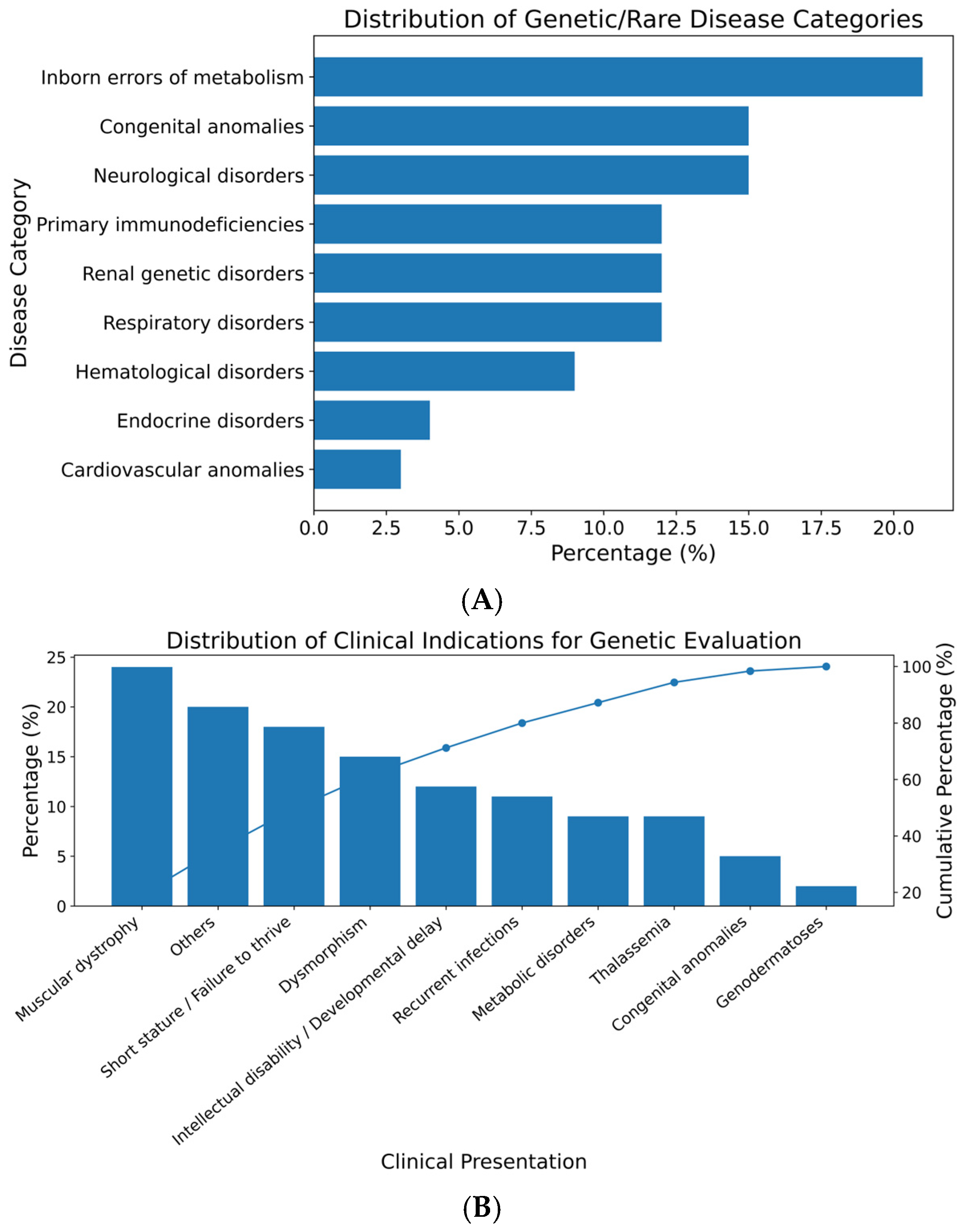
The most common systemic disorders were: inborn errors of metabolism (21.3%), congenital anomalies (15.2%), neurological disorders (15%), primary immunodeficiencies (12.3%), renal genetic disorders (12.2%), respiratory disorders (12%), hematological disorders (9%), endocrine disorders (3.9%), and cardiovascular anomalies (3%) (
Figure 1A).
The Pareto analysis demonstrated that a limited number of clinical phenotypes accounted for the majority of presentations among probands. Muscular dystrophy (24%) emerged as the most frequent phenotype, followed by short stature/failure to thrive (18%), dysmorphism (15%), and intellectual disability/developmental delay (12%). Together, these four categories contributed to approximately two-thirds of the total clinical burden, indicating a concentrated pattern of referral indications. Additional phenotypes, including recurrent infections (11%), thalassemia (9%), and metabolic disorders (9%), contributed moderately to the overall case load, while congenital anomalies (5%) and genodermatoses (2%) represented smaller proportions. The cumulative distribution highlights that prioritizing diagnostic and counseling strategies for the most prevalent phenotypes could substantially improve service efficiency and resource allocation in rare disease genetic clinics (
Figure 1B).
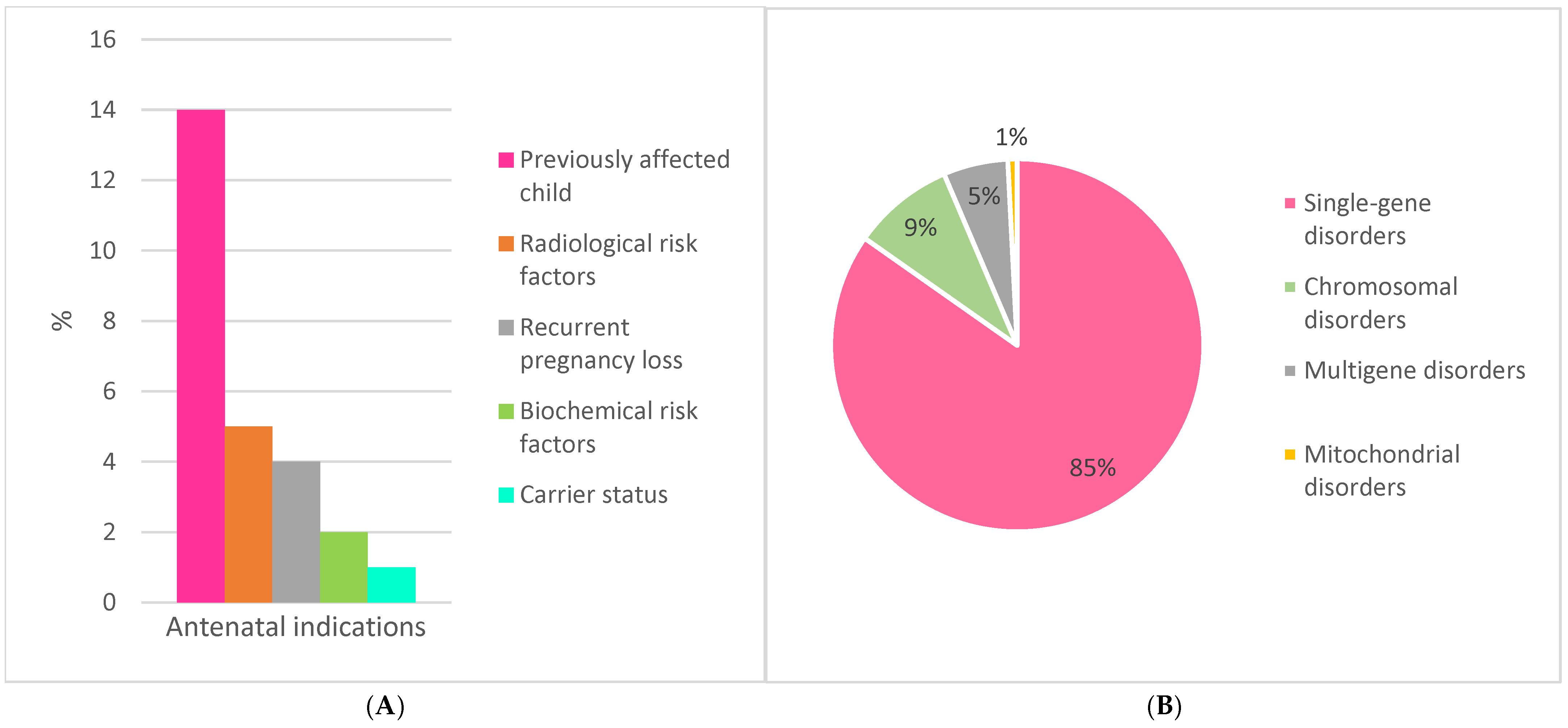
Antenatal indications included: previously affected child (14%), radiological risk factors (5%), recurrent pregnancy loss (4%), biochemical risk factors (2%), and carrier status (1%) (
Figure 2A).
3.5. Final Diagnosis
Confirmed diagnoses comprised single-gene disorders (84.8%), chromosomal disorders (8.8%), multigene disorders (5.6%), and mitochondrial disorders (0.8%) (
Figure 2B).
Genetic testing uptake was higher in the antenatal group. The most common reason for declining testing was unaffordability (69% of pediatric consultands and 60% of antenatal consultands), followed by the belief that testing was unnecessary, indecision, a lack of understanding of the disorder, dissatisfaction with counseling, or a combination of these factors.
The details of the suggested genetic tests, based on the clinical phenotype and the most prevalent mutation profiles among those who consented to testing, are presented in
Table 2.
3.6. Factors Influencing the Genetic Counseling Satisfaction Scale (GCSS) in the Pediatric Group
The educational status of Consultand A (mother) was not significantly associated with post-counseling satisfaction. Similarly, the education level of Consultand B (father) did not influence overall satisfaction scores. However, fathers with higher educational attainment (graduate or professional degrees) were significantly more likely to perceive that adequate time had been allocated during counseling (p = 0.02). Socioeconomic status was significantly associated with satisfaction. Consultands from higher socioeconomic classes reported greater overall satisfaction (p = 0.048).
Referral status (self-referred vs. specialty-referred) did not influence satisfaction levels. Likewise, prior awareness of genetic disorders, presence of consanguinity, reproductive planning, and having unaffected children were not associated with satisfaction. A positive family history of genetic disorders also showed no significant effect.
3.7. Factors Influencing the GCSS in the Antenatal Group
Antenatal risk factors were not significantly associated with satisfaction scores (p = 0.64). Similarly, the timing of counseling, whether preconception or during pregnancy, had no impact on GCSS outcomes (p = 0.62).
Prior awareness of genetic disorders showed no significant effect (p = 0.06). A positive family history also did not influence satisfaction (p = 0.143). Undergoing genetic testing was not significantly associated with satisfaction levels (p = 0.21), and decisions regarding pregnancy termination were also unrelated (p = 0.47).
The number of unaffected children (none vs. at least one) was not associated with satisfaction (p = 1.00). Likewise, socioeconomic status and education of both Consultand A (mother) and Consultand B (father) did not significantly affect satisfaction (p = 0.11 and p = 0.47, respectively).
3.8. Factors Influencing Perceived Personal Control (PPC) in the Pediatric Group
Total PPC scores were not significantly different between self-referred and specialty-referred participants. Couples attending voluntarily (self-visits) had slightly better pre-counseling PPC than referred couples, but this difference was not statistically significant (p = 0.07). In contrast, referred couples demonstrated higher post-counseling PPC scores, particularly in believing that steps could be taken to prevent recurrence (p = 0.012).
Prior awareness of genetic disorders did not influence overall PPC. However, consultands who were already aware of genetic counseling felt they understood the implications of the disorder for their family’s future (p = 0.021) and, post-counseling, were clearer about next steps (p = 0.016). Consultands with an affected family member demonstrated the greatest improvement in PPC after counseling.
Consanguinity and the number of unaffected children (none vs. at least one) were not significantly associated with PPC. Conversely, participants planning future pregnancies had significantly higher pre-counseling PPC (p = 0.01) and felt more confident about preventing recurrence.
3.9. Factors Influencing PPC in the Antenatal Group
Consultands with a positive family history of genetic disorders reported significant improvement in PPC after counseling, particularly in relation to preventing recurrence (p = 0.041). Those who underwent genetic testing reported feeling better informed about the purpose of counseling, the implications for their family, and their available options, with significantly improved PPC scores (p = 0.009).
Participants who were advised to terminate their pregnancy also showed significant gains in PPC, particularly regarding clarity on next steps in management (p = 0.007). Consultands whose primary concern was preventing recurrence in future pregnancies demonstrated consistently higher PPC scores both pre- (p = 0.026) and post-counseling (p = 0.009), with the greatest overall improvement (p = 0.044).
Antenatal risk factors and prior awareness of genetic disorders were not significantly associated with PPC (p = 0.401 and p = 0.710, respectively).
Couples who attended counseling in the preconception period had significantly higher PPC scores both before (p = 0.044) and after counseling (p = 0.036). These couples also reported better understanding of the disorder’s impact, clearer evaluation of options, and stronger belief in their ability to prevent recurrence (p = 0.039). Higher educational attainment of both Consultand A and Consultand B was significantly associated with improved PPC scores.
3.10. Reproductive Choice
We evaluated the necessity of pregnancy termination and its determinants. Termination was suggested in 39% of antenatal consultands, in accordance with the PCPNDT Act [
14]. The primary indication was detection of major congenital anomalies on ultrasonography. Among these, 77.8% opted for MTP, 22.2% chose to continue, one couple remained undecided, and another declined termination, considering it unnecessary. Notably, the two couples who refused termination did not undergo genetic testing due to financial constraints.
4. Discussion
In India, despite recent advances in genetic diagnostic facilities, awareness of genetic disorders remains limited, with most cases identified only after an affected child is born. In this study, 59% of parents sought counseling for the proband’s treatment, while only 4% were concerned about recurrence risk. In contrast, 85% of pregnant women sought counseling for both ongoing and future pregnancies. Similar trends were reported by Phadke et al., where diagnosis (78.5%) and treatment (58.7%) were the main reasons for consultation [
15].
Effective genetic counseling requires clients to understand its purpose and process, yet awareness remains low in India. In our study, only 2% of antenatal couples and 32% of parents of affected children were aware of the genetic basis of disorders. Limited awareness often leads to delayed diagnosis and recurrence of the same genetic condition in siblings [
16].
Based on clinical features and investigations, single-gene disorders were the most common in both groups. Chromosomal disorders were the next most frequent postnatally, while multigene/multifactorial conditions predominated antenatally. Duchenne muscular dystrophy (15%) and lethal skeletal dysplasia (15%) were the most common diagnoses. Previous studies report β-thalassemia as India’s most prevalent genetic disorder, with carrier rates of 1–37.9% and 12.5% in western Rajasthan [
17,
18,
19].
Three-generation pedigree analysis revealed a positive family history in 15% of postnatal and 13% of antenatal cases, most commonly involving siblings. First-degree relationships were most frequent (66.6% postnatal, 9.25% antenatal), while third-degree relations were rare. Detailed pedigree analysis proved valuable in uncovering hidden familial patterns, particularly among extended relatives [
20,
21].
Consanguinity increases homozygosity of deleterious alleles, raising the risk of autosomal recessive disorders and contributing significantly to the genetic disease burden in populations with high consanguineous marriage rates. A recent whole-genome study revealed that children of double first-cousin unions harbored 20 times more deleterious homozygous variants than those of unrelated parents, with a 10-fold increase in first-cousin offspring and a 2-fold increase in second-cousin offspring, highlighting the substantial genetic burden posed by consanguinity in recessive disease risk [
22]. Consanguineous marriages are not uncommon in India. The present study found that 16% of the consultands in the postnatal group and 15.3% in the antenatal group were consanguineously married couples, with the majority having grade 3 and grade 2 consanguinity. The consanguinity rate in South India is reported to be as high as 28.8% [
23]. The difference can be explained by relatively lower consanguinity in the North Indian Hindu-majority states.
Prenatal genetic counseling is crucial for screening and diagnosing fetal genetic disorders. Yotsumoto et al. reported advanced maternal age (96.5%) as the leading indication for NIPT and counseling, followed by sonographic and serum marker abnormalities [
24]. In our study, the most common concern among antenatal patients was previously affected siblings (53%) and risk of recurrence in current or future pregnancies. Referrals were mainly due to abnormal ultrasound findings (19.2%) or abnormal biochemical markers (7.7%). Most women presented before 18 weeks of gestation (57.7%), while 30.8% presented after 18 weeks, and 11.5% sought preconception counseling.
Satisfaction is an important patient-reported outcome of genetic counseling. However, research on patient satisfaction with genetic counseling has been limited, partly due to the lack of standardized measures available to assess this construct. Counselor–counselee concordance in interpreting risk or therapeutic progress has been empirically linked to higher satisfaction and better outcomes. For instance, agreement on the working alliance predicts smoother sessions and symptom improvementand moderate agreement in perceived improvement between clients and therapists has been shown to be significantly associated with satisfaction [
25]. There are limited studies from India on satisfaction in genetic counseling and the factors affecting it, and no specific scale has been developed with consideration for the Indian scenario.
The GCSS assesses domains such as clarity of information, emotional support, and overall utility of counseling. Each item is scored on a Likert scale, and the total score provides a quantitative measure of satisfaction, with higher scores indicating greater satisfaction [
12]. This scale has been widely used across clinical genetics and oncology settings. In our study, it was adapted into Hindi for cultural relevance. The average GCSS total score in our study was 24.0. The majority of consultands considered the counseling session valuable (86% in the pediatric group and 92% in the antenatal group). In the pediatric group, 47% reported not feeling better about their health after counseling. In the antenatal group, 3.8% felt the counselor did not understand their stress, while 34.6% were uncertain. Regarding decision-making, 64.6% felt the counselor helped them arrive at a decision, 7.7% disagreed, and 26.9% were unsure. DeMarco et al. reported a mean GCSS total score of 26.87 in their study on patient satisfaction with cancer and prenatal genetic counseling and found no significant variation in satisfaction by sociodemographic characteristics [
12]. In the present study, the pediatric group, consisting of consultands with higher socioeconomic status, reported greater satisfaction compared to those with lower socioeconomic status. Additionally, participants with higher socioeconomic and educational levels felt they were given adequate time during counseling. However, total GCSS scores were not significantly influenced by the education level of either consultand, positive family history, reason for visit, awareness of genetic disorders, consanguinity, plans for future pregnancy, number of unaffected pregnancies, willingness to test, or mode of visit (self vs. referral). In the antenatal group, GCSS scores were similarly unaffected by these factors. Couples with prior awareness of genetic disorders showed slightly higher satisfaction scores compared to those without prior awareness, though this difference did not reach statistical significance (
p = 0.06).
Shoshana Shiloh et al. found that counselor dedication, attention to personal concerns, and clear communication were stronger determinants of satisfaction than treatment or reassurance [
26]. In the present study, we were unable to enroll a control group.
Genetic testing is vital in counseling but limited in India due to high costs, low availability, and lack of insurance. In this study, 52.8% of parents of affected children and 80.8% of antenatal couples underwent testing. The main barriers were unaffordability (69% postnatal, 60% antenatal), perceived lack of necessity (19% pediatric), poor understanding (20% antenatal), and dissatisfaction with counseling (20% antenatal), consistent with global findings on financial and knowledge barriers. These findings align with Li L et al., which reported high acceptance of genetic counseling among patients with epithelial ovarian cancer, with non-testing attributed to poor understanding of genetic tests (25%) and financial constraints [
27]. At the All India Institute of Medical Sciences, Jodhpur, the promotion and implementation of genetic testing are aligned with the National Policy for Rare Diseases 2021 (NPRD-2021) [
6]. As a designated Center of Excellence for Rare Diseases, the institute facilitates early diagnosis through advanced genomic testing, multidisciplinary clinical services, and genetic counseling. Awareness is strengthened through clinician training, academic workshops, and community outreach programs. These initiatives aim to improve early detection of genetic disorders, expand access to diagnostic services, and support national efforts for rare disease management and research.
This study evaluated the impact of genetic counseling on consultands’ perceived personal control (PPC). Significant increases in total PPC scores were associated with positive family history (p = 0.0098) and plans for future pregnancy (p = 0.013). Prior awareness of genetic disorders improved understanding of family implications (p = 0.021) and identification of next steps (p = 0.016). Those planning future pregnancies were more likely to recognize preventive measures (p = 0.016). In the antenatal group, higher pre- and post-counseling PPC scores were seen in consultands willing to undergo testing, with positive family history, or concerned about recurrence. The greatest PPC improvement occurred in individuals primarily focused on future reproduction, and post-counseling guidance on termination and preventive measures was well understood.
Pregnancy termination plays a pivotal role in the management of severe fetal anomalies, particularly when identified early by ultrasound. In this context, genetic counseling in our center provides balanced, non-directive information and supports informed decision-making by discussing clinical findings, reproductive implications, and psychosocial considerations while respecting patient autonomy. In our study, 39% of antenatal consultands were advised to consider termination, mostly due to major anomalies—mirroring findings where severe cardiac malformations significantly increased termination rates and earlier gestational age made decisions more likely [
28]. In contexts like Nigeria, over 32% of pregnancies complicated by major anomalies were terminated following prenatal ultrasound detection [
29]. However, our findings underscore that financial constraints can impede access to confirmatory testing and influence decisions, consistent with data from Chile where women required weeks to save for diagnostic exams vital for making termination decisions.




 ,
,