1. Introduction
Tonsillectomy, with or without adenoidectomy, stands as one of the most frequently performed surgical procedures in the pediatric population worldwide [
1]. The primary indications for surgery include sleep-disordered breathing (SDB) caused by adenotonsillar hypertrophy and chronic recurrent tonsillitis [
2]. While the procedure is routine, the postoperative course is often distressing for both the child and the parents. Postoperative morbidity, characterized primarily by significant odynophagia, poor oral intake, dehydration, and the risk of secondary hemorrhage, remains a major concern in pediatric otolaryngology [
3]. Consequently, the continuous evolution of surgical techniques aims to minimize tissue trauma and accelerate recovery.
Historically, cold dissection has been considered the “gold standard” for tonsillectomy. This technique involves the separation of the tonsil from the pharyngeal muscle bed using metal instruments, followed by hemostasis typically achieved via ligatures or packs [
4,
5]. While cold dissection minimizes thermal injury during the dissection phase, the frequent need for monopolar or bipolar electrocautery to control intraoperative bleeding can result in high-temperature thermal spread (>400 °C) to the surrounding pillars and musculature. This thermal damage is directly correlated with increased postoperative edema and pain [
4,
5].
In recent decades, coblation technology has emerged as a popular alternative. Unlike traditional electrocautery, coblation utilizes bipolar radiofrequency energy transmitted through a conductive saline medium to create a plasma field. This plasma field breaks down molecular bonds within the tissue at relatively low temperatures, typically between 60 °C and 70 °C [
6,
7]. The theoretical advantage of this “cool” ablation is the significant reduction in thermal dissemination to the underlying pharyngeal constrictor muscles and nerve endings, potentially leading to less postoperative pain and faster healing [
6,
7].
However, the superiority of coblation remains a subject of debate in the current literature. While several studies have reported reduced analgesic requirements and a faster return to normal activity [
8], others have suggested comparable pain scores to traditional methods or raised concerns regarding a potentially higher rate of secondary hemorrhage [
9]. Furthermore, the significantly higher cost of the disposable coblation wands requires a clear demonstration of clinical benefit to justify the economic burden on the healthcare system [
10].
Therefore, the aim of this prospective study is to compare the clinical outcomes of coblation tonsillectomy versus traditional cold dissection in a pediatric cohort. Specifically, we seek to evaluate differences in postoperative pain intensity, the time required to return to a normal diet, and the safety profile regarding primary and secondary hemorrhagic complications.
2. Materials and Methods
This prospective, randomized, single-blinded comparative study was conducted at the Department of Otorhinolaryngology of Medicover Hospital Cluj-Napoca between 1 February 2024 and 1 July 2025. The study protocol was approved by the Institutional Ethics Committee (Ref. No. 14/8.01.2024). According to local regulatory statements, the study was approved by the local institutional ethical committee without considering it as a clinical trial. The procedures followed were in accordance with the ethical standards of the Declaration of Helsinki. Written informed consent was obtained from the parents or legal guardians of all participating children.
To ensure statistical power, a sample size calculation was performed prior to patient enrollment. Based on previous studies regarding post-tonsillectomy pain, we anticipated a mean difference of 1.5 points on the visual analog scale (VAS) between groups, with a standard deviation of 2.0. Assuming an alpha error of 0.05 and a power of 80%, a minimum of 38 patients per group was required. To account for a potential dropout rate of approximately 20%, a total of 100 patients were enrolled in the study.
The study cohort comprised children aged 3 to 17 years diagnosed with either recurrent tonsillitis, as defined by the Paradise criteria, or obstructive sleep apnea secondary to grade III/IV tonsillar hypertrophy, while excluding those with a history of peritonsillar abscess, known coagulopathies, craniofacial malformations, documented allergies to the analgesic protocol, or any acute infection within the two weeks preceding the intervention.
Participants were allocated in a 1:1 ratio to either group A (n = 50), involving coblation tonsillectomy, or group B (n = 50), involving traditional cold dissection, using a computer-generated randomization sequence.
All surgeries were performed under general anesthesia with orotracheal intubation by the same surgical team to minimize inter-operator variability.
In group A, tonsillectomy was performed using the Coblator II Surgery System Smith & Nephew (Austin, TX, USA) with a disposable EVAC 70 wand at standardized settings (ablation level 7, coagulation level 3) for extracapsular dissection and primary hemostasis, whereas in group B, the tonsils were removed via standard cold steel instruments, with hemostasis achieved through suture ligation or bipolar electrocautery strictly localized to bleeding points, while strictly avoiding monopolar cautery, to ensure a fair comparison of thermal injury and minimize collateral damage.
The postoperative analgesic protocol consisted of Acetaminophen (15 mg/kg) administered orally or rectally every 6 h for the first 48 h, transitioning to an on-demand regimen starting from postoperative day 3. Ibuprofen (10 mg/kg) was prescribed as a rescue analgesic, to be administered only if the pain score exceeded 4 (Moderate Pain). Total analgesic doses represent the sum of all Acetaminophen and Ibuprofen doses given. Pain intensity was categorized as: No Pain (0), Mild (1–3), Moderate (4–6), and Severe (7–10).
In cases of refractory pain (VAS > 7), parents were instructed to contact the department for potential administration of Metamizole (15 mg/kg). No antibiotics were routinely prescribed.
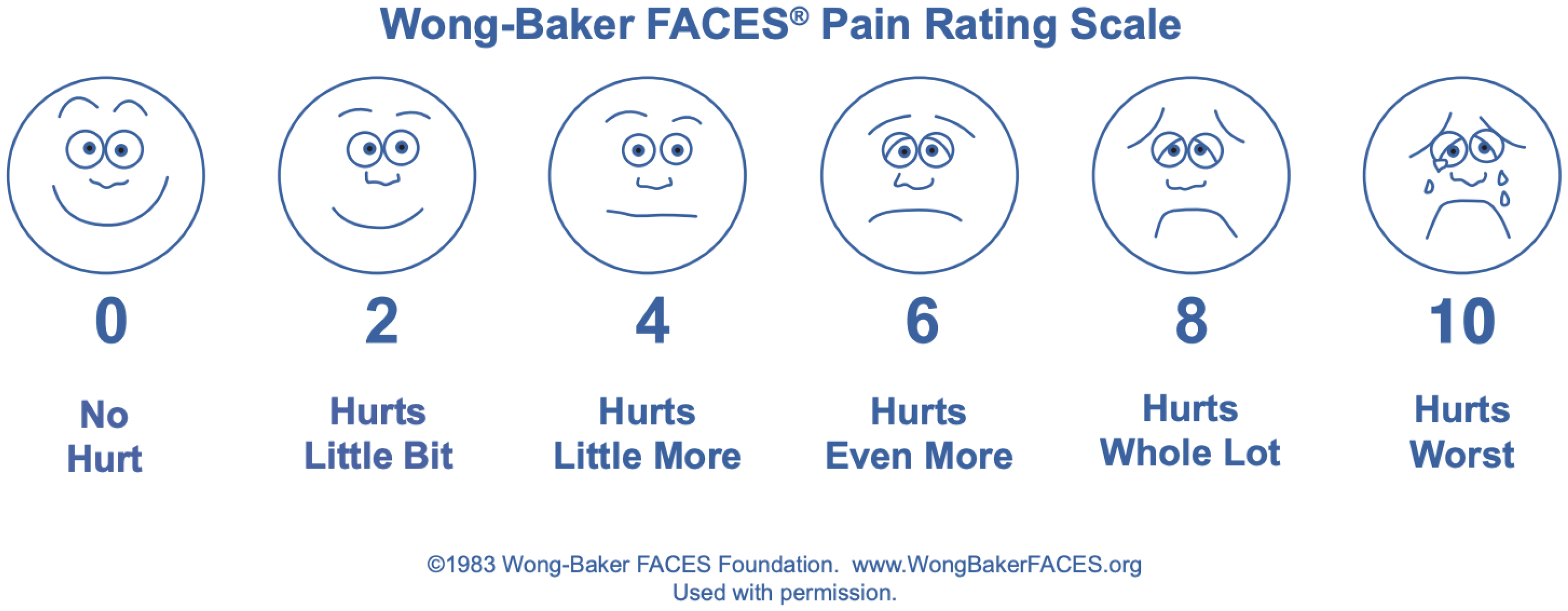
Postoperative outcomes were documented by parents using a standardized 10-day diary, which recorded pain intensity measured twice daily via the Wong–Baker FACES Pain Rating Scale (
Figure 1), daily analgesic consumption, the day of return to a normal solid diet, and any instances of primary or secondary hemorrhage requiring medical intervention.
Data analysis was performed using SPSS version 26.0. Continuous variables were expressed as mean ± standard deviation (SD) and compared using Student’s t-test for independent samples. Categorical variables were compared using the Chi-square test or Fisher’s exact test. A p-value of <0.05 was considered statistically significant.
3. Results
3.1. Demographic Characteristics
A total of 100 pediatric patients were successfully enrolled and completed the 10-day follow-up protocol. The cohort was equally divided into group A (coblation,
n = 50) and group B (cold dissection,
n = 50). Statistical analysis of baseline data (
Table 1) confirmed that both groups were homogeneous regarding age, gender distribution, and body weight. Furthermore, the clinical indications preoperative tonsil size showed no significant differences between the two groups (
p > 0.05), ensuring that the comparison of postoperative outcomes was not biased by preoperative factors.
3.2. Intraoperative and Recovery Outcomes
The operative efficiency and recovery metrics are summarized in
Table 2. The mean operative time was significantly shorter in the coblation group (18.5 ± 4.2 min) compared to the cold dissection group (24.1 ± 5.6 min;
p < 0.05). Regarding functional recovery, patients in group A achieved a significantly faster return to a solid diet (mean day 5.2 ± 1.1) compared to group B (mean day 7.4 ± 1.5;
p < 0.01).
3.3. Postoperative Pain and Analgesic Requirements
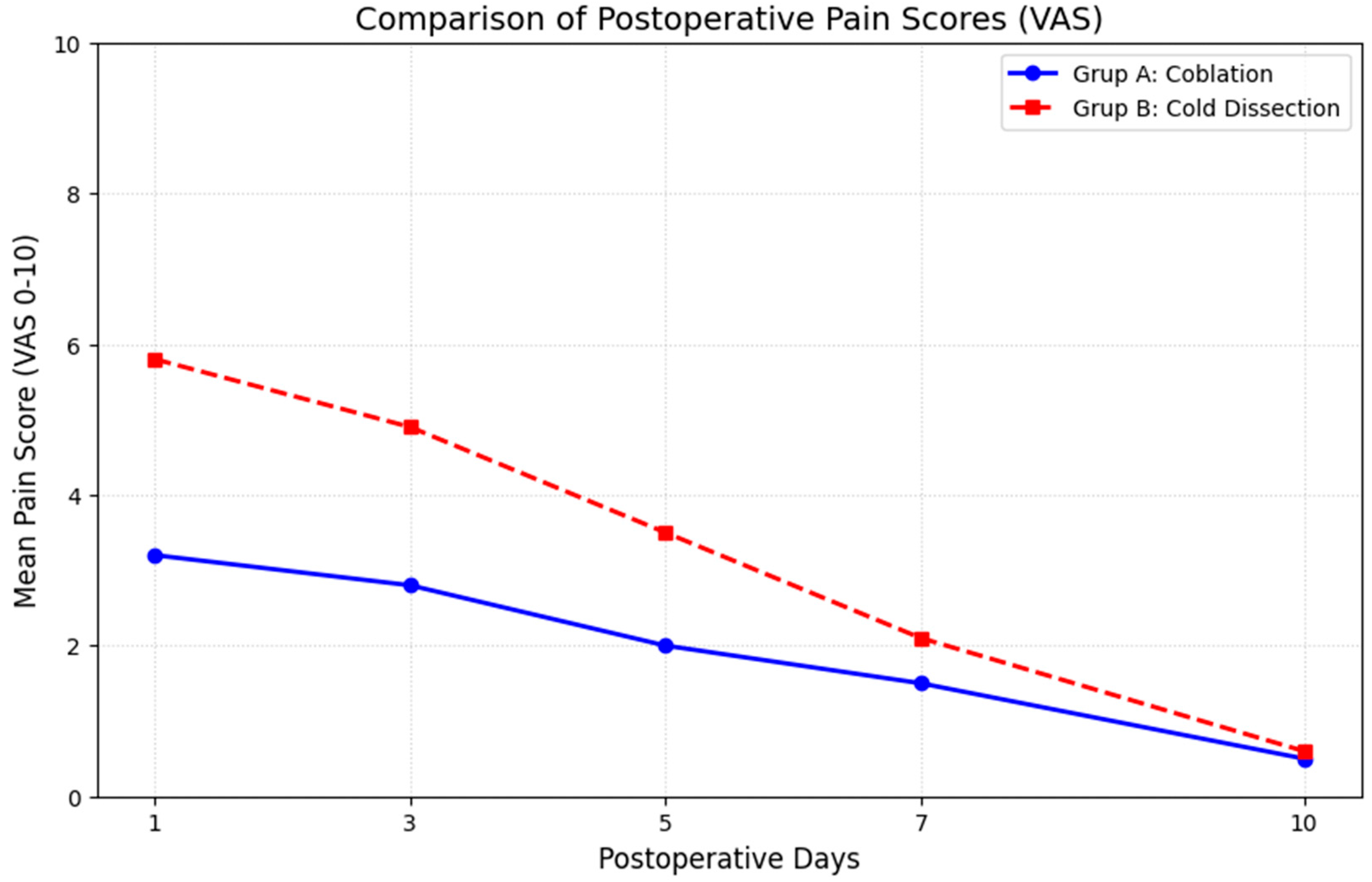
Pain intensity, assessed via the Wong–Baker FACES scale, was significantly lower in the coblation group during the early postoperative window. On day 1, group A reported a mean score of 3.2 ± 1.2, while group B reported 5.8 ± 1.5 (p < 0.001). This trend of reduced pain persisted significantly through day 7. Consequently, the cumulative number of analgesic doses required during the first three postoperative days was significantly lower in the Coblation group (6.1 ± 1.2) compared to the Cold Dissection group (9.4 ± 1.8; p < 0.001).
3.4. Safety and Complications
The incidence of complications was low and comparable between the two techniques. No cases of primary hemorrhage were recorded. Secondary hemorrhage requiring medical intervention occurred in 1 patient (2%) in the coblation group and 1 patient (2%) in the cold dissection group (p = 1.00). No other major adverse events were reported during the study period.
3.5. Pain Kinetic Analysis
The evolution of postoperative pain scores, as illustrated in
Figure 2, demonstrates a consistent downward trend in both cohorts. However, the Coblation group exhibited a significantly “flatter” recovery curve, maintaining lower mean VAS scores at every assessed interval during the first 7 days. A notable divergence is observed in the immediate postoperative window (days 1–3), where the gap between the two techniques is maximal. By day 10, both curves converged as pain scores reached minimal levels (VAS < 1) in all patients, indicating that the analgesic benefit of coblation is most prominent during the early inflammatory phase of healing.
4. Discussion
The present study aimed to compare the clinical efficacy and postoperative morbidity of coblation tonsillectomy versus the traditional cold dissection technique in a pediatric cohort. Our findings suggest that while both methods are safe and effective for the removal of tonsillar tissue, coblation offers significant advantages regarding immediate postoperative quality of life, specifically by reducing pain intensity and accelerating the return to a normal diet.
The most significant finding of our study was the reduction in pain scores (VAS) in the Coblation group, particularly during the first 3 to 5 postoperative days. This aligns with other prospective studies in the literature [
11], which attribute the reduced morbidity to the fundamental difference in tissue interaction. While cold dissection is theoretically non-traumatic, hemostasis is frequently achieved using electrocautery, which generates temperatures exceeding 400 °C. This high thermal energy can cause collateral damage to the pharyngeal constrictor muscles and the nerve endings within the tonsillar fossa, leading to significant inflammation and vasospasm [
6,
7]. In contrast, coblation operates at significantly lower temperatures (60–70 °C) by creating a plasma field that dissolves molecular bonds. Our results support the hypothesis that minimizing thermal spread to the tonsillar pillars preserves the local mucosa and reduces the inflammatory cascade, thereby lowering the nociceptive input in the early healing phase.
A critical analysis of the postoperative pain trajectory, as illustrated in our comparative data, reveals a distinct “recovery gap” between the two surgical modalities. In the Cold Dissection group, the pain curve exhibits a significantly higher starting point (mean VAS > 5.5) and a slower rate of decline, reflecting the extensive inflammatory response associated with conventional hemostatic techniques.
Conversely, the Coblation group demonstrates a “flatter” pain curve from the first postoperative day. The most striking finding is the accelerated convergence towards baseline levels; while the Cold Dissection group maintains moderate pain levels until day 5–6, the Coblation group enters the mild pain category (VAS < 3) as early as the second postoperative day. The divergence between the two lines on the graph represents the “clinical benefit zone.” This gap is widest during the first 72 h, the period most associated with primary complications such as dehydration and refusal of oral intake. By day 10, the convergence of the two lines indicates that once the fibrin eschar begins to reorganize, the initial method of dissection becomes less relevant to the patient’s comfort, emphasizing that the primary advantage of coblation is concentrated in the immediate and early postoperative window.
Pain is the primary limiting factor for oral intake in children. The earlier reduction in pain observed in the Coblation group correlated directly with a faster return to a solid diet. This is a clinically relevant outcome, as delayed feeding is the leading cause of postoperative dehydration and readmission in pediatric tonsillectomy [
8]. By enabling children to eat sooner, the coblation technique not only improves patient comfort but may also reduce the indirect burden on parents and caregivers.
Regarding intraoperative parameters, our data showed a significantly shorter operative time for the Coblation group. This efficiency is likely due to the dual capability of the coblation wand to ablate tissue and coagulate vessels simultaneously, eliminating the need for repeated instrument exchanges common in cold dissection [
11,
12]. While a difference in a few minutes may not seem critical per individual case, in high-volume pediatric ENT centers, this cumulative time saving can optimize operating room turnover.
The implementation of coblation in pediatric tonsillectomy reflects the broader trend in otolaryngology toward minimizing tissue trauma through technical precision. In this context, the ongoing evolution of surgical education and the adoption of standardized training protocols, remain fundamental to ensuring that technological advancements translate into superior clinical results for the patient [
13].
A major topic of debate regarding coblation has been the risk of secondary hemorrhage. Early reports suggested a higher bleeding rate due to the lack of thermal sealing of deeper vessels or premature separation of the eschar [
12]. However, our study found no statistically significant difference in secondary hemorrhage rates between the two groups (2% vs. 2%).
Our results are consistent with the findings of Shapiro and Bhattacharyya [
14], who reported significantly lower pain scores in the coblation group on the first postoperative day. However, unlike Mitic et al. [
15], who found no significant difference in analgesic consumption, our study demonstrated a clear reduction in medication use for the Coblation group. This discrepancy may be attributed to our strict stratification of the rescue analgesic protocol based on pain intensity thresholds.
Several limitations to the present study warrant consideration. Primarily, the design was restricted to a single-blinded model, while patients and their legal guardians remained unaware of the surgical modality used, the operating surgeons could not be blinded to the technique used. This introduces a potential performance bias particularly regarding operative time, as the surgeon’s awareness of the device might unconsciously influence the speed of dissection. Therefore, intraoperative time differences should be interpreted with caution. Secondly, although our sample size was statistically powered to detect significant differences in postoperative pain and recovery kinetics, it remains insufficient for evaluating rare complications, such as major post-tonsillectomy hemorrhage, which would require a significantly larger multicenter cohort. Furthermore, our follow-up period was limited to 10 days post-surgery. While this interval is critical for assessing immediate morbidity and the peak period of secondary hemorrhage risk, long-term outcomes, such as potential tonsillar regrowth, were not monitored, despite being clinically rare following total extracapsular dissection. Finally, the higher procedural cost associated with disposable coblation equipment must be acknowledged. However, we contend that these direct costs are offset by the substantial clinical benefits in patient comfort and accelerated functional recovery, which are of paramount importance in high-volume pediatric surgical settings.
5. Conclusions
In conclusion, our study demonstrates that coblation tonsillectomy is a safe and effective technique for the treatment of tonsillar pathology in the pediatric population. Compared to the traditional cold dissection method, coblation significantly reduces immediate postoperative morbidity, characterized by lower pain scores and decreased analgesic requirements in the first postoperative week. Furthermore, the technique facilitates a faster return to a normal solid diet, which is a critical factor in preventing dehydration and improving patient satisfaction.
While the incidence of secondary hemorrhage is comparable between the two techniques, suggesting that coblation does not compromise safety, the higher cost of disposable wands remains a consideration. However, we believe that the clinical benefits, specifically the reduction in physical suffering and the accelerated recovery period, justify the additional expense. Therefore, coblation should be considered a preferred surgical option in pediatric centers where resources allow, prioritizing the quality of life of the child during the convalescence period.





 ,
,