
Quality of Life in CAR-T Cell Therapy

 , , , ,
Abstract
1. Introduction
2. Quality-of-Life Assessment Methods
2.1. FACT-Lym
2.2. FACT-Leu
2.3. EORTC QLQ-C30
2.4. EQ-5D-5L
3. Temporal QoL Trajectory
3.1. Acute Phase (Days 0–30 Post-Infusion)
3.2. Early Recovery (Months 1–3)
3.3. Long-Term Phase (≥6 Months)
4. CAR-T Versus Autologous-Stem-Cell Transplantation
4.1. Pivotal Trial Data: ZUMA-7 and TRANSFORM
4.2. BELINDA Trial: Efficacy–QoL Dissociation
4.3. Domain-Specific QoL Considerations
4.4. Psychological Distress
4.5. Social Function
4.6. Older Adults (>65 Years)
4.7. Frail Patients
4.8. Previously Transplanted Patients
5. CAR-T Versus Allogeneic-Stem-Cell Transplantation
6. CAR-T Versus Salvage Chemotherapy
7. Disease-Specific QoL Considerations
7.1. Aggressive B-Cell Lymphomas (DLBCL, PMBCL)
7.2. Acute Lymphoblastic Leukemia
7.3. Multiple Myeloma
8. Predictors and Modifiers of QoL Outcomes
8.1. Patient Profile
8.2. Treatment-Related Factors
8.3. Response Kinetics
8.4. Toxicity-Related QoL Impact
9. Integrating QoL Considerations into Treatment Selection
10. QoL Optimization Strategies
11. Controversies and Unresolved Issues
12. Conclusions
- Systematic PRO integration in both trials and clinical practice.
- Development of CAR-T-specific supportive care interventions.
- Comparative effectiveness research incorporating QOL as a co-primary endpoint alongside survival.
- Health economics analyses incorporating patient-centered outcomes.
- Toxicity mitigation strategies that preserve efficacy while enhancing tolerability. Patient selection should consider QoL alongside efficacy, toxicity profiles, and individual circumstances.
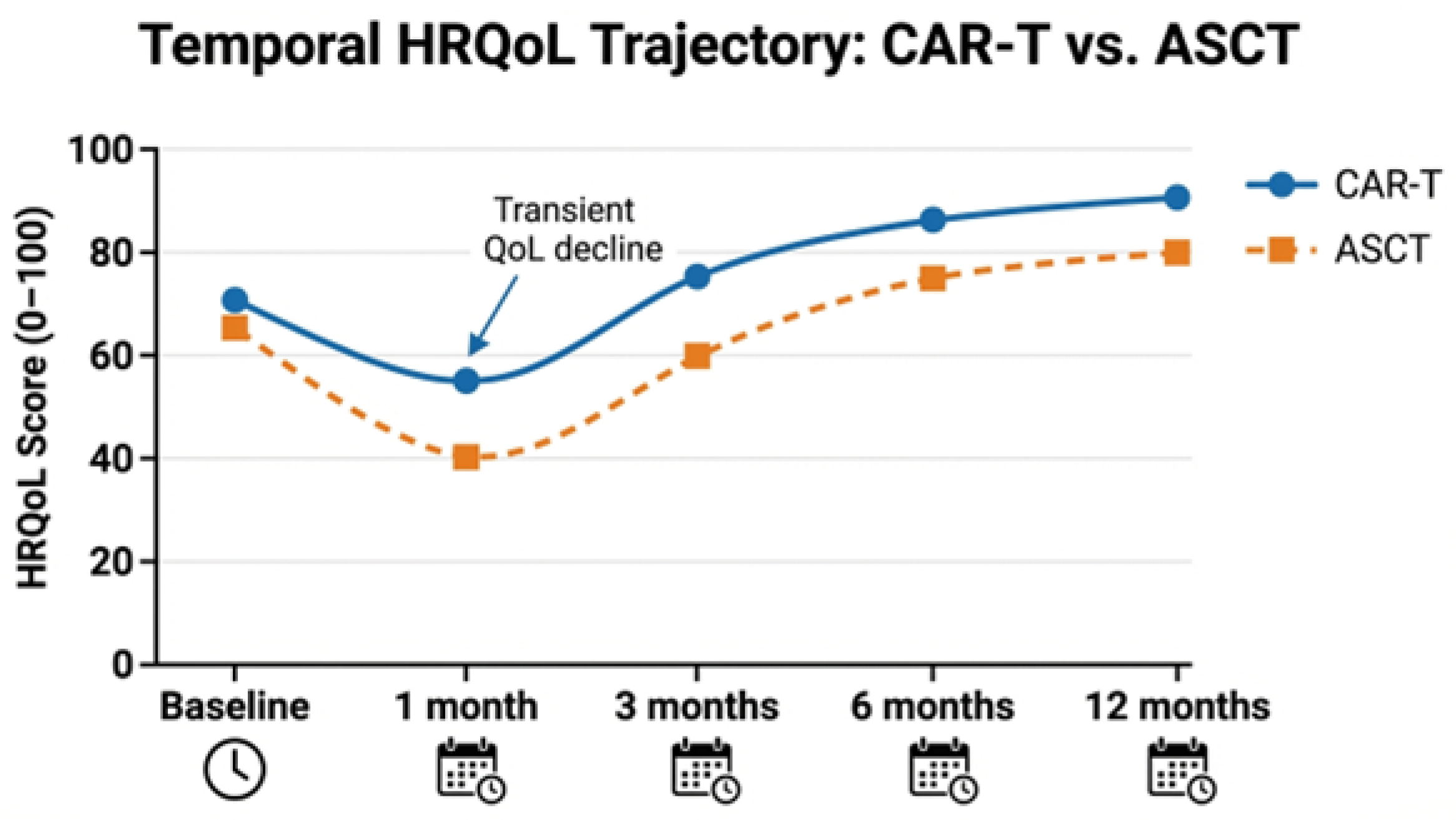
- QoL typically nadirs at day 30 post-CAR-T infusion, returns to baseline by month 3, and improves above baseline by 6–12 months in durable responders.
- Treatment response is the strongest predictor of long-term QOL, overriding most baseline patient factors.
- Grade 3–4 ICANS particularly impacts cognitive and functional QoL domains, with recovery typically requiring 6–8 weeks.
- CAR-T generally offers superior long-term QoL compared to transplantation in disease-free survivors.
- CAR-T demonstrates faster QoL recovery compared to transplant (median 3 vs. 6–8 months) with earlier return to work and normal activities.
- Systematic PRO collection enables early detection of disease progression, late toxicities, and supportive care needs.
- Multidisciplinary supportive care—including neurology, rehabilitation medicine, and psychosocial services—optimizes QOL outcomes.
- ZUMA-7 and TRANSFORM provide Level 1 evidence supporting CAR-T’s QoL advantages in second-line LBCL.
Author Contributions
Funding
Institutional Review Board Statement
Informed Consent Statement
Data Availability Statement
Conflicts of Interest
References
- Crump, M.; Neelapu, S.S.; Farooq, U.; Van Den Neste, É.; Kuruvilla, J.; Westin, J.R.; Link, B.K.; Hay, A.E.; Cerhan, J.R.; Zhu, L.; et al. Outcomes in refractory diffuse large B-cell lymphoma: Results from the international SCHOLAR-1 study. Blood 2017, 130, 1800–1808, Erratum in Blood 2018, 131, 587–588. https://doi.org/10.1182/blood-2017-11-817775. [Google Scholar] [CrossRef] [Scilit] [PubMed] [PubMed Central]
- DuVall, A.S.; Sheade, J.; Anderson, D.; Yates, S.J.; Stock, W. Updates in the Management of Relapsed and Refractory Acute Lymphoblastic Leukemia: An Urgent Plea for New Treatments Is Being Answered! JCO Oncol. Pract. 2022, 18, 479–487. [Google Scholar] [CrossRef] [Scilit] [PubMed]
- Mateos, M.V.; Weisel, K.; De Stefano, V.; Goldschmidt, H.; Delforge, M.; Mohty, M.; Cavo, M.; Vij, R.; Lindsey-Hill, J.; Dytfeld, D.; et al. LocoMMotion: A prospective, non-interventional, multinational study of real-life current standards of care in patients with relapsed and/or refractory multiple myeloma. Leukemia 2022, 36, 1371–1376. [Google Scholar] [CrossRef] [Scilit] [PubMed] [PubMed Central]
- Thieblemont, C.; Da Gomes Silva, M.; Leppä, S.; Lenz, G.; Cottereau, A.S.; Fox, C.; Lopez-Guillermo, A.; Illidge, T.; Jurczak, W.; Eich, H.; et al. Large B-cell lymphoma (LBCL): EHA Clinical Practice Guidelines for diagnosis, treatment, and follow-up. Hemasphere 2025, 9, e70207, Erratum in Hemasphere 2025, 9, e70273. https://doi.org/10.1002/hem3.70273. [Google Scholar] [CrossRef] [Scilit] [PubMed] [PubMed Central]
- Dimopoulos, M.A.; Terpos, E.; Boccadoro, M.; Moreau, P.; Mateos, M.-V.; Zweegman, S.; Cook, G.; Engelhardt, M.; Delforge, M.; Hajek, R.; et al. EHA–EMN Evidence-Based Guidelines for diagnosis, treatment and follow-up of patients with multiple myeloma. Nat. Rev. Clin. Oncol. 2025, 22, 680–700. [Google Scholar] [CrossRef] [Scilit]
- Gökbuget, N.; Boissel, N.; Chiaretti, S.; Dombret, H.; Doubek, M.; Fielding, A.; Foà, R.; Giebel, S.; Hoelzer, D.; Hunault, M.; et al. Management of ALL in adults: 2024 ELN recommendations from a European expert panel. Blood 2024, 143, 1903–1930. [Google Scholar] [CrossRef] [Scilit] [PubMed]
- Tang, L.; Huang, Z.; Mei, H.; Hu, Y. Immunotherapy in hematologic malignancies: Achievements, challenges and future prospects. Signal Transduct. Target. Ther. 2023, 8, 306. [Google Scholar] [CrossRef] [Scilit]
- Yasui, H.; Idogawa, M.; Ishida, T.; Imai, K. Therapeutic Antibodies in Hematology: Advances in Malignant and Non-Malignant Disorders. Cells 2025, 15, 46. [Google Scholar] [CrossRef] [Scilit] [PubMed] [PubMed Central]
- Alati, C.; Pitea, M.; Molica, M.; Scalise, L.; Porto, G.; Bilardi, E.; Lazzaro, G.; Micò, M.C.; Pugliese, M.; Canale, F.A.; et al. CAR-T Cell Therapies in B-Cell Acute Lymphoblastic Leukemia: Emerging Data and Open Issues. Cancers 2025, 17, 3027. [Google Scholar] [CrossRef] [Scilit] [PubMed] [PubMed Central]
- Martino, M.; Gamberi, B.; Antonioli, E.; Aquino, S.; Pepa, R.D.; Malerba, L.; Mangiacavalli, S.; Pezzatti, S.; Bringhen, S.; Zamagni, E. Anti-BCMA CAR-T cell-based therapies and bispecific antibodies in the immunotherapy era: Are we ready for this? Expert Rev. Hematol. 2024, 17, 375–390. [Google Scholar] [CrossRef] [Scilit] [PubMed]
- Martino, M.; Canale, F.A.; Porto, G.; Verduci, C.; Utano, G.; Policastro, G.; Germanò, J.; Alati, C.; Santoro, L.; Imbalzano, L.; et al. Integrating CAR-T cell therapy into the management of DLBCL: What we are learning. Expert Opin. Biol. Ther. 2023, 23, 1277–1285. [Google Scholar] [CrossRef] [Scilit] [PubMed]
- Martino, M.; Naso, V.; Loteta, B.; Canale, F.A.; Pugliese, M.; Alati, C.; Musuraca, G.; Nappi, D.; Gaimari, A.; Nicolini, F.; et al. Chimeric Antigen Receptor T-Cell Therapy: What We Expect Soon. Int. J. Mol. Sci. 2022, 23, 13332. [Google Scholar] [CrossRef] [Scilit] [PubMed] [PubMed Central]
- Martino, M.; Canale, F.A.; Alati, C.; Vincelli, I.D.; Moscato, T.; Porto, G.; Loteta, B.; Naso, V.; Mazza, M.; Nicolini, F.; et al. CART-Cell Therapy: Recent Advances and New Evidence in Multiple Myeloma. Cancers 2021, 13, 2639. [Google Scholar] [CrossRef] [Scilit] [PubMed] [PubMed Central]
- Martino, M.; Alati, C.; Canale, F.A.; Musuraca, G.; Martinelli, G.; Cerchione, C. A Review of Clinical Outcomes of CAR T-Cell Therapies for B-Acute Lymphoblastic Leukemia. Int. J. Mol. Sci. 2021, 22, 2150. [Google Scholar] [CrossRef] [Scilit] [PubMed] [PubMed Central]
- Passweg, J.R.; Baldomero, H.; Atlija, M.; Kleovoulou, I.; Witaszek, A.; Alexander, T.; Angelucci, E.; Averbuch, D.; Bazarbachi, A.; Ciceri, F.; et al. The 2023 EBMT report on hematopoietic cell transplantation and cellular therapies. Increased use of allogeneic HCT for myeloid malignancies and of CAR-T at the expense of autologous HCT. Bone Marrow Transplant. 2025, 60, 519–528. [Google Scholar] [CrossRef] [Scilit] [PubMed] [PubMed Central]
- Spellman, S.R.; Xu, K.; Oloyede, T.; Ahn, K.W.; Akhtar, O.; Bolon, Y.T.; Broglie, L.; Bloomquist, J.; Bupp, C.; Chen, M.; et al. Current Activity Trends and Outcomes in Hematopoietic Cell Transplantation and Cellular Therapy—A Report from the CIBMTR. Transplant. Cell. Ther. 2025, 31, 505–532, Erratum in Transplant. Cell. Ther. 2025, 32, 764. https://doi.org/10.1016/j.jtct.2025.09.001. [Google Scholar] [CrossRef] [Scilit] [PubMed] [PubMed Central]
- Bhaskar, S.T.; Dholaria, B.; Savani, B.N.; Sengsayadeth, S.; Oluwole, O. Overview of approved CAR-T products and utility in clinical practice. Clin. Hematol. Int. 2024, 6, 93–99. [Google Scholar] [CrossRef] [Scilit] [PubMed] [PubMed Central]
- O’Leary, M.C.; Lu, X.; Huang, Y.; Lin, X.; Mahmood, I.; Przepiorka, D.; Gavin, D.; Lee, S.; Liu, K.; Bindu, G.; et al. FDA Approval Summary: Tisagenlecleucel for Treatment of Patients with Relapsed or Refractory B-cell Precursor Acute Lymphoblastic Leukemia. Clin. Cancer Res. 2019, 25, 1142–1146. [Google Scholar] [CrossRef] [Scilit]
- Sharma, P.; Kasamon, Y.L.; Lin, X.; Xu, Z.; Theoret, M.R.; Purohit-Sheth, T. FDA Approval Summary: Axicabtagene Ciloleucel for Second-Line Treatment of Large B-Cell Lymphoma. Clin. Cancer Res. 2023, 29, 4331–4337. [Google Scholar] [CrossRef] [Scilit]
- Vera, D.G.; Waghela, H.; Nuh, M.; Pan, J.; Lulla, P. Approved CAR-T therapies have reproducible efficacy and safety in clinical practice. Hum. Vaccines Immunother. 2024, 20, 2378543. [Google Scholar] [CrossRef] [Scilit] [PubMed] [PubMed Central]
- Neelapu, S.S.; Locke, F.L.; Bartlett, N.L.; Lekakis, L.J.; Miklos, D.B.; Jacobson, C.A.; Braunschweig, I.; Oluwole, O.O.; Siddiqi, T.; Lin, Y.; et al. AxicabtageneCiloleucel CAR T-Cell Therapy in Refractory Large B-Cell Lymphoma. N. Engl. J. Med. 2017, 377, 2531–2544. [Google Scholar] [CrossRef] [Scilit] [PubMed] [PubMed Central]
- Neelapu, S.S.; Jacobson, C.A.; Ghobadi, A.; Miklos, D.B.; Lekakis, L.J.; Oluwole, O.O.; Lin, Y.; Braunschweig, I.; Hill, B.T.; Timmerman, J.M.; et al. Five-year follow-up of ZUMA-1 supports the curative potential of axicabtageneciloleucel in refractory large B-cell lymphoma. Blood 2023, 141, 2307–2315. [Google Scholar] [CrossRef] [Scilit] [PubMed] [PubMed Central]
- Locke, F.L.; Miklos, D.B.; Jacobson, C.A.; Perales, M.A.; Kersten, M.J.; Oluwole, O.O.; Ghobadi, A.; Rapoport, A.P.; McGuirk, J.; Pagel, J.M.; et al. All ZUMA-7 Investigators and Contributing Kite Members. AxicabtageneCiloleucel as Second-Line Therapy for Large B-Cell Lymphoma. N. Engl. J. Med. 2022, 386, 640–654. [Google Scholar] [CrossRef] [Scilit] [PubMed]
- Westin, J.R.; Oluwole, O.O.; Kersten, M.J.; Miklos, D.B.; Perales, M.A.; Ghobadi, A.; Rapoport, A.P.; Sureda, A.; Jacobson, C.A.; Farooq, U.; et al. ZUMA-7 Investigators; Kite Members. Survival with AxicabtageneCiloleucel in Large B-Cell Lymphoma. N. Engl. J. Med. 2023, 389, 148–157. [Google Scholar] [CrossRef] [Scilit] [PubMed]
- Houot, R.; Bachy, E.; Cartron, G.; Gros, F.-X.; Morschhauser, F.; Oberic, L.; Gastinne, T.; Feugier, P.; Duléry, R.; Thieblemont, C.; et al. Axicabtageneciloleucel as second-line therapy in large B cell lymphoma ineligible for autologous stem cell transplantation: A phase 2 trial. Nat. Med. 2023, 29, 2593–2601. [Google Scholar] [CrossRef] [Scilit]
- Charton, E.; Anota, A.; Bachy, E.; Cartron, G.; Gros, F.X.; Morschhauser, F.; Oberic, L.; Gastinne, T.; Feugier, P.; Dulery, R.; et al. Health-related quality of life after second-line axi-cel in transplant-ineligible patients with large B-cell lymphoma. Blood Adv. 2026, 10, 1773–1782. [Google Scholar] [CrossRef] [Scilit] [PubMed] [PubMed Central]
- Schuster, S.J.; Bishop, M.R.; Tam, C.S.; Waller, E.K.; Borchmann, P.; McGuirk, J.P.; Jäger, U.; Jaglowski, S.; Andreadis, C.; Westin, J.R.; et al. Tisagenlecleucel in Adult Relapsed or Refractory Diffuse Large B-Cell Lymphoma. N. Engl. J. Med. 2019, 380, 45–56. [Google Scholar] [CrossRef] [Scilit] [PubMed]
- Maziarz, R.T.; Bishop, M.R.; Tam, C.S.; Borchmann, P.; Worel, N.; McGuirk, J.P.; Holte, H.; Waller, E.K.; Jaglowski, S.; Andreadis, C.; et al. Five-Year Analysis of the JULIET Trial of Tisagenlecleucel in Patients with Relapsed/Refractory Large B-Cell Lymphoma. J. Clin. Oncol. 2026, 44, 86–91. [Google Scholar] [CrossRef] [Scilit] [PubMed] [PubMed Central]
- Abramson, J.S.; Palomba, M.L.; Gordon, L.I.; Lunning, M.A.; Wang, M.; Arnason, J.; Mehta, A.; Purev, E.; Maloney, D.G.; Andreadis, C.; et al. Lisocabtagenemaraleucel for patients with relapsed or refractory large B-cell lymphomas (TRANSCEND NHL 001): A multicentre seamless design study. Lancet 2020, 396, 839–852. [Google Scholar] [CrossRef] [Scilit] [PubMed]
- Abramson, J.S.; Palomba, M.L.; Gordon, L.I.; Lunning, M.; Wang, M.; Arnason, J.; Purev, E.; Maloney, D.G.; Andreadis, C.; Sehgal, A.; et al. Two-year follow-up of lisocabtagenemaraleucel in relapsed or refractory large B-cell lymphoma in TRANSCEND NHL 001. Blood 2024, 143, 404–416. [Google Scholar] [CrossRef] [Scilit] [PubMed]
- Abramson, J.S.; Solomon, S.R.; Arnason, J.; Johnston, P.B.; Glass, B.; Bachanova, V.; Ibrahimi, S.; Mielke, S.; Mutsaers, P.; Hernandez-Ilizaliturri, F.; et al. Lisocabtagenemaraleucel as second-line therapy for large B-cell lymphoma: Primary analysis of the phase 3 TRANSFORM study. Blood 2023, 141, 1675–1684. [Google Scholar] [CrossRef] [Scilit] [PubMed] [PubMed Central]
- Morschhauser, F.; Dahiya, S.; Palomba, M.L.; Martin Garcia-Sancho, A.; Reguera Ortega, J.L.; Kuruvilla, J.; Jäger, U.; Cartron, G.; Izutsu, K.; Dreyling, M.; et al. Lisocabtagenemaraleucel in follicular lymphoma: The phase 2 TRANSCEND FL study. Nat. Med. 2024, 30, 2199–2207, Erratum in Nat. Med. 2024, 30, 2374. https://doi.org/10.1038/s41591-024-03175-4. [Google Scholar] [CrossRef] [Scilit] [PubMed] [PubMed Central]
- Wang, M.; Munoz, J.; Goy, A.; Locke, F.L.; Jacobson, C.A.; Hill, B.T.; Timmerman, J.M.; Holmes, H.; Jaglowski, S.; Flinn, I.W.; et al. KTE-X19 CAR T-Cell Therapy in Relapsed or Refractory Mantle-Cell Lymphoma. N. Engl. J. Med. 2020, 382, 1331–1342. [Google Scholar] [CrossRef] [Scilit] [PubMed] [PubMed Central]
- Wang, M.; Munoz, J.; Goy, A.; Locke, F.L.; Jacobson, C.A.; Hill, B.T.; Timmerman, J.M.; Holmes, H.; Jaglowski, S.; Flinn, I.W.; et al. Three-Year Follow-Up of KTE-X19 in Patients with Relapsed/Refractory Mantle Cell Lymphoma, Including High-Risk Subgroups, in the ZUMA-2 Study. J. Clin. Oncol. 2023, 41, 555–567. [Google Scholar] [CrossRef] [Scilit] [PubMed] [PubMed Central]
- Van Meerten, T.; Kersten, M.J.; Iacoboni, G.; Hess, G.R.; Mutsaers, P.G.N.J.; Garcia-Sancho, A.M.; Goy, A.; Gine, E.; Hill, B.T.; Weng, W.K.; et al. Brexucabtageneautoleucel for BTKi-naive relapsed/refractory mantle cell lymphoma: Primary analysis of ZUMA-2 Cohort 3. Blood 2025, 147, 1302–1314. [Google Scholar] [CrossRef] [Scilit] [PubMed]
- Shah, B.D.; Ghobadi, A.; Oluwole, O.O.; Logan, A.C.; Boissel, N.; Cassaday, R.D.; Leguay, T.; Bishop, M.R.; Topp, M.S.; Tzachanis, D.; et al. KTE-X19 for relapsed or refractory adult B-cell acute lymphoblastic leukaemia: Phase 2 results of the single-arm, open-label, multicentre ZUMA-3 study. Lancet 2021, 398, 491–502. [Google Scholar] [CrossRef] [Scilit] [PubMed] [PubMed Central]
- Kopmar, N.E.; Cassaday, R.D. Clinical Insights on BrexucabtageneAutoleucel for the Treatment of Patients with Relapsed or Refractory B-Cell Acute Lymphoblastic Leukemia. Cancer Manag. Res. 2024, 16, 1587–1596. [Google Scholar] [CrossRef] [Scilit] [PubMed] [PubMed Central]
- Shah, B.D.; Cassaday, R.D.; Park, J.H.; Houot, R.; Logan, A.C.; Boissel, N.; Leguay, T.; Bishop, M.R.; Topp, M.S.; O’Dwyer, K.M.; et al. Three-year analysis of adult patients with relapsed or refractory B-cell acute lymphoblastic leukemia treated with brexucabtageneautoleucel in ZUMA-3. Leukemia 2025, 39, 1058–1068. [Google Scholar] [CrossRef] [Scilit] [PubMed] [PubMed Central]
- Roloff, G.W.; Aldoss, I.; Kopmar, N.E.; Lin, C.; Dekker, S.E.; Gupta, V.K.; O’Connor, T.E.; Jeyakumar, N.; Muhsen, I.N.; Valtis, Y.; et al. Outcomes After BrexucabtageneAutoleucel Administered as a Standard Therapy for Adults with Relapsed/Refractory B-Cell ALL. J. Clin. Oncol. 2025, 43, 558–566. [Google Scholar] [CrossRef] [Scilit] [PubMed] [PubMed Central]
- Maude, S.L.; Laetsch, T.W.; Buechner, J.; Rives, S.; Boyer, M.; Bittencourt, H.; Bader, P.; Verneris, M.R.; Stefanski, H.E.; Myers, G.D.; et al. Tisagenlecleucel in Children and Young Adults with B-Cell Lymphoblastic Leukemia. N. Engl. J. Med. 2018, 378, 439–448. [Google Scholar] [CrossRef] [Scilit] [PubMed] [PubMed Central]
- Laetsch, T.W.; Maude, S.L.; Rives, S.; Hiramatsu, H.; Bittencourt, H.; Bader, P.; Baruchel, A.; Boyer, M.; De Moerloose, B.; Qayed, M.; et al. Three-Year Update of Tisagenlecleucel in Pediatric and Young Adult Patients with Relapsed/Refractory Acute Lymphoblastic Leukemia in the ELIANA Trial. J. Clin. Oncol. 2023, 41, 1664–1669. [Google Scholar] [CrossRef] [Scilit] [PubMed] [PubMed Central]
- Munshi, N.C.; Anderson, L.D., Jr.; Shah, N.; Madduri, D.; Berdeja, J.; Lonial, S.; Raje, N.; Lin, Y.; Siegel, D.; Oriol, A.; et al. IdecabtageneVicleucel in Relapsed and Refractory Multiple Myeloma. N. Engl. J. Med. 2021, 384, 705–716. [Google Scholar] [CrossRef] [Scilit] [PubMed]
- Rodriguez-Otero, P.; Ailawadhi, S.; Arnulf, B.; Patel, K.; Cavo, M.; Nooka, A.K.; Manier, S.; Callander, N.; Costa, L.J.; Vij, R.; et al. Ide-cel or Standard Regimens in Relapsed and Refractory Multiple Myeloma. N. Engl. J. Med. 2023, 388, 1002–1014. [Google Scholar] [CrossRef] [Scilit] [PubMed]
- Sharma, P.; Lin, X.; Xu, Z.; Kanapuru, B.; Theoret, M.R.; Sokolic, R.; Fashoyin-Aje, L.A. FDA Approval Summary: IdecabtageneVicleucel for the Treatment of Triple-Class-Exposed, Relapsed or Refractory Multiple Myeloma. Clin. Cancer Res. 2025, 31, 3362–3367. [Google Scholar] [CrossRef] [Scilit] [PubMed] [PubMed Central]
- Berdeja, J.G.; Madduri, D.; Usmani, S.Z.; Jakubowiak, A.; Agha, M.; Cohen, A.D.; Stewart, A.K.; Hari, P.; Htut, M.; Lesokhin, A.; et al. Ciltacabtageneautoleucel, a B-cell maturation antigen-directed chimeric antigen receptor T-cell therapy in patients with relapsed or refractory multiple myeloma (CARTITUDE-1): A phase 1b/2 open-label study. Lancet 2021, 398, 314–324, Erratum in Lancet 2021, 398, 1216. https://doi.org/10.1016/S0140-6736(21)02132-2. [Google Scholar] [CrossRef] [Scilit] [PubMed]
- Jagannath, S.; Martin, T.G.; Lin, Y.; Cohen, A.D.; Raje, N.; Htut, M.; Deol, A.; Agha, M.; Berdeja, J.G.; Lesokhin, A.M.; et al. Long-Term (≥5-Year) Remission and Survival After Treatment with CiltacabtageneAutoleucel in CARTITUDE-1 Patients with Relapsed/Refractory Multiple Myeloma. J. Clin. Oncol. 2025, 43, 2766–2771. [Google Scholar] [CrossRef] [Scilit] [PubMed] [PubMed Central]
- San-Miguel, J.; Dhakal, B.; Yong, K.; Spencer, A.; Anguille, S.; Mateos, M.V.; de Fernández Larrea, C.; Martínez-López, J.; Moreau, P.; Touzeau, C.; et al. Cilta-cel or Standard Care in Lenalidomide-Refractory Multiple Myeloma. N. Engl. J. Med. 2023, 389, 335–347. [Google Scholar] [CrossRef] [Scilit] [PubMed]
- Einsele, H.; San-Miguel, J.; Dhakal, B.; Touzeau, C.; Leleu, X.; van de Donk, N.W.; Sidana, S.; Oriol, A.; Cohen, Y.C.; Harrison, S.J.; et al. Cilta-cel in lenalidomide-refractory multiple myeloma (CARTITUDE-4): An updated analysis including overall survival from an open-label, multicentre, randomised, phase 3 trial. Lancet Oncol. 2026, 27, 254–268. [Google Scholar] [CrossRef] [Scilit] [PubMed]
- Anagnostou, V.; Yarchoan, M.; Hansen, A.R.; Wang, H.; Verde, F.; Sharon, E.; Collyar, D.; Chow, L.Q.M.; Forde, P.M. Immuno-oncology Trial Endpoints: Capturing Clinically Meaningful Activity. Clin. Cancer Res. 2017, 23, 4959–4969. [Google Scholar] [CrossRef] [Scilit] [PubMed] [PubMed Central]
- Delgado, A.; Guddati, A.K. Clinical endpoints in oncology—A primer. Am. J. Cancer Res. 2021, 11, 1121–1131. [Google Scholar] [PubMed] [PubMed Central]
- Valsecchi, A.A.; Di Maio, M. Association Between Health-Related Quality of Life Measures and Survival Endpoints in Oncology Clinical Trials and in Clinical Decision Making: A Narrative Review. Pharm. Med. 2025, 39, 171–182. [Google Scholar] [CrossRef] [Scilit] [PubMed] [PubMed Central]
- Bonsel, J.M.; Itiola, A.J.; Huberts, A.S.; Bonsel, G.J.; Penton, H. The use of patient-reported outcome measures to improve patient-related outcomes—A systematic review. Health Qual. Life Outcomes 2024, 22, 101. [Google Scholar] [CrossRef] [Scilit] [PubMed] [PubMed Central]
- Lizano-Barrantes, C.; Amat-Fernandez, C.; Garin, O.; Luer-Aguila, R.; Pardo, Y.; Rojas-Concha, L.; Thong, M.S.Y.; Apolone, G.; Brunelli, C.; Caraceni, A.; et al. Needs and health-related quality of life domains relevant to people in Europe with advanced cancer in need of palliative care: A systematic review of qualitative research. Qual. Life Res. 2026, 35, 74. [Google Scholar] [CrossRef] [Scilit] [PubMed] [PubMed Central]
- Chakraborty, R.; Sidana, S.; Shah, G.L.; Scordo, M.; Hamilton, B.K.; Majhail, N.S. Patient-Reported Outcomes with Chimeric Antigen Receptor T Cell Therapy: Challenges and Opportunities. Biol. Blood Marrow Transplant. 2019, 25, e155–e162. [Google Scholar] [CrossRef] [Scilit] [PubMed] [PubMed Central]
- Banerjee, R.; Amonoo, H.L.; Barata, A.; Bhatt, N.S.; Espinoza-Gutarra, M.R.; Jayani-Kosarzycki, R.V.; Katz, H.; Kennedy, V.E.; Nawas, M.; Steineck, A.; et al. Assessing Quality of Life and Symptoms in Transplantation and CAR-T Recipients: Expert Panel Recommendations from the Survivorship Special Interest Group of ASTCT. Transplant. Cell. Ther. 2025, 31, 774–788. [Google Scholar] [CrossRef] [Scilit] [PubMed] [PubMed Central]
- Webster, K.; Cashy, J.; Cella, D. Measuring quality of life (QOL) in patients with non-Hodgkin’s lymphoma (NHL): The Functional Assessment of Cancer Therapy—Lymphoma (FACT-Lym). In 12th Annual Conference of the International Society for Quality of Life Research; Springer: San Francisco, CA, USA, 2005. [Google Scholar]
- Cella, D.; Jensen, S.E.; Webster, K.; Hongyan, D.; Lai, J.S.; Rosen, S.; Tallman, M.S.; Yount, S. Measuring health-related quality of life in leukemia: The Functional Assessment of Cancer Therapy—Leukemia (FACT-Leu) questionnaire. Value Health 2012, 15, 1051–1058. [Google Scholar] [CrossRef] [Scilit] [PubMed]
- Aaronson, N.K.; Ahmedzai, S.; Bergman, B.; Bullinger, M.; Cull, A.; Duez, N.J.; Filiberti, A.; Flechtner, H.; Fleishman, S.B.; de Haes, J.C.; et al. The European Organization for Research and Treatment of Cancer QLQ-C30: A quality-of-life instrument for use in international clinical trials in oncology. J. Natl. Cancer Inst. 1993, 85, 365–376. [Google Scholar] [CrossRef] [Scilit] [PubMed]
- Schwarz, R.; Hinz, A. Reference data for the quality of life questionnaire EORTC QLQ-C30 in the general German population. Eur. J. Cancer 2001, 37, 1345–1351. [Google Scholar] [CrossRef] [Scilit] [PubMed]
- Pleyer, L.; Heibl, S.; Tinchon, C.; Vallet, S.; Schreder, M.; Melchardt, T.; Stute, N.; Föhrenbach Quiroz, K.T.; Leisch, M.; Egle, A.; et al. Health-Related Quality of Life as Assessed by the EQ-5D-5L Predicts Outcomes of Patients Treated with Azacitidine-A Prospective Cohort Study by the AGMT. Cancers 2023, 15, 1388. [Google Scholar] [CrossRef] [Scilit] [PubMed] [PubMed Central]
- Bai, G.; Zhang, J.; Chen, Y.; Cao, L.; Yang, Y.; Jiang, C. Health-related quality of life assessed by EQ-5D-5L and its determinants among Chinese adults. Front. Public Health 2024, 12, 1383781. [Google Scholar] [CrossRef] [Scilit] [PubMed] [PubMed Central]
- Efficace, F.; Bonifazi, F.; Zinzani, P.L.; Cutini, I.; Botto, B.; Farina, M.; Chiappella, A.; Gambella, M.; Tisi, M.C.; Martino, M.; et al. Health-related quality of life trajectories of patients with aggressive B-cell lymphomas treated with CAR T-cell therapy: Results from a prospective observational study. Blood 2025, 146, 6279. [Google Scholar] [CrossRef] [Scilit]
- Laetsch, T.W.; Myers, G.D.; Baruchel, A.; Dietz, A.C.; Pulsipher, M.A.; Bittencourt, H.; Buechner, J.; De Moerloose, B.; Davis, K.L.; Nemecek, E.; et al. Patient-reported quality of life after tisagenlecleucel infusion in children and young adults with relapsed or refractory B-cell acute lymphoblastic leukaemia: A global, single-arm, phase 2 trial. Lancet Oncol. 2019, 20, 1710–1718. [Google Scholar] [CrossRef] [Scilit] [PubMed] [PubMed Central]
- Delforge, M.; Shah, N.; Miguel, J.S.F.; Braverman, J.; Dhanda, D.S.; Shi, L.; Guo, S.; Yu, P.; Liao, W.; Campbell, T.B.; et al. Health-related quality of life with idecabtagenevicleucel in relapsed and refractory multiple myeloma. Blood Adv. 2022, 6, 1309–1318. [Google Scholar] [CrossRef] [Scilit] [PubMed] [PubMed Central]
- Jagannath, S.; Lin, Y.; Goldschmidt, H.; Reece, D.; Nooka, A.; Senin, A.; Rodriguez-Otero, P.; Powles, R.; Matsue, K.; Shah, N.; et al. KarMMa-RW: Comparison of idecabtagenevicleucel with real-world outcomes in relapsed and refractory multiple myeloma. Blood Cancer J. 2021, 11, 116. [Google Scholar] [CrossRef] [Scilit] [PubMed] [PubMed Central]
- Han, M.W.; Jeong, S.Y.; Suh, C.H.; Park, H.; Guenette, J.P.; Huang, R.Y.; Kim, K.W.; Yoon, D.H. Incidence of immune effector cell-associated neurotoxicity among patients treated with CAR T-cell therapy for hematologic malignancies: Systematic review and meta-analysis. Front. Neurol. 2024, 15, 1392831. [Google Scholar] [CrossRef] [Scilit] [PubMed] [PubMed Central]
- Patrick, D.L.; Powers, A.; Jun, M.P.; Kim, Y.; Garcia, J.; Dehner, C.; Maloney, D.G. Effect of lisocabtagenemaraleucel on HRQoL and symptom severity in relapsed/refractory large B-cell lymphoma. Blood Adv. 2021, 5, 2245–2255. [Google Scholar] [CrossRef] [Scilit] [PubMed] [PubMed Central]
- Greco, R.; Ruggeri, A.; McLornan, D.P.; Snowden, J.A.; Alexander, T.; Angelucci, E.; Averbuch, D.; Bazarbachi, A.; Hazenberg, M.D.; Kalwak, K.; et al. Indications for haematopoietic cell transplantation and CAR-T for haematological diseases, solid tumours and immune disorders: 2025 EBMT practice recommendations. Bone Marrow Transplant. 2025, 60, 1499–1525. [Google Scholar] [CrossRef] [Scilit] [PubMed] [PubMed Central]
- Elsawy, M.; Chavez, J.C.; Avivi, I.; Larouche, J.F.; Wannesson, L.; Cwynarski, K.; Osman, K.; Davison, K.; Rudzki, J.D.; Dahiya, S.; et al. Patient-reported outcomes in ZUMA-7, a phase 3 study of axicabtageneciloleucel in second-line large B-cell lymphoma. Blood 2022, 140, 2248–2260. [Google Scholar] [CrossRef] [Scilit] [PubMed] [PubMed Central]
- Berro, M.; Arbelbide, J.A.; Rivas, M.M.; Basquiera, A.L.; Ferini, G.; Vitriu, A.; Foncuberta, C.; Fernandez Escobar, N.; Requejo, A.; Milovic, V.; et al. Hematopoietic Cell Transplantation-Specific Comorbidity Index Predicts Morbidity and Mortality in Autologous Stem Cell Transplantation. Biol. Blood Marrow Transplant. 2017, 23, 1646–1650. [Google Scholar] [CrossRef] [Scilit] [PubMed]
- Greenbaum, U.; Hashmi, H.; Elsawy, M.; Kim, S.; Moskop, A.; Oloyede, T.; Awan, F.T.; Bachanova, V.; Badar, T.; Bar, M.; et al. New comorbidity index associated with survival after chimeric antigen receptor T-cell therapy for large B-cell lymphoma. Blood Adv. 2026, 10, 217–227. [Google Scholar] [CrossRef] [Scilit] [PubMed] [PubMed Central]
- Pennings, E.R.A.; Spanjaart, A.M.; Thielen, F.W.; Oerlemans, S.; Fleischer, A.; Sanges, C.; Da Gomes Silva, M.; Cabrerizo, Y.; Lecot, P.; Roux-Opstaele, L.; et al. Patient-reported outcomes in patients with hematologic malignancies treated with CAR T-cell therapy in Europe. Blood Adv. 2025, 9, 6380–6393. [Google Scholar] [CrossRef] [Scilit] [PubMed] [PubMed Central]
- Bishop, M.R.; Dickinson, M.; Purtill, D.; Barba, P.; Santoro, A.; Hamad, N.; Kato, K.; Sureda, A.; Greil, R.; Thieblemont, C.; et al. Second-Line Tisagenlecleucel or Standard Care in Aggressive B-Cell Lymphoma. N. Engl. J. Med. 2022, 386, 629–639. [Google Scholar] [CrossRef] [Scilit] [PubMed]
- Obstfelder, E.; Herrmann, J.; Vučinić, V.; Hochhaus, A.; Schnetzke, U.; Eigendorff, F. Tisagenlecleucel yields superior patient-reported health-related quality of life compared to autologous stem cell transplantation in patients with relapsed/refractory large B-cell lymphomas. Ann. Hematol. 2026, 105, 88. [Google Scholar] [CrossRef] [Scilit] [PubMed] [PubMed Central]
- Kazzi, C.; Griffith, S.P.; Ko, K.Y.; Pearce, D.J.; Parsons, S.; Wesselingh, R.; Seery, N.; Tan, T.H.; Wronski, M.; Rushen, T.; et al. Cognitive recovery following immune effector cell-associated neurotoxicity syndrome in the first 6 months after chimeric antigen receptor T-cell therapy. Transplant. Cell. Ther. 2026. Epub ahead of printing. [Google Scholar] [CrossRef] [Scilit]
- Harrison, R.A.; Sharafeldin, N.; Rexer, J.L.; Streck, B.; Petersen, M.; Henneghan, A.M.; Kesler, S.R. Neurocognitive Impairment After Hematopoietic Stem Cell Transplant for Hematologic Malignancies: Phenotype and Mechanisms. Oncologist 2021, 26, e2021–e2033. [Google Scholar] [CrossRef] [Scilit] [PubMed] [PubMed Central]
- Wu, N.L.; Phipps, A.I.; Krull, K.R.; Syrjala, K.L.; Carpenter, P.A.; Connelly-Smith, L.S.; Flowers, M.E.; Krakow, E.F.; Ueda Oshima, M.; Lee, S.J.; et al. Long-term patient-reported neurocognitive outcomes in adult survivors of hematopoietic cell transplant. Blood Adv. 2022, 6, 4347–4356. [Google Scholar] [CrossRef] [Scilit] [PubMed] [PubMed Central]
- Dai, H.; Xu, S.; Han, J.; Li, Z.; Cao, J.; Hu, T.; Li, H.; Wei, J.; Dou, X.; Zhou, F.; et al. Prevalence and factors associated with anxiety and depressive symptoms among patients hospitalized with hematological malignancies after chimeric antigen receptor T-cell (CAR-T) therapy: A cross-sectional study. J. Affect. Disord. 2021, 286, 33–39. [Google Scholar] [CrossRef] [Scilit] [PubMed]
- Hjermstad, M.J.; Loge, J.H.; Evensen, S.A.; Kvaløy, S.O.; Fayers, P.M.; Kaasa, S. The course of anxiety and depression during the first year after allogeneic or autologous stem cell transplantation. Bone Marrow Transplant. 1999, 24, 1219–1228. [Google Scholar] [CrossRef] [Scilit] [PubMed]
- Sidana, S.; Dueck, A.C.; Thanarajasingam, G.; Griffin, J.M.; Thompson, C.; Durani, U.; Burtis, M.; Warsame, R.; Paludo, J.; Gertz, M.A.; et al. Longitudinal Patient Reported Outcomes with CAR-T Cell Therapy Versus Autologous and Allogeneic Stem Cell Transplant. Transplant. Cell. Ther. 2022, 28, 473–482. [Google Scholar] [CrossRef] [Scilit] [PubMed] [PubMed Central]
- Ahmed, N.; Wesson, W.; Lutfi, F.; Porter, D.L.; Bachanova, V.; Nastoupil, L.J.; Perales, M.A.; Maziarz, R.T.; Brower, J.; Shah, G.L.; et al. Optimizing the post-CAR T monitoring period in recipients of axicabtageneciloleucel, tisagenlecleucel, and lisocabtagenemaraleucel. Blood Adv. 2024, 8, 5346–5354. [Google Scholar] [CrossRef] [Scilit] [PubMed] [PubMed Central]
- Reblin, M.; Liang, I.; Tay, D.L.; Kirtane, K.; Ketcher, D. The patient and caregiver experience of CAR T-cell therapy: A qualitative analysis. J. Psychosoc. Oncol. 2025, 43, 875–885. [Google Scholar] [CrossRef] [Scilit] [PubMed] [PubMed Central]
- Hensel, M.; Egerer, G.; Schneeweiss, A.; Goldschmidt, H.; Ho, A.D. Quality of life and rehabilitation in social and professional life after autologous stem cell transplantation. Ann. Oncol. 2002, 13, 209–217. [Google Scholar] [CrossRef] [Scilit] [PubMed]
- Braamse, A.M.J.; van Meijel, B.; Visser, O.J.; Huijgens, P.C.; Beekman, A.T.F.; Dekker, J. Help-seeking behaviour of patients with haematological malignancies treated with autologous stem cell transplantation. Eur. J. Cancer Care 2017, 26, e12454. [Google Scholar] [CrossRef] [Scilit] [PubMed]
- Gruber, U.; Fegg, M.; Buchmann, M.; Kolb, H.J.; Hiddemann, W. The long-term psychosocial effects of haematopoetic stem cell transplantation. Eur. J. Cancer Care 2003, 12, 249–256. [Google Scholar] [PubMed]
- Hansen, D.K.; Liu, Y.H.; Ranjan, S.; Bhandari, H.; Potluri, R.; McFarland, L.; De Braganca, K.C.; Huo, S. The Impact of Outpatient versus Inpatient Administration of CAR-T Therapies on Clinical, Economic, and Humanistic Outcomes in Patients with Hematological Cancer: A Systematic Literature Review. Cancers 2023, 15, 5746. [Google Scholar] [CrossRef] [Scilit] [PubMed]
- Snyder, S.; Albertson, T.; Garcia, J.; Gitlin, M.; Jun, M.P. Travel-Related Economic Burden of Chimeric Antigen Receptor T Cell Therapy Administration by Site of Care. Adv. Ther. 2021, 38, 4541–4555. [Google Scholar] [CrossRef] [Scilit] [PubMed] [PubMed Central]
- Abramson, J.S.; Johnston, P.B.; Kamdar, M.; Ibrahimi, S.; Izutsu, K.; Arnason, J.; Glass, B.; Mutsaers, P.; Lunning, M.; Braverman, J.; et al. Health-related quality of life with lisocabtagenemaraleucel vs standard of care in relapsed or refractory LBCL. Blood Adv. 2022, 6, 5969–5979. [Google Scholar] [CrossRef] [Scilit] [PubMed] [PubMed Central]
- Rosko, A.E.; Huang, Y.; Benson, D.M.; Efebera, Y.A.; Hofmeister, C.; Jaglowski, S.; Devine, S.; Bhatt, G.; Wildes, T.M.; Dyko, A.; et al. Use of a comprehensive frailty assessment to predict morbidity in patients with multiple myeloma undergoing transplant. J. Geriatr. Oncol. 2019, 10, 479–485. [Google Scholar] [CrossRef] [Scilit] [PubMed] [PubMed Central]
- Clesham, J.; McGrory, J.; Bannon, A.; Cox, D.; Dowling, M. Role of Frailty in Assessing Eligibility for CAR T-Cell Therapy in Haematology. Eur. J. Haematol. 2026, 116, 4–13. [Google Scholar] [CrossRef] [Scilit] [PubMed] [PubMed Central]
- Yuan, S.; Chen, Y.; Liu, H. Progress and prospect of ASCT combined with CAR-T therapy in the treatment of multiple myeloma. Ther. Adv. Hematol. 2024, 15, 20406207241237594. [Google Scholar] [CrossRef] [Scilit] [PubMed] [PubMed Central]
- Parrondo, R.D.; Ailawadhi, S.; Sher, T.; Chanan-Khan, A.A.; Roy, V. Autologous Stem-Cell Transplantation for Multiple Myeloma in the Era of Novel Therapies. JCO Oncol. Pract. 2020, 16, 56–66. [Google Scholar] [CrossRef] [Scilit] [PubMed]
- Beer, S.A.; Blättel, J.; Reuß, K.; Maier, C.-P.; Faul, C.; Vogel, W.; Bethge, W.; Lengerke, C. Long-term patient-reported outcomes following allogeneic hematopoietic cell transplantation. Bone Marrow Transplant. 2025, 60, 617–624. [Google Scholar] [CrossRef] [Scilit]
- O’Sullivan, D.E.; Blosser, N.; Crisp, N.; Randhawa, B.; Bista, S.; Beda, G.; Shafey, M.; Hay, K.; Puckrin, R.; Daly, A.; et al. Quality of Life and Comorbidities of Long-Term Survivors of Allogeneic Hematopoietic Cell Transplant Versus Their Siblings. Transplant. Cell. Ther. 2025, 32, 613.e1–613.e10. [Google Scholar] [CrossRef] [Scilit] [PubMed]
- Brice, L.; Gilroy, N.; Dyer, G.; Kabir, M.; Greenwood, M.; Larsen, S.; Moore, J.; Gottlieb, D.; Hertzberg, M.; Brown, L.; et al. Predictors of quality of life in allogeneic hematopoietic stem cell transplantation survivors. J. Psychosoc. Oncol. 2021, 39, 534–552. [Google Scholar] [CrossRef] [Scilit] [PubMed]
- Balitsky, A.; Pond, G.R.; Davies, G.A.; Fraser, G.; Kouroukis, T.; Levine, M.; Meyer, R.M.; Foley, R. Feasibility of collecting longitudinal patient-reported outcomes in individuals with relapsed or refractory large B-cell lymphoma who received chimeric antigen receptor T-cell (CART) therapy. BMC Cancer 2024, 24, 984. [Google Scholar] [CrossRef] [Scilit] [PubMed] [PubMed Central]
- Roschewski, M.; Longo, D.L.; Wilson, W.H. CAR T-Cell Therapy for Large B-Cell Lymphoma—Who, When, and How? N. Engl. J. Med. 2022, 386, 692–696. [Google Scholar] [CrossRef] [Scilit] [PubMed] [PubMed Central]
- Kersten, M.J.; Qiao, Y.; Shah, R.; Solem, C.; Snider, J.T.; To, C.; Cheng, P.; Spooner, C.; Perales, M.A. Quality-Adjusted Time without Symptoms or Toxicity: Analysis of AxicabtageneCiloleucel versus Standard of Care in Patients with Relapsed/Refractory Large B Cell Lymphoma. Transplant. Cell. Ther. 2023, 29, 335.e1–335.e8. [Google Scholar] [CrossRef] [Scilit] [PubMed] [PubMed Central]
- Maziarz, R.T.; Waller, E.K.; Jaeger, U.; Fleury, I.; McGuirk, J.; Holte, H.; Jaglowski, S.; Schuster, S.J.; Bishop, M.R.; Westin, J.R.; et al. Patient-reported long-term quality of life after tisagenlecleucel in relapsed/refractory diffuse large B-cell lymphoma. Blood Adv. 2020, 4, 629–637. [Google Scholar] [CrossRef] [Scilit] [PubMed] [PubMed Central]
- Sesques, P.; Kirkwood, A.A.; Kwon, M.; Rejeski, K.; Jain, M.D.; Di Blasi, R.; Brisou, G.; Gros, F.X.; Bras, F.L.; Bories, P.; et al. Novel prognostic scoring systems for severe CRS and ICANS after anti-CD19 CAR T cells in large B-cell lymphoma. J. Hematol. Oncol. 2024, 17, 61. [Google Scholar] [CrossRef] [Scilit] [PubMed] [PubMed Central]
- Shah, B.; Solem, C.; Feng, C.; Maglinte, G.; Wang, W.; Shen, T.; Masouleh, B.; Houot, R. POSC340 Health-Related Quality of Life Among Refractory/Relapsed B-Cell Precursor Acute Lymphoblastic Leukemia Patients Treated with KTE-X19: Phase 2 Results from Zuma-3 Trial. Value Health 2022, 25, S238. [Google Scholar] [CrossRef] [Scilit]
- Johnson, P.C.; Dhawale, T.; Newcomb, R.A.; Amonoo, H.L.; Lavoie, M.W.; Vaughn, D.; Karpinski, K.; El-Jawahri, A. Longitudinal patient-reported outcomes in patients receiving chimeric antigen receptor T-cell therapy. Blood Adv. 2023, 7, 3541–3550. [Google Scholar] [CrossRef] [Scilit] [PubMed] [PubMed Central]
- Martin, T.; Usmani, S.Z.; Berdeja, J.G.; Agha, M.; Cohen, A.D.; Hari, P.; Avigan, D.; Deol, A.; Htut, M.; Lesokhin, A.; et al. CiltacabtageneAutoleucel, an Anti-B-cell Maturation Antigen Chimeric Antigen Receptor T-Cell Therapy, for Relapsed/Refractory Multiple Myeloma: CARTITUDE-1 2-Year Follow-Up. J. Clin. Oncol. 2023, 41, 1265–1274. [Google Scholar] [CrossRef] [Scilit] [PubMed] [PubMed Central]
- Delforge, M.; Patel, K.; Eliason, L.; Dhanda, D.; Shi, L.; Guo, S.; Marshall, T.S.; Arnulf, B.; Cavo, M.; Nooka, A.; et al. Health-related quality of life in patients with triple-class exposed relapsed and refractory multiple myeloma treated with idecabtagenevicleucel or standard regimens: Patient-reported outcomes from the phase 3, randomised, open-label KarMMa-3 clinical trial. Lancet Haematol. 2024, 11, e216–e227, Erratum in Lancet Haematol. 2024, 11, e319. https://doi.org/10.1016/S2352-3026(24)00080-2. [Google Scholar] [CrossRef] [Scilit] [PubMed]
- Martin, T.; Lin, Y.; Agha, M.; Cohen, A.D.; Htut, M.; Stewart, A.K.; Hari, P.; Berdeja, J.G.; Usmani, S.Z.; Yeh, T.M.; et al. Health-related quality of life in patients given ciltacabtageneautoleucel for relapsed or refractory multiple myeloma (CARTITUDE-1): A phase 1b-2, open-label study. Lancet Haematol. 2022, 9, e897–e905. [Google Scholar] [CrossRef] [Scilit] [PubMed]
- Habib, A.; Ahmed, N.; Khan, A.M.; Chang, D.; Paul, B.; Shaikh, H.; Strouse, C.; Struble, E.; Vegel, A.; Mahmoudjafari, Z.; et al. BCMA-Directed CAR T-Cell Therapy in Patients with Relapsed/Refractory Multiple Myeloma and Renal Impairment. Curr. Oncol. 2026, 33, 80. [Google Scholar] [CrossRef] [Scilit] [PubMed] [PubMed Central]
- Fatahichegeni, M.; Ansarian, M.A.; Wang, Y.; Ren, J.; Zhang, T.; Wang, X. Immune effector cell-associated neurotoxicity syndrome following CAR T-cell therapy: A review of recent advances. J. Transl. Med. 2025, 24, 114. [Google Scholar] [CrossRef] [Scilit] [PubMed] [PubMed Central]
- Neelapu, S.S.; Jacobson, C.A.; Oluwole, O.O.; Munoz, J.; Deol, A.; Miklos, D.B.; Bartlett, N.L.; Braunschweig, I.; Jiang, Y.; Kim, J.J.; et al. Outcomes of older patients in ZUMA-1, a pivotal study of axicabtageneciloleucel in refractory large B-cell lymphoma. Blood 2020, 135, 2106–2109. [Google Scholar] [CrossRef] [Scilit] [PubMed] [PubMed Central]
- Hughes, S.E.; McMullan, C.; Aiyegbusi, O.L.; Shaw, K.; Kinsella, F.; Ferguson, P.; Khatsuria, F.; Burns, D.; Pyatt, L.; Ansell, J.; et al. Protocol for a mixed-methods study to develop and feasibility test a digital system for the capture of patient-reported outcomes (PROs) in patients receiving chimeric antigen receptor T-cell (CAR-T) therapies (the PRO-CAR-T study). BMJ Open 2024, 14, e085392. [Google Scholar] [CrossRef] [Scilit] [PubMed] [PubMed Central]
- Tchernonog, E.; Moignet, A.; Anota, A.; Bernard, S.; Bouguet, G.; Colin, F.; Rioufol, C.; Ysebaert, L.; Gyan, E. Health-related quality of life in patients with hematologic malignancies treated with chimeric antigen receptor T-cell therapy: Review and current progress. Haematologica 2024, 109, 2401–2419. [Google Scholar] [CrossRef] [Scilit] [PubMed] [PubMed Central]
- Hoogland, A.I.; Barata, A.; Li, X.; Irizarry-Arroyo, N.; Jain, M.D.; Welniak, T.; Rodriguez, Y.; Oswald, L.B.; Gudenkauf, L.M.; Chavez, J.C.; et al. Prospective Assessment of Quality of Life and Patient-Reported Toxicities Over the First Year After Chimeric Antigen Receptor T-Cell Therapy. Transplant. Cell. Ther. 2024, 30, 1219.e1–1219.e11. [Google Scholar] [CrossRef] [Scilit] [PubMed] [PubMed Central]
- Dall’Olio, F.G.; Maggio, I.; Massucci, M.; Mollica, V.; Fragomeno, B.; Ardizzoni, A. ECOG performance status ≥2 as a prognostic factor in patients with advanced non small cell lung cancer treated with immune checkpoint inhibitors-A systematic review and meta-analysis of real world data. Lung Cancer 2020, 145, 95–104. [Google Scholar] [CrossRef] [Scilit] [PubMed]
- Ram, R.; Grisariu, S.; Shargian-Alon, L.; Amit, O.; Bar-On, Y.; Stepensky, P.; Yeshurun, M.; Avni, B.; Hagin, D.; Perry, C.; et al. Toxicity and efficacy of chimeric antigen receptor T-cell therapy in patients with diffuse large B-cell lymphoma above the age of 70 years compared to younger patients—A matched control multicenter cohort study. Haematologica 2022, 107, 1111–1118. [Google Scholar] [CrossRef] [Scilit] [PubMed] [PubMed Central]
- Locke, F.L.; Ghobadi, A.; Jacobson, C.A.; Miklos, D.B.; Lekakis, L.J.; Oluwole, O.O.; Lin, Y.; Braunschweig, I.; Hill, B.T.; Timmerman, J.M.; et al. Long-term safety and activity of axicabtageneciloleucel in refractory large B-cell lymphoma (ZUMA-1): A single-arm, multicentre, phase 1-2 trial. Lancet Oncol. 2019, 20, 31–42. [Google Scholar] [CrossRef] [Scilit] [PubMed] [PubMed Central]
- Garcia-Recio, M.; Wudhikarn, K.; Pennisi, M.; Alonso-Trillo, R.; Flynn, J.; Shouval, R.; Afuye, A.O.; Silverberg, M.L.; Batlevi, C.W.; Dahi, P.; et al. The International Prognostic Index Is Associated with Outcomes in Diffuse Large B Cell Lymphoma after Chimeric Antigen Receptor T Cell Therapy. Transplant. Cell. Ther. 2021, 27, 233–240. [Google Scholar] [CrossRef] [Scilit] [PubMed] [PubMed Central]
- Nakamura, N.; Jo, T.; Arai, Y.; Kitawaki, T.; Nishikori, M.; Mizumoto, C.; Kanda, J.; Yamashita, K.; Nagao, M.; Takaori-Kondo, A. Clinical Impact of Cytokine Release Syndrome on Prolonged Hematotoxicity after Chimeric Antigen Receptor T Cell Therapy: KyoTox A-Score, a Novel Prediction Model. Transplant. Cell. Ther. 2024, 30, 404–414. [Google Scholar] [CrossRef] [Scilit] [PubMed]
- Dahunsi, D.; Eleanya, C.; Akintunde, A.; Oluwole, O. Prolonged Cytopenia with CAR-T Cell Therapy and Management Recommendations. Clin. Hematol. Int. 2025, 7, 47–54. [Google Scholar] [CrossRef] [Scilit] [PubMed] [PubMed Central]
- Nath, K.; Shekarkhand, T.; Nemirovsky, D.; Derkach, A.; Costa, B.A.; Nishimura, N.; Farzana, T.; Rueda, C.; Chung, D.J.; Landau, H.J.; et al. Comparison of infectious complications with BCMA-directed therapies in multiple myeloma. Blood Cancer J. 2024, 14, 88. [Google Scholar] [CrossRef] [Scilit]
- Williams, C.P.; Miller-Sonet, E.; Nipp, R.D.; Kamal, A.H.; Love, S.; Rocque, G.B. Importance of quality-of-life priorities and preferences surrounding treatment decision making in patients with cancer and oncology clinicians. Cancer 2020, 126, 3534–3541. [Google Scholar] [CrossRef] [Scilit] [PubMed]
- Epperla, N.; Kumar, A.; Abutalib, S.A.; Awan, F.T.; Chen, Y.B.; Gopal, A.K.; Holter-Chakrabarty, J.; Kekre, N.; Lee, C.J.; Lekakis, L.; et al. ASTCT Clinical Practice Recommendations for Transplantation and Cellular Therapies in Diffuse Large B Cell Lymphoma. Transplant. Cell. Ther. 2023, 29, 548–555. [Google Scholar] [CrossRef] [Scilit] [PubMed]
- Kowalski, A.; Lykon, J.; Diamond, B.; Coffey, D.G.; Kaddoura, M.; Maura, F.; Hoffman, J.E.; Kazandjian, D.; Landgren, O. Emerging Strategies for the Prevention of Immune Toxicities Associated with T cell-Engaging Cancer Therapies. Blood Cancer Discov. 2024, 5, 90–94. [Google Scholar] [CrossRef] [Scilit] [PubMed] [PubMed Central]
- Caimi, P.F.; Pacheco Sanchez, G.; Sharma, A.; Otegbeye, F.; Ahmed, N.; Rojas, P.; Patel, S.; Kleinsorge Block, S.; Schiavone, J.; Zamborsky, K.; et al. Prophylactic Tocilizumab Prior to Anti-CD19 CAR-T Cell Therapy for Non-Hodgkin Lymphoma. Front. Immunol. 2021, 12, 745320. [Google Scholar] [CrossRef] [Scilit] [PubMed] [PubMed Central]
- Oluwole, O.O.; Bouabdallah, K.; Muñoz, J.; De Guibert, S.; Vose, J.M.; Bartlett, N.L.; Lin, Y.; Deol, A.; McSweeney, P.A.; Goy, A.H.; et al. Prophylactic corticosteroid use in patients receiving axicabtageneciloleucel for large B-cell lymphoma. Br. J. Haematol. 2021, 194, 690–700, Erratum in Br. J. Haematol. 2025, 207, 690. https://doi.org/10.1111/bjh.20237. [Google Scholar] [CrossRef] [Scilit] [PubMed Central]
- Topp, M.S.; van Meerten, T.; Houot, R.; Minnema, M.C.; Bouabdallah, K.; Lugtenburg, P.J.; Thieblemont, C.; Wermke, M.; Song, K.W.; Avivi, I.; et al. Earlier corticosteroid use for adverse event management in patients receiving axicabtageneciloleucel for large B-cell lymphoma. Br. J. Haematol. 2021, 195, 388–398. [Google Scholar] [CrossRef] [Scilit] [PubMed] [PubMed Central]
- Gazeau, N.; Liang, E.C.; Wu, Q.V.; Voutsinas, J.M.; Barba, P.; Iacoboni, G.; Kwon, M.; Ortega, J.L.R.; López-Corral, L.; Hernani, R.; et al. Anakinra for Refractory Cytokine Release Syndrome or Immune Effector Cell-Associated Neurotoxicity Syndrome after Chimeric Antigen Receptor T Cell Therapy. Transplant. Cell. Ther. 2023, 29, 430–437. [Google Scholar] [CrossRef] [Scilit] [PubMed] [PubMed Central]
- Vinoo, S.; Jaiswal, D.; Mehta, P.; Battu, A.; Majumdar, A. Living Medicines Engineered to Fight: A Comprehensive Review on CAR T-Cell Therapy. Int. J. Hematol. Oncol. Stem Cell Res. 2025, 19, 180–190. [Google Scholar] [CrossRef] [Scilit] [PubMed] [PubMed Central]
- Alacevich, C.; Abi Nehme, A.; Lee, J.H.; Li, D.; Mobley, E.M.; Close, J.L.; George, T.J.; LeLaurin, J.H.; Hong, Y.R.; Shenkman, E.A.; et al. A point-of-care pilot randomized intervention to connect patients with cancer-induced financial toxicity to telehealth financial counseling. Cancer Causes Control 2024, 35, 393–403. [Google Scholar] [CrossRef] [Scilit] [PubMed] [PubMed Central]
- Wang, X.S.; Srour, S.A. Patient-reported outcomes after CAR T-cell therapy in patients with hematological malignancies. Hematol. Am. Soc. Hematol. Educ. Program 2024, 2024, 102–108. [Google Scholar] [CrossRef] [Scilit] [PubMed] [PubMed Central]
- Renninger, J.; Kurz, L.; Stein, H. Mitigation and Management of Common Toxicities Associated with the Administration of CAR-T Therapies in Oncology Patients. Drug Saf. 2025, 48, 719–737. [Google Scholar] [CrossRef] [Scilit] [PubMed] [PubMed Central]


| Drug | Target | Manufacturer | FDA Indication(s) | FDA Approval | EMA Indication(s) | EMA Approval | Pivotal Trial(s) | ORR | CR Rate | Median PFS/EFS | CRS (Any/G ≥ 3) | ICANS (Any/G ≥ 3) |
|---|---|---|---|---|---|---|---|---|---|---|---|---|
| B-cell lymphomas | ||||||||||||
| Axicabtageneciloleucel | CD19 | Kite/Gilead | R/R LBCL ≥ 2L; R/R FL ≥ 2L; R/R LBCL 2L (early relapsers) | Oct 2017 (LBCL), Mar 2021 (FL), Apr 2022 (2L) | R/R DLBCL/PMBCL/HGBCL ≥ 2L; R/R FL ≥ 3L; R/R LBCL 2L | Aug 2018, Apr 2022, Jan 2023 | ZUMA-1 Ph II, single-arm; R/R LBCL ZUMA-5 Ph II, single-arm; R/R FL ZUMA-7 Ph III, RCT vs. SOC; 2L LBCL | 83% 92% FL | 58% 74% FL | 5.9 mo LBCL; NR FLEFS HR 0.40 (Z7) | 93%/9% | 64%/28% |
| Tisagenlecleucel | CD19 | Novartis | R/R ALL ≤ 25 years; R/R LBCL ≥ 2L; R/R FL ≥ 2L | Aug 2017 (ALL), May 2018 (LBCL), May 2022 (FL) | R/R ALL ≤ 25 years; R/R DLBCL/HGBCL ≥ 2L; R/R FL ≥ 2L | Aug 2018, Dec 2022 (FL) | ELIANA Ph II, single-arm; peds ALL JULIET Ph II, single-arm; R/R DLBCL ELARA Ph II, single-arm; R/R FL | 81% 52% DLBCL86% FL | 60% 40% DLBCL69% FL | NR (ALL 12 mo) 2.9 mo DLBCLNR FL | 77%/22% | 40%/13% |
| Lisocabtagenemaraleucel | CD19 | Bristol Myers Squibb | R/R LBCL ≥ 2L; R/R LBCL 2L; R/R CLL/SLL; R/R FL; R/R MCL after BTKi | Feb 2021 (LBCL), Jun 2022 (2L), Mar 2024 (CLL/MCL/FL) | R/R DLBCL/HGBCL/PMBCL/FL3B ≥ 2L; R/R LBCL 2L | Apr 2022, Dec 2023 (2L) | TRANSCEND NHL 001 Ph I; R/R LBCL TRANSFORM Ph III, RCT; 2L LBCL TRANSCEND CLL 004 Ph I/II; R/R CLL/SLL | 73% 42% CLL/SLL | 53%18% CLL/SLL | 6.8 mo LBCLEFS HR 0.35 (TRANSFORM) | 46%/4% | 30%/10% |
| Mantle cell lymphoma | ||||||||||||
| Brexucabtageneautoleucel | CD19 | Kite/Gilead | R/R MCL after BTKi; R/R B-cell ALL (adults) | Jul 2020 (MCL), Oct 2021 (ALL) | R/R MCL after BTKi; R/R B-cell ALL (adults) | Dec 2021 (MCL), Nov 2023 (ALL) | ZUMA-2 Ph II, single-arm; R/R MCL ZUMA-3 Ph II, single-arm; adult ALL | 91% 71% ALL | 68% 56% ALL | 25.8 mo MCL11 0.6 mo ALL | 91%/18% | 63%/31% |
| Acute lymphoblastic leukemia (ALL) | ||||||||||||
| Tisagenlecleucel | CD19 | Novartis | R/R B-cell ALL in patients ≤ 25 years | Aug 2017 | R/R B-cell ALL in patients ≤ 25 years | Aug 2018 | ELIANA Ph II, single-arm; peds/young adult ALL | 81% | 60% | NR at 12 months | 77%/22% | 40%/13% |
| Brexucabtageneautoleucel | CD19 | Kite/Gilead | R/R B-cell ALL in adults | Oct 2021 | R/R B-cell ALL in adults | Nov 2023 | ZUMA-3 Ph II, single-arm; adult R/R ALL | 71% | 56% | 11.6 mo | 91%/18% | 63%/31% |
| Multiple myeloma | ||||||||||||
| Idecabtagenevicleucel | BCMA | BMS/2seventy bio | R/R MM ≥ 4 prior lines (IMiD + PI + anti-CD38 mAb) | Mar 2021 | R/R MM ≥ 3 prior lines; refractory to last therapy | Aug 2021 | KarMMa Ph II, single-arm; R/R MM KarMMa-3 Ph III, RCT vs. standard regimens | 73% 71% KarMMa-3 | 33% sCR; 39% K-3 | 8.8 mo KarMMaHR 0.49 (K-3) | 84%/5% | 18%/3% |
| Ciltacabtageneautoleucel | BCMA | Janssen/Legend Biotech | R/R MM ≥ 4L; expanded ≥ 2L (lena-refractory) | Feb 2022 (≥4L), Apr 2024 (≥2L) | R/R MM ≥ 3 prior lines; refractory to last therapy | May 2022 | CARTITUDE-1 Ph Ib/II, single-arm; R/R MM CARTITUDE-4 Ph III, RCT vs. SOC; 2L MM | 98% 84% C-4 | 83% sCR; 73% C-4 | 34.9 mo CARTITUDE-1HR 0.26 (C-4) | 95%/4% | 23%/5% |
| Instrument | Disease Focus | No. Items | Key Domains | Strengths/Recommended Use in CAR-T |
|---|---|---|---|---|
| FACT-Lym | B-cell lymphomas | 15 + FACT-G (27 items total) | Physical, functional, social, emotional well-being; lymphoma-specific symptoms | Most widely used in BCL CAR-T trials; captures lymphoma-specific fatigue; recommended as core instrument for BCL patients |
| FACT-Leu | Leukemia (ALL, CLL) | 17 + FACT-G (44 items total) | Physical, functional, social, emotional well-being; leukemia-specific symptoms | Validated in both acute and chronic leukemia; recommended as core instrument for ALL/CLL patients receiving CAR-T |
| EORTC QLQ-C30 | Pan-cancer (modular) | 30 | Global health status; 5 functional scales; 9 symptom scales | International standard; widely used in European CAR-T trials; use with disease-specific modules (e.g., QLQ-NHL-HG29) for added specificity |
| EQ-5D-5L | Generic (all conditions) | 5 + EQ-VAS | Mobility, self-care, usual activities, pain/discomfort, anxiety/depression; utility scores for QALY calculation | Essential for health economic analyses; recommended as add-on to disease-specific instruments at all time points; limited sensitivity for disease-specific nuances |
| Time Period | QOL Pattern | Primary Determinants | Mean FACT Score Change |
|---|---|---|---|
| Baseline (Pre-lympho- depletion) | Reference point | Disease burden, prior treatment toxicity, baseline performance status | Reference (0) |
| Day 30 | Nadir (peak toxicity) | CRS/ICANS severity, hospitalization, cytopenias, infections | −8 to −15 points |
| Month 3 | Recovery to baseline (responders) | Treatment response, toxicity resolution, immune reconstitution | −2 to +3 points |
| Month 6–12 | Improvement above baseline | Sustained remission, reduced disease symptoms, psychological benefit | +5 to +12 points |
| ≥12 months | Sustained improvement (durable responders) | Long-term remission, adaptation to chronic immunoglobulin needs, survivorship | +8 to +15 points |
| Phase | CAR-T Characteristics | ASCT Characteristics |
|---|---|---|
| Acute (0–3 months) |
|
|
| Subacute (3–12 months) |
|
|
| Long-term (>12 months) |
|
|
| Disease | Baseline QOL Factors | Primary QOL Gains | Recovery Timeline |
|---|---|---|---|
| DLBCL/PMBCL | Bulky disease, B symptoms, organ compromise | Rapid symptom resolution, physical functioning improvement | 3–6 months |
| Follicular Lymphoma | Lower symptom burden, treatment fatigue from multiple prior lines | Treatment-free remission, reduced medical encounters | 2–4 months |
| ALL (Pediatric/YA) | CNS disease, multiple relapses, psychosocial burden | School/social reintegration, cessation of maintenance therapy | 3–6 months |
| Multiple Myeloma | Bone pain, neuropathy, renal dysfunction, heavy prior treatment | Pain reduction, treatment-free intervals, improved mobility | 6–12 months |
| Time Point | Recommended Instruments | Clinical Rationale |
|---|---|---|
| Baseline (pre-apheresis) | FACT-Lym/Leu, EQ-5D, PROMIS-29 | Establish individual baseline for comparison; identify pre-existing deficits |
| Day 7, 14, 21, 30 | PROMIS Global Health, symptom-specific PROs | Monitor acute toxicity impact; brief instruments appropriate for hospitalized/acutely ill patients |
| Month 3 | FACT-Lym/Leu, EQ-5D, neurocognitive screening if prior ICANS | Assess early recovery; identify patients requiring additional supportive interventions |
| Month 6 | FACT-Lym/Leu, EQ-5D, PROMIS-29 | Key timepoint for QOL stabilization; comprehensive multidomain assessment |
| Month 12, then annually | FACT-Lym/Leu, survivorship-specific questionnaires | Long-term survivorship monitoring; late effect detection; survivorship care planning |
Disclaimer/Publisher’s Note: The statements, opinions and data contained in all publications are solely those of the individual author(s) and contributor(s) and not of MDPI and/or the editor(s). MDPI and/or the editor(s) disclaim responsibility for any injury to people or property resulting from any ideas, methods, instructions or products referred to in the content. |
© 2026 by the authors. Licensee MDPI, Basel, Switzerland. This article is an open access article distributed under the terms and conditions of the Creative Commons Attribution (CC BY) license.
Share and Cite
Alati, C.; Pitea, M.; Porto, G.; Policastro, G.; Bilardi, E.; Utano, G.; Giordano, L.; Sgarlata, A.; Delfino, I.M.; Idato, A.; et al. Quality of Life in CAR-T Cell Therapy. Hematol. Rep. 2026, 18, 40. https://doi.org/10.3390/hematolrep18030040
Alati C, Pitea M, Porto G, Policastro G, Bilardi E, Utano G, Giordano L, Sgarlata A, Delfino IM, Idato A, et al. Quality of Life in CAR-T Cell Therapy. Hematology Reports. 2026; 18(3):40. https://doi.org/10.3390/hematolrep18030040
Chicago/Turabian StyleAlati, Caterina, Martina Pitea, Gaetana Porto, Giorgia Policastro, Erica Bilardi, Giovanna Utano, Laura Giordano, Annalisa Sgarlata, Ilaria Maria Delfino, Aurora Idato, and et al. 2026. "Quality of Life in CAR-T Cell Therapy" Hematology Reports 18, no. 3: 40. https://doi.org/10.3390/hematolrep18030040
APA StyleAlati, C., Pitea, M., Porto, G., Policastro, G., Bilardi, E., Utano, G., Giordano, L., Sgarlata, A., Delfino, I. M., Idato, A., Santoro, G., Canale, F. A., Naso, V., & Martino, M. (2026). Quality of Life in CAR-T Cell Therapy. Hematology Reports, 18(3), 40. https://doi.org/10.3390/hematolrep18030040