
Novel Approaches to the Management of Myelodysplastic Syndromes: The Roles of Artificial Intelligence and Oxidative Stress Biomarkers

 ,
,  , , , , , ,
  and
and
Abstract
1. Introduction
2. Materials and Methods
3. Results and Discussion
4. Part A: Role of AI and ML in Diagnosis of MDS
5. Part B: AI Tools and Potential Use of Oxidative Stress Biomarkers in MDS
6. Progress, Obstacles, and Limitations
7. Conclusions
Author Contributions
Funding
Institutional Review Board Statement
Informed Consent Statement
Data Availability Statement
Conflicts of Interest
References
- Gonçalves, A.C.; Alves, R.; Baldeiras, I.; Jorge, J.; Marques, B.; Paiva, A.; Oliveiros, B.; Cortesão, E.; Nascimento Costa, J.M.; Sarmento-Ribeiro, A.B. Oxidative Stress Parameters Can Predict the Response to Erythropoiesis-Stimulating Agents in Myelodysplastic Syndrome Patients. Front. Cell Dev. Biol. 2021, 9, 701328. [Google Scholar] [CrossRef]
- Chung, Y.J.; Robert, C.; Gough, S.M.; Rassool, F.V.; Aplan, P.D. Oxidative Stress Leads to Increased Mutation Frequency in a Murine Model of Myelodysplastic Syndrome. Leuk. Res. 2014, 38, 95–102. [Google Scholar] [CrossRef]
- López-Holgado, N.; Arroyo, J.L.; Pata, C.; Villarón, E.; Sánchez Guijo, F.; Martín, A.; Hernández Rivas, J.M.; Orfao, A.; San Miguel, J.F.; Del Canizo Fernandez-Roldan, M.C. Analysis of Hematopoietic Progenitor Cells in Patients with Myelodysplastic Syndromes According to Their Cytogenetic Abnormalities. Leuk. Res. 2004, 28, 1181–1187. [Google Scholar] [CrossRef]
- Zahid, M.F.; Malik, U.A.; Sohail, M.; Hassan, I.N.; Ali, S.; Shaukat, M.H.S. Cytogenetic Abnormalities in Myelodysplastic Syndromes: An Overview. Int. J. Hematol.-Oncol. Stem Cell Res. 2017, 11, 232–240. [Google Scholar]
- Jing, Q.; Zhou, C.; Zhang, J.; Zhang, P.; Wu, Y.; Zhou, J.; Tong, X.; Li, Y.; Du, J.; Wang, Y. Role of Reactive Oxygen Species in Myelodysplastic Syndromes. Cell. Mol. Biol. Lett. 2024, 29, 53. [Google Scholar] [CrossRef]
- Mattes, K.; Vellenga, E.; Schepers, H. Differential Redox-Regulation and Mitochondrial Dynamics in Normal and Leukemic Hematopoietic Stem Cells: A Potential Window for Leukemia Therapy. Crit. Rev. Oncol./Hematol. 2019, 144, 102814. [Google Scholar] [CrossRef] [PubMed]
- Marrocco, I.; Altieri, F.; Peluso, I. Measurement and Clinical Significance of Biomarkers of Oxidative Stress in Humans. Oxidative Med. Cell. Longev. 2017, 2017, 6501046. [Google Scholar] [CrossRef] [PubMed]
- Tsamesidis, I.; Fozza, C.; Vagdatli, E.; Kalpaka, A.; Cirotto, C.; Pau, M.C.; Panataleo, A.; Turrini, F.; Grigoriou, E.; Lymperaki, E. Total Antioxidant Capacity in Mediterranean β-Thalassemic Patients. Adv. Clin. Exp. Med. 2017, 26, 789–793. [Google Scholar] [CrossRef] [PubMed]
- Bodega, G.; Alique, M.; Puebla, L.; Carracedo, J.; Ramírez, R.M. Microvesicles: ROS Scavengers and ROS Producers. J. Extracell. Vesicles 2019, 8, 1626654. [Google Scholar] [CrossRef]
- Betteridge, D.J. What Is Oxidative Stress? Metabolism 2000, 49, 3–8. [Google Scholar] [CrossRef]
- Kumar, K.; Fornace, A.J.; Suman, S. 8-OxodG: A Potential Biomarker for Chronic Oxidative Stress Induced by High-LET Radiation. DNA 2024, 4, 221–238. [Google Scholar] [CrossRef] [PubMed]
- Borrego, S.; Vazquez, A.; Dasí, F.; Cerdá, C.; Iradi, A.; Tormos, C.; Sánchez, J.M.; Bagán, L.; Boix, J.; Zaragoza, C.; et al. Oxidative Stress and DNA Damage in Human Gastric Carcinoma: 8-Oxo-7′8-Dihydro-2′-Deoxyguanosine (8-Oxo-DG) as a Possible Tumor Marker. Int. J. Mol. Sci. 2013, 14, 3467–3486. [Google Scholar] [CrossRef]
- Obinata, H.; Hattori, T.; Nakane, S.; Tatei, K.; Izumi, T. Identification of 9-Hydroxyoctadecadienoic Acid and Other Oxidized Free Fatty Acids as Ligands of the G Protein-Coupled Receptor G2A. J. Biol. Chem. 2005, 280, 40676–40683. [Google Scholar] [CrossRef]
- Kundu, S.; Ghosh, P.; Datta, S.; Ghosh, A.; Chattopadhyay, S.; Chatterjee, M. Oxidative Stress as a Potential Biomarker for Determining Disease Activity in Patients with Rheumatoid Arthritis. Free Radic. Res. 2012, 46, 1482–1489. [Google Scholar] [CrossRef]
- Simonian, N.A.; Coyle, J.T. Oxidative Stress in Neurodegenerative Diseases. Annu. Rev. Pharmacol. Toxicol. 1996, 36, 83–106. [Google Scholar] [CrossRef]
- Curtis, J.M.; Hahn, W.S.; Long, E.K.; Burrill, J.S.; Arriaga, E.A.; Bernlohr, D.A. Protein Carbonylation and Metabolic Control Systems. Trends Endocrinol. Metab. 2012, 23, 399–406. [Google Scholar] [CrossRef]
- Perrotte, M.; Le Page, A.; Fournet, M.; Le Sayec, M.; Rassart, É.; Fulop, T.; Ramassamy, C. Blood-Based Redox-Signature and Their Association to the Cognitive Scores in MCI and Alzheimer’s Disease Patients. Free Radic. Biol. Med. 2019, 130, 499–511. [Google Scholar] [CrossRef] [PubMed]
- Sharma, A.; Weber, D.; Raupbach, J.; Dakal, T.C.; Fließbach, K.; Ramirez, A.; Grune, T.; Wüllner, U. Advanced Glycation End Products and Protein Carbonyl Levels in Plasma Reveal Sex-Specific Differences in Parkinson’s and Alzheimer’s Disease. Redox Biol. 2020, 34, 101546. [Google Scholar] [CrossRef]
- Frijhoff, J.; Winyard, P.G.; Zarkovic, N.; Davies, S.S.; Stocker, R.; Cheng, D.; Knight, A.R.; Taylor, E.L.; Oettrich, J.; Ruskovska, T.; et al. Clinical Relevance of Biomarkers of Oxidative Stress. Antioxid. Redox Signal. 2015, 23, 1144–1170. [Google Scholar] [CrossRef]
- Tsamesidis, I.; Pantaleo, A.; Pekou, A.; Gusani, A.; Iliadis, S.; Makedou, K.; Manca, A.; Carruale, A.; Lymperaki, E.; Fozza, C. Correlation of Oxidative Stress Biomarkers and Hematological Parameters in Blood Cancer Patients from Sardinia, Italy. Int. J. Hematol.-Oncol. Stem Cell Res. 2019, 13, 49–57. [Google Scholar] [CrossRef] [PubMed]
- Desai, K.; Sharma, R.; Croce, P.; Hanif, A.; Thalji, M.; ElManzalawi, Y. Systematic Review of Machine Learning Models for Myelodysplastic Syndrome Diagnosis. Blood 2024, 144, 7497. [Google Scholar] [CrossRef]
- Clichet, V.; Lebon, D.; Chapuis, N.; Zhu, J.; Bardet, V.; Marolleau, J.P.; Garçon, L.; Caulier, A.; Boyer, T. Artificial Intelligence to Empower Diagnosis of Myelodysplastic Syndromes by Multiparametric Flow Cytometry. Haematologica 2023, 108, 2435–2443. [Google Scholar] [CrossRef]
- Ma, L.; Hao, S.; Diong, C.; Goh, Y.T.; Gopalakrishnan, S.; Ho, A.; Hwang, W.; Koh, L.P.; Koh, M.; Lim, Z.Y.; et al. WPSS Is a Strong Prognostic Indicator for Clinical Outcome of Allogeneic Transplant for Myelodysplastic Syndrome in Southeast Asian Patients. Ann. Hematol. 2015, 94, 761–769. [Google Scholar] [CrossRef] [PubMed]
- Nazha, A. The MDS Genomics-Prognosis Symbiosis. Hematology 2018, 2018, 270–276. [Google Scholar] [CrossRef]
- Patel, S.S.; Sekeres, M.A.; Nazha, A. Prognostic Models in Predicting Outcomes in Myelodysplastic Syndromes after Hypomethylating Agent Failure. Leuk. Lymphoma 2017, 58, 2532–2539. [Google Scholar] [CrossRef]
- Zhu, J.; Lemaire, P.; Mathis, S.; Ronez, E.; Clauser, S.; Jondeau, K.; Fenaux, P.; Adès, L.; Bardet, V. Machine Learning-Based Improvement of MDS-CBC Score Brings Platelets into the Limelight to Optimize Smear Review in the Hematology Laboratory. BMC Cancer 2022, 22, 972. [Google Scholar] [CrossRef] [PubMed]
- Elshoeibi, A.M.; Badr, A.; Elsayed, B.; Metwally, O.; Elshoeibi, R.; Elhadary, M.R.; Elshoeibi, A.; Attya, M.A.; Khadadah, F.; Alshurafa, A.; et al. Integrating AI and ML in Myelodysplastic Syndrome Diagnosis: State-of-the-Art and Future Prospects. Cancers 2024, 16, 65. [Google Scholar] [CrossRef]
- Acevedo, A.; Merino, A.; Boldú, L.; Molina, Á.; Alférez, S.; Rodellar, J. A New Convolutional Neural Network Predictive Model for the Automatic Recognition of Hypogranulated Neutrophils in Myelodysplastic Syndromes. Comput. Biol. Med. 2021, 134, 104479. [Google Scholar] [CrossRef] [PubMed]
- Cilloni, D.; Ravera, S.; Calabrese, C.; Gaidano, V.; Niscola, P.; Balleari, E.; Gallo, D.; Petiti, J.; Signorino, E.; Rosso, V.; et al. Iron Overload Alters the Energy Metabolism in Patients with Myelodysplastic Syndromes: Results from the Multicenter FISM BIOFER Study. Sci. Rep. 2020, 10, 9156. [Google Scholar] [CrossRef]
- Tsiara, E.; Makri, S.; Skaperda, Z.; Giannakoulas, N.; Vasilopoulos, G.; Kouretas, D. Redox Biomarker Levels in Patients with Myelodysplastic Syndrome. Biomed. Rep. 2025, 22, 45. [Google Scholar] [CrossRef]
- Pierro, F.; Fazio, M.; Murdaca, G.; Stagno, F.; Gangemi, S.; Allegra, A. Oxidative Stress and Mitochondrial Dysfunction in Myelodysplastic Syndrome: Roles in Development, Diagnosis, Prognosis, and Treatment. Int. J. Mol. Sci. 2025, 26, 6415. [Google Scholar] [CrossRef]
- Montes, P.; Guerra-Librero, A.; García, P.; Cornejo-Calvo, M.E.; López, M.D.S.; de Haro, T.; Martínez-Ruiz, L.; Escames, G.; Acuña-Castroviejo, D. Effect of 5-Azacitidine Treatment on Redox Status and Inflammatory Condition in MDS Patients. Antioxidants 2022, 11, 139. [Google Scholar] [CrossRef] [PubMed]
- Pantic, I.; Paunovic, J.; Pejic, S.; Drakulic, D.; Todorovic, A.; Stankovic, S.; Vucevic, D.; Cumic, J.; Radosavljevic, T. Artificial Intelligence Approaches to the Biochemistry of Oxidative Stress: Current State of the Art. Chem.-Biol. Interact. 2022, 358, 109888. [Google Scholar] [CrossRef]
- Stagno, F.; Mirabile, G.; Rizzotti, P.; Bottaro, A.; Pagana, A.; Gangemi, S.; Allegra, A. Using Artificial Intelligence to Enhance Myelodysplastic Syndrome Diagnosis, Prognosis, and Treatment. Biomedicines 2025, 13, 835. [Google Scholar] [CrossRef] [PubMed]
- Ferro Desideri, L.; Kojima, K.; Eldridge, N.; Zysset-Burri, D.C.; Ørskov, M.; Vorum, H.; Honoré, B.; Zinkernagel, M.S.; Cehofski, L.J. Integration of Proteomics and Artificial Intelligence-Driven OCT Biomarker Analysis in Central Retinal Vein Occlusion. Exp. Eye Res. 2025, 258, 110462. [Google Scholar] [CrossRef] [PubMed]



| Type of Article | Data Type | AI-Techniques and Other | Result | Next Step | Limitations | Clinical Relevance |
|---|---|---|---|---|---|---|
| Original [26] | Hematological parameters (CBC, IPF) | Machine learning (random forests and CART) | Found that two parameters, Ne-WX (a neutrophil dispersion measure) and IPF, were the strongest discriminators | Propose a two-step decision tree (based on MDS-CBC score thresholds and IPF) to guide whether a smear review is needed | Limited to specific parameters; requires validation | May reduce unnecessary smear reviews and improve diagnostic efficiency |
| Original [24] | Clinical + molecular data | Prognostic models | Incorporating molecular data may enhance predictive accuracy through optimal integration strategies | To create personalized prediction models | Lack of standardized integration strategies | Supports the development of personalized prognostic tools |
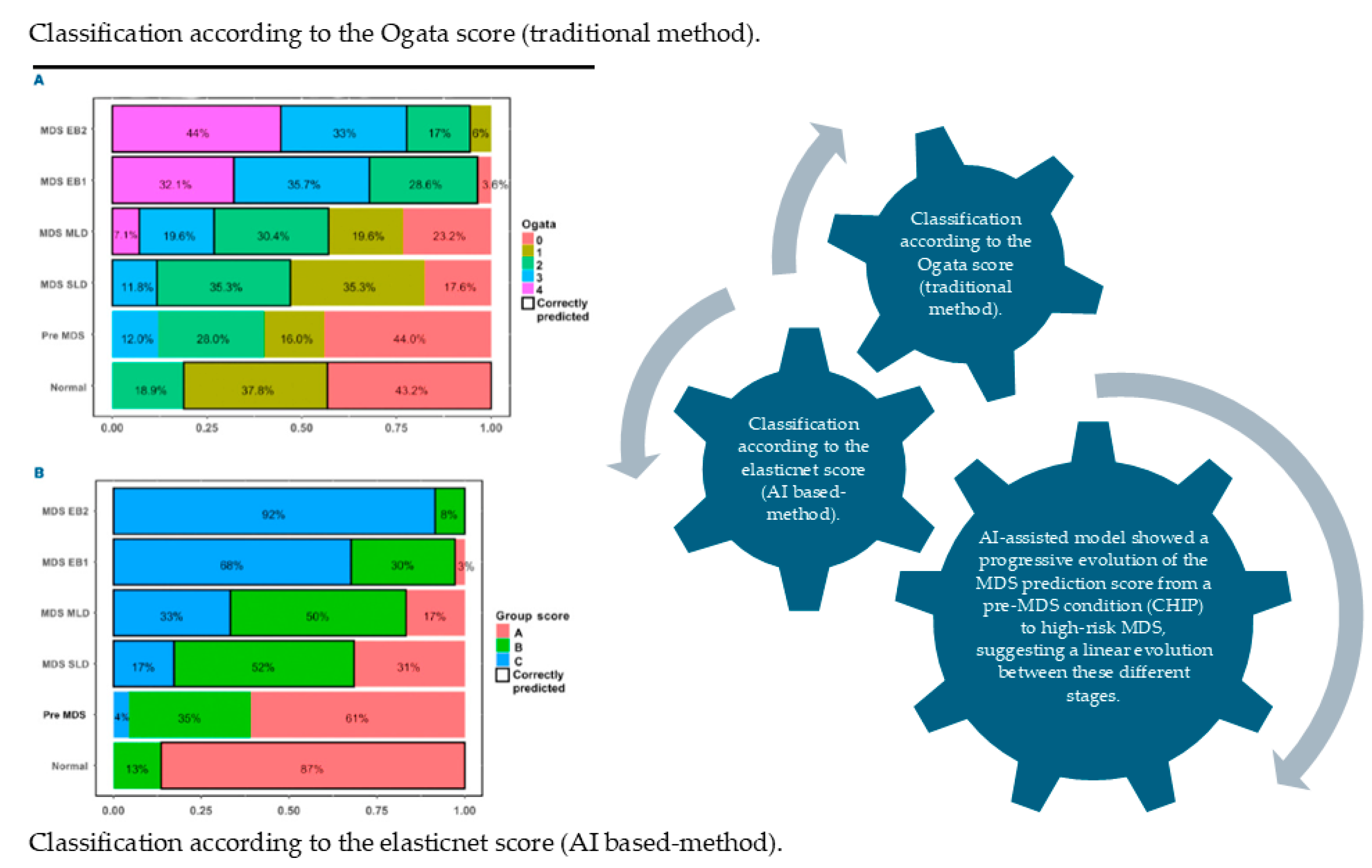
| Original [22] | Flow cytometry | AI-based MDS prediction score (using flow cytometry data) | Outperforms the traditional Ogata score. AI empowers the diagnosis of myelodysplastic syndromes by multiparametric flow cytometry | Suggest that this method could become a robust adjunct diagnostic tool | Requires specialized datasets and validation | Promising adjunct diagnostic tool, especially in unclear cases |
| Review [27] | Mixed (imaging, clinical, flow cytometry) | Artificial intelligence, machine learning, and deep learning | A significant proportion of the studies examined exhibited excellent predictive capabilities, with an AUC greater than 0.9. | Utilization of machine learning algorithms holds significant promise in the diagnosis of MDS | Heterogeneity across studies; lack of standardization | Confirms potential of AI in MDS diagnosis |
| Original [28] | Peripheral blood smear images | Convolutional neural networks | Primary contribution of this work is a predictive model for the automatic recognition in an objective way of hypogranulated neutrophils in peripheral blood smear | The utility of the model implemented is as an evaluation tool for MDS diagnosis integrated in the clinical laboratory workflow | Requires large, annotated datasets; less interpretable | Enhances diagnostic consistency and automation |
Disclaimer/Publisher’s Note: The statements, opinions and data contained in all publications are solely those of the individual author(s) and contributor(s) and not of MDPI and/or the editor(s). MDPI and/or the editor(s) disclaim responsibility for any injury to people or property resulting from any ideas, methods, instructions or products referred to in the content. |
© 2026 by the authors. Licensee MDPI, Basel, Switzerland. This article is an open access article distributed under the terms and conditions of the Creative Commons Attribution (CC BY) license.
Share and Cite
Tsamesidis, I.; Drillis, G.; Varlamis, S.; Smaragdaki, N.; Klonizakis, P.; Dimou, M.; Liapis, K.; Vrahiolias, G.; Andreadou, E.; Mitka, S.; et al. Novel Approaches to the Management of Myelodysplastic Syndromes: The Roles of Artificial Intelligence and Oxidative Stress Biomarkers. Hematol. Rep. 2026, 18, 33. https://doi.org/10.3390/hematolrep18030033
Tsamesidis I, Drillis G, Varlamis S, Smaragdaki N, Klonizakis P, Dimou M, Liapis K, Vrahiolias G, Andreadou E, Mitka S, et al. Novel Approaches to the Management of Myelodysplastic Syndromes: The Roles of Artificial Intelligence and Oxidative Stress Biomarkers. Hematology Reports. 2026; 18(3):33. https://doi.org/10.3390/hematolrep18030033
Chicago/Turabian StyleTsamesidis, Ioannis, Georgios Drillis, Sotirios Varlamis, Niki Smaragdaki, Philippos Klonizakis, Maria Dimou, Konstantinos Liapis, Georgios Vrahiolias, Eleni Andreadou, Stella Mitka, and et al. 2026. "Novel Approaches to the Management of Myelodysplastic Syndromes: The Roles of Artificial Intelligence and Oxidative Stress Biomarkers" Hematology Reports 18, no. 3: 33. https://doi.org/10.3390/hematolrep18030033
APA StyleTsamesidis, I., Drillis, G., Varlamis, S., Smaragdaki, N., Klonizakis, P., Dimou, M., Liapis, K., Vrahiolias, G., Andreadou, E., Mitka, S., Chatzidimitriou, M., Kotsianidis, I., Skepastianos, P., Kriebardis, A. G., & Pessach, I. (2026). Novel Approaches to the Management of Myelodysplastic Syndromes: The Roles of Artificial Intelligence and Oxidative Stress Biomarkers. Hematology Reports, 18(3), 33. https://doi.org/10.3390/hematolrep18030033