


Clinical and Biological Insights into Myelodysplastic Neoplasms Associated with Deletions of Chromosome 5q Region


Abstract
1. Introduction
2. 5q Deletion in MDS
3. Classification of MDS Associated with del(5q)
4. Molecular Pathogenesis of MDS-del(5q)
4.1. RPS14
4.2. miR-145 and miR-146a
4.3. CSNK1A1
4.4. HSPAP9 and SPARC
4.5. CTNNA1
4.6. EGR1
4.7. CDC25 and PP2A
4.8. DELE1
4.9. DIAPH1
4.10. TIFAB
4.11. NPM1
5. MDS-del(5q) as a Contiguous Gene Syndrome
6. Therapy-Related MDS-del(5q)
7. Progression and Disease Evolution in MDSA-del(5q)
8. Treatment of MDS-del(5q)
9. Conclusions
Author Contributions
Funding
Institutional Review Board Statement
Informed Consent Statement
Data Availability Statement
Conflicts of Interest
References
- Van den Berghe, H.; Cassiman, J.J.; Frins, J.P.; Michaux, J.L.; Sokal, G. Distinct hematological disorder with deletion of long arm of no. 5 chromosome. Nature 1974, 251, 437–438. [Google Scholar] [CrossRef]
- Jaffe, E.S.; Harris, N.L.; Stein, H.; Vardiman, J. World Health Organization classification of tumors. In Pathology and Genetics of Tumors of Hematopoietic and Lymphoid Tissues, 3rd ed.; IARC: Lyon, France, 2001. [Google Scholar]
- Arber, D.A.; Orazi, A.; Hasserjian, R.P.; Borowitz, M.J.; Calvo, K.R.; Kvanicka, H.M.; Bagg, W.A.; Barbui, T.; Branford, S.; Beso-Ramos, C.E.; et al. International Consensus Classification of myeloid neoplasms and acute leukemias: Integrating morphologic, clinical and genomic data. Blood 2022, 140, 1200–1228. [Google Scholar] [CrossRef]
- Khoury, J.D.; Solary, E.; Abla, O.; Akkori, Y.; Aleggio, R.; Apperley, J.F.; Bejar, R.; Berti, E.; Busque, L.; Chan, J.; et al. The 5th edition of the world Health Organization Classification of hematolymphoid tumors: Myeloid and histiocytic/dendritic neoplasms. Leukemia 2022, 36, 1703–1719. [Google Scholar] [CrossRef]
- Bernard, E.; Hasserjian, R.; Greenberg, P.L.; Ossa, J.E.; Creignou, M.; Tuechler, H.; Gutierrez-Abril, J.; Domenico, D.; Medina-Martinez, J.S.; Farmoud, N.; et al. Molecular taxonomy of myelodysplastic syndromes and its clinical implications. Blood 2024, 144, 1617–1632. [Google Scholar] [CrossRef]
- Meggendorfer, M.; Haferlach, C.; Kern, W.; Haferlach, T. Molecular analysis of myelodysplastic syndrome with isolated deletion of the long arm of chromosome 5 reveals a specific spectrum of molecular mutations with prognostic impact: A study on 123 patients and 27 genes. Haematologica 2017, 102, 1502–1510. [Google Scholar] [CrossRef]
- Montoro, M.J.; Palomo, L.; Haferlach, C.; Acha, P.; Chan, O.; Navarro, V.; Kubota, Y.; Schultz, F.I.; Meggendorfer, M.; Briski, R.; et al. Influence of TP53 gene mutations and their allelic status in myelodysplastic syndromes with isolated 5q deletion. Blood 2024, 144, 1722–1732. [Google Scholar] [CrossRef]
- Xie, Z.; Al Ali, N.; Zhang, L.; Papenhausen, P.; Volpe, V.O.; Chan, O.; Kuykendall, A.; Yun, S.; Walker, A.; Sweet, K.; et al. Clinical correlation and prognostic impact of cytogenetic clone size for myelodysplastic syndromes/neoplasm. Blood Neoplasia 2025, 2, 100062. [Google Scholar] [CrossRef]
- Haase, D.; Stevenson, K.E.; Neuberg, D.; Macjeweski, J.P.; Nazha, A.; Sekeres, M.A.; Ebert, B.L.; Garcia-Manero, G.; Haferlach, C.; Haferlach, T.; et al. TP53 mutation status divides myelodysplastic syndromes with complex karyotypes into distinct prognostic subgroups. Leukemia 2019, 33, 1747–1758. [Google Scholar] [CrossRef]
- Huber, S.; Hutter, S.; Baer, C.; Meggendorfer, M.; Hoermann, G.; Kern, W.; Haferlach, T.; Haferlach, C. Two ways to complex karyotype in MDS-the role of del(5q) and TP53. Blood Cancer J. 2025, 15, 96. [Google Scholar] [CrossRef]
- Kewan, T.; Durmaz, A.; Bahaj, W.; Gurnari, C.; Terkawi, L.; Awada, H.; Ogbue, O.; Ahmed, R.; Pagliuca, S.; Awada, H.; et al. Molecular patterns identify distinct subclasses of myeloid neoplasia. Nat. Commun. 2023, 14, 3136. [Google Scholar] [CrossRef]
- Greenberg, P.L.; Tuechler, H.; Schanz, J.; Sanz, G.; Garcia-Manero, G.; Solé, F.; Bennett, J.M.; Bowen, D.; Fenaux, P.; Dreyfus, F.; et al. Revised international prognostic scoring system for myelodysplastic syndromes. Blood 2012, 120, 2454–2465. [Google Scholar] [CrossRef]
- Bernard, E.; Tuechler, H.; Greenberg, P.L.; Hasserjian, R.P.; Arongo Ossa, J.E.; Nannya, Y.; Devlin, S.M.; Creignou, M.; Pinel, P.; Monnier, L.; et al. Molecular international prognostic scoring system for myelodysplastic syndromes. NEJM Evid. 2022, 1, EVIDoa22000008. [Google Scholar] [CrossRef]
- Montero, M.J.; Palomo, L.; Haferlach, C.; Acha, P.; Chan, O.; Navarro, V.; Kubota, Y.; Schulz, F.; Briski, R.; Al Ali, N.; et al. Newly developed prognostic score for myelodysplastic syndrome (MDS) with isolated 5q deletion (IPSS-del(5q)). Blood 2024, 144 (Suppl. S1), 666–668. [Google Scholar] [CrossRef]
- Komrokji, R.S.; Lanino, L.; Ball, S.; Bewersdorf, J.P.; Marchetti, M.; Maggioni, G.; Travaglino, E.; Al Ali, N.; Fenaux, P.; Platzbecker, U.; et al. Data-driven, harmonized classification system for myelodysplastic syndromes: A consensus paper from the International Consortium for Myelodysplastic Syndromes. Lancer Hematol. 2024, 11, e862–e872. [Google Scholar] [CrossRef]
- Bernard, E.; Nannya, Y.; Hasserjian, R.P.; Devlin, S.M.; Tuechler, H.; Medina-Martinez, J.S.; Yoshizato, T.; Shiozawa, Y.; Suki, R.; Malcovati, L.; et al. Implications of TP53 allelic state for genome stability, clinical presentation and outcomes in myelodysplastic syndromes. Nat. Med. 2020, 26, 1549–1556. [Google Scholar] [CrossRef]
- Stengel, A.; Meggendorfer, M.; Walter, V.; Baer, C.; Nadarajah, N.; Hutetr, S.; Kern, W.; Haferlach, T.; Haferlach, C. Interplay of TP53 allelic state, blast count, and complex karyotype on survival of patients with AML and MDS. Blood Adv. 2023, 7, 5540–5548. [Google Scholar] [CrossRef]
- Pandiri, M.; Stengel, A.; Zhang, J.; Wang, P.; Shao, H.; Velmurugan, S.; Jacob, A.; Symes, E.; Kaur, A.; Rojek, A.; et al. Karyotypic clonal fraction predicts adverse outcome in TP53-mutated myeloid neoplasms: An international TP53 investigators network (iTiN) study. J. Clin. Pathol. 2025, 78, 629–635. [Google Scholar] [CrossRef]
- Shah, M.V.; Hung, K.; Baranwal, A.; Kutyna, M.; Al-Kali, A.; Toop, C.; Greipp, P.; Brown, A.; Shah, S.; Khanna, S.; et al. Evidence-based risk stratification of myeloid neoplasms harboring TP53 mutations. Blood Adv. 2025, 9, 3370–3380. [Google Scholar] [CrossRef]
- Boultwood, J.; Fidler, C.; Lewis, S.; Kelly, S.; Sheridan, H.; Littlewood, T.; Buckle, V.; Wainscoat, J. Molecular Mapping of Uncharacteristically Small 5q Deletions in Two Patients with the 5q- Syndrome: Delineation of the Critical Region on 5q and Identification of a 5q- Breakpoint. Genomics 1994, 19, 425–432. [Google Scholar] [CrossRef]
- Boultwood, J.; Fidler, C.; Strickson, A.J.; Watkins, F.; Gama, S.; Kearney, L.; Tosi, S.; Kasprzyk, A.; Cheng, J.-F.; Jaju, R.J.; et al. Narrowing and Genomic Annotation of the Commonly Deleted Region of the 5q- Syndrome. Blood 2002, 99, 4638–4641. [Google Scholar] [CrossRef]
- Jaju, R.; Boultwood, J.; Oliver, F.; Kostrzewa, M.; Fidler, C.; Parker, N.; McPherson, J.; Morris, S.; Müller, U.; Wainscoat, J.; et al. Molecular Cytogenetic Delineation of the Critical Deleted Region in the 5q- Syndrome. Genes Chromosomes Cancer 1998, 22, 251–256. [Google Scholar] [CrossRef]
- Jerez, A.; Gondek, L.P.; Jankowska, A.M.; Makishima, H.; Przychodzen, B.; Tiu, R.V.; O’Keefe, C.L.; Mohamedali, A.M.; Batista, D.; Sekeres, M.A.; et al. Topography, Clinical, and Genomic Correlates of 5q Myeloid Malignancies Revisited. J. Clin. Oncol. 2012, 30, 1343–1349. [Google Scholar] [CrossRef]
- La Starza, R.; Matteucci, C.; Gorello, P.; Brandimarte, L.; Pierini, V.; Crescenzi, B.; Nofrini, V.; Rosati, R.; Gottardi, E.; Saglio, G.; et al. NPM1 deletion is associated with groos chromosomal rearrangements in leukemia. PLoS ONE 2010, 5, e12855. [Google Scholar] [CrossRef]
- Nofrini, V.; La Starza, R.; Crescenzi, B.; Pierini, V.; Barba, G.; Mecucci, C. Different boundaries characterize isolated and non-isolated 5q deletions in myelodysplastic syndromes and acute myeloid leukemias. Haematologica 2012, 97, 792–794. [Google Scholar] [CrossRef] [PubMed][Green Version]
- Rea, B.; Aggarwal, N.; Yetsenko, S.A.; Bailey, N.; Liu, Y.C. Acute myeloid leukemia with isolated del(5q) is associated with IDH1/IDH2 mutations and better prognosis when compared to acute myeloid leukemia with complex karyotype including del(5q). Mod. Patol. 2020, 33, 566–575. [Google Scholar] [CrossRef]
- Stengel, A.; Kern, W.; Haferlach, T.; Meggendorfer, M.; Haferlach, C. The 5q deletion size in myeloid malignancies is correlated with additional chromosomal aberrations and to TP53 mutations. Genes Chromosomes Cancer 2016, 55, 777–785. [Google Scholar] [CrossRef] [PubMed]
- Zemanova, Z.; Michalova, K.; Buryova, H.; Brezinova, J.; Lizcova, L.; Kostykova, K.; Sarova, I.; Izakova, S.; Rnasdorfova, S.; Krejcik, Z.; et al. Involvment of deleted chromosome 5 in complex chromosomal aberratyions in newly diagnosed myelodysplastic syndroems (MDS) is correlated with extremely adverse prognosis. Leuk. Res. 2014, 38, 537–544. [Google Scholar] [CrossRef]
- Warnstorf, D.; Bawadi, R.; Schienke, A.; Starsser, R.; Schmidt, G.; Illig, T.; Tauscher, M.; Thol, F.; Heuser, M.; Steinemann, D.; et al. Unbalanced translocation del(5;17) resulting in TP53 loss as recurrent aberration in myelodysplastic syndrome and acute myeloid leukemia with complex karyotype. Genes Chromosomes Cancer 2021, 60, 452–457. [Google Scholar] [CrossRef]
- Volkert, S.; Kohlmann, A.; Schnittger, S.; Kern, W.; Haferlach, T.; Haferlach, C. Association of the type of 5q loss with complex karyotype, clonal evolution, TP53 mutation status, and prognosis in acute myeloid leiukemia and myelodysplastic syndrome. Genes Chromosomes Cancer 2014, 53, 402–410. [Google Scholar] [CrossRef]
- Boultwood, J.; Pellagatti, A.; Cattan, H. Gene expression profiling of CD34+ cells in patients with 5q- syndrome. Br. J. Haematol. 2007, 139, 578–589. [Google Scholar] [CrossRef]
- Adema, V.; Paloma, L.; Walter, W.; Mallo, M.; Hutter, S.; La Franboise, T.; Arenillas, L.; Meggendorfer, M.; Radivoyevitch, T.; Xicoy, B.; et al. Pathophysiologic and clinical implications of molecular profiles resultant from deletion 5q. EBiomedicine 2022, 80, 104059. [Google Scholar] [CrossRef] [PubMed]
- Ebert, B.L.; Pretz, J.; Bosco, J.; Chang, C.Y.; Tamayo, P.; Galili, N.; Raza, A.; Root, D.E.; Attar, E.; Dellis, S.R.; et al. Identification of RPS14 as a 5q- syndrome gene by RNA interference screen. Nature 2008, 451, 335–339. [Google Scholar] [CrossRef] [PubMed]
- Dutt, S.; Narla, A.; Lin, K.; Mullally, A.; Abayasekara, N.; Megerdichian, C.; Wilson, F.H.; Currie, T.; Khanna-Gupta, A.; Berliner, N.; et al. Haploinsufficiency for ribosomal protein genes causes selective activation of p53 in huma erythroid progenitor cells. Blood 2011, 117, 2567–2576. [Google Scholar] [CrossRef] [PubMed]
- Pellagatti, A.; Marafioti, T.; Paterson, J.C.; Barlow, J.L.; Drynan, L.F.; Giagounidis, A.; Pileri, S.A.; Cazzola, M.; McKenzie, A.; Wainscoat, J.S.; et al. Induction of p53 and up-regulation of the p53 pathway in the human 5q- syndrome. Blood 2010, 115, 2721–2723. [Google Scholar] [CrossRef]
- Barlow, J.L.; Drynan, L.F.; Hewett, D.R.; Holmes, L.R.; Lorenzo-Abalkde, S.; Lane, A.L.; Jolin, H.E.; Pannell, R.; Middleton, A.; Wong, S.H.; et al. A p53-dependent mechanism underlies macrocytic anemia in a mouse model of human 5q- syndrome. Nat. Med. 2010, 16, 59–66. [Google Scholar] [CrossRef]
- Pellagatti, A.; Hellstrom-Lindberg, E.; Giagounidis, A.; Perry, J.; Malcovati, L.; Della Porta, M.; Jadersten, M.; Killick, S.; Fidler, C.; Cazzola, M.; et al. Haloinsufficiency of RPS14 in 5q− syndrome is associated with deregulation of ribosomal- and translation-related genes. Br. J. Haematol. 2008, 142, 57–64. [Google Scholar] [CrossRef]
- Pellagatti, A.; Hellstrom-Lindberg, E.; Giagounidis, A.; Perry, J.; Malcovati, L.; Della Porta, M.; Jadersten, M.; Killick, S.; Sohal, D.; Verma, A.; et al. Haploinsufficiency of RPS14 and deregulation of ribosomal- and translation-related genes in MDS patients with del(5q). Blood 2008, 112 (Suppl. S1), 3641. [Google Scholar] [CrossRef]
- Cziberre, A.; Bruns, I.; Junge, B.; Kobbe, G.; Haas, R.; Germing, U. Low RPS14 expression is common in myelodysplastic syndromes without 5q− aberration and defines a subgroup of patients with prolonged survival. Haematologica 2009, 94, 1453–1455. [Google Scholar] [CrossRef]
- Wu, L.; Xu, F.; Zhang, Z.; Chang, C. Low Rps14 expression in MDS without 5q- aberration confers higher apoptosis rate of nucleated erythrocytes and predict prolonged survival and possible response to lenalidomide in lower risk non-5q- patients. Eur. J. Haematol. 2013, 90, 486–493. [Google Scholar] [CrossRef]
- Linares, M.; Rapado, I.; Ruiz-Heredia, Y.; Cedena, M.T.; Quiroz, K.; Barrio, S.; Ayala, R.; Martinez, J. 5q+ MDS patients with low RPS14 expression are candidates to immune-modulating drugs. Blood 2017, 130, 5303. [Google Scholar]
- Adema, V.; Kongkiatkamon, S.; Palomo, L.; Walter, W.; Hutter, S.; LaFrambiose, T.; Diez-Campelo, M.; Mallo, M.; Xicoy, B.; Meggendorfer, M.; et al. Deficiency of RPs14 beyond the haploinsufficient loss in del(5q). Blood 2021, 138 (Suppl. S1), 2591. [Google Scholar] [CrossRef]
- Schneider, R.K.; Schenone, M.; Ventura Ferreira, M.; Kramann, R.; Joyce, C.E.; Hartigan, C.; Beier, F.; Brummendorf, T.H.; Germin, L.; Pletzbecker, U.; et al. Rps14 haploinsufficiency causes a block in erythroid differentiation mediated by S100A8 and S100A9. Nat. Med. 2016, 22, 288–297. [Google Scholar] [CrossRef] [PubMed]
- Starczynowski, D.T.; Kuchenbauer, F.; Argiropoulos, B.; Sung, S.; Morin, R.; Muranyi, A.; Hirst, M.; Hogge, D.; Marra, M.; Wells, R.A.; et al. Identification of MiR-145 and MiR-146a as Mediators of the 5q– Syndrome Phenotype. Nat. Med. 2010, 16, 49–58. [Google Scholar] [CrossRef]
- Kumar, M.S.; Narla, A.; Nonami, A.; Mullally, A.; Dimitrova, N.; Ball, B.; McAuley, J.R.; Poveromo, L.; Kutok, J.L.; Galili, N.; et al. Coordinate Loss of a MicroRNA and Protein-Coding Gene Cooperate in the Pathogenesis of 5q- Syndrome. Blood 2011, 118, 8. [Google Scholar] [CrossRef] [PubMed]
- Schneider, R.K.; Adema, V.; Heckl, D.; Jaras, M.; Mallo, M.; Lord, A.; Chu, L.; McConkey, M.; Kramann, R.; Mullally, A.; et al. Role of casein kinase 1A1 in the biology and targeted therapy of del(5q) MDS. Cancer Cell 2014, 26, 509–520. [Google Scholar] [CrossRef]
- Smith, A.E.; Kulakaseraj, A.; Jiang, J.; Mian, S.; Mohamedali, A.; Gaken, J.; Ireland, R.; Czepulkowski, B.; Best, S.; Mufti, G.J.; et al. CSNK1A1 mutations and isolated del(5q) abnormality in myelodysplastic syndrome: A retrospective mutational analysis. Lancet Hematol. 2015, 2, e212–e221. [Google Scholar] [CrossRef]
- Heuser, M.; Meggendorfer, M.; Cruz, M.M.; Fabisch, J.; Klesse, S.; Kohler, L.; Gohring, G.; Ganster, C.; Shirneshan, K.; Gutermuth, A.; et al. Frequency and prognostic impact of casein kinase 1A1 mutations in MDS patients with deletion of chromosome 5q. Leukemia 2015, 29, 1942–1945. [Google Scholar] [CrossRef]
- Stalmann, U.; Ticconi, F.; Snoeren, I.; Li, R.; Gleitz, H.; Coeley, G.; McConkey, M.; Wong, A.; Smitz, S.; Fuchs, S.; et al. Genetic barcoding systematically compares genes in del(5q) MDS and reveals a central role for CSNK1A1 in clonal expansion. Blood Adv. 2022, 6, 1780–1786. [Google Scholar] [CrossRef]
- Fuchs, S.; Stalmann, U.; Snoeren, I.; Bindels, E.; Schmitz, S.; Banjamin, B.; Hoogenboezem, R.; van Herk, S.; Saad, M.; Walter, W.; et al. Collaborative effect of CSNK1A1 haploinsufficiency and mutant p53 in Myc induction can promote leukemic transformation. Blood Adv. 2024, 8, 766–774. [Google Scholar] [CrossRef]
- Kollotzek, F.; Mott, K.; Fischer, M.; Findik, B.; Gob, V.; Manke, M.C.; Borst, C.E.; Polzin, A.; Burkhalter, M.D.; Eckly, A.E.; et al. Casein kinase 1α essentially regulates thrombopoiesis by driving megakaryocyte maturation and cytoskeleton organization. Blood 2025, 146, 1964–1978. [Google Scholar] [CrossRef] [PubMed]
- Liu, X.; Huang, Q.; Chen, L.; Zhang, H.; Schobrunn, E.; Chen, J. Tumor-derived CK1α mutations enhance MDMX inhibition of p53. Oncogene 2020, 39, 176–186. [Google Scholar] [CrossRef] [PubMed]
- Esfahanian, N.; Knoblsch, C.D.; Bowman, C.A.; Rezvani, K. Mortalin: Protein partners, biological impacts, pathological role, and therapeutic opportunities. Front. Cell Dev. Biol. 2023, 11, 10228519. [Google Scholar] [CrossRef]
- Chen, T.H.; Kambai, A.; Krysiak, K.; Walhauser, M.A.; Raju, G.; Tibbitts, J.F.; Walter, M.J. Kockdown of Hspa9, a del(5q31.2), results in a decrease in hematopoietic progenitors in mice. Blood 2010, 117, 1530–1539. [Google Scholar] [CrossRef]
- Liu, T.; Krysiak, K.; Shirai, C.L.; Kim, S.; Shao, J.; Ndonwi, M.; Walter, M.J. Knockdown of HSPA9 induces TP53-dependent apoptosis in human hematopoietic progenitor cells. PLoS ONE 2017, 12, e0170470. [Google Scholar] [CrossRef]
- Butler, C.; Dunmire, M.; Choi, J.; Szalai, G.; Johnson, A.; Lei, W.; Chen, X.; Liu, L.; Li, W.; Walter, M.J.; et al. SSPA9/mortalin inhibition disrupts erythroid maturation through a TP53-dependent mechanism in human CD34+ hematopoietic progenitor cells. Cell Stress Chaperones 2024, 29, 300–311. [Google Scholar] [CrossRef] [PubMed]
- Lehmann, S.; O’Kelly, J.; Raynaud, S.; Funk, S.E.; Sage, E.H.; Koeffler, H.P. Common deleted genes in the 5q- syndrome: Thrombocytopenia and reduced erythroid colony formation in SPARC null mice. Leukemia 2007, 21, 1931–1936. [Google Scholar] [CrossRef]
- Luo, Z.; Luo, P.; Yu, Y.; Zhao, Q.; Cheng, L. SPARC promotes the development of erythroid progenitors. Exp. Hematol. 2012, 40, 828–836. [Google Scholar] [CrossRef] [PubMed]
- Liu, T.X.; Becker, M.W.; Jelinck, J.; Wu, W.S.; Deng, M.; Mikhalkevich, N.; Hsu, K.; Blomfield, C.; Stone, R.M.; DeAngelo, D.J.; et al. Chromosome 5 deletion and epigenetic suppression of the gene encoding α-catenin (CTNNA1) in myeloid cell transformation. Nat. Med. 2007, 13, 78–83. [Google Scholar] [CrossRef]
- Joslin, J.M.; Fernald, A.A.; Qian, Z.; Crispino, J.D.; LeBeau, M. Egr1, a candidate gene within the commonly deleted segment of chromosome 5, plays a role in murine erythropoiesis and leukemogenesis. Blood 2005, 106 (Suppl. S1), 663. [Google Scholar] [CrossRef]
- Joslin, J.M.; Fernald, A.A.; Tennant, T.R.; Davis, E.M.; Kogan, S.C.; Anastasi, J.; Crispino, J.D.; LeBeau, M. Haploinsufficiency of EGR1, a candidate gene in the del(5q), leads to the development of myeloid disorders. Blood 2007, 110, 719–726. [Google Scholar] [CrossRef]
- Stoddart, A.; Fernald, A.A.; Davis, E.M.; McNerney, M.E.; LeBeau, M. EGR1 haploinsufficiency confers a fitness advantage to hematopoietic stem cells following chemotherapy. Exp. Hematol. 2022, 115, 54–67. [Google Scholar] [CrossRef] [PubMed]
- Wei, S.; Rocha, K.; Williams, A.; Chen, X.; Burnette, P.K.; Djeu, J.Y.; Liu, Q.; Byrd, J.; Sokol, L.; Lawrence, N.; et al. Gene dosage of the cell cycle regulatory phosphatases Cdsc25C and PP2A determines sensitivity to lenalidomide in del(5q) MDS. Blood 2007, 110 (Suppl. S1), 118. [Google Scholar] [CrossRef]
- Wei, S.; Chen, X.; Rocha, K.; Epling-Burnette, P.K.; Dieu, J.Y.; Liu, Q.; Byrd, J.; Sokol, L.; Lawrence, N.; Pireddu, R.; et al. A critical role for phosphatase haploinsufficiency in the selective suppression of deletion 5q MDS by leniladomide. Proc. Natl. Acad. Sci. USA 2009, 106, 12974–12979. [Google Scholar] [CrossRef]
- Spinell, J.F.; Chanbgroul, J.; Moison, C.; Lavallée, V.P.; Bolin, I.; Gracias, D.; Lavallée, S.; Richard Carpentier, G.; Beliveau, F.; Hébert, J.; et al. DELE1 haploinsufficiency causes resistance to mitochondrial stress-induced apoptosis in monosomy 5/del(5q) AML. Leukemia 2024, 38, 530–537. [Google Scholar] [CrossRef]
- Peng, J.; Kitchen, S.M.; West, R.A.; Sigler, R.; Eisenmann, K.M.; Alberts, A.S. Myeloproliferative defects following targeting of the Drfg1 gene encoding the mammalian diaphanous-related formin mDia1. Cancer Res. 2007, 67, 7565–7571. [Google Scholar]
- Keerthivasan, G.; Mei, Y.; Zhao, B.; Zhang, L.; Harris, C.E.; Gao, J.; Basiorka, A.A.; Schipma, M.J.; McElherme, J.; Verma, A.K.; et al. Aberrant overexpression of CD14 on granulocytes sensitizes the innate immune response in mDia1 heterozygous del(5q) MDS. Blood 2014, 124, 780–790. [Google Scholar] [CrossRef] [PubMed]
- Pan, J.; Lodier, L.; Meyran, D.; Rameau, P.; Lecluse, Y.; Kitchen-Goosen, S.; Badirou, I.; Mokrani, H.; Narumya, S.; Alberts, A.S.; et al. The forming DIAPH1 (mDia1) regulates megakaryocyte proplatelet formation by remodeling the actin and microtubule cytoskeletons. Blood 2014, 124, 3967–3977. [Google Scholar] [CrossRef] [PubMed]
- Tang, Y.; Wang, H.; Zhang, Z.; Yao, Y.; Han, Y.; Wu, D. DIAPH1 mutations predict favorable outcome for de novo MDS. Cancer Lett. 2024, 598, 217125. [Google Scholar] [CrossRef]
- Nakamura, T.; Ohyama, C.; Sakamoto, M.; Toma, T.; Tateishi, H.; Matsuo, M.; Chirifu, M.; Ikemizu, S.; Morioka, H.; Fujita, M.; et al. TIFAB regulates the TIFA-TRAF6 signaling pathway involved in innate immunity by forming a heterodimer complex with TIFA. Proc. Natl. Acad. Sci. USA 2024, 121, e2318794121. [Google Scholar] [CrossRef]
- Varney, M.; Christie, S.; Niederkom, M.; Fang, J.; Jerez, A.; Maciejewski, D.T.; Inoue, J.; Starczynowski, D.T. Deletion of TIFAB, a novel candidate gene on chromosome 5q, results in hematopoietic defects by changing the dynamic range of innate immune pathway activation. Blood 2013, 122 (Suppl. S1), 102. [Google Scholar] [CrossRef]
- Varney, M.E.; Niederkon, M.; Konno, H.; Matsumara, T.; Gohdfa, J.; Yoshida, N.; Akiyama, T.; Christie, S.; Fang, J.; Miller, D.; et al. Loss of Tifab, a del(5q) MDS gene, alters hematopoiesis through derepression of Toll-like receptor-TRAF6 signaling. J. Exp. Med. 2015, 212, 1967–1985. [Google Scholar] [CrossRef]
- Niederkon, M.; Hueneman, K.; Choi, K.; Varney, M.E.; Romano, L.; Pujato, M.A.; Greis, K.D.; Inoue, J.; Meetei, R.; Starczynowski, D.T. TIFAB regulates USP15-mediated p53 signaling during stressed and malignant hematopoiesis. Cell Rep. 2020, 30, 2776–2790. [Google Scholar] [CrossRef]
- Raval, A.; Kusler, B.; Weissman, I.L.; Mitchell, B.S.; Park, C.Y. Effect of nucleophosmin 1 haploinsufficiency on hematopoietic stem cells. Leukemia 2012, 26, 853–855. [Google Scholar] [CrossRef]
- Morganti, C.; Ito, K.; Yanase, C.; Verma, A.; Teruya-Feldstein, J.; Ito, K. NPM1 ablation induces HSC aging and inflammation to develop myelodysplastic syndrome exacerbated by p53 loss. EMBO Rep. 2022, 23, e54262. [Google Scholar] [CrossRef] [PubMed]
- Ribezzo, F.; Snoeren, I.; Ziegler, S.; Stoelben, J.; Olofsen, P.A.; Henic, A.; Ventura Ferreira, M.; Chen, S.; Stalmann, U.; Buesche, G.; et al. Rps14, Csnk1A1 and miR145/miR146a deficiency cooperate in the clinical phenotype and activation of the innate immune system in the 5q− syndrome. Leukemia 2019, 33, 1759–1772. [Google Scholar] [CrossRef]
- Varney, M.E.; Choi, K.; Bolanos, L. Epistasis between TIFAB and miRT-146a: Neighboring genes in del(5q) myelodysplastic syndrome. Leukemia 2017, 31, 491–495. [Google Scholar] [CrossRef]
- Muto, T.; Walker, C.S.; Agarwal, P.; Vick, E.; Sampson, A.; Choi, K.; Niederkon, M.; Ishikawa, C.; Hueneman, K.; Varney, M.; et al. Inactivation of p53 provides a competitive advantage to del(5q) myelodysplastic syndrome hematopoietic stem cells. Haematologica 2023, 108, 2715–2729. [Google Scholar] [CrossRef]
- Berggren, D.M.; Garelius, H.; Hjielm, P.W.; Nilsson, L.; Ramussen, B.; Elbult, C.E.; Lambe, M.; Lehmann, S.; Heelstrom-Lindberg, E.; Jadersten, M.; et al. Therapy-related MDAS dissected based in primary disease and treatment-a nation-wide perspective. Leukemia 2023, 37, 1103–1112. [Google Scholar] [CrossRef] [PubMed]
- Wong, T.N.; Ramsingh, G.; Young, A.L.; Miller, C.A.; Touma, W.; Welch, J.S.; Lamprecht, T.L.; Shen, D.; Hundal, J.; Fulton, R.S.; et al. Role of TP53 mutations in the origin and evolution of therapy-related acute myeloid leukemia. Nature 2015, 518, 552–555. [Google Scholar] [CrossRef] [PubMed]
- Lindsley, R.C.; Saber, W.; Nar, B.G.; Wang, T.; Haagenson, M.D.; Grauman, P.V.; Hu, Z.H.; Spellman, R.R.; Lee, S.J.; Verneris, M.R.; et al. Prognostic mutations in myelodysplastic syndrome after stem-cell transplantation. N. Engl. J. Med. 2017, 376, 536–547. [Google Scholar] [CrossRef]
- Smith, S.M.; Le Beau, M.; Huo, D.; Karrison, T.; Sobecks, R.M.; Anastasi, J.; Varrdiman, J.W.; Rowley, J.D.; Lrason, R.A. Clinical-cytogenetic associations in 306 patients with therapy-related myelodysplasia and myeloid leukemia: The University of Chicago series. Blood 2003, 102, 43–52. [Google Scholar] [CrossRef]
- Zeidan, A.M.; Al Ali, N.; Barnard, J.; Padron, E.; Lancet, J.E.; Sekeres, M.A.; Steensma, D.P.; DeZern, A.; Roboz, G.; Jabbour, E.; et al. Comparison of clinical outcomes and prognostic utility of risk stratification tools in patients with therapy-related vs de novo myelodysplastic syndromes: A report on behalf of the MDS clinical research consortium. Leukemia 2017, 31, 1391–1397. [Google Scholar] [CrossRef] [PubMed]
- Hiwase, D.; Hahn, C.; Tran, E.N.H.; Chhetri, R.; Baronwal, A.; Al-kali, A.; Sharplin, K.; Ladon, D.; Hillins, R.; Greipp, P.; et al. TP53 mutation in therapy-related myeloid neoplasms defines a distinct molecular subtype. Blood 2023, 141, 1087–1091. [Google Scholar] [CrossRef]
- Shah, M.V.; Tran, E.H.N.; Shah, S.; Chhetri, R.; Baranawl, A.; Ladon, D.; Shultz, C.; Al-kali, A.; Brown, A.L.; Chen, D.; et al. TP 53 mutation variant allele frequency of ≥10% is associated with poor prognosis in therapy-related myeloid neoplasms. Blood Cancer J. 2023, 13, 51. [Google Scholar] [CrossRef]
- Bao, Z.; Li, B.; Qin, T.; Xu, Z.; Qu, S.; Jia, Y.; Li, C.; Pan, L.; Gao, Q.; Jiao, M.; et al. Molecular characteristics and clinical implications of TP53 mutations in therapy-related myelodysplastic syndromes. Blood Cancer J. 2025, 15, 58. [Google Scholar] [CrossRef] [PubMed]
- Lessard, M.; Hélias, C.; Struski, S.; Perrusson, N.; Uetwiller, F.; Mozziconacci, M.J.; Lafage-Pochitaloff, M.; Dastugue, N.; Terré, C.; Brizard, F.; et al. Groupe francophone de cytogénétique hématologique. Fluorescence in situ hybridization analysis of 110 hematopoietic disorders with chromosome 5 abnormalities: Do de novo and therapy-related myelodysplastic syndrome-acute myeloid leukemia actually differ? Cancer Genet. Cytogenet. 2007, 176, 1–21. [Google Scholar] [CrossRef]
- Fleti, F.; Singh, A.; Al-Kali, A.; Foran, J.M.; Elliott, M.A.; Begna, K.; Badar, T.; Khera, N.; Shah, M.V.; Alkhateeb, H.B.; et al. Therapy-related myelodysplastic syndromes with isolated del(5q): A comparative analysis of phenotype and long-term survival. Blood 2022, 140, 6940–6941. [Google Scholar] [CrossRef]
- Jadersten, M.; Saft, L.; Pellegatti, A.; Gohring, G.; Wainscopat, J.S.; Boutwood, J.; Porwit, A.; Schagelberger, B.; Hellstrom-Lindberg, E. Clonal heterogeneity in the 5q− syndrome: p53 expressing progenitors prevail during lenalidomide treatment and expand at disease progression. Haematologica 2009, 94, 1762–1766. [Google Scholar] [CrossRef]
- Schagelberger, B.; Giai, V.; Pellagatti, A.; Saft, L.; Dimitriou, M.; Jansson, M.; Jadersten, M.; Grandien, A.; Davagi, I.; Neuberg, D.S.; et al. Progression in patients with low- and intermediate-risk del(5q) myelodysplastic syndromes is predicted by a limited subset of mutations. Haematologica 2017, 102, 498–508. [Google Scholar]
- Mossner, M.; Jann, J.C.; Witting, J.; Nolte, F.; Fey, S.; Nowak, V.; Oblander, J.; Pressler, J.; Palme, I.; Xanthopoulos, C.; et al. Mutational hierarchies in myelodysplastic syndromes dynamically adapt and evolve upon therapy response and failure. Blood 2016, 128, 1246–1259. [Google Scholar] [CrossRef]
- Mossner, M.; Jann, J.C.; Nowak, D.; Platzbecker, U.; Giagounidis, A.; Gotze, K. Prevalence, clonal dynamics and clinical impact of TP53 mutations in patients with myelodysplastic syndrome with isolated deletion (5q) treated with lenalidomide: Results from a prospective multicenter study of the German MDS study group (GMDS). Leukemia 2016, 30, 1956–1959. [Google Scholar] [CrossRef]
- Lode, L.; Menard, A.; Flet, L.; Richebourg, S.; Loirat, M.; Eveillard, M.; Le Bris, Y.; Godon, C.; Theisen, O.; Gagez, A.-L.; et al. Emergence and evolution of TP53 mutations are key features of disease progression in myelodysplastic patients with lower-risk del(5q) treated with lenalidomide. Haematologica 2018, 103, e143–e146. [Google Scholar] [CrossRef] [PubMed]
- Sperling, A.S.; Guerra, V.; Kennedy, J.A.; Yan, Y.; Hsu, J.; Wang, F.; Nguyen, A.T.; Miller, P.G.; McConkey, M.; Quevedo Barrios, V.; et al. Lenalidomide promotes the development of TP53-mutated therapy-related myeloid neoplasms. Blood 2022, 140, 1753–1763. [Google Scholar] [CrossRef]
- Abdallah, M.; Reichard, K.; Gnagat, N.; Tefferi, A. Treatment-emergent mutations in myelodysplastic syndrome with del (5q)-lenalidomide related or disease-intrinsic clonal evolution. Blood Cancer J. 2024, 14, 49. [Google Scholar] [CrossRef]
- Feurstein, S.; Thomay, K.; Hofmann, W.; Buesche, G.; Kreipe, H.; Thol, F.; Heuser, M.; Ganser, A.; Schlegelberger, B.; Gihring, G. Routes of clonal evolution into complex karyotypes in myelodysplastic syndrome patients with 5q deletion. Int. Mol. Sci. 2018, 19, 3269. [Google Scholar] [CrossRef]
- Merz, A.M.A.; Platzbecker, U. Treatment of lower-risk myelodysplastic syndromes. Hamatologica 2025, 110, 330–338. [Google Scholar] [CrossRef]
- McMahon, C.; Raddi, M.G.; Mohan, S.; Santini, V. New approvals in low- and intermediate-risk myelodysplastic syndromes. Am. Soc. Clin. Oncol. Educ. Book. 2025, 45, e473654. [Google Scholar] [CrossRef]
- Roncador, M.; Bernard, E.; Hasserjian, R.; Boulwood, J.; Elena, C.; Galli, A.; Gurnari, C.; Mecacci, C.; Michaux, L.; Mittelman, M.; et al. A precision medicine approach to the myelodysplastic syndrome with isolated deletion 5q, fifty years after its discovery. Blood 2025, 146, 1883–1896. [Google Scholar] [CrossRef]
- Huber, S.; Haferlach, T.; Meggendorfer, M.; Hutter, S.; Hoermann, G.; Baer, C.; Kern, W.; Haferlach, C. SF3B1 mutated MDS: Blast count, genetic co-abnormalities and their impact on classification and prognosis. Leukemia 2022, 36, 2894–2902. [Google Scholar] [CrossRef]
- Chan, O.; Al Ali, N.; Sallman, D.A.; Padron, E.; Lancet, J.E.; Komrokji, R. SF3B1 mutations and not TP53 are associated with outcomes in patients with del(5q) myelodysplastic syndromes (MDS). Blood 2020, 136 (Suppl. S1), 25–26. [Google Scholar] [CrossRef]
- Duetz, C.; Westers, T.; Hout, F.; Cremers, E.; Alhan, C.; Venniker-Punt, B.; Visser-Wisselaar, B.; Chitu, D.; de Graaf, A.; Smit, L.; et al. Distinct bone marrow immunophenotypic features define the splicing factor 3B subunit 1 (SF3B1)-mutant myelodysplastic syndromes subtype. Br. J. Haematol. 2021, 193, 798–803. [Google Scholar] [CrossRef]
- Sun, X.; Gao, Q.; Arcila, M.; Roshal, M.; Zhang, Y.; Xiao, W.; Chan, A. Diagnostic challenges and proposed classification of myeloid neoplasms with overlapping features of thrombocytosis, ring sideroblasts and concurrent del(5q) and SF3B1 mutations. Haematologica 2024, 109, 2676–2681. [Google Scholar]
- Komrokji, R.S.; Schwabkey, Z.I.; Al Ali, N.K.; Aguirre, L.E.; Stahl, M.; Ball, S.; Mason, E.F.; Savona, M.R.; Santini, V.; Consagra, A.; et al. Myelodysplastic syndromes with concomitant SF3B1 mutation and deletion of the long arm of chromosome 5 (SF3B1del5q): Outcomes and response to treatment. Blood 2024, 144 (Suppl. S1), 1845–1847. [Google Scholar] [CrossRef]
- Marinez-Heter, S.; Deng, Y.; Parker, J.; Jiang, J.; Mo, A.; Decking, T.R.; Gharaee, N.; Li, J.; Umlandt, P.; Fuller, M.; et al. Loss of lenalidomide-induced megakaryocytic differentiation leads to therapy resistance in del(5q) myelodysplastic syndrome. Nat. Cell Biol. 2020, 22, 526–533. [Google Scholar]
- Barreyro, L.; Sampson, A.M.; Hueneman, K.; Choi, K.; Christie, S.; Ramesh, V.; Wyder, M.; Wang, D.; Pujato, M.; Greis, K.D.; et al. Dysregulated innate immune signaling cooperates with RUNX1 mutations to transform an MDS-like disease to AML. iScience 2024, 27, 109809. [Google Scholar] [CrossRef]
- Garcia-Manero, G.; Santini, V.; Zeidan, A.M.; Komrokoji, R.S.; Pozharskaya, V.; Rose, S.; Keeperman, K.; Lai, Y.; Karsekar, S.; Aggarwal, B.; et al. Long-term transfusion independence with Luspatercept versus epoietin alfa in erythropoiesis-stimulating agent-naïve, lower-risk myelodysplastic syndromes in the COMMANDS trial. Adv. Ther. 2025, 42, 3676–3689. [Google Scholar] [CrossRef]
- Della Porta, M.G.; Garcia-Manero, G.; Santini, V.; Zeidan, A.M.; Komrokji, R.S.; Shortt, J.; Valcarcel, D.; Jonasova, A.; Dimicoli-Salazar, S.; Tiong, I.S.; et al. Luspatercept versus epoietin alfa in erythropoiesis-stimulating agent-naïve, transfusion-dependent, lower-risk myelodysplastic syndromes (COMMANDS): Primary analysis of a phase 3, open-label, randomized, controlled trial. Lancet Hematol. 2024, 11, e646–e659. [Google Scholar] [CrossRef]
- Platzbacker, U.; Della Porta, M.G.; Santini, V.; Zeidan, A.M.; Komrokji, R.S.; Shott, J.; Valcarcel, D.; Jonasova, A.; Dimicoli-Salazar, S.; Tiong, I.S.; et al. Efficacy and safety of luspatercept versus epoietin alfa in erythropoiesis-stimulating agent-naïve, transfusion-dependent, lower-risk myelodysplastic syndromes (COMMANDS): Interim analysis of a phase 3, open-label, randomized controlled trial. Lancet 2023, 402, 373–385. [Google Scholar] [CrossRef]
- Fenaux, P.; Platzbecker, U.; Mufti, G.J.; Garcia-Manero, G.; Buckskin, R.; Santini, V.; Dier-Compelo, M.; Finelli, C.; Cazzola, M.; Ilhan, D.; et al. Luspatercept in patients with lower-risk myelodysplastic syndromes. N. Engl. J. Med. 2020, 382, 140–151. [Google Scholar] [CrossRef]
- Oliva, E.N.; Poloni, A.; Frairia, C.; Riva, M.; Capodanno, I.; Delfino, I.M.; D’Errigo, M.G.; Mammì, C.; Ianni, G.; Zini, G.; et al. Luspatercept for the treatment of transfusion-dependent anemia in patients with myelodysplastic neoplasms with del5q, refractory/resistant/intolerant to prior treatments (QOL_ONE Phoenix). Blood 2024, 144 (Suppl. S1), 6741–6742. [Google Scholar] [CrossRef]
- Patsialos, I.; Kontandreopoulou, C.N.; Vlachopoulou, D.; Safylidis, C.; Syriopoulou, S.; Kalala, F.; Anastasopoulou, A.; Mantzrourani, M.; Diamantopoulos, P. A myelodysplastic neoplasm with del(5q) treated with luspatercept uncovers unexplored mechanisms of action for the drug. Br. J. Haematol. 2024, 205, 1641–1644. [Google Scholar] [CrossRef]
- Fenaux, P.; Mufti, G.J.; Hellstrom-Lindberg, E.; Santini, V.; Finelli, C.; Giagounidis, A.; Schoch, R.; Gattermann, N.; Sanz, G.; List, A.; et al. Efficacy of azacitidine compared with that of conventional care regimens in the treatments of myelodysplastic syndromes: A randomized, open-label, phase III study. Lancet Oncol. 2009, 10, 223–232. [Google Scholar] [CrossRef]
- Sekeres, M.A.; Othus, M.; List, A.F.; Odenike, O.; Stone, R.M.; Gore, S.D.; Litzow, M.R.; Buckstein, R.; Fang, M.; Roulston, D.; et al. Randomized phase II study of azacitidine alone or in combination with lenalidomide or verinostat in higher-risk myelodysplastic syndromes and chronic myelomonocytic leukemia: North American Intergroup Study sWOG S1117. J. Cin. Oncol. 2017, 35, 2745–2753. [Google Scholar] [CrossRef]
- Bernal, T.; Martinez-Camblor, P.; Sanchez-Garcia, J.; de Paz, R.; Luño, E.; Nomdedeu, B.; Ardanaz, M.T.; Pedro, C.; Amigo, M.L.; Xicoy, B.; et al. Effectiveness of azacitidine in unselected high-risk myelodysplastic syndromes: Results from the Spanish registry. Leukemia 2015, 29, 1875–1881. [Google Scholar] [CrossRef]
- Garcia, J.S.; Platbecker, U.; Odenike, O.; Fleming, S.; Fong, C.Y.; Borate, U.; Jacoby, M.A.; Nowak, D.; Baer, M.R.; Petrlin, P.; et al. Efficacy and safety of venetoclax plus azacitidine for patients with treatment-naïve high-risk myelodysplastic syndromes. Blood 2025, 145, 1126–1135. [Google Scholar] [CrossRef]
- Bazinet, A.; Loghavi, S.; Wei, Y.; Bataller, A.; Sasaki, K.; Arani, N.; Darbaniyan, F.; Chien, K.; Hammond, D.; Bouligny, I.; et al. Erythroid-predominant myelodysplastic neoplasms exhibit a distinct genomic landscape with poor outcomes after venetoclax-based therapy. Leukemia 2025, 39, 2256–2265. [Google Scholar] [CrossRef]
- Huber, S.; Haferlach, T.; Muller, H.; Meggendorfer, M.; Hutter, S.; Hoerman, G.; Haferlach, C. MDS subclassification-do we still have to count blasts? Leukemia 2023, 37, 942–945. [Google Scholar] [CrossRef]
- Molina, A.; Khanna, V.; Jensen, A.; Stehr, H.; Tan, B.; Yatsenko, S.; Greenberg, P.L. Molecular taxonomy of MDS/CMML patients influences responses to hypomethylating agents and clinical outcomes. Leuk. Res. 2025, 156, 107736. [Google Scholar] [CrossRef]
- Patwardhan, P.P.; Al Amri, R.; Baloda, V.; Aarabi, M.; Aggarwal, N.; Djokic, M.; Monaghan, S.A.; Moore, E.M.; Rea, B.; Bailey, N.G. Validation of clinicopathologic features of a genetic myelodysplastic syndrome classification in an independent cohort. J. Hematop. 2025, 18, 42. [Google Scholar] [CrossRef]
- Huber, S.; Haferlach, T.; Hutter, S.; Hoermann, G.; Kern, W.; Haferlach, C. Relevance of blast counts for genetic subclassification in MDS. Leukemia 2025, 39, 271–273. [Google Scholar] [CrossRef]
- Al Amri, R.; Baloda, V.; Monaghan, S.A.; Rosado, F.G.; Moore, E.M.; Rea, B.; Diokic, M.; Aggarwal, N.; Yatsenko, S.A.; Bailey, N.G. Validation of independent prognostic significance of blast count in a large cohort of MDS patients. Leukemia 2024, 38, 2064–2067. [Google Scholar] [CrossRef]
- Zampini, M.; Riva, E.; Lanino, L.; Sauta, E.; Dos Reis, R.A.; Ejarque, R.M.A.; Maggioni, G.; Termanini, A.; Merlotti, A.; Campagna, A.; et al. Characterization and clinical implications of p53 dysfunction in patients with myelodysplastic syndromes. J. Clin. Oncol. 2025, 43, 2069–2083. [Google Scholar] [CrossRef]
- Rasmussen, B.; Gohring, G.; Bernard, E.; Nilsson, L.; Tobiasson, M.; Jadersten, M.; Garelius, H.; Dybedal, I.; Gronbaeck, K.; Ejerblad, E.; et al. Randomized phase II study of azacitidine ± lenalidomide in higher-risk myelodysplastic syndromes and acute myeloid leukemia with a karyotype including Del(5q). Leukemia 2022, 36, 1436–1439. [Google Scholar] [CrossRef]
- Rasmussen, B.; Nilsson, L.; Tobiasson, M.; Jadersten, M.; Garelius, H.; Dybedal, I.; Gronbaek, K.; Ejerblad, E.; Lorenz, F.; Flogegard, M.; et al. Influence of cytogenetics on the outcome of patients with high-risk myelodysplastic syndrome including deletion 5q treated with azacitidine with or without lenalidomide. Genes Chromosomes Cancer 2025, 64, e70029. [Google Scholar] [CrossRef]
- Montoro, M.J.; Acha, P.; Haferlach, C.; Chan, O.; Prince-Eladnani, R.; Kubota, Y.; Schultz, F.; Briski, R.; Al Ali, N.; Xicoy, B.; et al. Refining the prognostic hierarchy of TP53 multihit alterations and isolated deletion of chromosome 5q in myelodysplastic syndromes. Blood 2025, 146 (Suppl. S1), abs25-2209. [Google Scholar]
- Fang, M.; Othus, M.; Kroeger, K.; Nfguyen, T.; Qu, X.; Wood, B.; Harris, L.; Erba, H.; Radich, J.; Little, R.; et al. Biallelic TP53 aberrations and double TP53 mutations are prevalent in AML/MDS patients with del(5q) complex karyotype—An NCI myelomatch and SWOG report. Blood 2025, 146 (Suppl. S1), abs25-12208. [Google Scholar]
- Creamer, J.P.; Ray, S.; Stewart, S.; Appelbaum, J.S.; Fang, M.; Swisher, E.; Doulatov, S. Loss of 5q drives evolution to aneuploidy in an IPSC model of complex karyotype AML. Blood 2024, 144 (Suppl. S1), 629. [Google Scholar] [CrossRef]



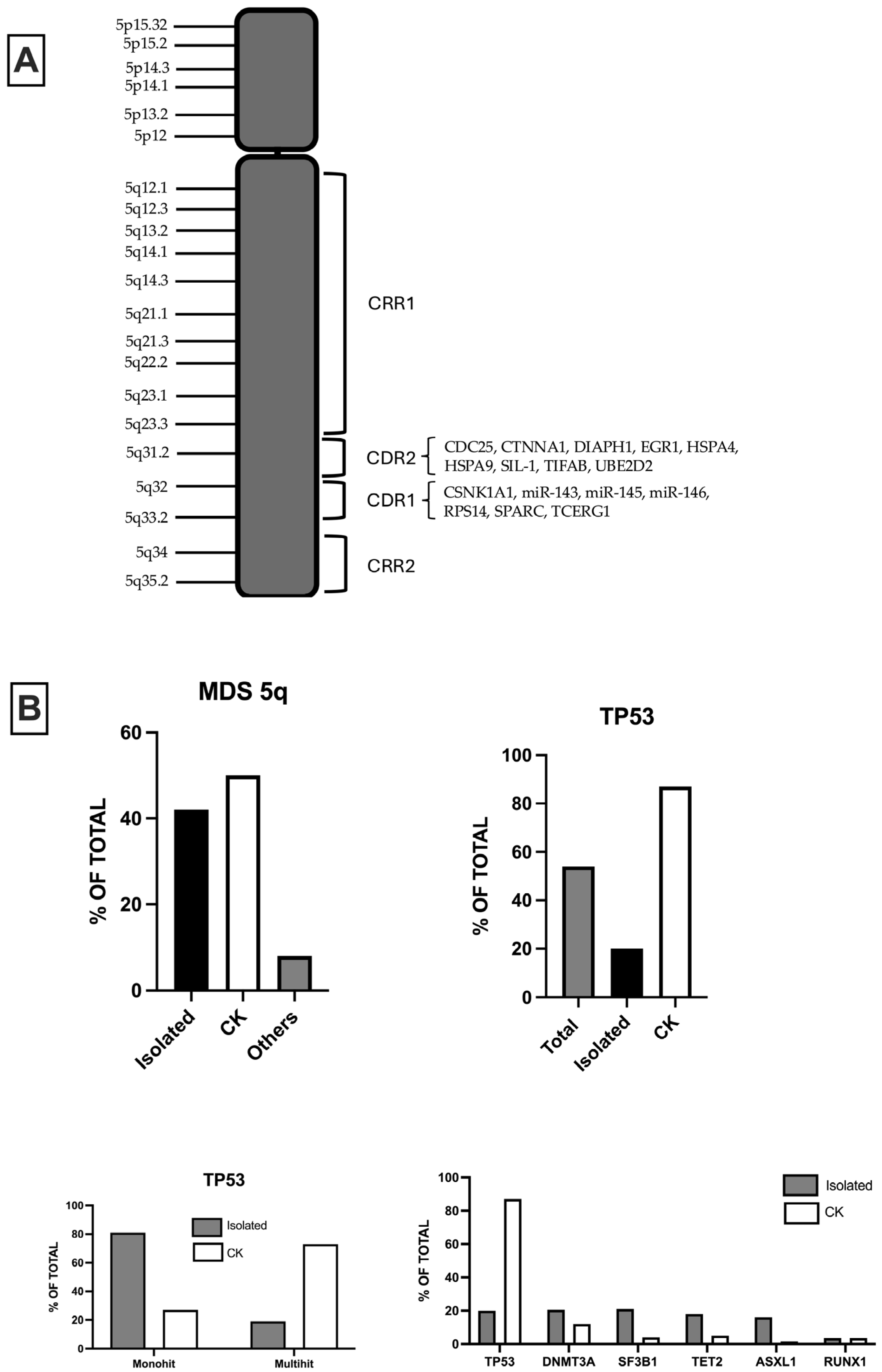
| Gene | Location | Biological Activity | Gene Knockout Hematologic Phenotype |
|---|---|---|---|
| CDC25C | Proximal CDR (5q31.2) | It regulates the transition from G2 to the M phase of the cell cycle | CDC25 knockout mice are viable and display co-alterations of cell cycle; CDC25 haploinsufficiency confers sensitivity to lenalidomide |
| CTNNA1 | Proximal CDR (5q31.2) | Catenin 1 alpha mediates the anchorage of actin filaments and signal transduction | Growth advantage to HSCs |
| DIAPH1 | Proximal CDR (5q31.3) | Cytoskeleton formation Tumor suppressor | Development of age-dependent myelo- proliferation or MDS |
| EGR1 | Proximal CDR (5q31.2) | Transcription factor | Fitness advantage to HSCs |
| HSPA9 | Proximal CDR (5q31.2) | Control of cell proliferation and response to stress, as well as inhibition of apoptosis | Apoptosis of hematopoietic progenitors; block of erythroid maturation |
| TIFAB | Proximal CDR (5q31.1) | Inhibition of NF-kB signaling | Deregulation of TRAF6, NF-kB activation in HSCs, induction of ineffective hematopoiesis |
| CSNK1A1 | Distal CDR (5q32) | Serine/threonine kinase involved in multiple cellular processes and pathways | CSNK1A1 haploinsufficiency confers growth advantage to HSCs/HPCs |
| miR-145 | Distal CDR (5q33.1) | It targets various tumor-specific genes | miR-145 and miR-146a loss induces dysmegakaryopoiesis, thrombocytosis and innate immune signaling |
| miR-146a | Distal CDR (5q33.3) | It targets genes involved in regulation of inflammation and innate immune system | miR-145 and miR-146a loss induces dysmegakaryopoiesis, thrombocytosis and innate immune signaling |
| RPS14 | Distal CDR (5q33) | 40S ribosomal protein | Macrocytic anemia |
| SPARC (Osteonectin) | Distal CDR (5q32) | Glycoprotein that binds calcium | Thrombocytopenia Anemia (reduced erythroid progenitors) |
| Commutation | Frequency in MDS-del(5q) | Biologic and Clinical Implications |
|---|---|---|
| SF3B1 | 15–20% | Concomitant SF3B1 mutations are associated with a lower response rate to lenalidomide, lower OS and increased risk of leukemic transformation. MDS-del(5q)/SF3B1-mutant cases are frequently associated with TP53 and RUNX1 mutations and display phenotypic properties of both SF3B1-mutant and MDS-del(5q). |
| TP53 (monoallelic mutation) | 15–20% | Clinical impact of concomitant TP53 mutations depending on VAF of mutant allele: <20% no effect on AML transformation rate and OS; >20% increased AML transformation rate and shorter OS. MDS-del(5q) with concomitant TP53 mutations has a trend toward a reduced rate of response to lenalidomide. |
| RUNX1 | 1–3% | RUNX1 mutations are associated with reduced response to lenalidomide, reduced overall survival and a high risk of AML progression. |
| CSNK1A1 | 8–10% | CSNK1A1 mutation occurring at the level of the non-deleted CSNK1A1 allele is associated with reduced response to lenalidomide and increased risk of progression. |
Disclaimer/Publisher’s Note: The statements, opinions and data contained in all publications are solely those of the individual author(s) and contributor(s) and not of MDPI and/or the editor(s). MDPI and/or the editor(s) disclaim responsibility for any injury to people or property resulting from any ideas, methods, instructions or products referred to in the content. |
© 2025 by the authors. Licensee MDPI, Basel, Switzerland. This article is an open access article distributed under the terms and conditions of the Creative Commons Attribution (CC BY) license (https://creativecommons.org/licenses/by/4.0/).
Share and Cite
Testa, U.; Castelli, G.; Pelosi, E. Clinical and Biological Insights into Myelodysplastic Neoplasms Associated with Deletions of Chromosome 5q Region. Hematol. Rep. 2025, 17, 67. https://doi.org/10.3390/hematolrep17060067
Testa U, Castelli G, Pelosi E. Clinical and Biological Insights into Myelodysplastic Neoplasms Associated with Deletions of Chromosome 5q Region. Hematology Reports. 2025; 17(6):67. https://doi.org/10.3390/hematolrep17060067
Chicago/Turabian StyleTesta, Ugo, Germana Castelli, and Elvira Pelosi. 2025. "Clinical and Biological Insights into Myelodysplastic Neoplasms Associated with Deletions of Chromosome 5q Region" Hematology Reports 17, no. 6: 67. https://doi.org/10.3390/hematolrep17060067
APA StyleTesta, U., Castelli, G., & Pelosi, E. (2025). Clinical and Biological Insights into Myelodysplastic Neoplasms Associated with Deletions of Chromosome 5q Region. Hematology Reports, 17(6), 67. https://doi.org/10.3390/hematolrep17060067