1. Introduction
Wheat blast, caused by the fungal pathogen
Magnaporthe oryzae pathotype
Triticum (MoT), is one of the most devastating diseases affecting global wheat production, capable of causing yield losses up to 100% under favorable conditions [
1,
2]. The disease was first reported in Brazil in 1985, in the state of Paraná [
3], and subsequently spread to neighboring countries, including Paraguay in 1987, Bolivia in 1996, and Argentina in 2007 [
4]. Other countries reporting outbreaks include Bangladesh [
5] and Uruguay [
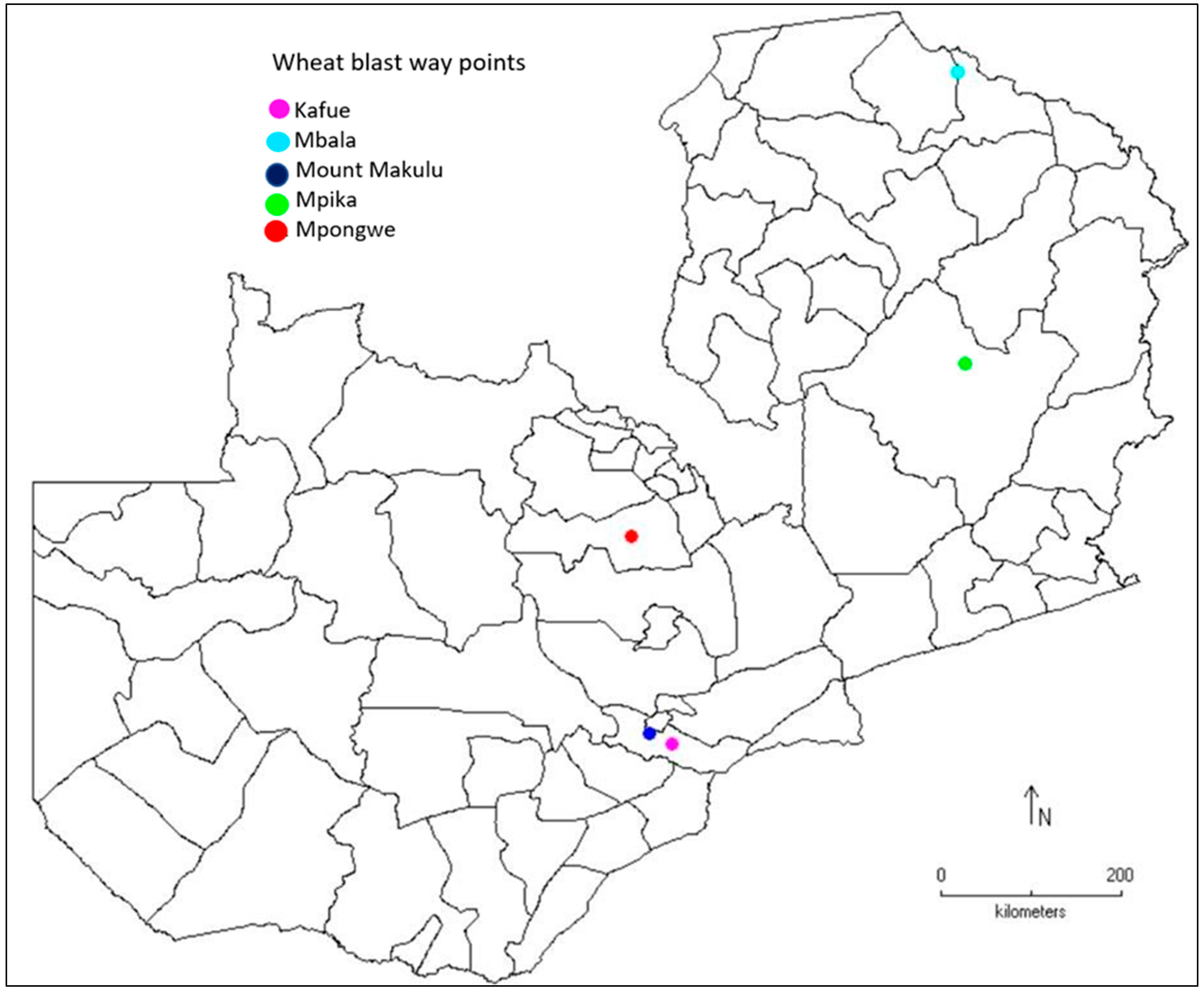
6]. Wheat blast was later detected in Africa for the first time in 2018, in farmers’ wheat fields and experimental plots in Mpika district, Muchinga province, Zambia [
7]. The emergence of the disease outside the Americas marked a critical shift in its global status, transforming wheat blast from a regional problem into a major international threat to wheat production and food security.
As wheat (
Triticum spp.) is a primary source of calories and protein for over one-third of the world’s population, the global spread of wheat blast poses significant risks to food security, livelihoods, and agricultural sustainability. Wheat production is constrained by both biotic and abiotic factors, with diseases and pests among the most significant. In Zambia, economically important wheat diseases under rainfed conditions include spot blotch and Fusarium head blight [
8]. The detection of wheat blast has made the situation more dire, as farmers now face an additional highly destructive disease capable of causing severe yield and quality losses. These losses translate into substantial economic impacts through reduced grain quality, increased production costs for disease management, and loss of market value, thereby threatening farmer incomes and national food security. At the national level, wheat blast further increases disease pressure, complicates wheat management practices, raises biosecurity concerns due to its potential spread within Zambia and the region, and poses a major challenge to the sustainability and resilience of Zambian agriculture.
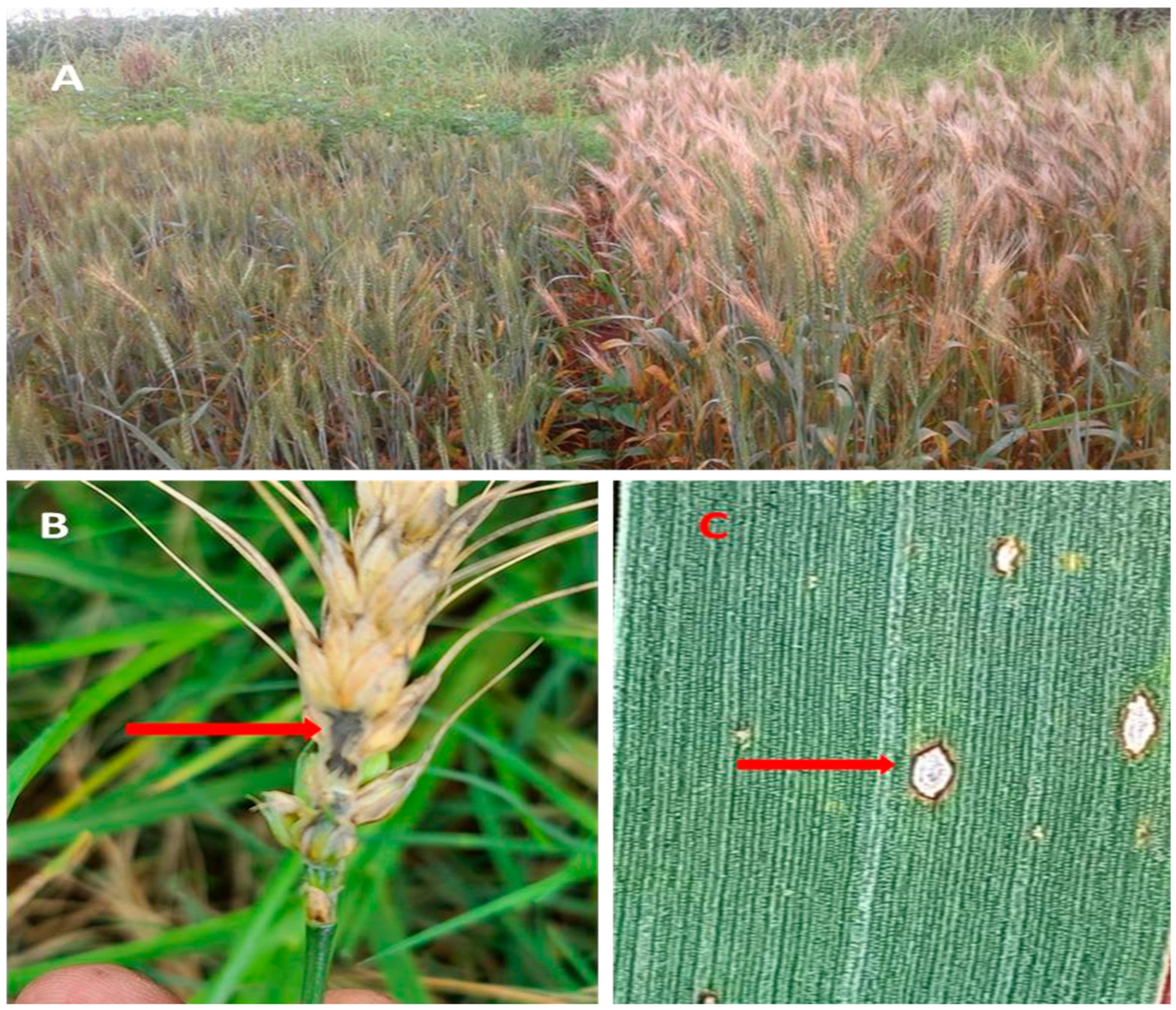
The fungus can attack various parts of the plant, but it can cause the most damage to the spike, causing wilting and deformation of the grain in less than a week, leaving little time for farmers to act. MoT is a distinct and diverse lineage of the
M. oryzae. According to studies [
9,
10,
11],
M. oryzae is the causative agent of blast disease in 50 species of the Poaceae family, including the major cereal crops such as wheat and barley. MoT strains have been reported in different regions of the world [
12] and have been reported to react differently in various wheat varieties [
13,
14]. Comparative genomic analysis of the Zambian strain indicates that it belongs to the B71 clonal lineage [
12].
For many decades Africa remained unaffected until recently when the disease was reported for the first time in Zambia as earlier alluded to. Despite detecting the fungus in the country, very few farmers are aware of its significance and the threat it poses to wheat production. Many small-scale farmers in Zambia grow wheat during the rainy season when the environmental conditions are conducive for disease outbreaks. The disease is strictly dependent on high temperatures and humidity during the wheat-heading period.
Over the years Zambia has been experiencing adverse weather patterns due to climate change. The changes include increase in the frequency and severity of seasonal droughts, occasional dry spells, increased temperatures, flash floods and changes in the length of the growing season, especially in ecological region I and II [
15]. With this scenario, wheat production in Zambia could be vulnerable to changing weather patterns exacerbated by climate change. Studies that investigate weather related impacts on wheat yields are scarce in the country. However, in South Africa studies have shown that an additional 24 h of exposure to temperatures above 30 °C was associated with a 12.5% yield reduction [
16]. Therefore, this review paper discusses the threat of wheat blast, examines the current state of wheat production in Zambia, and assesses the growing vulnerability of wheat production in the face of climate change, including rising temperatures, shifting rainfall patterns, and increased frequency of extreme weather events. It also outlines control measures and adaptive strategies that can be implemented to enhance wheat productivity and ensure long-term food security.
2. Wheat Production in Zambia
Wheat is the second most produced cereal based on acreage and total production by volume after maize (
Zea mays). In 2022 global production was almost 808 million metric tons with China (137,726,000 t), India (107,742,070 t) and Russian Federation (104,233,944 t) being the largest producers [
17]. In Africa, Zambia was ranked 10th in terms of wheat production in the 2022–2023 marketing year. Annual production was 277,491 metric tons with an average yield of 6.9 t/ha (
Table 1). However, the country’s wheat production has fluctuated over the years, for example, between 2012 and 2023, the highest production was in 2023 (277,491 metric tons) and the lowest in 2018 (114,463 metric tons). Amidst the fluctuations, production is still far from reaching the country’s wheat growing potential. Historically, wheat production has been low compared to other cereals such as maize, leading to significant wheat imports.
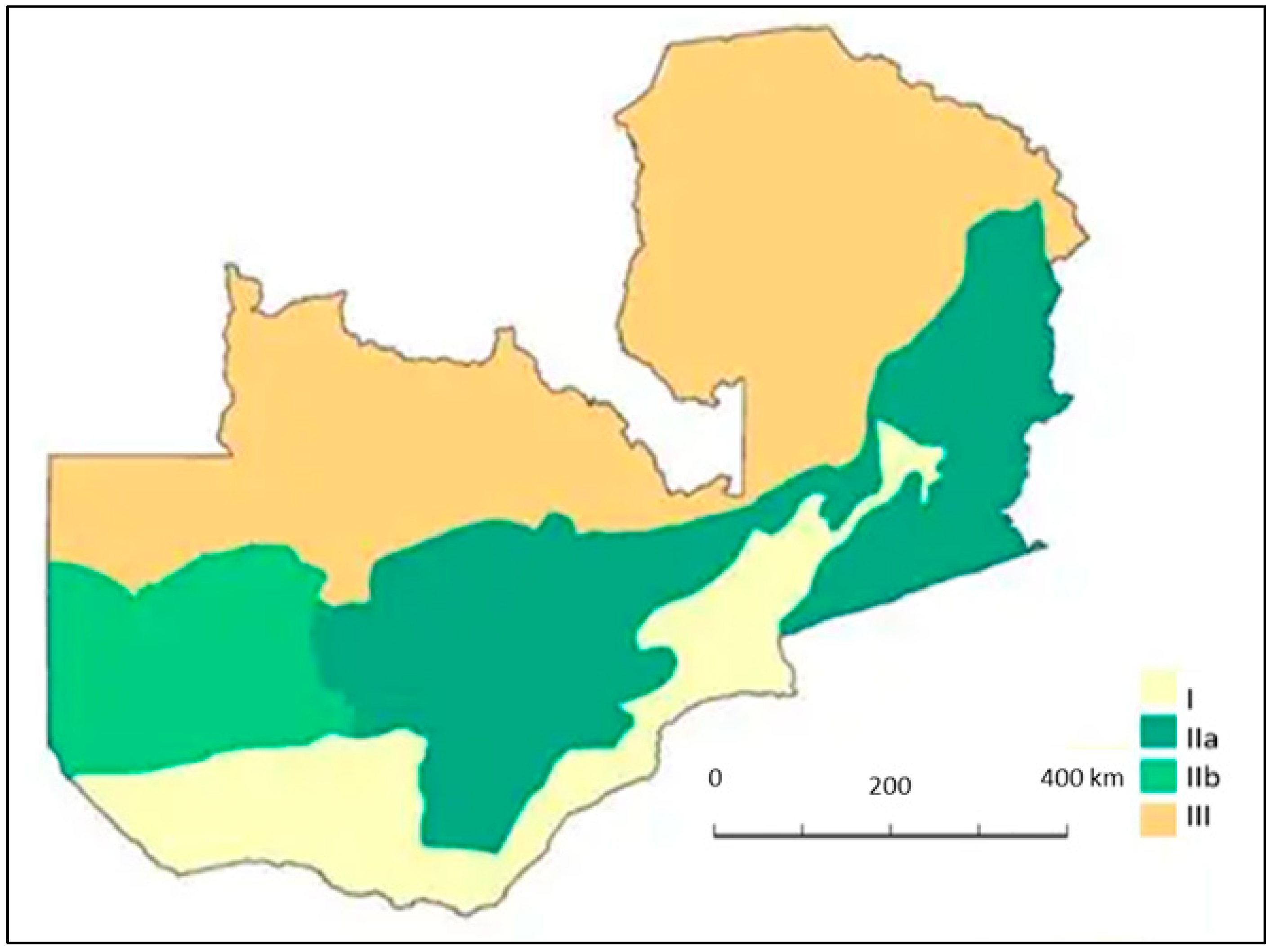
Zambia is divided into three major agro-ecological zones (AEZ) based on soil characteristics, climatic factors, rainfall patterns and traditional agricultural practices (
Figure 1). The three ecological zones extend from the west to the east of the country, with AEZ I in the south consisting of the Zambezi and Luangwa valleys. It receives less than 800 mm of rainfall annually and has a growing season spanning between 80 and 120 days [
19]. North of AEZI is AEZ II which includes parts of the Western, Southern and Central provinces, while further north AEZ III includes parts of the Northwest, Northern, Luapula and Muchinga provinces, which receive the highest rainfall. AEZII is subdivided into AER IIa, covering Central, Lusaka, and parts of Southern and Eastern provinces, has generally fertile soils, while AER IIb, covering the Western plateau, has infertile, sandy soils [
19].
Zambia experiences a predominantly sub-tropical climate (dry-cold, hot-dry, and rainy-hot). Wheat is grown primarily by commercial farmers in the cool season (May to September) under irrigation and by smallholder farmers in the summer (rainy-hot season, November to April). Much of the production of wheat is done in AEZ II which depends on irrigation and production is often affected by the availability of water. Most small-scale farmers on the other hand grow wheat in AEZ III under rainfed conditions. Recently, the Government of the Republic of Zambia revealed an initiative with a call to small-scale farmers to contribute to the country’s target to produce a million metric tonnes by 2027.
AEZ II is characterized by high rainfall, ranging from 800 to 1000 mm with a growing season that ranges between 100 and 140 days [
19]. It is characterized by hot summers (September–November) and cold winters (May–July). During the winter months, the minimum temperature can drop to 5 °C. AEZ II is the agricultural frontier for commercial wheat production. AEZ III receives more than 1000 mm of rainfall per year. The precipitation regime is unimodal and lasts from November to April. The average annual minimum temperature is 10 °C and the average annual maximum temperature is 31 °C. The growing season is about 130 to 160 days (November to April) for rainfed crops [
19]. AEZ I is considered moderately dry and hot, including the Luangwa and Zambezi valleys and is considered a nontraditional area for wheat production.
As earlier indicated, wheat is grown mainly in AEZ II under irrigation: In 2022, 36,551 hectares of wheat were grown [
18]. Wheat yields are higher under irrigation (7 t/ha) [
17] and lower under rainfed (1–2 t/ha: [
20]. There are several limitations to the cultivation of rainfed wheat in Zambia, which is sown in early November almost simultaneously with other major crops such as maize, cassava (
Manihot esculenta), and soybeans (
Glycine max L.). These limitations include high rainfall and humidity during the early planting season, which can lead to waterlogging and increased disease pressure; competition for land, labor, and inputs with other crops; unsuitable high temperatures during critical growth stages; poor soil fertility and drainage; limited agronomic knowledge and support for wheat production; and underdeveloped market and post-harvest infrastructure [
21].
3. Infection, Transmission and Spread of MoT
MoT can infect all above-ground parts of wheat plants [
1,
22,
23]. MoT completes its life cycle through a sequence of well-coordinated developmental stages that facilitate its role as a hemi-biotrophic pathogen. The infection process initiates when asexual spores (conidia) are deposited on the surface of a susceptible wheat plant and germinate under suitable environmental conditions [
24,
25,
26]. The resulting germ tube differentiates into an appressorium, a specialized structure that builds up significant turgor pressure to breach the plant’s outer cuticle [
24]. After successful penetration, MoT enters a biotrophic phase, during which it colonizes living host cells while evading or suppressing the plant’s immune defenses [
25]. As the disease progresses, the fungus shifts to a necrotrophic phase, killing host tissues and promoting further fungal growth and spread. These sequential developmental changes are essential for the fungus to establish infection, spread within the host, and complete its reproductive cycle [
24].
Wheat blast spreads in a variety of ways: through contaminated seeds, plant debris, and airborne spores that can travel long distances [
2,
27,
28]. The spread and transmission of MoT occur through multiple, interconnected pathways operating at local, national, and international scales. These pathways involve both natural dispersal mechanisms and human-mediated activities, making wheat blast a highly invasive and transboundary disease.
One of the most important long-distance transmission pathways of MoT is through infected wheat seed and grain [
27,
29]. Although the pathogen primarily infects wheat spikes, it can survive on contaminated seed surfaces or within grain, facilitating its movement across regions and international borders through both formal and informal seed trade. The transcontinental spread of wheat blast from South America to South Asia and Africa is widely believed to have occurred through this pathway [
27]. The use of uncertified or farmer-saved seed further increases the risk of disease introduction and establishment in new areas.
MoT spreads through airborne conidia produced on infected plant tissues [
30]. These spores are readily disseminated by wind and rain splash, enabling rapid spread, particularly under warm and humid conditions. Airborne dispersal plays a major role in epidemic development during the heading and flowering stages of wheat, when spikes are highly susceptible to infection.
MoT can survive on infected wheat plants that remain in the field after harvest, serving as a source of primary inoculum for subsequent cropping seasons [
31]. In addition, the pathogen can infect or persist on other grasses and cereal hosts within the Poaceae family [
31]. These alternative hosts, along with volunteer wheat plants, act as reservoirs that maintain the pathogen within the agroecosystem and facilitate its persistence and spread between growing seasons.
Human-mediated activities, including the movement of contaminated farm machinery, tools, clothing, and vehicles, also contribute to short- and medium-distance spread of MoT. Spores adhering to equipment or plant debris can be transported from infected to non-infected fields, particularly in regions with clustered wheat production.
6. Conducive Weather for Wheat Blast
Weather conditions are a very important factor for the development of wheat blast disease. Rainy and humid weather conditions during the wheat heading stage have been found to be favorable for the development and progression of the disease. The combination of several environmental factors (high temperature, precipitation) during the flowering stage, and wetness of the leaves/spikelets contribute to disease development [
32,
39].
In countries such as Bangladesh and Brazil, rising temperatures and shifting rainfall patterns due to climate change are likely contributing to the outbreak of wheat blast. These environmental factors will contribute to future events in new unaffected areas. Climate change scenarios for the period 2040–2070 predict an increased risk of wheat blast in tropical regions, including Zambia, due to rising temperatures and humidity [
40]. These conditions are expected to enhance the suitability for the wheat blast fungus, potentially leading to significant global wheat production losses. Although Zambia and other African nations already exhibit some vulnerability, future climate conditions may further intensify the spread and impact of the disease. Countries such as Zambia, Ethiopia, Kenya, and the Democratic Republic of Congo are projected to experience yield losses due to the expansion of wheat blast into previously less-affected or unaffected areas [
40].
According to Pequeno et al. [
40], global crop modelling studies indicate a growing global risk associated with the spread of wheat blast disease, particularly under environmental conditions that favor its development; rainy periods during flowering, followed by sunny, hot, and humid weather, with average temperatures between 18–25 °C [
4]. Additionally, studies have shown that temperatures between 25–30 °C, combined with prolonged humidity (25–40 h), can trigger severe epidemics [
41].
These climatic conditions align with parts of Zambia’s rainy and post-rainy seasons, especially in highland areas where wheat is currently cultivated or targeted for expansion. As Zambia aims to scale up wheat production to strengthen food security and reduce import dependence, these conditions suggest a potential vulnerability to wheat blast outbreaks, which could significantly reduce yields and threaten national production goals. This highlights the urgent need for proactive disease surveillance, adoption of resistant wheat varieties, and climate-informed crop management practices to minimize the risk.
Wheat blast epidemics are governed by narrow climatic thresholds, particularly moderate temperatures prolonged spike wetness, and very high relative humidity [
41] as earlier alluded. These constraints mean that epidemic risk depends less on seasonal rainfall totals and more on the occurrence of specific weather events that sustain long periods of moisture during heading and anthesis.
7. Impacts of Climate Change
Climate change has a significant influence on the emergence and spread of wheat blast epidemics, primarily because the disease is caused by a fungus that thrives under warm and humid conditions. Projections suggest that rising temperatures and increased moisture associated with climate change will expand the geographical range suitable for wheat blast, particularly in tropical and subtropical regions of which Zambia is part. Under climatic conditions, the area at risk could increase from the current 6.4 million hectares to approximately 13.5 million hectares by mid-century [
40].
As earlier stated, wheat blast was first reported in Brazil in 1985 and has since spread to countries such as Bangladesh and Zambia, demonstrating the pathogen’s capacity to colonize new regions when climatic conditions are favorable. Climate change facilitates this spread by creating warmer and more humid environments that enhance spore germination, infection efficiency, and rapid disease progression. As a result, outbreaks are expected to become more frequent and severe, particularly during critical stages of wheat development [
40].
Model-based simulations that integrate crop growth and disease dynamics indicate that under future climate scenarios characterized by higher temperatures and increased relative humidity, wheat blast could reduce global wheat yields by approximately 13% by 2050 due to increased disease incidence [
40]. South America, southern Africa, and parts of Asia are projected to experience the greatest increases in vulnerability, with up to 75% of wheat-growing areas at risk in some locations if temperature and humidity rise as anticipated.
The key climatic drivers of these changes include elevated temperatures, which accelerate fungal growth and shorten the pathogen’s life cycle, and prolonged periods of high relative humidity, which extend leaf wetness duration and enhance infection success. In addition, climate variability such as altered rainfall patterns and more frequent extreme weather events can synchronize moist conditions with sensitive stages of wheat development, increasing the likelihood and unpredictability of outbreaks.
Climate change may also intensify plant disease risks by influencing pathogen evolution, host–pathogen interactions, and the emergence of new pathogen strains [
42]. Shifts in pathogen distribution may facilitate the spread of wheat blast into previously unaffected regions. In Zambia, more than 30,000 hectares of irrigated wheat are currently at risk. While irrigation supports wheat production by maintaining soil moisture, it also extends the growing season into warmer months that coincide with high temperatures and elevated relative humidity conditions highly favorable for wheat blast development. Irrigation further increases canopy humidity, particularly during early mornings and late evenings, creating a persistent microclimate that promotes fungal growth. These conditions can accelerate the infection cycle of MoT, enhancing spore production and dispersal. As climate change continues to increase temperatures and alter rainfall patterns, the combined effects of irrigation and changing environmental conditions are likely to intensify the frequency and severity of wheat blast outbreaks in irrigated systems. Consequently, climate change poses a growing threat to Zambia’s food security [
40].
Zambia’s subtropical climate is moderated by the high elevation of the Central African Plateau. The hottest period occurs between September and November, with temperatures reaching 35–37 °C, while the coolest and driest season extends from May to August, with temperatures ranging from 10–20 °C [
43]. The late dry season (September to October) is characterized by very high temperatures and minimal rainfall, with humidity increasing as the rainy season approaches.
Temperatures frequently exceed 30 °C and can reach up to 40 °C in some areas [
44]. The rainy season, from November to April, is marked by hot, humid conditions and frequent, sometimes heavy rainfall [
19,
43], with average temperatures typically between 25 °C and 30 °C. Rainfall variability is strongly influenced by the El Niño–Southern Oscillation (ENSO). El Niño events often bring drier-than-average conditions to southern Zambia during the rainy season, while the northern regions experience above-average rainfall [
45].
Since 1960, Zambia’s average annual temperature has increased by approximately 1.3 °C, at a rate of 0.29 °C per decade, with the most pronounced warming occurring during the winter months (0.34 °C per decade) [
46]. The frequency of warm days and nights has increased across all seasons, while cold days and nights have become less common. Additionally, average annual precipitation has declined by approximately 1.9 mm per month per decade, particularly during the peak rainy season from December to February [
47]. These climatic trends especially rising temperatures have significant implications for wheat production and the future risk of wheat blast in Zambia.
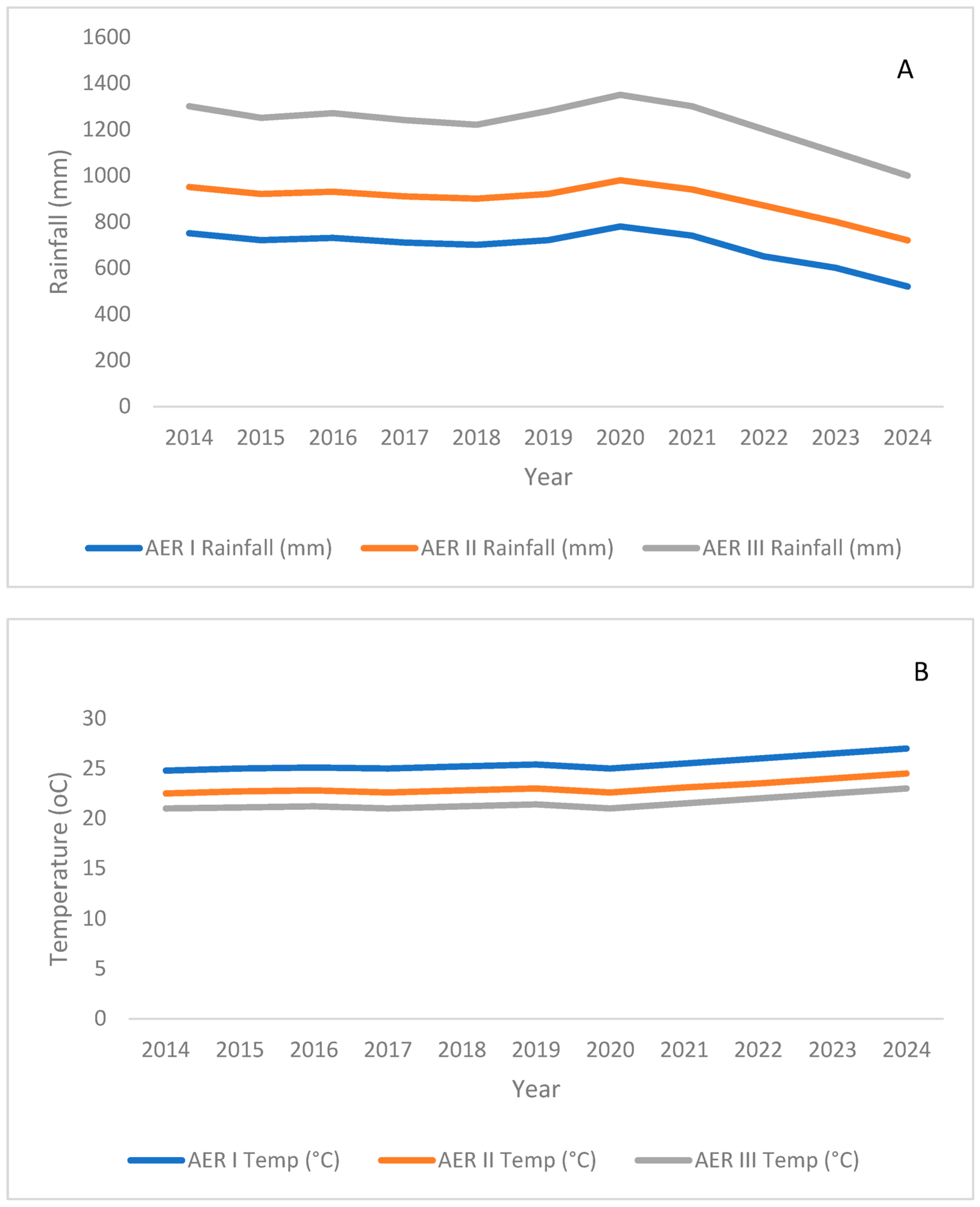
Analysis of rainfall and temperature between 2014 to 2024, Zambia’s agro-ecological regions show marked changes in weather patterns, characterized by a gradual decline in rainfall and a consistent rise in mean annual temperatures (
Figure 4A,B) [
48,
49]. These changes indicate a shift toward hotter and more drought-prone conditions, accompanied by irregular rainfall onset and early cessation of the rainy season.
AEZ I showed the strongest drying and warming signal, intensifying aridity and increasing crop water stress. Although wheat production in this region is limited, higher temperatures can weaken crop resilience and create favorable conditions for faster pathogen development where irrigation or residual moisture increases local humidity. In AEZ II, which supports most of Zambia’s irrigated wheat production, declining rainfall combined with rising temperatures has altered field-level microclimates. Irrigation under warmer conditions increases humidity within the crop canopy, particularly during heading and flowering, creating conditions that are highly conducive to wheat blast infection.
AEZ III, traditionally cooler and wetter, also exhibited rising temperatures and reduced rainfall reliability. While still receiving higher total rainfall than the other regions, warming trends and episodic moisture stress suggest increasing suitability for wheat production and, consequently, for wheat blast establishment. Periods of high humidity following rainfall events, together with warmer temperatures, enhance the survival, sporulation, and dispersal of MoT.
Overall, the changing weather patterns observed during 2014–2024 increase both crop stress and disease favorability, two key drivers of wheat blast epidemics. Warmer temperatures increase the likelihood that critical wheat growth stages coincide with conditions optimal for infection, while rainfall variability and irrigation practices contribute to humid microclimates that support pathogen spread. These trends suggest an expanding geographic and seasonal risk of wheat blast in Zambia, underscoring the importance of climate-informed disease surveillance, deployment of resistant varieties, and adaptive crop and water management strategies.
In the Zambian wheat belt, where much of the wheat is grown under irrigation, warming temperatures can create more favorable conditions for the development and spread of MoT. The pathogen thrives in warm (18–30 °C), humid environments, especially when high temperatures coincide with moisture from rainfall or irrigation during key crop growth stages. Irrigation, while essential for wheat production in Zambia’s dry season, can inadvertently increase relative humidity in crop canopies, thereby exacerbating conditions conducive to wheat blast outbreaks. As such, the combination of rising temperatures and irrigation practices may accelerate the spread and severity of wheat blast, posing a growing threat to wheat production in Zambia’s key agricultural zones. All these climatic indicators are expressed in Zambia and make the probability of disease outbreaks. Cardoso et al. [
41] noted that an optimum temperature of 25–30 °C and a sudden increase in humidity within 25–40 h can lead to a significant outbreak of the disease. Additionally, sporulation of MoT from a very low initial inoculum level before spike initiation may provide sufficient secondary inoculum, resulting in head blast epidemics [
22]. In South America, major wheat blast outbreaks are observed in humid and warm regions such as Brazil, Bolivia, Paraguay and northwestern Argentina [
4].
This is mainly due to two environmental factors: increasing temperatures and increased relative humidity leading to prolonged wetness of spikes and leaves. For instance, the environmental conditions in Patos de Minas, Brazil, and Mpika, Zambia, closely mirror each other [
49] both being tropical regions that have experienced outbreaks of wheat blast. From December to April, Mpika undergoes a tropical rainy season characterized by persistent rainfall, high humidity, and moderate temperatures; a climate pattern strikingly similar to that of tropical wheat-growing areas in Brazil, such as Patos de Minas, where wheat blast is a well-documented agricultural threat.
In Mpika, December records the highest rainfall at 357 mm over 30.4 days, with average temperatures of 26.6 °C during the day and 14.6 °C at night, alongside 85% relative humidity. These wet and humid conditions persist into January and February, with daytime temperatures consistently above 23 °C, nighttime lows above 16 °C, and humidity peaking at 91% in January, remaining above 90% through March [
49].
This climatic window in Mpika aligns closely with Brazil’s summer months, particularly February and March, during which research in Patos de Minas has shown extremely high wheat blast incidence when wheat is sown at that time. The combination of warm temperatures, high humidity, and frequent rainfall as earlier alluded to creates optimal conditions for the development and spread of MoT, especially during the wheat heading stage, when the crop is most susceptible.
Although March in Mpika sees a moderate reduction in rainfall to 227 mm, temperatures remain warm (23.7 °C daytime/15.9 °C nighttime) and humidity remains high at 90%, maintaining high disease pressure. It is not until April that a significant drop in rainfall occurs (43 mm over 18.9 days) and nighttime temperatures decline to 14.4 °C, nearing the critical threshold identified in Brazilian studies. These studies indicate that wheat blast incidence falls below 10% when average minimum temperatures drop below 14 °C. However, in Mpika, this cooling arrives too late to protect wheat sown earlier in the high-risk months.
8. Economic Impact
Wheat blast, as discussed above, is an economically important disease due to its rapid spread and severe destructiveness. The disease poses a significant threat to wheat production not only in Zambia but also worldwide. Crop disease simulation models show the potential global risk associated with the spread of wheat blast. Globally, the disease already threatens 6.4 million hectares under current climate conditions, and the problem is expected to further increase due to climate change to 13.5 million hectares by mid-century [
40]. According to Pequeno et al. [
50], simulations of a warmer and more humid future climate indicate that wheat blast is likely to spread, particularly in the Southern Hemisphere leading to a reduction in global wheat production of up to 69 million tons per year (a 13% decrease) by mid-century. The economic importance of wheat blast stems from the fact that the fungus can reduce grain yield and quality. At the time of writing, there was no definitive information on the impact of the disease on wheat production in Zambia. However, information from other countries shows that it is a devastating disease that can cause crop losses of up to 100% [
1]. When environmental conditions are favorable (18–30 °C and >80% RH) at heading or grain filling, the disease destroys the wheat crop within a week [
5].
In the 2015–2016 wheat growing season, the disease affected 15,000 hectares of wheat in eight districts in Bangladesh [
38]. Further, it made Bangladesh to be among the top 5 wheat importing nation in the world [
2]. In 1996, almost 80% of wheat production was lost in the Bolivian lowland in the Santa-Cruz region [
4]. The following year, the disease destroyed early seed fields and caused 100% loss [
4].
Despite seven years since wheat blast was first detected in Zambia, the majority of farmers are less informed of the disease and or its effects. Farmers typically do not control wheat blast because they don’t know enough about how to identify and treat it. Nevertheless, efforts have been made to train extension officers and farmers on wheat blast detection, monitoring and management practices to reduce the spread of the disease in wheat blast prone areas. Apart from educating the extension staff, farmers, stakeholders in the seed industry have to be capacitated with disease recognition and diagnostic skills. Additionally, radio and television have to be used to distribute information about the disease’s significance, spread, and effects.
9. Integrated Disease Management
The rapid epidemic potential of wheat blast and the limited effectiveness of single control measures necessitate an integrated approach. Integrated Disease Management (IDM) combines cultural, biological, genetic, and chemical strategies to manage the disease in a sustainable and effective manner. The following components are critical to a successful IDM plan for wheat blast.
9.1. Phytosanitation
MoT can survive on crop residues between wheat growing seasons. Grasses may also act as sources of secondary inoculum [
51]. In such instances deep plowing of crop residues is necessary to reduce the initial inoculum pressure. However, deep plowing and the destruction of crop residues, can be labour-intensive and costly. Following a report on the wheat blast outbreak in Zambia, officials from the ministry of agriculture recommended quarantine measures in the affected areas. The measures included restricting the movement of wheat seed from the affected areas and a suspension on cultivation of rainfed wheat to minimize further spread. However, this strategy should also consider a concerted effort to find and destroy any alternative host where blast fungus may have established in a contaminated area. This can be achieved by creating a buffer zone. A non-host alternate crop is one that can minimize the spread of the disease. However, due to the seed- and air-borne mode of spread of the fungus, there is a high potential of its further spread to major wheat-growing areas and beyond the borders of Zambia. Several of Zambia’s neighbors have similar climatic conditions and therefore, there is a high risk related to inadvertent introduction of this disease into those areas. Although quarantine measures were applied the strategy may be difficult to enforce completely due to the seed- and air-borne nature of the wheat blast pathogen. Additionally, alternative hosts such as grasses and weeds can harbor the fungus, making complete eradication challenging.
9.2. Surveillance of Wheat Blast
The spread of wheat blast in Muchinga Province has raised concerns that the disease may spread to other provinces, particularly Central, and Southern provinces, where irrigated wheat production is concentrated. Careful surveillance is needed to ensure the spread of MoT is monitored. During the rainy season, Zambia experiences high temperatures and above average rainfall in some places especially AEZ II and III, and it has been reported that this combination of climatic factors (high temperature, excessive rain, and prolonged leaf wetness) predisposes the disease to outbreaks in epidemic years [
32]. Surveying wheat blast disease should not only include wheat plants in the field but also weeds that may serve as alternative hosts and as reservoirs for the long-term survival of the pathogen. However, surveillance is labour-intensive and requires continuous monitoring to be effective.
Diagnosis of wheat blast in suspected samples typically relies on conventional diagnostic methods, including visual assessment of characteristic disease symptoms and identification of the fungus’s distinctive pear-shaped conidia. In addition, molecular techniques such as the use of the MoT3 marker, which is specific to the wheat blast pathogen, are employed to confirm the presence of MoT. Molecular tools have been developed to precisely diagnose MoT, as reported in several studies [
52,
53,
54,
55], and rapid test assays for MoT are available that enables the diagnosis to be done within approximately 30 min after fungal DNA is extracted [
54]. However, accurate diagnosis often depends on specialized molecular tools, and visual assessment of symptoms can be unreliable since early infections may not show visible signs. Furthermore, environmental factors such as high rainfall and temperature fluctuations can complicate timely detection of the disease.
9.3. Cultural
The goal of cultural control is to make the crop environment less suitable for disease spread. For instance, adjusting crop planting time; planting wheat crop at a time when the likelihood of damage by MoT is reduced. This can be done by fallowing the land for one or several growing seasons before planting the same crop in the same place, or by adjusting the date of planting or other field operations around MoT disease cycle. In Bolivia, Brazil, and Paraguay, delaying the planting date has significantly reduced yield losses [
40,
56]. This practice is used to avoid wheat heading during periods of high temperatures, high precipitation, and high relative humidity [
57]. The research from Brazil and other affected areas underscores that to reduce wheat blast risk, sowing must be timed so that wheat heading occurs during the cooler months typically May to July; when minimum temperatures are low enough to inhibit fungal development. In most tropical climates, including Mpika, such cooler temperatures are not observed until after April, making it clear that early sowing especially from December to March exposes wheat to high disease risk. Adjusting planting dates or fallowing land may not always be feasible due to local climatic constraints, particularly in tropical regions where high temperatures persist.
Deep plowing of infected plant residues and elimination of possible alternate hosts have also been recommended [
29]. Removal of alternative hosts will also help to control WB. Volunteer wheat plants and related grasses can act as alternative hosts for the wheat blast pathogen and contribute to early-season disease pressure. These hosts can harbor the fungus during the off-season, allowing it to persist in the field even when wheat is not actively growing. Effective management involves identifying and removing such alternative hosts from the vicinity of wheat fields, including weedy grasses and selfsown wheat plants. In addition, crop rotation with non-host crops can help break the disease cycle and reduce the chances of early infection. However, deep plowing and removal of alternative hosts are laborious measures and may not completely eliminate the pathogen. Crop rotation alone may have limited effect because the fungus can survive on weeds or volunteer wheat plants.
9.4. Avoiding Recycling of Seed
Small-holder farmers choose to recycle seed for several seasons due to several factors. It is generally accepted that access to improved seeds is an important factor for increasing agricultural productivity among small-holder farmers. However, the practice of recycling seeds can have serious consequences when it comes to managing wheat blast. Recycled seeds infected with the wheat blast pathogen not only facilitate short- and long-distance spread of the disease [
58] but can also cause seedling blight, which kills plants at an early stage. Infected seeds may carry the fungus internally or on the seed surface, leading to poor crop establishment and reduced yields.
Limited access to certified, disease-free seeds due to high costs, low availability, or inadequate distribution systems makes it challenging for farmers to adopt safer alternatives. Even seeds that appear healthy may harbor latent infections, which can manifest under favorable environmental conditions and cause the disease to reappear in subsequent seasons. Moreover, recycling infected seeds undermines other disease management strategies, such as crop rotation and phytosanitation, because it reintroduces the pathogen into fields that might otherwise have been cleared of inoculum.
9.5. Elimination of Possible Hosts
The wheat blast fungus can infect some weeds, such as some grasses. These weeds may serve as a reservoir for the fungus once it infects them, enabling the disease to endure and spread to wheat harvests. Therefore, elimination of possible hosts in wheat fields can aid in the management of wheat blast [
29]. This lessens the possibility of infection and aids in stopping the disease’s spread. The level of the disease can be lessened in the field by eliminating weeds since they are a possible source of fungal spores that can infect wheat plants.
While regular weeding is an important agronomic practice for reducing competition from unwanted plants, it has significant limitations when it comes to managing wheat blast. Manual weeding is labour-intensive and time-consuming, and smallholder farmers may not be able to perform it frequently enough to prevent disease spread. Even with diligent weeding, the wheat blast pathogen can persist in infected seeds, crop residues, or on surviving alternate hosts, meaning that weed removal alone cannot eliminate the source of infection.
Weeds themselves may act as transient hosts or provide microenvironments that favor pathogen survival, allowing the fungus to persist in fields despite regular weeding. Additionally, repeated weeding, especially when done manually or with hand tools, can inadvertently damage wheat seedlings, reducing their vigor and making them more susceptible to blast infection. Environmental factors further limit the effectiveness of weeding: in regions with rapid weed regrowth, maintaining weed-free fields consistently is difficult, which can indirectly promote conditions favorable for disease development.
9.6. Promoting Crop Rotation with Non-Cereal Crops
Crop rotation with non-cereal crops is often recommended as a strategy to reduce the buildup of pathogens in cereal fields. While this practice can help manage many soilborne diseases, it has notable limitations when applied to wheat blast management [
27]. Wheat blast, caused by MoT, primarily spreads through infected seeds and infected crop residues rather than relying solely on soil-borne inoculum. As a result, rotating with non-cereal crops may have limited impact if infected wheat seeds are continuously recycled or introduced into fields.
One key limitation is that crop rotation alone cannot eliminate the pathogen from contaminated seeds or surviving residues left in the field. Even after a non-cereal crop has been planted, infected wheat residues in the soil or field margins can continue to harbor the pathogen, providing inoculum for subsequent wheat crops. Furthermore, smallholder farmers may face practical constraints in implementing effective rotations. Land availability, market demands, and socio-economic considerations often restrict the diversity and timing of rotations, preventing consistent adoption of non-cereal crops at the scale needed to significantly reduce disease pressure.
9.7. Chemical Control
Chemical control through fungicide application has been investigated as a potential strategy for managing wheat blast, particularly during the heading stage. In South America, fungicides have shown some promise in reducing head blast severity. However, their overall efficacy remains inconsistent and often inadequate under conducive environmental conditions. For instance, Cruz and Valent [
1] noted that while fungicides can provide a degree of protection, their effectiveness diminishes significantly when warm, rainy weather coincides with the heading period conditions that are highly favorable for disease development. Similarly, studies by Goulart et al. [
32] and Urashima et al. [
37] concluded that fungicides are generally ineffective at controlling head blast during such weather conditions.
Numerous field trials have demonstrated that fungicide efficacy is often only partial. Cultivars with moderate to high levels of genetic resistance tend to respond better to fungicide applications, suggesting that chemical control is most effective when integrated with host resistance [
4,
59]. According to Rocha et al. [
60], fungicide applications were ineffective in controlling the blast disease especially where conditions are favourable for the disease to develop. In addition to foliar sprays, fungicide seed treatments serve as another important line of defense, especially since MoT can be seed-borne. Bockus et al. [
61] found that certain fungicides reduced MoT sporulation by 52.2% to 100% compared to untreated seeds. However, the widespread use of fungicides has also led to significant challenges, particularly the development of fungicide-resistant strains.
In Brazil, the heavy reliance on strobilurin (QoI) fungicides has resulted in the emergence of MoT isolates carrying cyt
b mutations, which confer resistance to this class of chemicals [
62]. This development highlights the urgent need for routine monitoring of fungicide resistance within pathogen populations. Resistance management strategies including rotating fungicide modes of action and combining chemical control with other practices are critical for maintaining long-term fungicide efficacy. Apart from the use of fungicides, other studies reported that Silicon treatment on wheat plants enhances resistance to wheat blast [
63]. Use of Silicon presents another option that can be explored to halt the spread of the disease.
9.8. Genetic Resistance and Breeding of Resistant Wheat Cultivars
Breeding wheat cultivars with resistance to wheat blast is an environmentally friendly and practical strategy for managing the disease. Since the initial report of wheat blast in Brazil in 1985, extensive research has been conducted to identify and develop resistant varieties. However, conventional breeding approaches are time-consuming and constrained by the limited availability of resistant genetic resources.
To date, a total of seven resistance (R) genes and the 2NS/2AS translocation have been identified conferring resistance to wheat blast [
64]. Among these,
Rmg7 is effective at both the seedling and adult plant stages but loses efficacy under high temperatures [
65,
66]. In contrast,
Rmg2 and
Rmg3 are temperature-sensitive and provide resistance only at the seedling stage [
67]. On the other hand,
Rmg8, identified in the wheat cultivar S-615, remains active during the heading stage and effective at higher temperatures [
65]. However, field deployment of
Rmg8 in blast-prone environments has not yet been widely implemented. Notably, the Zambian MoT strains belong to the B71 lineage (AVR-Rmg8 positive, PWT4 negative), which are unable to infect wheat plants carrying the Rmg8 resistance gene [
12]. Therefore, introgressing
Rmg8 and other effective resistance genes such as
Rmg10 and
Rmg11 recently identified [
64] into locally adapted Zambian wheat lines offers a promising strategy for mitigating the spread and impact of wheat blast in the region. The most important and widely utilized locus for wheat blast resistance is the 2NS translocation, which was initially introduced into wheat from the wild relative
Aegilops ventricose for the utilization of eyespot disease resistance. Later, it was found to confer a broad spectrum of wheat diseases, including rusts, spot blotch, nematodes, and wheat blast. So far, majority of the released wheat varieties resistant to wheat blast carry the 2NS translocation [
27].
The wheat blast pathogen, like other fungi, secretes small molecules known as effectors that manipulate host cell structure and function. These effectors can either promote infection by acting as virulence factors or trigger a defense response by acting as avirulence factors (Avr). Their role in host-pathogen interactions is critical, influencing the outcome of an infection depending on the host genotype. One class of effectors, called AVR effectors, is especially important for determining host specificity. These effectors can block infection and induce a hypersensitive resistance response when recognized by corresponding species-specific resistance (R) genes. Recent studies have identified the AVR-Rmg8 effector, which is common to wheat-infecting isolates of the pathogen [
12]. The AVR-Rmg8 effector, common in wheat-infecting isolates, is recognized by the gene Pm4, previously shown to confer resistance to specific races of
Blumeria graminis f. sp.
tritici, the cause of powdery mildew of wheat [
68].
AVR-Rmg8 is an avirulence effector from
M. oryzae that is specifically recognized by the wheat NLR resistance gene Rmg8, which is allelic to Pm4. Thus, Pm4 and Rmg8 represent the same resistance locus, with the unusual ability to confer resistance to both powdery mildew and wheat blast through effector-triggered immunity. This gene-for-gene interaction provides strong but inherently vulnerable resistance, because loss or modification of AVR-Rmg8 in pathogen populations can rapidly overcome Pm4/Rmg8-mediated defense. Similar risks apply to heavy reliance on single resistance loci such as the 2NS translocation [
69], which, despite providing broad-spectrum resistance, imposes strong selection pressure on pathogen populations. Once virulence evolves against key components of 2NS, resistance breakdown can occur. Consequently, durable resistance to wheat blast will require pyramiding multiple resistance genes and integrating quantitative resistance rather than depending on single major-effect loci [
70].
The development of resistant wheat varieties represents the most important, cost effective, and sustainable solution to mitigate the impact of wheat blast. Ongoing research has yielded promising results, with several wheat genotypes and lines demonstrating resistance to the disease. Notably, varieties such as Milan, Caninde 1”S”, and BR8 have shown high levels of resistance [
71].
Further advancements have been made through breeding programs utilizing resistant varieties. For example, the Milan variety carrying the 2NS translocation has been used to develop resistant lines such as Paragua CIAT, Sausal CIAT, and Milan3/Atila/CIMMYT3 [
4,
72]. According to the Wheat Atlas database, recent releases in India, including MACS-6478 and DBW-88, were developed using Milan as a parent. More than two dozen varieties in India possess WB resistance including DBW187, DBW252, HD 2967, HUW838 and MP1368, all being 2NS carriers. In Bangladesh, the Bangladesh Wheat and Maize Research Institute (BWMRI), with support from CIMMYT, developed and released the resistant variety BARI Gom 33 [
73]. Other cultivars such as BRS210 and BRS229 have also been reported to exhibit resistance to wheat blast [
72], INIAF Tropical, INIAF Okinawa, INIAF Sumuque in Bolivia and in Nepal, Borlaug 2020 [
27]. Similarly, rainfed cultivars Tyetye and Mpheta with 2NS segment in Zambia have demonstrated resistance to the disease. Additionally, 2 irrigated candidates wheat varieties with 2NS segment are in the pipeline for release, being suitable for the cool and dry season. The widespread adoption of these resistant varieties could play a crucial role in limiting the spread of wheat blast and enhancing wheat productivity.
11. Knowledge Gaps of MoT in African Agroecologies
The precise geographical range of MoT in Africa is largely unknown due to insufficient monitoring in terms of both location and duration [
5]. Infections that show no symptoms or only minor symptoms may go unnoticed, creating uncertainty about whether MoT is restricted to the locations where outbreaks have been reported or whether it has already spread to other areas where wheat is grown through unofficial seed distribution channels and trade within the region.
Although infected seeds are the main source of initial infection, MoT may also persist on crop residue material, self-sown wheat plants, and other types of grass [
1,
78,
79]. The function of native African grasses, cultivated grains, and weeds as reservoirs for the pathogen has not been adequately studied. It is essential to comprehend these reservoirs in order to ascertain how long the pathogen persists, how its genetic makeup diversifies, and how it survives from one season to the next.
The temperature and humidity levels that encourage wheat blast are clearly defined in South America and South Asia; however, it is unclear whether they are applicable to African climatic conditions. There is not enough information on how rainfall patterns, irrigation methods, altitude, and localized climates affect when the disease starts, how severe it becomes, and how quickly it spreads.
Currently, Africa lacks effective epidemiological models and early warning systems designed specifically for MoT. The absence of localized disease forecasting tools hinders timely interventions and reduces preparedness for future outbreaks, particularly in the context of climate variability and change. Developing predictive models is essential for proactive strategies to manage and contain the disease.




 ,
,