


In Vitro Prevention of Browning in Persian Walnut (Juglans regia L.) cv. Sulaiman
 , ,
, ,  and
and 
Abstract
:1. Introduction
2. Materials and Methods
Experimental Design and Statistical Data Analysis
3. Results
3.1. Medium, Anti-Browning Regime and Explant Browning
3.2. Medium, Anti-Browning Regime and Medium Browning
3.3. Medium, Anti-Browning Regime and Mean Browning Score per Explant (0–4)
3.4. Medium, Anti-Browning Regime and Explant Survival Percentage
4. Discussion
5. Conclusions
Author Contributions
Funding
Institutional Review Board Statement
Informed Consent Statement
Data Availability Statement
Acknowledgments
Conflicts of Interest
Appendix A

| Dependent Variable: | Response | ||||
|---|---|---|---|---|---|
| Source | Type III Sum of Squares | df | Mean Square | F | Sig. |
| Corrected Model | 21,098.191 b | 53 | 398.079 | 27.793 | 0.000 |
| Intercept | 223,149.113 | 1 | 223,149.113 | 15,579.546 | 0.000 |
| Explant | 4948.022 | 2 | 2474.011 | 172.727 | 0.000 |
| Conc | 11,944.359 | 2 | 5972.180 | 416.958 | 0.000 |
| Media | 617.566 | 1 | 617.566 | 43.116 | 0.000 |
| AntB.A | 2395.080 | 2 | 1197.540 | 83.608 | 0.000 |
| Explant * Conc | 247.855 | 4 | 61.964 | 4.326 | 0.003 |
| Explant * Media | 241.201 | 2 | 120.600 | 8.420 | 0.000 |
| Explant * AntB.A | 41.606 | 4 | 10.402 | 0.726 | 0.576 |
| Conc * Media | 5.938 | 2 | 2.969 | 0.207 | 0.813 |
| Conc * AntB.A | 247.073 | 4 | 61.768 | 4.312 | 0.003 |
| Media * AntB.A | 33.589 | 2 | 16.795 | 1.173 | 0.313 |
| Explant * Conc * Media | 33.028 | 4 | 8.257 | 0.576 | 0.680 |
| Explant * Conc * AntB.A | 256.664 | 8 | 32.083 | 2.240 | 0.030 |
| Explant * Media * AntB.A | 42.545 | 4 | 10.636 | 0.743 | 0.565 |
| Conc * Media * AntB.A | 23.081 | 4 | 5.770 | 0.403 | 0.806 |
| Explant * Conc * Media * AntB.A | 20.584 | 8 | 2.573 | 0.180 | 0.993 |
| Error | 1546.907 | 108 | 14.323 | ||
| Total | 245,794.210 | 162 | |||
| Corrected Total | 22,645.097 | 161 |
| Dependent Variable: | Response | ||||
|---|---|---|---|---|---|
| Source | Type III Sum of Squares | df | Mean Square | F | Sig. |
| Corrected Model | 16,551.497 b | 53 | 312.292 | 90.727 | 0.000 |
| Intercept | 162,114.507 | 1 | 162,114.507 | 47097.576 | 0.000 |
| Explant | 3277.921 | 2 | 1638.960 | 476.151 | 0.000 |
| Conc | 10,735.006 | 2 | 5367.503 | 1559.369 | 0.000 |
| Media | 73.744 | 1 | 73.744 | 21.424 | 0.000 |
| AntB.A | 1282.382 | 2 | 641.191 | 186.279 | 0.000 |
| Explant * Conc | 304.279 | 4 | 76.070 | 22.100 | 0.000 |
| Explant * Media | 2.943 | 2 | 1.472 | .428 | 0.653 |
| Explant * AntB.A | 80.665 | 4 | 20.166 | 5.859 | 0.000 |
| Conc * Media | 0.003 | 2 | 0.002 | .001 | 0.999 |
| Conc * AntB.A | 561.103 | 4 | 140.276 | 40.753 | 0.000 |
| Media * AntB.A | 0.005 | 2 | 0.002 | .001 | 0.999 |
| Explant * Conc * Media | 0.005 | 4 | 0.001 | 0.000 | 1.000 |
| Explant * Conc * AntB.A | 233.412 | 8 | 29.176 | 8.476 | 0.000 |
| Explant * Media * AntB.A | 0.006 | 4 | 0.001 | 0.000 | 1.000 |
| Conc * Media * AntB.A | 0.007 | 4 | 0.002 | 0.000 | 1.000 |
| Explant * Conc * Media * AntB.A | 0.016 | 8 | 0.002 | 0.001 | 1.000 |
| Error | 371.747 | 108 | 3.442 | ||
| Total | 179,037.750 | 162 | |||
| Corrected Total | 16,923.243 | 161 | |||
| Dependent Variable: | Response | ||||
|---|---|---|---|---|---|
| Source | Type III Sum of Squares | df | Mean Square | F | Sig. |
| Corrected Model | 102.860 b | 53 | 1.941 | 43.261 | 0.000 |
| Intercept | 182.384 | 1 | 182.384 | 4065.521 | 0.000 |
| Explant | 6.490 | 2 | 3.245 | 72.333 | 0.000 |
| Conc | 86.070 | 2 | 43.035 | 959.293 | 0.000 |
| Media | 1.566 | 1 | 1.566 | 34.918 | 0.000 |
| AntB.A | 6.491 | 2 | 3.246 | 72.348 | 0.000 |
| Explant * Conc | 0.040 | 4 | 0.010 | 0.220 | 0.927 |
| Explant * Media | 0.088 | 2 | 0.044 | 0.984 | 0.377 |
| Explant * AntB.A | 0.120 | 4 | 0.030 | 0.669 | 0.615 |
| Conc * Media | 0.138 | 2 | 0.069 | 1.534 | 0.220 |
| Conc * AntB.A | 1.363 | 4 | 0.341 | 7.597 | 0.000 |
| Media * AntB.A | 0.015 | 2 | 0.008 | 0.173 | 0.842 |
| Explant * Conc * Media | 0.066 | 4 | 0.017 | 0.369 | 0.831 |
| Explant * Conc * AntB.A | 0.124 | 8 | 0.016 | 0.346 | 0.946 |
| Explant * Media * AntB.A | 0.081 | 4 | 0.020 | 0.453 | 0.770 |
| Conc * Media * AntB.A | 0.104 | 4 | 0.026 | 0.579 | 0.679 |
| Explant * Conc * Media * AntB.A | 0.103 | 8 | 0.013 | 0.287 | 0.969 |
| Error | 4.845 | 108 | 0.045 | ||
| Total | 290.089 | 162 | |||
| Corrected Total | 107.705 | 161 |
| Dependent Variable: | Response | ||||
|---|---|---|---|---|---|
| Source | Type III Sum of Squares | df | Mean Square | F | Sig. |
| Corrected Model | 45,953.049 b | 53 | 867.039 | 108.541 | 0.000 |
| Intercept | 410,881.197 | 1 | 410,881.197 | 51,436.749 | 0.000 |
| Explant | 11,824.454 | 2 | 5912.227 | 740.131 | 0.000 |
| Conc | 30,550.312 | 2 | 15,275.156 | 1912.242 | 0.000 |
| Media | 88.002 | 1 | 88.002 | 11.017 | 0.001 |
| AntB.A | 466.952 | 2 | 233.476 | 29.228 | 0.000 |
| Explant * Conc | 1710.347 | 4 | 427.587 | 53.528 | 0.000 |
| Explant * Media | 104.749 | 2 | 52.375 | 6.557 | 0.002 |
| Explant * AntB.A | 77.474 | 4 | 19.369 | 2.425 | 0.052 |
| Conc * Media | 225.480 | 2 | 112.740 | 14.114 | 0.000 |
| Conc * AntB.A | 60.325 | 4 | 15.081 | 1.888 | 0.118 |
| Media * AntB.A | 142.223 | 2 | 71.112 | 8.902 | 0.000 |
| Explant * Conc * Media | 102.654 | 4 | 25.664 | 3.213 | 0.016 |
| Explant * Conc * AntB.A | 135.182 | 8 | 16.898 | 2.115 | 0.040 |
| Explant * Media * AntB.A | 216.921 | 4 | 54.230 | 6.789 | 0.000 |
| Conc * Media * AntB.A | 9.204 | 4 | 2.301 | .288 | 0.885 |
| Explant * Conc * Media *AntB.A | 238.769 | 8 | 29.846 | 3.736 | 0.001 |
| Error | 862.713 | 108 | 7.988 | ||
| Total | 457,696.960 | 162 | |||
| Corrected Total | 46,815.763 | 161 |
References
- Dandekar, A.; Leslie, C.; McGranahan, G. Juglans regia Walnut. In Biotechnology of Fruit and Nut Crops; Biotechnology in Agriculture 29; Litz, R.E., Ed.; The Doyle Foundation: Glasgow, UK, 2005. [Google Scholar]
- Bernard, A.; Lheureux, F.; Dirlewanger, E. Walnut: Past and future of genetic improvement. Tree Genet. Genomes 2017, 14, 1–28. [Google Scholar] [CrossRef]
- Pollegioni, P.; Woeste, K.; Chiocchini, F.; Del Lungo, S.; Ciolfi, M.; Olimpieri, I.; Clark, J.; Hemery, G.E.; Mapelli, S.; Malvolti, M.E.; et al. Rethinking the history of common walnut (Juglans regia L.) in Europe: Its origins and human interactions. PLoS ONE 2017, 12, e0172541. [Google Scholar] [CrossRef] [PubMed]
- Aradhya, M.K.; Potter, D.; Gao, F.; Simon, C.J. Molecular phylogeny of Juglans(Juglandaceae): A biogeographic perspective. Tree Genet. Genomes 2007, 3, 363–378. [Google Scholar] [CrossRef]
- McGranahan, G.; Leslie, C. Breeding walnuts (Juglans regia). In Breeding Plantation Tree Crops: Temperate Species; Mohan Jain, S., Priyadarshan, P.M., Eds.; Springer: New York, NY, USA, 2009. [Google Scholar]
- Vahdati, K.; Ashrafi, E.N.; Ebrahimzadeh, H.; Mirmasoumi, M. Improved Micropropagation of Walnut (Juglans regia L.) on Media Optimized for Growth Based upon Mineral Content of Walnut Seed. 1st International Symposium on Biotechnology of Fruit Species. Acta Hortic. 2009, 839, 117–124. [Google Scholar]
- Kaur, R.; Sharma, N.; Kumar, K.; Sharma, D.R.; Sharma, S.D. In vitro germination of walnut (Juglans regia L.) embryos. Sci. Hortic. 2006, 109, 385–388. [Google Scholar] [CrossRef]
- FAO. 2020. Available online: http://www.fao.org/faostat (accessed on 10 August 2022).
- Rezaee, R.; Vahdati, K.; Grigoorian, W.; Valizadeh, M. Walnut grafting success and bleeding rate as affected by different grafting methods and seedling vigor. J. Hortic. Sci. Biotechnol. 2008, 83, 94–99. [Google Scholar] [CrossRef]
- Hassan, G.I.; Bhat, Z.A.; Sofi, J.A.; Wani, A.A.; Sofi, K.A.; Wani, A.W.; Khan, O.A.; Dar, A.A.; John, I.; Hajam, M.A. Propagation of Persian walnut (Juglans regia L.) under controlled climatic conditions. J. Pharmacogn. Phytochem. 2019, 8, 1675–1677. [Google Scholar]
- McGranahan, G.; Leslie, C. Walnuts (Juglans). Acta Hortic. 1991, 290, 907–974. [Google Scholar] [CrossRef]
- Sanchez-Zamora, M.A.; Cos-Terrer, J.; Frutos-Tomas, D. Embryo germination and proliferation in vitro of Juglans regia L. Sci. Hortic. 2006, 108, 317–321. [Google Scholar] [CrossRef]
- Cummins, J.N.; Ashby, W.C. Aseptic culture of Juglans nigra stem tissues. For. Sci. 1969, 15, 102–103. [Google Scholar]
- McGranahan, G.H.; Driver, J.A.; Tulecke, W. Tissue culture of Juglans. In Cell and Tissue Culture in Forestry; Bonga, J.M., Durzan, D.J., Eds.; Martinus Nijhoff: Boston, MA, USA, 1987; Volume 3, pp. 261–271. [Google Scholar]
- Cornu, D.; Jay-Allemand, C. Micropropagation of hybrid walnut trees (Juglans nigra × Juglans regia) through culture and multiplication of embryos. In Annales des Sciences Forestières; Dreyer, E., Ed.; Elsevier: Amsterdam, The Netherlands, 1989; Volume 46. [Google Scholar]
- Pijut, P.M. Micropropagation of Juglans cinerea L. (butternut). In High-Tech and Micropropagation V. Biotechnology in Agriculture and Forestry; Bajaj, Y.P.S., Ed.; Springer: Berlin/Heidelberg, Germany, 1997; Volume 39, pp. 345–357. [Google Scholar]
- Navatel, J.C.; Bourrain, L. Plant production of walnut Juglans regia L. by in vitro multiplication. Acta Hortic. 2001, 544, 465–471. [Google Scholar] [CrossRef]
- Gotea, R.; Gotea, I.; Sestras, R.E.; Vahdati, K. In vitro propagation of several walnut cultivars. Bulletin of University of Agricultural Sciences and Veterinary Medicine Cluj-Napoca. Horticulture 2012, 69, 167–171. [Google Scholar]
- Licea-Moreno, R.J.; Contreras, A.; Morales, A.V.; Urban, I.; Daquinta, M.; Gomez, L. Improved walnut mass micropropagation through the combined use of phloroglucinol and FeEDDHA. Plant Cell Tissue Organ Cult. 2015, 123, 143–154. [Google Scholar] [CrossRef]
- Payghamzadeh, K.; Kazemitabar, S.K. In vitro propagation of walnut—A review. Afr. J. Biotechnol. 2011, 10, 290–311. [Google Scholar]
- Toosi, S.; Dilmagani, K. Proliferation of Juglans regia L. by in vitro embryo culture. J. Cell Biol. Genet. 2010, 1, 12–19. [Google Scholar]
- Rahman, S.S. DKW emerges as a superior media factor in in vitro plant regeneration. J. Agrisearch 2018, 1, 3–4. [Google Scholar]
- Yegizbayeva, T.K.; García-García, S.; Yausheva, T.V.; Kairova, M.; Apushev, A.K.; Oleichenko, S.N.; Licea-Moreno, R.J. Unraveling Factors Affecting Micropropagation of Four Persian Walnut Varieties. Agronomy 2021, 11, 1417. [Google Scholar] [CrossRef]
- Ehteshamnia, A.; Gholami, M. Inhibition of Persian walnut (Juglans regia L.) microcuttings browning by utilizing different methods. J. Biodivers. Environ. Sci. 2014, 5, 562–571. [Google Scholar]
- Xiao-Dong, C.A.I.; Wang, G.Y.; Wen-Juan, C.A.O. In vitro induction and proliferation of callus from immature cotyledons and embryos of Juglans regia cv. ‘Xiangling’. NotulaeBotanicae Horti Agrobotanici Cluj-Napoca 2013, 41, 378–384. [Google Scholar]
- Rout, G.R.; Samantaray, S.; Mottley, J.; Das, P. Biotechnology of the rose: A review of recent progress. Sci. Hortic. 1999, 81, 201–228. [Google Scholar] [CrossRef]
- Christiansen, J.; Fonnesbech, M. Prevention by polyvinylpyrrolidone of growth inhabitation of Hamamelis shoot tips grown in vitro and browning of the agar medium. Acta Hortic. 1975, 54, 101–104. [Google Scholar] [CrossRef]
- Babaei, N.; Abdullah, N.A.P.; Saleh, G.; Abdullah, T.L. Control of contamination and explant browning in Curculigo latifolia in vitrocultures. J. Med. Plants Res. 2013, 7, 448–454. [Google Scholar]
- Gioushy, S.F.E.; Liu, R.; Fan, H.K. A complete protocol to reduce browning during coconut (cocos nucifera L.) tissue culture through shoot tips and inflorescence explants. Plant Arch. 2020, 20, 2196–2204. [Google Scholar]
- Mir, J.I.; Ahmed, N.; Itoo, H.; Sheikh, M.A.; Wani, S.H.; Rashid, R.; Mir, H. Technique to minimize phenolics in walnut in in vitro culture initiation. Indian J. Hortic. 2017, 74, 285–287. [Google Scholar] [CrossRef]
- Poudyal, B.K.; Du, G.; Zhang, Y.; Liu, J.; Shi, Q. Studies on browning problem and phenols content on shoots of Yali, Aikansui and Abbe Fetel pears for in vitro culture. Front. Agric. China 2008, 2, 321–330. [Google Scholar] [CrossRef]
- Dalal, M.A.; Sharma, B.B.; Rao, M.S. Studies on stock plant treatment and initiation culture mode in control of oxidative browning in in vitroculture of grape vine. Sci. Hortic. 1992, 51, 35–41. [Google Scholar] [CrossRef]
- Murashige, T.; Skoog, F. A revised medium for rapid growth and bioassays with tobacco tissue cultures. Plant Physiol. 1962, 15, 473–497. [Google Scholar] [CrossRef]
- Driver, J.A.; Kuniyuki, A.H. In vitropropagation of paradox walnut rootstock. J. Hortic. Sci. 1984, 19, 507–509. [Google Scholar]
- Dodds, J.H.; Roberts, L.W. Experiments in Plant Tissue Culture; Cambridge University Press: London, UK, 1982; p. 178. [Google Scholar]
- Anderson, W.C. Propagation of Rhododendrons by tissue culture. Part I. Development of a culture medium for multiplication of shoots. Proc. Int. Plant Propag. Soc. 1975, 25, 129–135. [Google Scholar]
- George, E.F.; Hall, M.A.; Klerk, G.J.D. Effects of the Physical Environment: Plant Propagation by Tissue Culture; Wiley-Blackwell: Dordrecht, The Netherlands, 2008; Volume 1, pp. 423–464. [Google Scholar]
- Shen, H.L. Plant Tissue Culture; China’s Forestry Press: Beijing, China, 2005; Volume 3, pp. 256–261. (In Chinese) [Google Scholar]
- Beruto, M.; Curir, P.; Debergh, P. Callus growth and somatic embryogenesis in thalamus tissue of Ranunculus asiaticus L. cultivated in vitro: Cytokinin effect and phenol metabolism. In Vitro Cell. Dev. Biol. Anim. 1996, 32, 154–160. [Google Scholar]
- Camm, E.L.; Towers, G.H.N. Phenylalanine ammonia lyase. Phytochemistry 1977, 12, 961–973. [Google Scholar] [CrossRef]
- Murata, M.; Nishimura, M.; Murai, N.; Haruta, M.; Homma, S.; Itoh, Y.J. A transgenic apple callus showing reduced polyphenol oxidase activity and lower browning potential bioscience. Biosci. Biotechnol. Biochem. 2001, 65, 383–388. [Google Scholar] [CrossRef] [PubMed]
- Zhou, Y.C.; Dahler Janelle, M.; Underhill Steven, J.R.; Wills Ron, B.H. Enzymes associated with blackheart development in pineapple fruit. Food Chem. 2003, 80, 565–572. [Google Scholar] [CrossRef]
- Liao, Z.; Chen, R.; Chen, M.; Yang, Y.; Fu, Y.; Zhang, Q.; Lan, X. Molecular cloning and characterization polyphenol oxidase gene from sweetpotato. Mol. Biol. 2006, 40, 907–913. [Google Scholar] [CrossRef]
- Yan, S.J.; Li, L.; He, L.H.; Liang, L.Y.; Li, X.D. Maturity and cooling rate affects browning: Polyphenol oxidase activity and gene expression of ‘Yali’ pears during storage. Postharvest Biol. Technol. 2013, 85, 39–44. [Google Scholar] [CrossRef]
- Cheng, Y.D.; Liu, L.Q.; Zhao, G.Q.; Shen, C.G.; Yan, H.B.; Guan, J.F.; Yang, K. The effects of modified atmosphere packaging on core browning and the expression patterns of PPO and PAL genes in ‘Yali’ pears duriing cold storage. LWT-Food Sci. Technol. 2015, 60, 11243–11248. [Google Scholar] [CrossRef]
- Banerjee, A.; Penna, S.; Variyar, P.S.; Sharma, A. Gamma irradiation inhibits wound induced browning in shredded cabbage. Food Chem. 2015, 173, 38–41. [Google Scholar] [CrossRef]
- Cai, X.; Wei, H.; Liu, C.; Ren, X.; Thi, L.T.; Jeong, B.R. Synergistic Effect of NaCl Pretreatment and PVP on Browning Suppression and Callus Induction from Petal Explants of Paeonia Lactiflora Pall. ‘Festival Maxima’. Plants 2020, 9, 346. [Google Scholar] [CrossRef]
- Tian, D. Container Production and Post-Harvest Handling of Lotus (Nelubo) and Micropropagation of Herbaceous Peony (Paeonia). Ph.D. Thesis, Auburn University, Auburn, AL, USA, 2008; pp. 56–58. [Google Scholar]
- Johansson, L. Effects of activated charcoal in anther cultures. Physiol. Plant. 1983, 59, 397–403. [Google Scholar] [CrossRef]
- Fridborg, G.; Pedersen, M.; Landstrom, L.E.; Eriksson, T. The effect of activated charcoal on tissue cultures: Adsorption of metabolites inhibiting morphogenesis. Physiol. Plant. 1978, 43, 104–106. [Google Scholar] [CrossRef]
- Fan, M.H.; Wang, M.; Zou, P.B. Effect of sodium chloride on the activity and stability of polyphenol oxidase from fuji apple. J. Food Biochem. 2005, 29, 221–230. [Google Scholar] [CrossRef]
- Christopoulos, M.V.; Tsantili, E. Participation of phenylalanine ammonia-lyase (PAL) in increased phenolic compounds in fresh cold stressed walnut (Juglans regia L.) kernels. Postharvest Biol. Technol. 2015, 104, 17–25. [Google Scholar] [CrossRef]
- Cheema, G.S.; Sharma, D.P. In vitro propagation of apple root-stock-EMLA 25. Acta Hortic. 1983, 131, 75–88. [Google Scholar] [CrossRef]
- Yu, D.H.; Meredith, C.P. The influence of explant origin on tissue browning and shoot production in shoot tip culture of grapevine. J. Am. Soc. Hortic. Sci. 1986, 111, 972–975. [Google Scholar] [CrossRef]
- Esau, K. Anatomy of Seed Plants, 2nd ed.; John Wiley and Sons, Inc.: New York, USA, 1977; pp. 111–119. [Google Scholar]
- Dalal, M.A.; Das, B.; Sharma, A.K.; Mir, M.A.; Sounduri, A.S. In vitro cloning of apple (Malus domestica Borkh) employing forced shoot tip cultures of M9 rootstock. Indian J. Biotechnol. 2006, 5, 543–550. [Google Scholar]
- Torres, K.; Carlisi, J.A. Shoot and root organogenesis of Camellia sasanqua. Plant Cell Rep. 1986, 5, 381–384. [Google Scholar] [CrossRef]
- Pittet, H.; Moncousin, C. Multiplication novelle du rosier. Rev. Hortic. Sci. 1981, 54, 169–173. [Google Scholar]
- Arias, E.; Gonzalez, J.; Peiro, J.M.; Oria, R.; Buesa, P.L. Browning prevention by ascorbic acid and 4-hexylresorcinol: Different machanisms of action on polyphenols oxidase in the presence and in the absence of substrates. J. Food Sci. 2007, 72, 464–470. [Google Scholar] [CrossRef]
- Thomas, T.D. Role of activated charcoal in plant tissue culture. Biotechnol. Adv. 2008, 26, 618–631. [Google Scholar] [CrossRef]
- Uchendu, E.E.; Paliyath, G.; Brown, D.C.W.; Saxena, P.K. In vitro propagation of North American ginseng (Panax quinquefolius L.). In Vitro Cell. Dev. Biol. Plant 2011, 47, 710–718. [Google Scholar] [CrossRef]
- Chevere, A.M.; Gill, S.S.; Mouras, A.; Salesses, G. In vitro vegetative multiplication of chestnut. J. Hortic. Sci. 1983, 58, 23–29. [Google Scholar] [CrossRef]
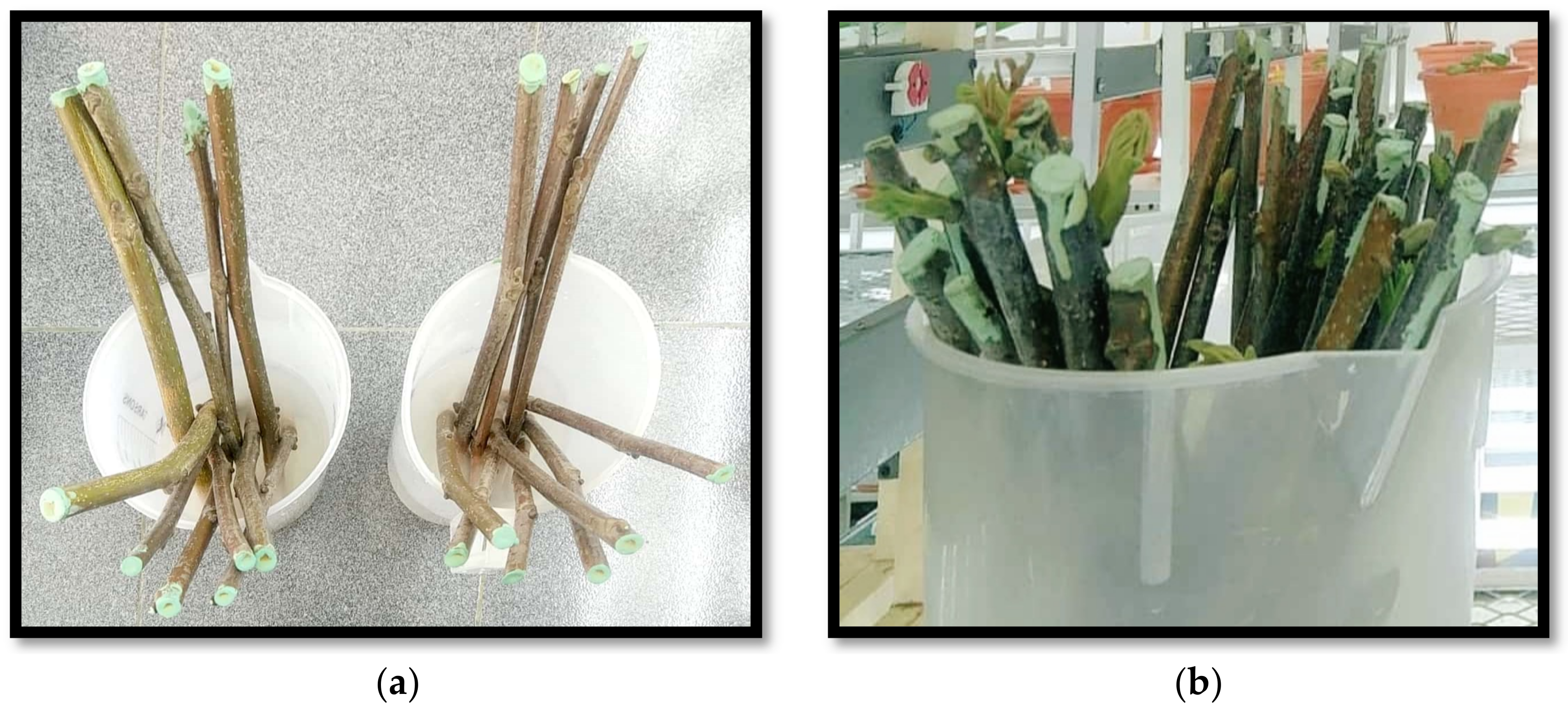
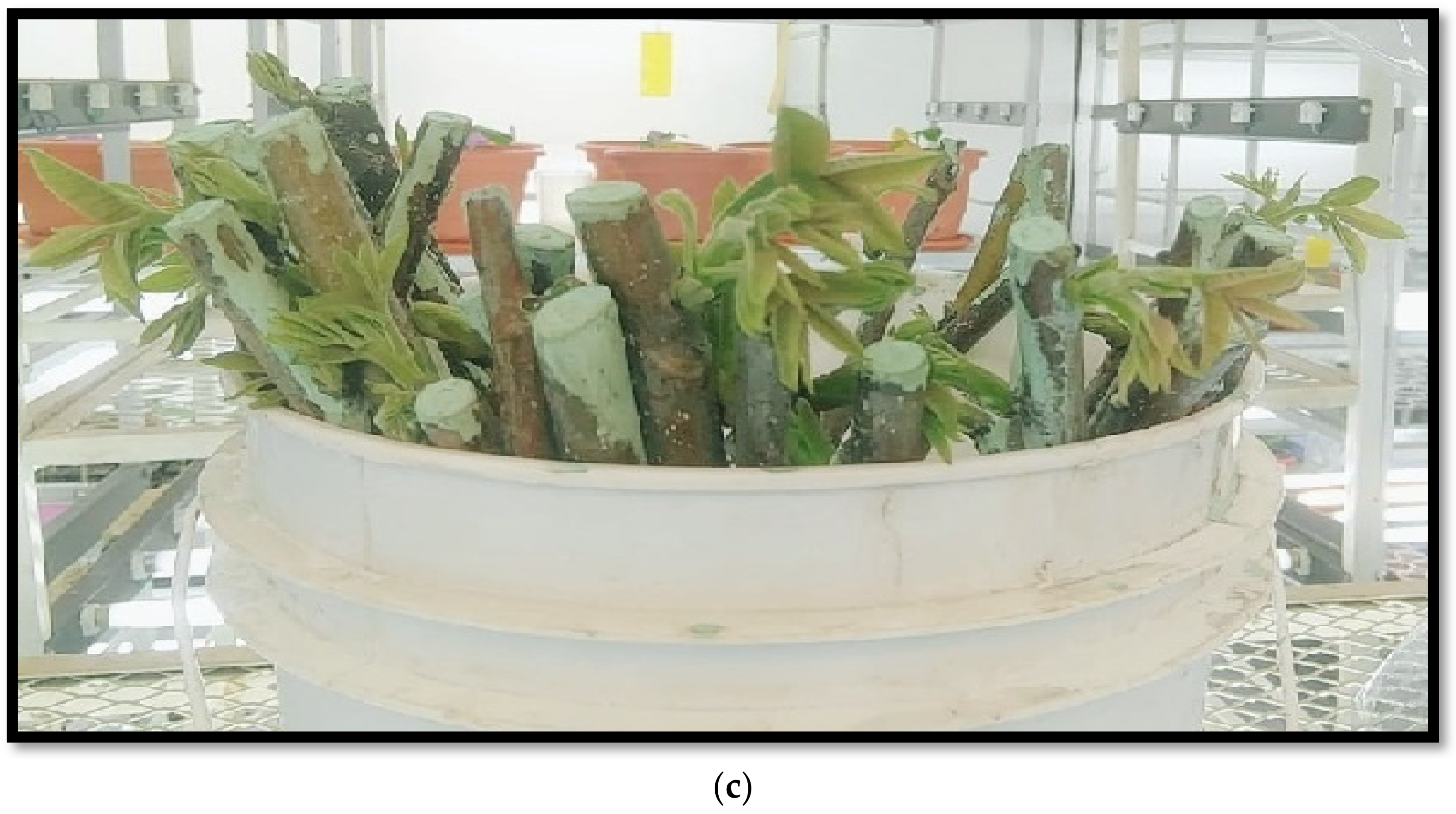
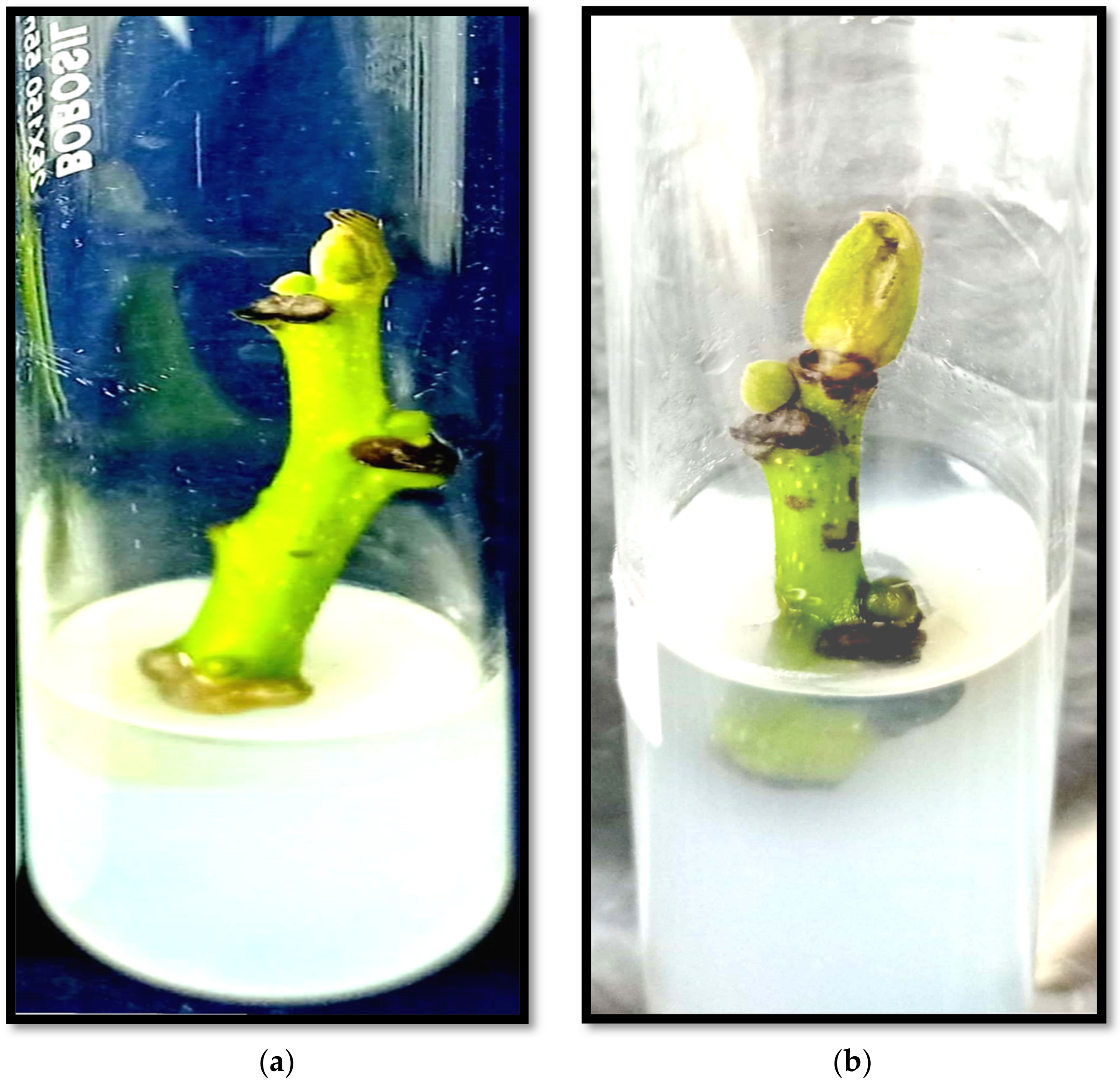
| Factors and Size of Factorial Experiment a | Levels of Factors b | Parameters c | Design of Experiment d |
|---|---|---|---|
| E1-Unforced shoot tip E2-Forced shoot tip M1-MS M2-DKW A1-Polyvinylpyrrolidone A2-Ascorbic acid A3-Activated charcoal C1-150 C2-350 C3-550 | 1–4 | CRD |
| MS | DKW | |
|---|---|---|
| NH4NO3 | 1650 | 1416 |
| Ca (NO3)2.4H2O | - | 1968 |
| KNO3 | 1900 | - |
| MgSO47H2O | 370 | 740 |
| KH2PO4 | 170 | 265 |
| K2SO4 | - | 1559 |
| CaCl22H2O | 440 | 149 |
| H3 BO3 | 6.2 | 4.8 |
| KI | 0.83 | - |
| Na2MoO42H2O | 0.25 | 0.39 |
| CoCl26 H2O CuSO4 5H2O | 0.025 | - |
| 0.025 | 0.25 | |
| ZnSO4 7H2O | 8.6 | - |
| MnSO4 4H2O | 22.3 | 33.5 |
| Na2 EDTA 2H2O | 37.3 | 45.4 |
| FeSO47H2O | 27.8 | 33.8 |
| Glycine | 2 | 2 |
| Nicotinic acid | 0.5 | 1 |
| Thiamine HCl | 0.1 | 2 |
| Pyridoxine HCl | 0.5 | - |
| Myo-inositol | 100 | 100 |
| Explant (E) | |||||||
|---|---|---|---|---|---|---|---|
| E1 | E2 | ||||||
| Concentration (C) | C1 | C2 | C3 | C1 | C2 | C3 | |
| Anti browng Agent (A) | A1 | 52.9 ± 5.2 | 33.8 ± 5.3 | 31.4 ± 9.0 | 44.2 ± 11.0 | 22.2 ± 5.1 | 21.2 ± 7.0 |
| A2 | 39.5 ± 5.4 | 32.7 ± 6.3 | 30.7 ± 4.9 | 35.2 ± 9.8 | 15.0 ± 6.1 | 13.6 ± 10.5 | |
| A3 | 49.0 ± 5.1 | 33.8 ± 7.7 | 31.8 ± 4.2 | 42.1 ± 6.0 | 24.2 ± 6.1 | 22.3 ± 7.9 | |
| Explant (E) | |||||||
|---|---|---|---|---|---|---|---|
| E1 | E2 | ||||||
| Media(M) | Concentration(C) | C1 | C2 | C3 | C1 | C2 | C3 |
| M1 | A1 | 58.4 ± 4.6 | 44.6 ± 2.0 | 41.7 ± 0.7 | 52.5 ± 2.0 | 31.3 ± 0.3 | 27.8 ± 0.8 |
| A2 | 49.1 ± 1.7 | 39.2 ± 2.1 | 33.3 ± 1.4 | 40.5 ± 0.7 | 25.4 ± 1.1 | 22.7 ± 1.2 | |
| A3 | 57.9 ± 2.5 | 41.7 ± 1.0 | 36.0 ± 1.3 | 47.8 ± 3.4 | 28.6 ± 2.0 | 26.9 ± 1.3 | |
| M2 | A1 | 55.5 ± 4.1 | 44.2 ± 1.8 | 39.2 ± 0.6 | 50.1 ± 1.9 | 23.3 ± 0.3 | 21.9 ± 0.8 |
| A2 | 46.3 ± 1.2 | 37.0 ± 2.1 | 31.4 ± 2.4 | 33.8 ± 0.7 | 13.2 ± 1.2 | 19.6 ± 1.1 | |
| A3 | 55.1 ± 2.5 | 39.8 ± 1.1 | 33.2 ± 1.4 | 41.2 ± 3.5 | 22.9 ± 2.1 | 21.3 ± 1.3 | |
| Explant (E) | |||||||
|---|---|---|---|---|---|---|---|
| E1 | E2 | ||||||
| Media (M) | Concentration (C) | C1 | C2 | C3 | C1 | C2 | C3 |
| M1 | A1 | 3.4 ± 0.2 | 1.7 ± 0.1 | 1.4 ± 0.1 | 2.8 ± 0.1 | 1.1 ± 0.1 | 0.9 ± 0.0 |
| A2 | 2.7 ± 0.0 | 1.3 ± 0.0 | 1.1 ± 0.0 | 2.1 ± 0.0 | 0.7 ± 0.0 | 0.7 ± 0.0 | |
| A3 | 2.8 ± 0.4 | 1.3 ± 0.1 | 1.2 ± 0.1 | 2.2 ± 0.4 | 0.8 ± 0.1 | 0.8 ± 0.2 | |
| M2 | A1 | 3.1 ± 0.1 | 1.5 ± 0.1 | 1.2 ± 0.0 | 2.6 ± 0.1 | 0.9 ± 0.1 | 0.7 ± 0.0 |
| A2 | 1.9 ± 0.8 | 1.0 ± 0.0 | 1.0 ± 0.0 | 1.9 ± 0.0 | 0.7 ± 0.0 | 0.6 ± 0.0 | |
| A3 | 2.6 ± 0.4 | 1.1 ± 0.0 | 1.1 ± 0.2 | 2.0 ± 0.4 | 0.7 ± 0.0 | 0.6 ± 0.1 | |
| Explant (E) | |||||||
|---|---|---|---|---|---|---|---|
| E1 | E2 | ||||||
| Media (M) | Concentration (C) | C1 | C2 | C3 | C1 | C2 | C3 |
| M1 | A1 | 25.8 ± 1.7 | 42.0 ± 2.9 | 54.0 ± 2.8 | 34.0 ± 2.9 | 47.3 ± 2.3 | 59.8 ± 2.3 |
| A2 | 39.8 ±2.3 | 56.0 ± 2.4 | 65.5 ± 1.5 | 41.6 ± 3.1 | 54.9 ± 2.9 | 71.3 ± 1.9 | |
| A3 | 31.5 ±3.1 | 47.7 ± 2.7 | 59.8 ± 4.0 | 39.2 ± 3.3 | 52.5 ± 3.8 | 62.8 ± 2.6 | |
| M2 | A1 | 28.3 ±2.4 | 44.5 ± 3.9 | 57.0 ± 1.2 | 35.9 ± 1.0 | 49.2 ± 3.7 | 65.0 ± 3.0 |
| A2 | 37.3 ±1.3 | 53.5 ± 2.9 | 68.0 ± 0.7 | 44.0 ± 2.3 | 57.3 ± 2.2 | 74.5 ± 2.4 | |
| A3 | 34.0 ±1.0 | 50.2 ± 2.0 | 62.2 ± 3.0 | 41.3 ± 1.1 | 54.6 ± 0.9 | 68.3 ± 1.6 | |
Publisher’s Note: MDPI stays neutral with regard to jurisdictional claims in published maps and institutional affiliations. |
© 2022 by the authors. Licensee MDPI, Basel, Switzerland. This article is an open access article distributed under the terms and conditions of the Creative Commons Attribution (CC BY) license (https://creativecommons.org/licenses/by/4.0/).
Share and Cite
Bhat, S.N.; Khalil, A.; Nazir, N.; Mir, M.A.; Khan, I.; Mubashir, S.S.; Dar, M.S.; Wani, S.H.; Hossain, M.A. In Vitro Prevention of Browning in Persian Walnut (Juglans regia L.) cv. Sulaiman. Int. J. Plant Biol. 2022, 13, 330-342. https://doi.org/10.3390/ijpb13030027
Bhat SN, Khalil A, Nazir N, Mir MA, Khan I, Mubashir SS, Dar MS, Wani SH, Hossain MA. In Vitro Prevention of Browning in Persian Walnut (Juglans regia L.) cv. Sulaiman. International Journal of Plant Biology. 2022; 13(3):330-342. https://doi.org/10.3390/ijpb13030027
Chicago/Turabian StyleBhat, Suhail Nazir, Aroosa Khalil, Nowsheen Nazir, Mohammad Amin Mir, Imran Khan, Syed Shoaib Mubashir, Mohammad Saleem Dar, Shabir Hussain Wani, and Mohammad Anwar Hossain. 2022. "In Vitro Prevention of Browning in Persian Walnut (Juglans regia L.) cv. Sulaiman" International Journal of Plant Biology 13, no. 3: 330-342. https://doi.org/10.3390/ijpb13030027
APA StyleBhat, S. N., Khalil, A., Nazir, N., Mir, M. A., Khan, I., Mubashir, S. S., Dar, M. S., Wani, S. H., & Hossain, M. A. (2022). In Vitro Prevention of Browning in Persian Walnut (Juglans regia L.) cv. Sulaiman. International Journal of Plant Biology, 13(3), 330-342. https://doi.org/10.3390/ijpb13030027

