
Studies on the Potential of Beneficial Bacteria in a Biological Input Made from a Fermented Nettle (Urtica dioica L.) Slurry


Abstract
1. Introduction
2. Materials and Methods
2.1. Preparation of Fermented Nettles Slurry
2.2. Quantification of Cultivable Bacteria
2.3. DNA Extraction and Microbiomic Analysis
2.3.1. DNA Extraction and Targeted Library Preparation
2.3.2. Statistical and Bioinformatic Analysis
3. Results
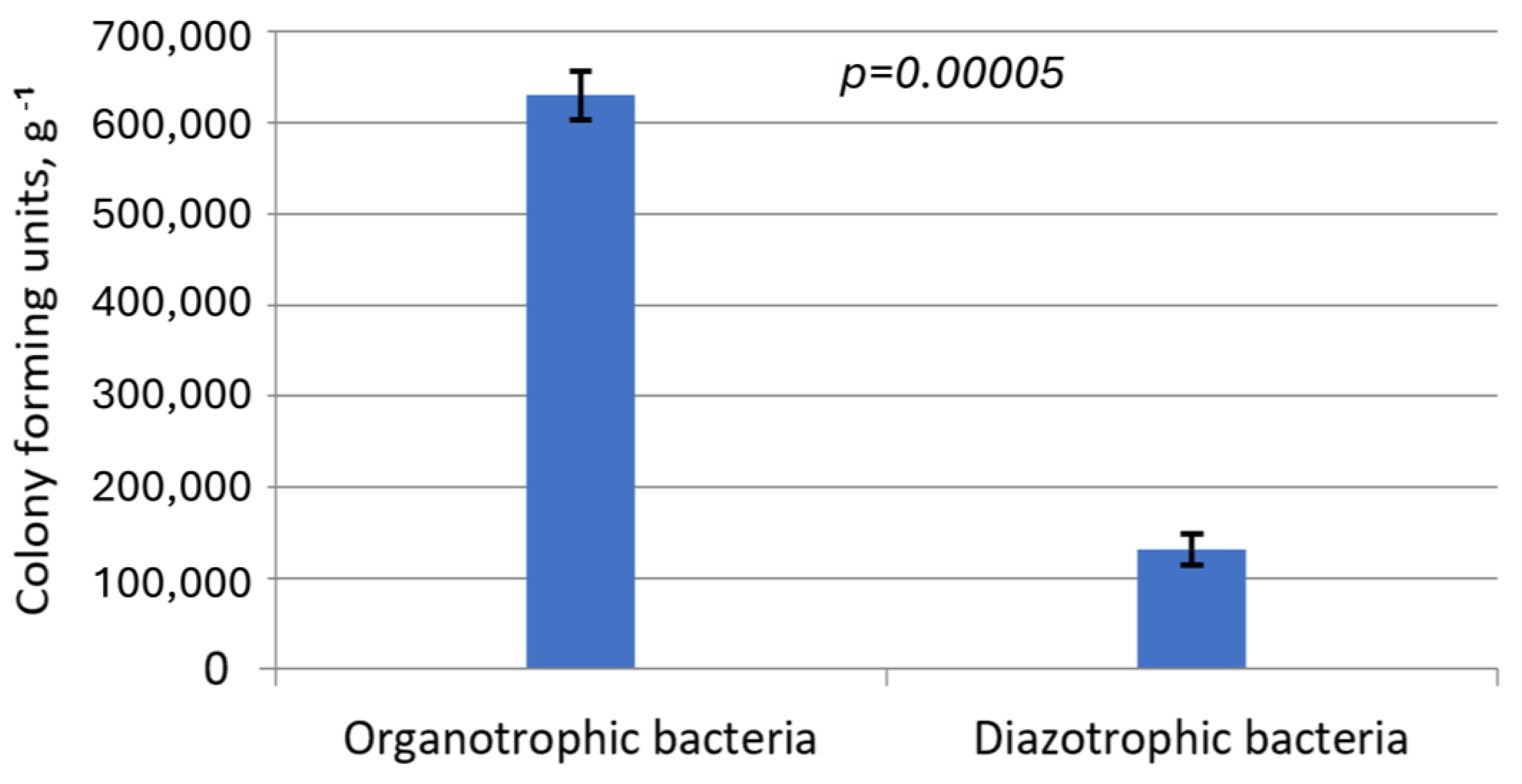
3.1. Abundance of Cultivable Bacteria
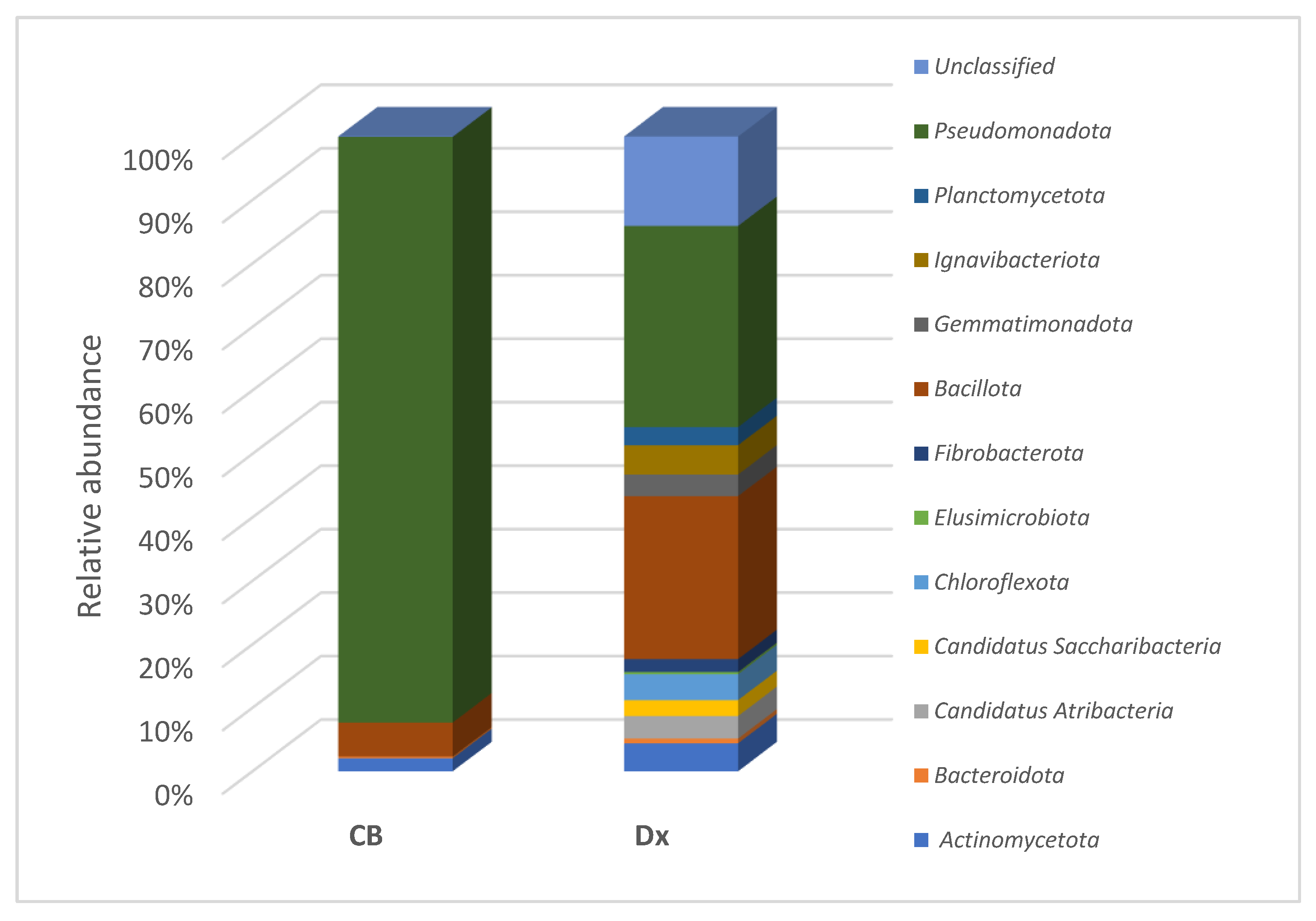
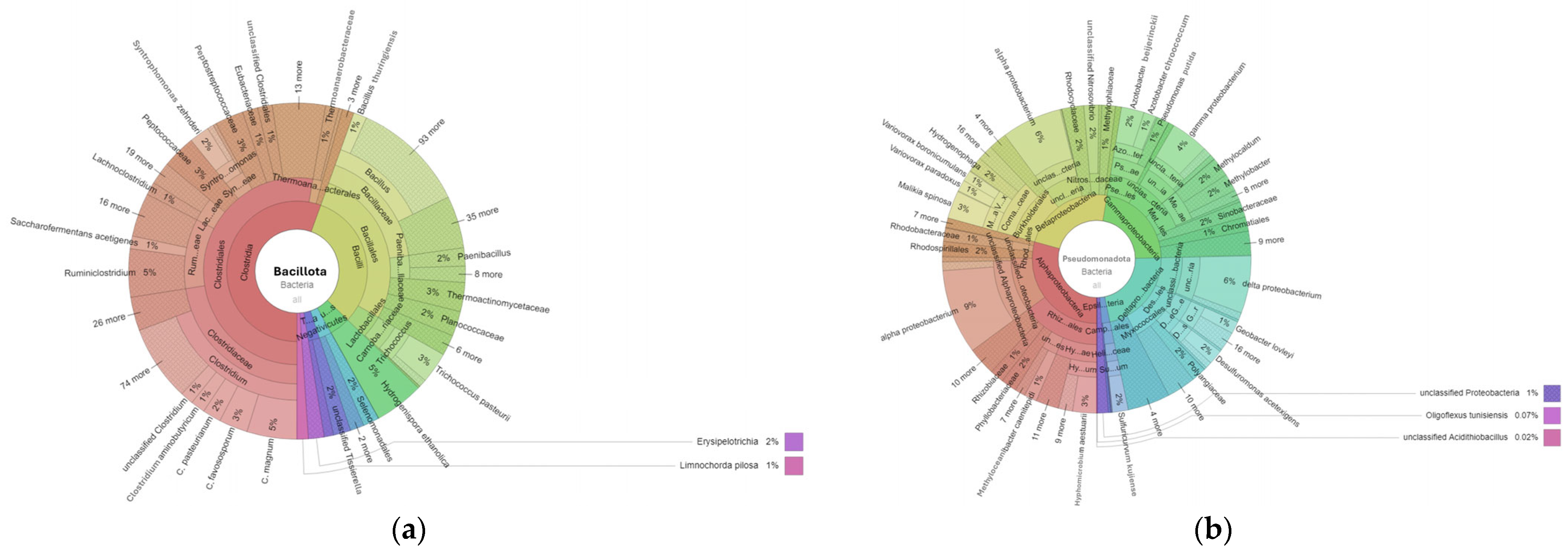
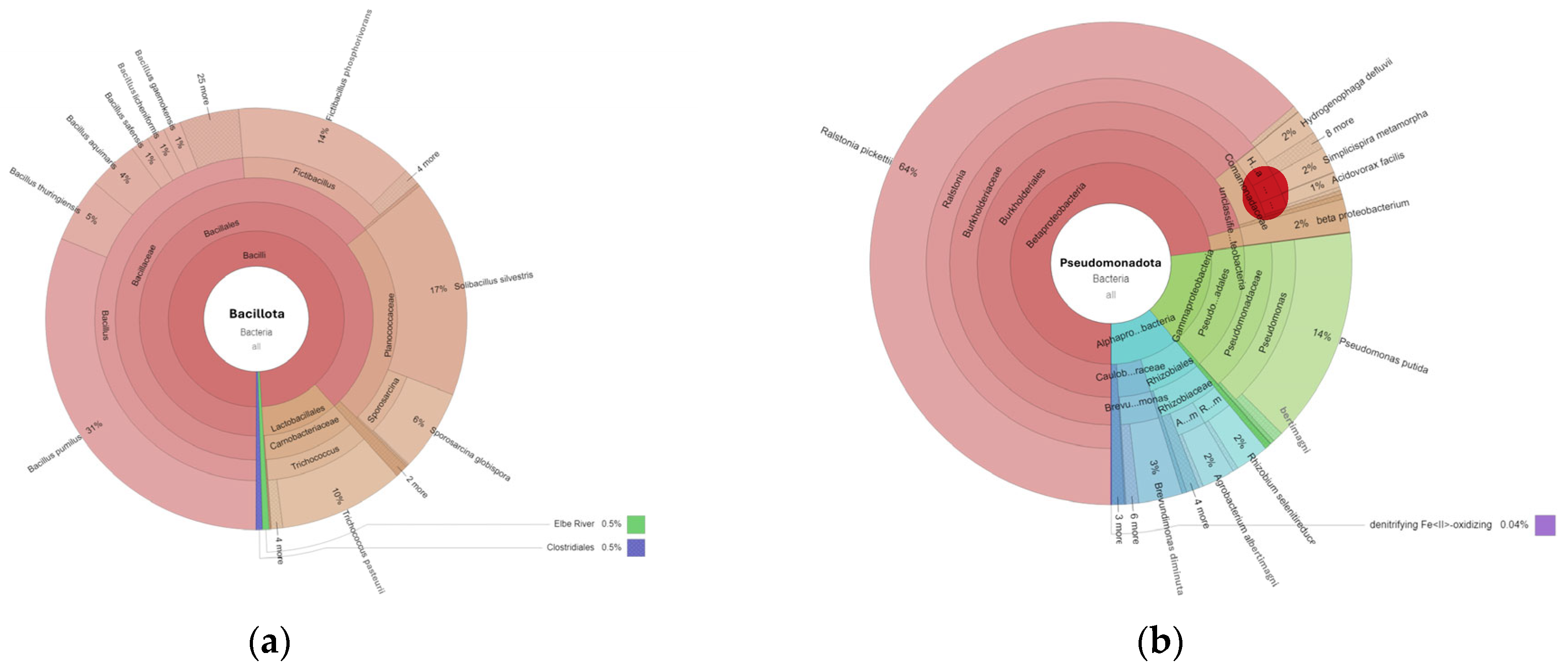
3.2. Microbiomic Analysis
4. Discussion
5. Conclusions
Funding
Institutional Review Board Statement
Informed Consent Statement
Data Availability Statement
Acknowledgments
Conflicts of Interest
References
- Paris Climate Agreement. Available online: https://unfccc.int/process-and-meetings/the-paris-agreement (accessed on 23 May 2026).
- European Green Deal. Available online: https://commission.europa.eu/strategy-andpolicy/priorities-2019-2024/european-green-deal_en (accessed on 23 May 2026).
- De Corato, U. Soil microbiota manipulation and its role in suppressing soil-borne plant pathogens in organic farming systems under the light of microbiome-assisted strategies. Chem. Biol. Technol. Agric. 2020, 7, 17. [Google Scholar] [CrossRef] [Scilit]
- Marques, B.; Bahcevandziev, K.; César de Melo, P.; Critchley, A.T. The Influence of Applications of Bio-Inputs Derived from Macroalgae and Bacteria on a Phaseolus vulgaris L. Crop. Front. Biosci. 2022, 14, 21. [Google Scholar] [CrossRef] [Scilit] [PubMed]
- Jiménez, O.R.; Bornemann, A.C.; Medina, Y.E.; Romero, K.; Bravo, J.R. Prospects of biological inputs as a measure for reducing crop losses caused by climate change effects. J. Agric. Food Res. 2023, 14, 100689. [Google Scholar] [CrossRef] [Scilit]
- Sharma, I.; Raina, A.; Choudhary, M.; Apra Kaul, S.; Dhar, M.K. Fungal endophyte bioinoculants as a green alternative towards sustainable agriculture. Heliyon 2023, 9, e19487. [Google Scholar] [CrossRef] [Scilit] [PubMed]
- Nadarajah, K.; Abdul Rahman, N.S.N. The Microbial Connection to Sustainable Agriculture. Plants 2023, 12, 2307. [Google Scholar] [CrossRef] [Scilit] [PubMed]
- Chojnacka, K.; Moustakas, K.; Witek-Krowiak, A. Bio-based fertilizers: A practical approach towards circular economy. Bioresour. Technol. 2020, 295, 122223. [Google Scholar] [CrossRef] [Scilit] [PubMed]
- Ammar, E.E.; Rady, H.A.; Khattab, A.M.; Amer, M.H.; Mohamed, S.A.; Elodamy, N.I.; AL-Farga, A.; Aioub, A.A.A. A comprehensive overview of eco-friendly bio-fertilizers extracted from living organisms. Environ. Sci. Pollut. Res. 2023, 30, 113119–113137. [Google Scholar] [CrossRef] [Scilit] [PubMed]
- Medina, G.d.S.; Rotondo, R.; Rodríguez, G.R. Agricultural Bio-Inputs as an Innovative Area of Opportunity for Agro-Industrial Growth in Developing Countries: Lessons from Argentina. World 2023, 4, 709–725. [Google Scholar] [CrossRef] [Scilit]
- Santoyo, G.; Moreno-Hagelsieb, G.; del Carmen Orozco-Mosqueda, M.; Glick, B.R. Plant growth promoting bacterial endophytes. Microbiol. Res. 2016, 183, 92–99. [Google Scholar] [CrossRef] [Scilit] [PubMed]
- Taulé, C.; Vaz-Jauri, P.; Battistoni, F. Insights into the early stages of plant–endophytic bacteria interaction. World J. Microbiol. Biotechnol. 2021, 37, 13. [Google Scholar] [CrossRef] [Scilit] [PubMed]
- Marchut-Mikołajczyk, O.; Chlebicz, M.; Kawecka, M.; Michalak, A.; Prucnal, F.; Nielipinski, M.; Filipek, J.; Jankowska, M.; Perek, Z.; Drożdżyński, P.; et al. Endophytic bacteria isolated from Urtica dioica L.-preliminary screening for enzyme and polyphenols production. Microb. Cell Fact. 2023, 22, 169. [Google Scholar] [CrossRef] [Scilit] [PubMed]
- Tsipinana, S.; Husseiny, S.; Alayande, K.A.; Raslan, M.; Amoo, S.; Adeleke, R. Contribution of endophytes towards improving plant bioactive metabolites: A rescue option against red-taping of medicinal plants. Front. Plant Sci. 2023, 14, 1248319. [Google Scholar] [CrossRef] [Scilit] [PubMed]
- Manias, D.; Verma, A.; Soni, D.K. Isolation and characterization of endophytes: Biochemical and molecular approach. In Microbial Endophytes; Woodhead Publishing Series in Food Science, Technology and Nutrition; Kumar, A., Singh, V.K., Eds.; Woodhead Publishing: Cambridge, UK, 2020; pp. 1–14. [Google Scholar] [CrossRef] [Scilit]
- Burragoni, S.G.; Jeon, J. Applications of endophytic microbes in agriculture, biotechnology, medicine, and beyond. Microbiol. Res. 2021, 245, 126691. [Google Scholar] [CrossRef] [Scilit] [PubMed]
- Alori, E.T.; Glick, B.R.; Babalola, O.O. Microbial Phosphorus Solubilization and Its Potential for Use in Sustainable Agriculture. Front. Microbiol. 2017, 8, 971. [Google Scholar] [CrossRef] [Scilit] [PubMed]
- Modarresi-Chahardehi, A.; Ibrahim, D.; Fariza-Sulaiman, S.; Mousavi, L. Screening antimicrobial activity of various extracts of Urtica dioica. Rev. Biol. Trop. 2012, 60, 1567–1576. [Google Scholar] [CrossRef] [Scilit] [PubMed]
- Di Virgilio, N.; Papazoglou, E.G.; Jankauskiene, Z.; Di Lonardo, S.; Praczyk, M.; Wielgusz, K. The potential of stinging nettle (Urtica dioica L.) as a crop with multiple uses. Ind. Crops Prod. 2015, 68, 42–49. [Google Scholar] [CrossRef] [Scilit]
- Danilčenko, H.; Dabkevičius, Z.; Jarienė, E.; Tarasevičienė, Ž.; Televičiūtė, D.; Tamošiūnas, A.; Jeznach, M. The effect of stinging nettle and field horsetail extracts on the synthesis of biologically active compounds in germinated leguminous and quinoa seed. Zemdirb.-Agric. 2017, 104, 337–344. [Google Scholar] [CrossRef] [Scilit]
- Repajić, M.; Cegledi, E.; Zoric, Z.; Pedisic, S.; Elez Garofulic, I.; Radman, S.; Palcic, I.; Dragovic-Uzelac, V. Bioactive Compounds inWild Nettle (Urtica dioica L.) Leaves and Stalks: Polyphenols and Pigments upon Seasonal and Habitat Variations. Foods 2021, 10, 190. [Google Scholar] [CrossRef] [Scilit] [PubMed]
- Viotti, C.; Albrecht, K.; Amaducci, S.; Bardos, P.; Bertheau, C.; Blaudez, D.; Bothe, L.; Cazaux, D.; Ferrarini, A.; Govilas, J.; et al. Nettle, a Long-Known Fiber Plant with New Perspectives. Material 2022, 15, 4288. [Google Scholar] [CrossRef] [Scilit] [PubMed]
- Maričić, B.; Radman, S.; Romić, M.; Perković, J.; Major, N.; Urlić, B.; Palčić, I.; Ban, D.; Zorić, Z.; Ban, S.G. Stinging Nettle (Urtica dioica L.) as an Aqueous Plant-Based Extract Fertilizer in Green Bean (Phaseolus vulgaris L.) Sustainable Agriculture. Sustainability 2021, 13, 4042. [Google Scholar] [CrossRef] [Scilit]
- Maričić, B.; Brkljača, M.; Ban, D.; Palčić, I.; Franin, K.; Marcelić, Š.; Goreta Ban, S. Non-Aerated Common Nettle (Urtica dioica L.) Extract Enhances Green Beans (Phaseolus vulgaris L.) Growth and Soil Enzyme Activity. Life 2022, 12, 2145. [Google Scholar] [CrossRef] [Scilit] [PubMed]
- Petrauskė, S.; Malinauskaitė, R. Dilgėlių vandeninės ištraukos įtaka chlorofilų kiekiui žieminių kviečių koleoptilėse. In Žmogaus Ir Gamtos Sauga VDU; Vytauto Didžiojo Universitetas: Kaunas, Lithuania, 2022; pp. 181–184. [Google Scholar] [CrossRef] [Scilit]
- Sehari, M.; Kouadria, M.; Amirat, M.; Sehari, N.; Hassani, A. Phytochemistry and antifungal activity of plant extracts from Nettle (Urtica dioica L.). Ukr. J. Ecol. 2020, 10, 1–6. [Google Scholar] [CrossRef] [Scilit] [PubMed]
- Merah, O.; Djazouli, Z.E.; Zebib, B. Aqueous Extract of Algerian Nettle (Urtica dioica L.) as Possible Alternative Pathway to Control Some Plant Diseases. Iran. J. Sci. Technol. Trans. Sci. 2021, 45, 463–468. [Google Scholar] [CrossRef] [Scilit]
- Ahmad, S.; Imran, M.; Hussain, S.; Mahmood, S.; Hussain, A.; Hasnain, M. Bacterial impregnation of mineral fertilizers improves yield and nutrient use efficiency of wheat. J. Sci. Food Agric. 2017, 97, 3685–3690. [Google Scholar] [CrossRef] [Scilit] [PubMed]
- Sivojiene, D.; Kacergius, A.; Baksiene, E.; Maseviciene, A.; Zickiene, L. The Influence of Organic Fertilizers on the Abundance of Soil Microorganism Communities, Agrochemical Indicators, and Yield in East Lithuanian Light Soils. Plants 2021, 10, 2648. [Google Scholar] [CrossRef] [Scilit] [PubMed]
- Anušauskas, J.; Steponavičius, D.; Romaneckas, K.; Lekavičienė, K.; Zaleckas, E.; Sendžikienė, E. The Influence of Bacteria-Inoculated Mineral Fertilizer on the Productivity and Profitability of Spring Barley Cultivation. Plants 2023, 12, 1227. [Google Scholar] [CrossRef] [Scilit] [PubMed]
- Anušauskas, J.; Grigas, A.; Lekavičienė, K.; Zaleckas, E.; Paulikienė, S.; Steponavičius, D. Energy and Environmental Assessment of Bacteria-Inoculated Mineral Fertilizer Used in Spring Barley Cultivation Technologies. Agriculture 2024, 14, 569. [Google Scholar] [CrossRef] [Scilit]
- Khalaf, A.F.A.; Hussein, K.T.; Ali, S.A.; Barakat, D.A.; Gad, M.I. Effect of some plant extracts on some biological aspects of Chrysoperla carnea. Adv. Anim. Vet. Sci. 2024, 12, 49–54. [Google Scholar] [CrossRef] [Scilit]
- Zhang, R.; Vivanco, J.M.; Shen, Q. The unseen rhizosphere root–soil–microbe interactions for crop production. Curr. Opin. Microbiol. 2017, 37, 8–14. [Google Scholar] [CrossRef] [Scilit] [PubMed]
- Rocha, I.; Ma, Y.; Souza-Alonso, P.; Vosa’tka, M.; Freitas, H.; Oliveira, R.S. Seed coating: A tool for delivering beneficial microbes to agricultural crops. Front. Plant Sci. 2019, 10, 1357. [Google Scholar] [CrossRef] [Scilit] [PubMed]
- Khabbaz, S.E.; Ladhalakshmi, D.; Babu, M.; Kandan, A.; Ramamoorthy, V.; Saravanakumar, D.; Al-Mughrabi, T.; Kandasamy, S. Plant growth promoting bacteria (PGPB)—A versatile tool for plant health management. Can. J. Pestic. Pest Manag. 2019, 1, 1–25. [Google Scholar] [CrossRef]
- Gouda, S.; Kerry, R.G.; Das, G.; Paramithiotis, S.; Shin, H.-S.; Patra, J.K. Revitalization of plant growth promoting rhizobacteria for sustainable development in agriculture. Microbiol. Res. 2018, 206, 131–140. [Google Scholar] [CrossRef] [Scilit] [PubMed]
- Aquilanti, L.; Favilli, F.; Clemeti, F. Comparison of different strategies for isolation and preliminary identification of Azotobacter from soil samples. Soil Biol. Biochem. 2004, 36, 1475–1483. [Google Scholar] [CrossRef] [Scilit]
- Carter, M.R.; Gregorich, E.G. Soil Sampling and Methods of Analysis; CRC Press: Boka Raton, FL, USA, 2007; pp. 342–351. [Google Scholar]
- Amplification of Bacterial Full-Length 16S Gene with Barcoded Primers. Available online: https://www.pacb.com/wp-content/uploads/Procedure-checklist-Amplification-of-bacterial-full-length-16S-rRNA-gene-with-barcoded-primers.pdf (accessed on 25 March 2026).
- Callahan, B.J.; McMurdie, P.J.; Rosen, M.J.; Han, A.W.; Johnson, A.J.; Holmes, S.P. DADA2: High resolution sample inference from Illumina amplicon data. Nat. Methods 2016, 13, 581–583. [Google Scholar] [CrossRef] [Scilit] [PubMed]
- Caporaso, J.G.; Kuczynski, J.; Stombaugh, J.; Bittinger, K.; Bushman, F.D.; Costello, E.K.; Fierer, N.; Gonzalez Peña, A.; Goodrich, J.K.; Gordon, J.I.; et al. QIIME allows analysis of high-throughput community sequencing data. Nat. Methods 2010, 7, 335–336. [Google Scholar] [CrossRef] [Scilit] [PubMed]
- Ondov, B.D.; Bergman, N.H.; Phillippy, A.M. Interactive metagenomic visualization in a Web browser. BMC Bioinform. 2011, 12, 385. [Google Scholar] [CrossRef] [Scilit] [PubMed]
- Sanchez-Peinado, M.M.; Rodelas, B.; Martıґnez-Toledo, M.V.; Gonzalez-Lopez, J.; Pozo, C. Response of soil enzymes to Linear Alkylbenzene Sulfonate (LAS) addition in soil microcosms. Soil Biol. Biochem. 2009, 41, 69–76. [Google Scholar] [CrossRef] [Scilit]
- Néble, S.; Calvert, V.; Le Petit, J.; Criquet, S. Dynamics of phosphatase activities in a cork oak litter (Quercus suber L.) following sewage sludge application. Soil Biol. Biochem. 2007, 39, 2735–2742. [Google Scholar] [CrossRef] [Scilit]
- Blagodatskaya, E.; Kuzyakov, Y. Active microorganisms in soil: Critical review of estimation criteria and approaches. Soil Biol. Biochem. 2013, 67, 192–211. [Google Scholar] [CrossRef] [Scilit]
- Tomar, A.; Bharati, D.; Rehan, S.; Vishwakarma, R.K.; Shukla, M. The Quantitative Assessment of Bacterial Species from Soil Samples through Real Time PCR. Int. J. Curr. Microbiol. App. Sci. 2024, 13, 141–147. [Google Scholar] [CrossRef] [Scilit]
- Garmendia, A.; Raigon, M.D.; Marques, O.; Ferriol, M.; Royo, J.; Merle, H. Effects of nettle slurry (Urtica dioica L.) used as foliar fertilizer on potato (Solanum tuberosum L.) yield and plant growth. PeerJ 2018, 6, e4729. [Google Scholar] [CrossRef] [Scilit] [PubMed]
- Domenico, P. Bat guano and Nettle slurry (Urtica dioica L.) used as biostimulants on Delosperma cooperi and Sedum rubrotinctum plants. World J. Adv. Res. Rev. 2019, 3, 17–23. [Google Scholar] [CrossRef] [Scilit]
- Gokkus, M.K. Effects of urea fertilizer and nettle extract on the biochemical and morphological characteristics of ornamental peppers (Capsicum frutescens L.) under deficit irrigation conditions. Irrig. Drain. 2025, 74, 600–614. [Google Scholar] [CrossRef] [Scilit]
- Praženicová, R.; Larkov, A.; Hanzelková, K.; Korban, A.; Křížek, T.; Hýskova, V.; Ječmen, T.; Hraníček, J.; Vlčková, D.; Gaudinová, A.; et al. Fermented Nettles: Bioactive Profile and Seasonal Variability. Nitrogen 2025, 6, 109. [Google Scholar] [CrossRef] [Scilit]
- Rosales-Castillo, R.; Velázquez-de Lucio, B.S.; Hernández-Domínguez, E.M.; Álvarez-Cervantes, J. Bio-inputs: An Alternative to Achieve Sustainable Agriculture. Terra Latinoam. 2025, 43, 2045. [Google Scholar] [CrossRef] [Scilit]
- Babianskaitė, U.; Kačergius, A. 2025: The influence of the composition of biological inputs on plant development in the initial growth stages. In Proceedings of Summer with LMT, 2025: Results of Students’ Summer Scientific Practice; Lithuanian Research Council: Vilnius, Lithuania, 2025; pp. 235–236. ISSN 3030-2706. [Google Scholar]
- Ryan, M.P.; Pembroke, J.T.; Adley, C.C. Ralstonia pickettii in environmental biotechnology: Potential and applications. J. Appl. Microbiol. 2007, 103, 754–764. [Google Scholar] [CrossRef] [Scilit] [PubMed]
- Ryan, M.P.; Adley, C.C. Ralstonia spp.: Emerging global opportunistic pathogens. Eur. J. Clin. Microbiol. Infect. Dis. 2014, 33, 291–304. [Google Scholar] [CrossRef] [Scilit] [PubMed]
- Zou, R.; Zhang, Y.; Zhang, L.; Chen, M.; Xin, L.; Zhang, L. The Effect of Pseudomonas putida on the Microbial Community in Casing Soil for the Cultivation of Morchella sextelata. J. Fungi 2025, 11, 775. [Google Scholar] [CrossRef] [Scilit] [PubMed]
- Molina, L.; Segura, A.; Duque, E.; Ramos, J.-L. The versatility of Pseudomonas putida in the rhizosphere environment. Adv. Appl. Microbiol. 2020, 110, 149–180. [Google Scholar] [CrossRef] [Scilit] [PubMed]
- Brahmaprakash, G.P.; Sahu, P.K. Biofertilizers for Sustainability. J. Indian Inst. Sci. 2012, 92, 37–62. Available online: https://journal.iisc.ac.in/index.php/iisc/article/view/22 (accessed on 7 July 2026).
- Hunter, W.J.; Kuykendall, L.D.; Manter, D.K. Rhizobium selenireducens sp. nov.: A Selenite-Reducing a-Proteobacteria Isolated From a Bioreactor. Curr. Microbiol. 2007, 55, 455–460. [Google Scholar] [CrossRef] [Scilit] [PubMed]
- Mayer, E.; Dörr de Quadros, P.; Fulthorpe, R. Plantibacter flavus, Curtobacterium herbarum, Paenibacillus taichungensis, and Rhizobium selenitireducens endophytes provide host-specific growth promotion of Arabidopsis thaliana, basil, lettuce, and bok choy plants. Appl. Environ. Microbiol. 2019, 85, e00383-19. [Google Scholar] [CrossRef] [Scilit] [PubMed]
- Behrendt, U.; Kämpfer, P.; Glaeser, S.P.; Augustin, J.; Ulrich, A. Characterization of the N2O-producing soil bacterium Rhizobium azooxidifex sp. nov. Int. J. Syst. Evol. Microbiol. 2016, 66, 2354–2361. [Google Scholar] [CrossRef] [Scilit] [PubMed]
- Akhallaa Youne, M.; Akhallaa Youne, O.; Bouskout, M.; Khan, Y.; Khassali, H.; Shah, S.; Sujat, A.; Alahoui, H.; Alfeddy, M.N.; Mnasri, B.; et al. Synergistic Interaction Between Endophytic Bacillus pumilus and Indigenous Arbuscular Mycorrhizal Fungi Complex Improves Photosynthetic Activity, Growth, and Yield of Pisum sativum. Plants 2025, 14, 1991. [Google Scholar] [CrossRef] [Scilit] [PubMed]
- Swarnakar, S.; Chakraborty, A.P. Bacillus pumilus: A potent IAA producing plant growth-promoting rhizobacteria with In Vitro PGP traits and antagonism against Fusarium equiseti. Discov. Plants 2025, 2, 183. [Google Scholar] [CrossRef] [Scilit]
- Kumar, P.; Kamle, M.; Borah, R.; Mahato, D.K.; Sharma, B. Bacillus thuringiensis as microbial biopesticide: Uses and application for sustainable agriculture. Egypt J. Biol. Pest Control 2021, 31, 95. [Google Scholar] [CrossRef] [Scilit]
- Ma, C.X. Bt in organic farming: Benefits and limitations. Bt Res. 2024, 15, 174–182. [Google Scholar] [CrossRef] [Scilit]
- Ragasruthi, M.; Balakrishnan, N.; Murugan, M.; Swarnakumari, N.; Harish, S.; Sharmila, D.J.S. Bacillus thuringiensis (Bt)-based biopesticide: Navigating success, challenges, and future horizons in sustainable pest control. Sci. Total Environ. 2024, 954, 176594. [Google Scholar] [CrossRef] [Scilit] [PubMed]
- Grady, E.N.; MacDonald, J.; Liu, L.; Richman, A.; Yuan, Z.-C. Current knowledge and perspectives of Paenibacillus: A review. Microb. Cell Fact. 2016, 15, 203. [Google Scholar] [CrossRef] [Scilit] [PubMed]
- Tariq, H.; Subramanian, S.; Geitmann, A.; Smith, D.L. Bacillus and Paenibacillus as plant growth-promoting bacteria in soybean and cannabis. Front Plant Sci. 2025, 16, 1529859. [Google Scholar] [CrossRef] [Scilit] [PubMed]
- Pandey, R.; Sharma, P.; Rathee, S.; Pal Singh, H.; Batish, D.R.; Krishnamurthy, B.; Kohli, R.K. Isolation and characterization of a novel hydrocarbonoclastic and biosurfactant producing bacterial strain: Fictibacillus phosphorivorans RP3. 3 Biotech 2021, 11, 105. [Google Scholar] [CrossRef] [Scilit] [PubMed]
- Zheng, Z.; Zheng, J.; Liu, H.; Peng, D.; Sun, M. Complete genome sequence of Fictibacillus phosphorivorans G25–29, a strain toxic to nematodes. J. Biotechnol. 2016, 239, 20–22. [Google Scholar] [CrossRef] [Scilit] [PubMed]

Disclaimer/Publisher’s Note: The statements, opinions and data contained in all publications are solely those of the individual author(s) and contributor(s) and not of MDPI and/or the editor(s). MDPI and/or the editor(s) disclaim responsibility for any injury to people or property resulting from any ideas, methods, instructions or products referred to in the content. |
© 2026 by the author. Licensee MDPI, Basel, Switzerland. This article is an open access article distributed under the terms and conditions of the Creative Commons Attribution (CC BY) license.
Share and Cite
Kačergius, A. Studies on the Potential of Beneficial Bacteria in a Biological Input Made from a Fermented Nettle (Urtica dioica L.) Slurry. Microbiol. Res. 2026, 17, 147. https://doi.org/10.3390/microbiolres17080147
Kačergius A. Studies on the Potential of Beneficial Bacteria in a Biological Input Made from a Fermented Nettle (Urtica dioica L.) Slurry. Microbiology Research. 2026; 17(8):147. https://doi.org/10.3390/microbiolres17080147
Chicago/Turabian StyleKačergius, Audrius. 2026. "Studies on the Potential of Beneficial Bacteria in a Biological Input Made from a Fermented Nettle (Urtica dioica L.) Slurry" Microbiology Research 17, no. 8: 147. https://doi.org/10.3390/microbiolres17080147
APA StyleKačergius, A. (2026). Studies on the Potential of Beneficial Bacteria in a Biological Input Made from a Fermented Nettle (Urtica dioica L.) Slurry. Microbiology Research, 17(8), 147. https://doi.org/10.3390/microbiolres17080147