
Article

Adaptive Laboratory Evolution of Ashbya gossypii in Sugarcane Molasses: Biomass-Driven Riboflavin Overproduction

1
School of Petroleum and Chemical Engineering, Xinjiang College of Science and Technology, Kuerle 841000, China
2
School of Information Science and Engineering, Xinjiang College of Science and Technology, Kuerle 841000, China
*
Author to whom correspondence should be addressed.
Microbiol. Res. 2026, 17(6), 118; https://doi.org/10.3390/microbiolres17060118
Submission received: 14 May 2026 / Revised: 16 June 2026 / Accepted: 17 June 2026 / Published: 22 June 2026

Abstract

The utilization of sugarcane molasses as a low-cost carbon source for riboflavin production is hindered by the reactive oxygen species (ROS) stress induced by its complex components, which suppresses microbial metabolism. To address this, we employed adaptive laboratory evolution (ALE) under progressively increasing stress to develop a sugarcane molasses-tolerant and high-yielding Ashbya gossypii. The adapted strain achieved a riboflavin titer of 298.39 ± 2.01 mg/L, representing a 99.4% increase over the parental strain (149.66 ± 4.97 mg/L), accompanied by a 96% increase in biomass (dry cell weight). Notably, the specific riboflavin production per unit biomass showed no significant difference between the two strains, indicating that the improved total yield was primarily driven by enhanced biomass accumulation. Transcriptomic analysis revealed the molecular basis for this enhanced biomass accumulation—the elevated expression of antioxidant enzymes (SOD1, PRDX5) mitigated ROS levels to support cellular growth, while the coordinated upregulation of the pentose phosphate pathway (E2.2.1.1) and purine metabolism genes (PPAT, ADE5, PFAS, ADSL) enhanced the supply of biosynthetic precursors, ribulose-5-phosphate (Ru5P) and GTP, for nucleotide biosynthesis and cell proliferation. These metabolic adjustments collectively enabled the adapted strain to achieve robust growth under sugarcane molasses stress, thereby driving the overall increase in riboflavin production. This study elucidates the molecular mechanism underlying ALE-improved riboflavin production and provides a promising strategy for its industrial fermentation using sugarcane molasses.

1. Introduction

Riboflavin is an essential vitamin that plays a critical role in human growth, development, and metabolic regulation [1]. Its deficiency can lead to skin damage and corneal vascularization, and in pregnant women, it can cause growth defects in newborns [2]. Owing to its increasing use in the global food, feed, cosmetics, chemical, and pharmaceutical industries, the demand for this nutrient is on the rise [3]. Riboflavin industrial production can be achieved through chemical synthesis or microbial fermentation. However, chemical synthesis is hindered by complex processes, high costs, and environmental pollution [4]. Currently, microbial fermentation, being eco-friendly and cost-effective, dominates riboflavin production. Among microorganisms, Ashbya gossypii is widely used in industrial production due to its high riboflavin yield [5,6].
Currently, riboflavin production using A. gossypii mainly relies on glucose or plant oils, but the sustainability of these resources is controversial [7]. Against this backdrop, producing riboflavin from sugarcane molasses is an appealing alternative. Molasses, a non-food byproduct of sugar refining, costs less than glucose or plant oils and aligns with the use of non-food resources and green bio-manufacturing requirements [8]. However, A. gossypii fails to achieve high—yield riboflavin fermentation using sugarcane molasses. The root cause is the complex components in molasses (phenols, heavy metal ions, and gums), which can lead to excessive reactive oxygen species (ROS) accumulation in microorganisms and inhibit microbial metabolic activity [9,10,11]. This highlights the urgent need to develop industrial strains that can efficiently utilize sugarcane molasses.
Adaptive laboratory evolution (ALE) technology enhances microbial stress adaptability by simulating natural selection under specific pressures, thus optimizing metabolic networks [12]. Studies have shown that ALE can significantly improve microbial environmental tolerance and boost target product yields. For example: Wang et al. [13]. used ALE to bolster the osmotic stress tolerance of Serratia marcescens SDSPY-136 (0.8 M NaCl), which lifted prodigiosin yield by 2.1-fold. Gwon et al. [14]. employed ALE to enhance violet pigment production using galactose as the carbon source, with the violet pigment concentration surging 2.81-fold. Another study by Wang et al. [15]. leveraged ALE to improve sucrose utilization in sugarcane molasses, enabling the strain to achieve a DHA titer of 25.26 g/L. However, the mechanism of ALE in enhancing A. gossypii for riboflavin production in sugarcane molasses remains underexplored, which has impeded the resource utilization of agricultural byproducts.
In this study, we aim to use ALE to screen high—riboflavin—producing A. gossypii in sugarcane molasses. We will verify their fermentation ability, antioxidant activity, and mycelial membrane permeability and integrity. By assessing the adapted strains with transcriptome sequencing, we investigated the molecular mechanism by which enhanced biomass accumulation drives the increase in total riboflavin titer. This study will offer a theoretical basis for molasses resource utilization and a genomics foundation for industrial strain engineering.

2. Materials and Methods

2.1. Strains and Media

A. gossypii (ATCC 10895, Manassas, VA, USA) preserved at −80 °C was cultured and activated in Ashbya full medium (AFM, pH 6.8). Mycelium was grown in AFM containing 10 g/L tryptone, 10 g/L yeast extract, 20 g/L glucose and 1 g/L inositol at 220 rpm at 28 °C for 48 h [16]. Then 10% of the mycelium was inoculated into a 500 mL Erlenmeyer flask containing 50 mL of production medium for riboflavin production [17].
The modified Ashbya full medium (AFM) was a replacement of the carbon source on AFM, which is the replacement of glucose with cane molasses. Modified AFM containing an increasing concentration of cane molasses (150 g/L–240 g/L) was used as an adaptation medium. Cane molasses (including 231.16 g/L sucrose, 24.25 g/L fructose, 34.93 g/L glucose and other substances) was obtained from the Mingyang Sugar Factory (Nanning, China). The medium was autoclaved at 115 °C for 30 min.

2.2. Strain Adaptation

Inoculation with 10% (v/v) of A. gossypii was grown until the fourth day and transferred to modified AFM supplemented with 150 g/L cane molasses. The concentration of cane molasses was gradually increased in 30 g/L increments, from 150 g/L to 240 g/L. At each concentration level, the culture was transferred when growth ceased (defined as no further increase in biomass and no detectable sugar consumption), and this process was repeated three times at the same concentration to enhance the adaptability of the strain to molasses.

2.3. Determination of the Antioxidant Activity

The strains were cultured in modified AFM containing 240 g/L cane molasses to evaluate the antioxidant activity. After 4 days of culture at 28 °C and 220 rpm, mycelia as precipitates were harvested by centrifugation (10,000× g, 4 °C, 10 min). The mycelia were cleaned and then resuspended in deionized water as intact cells. The above intact cells were disrupted using the ultrasonic homogenizer (SCIENTZ, Ningbo, China), and then the resulting supernatant was used to determine the antioxidant activity. Lastly, intracellular cell-free extracts were performed by the method described in previous studies [18].
The DPPH (2,2-diphenyl-1-picrylhydrazyl) free-radical scavenging ability of the adapted and parent strains was determined by following previously published studies with some modifications [19]. Briefly, 1 mL of supernatant, intracellular cell-free extracts, or intact cells was mixed with 1 mL of ethanolic DPPH solution (0.15 mM). After being mixed thoroughly, the absorbance of the resulting solution was measured at 517 nm. The scavenging percent was calculated as:
S c a v e n g i n g   a c t i v i t y   ( % )   =   ( 1     A s a m p l e     A b l a n k A c o n t r o l   )   ×   100

2.4. Determination of Membrane Integrity and Permeability

Membrane permeability was assessed using a previously described method with modifications [20]. Intracellular β-galactosidase hydrolyzes ONPG to produce ONP, whose absorbance was measured using a spectrophotometer. The level of ONPG hydrolysis reflects substrate diffusion through the membrane, offering a more accurate assessment of membrane permeability. Briefly, 0.02 g of mycelia was collected, washed three times with PBS, and resuspended in 10 mM PBS buffer (pH 7.4). The uptake of a model substrate was monitored by measuring the intracellular hydrolysis product using a spectrophotometer at 420 nm.
Membrane integrity was measured based on the uptake of propidium iodide (PI) [21]. In brief, 1 mL PBS buffer and PI solution (pH 7.0, 15 µmol/L) was added to the cell suspension. The mixture was left at room temperature for 20 min. Then, 100 µL samples were added to the 96-well plate, and the fluorescence intensity was measured using a fluorescence spectrophotometer (Agilent, Santa Clara, CA, USA).

2.5. Determination of Dry Cell Weight (DCW) of A. gossypii, Riboflavin Production, and Total Sugar Content of Fermentation Broth

The fermentation broth was centrifuged to collect the mycelial precipitate. The mycelial precipitation was washed with sterile water three times, harvested by centrifugation, and dried to constant weight at 80 °C [16].
The amount of riboflavin was determined in accordance with a previous protocol [22]. In brief, 0.8 mL of the culture broth was added to 0.2 mL of 1 N NaOH. The mixture was mixed thoroughly and neutralized with 1 mL of 0.1 M potassium phosphate buffer (pH 6.0). The absorbance was measured at 444 nm. We note that molasses contains colored compounds that may interfere with absorbance measurements; however, using non-inoculated molasses medium as a blank control, the interference at 444 nm was negligible. Because the same method was applied to both strains, the relative comparison remains valid. Future validation using HPLC would further improve accuracy.
The total sugar content was measured in accordance with the method of the previous protocol with some modifications [23]. The fermentation broth (2 mL) was centrifuged at 12,000 r/min for 10 min and 1 mL of supernatant was added to 5 mg Lead acetate basic. The supernatant of the mixture was mixed with 100 µL HCl (6 mol/L). The solution was heated at 70 °C for 15 min and then cooled to room temperature immediately, adding 120 uL NaOH. After centrifugation, the total reduced sugar in the supernatant (400 µL) was determined by the DNS (3,5 dinitrosalicylic acid) method.

2.6. RNA Extraction and Transcriptome Analysis

The parent strain and the adapted strain were incubated at 220 rpm for 72 h at 28 °C to perform the transcriptomic analysis. The parent strain was set as the control group (named A1, A2 and A3), while the adapted strain was set as the treated sample (named B1, B2 and B3). The cells were collected by centrifugation of 10 mL of fermentation broth for 5 min, and the collected cells were washed with sterile distilled water, then snap frozen in liquid nitrogen and stored at −80 °C. Total RNA was extracted by RNA purification kit (Sangon Biotech, Shanghai, China) according to the manufacturer’s instructions, and then transported to Beijing Genomics Institute (BGI) for sequencing. Transcriptome analysis was performed on the BGISEQ-500 platform (BGI Tech., Wuhan, China).
Clean reads can be obtained by removing raw reads with low-quality reads. With the obtained filtered reads, Bowtie 2 was used to compare the reference genes, and the expression levels of genes were obtained by RSEM [24]. Furthermore, the differentially expressed genes (DEGs) were identified using DESeq2 [25]. Transcripts with a p value < 0.05 and log2-fold-change > 0 were considered upregulated, and transcripts with a log2-fold-change < 0 were considered downregulated.
Gene enrichment analysis uses statistical tools and biological information databases to enrich the target genes of modules or biological pathways, enabling the in-depth study of gene functions from a biological perspective [26]. It primarily includes the analysis of metabolic pathway enrichment (KEGG enrichment analysis) and gene function enrichment (GO enrichment analysis).

2.7. Statistical Analysis

All the experiments were performed at least three times, and the results are expressed as the means ± standard deviation (SD). SPSS 18 (SPSS Inc., Chicago, IL, USA) was used to assess statistically significant differences.

3. Results

3.1. Effects of Sugarcane Molasses on Cell Growth and Metabolism

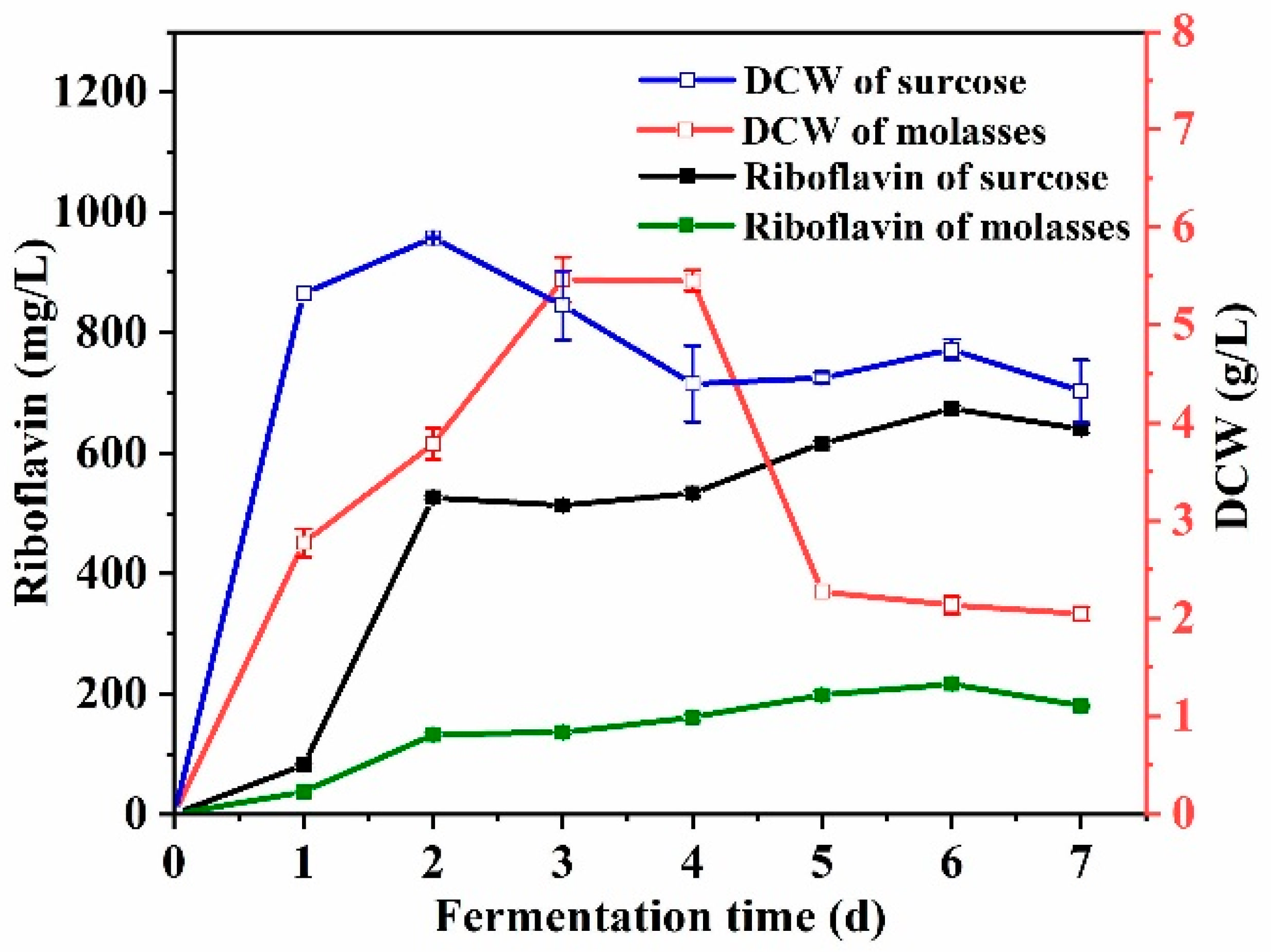
The fermentation performance of A. gossypii using different carbon sources was evaluated based on mycelia growth and riboflavin production (Figure 1). The results showed that A. gossypii can utilize sucrose or sugarcane molasses as carbon sources for riboflavin production, though carbon source type significantly impacts fermentation efficiency. When sucrose was used as the sole carbon source, it was hydrolyzed into glucose and fructose by β-fructofuranosidase, which were directly utilized by A. gossypii. Under these conditions, A. gossypii entered the logarithmic phase on day 2 and achieved peak riboflavin production of 673.64 ± 4.34 mg/L on day 7. In contrast, when sugarcane molasses was used as the carbon source, the logarithmic phase of A. gossypii was delayed to day 3, and riboflavin production decreased to 216.46 ± 1.87 mg/L.
This reduction may be attributed to the complex composition of sugarcane molasses, which causes multiple adverse effects: (1) Ca2+ in sugarcane molasses inhibits β-fructofuranosidase activity, reducing the efficiency of sucrose hydrolysis and limiting the availability of utilizable monosaccharides [27]. (2) phenolic compounds (e.g., ferulic acid) and heavy metal ions (e.g., Fe3+) in sugarcane molasses induce oxidative stress, which inhibits cellular metabolism [28]. To address the above metabolic challenges, this study used adaptive laboratory evolution to screen for A. gossypii adapted to sugarcane molasses, aiming to improve riboflavin production.

3.2. ALE of Strains Adapted to Sugarcane Molasses

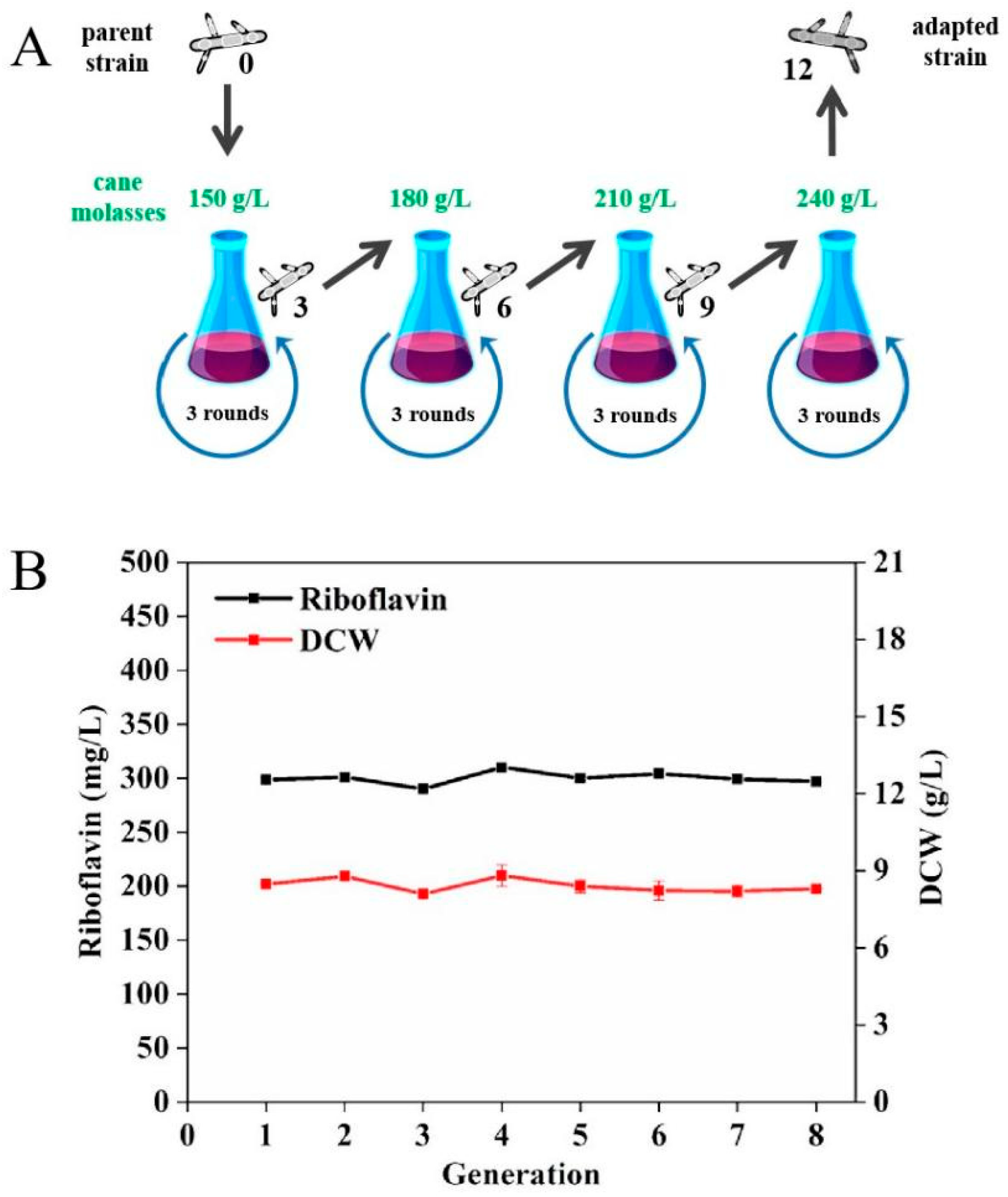
ALE of A. gossypii was conducted as shown in Figure 2A. In this study, A. gossypii was cultured using 150 g/L sugarcane molasses as the initial carbon source. The sugarcane molasses concentration was increased stepwise by 30 g/L increments (with three subcultures at each concentration level). A stable strain was obtained under 240 g/L molasses conditions. After purification on solid medium and confirmation of fermentation performance, an adapted strain was isolated.
The adapted strains were cultivated for eight consecutive generations in 240 g/L sugarcane molasses to evaluate their phenotypic stability. After eight generations, riboflavin production and DCW remained relatively stable (Figure 2B), indicating acceptable short-term phenotypic stability in sugarcane molasses over eight generations, though long-term stability remains to be evaluated [29]. This result confirmed the effectiveness of the ALE method in enhancing microbial adaptation to complex carbon sources.

3.3. Fermentation Validation of the Adapted Strain

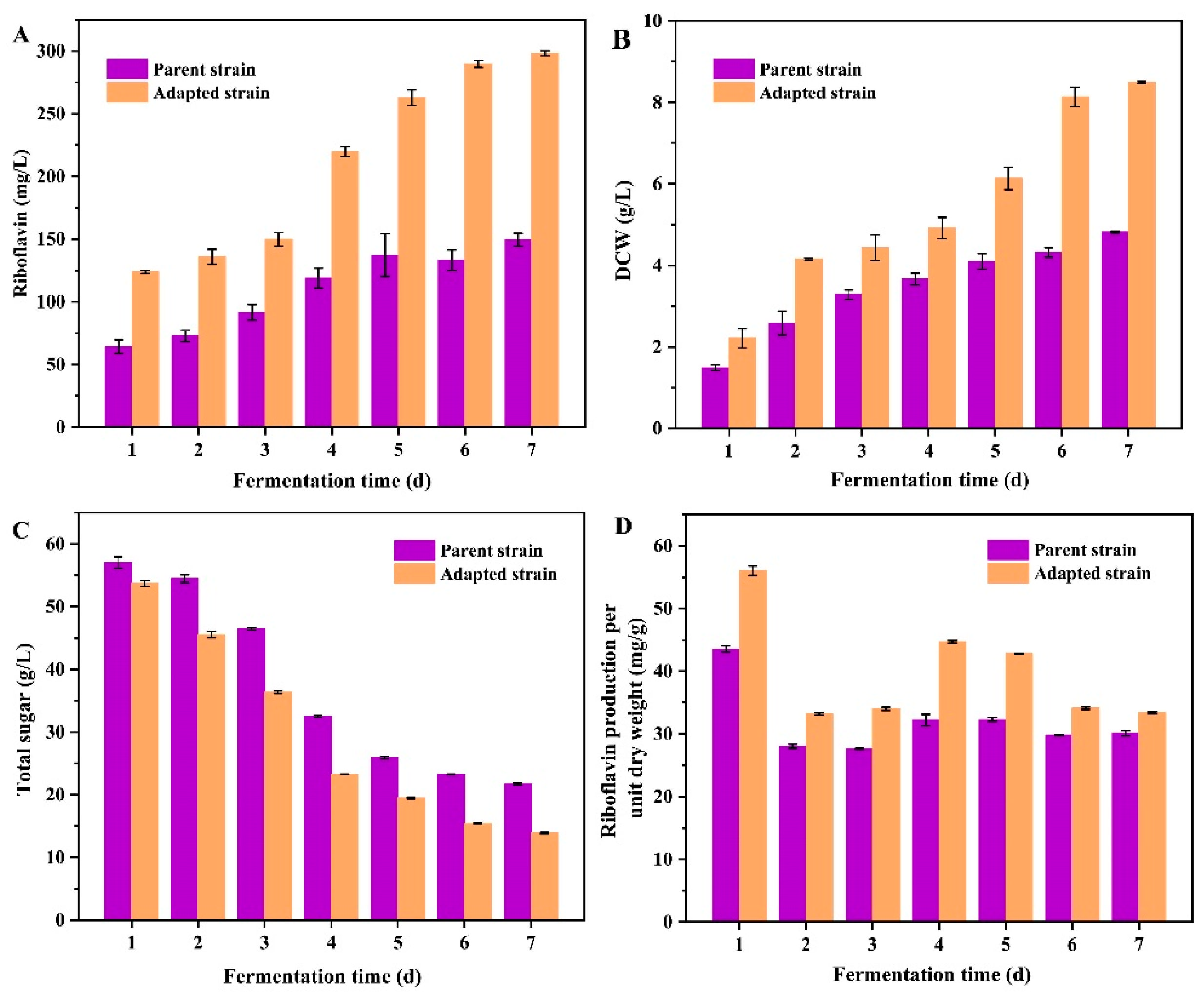
Fermentation performance of the parent and adapted strains was investigated using sugarcane molasses as the carbon source (Figure 3). The final riboflavin yield of the adapted strain reached 298.39 mg/L, which was 99.4% higher than that of the parental strain (149.66 mg/L) (Figure 3A). Its DCW (9.48 g/L) also saw a 96% rise compared to the parent strain (4.82 g/L) (Figure 3B). In terms of specific riboflavin production per unit biomass, the adapted strain exhibited higher values during the early fermentation phase (days 2–5), although the final values converged between the two strains (30–31.5 mg/g DCW) (Figure 3D). Compared with the results of fermentation with 150 g/L molasses as the carbon source in part 3.1 (Figure 1), the biomass of both strains continued to grow and did not decline at the high sugarcane molasses concentration of 240 g/L, which could be attributed to the adequate supply of carbon source in the medium.
The total sugar utilization of the adapted strain reached 78.2%, which was significantly higher than that of the parent (63.4%) (Figure 3C). These results demonstrate that adaptive evolution enhanced substrate utilization, DCW, and riboflavin production. ALE shows promising applications in microbial optimization.

3.4. Effects of ALE on Cell Membrane Permeability and Integrity

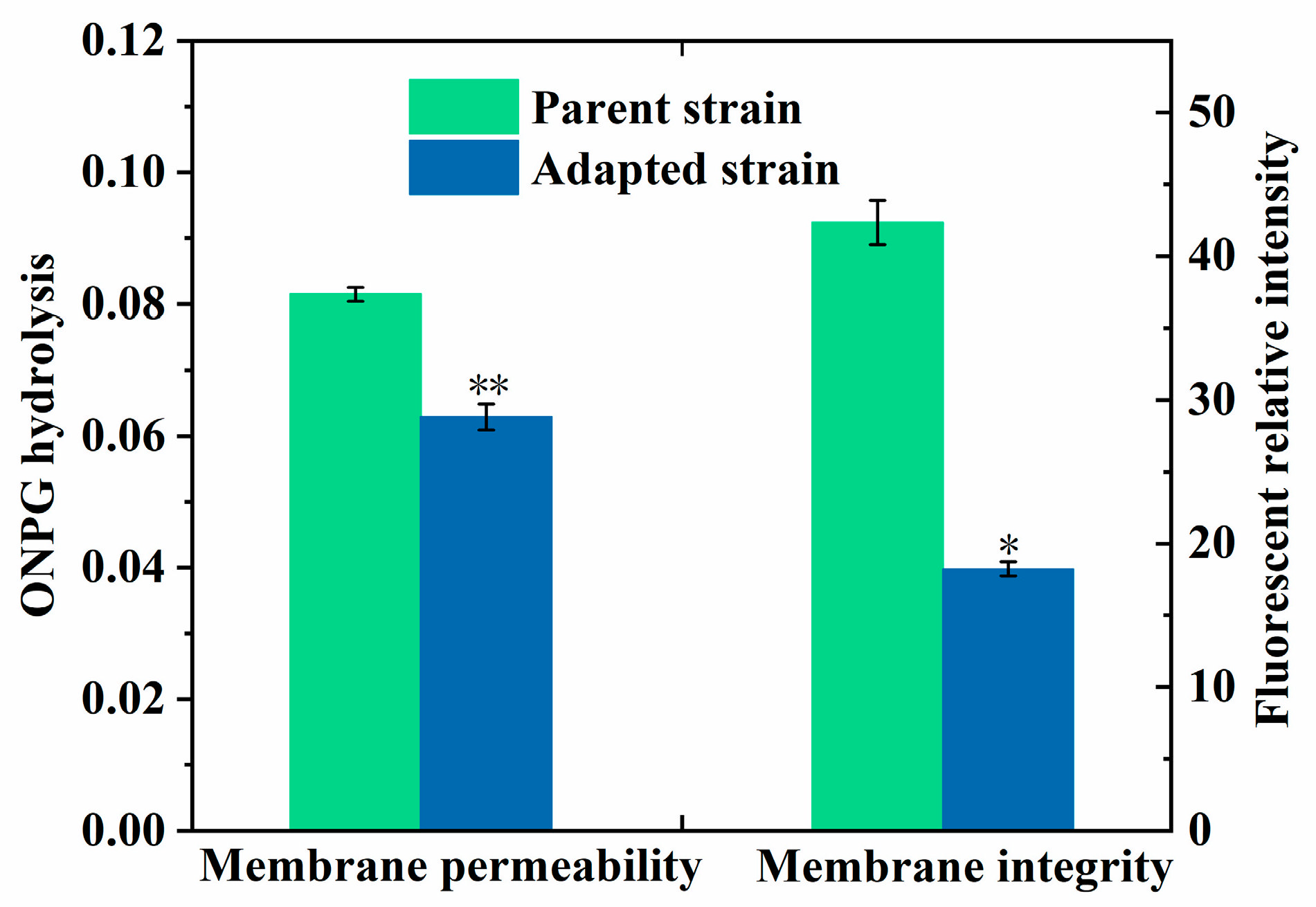
Cell membrane permeability and integrity are closely related to microbial growth and metabolism. Figure 4 shows the changes in membrane permeability and integrity after ALE. In terms of membrane permeability, the substrate diffusion rate of the parent strain was approximately 1.3-fold higher than that of the adapted strain, confirming that ALE significantly reduced the cell membrane permeability of A. gossypii. Previous studies have shown that reduced membrane permeability inhibits the intracellular penetration of phenols, metal ions, and organic acids present in sugarcane molasses, thereby decreasing ROS accumulation and enhancing cellular metabolic activity [30].
PI (propidium iodide) is an indicator of cell membrane integrity that penetrates damaged cell membranes and binds to DNA or RNA to form fluorescent complexes [31]. As shown in Figure 4, the PI fluorescence intensity of the parent strain was significantly higher than that of the adapted strain, indicating that the cell membrane integrity of the parent strain was severely damaged. Reduced cell membrane integrity may lead to leakage of intracellular substances (important cofactors in biological processes), which may interfere with redox homeostasis and energy metabolism, resulting in reduced fermentation efficiency [32,33].
In summary, ALE reduces membrane permeability to limit the influx of toxic substances and enhances membrane integrity to prevent the leakage of intracellular metabolites. These changes boost cellular metabolic activity and riboflavin fermentation efficiency.

3.5. The Effect of ALE on Antioxidant Activity of A. gossypii

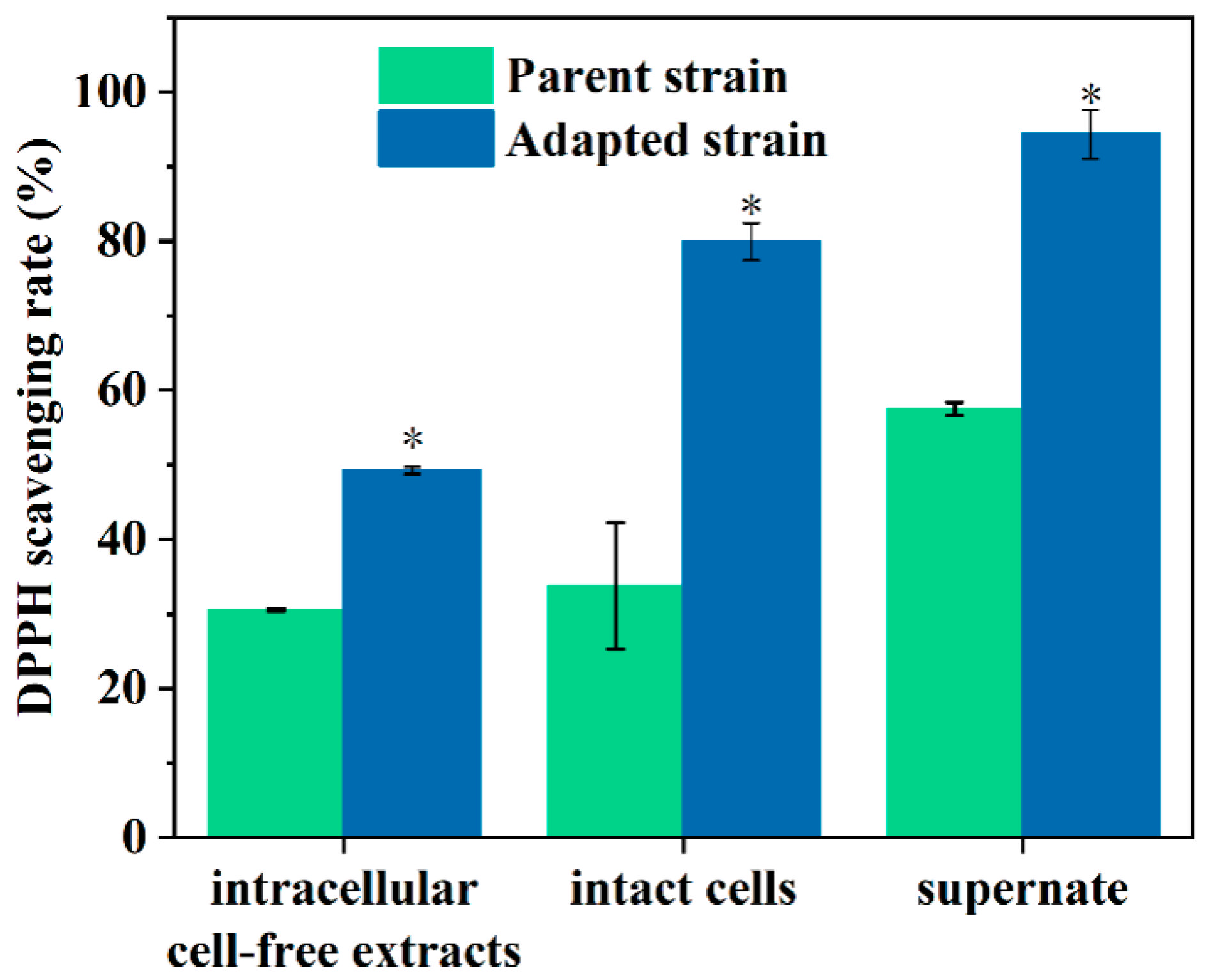
The scavenging of DPPH free radicals is attributed to the ability of antioxidants to donate hydrogen, and this is the most commonly used method for evaluating antioxidant capacity [34]. This study further evaluated the antioxidant activity of the adapted strain and the parent strain. As shown in Figure 5, the DPPH free radical scavenging ability of cell-free extracts was lower than that of the supernatant and intact cells. This may be because intact cells possess a complete antioxidant enzyme system (such as SOD and CAT), while the supernatant contains antioxidant substances like riboflavin [35]. Previous studies have shown that the cell lysis process can lead to the inactivation of the antioxidant enzyme system, thereby reducing the free radical scavenging efficiency of cell-free extracts [36]. Notably, the DPPH free radical scavenging rates of the intracellular cell-free extracts, supernatant, and intact cell groups of the adapted strains were increased by 61.16%, 63.98%, and 136.51%, respectively, compared to the parent strains. This indicates that under oxidative stress, the adapted strains induced the synthesis of more antioxidant metabolites or enzymes involved in free radical scavenging [37]. The enhanced antioxidant capacity helps A. gossypii better cope with oxidative stress in sugarcane molasses, maintain cellular homeostasis, thereby promoting growth and metabolism, and increasing biomass accumulation and riboflavin production [11].

3.6. Transcriptomic Analysis of the Adapted Strain

3.6.1. Quality Control of Transcriptome Data

In order to elucidate the molecular mechanism of enhanced riboflavin synthesis by adaptive evolution, transcriptome sequencing was performed at the molecular level for the adapted and parental strains (Supplementary Table S1). The results showed that the GC content of the parent and adapted strains was 56.7% ± 0.3% and 57.0% ± 0.2%, respectively, and the Q30 values were both over 92.3% and 92.2%, respectively. These metrics indicate that the transcriptome data are reliable for subsequent analysis.

3.6.2. Analysis of Differentially Expressed Genes

Differential expression genes (DEGs) were screened using |log2FoldChange| > 0.0 and p-value < 0.05 as criteria. In this study, all genes were analyzed by DESeq2, which identified 3625 DEGs, with 1807 up-regulated (49.8%) and 1818 down-regulated (50.2%) (Supplementary Figure S1). The volcano plot illustrates the distribution of DEGs, with points closer to the sides and top indicating more significant expression differences [13].

3.6.3. GO and KEGG Analysis

GO and KEGG analyses were used to assess the biological and functional significance of the DEGs. The GO database categorizes gene functions into three main classes: biological processes, cellular components, and molecular functions. As shown in Supplementary Figure S2, the top five biological processes were positive regulation of phosphorus metabolic processes, steroid metabolic processes, regulation of phosphorus metabolic processes, DNA-templated transcription elongation, and secondary alcohol metabolic processes. The top five cellular components were cytoplasmic ribosomes, cytoplasm, plasma membrane, large cytoplasmic ribosomal subunits and cell periphery. The molecular function types included secondary active transmembrane transporter activity, carbohydrate binding, metal ion transmembrane transporter activity, catalytic activity, and monosaccharide binding. GO analysis indicated that ALE affected catalytic activity, cell membrane, and ribosomal functions of the adapted strain, which may contribute to its enhanced growth capacity.
KEGG pathway enrichment analysis was performed on the DEGs. As shown in Supplementary Figure S3, the top 20 enriched pathways included antibiotic biosynthesis, ribosomes, carbon metabolism, the citric acid cycle (TCA cycle), fatty acid metabolism, and oxidative phosphorylation. These results suggest that ALE may enhance stress resistance through pathways involved in ribosome function and carbon metabolism.

3.7. Mechanism Analysis of ALE for Enhanced Riboflavin Production

3.7.1. Regulation of Metabolic Activity

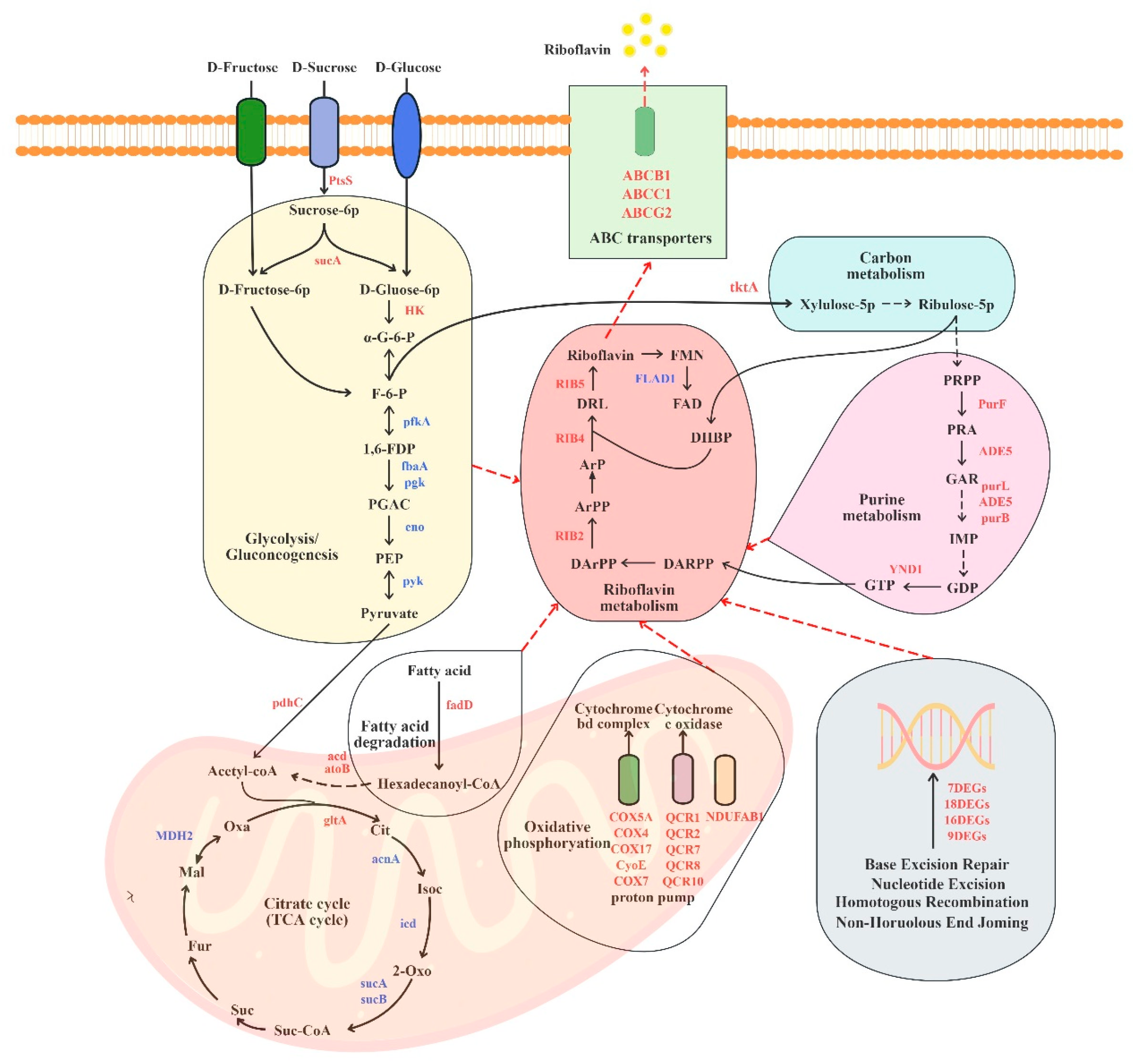
Transcriptomic analysis revealed that the adapted strain achieved enhanced biomass accumulation and consequently higher total riboflavin titer through reconfiguration of central carbon metabolism (Figure 6). Carbohydrate metabolism plays a crucial role in synthesizing key biosynthetic precursors and supporting cell proliferation [38]. Transcriptomic analysis showed that the expression of the β-fructofuranosidase gene (INV) was upregulated 2.46-fold (log2FC = 1.30), enhancing the efficiency of sucrose hydrolysis into glucose and fructose. This further demonstrates that ALE improves the utilization of sucrose in sugarcane molasses by microorganisms [15]. Additionally, the expression of the hexokinase gene (HK), which encodes the enzyme responsible for converting glucose into glucose-6-phosphate, was increased 1.68-fold (log2FC = 0.76). This accelerates glucose phosphorylation and enhances carbon source utilization capacity. These findings are consistent with experimental results showing that the substrate utilization rate of the adapted strain is higher than that of the parent strain.
Notably, several genes encoding key glycolytic enzymes (phosphofructokinase-1, PFK; pyruvate kinase, PK) and TCA cycle enzymes (isocitrate dehydrogenase, α-ketoglutarate dehydrogenase complex, and malate dehydrogenase) were downregulated, while transketolase (E2.2.1.1), a key enzyme redirecting carbon flux from fructose-6-phosphate to the pentose phosphate pathway (PPP), was upregulated 0.75-fold. This transcriptional pattern indicates a redirection of carbon flux from glycolysis and the TCA cycle toward the PPP. Increased PPP flux enhances the supply of ribulose-5-phosphate (Ru5P), a precursor for nucleotide biosynthesis [39]. Thus, the redirected carbon flux primarily supports the synthesis of nucleotides and other cellular building blocks, thereby promoting cell proliferation and biomass accumulation.
In fatty acid metabolism, genes involved in acetyl-CoA formation (ACSL, ACADM, E2.3.1.9) were upregulated, which may contribute to membrane phospholipid synthesis and thus support increased cell mass production. GTP is a key precursor for both nucleic acid synthesis and riboflavin biosynthesis. Upregulation of purine metabolism genes (PPAT, ADE5, PFAS, ADSL) was observed in the adapted strain. This increased capacity for GTP synthesis likely fuels DNA and RNA synthesis to support the nearly doubled biomass. In addition, the riboflavin biosynthesis gene cluster (RIB2, RIB4, RIB5) showed increased expression, and FLAD1 (encoding FAD synthase) was downregulated. However, despite these transcriptional changes in the riboflavin pathway, the specific riboflavin productivity per unit biomass did not differ significantly between the adapted and parent strains (Figure 3D). This indicates that the upregulation of riboflavin biosynthesis genes did not directly enhance per-cell biosynthetic capacity under the tested conditions. These transcriptional changes may instead reflect an adaptive response to the oxidative and inhibitory stress of sugarcane molasses, or they may be secondary consequences of the global metabolic adjustments that support enhanced biomass accumulation. Further studies, including targeted gene deletion or overexpression combined with flux analysis, are needed to clarify the functional roles of these genes under molasses stress.

3.7.2. Environmental Pressure Regulation

The effects of ALE on strain stress response were also analyzed (Table S2). Microorganisms sense, respond, and adapt to environmental conditions through various mechanisms [40]. Transcriptomic analysis revealed that the adapted strain exhibited an enhanced oxidative phosphorylation pathway. The expression of genes encoding cytochrome b complex (COX4, COX5A, COX7) and cytochrome c oxidase (QCR1, QCR2, QCR10) was upregulated. This, together with TCA cycle downregulation, reflects a metabolic shift that prioritizes nucleotide synthesis while meeting energy demands for increased biomass (see explanation in Section 3.7.1). Instead, the upregulation of SOD and PRDX5 gene expression indicates enhanced antioxidant enzyme activity, which strengthens cellular antioxidant capacity [19] and is consistent with the increased DPPH scavenging activity reported in Section 3.5.
ABC transporter proteins are important components of the cell membrane, functioning as pumps to facilitate the transfer of ions, nutrients, and various other substances across the membrane. They are critical for the strain’s response to external stresses [41]. Upregulated expression of ABC transporter genes (ABCB1, ABCC1, ABCG2) may enhance the efflux of riboflavin and other metabolites, potentially alleviating product feedback inhibition and reducing intracellular accumulation of toxic compounds. This adaptation likely supports cellular growth and biomass accumulation rather than directly increasing per-cell riboflavin biosynthetic capacity.
ALE also enhanced the expression of genes related to DNA repair systems (base excision repair, nucleotide excision repair, homologous recombination, and non-homologous end-joining). This helps maintain genomic stability under the stressful conditions of sugarcane molasses [42,43,44], thereby supporting sustained cell proliferation and biomass accumulation.
In summary, ALE redirected carbon flux from glycolysis and the TCA cycle toward the PPP and purine metabolism, providing precursors for nucleotide synthesis. Concurrently, improved antioxidant capacity, ABC transporter-mediated efflux, and DNA repair collectively enhanced stress tolerance and cellular homeostasis. These coordinated changes enabled the adapted strain to achieve robust growth and a 96% increase in biomass, which in turn drove the 99.4% increase in total riboflavin titer without altering the specific productivity per unit biomass (Figure 3D).

4. Conclusions

In this study, adaptive laboratory evolution (ALE) was successfully employed to engineer A. gossypii for improved growth and total riboflavin production using sugarcane molasses as a low-cost carbon source. The adapted strain exhibited a 96% increase in biomass, which was the primary driver of the 99.4% increase in total riboflavin titer. Notably, the specific riboflavin productivity per unit biomass showed no significant difference between the adapted and parent strains (Figure 3D), confirming that the increased total yield was attributable to enhanced biomass accumulation rather than to an increased per-cell biosynthetic rate.
Transcriptomic analysis revealed that this improved performance was underpinned by a global metabolic reprogramming that supports cell proliferation and stress tolerance. The adapted strain exhibited upregulation of genes involved in antioxidant defense, the pentose phosphate pathway, purine metabolism, and DNA repair systems. In contrast, genes encoding key glycolytic and TCA cycle enzymes were downregulated, while oxidative phosphorylation was upregulated. These changes redirected carbon flux toward the synthesis of nucleotides and other cellular building blocks, thereby promoting biomass accumulation. Although the riboflavin biosynthesis gene cluster and certain ABC transporter genes were also upregulated, the unchanged specific productivity indicates that these transcriptional changes likely reflect adaptive stress responses or secondary consequences of metabolic adjustments rather than a direct enhancement of per-cell riboflavin biosynthetic capacity.
This study provides a theoretical basis for the valorization of sugarcane molasses in riboflavin fermentation and establishes a genomic foundation for rational engineering of industrial strains. Future studies—including whole-genome sequencing and targeted genetic validation—are warranted to pinpoint the causal mutations underlying these adaptive traits and to further optimize strain performance for industrial applications.

Supplementary Materials

The following supporting information can be downloaded at: https://www.mdpi.com/article/10.3390/microbiolres17060118/s1, Figure S1: Volcano plot of the DEGs between parent vs. adapted strains. Red dots represent upregulated genes, blue dots represent downregulated genes, and gray dots represent genes that were not significantly expressed; Figure S2: GO enrichment of differentially expressed genes (DEGs); Figure S3: KEGG pathway enrichment analysis of DEGs; Table S1: Summary of A. gossypii RNA-sequencing data analyzed in this study. A1/2/3 was the parent strain, and B1/2/3 was the adapted strain; Table S2: Annotations of the main DEGs associated with riboflavin excess.

Author Contributions

X.Z.: Investigation, Conceptualization, Writing—Original Draft. W.Z.: Investigation, Conceptualization. S.G.: Supervision, Funding Acquisition, Project Administration. All authors have read and agreed to the published version of the manuscript.

Funding

This work was supported by the Third Batch of the Xinjiang Tianchi Program.

Data Availability Statement

The datasets used and/or analyzed during the current study are available from the corresponding author on reasonable request.

Conflicts of Interest

The authors declare no conflicts of interest.

References

  1. Aragão, M.Â.; Pires, L.; Santos-Buelga, C.; Barros, L.; Calhelha, R.C. Revitalising Riboflavin: Unveiling Its Timeless Significance in Human Physiology and Health. Foods 2024, 13, 2255. [Google Scholar] [CrossRef] [PubMed]
  2. Robitaille, J.; Carmichael, S.L.; Shaw, G.M.; Olney, R.S. Maternal nutrient intake and risks for transverse and longitudinal limb deficiencies: Data from the National Birth Defects Prevention Study, 1997–2003. Birth Defects Res. Part A Clin. Mol. Teratol. 2009, 85, 773–779. [Google Scholar] [CrossRef] [PubMed]
  3. Wendland, J. Sporulation in Ashbya gossypii. J. Fungi 2020, 6, 157. [Google Scholar] [CrossRef] [PubMed]
  4. Averianova, L.A.; Balabanova, L.A.; Son, O.M.; Podvolotskaya, A.B.; Tekutyeva, L.A. Production of Vitamin B2 (Riboflavin) by Microorganisms: An Overview. Front. Bioeng. Biotechnol. 2020, 12, 570828. [Google Scholar]
  5. Revuelta, J.L.; Ledesma-Amaro, R.; Lozano-Martinez, P.; Diaz-Fernandez, D.; Buey, R.M.; Jimenez, A. Bioproduction of riboflavin: A bright yellow history. J. Ind. Microbiol. Biotechnol. 2017, 44, 659–665. [Google Scholar] [CrossRef] [PubMed]
  6. Aguiar, T.Q.; Silva, R.; Domingues, L. Ashbya gossypii beyond industrial riboflavin production: A historical perspective and emerging biotechnological applications. Biotechnol. Adv. 2015, 33, 1774–1786. [Google Scholar] [CrossRef] [PubMed]
  7. Alvira, P.; Tomás-Pejó, E.; Ballesteros, M.; Negro, M.J. Pretreatment technologies for an efficient bioethanol production process based on enzymatic hydrolysis: A review. Bioresour. Technol. 2010, 101, 4851–4861. [Google Scholar] [CrossRef] [PubMed]
  8. Bumroongsri, P. Value-added product from sugarcane molasses: Conversion of sugarcane molasses to non-caloric sweetener for applications in food and pharmaceutical industries. Bioresour. Technol. 2024, 395, 130370. [Google Scholar] [PubMed]
  9. Paracchini, V.; Petrillo, M.; Reiting, R.; Angers-Loustau, A.; Wahler, D.; Stolz, A.; Schönig, B.; Matthies, A.; Bendiek, J.; Meinel, D.M.; et al. Molecular characterization of an unauthorized genetically modified Bacillus subtilis production strain identified in a vitamin B(2) feed additive. Food Chem. 2017, 230, 681–689. [Google Scholar] [PubMed]
  10. Xu, S.; Hao, N.; Xu, L.; Liu, Z.; Yan, M.; Li, Y.; Ouyang, P. Series fermentation production of ornithine and succinic acid from cane molasses by Corynebacterium glutamicum. Biochem. Eng. J. 2015, 99, 177–182. [Google Scholar] [CrossRef]
  11. Mladenović, D.; Pejin, J.; Kocić-Tanackov, S.; Djukić-Vuković, A.; Mojović, L. Enhanced Lactic Acid Production by Adaptive Evolution of Lactobacillus paracasei on Agro-industrial Substrate. Appl. Biochem. Biotech. 2018, 187, 753–769. [Google Scholar] [CrossRef] [PubMed]
  12. Jin, C.; Hou, W.; Yao, R.; Zhou, P.; Zhang, H.; Bao, J. Adaptive evolution of Gluconobacter oxydans accelerates the conversion rate of non-glucose sugars derived from lignocellulose biomass. Bioresour. Technol. 2019, 289, 121623. [Google Scholar] [CrossRef] [PubMed]
  13. Wang, J.; Zhang, T.; Liu, Y.; Wang, S.; Liu, S.; Han, Y.; Xu, H. Adaptive laboratory evolution of Serratia marcescens with enhanced osmotic stress tolerance for prodigiosin synthesis. Process Biochem. 2025, 148, 32–42. [Google Scholar] [CrossRef]
  14. Gwon, D.-A.; Seok, J.Y.; Jung, G.Y.; Lee, J.W. Biosensor-Assisted Adaptive Laboratory Evolution for Violacein Production. Int. J. Mol. Sci. 2021, 22, 6594. [Google Scholar] [CrossRef] [PubMed]
  15. Ma, W.; Zhang, Z.; Yang, W.; Huang, P.; Gu, Y.; Sun, X.; Huang, H. Enhanced docosahexaenoic acid production from cane molasses by engineered and adaptively evolved Schizochytrium sp. Bioresour. Technol. 2023, 376, 128833. [Google Scholar] [CrossRef] [PubMed]
  16. Kavitha, S.; Chandra, T.S. Oxidative stress protection and glutathione metabolism in response to hydrogen peroxide and menadione in riboflavinogenic fungus Ashbya gossypii. Appl. Biochem. Biotechnol. 2014, 174, 2307–2325. [Google Scholar] [CrossRef] [PubMed]
  17. Chen, J.; Zhai, W.; Li, Y.; Guo, Y.; Zhu, Y.; Lei, G.; Li, J. Enhancing the biomass and riboflavin production of Ashbya gossypii by using low-intensity ultrasound stimulation. Biochem. Eng. J. 2022, 181, 108394. [Google Scholar] [CrossRef]
  18. Li, S.; Zhao, Y.; Zhang, L.; Zhang, X.; Huang, L.; Li, D.; Niu, C.; Yang, Z.; Wang, Q. Antioxidant activity of Lactobacillus plantarum strains isolated from traditional Chinese fermented foods. Food Chem. 2012, 135, 1914–1919. [Google Scholar] [CrossRef] [PubMed]
  19. Sun, T.; Jiang, H.; Xu, X.; Ma, Y.; Liang, X.; Wang, R.; Gu, Y.; Li, S.; Qiu, Y.; Sun, D.; et al. Adaptive laboratory evolution of Naematelia aurantialba under high temperature for efficient production of exopolysaccharide. Int. J. Biol. Macromol. 2024, 263, 130425. [Google Scholar] [CrossRef] [PubMed]
  20. Zhang, D.; Zhu, L.; Li, F. Influences and mechanisms of surfactants on pyrene biodegradation based on interactions of surfactant with a Klebsiella oxytoca strain. Bioresour. Technol. 2013, 142, 454–461. [Google Scholar] [CrossRef] [PubMed]
  21. Huang, C.; Zhu, D.-H.; Wu, H.; Lou, W.-Y.; Zong, M.-H. Evaluating the influence of inhibitors present in lignocellulosic hydrolysates on the cell membrane integrity of oleaginous yeast Trichosporon fermentans by flow cytometry. Process Biochem. 2014, 49, 395–401. [Google Scholar]
  22. Tajima, S.; Itoh, Y.; Sugimoto, T.; Kato, T.; Park, E.Y. Increased riboflavin production from activated bleaching earth by a mutant strain of Ashbya gossypii. J. Biosci. Bioeng. 2009, 108, 325–329. [Google Scholar] [CrossRef] [PubMed]
  23. Yang, J.; Ji, Y.; Park, H.; Lee, J.; Park, S.; Yeo, S.; Shin, H.; Holzapfel, W.H. Selection of functional lactic acid bacteria as starter cultures for the fermentation of Korean leek (Allium tuberosum Rottler ex Sprengel.). Int. J. Food Microbiol. 2014, 191, 164–171. [Google Scholar] [CrossRef] [PubMed]
  24. Li, B.; Dewey, C.N. RSEM: Accurate transcript quantification from RNA-Seq data with or without a reference genome. BMC Bioinform. 2011, 12, 323. [Google Scholar] [CrossRef] [PubMed]
  25. Love, M.I.; Huber, W.; Anders, S. Moderated estimation of fold change and dispersion for RNA-seq data with DESeq2. Genome Biol. 2014, 15, 550. [Google Scholar] [CrossRef] [PubMed]
  26. Gu, Y.; Bai, J.; Zhang, J.; Zhao, Y.; Pan, R.; Dong, Y.; Cui, H.; Xiao, X. Transcriptomics reveals the anti-obesity mechanism of Lactobacillus plantarum fermented barley extract. Food Res. Int. 2022, 157, 111285. [Google Scholar] [CrossRef] [PubMed]
  27. Sjölin, M.; Djärf, M.; Ismail, M.; Schagerlöf, H.; Wallberg, O.; Hatti-Kaul, R.; Sayed, M. Investigating the Inhibitory Factors of Sucrose Hydrolysis in Sugar Beet Molasses with Yeast and Invertase. Catalysts 2024, 14, 330. [Google Scholar] [CrossRef]
  28. He, X.; Chen, K.; Li, Y.; Wang, Z.; Zhang, H.; Qian, J.; Ouyang, P. Enhanced L-lysine production from pretreated beet molasses by engineered Escherichia coli in fed-batch fermentation. Bioprocess Biosyst. Eng. 2015, 38, 1615–1622. [Google Scholar] [PubMed]
  29. Zhang, W.; Tao, Y.; Wu, M.; Xin, F.; Dong, W.; Zhou, J.; Gu, J.; Ma, J.; Jiang, M. Adaptive evolution improves acid tolerance and succinic acid production in Actinobacillus succinogenes. Process Biochem. 2020, 98, 76–82. [Google Scholar] [CrossRef]
  30. Yang, J.; Ding, M.Z.; Li, B.Z.; Liu, Z.L.; Wang, X.; Yuan, Y.J. Integrated phospholipidomics and transcriptomics analysis of Saccharomyces cerevisiae with enhanced tolerance to a mixture of acetic acid, furfural, and phenol. Omics J. Integr. Biol. 2012, 16, 374–386. [Google Scholar] [CrossRef] [PubMed]
  31. Li, C.; Lu, J.; Yan, X.-J.; Li, C.-W.; Lin, L.-C.; Xiao, D.-G.; Zhang, C.-Y. The eisosomes contribute to acid tolerance of yeast by maintaining cell membrane integrity. Food Microbiol. 2023, 110, 104157. [Google Scholar] [PubMed]
  32. Royce, L.A.; Liu, P.; Stebbins, M.J.; Hanson, B.C.; Jarboe, L.R. The damaging effects of short chain fatty acids on Escherichia coli membranes. Appl. Microbiol. Biotechnol. 2013, 97, 8317–8327. [Google Scholar] [CrossRef] [PubMed]
  33. Liu, P.; Chernyshov, A.; Najdi, T.; Fu, Y.; Dickerson, J.; Sandmeyer, S.; Jarboe, L. Membrane stress caused by octanoic acid in Saccharomyces cerevisiae. Appl. Microbiol. Biotechnol. 2013, 97, 3239–3251. [Google Scholar] [CrossRef] [PubMed]
  34. Mishra, V.; Shah, C.; Mokashe, N.; Chavan, R.; Yadav, H.; Prajapati, J. Probiotics as potential antioxidants: A systematic review. J. Agric. Food Chem. 2015, 63, 3615–3626. [Google Scholar] [CrossRef] [PubMed]
  35. Chen, Y.; Xie, M.-Y.; Nie, S.-P.; Li, C.; Wang, Y.-X. Purification, composition analysis and antioxidant activity of a polysaccharide from the fruiting bodies of Ganoderma atrum. Food Chem. 2008, 107, 231–241. [Google Scholar] [CrossRef]
  36. Allen, S.A.; Clark, W.; McCaffery, J.M.; Cai, Z.; Lanctot, A.; Slininger, P.J.; Liu, Z.L.; Gorsich, S.W. Furfural induces reactive oxygen species accumulation and cellular damage in Saccharomyces cerevisiae. Biotechnol. Biofuels 2010, 3, 2. [Google Scholar] [CrossRef] [PubMed]
  37. Mavrommati, M.; Daskalaki, A.; Papanikolaou, S.; Aggelis, G. Adaptive laboratory evolution principles and applications in industrial biotechnology. Biotechnol. Adv. 2022, 54, 107795. [Google Scholar] [CrossRef] [PubMed]
  38. Qiu, X.; Gu, Y.; Du, G.; Zhang, J.; Xu, P.; Li, J. Conferring thermotolerant phenotype to wild-type Yarrowia lipolytica improves cell growth and erythritol production. Biotechnol. Bioeng. 2021, 118, 3117–3127. [Google Scholar] [PubMed]
  39. Wang, Z.; Chen, T.; Ma, X.; Shen, Z.; Zhao, X. Enhancement of riboflavin production with Bacillus subtilis by expression and site-directed mutagenesis of zwf and gnd gene from Corynebacterium glutamicum. Bioresour. Technol. 2011, 102, 3934–3940. [Google Scholar] [CrossRef] [PubMed]
  40. Wani, A.K.; Akhtar, N.; Sher, F.; Navarrete, A.A.; Américo-Pinheiro, J.H.P. Microbial adaptation to different environmental conditions: Molecular perspective of evolved genetic and cellular systems. Arch. Microbiol. 2022, 204, 144. [Google Scholar] [CrossRef] [PubMed]
  41. Teichmann, L.; Chen, C.; Hoffmann, T.; Smits, S.H.J.; Schmitt, L.; Bremer, E. From substrate specificity to promiscuity: Hybrid ABC transporters for osmoprotectants. Mol. Microbiol. 2017, 104, 761–780. [Google Scholar] [CrossRef] [PubMed]
  42. Khan, Q.A.; Shamsi, F.A.; Hadi, S.M. Mutagenicity of furfural in plasmid DNA. Cancer Lett. 1995, 89, 95–99. [Google Scholar] [CrossRef] [PubMed]
  43. Tännler, S.; Zamboni, N.; Kiraly, C.; Aymerich, S.; Sauer, U. Screening of Bacillus subtilis transposon mutants with altered riboflavin production. Metab. Eng. 2008, 10, 216–226. [Google Scholar] [CrossRef] [PubMed]
  44. Li, Y.; Xiong, D.; Yuan, L.; Fan, P.; Xiao, Y.; Chen, J.; Feng, W. Transcriptome and protein networks to elucidate the mechanism underlying nitrite degradation by Lactiplantibacillus plantarum. Food Res. Int. 2022, 156, 111319. [Google Scholar] [CrossRef] [PubMed]
Figure 1. The riboflavin production and DCW (dry cell weight) of A. gossypii in 30 g/L sucrose medium and 150 g/L cane molasses medium at 28 °C with stirring at 220 rpm and pH 6.8. All data are shown as the means and standard deviation (n = 3 biological replicates).
Microbiolres 17 00118 g001
Figure 2. (A) Adaptive laboratory evolution (ALE) process for A. gossypii. (B) phenotypic stability of adapted strain during generations.
Microbiolres 17 00118 g002
Figure 3. Time course of batch fermentation by parent and adapted strains on 240 g/L cane molasses (58 g/L total sugar) medium. Fermentation was performed at 28 °C, pH 6.8 and 220 rpm. (A) Riboflavin concentration; (B) dry cell weight; (C) total sugar concentration; and (D) riboflavin production per unit dry weight.
Microbiolres 17 00118 g003
Figure 4. Effects of ALE on A. gossypii cell membrane integrity and permeability (* p < 0.05 versus control, ** p < 0.01 versus control).
Microbiolres 17 00118 g004
Figure 5. DPPH free-radical scavenging ability of parent and adapted strains. Values are mean ± SD from three independent experiments (* p < 0.05 versus control).
Microbiolres 17 00118 g005
Figure 6. The mechanism of riboflavin production by the adapted strain under sugarcane molasses conditions. The red gene represents up-regulation, and the green gene represents down-regulation. G-6-P: glucose-6-phosphate. F-6-P: fructose-6-phosphate. 1,6-FDP: fructose-1,6-diphosphate. PGAL: phosphoglyceraldehyde. PEP: phosphoenolpyruvate. Cit: citrate. Isoc: isocitrate. 2-Oxo: 2-oxobutyric acid. Suc-CoA: Succinyl-CoA. Suc: succinic acid. Fur: fumaric acid. Mal: malic acid. Oxa: oxaloacetic acid. DRL: 6,7-dimethyl-8-ribityllumazine. ArP: 5-amino-6-ribityl-amino-2,4(1H,3H)pyrimidinedione. ArPP: 5-amino-6-ribityl-amino-2,4(1H,3H)pyrimidinedione 5-phosphate. DArPP: 2,5-diamino-6-ribityl-amino-4(3H)pyrimidinedione 5′-phosphate. DARPP: 2,5-diamino-6-ribosyl-amino-4(3H)pyrimidinedione 5′-phosphate. PRPP: phosphoribosyl pyrophosphate. PRA: 5-P-β-D-ribosyl-amine. GAR: 5′-phosphoribosylglycinamide. IMP: inosine-5′-phosphate. GDP: Guanosine diphosphate. GTP: guanosine-5′-triphosphate.
Microbiolres 17 00118 g006
Disclaimer/Publisher’s Note: The statements, opinions and data contained in all publications are solely those of the individual author(s) and contributor(s) and not of MDPI and/or the editor(s). MDPI and/or the editor(s) disclaim responsibility for any injury to people or property resulting from any ideas, methods, instructions or products referred to in the content.