1. Introduction
Mucormycosis is a severe, rapid-onset, and often fatal invasive fungal infection caused by ubiquitous filamentous molds belonging to the order Mucorales [
1]. While this opportunistic mycosis historically predominated in individuals with uncontrolled diabetes mellitus, hematological malignancies, or severe immunosuppression, the global epidemiological landscape has shifted dramatically following the COVID-19 pandemic. The widespread emergence of COVID-19-associated mucormycosis (CAM)—driven by severe immune dysregulation, corticosteroid overuse, and hyperglycemia—exponentially increased global morbidity and heightened scientific urgency regarding these pathogens. The most prevalent causative clinical genera remain
Mucor and
Rhizopus, which collectively account for approximately 70% to 80% of systemic cases [
2].
These fungi are characterized by their nonseptate hyphae with wide-angle branching and a tendency to invade tissues, leading to necrosis, vascular thrombosis, and, in some cases, disfigurement or death [
3]. Clinical manifestations often include sinusitis, facial swelling, black necrotic eschars, and pulmonary involvement, all of which require prompt diagnosis and treatment. However, current antifungal therapies, primarily amphotericin B, are limited by toxicity and emerging resistance, underscoring the urgent need for novel antifungal agents [
4].
Candida albicans is a commensal yeast found on human oral, gastrointestinal, and genital mucosal surfaces, and the skin. It is the leading cause of opportunistic fungal infections. Among mucocutaneous infections, the vagina is most frequently affected, with approximately 75% of women experiencing vulvovaginal candidiasis (VVC) at least once in their lifetime [
5]. The oral cavity (oropharyngeal candidiasis, OPC) and the esophagus (esophageal candidiasis, EPC) are also commonly involved, whereas nail infections (onychomycosis) occur less often. Cutaneous candidiasis is rare and usually restricted to individuals with specific inborn immune defects [
6]. Polyenes, fluoropyrimidines, echinocandins, and azoles are the main types of antifungal drugs used to treat candidiasis. Fluconazole, an azole drug, is commonly used because it is inexpensive, has low toxicity, and is available in many forms. However, many studies have reported that
Candida species are becoming increasingly resistant to antifungal drugs, especially to azoles [
7]. A population-based study conducted at 4 U.S. centers over a 4-year period (2012–2016) reported that 7% of Candida bloodstream isolates were resistant to fluconazole, while 1.6% were resistant to echinocandins [
8]. In patients with chronic tuberculosis, 70.59% of
C. albicans isolates exhibit resistance to fluconazole [
9].
Recent research has highlighted the potential of endophytic fungi as prolific sources of bioactive secondary metabolites with diverse pharmacological properties. These fungi, residing within healthy plant tissues without causing harm, have demonstrated the capacity to produce compounds with antimicrobial, anticancer, antioxidant, and anti-inflammatory activities. Previous studies have shown that endophytic fungi from medicinal plants possess notable antibacterial activity. Extracts obtained from fungi are isolated from
Lantana camara,
Orthosiphon aristatus,
Mansonia gagei,
Terminalia bellirica,
Oroxylum indicum,
Elaeagnus latifolia,
Talinum paniculatum, and
Capsicum annuum and exhibited inhibitory effects against
Escherichia coli and
Pseudomonas aeruginosa. Synergistic effects were further demonstrated when several of these extracts were combined with EDTA, resulting in enhanced bactericidal activity against
P.
aeruginosa [
10]. Notably, studies have identified numerous bioactive molecules from endophytes, including alkaloids, polyketides, and terpenoids, which could serve as leads for novel drug development [
11].
Their capacity to synthesize structurally unique and potent compounds makes them valuable candidates in the ongoing search for new antifungal agents, especially against resistant or invasive fungi such as Mucorales.
Recent investigations have demonstrated that crude ethyl acetate extracts from isolates such as
Aspergillus terreus and
Fusarium proliferatum can effectively inhibit the growth of Mucorales pathogens, such as
M. racemosus and
Rhizopus oryzae, through mechanisms involving membrane disruption and lipid peroxidation [
11]. Furthermore, specific secondary metabolites, such as penicolinates A–C from
Penicillium sp. and cyclodepsipeptides from
Fusarium sp., exhibit potent antifungal activity, while volatile compounds produced by endophytes, such as
Chaetomium fusiforme, extend this inhibitory effect to other pathogens, including
A.
fumigatus and
Cryptococcus neoformans [
12]. These studies collectively highlight the potential of endophytes to yield novel lead compounds targeting both fungal survival and virulence factors, offering a promising biological rationale for the development of alternative therapeutics against resistant fungal infections.
Lantana camara L., commonly known as Lantana, is a sprawling, evergreen shrub belonging to the Verbenaceae family. The plant is recognized for its dense, colorful clusters of flowers, which range from yellow to purple, attracting a variety of pollinators and contributing to its ornamental value.
L.
camara has been traditionally used in folk medicine across different cultures for its purported therapeutic properties, including anti-inflammatory, antimicrobial, anti-diabetic, and anticancer activities [
13,
14]. Phytochemical analyses have revealed that the plant contains a diverse array of bioactive compounds, including flavonoids, terpenoids, phenolics, saponins, and alkaloids, which are believed to mediate its medicinal effects [
13]. Recent scientific investigations have focused on exploring these phytochemicals for potential pharmaceutical applications, including antimicrobial and antioxidant activities [
15].
Capsicum annuum L., commonly known as bell pepper or sweet pepper, is a widely cultivated member of the Solanaceae family. The plant produces colorful fruits that are rich in vitamins, particularly vitamin C, carotenoids, capsaicinoids, and other bioactive phytochemicals, which contribute to its health-promoting properties [
16].
C.
annuum has been extensively studied for its medicinal properties, including antioxidants, anti-inflammatory, antimicrobial, and anticancer activities [
17]. The bioactive compounds, especially capsaicinoids, flavonoids, and phenolic acids, are believed to play crucial roles in mediating these pharmacological effects.
Despite the high mortality rates associated with invasive mycoses, current therapeutic options remain bottlenecked by extreme host toxicity (e.g., amphotericin B) and rapidly emerging drug resistance in opportunistic companion pathogens like Candida albicans. A significant scientific gap exists in natural product discovery; traditional bioprospecting heavily prioritizes absolute fungal growth inhibition (MIC), completely overlooking the therapeutic value of disrupting fungal virulence mechanisms. Furthermore, while endophytic fungi are recognized as metabolic goldmines, the foliar endophytes of Lantana camara L. remain largely unmapped.
In this context, the present study specifically prioritized the foliar endophyte Fusarium proliferatum after a preliminary screening of ten regional isolates revealed its superior, low-dose potency against resistant molds. We aim to evaluate the crude metabolic extracts of this prioritized endophyte against a target panel consisting of six environmental Mucorales isolates (Mucor spp. and Rhizopus spp.) and two distinct strains of C. albicans. Moving beyond simple fungicidal scoring, this study pairs phenotypic growth-inhibition profiles with a focused anti-virulence assay targeting the yeast-to-hyphal morphological transition in C. albicans. Finally, high-resolution liquid chromatography–mass spectrometry (LC-MS) was used to profile the chemical landscape of the crude extract, identifying specific lead scaffolds—such as beauvericin—to support the pharmaceutical development of low-toxicity, dual-action therapeutic alternatives or combination regimens for immunocompromised cohorts.
2. Materials and Methods
2.1. Sample Collection and Fungal Isolation
This study involved isolating and identifying endophytic fungi from healthy leaves of various Thai medicinal plants collected from botanical gardens. No human or animal clinical samples were used in this research. All procedures followed ethical guidelines for scientific research and biosafety standards. The collection of plant materials was carried out in accordance with local regulations and with the appropriate authorities’ permissions.
Fifty-eight endophytic fungi, including
Clinacanthus nutans Burm. f,
Carissa carandas L.,
Rhinacanthus nasutus L.,
Acanthus ebracteatus,
Mansonia gagei Drumm,
Lantana camara L., and
Elaeagnus conferta Roxb, were isolated from healthy mature leaves of various Thai medicinal plants. C,
Talinum paniculatum Jacq,
Capsicum annuum L.,
Orthosiphon aristatus (Blume) Miq,
Piper retrofractum Vahl,
Galinsoga mangostana L.,
Terminalia bellirica Gaertn,
Oroxylum indicum L.,
Gynura pseudochina L.,
Phyllanthus pulcher Wall,
Millingtonia hortensis L.,
Vallaris glabra L.,
Strophanthus gratus Wall & Hook,
Gloriosa superba L.,
Ocimum tenuiflorum L., Barleria strigosa Willd,
Citrus hystrix DC.,
Pogostemon cablin (Blanco) Benth,
Argyreia nervosa (Burm. f.),
Cananga odorata (Lam.),
Ludwigia adscendens (L.),
Crotalaria shanica Lace,
Plumbago zeylanica L., and
Plumbago indica L. These samples were collected from the botanical garden at Walailak University between 2022 and 2024 to capture potential seasonal variations across both the wet and dry periods of Southern Thailand. For each of the medicinal plant species, 3 to 5 independent, visually healthy individual plants were selected. From each plant, 5 to 10 mature leaves without physical damage, necrosis, or visible signs of pathogenic infection were randomly harvested as biological replicates. The identification of these fungi was supported by voucher numbers maintained in the Walailak Herbarium, as detailed in
Table 1. Leaves exhibiting physical damage or signs of pathogenic infection were excluded from the study.
Healthy leaves were randomly selected, placed in Ziploc plastic bags, chilled on ice, and taken to the laboratory. The leaves were rinsed under running tap water to eliminate any attached epiphytes. After being air-dried under sterile conditions, the leaf surfaces were sanitized by immersion in 70% ethanol for 5 min. The leaves were subsequently cut into 0.5-cm pieces (10 pieces per leaf) using a hole puncher in an aseptic environment. These pieces were then soaked in 95% ethanol for 1 min, immersed in a 3% sodium hypochlorite solution for 3 min, and finally immersed in 95% ethanol for 30 s. Each sample was thoroughly rinsed with sterile distilled water and dried on sterile paper. The leaf pieces were cultured on Sabouraud dextrose agar (SDA) supplemented with chloramphenicol and incubated at 25 ± 2 °C for 1–3 days. If hyphal tips emerged from the fungal colony, the colony was subcultured on fresh SDA plates to obtain pure cultures. This study received approval from the Institutional Biosafety Committee at the Faculty of Science, Prince of Songkla University, Thailand.
2.2. Morphological Identification of an Endophytic Fungus
To identify endophytic fungal isolates, slides prepared from cultures were stained with lactophenol-cotton blue reagent and examined under a bright-field and a phase-contrast microscope [
18]. Morphological identification was completed based on the growth pattern, hyphae, color of the colony and medium, surface texture, margin character, aerial mycelium, sporulation, and production of acervuline, coloration of the medium, and size and coloration of the conidia via standard identification manuals [
19].
2.3. Molecular Identification
The endophytic fungus was identified at the molecular level by amplifying and sequencing the internal transcribed spacer (ITS) region, following the protocol outlined in [
20]. Fungal hyphae, ranging in size from 0.5 to 1.0 cm
2, were collected from the Petri dish, placed into a 2 mL Eppendorf tube (Eppendorf, Hamburg, Germany), and lyophilized. The dried mycelia were then finely ground to disrupt the cells. Fungal DNA extraction was performed via a fungal genomic DNA Kit (Geneaid, New Taipei City, Taiwan) according to the provided protocol. The extracted DNA was then subjected to polymerase chain reaction (PCR) for amplification. The primers ITS5 (5′-GGA AGT AAA AGT CGT AACAAG G-3′) and ITS4 (5′-TCC TCC GCT TAT TGA TAT GC-3′) were used for PCR. The reaction employed 20 ng of genomic DNA in a 30 μL mixture with EF-Taq (SolGent, Daejeon, Republic of Korea), beginning with 5 min of Taq polymerase activation at 95 °C, followed by 31 cycles of denaturation at 95 °C for 30 s, annealing at 57 °C for 30 s, and extension at 72 °C for 1.4 min, with a final extension for 10 min at 72 °C. The amplification products were purified via a multiscreen filter plate (Millipore Corp., Billerica, MA, USA). The sequencing reaction was performed using the PRISM BigDye Terminator v3.1 Cycle Sequencing Kit. The DNA with extension products was combined with Hi-Di formamide (Applied Biosystems, Foster City, CA, USA), heated at 95 °C for 5 min, cooled on ice for 5 min, and then analyzed via an ABI Prism 3730XL DNA analyzer (Applied Biosystems, Foster City, CA, USA) as described [
21].
2.4. Endophytic Fungal Cultivation and Extraction
Endophytic isolates were cultivated on Sabouraud dextrose agar (SDA) at 25 ± 2 °C for 7 days. Four mycelial agar plugs, measuring 0.5 cm × 0.5 cm, were then inoculated into two distinct culture flasks, each containing 175 mL of Sabouraud dextrose broth (SDB). The flasks were shaken at 200 rpm and maintained at 25 ± 2 °C for 14 days. Following this incubation period, the culture broth was filtered to separate the mycelial components. The resulting cell-free supernatants (CFSs) were concentrated via a rotary vacuum evaporator and subsequently dried at 45 °C for 24 h. The mycelia filtrate (MF) was collected in a 15 mL conical tube containing 1 mL of Triton X-100 and vigorously vortexed. The MF was then subjected to microwave extraction at 800 W and 2450 ± 50 MHz for 60 s [
22]. The combined CFS and MF were evaporated to obtain a concentrated extract. The evaporated extracts were further dried through freeze-drying (FDU-2100; Eyela, Tokyo, Japan) at −80 °C for 36 h. The resulting dried material was ground into a powder, weighed, and stored at 4 °C for subsequent analysis. To prevent any chemical or metabolic degradation over the multi-year study timeline, all freeze-dried crude powders were stored in airtight amber glass vials in a dark vacuum desiccator at 4 °C, while master fungal isolates were continuously archived as 20% glycerol stocks at −80 °C to ensure baseline enzymatic and physiological stability.
2.5. CLSI Broth Microdilution Determination of Mold Minimum Inhibitory Concentrations (MICs)
To assess the minimum inhibitory concentration (MIC) of evaporated extracts against Mucor and Rhizopus species, the broth microdilution method specified by the Clinical and Laboratory Standards Institute (CLSI) M38 (4th edition) guidelines is employed [
23]. This method involves using round-bottomed 96-well plates filled with mold conidial suspensions prepared in RPMI 1640 medium (buffered with MOPS, pH 7.0). Each well receives 100 µL of the prepared extracted concentration series, obtained by serially diluting the antifungal agents in RPMI 1640 medium containing up to 5% DMSO. An inoculum is then added to each well to reach a final volume of 200 µL, with suspensions verified by hemocytometry and spectrophotometrically adjusted to a final concentration of 2.5 × 10
4 CFU/mL Wells containing only medium with 5% DMSO and the fungal inoculum served as negative/vehicle controls, while wells containing standard Amphotericin B served as positive drug controls. The plates are incubated at 35 °C for 24 h. To meet assay validation and quality control criteria in accordance with CLSI M38 guidelines, Amphotericin B (Sigma-Aldrich, St. Louis, MO, USA) was included in parallel as a reference positive control, prepared by twofold serial dilution from 0.03 to 16.0 mg/L. The MIC is the lowest drug concentration that completely inhibits visible fungal growth.
2.6. In Vitro Antifungal Activity Demonstration via a Dual Culture Assay
Endophytic fungal isolates were assessed for their antifungal activity against Mucorales growth using an in vitro dual-culture assay. Mucor spp. and Rhizopus spp. were isolated from environmental samples collected from botanical gardens. Their morphological characteristics were examined, and they were identified as members of the order Mucorales. The fungal strains under investigation were cultivated on potato dextrose agar (PDA) to achieve actively expanding mycelia. The test fungus, which represents an isolated endophyte evaluated for its antifungal potential, was also cultured separately. In Petri dishes, a mycelial plug with a diameter of 5 mm from Mucor spp. and Rhizopus spp. was used, and the endophytic isolate was positioned on opposite sides of the PDA plates. The plates were incubated at 25 °C for 7 days to facilitate fungal growth and interaction. Following incubation, the plates were examined for indications of growth inhibition. This evaluation involved measuring the distance between the colony edges of the two fungal species. The percentage of inhibition was calculated by comparing the growth of the test fungus in the presence of the pathogenic strain to that of a control plate where the test fungus was cultivated alone.
This evaluation involved measuring the radial distance between the colony edges of the two fungal species. The percentage of mycelial growth inhibition was calculated using the standardized formula:
where
Rc represents the radial growth of the pathogen in the control plate (mm), and
Rt represents the radial growth of the pathogen facing the endophytic isolate in the dual-culture plate (mm). All experiments were performed in triplicate [
24].
2.7. Yeast-to-Hyphal Transition Inhibition Assay
The target yeast species, including
Candida albicans ATCC 10231 and DMST 58153, were cultured overnight in Yeast Peptone Dextrose broth at 37 °C. The blastospores were harvested by centrifugation and washed twice with sterile phosphate-buffered saline. The final spore concentration was adjusted to 1.0 × 10
6 cells/mL using a hemocytometer. The test extracts were prepared as two-fold serial dilutions in 100 µL of a 10% fetal bovine serum in RPMI 1640. Into each well containing the extract dilution, 100 µL of the standardized yeast cell suspension was added, yielding a final cell density of 0.5 × 10
5 cells/mL. The microtiter plates were incubated at 37 °C for three hours, an optimal condition for germination, which was sufficient for germ tube formation in the control wells. Untreated control wells consisted of the yeast suspension in 10% FBS in RPMI 1640 supplemented with 0.1% DMSO (vehicle control) without any extract, establishing a baseline of maximum filamentation (~100% germination). Following incubation, the cultures were gently mixed, and 10 µL were transferred for microscopic examination. At least 100 cells were counted per well using a bright-field microscope at 400 magnification. A cell was scored as germinated if the length of the developing germ tube exceeded the width of the original blastospore. The percentage of germination inhibition was calculated relative to the untreated control [
25]. Amphotericin B at a standardized concentration of 1.0 µg/mL was integrated into each analytical run as a positive reference control to establish an upper benchmark for cell germination and structural transition breakdown.
2.8. Liquid Chromatography–Mass Spectrometry (LC-MS)
The bioactive compounds in the endophyte extracts, including both cell-free supernatants (CFSs) and mycelial filtrates (MFs), were analyzed by liquid chromatography–mass spectrometry (LC-MS), with assistance from an expert at the Scientific and Technological Instruments Center, Mae Fah Luang University. In preparation for LC analysis, the fermented crude extracts were diluted in absolute methanol and subsequently filtered, with final sample concentrations set at 100 ppm. The LC system comprised an Agilent 1290 UHPLC (Agilent Technologies, Santa Clara, CA, USA) coupled with an Agilent Poroshell EC-C18 column (2.1 mm × 150 mm, 2.7 µm) and a guard column of Agilent Poroshell EC-C18 (4.6 mm × 5 mm, 2.7 µm). The injection volume was standardized to 1 mL, and the column and autosampler temperatures were set to 30 °C and 5 °C, respectively. LC separation was conducted at a flow rate of 0.2 mL/min, following a specific time and gradient program, using the mobile phase.
For tandem mass spectrometry (MS/MS) acquisition, the same scan source parameters used for the MS analysis were employed, with collision energies set to 10, 20, or 40 eV [
26]. This study aims to elucidate the chemical components of endophytes using LC-MS. The results will be cross-referenced with available literature from databases, including ScienceDirect, SciFinder, and Google Scholar. Data analysis will be performed using Agilent Mass Hunter Workstation Software (Qualitative Analysis, version B.08.00; Agilent), which focuses on chemical components with scores greater than 80 for further scrutiny. To ensure high-confidence chemical annotations, formula assignment was determined by evaluating high-resolution mass error values within a strict tolerance (<5 ppm), matching isotopic abundance distributions, and manually evaluating tandem MS/MS fragmentation patterns against specialized databases, including METLIN, SciFinder, and Google Scholar.
Chemical formula identification is determined by evaluating mass error values. The study will also examine ions expressed as mass–charge ratios (m/z), with mass spectrometric analysis performed in both positive and negative ionization modes. The m/z value expressed as [M+K]+ represents the molecular mass of the compound along with the contribution of a potassium ion (K+).
2.9. Statistical Analysis
The data are presented as the means with standard deviations. A multivariate analysis of variance (ANOVA) was conducted to assess differences among group means using SPSS Statistics version 29.0.1.0 (IBM, Chicago, USA). The threshold for statistical significance was set at p-values of 0.05, 0.01, and 0.001.
3. Results and Discussions
3.1. Endophytic Fungi
Endophytes inhabiting leaves are often highly metabolically active and capable of producing a diverse array of secondary metabolites that support their survival and symbiotic relationship with the host plant. Many of these compounds possess pharmacological or antimicrobial properties, making leaf-associated endophytes attractive targets for the discovery of natural products and the potential development of bioactive agents.
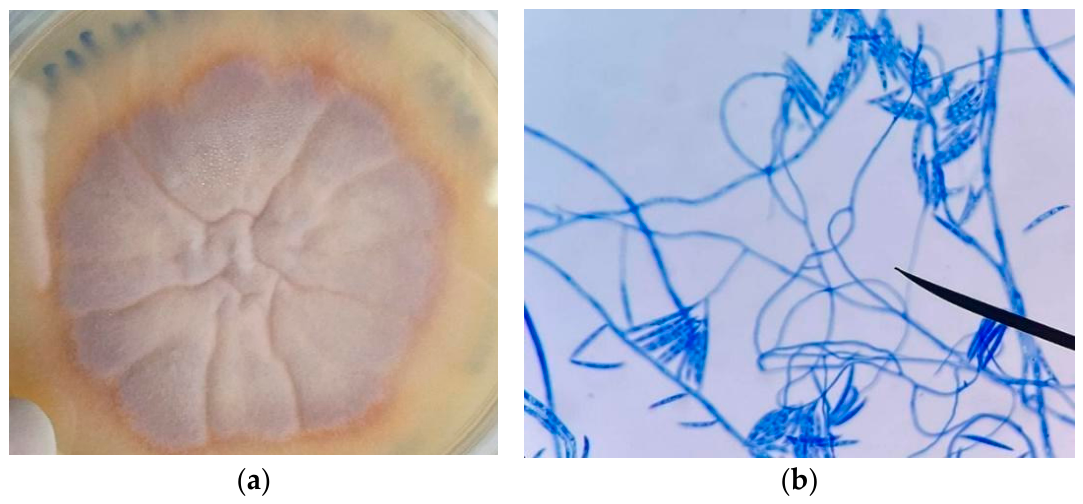
The endophytic fungi were isolated from healthy leaves and morphologically identified (
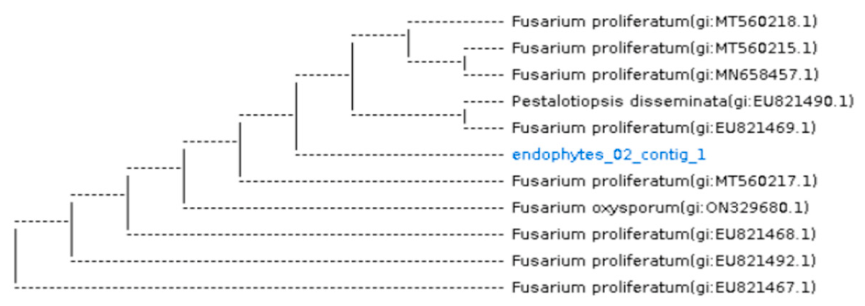
Figure 1). Based on these identifications, one isolate was selected for further study, including molecular identification and analysis of secondary metabolites. Molecular identification of the endophytes was conducted through sequencing the internal transcribed spacer (ITS) regions 4 and 5 of the fungal genome. The isolation from
L.
camara (isolate 02) yielded an ITS fragment of approximately 563 bp, showing 100% sequence similarity to
Fusarium proliferatum (accession number: MT560218.1) upon NCBI BLAST (version 2.16.0) analysis (
Figure 2). While the authors acknowledge that multi-locus sequence typing (MLST) utilizing loci such as translation elongation factor 1-alpha (TEF1-α) or RNA polymerase II second largest subunit (RPB2) is ideal for definitive
Fusarium phylogenetics, the combination of a 100% sequence match across the 563 bp ITS fragment paired with clear diagnostic morphological traits—specifically the formation of microconidia in chains from monophialides and the distinct absence of chlamydospores—justifies the operational identification of this isolate as
F. proliferatum for the scope of this baseline screen.
During the initial isolation pipeline, 58 endophytic fungal isolates were successfully recovered from 30 medicinal plant species. The global colonization rate across all sampled leaf segments was calculated at approximately 18.3%, indicating a robust yet selective endosymbiotic demographic within the Walailak Herbarium cohorts. While Fusarium species are ubiquitous soil-associated hyphomycetes, their residency patterns within foliar tissues vary drastically. Recent literature indicates that, while Fusarium species have been recovered from the root architecture or woody stems of Lantana camara globally, targeted isolation from healthy leaf tissue remains rare. To the best of our knowledge, this study provides the first definitive report confirming F. proliferatum as a foliar endophyte of L. camara within Southern Thailand’s distinct microclimate, suggesting a highly specialized ecological niche.
While the endophytic mycobiota of
L.
camara leaves have previously yielded genera such as
Cladosporium,
Geotrichum, and
Aspergillus, here, we expand this profile by reporting the first isolation of
Fusarium as an endophyte from
L.
camara foliage [
27,
28,
29].
Fusarium is a large genus of filamentous fungi, known as hyphomycetes, widely distributed in soil and frequently associated with various plants [
30].
F.
proliferatum produces secondary metabolites known as mycotoxins that activate host defense mechanisms. Among these, mycotoxins are fumonisin B, beauvericin, fusaproliferin, moniliformin, fusaric acid, and fusarins, which have been shown to enhance host systemic acquired resistance [
31]. Plant metabolites associated with disease resistance include flavonoids, phenylpropanoids, and polyamines. Additionally, phenolic compounds such as coumaric acid, coumarin, and quercetin are synthesized [
32].
3.2. Minimum Inhibitory Concentration
A total of ten endophytic fungal isolates were successfully obtained during the study. Initial screening for antifungal activity revealed that extracts from three isolates showed particularly promising MIC values. Consequently, the selected isolate, F. proliferatum, was chosen for further investigation, including the dual culture assay and Liquid Chromatography–Mass Spectrometry (LC-MS) analysis.
The in vitro susceptibility of a panel of six environmental Mucorales isolates (three Mucor and three Rhizopus species) was determined using the broth microdilution method. The extracts were tested in a two-fold serial dilution series ranging from 0.01 to 5.00 mg/L after being dissolved in 5% DMSO, with each concentration tested in triplicate.
The in vitro susceptibility testing results for all six environmental isolates, including three Mucorales and three
Rhizopus species, are presented as MICs. The MIC ranges for the
F.
proliferatum evaporated extract were 0.3–1 mg/L, for
P.
lilacinum, 0.6–5 mg/L, and for
A.
aculeatus, 1–5 mg/L (
Table 2). Crucially, parallel testing of the standard reference drug, Amphotericin B, yielded an MIC range of 0.5–2.0 mg/L across the environmental Mucorales isolates tested. This confirms that our experimental setup fully aligns with CLSI performance standards and demonstrates that the crude extract of
F. proliferatum (MIC 0.3–1.0 mg/L) exhibits potency parameters warranting deeper clinical evaluation.
The MIC values obtained for the
Fusarium,
Purpureocillium, and
Aspergillus isolates suggest variable antifungal activity against Mucorales and related fungi. According to the CLSI M38-A4 guidelines, antifungal susceptibility testing of filamentous fungi, including Mucorales, is challenging due to their inherent resistance to many conventional antifungals. The CLSI recommends using broth microdilution methods to determine MICs, with certain interpretative criteria for specific antifungal agents. However, it is essential to note that CLSI has not established specific MIC breakpoints for most Mucorales species, primarily because of their high intrinsic resistance and variable susceptibility profiles [
33,
34].
The observed MIC range of 0.3 to 1.0 mg/L for the crude F. proliferatum extract against environmental Mucorales is remarkably low, rivaling the baseline in vitro potency of established clinical monotherapies. For comparison, standard first-line treatments such as Amphotericin B typically exhibit MIC values between 0.5 and 2.0 mg/L against susceptible clinical Mucorales strains, whereas these pathogens remain completely untouched by azoles due to intrinsic resistance mechanisms. The fact that a crude metabolic extract displays parity with a purified clinical standard strongly implies the presence of highly concentrated, synergistic structural components within the volatile or lipophilic fractions of the endophyte’s secretome.
In particular, the MIC values for
Fusarium and
Purpureocillium extracts observed in our study fall within ranges that may indicate moderate to potent activity, depending on the antifungal agent. Previous studies have reported that some natural extracts and compounds demonstrate promising activity against Mucorales species, although their clinical efficacy remains to be validated [
34]. It is essential to interpret these MICs with caution, given the lack of standardized breakpoints and the unique resistance mechanisms of Mucorales, including their ability to adapt to antifungal stress and to rapidly form resistant biofilms [
34].
3.3. Dual Culture Assay
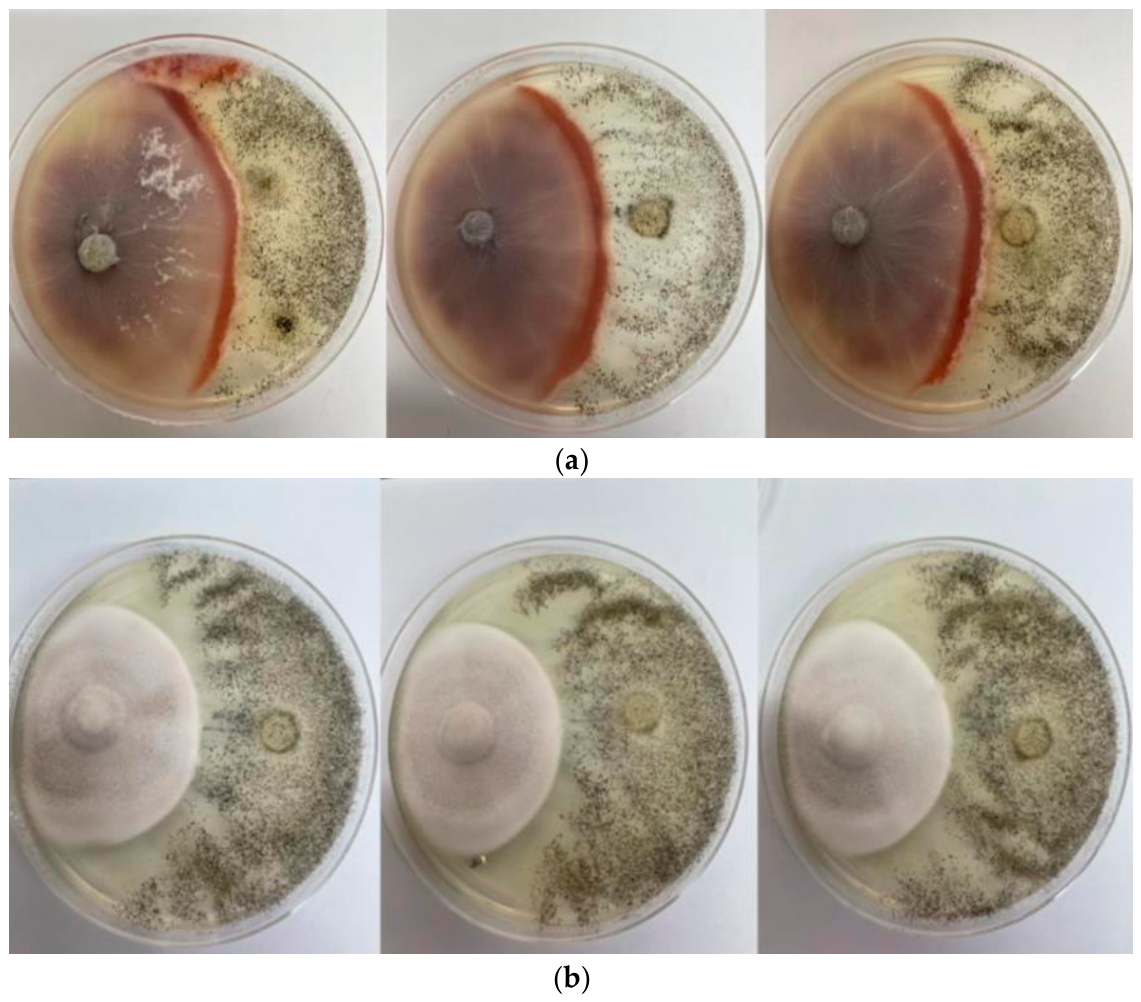
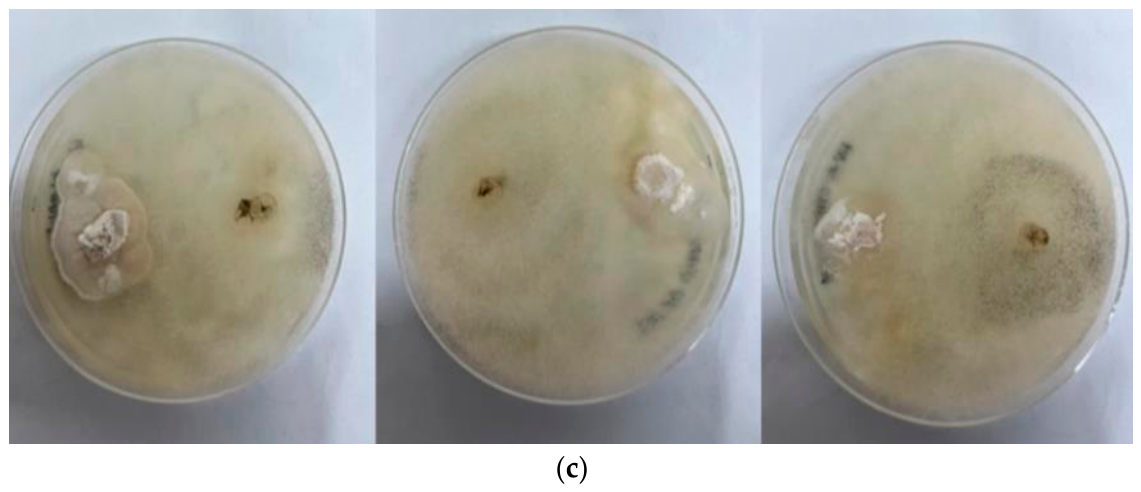
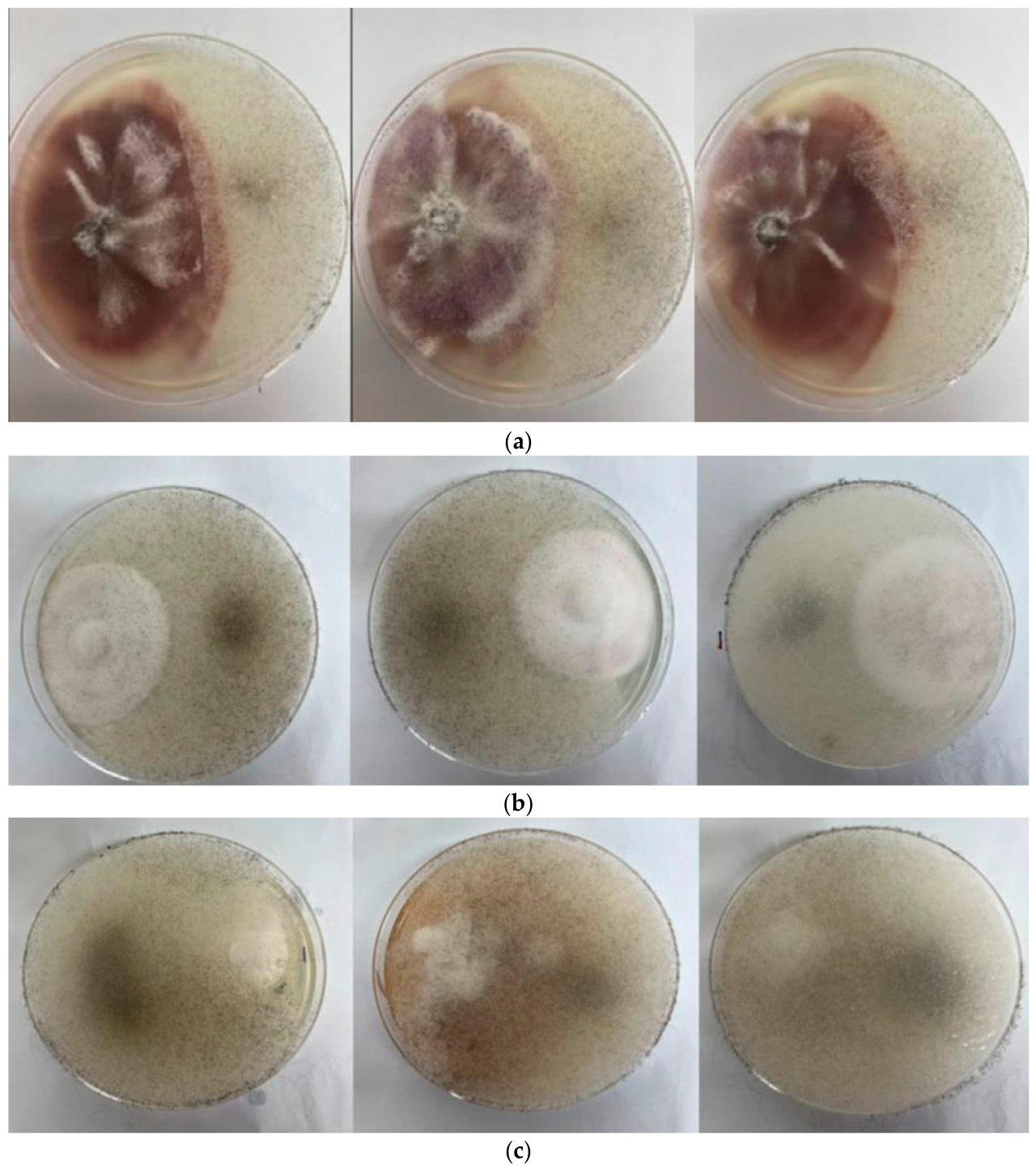
To evaluate the interactions between two microbial species and specifically assess the antifungal activity of a test organism against a target organism, the results indicated that F. proliferatum, P. lilacinum, and A. aculeatus produced metabolites that inhibited the growth of Mucor spp. and Rhizopus spp. After 7 days of incubation, the endophytic fungal isolates were tested against 3-day-old cultures of the pathogenic fungi on PDA and maintained at 25 °C for an additional 3 days. The control plate had a radius of 62 mm, corresponding to an inhibition rate of 0%.
The antifungal activities of the endophytic fungi were investigated against
Mucor spp. and
Rhizopus spp. (
Figure 3 and
Figure 4). The mean colony diameter (mm) and mycelial growth inhibition (%) are presented in
Table 3 and
Table 4.
F. proliferatum inhibited
Mucor spp. (93%), which was significantly different from that of
P. lilacinum (79%). Additionally,
F. proliferatum inhibited mycelial growth by 92% for
Mucor spp., whereas
P. lilacinum inhibited mycelial growth by 79% for
Rhizopus spp.
The endophytic fungus
F.
proliferatum demonstrated significant antifungal activity against
Mucor spp., with average inhibition rates of 93.67%, 93.30%, and 93.33%, respectively. The average inhibition rates of
Rhizopus spp. were also notable at 88.67%, 93.25%, and 93.67%, respectively. In contrast, the endophytic fungus
P.
lilacinum inhibited
Mucor spp., with inhibition rates of 79.67%, 78.65%, and 79.33%, respectively. However, it did not exhibit any inhibitory effects against
Rhizopus spp. The endophytic fungus
A.
aculeatus had no significant inhibitory effect on either
Mucor or
Rhizopus species (
Table 3 and
Table 4).
3.4. Yeast-to-Hyphal Transition Inhibition
To evaluate virulence-targeting capabilities, an exploratory phenotypic screen was conducted against two model yeasts to observe initial disruption of morphogenesis, rather than to draw sweeping taxonomic conclusions across broad clinical populations. Candida albicans ATCC 10231 was utilized as the globally standardized, pan-susceptible reference strain, while C. albicans DMST 58153 represents a clinically derived repository isolate from Thailand, utilized to mimic field-relevant pathogenic fitness. The authors explicitly recognize that evaluating a restricted cohort of two model strains limits the immediate generalizability of these findings across highly diverse, resistant field phenotypes. Nevertheless, before embarking on extensive clinical screens involving large panels of multidrug-resistant (MDR) patient isolates, these paired benchmark strains provide a highly controlled, reproducible matrix for validating the baseline anti-virulence efficacy of the crude extract.
The inhibitory activity of the three endophytic fungal crude extracts was evaluated against the germination of two
Candida sp., including
C.
albicans ATCC 10231 and
C.
albicans DMST 58153. The inhibition was measured at the previously determined MIC for each extract, as shown in
Table 5. Among the extracts tested,
F.
proliferatum demonstrated the highest efficacy against germination, achieving 65 ± 5% inhibition against
C.
albicans ATCC 10231 and 68 ± 3% inhibition against
C.
albicans DMST 58153 at 0.3 µg/mL.
P.
lilacinum showed a moderate inhibitory effect at its MIC of 0.6 µg/mL, resulting in 24 ± 2% inhibition against the ATCC strain and 26 ± 6% against the DMST strain. In contrast,
A.
aculeatus exhibited only minimal inhibitory activity, showing 12 ± 5% inhibition against the ATCC strain and 10 ± 4% inhibition against the DMST strain at its MIC of 1.0 µg/mL. These results indicate that the compounds produced by
F.
proliferatum are particularly effective at blocking the morphological transition necessary for fungal establishment.
3.5. Identification of Compounds
In this study, LC-MS proved an effective method for detecting and characterizing compounds at very low concentrations, which is common for secondary metabolites produced by endophytic fungi. Its high sensitivity enables the identification of minor but potentially potent bioactive constituents that might otherwise go undetected using less sensitive techniques. Mass spectrometry analysis provides essential structural insights, including molecular weight, fragmentation patterns, and functional groups, which are vital for preliminary compound identification, particularly in the absence of reference standards.
Overall, given the current budget constraints, LC-MS offers a practical and comprehensive approach for initial screening and identification of secondary metabolites, making it an indispensable tool for advancing knowledge of bioactive compounds produced by endophytic fungi. The analytical results provide insights into the likely structural configurations of the chemical components, which are classified at levels 4 and 5.
The analysis of
F.
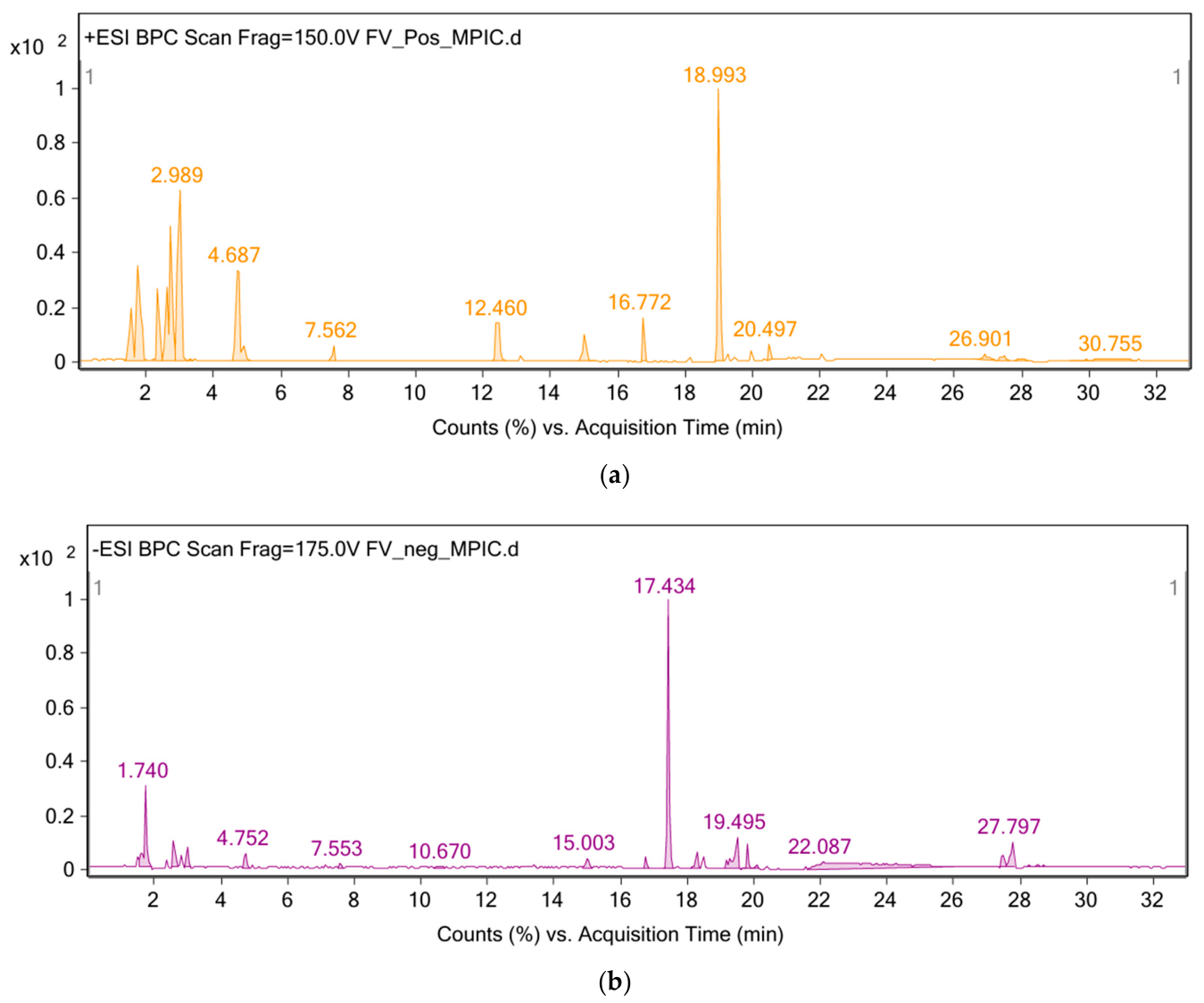
proliferatum secondary metabolites identified 51 compounds, categorized into seven classes: organic acids, anthraquinones, indoles, polyketides, peptides, steroids, and miscellaneous compounds (
Table 6). These compounds underwent MS/MS fragmentation in both positive and negative ionization modes, as illustrated in the LC-MS chromatogram (
Figure 5). Many of these compounds are renowned for their antimicrobial, anticancer, and anti-inflammatory activities [
35], notably, compounds such as the cyclic peptide beauvericin, polyketides like cladobotrin V and fusarielin E, and indole derivatives [
36].
Consistent with previous descriptions [
37], the
L.
camara leaf extract yielded key constituents including 5,8-diethyl-dodecane, complex pyrimidin-2-one derivatives, and 3-(octadecyloxy)propyl oleate. Notably, these phytochemicals correlate with the secondary metabolite profiles of the associated endophytic fungi, suggesting potential metabolic overlap.
F.
proliferatum is a prolific producer of bioactive secondary metabolites, most notably beauvericin, which exhibits potent antimicrobial properties. This bioactivity stems from its cyclic hexadepsipeptide structure, which acts as a cation-transporting ionophore. By permeabilizing membranes and disrupting energy metabolism, beauvericin exerts broad cytotoxicity against Gram-positive bacteria, fungi, and protozoa. Notably, endophytic isolates of
F.
proliferatum frequently exhibit higher production yields than their non-endophytic counterparts [
38].
The antimicrobial properties of endophytic fungi are attributed to their ability to produce bioactive compounds. Endophytic fungal extracts may contain various secondary metabolite groups, including alkaloids, terpenoids, steroids, polyketides, peptides, flavonoids, furanones, quinones, perylene derivatives, and depsipeptides [
39].
These compounds exhibit different mechanisms of action against
Candida. For instance, alkaloids can inhibit bacterial growth by interfering with cellular respiration, integrating into DNA, and inhibiting enzymes crucial for replication, transcription, and translation [
40].
The endophytic fungi produced many plant-derived secondary metabolites, including hydrocarbons, esters, and monoterpenoids. Endophytes are closely associated with the host plant and thus mimic the host in the production of secondary metabolites [
41,
42]. In this study, the endophytic fungi showed high adaptability and a strong association with
L.
camara, and produced secondary metabolites similar to those of the host plant.
3.6. Mechanistic Basis, Biosafety Profiles, and Translational Feasibility
The greater antifungal potency of
F. proliferatum than
P. lilacinum and
A. aculeatus observed in this study can be directly attributed to the distinct chemical architectures identified in its secondary metabolome. LC-MS profiling revealed that
F. proliferatum selectively hyperaccumulates the cyclic hexadepsipeptide beauvericin, along with lipid-disrupting polyketides such as fusarielin E [
29,
34]. Mechanistically, beauvericin operates as a mobile, lipid-soluble ionophore that physically inserts into the fungal plasma membrane bilayer. This structural insertion facilitates the uncontrolled transmembrane translocation of mono- and divalent cations (K
+ and Ca
2+) down their respective electrochemical gradients, collapsing the mitochondrial membrane potential and inducing lethal intracellular oxidative stress [
31]. Because this biophysical mode of action relies on direct disruption of the lipid matrix and energetic uncoupling rather than binding to specific enzyme pockets, it completely bypasses the modified target enzymes or altered ergosterol synthesis pathways that typically confer absolute intrinsic resistance to clinical azole monotherapies on members of the order Mucorales [
4].
From an ecological perspective, this defensive chemical arsenal plays a critical symbiotic role within the host plant environment. By secreting potent, broad-spectrum ionophores and polyketides, the foliar endophyte
F. proliferatum establishes a localized chemical shield that protects the leaves of
L. camara from opportunistic, highly destructive soil-borne phytopathogens—including environmental Mucorales—that threaten plant survival [
11]. In return for this systemic microbial security, the host plant provides a nutrient-sheltered carbon sanctuary, demonstrating a highly evolved adaptive synergy [
41].
Furthermore, the metabolic expression of these secondary metabolites is highly dependent on specific upstream fermentation parameters. Our use of Sabouraud Dextrose Broth with continuous rotary aeration (200 rpm) at 25 °C for an extended 14-day cycle provides a high-carbon, high-oxygen environment. As nutrients become exhausted, this setup triggers the fungal idiophase, shifting metabolic flux away from primary mycelial growth and toward the hyper-accumulation of defensive secondary molecules [
28,
33,
38].
However, transitioning these crude metabolic extracts into viable human therapeutics introduces legitimate biosafety and pharmacological hurdles. While our high-resolution LC-MS screening confirmed that highly regulated, systemic mammalian mycotoxins—such as Fumonisin B1 and B2—were not synthesized above analytical detection limits under these culture constraints [
28], the verified presence of beauvericin and L-tenuazonic acid poses risks of host cytotoxicity that must be addressed [
13,
42]. Additionally, the highly lipophilic nature of these active peptides and polyketide complexes poses significant translational challenges, including poor aqueous solubility, limited metabolic stability, and compromised systemic pharmacokinetics (PK) [
42]. To overcome these feasibility limits, future clinical development must move away from crude extract applications. Advanced pharmaceutical formulation strategies—such as encapsulating active fractions within solid lipid nanoparticles, nanoemulsions, or liposomal vehicles—are required to safely sequester cytotoxic components, stabilize active structures, control systemic pharmacokinetic release, and selectively deliver therapeutic concentrations directly to sites of invasive fungal infection [
13,
15,
25].
4. Conclusions
This study successfully identified Fusarium proliferatum as a foliar endophyte of Lantana camara L. for the first time, establishing it as a promising biological source of competitive antifungal agents with in vitro MIC profiles equivalent to or superior to standard reference parameters. The isolate demonstrated substantial efficacy against invasive Mucorales, achieving over 93% inhibition with MIC values as low as 0.3–1.0 mg/L. Beyond growth suppression, its dual-action mechanism effectively targets fungal virulence by inhibiting Candida albicans morphogenesis, reducing it by up to 68%.
Despite these highly promising results, several critical limitations must be acknowledged before these findings can translate into clinical applications. First, this investigation was strictly limited to initial in vitro phenotypic screens and crude high-resolution chemical indexing. The study currently lacks direct mammalian cell cytotoxicity testing, in vivo model validations, and deep molecular assays to isolate individual active fractions from the crude matrix. Furthermore, because F. proliferatum has historically produced dangerous mycotoxins, comprehensive biosafety evaluations are mandatory to confirm the absence of trace levels of systemic mammalian toxins in clinical production settings.
Consequently, our immediate future research will focus on the bio-guided fractionation and purification of the 51 identified metabolites to isolate individual active leads. These isolated molecules will undergo rigorous profiling for cytotoxicity in mammalian cell lines and for systemic in vivo safety. Ultimately, to overcome the lipophilic delivery challenges of these active peptide and polyketide networks, we aim to design advanced nanoformulations, such as solid lipid nanoparticles, to safely deliver targeted, low-toxicity therapeutics capable of combating life-threatening, drug-resistant fungal co-infections in immunocompromised populations.