
Bioactivity of Pod and Seed Extracts from Leucaena leucocephala, Prosopis laevigata, and Pithecellobium dulce Collected in Oaxaca, Mexico

 , ,
, ,  ,
,  , , and
Abstract
1. Introduction
2. Materials and Methods
2.1. Collection of Plant Material
2.2. Preparation of Ethyl Acetate and Ethanol Extracts
2.3. Phytochemical Analysis
2.4. Antimicrobial Activity
2.4.1. Minimum Inhibitory Concentration (MIC)
2.4.2. Minimum Bactericidal and Fungicidal Concentrations (MBC, MFC)
2.5. Antioxidant Activity
2.6. Quantification of Total Phenolic and Flavonoid Contents
2.7. Brine Shrimp Lethality Assay (Artemia salina)
2.8. Statistical Analysis
3. Results
3.1. Phytochemical Profile
3.2. Antimicrobial Activity
3.3. Antioxidant Activity
3.4. Total Phenolic and Flavonoid Contents
3.5. Toxicity Assay (LC50) in Artemia salina
4. Discussion
5. Conclusions
Author Contributions
Funding
Institutional Review Board Statement
Informed Consent Statement
Data Availability Statement
Acknowledgments
Conflicts of Interest
References
- Torres-Chati, J.; León-Quispe, J.; Tomas-Chota, G. Antibacterial and antifungal activity from leaf extracts of Luma chequen (Molina) A. Gray “myrtle” against pathogens of clinical origin. Rev. Soc. Venez. Microbiol. 2017, 37, 10–16. [Google Scholar]
- Román-Cortés, N.; García-Mateos, M.D.; Castillo-González, A.M.; Sahagún-Castellanos, J.; Jiménez-Arellanes, A. Nutritional components and antioxidants of two species of guaje (Leucaena spp.): An underutilized traditional resource. Rev. Chapingo Ser. Hortic. 2014, 20, 157–170. [Google Scholar] [CrossRef]
- Mora-Villa, A.; Serrano-Parrales, R.; Lira-Saade, R.; Jiménez-Estrada, M.; Hernández-Delgado, T. Evaluation of the antimicrobial activity of Leucaena esculenta and Leucaena leucocephala seed collected from Tlayacapan, Morelos, México. Polibotánica 2021, 52, 175–191. [Google Scholar] [CrossRef]
- Abu, M.; Yin, H.; Isha, A.; Armania, N. Antioxidant, antimicrobial and cytotoxic potential of condensed tannins from Leucaena leucocephala hybrid-Rendang. Food Sci. Hum. Wellness 2016, 5, 65–75. [Google Scholar] [CrossRef]
- Retnaningsih, A. Test of the inhibitory power of petai cina leaves (Leucaena leucocephala folium) against Staphylococcus aureus and Escherichia coli bacteria using the agar diffusion method. J. Dunia Kesmas 2016, 5, 110–114. [Google Scholar]
- Utami, P.R.; Chairani; Yudha, H. Combination test of Chinese leaf extract (Leucaena leucocephala folium) and Aloe vera inhibiting growth of Escherichia coli. Indones. J. Med. Lab. Sci. Technol. 2020, 2, 60–67. [Google Scholar] [CrossRef]
- Zayed, M.Z.; Samling, B. Phytochemical constituents of the leaves of Leucaena leucocephala from Malaysia. Int. J. Pharm. Pharm. Sci. 2016, 8, 174–179. [Google Scholar] [CrossRef]
- Valencia, D.; Rueda, E.O.; Leyva, P.M.A.; Mazón-López, S.R.; Ortega-García, J. Bioactive Compounds, Antioxidant Activity and Profile of Fatty Acids in Mesquite Seed Oil (Prosopis spp.). Arch. Latinoam. Nutr. 2020, 70, 50–59. [Google Scholar] [CrossRef]
- Ramírez-Rojo, M.I.; Vargas-Sánchez, R.D.; Hernández-Martínez, J.; Martínez-Benavidez, E.; Sánchez-Escalante, J.J.; Torrescano-Urrutia, G.R.; Sánchez-Escalante, A. Antioxidant activity of mesquite leaf extracts (Prosopis velutina). Biotecnia 2019, 21, 113–119. [Google Scholar] [CrossRef]
- Rennan, P.G.; Souza, G.T.A.; Moura, H.V.; Martins, D.M.E.; Calvalcanti-Mata, M.E. Technological characterization of cookies made with different concentrations of mesquite flour during 120 days of storage. Braz. J. Food Technol. 2018, 21, e2017116. [Google Scholar] [CrossRef]
- Poongodi, T.; Hemalatha, R. In vitro cytotoxicity, phytochemistry, and GC–MS analysis of Pithecellobium dulce leaves. World J. Pharm. Pharm. Sci. 2015, 4, 1266–1276. [Google Scholar]
- Kalavani, R.; Banu, R.S.; Jeyanthi, K.A.; Sankari, T.U.; Kanna, A.V. Evaluation of anti-inflammatory and antibacterial activity of Pithecellobium dulce (Benth.) extract. Biotechnol. Res. 2016, 2, 148–154. [Google Scholar]
- Praveen, A.R.; Prasath, K.; Kalyan, B.; Babu, I. Antidiabetic activity of bark extract of Pithecellobium dulce Benth. in alloxan-induced diabetic rats. Nat. Prod. Indian J. 2010, 6, 201–204. [Google Scholar]
- Sagar, N.A.; Pareek, S.; Sharma, S.; Yahia, E.M.; Lobo, G.M. Fruit and vegetable waste: Bioactive compounds, their extraction, and possible utilization. Compr. Rev. Food Sci. Food Saf. 2018, 17, 512–531. [Google Scholar] [CrossRef]
- Muñoz, R.A.; Santome, S.; León, J.Q. Antibacterial activity of hexane and ethanolic extracts of marine macroalgae of the Bay of Ancón, Lima–Peru. Rev. Investig. Vet. Peru 2020, 31, e17829. [Google Scholar] [CrossRef]
- Wagner, H.; Bladt, S. Plant Drug Analysis: A Thin Layer Chromatography Atlas, 2nd ed.; Springer: Berlin/Heidelberg, Germany, 1996. [Google Scholar]
- Rodríguez-Pava, C.N.; Zarate Sanabria, A.G.; Sánchez Leal, L.C. Antimicrobial activity of four varieties of plants against pathogens clinical significance in Colombia. Nova 2017, 15, 119–129. [Google Scholar] [CrossRef]
- CLSI M100; Performance Standards for Antimicrobial Susceptibility Testing. Clinical and Laboratory Standard Institute: Wayne, PA, USA, 2020. Available online: https://clsi.org/shop/standards/m100/ (accessed on 11 May 2026).
- Navarrete-Barragán, N.A.; Pita-Ospina, E.F.; Sánchez Mora, R.M.; Giraldo Quintero, S.E.; Bernal Lizarazú, M.C. In vitro activity of the ethanolic extracts from Lantana camara L., Petiveria alliacea L. and Lippia dulcis T. against pathogenic bacteria. Nova 2020, 18, e3700. [Google Scholar] [CrossRef]
- Maželienė, Ž.; Kirvaitienė, J.; Kaklauskienė, K.; Volskienė, R.; Aleksandravičienė, A. Antifungal and antibacterial activity of aqueous and ethanolic extracts of different Rosa rugosa parts. Microbiol. Res. 2025, 16, 26. [Google Scholar] [CrossRef]
- Cárdenas, A.; Isaza Mejía, G.; Pérez Cárdenas, J.E.; Martínez Garzón, M.M. Estudio fitoquímico preliminar y evaluación de la actividad antibacteriana de Solanum dolichosepalum Bitter (frutillo). Rev. Cuba. Plantas Med. 2017, 22, 1–11. [Google Scholar]
- López, T.; Morillo, M.; Visbal, T.; Carmona, J. Phytochemical study, antioxidant activity and toxicity on Artemia salina, from extracts of aerial parts of Justicia secunda Vahl. (Acanthaceae), collected in Mérida-Venezuela. Rev. Colomb. Cienc. Quím. Farm. 2022, 51, 213–229. [Google Scholar] [CrossRef]
- Chandra, S.; Khan, S.; Avula, B.; Lata, H.; Yang, M.H.; ElSohly, M.A.; Khan, I.A. Assessment of total phenolic and flavonoid content, antioxidant properties, and yield of aeroponically and conventionally grown leafy vegetables and fruit crops: A comparative study. Evid.-Based Complement. Altern. Med. 2014, 2014, 253875. [Google Scholar] [CrossRef] [PubMed]
- Torres-López, T.G.; Magaña Magaña, J.E.; Licón Trillo, L.P.; Alonso Gómez, M.A. Comparison of different extracts, their lethal dose 50 in brine Shrimp and the chemical composition of Granje (Celtis pallida Torr.). Rev. Biológico Agropec. 2022, 10, 17–27. [Google Scholar] [CrossRef]
- Fernández-Calienes Valdés, A.; Mendiola Martínez, J.; Monzote Fidalgo, L.; García Parra, M.; Sariego Ramos, I.; Acuña Rodríguez, D.; Gutiérrez Gaitén, Y. Evaluation of toxicity of Cuban plant extracts with possible antiparasitic action based on the use of Artemia salina larvae. Rev. Cuba. Med. Trop. 2009, 61, 254–258. [Google Scholar]
- Hernández-Lalinde, J.D.; Espinosa-Castro, J.F.; Peñaloza-Tarazona, M.E.; Fernández-González, J.E.; Chacón-Rangel, J.G.; Toloza-Sierra, C.A.; Rodríguez-Rodríguez, J.A.; Bermúdez-Pirela, V.J. Sobre el uso adecuado del coeficiente de correlación de Pearson: Definición, propiedades y suposiciones. Arch. Venez. Farmacol. Ter. 2018, 37, 587–595. [Google Scholar]
- Acosta-Salas, U.J.; Favela González, K.M.; Pérez García, L.A.; del Río Arellano, C.N.; de la Fuente Salcido, N.M. Extracción preliminar y determinación de la actividad biológica de péptidos de semilla de Prosopis laevigata (mezquite). Cienc. Farm. Biomed. 2019, 4, 56–67. [Google Scholar]
- Hoffmann, E.; Boeri, P.; Monasterio, R.; Fontana, A.; Puppo, M.A.; Barrio, D.A.; Piñuel, L. Bioactivity of Prosopis alpataco and Prosopis flexuosa flours: Healthy alternatives as ingredients for nutritional foods. Food Biosci. 2024, 58, 103778. [Google Scholar] [CrossRef]
- Touré, A.; Tiho, T.; Yao, N.; Adima, A. Phytochemical composition and antioxidant activities of leaves, fruit pulp, and stem and root barks of Parkia biglobosa (Mimosaceae). J. Biosci. Med. 2022, 10, 48–62. [Google Scholar] [CrossRef]
- Delgadillo-Puga, C.; Cuchillo-Hilario, M.; Navarro-Ocaña, A.; Medina-Campos, O.N.; Nieto-Camacho, A.; Ramírez-Apan, T.; López-Tecpoyotl, Z.G.; Díaz-Martínez, M.; Álvarez-Izazaga, M.A.; Cruz-Martínez, Y.R.; et al. Phenolic compounds in organic and aqueous extracts from Acacia farnesiana pods analyzed by ULPS-ESI-Q-oa/TOF-MS. In vitro antioxidant activity and anti-inflammatory response in CD-1 mice. Molecules 2018, 23, 2386. [Google Scholar] [CrossRef]
- Deka, L.; Kashyap, B.; Ahmed, R.; Sarma, H.; Doley, R.; Bora, N.S.; Gam, S.; Gogoi, B.; Borah, R.; Dutta, K.N. Exploration of the antioxidant and anti-inflammatory potential of Vachellia farnesiana bark by in vitro method. J. Pharmacogn. Phytochem. 2024, 13, 702–707. [Google Scholar] [CrossRef]
- Manríquez-Torres, J.d.J.; Hernández-Lepe, M.A.; Chávez-Méndez, J.R.; González-Reyes, S.; Serafín-Higuera, I.R.; Rodríguez-Uribe, G.; Torres-Valencia, J.M. Isolation and Cytotoxic Activity of Phyllocladanes from the Roots of Acacia schaffneri (Leguminosae). Molecules 2020, 25, 3944. [Google Scholar] [CrossRef]
- Olmedo-Juárez, A.; Jimenez-Chino, A.L.; Bugarin, A.; Zamilpa, A.; Gives, P.M.-d.; Villa-Mancera, A.; López-Arellano, M.E.; Olivares-Pérez, J.; Delgado-Núñez, E.J.; González-Cortazar, M. Phenolic Acids and Flavonoids from Pithecellobium dulce (Robx.) Benth Leaves Exhibit Ovicidal Activity against Haemonchus contortus. Plants 2022, 11, 2555. [Google Scholar] [CrossRef] [PubMed]
- Borges, C.V.; Minatel, I.O.; Gomez-Gomez, H.A.; Lima, G.P.P. Medicinal plants: Influence of environmental factors on the content of secondary metabolites. In Medicinal Plants and Environmental Challenges; Ghorbanpour, M., Varma, A., Eds.; Springer International Publishing: Cham, Switzerland, 2017; pp. 259–277. [Google Scholar]
- Cushnie, T.P.T.; Lamb, A.J. Recent advances in understanding the antibacterial properties of flavonoids. Int. J. Antimicrob. Agents 2011, 38, 99–107. [Google Scholar] [CrossRef]
- Nava-Solis, U.; Rodríguez-Canales, M.; Hernández-Hernández, A.B.; Velasco-Melgoza, D.A.; Moreno-Guzman, B.P.; Rodríguez-Monroy, M.A.; Canales-Martínez, M.M. Antimicrobial activity of the methanolic leaf extract of Prosopis laevigata. Sci. Rep. 2022, 12, 20807. [Google Scholar] [CrossRef]
- Aldarhami, A.; Bazaid, A.S.; Alhamed, A.S.; Alghaith, A.F.; Ahamad, S.R.; Alassmrry, Y.A.; Alharazi, T.; Snoussi, M.; Qanash, H.; Alamri, A.; et al. Antimicrobial potential of Pithecellobium dulce seed extract against pathogenic bacteria: In silico and in vitro evaluation. BioMed Res. Int. 2023, 2023, 2848198. [Google Scholar] [CrossRef]
- Daglia, M. Polyphenols as antimicrobial agents. Curr. Opin. Biotechnol. 2012, 23, 174–181. [Google Scholar] [CrossRef]
- Bakkali, F.; Averbeck, S.; Averbeck, D.; Idaomar, M. Biological effects of essential oils—A review. Food Chem. Toxicol. 2008, 46, 446–475. [Google Scholar] [CrossRef] [PubMed]
- Nazzaro, F.; Fratianni, F.; De Martino, L.; Coppola, R.; De Feo, V. Effect of essential oils on pathogenic bacteria. Pharmaceuticals 2013, 6, 1451–1474. [Google Scholar] [CrossRef]
- Górniak, I.; Bartoszewski, R.; Króliczewski, J. Comprehensive review of antimicrobial activities of plant flavonoids. Phytochem. Rev. 2019, 18, 241–272. [Google Scholar] [CrossRef]
- Wink, M. Modes of Action of Herbal Medicines and Plant Secondary Metabolites. Medicines 2015, 2, 251–286. [Google Scholar] [CrossRef]
- Muscolo, A.; Mariateresa, O.; Giulio, T.; Mariateresa, R. Oxidative Stress: The Role of Antioxidant Phytochemicals in the Prevention and Treatment of Diseases. Int. J. Mol. Sci. 2024, 25, 3264. [Google Scholar] [CrossRef] [PubMed]
- Chowtivannakul, P.; Srichaikul, B.; Talubmook, C. Antidiabetic and antioxidant activities of seed extract from Leucaena leucocephala (Lam.) de Wit. Agric. Nat. Resour. 2016, 50, 357–361. [Google Scholar] [CrossRef]
- Benjakul, S.; Kittiphattanabawon, P.; Sumpavapol, P.; Maqsood, S. Antioxidant activities of lead (Leucaena leucocephala) seed as affected by extraction solvent, prior dechlorophyllisation and drying methods. J. Food Sci. Technol. 2014, 51, 3026–3037. [Google Scholar] [CrossRef] [PubMed]
- García-Azpeitia, L.; Montalvo-González, E.; Loza-Cornejo, S. Nutritional and phytochemical characterization of leaves, flower and fruits of Prosopis laevigata. Bot. Sci. 2022, 100, 1014–1024. [Google Scholar] [CrossRef]
- Isah, T. Stress and defense responses in plant secondary metabolites production. Biol. Res. 2019, 52, 39. [Google Scholar] [CrossRef]
- Habli, Z.; Toumieh, G.; Fatfat, M.; Rahal, O.N.; Gali-Muhtasib, H. Emerging Cytotoxic Alkaloids in the Battle against Cancer: Overview of Molecular Mechanisms. Molecules 2017, 22, 250. [Google Scholar] [CrossRef]
- Cushnie, T.P.; Cushnie, B.; Lamb, A.J. Alkaloids: An overview of their antibacterial, antibiotic-enhancing and antivirulence activities. Int. J. Antimicrob. Agents 2014, 44, 377–386. [Google Scholar] [CrossRef]
- Podolak, I.; Galanty, A.; Sobolewska, D. Saponins as cytotoxic agents: A review. Phytochem. Rev. 2010, 9, 425–474. [Google Scholar] [CrossRef] [PubMed]
- Kumagai, Y.; Shinkai, Y.; Miura, T.; Cho, A.K. The chemical biology of naphthoquinones and its environmental implications. Annu. Rev. Pharmacol. Toxicol. 2012, 52, 221–247. [Google Scholar] [CrossRef] [PubMed]


| Treatment Code | Plant Species | Plant Part |
|---|---|---|
| Ethyl acetate | ||
| ASLL | L. leucocephala | Seed |
| AVLL | Pod | |
| ASPD | P. dulce | Seed |
| AVPD | Pod | |
| ASPL | P. laevigata | Seed |
| AVPL | Pod | |
| Ethanol | ||
| ESLL | L. leucocephala | Seed |
| EVLL | Pod | |
| ESPD | P. dulce | Seed |
| EVPD | Pod | |
| ESPL | P. laevigata | Seed |
| EVPL | Pod | |
| Secondary Metabolites | |||||||||
|---|---|---|---|---|---|---|---|---|---|
| Extracts | SAP 1 | FHE 2 | FLA 3 | FLV 4 | CHA 5 | TER 6 | TAN 7 | ALK 8 | QUI 9 |
| ASLL | − | − | + | − | ++ | − | − | − | − |
| AVLL | + | ++ | + | +++ | − | ++ | ++ | + | − |
| ASPD | − | − | + | ++ | − | − | − | − | − |
| AVPD | + | +++ | +++ | − | +++ | ++ | +++ | ++ | − |
| ASPL | − | − | ++ | − | ++ | − | − | ++ | + |
| AVPL | − | ++ | + | − | +++ | +++ | − | ++ | − |
| ESLL | ++ | + | + | − | +++ | − | − | +++ | − |
| EVLL | ++ | +++ | +++ | ++ | − | +++ | − | +++ | − |
| ESPD | +++ | − | + | − | +++ | + | − | ++ | ++ |
| EVPD | + | +++ | +++ | − | ++ | +++ | − | +++ | − |
| ESPL | ++ | − | +++ | ++ | − | ++ | + | ++ | ++ |
| EVPL | + | + | + | − | +++ | ++ | − | ++ | ++ |
| Inhibition Zones (mm) | ||||||
|---|---|---|---|---|---|---|
| Concentration | Microorganisms | |||||
| Extracts | mg/mL | EC 1 | SA 2 | EF 3 | CA 4 | CK 5 |
| ASLL | 5 | - | - | - | 8.9 ± 0.57 *** | - |
| 10 | 9.6 ± 0.23 *** | 10.5 ± 0.55 *** | - | 14.1 ± 0.58 *** | - | |
| AVLL | 5 | 8.1 ± 0.29 *** | - | - | 9.4 ± 0.94 *** | 8.5 ± 0.37 *** |
| 10 | 12 ± 0.29 ** | - | - | 14.8 ± 0.99 ** | 20.5 ± 0.75 ns | |
| ASPD | 5 | - | - | - | 9.9 ± 0.48 *** | 8.6 ± 0.47 *** |
| 10 | 12.1 ± 0.1 *** | - | - | 15.4 ± 0.31 ** | 22.6 ± 0.59 ns | |
| AVPD | 5 | - | 12 ± 0.35 *** | 11.3 ± 0.53 *** | 14.7 ± 0.48 ** | 13.8 ± 0.97 ** |
| 10 | - | 12.5 ± 0.41 *** | 14.7 ± 0.72 *** | 22.6 ± 0.82 ns | 19.7 ± 0.76 ns | |
| ASPL | 5 | - | - | - | - | 11.7 ± 0.69 * |
| 10 | - | - | - | - | 13.7 ± 0.42 * | |
| AVPL | 5 | - | - | - | 13 ± 0.54 ** | - |
| 10 | - | - | - | 14.8 ± 0.33 ** | - | |
| ESLL | 5 | 8.1 ± 0.1 *** | - | - | 9 ± 0.38 *** | 9 ± 0.38 *** |
| 10 | 14.7 ± 0.38 ** | 9.9 ± 0.35 *** | - | 22.4 ± 0.64 ns | 22 ± 0.48 ns | |
| EVLL | 5 | 10.2 ± 0.33 ** | 11.3 ± 0.64 *** | - | 8.2 ± 0.25 *** | - |
| 10 | 12.2 ± 0.22 ** | 11.7 ± 0.31 *** | - | 13 ± 0.26 *** | 11.9 ± 0.30 ** | |
| ESPD | 5 | - | - | - | 11.2 ± 0.50 ** | - |
| 10 | 11.2 ± 0.51 *** | 8.8 ± 0.11 *** | - | 14.7 ± 0.81 ** | 10.4 ± 0.18 *** | |
| EVPD | 5 | - | 13.5 ± 0.93 ** | 12.4 ± 0.45 *** | 15.1 ± 0.30 ** | 19.4 ± 0.47 ns |
| 10 | - | 15.1 ± 0.88 ** | 15.4 ± 0.26 *** | 24.1 ± 0.60 ns | 22.1 ± 0.79 ns | |
| ESPL | 5 | - | - | - | - | - |
| 10 | - | - | - | - | - | |
| EVPL | 5 | - | - | - | - | - |
| 10 | - | - | - | - | - | |
| Controls | ||||||
| (Ceftriaxone /ketoconazole) | 5 | 26.4 ± 0.41 | 25.7 ± 0.49 | 25.08 ± 0.49 | 26.5 ± 0.40 | 26.4 ± 0.40 |
| 10 | 27.9 ± 0.69 | 27.5 ± 0.40 | 28.3 ± 0.81 | 28.2 ± 0.58 | 28.86 ± 0.58 | |
| DMSO | 5% | - | - | - | - | - |
| Microorganisms | |||||||||||
|---|---|---|---|---|---|---|---|---|---|---|---|
| Extracts | E. coli | S. aureus | E. faecalis | C. albicans | C. krusei | ||||||
| Code | Plant species | MIC 1 | MBC 2 | MIC 1 | MBC 2 | MIC 1 | MBC 2 | MIC 1 | MFC 3 | MIC 1 | MFC 3 |
| ASLL | L. leucocephala | >2.5 | >2.5 | 2.5 | >2.5 | - | - | >2.5 | >2.5 | - | - |
| AVLL | 0.07 | >2.5 | - | - | - | - | >2.5 | >2.5 | >2.5 | >2.5 | |
| ASPD | P. dulce | >2.5 | >2.5 | - | - | - | - | >2.5 | >2.5 | >2.5 | >2.5 |
| AVPD | - | - | 0.15 | 0.31 | 0.15 | 0.31 | 1.25 | >2.5 | >2.5 | >2.5 | |
| ASPL | P. laevigata | - | - | - | - | - | - | - | - | >2.5 | >2.5 |
| AVPL | - | - | - | - | - | - | >2.5 | - | - | - | |
| ESLL | L. leucocephala | 1.25 | >2.5 | >2.5 | >2.5 | - | - | >2.5 | >2.5 | - | - |
| EVLL | 0.01 | >2.5 | 0.07 | 0.07 | - | - | 1.25 | >2.5 | 1.25 | >2.5 | |
| ESPD | P. dulce | 0.15 | 0.62 | >2.5 | >2.5 | - | - | 0.31 | 1.25 | >2.5 | - |
| EVPD | - | - | 0.03 | 0.07 | 0.07 | 0.07 | 0.62 | 1.25 | 0.31 | 0.62 | |
| ESPL | P. laevigata | - | - | - | - | - | - | - | - | - | - |
| EVPL | - | - | - | - | - | - | - | - | - | - | |
| Treatment Code | Plant Species | Plant Part | Total Phenolics | Total Flavonoids | Antioxidant Activity | |
|---|---|---|---|---|---|---|
| 1 (mg GAE/g) | 2 (mg QE/g) | DPPH Inhibition (%) | IC50 3 (mg/mL) | |||
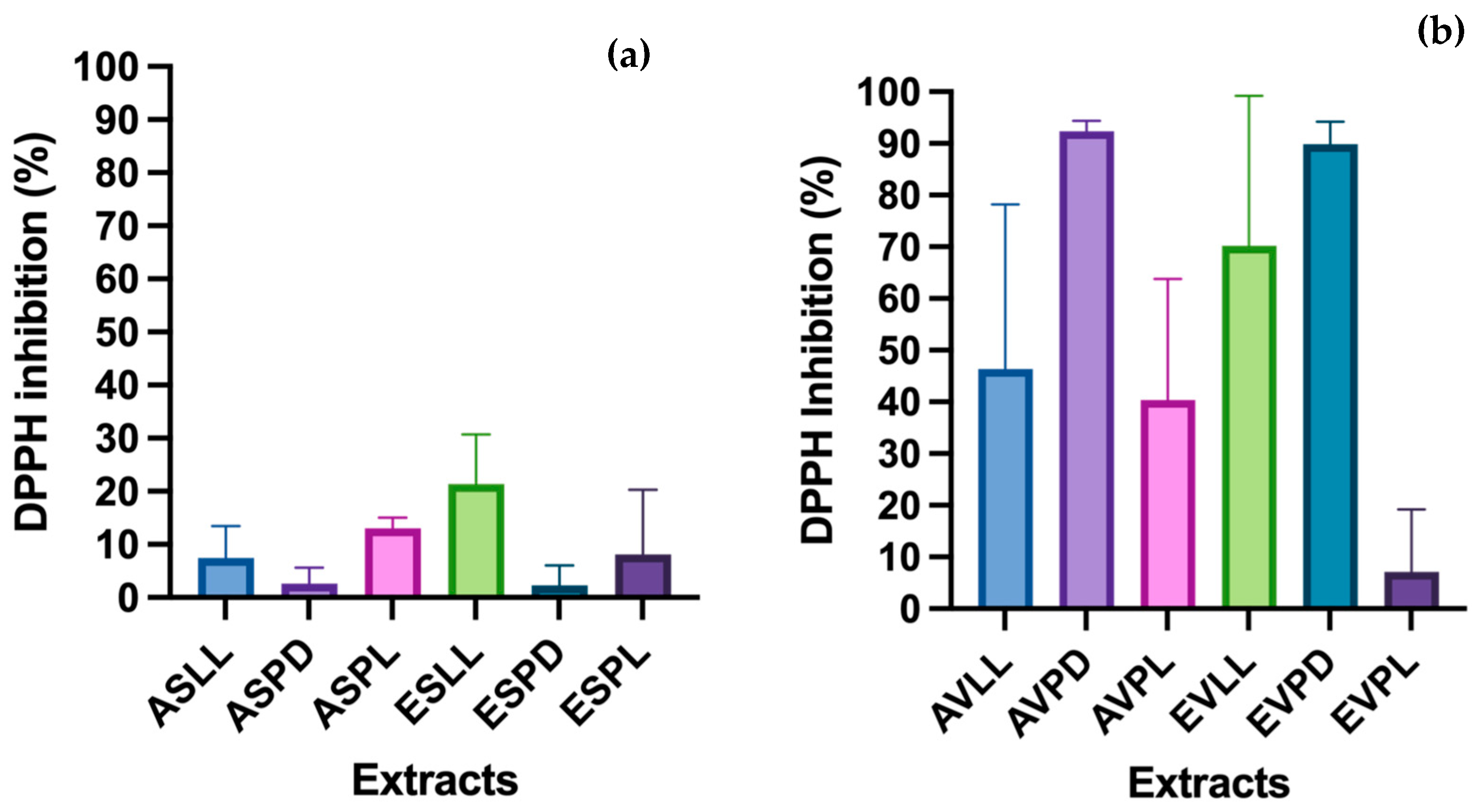
| ASLL | L. leucocephala | Seed | 7.87 ± 0.57 | 4.87 ± 0.16 | 16.81 ± 0.62 | 77.25 ± 0.78 |
| AVLL | Pod | 32.10 ± 0.91 | 20.07 ± 0.36 | 90.99 ± 0.43 | 9.01 ± 0.45 | |
| ASPD | P. dulce | Seed | 11.05 ± 0.26 | 0.61 ± 0.12 | 7.60 ± 0.21 | 157.57 ± 0.31 |
| AVPD | Pod | 87.29 ± 0.93 | 42.40 ± 0.13 | 93.43 ± 0.12 | 0.257 ± 0.18 | |
| ASPL | P. laevigata | Seed | 17.91 ± 0.12 | 3.85 ± 0.30 | 16.50 ± 0.31 | 163.4 ± 0.39 |
| AVPL | Pod | 22.49 ± 0.20 | 31.60 ± 0.80 | 77.01 ± 0.49 | 13.61 ± 0.53 | |
| ESLL | L. leucocephala | Seed | 8.06 ± 0.08 | 8.11 ± 0.48 | 36.48 ± 0.90 | 39.05 ± 0.95 |
| EVLL | Pod | 61.62 ± 0.20 | 42.21 ± 0.20 | 92.59 ± 0.68 | 3.18 ± 0.73 | |
| ESPD | P. dulce | Seed | 13.02 ± 0.34 | 11.77 ± 0.92 | 8.75 ± 0.71 | 237.4 ± 0.78 |
| EVPD | Pod | 133.24 ± 0.32 | 50.90 ± 0.24 | 92.32 ± 0.15 | 0.320 ± 0.19 | |
| ESPL | P. laevigata | Seed | 23.44 ± 0.28 | 2.64 ± 0.45 | 25.21 ± 0.06 | 29.75 ± 0.13 |
| EVPL | Pod | 21.52 ± 0.53 | 1.82 ± 0.12 | 25.90 ± 0.12 | 43.62 ± 0.18 | |
| Microorganism | 1 TPC (r) | 2 TFC (r) |
|---|---|---|
| E. coli | −0.378 | −0.201 |
| S. aureus | 0.610 | 0.613 |
| E. faecalis | 0.898 | 0.715 |
| C. albicans | 0.471 | 0.602 |
| C. krusei | 0.397 | 0.311 |
| Treatment Code | Plant Species | Plant Part | LC50 1 (μg/mL) | Classification of Toxicity |
|---|---|---|---|---|
| ASLL | L. leucocephala | Seed | >1000 | Non-toxic |
| AVLL | Pod | 399.57 | Moderately toxic | |
| ASPD | P. dulce | Seed | >1000 | Non-toxic |
| AVPD | Pod | 719.68 | Moderately toxic | |
| ASPL | P. laevigata | Seed | 229.78 | Moderately toxic |
| AVPL | Pod | 179.62 | Moderately toxic | |
| ESLL | L. leucocephala | Seed | 424.53 | Moderately toxic |
| EVLL | Pod | >1000 | Non-toxic | |
| ESPD | P. dulce | Seed | 76.43 | Very toxic |
| EVPD | Pod | 311.17 | Moderately toxic | |
| ESPL | P. laevigata | Seed | 206.1 | Moderately toxic |
| EVPL | Pod | 119.99 | Moderately toxic |
Disclaimer/Publisher’s Note: The statements, opinions and data contained in all publications are solely those of the individual author(s) and contributor(s) and not of MDPI and/or the editor(s). MDPI and/or the editor(s) disclaim responsibility for any injury to people or property resulting from any ideas, methods, instructions or products referred to in the content. |
© 2026 by the authors. Licensee MDPI, Basel, Switzerland. This article is an open access article distributed under the terms and conditions of the Creative Commons Attribution (CC BY) license.
Share and Cite
Morales-López, J.A.; Aquino-Bolaños, T.; Bautista-Cruz, A.; Aquino-Aguilar, T.; García-Sánchez, E.; Aquino-López, T.; Cruz-García, K. Bioactivity of Pod and Seed Extracts from Leucaena leucocephala, Prosopis laevigata, and Pithecellobium dulce Collected in Oaxaca, Mexico. Microbiol. Res. 2026, 17, 97. https://doi.org/10.3390/microbiolres17050097
Morales-López JA, Aquino-Bolaños T, Bautista-Cruz A, Aquino-Aguilar T, García-Sánchez E, Aquino-López T, Cruz-García K. Bioactivity of Pod and Seed Extracts from Leucaena leucocephala, Prosopis laevigata, and Pithecellobium dulce Collected in Oaxaca, Mexico. Microbiology Research. 2026; 17(5):97. https://doi.org/10.3390/microbiolres17050097
Chicago/Turabian StyleMorales-López, Jesús Andres, Teodulfo Aquino-Bolaños, Angélica Bautista-Cruz, Tamara Aquino-Aguilar, Edgar García-Sánchez, Tlacaelel Aquino-López, and Keyla Cruz-García. 2026. "Bioactivity of Pod and Seed Extracts from Leucaena leucocephala, Prosopis laevigata, and Pithecellobium dulce Collected in Oaxaca, Mexico" Microbiology Research 17, no. 5: 97. https://doi.org/10.3390/microbiolres17050097
APA StyleMorales-López, J. A., Aquino-Bolaños, T., Bautista-Cruz, A., Aquino-Aguilar, T., García-Sánchez, E., Aquino-López, T., & Cruz-García, K. (2026). Bioactivity of Pod and Seed Extracts from Leucaena leucocephala, Prosopis laevigata, and Pithecellobium dulce Collected in Oaxaca, Mexico. Microbiology Research, 17(5), 97. https://doi.org/10.3390/microbiolres17050097