
Optimization of IAA Production by Halotolerant Vreelandella titanicae J113 Through Fermentation Process Engineering with Response Surface Methodology


 ,
,
Abstract
1. Introduction
2. Materials and Methods
2.1. Strains and Culture Media
2.2. Optimization of Culture Medium Components
2.2.1. Single-Factor Experiment Design
2.2.2. Response Surface Optimization Design
2.3. Optimization of Culture Conditions [18]
2.3.1. Single-Factor Experiment Design
2.3.2. Response Surface Optimization Design
2.4. Analytical Methods
2.5. Verification of Growth-Promoting Effect
2.6. Data Processing Methods
3. Results
3.1. Optimization Results of Culture Medium Components
3.1.1. Results of Single-Factor Experiments
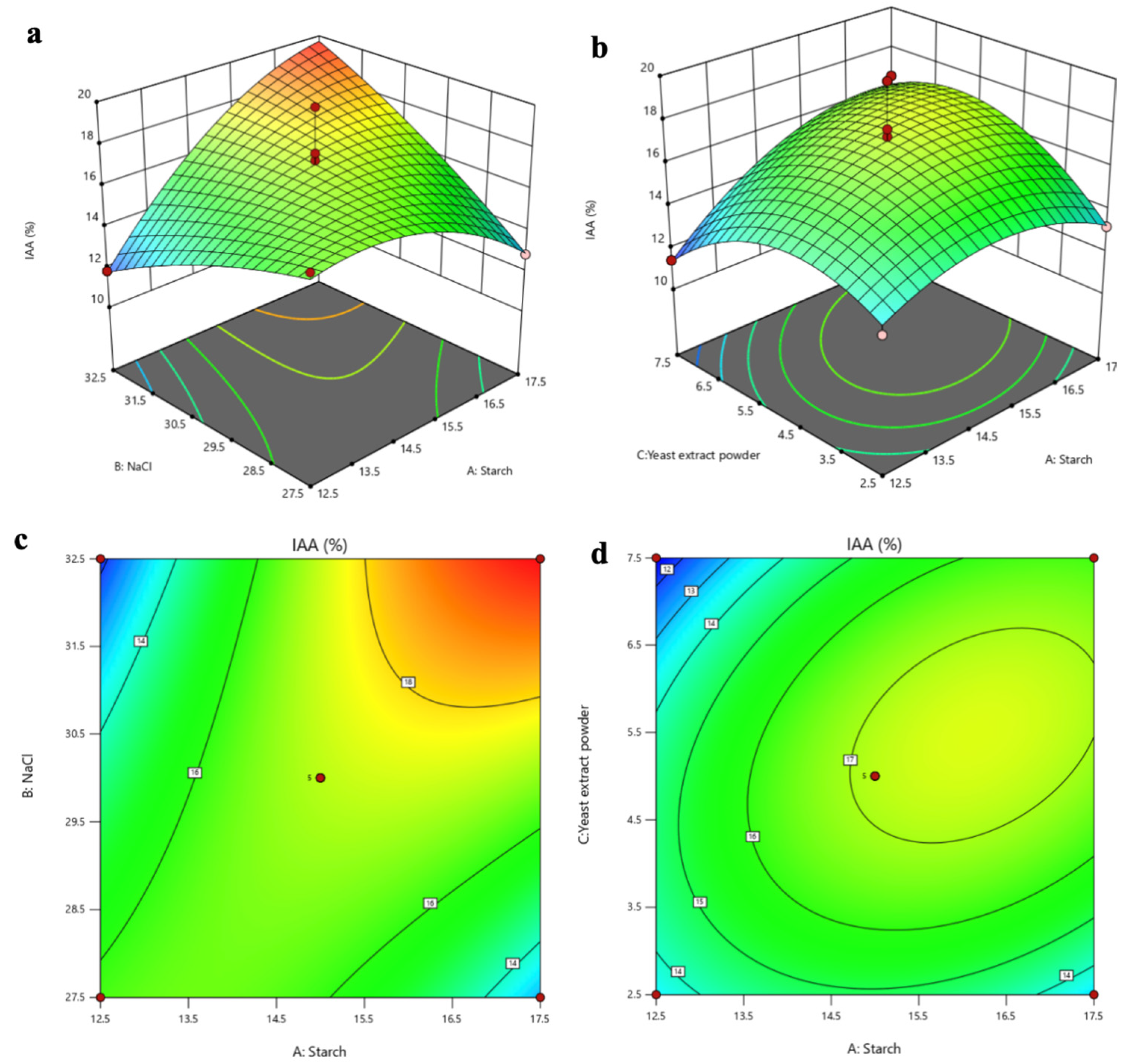
3.1.2. Optimization Results of Response Surface
3.2. Optimization Results of Culture Conditions
3.2.1. Results of Single-Factor Experiments
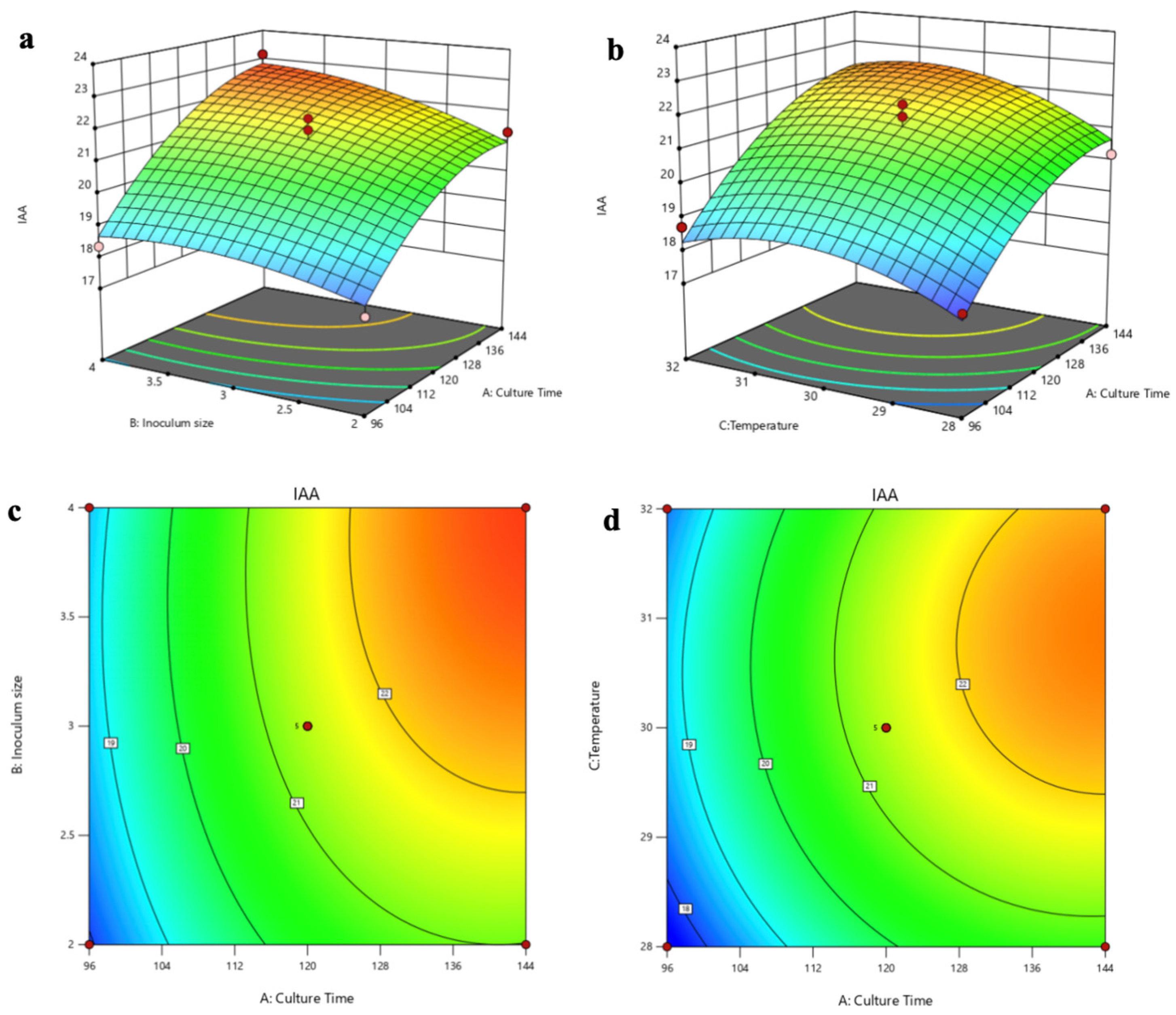
3.2.2. Optimization of Cultivation Conditions Based on Response Surface Analysis
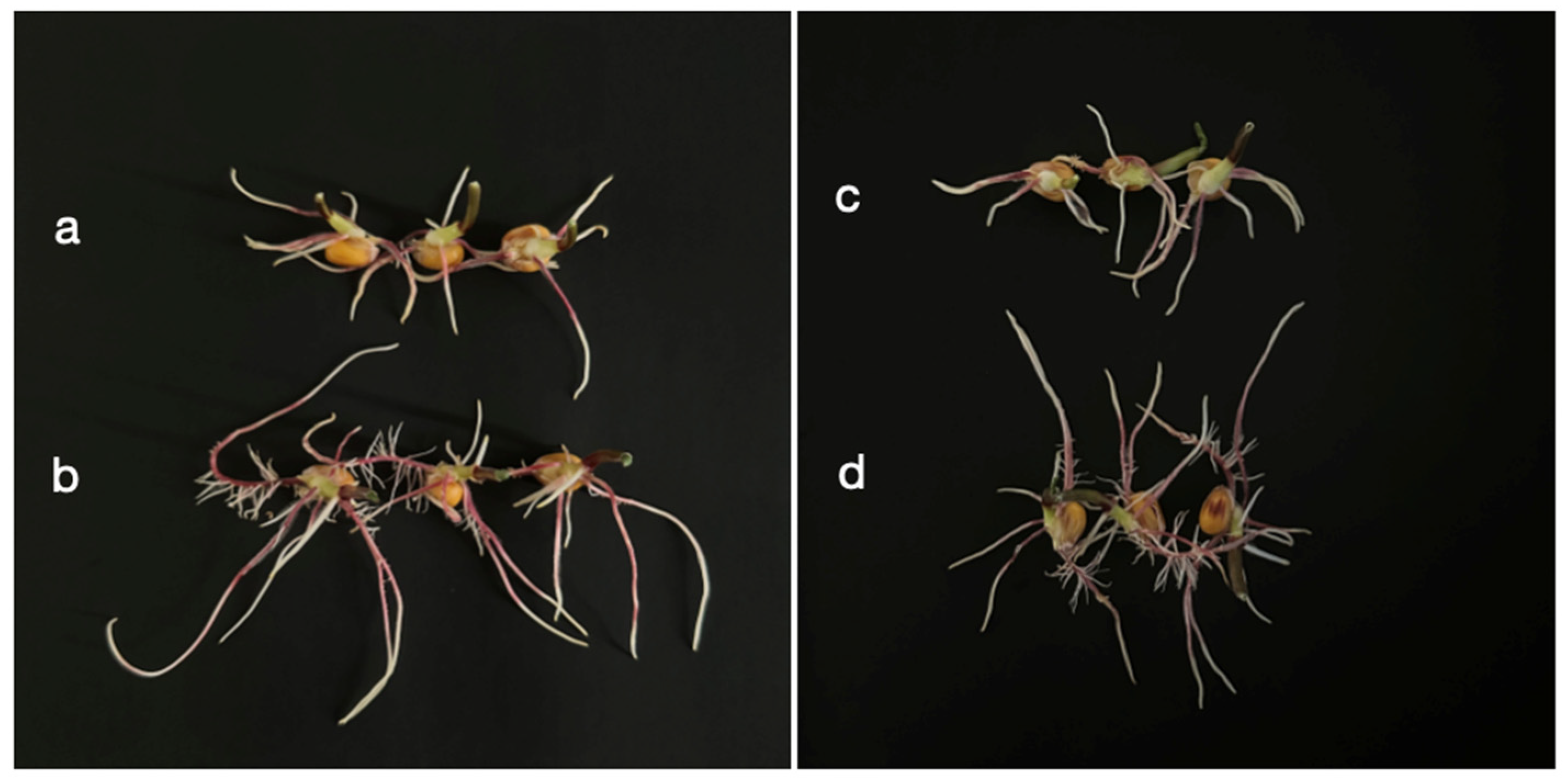
3.3. Verification of Growth-Promoting Effect
4. Discussion
5. Limitations and Future Perspectives
6. Conclusions
Author Contributions
Funding
Institutional Review Board Statement
Informed Consent Statement
Data Availability Statement
Conflicts of Interest
References
- Chen, X.; Wang, Y.; Zhang, L. Saline-Alkali Land Management Policies in Typical Regions of Northwestern China. Bull. Soil Water Conserv. 2025, 45, 294–304. [Google Scholar]
- Schirawski, J.; Perlin, M.H. Plant–Microbe Interaction 2017—The Good, the Bad and the Diverse. Int. J. Mol. Sci. 2018, 19, 1374. [Google Scholar] [CrossRef] [Scilit] [PubMed]
- Rütting, T.; Aronsson, H.; Delin, S. Efficient Use of Nitrogen in Agriculture. Nutr. Cycl. Agroecosyst. 2018, 110, 1–5. [Google Scholar] [CrossRef] [Scilit]
- Bashan, Y.; Singh, M.; Levanony, H. Contribution of Azospirillum brasilense Cd to Growth of Tomato Seedlings is not through Nitrogen Fixation. Can. J. Bot. 1989, 67, 2429–2434. [Google Scholar] [CrossRef] [Scilit]
- Bowen, G.D.; Rovira, A.D. The Rhizosphere and Its Management to Improve Plant Growth. Adv. Agron. 1999, 66, 1–102. [Google Scholar]
- Ma, Q.; Liu, Y.; Liu, Z.; Xu, Y.; Yin, S.; Bai, H.; Wang, J. Halotolerant Endophytic Fungi: Diversity, Host Plants, and Mechanisms in Plant Salt–Alkali Stress Alleviation. Plants 2025, 14, 2907. [Google Scholar] [CrossRef] [Scilit]
- Takatsuka, H.; Umeda, M. Hormonal Control of Cell Division and Elongation along Differentiation Trajectories in Roots. J. Exp. Bot. 2014, 65, 2633–2643. [Google Scholar] [CrossRef] [Scilit]
- Spaepen, S.; Vanderleyden, J.; Remans, R. Indole-3-Acetic Acid in Microbial and Microorganism-Plant Signaling. FEMS Microbiol. Rev. 2007, 31, 425–448. [Google Scholar] [CrossRef] [Scilit]
- Duca, D.; Lorv, J.; Patten, C.L.; Rose, D.; Glick, B.R. Indole-3-Acetic Acid in Plant–Microbe Interactions. Antonie Van Leeuwenhoek 2014, 106, 85–125. [Google Scholar] [CrossRef] [Scilit]
- Khalid, A.; Tahir, S.; Arshad, M.; Zahir, Z.A. Relative Efficiency of Rhizobacteria for Auxin Biosynthesis in Rhizosphere and Non-Rhizosphere Soils. Soil Res. 2004, 42, 921–926. [Google Scholar] [CrossRef] [Scilit]
- Naveed, M.; Qureshi, M.A.; Zahir, Z.A.; Hussain, M.B.; Sessitsch, A.; Mitter, B. L-Tryptophan-Dependent Biosynthesis of Indole-3-Acetic Acid (IAA) Improves Plant Growth and Colonization of Maize by Burkholderia phytofirmans PsJN. Ann. Microbiol. 2015, 65, 1381–1389. [Google Scholar] [CrossRef] [Scilit]
- Vaghela, N.R.; Jotaniya, V.B.; Gohel, S.D. A Review on Enhancing Crop Resilience in Adverse Environmental Conditions: Unveiling the Action Between Plant Growth-Promoting Rhizobacteria and Crops. Microbe 2025, 10, 100651. [Google Scholar] [CrossRef] [Scilit]
- Kaya, C. Microbial Modulation of Hormone Signaling, Proteomic Dynamics, and Metabolomics in Plant Drought Adaptation. Food Energy Secur. 2024, 13, e513. [Google Scholar] [CrossRef] [Scilit]
- Melini, F.; Luziatelli, F.; Bonini, P.; Ficca, A.G.; Melini, V.; Ruzzi, M. Optimization of the Growth Conditions through Response Surface Methodology and Metabolomics for Maximizing the Auxin Production by Pantoea agglomerans C1. Front. Microbiol. 2023, 14, 1022248. [Google Scholar] [CrossRef] [Scilit]
- Goswami, D.; Thakker, J.N.; Dhandhukia, P.C. Portraying Mechanics of Plant Growth Promoting Rhizobacteria (PGPR): A Review. Cogent Food Agric. 2016, 2, 1127500. [Google Scholar] [CrossRef] [Scilit]
- Spaepen, S.; Vanderleyden, J. Auxin and Plant-Microbe Interactions. Cold Spring Harb. Perspect. Biol. 2011, 3, a001438. [Google Scholar]
- Henan Agricultural University. A Halophilic Strain of the Family Halomonadaceae, Genus Vreelandella, with Saline-Alkali Tolerance Capacity and Its Application. China Patent 202411592096.5, 5 November 2024. [Google Scholar]
- Shi, Y.; Niu, X.; Yang, H.; Chu, M.; Wang, N.; Bao, H.; Zhan, F.; Yang, R.; Lou, K. Optimization of the fermentation media and growth conditions of Bacillus velezensis BHZ-29 using a Plackett–Burman design experiment combined with response surface methodology. Front. Microbiol. 2024, 15, 1355369. [Google Scholar] [CrossRef] [Scilit] [PubMed]
- Zhang, T.; Wan, Y.X.; Xu, W.H.; Wang, Z.G.; Chen, W.J.; Hu, Y.L. Study on the Growth-Promoting Effect and Genomic Analysis of a Maize Rhizosphere Plant Growth-Promoting Bacterium Leclercia adecarboxylata LN01. Biotechnol. Bull. 2025, 41, 263–275. [Google Scholar]
- Wang, M.; Han, T.; Huang, F.; Li, X.; Shan, J.; Zhang, D.; Shen, Z.; Wang, J.; Qiao, K. Saline–Alkaline Stress-Driven Rhizobacterial Community Restructuring and Alleviation of Stress by Indigenous PGPR in Alfalfa. Plants 2025, 14, 3844. [Google Scholar] [CrossRef] [Scilit]
- Waadt, R.; Seller, C.A.; Hsu, P.K.; Takahashi, Y.; Munemasa, S.; Schroeder, J.I. Plant Hormone Regulation of Abiotic Stress Responses. Nat. Rev. Mol. Cell Biol. 2022, 23, 680–694. [Google Scholar] [CrossRef] [Scilit] [PubMed]
- Oliva, G.; Iannece, P.; Castiglione, S.; Vigliotta, G. Insights into IAA Production by the Halotolerant Bacterium Vreelandella titanicae. Fermentation 2026, 12, 68. [Google Scholar] [CrossRef] [Scilit]
- Ahmad, E.; Sharma, S.K.; Sharma, P.K. Deciphering Operation of Tryptophan-Independent Pathway in High Indole-3-Acetic Acid (IAA) Producing Micrococcus aloeverae DCB-20. FEMS Microbiol. Lett. 2020, 367, fnaa190. [Google Scholar] [CrossRef] [Scilit]
- Li, Y.; Huang, Y.; Ding, H.; Huang, Y.; Xu, D.; Zhan, S.; Ma, M. Effects of the plant growth-promoting rhizobacterium Zobellella sp. DQSA1 on alleviating salt-alkali stress in job’s tears seedings and its growth-promoting mechanism. BMC Plant Biol. 2025, 25, 368. [Google Scholar] [CrossRef] [Scilit] [PubMed]
- Selami, N.; Zitouni-Haouar, F.E.; Zerouki, C.; Abdeddaim, K.K.; Aibeche, C.; Draou, N.; Khelil, O.; Choubane, S.; Maatallah, M.; Bokhari, H.; et al. Deciphering the genome of the endophytic bacterium Pseudomonas retamae type strain RB5T: A prominent plant growth promoter for wheat with potential applications in sustainable agriculture. Appl. Soil Ecol. 2025, 212, 105683. [Google Scholar] [CrossRef] [Scilit]
- Bao, X.; Chong, P.; He, C.; Wang, X.-Y.; Zhang, F.; Tan, B.-B.; Lou, K.-X. Bacillus tequilensis S40 inoculation alleviates salt stress by modifying bacterial community structure and regulating elemental cycling rhizosphere of Reaumuria soongorica. BMC Plant Biol. 2025, 25, 1251. [Google Scholar] [CrossRef] [Scilit]
- Xu, J.; Fang, J.; Wu, R.; Wang, Y.; Zhang, C.; Wang, X.; Qiu, T. Exploring the genomic features and plant growth-promoting properties of Enterobacter vonholyi Y16 isolated from maize rhizosphere. Microbiol. Res. 2026, 266, 127764. [Google Scholar] [CrossRef] [Scilit]
- Sharma, S.K.; Sharma, M.P.; Ramesh, A.; Joshi, O.P. Characterization of Zinc-Solubilizing Bacillus Isolates and Their Potential to Influence Zinc Assimilation in Soybean Seeds. J. Microbiol. Biotechnol. 2012, 22, 352–359. [Google Scholar] [CrossRef] [Scilit]
- Nadeem, S.M.; Zahir, Z.A.; Naveed, M.; Nawaz, S. Mitigation of Salinity-Induced Negative Impact on the Growth and Yield of Wheat by Plant Growth-Promoting Rhizobacteria in Naturally Saline Conditions. Ann. Microbiol. 2013, 63, 225–232. [Google Scholar] [CrossRef] [Scilit]
- Dodd, I.C.; Zinovkina, N.Y.; Safronova, V.I.; Belimov, A.A. Rhizobacterial Mediation of Plant Hormone Status. Ann. Appl. Biol. 2010, 157, 361–379. [Google Scholar] [CrossRef] [Scilit]
- Khan, A.L.; Waqas, M.; Kang, S.M.; Al-Harrasi, A.; Hussain, J.; Al-Rawahi, A.; Al-Khiziri, S.; Ullah, I.; Ali, L.; Jung, H.-Y.; et al. Bacterial Endophyte Sphingomonas sp. LK11 Produces Gibberellins and IAA and Promotes Tomato Plant Growth. J. Microbiol. 2014, 52, 689–695. [Google Scholar] [CrossRef] [Scilit]
- Paez-Garcia, A.; Motes, C.M.; Scheible, W.R.; Chen, R.; Blancaflor, E.B.; Monteros, M.J. Root Traits and Phenotyping Strategies for Plant Improvement. Plants 2015, 4, 334–355. [Google Scholar] [CrossRef] [Scilit]
- Grover, M.; Bodhankar, S.; Sharma, A.; Sharma, P.; Singh, J.; Nain, L. PGPR Mediated Alterations in Root Traits: Way toward Sustainable Crop Production. Front. Sustain. Food Syst. 2021, 4, 618230. [Google Scholar] [CrossRef] [Scilit]
- Mohanty, P.; Singh, P.K.; Chakraborty, D.; Mishra, S.; Pattnaik, R. Insight into the Role of PGPR in Sustainable Agriculture and Environment. Front. Sustain. Food Syst. 2021, 5, 667150. [Google Scholar] [CrossRef] [Scilit]
- Gowtham, H.G.; Singh, S.B.; Shilpa, N.; Aiyaz, M.; Nataraj, K.; Udayashankar, A.C.; Amruthesh, K.N.; Murali, M.; Poczai, P.; Gafur, A.; et al. Insight into Recent Progress and Perspectives in the Improvement of Antioxidant Machinery upon PGPR Augmentation in Plants under Drought Stress: A Review. Antioxidants 2022, 11, 1763. [Google Scholar] [CrossRef] [Scilit] [PubMed]
- Sapre, S.; Gontia-Mishra, I.; Tiwari, S. Klebsiella sp. Confers Enhanced Tolerance to Salinity and Plant Growth Promotion in Oat Seedlings (Avena sativa). Microbiol. Res. 2018, 206, 25–32. [Google Scholar] [CrossRef] [Scilit]
- Xu, L.; Xin, C.; Haider, F.U.; Li, H.; Li, S.; Zhang, H.; Zhang, P.; Li, X. Rhizobacteria mitigate salinity stress in maize by modulating photosynthesis, antioxidant defense, and rhizosphere microbial diversity. Plant Stress 2025, 12, 100781. [Google Scholar] [CrossRef] [Scilit]
- Lorenz, C.; Vitale, E.; Hay-Mele, B.; Arena, C. Plant Growth Promoting Rhizobacteria (PGPR) Application for Coping with Salinity and Drought: A Bibliometric Network Multi-Analysis. Plant Biol. 2024, 26, 777–788. [Google Scholar] [CrossRef] [Scilit] [PubMed]
- Sarin, P.; Theerakulpisut, P.; Siripornadulsil, S.; Riddech, N. Assessing the Effectiveness of Granular and Cell Suspension PGPR Biofertilizers in Enhancing Rice Growth in Saline Soils. J. Microbiol. Biotechnol. 2025, 35, e2502008. [Google Scholar] [CrossRef] [Scilit] [PubMed]
- Bhattacharyya, P.N.; Jha, D.K. Plant Growth-Promoting Rhizobacteria (PGPR): Emergence in Agriculture. World J. Microbiol. Biotechnol. 2012, 28, 1327–1350. [Google Scholar] [CrossRef] [Scilit]



| Treated Group | OD600 (nm) | IAA (μg/mL) |
|---|---|---|
| CK | 1.29 ± 0.08 | 5.13 ± 0.91 |
| 1% NaCl | 1.24 ± 0.11 | 5.38 ± 1.64 |
| 3% NaCl | 1.345 ± 0.23 | 9.5 ± 0.09 *** |
| 5% NaCl | 1.278 ± 0.02 | 4.86 ± 0.52 |
| Starch | 1.117 ± 0.04 ** | 10.71 ± 0.27 *** |
| Sucrose | 1.187 ± 0.09 | 5.48 ± 1.08 |
| Glucose | 1.258 ± 0.08 | 6.05 ± 0.17 |
| Yeast Extract | 0.933 ± 0.10 ** | 7.48 ± 0.64 * |
| Tryptone | 1.296 ± 0.21 | 4.59 ± 0.3 |
| Beef Extract | 1.377 ± 0.03 | 5.2 ± 0.84 |
| Level | Factor | ||
|---|---|---|---|
| A (Starch)/g/L | B (NaCl)/g/L | C (Yeast Extract Powder)/g/L | |
| −1 | 10 | 27.5 | 5 |
| 0 | 15 | 30 | 7.5 |
| 1 | 20 | 32.5 | 10 |
| Run Numbers | A: (Starch)/g/L | B: (NaCl)/g/L | C: (Yeast Extract Powder)/g/L | IAA μg/mL |
|---|---|---|---|---|
| 1 | 12.50 | 27.50 | 5.00 | 16.53 |
| 2 | 17.50 | 27.50 | 5.00 | 12.86 |
| 3 | 12.50 | 32.50 | 5.00 | 11.83 |
| 4 | 17.50 | 32.50 | 5.00 | 19.42 |
| 5 | 12.50 | 30.00 | 2.50 | 13.05 |
| 6 | 17.50 | 30.00 | 2.50 | 13.23 |
| 7 | 12.50 | 30.00 | 7.50 | 11.42 |
| 8 | 17.50 | 30.00 | 7.50 | 16.60 |
| 9 | 15.00 | 27.50 | 2.50 | 15.05 |
| 10 | 15.00 | 32.50 | 2.50 | 14.23 |
| 11 | 15.00 | 27.50 | 7.50 | 12.71 |
| 12 | 15.00 | 32.50 | 7.50 | 16.38 |
| 13 | 15.00 | 30.00 | 5.00 | 17.34 |
| 14 | 15.00 | 30.00 | 5.00 | 19.83 |
| 15 | 15.00 | 30.00 | 5.00 | 14.49 |
| 16 | 15.00 | 30.00 | 5.00 | 16.42 |
| 17 | 15.00 | 30.00 | 5.00 | 17.68 |
| Source | Sum of Squares | df | Mean Square | F-Value | p-Value |
|---|---|---|---|---|---|
| Model | 87.90 | 9 | 9.77 | 4.28 | 0.0341 |
| A | 10.76 | 1 | 10.76 | 4.72 | 0.0663 |
| B | 2.77 | 1 | 2.77 | 1.22 | 0.3065 |
| C | 0.3003 | 1 | 0.3003 | 0.1318 | 0.7273 |
| AB | 31.70 | 1 | 31.70 | 13.91 | 0.0074 |
| AC | 6.25 | 1 | 6.25 | 2.74 | 0.1417 |
| BC | 5.04 | 1 | 5.04 | 2.21 | 0.1806 |
| A2 | 9.53 | 1 | 9.53 | 4.18 | 0.0801 |
| B2 | 0.9996 | 1 | 0.9996 | 0.4386 | 0.5290 |
| C2 | 18.08 | 1 | 18.08 | 7.93 | 0.0259 |
| Residual | 15.96 | 7 | 2.28 | ||
| Lack of Fit | 0.8473 | 3 | 0.2824 | 0.0748 | 0.9704 |
| Pure Error | 15.11 | 4 | 3.78 | ||
| Cor Total | 103.85 | 16 |
| Treated Group | OD600 (nm) | IAA (μg/mL) |
|---|---|---|
| 25 °C | 1.105 ± 0.08 | 10.20 ± 0.92 |
| 30 °C | 1.65 ± 0.12 ** | 18.34 ± 1.65 ** |
| 35 °C | 1.375 ± 0.10 * | 11.31 ± 1.02 |
| 1% Inoculum size | 1.119 ± 0.09 | 13.53 ± 1.22 |
| 3% Inoculum size | 1.195 ± 0.11 ** | 20.57 ± 1.85 ** |
| 5% Inoculum size | 1.175 ± 0.10 | 12.05 ± 1.08 |
| 50 mL Liquid volume | 0.995 ± 0.07 | 14.64 ± 1.32 |
| 100 mL Liquid volume | 1.147 ± 0.09 | 13.90 ± 1.25 |
| 150 mL Liquid volume | 1.179 ± 0.10 ** | 21.31 ± 1.92 ** |
| 72 h Culture | 1.112 ± 0.08 | 1.123 ± 0.09 |
| 96 h Culture | 1.123 ± 0.09 | 10.20 ± 0.92 |
| 120 h Culture | 1.165 ± 0.10 ** | 21.31 ± 1.92 ** |
| 120 rpm | 1.344 ± 0.12 | 13.46 ± 1.21 |
| 150 rpm | 1.246 ± 0.11 ** | 21.38 ± 1.92 ** |
| 180 rpm | 1.375 ± 0.12 * | 16.23 ± 1.46 |
| Level | Factor | ||
|---|---|---|---|
| A (Culture Time)/h | B (Inoculum Size)/% | C (Temperature)/°C | |
| −1 | 96 | 2 | 28 |
| 0 | 120 | 3 | 30 |
| 1 | 144 | 4 | 32 |
| Run Numbers | A: (Culture Time)/h | B: (Inoculum Size)/% | C: (Temperature)/°C | IAA μg/mL |
|---|---|---|---|---|
| 1 | 96 | 2 | 30 | 17.60 |
| 2 | 144 | 2 | 30 | 21.31 |
| 3 | 96 | 4 | 30 | 18.34 |
| 4 | 144 | 4 | 30 | 23.16 |
| 5 | 96 | 3 | 28 | 17.60 |
| 6 | 144 | 3 | 28 | 20.20 |
| 7 | 96 | 3 | 32 | 18.71 |
| 8 | 144 | 3 | 32 | 22.05 |
| 9 | 120 | 2 | 28 | 19.09 |
| 10 | 120 | 4 | 28 | 20.20 |
| 11 | 120 | 2 | 32 | 19.83 |
| 12 | 120 | 4 | 32 | 21.31 |
| 13 | 120 | 3 | 30 | 22.05 |
| 14 | 120 | 3 | 30 | 21.68 |
| 15 | 120 | 3 | 30 | 21.31 |
| 16 | 120 | 3 | 30 | 20.57 |
| 17 | 120 | 3 | 30 | 21.31 |
| Source | Sum of Squares | df | Mean Square | F-Value | p-Value |
|---|---|---|---|---|---|
| Model | 40.73 | 9 | 4.53 | 14.42 | 0.0010 |
| A | 26.17 | 1 | 26.17 | 83.38 | <0.0001 |
| B | 3.35 | 1 | 3.35 | 10.69 | 0.0137 |
| C | 2.89 | 1 | 2.89 | 9.21 | 0.0190 |
| AB | 0.3080 | 1 | 0.3080 | 0.9813 | 0.3549 |
| AC | 0.1369 | 1 | 0.1369 | 0.4361 | 0.5301 |
| BC | 0.0342 | 1 | 0.0342 | 0.1090 | 0.7509 |
| A2 | 3.22 | 1 | 3.22 | 10.26 | 0.0150 |
| B2 | 0.6975 | 1 | 0.6975 | 2.22 | 0.1797 |
| C2 | 3.18 | 1 | 3.18 | 10.14 | 0.0154 |
| Residual | 2.20 | 7 | 0.3139 | ||
| Lack of Fit | 0.9925 | 3 | 0.3308 | 1.10 | 0.4467 |
| Pure Error | 1.20 | 4 | 0.3012 | ||
| Cor Total | 42.93 | 16 |
| Treated Group | Shoot Length | Root Length | Main Root | Fibrous Roots | Fresh Weight | |||||
|---|---|---|---|---|---|---|---|---|---|---|
| Value/cm | Increase/% | Value/cm | Increase /% | Number | Increase /% | Number | Increase /% | Value/g | Increase /% | |
| NaCl | 3.1 ± 0.1 | 3.5 ± 0.1 | 7 | 16 | 0.5 ± 0.04 | |||||
| NaCl + J113 | 5.3 ± 0.62 | 71% | 6.53 ± 1.5 | 86% | 11 | 57% | 38 | 137% | 0.75 ± 0.05 | 50% |
| NaHCO + NaCl | 3.07 ± 0.35 | 3.8 ± 0.4 | 8 | 15 | 0.56 ± 0.1 | |||||
| NaHCO + NaCl + J113 | 3.23 ± 0.35 | 5% | 6.1 ± 0.2 | 61% | 10 | 25% | 45 | 200% | 0.68 ± 0.08 | 21% |
| Strain | Optimal Conditions/Key Features for IAA Production | Maximum IAA Yield Reported (μg/mL) | Reference/Note |
|---|---|---|---|
| Vreelandella titanicae J113 (This study) | Optimized via RSM: starch 17.5 g/L, yeast extract 5 g/L, NaCl 32.5 g/L, 30 °C, 144 h. Halotolerant. | 23.02 | (Current study, under 3.25% NaCl) |
| Pantoea agglomerans C1 | Optimized via RSM and metabolomics; fed-batch process. | 102.2 | [14,27] |
| Vreelandella titanicae (Halotolerant strain) | Cultured in seawater-based medium. Halotolerant. | 2.1 | [22] (Strain from cited study) |
| Burkholderia phytofirmans PsJN | L-Tryptophan-dependent biosynthesis; promotes maize growth. | 15.0 | [11] (Value estimated from plant growth promotion data) |
| Micrococcus aloeverae DCB-20 | High IAA producer; utilizes tryptophan-independent pathway. | 154.3 | [23] |
| Bacillus spp. (Zinc-solubilizing isolates) | Plant growth-promoting rhizobacteria (PGPR). | ~8.5 (Range: 7.2–10.1) | [28] |
Disclaimer/Publisher’s Note: The statements, opinions and data contained in all publications are solely those of the individual author(s) and contributor(s) and not of MDPI and/or the editor(s). MDPI and/or the editor(s) disclaim responsibility for any injury to people or property resulting from any ideas, methods, instructions or products referred to in the content. |
© 2026 by the authors. Licensee MDPI, Basel, Switzerland. This article is an open access article distributed under the terms and conditions of the Creative Commons Attribution (CC BY) license.
Share and Cite
Tursun, D.; Yakup, Z.; Bao, H.; Zhan, F.; Shi, Y.; Yang, H.; Sun, J.; Fang, S.; Wang, N. Optimization of IAA Production by Halotolerant Vreelandella titanicae J113 Through Fermentation Process Engineering with Response Surface Methodology. Microbiol. Res. 2026, 17, 95. https://doi.org/10.3390/microbiolres17050095
Tursun D, Yakup Z, Bao H, Zhan F, Shi Y, Yang H, Sun J, Fang S, Wang N. Optimization of IAA Production by Halotolerant Vreelandella titanicae J113 Through Fermentation Process Engineering with Response Surface Methodology. Microbiology Research. 2026; 17(5):95. https://doi.org/10.3390/microbiolres17050095
Chicago/Turabian StyleTursun, Dilbar, Zulhumar Yakup, Huifang Bao, Faqiang Zhan, Yingwu Shi, Hongmei Yang, Jiusheng Sun, Shijie Fang, and Ning Wang. 2026. "Optimization of IAA Production by Halotolerant Vreelandella titanicae J113 Through Fermentation Process Engineering with Response Surface Methodology" Microbiology Research 17, no. 5: 95. https://doi.org/10.3390/microbiolres17050095
APA StyleTursun, D., Yakup, Z., Bao, H., Zhan, F., Shi, Y., Yang, H., Sun, J., Fang, S., & Wang, N. (2026). Optimization of IAA Production by Halotolerant Vreelandella titanicae J113 Through Fermentation Process Engineering with Response Surface Methodology. Microbiology Research, 17(5), 95. https://doi.org/10.3390/microbiolres17050095