
Article

Prevalence and Risk Factors of Anal Human Papillomavirus and Anal–Cervical Concordance Among Women of Eastern Cape Province, South Africa

by
Zizipho Z. A. Mbulawa
1,*,
Laston Gonah
2,
Lindiwe M. Faye
1 and
Charles B. Businge
3
1
School of Pathology, Faculty of Medicine and Health Sciences, Walter Sisulu University, Mthatha 5100, South Africa
2
School Public Health, Faculty of Medicine and Health Sciences, Walter Sisulu University, Mthatha 5100, South Africa
3
Department of Obstetrics and Gynaecology, Faculty of Medicine and Health Sciences, Walter Sisulu University, Mthatha 5100, South Africa
*
Author to whom correspondence should be addressed.
Microbiol. Res. 2026, 17(3), 62; https://doi.org/10.3390/microbiolres17030062
Submission received: 14 January 2026 / Revised: 23 February 2026 / Accepted: 18 March 2026 / Published: 20 March 2026

Abstract

Anal human papillomavirus (HPV) and cancer prevalence are increasing. Therefore, this study investigated the prevalence of anal HPV and associated risk factors, as well as HPV genotype-specific concordance at cervical and anal sites and associated risk factors among women of Eastern Cape Province, South Africa. A total of 326 women aged 18–60 were recruited from an Eastern Cape community health facility. HPV DNA was detected in cervical and anal specimens using the Seegene Anyplex™ and Allplex™ II HPV28 assay (Seegene Inc., Seoul, Republic of Korea), respectively. Anal HPV was detected in 68.1% (95% CI: 62.9–72.9) and independent predictors were cervical HPV positivity (AOR: 2.40, 95% CI: 1.39–4.14, p = 0.002), abnormal cytology (AOR: 3.12, 95% CI: 1.29–7.55, p = 0.012), single marital status (AOR: 3.55, 95% CI: 1.24–10.17, p = 0.018), and having more than three lifetime sexual partners (AOR: 1.75, 95% CI: 1.03–2.98, p = 0.039). Anal high risk (HR)-HPV types were detected in 50.9%, with HPV-58 (13.2%), HPV-68 (11.0%) and HPV-52 (9.2%) being the most dominant types. HPV genotype-specific cervical and anal concordance was observed in 33.5% of cases, with HPV-58 (7.1%), HPV-68 (4.9%), and HPV-35 (4.6%) being the most dominant. Women who were positive for cervical HPV infection (AOR: 3.24, 95% CI: 2.36–4.45, p < 0.001), anal HPV infection (AOR: 2.70, 95% CI: 2.01–3.63, p < 0.001) and abnormal cervical cytology (AOR: 2.01, 95% CI: 1.36–2.96, p < 0.001) had substantially higher odds of anal–cervical HPV concordance compared to those who were negative. High anal HPV prevalence and HPV genotype-specific anal and cervical concordance were observed among Eastern Cape women. Understanding anal HPV, HPV genotype-specific anal–cervical concordance, and associated factors can contribute to strategies towards anal HPV and associated disease prevention. These findings warrant further longitudinal investigation in future studies.

1. Introduction

Persistent anal human papillomavirus (HPV) infection is associated with the development of anal cancer [1,2,3,4]. Anal intercourse is recognized as a risk factor for anal HPV infection; however, anal HPV acquisition has also been reported in women without a history of receptive anal intercourse. This suggests that alternative transmission routes, such as self-inoculation from HPV-infected genital sites, may contribute to anal infection [2]. Concordance of HPV types between the cervicovaginal and anal sites is common in women and may occur via both sexual and non-sexual routes. The high prevalence and viral load of HPV in the cervicovaginal region further increase the likelihood of autoinoculation and subsequent anal infection. Notably, anal HPV infection can occur independently of cervical HPV infection, indicating distinct acquisition dynamics [2,5,6]. Risky sexual behavior and smoking have been consistently identified as significant risk factors for HPV infections, including anal HPV, cervical HPV, and anal–cervical concordance. Engaging in an early sexual debut, having multiple sexual partners, and inconsistent condom use significantly increase the likelihood of acquiring HPV and progression to high-grade lesions [7,8,9].
According to the South African National Cancer Registry, which collects statistics for histologically diagnosed cancers in South Africa, among women the anal cancer age standardized incidence in 2013 was 0.47 per 100,000 (95% CI: 0.39–0.56); a decade later (2023) it had increased to 0.92 per 100,000 (95% CI: 0.82–1.03) [10,11]. Globally, the incidence and mortality of anal cancer have increased in recent decades [1,2,12,13,14]. Zuma et al. reported increasing anal squamous cell carcinoma in KwaZulu-Natal Province of South Africa and the influence of HIV infection [15]. Anal HR-HPV prevalence among South African HIV-positive women attending HIV treatment clinics has been reported to be 62.0%, and 18.8% had HPV-16 [16]. The increasing anal cancer rate in women suggests that further investigation on anal cancer risk factors, natural history, screening, and treatment is needed; the high burden of HIV infection in South Africa and Eastern Cape Province further enhances the need [17,18,19].
Anal HPV and cancer in women are more prevalent in individuals with a history of anal condyloma, cervical cancer, vulvovaginal cancer, genital warts, and immunosuppression, including HIV infection [2,3,7,15,19,20]. However, data on the prevalence and determinants of anal HPV infection among women in the general population of South Africa remain scarce. Therefore, this study investigated anal HPV and associated factors, and further investigated HPV genotype-specific concordance at cervical and anal sites and associated factors among women of Eastern Cape Province, South Africa. Understanding genotype-specific concordance between cervical and anal sites is clinically relevant because shared infections may indicate autoinoculation pathways, persistent infection across mucosal sites, and implications for integrated screening strategies. The Eastern Cape Province is underrepresented in anal HPV epidemiological studies and has a unique population represented by mixed rural–peri-urban populations. Local data are essential for regional prevention strategies, and, furthermore, determining the proportion of infections covered by current HPV vaccines is essential for informing vaccination policy and secondary prevention strategies in high-burden, resource-limited settings such as the Eastern Cape Province.

2. Materials and Methods

2.1. Study Design, Setting, and Population

This was a cross-sectional analytical study involving paired cervical and anal specimen collection. This quantitative study was conducted at a primary healthcare facility located within the King Sabata Dalindyebo (KSD) sub-district of the Department of Health, in the Oliver Reginald (O.R.) Tambo District Municipality, Eastern Cape Province, South Africa. The healthcare facility provides services to a diverse catchment area that encompasses rural communities, informal settlements, peri-urban areas, and urban settings. Women who attended the facility for any health-related reason, including medication collection, between June and July 2023 (Tuesdays to Thursdays each week), were invited to participate in the study. Convenience sampling was used to recruit participants during the clinic’s operating hours over the study period. Participants were recruited at the health facility reception by using posters and education leaflets on human papillomavirus and associated diseases. Participation in the study was entirely voluntary with written informed consent. Included participants were women aged 18–60 years who were attending the facility for any health-related reason and were able to provide informed consent. Exclusion criteria included prior hysterectomy, current menstruation at the time of sampling, being pregnant at the time of recruitment, and prior anal cancer diagnosis. Prior HPV vaccination status was recorded but not used as an exclusion criterion. The informed consent process was conducted in participants’ preferred language, which was commonly isiXhosa (the local language). Written consent, biological specimens, and responses to questionnaires were obtained from all study participants in a private room.

2.2. Collection of Clinical Specimens and an HIV Test

All study procedures were conducted in a private room by the investigator. To maintain participant confidentiality, a unique study number was assigned to each participant, linking all their collected specimens and questionnaires. To confirm the HIV status of study participants, an HIV rapid test was offered to all HIV negative or unknown participants by a qualified nurse or an HIV lay counselor. Pre- and post-HIV counseling and rapid HIV tests were administered following the South African Department of Health HIV guidelines. Participants who were not willing to test for HIV were allowed to continue participating in the study.
Prior to sample collection, the professional nurse conducted a speculum examination. Clinical examinations were performed by an experienced professional nurse, who carefully noted any signs and symptoms of vaginal abnormalities. The cervical specimens were collected for cervical cancer screening and HPV testing. The cervical cancer screening specimen was collected using the ThinPrep Pap Test collection kit (Hologic, Marlborough, MA, USA) and sent to the Nelson Mandela Academic Hospital National Health Laboratory Service cytopathology laboratory, in which the cervical cytology results were classified following the Bethesda system. The second cervical specimen was collected using a Digene cervical sampler brush (Qiagen Inc., Gaithersburg, MD, USA) and placed into the Digene transport medium (Qiagen Inc., Gaithersburg, MD, USA). The anal specimens collection protocol was adapted from a published protocol [21]; briefly, the Digene swab (Qiagen Inc., Gaithersburg, MD, USA) was inserted approximately 3–5 cm into the anal canal and rotated 360 degrees, three times, while maintaining lateral pressure on the swab against the walls of the anus. The swab with the specimen was then withdrawn gently in a twirling motion and placed into the Digene transport medium (Qiagen Inc., Gaithersburg, MD, USA). It is important to mention that no lubricant was used during anal specimen collection, and no challenges or resistance were observed during the collection. Both cervical and anal specimens were collected on the same day; this offers insights into the synchronicity of HPV genotypes across different mucosal sites, which is critical for understanding the natural history of HPV in women. The cervical specimens were collected prior to anal sampling to minimize potential cross-site contamination. The cervical and anal HPV specimens were transported at room temperature to the Nelson Mandela Academic Hospital NHLS/WSU Virology laboratory within three hours of collection and stored at −20 °C until nucleic acid extraction.

2.3. Nucleic Acid Extraction and Molecular Detection of Human Papillomavirus

Nucleic acid extraction from anal and cervical specimens was performed using an automated procedure, the Seegene NIMBUS and a universal STARMag extraction system (Seegene Inc., Seoul, Republic of Korea), following the manufacturer’s instructions. A total of 300 µL anal and cervical specimens in transport medium were used as the initial volume for extraction and eluted to approximately 100 µL nucleic acid. The Seegene Anyplex™ II HPV28 and Seegene Allplex™ II HPV28 (Seegene Inc., Seoul, Republic of Korea) were used to detect and genotype HPV in cervical and anal nucleic extracted specimens, respectively. It is important to mention that the current study did not determine the performance of the two assays; however, in the literature, good agreement between them has been documented [22,23]. The Seegene Anyplex™ II HPV28 and Seegene Allplex™ II HPV28 (Seegene Inc., Seoul, Republic of Korea) multiplexed real-time type-specific polymerase chain reaction (PCR) assays detect, differentiate and quantify 28 different HPV genotypes (19 HR-HPV: 16, 18, 26, 31, 33, 35, 39, 45, 51, 52, 53, 56, 58, 59, 66, 68, 69, 73, 82; nine LR-HPV: 6, 11, 40, 42, 43, 44, 54, 61, 70 and six probable HR-HPV: 26, 53, 66, 68, 73, 82). Amplification on a Bio-Rad CFX96 real-time thermocycler (Bio-Rad, Hercules, CA, USA) was conducted according to the manufacturer’s instructions. The Anyplex™ and Allplex™ II HPV28 target the L1 major capsid gene of the HPV types. The human housekeeping gene (β-globin) was used as an internal control and was co-amplified simultaneously with the L1 gene of the targeted HPV types. Data was automatically generated and interpreted by the Seegene Viewer Software (Seegene Inc., Seoul, Republic of Korea) according to the manufacturer’s instructions. Samples with negative internal control and a negative HPV result were re-analyzed, and if this persisted, they were deemed invalid. If the internal control was negative, but the HPV test result was positive, the test result was considered valid. Negative HPV tests with a positive internal control were deemed negative for the 28 HPV types targeted by the Seegene Anyplex™ and Allplex™ II HPV28.

2.4. Data Analysis

HPV prevalence was described according to HR-, probable HR-, and LR-HPV. Anal HPV detection refers to the detection of any of the 28 different HPV types, while HR-HPV, probable HR-HPV, and LR-HPV prevalence refer to the detection of only the HR-HPV types, probable HR-HPV types, and LR-HPV types, respectively. Single HPV infection was defined as infection with one HPV type, while multiple HPV infection was described as being infected with two or more HPV types in the same sample. Women with abnormal cervical cytology were women presenting with atypical squamous cells of undetermined significance (ASCUS), a low-grade squamous intraepithelial lesion (LSIL), an atypical squamous cells-cannot exclude high-grade squamous intraepithelial lesion (ASC-H), or a high-grade squamous intraepithelial lesion (HSIL). Cervical histopathology data were not available and therefore not presented. The primary outcomes were anal HPV infection (any genotype) and genotype-specific anal–cervical concordance, defined as the detection of the same HPV genotype at both anatomical sites within the same participant. Secondary outcomes included the prevalence of commercial vaccine-covered HPV types. All variables were captured and coded in Microsoft Excel. The modified Wald method (GraphPad Prism) was used to estimate the 95% confidence intervals for the proportions. Data were analyzed using IBM SPSS Statistics version 30. Bivariate and multivariable logistic regression models were applied to identify factors associated with anal HPV infection and anal–cervical HPV concordance. Variables with p < 0.20 in bivariate analysis were entered into adjusted models; results are presented as adjusted odds ratios (AORs) with 95% confidence intervals. Model fit was evaluated using the Hosmer–Lemeshow test. Statistical significance was set at p < 0.05 (two-tailed).

3. Results

3.1. Study Population Characteristics and HPV Anal Prevalence

A comprehensive description of the study population is available in a separate publication [24], in which only cervical HPV data were reported. Briefly, the study included 326 women with a median age of 36 years (interquartile range [IQR]: 28–45 years; age range: 18–60 years). The majority of the study population was HIV-positive (64.5%, 209/324), and the minority were HIV-negative (35.5%, 115/324). HIV-positive women (median age 39 years, IQR: 32–46 years) were older than the HIV-negative women (31 years median, IQR: 23–42 years, p < 0.0001). A proportion of 82.8% were negative for intraepithelial lesion or malignancy, 12.9% had abnormal cervical cytology (ASCUS, LSIL, ASC-H or HSIL), and 4.0% had a cytology diagnosis deferred.
Anal HPV infection was detected in 68.1% (95% CI: 62.9–72.9) of participants, and it was not significantly different between HIV-positive women (67.5%, 95% CI: 60.8–73.5) and HIV-negative women (69.6%, 95% CI: 60.6–77.3). Among those with anal HPV infections, multiple (2–16) HPV types were more common than single infections in overall women (59.9%, 95% CI: 53.4–66.1; 40.1%, 95% CI: 33.9–46.7; respectively, p < 0.0001), HIV-positive women (58.9%, 95% CI: 50.6–66.7; 41.1%, 33.4–49.4, p = 0.004) and HIV-negative women (62.5%, 95% CI: 51.5–72.3; 37.5%, 95% CI: 27.7–48.5, respectively, p = 0.003). Anal HR-HPV prevalence was 50.9% (95% CI: 45.5–58.0) and was detected at a similar proportion among HIV-positive and HIV-negative women (Table 1). Anal HPV prevalence was not found to significantly decrease with increasing age among overall participants (p = 0.291), HIV-positive women (p = 0.930), and HIV-negative women (p = 0.058). However, the prevalence of multiple anal HPV infections significantly declined with increasing age among the overall study population (p = 0.026) and among HIV-positive women (p = 0.001), but this trend was not statistically significant among HIV-negative women (p = 0.061).
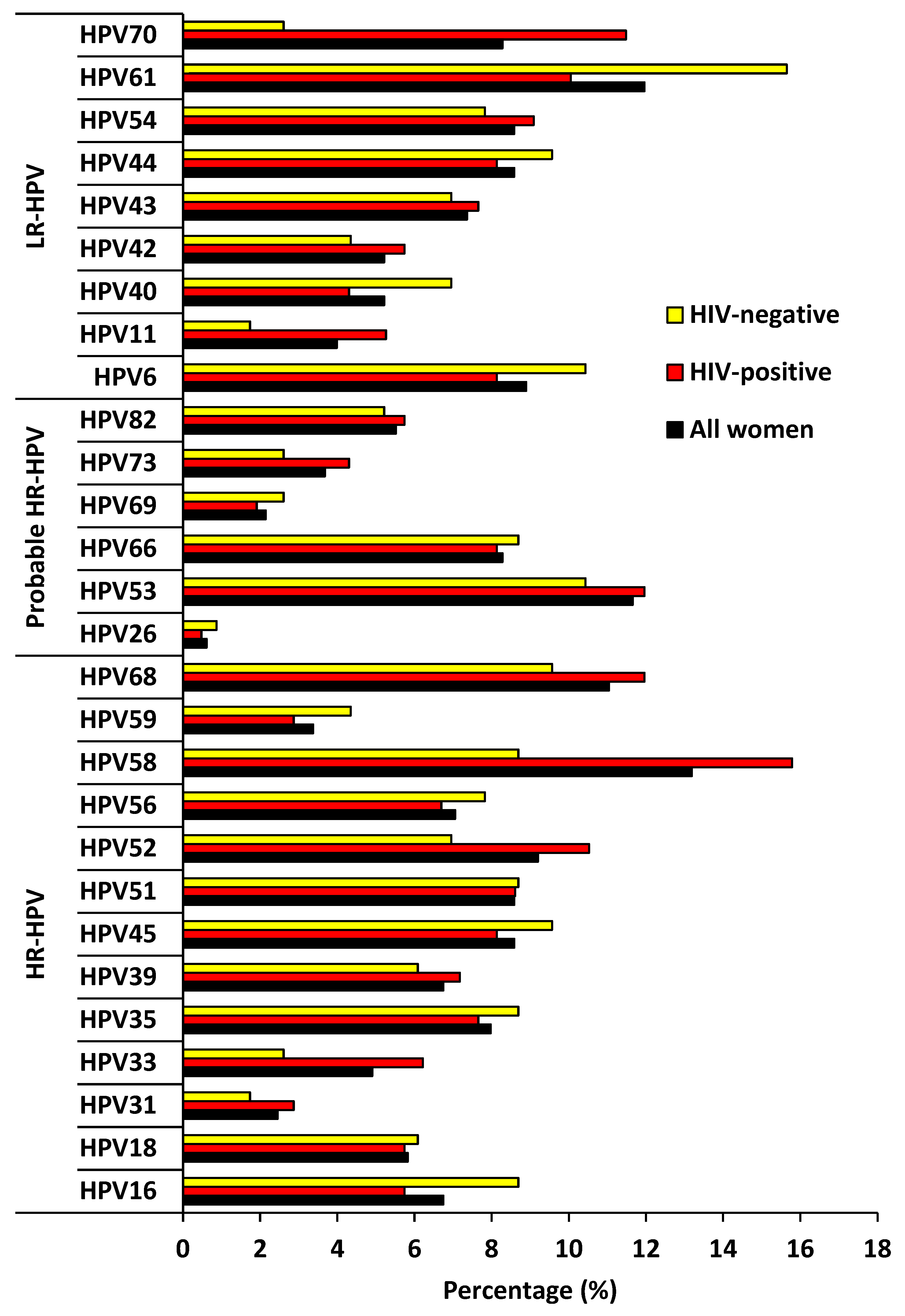
The four most dominant anal HR-HPV types were HPV-58 (13.2%), followed by HPV-68 (11.0%), HPV-52 (9.2%) and HPV-51, -45, and -35 (8.3% each). The four most common LR-HPV types were HPV-61 (12.0%), HPV-6 (8.9%), HPV-54 and HPV-44 (8.6% each), and HPV-70 (8.3%). Among the probable HR-HPV, HPV-53 (11.7%) and HPV-66 (8.3%) were the most common types (Figure 1). With particular reference to the genotypes most strongly associated with anal cancer, anal HPV-16 was detected in 6.7% and HPV-18 in 5.8% of women. The detailed distribution of different anal HPV types according to HIV status is presented in Figure 1.

3.2. Anal HPV Types Targeted by Current Commercial HPV Vaccines

A proportion of 11.7% (95% CI: 8.6–15.6) of women were anal-infected with one or more HPV types covered by the Cervarix® HPV vaccine types (HPV-16 and/or -18), 4.6% (95% CI: 2.8–7.5) at both the anus and cervix, and 7.1% (95% CI: 4.7–10.4) at the anal site only. HPV infection with one or more types covered by Gardasil®4 (HPV-6, -11, -16 and/or -18) was detected in the anal site of 19.6% (95% CI: 15.7–24.3) of women, at both the anus and cervix of 8.3% (95% CI: 5.7–11.9), and at the anal site only of 11.4% (95% CI: 8.3–15.3). Meanwhile HPV infection with one or more types covered by Gardasil®9 HPV types (HPV-6, -11, -16, -18, -31, -33, -45, -52 and/or -58) was detected in the anal site of 38.7% (95% CI: 33.5–44.0) of women, at both the anus and cervix of 19.4% (95% CI: 15.4–24.0), and at the anal site only of 19.4% (95% CI: 15.4–24.0). The anal HPV prevalence of types targeted by the current commercial HPV vaccines did not differ according to participants’ HIV status (Table 2).

3.3. Factors Associated with Anal HPV Infection

In bivariate analysis (Supplementary Table S1), anal HPV positivity was significantly associated with younger age, marital status, an earlier sexual debut, lifetime sexual partners, wiping direction, pregnancy history, HIV status, abnormal cervical cytology, and cervical HPV positivity (all p < 0.001). Anal HPV-positive women were more likely to be younger, single, sexually active at an earlier age, have more than three lifetime partners, report wiping from vagina to anus, never been pregnant, live with HIV, and present with abnormal cytology or concurrent cervical HPV infection. In the adjusted model, which demonstrated good fit (Hosmer–Lemeshow p = 0.278), independent predictors of anal HPV infection were cervical HPV positivity (AOR: 2.40, 95% CI: 1.39–4.14, p = 0.002), abnormal cytology (AOR: 3.12, 95% CI: 1.29–7.55, p = 0.012), single marital status (AOR: 3.55, 95% CI: 1.24–10.17, p = 0.018), and having more than three lifetime sexual partners (AOR: 1.75, 95% CI: 1.03–2.98, p = 0.039). Other variables, including age, sexual debut, HIV status, wiping direction, and pregnancy history, were not statistically significant after adjustment, possibly due to confounding from cervical HPV status, cytology, and related sexual or marital characteristics (Table 3).

3.4. Anal–Cervical HPV Concordance and Associated Factors Among Women

Half of the overall population were anal and cervical HPV positive (49.8%, 95% CI: 44.4–55.3) for any HPV type. A proportion of 33.5% (95% CI: 28.6–38.8) of women had HPV genotype-specific concordance at cervical and anal sites. Women shared up to ten different HPV types at both the anus and cervix. Among overall women, HPV types with high anal–cervical HPV concordance were HPV-58 (7.1%, 95% CI: 4.7–10.4), followed by HPV-68 (4.9%, 95% CI: 3.0–7.9), HPV-35 (4.6%, 95% CI: 2.8–7.5), HPV-6 (4.3%, 95% CI: 2.5–7.2), HPV-61 (3.7%, 95% CI: 2.1–6.4) and HPV-52 (3.4%, 95% CI: 1.8–6.1). Of the isolates detected in the anal site, HR-HPV isolates were detected in both the anus and cervix of 41.0% (128/312, 95% CI: 35.7–46.6), LR-HPV in 30.6% (68/222, 95% CI: 24.9–37.0) and probable HR-HPV types in 27.9% (29/104, 95% CI: 20.1–37.2, Table 4).
Even though there was high HPV genotype-specific concordance at cervical and anal sites, the proportion of HPV types detected at the anal site only ranged between 42.3% and 84.2%. Among the HR-HPV types, HPV-56 had a higher proportion of being detected at the anal site only (82.6%), while HPV-35 had the lowest chances (42.3%). Among the probable HR-HPV types, HPV-53 had a higher proportion of being detected at the anal site only (84.2%) while HPV-69 had the lowest chances (42.9%). Among the LR-HPV types, HPV-40 had a higher proportion of being detected at the anal site only (82.4%) while HPV-6 had the lowest chances (51.7%). Among the proportion of all detected HPV isolates at the anal site, 64.7% were more likely to be detected at the anal site only; when grouped according to risk level, probable HR-HPV types had higher chances (72.1%), followed by LR-HPV types (69.4%) and HR-HPV types (59.0%, Table 4).
Results from the adjusted logistic regression model indicate that cervical and anal HPV infections were the strongest independent predictors of anal–cervical HPV concordance rather than sociodemographic or behavioral factors. Women who were positive for cervical HPV had substantially higher odds of concordance compared to those who were negative (OR: 3.24, 95% CI: 2.36–4.45, p < 0.001), and those positive for anal HPV also had significantly higher odds (OR: 2.70, 95% CI: 2.01–3.63, p < 0.001). Abnormal cervical cytology was independently associated with increased odds of concordance (OR: 2.01, 95% CI: 1.36–2.96, p < 0.001). Other demographic and behavioral factors, including ever being pregnant, HIV status, age at sexual debut, age category, marital status, lifetime number of sexual partners, and wiping direction, did not show statistically significant associations with concordance after adjusting for other variables (all p > 0.05).

4. Discussion

Although this cohort was previously described in Mbulawa et al. [24], the prior publication focused exclusively on cervical HPV genotypes. To the best of our knowledge, based on the published literature, the present study is the first to report anal HPV prevalence, genotype-level cervical–anal concordance, associated behavioral factors and cervical cytology outcomes among Eastern Cape Province women. By analyzing paired specimens collected on the same day, this study provides novel insights into cross-site HPV dynamics that were not previously examined. There was high anal HPV among women of the Eastern Cape Province of South Africa; this concurs with other studies [2,7,20,25]; however, in the current study population, HIV infection did not significantly impact the anal HPV and anal–cervical concordance prevalence. In South Africa, there is a high burden of HIV and cervical HPV infection, even in the general population [17,18,26]. In particular, in the Eastern Cape population, cervical HPV prevalence has been reported to be up to 76% in the general population [24,27]. In addition, in the current study, HIV-positive women were the majority of the study population; all these could have contributed to this difference. The absence of a statistically significant association between HIV and anal HPV in this study should be interpreted cautiously, as the cross-sectional design and sample size may limit statistical power to detect modest differences.
HPV-16 is the dominant type in anal cancer [1,2,25,28], and in the current study, it was detected only in seven percent of the population. HPV-58 was the dominant anal HPV type in the current study, and it has been detected in the Central African Republic as the second most dominant anal HR-HPV type [29]. In a community-based study, in women, the prevalence of anal HPV-16 was found to be typically low, depending on age and other sexual behavior characteristics, compared to the high-risk clinical population [30]. HPV-16 uniquely persists longer in the anal canal and increases the risk of the carcinogenesis process [31].
Anal–cervical HPV concordance and genotype-specific concordance have been observed in a high proportion of the population [5,6,32]. High-risk behaviors are associated with a high incidence of anal HPV and cancer [3,33]. In the current study, having a new sexual partner in the past 12 months and alcohol consumption were associated with anal–cervical HPV concordance, consistent with findings from previous studies [7]. High HPV viral load, usually found in women with abnormal cervical cytology, could contribute to the observed high anal HPV and anal–cervical concordance among women with abnormal cervical cytology [25]. The history of anal intercourse is reported not to be a consistent risk factor for anal HPV. In the current study, anal intercourse was not a risk factor for anal HPV, but it was for anal–cervical HPV concordance [2,3]. It is important to note that the history of anal intercourse was limited in this study; therefore, these findings should be interpreted with caution.
Post-toilet wiping behaviors have been reported to have an impact on anal HPV natural history and anal cancer; in particular, wiping from vagina to anus has been reported to significantly increase anal HPV and anal precancerous risk [34]. In the current study, after multivariate analysis, the wiping direction was not a predictor of anal HPV. Widows/divorced women and women with a prior history of pregnancy had a lower risk of anal HPV; however, young age, mostly associated with being single and never having been pregnant, could have contributed to these observations [6,35]. The association of anal HPV with being single is primarily driven by sexual behavioral factors such as multiple sexual partners rather than relationship status, although several studies reported that women have an increased risk of anal HPV as parity increases [36,37,38]. The observed association with prior pregnancy may reflect behavioral stability, hormonal influences, or residual confounding by age. These findings warrant further longitudinal investigation in future studies.
More than one-third of the study population had anal HPV infection of types targeted by the Gardasil®9 HPV vaccine. In the same population, cervical HPV prevalence of Gardasil®9 was reported in 42% [24]. Detection of Gardasil®9 HPV types at the anal and cervical sites concurrently was reported at 19.4% of the population. The use of the Gardasil®9 HPV vaccine in South Africa could be beneficial for both anal and cervical HPV-associated diseases, as the current HPV vaccines have been shown to offer protection at multiple sites [39,40]. These findings suggest that broader vaccine coverage, such as that offered by Gardasil®9, may provide additional protection against anal HPV types in this population; however, policy decisions should consider cost-effectiveness, national epidemiology, and long-term effectiveness data. Currently, South Africa uses the Cervarix® HPV vaccine for its national HPV vaccination program, and this is also beneficial for anal HPV infection; however, the Cervarix® HPV vaccine would protect approximately 11.7% of HPV16/18 anal HPV infection cases in this population, while the Gardasil®9 HPV vaccine would offer more protection.

Strengths and Weaknesses

The use of molecular-based HPV testing and genotyping of 28 different HPV genotypes in both the anal and cervical sites of the same participant strengthened the study. The large sample size and comprehensive genotyping may represent evidence to guide prevention strategies, particularly in high-burden settings. This is important as there is currently no data on anal HPV prevalence in Eastern Cape, South African women; in addition, the distribution of different HPV types is important in advising on HPV vaccine-related matters, as well as anal HPV and cancer screening strategies in South Africa. Specimens were collected by one study nurse; therefore, this reduced inconsistency in sampling between participants, which is a strength of the study.
However, some study limitations are worth mentioning; for instance, the cross-sectional design of the study restricted the ability to infer temporality of associations or causality between study variables. Moreover, anal intercourse was underreported, limiting assessment of its contribution to anal HPV transmission. Self-reported behavioral data, such as alcohol use, sexual behaviors, and hygiene practices, were prone to recall or reporting bias. It is also important to note that detailed hygiene practices were not investigated; onlynthe response to post-toilet wiping style was available. Furthermore, HPV testing did not include other key variables such as viral load or persistence assessment, precluding insights into progression risk. Not performing anal cytology limited the study; therefore, the anal HPV data could not be analyzed in conjunction with anal cytology. The desired sample size was achieved; however, during enrolment, the number of women approached was not recorded, and therefore, the participation rate was not reported.
This data is viewed as necessary in advising the South African community on anal HPV and its link with anal precancerous lesions and cancer, as well as advising policymakers on clinical guidelines for anal cancer screening. However, the anal HPV testing data presented in this study are also important in advising on this aspect, as HPV sensitivity and specificity for the detection of anal intraepithelial neoplasia grade 2 or worse is reported to be approximately 92% and 42%, respectively, while anal cytology is reported to have ~81% sensitivity and ~62% specificity. Both anal HPV testing and anal cytology are accepted anal cancer screening methods [41,42]. It is acknowledged that the study population may not be fully representative of the broader Eastern Cape Province; therefore, the findings should not be overgeneralized. The study was also conducted at a single site; therefore, generalizability to other populations or other settings is limited. Nonetheless, the data generated from this study are of substantial significance for the Eastern Cape and South Africa at large—particularly as this represents the first report on anal HPV infection, anal–cervical HPV concordance, and their associated risk factors among women in the region. These findings offer a critical foundation for future research and public health interventions in similar settings.

5. Conclusions

This study identified a high prevalence of anal HPV infection and anal–cervical HPV concordance among women in the Eastern Cape Province of South Africa. Notably, HIV infection did not significantly influence anal HPV or concordance, suggesting the possible role of other host, behavioral, and biological factors in this population. The strong association between abnormal cervical cytology and anal HPV may support the role of autoinoculation and cross-site persistence, while associations with alcohol use, sexual partnerships, and hygiene practices highlight the potential contribution of modifiable behaviors. Protective effects of older age and pregnancy history represent complex host–virus interactions that may require further investigation. To our knowledge, this is the first evidence on anal HPV and its possible risk factors among women in this region, contributing critical evidence to the limited epidemiological literature. These findings have direct implications for prevention, underscoring the urgent need for integrated cervical–anal cancer strategies and more targeted screening approaches to reduce HPV-related disease in low-income settings.

Supplementary Materials

The following supporting information can be downloaded at: https://www.mdpi.com/article/10.3390/microbiolres17030062/s1, Table S1: Univariate logistic regression for factors associated with selected socio-demographic, behavioural, and clinical factors and Anal HPV status among women of Eastern Cape Province, South Africa.

Author Contributions

Conceptualization, Z.Z.A.M., L.M.F. and C.B.B.; methodology, Z.Z.A.M., L.M.F. and C.B.B.; formal analysis, Z.Z.A.M. and L.G.; investigation, Z.Z.A.M., L.G., L.M.F. and C.B.B.; resources, Z.Z.A.M., L.M.F. and C.B.B.; writing—original draft preparation, Z.Z.A.M.; writing—review and editing, Z.Z.A.M., L.G., L.M.F. and C.B.B.; visualization, Z.Z.A.M. and L.M.F.; supervision, Z.Z.A.M.; project administration, Z.Z.A.M.; funding acquisition, Z.Z.A.M. All authors have read and agreed to the published version of the manuscript.

Funding

This work is based on the research supported wholly by the National Research Foundation of South Africa (Development Grant for Y-Rated Researchers, Grant number 137779). The findings, views, conclusions, or recommendations expressed in this article are those of the authors and do not necessarily represent the views of the funders and institutes affiliated with the authors and/or those mentioned in this section.

Institutional Review Board Statement

All study procedures were conducted in accordance with relevant laws, institutional guidelines, and the ethical standards outlined in the Declaration of Helsinki. All study aspects were approved by the Human Research Ethics Committee of Walter Sisulu University (HREC: 004/2022) and the Eastern Cape Province Department of Health (EC_202203_011).

Informed Consent Statement

Written informed consent was obtained from all participants in the study.

Data Availability Statement

Data is attached as Supplementary to this article.

Acknowledgments

We thank all the women who participated in this study and the health facility staff for supporting the study procedures. A preprint on this data has previously been published [42] and the authors have reviewed and edited the output and take full responsibility for the content of this publication.

Conflicts of Interest

The authors declare no conflicts of interest. In addition, the authors have no potential conflicts of interest related to the funding received for the study.

Abbreviations

The following abbreviations are used in this manuscript:
ASCUSAtypical squamous cells of undetermined significance
ASC-HAtypical squamous cells-cannot exclude high-grade squamous intraepithelial lesion
CIConfidence interval
HIVHuman immunodeficiency virus
HPVHuman papillomavirus
HRHigh-risk
HSILHigh-grade squamous intraepithelial lesion
LRLow-risk
LSILLow-grade squamous intraepithelial lesion
RRRelative risk

References

  1. de Sanjose, S.; Bruni, L.; Alemany, L. HPV in genital cancers (at the exception of cervical cancer) and anal cancers. Presse Medicale 2014, 43, e423–e428. [Google Scholar] [CrossRef] [Scilit]
  2. Stier, E.A.; Sebring, M.C.; Mendez, A.E.; Ba, F.S.; Trimble, D.D.; Chiao, E.Y. Prevalence of anal human papillomavirus infection and anal HPV-related disorders in women: A systematic review. Am. J. Obstet. Gynecol. 2015, 213, 278–309. [Google Scholar] [CrossRef] [Scilit]
  3. English, K.J. Anal carcinoma—Exploring the epidemiology, risk factors, pathophysiology, diagnosis, and treatment. World J. Exp. Med. 2024, 14, 98525. [Google Scholar] [CrossRef] [Scilit]
  4. Stier, E.A.; Jain, M.; Joshi, H.; Darragh, T.M.; Deshmukh, A.A.; Lee, J.; Einstein, M.H.; Jay, N.; Berry-Lawhorn, J.M.; Palefsky, J.M. Two-Year Incidence and Cumulative Risk and Predictors of Anal High-Grade Squamous Intraepithelial Lesions (Anal Precancer) Among Women with Human Immunodeficiency Virus. Clin. Infect. Dis. 2024, 78, 681–689. [Google Scholar] [CrossRef] [Scilit]
  5. Rodrigues, L.L.S.; Pilotto, J.H.; Martinelli, K.G.; Nicol, A.F.; De Paula, V.S.; Gheit, T.; Oliveira, N.S.C.; Silva-de-Jesus, C.; Sahasrabuddhe, V.V.; Da Silva, D.M. Diversity of Anal HPV and Non-HPV Sexually Transmitted Infections and Concordance with Genital Infections in HIV-Infected and HIV-Uninfected Women in the Tapajós Region, Amazon, Brazil. Viruses 2023, 15, 1328. [Google Scholar] [CrossRef] [Scilit]
  6. Hernandez, B.Y.; McDuffie, K.; Zhu, X.; Wilkens, L.R.; Killeen, J.; Kessel, B.; Wakabayashi, M.T.; Bertram, C.C.; Easa, D.; Ning, L. Anal human papillomavirus infection in women and its relationship with cervical infection. Cancer Epidemiol. Biomark. Prev. 2005, 14, 2550–2556. [Google Scholar] [CrossRef] [Scilit] [PubMed]
  7. Tadese, B.K.; You, X.; Ndao, T.; Tota, J.E.; Chen, Y.T.; Chowdhary, A.; Pan, J.; Costa, A.C.; Mugo, N. The Burden of HPV Infections and HPV-Related Diseases Among People With HIV: A Systematic Literature Review. J. Med. Virol. 2025, 97, e70274. [Google Scholar] [CrossRef] [Scilit]
  8. Hidalgo-Tenorio, C.; Calle-Gómez, I.; Moya-Megías, R.; Rodríguez-Granges, J.; Omar, M.; López Hidalgo, J.; García-Martínez, C. HPV infection of the oropharyngeal, genital and anal mucosa and associated dysplasia in people living with HIV. Viruses 2023, 15, 1170. [Google Scholar] [CrossRef] [Scilit] [PubMed]
  9. Quinlan, J.D. Human papillomavirus: Screening, testing, and prevention. Am. Fam. Physician 2021, 104, 152–159. [Google Scholar] [PubMed]
  10. NCR-SA. National Cancer Registry of South Africa. Cancer in South Africa. Full Report 2013. Available online: https://www.nicd.ac.za/wp-content/uploads/2019/12/2013-NCR.pdf (accessed on 25 May 2025).
  11. NCR-SA. National Cancer Registry of South Africa. Cancer in South Africa. Full Report 2023. Available online: https://www.nicd.ac.za/wp-content/uploads/2025/04/NCR_ASR_tables_2023.pdf (accessed on 25 May 2025).
  12. Deshmukh, A.A.; Damgacioglu, H.; Georges, D.; Sonawane, K.; Ferlay, J.; Bray, F.; Clifford, G.M. Global burden of HPV-attributable squamous cell carcinoma of the anus in 2020, according to sex and HIV status: A worldwide analysis. Int. J. Cancer 2023, 152, 417–428. [Google Scholar] [CrossRef] [Scilit]
  13. Mignozzi, S.; Santucci, C.; Malvezzi, M.; Levi, F.; La Vecchia, C.; Negri, E. Global trends in anal cancer incidence and mortality. Eur. J. Cancer Prev. 2024, 33, 77–86. [Google Scholar] [CrossRef] [Scilit]
  14. Shing, J.Z.; Mashele, S.; Tsegaye, A.T.; Da Costa Dias, B.; Engels, E.A.; Chikandiwa, A.; Shiels, M.S.; Mwansa-Kambafwile, J.; Stephens, E.S.; Metekoua, C.; et al. Changes in incidence of HPV-related cancers in South Africa (2011–21): A cross-sectional analysis of the South African National Cancer Registry. Lancet Glob. Health 2025, 13, e1101–e1110. [Google Scholar] [CrossRef] [Scilit] [PubMed]
  15. Zuma, N.; Ngidi, S.; Madiba, T. Anal squamous cell carcinoma in KwaZulu-Natal Province, South Africa, with special reference to the influence of HIV infection on clinical presentation and management outcome. SAMJ S. Afr. Med. J. 2020, 110, 243–248. [Google Scholar] [CrossRef] [Scilit]
  16. Mbulawa, Z.Z.; Wilkin, T.J.; Goeieman, B.; Swarts, A.; Williams, S.; Levin, S.; Faesen, M.; Smith, J.S.; Chibwesha, C.J.; Williamson, A.-L. Xpert human papillomavirus test is a promising cervical cancer screening test for HIV-seropositive women. Papillomavirus Res. 2016, 2, 56–60. [Google Scholar] [CrossRef] [Scilit] [PubMed]
  17. Hopkins, K.L.; Jaffer, M.; Hlongwane, K.E.; Otwombe, K.; Dietrich, J.; Cheyip, M.; Olivier, J.; Doherty, T.; Gray, G.E. Assessing national cervical cancer screening guidelines: Results from an HIV testing clinic also screening for cervical cancer and HPV in Soweto, South Africa. PLoS ONE 2021, 16, e0255124. [Google Scholar] [CrossRef] [Scilit] [PubMed]
  18. Oosthuizen, A. SABSSM VI: An evolving epidemic with persistent challenges. Hum. Sci. Resour. Counc. Rev. 2024, 22, 2–13. [Google Scholar]
  19. Fernández Villalobos, N.V.; Ruffieux, Y.; Chinogurei, C.; Haas, A.D.; Low, N.; Egger, M.; Noble, J.; Maartens, G.; Folb, N.; Rohner, E. Anal Cancer Incidence Rates Among Men and Women With and Without HIV in South Africa. Open Forum Infect. Dis. 2025, 12, ofaf537. [Google Scholar] [CrossRef] [Scilit]
  20. Moscicki, A.B.; Ma, Y.; Farhat, S.; Jay, J.; Hanson, E.; Benningfield, S.; Jonte, J.; Godwin-Medina, C.; Wilson, R.; Shiboski, S. Natural history of anal human papillomavirus infection in heterosexual women and risks associated with persistence. Clin. Infect. Dis. 2014, 58, 804–811. [Google Scholar] [CrossRef] [Scilit] [PubMed]
  21. Laurie, C.; El-Zein, M.; Tota, J.; Tellier, P.-P.; Coutlée, F.; Franco, E.L.; de Pokomandy, A. Lubricant investigation in men to inhibit transmission of HPV infection (LIMIT-HPV): Design and methods for a randomised controlled trial. BMJ Open 2020, 10, e035113. [Google Scholar] [CrossRef] [Scilit] [PubMed]
  22. Mafi, S.; Theuillon, F.; Meyer, S.; Woillard, J.-B.; Dupont, M.; Rogez, S.; Alain, S.; Hantz, S. Comparative evaluation of Allplex HPV28 and Anyplex II HPV28 assays for high-risk HPV genotyping in cervical samples. PLoS ONE 2025, 20, e0320978. [Google Scholar] [CrossRef] [Scilit]
  23. Naegele, K.; Bubendorf, L.; Hirsch, H.H.; Leuzinger, K. Comparative evaluation of Anyplex II HPV28 and Allplex HPV28 molecular assays for human papillomavirus detection and genotyping in anogenital cancer screening. J. Med. Virol. 2024, 96, e29649. [Google Scholar] [CrossRef] [Scilit]
  24. Mbulawa, Z.Z.; Kondlo, S.; Toni, S.; Faye, L.M.; Businge, C.B. Prevalence, Characteristics, and Distribution of Human Papillomavirus According to Age and HIV Status in Women of Eastern Cape Province, South Africa. Viruses 2024, 16, 1751. [Google Scholar] [CrossRef] [Scilit] [PubMed]
  25. Lin, C.; Slama, J.; Gonzalez, P.; Goodman, M.T.; Xia, N.; Kreimer, A.R.; Wu, T.; Hessol, N.A.; Shvetsov, Y.; Ortiz, A.P. Cervical determinants of anal HPV infection and high-grade anal lesions in women: A collaborative pooled analysis. Lancet Infect. Dis. 2019, 19, 880–891. [Google Scholar] [CrossRef] [Scilit]
  26. Mbulawa, Z.Z.; Coetzee, D.; Williamson, A.L. Human papillomavirus prevalence in South African women and men according to age and human immunodeficiency virus status. BMC Infect. Dis. 2015, 15, 459. [Google Scholar] [CrossRef] [Scilit]
  27. Taku, O.; Businge, C.B.; Mdaka, M.L.; Phohlo, K.; Basera, W.; Garcia-Jardon, M.; Meiring, T.L.; Gyllensten, U.; Williamson, A.-L.; Mbulawa, Z.Z. Human papillomavirus prevalence and risk factors among HIV-negative and HIV-positive women residing in rural eastern cape, South Africa. Int. J. Infect. Dis. 2020, 95, 176–182. [Google Scholar] [CrossRef] [Scilit]
  28. Lin, C.; Franceschi, S.; Clifford, G.M. Human papillomavirus types from infection to cancer in the anus, according to sex and HIV status: A systematic review and meta-analysis. Lancet Infect. Dis. 2018, 18, 198–206. [Google Scholar] [CrossRef] [Scilit]
  29. Mboumba Bouassa, R.-S.; Mbeko Simaleko, M.; Camengo, S.P.; Mossoro-Kpinde, C.D.; Veyer, D.; Matta, M.; Robin, L.; Longo, J.D.D.; Grésenguet, G.; Péré, H.; et al. Unusual and unique distribution of anal high-risk human papillomavirus (HR-HPV) among men who have sex with men living in the Central African Republic. PLoS ONE 2018, 13, e0197845. [Google Scholar] [CrossRef] [Scilit] [PubMed]
  30. Wei, F.; Xia, N.; Ocampo, R.; Goodman, M.T.; Hessol, N.A.; Grinsztejn, B.; Ortiz, A.P.; Zhao, F.; Kojic, E.M.; Kaul, R. Age-specific prevalence of anal and cervical human papillomavirus infection and high-grade lesions in 11 177 women by human immunodeficiency virus status: A collaborative pooled analysis of 26 studies. J. Infect. Dis. 2023, 227, 488–497. [Google Scholar] [CrossRef] [Scilit]
  31. Wei, F.; Goodman, M.T.; Xia, N.; Zhang, J.; Giuliano, A.R.; D’Souza, G.; Hessol, N.A.; Schim van der Loeff, M.F.; Dai, J.; Neukam, K.; et al. Incidence and Clearance of Anal Human Papillomavirus Infection in 16 164 Individuals, According to Human Immunodeficiency Virus Status, Sex, and Male Sexuality: An International Pooled Analysis of 34 Longitudinal Studies. Clin. Infect. Dis. 2023, 76, e692–e701. [Google Scholar] [CrossRef] [Scilit] [PubMed]
  32. Nasioutziki, M.; Chatzistamatiou, K.; Loufopoulos, P.-D.; Vavoulidis, E.; Tsampazis, N.; Pratilas, G.-C.; Liberis, A.; Karpa, V.; Parcharidis, E.; Daniilidis, A. Cervical, anal and oral HPV detection and HPV type concordance among women referred for colposcopy. Infect. Agents Cancer 2020, 15, 22. [Google Scholar] [CrossRef] [Scilit]
  33. Chikandiwa, A.; Pisa, P.T.; Muller, E.E.; Tamalet, C.; Mayaud, P.; Chersich, M.F.; Delany-Moretlwe, S. Incidence, Persistence, Clearance, and Correlates of Genital Human Papillomavirus Infection and Anogenital Warts in a Cohort of Men Living with Human Immunodeficiency Virus in South Africa. Sex. Transm. Dis. 2019, 46, 347–353. [Google Scholar] [CrossRef] [Scilit]
  34. Simpson, S., Jr.; Blomfield, P.; Cornall, A.; Tabrizi, S.N.; Blizzard, L.; Turner, R. Front-to-back & dabbing wiping behaviour post-toilet associated with anal neoplasia & HR-HPV carriage in women with previous HPV-mediated gynaecological neoplasia. Cancer Epidemiol. 2016, 42, 124–132. [Google Scholar] [CrossRef] [Scilit]
  35. Castro, F.A.; Quint, W.; Gonzalez, P.; Katki, H.A.; Herrero, R.; van Doorn, L.J.; Schiffman, M.; Struijk, L.; Rodriguez, A.C.; DelVecchio, C.; et al. Prevalence of and risk factors for anal human papillomavirus infection among young healthy women in Costa Rica. J. Infect. Dis. 2012, 206, 1103–1110. [Google Scholar] [CrossRef] [Scilit]
  36. Yamaguchi, M.; Sekine, M.; Hanley, S.J.; Kudo, R.; Hara, M.; Adachi, S.; Ueda, Y.; Miyagi, E.; Enomoto, T. Risk factors for HPV infection and high-grade cervical disease in sexually active Japanese women. Sci. Rep. 2021, 11, 2898. [Google Scholar] [CrossRef] [Scilit]
  37. Brum, V.d.O.R.; Tricoti, A.d.S.O.; Pannain, G.D.; Drumond, D.G.; Leite, I.C.G. Cytology-based screening for anal intraepithelial neoplasia in immunocompetent brazilian women with a history of high-grade cervical intraepithelial neoplasia or cancer. Rev. Bras. Ginecol. Obstet. 2022, 44, 678–685. [Google Scholar] [CrossRef]
  38. Beachler, D.C.; Kreimer, A.R.; Schiffman, M.; Herrero, R.; Wacholder, S.; Rodriguez, A.C.; Lowy, D.R.; Porras, C.; Schiller, J.T.; Quint, W.; et al. Multisite HPV16/18 Vaccine Efficacy Against Cervical, Anal, and Oral HPV Infection. J. Natl. Cancer Inst. 2016, 108, djv302. [Google Scholar] [CrossRef] [Scilit] [PubMed]
  39. Stier, E.A.; Chigurupati, N.L.; Fung, L. Prophylactic HPV vaccination and anal cancer. Hum. Vaccines Immunother. 2016, 12, 1348–1351. [Google Scholar] [CrossRef] [Scilit]
  40. Fontes, F.; Albuquerque, A. Recent Guidelines on Anal Cancer Screening: A Systematic Review. J. Low Genit Tract Dis 2025, 29, 180–185. [Google Scholar] [CrossRef] [Scilit]
  41. Stier, E.A.; Clarke, M.A.; Deshmukh, A.A.; Wentzensen, N.; Liu, Y.; Poynten, I.M.; Cavallari, E.N.; Fink, V.; Barroso, L.F.; Clifford, G.M. International Anal Neoplasia Society’s consensus guidelines for anal cancer screening. Int. J. Cancer 2024, 154, 1694–1702. [Google Scholar] [CrossRef] [Scilit] [PubMed]
  42. Mbulawa, Z.Z.; Faye, L.M.; Businge, C.B. High Anal Human Papillomavirus (HPV) Prevalence and Anal-Cervical HPV Concordance Among Women of Eastern Cape Province, South Africa. 2025. Available online: https://www.authorea.com/users/930711/articles/1301847-high-anal-human-papillomavirus-hpv-prevalence-and-anal-cervical-hpv-concordance-among-women-of-eastern-cape-province-south-africa (accessed on 10 November 2025).
Figure 1. Prevalence and distribution of anal human papillomavirus (HPV) among women of Eastern Cape Province.
Microbiolres 17 00062 g001
Table 1. Anal human papillomavirus (HPV) prevalence among women of Eastern Cape Province according to human immunodeficiency virus (HIV) status and age.
All WomenHIV-Positive WomenHIV-Negative Women
%n/N%n/N%n/N
Overall68.1222/32667.5141/20969.680/115
Single HPV infection27.389/32627.858/20926.130/155
Dual HPV infection12.039/32611.524/20913.015/115
Triple HPV infection11.337/32611.023/20912.214/115
Quadruple+ HPV infection *17.557/32617.236/20918.321/115
Multiple HPV infection40.8133/32639.783/20943.550/115
HR-HPV50.9166/32651.7108/20950.458/115
Probable HR-HPV28.894/32623.449/20923.527/115
LR-HPV37.4122/32636.476/20940.046/115
* Refer to four and above HPV types.
Table 2. Anal human papillomavirus (HPV) types targeted by current commercial HPV vaccines among women of Eastern Cape Province.
HPV VaccinesHPV InfectionAll Women
% (n/N)
HIV-Positive Women % (n/N)HIV-Negative Women % (n/N)
Cervarix®Anal site11.7 (38/326)10.5 (22/209)13.9 (16/115)
Anal & cervix positive4.6 (15/325) *4.3 (9/209)5.2 (6/115)
Anal positive & cervix negative7.1 (23/325) *6.2 (13/209)8.7 (10/115)
Gardasil®4Anal site19.6 (64/326)17.2 (36/209)24.3 (28/115)
Anal & cervix positive8.3 (27/325) *6.7 (14/209)11.3 (13/115)
Anal positive & cervix negative11.4 (37/325) *10.5 (22/209)13.0 (15/115)
Gardasil®9Anal site38.7 (126/326)38.8 (81/209)39.1 (45/115)
Anal & cervix positive19.4 (63/325) *19.6 (41/209)19.1 (22/115)
Anal positive & cervix negative19.4 (63/325) *19.1 (40/209)20.0 (23/115)
* One participant had no cervical HPV data. HIV status is unknown for two participants. Cervarix® HPV vaccine: HPV-16/18; Gardasil®4 HPV vaccine: HPV-6/11/16/18; and Gardasil®9 HPV vaccine: HPV-6/11/16/18/31/33/45/52/58.
Table 3. Multivariate logistic regression analysis of factors associated with anal HPV positivity among women of the Eastern Cape, South Africa.
VariableCategoryAOR95% CIp-Value
Age group (years)46–60 (Reference)1.00--
18–250.980.34–2.820.974
26–350.930.43–2.030.862
36–450.860.40–1.840.697
Marital statusWidow/Divorced (Reference)1.00--
Single3.551.24–10.170.018
Married/Cohabiting2.330.80–6.790.121
Sexual debut (vaginal)22–34 years (Reference)1.00--
≤16 years1.050.40–2.740.919
17–18 years0.500.21–1.170.111
19–21 years0.410.17–1.020.055
Lifetime sexual partners≤31.00--
>31.751.03–2.980.039
Wiping directionFrom anus to vagina (Reference)1.00--
From vagina to anus0.700.42–1.160.168
Ever pregnantNo (Reference)1.00--
Yes0.490.23–1.060.069
HIV statusNegative (Reference)1.00--
Positive1.130.64–2.000.672
Cervical cytologyNormal (Reference)1.00--
Abnormal *3.121.29–7.550.012
Cervix HPVNegative (Reference)1.00--
Positive2.401.39–4.140.002
* Abnormal cervical cytology includes ASCUS, ASC-H, LSIL, or HSIL. Bold p-values indicate significance.
Table 4. Anal–cervical human papillomavirus (HPV) genotype concordance and proportion of detecting the HPV type at the anal site only among women of Eastern Cape Province.
Anal HPV+Anal & Cervical
HPV Positive *
Anal HPV+ & Cervix HPV Negative *Proportion of Detecting Type at Anal Site Only
HPV TypenN%n%
HR-HPVHPV162292.8134.059.1
HPV181992.8103.152.6
HPV31841.241.250.0
HPV331672.292.856.3
HPV3526154.6113.442.3
HPV392282.5144.363.6
HPV4528103.1185.564.3
HPV512882.5206.271.4
HPV52 #29113.4185.865.5
HPV562341.2195.882.6
HPV5843237.1206.246.5
HPV591141.272.263.6
HPV6836164.9206.255.6
Total HR-HPV isolates312128 184 59.0
Probable HR-HPVHPV26210.310.350.0
HPV533861.8329.884.2
HPV6627103.1175.263.0
HPV69741.230.942.9
HPV731220.6103.183.3
HPV821861.8123.766.7
Total Probable HR-HPV isolates10429 75 72.1
LR-HPVHPV629144.3154.651.7
HPV111341.292.869.2
HPV401730.9144.382.4
HPV421751.5123.770.6
HPV432472.2175.270.8
HPV442861.8226.878.6
HPV542882.5206.271.4
HPV6139123.7278.369.2
HPV702792.8185.566.7
Total LR-HPV isolates22268 154 69.4
Overall Total HPV isolates638225 413 64.7
* Total sample size 325; one participant had no cervical HPV data. # Participant positive for HPV52 at anal site who had no cervical data was excluded in this analysis.
Disclaimer/Publisher’s Note: The statements, opinions and data contained in all publications are solely those of the individual author(s) and contributor(s) and not of MDPI and/or the editor(s). MDPI and/or the editor(s) disclaim responsibility for any injury to people or property resulting from any ideas, methods, instructions or products referred to in the content.