
Case Report

Dermatofibrosarcoma Protuberans in a Patient Living with Human Immunodeficiency Virus Infection

1
Complex Unit of Plastic and Reconstructive Surgery, Department of Clinical and Experimental Medicine, Medical School, University of Foggia, 71100 Foggia, Italy
2
Pathology Unit, Policlinico Foggia, University of Foggia, 71122 Foggia, Italy
3
Unit of Infectious Diseases, Department of Medical and Surgical Sciences, University of Foggia, 71122 Foggia, Italy
4
Casa di Cura Villa Montallegro, 16145 Genoa, Italy
5
Internal Medicine, Department of Medical and Surgical Sciences, University of Foggia, 71122 Foggia, Italy
6
Dermatology Unit, Department of Medical and Surgical Sciences, University of Foggia, Viale L. Pinto, 1, 71122 Foggia, Italy
*
Author to whom correspondence should be addressed.
Microbiol. Res. 2026, 17(3), 61; https://doi.org/10.3390/microbiolres17030061

Submission received: 31 January 2026 / Revised: 14 March 2026 / Accepted: 17 March 2026 / Published: 19 March 2026
(This article belongs to the Special Issue Host–Microbe Interactions in Health and Disease)

Abstract

Dermatofibrosarcoma protuberans (DFSP) is a rare tumor presenting as a slow-growing, plaque-like or multinodular, brownish lesion on the trunk in adult patients. Diagnosis is established by histological examination and surgical excision is the primary treatment. Typically, DFSP has an indolent course and local spread. In the present work, we describe the clinical–histologic features, surgical treatment and follow-up of a case of DFSP in a patient living with HIV infection (PLWH). A 40-year-old man was referred to us with confluent lesions on the left shoulder, present for about 3 years. His medical history was positive for HIV-1 infection, for which he was taking antiretroviral therapy. Microscopic examination showed dermal and hypodermic proliferation of spindle cells in a storiform pattern, confirming the clinical diagnosis of DFSP. A wide excision was performed with 3 cm clinically healthy tissue margins, and the defect was repaired using an artificial bilaminar dermal matrix. The histological examination revealed tumor-free margins, and a split-thickness skin graft was harvested from the same arm. After 10 months, the patient was free from the disease. As observed with other skin cancers, DFSP may have a higher incidence and greater aggressiveness in immunosuppressed than in immunocompetent patients. DFSP has been reported only twice in PLWH. Our case constitutes a third report, adding to the evidence that there may be an over-representation of this cancer in immunosuppressed individuals.

1. Introduction

Dermatofibrosarcoma protuberans (DFSP) is a rare tumor that arises in the dermis and subcutaneous tissue, accounting for less than 0.1% of all malignancies with an incidence rate of 0.008–0.045 cases per 100,000 persons per year [1,2]. The incidence rate is very low (less than one per million individuals) under the age of 20 [3].
Although the first recognition as a separate entity dates back to 1890 [4], there is still controversy regarding the cells of origin, with evidence supporting the development of DFSP from fibroblasts, histiocytes and perineural cells [1,2,3,4].
Epidemiological studies showed a higher incidence of DFSP in women than in men (4.7 versus 4.4 per million per year, respectively) and in African Americans than in other races [1].
The tumor typically presents as a slow-growing, firm, plaque-like lesion or, more often, multinodular lesions with variable color from brownish to red, usually on the trunk or proximal extremities in adults aged 30–50 years [1]. The term “protuberans,” which is part of the disease’s name, refers to lumps of tissue that develop slowly beneath the skin [4]. A definitive diagnosis is established by biopsy for histological examination, including immunohistochemistry. Microscopically, DFSP shows a proliferation of spindle-shaped cells arranged in a storiform pattern; these cells have minimal cytologic atypia, uniform nuclei, and low-to-absent mitotic activity and are usually CD34-positive. CD34 is a monomeric 115 kDa glycoprotein primarily expressed on normal hematopoietic progenitor cells [1,4]. DFSP spindle cells infiltrate the dermis and subcutaneous tissue, often developing a honeycomb pattern within the subcutaneous fat [1,2,3,4]. From a genetic and molecular biology perspective, DFSP is associated with specific mutations on chromosomes 17 and 22, more specifically with a characteristic chromosomal translocation (t(17;22) (q22;q13)) that results in the COL1A1-PDGFB fusion gene. The COL1A1-PDGFB fusion gene leads to the overproduction of platelet-derived growth factor beta (PDGFB), which drives tumor growth through a signaling mechanism that promotes uncontrolled cell proliferation and survival. Fluorescent in situ hybridization (FISH) or multiplex reverse transcriptase–polymerase chain reaction (RT-PCR) can be used to detect fusion COL1A1-PDGFB [1].
Differential diagnoses of DFSP include several conditions that have a similar clinical appearance: dermatofibroma, especially atypical forms (common, single, and isolated benign lesion histologically characterized by prominent epidermal hyperplasia and peripheral collagen trapping, variable cellularity and cells showing immunohistochemical expression of factor XIIIa rather than CD34, as well as alpha-smooth-muscle actin), epidermal inclusion cysts (nodules with a visible central punctum), keloid or hypertrophic scars (post-traumatic firm, raised lesions), cutaneous neurofibroma (barely visible flat/sessile/pedunculated nodule with subtle discoloration histologically composed of neoplastic Schwann cells and non-neoplastic elements including mast cells and fibroblasts) and, in its earliest manifestations, nodular morphea [1].
Although DFSP can invade the dermis and subcutaneous tissue, sometimes including muscle and even bone, it generally has an indolent course and local spread, with metastases occurring in less than 5% of cases, especially when the tumor is located on the head and neck and genitalia [1,2,3,4,5,6]. Increased age, high mitotic index (10–15 mitoses per 10 high-power fields), and increased cellularity are predictors of poor clinical outcome. When metastases do occur, the lung and the regional lymph nodes are the most common target organs. The prognosis is therefore favorable, with a five-year progression-free survival (PFS) rate of around 93%. Only in the case of fibrosarcomatous transformation, a high-grade variant of DFSP, is the prognosis is significantly worse, with a 5-year PFS rate of 33% and a 14.4–57% risk of metastasis [1,2,3,4,5].
The primary treatment of DFSP is surgical excision. Mohs micrographic surgery (MMS) allows for the lowest local recurrence rates due to complete margin evaluation; however, this technique is not available everywhere. Therefore, the European consensus-based guideline considers a wide local excision (WLE) with margins of 2–3 cm, including excision of the deep fascia, an acceptable alternative to MMS [1,4,5]. Reconstruction is often a challenge because of both aesthetic and functional issues. Some of us reported satisfactory outcomes through a novel combined reparation approach consisting of applying a new artificial bilaminar dermal template and a negative-pressure wound therapy (NPWT) system, followed by a split-thickness skin graft (STSG) harvested from a distant anatomical site and fixed to the new regenerated derma using a negative-pressure wound therapy system [7]. Adjuvant radiation therapy may help decrease the local recurrence rate [7].
Regarding the staging of DFSP, there is no definitive system. Some studies used the American Joint Committee on Cancer (AJCC) staging protocol for soft-tissue sarcomas or simply a distinction between primary tumor and local recurrence. Recently, a new staging system based on Tumor Characteristics (T), Fibrosarcomatous Change (FS), Lymph Node Involvement (N), and Metastasis (M) has been proposed to integrate the presence of FS differentiation [1].
As observed with other skin cancers, DFSP may have a higher incidence and greater aggressiveness in immunosuppressed patients than in immunocompetent patients [8,9,10].
Higher morbidity and mortality from cutaneous squamous cell carcinoma and Merkel cell carcinoma have been described in patients with solid organ transplantation and with chronic lymphocytic leukemia compared to the general population [8,9,10].
In one of our recent studies, we observed similar rates of precancerous and cancerous skin lesions in people living with human immunodeficiency virus (HIV) infection (PLWH) as compared to HIV-uninfected people (HUP). However, PLWH showed multiple and uncommon skin cancers such as basosquamous carcinoma and DFSP [11].
In the present work, we describe the clinical and histologic features, surgical treatment and follow-up of a case of DFSP that we mentioned in our previous study [11].
The interest in this case arises from the rarity of the described disease (DFSP) and, notably, from its occurrence in the context of an immune system weakened by HIV infection. As recently described [11], our case highlights that uncommon skin neoplasms (such as DFSP) occur in PLWH more frequently than in HIV-uninfected individuals. Therefore, a high index of suspicion must be maintained in patients with an impaired immune system—even those on antiretroviral therapy. Specialists managing cutaneous malignancies must be prepared to identify rare skin tumors, particularly within vulnerable populations.
We also aim to raise awareness among the public and scientific communities about the importance of skin cancer screening and an integrated, interdisciplinary approach for patients with weakened immune systems, such as PLWH.
The investigations were conducted in accordance with the principles outlined in the Declaration of Helsinki (1975, revised in 2013) and approved by the Ethics Committee of OSPEDALI RIUNITI DI FOGGIA (protocol code 104/C.E./2020, dated 30 September 2020). The patient consented to the publishing of his clinical data.

2. Case Report

A 40-year-old Caucasian man referred to us with multiple confluent lesions on the left shoulder, present for about 3 years and gradually increasing in size. His medical history had been positive for HIV-1 infection since 2012. His therapy included a long-acting regimen with intramuscular injections of cabotegravir and rilpivirine every two months from June 2023, maintaining virological suppression (nondetectable HIV RNA load in plasma). The patient’s CD4+ T cells in peripheral blood were within normal ranges, with 1490 cells/uL (normal values: 410–1590 cells/uL, [34.8%]), while the CD8+ T cell count was slightly increased with 1556 cells/uL (normal values: 190–1140 cells/uL, [36.4%]); the T CD4+/CD8+ ratio was 0.96.
Screening for anal squamous cell carcinoma showed multiple high-risk HPV genotypes (HPV-16, HPV-31) but the patient declined an anoscopy to check for mucosal abnormalities.
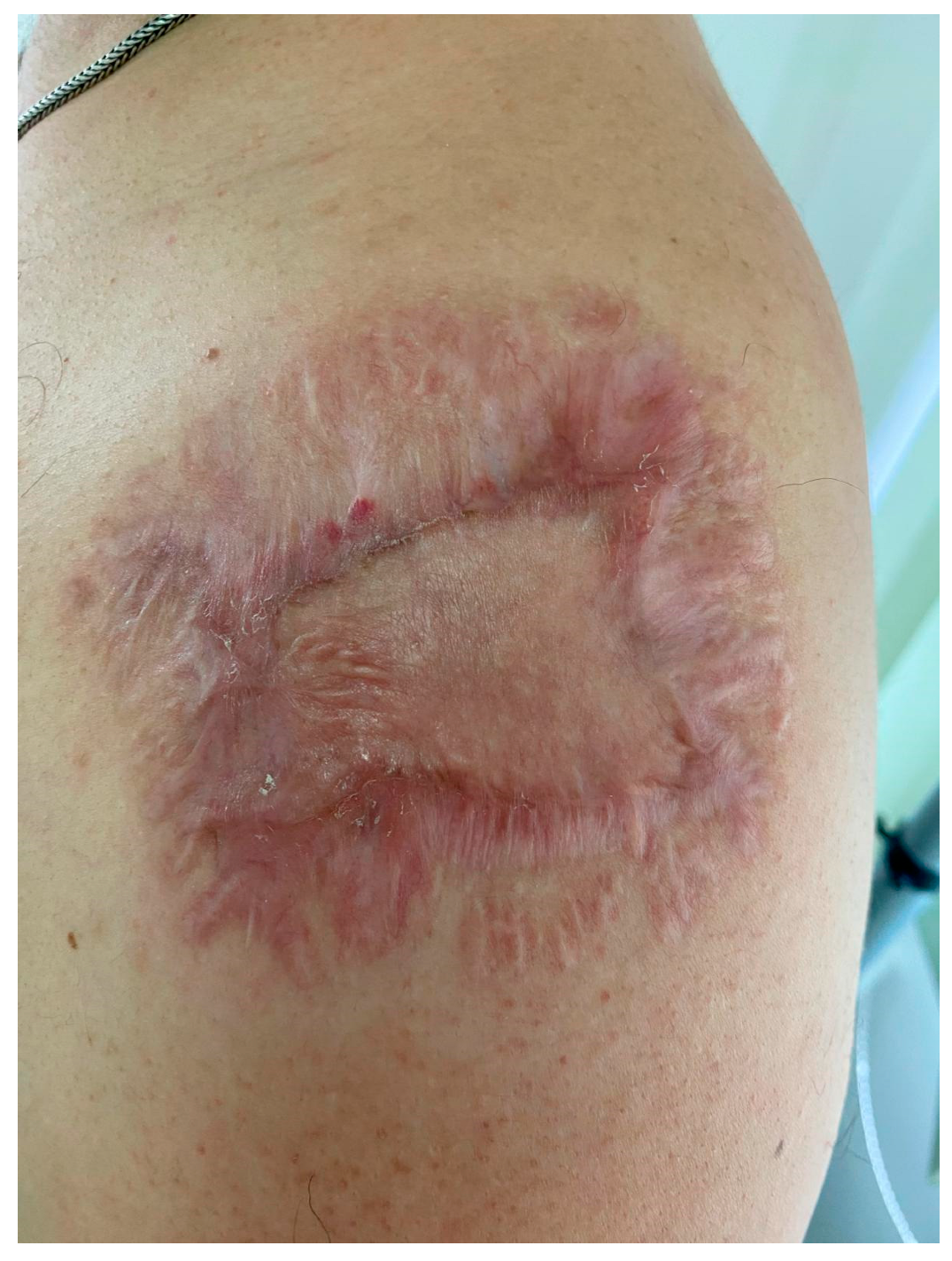
Dermatological examination revealed a 20 by 30 mm area characterized by multiple confluent red-brown macules and papules of hard-elastic consistency on the left shoulder (Figure 1).
Ultrasound of the skin and subcutaneous tissue revealed an echogenic thickening of the dermal layer with disappearance of the subcutaneous adipose layer for an extension of 33 by 23 mm. An incisional biopsy was taken from the papular component of the lesion.
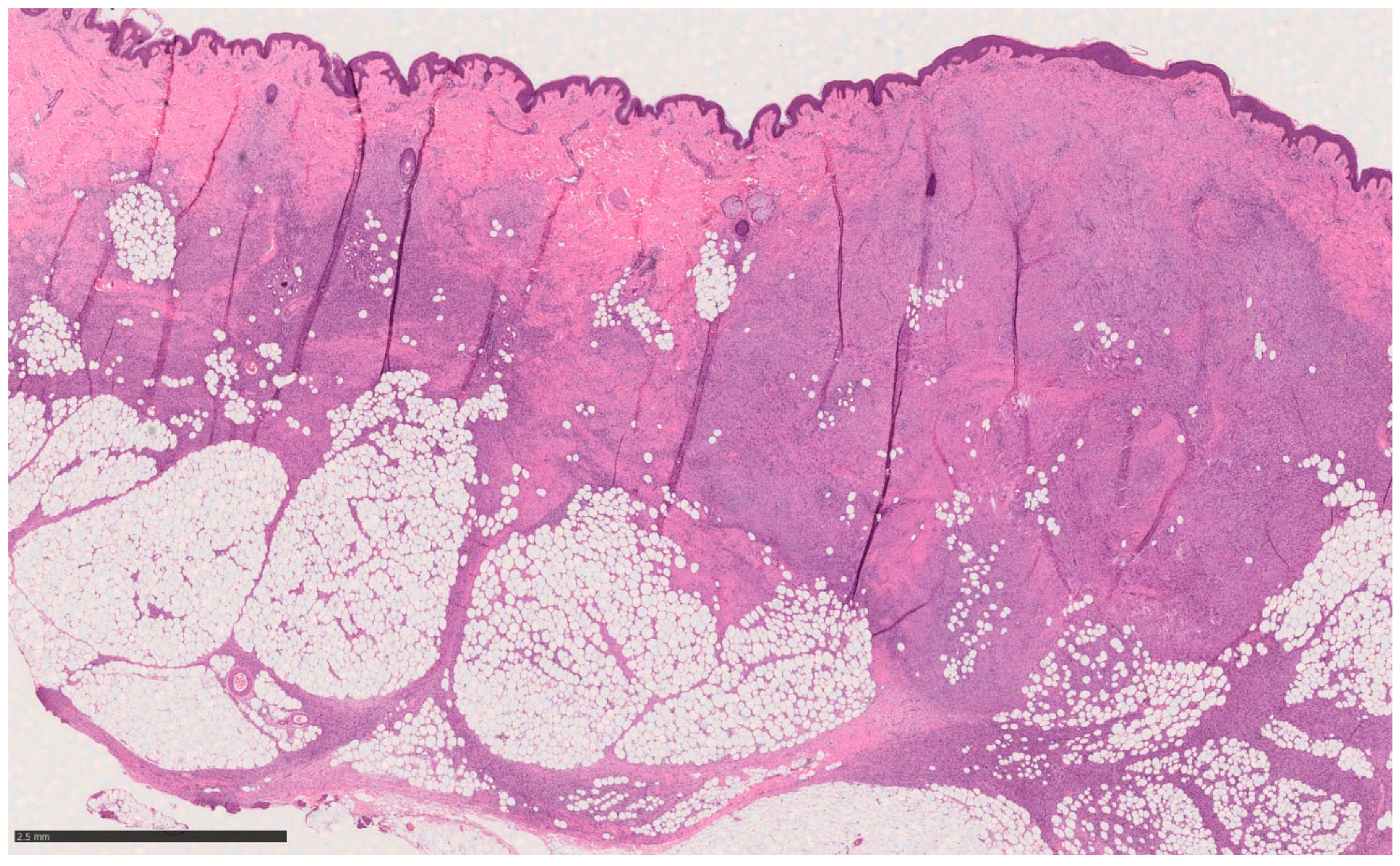
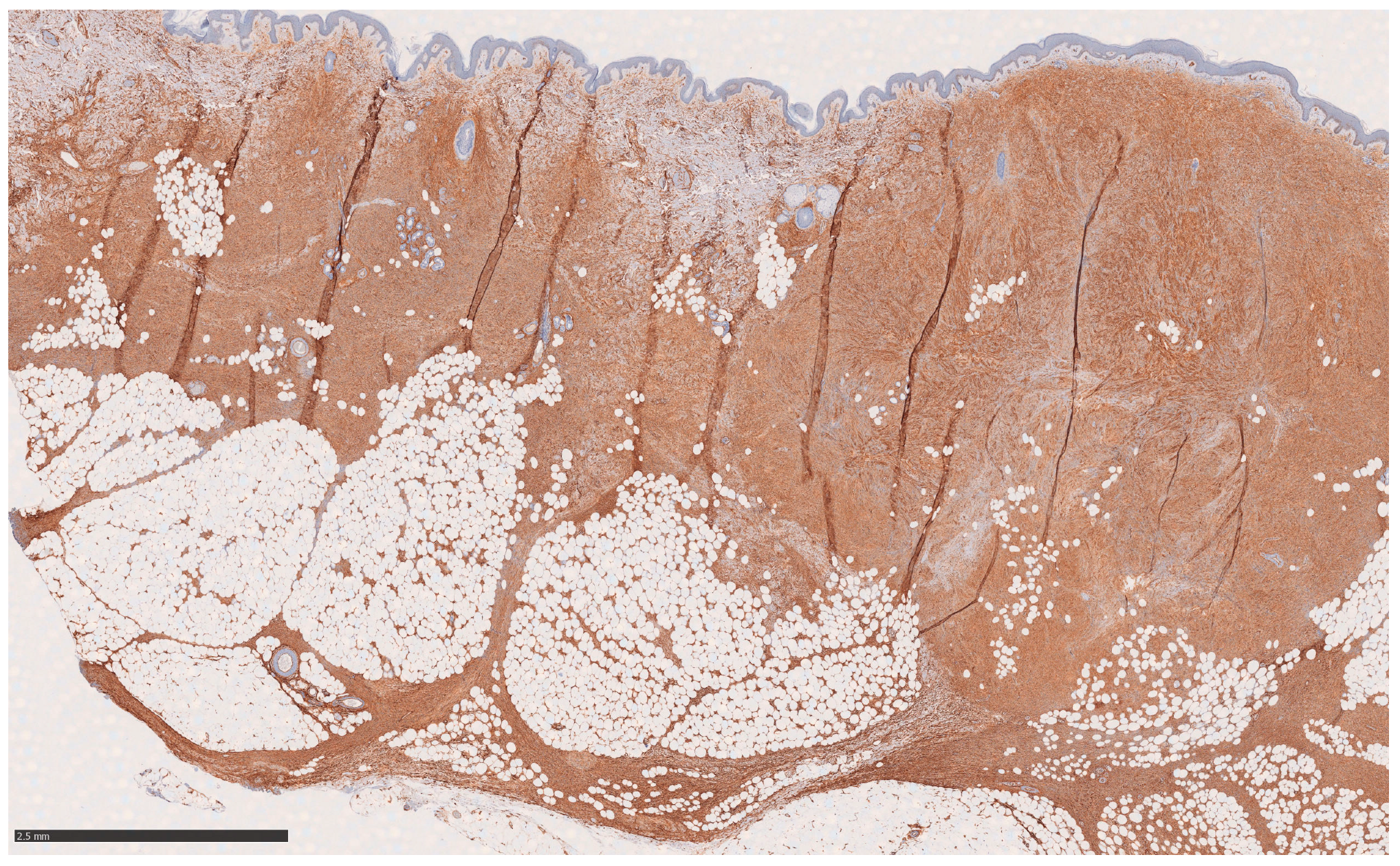
Microscopic examination revealed a dermal-based neoplasm composed of uniform spindle cells arranged in a storiform pattern. The tumor infiltrated the deep dermis and extended into the subcutaneous adipose tissue in a characteristic “honeycomb” pattern. The neoplastic cells displayed mild nuclear atypia and low mitotic activity (fewer than 1 mitosis per 10 high-power fields). No areas suggestive of fibrosarcomatous transformation were identified. Immunohistochemically, the tumor cells showed strong and diffuse CD34 expression, while S100 was negative, thus ruling out a neural neoplasm. No dermal melanocytes or melanin pigment were observed (Figure 2 and Figure 3).
The clinical and immunohistological features were consistent with the diagnosis of DFSP.
Molecular testing for the COL1A1–PDGFB fusion was not performed, as the diagnosis was considered conclusive based on the characteristic morphology and diffuse CD34 immunoreactivity in accordance with the essential diagnostic criteria recommended in the WHO Classification of Skin Tumours (5th edition).
Before completing surgical excision, the patient underwent a chest X-ray and an ultrasound of the surgical scar, abdomen, left axilla, and neck without detection of suspected lymph nodes or distant metastases.
Mohs micrographic surgery allows for intraoperative microscopic control of the surgical margins, ensuring a complete microscopic examination of the tumor margins with the conservation of surrounding tissue, leading to high cure rates and favorable cosmetic outcomes. Therefore, it is the gold-standard treatment for high-risk non-melanoma skin cancers such as DFSP. Unfortunately, this procedure may not be available everywhere due to medical, financial, or geographic constraints [12].
In our patient, a wide excision was performed with 3 cm clinically healthy tissue margins, including skin, subcutaneous tissue and deep muscle fascia, which were identified in the excision. The histopathological specimen measured 60 by 40 mm. Surgical margins were evaluated on formalin-fixed paraffin-embedded sections by radial sampling of the specimen. Multiple blocks were taken from the peripheral margins at different points and from the deep margin to assess tumor extension. All examined margins were negative for tumors.
The defect was repaired using an artificial bilaminar dermal matrix (the patient refused other types of surgical reconstruction, such as split-thickness skin grafts, full-thickness skin grafts, or local/pedicled flaps). The dermal matrix was fixed on the wound by multiple stitches, and a tie-over dressing made by non-adherent gauze was applied directly over the fenestrated silicon layer of the dermal matrix because of the need to ensure adequate dermal thickness and tissue coverage. The dressing was changed after one week and then twice a week for 15 days. The final histological examination showed tumor-free margins, and a split-thickness skin graft (STSG) was harvested from the lowest third of the same arm to avoid morbidity on other donor sites and then fixed to the new derma with a tie-over dressing as previously mentioned [7]. Both surgical procedures were performed under local anesthesia and sedation, with good compliance by the patient. Postoperative radiotherapy was not necessary. At 30 days of follow-up, the wound had healed without complications or adverse events, without pain or limitation of the arm motion and with a satisfactory aesthetic outcome.
Laboratory investigations repeated after 6 months confirmed virological suppression (nondetectable HIV RNA load in plasma) and stable T CD4+ and CD8+ counts (1271 cells/uL and 1219 cells/uL, respectively), with a T CD4+/CD8+ ratio of 1.04.
After 10 months of clinical follow-up, the patient was free from disease with a good quality of life. We used the Vancouver Scar Scale (VSS) to objectively rate the appearance of the scar, evaluating vascularity, height, pliability, and pigmentation. The scale assigns a score to each characteristic, which are added together to yield an overall score between 0 and 13. In our patient, we obtained a total score of 5, indicating slight hypertrophy. However, our patient did not report pain or functional or psychological sequelae [13,14].
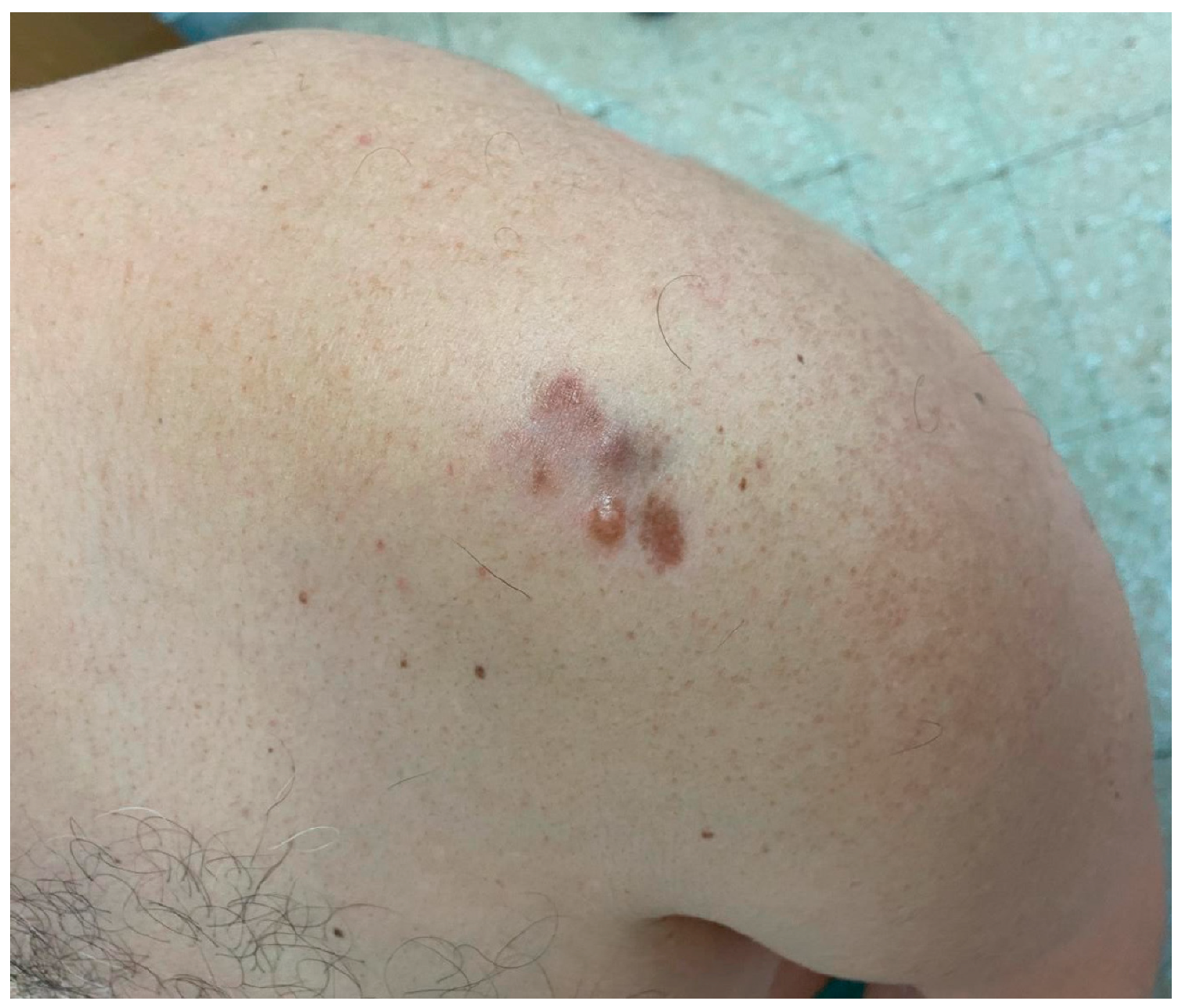
The final aesthetic outcome was acceptable, considering the anatomic location (deltoid region) that is notoriously predisposed to hypertrophic scars and keloids and the patient’s incomplete adherence to the use of silicone medications. This ended up resulting in a slight hypertrophy of the final scar (Figure 4).
This case was the first patient with DFSP within our cohort of 91 PLWH followed longitudinally for the past 3 years [11].

3. Discussion

The clinical diagnosis of DFSP may be challenging for clinicians since it is an uncommon cancer that can be easily mistaken for an atypical large histiocytoma, scarring or a keloid growth.
Ultrasound may be useful for an initial assessment of the lesion, for the preoperative planning and, in some cases, for the postoperative monitoring of recurrences. DFSP typically presents as a hypoechoic or heterogeneously hypoechoic mass with well-defined margins. The lesion tends to infiltrate the subcutaneous fat, forming a characteristic honeycomb pattern. Doppler ultrasound may show increased vascularity within the tumor, indicating its infiltrative and proliferative nature [1,2,3,4].
Very recently, a study from China demonstrated the strong diagnostic utility of high-frequency ultrasound and ultra-high-frequency ultrasound in differentiating DFSP from dermatofibroma based on key clinical and sonographic features. These findings supported the use of such diagnostic imaging techniques as valuable non-invasive tools for preoperative diagnosis [15].
However, definitive diagnosis is based on histological examination and immunohistochemistry.
Several machine learning methodologies, including those leveraging hyperspectral imaging, have been implemented to facilitate the early and accurate diagnosis of skin cancer. In particular, the Spectrum-Aided Vision Enhancer (SAVE) can convert any Red, Green, and Blue (RGB) image into a narrow-band image (NBI) to increase the contrast between cancerous lesions and normal tissue, thereby increasing diagnostic accuracy. This advanced method has been demonstrated to offer skin cancer specialists a tool for differentiating actinic keratoses from basal cell carcinomas and seborrheic keratoses with heightened accuracy. Its performance in facilitating the diagnosis of rarer skin cancers (such as DFSP) has never been investigated and represents a future challenge [16].
Given the rarity of DFSP, the literature reports few cases of this tumor in immunosuppressed individuals [11,17,18,19,20], and the occurrence in PLWH is exceptional [21].
Only a few case reports have described the onset of DFSP in renal transplant recipients, dating back more than twenty years ago [18,22,23]. They were all adult men of different ethnicities (one Chinese, one Italian and one Mauritian subject) aged from 34 to 61 years who developed DFSP in different body sites (chin, shoulder and arm) a few years after transplantation. In all cases, the tumors were locally invasive and no short-term complications were reported (follow-up ranging from 6 months to 4 years after excision) [18,22,23].
In our experience of a cohort of more than two hundred immunosuppressed subjects who had undergone solid organ transplantation (patients consecutively visited in the Dermatology Unit, San Martino Hospital, Genoa, Italy, from January 2016 to May 2022), no cases of DFSP were registered [24]. The most commonly detected skin cancer in this series was basal cell carcinoma (BCC), followed by squamous cell carcinomas (SCCs). We found a ratio of 1.7:1 between BCC-affected patients and SCC-affected patients [24], different from the ratio reported in older studies on transplanted patients, where the proportions were reversed (1:3) [25,26]. The downward trend of SCCs reported in our series might be due to less aggressive and more individualized immunosuppressive treatments, as well as to reduced doses in and careful monitoring of the patients compared to the past two decades, as described elsewhere [27,28].
Authors from the USA estimated the incidence of several rare skin cancers, including DFSP, in a different setting of immunocompromised patients, namely in patients with chronic lymphocytic leukemia (CLL) and non-Hodgkin lymphoma (NHL), using the Surveillance, Epidemiology and End Results (SEER) Program of the National Cancer Institute [10]. Two cases of DFSP were detected in a cohort of 28,964 patients with CLL and three cases in a cohort of 94,967 patients with NHL, corresponding to an incidence of 1.5 (0.2–5.3) and 0.8 (0.2–2.3) per 100,000 persons per year (95% confidence interval [CI]), respectively [10]. Considering that, globally, the incidence of DFSP is 0.008–0.045 cases per 100,000 persons per year [1,2], the authors concluded that patients with CLL/SLL or NHL have a higher risk for the subsequent development of rare skin cancers as compared to the general population [10].
In the last decade, sporadic cases of DFSP have been described in patients with inherited immunodeficiency, such as children affected by a life-threatening inborn error of immunity: adenosine deaminase-deficient severe combined immunodeficiency (ADA-SCID) [19,20,29,30]. ADA-SCID is a rare genetic disorder characterized by deficient and impaired ADA activity, resulting in the accumulation of metabolic substrates (adenosine, deoxyadenosine, and dATP), with consequences for several cellular functions. Lymphocyte maturation and function are particularly affected with both humoral and cellular immunity defects, pan-lymphopenia, life-threatening infections, failure to thrive, autoimmunity, and non-immunological organ dysfunction secondary to accumulated cytotoxic adenine metabolites [19,20,29,30]. Interestingly, Cowen E. and colleagues evaluated 15 pediatric ADA-SCID patients with one or more DFSP tumors, presenting as small (3–6 mm), atrophic, hyperpigmented, and indurated papules on the neck, trunk and extremities. The authors highlighted that ADA-SCID-associated DFSPs are usually composed of multiple lesions in the same patient (as many as 18 in a single patient) and are histologically relatively hypocellular, lacking the classic storiform pattern [30]. The natural history and optimal management of atrophic/plaque-like DFSP in children with ADA-SCID is uncertain, as is the pathologic basis for susceptibility to skin sarcomas in these patients [30].
Lastly, in the context of HIV-related immunodeficiency, DFSP has been reported only twice in a small case series dating back more than 20 years [21]. The authors described the cases of two PLWH (a 41-year-old woman with dark skin and a 50-year-old man with unspecified phototype) who developed protuberant, hypopigmented nodules on the back that were histologically diagnosed as myxoid and classic DFSP. The lesions in the second case had a recurrent behavior requiring treatment with MMS and complete excision over eight stages. Unlike our patient, both cases were in an advanced stage of HIV infection with a peripheral CD4+ T cell count of 48/mm3 and 180/mm3, corresponding to acquired immunodeficiency syndrome (AIDS). Regrettably, the HIV RNA load in plasma was not reported and the antiretroviral medications were indicated only for one patient (zidovudine and lamivudine) [21].
Table 1 summarizes the DSFP incidence in healthy and immunocompromised patients.
Our case constitutes the third reported instance of DFSP in PLWH, potentially strengthening the evidence for an increased prevalence of this rare cancer in individuals with impaired immune function. The incidence rate of DFSP in our cohort of PLWH corresponds, therefore, to one case out of 91 people (1.1%) [11].
Interestingly, the patient did not report any additional immunosuppressive factors that might have influenced the risk of developing DFSP beyond HIV infection. Indeed, he had no history of prior malignancies and was a non-smoker. The previous history of high-risk HPV infection in the anal region of our patient seems to not be relevant because it is topographically distinct from the shoulder where the DFSP developed. Furthermore, while some HPV genotypes (particularly beta-genus HPVs) are linked to the development of squamous cell carcinoma (SCC) [31,32,33], HPVs are not recognized as a pathogenic driver for DFSP. The same applies to ultraviolet (UV) radiation and sun exposure. Unlike many other skin cancers, the literature confirms that dermatofibrosarcoma protuberans is among the few without a direct link to UV radiation [34].
It should also be emphasized that our patient was unaware of the risk associated with his asymptomatic slow-growing skin lesions. Therefore, his DFSP would have remained undiagnosed indefinitely if he had not been invited to undergo skin cancer screening as part of the study on cutaneous neoplasms in PLWH [11].
A limitation of our study is the short follow-up period (10 months from diagnosis), which is too short to draw definitive conclusions. However, there is no consensus, nor is there a sufficient evidence base, regarding optimal follow-up schedules. Clinical examinations focusing on the primary site, performed every 6–12 months for at least 5 years, are recommended by the updated 2024 European interdisciplinary guidelines to detect early recurrence [5].
To date, there are no medical guidelines for managing the risk of cutaneous tumors in PLWH, despite evidence that skin cancer risk in these patients extends beyond the well-known association with Kaposi sarcoma and includes squamous cell carcinoma, high-risk melanomas and also rare tumors like Merkel cell carcinoma [17] and DFSP [11].
Although it has been shown that taking antiretroviral therapy reduces the risk of developing skin cancers compared to not taking it, PLWH undergo chronic antigenic stimulation by the virus, suffering a state of chronic inflammation and cytokine dysregulation (even when HIV replication is suppressed and CD4+ T cell count is preserved) that can contribute to the development of lymphomas and other neoplasms [35,36].
Based on the observation that skin cancers may behave more aggressively in patients with immunological deficiency [10,17] and on our cohort’s experience, demonstrating that PLWH tended to develop multiple and rare skin cancers compared to HIV-uninfected people [11], the regular use of sun protection in photoexposed areas, skin self-examinations, and dermatology evaluations for skin cancer screening at least once a year are justified and warranted in this population [10,17].
A low threshold for skin biopsy is warranted in patients with immunodeficiency, regardless of whether viral load is controlled. The onset of a new skin lesion, even if asymptomatic and slow-growing, as can occur in DFSP, should prompt careful evaluation to avoid misdiagnosis and delay in life-threatening treatment. Indeed, lesions with a long history of no treatment may evolve, especially in immunosuppressed patients, into tumors that are difficult or impossible to treat with standard surgery or radiation therapy [24,37].
Notably, patients with weakened immune systems are at risk of developing rare skin cancers that require careful examination and a high level of suspicion from dermatologists and other healthcare providers [17,24].

Author Contributions

Conceptualization, G.C. and V.V.; Methodology, V.V., A.P., L.C., P.B., L.A. and F.F.; Validation, L.C., F.S., M.M. and G.S.; Formal Analysis, F.S., P.B., V.V. and L.A.; Investigation, S.L.C., F.F., L.A., F.F. and L.C.; Resources, M.M., V.V. and S.L.C.; Data Curation, F.D., L.A. and P.B.; Writing—Original Draft Preparation, G.C. and V.V.; Writing—Review and Editing, F.S., F.D. and A.P.; Visualization, G.S., M.M. and S.L.C.; Supervision, G.C., G.S. and A.P. All authors have read and agreed to the published version of the manuscript.

Funding

This research received no external funding.

Institutional Review Board Statement

This study was conducted in accordance with the Declaration of Helsinki and approved by the Ethics Committee of OSPEDALI RIUNITI DI FOGGIA (protocol code: 104/C.E./2020; dated 30 September 2020).

Informed Consent Statement

Informed consent for publication was obtained from identifiable human participants.

Data Availability Statement

Data are unavailable due to privacy and ethical restrictions.

Conflicts of Interest

The authors declare no conflict of interest.

References

  1. Remiszewski, P.; Taczała, J.; Rosiński, M.; Szumera-Ciećkiewcz, A.; Szostakowski, B.; Czarnecka, A.M. Dermatofibrosarcoma Protuberans (DFSP): Diagnostics and Molecular Pathology. Curr. Treat. Options Oncol. 2025, 26, 950–966. [Google Scholar] [CrossRef]
  2. Remiszewski, P.; Pisklak, A.; Filipek, K.; Spałek, M.J.; Szumera-Ciećkiewicz, A.; Szostakowski, B.; Krotewicz, M.; Czarnecka, A.M. Dermatofibrosarcoma Protuberans (DFSP): Current Treatments and Clinical Trials. Curr. Treat. Options Oncol. 2025, 26, 967–989. [Google Scholar] [CrossRef]
  3. Sleiwah, A.; Psomadakis, C.; Craythorne, E.; Stefanato, C.M.; Rickaby, W.; Robson, A.; Mellerio, J.E.; Greig, A. Dermatofibrosarcoma protuberans (DFSP) in children: A combined multidisciplinary approach. Pediatr. Dermatol. 2021, 38, 233–236. [Google Scholar]
  4. Jozwik, M.; Bednarczuk, K.; Osierda, Z. Dermatofibrosarcoma Protuberans: An Updated Review of the Literature. Cancers 2024, 16, 3124. [Google Scholar] [CrossRef] [PubMed]
  5. Saiag, P.; Lebbe, C.; Brochez, L.; Emile, J.F.; Forsea, A.M.; Harwood, C.; Hauschild, A.; Italiano, A.; Kandolf, L.; Kelleners-Smeets, N.W.; et al. Diagnosis and treatment of dermatofibrosarcoma protuberans. European interdisciplinary guideline—Update 2024. Eur. J. Cancer 2025, 218, 115265. [Google Scholar] [PubMed]
  6. Maghfour, J.; Genelin, X.; Olson, J.; Wang, A.; Schultz, L.; Blalock, T.W. The epidemiology of dermatofibrosarcoma protuberans incidence, metastasis, and death among various population groups: A Surveillance, Epidemiology, and End Results database analysis. J. Am. Acad. Dermatol. 2024, 91, 826–833. [Google Scholar] [CrossRef] [PubMed]
  7. Lembo, F.; Cecchino, L.R.; Parisi, D.; Portincasa, A. Role of a new acellular dermal matrix in a multistep combined treatment of dermatofibrosarcoma protuberans of the lumbar region: A case report. J. Med. Case Rep. 2021, 15, 180. [Google Scholar] [CrossRef]
  8. Lai, M.; Pampena, R.; Cornacchia, L.; Odorici, G.; Piccerillo, A.; Pellacani, G.; Peris, K.; Longo, C. Cutaneous squamous cell carcinoma in patients with chronic lymphocytic leukemia: A systematic review of the literature. Int. J. Dermatol. 2022, 61, 548–557. [Google Scholar]
  9. Akaike, T.; Ch’en, P.Y.; Hippe, D.S.; Gilmour, M.W.; Gong, E.; Fu, A.; Singh, N.; Cahill, K.; Gunnell, L.; Vohra, N.; et al. Merkel cell carcinoma in solid organ transplant recipients: Prognosis and response to immunotherapy. Br. J. Dermatol. 2025, 193, 1221–1231. [Google Scholar] [CrossRef]
  10. Brewer, J.D.; Shanafelt, T.D.; Call, T.G.; Cerhan, J.R.; Roenigk, R.K.; Weaver, A.L.; Otley, C.C. Increased incidence of malignant melanoma and other rare cutaneous cancers in the setting of chronic lymphocytic leukemia. Int. J. Dermatol. 2015, 54, 287–293. [Google Scholar] [CrossRef]
  11. Ciccarese, G.; Cecchino, L.R.; Lembo, F.; Ferrara, S.; Grillo, C.; Pizzulli, C.; Di Tullio, P.; Romita, P.; Foti, C.; Sanguedolce, F.; et al. Skin Cancers in People Living with Human Immunodeficiency Virus (HIV) Infection. J. Clin. Med. 2025, 14, 6447. [Google Scholar] [CrossRef] [PubMed]
  12. Maciejewska, M.; Bętkowska, A.; Czuwara, J.; Rudnicka, L.; Banciu, L.; Tebeica, T.; Leventer, M. Mohs Micrographic Surgery: A Narrative Review of Current Practices, Emerging Trends, and Case-Based Insights. Adv. Ther. 2025, 42, 5397–5426. [Google Scholar] [CrossRef] [PubMed]
  13. Thompson, C.M.; Sood, R.F.; Honari, S.; Carrougher, G.J.; Gibran, N.S. What score on the Vancouver Scar Scale constitutes a hypertrophic scar? Results from a survey of North American burn-care providers. Burns 2015, 41, 1442–1448. [Google Scholar] [CrossRef]
  14. Knight, D.; Parks, J. 108 An Introductory Systematic Review of the Vancouver Scar Scale: Versions, Validations and Utilizations. J. Burn Care Res. 2025, 46, S86. [Google Scholar] [CrossRef]
  15. Chen, G.; Luo, H.; Liu, W.; Liao, X.; Meng, J.; Qiu, Z.; Leng, X. Diagnostic Performance of High-Frequency Ultrasound and Ultra-High-Frequency Ultrasound in Distinguishing Dermatofibrosarcoma Protuberans from Dermatofibroma: A 15-year Period Retrospective Analysis. Clin. Cosmet. Investig. Dermatol. 2025, 18, 3621–3634. [Google Scholar] [CrossRef]
  16. Lin, T.L.; Mukundan, A.; Karmakar, R.; Avala, P.; Chang, W.Y.; Wang, H.C. Hyperspectral Imaging for Enhanced Skin Cancer Classification Using Machine Learning. Bioengineering 2025, 12, 755. [Google Scholar] [CrossRef] [PubMed]
  17. Reinhart, J.P.; Leslie, K.S. Skin cancer risk in people living with HIV: A call for action. Lancet HIV 2024, 11, e60–e62. [Google Scholar] [CrossRef]
  18. Brown, V.L.; Proby, C.M.; Harwood, C.A.; Cerio, R. Dermatofibrosarcoma protruberans in a renal transplant recipient. Histopathology 2003, 42, 198–200. [Google Scholar] [CrossRef]
  19. Fostier, W.; Gardner, L.; Charlton, F.; Dubois, A.; Gennery, A.R.; Leech, S. P06 Adenosine deaminase deficient-severe combined immunodeficiency and multicentric dermatofibrosarcoma protuberans: An emerging association. Br. J. Dermatol. 2025, 193, ljaf465.014. [Google Scholar] [CrossRef]
  20. Wahjudi, T.D.; Kutzner, H.; Bleeke, M.; Hoeger, P.H. Multicentric dermatofibrosarcoma protuberans in a child with severe combined immunodeficiency due to adenosine deaminase deficiency. Pediatr. Dermatol. 2021, 38, 875–878. [Google Scholar] [CrossRef]
  21. Sapadin, A.N.; Gelfand, J.M.; Howe, K.L.; Phelps, R.G.; Grand, D.; Rudikoff, D. Dermatofibrosarcoma protuberans in two patients with acquired immunodeficiency syndrome. Cutis 2000, 65, 85–88. [Google Scholar]
  22. Lai, K.N.; Lai, F.M.; King, W.W.; Li, P.K.; Siu, D.; Leung, C.B.; Lui, S.F. Dermatofibrosarcoma protuberans in a renal transplant patient. Aust. N. Z. J. Surg. 1995, 65, 900–902. [Google Scholar] [CrossRef]
  23. Picciotto, F.; Basolo, B.; Massara, C.; Caliendo, V.; Aloi, F.; Gaia, S.; Bayle, F.; Quarello, F. Dermatofibrosarcoma protuberans at the site of arteriovenous fistula in a renal transplant recipient. Transplantation 1999, 68, 1074–1075. [Google Scholar] [CrossRef] [PubMed]
  24. Trave, I.; Ciccarese, G.; Gasparini, G.; Canta, R.; Serviddio, G.; Herzum, A.; Drago, F.; Parodi, A. Skin cancers in solid organ transplant recipients: A retrospective study on 218 patients. Transpl. Immunol. 2023, 80, 101896. [Google Scholar] [CrossRef] [PubMed]
  25. Madeleine, M.M.; Patel, N.S.; Plasmeijer, E.I.; Engels, E.A.; Bouwes Bavinck, J.N.; Toland, A.E.; Green, A.C. Epidemiology of keratinocyte carcinomas after organ transplantation. Br. J. Dermatol. 2017, 177, 1208–1216. [Google Scholar] [CrossRef]
  26. Euvrard, S.; Kanitakis, J.; Claudy, A. Skin cancers after organ transplantation. N. Engl. J. Med. 2003, 348, 1681–1691. [Google Scholar] [CrossRef]
  27. Rizvi, S.M.H.; Aagnes, B.; Holdaas, H.; Gude, E.; Boberg, K.M.; Bjørtuft, Ø.; Helsing, P.; Leivestad, T.; Møller, B.; Gjersvik, P. Long-term Change in the Risk of Skin Cancer After Organ Transplantation: A Population-Based Nationwide Cohort Study. JAMA Dermatol. 2017, 153, 1270–1277. [Google Scholar] [CrossRef]
  28. El-Qushayri, A.E.; Mahmoud, A.R.; Tawfik, A.G.; Reda, A.; Nardone, B. The underestimated skin cancer risk after liver transplantation: A systematic review and meta-analysis. Ital. J. Dermatol. Venerol. 2025, 160, 234–241. [Google Scholar] [CrossRef]
  29. Cowen, E.W.; Pichard, D.C.; Garabedian, E.; Miettinen, M. Medallion-Like Dermal Dendrocytic Hamartoma, Dermatofibrosarcoma Protuberans, and Adenosine Deaminase-Deficient Severe Combined Immunodeficiency. Pediatr. Dermatol. 2016, 33, 359–360. [Google Scholar] [CrossRef] [PubMed]
  30. Kesserwan, C.; Sokolic, R.; Cowen, E.W.; Garabedian, E.; Heselmeyer-Haddad, K.; Lee, C.C.; Pittaluga, S.; Ortiz, C.; Baird, K.; Lopez-Terrada, D.; et al. Multicentric dermatofibrosarcoma protuberans in patients with adenosine deaminase-deficient severe combined immune deficiency. J. Allergy Clin. Immunol. 2012, 129, 762–769. [Google Scholar] [CrossRef]
  31. Cohen, C.M.; Clarke, M.A. Anal Cancer and Anal Cancer Screening. Clin. Obstet. Gynecol. 2023, 66, 516–533. [Google Scholar] [CrossRef] [PubMed] [PubMed Central]
  32. Alam, Z.; Nguyen, K.T.; Goldstein, D.R.; Raman, J.; Pyrtle, F.A.; Posligua, A.; West, C.E.; Verma, K.K.; Tarbox, M.B. Amplified Skin Cancer Risk in HPV-Positive Immunosuppressed Patients: A Multicenter Real-World Cohort Study. Int. J. Dermatol. 2026, 65, 857–859. [Google Scholar] [CrossRef] [PubMed]
  33. Neagu, N.; Dianzani, C.; Venuti, A.; Bonin, S.; Voidăzan, S.; Zalaudek, I.; Conforti, C. The role of HPV in keratinocyte skin cancer development: A systematic review. J. Eur. Acad. Dermatol. Venereol. 2023, 37, 40–46. [Google Scholar] [CrossRef] [PubMed]
  34. Laikova, K.V.; Oberemok, V.V.; Krasnodubets, A.M.; Gal’chinsky, N.V.; Useinov, R.Z.; Novikov, I.A.; Temirova, Z.Z.; Gorlov, M.V.; Shved, N.A.; Kumeiko, V.V.; et al. Advances in the Understanding of Skin Cancer: Ultraviolet Radiation, Mutations, and Antisense Oligonucleotides as Anticancer Drugs. Molecules 2019, 24, 1516. [Google Scholar] [CrossRef] [PubMed]
  35. Zhao, H.; Shu, G.; Wang, S. The risk of non-melanoma skin cancer in HIV-infected patients: New data and meta-analysis. Int. J. STD AIDS 2016, 27, 568–575. [Google Scholar] [CrossRef]
  36. Yarchoan, R.; Uldrick, T.S. HIV-Associated Cancers and Related Diseases. N. Engl. J. Med. 2018, 378, 1029–1041. [Google Scholar] [CrossRef]
  37. Ascierto, P.A.; Fargnoli, M.C.; Caracò, C.; Dika, E.; Mandalà, M.; Massi, D.; Paradisi, A.; Portincasa, A.; Quaglino, P.; Queirolo, P.; et al. Evaluation of Sonidegib Cytoreductive Activity in Locally Advanced Basal Cell Carcinoma Treatment: A Delphi Consensus. Int. J. Dermatol. 2025, 65, 543–552. [Google Scholar] [CrossRef]
Figure 1. Multiple confluent red-brown macules and papules of hard-elastic consistency on the left shoulder.
Microbiolres 17 00061 g001
Figure 2. Spindle cell neoplasm with a storiform pattern, infiltrating the deep dermis and subcutaneous fat in a honeycomb pattern (H&E; original magnification 250×).
Microbiolres 17 00061 g002
Figure 3. The neoplastic cells are intensely and uniformly CD34-positive (IHC; original magnification 250×).
Microbiolres 17 00061 g003
Figure 4. After 10 months from diagnosis, the aesthetic outcome was acceptable. The scar reached an overall size of 5 by 7 cm.
Microbiolres 17 00061 g004
Table 1. Summary of DSFP incidence in healthy and immunocompromised patients.
ConditionIncidence of DFSPReferences
General population0.008–0.045 cases per 100,000 persons per year [1,2]
People under 20 years of age<1 case per one million people[3]
Patients with chronic lymphocytic leukemia (CLL) and non-Hodgkin lymphoma1.5 (0.2–5.3) and 0.8 (0.2–2.3) per 100,000 persons per year [10]
Patients with adenosine deaminase-deficient severe combined immunodeficiency (ADA-SCID)Unknown (among 12 patients with ADA-SCID studied, eight had DFSP)[30]
People living with human immunodeficiency virus infection (PLWH)One out of 91 persons[11]
Transplanted patientsUnknown (sporadic case reports)[18,22,23]
Disclaimer/Publisher’s Note: The statements, opinions and data contained in all publications are solely those of the individual author(s) and contributor(s) and not of MDPI and/or the editor(s). MDPI and/or the editor(s) disclaim responsibility for any injury to people or property resulting from any ideas, methods, instructions or products referred to in the content.