Article

Screening and Culture Condition Optimization of a Catalpol-Producing Brevundimonas olei

1
School of Resources and Environment, Henan Polytechnic University, Jiaozuo 454000, China
2
School of Medicine, Henan Polytechnic University, Jiaozuo 454000, China
*
Author to whom correspondence should be addressed.
Microbiol. Res. 2026, 17(3), 60; https://doi.org/10.3390/microbiolres17030060

Submission received: 30 January 2026 / Revised: 5 March 2026 / Accepted: 13 March 2026 / Published: 19 March 2026

Abstract

Catalpol, one of the primary bioactive components in Rehmannia glutinosa, is an iridoid glycoside with significant pharmacological activities. To expand the microbial sources of catalpol, endophytic bacteria were isolated from R. glutinosa (cultivated in Jiaozuo, China) using the dilution plating method combined with vanillin–sulfuric acid colorimetric assay. High-performance liquid chromatography (HPLC) and liquid chromatography–mass spectrometry (LC-MS) were employed for screening and identification. The isolated strain was identified through morphological characterization and 16S rDNA gene sequence analysis, while single-factor experiments coupled with response surface methodology were utilized to optimize its fermentation conditions. Results indicated that the strain DH14 formed circular, cream-white, opaque colonies and was Gram-negative. It was identified as Brevundimonas olei. The optimal fermentation conditions were determined to be 190 rpm, pH 7.6, 31 °C, and 0% NaCl. Meanwhile, the results revealed a positive correlation between the pH of the fermentation broth and catalpol production. Under the optimized conditions, the maximum catalpol yield reached 0.142 mg/mL after 3 days of cultivation. This study provides a promising microbial resource and optimized fermentation parameters for the microbial production of catalpol.

1. Introduction

Rehmannia glutinosa Libosch., a perennial herb belonging to the family Scrophulariaceae, possesses a complex array of chemical constituents. The major bioactive components identified in this plant primarily include iridoid glycosides, phenylethanoid glycosides, ionones, triterpenes, and flavonoids [1]. Catalpol, a polar iridoid glycoside, demonstrates multifaceted pharmacological potential including anti-inflammatory, antioxidant, antitumor, and antidiabetic activities [2,3,4,5]. This compound is widely distributed in numerous plant families, including Scrophulariaceae, Lamiaceae, and Bignoniaceae. To date, the vast majority of studies have adopted material derived from Rehmannia glutinosa [6]. However, medicinal plants face intrinsic limitations such as low bioactive compound yields and prolonged growth cycles, rendering conventional cultivation-dependent approaches insufficient to meet growing market demands for natural bioactive agents [7].
Endophytic microorganisms establish intimate biological interactions with their host plants [8], producing secondary metabolites with novel structural scaffolds or enhanced bioactivities [9]. Empirical studies confirm that endophytes and hosts co-synthesize bioactive compounds including alkaloids, steroids, and terpenoids [10]. Liang et al. [11] reported that various endophytic fungi associated with Eucommia ulmoides are closely related to its major bioactive constituents. Li et al. demonstrated a positive correlation between endophytic fungi in Dendrobium and the accumulation of flavonoids in the plant [12]. Lata et al. isolated a strain from Rauvolfia serpentina capable of producing reserpine, a key medicinal component of the plant [13]. Similarly, Leng et al. isolated an endophytic fungus from the root tissue of Rehmannia glutinosa that produces catalpol, an active compound of this medicinal plant [14].
Building on this premise, this study isolated and screened endophytic strains from fresh R. glutinosa tubers for catalpol biosynthesis. Initial screening employed the vanillin–sulfuric acid colorimetric assay, followed by High-Performance Liquid Chromatography (HPLC) validation. Liquid Chromatography–Mass Spectrometry (LC-MS) analysis confirmed compound identity.

2. Materials and Methods

2.1. Experimental Materials and Media

R. glutinosa grows at temperatures ranging from 20 °C to 35 °C, and its fresh tuberous roots were collected from agricultural fields in Jiaozuo, Henan province, China. Molecular biology reagents including the Ezup Column Bacterial Genomic DNA Extraction Kit were obtained from Sangon Biotech (Shanghai) Co., Ltd. (Shanghai, China). Bacteriological media components comprised tryptone and yeast extract (Oxoid, UK), while analytical-grade NaCl, HgCl2, and ethanol were purchased from Tianjin Kemiou Chemical Reagent Co., Ltd. (Tianjin, China).
Luria–Bertani (LB) medium was prepared as follows: 1% (w/v) tryptone, 0.5% (w/v) yeast extract, 1% (w/v) NaCl, and 1.5% (w/v) agar for solid media. Liquid LB medium was prepared without agar. All components were autoclaved at 121 °C for 20 min prior to use.

2.2. Sample Processing and Endophyte Isolation

Fresh tuberous roots of R. glutinosa were thoroughly washed under running tap water for 20 min, followed by surface sterilization with 0.1% HgCl2 for 3 min and 75% ethanol for 3 min. The roots were then rinsed three times with sterile distilled water. Approximately 20 g of the disinfected tissue was cut into small pieces using a sterile scalpel and homogenized in a sterile mortar. The homogenate was suspended in 10 mL of sterile water and serially diluted (10−2 and 10−3). Aliquots of 100 μL were plated onto LB agar plates and incubated at 35 °C for 3 days. Single colonies that emerged were subsequently purified three times to obtain axenic strains.

2.3. Screening by Vanillin–Sulfuric Acid Colorimetric Assay and Construction of the Catalpol Standard Curve

The bacterial strains were inoculated into 30 mL of LB medium and cultured under optimized conditions for 24 h. Subsequently, they were transferred to 50 mL of fresh medium at a 2% (v/v) inoculum size and cultivated under the same conditions for another 5 days.
Endophytic strains were screened for catalpol production using the vanillin–sulfuric acid colorimetric assay. This method relies on the principle that iridoid glycosides (e.g., catalpol) undergo condensation reactions with aldehydes like vanillin under acidic conditions, forming pink complexes with characteristic visible absorption [15]. Post-fermentation, cultures were centrifuged at 9000 rpm for 10 min to collect supernatants. Aliquots of supernatant were mixed with colorimetric reagent (comprising 82 mL deionized water, 8 mL concentrated H2SO4, and 27 mg vanillin per 90 mL total volume) in a 1:9 (v/v) ratio. The reaction mixtures were incubated at 80 °C for 4 h, after which absorbance was measured at 510 nm. Strains exhibiting higher absorbance values (indicative of elevated catalpol production) were selected for subsequent analyses [16].
For quantitative determination, a standard curve was constructed using purified catalpol. A stock solution (1 mg/mL) was prepared by dissolving 25 mg catalpol standard in 25 mL ultrapure water. Serial dilutions generated working solutions of 0.04–0.24 mg/mL. Following identical colorimetric processing, absorbance values at 510 nm were plotted against known concentrations to establish the calibration curve. This curve enabled precise quantification of catalpol in fermentation samples.

2.4. Catalpol Identification

2.4.1. HPLC Analysis

Fermentation broth was vacuum-filtered and freeze-dried. The resulting residue was extracted via ultrasonication (30 min) in 25 mL methanol. After filtration, the supernatant was evaporated under nitrogen flow in a fume hood. The dried extract was reconstituted in 5 mL ultrapure water, centrifuged (10,000× g, 10 min), and filtered through a 0.22 μm membrane prior to analysis. Meanwhile, A 0.4 mg/mL catalpol standard solution was prepared by dissolving 10 mg certified reference material in 25 mL ultrapure water, followed by membrane filtration (0.22 μm). HPLC analysis was performed using a Waters e2695 system. The chromatographic separation was conducted according to the relevant methods outlined in the Chinese Pharmacopoeia with slight modifications. The analytical column was a C18 reversed-phase column. The mobile phase consisted of acetonitrile (A) and water (B) under isocratic elution conditions (v:v = 5:95) at a flow rate of 1.0 mL/min. The column temperature was maintained at 30 °C, and the detection wavelength was set at 210 nm with an injection volume of 10 μL. Under the aforementioned chromatographic conditions, the sample solutions were analyzed and compared with the catalpol standard based on retention time for qualitative identification.

2.4.2. LC-MS Analysis

LC-MS analysis was carried out using a Thermo Scientific Q Exactive mass spectrometer coupled with a liquid chromatography system. The mass spectrometric parameters were set according to the method reported by Xu et al. [17] with specific configurations as follows: a heated electrospray ionization (HESI) source was employed; the spray voltage was set to 3200 V in negative ion mode; the capillary temperature was maintained at 320 °C; the sheath gas flow rate was 40 arb; and the auxiliary gas flow rate was 10 arb. Following chromatographic separation, the samples were introduced into the mass spectrometer. Catalpol was further identified by comparing the extracted ion chromatograms (EICs) and retention times between the sample solutions and the reference standard.

2.5. Strain Identification

The colony morphology of the selected strain DH14 was observed, and bacterial classification was preliminarily determined by Gram staining. Genomic DNA was extracted from strain DH14, and the 16S rDNA sequence was amplified using the universal primers 27F (5′-AGAGTTTGATCCTGGCTCAG-3′) and 1492R (5′-GGTTACCTTGTTACGACTT-3′). The PCR products were purified and sequenced using an ABI 3730XL Genetic Analyzer. The obtained 16S rDNA sequences were compared with those in the GenBank database (http://www.ncbi.nlm.nih.gov, accessed on 16 December 2025) using the BLASTn algorithm (version 2.16.0). Reference sequences from related species and an outgroup strain were downloaded, and a phylogenetic tree was generated using MEGA (version 9.0) based on the 16S rDNA sequences. The Neighbor-Joining method was employed, and the Kimura 2-parameter model was selected to compute the evolutionary distances.

2.6. Optimization of Culture Conditions

2.6.1. Single-Factor Cultivation Experiments

The strain DH14 was inoculated into 30 mL of medium and cultured at 34 °C with shaking at 150 rpm for 24 h to prepare the seed culture.
Optimal pH for growth: The seed culture was inoculated at 5% (v/v) into 30 mL of medium with initial pH values of 6.0, 6.5, 7.0, 7.5, and 8.0, followed by overnight incubation at 34 °C and 150 rpm.
Optimal NaCl concentration: The seed culture was inoculated at 5% (v/v) into 30 mL of medium containing 0%, 1%, 2%, 3%, and 4% (w/v) NaCl. Cultures were incubated overnight at 34 °C and 150 rpm without pH adjustment.
Optimal temperature: The seed culture was inoculated at 5% (v/v) into 30 mL of medium and incubated overnight at 28 °C, 30 °C, 32 °C, 34 °C, and 36 °C with shaking at 150 rpm, without pH adjustment.
Optimal shaking speed: The seed culture was inoculated at 5% (v/v) into 30 mL of medium and shaken at 100, 130, 160, 190, and 220 rpm overnight at 34 °C, without pH adjustment.
Optimal inoculum size: The seed culture was inoculated at 1%, 2%, 3%, 4%, and 5% (v/v) into 30 mL of medium and incubated overnight at 34 °C and 150 rpm, without pH adjustment.
After cultivation, each culture was diluted appropriately, and the optical density at 600 nm (OD600) was measured using a UV-visible spectrophotometer.

2.6.2. Response Surface Optimization

Based on the results of the single-factor experiments, four key factors—initial pH (A), NaCl concentration (B), incubation temperature (C), and shaking speed (D)—were selected for further optimization. A four-factor, three-level Box–Behnken design was employed to systematically evaluate the effects of these factors and their interactions on bacterial growth. The optical density at 600 nm (OD600) was used as the response variable (Y).

2.7. Analysis of Catalpol Production and pH Variation in the Culture Medium

The strain DH14 was inoculated into 50 mL of culture medium and cultivated under the optimal conditions determined by response surface methodology. Samples were collected at 24 h intervals. The fermentation broth was subjected to chromogenic reaction as described previously, and the absorbance at 510 nm was measured to determine the relative catalpol content. The pH of the fermentation broth was recorded concurrently. Based on the measurements, the change in pH and the accumulation profile of catalpol during the cultivation period were plotted. The concentration of catalpol corresponding to its maximum level was calculated.

2.8. Statistical Analysis

All experiments in this study were conducted with three parallel replicates. A p-value < 0.05 was set as the threshold for statistical significance, and experimental data were expressed as the mean ± standard deviation. Data from single-factor experiments were processed and analyzed using Origin software 2024, and histograms with error bars were generated to illustrate the relationships between variables and experimental indicators, as well as data variability. Response surface methodology (RSM) experimental design, regression fitting, and analysis of variance (ANOVA) were performed using Design-Expert software. A quadratic regression equation was established to evaluate the fit and the significance of variables.

3. Results

3.1. Isolation and Preliminary Screening of Endophytic Bacteria from R. glutinosa

A total of 25 bacterial strains were isolated and purified from the collected samples. The colorimetric vanillin–sulfuric acid method was used to compare the OD510 values of each strain, revealing one strain with relatively high catalpol production, which showed an OD510 of 0.105. This strain was designated as DH14.
A standard curve of catalpol was established, yielding the linear equation Y = 1.0662 X (Y: catalpol concentration, mg/mL; X: OD510 after color development), with a correlation coefficient (R2) of 0.9929, indicating a good linear relationship. Based on this equation, the catalpol content in the fermentation broth of strain DH14 was calculated to be approximately 0.112 mg/mL.

3.2. Identification by HPLC and LC-MS

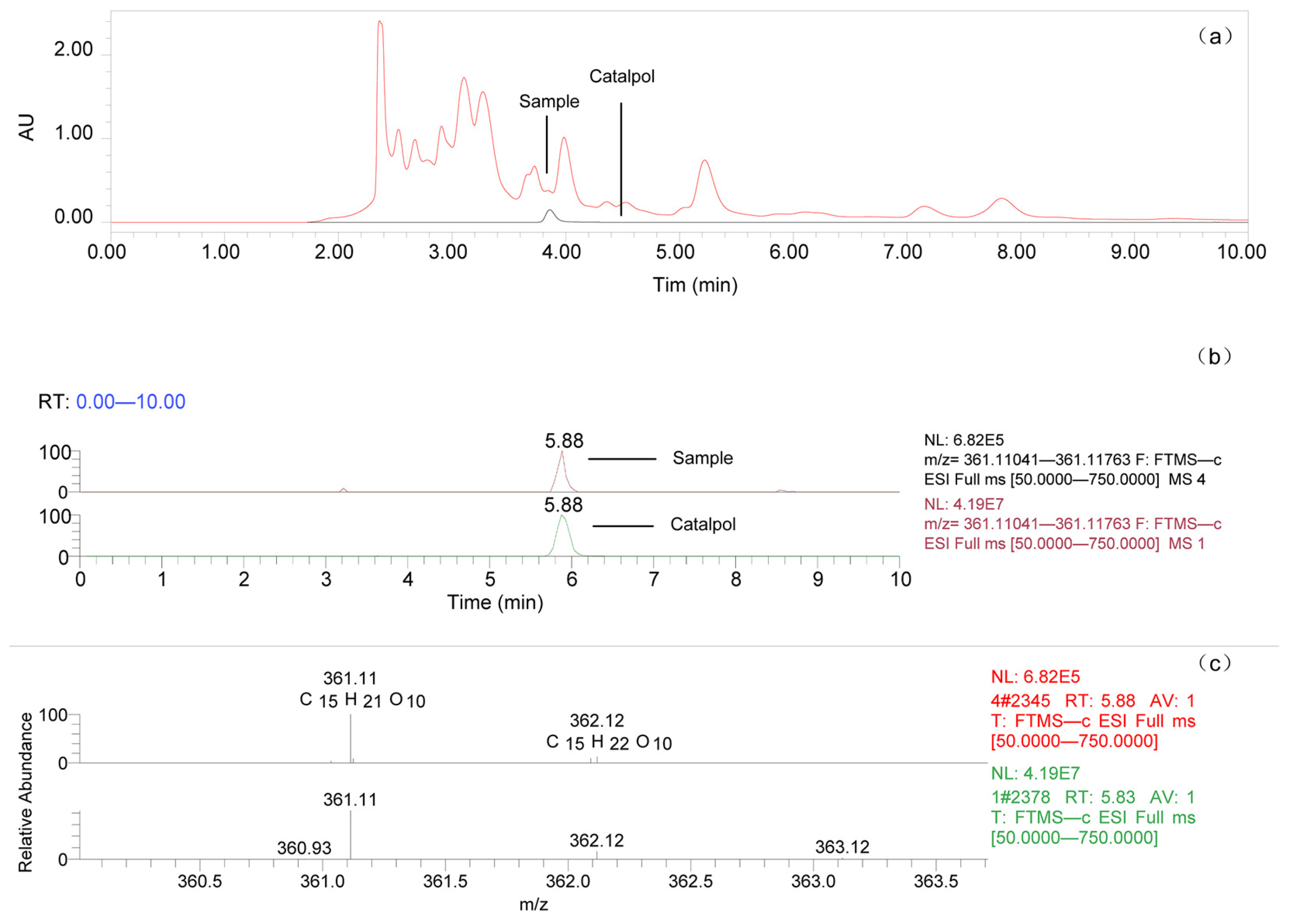
The processed fermentation broth of strain DH14 was subjected to HPLC analysis. As shown in Figure 1a, a distinct characteristic peak appeared at the retention time corresponding to that of the catalpol standard, suggesting the presence of catalpol in the fermentation broth.
Further analysis was performed using LC-MS. The extracted ion chromatograms of the quasi-molecular ion peak of catalpol from the DH14 sample and the standard were compared (Figure 1b). The retention time of the target compound in the DH14 sample matched that of the catalpol standard. Moreover, the mass spectral features of the compound in the sample were highly consistent with those of the standard (Figure 1c). These results confirmed that catalpol was produced in the fermentation broth of strain DH14.

3.3. Identification and Phylogenetic Analysis of Strain DH14

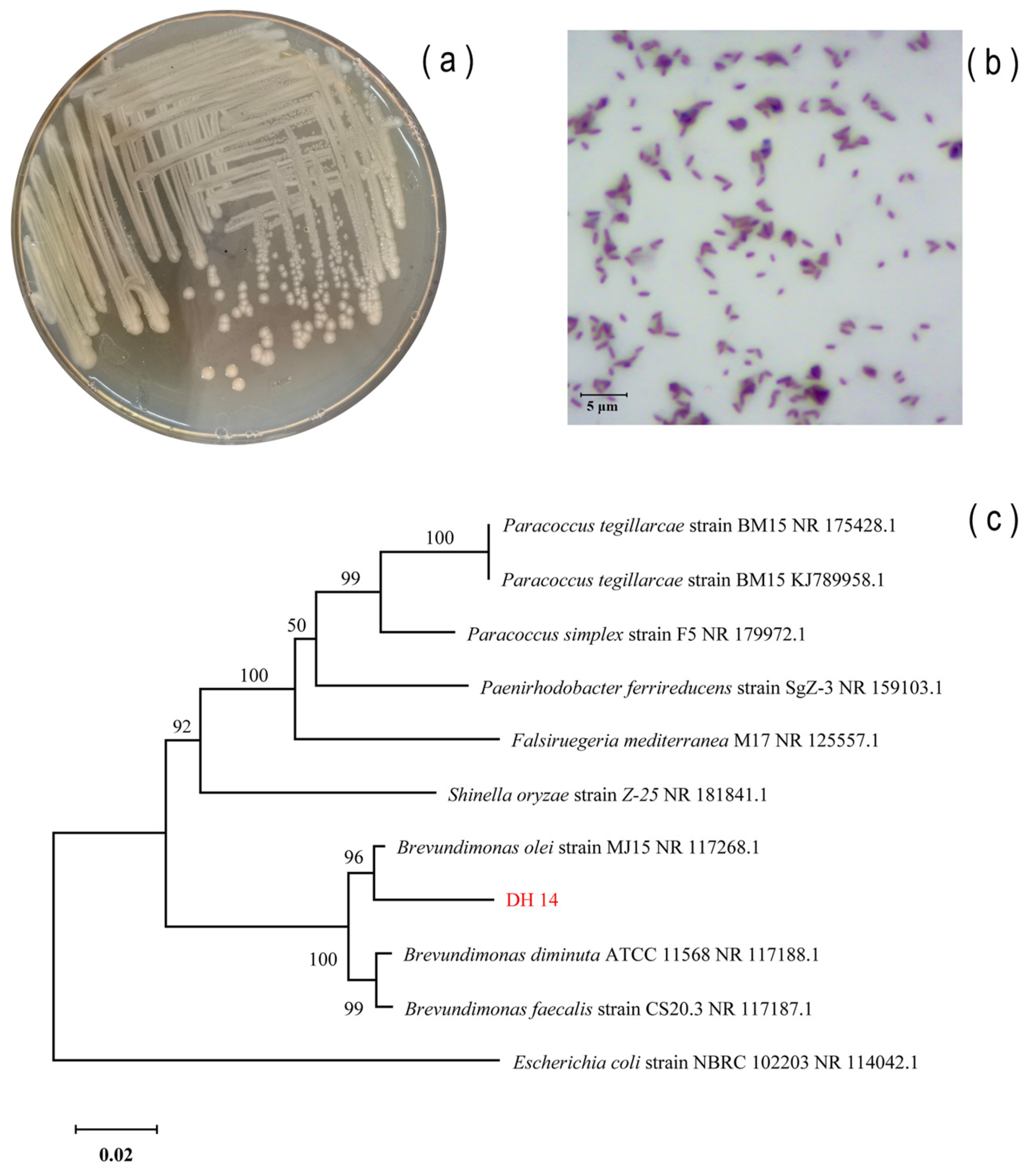
Colonies of strain DH14 on agar plates appeared circular, cream-white, opaque, with slightly convex surfaces and smooth, entire margins (Figure 2a). Gram staining revealed red-colored cells, indicating that the strain is Gram-negative (Figure 2b). Microscopic observation showed short rod-shaped cells, measuring approximately 1–1.5 μm in length and about 0.5 μm in diameter.
The 16S rDNA sequence of strain DH14 (GenBank accession number: PX715492.1) was compared for similarity using the NCBI Nucleotide BLAST database. The results showed that it shared the highest sequence similarity (99.2%) with Brevundimonas olei strain MJ15. Related sequences with high similarity were selected to construct a phylogenetic tree. As shown in Figure 2c, DH14 clustered within the same clade as B. olei strain MJ15, indicating the closest phylogenetic relationship between them. Based on the colony morphology, microscopic characteristics, and molecular phylogenetic analysis, strain DH14 was preliminarily identified as belonging to the genus B. olei and was designated B. olei DH14.

3.4. Optimization of Culture Conditions by Single-Factor Experiments

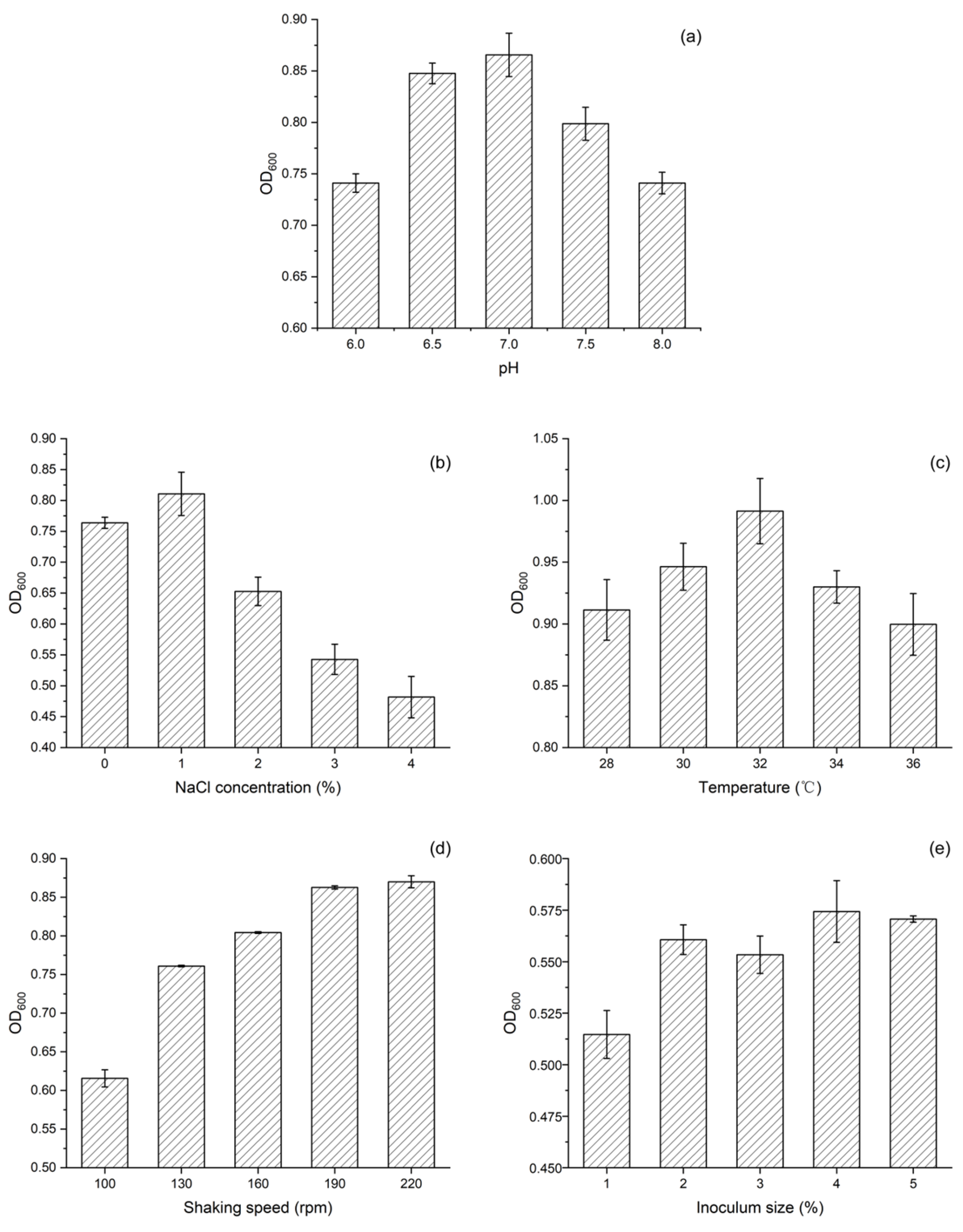
The growth of strain DH14 was significantly influenced by pH, medium salinity (NaCl concentration), incubation temperature, shaking speed, and inoculum size, as shown in Figure 3. Strain DH14 grew well within an initial pH range of 6.5–7.0, with the maximum biomass achieved at pH 7.0 (Figure 3a). pH primarily regulates microbial metabolism and growth by affecting membrane potential, enzyme activity, and the ionization state of nutrients [18].
The NaCl concentration in the medium had a notable impact on bacterial growth. The highest biomass was observed at NaCl concentrations between 0% and 1% (w/v) (Figure 3b). Growth was markedly inhibited as salinity increased, likely due to cellular dehydration caused by hyperosmotic stress and ion toxicity, which can damage cells through osmotic stress and oxidative stress [19].
Results from the single-factor temperature experiment indicated that the strain grew most vigorously at 32 °C (Figure 3c). Temperature directly affected enzymatic reaction rates and membrane fluidity, thereby determining metabolic activity.
Within the shaking speed range of 100–190 rpm, biomass gradually increased with higher rotation speeds and stabilized after 190 rpm (Figure 3d). Shaking speed mainly influenced the dissolved oxygen level and uniformity of nutrient mixing in the culture system, thereby affecting the growth efficiency of aerobic bacteria.
The inoculum size experiment showed that when the inoculum reached 2% (v/v), biomass no longer increased significantly with further increases in inoculum size (Figure 3e). Although a higher inoculum can shorten the lag phase, excessive inoculation may lead to rapid nutrient depletion or early accumulation of metabolic by-products, resulting in environmental pH changes that ultimately inhibited later growth.
Based on the above single-factor experiment results, the preliminary optimal culture conditions for strain DH14 were determined as follows: initial pH 7.0, NaCl concentration 1%, temperature 32 °C, shaking speed 190 rpm, and inoculum size 2%. This combination reflects the strain’s specific requirements for environmental osmoregulation, acidity/alkalinity, and oxygen transfer, providing fundamental parameters for subsequent scale-up cultivation and physiological–biochemical studies.

3.5. Response Surface Analysis

The experimental design matrix, with initial pH (A), NaCl concentration (B), incubation temperature (C), and shaking speed (D) as independent variables and the OD600 of the bacterial suspension (Y) as the response value, along with the corresponding response results, are presented in Table 1. Based on the data in Table 1, a quadratic polynomial regression equation describing the OD600 (Y) was fitted using Design-Expert 13.0 software: Y = 0.6914 + 0.0021 A 0.0370 B + 0.0205 C + 0.0345 D 0.0041 A B + 0.0043 A C 0.0059 A D + 0.0346 B C + 0.0213 B D + 0.0047 C D 0.0046 A 2 + 0.0009 B 2 0.0291 C 2 + 0.0016 D 2 .
Analysis of variance (ANOVA) was performed on the model, and the results are shown in Table 2. The regression model was highly significant (p < 0.01), indicating it effectively characterized the relationship between the independent variables (A, B, C, D) and the response value (OD600). The lack-of-fit term was not significant (p = 0.3276 > 0.05), suggesting that the model error primarily stemmed from random variation rather than a flaw in the model itself, thus conferring high reliability to the model’s predictions. The coefficient of determination (R2) was 0.9356, and the adjusted R2 (R2adj) was 0.8604. Both values being close to 1 indicated a good fit of the regression equation to the actual experimental data, accurately reflecting the real conditions. Therefore, the model can be used for subsequent prediction of OD600 and optimization of culture conditions.
Further analysis of the significance of each factor revealed that the linear terms B (NaCl concentration) and D (shaking speed) had a highly significant effect on OD600 (p < 0.01). The linear term C (incubation temperature) and the interaction terms BC (interaction between NaCl concentration and temperature) and BD (interaction between NaCl concentration and shaking speed) had significant effects (p < 0.05). In contrast, the linear term A (initial pH) was not significant. These results indicate that the influence of each factor on bacterial growth is not simply linear, and significant interactive effects exist. Judging by the magnitude of the F-values, the order of primary influence of the factors on OD600 was B (NaCl concentration) > D (shaking speed) > C (incubation temperature). This suggests that, within the range of this experimental design, salt concentration was the most critical factor limiting the growth of strain DH14.
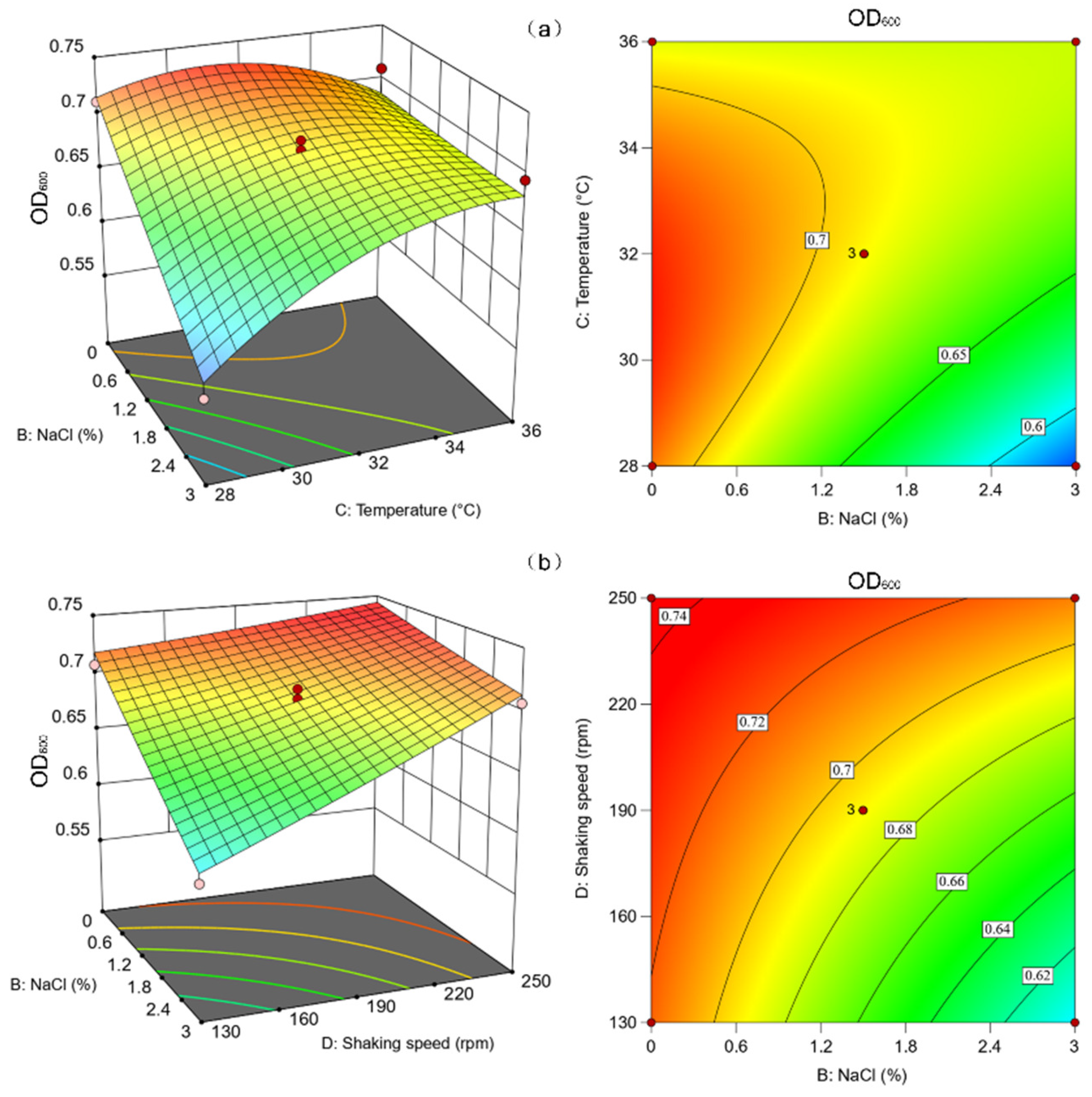
Through the response surface model, two significant interaction terms influencing the growth of strain DH14 were identified: the interaction between NaCl concentration and incubation temperature (BC), and the interaction between NaCl concentration and shaking speed (BD). Figure 4a illustrates the interaction between NaCl concentration (B) and incubation temperature (C). At lower incubation temperatures, bacterial growth was particularly sensitive to increasing NaCl concentration, showing significant reduced biomass. As the temperature approached the optimum (near 32 °C), the inhibitory effect of NaCl concentration was substantially reduced. Conversely, at lower NaCl concentrations, changes in temperature had a smaller impact on growth. This suggests that a suitable temperature can effectively alleviate the stress imposed on the strain by high-salinity conditions. Figure 4b shows the interaction between NaCl concentration (B) and shaking speed (D). Under low shaking speeds, higher NaCl concentrations exerted a stronger inhibitory effect on growth. As the shaking speed increased, improved dissolved oxygen and mass transfer conditions enhanced the strain’s tolerance to elevated salinity. Similarly, within a suitable NaCl concentration range, variations in shaking speed no longer significantly affected the final biomass. This indicated that adequate oxygen supply helped the strain cope with salt stress.
In summary, both appropriate incubation temperature and sufficient dissolved oxygen (achieved by increasing shaking speed) can partially mitigate the adverse effects of higher NaCl concentrations on the growth of strain DH14. Conversely, maintaining NaCl concentration within a suitable range also reduced the negative impact of other suboptimal conditions (such as fluctuations in temperature or shaking speed) on growth.
As the biomass of the bacterial cells increased with higher shaking speed, the single-factor experiment showed that the biomass growth rate began to slow down when the shaking speed exceeded 190 rpm. Based on interaction analysis and model predictions, and taking all the above factors into consideration, the optimal growth conditions for strain DH14 were determined with the shaking speed fixed at 190 rpm: initial pH 7.6, NaCl concentration 0%, and cultivation temperature 31 °C. This combination represents a stable optimum predicted by the model, which not only ensures relatively high biomass but also enhances the robustness of the cultivation process against fluctuations in conditions such as salinity.

3.6. Correlation Between Catalpol Production and pH Variation of Fermentation Broth

The strain DH14 was subjected to fermentation under the following conditions: pH 7.6, 31 °C, and 190 rpm. During the fermentation process, pH was monitored periodically, and the absorbance at 510 nm (OD510) was determined using a colorimetric method to indirectly estimate catalpol content.
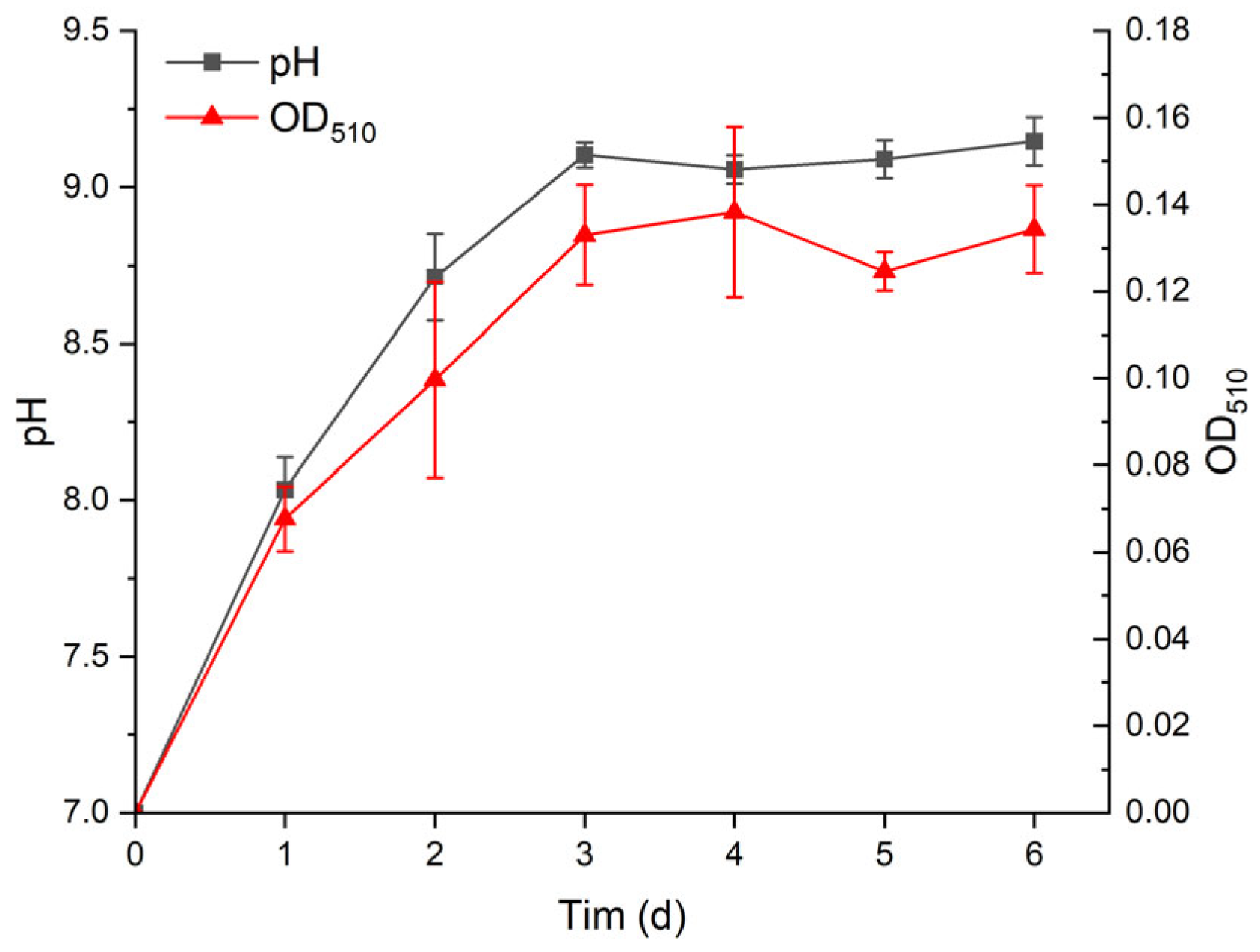
The results indicated that the accumulation trend of catalpol was consistent with the variation in pH (Figure 5). Both parameters exhibited an increasing trend during the first three days of cultivation, followed by a gradual stabilization. The pH of the fermentation broth increased from an initial value of 7.0 to 9.0, while the OD510 value eventually stabilized at approximately 0.133. According to the catalpol standard curve, the catalpol concentration in the fermentation broth reached 0.142 mg/mL, representing a 26.79% increase compared to that before optimization.

4. Discussion

Medicinal plants represent an indispensable repository of bioactive molecules. Endophytic bacteria, which live in symbiosis with their host plants, can regulate plant growth, development, and secondary metabolism, and may synthesize compounds analogous to those produced by the host [20,21,22]. Among these, the genus Brevundimonas is widely distributed in natural environments and frequently forms symbiotic associations with plants. Numerous studies have indicated that various strains within this genus possess potential for promoting plant growth and exerting biocontrol effects [23,24,25,26].
In contrast, reports regarding the biosynthesis of catalpol via fermentation by Brevundimonas species remain relatively scarce. Although catalpol is traditionally sourced from plant extraction, microbial synthesis pathways have been documented. For instance, Zhao et al. [27] isolated a catalpol-producing strain of Bacillus cereus from R. glutinosa tissue, with a yield of 0.884 mg/mL as determined by the 2,4-dinitrophenylhydrazine colorimetric method. Zhang [28] screened a catalpol-producing strain of Bacillus subtilis, initially identified by thin-layer chromatography and quantified by absorbance at 210 nm, achieving a yield of 0.0447 mg/mL. Among conventional detection methods, ultraviolet spectrophotometry lacks specificity and exhibits considerable errors, while the stability of the dinitrophenylhydrazine method requires further optimization. Therefore, this study employed the sulfuric acid–vanillin colorimetric method, which offers greater convenience and accuracy, for the screening and quantitative determination of catalpol.
Beyond yield, the physicochemical properties of the fermentation environment constitute another critical parameter. Notably, during the fermentation process of Brevundimonas for catalpol production, a significant increase in culture pH was observed. This phenomenon is presumably attributed to the metabolic activity of the strain, specifically the deamination of amino acids within the medium, which typically results in the release of ammonia [29].
Compared with the aforementioned studies, the catalpol yield observed in this work was relatively low and exhibited considerable variability. The fermentation process has not yet been systematically optimized, and the present results are based on small-scale (50 mL) shake-flask cultures, without validation under larger-scale or broader cultivation conditions. There is a risk of yield reduction during future scale-up. Notably, certain Brevundimonas species are regarded as opportunistic pathogens associated with various infections [30], which introduces additional safety considerations for their potential industrial applications.
Although the current yield is relatively low and the strain may pose potential pathogenicity, this study confirms that it is capable of synthesizing catalpol. These findings provide new strain resources and a foundational basis for the microbial synthesis, metabolic regulation, and future high-yield engineering of catalpol. This holds important implications for advancing the green biomanufacturing of natural bioactive compounds.

5. Conclusions

In this study, an endophytic bacterium strain DH14 capable of synthesizing catalpol was isolated from the tuberous roots of R. glutinosa. The production of catalpol was detected and quantified using vanillin–sulfuric acid colorimetric assay and LC-MS. Based on 16S rDNA sequencing analysis, the strain was identified as a Gram-negative bacterium belonging to the genus Brevundimonas olei. Based on the results of single-factor experiments and response surface methodology, the optimal fermentation conditions were determined as follows: pH 7.6, 0% NaCl, and a cultivation temperature of 31 °C, with the shaking speed at 190 rpm. Under these conditions, the catalpol yield reached 0.142 mg/mL after 3 days of cultivation.

Author Contributions

Writing—original draft, M.G.; Writing—review & editing, J.L.; Formal analysis, Y.C.; Methodology, Z.W. All authors have read and agreed to the published version of the manuscript.

Funding

This study was supported by the Natural Science Foundation of Henan Province (262300420090).

Institutional Review Board Statement

Not applicable.

Informed Consent Statement

Not applicable.

Data Availability Statement

The datasets generated during and analysed during the current study are available in this manuscript. Further inquiries can be directed to the corresponding author.

Conflicts of Interest

The authors declare that they have no conflicts of interest.

References

  1. Jia, J.; Chen, J.; Wang, G.; Li, M.; Zheng, Q.; Li, D. Progress of research into the pharmacological effect and clinical application of the traditional Chinese medicine Rehmanniae radix. Biomed. Pharmacother. 2023, 168, 115809. [Google Scholar] [CrossRef]
  2. Bhattamisra, S.K.; Koh, H.M.; Lim, S.Y.; Choudhury, H.; Pandey, M. Molecular and biochemical pathways of catalpol in alleviating diabetes mellitus and its complications. Biomolecules 2021, 11, 323. [Google Scholar] [CrossRef]
  3. Liu, J.; Liu, S.; Yu, M.; Li, J.; Xie, Z.; Gao, B.; Liu, Y. Anti-Inflammatory effect and mechanism of catalpol in various inflammatory diseases. Drug Dev. Res. 2023, 84, 1376–1394. [Google Scholar] [CrossRef]
  4. Zhang, Z.; Dai, Y.; Xiao, Y.; Liu, Q. Protective effects of catalpol on cardio-cerebrovascular diseases: A comprehensive review. J. Pharm. Anal. 2023, 13, 1089–1101. [Google Scholar] [CrossRef]
  5. Zheng, X.; Li, W.; Wang, M.; Gao, H.; Zhao, Y.; Dong, P.; Han, H. The anti-inflammatory effects of iridoid glycosides: A comprehensive review of mechanisms of action and structure-activity relationships. Med. Chem. Res. 2025, 34, 1833–1854. [Google Scholar] [CrossRef]
  6. Hassan, M.-A.M.; Fahmy, M.I.; Azzam, H.N.; Ebrahim, Y.M.; El-Shiekh, R.A.; Aboulmagd, Y.M. Multifaceted therapeutic potentials of catalpol, an iridoid glycoside: An updated comprehensive review. Inflammopharmacology 2025, 1–27. [Google Scholar] [CrossRef]
  7. Zhou, Y.; Mai, M.; Huang, Z.; Zhang, Y. Research progress on endophytic fungi of medicinal plants in natural drug development. Xiandai Hortic. 2022, 45, 170. [Google Scholar] [CrossRef]
  8. Hashem, A.H.; Attia, M.S.; Kandil, E.K.; Fawzi, M.M.; Abdelrahman, A.S.; Khader, M.S.; Khodaira, M.A.; Emam, A.E.; Goma, M.A.; Abdelaziz, A.M. Bioactive compounds and biomedical applications of endophytic fungi: A recent review. Microb. Cell Factories 2023, 22, 107. [Google Scholar] [CrossRef] [PubMed]
  9. Yuan, L.J. Research survey on the secondary metabolite of plant rhizosphere microbe. J. Anhui Agric. Sci. 2010, 38, 15471–15474. [Google Scholar] [CrossRef]
  10. Sharma, M.; Sood, G.; Chauhan, A. Bacterial endophytes of medicinal plants: Applications and recent developments. Curr. Microbiol. 2025, 82, 519. [Google Scholar] [CrossRef] [PubMed]
  11. Liang, X.; Zhou, K.; Li, P.; Wan, D.; Liu, J.; Yi, X.; Peng, Y. Characteristics of endophytic bacteria and active ingredients in the eucommiae cortex from different origins. Front. Microbiol. 2023, 14, 1164674. [Google Scholar] [CrossRef]
  12. Li, C.; Qiu, S.; Yang, C.; Zhou, R.; Yuan, Y. Endophytic microbes in dendrobium: Role in endophytic microbial function and accumulation of medicinal compounds. J. Sci. Food Agr. 2025, 105, 8380–8391. [Google Scholar] [CrossRef] [PubMed]
  13. Lata, R.; Gond, S.K. Antibacterial and Antioxidant Potentials, Detection of Host Origin Compounds, and Metabolic Profiling of Endophytic bacillus spp. Isolated from Rauvolfia serpentina (L.) Benth. Ex Kurz. Sci. Rep. 2025, 15, 2094. [Google Scholar] [CrossRef] [PubMed]
  14. Leng, M.C. Study on the Correlation of Endogenous Fungus and Itssecondary Metabolites in Rehmannia glutinosa Libosch. Doctoral Dissertation, Henan University of Traditional Chinese Medicine, Zhengzhou, China, 2014. Available online: https://kns.cnki.net/kcms2/article/abstract?v=jpN_MAf5WI7tRqvEpfNgBriNAwTuLezCE1Or4Uf-Wy4LqVszQIZbWFNmWXb-ndeafCb7FkPFqGQMVQ2tTO0biMrO4QF-bdBrOL-CksKKZ--6Kf6oydVBl91IrtAAJTzaJENKsysFVYgKCz7ueGJ6iGcmb97zTEqcoxz7BWV_EBkPQ0DQ7v2CiQ==&uniplatform=NZKPT&language=CHS (accessed on 6 February 2026).
  15. Martínez-Bonfil, B.P.; Salcedo-Morales, G.; López-Laredo, A.R.; Ventura-Zapata, E.; Evangelista-Lozano, S.; Trejo-Tapia, G. Shoot regeneration and determination of iridoid levels in the medicinal plant castilleja tenuiflora benth. Plant Cell Tissue Organ Cult. 2011, 107, 195–203. [Google Scholar] [CrossRef]
  16. Sun, P.; Ma, J.; Duan, C.; Fu, N.; Huang, Y.; Li, X. Determination of total iridoid glutinoside content of Rehmannia glutinosa by Sulfo-Phospho-Vanillin method. Hubei Agric. Sci. 2021, 60, 115–117. [Google Scholar] [CrossRef]
  17. Xu, J.Q.; Yu, Z.D.; Li, T.; Song, L.L.; Qiu, Z.D.; Huang, L.Q.; Chen, H.W.; Li, H. Combination of internal extractive electrospray ionization mass spectrometry and statistical analysis for high-throughput molecular differentiation of Rehmannia glutinosa samples. J. Am. Soc. Mass Spectrom. 2023, 34, 1342–1348. [Google Scholar] [CrossRef]
  18. Brito, M.G.; López, N.I.; Raiger Iustman, L.J. Unraveling the effects of polyhydroxyalkanoates accumulation in Pseudomonas extremaustralis growth and survival under different pH conditions. Extremophiles 2024, 29, 9. [Google Scholar] [CrossRef]
  19. Xu, Y.; You, G.X.; Zhang, M.R.; Peng, D.Y.; Jiang, Z.W.; Qin, S.T.; Yang, S.H.; Hou, J. Antibiotic resistance genes alternation in soils modified with neutral and alkaline salts: Interplay of salinity stress and response strategies of microbes. Sci. Total Environ. 2022, 809, 152246. [Google Scholar] [CrossRef]
  20. Vishwakarma, S.; Chaudhry, V.; Chand, S.; Sagar, K.; Gupta, K.K.; Bhardwaj, N.; Prasad, R.; Kumar, P.; Chandra, H. The potential of fungal endophytes in plants: Sources of bioactive compounds. Indian J. Microbiol. 2024, 65, 1813–1827. [Google Scholar] [CrossRef] [PubMed]
  21. Wang, E.J.; Zhang, Y.L.; Ma, X.H.; Gong, H.Q.; Xie, S.Y.; Zhang, G.S.; Jin, L. Research progress on interactions between medicinal plants and microorganisms. Chin. J. Chin. Mater. Med. 2025, 50, 3267–3280. [Google Scholar] [CrossRef]
  22. Hu, D.; Hu, L.Z.; Xiao, O.L.; Chen, J.Y.; Dai, X.F.; Sun, Y.W.; Kong, Z.Q. Bibliometric analysis of research trends and advancements in medicinal plant microbiome. Front. Plant Sci. 2024, 15, 1495198. [Google Scholar] [CrossRef]
  23. Huang, Z.; Yu, K.; Xiao, Y.; Wang, Y.L.; Xiao, D.; Wang, D.C. Comparative genomic analysis reveals potential pathogenicity and slow-growth characteristics of genus Brevundimonas and description of Brevundimonas pishanensis sp. nov. Microb. Spectr. 2022, 10, e0246821. [Google Scholar] [CrossRef] [PubMed]
  24. Pattanayak, S.; Chouhan, V.; Bashyal, B.M.; Mandal, P.K.; Kumar, M.; Gogoi, R.; Kumar, A. Exploring the endophytic microbiome of maize leaves: Roles in plant growth promotion and defense against Bipolaris maydis. Plant Soil 2025, 514, 2309–2333. [Google Scholar] [CrossRef]
  25. Bekkar, A.A.; Zaim, S. Newly isolated Brevundimonas naejangsanensis as a biocontrol agent against Fusarium redolens the causal of Fusarium yellows of chickpea. Folia Microbiol. 2024, 69, 835–846. [Google Scholar] [CrossRef] [PubMed]
  26. Chabbi, N.; Chafiki, S.; Telmoudi, M.; Labbassi, S.; Bouharroud, R.; Tahiri, A.; Mentag, R.; Amri, M.; Bendiab, K.; Hsissou, D.; et al. Plant-growth-promoting rhizobacteria improve seeds germination and growth of Argania spinosa. Plants 2024, 13, 2025. [Google Scholar] [CrossRef]
  27. Zhao, Y.; Xu, H.Y.; Xin, G.Q.; Wu, X.Y.; Gu, W. Isolation and identification of endophytic bacteria produced catalpol from rehmannia and studies on genetic stability. J. Pharm. Res. 2014, 33, 567–570, 577. [Google Scholar] [CrossRef]
  28. Zhang, T. Isolation Entophytes and Study on the Fermentation of Bacillus subtilis tjD7 from Rehmannia. Master’s Thesis, Henan Agricultural University, Zhengzhou, China, 2012. Available online: https://kns.cnki.net/kcms2/article/abstract?v=jpN_MAf5WI5ANRDOrZpPKB2Dc1iEzNY6fxVAYt-OFj4zmGh-A3b_JuEWdOqXkbdPey01oPRZqhjjq5vHtwmyTSk49lcjzDGupP9vKaqRMOKYvgcdMteRD5acm32x_bhXUV7iVbJ0vPOa54xl0PkN3SkF26GTnSPEiCkJfj3wMEFSYCZVi8Gogw==&uniplatform=NZKPT&language=CHS (accessed on 26 February 2026).
  29. Visser, F.M.W. Contribution of Enzymes from Rennet, Starter Bacteria and Milk to Proteolysis and Flavour Development in Gouda Cheese. Doctoral Dissertation, Wageningen University and Research, Wageningen, The Netherlands, 1977. [Google Scholar] [CrossRef]
  30. Paul, I.; Roy, A.; Sarkar, T.; Dutta, S.; Ray, S. An in silico vaccinomics strategy to develop multiepitope vaccine using essential hypothetical protein as a target against Brevundimonas subvibrioides: A combined subtractive proteomics and immunoinformatics approach. Microb. Pathog. 2025, 205, 107651. [Google Scholar] [CrossRef]
Figure 1. HPLC and LC-MS analysis for the identification of catalpol. (a) HPLC chromatogram; (b) Extracted ion chromatogram (XIC); (c) Corresponding mass spectrum.
Microbiolres 17 00060 g001
Figure 2. Morphological characterization of strain DH14. (a) Colony morphology on an agar plate; (b) Cellular morphology observed under microscopy after Gram staining (BM2000 Biological Microscope, Nanjing Jiangnan Yongxin Optics Co., Ltd., Nanjing, China). (c) Phylogenetic tree showing the position of strain DH14 based on 16S rRNA gene sequences.
Microbiolres 17 00060 g002
Figure 3. Effects of different culture conditions on the biomass of strain DH14; (a) Effect of pH; (b) Effect of NaCl concentration; (c) Effect of temperature; (d) Effect of shaking speed; (e) Effect of inoculum size.
Microbiolres 17 00060 g003
Figure 4. Bacterial growth (OD600) in response to interactions between key factors. (a) NaCl concentration versus incubation temperature; (b) NaCl concentration versus shaking speed.
Microbiolres 17 00060 g004
Figure 5. Changes in pH and catalpol content during the cultivation process.
Microbiolres 17 00060 g005
Table 1. Response surface design and results.
StdRunFactor 1Factor 2Factor 3Factor 4Response
A:pHB:NaCl (%)Temperature (°C)Shaking Speed (rpm)OD600
17.001.006.001.5028.00190.000.63
12.002.008.001.5032.00250.000.73
1.003.006.000.0032.00190.000.73
24.004.007.003.0032.00250.000.71
16.005.007.003.0036.00190.000.69
9.006.006.001.5032.00130.000.65
22.007.007.003.0032.00130.000.59
8.008.007.001.5036.00250.000.72
27.009.007.001.5032.00190.000.69
5.0010.007.001.5028.00130.000.63
3.0011.006.003.0032.00190.000.67
15.0012.007.000.0036.00190.000.71
11.0013.006.001.5032.00250.000.73
13.0014.007.000.0028.00190.000.71
26.0015.007.001.5032.00190.000.68
19.0016.006.001.5036.00190.000.65
21.0017.007.000.0032.00130.000.71
25.0018.007.001.5032.00190.000.70
6.0019.007.001.5036.00130.000.64
23.0020.007.000.0032.00250.000.74
18.0021.008.001.5028.00190.000.64
2.0022.008.000.0032.00190.000.72
10.0023.008.001.5032.00130.000.67
20.0024.008.001.5036.00190.000.68
14.0025.007.003.0028.00190.000.56
4.0026.008.003.0032.00190.000.65
7.0027.007.001.5028.00250.000.68
Note: Std: Standard order, Run: Run order.
Table 2. Results of analysis of variance.
SourceSum of SquaresdfMean SquareF-Valuep-ValueSignificance
Model0.0485140.003512.45<0.0001significant
A-pH0.000110.00010.18230.677
B-NaCl (%)0.016510.016559.15<0.0001
C-Temperature (°C) 0.005110.005118.180.0011
D- Shaking speed (rpm)0.014310.014351.35<0.0001
AB0.000110.00010.23980.6332
AC0.000110.00010.270.6128
AD0.000110.00010.50340.4916
BC0.004810.004817.20.0014
BD0.001810.00186.490.0255
CD0.000110.00010.31320.586
A20.000110.00010.41260.5327
B24.35 × 10−614.35 × 10−60.01560.9026
C20.004510.004516.230.0017
D20100.04980.8272
Residual0.0033120.0003
Lack of Fit0.0031100.00032.420.3276not significant
Pure Error0.000320.0001
Cor Total0.051826
Disclaimer/Publisher’s Note: The statements, opinions and data contained in all publications are solely those of the individual author(s) and contributor(s) and not of MDPI and/or the editor(s). MDPI and/or the editor(s) disclaim responsibility for any injury to people or property resulting from any ideas, methods, instructions or products referred to in the content.