Article

Fungi from the Depths: A Preliminary Survey Using Hybrid Underwater Robotics in the Bathypelagic Zone off the Coast of Toulon (SE France)


1
ColD-UNIGE, Laboratory of Mycology, Department of Earth, Environmental and Life Sciences (DISTAV), University of Genoa, Corso Europa 26, 16132 Genoa, Italy
2
Laboratory of Physical Oceanography, Department of Earth, Environmental and Life Sciences (DISTAV), University of Genoa, Corso Europa 26, 16132 Genoa, Italy
3
Centre de Physique des Particules de Marseille, Aix-Marseille Université, CPPM - Case 902, 163 Av de Luminy, 13288 Marseille Cedex 09, France
*
Author to whom correspondence should be addressed.
These authors contributed equally to this work.
Microbiol. Res. 2026, 17(2), 45; https://doi.org/10.3390/microbiolres17020045
Submission received: 5 February 2026 / Revised: 14 February 2026 / Accepted: 18 February 2026 / Published: 20 February 2026

Abstract

The deep sea is characterized by unique and extreme habitats. The absence of light, high salinity, hydrostatic pressure, low temperature, and high competition led to the evolution of physiological and biochemical adaptations necessary for survival. Marine fungi represent a significant part of deep-sea microbial communities. Studying bathypelagic sediment fungi helps us to understand their little-known communities and ecology, as well as their metabolic potential and ecophysiological properties, which have applications in pharmaceutical biotechnologies and bioremediation protocols. During an oceanographic campaign off the coast of Toulon (France, northwest Mediterranean Sea) in October 2021, as part of the KM3NeT Project, the Hybrid Remotely Operated Vehicle (HROV) Ariane collected a composite sediment sample at a depth of 2417 m. The sediment was physically, geochemically and mycologically characterized. Culturable fungi were isolated, and vital fungal strains were identified morphologically and molecularly. A total of 17 strains were isolated and identified in pure culture. The major taxa belonged to the Penicillium, Aspergillus, and Cladosporium genera, but widespread species such as Wallemia sebi were also found. This study also paves the way for further research into the advantages and disadvantages of using HROV technology for mycological cultural investigations at prohibitive depths.

1. Introduction

The deep sea, which constitutes more than 60% of the Earth’s surface, is one of the least explored ecosystems on the planet. The environmental conditions in this region are extreme, characterised by an absence of light, low temperatures, high hydrostatic pressure, and limited nutrient availability. These factors collectively present significant challenges to life [1]. Nevertheless, an increasing number of reports have emerged regarding the presence of microorganisms in abyssal environments, where they have been observed contributing to the degradation of organic matter, nutrient cycling, and even metal detoxification [2,3].
Fungi are recognised as important decomposers and potential symbionts in marine systems [4]. These organisms have been detected in water columns and sediments, as well as in association with invertebrates [5], yet their diversity and ecological functions in bathypelagic zones remain poorly characterised.
Recent studies suggest that fungi inhabiting extreme marine environments may represent reservoirs of novel metabolic pathways and secondary metabolites with biotechnological potential [6,7]. However, exploring Mediterranean bathypelagic sediments from this perspective is still in its infancy.
In this study, we present the initial isolation and identification of culturable fungi from bathypelagic sediments collected at a depth of 2417 m off the coast of Toulon, France, using ROV-based sampling. Although our analysis is based on a single composite sediment sample, our work aims to provide initial insights into the occurrence and diversity of viable fungi inhabiting deep marine sediments in this scarcely explored environment.
By combining sedimentological and geochemical characterisation with culture-based and molecular analyses, this study investigates potential relationships between fungal isolates and sediment features. Despite its exploratory nature, this work contributes to the limited understanding of deep-sea fungal communities and establishes a framework of references for future microbiological research in deep and technically challenging marine environments.

2. Materials and Methods

2.1. Study Area and Sampling

Sampling was carried out in October 2021 during the KM3NeT oceanographic campaign. The HROV Ariane (IFREMER, Toulon, France) was used to retrieve a box core from the abyssal plain (42°48′21.3″ N, 5°59′0.2″ E, depth: 2417 m) (see Figure 1). The robotic arm collected three 5 cm thick portions of surface sediment, from which a composite sample was obtained. This was transferred to sterile containers and stored at 4 °C for processing within 48 h of recovery. No procedural blanks or airborne contamination controls were included during sampling and cultivation. This limitation is acknowledged and considered when interpreting the taxonomic results. Nevertheless, ROV-based sampling, with its controlled deployment and precise sediment collection, helps mitigate potential contamination risks and provides a solid foundation for exploratory microbiological analyses in deep-sea sediments [7]. Water temperature and salinity were measured during sediment sampling using a sensor mounted on the HROV; the recorded values were 13.3 °C and 38.48 PSU, respectively.

2.2. Sediment Analyses

Grain size distribution was determined by laser granulometry (Beckman Coulter LS230, Krefeld, Germany) after pretreatment with hydrogen peroxide to remove organic matter and hydrochloric acid to dissolve carbonates [8]. Organic and inorganic fractions were quantified by loss-on-ignition (LOI) at 550 °C [9]. Major (Fe, Al) and trace elements (Cu, Ni, Zn, As, Co, Cr, Pb) were analysed after acid digestion in a microwave system (EPA 3051A protocol) [10] using ICP-OES and ICP-MS (PerkinElmer Optima 8300, PerkinElmer AES, UK).

2.3. Fungal Isolation

Sediment aliquots (1 g) were serially diluted in sterile seawater and plated in triplicate on different media: Malt Extract Agar (MEA, Sigma-Aldrich®, St. Louis, MO, USA); Potato Dextrose Agar (PDA, Sigma-Aldrich®, St. Louis, MO, USA); Czapek Dox Agar (CZ, Sigma-Aldrich®, St. Louis, MO, USA); Sabouraud Agar (SAB, Sigma-Aldrich®, St. Louis, MO, USA); Oatmeal Agar (OA, Sigma-Aldrich®, St. Louis, MO, USA); Tryptic Soy Agar (TSA, Sigma-Aldrich®, St. Louis, MO, USA); and Yeast Agar (YA, Sigma-Aldrich®, St. Louis, MO, USA). All media were supplemented with 3% (w/v) sea salts and chloramphenicol (100 mg/L). The plates were incubated at 5 °C and 24 °C (laboratory control) for up to 30 days in the dark [2]. Pure culture isolation was performed by transferring part of the colonies to new plates.

2.4. Morphological and Molecular Identification

Macroscopic and microscopic observations were used for preliminary identification [11]. DNA was extracted using a CTAB-based protocol. ITS (ITS1-5.8S-ITS2) and LSU regions were amplified with ITS1/ITS4 and LR0R/LR5 primers [12]. For Penicillium and Aspergillus, β-tubulin (BT2a/BT2b) and calmodulin (CMD5/CMD6) markers were also sequenced [13,14]. The use of multiple genetic markers was adopted to improve taxonomic resolution. While ITS and LSU regions are suitable for general fungal identification, they often lack discriminatory power within speciose genera such as Penicillium and Aspergillus. For this reason, β-tubulin and calmodulin loci were additionally sequenced for these taxa, following current taxonomic recommendations [11,13]. PCR products were sequenced (Sanger method, Eurofins Genomics) and compared with GenBank and CBS databases using BLAST (2.16.0+/25 June 2024). Phylogenetic placement was confirmed with MEGA-X software (V. 12) [15]. The sequences were deposited in GenBank with accession numbers from OQ520039 to OQ520059 for ITS; PQ525283-PQ525284 for LSU; from PQ580357 to PQ580366 for BT and CMD. The nomenclature of the species was checked by Index Fungorum (http://www.indexfungorum.org, accessed on 9 January 2026) and Mycobank (https://www.mycobank.org, accessed on 9 January 2026).

3. Results

3.1. Sediment Chemical and Physical Characterization

The sediment consisted mainly of fine particles (92.2%), with fine silt (51.3%) and clay (24.5%) being the dominant components (see Table 1). Organic matter accounted for 8.6% of the dry weight. Trace metals exhibited elevated concentrations compared to background Mediterranean levels, particularly Cu (32.7 ppm), Ni (49.6 ppm), and As (28.5 ppm) (see Table 2).
Major and trace metal concentrations are reported in Table 2.

3.2. Fungal Diversity

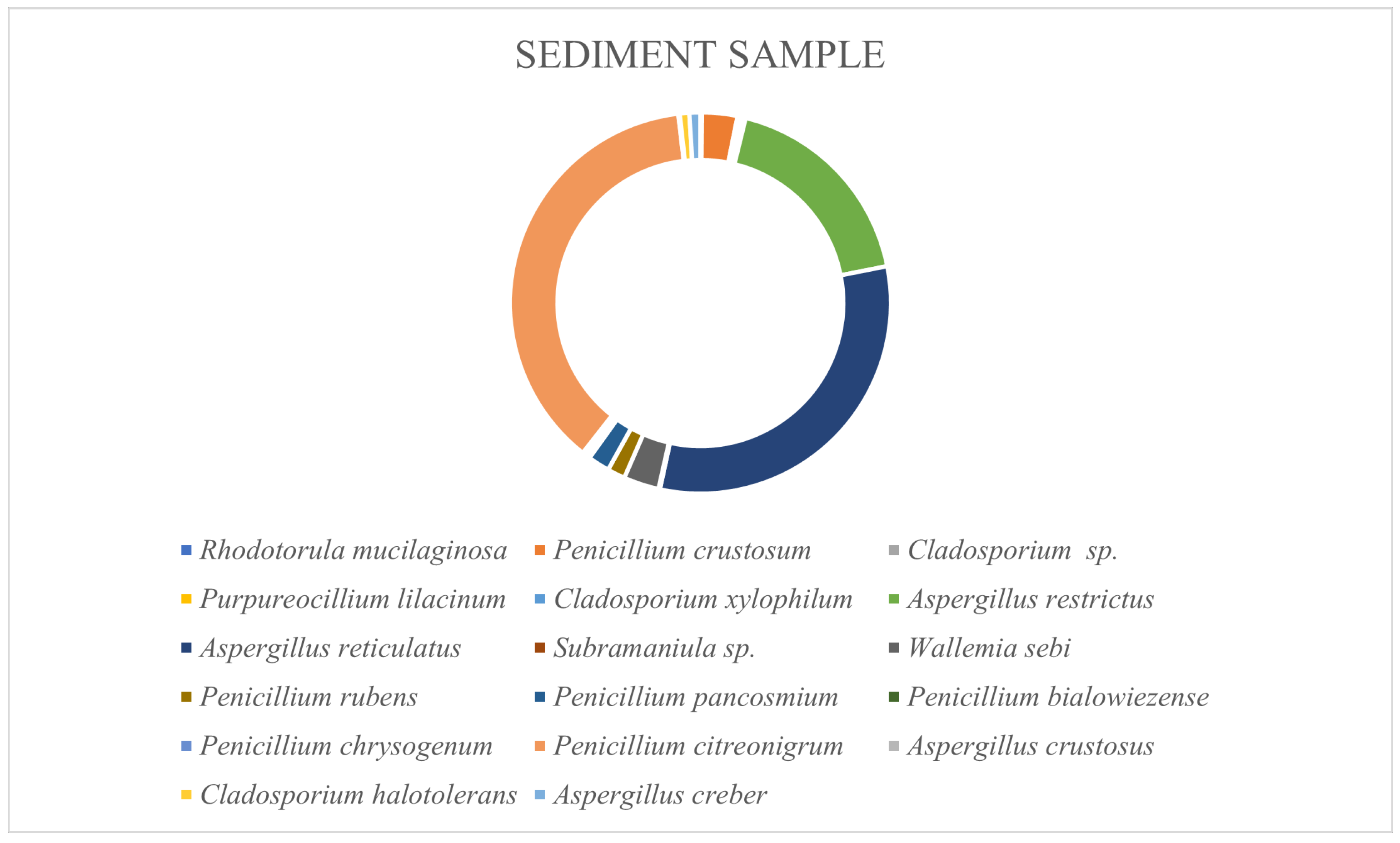
Seventeen fungal strains were isolated. The community was dominated by Ascomycota (89%), with the most frequent genera being Penicillium (6 strains), Aspergillus (4), and Cladosporium (3) (see Figure 2). Additional isolates included Wallemia sebi, Purpureocillium lilacinum, Subramaniula sp., and Rhodotorula mucilaginosa. While some species (e.g., Aspergillus restrictus, Penicillium citreonigrum) were abundant across media, others appeared rarely. Psychrophilic tolerance was confirmed for Cladosporium spp., which developed exclusively at 5 °C. The media culture appeared to be very selective: most of the species found grew only in one type of medium (Table 3). All strains were deposited in the ColD UNIGE culture collection. The main results are listed in Table 4.

3.3. Correlation Between Sediment Properties and Fungal Occurrence

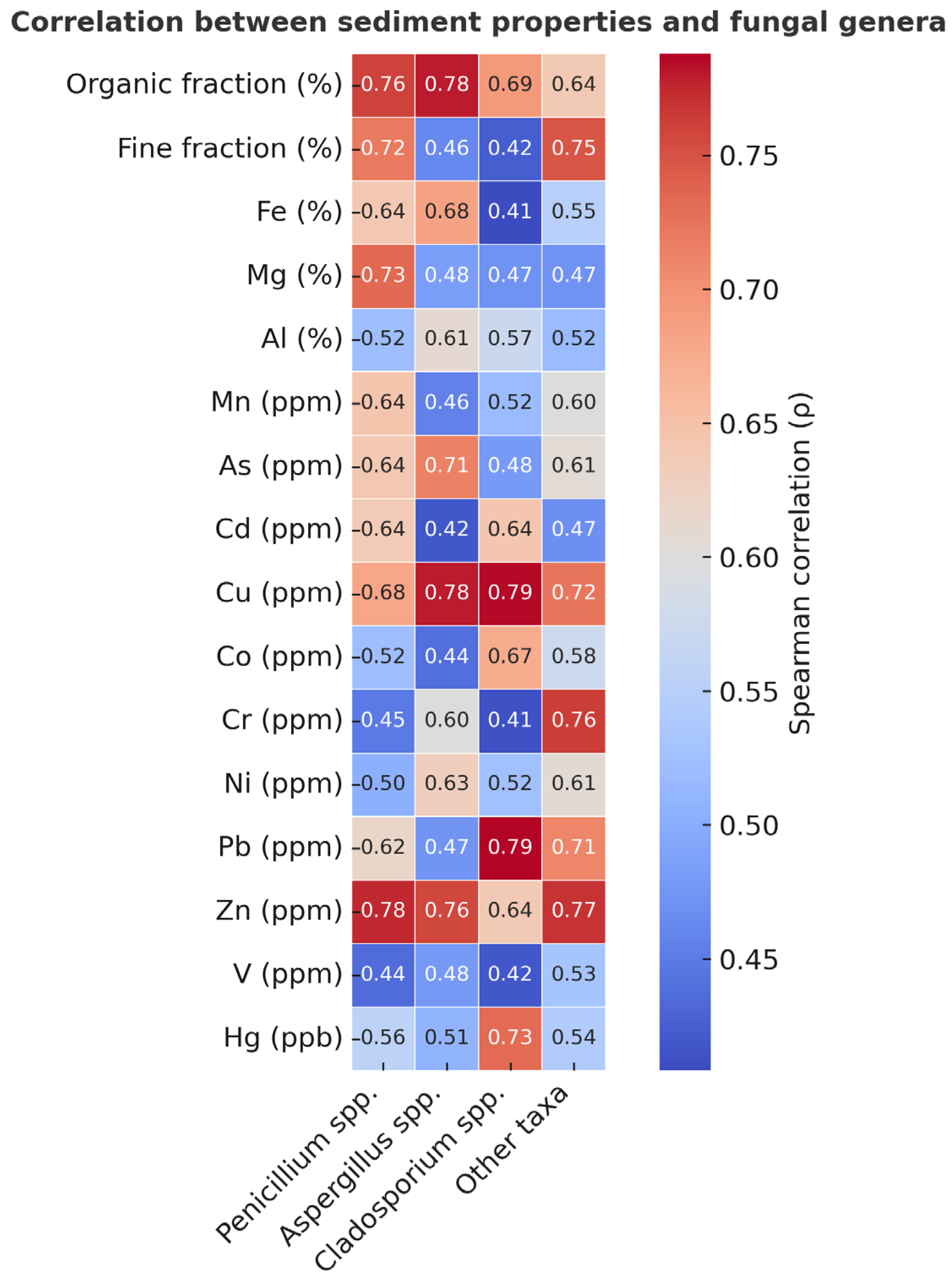
As the study is based on a single composite sediment sample, the correlation analysis does not constitute a statistical test of ecological hypotheses, but rather an exploratory, descriptive evaluation of the co-variation of the measured parameters within the same sample. Spearman correlation coefficients (ρ) were calculated using the R software (V. 4.2.3) and visualized as a heatmap using the pheatmap (version 1.0.13) package to explore associations between sediment physicochemical parameters (grain-size fractions, organic matter content, and trace element concentrations) and the relative occurrence of the main culturable fungal genera isolated from the sediment sample.
A general trend emerged, showing that the abundance of culturable fungi increased with the proportion of fine-grained particles (r_s ≈ 0.72) and organic matter content (r_s ≈ 0.76). These parameters are usually linked to an increased surface area and greater nutrient retention, which could encourage fungal colonisation and growth in bathypelagic sediments [2,3,16].
Of the chemical parameters examined, the relatively high concentrations of transition metals, particularly Ni (49.6 ppm), Cu (32.7 ppm), and As (15.7 ppm), appeared to favour the occurrence of metal-tolerant taxa, such as Penicillium and Cladosporium. These taxa together accounted for over 60% of total colony-forming units (CFUs). The two most abundant species, Penicillium citreonigrum and Aspergillus reticulatus, showed positive associations with Cu and Ni content (r_s ≈ 0.68 and 0.63, respectively), suggesting a potential selective effect of metal enrichment [17,18].
Conversely, low-abundance taxa (e.g., Rhodotorula mucilaginosa and Subramaniula sp.) were mainly associated with coarser sediment fractions and lower organic content. This could indicate that more oligotrophic microhabitats limit fungal proliferation [19]. The presence of Wallemia sebi, a xerotolerant species, correlated moderately with Mn and Fe concentrations, possibly reflecting its tolerance of oxidative stress [19]. Overall, these results highlight the differences in the relationships between sediment characteristics and fungal genera, providing a framework for interpreting the correlation matrix shown in Figure 3 without implying causality.

4. Discussion

This study shows that there are viable fungi in Mediterranean bathypelagic sediments that can be successfully isolated using a culture-based approach combined with HROV-assisted sampling. The fine granulometry and relatively high organic matter content of the sediments likely favour fungal colonisation by increasing substrate availability and surface area, as has been suggested in relation to deep-sea benthic environments previously [1,2]. Furthermore, elevated trace metal concentrations may act as selective pressures, thereby supporting the persistence of tolerant taxa such as Penicillium and Cladosporium, which are known for their physiological plasticity and stress tolerance [20,21].
The diversity of culturable fungi observed was influenced by both the choice of culture media and incubation conditions. Using a variety of media (MEA, PDA, CZ, SAB, OA, TSA, and YA) enables the isolation of taxa with different nutritional and physiological requirements, while incubating at 5 °C and 24 °C resulted in capture of both psychrotolerant and more generalist species. Some fungi, such as Cladosporium spp., grew exclusively at low temperatures, confirming their adaptation to deep-sea conditions [20,21,22].
HROV-assisted sampling enabled precise collection from a depth of 2417 m, providing access to otherwise unreachable sediments. While procedural or airborne contamination cannot be entirely ruled out and analysis is limited to a single composite sample, ROV-based approaches remain among the most effective strategies for the exploratory study of deep-sea microbiota [23,24]. Taken together, these considerations highlight that the results offer only a partial, culture-dependent view of the fungal community, yet they reveal the presence of metal- and stress-tolerant taxa that could be ecologically and biotechnologically significant.
While the culture-based approach employed provided valuable insights into the viable fungal community, it inherently captures only a subset of the total diversity present in bathypelagic sediments. Many slow-growing, obligately symbiotic, or highly selective taxa may have remained undetected [4]. Future studies that integrate culture-independent methods, such as metabarcoding or metagenomics, would complement these findings and enable a more comprehensive assessment of fungal diversity, ecological roles and potential biotechnological applications. Consequently, the taxonomic composition described in this study should be interpreted as a partial representation of the bathypelagic sediment mycobiota, rather than as a comprehensive assessment.
Despite these limitations, the dominance of the filamentous, cosmopolitan genera Penicillium, Aspergillus, and Cladosporium is consistent with that observed in previous investigations of bathypelagic sediments from various oceanic regions, including the South China Sea and the Indian Ocean [15,16,17,18,19]. The recurrent detection of these genera in geographically distant deep-sea environments lends support to the concept of ecological plasticity, whereby certain fungal taxa can survive and remain metabolically active under conditions of extremely high hydrostatic pressure, low temperature and limited nutrient availability [25,26]. In the absence of dedicated contamination controls designed to trace airborne inputs, their presence should be interpreted as evidence of ecological tolerance rather than as confirmation of deep-sea endemism.
From an ecological perspective, filamentous fungi in bathypelagic sediments may play a role in degrading complex organic matter and contributing to benthic carbon cycling, particularly in fine-grained, organic-rich substrates [2,27]. Experimental and observational studies have highlighted the capacity of marine-derived fungi to degrade refractory organic compounds, suggesting that they may complement bacterial processes in deep-sea carbon turnover [28].
Furthermore, the prevalence of metal-tolerant taxa suggests their potential involvement in metal-fungus interactions, including processes such as metal sequestration, immobilisation or transformation. Such interactions are increasingly recognised as relevant components of sediment biogeochemistry, particularly in environments characterised by elevated trace metal concentrations [20].
The presence of stress-tolerant and psychrotolerant fungi, such as Cladosporium spp. and Wallemia sebi species, further highlights the ability of fungi to adapt to multiple environmental stressors, including low temperatures, osmotic stress and exposure to metals [20,25,26]. These traits may provide a competitive advantage in bathypelagic habitats characterised by long-term environmental stability and chronic physicochemical stress.
Due to the semi-enclosed nature of the Mediterranean Sea, trace metals can accumulate in bathypelagic sediments over long periods of time due to natural processes and diffuse anthropogenic inputs. However, in the absence of replicated sampling, such considerations remain contextual and cannot be assessed quantitatively in the present study [29]. While causal relationships cannot be established using the current dataset, it is plausible that environmental conditions act as selective drivers, shaping the composition of the culturable fungal community towards metal-tolerant taxa.
As the present study is based on a single sediment sample, the statistical analyses performed were intentionally limited. Correlation patterns between fungal occurrence and sediment properties should therefore be regarded as exploratory and hypothesis-generating rather than definitive, as robust multivariate analyses require replicated sampling designs [29].
The successful isolation of viable, stress-adapted fungi from bathypelagic sediments highlights their potential biotechnological significance. Metal tolerance, psychrotolerance and metabolic versatility are of particular interest for a range of applications, including bioremediation and the discovery of novel enzymes and secondary metabolites [30,31,32]. While these aspects were not the focus of this investigation, the isolated strains represent a valuable resource for future functional and applied studies.

5. Conclusions

This preliminary survey reports the isolation of 17 culturable fungal strains from Mediterranean bathypelagic sediments, collected at a depth of 2417 m using hybrid underwater robotic technology. The recovered community was dominated by Penicillium, Aspergillus, and Cladosporium, as well as additional stress-tolerant taxa such as Wallemia sebi.
The distribution of these fungi appears to be associated with the fine sediment fraction, organic matter enrichment, and trace metal content. However, these relationships should be regarded as exploratory due to the limited number of isolates and the lack of replicated samples.
This study demonstrates the feasibility and reliability of HROV-based sampling for deep-sea mycological research, providing preliminary insight into viable fungal diversity in Mediterranean bathypelagic sediments. Future studies are recommended to integrate both culture-dependent and culture-independent approaches, including metabarcoding or metagenomics, alongside replicated sampling designs, to more accurately resolve fungal diversity, ecological roles and biotechnological potential in deep-sea environments.

Author Contributions

Conceptualization, M.Z., M.C. and V.B.; methodology, M.Z., G.C. and S.D.P.; data curation, M.D.B., G.C. and L.C.; writing—original draft preparation, M.D.B., G.C. and L.C.; visualization, S.D.P.; supervision, M.Z. and M.C.; writing-reviewing and editing, M.D.B., G.C. and L.C. All authors have read and agreed to the published version of the manuscript.

Funding

Part of this work was granted by the European Commission–NextGenerationEU, Project SUS-MIRRI.IT “Strengthening the MIRRI Italian Research Infrastructure for Sustainable Bioscience and Bioeconomy”, code n. IR0000005; and by the RETURN project (CUP D33C22001290002).

Institutional Review Board Statement

Not applicable.

Informed Consent Statement

Not applicable.

Data Availability Statement

Dataset available on request from the authors: The raw data supporting the conclusions of this article will be made available by the authors on request.

Acknowledgments

The authors want to thank the KM3NeT Project for allowing them to carry out this study. We acknowledge the contribution and support from the RI MIRRI-IT. Moreover, the authors would like to fondly remember Aurora Montemartini Corte, our friend and distinguished mycologist at the University of Genoa, who was the first to deal with marine mycology in Italy.

Conflicts of Interest

The authors declare no conflicts of interest. The funders had no role in the design of the study, the collection, analysis, or interpretation of data, the writing of the manuscript, or the decision to publish the results.

References

  1. Jørgensen, B.B.; Boetius, A. Feast and famine—Microbial life in the deep-sea bed. Nat. Rev. Microbiol. 2007, 5, 770–781. [Google Scholar] [CrossRef]
  2. Orsi, W.D.; Edgcomb, V.P.; Christman, G.D.; Biddle, J.F. Deep sequencing of subseafloor eukaryotic rRNA reveals active fungi across marine subsurface provinces. PLoS ONE 2013, 8, e56335. [Google Scholar] [CrossRef] [PubMed]
  3. Barone, G.; Rastelli, E.; Corinaldesi, C.; Tangherlini, M.; Danovaro, R. Benthic deep-sea fungi in submarine canyons of the Mediterranean Sea. Prog. Oceanogr. 2018, 168, 57–64. [Google Scholar] [CrossRef]
  4. Richards, T.A.; Jones, M.D.M.; Leonard, G.; Bass, D. Marine fungi: Their ecology and molecular diversity. Annu. Rev. Mar. Sci. 2012, 4, 495–522. [Google Scholar] [CrossRef] [PubMed]
  5. Rateb, M.E.; Ebel, R. Secondary metabolites of fungi from marine habitats. Nat. Prod. Rep. 2011, 28, 290–344. [Google Scholar] [CrossRef]
  6. Jones, E.G.; Pang, K.L.; Abdel-Wahab, M.A.; Scholz, B.; Hyde, K.D.; Boekhout, T.; Ebel, R.; Rateb, M.E.; Henderson, L.; Sakayaroj, J.; et al. An online resource for marine fungi. Fungal Divers. 2019, 96, 347–433. [Google Scholar] [CrossRef]
  7. Brandt, M.I.; Pradillon, F.; Trouche, B.; Henry, N.; Liautad-Haag, C.; Cambon-Bonavita, M.A.; Cueff-Gauchard, V.; Wincker, P.; Belser, C.; Poulain, J.; et al. Evaluating sediment and water sampling methods for the estimation of deep-sea biodiversity using environmental DNA. Sci. Rep. 2021, 11, 7856. [Google Scholar] [CrossRef]
  8. Folk, R.L. Petrology of Sedimentary Rocks; Hemphill Publishing Company: Austin, TX, USA, 1980. [Google Scholar]
  9. Heiri, O.; Lotter, A.F.; Lemcke, G. Loss on ignition as a method for estimating organic and carbonate content in sediments. J. Paleolimnol. 2001, 25, 101–110. [Google Scholar] [CrossRef]
  10. Method 3051A (SW-846); Microwave Assisted Acid Digestion of Sediments, Sludges, and Oils, Revision 1. U.S. EPA: Washington, DC, 2007.
  11. Samson, R.A.; Houbraken, J.; Thrane, U.; Frisvad, J.C.; Andersen, B. Food and Indoor Fungi; CBS-KNAW Fungal Biodiversity Centre: Utrecht, The Netherlands, 2014. [Google Scholar]
  12. White, T.J.; Bruns, T.; Lee, S.; Taylor, J. Amplification and direct sequencing of fungal ribosomal RNA genes for phylogenetics. In PCR Protocols; Academic Press: San Diego, CA, USA, 1990; pp. 315–322. [Google Scholar]
  13. Glass, N.L.; Donaldson, G.C. Development of primer sets for filamentous ascomycetes. Appl. Environ. Microbiol. 1995, 61, 1323–1330. [Google Scholar] [CrossRef]
  14. Carbone, I.; Kohn, L.M. A method for designing primer sets for speciation studies in filamentous fungi. Mycologia 1999, 91, 553–556. [Google Scholar] [CrossRef]
  15. Kumar, S.; Stecher, G.; Li, M.; Knyaz, C.; Tamura, K. MEGA X: Molecular evolutionary genetics analysis across computing platforms. Mol. Biol. Evol. 2018, 35, 1547–1549. [Google Scholar] [CrossRef] [PubMed]
  16. Zhang, X.Y.; Zhang, Y.; Xu, X.Y.; Qi, S.H. Diverse Deep-Sea Fungi from the South China Sea and Their Antimicrobial Activity. Curr Microbiol 2013, 67, 525–530. [Google Scholar] [CrossRef] [PubMed]
  17. Nagano, Y.; Nagahama, T.; Hatada, Y.; Nunoura, T.; Takami, H.; Miyazaki, J.; Takai, K.; Horikoshi, K. Fungal diversity in deep-sea sediments – the presence of novel fungal groups. Fungal Ecol. 2010, 4, 396–405. [Google Scholar] [CrossRef]
  18. Singh, P.; Raghukumar, C.; Verma, P.; Shouche, Y. Assessment of fungal diversity in deep-sea sediments. World J. Microbiol. Biotechnol. 2012, 28, 659–667. [Google Scholar] [CrossRef]
  19. Raghukumar, C.; Raghukumar, S. Barotolerant of fungi isolated from deep-sea sediments of the Indian Ocean. Aquat. Microb. Ecol. 1998, 15, 153–163. [Google Scholar] [CrossRef]
  20. Gadd, G.M. Geomycology: Biogeochemical transformations of metals by fungi. Mycol. Res. 2007, 111, 3–49. [Google Scholar] [CrossRef]
  21. Rédou, V.; Navarri, M.; Meslet-Cladière, L.; Barbier, G.; Burgaud, G. Species richness and adaptation of marine fungi from deep-subseafloor sediments. Appl. Environ. Microbiol. 2015, 81, 3571–3583. [Google Scholar] [CrossRef]
  22. Xu, W.; Gong, L.F.; Pang, K.L.; Luo, Z.H. Fungal diversity in deep-sea sediments of a hydrothermal vent system in the Southwest Indian Ridge. Deep-Sea Res. Part I Oceanogr. Res. Pap. 2018, 131, 16–26. [Google Scholar] [CrossRef]
  23. Mazzeo, A.; Aguzzi, J.; Calisti, M.; Canese, S.; Angiolillo, M.; Allcock, A.L.; Vecchi, F.; Stefanni, S.; Controzzi, M. Marine robotics for deep sea specimen collection: A taxonomy of underwater manipulative actions. Sensors 2022, 22, 1471. [Google Scholar] [CrossRef]
  24. Reis, E.C.; Rocha, I.V.; Curbelo-Fernandez, M.P.; Silva, P.R.; Reynier, M.V. A new ROV storage device for deep sea sampling. Anais Acad. Bras. Ciênc. 2023, 95, e20220391. [Google Scholar] [CrossRef]
  25. Zalar, P.; de Hoog, G.S.; Gunde-Cimerman, N. Ecology of halotolerant fungi. Stud. Mycol. 2005, 51, 1–50. [Google Scholar]
  26. Gostinčar, C.; Grube, M.; De Hoog, S.; Zalar, P.; Gunde-Cimerman, N. Extremotolerance in fungi: Evolution on the edge. FEMS Microbiol. Ecol. 2009, 71, 2–11. [Google Scholar] [CrossRef]
  27. Gostinčar, C.; Zajc, J.; Lenassi, M.; Plemenitas, A.; de Hoog, S.; Al-Hatmi, A.M.S.; Gunde-Cimerman, N. Fungi between extremotolerance and opportunistic pathogenicity on humans. Fungal Divers. 2018, 93, 195–213. [Google Scholar] [CrossRef]
  28. Raghukumar, C.; Raghukumar, S.; Sheelu, G.; Gupta, S.M.; Nath, B.N.; Rao, B.R. Buried in time: Culturable fungi in a deep-sea sediment core from the Chagos Trench, Indian Ocean. Deep-Sea Res. Part I Oceanogr. Res. Pap. 2004, 51, 1759–1768. [Google Scholar] [CrossRef]
  29. Legendre, P.; Legendre, L. Numerical Ecology, 3rd ed.; Elsevier: Amsterdam, The Netherlands, 2012. [Google Scholar]
  30. Imhoff, J.F.; Labes, A.; Wiese, J. Bio-mining the microbial treasures of the ocean: New natural products. Biotechnol. Adv. 2011, 29, 468–482. [Google Scholar] [CrossRef]
  31. Tisthammer, K.H.; Cobian, G.M.; Amend, A.S. Global biogeography of marine fungi. Fungal Ecol. 2016, 19, 39–46. [Google Scholar] [CrossRef]
  32. Damare, S.; Raghukumar, C. Fungi and macroaggregation in deep-sea sediments. Microb. Ecol. 2008, 56, 168–177. [Google Scholar] [CrossRef]
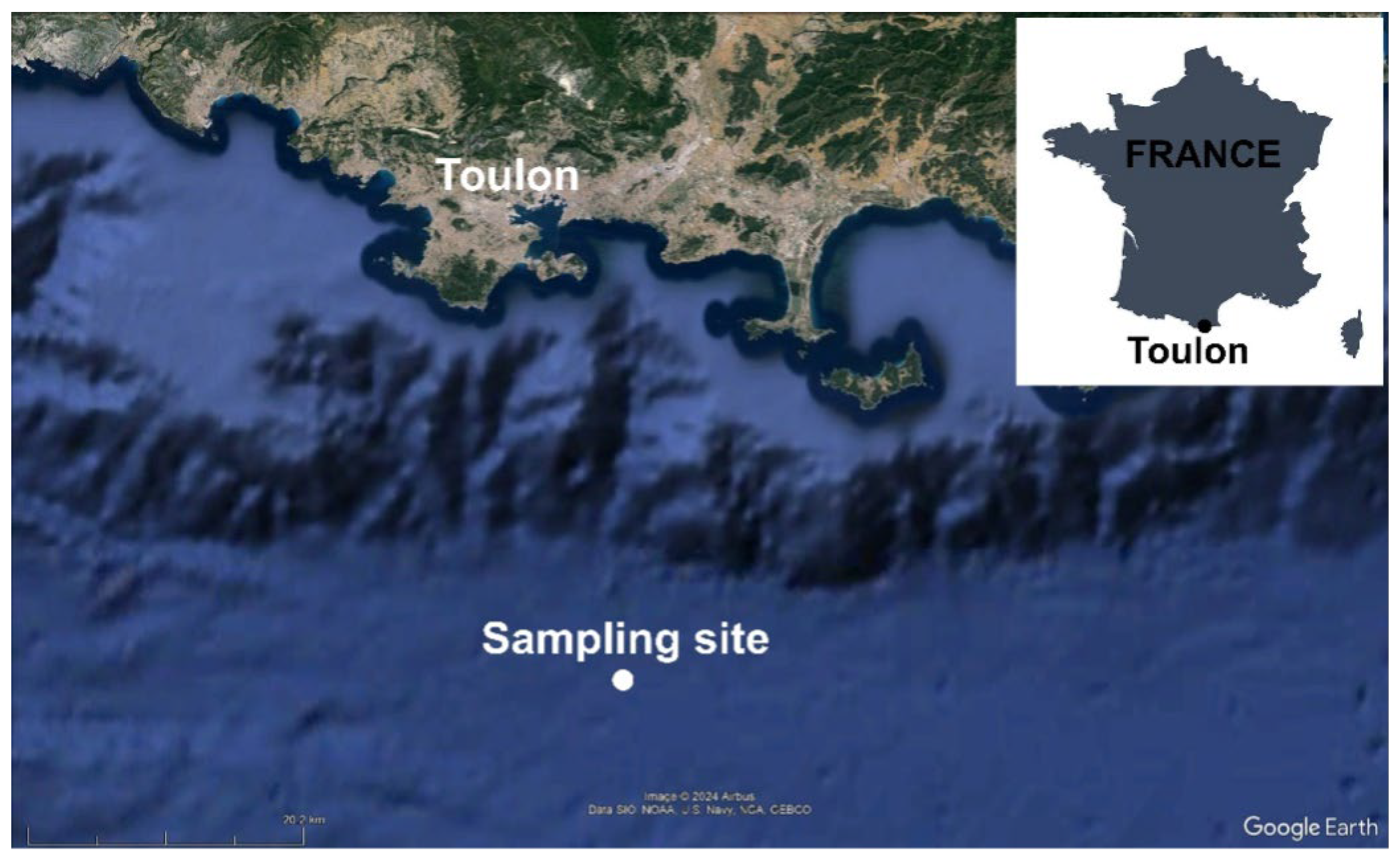
Figure 1. Sampling site off the coast of Toulon (France). Google Earth (version 7.3.6.9796).
Microbiolres 17 00045 g001
Figure 2. Fungal species distribution in the sediment sample.
Microbiolres 17 00045 g002
Figure 3. Spearman’s rank correlation coefficients (ρ) were used to describe patterns of co-variation between the physicochemical parameters of the sediment (grain-size fractions, organic matter content, and trace element concentrations) and the relative occurrence of the main culturable fungal genera isolated from the bathypelagic sediment sample. This analysis is based on a single composite sample and is therefore intended to be descriptive and exploratory, rather than implying statistical significance or causal relationships.
Microbiolres 17 00045 g003
Table 1. Mean results of inorganic-organic and grain size composition of sediment.
ParametersMean ValueStandard Deviation
Organic fraction (%)8.61.6
Inorganic fraction (%)91.41.6
Fine fraction (%)92.22.5
Coarse fraction (%)7.82.5
Clay (%)24.51.8
Fine silt (%)51.33.9
Medium silt (%)12.43.0
Coarse silt (%)4.04.8
Very fine sand (%)3.92.0
Fine sand (%)2.40.5
Medium sand (%)1.20.2
Coarse sand (%)0.20.1
Very-coarse sand (%)0.00.0
Gravel (%)0.00.0
Table 2. Major and trace metal concentrations in sediment samples.
Element Concentrations (Measurement Units)Mean ValueStandard Deviation
Fe (%)2.210.18
Mg (%)1.080.04
Al (%)1.650.17
Mn (ppm)937.88105.7
As (ppm)15.711.37
Cd (ppm)0.070.00
Cu (ppm)32.675.09
Co (ppm)12.661.45
Cr (ppm)43.363.47
Ni (ppm)49.655.05
Pb (ppm)20.881.33
Zn (ppm)61.196.29
V (ppm)34.503.30
Hg (ppb)151.0032.36
Table 3. Fungal species distribution in media (X = growth) and total CFUs values per g of sediment.
FUNGAL SPECIESCFUs x g of SEDIMENT CZMEAOAPDASABTSAYA
Aspergillus creber
Jurjević, S.W. Peterson & B.W. Horn
80X X
Aspergillus crustosus
Raper & Fennell
10 X
Aspergillus restrictus G. Sm.1.56 × 103XXXXXXX
Aspergillus reticulatus
Sklenar, Jurjević, Peterson & Hubka
2.72 × 10³XXXXXXX
Cladosporium cfr. halotolerans
Zalar, de Hoog & Gunde-Cim.
70 X
Cladosporium cfr. xylophilum
(Pers.) Link
30 X X X
Cladosporium sp.10 X
Penicillium bialowiezense
K.W. Zaleski
30 X X
Penicillium chrysogenum Thom30XX XX
Penicillium citreonigrum Dierckx3.24 × 103 X
Penicillium crustosum Thom2.6 × 102XX X X
Penicillium pancosmium
Houbraken, Frisvad & Samson
1.6 × 10² XXXX X
Penicillium rubens Biourge1.3 × 102X X
Purpureocillium lilacinum
(Thom) Luangsa-ard, Houbraken, Hywel-Jones & Samson
20 X
Rhodotorula mucilaginosa
(A. Jörg.) F.C. Harrison
10 X
Subramaniula sp.10 X
Wallemia sebi (Fr.) Arx2.6 × 102XXX X
Table 4. Morphological characteristics of the main fungal strains isolated in this study.
SpeciesColony
Diameter After 7 d (mm)
Colony General
Feature
Conidia Range (µm)Microscopic Image
(40×)
Aspergillus
restrictus
G. Sm., J.
MEA 25°: 2.5–6cerebriform and velutinous on MEAL 3.5–4.5
W 2.5–3
Microbiolres 17 00045 i001
Aspergillus
reticulatus
Sklenar, Jurjević, S.W. Peterson & Hubka
MEA 25°: 1–3.5velutinous to floccose on MEAL 3.5–4.5
W 2.5–3.5
Microbiolres 17 00045 i002
Penicillium
citreonigrum
Dierckx
MEA 25°: 17–19velvety and wrinkled on MEAL 1.2–2.0
W 2–2.4
Microbiolres 17 00045 i003
Penicillium
crustosum
Thom
MEA 25°: 25–40velvety on MEAL 3.5–4.0
W 2.8–3.2
Microbiolres 17 00045 i004
Wallemia
sebi
(Fr.) Arx
MEA 25°: 2–3compact on MEAL 1.5–2.0
W 2.5–3
Microbiolres 17 00045 i005
Disclaimer/Publisher’s Note: The statements, opinions and data contained in all publications are solely those of the individual author(s) and contributor(s) and not of MDPI and/or the editor(s). MDPI and/or the editor(s) disclaim responsibility for any injury to people or property resulting from any ideas, methods, instructions or products referred to in the content.