Article

Antibacterial Effect of Sapindus mukorossi Aqueous Extract in Human Saliva—A Pilot Translational Study with an Ex Vivo Model


1
School of Dentistry, College of Oral Medicine, Taipei Medical University, Taipei 11031, Taiwan
2
School of Oral Hygiene, College of Oral Medicine, Taipei Medical University, Taipei 11031, Taiwan
3
Department of Periodontics, Taipei Medical University Hospital, Taipei Medical University, Taipei 11031, Taiwan
*
Authors to whom correspondence should be addressed.
Microbiol. Res. 2025, 16(11), 230; https://doi.org/10.3390/microbiolres16110230
Submission received: 5 September 2025 / Revised: 15 October 2025 / Accepted: 28 October 2025 / Published: 30 October 2025

Abstract

Sapindus mukorrosi (Sm) seeds have been used in Chinese medicine for treating gingival disease, suggesting that Sm may modulate oral bacteria and alleviate gingival inflammation. However, the hydrophobicity of seed oil limits its use in the aqueous oral environment. Therefore, the artificial saliva-infused Sm seed aqueous extract (SMa) was developed and applied to our ex vivo model to test its anti-bacterial effect. Unstimulated whole saliva from seven patients with Stage III/IV, Grade C periodontitis was cultured for 8 h with or without SMa. The bacterial count was measured based on the optical density and bacterial DNA concentration. The salivary microbiome was sequenced via next-generation sequencing over the 16S rRNA gene V3-V4 hypervariable regions. The bacterial DNA concentration in the SMa group was significantly lower than the Without-SMa group after 6 to 8 h of culture. No significant difference in alpha and beta diversity was observed between the two groups. The relative abundance of Porphyromonas was reduced, while that of Veillonella was elevated in the SMa group compared to the Without-SMa group. The findings indicated that the antibacterial effects of SMa are manifested primarily through bacterial growth inhibition, with the minor modulation of specific taxa.

1. Introduction

Sapindus mukorossi (Sm) is a valuable plant native to India, China, and Japan, widely recognized for its diverse applications in traditional medicine. Found in tropical and subtropical regions of Asia, the deciduous tree grows to a height of 12–15 m [1], with branches bearing dry fruit containing smooth, black, globose seeds [2]. The fruit’s pericarp is particularly prized for its saponin content, which has long been utilized as a natural detergent [2] and insecticidal agent, traditionally employed to remove lice from the scalp [3]. In traditional medicine, Sm fruit is known for its expectorant, emetic, alexipharmic, and abortifacient properties and has been used to treat conditions such as excessive salivation, epilepsy, and chlorosis. The primary constituents of Sm fruit include saponins, sugars, and mucilage [4]. According to the Chinese Compendium of Materia Medica (Bencao Gangmu), Sm seeds, referred to as Wu Huan Zi, were historically noted for reducing gum swelling and malodor, indicating their potential to treat gingival inflammation. In modern research, several studies have explored the therapeutic potential of Sm seed oil in oral medicine. Shiu et al. [5] reported that in vitro co-culture with Sm seed oil promoted alkaline phosphatase activity and increased the secretion of mineralized nodules in dental pulp mesenchymal stem cells under osteogenic and odontogenic induction. In a rodent model of silk-ligature-induced periodontitis, rats with ligatures immersed in Sm seed oil exhibited less total bone loss over 14 days compared to an oil-free control group. Additionally, biofilms from the oil-immersed ligatures and tooth plaques showed lowered microbial diversity and an altered microbiome composition [6]. These findings suggest the potential of Sm seed oil for treating oral diseases and supporting periodontal health.
In prosthodontics, Sm pericarp ethanolic extract demonstrated antimicrobial efficacy against Candida albicans, Staphylococcus aureus, Streptococcus mutans, and Escherichia coli on ceramo-metallic crowns without altering the surface roughness or color [7]. In an in vitro study simulating removable denture prostheses, Sm pericarp aqueous extract also showed concentration-dependent inhibitory effects against C. albicans and S. mutans [8]. Similarly, Sm extracts using methanol, ethanol, butanol, and distilled water, respectively, inhibited in vitro growth of the endodontic pathogens Porphyromonas gingivalis, Actinomyces odontolyticus, Fusobacterium nucleatum, and C. albicans [9]. Another study tested the ability of commercially available Sm vegetable palm glycerine extract to dissolve pulp tissue and found it inferior to sodium hypochlorite [10]. Despite that, Sm pericarp ethanolic extract showed comparable results in microleakage and sealer penetration in dentinal tubules to 17% EDTA [11]. In terms of cariogenic pathogens, all hot aqueous, cold aqueous, acetonic, methanolic, and ethanolic extracts from Sm fruit inhibited the in vitro growth of Saccharomyces cerevisiae but not S. mutans, S. aureus, Lactobacillus acidophilus, and C. albicans [12]. In periodontics, Alasqah [13] reported using Sm as an adjunct to mechanical debridement in peri-implantitis patients with diabetes. Significant improvements n clinical periodontal parameters were observed among all study groups [13]. Last but not least, a study of the effects of Sapindus saponins on C. albicans, the primary pathogen of oral candidiasis, observed the destruction of surface morphology and disruption of biofilm aggregation, thereby showing promising antibiofilm activity [14].
Despite the attested long history and potential of Sm to modulate bacteria and alleviate gingival inflammation, the hydrophobic nature of seed oil, used in previous studies, is difficult to apply in an aqueous environment of the oral cavity. In this regard, the aqueous extract of Sm seed was developed, and artificial saliva was used to infuse Sm seed aqueous extract (SMa) to facilitate the translational application of Sm. Therefore, the objective of our study is to investigate the antibacterial effects of SMa in human saliva from patients with periodontitis using an ex vivo culture model.

2. Materials and Methods

2.1. Preparation of SMa

Sm seeds (He He Co. Ltd., Chengdu, China) were kindly provided by Dr. Haw-Ming Huang. After rinsing with running tap water followed by sterilized double-distilled water (ddH2O), the seeds were dried in an oven at 40 °C for 72 h. The entire seed was shaved into powder using a pulverizer and passed through a 0.5 mm-pore-size screen.
SMa was extracted via the hydro-distillation technique. After the water-cooling condenser (EYELA, Tokyo, Japan) was maintained at 7 °C and heater (EYELA, Tokyo, Japan) at 50 °C, 200 g of Sm seed powder and 400 g of ddH2O were added to the 2 L round-bottom distilling flask. The vacuum machine (EYELA, Tokyo, Japan) was turned on while the powder and ddH2O were homogenized. Volatile compounds were collected via the water-cooling condenser and gathered into a receiving flask. The extraction lasted 2–3 h and yielded around 400 mL SMa at a time, which was then sterilized with 0.22 μm bottle-top filters (JET Biofil, Guangzhou, China).
SMa-infused artificial saliva was formulated as an isotonic solution by dissolving 3150 mg (0.9%) of sodium chloride and 525 mg (0.15%) of carboxymethylcellulose (Sigma-Aldrich, Steinheim, Germany) in 350 mL of SMa. For the control group (Without-SMa), artificial saliva was prepared by adding 0.9% sodium chloride and 0.15% carboxymethylcellulose to ddH2O. Both solutions were sterilized using 0.22 μm bottle-top filters.

2.2. Ethics Statement and Patient Recruitment

All experimental procedures involving human participants were conducted in accordance with the Declaration of Helsinki, and the protocol was approved by Taipei Medical University—Joint Institutional Review Board (JIRB approval number: N202206042; date of approval: 29 June 2022). Patients were screened by periodontists in Taipei Medical University Hospital at the Periodontics Division of Dental Department in August 2023 according to the 1999 Armitage classification and American Academy of Periodontology/European Federation of Periodontology 2018 classification. Seven patients with generalized Stage III/IV, Grade C chronic periodontitis were included. There were two male and five female participants. The age distribution was as follows: one participant aged 30–40 years, one aged 40–50 years, three aged 50–60 years, and two aged over 60 years. The exclusion criteria were the use of antibiotics or antimicrobial agents in the previous month, to avoid alteration of the oral microbiome. Our study did not intend to include or extract extensive additional participant information. Written informed consent for participation was obtained from all patients before saliva collection.

2.3. Saliva Collection and Ex Vivo Incubation

Five milliliters of unstimulated whole saliva was collected from each patient. Immediately after collection, 0.7 mL of whole saliva, 0.7 mL of lysogeny broth (Bioman, New Taipei City, Taiwan), and 2.1 mL of artificial-saliva-infused ddH2O or artificial-saliva-infused SMa were homogenized. The bacterial suspension was incubated at 37 °C for 8 h. For more details, please see the original reference [15].

2.4. Monitoring Oral Bacterial Growth

Bacterial growth was monitored using samples from five participants based on the optical density (OD) and bacterial DNA concentration, measured every 2 h from baseline (0 h). For the OD, 0.4 mL of bacterial suspension was diluted with 0.6 mL of phosphate buffered saline before measurement with a NanoPhotometer NP80 (Implen GmbH, München, Germany).
For the bacterial DNA concentration, the bacterial suspension was centrifuged at 15,000× g for 2 min to pellet the cells. Bacterial DNA was extracted using the QIAamp DNA Microbiome Kit (QIAGEN, Hilden, Germany), which enabled the depletion of host nucleic acids, contaminant removal, and finally the lysis of bacterial cells with intact membranes. The amount of bacterial DNA was measured based on turbidity using a NanoPhotometer NP80.

2.5. Salivary Microbiome Analysis

Since the bacterial growth rate was highest between 4 h and 6 h of incubation from baseline, the salivary microbiome at 6 h of incubation was selected to represent the changes induced by SMa modulation. The extracted bacterial DNA from all seven participants was transferred to Genomics, BioSci & Tech Co. (New Taipei City, Taiwan) for polymerase chain reaction and next-generation sequencing (NGS) over the 16S rRNA gene V3-V4 hypervariable regions, which yielded comprehensible resolution up to the genus level but was limited at the species level. Details are presented in the original reference [15]. Raw data were included in the supplementary information online (Supplementary File S1, Tables S1–S7).

2.6. Statistical Analysis

The microbiome analysis was conducted with SPSS version 19 (IBM, Chicago, IL, USA). Comparisons of the OD, DNA concentration, relative abundance, and alpha diversity indices (abundance-based coverage estimator metric, Chao1 confidence interval, Shannon’s index and Simpson evenness measure E) among the baseline, Without-SMa, and SMa groups were conducted using the Wilcoxon signed rank test and paired t-test. Although the Wilcoxon signed rank test was more appropriate for small sample sizes, the two statistical tests yielded similar results. Statistical results generated from the Wilcoxon signed rank test were presented in the text and figures. Results from the paired t-test were included in the supplementary information online (Supplementary File S2, Tables S8–S13). Beta diversity was measured using the weighted UniFrac distance matrix and analyzed with permutational multivariate analysis of variance (PERMANOVA). The Firmicutes/Bacteroidetes ratio (F/B ratio) was calculated using the mean relative abundance. P-values under 0.05 were considered statistically significant.

3. Results

3.1. Ex Vivo Monitoring of Bacterial Growth

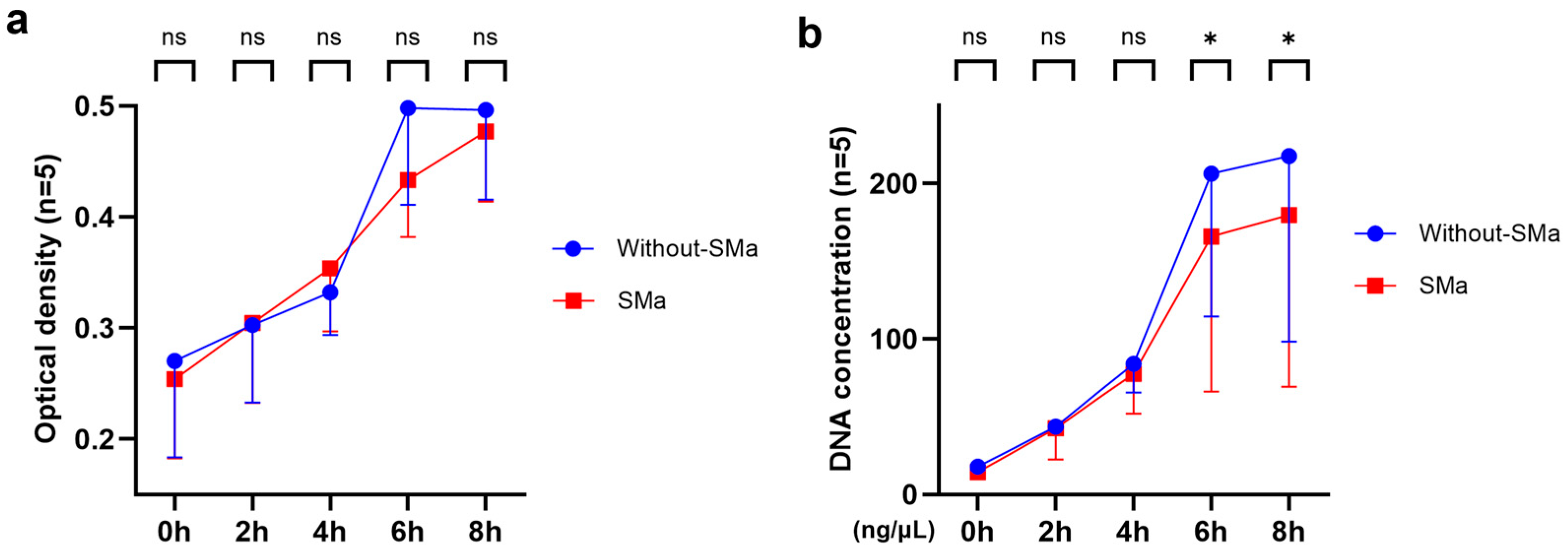
Bacterial growth was monitored based on the OD at 600 nm (OD600) and bacterial DNA concentration. A steady increase in the OD600 from baseline (0 h) to 8 h was observed in the SMa group, whereas a rise was noted in the Without-SMa group from 4 h to 6 h. However, no significant difference in the OD600 was observed between the two groups at all timepoints (Figure 1a).
The DNA concentration in both groups increased over time between 4 h and 6 h. At 6 h and 8 h, the median DNA concentration in the SMa group was significantly lower than the Without-SMa group, with reductions of 40.40 μg/mL (19.59%) at 6 h (p < 0.05) and 37.85 μg/mL (17.40%) at 8 h (p < 0.05) (Figure 1b). As bacterial growth was most evident from 4 h to 6 h, we inferred that modulation was also most rigorous at this time interval; therefore, we selected bacterial DNA collected at 6 h for further metagenome analysis.

3.2. Salivary Metagenome Analysis

The salivary microbiome was analyzed using NGS over the 16S rRNA gene V3-V4 hypervariable regions. After the raw sequences were processed with Trimmomatic and Cutadapt, a total of 2,005,712 sequences from the baseline, Without-SMa, and SMa groups were fed into the DADA2 pipeline. Following filtering, denoising, and removal of chimeric sequences, 1,652,820 reads (average length, 258 ± 16 bases) were retained for microbiome analysis. Taxonomic classification of the 16S rRNA gene V3-V4 hypervariable regions was performed using the SILVA database (version 138). Approximately 100% of the total mean relative abundance was attributed to 11 phyla, 99.69% to 80 named genera, and 27.82% to 95 named species.

3.3. Alpha and Beta Diversity

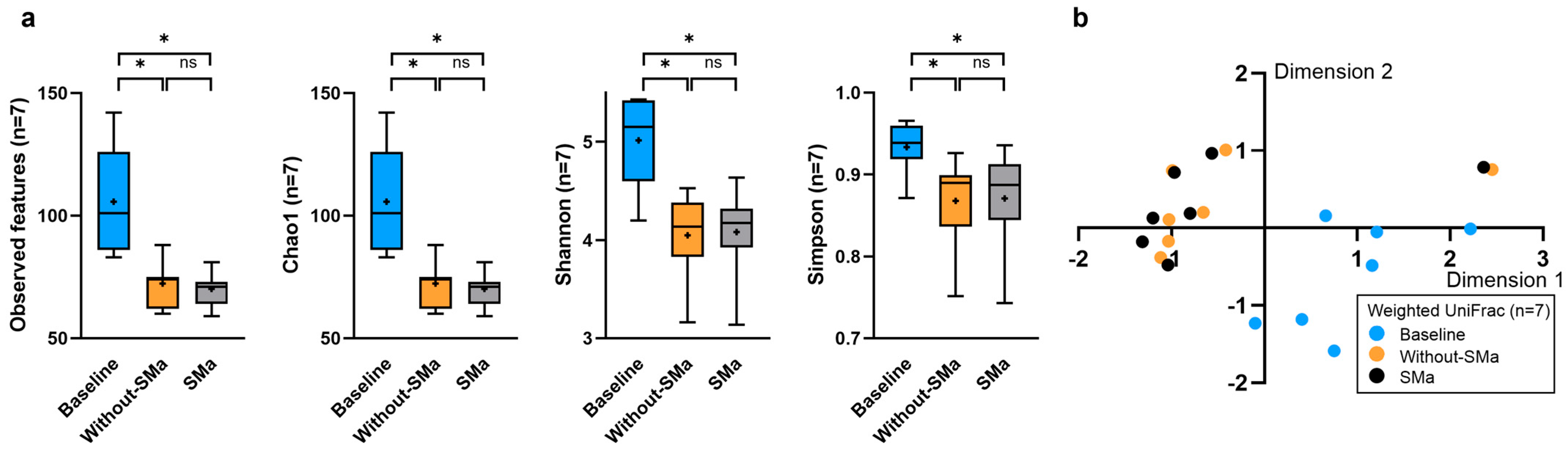
Microbial richness in alpha diversity was assessed using the abundance-based coverage estimator and Chao1 confidence interval. Shannon’s index and the Simpson evenness measure E were used to estimate microbial richness and evenness. No significant difference was observed between the Without-SMa and SMa groups across four alpha diversity indices (Figure 2a).
Similarly, beta diversity analyzed through PERMANOVA from the weighted UniFrac distance matrix revealed no significant difference with or without SMa (p = 0.961, pseudo-F = 0.024, permutations = 999). This was visualized using non-metric multidimensional scaling (NMDS), in which sample points from the two groups clustered closely, distinct from the baseline group (Figure 2b).

3.4. Shifts in the Salivary Microbiome

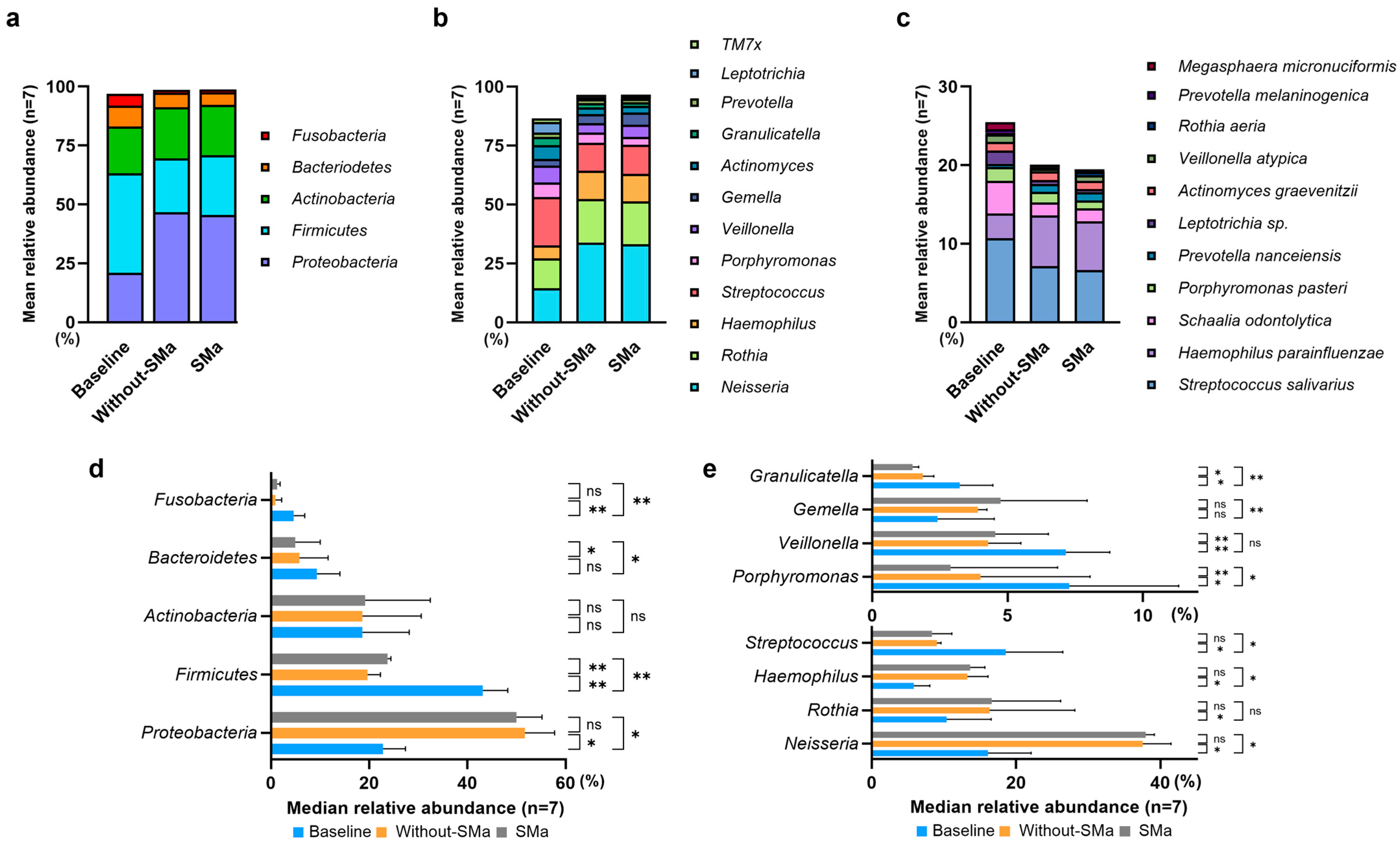
The alteration in the taxonomic distribution was trivial between the Without-SMa and SMa groups if compared to the baseline. The dominant phyla were consistent across all three groups, namely Proteobacteria, Firmicutes, Actinobacteria, Bacteroidetes, and Fusobacteria (Figure 3a). Twelve genera with the highest relative abundance were highlighted, including Neisseria, Rothia, Haemophilus, Streptococcus, Porphyromonas, Veillonella, Gemella, Actinomyces, Granulicatella, Prevotella, Leptotrichia, and TM7x (Figure 3b). The species presented in the figure were selected based on their prominence and consistency (Figure 3c).
The relative abundance of each taxon cultured with or without SMa was analyzed. Regarding the phyla, Firmicutes showed an increase (p < 0.01) in the SMa group, while Bacteroidetes exhibited a drop (p < 0.05) (Figure 3d). At the genus level, Porphyromonas (p < 0.01) and Granulicatella (p < 0.05) decreased, while Veillonella (p < 0.01) and Gemella (without statistical significance) increased in the presence of SMa (Figure 3e).

3.5. SMa Modulation of Porphyromonas and Veillonella

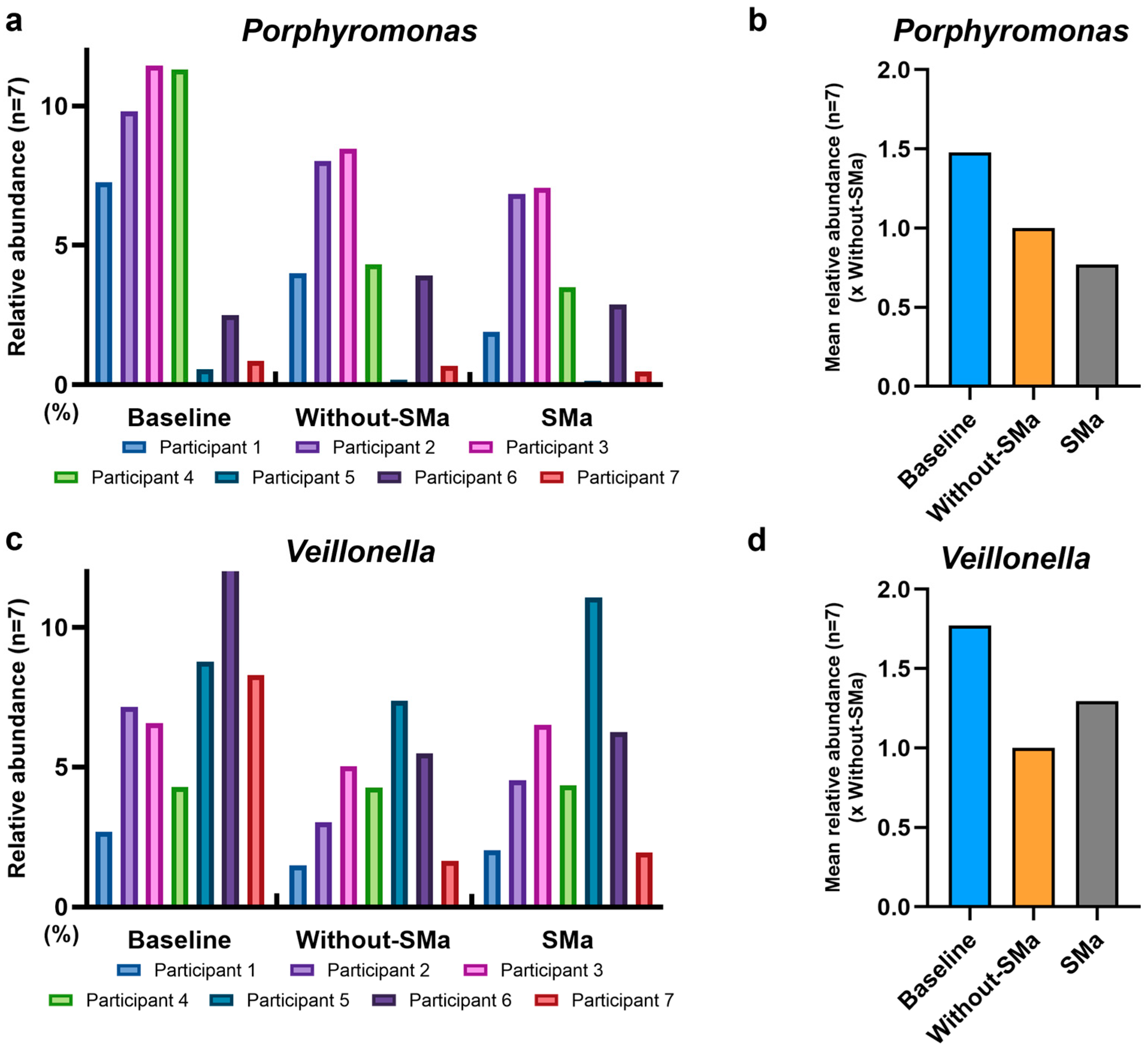
As Porphyromonas and Veillonella are key members of the oral microbiome, shifts in their relative abundance were analyzed to see if these trends were consistent. For Porphyromonas, six out of seven participants exhibited the highest relative abundance at baseline and the lowest with SMa (Figure 4a). For Veillonella, a trend of lowered relative abundance was observed in all samples after 6 h of culture without SMa, which was reversed by the presence of SMa, elevating the relative abundance (Figure 4c).
These results were converted to multiplicative differences by comparing the mean relative abundance to that of the Without-SMa group. For Porphyromonas, the mean relative abundance at baseline was 1.47 times that of the Without-SMa group, while it was 0.77 times in the SMa group (Figure 4b). For Veillonella, the mean relative abundance at baseline was 1.77 times that of the Without-SMa group and 1.29 times in the SMa group (Figure 4d).

3.6. F/B Ratio

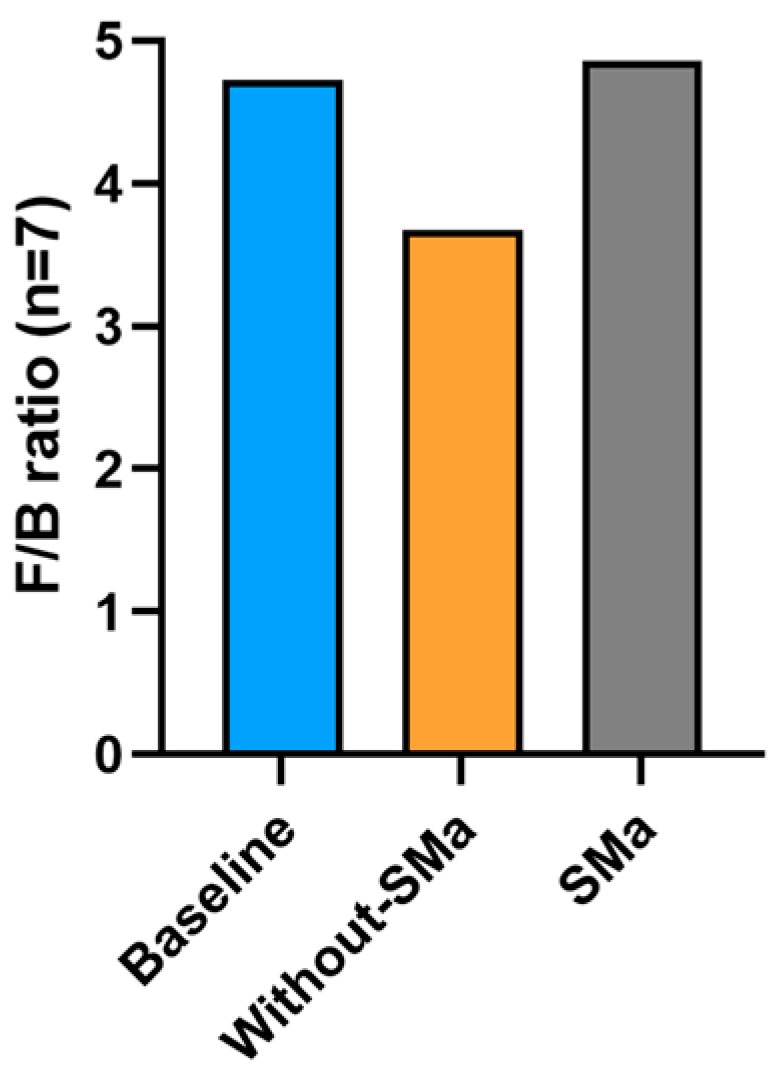
Firmicutes and Bacteroidetes were the only two phyla showing significant changes. The F/B ratio has been investigated as a candidate indicator of the gut microbiome dysbiosis associated with obesity and inflammation. Recently, it has also been examined in the oral microbiome [16]. At baseline, the F/B ratio was 4.7283. After 6 h of culture, the ratio was 3.6776 without SMa and increased to 4.8545 with SMa (Figure 5).

4. Discussion

As was stated in Bencao Gangmu, the seeds of Sm could alleviate halitosis and gingival swelling, which are both associated with oral bacterial deposition. Since the oral environment is hydrophilic, we investigated whether SMa could inhibit bacterial growth and modulate the salivary microbiome in an ex vivo culture model. The results revealed a significant reduction in the salivary bacterial count after the addition of SMa, and specific bacteria showed different trends in relative abundance. These findings suggested that SMa exerted antibacterial effects and could potentially modulate the salivary microbiome.
The monitoring of the DNA concentration, which provided optimized sole coverage of bacterial DNA, has revealed a significant reduction in the total bacterial load in the presence of SMa, observed from 6 h to 8 h of incubation. As far as the literature is concerned, no previous study has reported the inhibitory effect of Sm against a consortium of bacteria from a particular niche, as studies mainly focused on few specific pathogens [17,18,19,20]. Although the microbiome composition and conventional oral pathogens have been intensively studied, the effects of the total bacterial burden on periodontitis and other oral diseases have not yet been fully elucidated. According to Abusleme et al. [21], teeth with extensive periodontal inflammation, manifested as bleeding on probing, were associated with a higher number of 16S rRNA gene copies from subgingival microbiomes. Another study over a Nigerian university population investigated the correlation between the salivary bacterial count and oral lesions/habits, among which only periodontitis was significantly associated with an increased salivary bacterial burden, yet no causal relationship has been confirmed [22]. However, the salivary bacterial load has become increasingly important for hospitalized patients and seniors living in nursing homes concerning perioperative care and lowering the risk of aspiration pneumonia [23,24]. Sakamoto et al. [23] suggested that reducing the bacterial count in saliva helps prevent surgical site infections located in the head and neck and upper gastrointestinal tract, as these sites are prone to direct exposure to saliva. This result is especially important for patients with an older age, xerostomia, smoking, a low albumin level, and postoperative fasting, who have higher risks of developing a greater salivary bacterial burden [23]. In nursing homes, elderly with a lower Barthel index, higher number of remaining teeth, and the presence of food residue had a greater bacterial load in saliva [24]. These patients are more compromised in self-care and dexterity required for brushing and flossing, warranting a need for simple, auxiliary hygiene products, such as antibacterial mouthwash. The potential of SMa to reduce the salivary bacterial load may be able to help if validated in the future.
Interestingly, in our study, two methods, the OD600 and bacterial DNA concentration, were applied to estimate the salivary bacterial load and showed a discrepancy in the estimation of bacterial growth. Both methods detected a rise from 4 h to 6 h, but only the DNA concentration method showed a statistical difference between the two groups. The OD600 is a common method for estimating the cell count and growth stage via the attenuation of light through a suspension along a given pathlength [25]. It is routinely used in microbial research as it is fast, simple, automated, and non-disruptive compared to alternative methods, such as flow cytometry and colony-forming units [26]. Since the size of bacterial cells is at the same order as the wavelength of visible light, OD measures the turbidity of a bacterial suspension from light scattering rather than absorbance from cell contents. The size of bacterial cells and their heterogeneity further suggest the use of Rayleigh–Debye–Gans theory rather than Mie theory to approximate bacterial light scattering [27]. The shortcoming of using OD600 in our study was that other contents from collected saliva were present, including shredded oral epithelial cells and dissociated contents of lysed cells. Alternately, the DNA concentration is positively correlated with the cell count, although it becomes sophisticated when taking cell division, shifts in nutrients provided by the culture medium, and varying growth rates into consideration [28]. The variability of the genome size among microbial communities [29] also leads to complexity when samples with different microbiome compositions are compared. However, the key advantage of the DNA method in our study was that the measured DNA came explicitly from intact cells due to the reinforcement of contaminant removal, host cell depletion and final lysis of the intact bacterial membrane. That was the primary reason why we considered the DNA concentration method more reliable.
Apart from the technical factors mentioned above and statistical factors, given the small sample size, there may also be some biological reasons leading to the discrepancy of equivalent biomass and reduced DNA concentration in the SMa group, with hypotheses including deceleration of cell cycles, bioactive compound-induced cell lysis, a decrease in the rate of DNA synthesis [30], DNA degradation inside cells [31], or an uneven distribution of plasmid DNA [32]. During the cell cycle, there is a short period before and after splitting when the DNA level is increased but cell biomass remains approximately the same. However, it was still difficult to infer that rate of cell cycles slowed down in the SMa group solely because the DNA level decreased relative to the Without-SMa group. If that were the case, total biomass would later be reduced as well, especially in an asynchronous culture. Similarly, cell lysis or damage to the cell membrane might not fully explain the phenomenon, because over a longer period, the rate of total biomass growth would slow down due to the complete halt of activity in lysed cells. Other biological hypotheses involve cell responses to stress conditions, such as restructuring DNA during dormant transition, leading to lower DNA accessibility [33]. As Sm has an attested history of antimicrobial effects, it may not be surprising that it creates stress environments for bacteria. Nevertheless, all the hypotheses mentioned above are merely speculations, and the actual mechanism warrants further investigation.
Shifts in the salivary microbiome were obscure from a macroscopic view. Stacked barplots of phyla, genera, and species showed no prominent change, while alpha diversity indices confirmed that there were no statistical differences between the Without-SMa and SMa groups. In terms of beta diversity, the NMDS plot, which visualized weighted UniFrac results, revealed the proximity of datapoints from the two groups. However, a more detailed comparison of relative abundance revealed delicate modulation of the taxa induced by SMa. Among the phyla, core members of the salivary microbiome have been preserved in both groups, while an increase in Firmicutes and decrease of Bacteroidetes were observed. The reduction in Bacteroidetes (by mean, Mn, −0.98%) was contributed mainly by the genera Porphyromonas (by Mn −0.97%) and trivially by Prevotella (by Mn −0.02%). In contrast, the elevation in Firmicutes (by Mn +2.59%) was attributed by the genera Streptococcus (by Mn +0.61%), Veillonella (by Mn +1.19%), Gemella (by Mn +1.25%), and Granulicatella (by Mn −0.41%). These changes may imply slight elevations in early colonizers (Streptococcus) and bridging species (Veillonella) along with the reduction of late colonizers (Porphyromonas and Prevotella). Further investigation into the species level is warranted to clarify the roles of each species belonging to Porphyromonas and Veillonella.
Based on our results, Porphyromonas and Granulicatella were significantly reduced in all seven participants. Due to the constriction of NGS over the 16S rRNA gene V3-V4 hypervariable regions, only three species from Porphyromonas were identified in our study, namely Porphyromonas pasteri, Porphyromonas endodontalis, and P. gingivalis. The former two showed a decrease in the presence of SMa, while the latter was detected in only one participant at baseline (Supplementary File S1, Table S5). Of note, P. pasteri is a major component of Porphyromonas in saliva, being one of the core salivary species and associated with oral health [34]. The amount of P. pasteri in the saliva has been negatively correlated with caries [35] and oral squamous cell carcinoma [36]. In contrast, P. endodontalis was initially found in endodontic infections and later shown to be highly prevalent in diseased periodontitis sites [37]. Although the effects of P. pasteri and P. endodontalis on the oral environment largely differ, it may be suspected that these bacteria have similar metabolic pathways, thereby showing similar responses to SMa. The other genus experiencing a significant reduction in our study was Granulicatella, shrinking by around one quarter of the original relative abundance after the addition of SMa. No species from this genus was further identified in the analysis. Granulicatella was historically classified as Nutritionally Variant Streptococci, which now includes two genera, Granulicatella and Abiotrophia, both being natural inhabitants of the human microbiome but still responsible for rare implications in isolated infections, bacteremia, septicemia, and endocarditis [38]. Although the main effect of SMa was generalized inhibition of the total bacterial load, it may still aid in reducing certain taxa associated with disease.
Interestingly, the increase in Veillonella was evident in all seven participants in the SMa group compared to the Without-SMa group. Veillonella is one of the dominant oral genera and are Gram-negative anaerobic cocci. Most Veillonella species consume lactate as their primary carbon source and are spaciotemporally associated with acidogenic bacteria and caries, which results from the demineralization of the tooth structure from acids, especially lactic acid. Nevertheless, it remains unclear whether the genus is causally or consequentially related to caries [39]. Another well-known role of Veillonella is being the “bridging” species, which could build up healthy, symbiotic oral biofilms with commensal Streptococci or could connect early colonizers to later, pathogenic ones. However, strict anaerobes, most Veillonella species, can detoxify hydrogen peroxide (H2O2) and produce heme, thus providing favorable niches for periodontal pathogens, such as Fusobacterium nucleatum and P. gingivalis. The underlying mechanism that decides whether the oral biofilm progresses into commensalism or dysbiosis remains unclear but might depend on specific activities of certain Veillonella species and might be triggered by environmental lactate and oxygen levels. One example is the expression of hemagglutinin 1 (Hag1) by Veillonella atypica, which provides adhesion sites for P. gingivalis [39]. However, investigation into the species level could be challenging due to the high genomic similarities between Veillonella species. In our pilot study using NGS over 16S rRNA V3-V4 hypervariable regions, only two species, V. atypica and Veillonella parvula, were identified. It is purported that discrimination to the species- and strain-level may promote the understanding of their individual roles and that resolution might be achieved via 16S rRNA sequencing complemented with other housekeeping genes [39].
Despite the observation of the decrease in Porphyromonas and increase in Veillonella, it remained ambiguous about what biological or clinical significance that this might bring, especially with the lack of NGS resolution to the species level. The specific roles and functions of single species and strains have long been mysteries that warrant breakthroughs, not to mention that many species are not yet named/identified and those from the same genus may have both protective and pathogenic roles. Therefore, one should be cautious to interpret any clinical significance based on the change in abundance at the genus level. Nonetheless, the findings of our pilot study may still point to an obscure direction for future investigations. The following text is only a brief hypothesis to the possible biological impacts of the microbiome shift. Firstly, the total salivary bacterial load has been reduced by SMa. Secondly, the influence of SMa on mature biofilms could not be predicted by our pilot study since the salivary microbiome was presented as a planktonic state and that biofilms showed much stronger resistance to antiseptics than planktonic bacteria. Considering the aforementioned information, a biological effect of SMa might be the mitigation of the spread of Porphyromonas across the oral cavity via saliva due to a reduced bacterial load and decreased relative abundance, thus reducing the dissemination of periodontopathogens from diseased to susceptible sites. However, an increase in the relative abundance of planktonic Veillonella posed a question of whether the oral microbiome would be directed to symbiosis or dysbiosis. The decision might depend on the surface proteins expressed by different phenotypes, which are affected by environmental conditions such as lactate concentrations, oxygen availability, and nutritional sources. Hag1, an important surface protein of Veillonella spp., has as many as 7187 amino acids, thereby making different domains and mechanisms possible for connecting different early and late colonizers [39]. If periodontitis-related bacteria and the total bacterial load were reduced, as a potential result of SMa, there might be an opportunity for Veillonella to bridge to health-related commensals and build up surveillance of the salivary microbiome. Of note, this is only a hypothesis and should be read with caution not to be interpreted beyond its postulating nature. Future studies will incorporate NGS with higher resolution while knowledge over single species and strains is enhanced to provide mechanistic insight between the modulating agent and oral bacteria.
Intriguingly, the relative abundance of Firmicutes has increased while that of Bacteroidetes has decreased in our study, leading to a rise in the F/B ratio, although the association between the F/B ratio and obesity remained controversial [40]. In the oral microbiome, recent studies pointed out unique interactions between the two phyla. Li and Ma, 2020 [41], inferred an alliance between oral Firmicutes and Bacteroidetes to compete against Actinobacteria, a phylum with opportunistic pathogens. It may be inferred that although SMa modulation seemed modest, these modifications might have brought better outcomes. A dramatic shift in the oral microbiome might have allowed the invasion of opportunistic pathogens and become more challenging for oral health.
The absence of a positive control was a missed opportunity of our pilot study. To date, the most frequently used oral antiseptics are chlorhexidine digluconate (CHX) and cetylpyridinium chloride (CPC). CHX is a symmetric bis-biguanide molecule [42] that can cause damage to bacterial cytoplasmic membranes by reacting with negative charges on the surface [43]. Low concentrations of CHX exhibit inhibitory effects, while high concentrations are bactericidal by causing severe damage to nucleic acids, proteins, and other cell constituents [43,44]. CPC is a monocationic quaternary ammonium compound [42] that can bind to negatively charged bacterial cells. It degrades lipid bilayers of cell membranes and causes leakage of cell contents while inhibiting the synthesis of a particular polysaccharide crucial for the development of caries [43]. Both antiseptics have been validated as effective against planktonic bacteria [45,46]. Regarding their effects on the oral microbiome, one study investigated the effect of CHX mouthwash of the salivary microbiome in patients after 7-day use (for 1 min twice a day) and found increased abundance of Firmicutes and Proteobacteria, as well as a reduction in Bacteroidetes, TM7, SR1, and Fusobacteria. Salivary properties such as the pH, buffer capacity, and nitrite availability also decreased while lactate and glucose levels in saliva were elevated [47]. However, some also pointed out that the antimicrobial effect of CHX could cause dysbiosis of the oral microbiome when strains were killed and became less diverse. In another study applying CHX mouthwash twice daily for 4 weeks following periodontal surgical procedures, a reduction in alpha diversity was observed along with a higher relative abundance of Streptococci, suggesting promotion of the caries-associated community [44].
Although CHX and CPC have both proven to exert significant antimicrobial effects on planktonic bacteria, it is far more difficult to break through the structure of biofilms. To investigate the effects of CHX and CPC on oral biofilms, Mao et al., 2022 [42], collected salivary samples from healthy participants and cultured the bacteria in Amsterdam Active Attachment biofilm models. Both CHX and CPC could not inhibit biofilm growth but modulated the microbiome composition. CHX-treated biofilms were enriched with rather caries-associated saccharolytic taxa, including Streptococcus spp., Granulicatella spp., Neisseria spp., and Schaalia spp. In contrast, CPC-treated biofilms encouraged the growth of rather gingivitis-associated proteolytic taxa, including Fusobacterium spp., Leptotrichia spp., Selenomonas spp., Haemophilus spp., Campylobacterales, Oribacterium, and Prevotella loescheii. Both antiseptic-treated biofilms showed the loss of some Prevotella, Catonella, and Parvimonas spp. compared to NaCl-treated biofilms. Nevertheless, in each sample of all four donors, at least one species could be found to be resistant to CHX or CPC, with many of these being antibiotic-resistant at the same time [42]. Therefore, further research into the effects of oral antiseptics on the microbiome composition, biofilm structure, and bacterial resistance and new alternatives to conventional antiseptics are warranted. The primary objective of the present pilot study was to develop an experimental model for SMa. An integrated analysis of CHX, CPC, and SMa would be addressed in future studies, which would clarify the advantages and limitations of each antiseptic for various applications.
There were several limitations to this study. Firstly, the sample size was limited to seven participants. Without previous reference, a moderate effect size power calculation suggested 36–38 participants to be recruited in the definitive study. However, determined as a pilot study, our study design was focused on establishing the experiment model and testing its feasibility before a clinical trial. The primary outcome of this study is the inhibition of the bacterial growth of a Sapindus mukorossi aqueous extract. As the effect size was revealed beyond expectation, this pilot trial ended before the anticipated power sample size after reaching its feasibility and preliminary objective. Further studies would be able to estimate the effect size and sample size with reference to the results within the limitation of this ex vivo model. The second limitation was the constriction of the culture duration to 8 h. However, this can still mimic the oral biofilm dynamics between meals. Additionally, we have piloted a time-course trial to ensure that 8 h is within the exponential growth phase and that beyond 12–24 h, the current ex vivo model is reaching the stationary phase. According to Choi et al., 2024 [48], bacterial strains from Actinomyces, Granulicatella, Rothia, and Streptococcus grown in culture medium containing saliva showed doubling times under 220 min. In the same study, eight oral Streptococci, cultured in medium with saliva, entered stationary phase within 6–12 h [48]. Therefore, the current 8 h may still represent a reasonable timeframe simulating the dynamics within oral cavity, yet this limitation should be noted. The third limitation was the aerobic culture setting, which would make it difficult for the isolation and analysis of anaerobic periodontopathogens. Since the focus of our study was the salivary microbiome, aerobic culture was justified. Nevertheless, an optimal study design would be to include both aerobic and anaerobic culture settings, the former for the predominant members of the salivary microbiome and the latter specifically for periodontopathogens. Suggestions for further studies would be optimizing culture conditions with different media (lysogeny broth, brain heart infusion, artificial saliva, and mixtures), under aerobic and anaerobic conditions and under short- or long-term investigation (<24 h or >24 h). Lastly, a compositional analysis of SMa was not provided. This was beyond the scope of our pilot study, which focused primarily on the effects of SMa on the salivary microbiome in our ex vivo model. The novelty of SMa was the extraction of water-soluble compounds from Sm seeds, which were formerly processed for oil-soluble contents only. Possible bioactive compounds may be flavonoids and phenols, with potential antioxidant activity [49,50], and small volatile compounds, including short-chain alcohols and small terpenoid molecules [51].
To facilitate translational research on the oral microbiome, this was the first time we applied an agent to our ex vivo salivary microbiome model to test its antimicrobial and modulating capability. Although the modulatory effects of SMa were limited to selective taxa, the major contribution of our pilot study was demonstrating the potential of SMa for bacterial load reductions in human saliva. Given the positive preliminary results, we consider SMa of worthy value for further development to assist in oral bacterial control in certain groups. We hope to expand our sample size and adjust culture settings to optimally simulate the oral environment in the next stage.

Supplementary Materials

The following supplementary files can be downloaded online with the article: Supplementary File S1_raw data, including Table S1: Optical density, Table S2: DNA concentration, Table S3: Relative abundance of phyla, Table S4: Relative abundance of genera, Table S5: Relative abundance of species, Table S6: Alpha diversity indices, Table S7: Weighted UniFrac (distance matrix); Supplementary File S2_statistical analysis, including Table S8: Optical density, Table S9: DNA concentration, Table S10: Relative abundance of phyla, Table S11: Relative abundance of genera, Table S12: Alpha diversity indices, Table S13: Weighted UniFrac (PERMANOVA).

Author Contributions

Conceptualization, C.-W.W.; methodology, J.-J.Y., W.-M.C., and C.-W.W.; formal analysis, J.-J.Y. and Y.-H.Y.; resources, H.-M.H.; data curation, Y.-H.Y.; writing—original draft preparation, Y.-H.Y.; writing—review and editing, Y.-H.Y. and C.-W.W.; visualization, Y.-H.Y.; supervision, C.-W.W., W.-M.C., and H.-M.H.; project administration, C.-W.W.; funding acquisition, C.-W.W. All authors have read and agreed to the published version of the manuscript.

Funding

This research was funded by the Taipei Medical University Research Fund (TMU110-AE1-B27) and National Science and Technology Council (NSTC), Taiwan R.O.C. (grant number: NSTC112-2314-B-038-117) to C.-W.W.

Institutional Review Board Statement

The study was conducted in accordance with the Declaration of Helsinki, and approved by the Institutional Review Board of Taipei Medical University—Joint Institutional Review Board (JIRB approval number: N202206042; date of approval: 29 June 2022).

Informed Consent Statement

Informed consent was obtained from all subjects involved in the study.

Data Availability Statement

The original contributions presented in this study are included in the article/Supplementary Material. Further inquiries can be directed to the corresponding authors.

Acknowledgments

We gratefully acknowledge the Biostatistics Department of Taipei Medical University for assisting in the statistical analysis of PERMANOVA for beta diversity.

Conflicts of Interest

The authors declare no conflicts of interest.

Abbreviations

The following abbreviations are used in this manuscript:
SmSapindus mukorossi
SMaSapindus mukorossi seed aqueous extract
ddH2ODouble-distilled water
ODOptical density
NGSNext generation sequencing
PERMANOVAPermutational multivariate analysis of variance
F/B ratioFirmicutes/Bacteroidetes ratio
OD600Optical density at 600 nm
nsNot statistically significant
NMDSNon-metric multidimensional scaling
MnMean
H2O2Hydrogen peroxide
Hag1Hemaglutinin 1
CHXChlorhexidine gluconate
CPCCetylpyridinium chloride

References

  1. Sochacki, M.; Vogt, O. Triterpenoid Saponins from Washnut (Sapindus mukorossi Gaertn.)—A source of natural surfactants and other active components. Plants 2022, 11, 2355. [Google Scholar] [CrossRef]
  2. Upadhyay, A.; Singh, D.K. Pharmacological effects of Sapindus mukorossi. Revista do Instituto de Medicina Tropical de São Paulo 2012, 54, 273–280. [Google Scholar] [CrossRef] [PubMed]
  3. Suhagia, B.N.; Rathod, I.S.; Sindhu, S. Sapindus mukorossi (Areetha): An overview. Int. J. Pharm. Sci. Res. 2011, 2, 1905. [Google Scholar]
  4. Ibrahim, M.; Khan, A.A.; Tiwari, S.K.; Habeeb, M.A.; Khaja, M.N.; Habibullah, C.M. Antimicrobial activity of Sapindus mukorossi and Rheum emodi extracts against H pylori: In vitro and in vivo studies. World J. Gastroenterol. 2006, 12, 7136. [Google Scholar] [CrossRef] [PubMed]
  5. Shiu, S.T.; Lew, W.Z.; Lee, S.Y.; Feng, S.W.; Huang, H.M. Effects of Sapindus mukorossi seed oil on proliferation, osteogenetic/odontogenetic differentiation and matrix vesicle secretion of human dental pulp mesenchymal stem cells. Materials 2020, 13, 4063. [Google Scholar] [CrossRef] [PubMed]
  6. Lin, S.K.; Wu, Y.F.; Chang, W.J.; Feng, S.W.; Huang, H.M. The treatment efficiency and microbiota analysis of Sapindus mukorossi seed oil on the ligature-induced periodontitis rat model. Int. J. Mol. Sci. 2022, 23, 8560. [Google Scholar] [CrossRef]
  7. Alshahrani, A.; Alhamdan, E.M.; Alsahhaf, A.; Shafqat, S.; Kumari, U.; Alyahya, A.M.; Abduljabbar, T. Influence of contemporary ceramo-metallic crown decontamination on the surface roughness, color stability, and disinfection. An in vitro analysis. Photodiagnosis Photodyn. Ther. 2023, 41, 103256. [Google Scholar] [CrossRef]
  8. Hariharan, A.; Krishnamurthi, S.; Thamarai, C.; Thanya, K.; Parameswari, D.; Krithika, A. Sapindus mukurossi–An Effective Biocleanser for Removable Dental Prostheses? An In vitro Study. J. Pharm. Bioallied Sci. 2024, 16, S1154–S1160. [Google Scholar] [CrossRef]
  9. Saglik, İ.; Tuncay, Ö.G.; Özhak, B. Investigation of the antimicrobial effects of Sapindus mukorossi on endodontic pathogens. J. Exp. Clin. Med. 2020, 37, 111–118. [Google Scholar]
  10. Kaliamoorthy, S.; Rayar, S.; SundarRaj, S.; Sayeeram, S.P.; Premkumar, V.; Muddappa, S.C.; Muthukumaran, V.; Raju, K.; Samidorai, A.; Sreeram, R. Comparative Evaluation of Dental Pulp Tissue Dissolution Ability of Sapindus mukorossi and Sodium Hypochlorite. Cureus 2024, 16, e51820. [Google Scholar] [CrossRef]
  11. Tahir, A.; Ur-Rehman Qazi, F.; Choudhry, Z.; Musheer, U.; Amin, M.; Malik, S.; AlMokhatieb, A.; Almadi, K.; Alkahtany, M.; Ahmed, M. Influence of Sapindus mukorossi extract in comparison to 17% EDTA as final root canal irrigant on the sealer penetration and microleakage of dentinal tubules. Eur. Rev. Med. Pharmacol. Sci. 2023, 27, 2724–2732. [Google Scholar]
  12. Aneja, K.R.; Joshi, R.; Sharma, C. In vitro antimicrobial activity of Sapindus mukorossi and Emblica officinalis against dental caries pathogens. Ethnobot. Leafl. 2010, 2010, 3. [Google Scholar]
  13. Alasqah, M.N. Efficacy of Adjunctive Fotoenticine Photodynamic Therapy and Sapindus mukorossi Therapy on Clinical, Radiographic, and Cytokine Profile of Diabetics with Peri-Implantitis. Photobiomodul. Photomed. Laser Surg. 2024, 42, 174–181. [Google Scholar] [CrossRef]
  14. Li, L.; Wei, M.-P.; Yu, H.; Xie, Y.-F.; Guo, Y.-H.; Cheng, Y.-L.; Yao, W.-R. Antifungal activity of Sapindus saponins against Candida albicans: Interruption of biofilm formation. J. Herb. Med. 2023, 42, 100776. [Google Scholar] [CrossRef]
  15. Yang, Y.-H.; Yu, J.-J.; Han, H.-Y.; Chang, W.-M.; Wang, C.-W. Ex-vivo investigation of human salivary microbial growth with lysogeny broth for translational research–A pilot study. J. Dent. Sci. 2025, 20, 437–443. [Google Scholar] [CrossRef]
  16. Benahmed, A.G.; Gasmi, A.; Doşa, A.; Chirumbolo, S.; Mujawdiya, P.K.; Aaseth, J.; Dadar, M.; Bjørklund, G. Association between the gut and oral microbiome with obesity. Anaerobe 2021, 70, 102248. [Google Scholar] [CrossRef] [PubMed]
  17. Chen, C.-C.; Nien, C.-J.; Chen, L.-G.; Huang, K.-Y.; Chang, W.-J.; Huang, H.-M. Effects of Sapindus mukorossi seed oil on skin wound healing: In vivo and in vitro testing. Int. J. Mol. Sci. 2019, 20, 2579. [Google Scholar] [CrossRef]
  18. Selvaraj, A.; Valliammai, A.; Premika, M.; Priya, A.; Bhaskar, J.P.; Krishnan, V.; Pandian, S.K. Sapindus mukorossi Gaertn. and its bioactive metabolite oleic acid impedes methicillin-resistant Staphylococcus aureus biofilm formation by down regulating adhesion genes expression. Microbiol. Res. 2021, 242, 126601. [Google Scholar] [CrossRef] [PubMed]
  19. Wei, M.P.; Yu, H.; Guo, Y.H.; Cheng, Y.L.; Xie, Y.F.; Yao, W.R. Synergistic combination of Sapindoside A and B: A novel antibiofilm agent against Cutibacterium acnes. Microbiol. Res. 2022, 254, 126912. [Google Scholar] [CrossRef]
  20. Wei, M.-P.; Yu, H.; Guo, Y.-H.; Cheng, Y.-L.; Xie, Y.-F.; Yao, W.-R. Potent in vitro synergistic antibacterial activity of natural amphiphilic Sapindoside A and B against Cutibacterium acnes with destructive effect on bacterial membrane. Biochim. Biophys. Acta Biomembr. 2021, 1863, 183699. [Google Scholar] [CrossRef] [PubMed]
  21. Abusleme, L.; Dupuy, A.K.; Dutzan, N.; Silva, N.; Burleson, J.A.; Strausbaugh, L.D.; Gamonal, J.; Diaz, P.I. The subgingival microbiome in health and periodontitis and its relationship with community biomass and inflammation. ISME J. 2013, 7, 1016–1025. [Google Scholar] [CrossRef]
  22. Oyetola, E.O.; Awosusi, O.O.; Agho, E.T.; Abdullahi, M.A.; Suleiman, I.K.; Egunjobi, S. Salivary Bacterial Count and its Implications on the Prevalence of Oral Conditions. J. Contemp. Dent. Pract. 2019, 20, 184–189. [Google Scholar] [CrossRef]
  23. Sakamoto, Y.; Tanabe, A.; Moriyama, M.; Otsuka, Y.; Funahara, M.; Soutome, S.; Umeda, M.; Kojima, Y. Number of bacteria in saliva in the perioperative period and factors associated with increased numbers. Int. J. Environ. Res. Public Health 2022, 19, 7552. [Google Scholar] [CrossRef]
  24. Tohara, T.; Kikutani, T.; Tamura, F.; Yoshida, M.; Kuboki, T. Multicentered epidemiological study of factors associated with total bacterial count in the saliva of older people requiring nursing care. Geriatr. Gerontol. Int. 2017, 17, 219–225. [Google Scholar] [CrossRef]
  25. Myers, J.A.; Curtis, B.S.; Curtis, W.R. Improving accuracy of cell and chromophore concentration measurements using optical density. BMC Biophys. 2013, 6, 4. [Google Scholar] [CrossRef]
  26. Beal, J.; Farny, N.G.; Haddock-Angelli, T.; Selvarajah, V.; Baldwin, G.S.; Buckley-Taylor, R.; Gershater, M.; Kiga, D.; Marken, J.; Sanchania, V. Robust estimation of bacterial cell count from optical density. Commun. Biol. 2020, 3, 512. [Google Scholar] [CrossRef] [PubMed]
  27. Montesinos-Cruz, V.; Somerville, G.A. Shining a Light on Spectrophotometry in Bacteriology. Antibiotics 2024, 13, 1164. [Google Scholar] [CrossRef]
  28. Jun, S.; Si, F.; Pugatch, R.; Scott, M. Fundamental principles in bacterial physiology—History, recent progress, and the future with focus on cell size control: A review. Rep. Prog. Phys. 2018, 81, 056601. [Google Scholar] [CrossRef] [PubMed]
  29. Nayfach, S.; Pollard, K.S. Average genome size estimation improves comparative metagenomics and sheds light on the functional ecology of the human microbiome. Genome Biol. 2015, 16, 51. [Google Scholar] [CrossRef] [PubMed]
  30. Charbon, G.; Mendoza-Chamizo, B.; Campion, C.; Li, X.; Jensen, P.R.; Frimodt-Møller, J.; Løbner-Olesen, A. Energy starvation induces a cell cycle arrest in Escherichia coli by triggering degradation of the DnaA initiator protein. Front. Mol. Biosci. 2021, 8, 629953. [Google Scholar] [CrossRef]
  31. Kuong, K.J.; Kuzminov, A. Disintegration of nascent replication bubbles during thymine starvation triggers RecA-and RecBCD-dependent replication origin destruction. J. Biol. Chem. 2012, 287, 23958–23970. [Google Scholar] [CrossRef] [PubMed]
  32. Münch, K.M.; Müller, J.; Wienecke, S.; Bergmann, S.; Heyber, S.; Biedendieck, R.; Münch, R.; Jahn, D. Polar fixation of plasmids during recombinant protein production in Bacillus megaterium results in population heterogeneity. Appl. Environ. Microbiol. 2015, 81, 5976–5986. [Google Scholar] [CrossRef]
  33. Janissen, R.; Arens, M.M.; Vtyurina, N.N.; Rivai, Z.; Sunday, N.D.; Eslami-Mossallam, B.; Gritsenko, A.A.; Laan, L.; de Ridder, D.; Artsimovitch, I. Global DNA compaction in stationary-phase bacteria does not affect transcription. Cell 2018, 174, 1188–1199.e1114. [Google Scholar] [CrossRef]
  34. Relvas, M.; Regueira-Iglesias, A.; Balsa-Castro, C.; Salazar, F.; Pacheco, J.J.; Cabral, C.; Henriques, C.; Tomás, I. Relationship between dental and periodontal health status and the salivary microbiome: Bacterial diversity, co-occurrence networks and predictive models. Sci. Rep. 2021, 11, 929. [Google Scholar] [CrossRef]
  35. Yasunaga, H.; Takeshita, T.; Shibata, Y.; Furuta, M.; Shimazaki, Y.; Akifusa, S.; Ninomiya, T.; Kiyohara, Y.; Takahashi, I.; Yamashita, Y. Exploration of bacterial species associated with the salivary microbiome of individuals with a low susceptibility to dental caries. Clin. Oral. Investig. 2017, 21, 2399–2406. [Google Scholar] [CrossRef]
  36. Yang, C.Y.; Yeh, Y.M.; Yu, H.Y.; Chin, C.Y.; Hsu, C.W.; Liu, H.; Huang, P.J.; Hu, S.N.; Liao, C.T.; Chang, K.P. Oral microbiota community dynamics associated with oral squamous cell carcinoma staging. Front. Microbiol. 2018, 9, 862. [Google Scholar] [CrossRef]
  37. Lombardo Bedran, T.B.; Marcantonio, R.A.C.; Spin Neto, R.; Alves Mayer, M.P.; Grenier, D.; Spolidorio, L.C.; Spolidorio, D.P. Porphyromonas endodontalis in chronic periodontitis: A clinical and microbiological cross-sectional study. J. Oral Microbiol. 2012, 4, 10123. [Google Scholar] [CrossRef]
  38. Albano, C.; Bagarello, S.; Giordano, S.; Sanfilippo, M.F.; Comparato, C.; Scardino, G.; Garbo, V.; Boncori, G.; Condemi, A.; Cascio, A. Granulicatella spp., a causative agent of infective endocarditis in children. Pathogens 2022, 11, 1431. [Google Scholar] [CrossRef] [PubMed]
  39. Zhou, P.; Manoil, D.; Belibasakis, G.N.; Kotsakis, G.A. Veillonellae: Beyond bridging species in oral biofilm ecology. Front. Oral Health 2021, 2, 774115. [Google Scholar] [CrossRef] [PubMed]
  40. Magne, F.; Gotteland, M.; Gauthier, L.; Zazueta, A.; Pesoa, S.; Navarrete, P.; Balamurugan, R. The Firmicutes/Bacteroidetes ratio: A relevant marker of gut dysbiosis in obese patients? Nutrients 2020, 12, 1474. [Google Scholar] [CrossRef]
  41. Li, W.; Ma, Z. FBA ecological guild: Trio of Firmicutes-Bacteroidetes alliance against Actinobacteria in human oral microbiome. Sci. Rep. 2020, 10, 287. [Google Scholar] [CrossRef]
  42. Mao, X.; Hiergeist, A.; Auer, D.L.; Scholz, K.J.; Muehler, D.; Hiller, K.A.; Maisch, T.; Buchalla, W.; Hellwig, E.; Gessner, A. Ecological effects of daily antiseptic treatment on microbial composition of saliva-grown microcosm biofilms and selection of resistant phenotypes. Front. Microbiol. 2022, 13, 934525. [Google Scholar] [CrossRef]
  43. Yeon, L.S.; Young, L.S. Susceptibility of oral Streptococci to chlorhexidine and cetylpyridinium chloride. Biocontrol Sci. 2019, 24, 13–21. [Google Scholar] [CrossRef] [PubMed]
  44. Bartsch, S.; Kohnert, E.; Kreutz, C.; Woelber, J.P.; Anderson, A.; Burkhardt, A.S.; Hellwig, E.; Buchalla, W.; Hiller, K.A.; Ratka-Krueger, P. Chlorhexidine digluconate mouthwash alters the oral microbial composition and affects the prevalence of antimicrobial resistance genes. Front. Microbiol. 2024, 15, 1429692. [Google Scholar] [CrossRef]
  45. Marchi, A.P.; Farrel Côrtes, M.; Vásconez Noguera, S.; Rossi, F.; Levin, A.S.; Figueiredo Costa, S.; Perdigão Neto, L.V. Chlorhexidine susceptibility and Eagle effect in planktonic cells and biofilm of nosocomial isolates. Eur. J. Clin. Microbiol. Infect. Dis. 2023, 42, 787–792. [Google Scholar] [CrossRef]
  46. Mao, X.; Auer, D.L.; Buchalla, W.; Hiller, K.A.; Maisch, T.; Hellwig, E.; Al-Ahmad, A.; Cieplik, F. Cetylpyridinium chloride: Mechanism of action, antimicrobial efficacy in biofilms, and potential risks of resistance. Antimicrob. Agents Chemother. 2020, 64. [Google Scholar] [CrossRef] [PubMed]
  47. Bescos, R.; Ashworth, A.; Cutler, C.; Brookes, Z.L.; Belfield, L.; Rodiles, A.; Casas-Agustench, P.; Farnham, G.; Liddle, L.; Burleigh, M. Effects of chlorhexidine mouthwash on the oral microbiome. Sci. Rep. 2020, 10, 5254. [Google Scholar] [CrossRef] [PubMed]
  48. Choi, A.; Dong, K.; Williams, E.; Pia, L.; Batagower, J.; Bending, P.; Shin, I.; Peters, D.I.; Kaspar, J.R. Human saliva modifies growth, biofilm architecture, and competitive behaviors of oral streptococci. Msphere 2024, 9, e0077123. [Google Scholar] [CrossRef]
  49. Singh, R.; Kumari, N. Comparative determination of phytochemicals and antioxidant activity from leaf and fruit of Sapindus mukorrossi Gaertn.–A valuable medicinal tree. Ind. Crops Prod. 2015, 73, 1–8. [Google Scholar] [CrossRef]
  50. Uy, N.P.; Lee, H.D.; Ku, J.; Choi, K.; Lee, S. UPLC-QTOF-ESI-MS/MS-Based Comparative Study of Phytochemicals in Sapindus mukorossi. Horticulturae 2025, 11, 682. [Google Scholar] [CrossRef]
  51. Huang, H.C.; Liao, S.C.; Chang, F.R.; Kuo, Y.H.; Wu, Y.C. Molluscicidal saponins from Sapindus mukorossi, inhibitory agents of golden apple snails, Pomacea canaliculata. J. Agric. Food Chem. 2003, 51, 4916–4919. [Google Scholar] [CrossRef] [PubMed]
Figure 1. (a) OD and (b) DNA concentration of salivary microbiome culture of Without-SMa and SMa groups: represented with median and interquartile range. (ns: not statistically significant, * p < 0.05 based on Wilcoxon signed rank test.).
Microbiolres 16 00230 g001
Figure 2. Alpha and beta diversity of the salivary microbiome culture at baseline and after 6 h of culture in the Without-SMa and SMa groups: (a) alpha diversity, estimated with the abundance-based coverage estimator (observed features), Chao1 confidence interval (Chao1), Shannon’s index (Shannon), and Simpson evenness measure E (Simpson); the interleaved box extends from the 25th to 75th percentile; the midline of the box represents the median; the whiskers range from min to max; the mean was plotted as the plus sign within the box; (ns: not statistically significant, * p < 0.05, by Wilcoxon signed rank test). (b) Beta diversity, measured with weighted UniFrac, visualized with non-metric multidimensional scaling (NMDS).
Microbiolres 16 00230 g002
Figure 3. The compositional shifts of (a) the top five phyla, (b) top twelve genera, and (c) top eleven species of the salivary microbiome culture were recorded as stacked bar plots with the mean relative abundance. Relative abundance of (d) the prominent phyla and (e) genera at baseline and after 6 h of culture in the Without-SMa and SMa groups were compared using the Wilcoxon signed rank test and visualized with the median relative abundance and interquartile range (ns: no statistical significance, * p < 0.05, ** p < 0.01 by Wilcoxon signed rank test.).
Microbiolres 16 00230 g003
Figure 4. Intraindividual differences in (a) Porphyromonas and (c) Veillonella were presented with the relative abundance; mean relative abundance of (b) Porphyromonas and (d) Veillonella at baseline and in the Without-SMa and SMa groups were represented as multiples of the Without-SMa group.
Microbiolres 16 00230 g004
Figure 5. Firmicutes/Bacteroidetes ratio (F/B ratio) at baseline and in the Without-SMa and SMa groups.
Microbiolres 16 00230 g005
Disclaimer/Publisher’s Note: The statements, opinions and data contained in all publications are solely those of the individual author(s) and contributor(s) and not of MDPI and/or the editor(s). MDPI and/or the editor(s) disclaim responsibility for any injury to people or property resulting from any ideas, methods, instructions or products referred to in the content.