
Efficacy and Safety of a Tailored Dosing Strategy with High-Dose IncobotulinumtoxinA at Flexible Injection Intervals for Cervical Dystonia: An Open-Label, Uncontrolled, Single-Arm Study in Japan
 ,
,  , , , ,
Abstract
1. Introduction
2. Materials and Methods
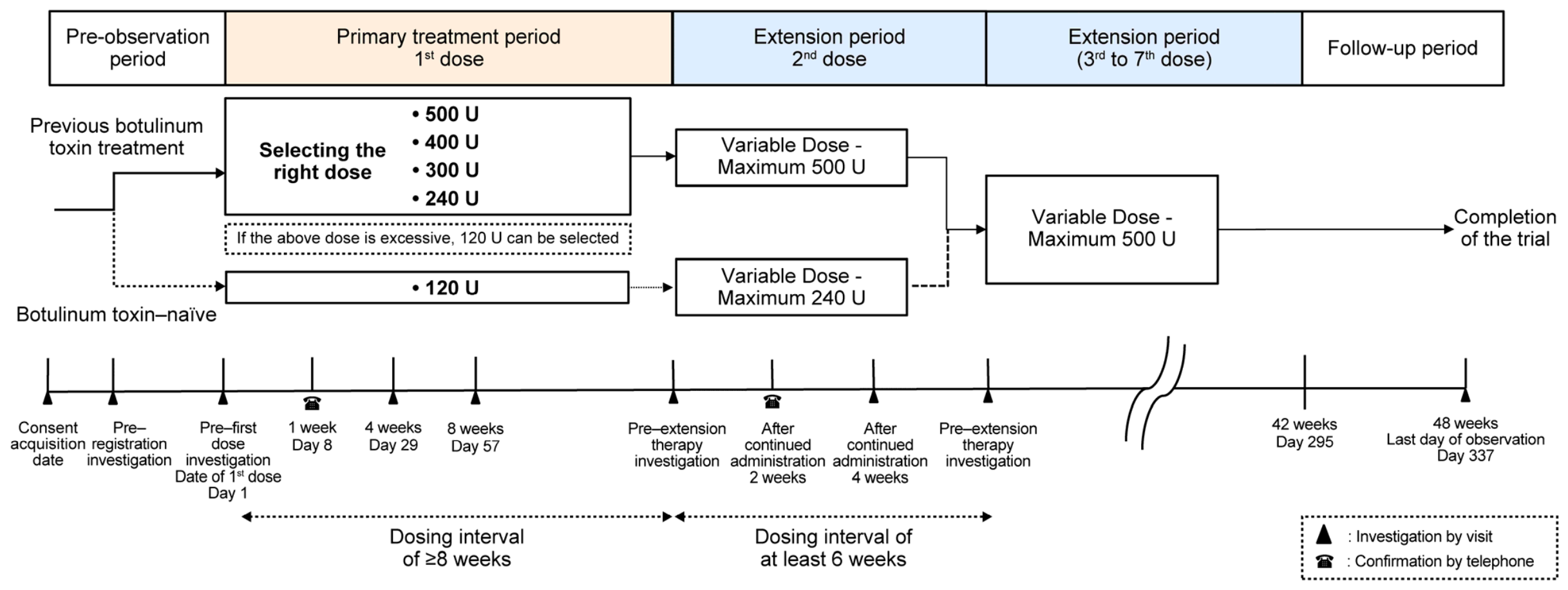
2.1. Study Design
2.2. Selection Criteria
2.2.1. Inclusion Criteria
2.2.2. Exclusion Criteria
2.3. Treatment
2.4. Endpoints
2.4.1. Efficacy
2.4.2. Secondary Endpoints
2.5. Statistical Analysis
2.5.1. Primary Efficacy Endpoints
2.5.2. Secondary Efficacy Endpoints
2.5.3. Safety Endpoint
2.5.4. Sample Size Determination
3. Results
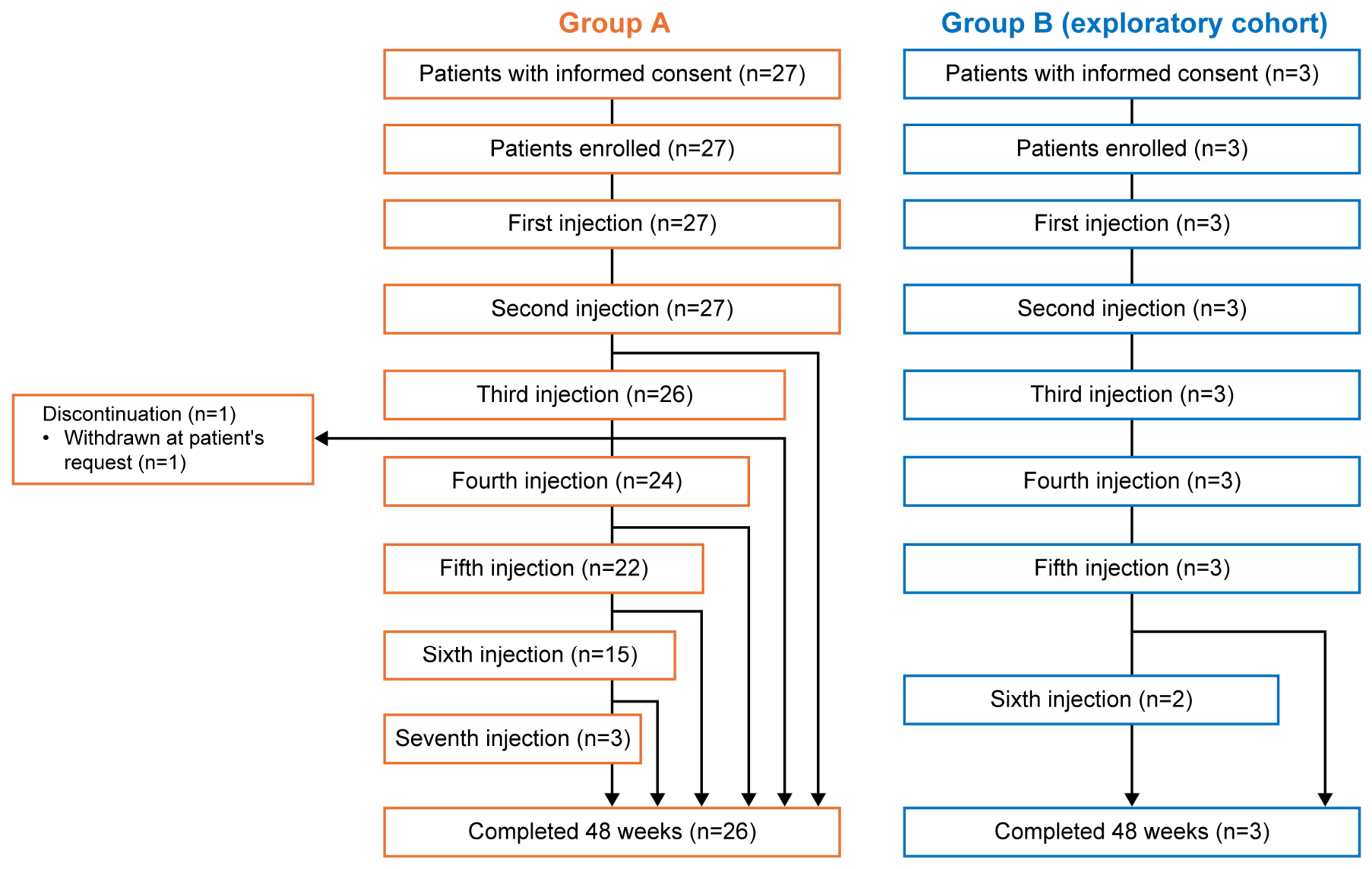
3.1. Patient Disposition
3.2. Demographic and Baseline Characteristics
3.3. Dosage of IncobotulinumtoxinA
3.4. Dosing Interval of IncobotulinumtoxinA (Group A)
3.5. Dose of IncobotulinumtoxinA by Target Muscle Group During the First Injection Cycle
3.6. Endpoints
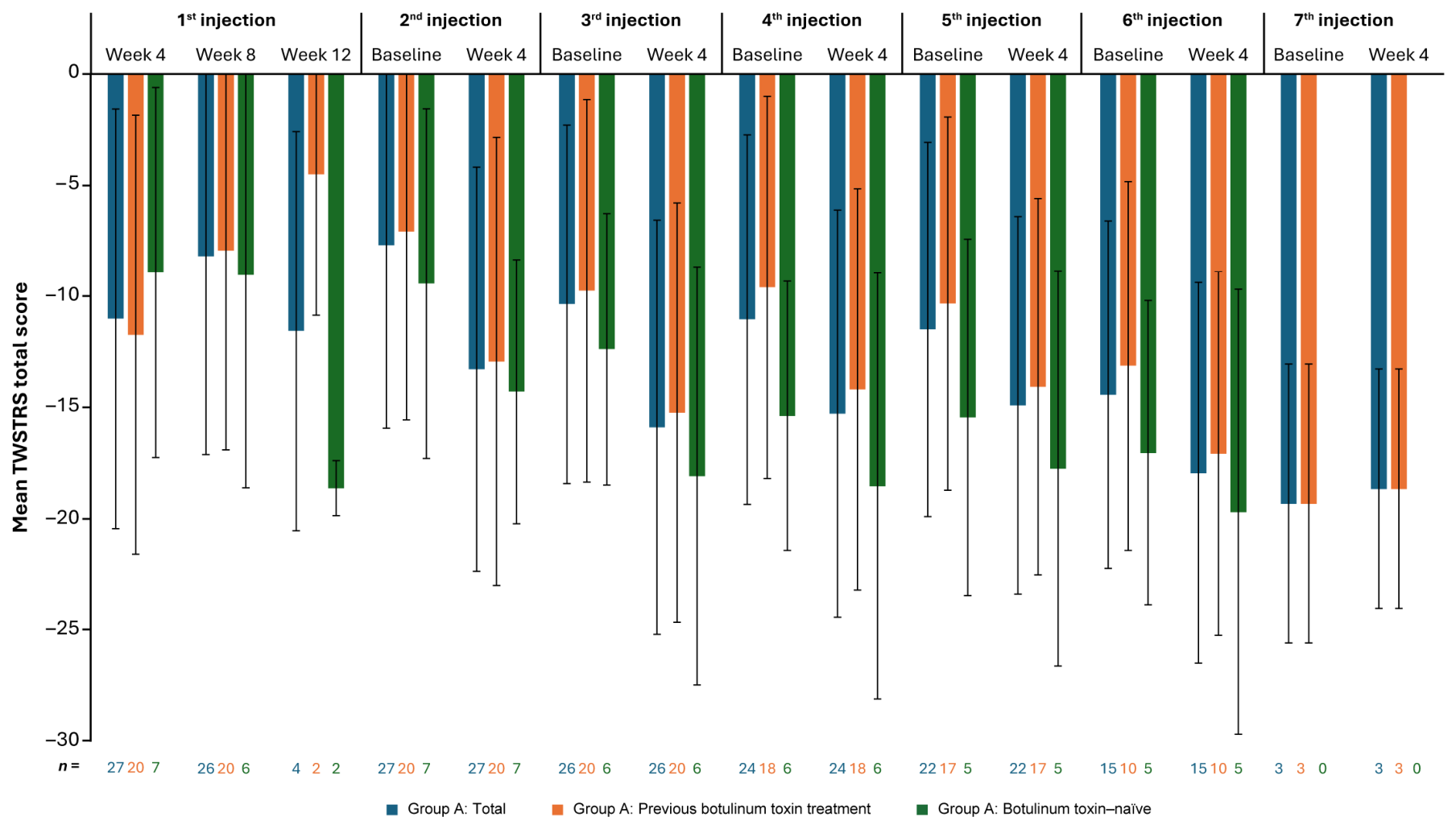
3.6.1. TWSTRS Total Score (Group A)
3.6.2. Reduction in the TWSTRS Total Score (Group A)
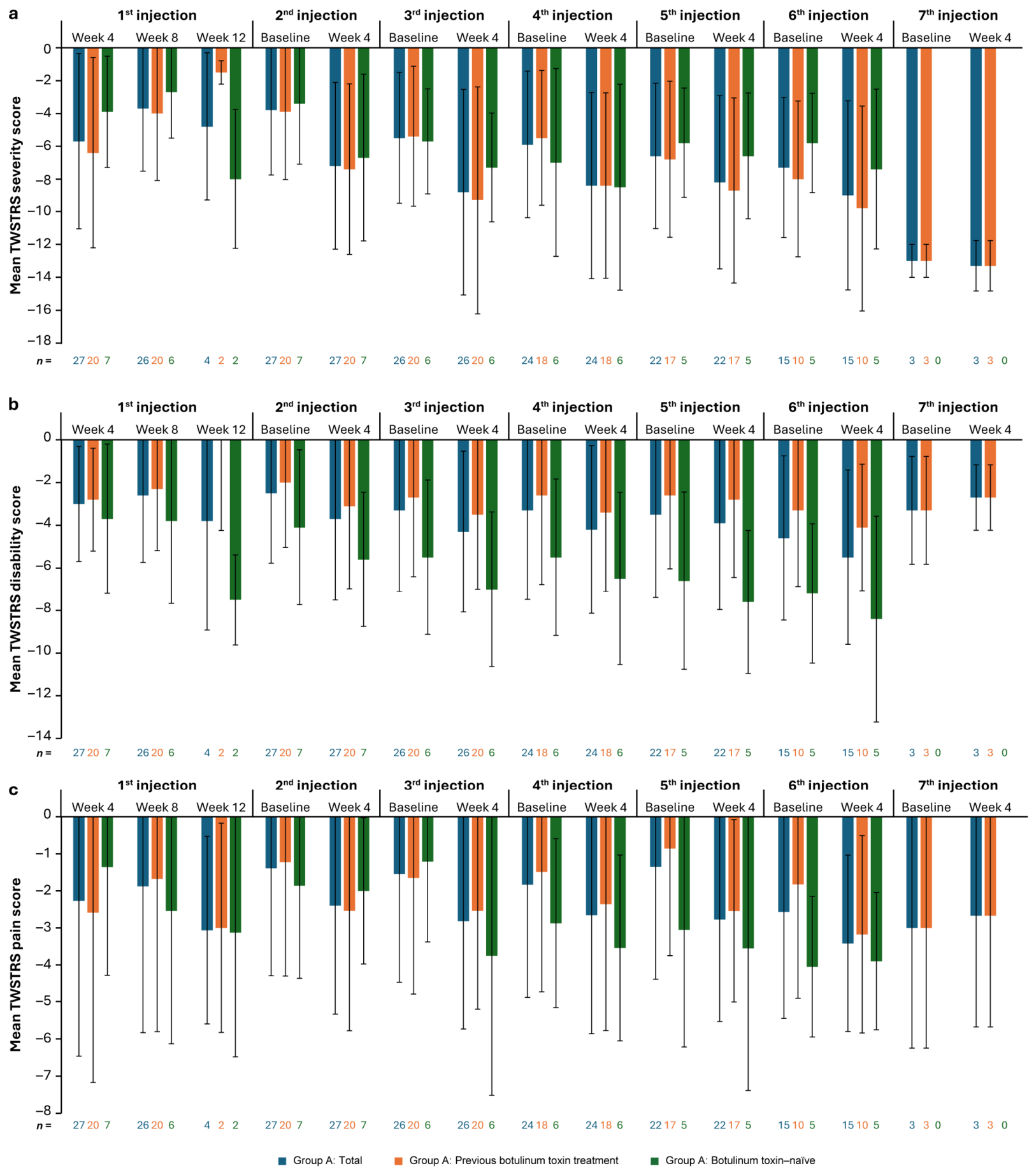
3.6.3. Reduction in the TWSTRS Severity Score (Group A)
3.6.4. Reduction in the TWSTRS Disability Score (Group A)
3.6.5. Reduction in the TWSTRS Pain Score (Group A)
3.6.6. CD Impact Profile (Group A)
3.6.7. PEGR (Group A)
3.6.8. Subscale D of the Modified Tsui Scale (Head Tremor Assessment) (Group A)
3.7. Exploratory Assessment of Patients with Tardive Dyskinesia (Cervical) and Tardive CD (Group B)
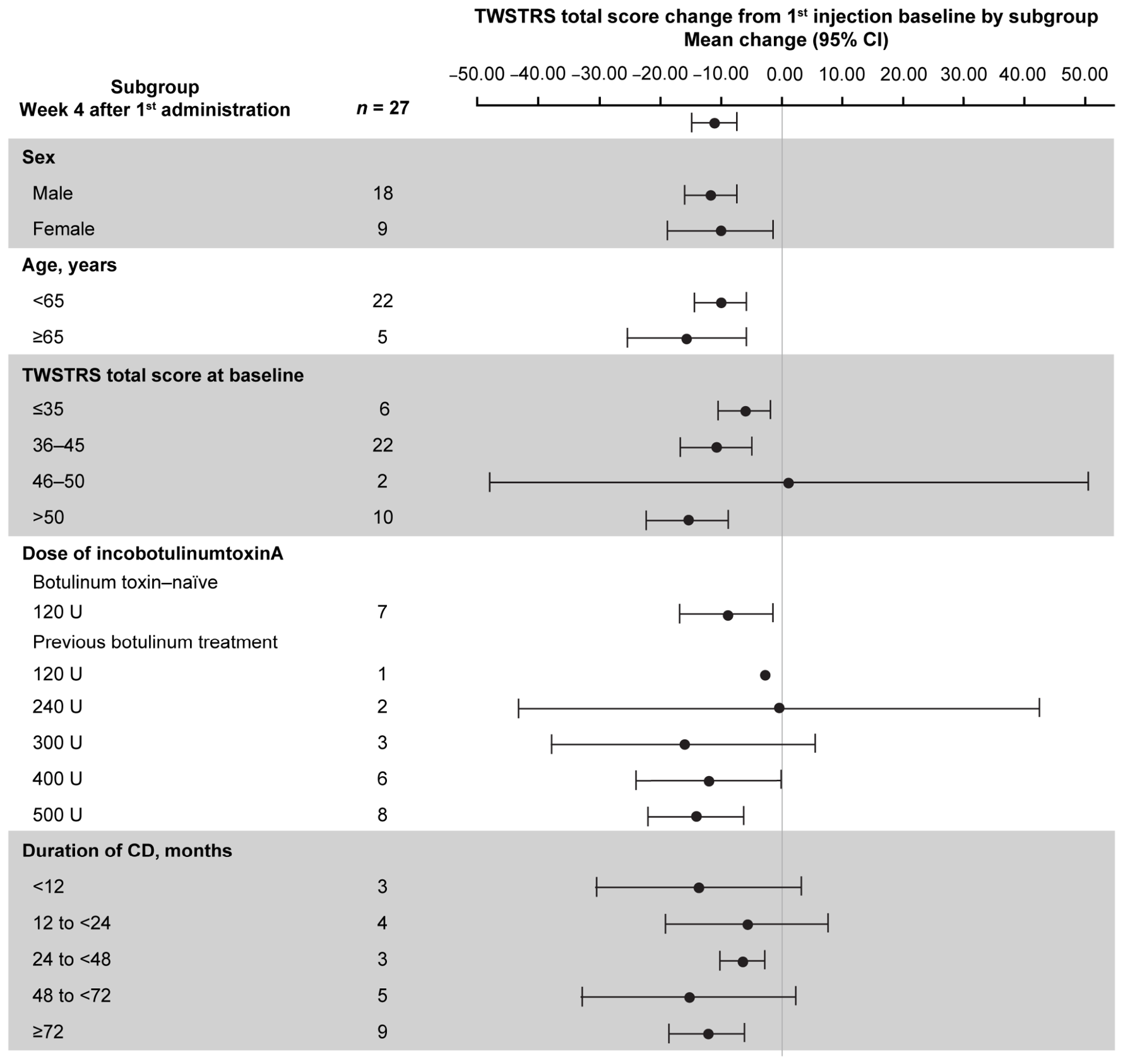
3.8. Subgroup Analysis (Group A)
3.9. Safety
4. Discussion
5. Conclusions
Supplementary Materials
Author Contributions
Funding
Institutional Review Board Statement
Informed Consent Statement
Data Availability Statement
Acknowledgments
Conflicts of Interest
Abbreviations
| ADL | Activities of daily living |
| AE | Adverse event |
| CD | Cervical dystonia |
| CDIP-58 | Cervical Dystonia Impact Profile-58 |
| CI | Confidence interval |
| FAS | Full analysis set |
| LSM | Least squares mean |
| MedDRA | Medical Dictionary for Regulatory Activities |
| PEGR | Patient Evaluation of Global Response |
| QoL | Quality of life |
| SD | Standard deviation |
| SNAP-25 | Synaptosomal-associated protein, 25 kDa |
| SE | Standard error |
| TWSTRS | Toronto Western Spasmodic Torticollis Rating Scale |
| US | United States |
References
- Sobel, J. Botulism. Clin. Infect. Dis. 2005, 41, 1167–1173. [Google Scholar] [CrossRef] [Scilit]
- Dong, M.; Masuyer, G.; Stenmark, P. Botulinum and tetanus neurotoxins. Annu. Rev. Biochem. 2019, 88, 811–837. [Google Scholar] [CrossRef] [Scilit] [PubMed]
- Rossetto, O.; Pirazzini, M.; Fabris, F.; Montecucco, C. Botulinum Neurotoxins: Mechanism of Action. In Handbook of Experimental Pharmacology; Springer: Cham, Switzerland, 2021; Volume 263, pp. 35–47. [Google Scholar] [CrossRef] [Scilit] [PubMed]
- Rodrigues, F.B.; Duarte, G.S.; Marques, R.E.; Castelão, M.; Ferreira, J.; Sampaio, C.; Moore, A.P.; Costa, J. Botulinum toxin type A therapy for cervical dystonia. Cochrane Database Syst. Rev. 2020, 11, Cd003633. [Google Scholar] [CrossRef] [Scilit] [PubMed]
- Kassaye, S.G.; De Hertogh, W.; Crosiers, D.; Gudina, E.K.; De Pauw, J. The effectiveness of physiotherapy for patients with isolated cervical dystonia: An updated systematic review and meta-analysis. BMC Neurol. 2024, 24, 53. [Google Scholar] [CrossRef] [Scilit] [PubMed]
- Sethi, K.D.; Rodriguez, R.; Olayinka, B. Satisfaction with botulinum toxin treatment: A cross-sectional survey of patients with cervical dystonia. J. Med. Econ. 2012, 15, 419–423. [Google Scholar] [CrossRef] [Scilit] [PubMed]
- Rosales, R.L.; Cuffe, L.; Regnault, B.; Trosch, R.M. Pain in cervical dystonia: Mechanisms, assessment and treatment. Expert. Rev. Neurother. 2021, 21, 1125–1134. [Google Scholar] [CrossRef] [Scilit] [PubMed]
- Matteo, C.; Daniele, B.; Isabella, B.; Annalisa, M.; Fabrizia, D.; Viola, B.; Arianna, T.; Gina, F.; Massimo, P.; Antonella, C.; et al. Motor and non-motor subtypes of cervical dystonia. Park. Relat. Disord. 2021, 88, 108–113. [Google Scholar] [CrossRef] [Scilit] [PubMed]
- Castelão, M.; Marques, R.E.; Duarte, G.S.; Rodrigues, F.B.; Ferreira, J.; Sampaio, C.; Moore, A.P.; Costa, J. Botulinum toxin type A therapy for cervical dystonia. Cochrane Database Syst. Rev. 2017, 12, Cd003633. [Google Scholar] [CrossRef] [Scilit] [PubMed]
- Defazio, G.; Jankovic, J.; Giel, J.L.; Papapetropoulos, S. Descriptive epidemiology of cervical dystonia. Tremor Other Hyperkinetic Mov. 2013, 3, tre-03-193-4374-2. [Google Scholar] [CrossRef] [Scilit]
- Dystonia Clinical Guidelines Developmental Committee of Japan Neurological Society. The 2018 Japanese Dystonia Clinical Guidelines; Nankodo: Tokyo, Japan, 2018. (In Japanese) [Google Scholar]
- Pharmaceuticals and Medical Devices Agency. Package Insert: BOTOX for Injection (Revised June 2026, Version 4). Available online: https://www.pmda.go.jp/PmdaSearch/iyakuDetail/ResultDataSetPDF/340278_1229404D1020_1_15 (accessed on 24 June 2026). (In Japanese)
- Jinnah, H.A.; Goodmann, E.; Rosen, A.R.; Evatt, M.; Freeman, A.; Factor, S. Botulinum toxin treatment failures in cervical dystonia: Causes, management, and outcomes. J. Neurol. 2016, 263, 1188–1194. [Google Scholar] [CrossRef] [Scilit] [PubMed]
- Kerscher, M.; Wanitphakdeedecha, R.; Trindade de Almeida, A.; Maas, C.; Frevert, J. IncobotulinumtoxinA: A highly purified and precisely manufactured botulinum neurotoxin type A. J. Drugs Dermatol. 2019, 18, 52–57. [Google Scholar] [PubMed]
- Benecke, R.; Jost, W.H.; Kanovsky, P.; Ruzicka, E.; Comes, G.; Grafe, S. A new botulinum toxin type A free of complexing proteins for treatment of cervical dystonia. Neurology 2005, 64, 1949–1951. [Google Scholar] [CrossRef] [Scilit] [PubMed]
- Comella, C.L.; Jankovic, J.; Truong, D.D.; Hanschmann, A.; Grafe, S.; U.S. XEOMIN Cervical Dystonia Study Group. Efficacy and safety of incobotulinumtoxinA (NT 201, XEOMIN®, botulinum neurotoxin type A, without accessory proteins) in patients with cervical dystonia. J. Neurol. Sci. 2011, 308, 103–109. [Google Scholar] [CrossRef] [Scilit] [PubMed]
- Evidente, V.G.; Fernandez, H.H.; LeDoux, M.S.; Brashear, A.; Grafe, S.; Hanschmann, A.; Comella, C.L. A randomized, double-blind study of repeated incobotulinumtoxinA (Xeomin(®)) in cervical dystonia. J. Neural. Transm. 2013, 120, 1699–1707. [Google Scholar] [CrossRef] [Scilit] [PubMed]
- Comella, C.; Hauser, R.A.; Isaacson, S.H.; Truong, D.; Oguh, O.; Hui, J.; Molho, E.S.; Brodsky, M.; Furr-Stimming, E.; Comes, G.; et al. Efficacy and safety of two incobotulinumtoxinA injection intervals in cervical dystonia patients with inadequate benefit from standard injection intervals of botulinum toxin: Phase 4, open-label, randomized, noninferiority study. Clin. Park. Relat. Disord. 2022, 6, 100142. [Google Scholar] [CrossRef] [Scilit] [PubMed]
- Dressler, D.; Paus, S.; Seitzinger, A.; Gebhardt, B.; Kupsch, A. Long-term efficacy and safety of incobotulinumtoxinA injections in patients with cervical dystonia. J. Neurol. Neurosurg. Psychiatry 2013, 84, 1014–1019. [Google Scholar] [CrossRef] [Scilit] [PubMed]
- Dressler, D.; Tacik, P.; Adib Saberi, F. Botulinum toxin therapy of cervical dystonia: Comparing onabotulinumtoxinA (Botox(®)) and incobotulinumtoxinA (Xeomin (®)). J. Neural. Transm. 2014, 121, 29–31. [Google Scholar] [CrossRef] [Scilit] [PubMed]
- Truong, D.D.; Gollomp, S.M.; Jankovic, J.; LeWitt, P.A.; Marx, M.; Hanschmann, A.; Fernandez, H.H. Sustained efficacy and safety of repeated incobotulinumtoxinA (Xeomin(®)) injections in blepharospasm. J. Neural. Transm. 2013, 120, 1345–1353. [Google Scholar] [CrossRef] [Scilit] [PubMed]
- Dressler, D.; Mander, G.; Fink, K. Measuring the potency labelling of onabotulinumtoxinA (Botox(®)) and incobotulinumtoxinA (Xeomin (®)) in an LD50 assay. J. Neural. Transm. 2012, 119, 13–15. [Google Scholar] [CrossRef] [Scilit] [PubMed]
- Karl-Heinz, E.; Taylor, H.V. Dissociation of the 900kDa neurotoxin complex from C. botulinum under physiological conditions. Toxicon 2008, 51, 10. [Google Scholar] [CrossRef] [Scilit]
- Fernandez, H.H.; Pagan, F.; Danisi, F.; Greeley, D.; Jankovic, J.; Verma, A.; Sethi, K.; Pappert, E.J. Prospective study evaluating incobotulinumtoxinA for cervical dystonia or blepharospasm: Interim results from the first 145 subjects with cervical dystonia. Tremor Other Hyperkinet Mov. 2013, 3, tre-03-139-2924-1. [Google Scholar] [CrossRef] [Scilit]
- Park, J.; Lee, M.S.; Harrison, A.R. Profile of Xeomin® (incobotulinumtoxinA) for the treatment of blepharospasm. Clin. Ophthalmol. 2011, 5, 725–732. [Google Scholar] [CrossRef] [Scilit] [PubMed]
- Drug Information Sheet. XEOMIN 200 Units for Intramuscular Injection. Available online: https://www.rad-ar.or.jp/siori/english/search/result?n=44284 (accessed on 16 June 2025).
- Dressler, D.; Altavista, M.C.; Altenmueller, E.; Bhidayasiri, R.; Bohlega, S.; Chana, P.; Chung, T.M.; Colosimo, C.; Fheodoroff, K.; Garcia-Ruiz, P.J.; et al. Consensus guidelines for botulinum toxin therapy: General algorithms and dosing tables for dystonia and spasticity. J. Neural. Transm. 2021, 128, 321–335. [Google Scholar] [CrossRef] [Scilit] [PubMed]
- Comella, C.; Ferreira, J.J.; Pain, E.; Azoulai, M.; Om, S. Patient perspectives on the therapeutic profile of botulinum neurotoxin type A in cervical dystonia. J. Neurol. 2021, 268, 903–912. [Google Scholar] [CrossRef] [Scilit] [PubMed]
- Kaji, R.; Shimizu, H.; Takase, T.; Osawa, M.; Yanagisawa, N. A double-blind comparative study to evaluate the efficacy and safety of NerBloc® (rimabotulinumtoxinB) administered in a single dose to patients with cervical dystonia. Brain Nerve 2013, 65, 203–211. [Google Scholar] [PubMed]
- Consky, E. The Toronto Western Spasmodic Torticollis Rating Scale (TWSTRS): Assessment of validity and inter-rater reliability (abstract). Neurology 1990, 40, 445. [Google Scholar]
- Consky, E.; Lang, A.; Jankovic, J. Therapy with Botulinum Toxin; Marcel Dekker: New York, NY, USA, 1994; pp. 211–237. [Google Scholar]
- Comella, C.L.; Buchman, A.S.; Tanner, C.M.; Brown-Toms, N.C.; Goetz, C.G. Botulinum toxin injection for spasmodic torticollis: Increased magnitude of benefit with electromyographic assistance. Neurology 1992, 42, 878–882. [Google Scholar] [CrossRef] [Scilit] [PubMed]
- Dubinsky, R.M.; Gray, C.S.; Vetere-Overfield, B.; Koller, W.C. Electromyographic guidance of botulinum toxin treatment in cervical dystonia. Clin. Neuropharmacol. 1991, 14, 262–267. [Google Scholar] [CrossRef] [Scilit] [PubMed]
- Cano, S.J.; Warner, T.T.; Linacre, J.M.; Bhatia, K.P.; Thompson, A.J.; Fitzpatrick, R.; Hobart, J.C. Capturing the true burden of dystonia on patients: The Cervical Dystonia Impact Profile (CDIP-58). Neurology 2004, 63, 1629–1633. [Google Scholar] [CrossRef] [Scilit] [PubMed]
- Cano, S.J.; Hobart, J.C.; Edwards, M.; Fitzpatrick, R.; Bhatia, K.; Thompson, A.J.; Warner, T.T. CDIP-58 can measure the impact of botulinum toxin treatment in cervical dystonia. Neurology 2006, 67, 2230–2232. [Google Scholar] [CrossRef] [Scilit] [PubMed]
- Wissel, J.; Müller, J.; Dressnandt, J.; Heinen, F.; Naumann, M.; Topka, H.; Poewe, W. Management of spasticity associated pain with botulinum toxin A. J. Pain Symptom Manag. 2000, 20, 44–49. [Google Scholar] [CrossRef] [Scilit] [PubMed]
- Poewe, W.; Deuschl, G.; Nebe, A.; Feifel, E.; Wissel, J.; Benecke, R.; Kessler, K.R.; Ceballos-Baumann, A.O.; Ohly, A.; Oertel, W.; et al. What is the optimal dose of botulinum toxin A in the treatment of cervical dystonia? Results of a double blind, placebo controlled, dose ranging study using Dysport. German Dystonia Study Group. J. Neurol. Neurosurg. Psychiatry 1998, 64, 13–17. [Google Scholar] [CrossRef] [Scilit] [PubMed]
- Ministry of Health, Labour and Welfare. Confirmed Numbers Nationwide Table 119 Total Number of Patients by Basic Classification of Injury and Illness. Available online: https://www.e-stat.go.jp/dbview?sid=0004002720 (accessed on 29 January 2026). (In Japanese)
- Walter, U.; Albrecht, P.; Carr, W.; Hefter, H. Systematic review and meta-analysis of secondary treatment failure and immunogenicity with botulinum neurotoxin A in multiple indications. Eur. J. Neurol. 2025, 32, e70289. [Google Scholar] [CrossRef] [Scilit] [PubMed]
- Chrobak, A.A.; Rusinek, J.; Dec-Ćwiek, M.; Porębska, K.; Siwek, M. Content overlap of 91 dystonia symptoms among the seven most commonly used cervical dystonia scales. Neurol. Sci. 2024, 45, 1507–1514. [Google Scholar] [CrossRef] [Scilit] [PubMed]
- Rahman, E.; Alhitmi, H.K.; Mosahebi, A. Immunogenicity to Botulinum Toxin Type A: A systematic review with meta-analysis across therapeutic indications. Aesthet. Surg. J. 2022, 42, 106–120. [Google Scholar] [CrossRef] [Scilit] [PubMed]



| Characteristic | Group A (N = 27) | Group B (Exploratory Cohort) (N = 3) | Total (N = 30) a |
|---|---|---|---|
| Japanese, n (%) | 27 (100.0) | 3 (100.0) | 30 (100.0) |
| Sex, n (%) | |||
| Male | 18 (66.7) | 2 (66.7) | 20 (66.7) |
| Female | 9 (33.3) | 1 (33.3) | 10 (33.3) |
| Age, years | |||
| Mean ± SD | 54.5 ± 11.27 | 48.3 ± 13.65 | 53.9 ± 11.41 |
| <65, n (%) | 22 (81.5) | 3 (100.0) | 25 (83.3) |
| ≥65, n (%) | 5 (18.5) | 0 (0.0) | 5 (16.7) |
| Type of CD b, n (%) c | |||
| Rotation | 27 (100.0) | 3 (100.0) | 30 (100.0) |
| Retrocollis | 11 (40.7) | 1 (33.3) | 12 (40.0) |
| Anterocollis | 13 (48.1) | 1 (33.3) | 14 (46.7) |
| Laterocollis | 25 (92.6) | 3 (100.0) | 28 (93.3) |
| Shift | 19 (70.4) | 2 (66.7) | 21 (70.0) |
| Shoulder elevation | 23 (85.2) | 3 (100.0) | 26 (86.7) |
| Scoliosis | 8 (29.6) | 1 (33.3) | 9 (30.0) |
| Head tremor | 16 (59.3) | 1 (33.3) | 17 (56.7) |
| Duration of CD d (months) | |||
| Mean ± SD | 92.58 ± 123.9 | 111.17 ± 31.0 | 94.65 ± 117.0 |
| Median | 54.62 | 124.69 | 60.36 |
| Treatment history for CD with botulinum toxin preparation, n (%) | |||
| Botulinum toxin-naïve | 7 (25.9) | 0 (0.0) | 7 (23.3) |
| Previous botulinum toxin treatment | 20 (74.1) | 3 (100.0) | 23 (76.7) |
| Dose of onabotulinumtoxinA at the last dose e, n (%) | |||
| <120 U | 4 (20.0) | 1 (33.3) | 5 (21.7) |
| ≥120 U to <240 U | 8 (40.0) | 0 (0.0) | 8 (34.8) |
| ≥240 U | 7 (35.0) | 2 (66.7) | 9 (39.1) |
| Dose of rimabotulinumtoxinB at the last dose e, n (%) | |||
| <5000 U | 1 (5.0) | 0 (0.0) | 1 (4.3) |
| ≥5000 U to <10,000 U | 0 (0.0) | 0 (0.0) | 0 (0.0) |
| ≥10,000 U | 0 (0.0) | 0 (0.0) | 0 (0.0) |
| Presence of complications, n (%) | |||
| No | 9 (33.3) | 0 (0.0) | 9 (30.0) |
| Yes | 18 (66.7) | 3 (100.0) | 21 (70.0) |
| TWSTRS total score, mean ± SD | |||
| All patients | 46.24 ± 10.33 | 45.75 ± 1.32 | 46.19 ± 9.78 |
| Botulinum toxin-naïve | 47.07 ± 7.45 | NA | NA |
| Previous botulinum toxin treatment | 45.95 ± 11.32 | 45.75 ± 1.32 | NA |
| TWSTRS severity score, mean ± SD | |||
| All patients | 23.0 ± 3.19 | 24.7 ± 2.08 | NA |
| Botulinum toxin-naïve | 22.3 ± 3.30 | NA | NA |
| Previous botulinum toxin treatment | 23.2 ± 3.21 | 24.7 ± 2.08 | NA |
| Severity of CD, n (%) | |||
| Mild: TWSTRS severity score is from 0 to 15 | 0 (0.0) | 0 (0.0) | 0 (0.0) |
| Moderate: TWSTRS severity score is from 16 to 21 | 8 (29.6) | 0 (0.0) | 8 (26.7) |
| Severe: TWSTRS severity score is from 22 to 35 | 19 (70.4) | 3 (100.0) | 22 (73.3) |
| TWSTRS disability score, mean ± SD | |||
| All patients | 12.8 ± 4.72 | 12.7 ± 2.08 | NA |
| Botulinum toxin-naïve | 14.1 ± 3.48 | NA | NA |
| Previous botulinum toxin treatment | 12.4 ± 5.08 | 12.7 ± 2.08 | NA |
| TWSTRS pain score, mean ± SD | |||
| All patients | 10.46 ± 4.29 | 8.42 ± 3.01 | NA |
| Botulinum toxin-naïve | 10.64 ± 2.66 | NA | NA |
| Previous botulinum toxin treatment | 10.40 ± 4.79 | 8.42 ± 3.01 | NA |
| CDIP-58, mean ± SD | |||
| All patients | 41.51 ± 20.42 | 54.17 ± 13.32 | NA |
| Subscale D of the Modified Tsui Scale, mean ± SD | |||
| All patients | 1.5 ± 1.0 | 4.0 | 1.6 ± 1.2 |
| Botulinum toxin-naïve | 1.0 ± 0.0 | NA | NA |
| Previous botulinum toxin treatment | 1.6 ± 1.1 | 4.0 | NA |
| 1st Injection Cycle | 2nd Injection Cycle | 3rd Injection Cycle | 4th Injection Cycle | 5th Injection Cycle | 6th Injection Cycle | 7th Injection Cycle | |
|---|---|---|---|---|---|---|---|
| Total Dose volume (U) a | |||||||
| n | 30 | 30 | 29 | 27 | 25 | 17 | 3 |
| Mean ± SD | 325.3 ± 156.4 | 362.3 ± 141.2 | 372.4 ± 141.4 | 378.0 ± 138.6 | 412.4 ± 121.4 | 428.2 ± 111.1 | 500.0 ± 0.0 |
| Min | 120 | 140 | 100 | 95 | 180 | 200 | 500 |
| Median | 400.0 | 375.0 | 400.0 | 400.0 | 500.0 | 500.0 | 500.0 |
| Max | 500 | 500 | 500 | 500 | 500 | 500 | 500 |
| Botulinum toxin-naïve | |||||||
| n | 7 | 7 | 6 | 6 | 5 | 5 | 0 |
| Mean ± SD | 120.0 ± 0.0 | 202.1 ± 43.8 | 221.7 ± 98.9 | 225.8 ± 100.6 | 292.0 ± 122.1 | 316.0 ± 128.4 | - |
| Min | 120 | 140 | 100 | 95 | 200 | 200 | - |
| Median | 120.0 | 220.0 | 200.0 | 220.0 | 240.0 | 240.0 | - |
| Max | 120 | 240 | 400 | 400 | 500 | 500 | - |
| Previous botulinum toxin treatment | |||||||
| n | 23 | 23 | 23 | 21 | 20 | 12 | 3 |
| Mean ± SD | 387.8 ± 121.5 | 411.1 ± 123.0 | 411.7 ± 124.1 | 421.4 ± 116.2 | 442.5 ± 103.4 | 475.0 ± 62.2 | 500.0 ± 0.0 |
| Min | 120 | 150 | 150 | 150 | 180 | 300 | 500 |
| Median | 400.0 | 500.0 | 500.0 | 500.0 | 500.0 | 500.0 | 500.0 |
| Max | 500 | 500 | 500 | 500 | 500 | 500 | 500 |
| Group A | |||||||
| n | 27 | 27 | 26 | 24 | 22 | 15 | 3 |
| Botulinum toxin-naïve (first injection cycle) b | |||||||
| 120 U | 7 (25.9) | - | - | - | - | - | - |
| Previous botulinum toxin treatment (first injection cycle) b | |||||||
| 120 U | 1 (3.7) | - | - | - | - | - | - |
| 240 U | 2 (7.4) | - | - | - | - | - | - |
| 300 U | 3 (11.1) | - | - | - | - | - | - |
| 400 U | 6 (22.2) | - | - | - | - | - | - |
| 500 U | 8 (29.6) | - | - | - | - | - | - |
| Group B (exploratory cohort) | |||||||
| n | 3 | 3 | 3 | 3 | 3 | 2 | 0 |
| Previous botulinum toxin treatment (first injection cycle) b | |||||||
| 120 U | 1 (33.3) | - | - | - | - | - | - |
| 240 U | 0 (0.0) | - | - | - | - | - | - |
| 300 U | 0 (0.0) | - | - | - | - | - | - |
| 400 U | 1 (33.3) | - | - | - | - | - | - |
| 500 U | 1 (33.3) | - | - | - | - | - | - |
| Group A (n = 27) | Group B (Exploratory Cohort) (n = 3) | Total (N = 30) | |
|---|---|---|---|
| Any AE | 21 (77.8) | 3 (100.0) | 24 (80.0) |
| Any related AE | 13 (48.1) | 1 (33.3) | 14 (46.7) |
| Leading to death | |||
| AE | 0 (0.0) | 0 (0.0) | 0 (0.0) |
| Related AE | 0 (0.0) | 0 (0.0) | 0 (0.0) |
| Serious | |||
| AE | 1 (3.7) | 0 (0.0) | 1 (3.3) |
| Related AE | 0 (0.0) | 0 (0.0) | 0 (0.0) |
| Leading to discontinuation of the study drug | |||
| AE | 0 (0.0) | 0 (0.0) | 0 (0.0) |
| Related AE | 0 (0.0) | 0 (0.0) | 0 (0.0) |
| Maximum severity | |||
| AE a | |||
| Mild | 12 (44.4) | 3 (100.0) | 15 (50.0) |
| Moderate | 9 (33.3) | 0 (0.0) | 9 (30.0) |
| Severe | 0 (0.0) | 0 (0.0) | 0 (0.0) |
| Related AE a | |||
| Mild | 7 (25.9) | 1 (33.3) | 8 (26.7) |
| Moderate | 6 (22.2) | 0 (0.0) | 6 (20.0) |
| Severe | 0 (0.0) | 0 (0.0) | 0 (0.0) |
Disclaimer/Publisher’s Note: The statements, opinions and data contained in all publications are solely those of the individual author(s) and contributor(s) and not of MDPI and/or the editor(s). MDPI and/or the editor(s) disclaim responsibility for any injury to people or property resulting from any ideas, methods, instructions or products referred to in the content. |
© 2026 by the authors. Licensee MDPI, Basel, Switzerland. This article is an open access article distributed under the terms and conditions of the Creative Commons Attribution (CC BY) license.
Share and Cite
Tamagawa, A.; Horiuchi, M.; Abe, T.; Matsumoto, S.; Mukai, Y.; Ikeguchi, K.; Mano, T.; Mihara, M.; Arimura, K.; Asanuma, K.; et al. Efficacy and Safety of a Tailored Dosing Strategy with High-Dose IncobotulinumtoxinA at Flexible Injection Intervals for Cervical Dystonia: An Open-Label, Uncontrolled, Single-Arm Study in Japan. Neurol. Int. 2026, 18, 136. https://doi.org/10.3390/neurolint18070136
Tamagawa A, Horiuchi M, Abe T, Matsumoto S, Mukai Y, Ikeguchi K, Mano T, Mihara M, Arimura K, Asanuma K, et al. Efficacy and Safety of a Tailored Dosing Strategy with High-Dose IncobotulinumtoxinA at Flexible Injection Intervals for Cervical Dystonia: An Open-Label, Uncontrolled, Single-Arm Study in Japan. Neurology International. 2026; 18(7):136. https://doi.org/10.3390/neurolint18070136
Chicago/Turabian StyleTamagawa, Akira, Masahiro Horiuchi, Takenori Abe, Shinichi Matsumoto, Yohei Mukai, Kunihiko Ikeguchi, Tomoo Mano, Masahito Mihara, Kimiyoshi Arimura, Kotaro Asanuma, and et al. 2026. "Efficacy and Safety of a Tailored Dosing Strategy with High-Dose IncobotulinumtoxinA at Flexible Injection Intervals for Cervical Dystonia: An Open-Label, Uncontrolled, Single-Arm Study in Japan" Neurology International 18, no. 7: 136. https://doi.org/10.3390/neurolint18070136
APA StyleTamagawa, A., Horiuchi, M., Abe, T., Matsumoto, S., Mukai, Y., Ikeguchi, K., Mano, T., Mihara, M., Arimura, K., Asanuma, K., Kurihara, K., Misawa, S., Miyamoto, R., Nishikawa, N., Sasaki, Y., Tateishi, S., & Nakamura, Y. (2026). Efficacy and Safety of a Tailored Dosing Strategy with High-Dose IncobotulinumtoxinA at Flexible Injection Intervals for Cervical Dystonia: An Open-Label, Uncontrolled, Single-Arm Study in Japan. Neurology International, 18(7), 136. https://doi.org/10.3390/neurolint18070136