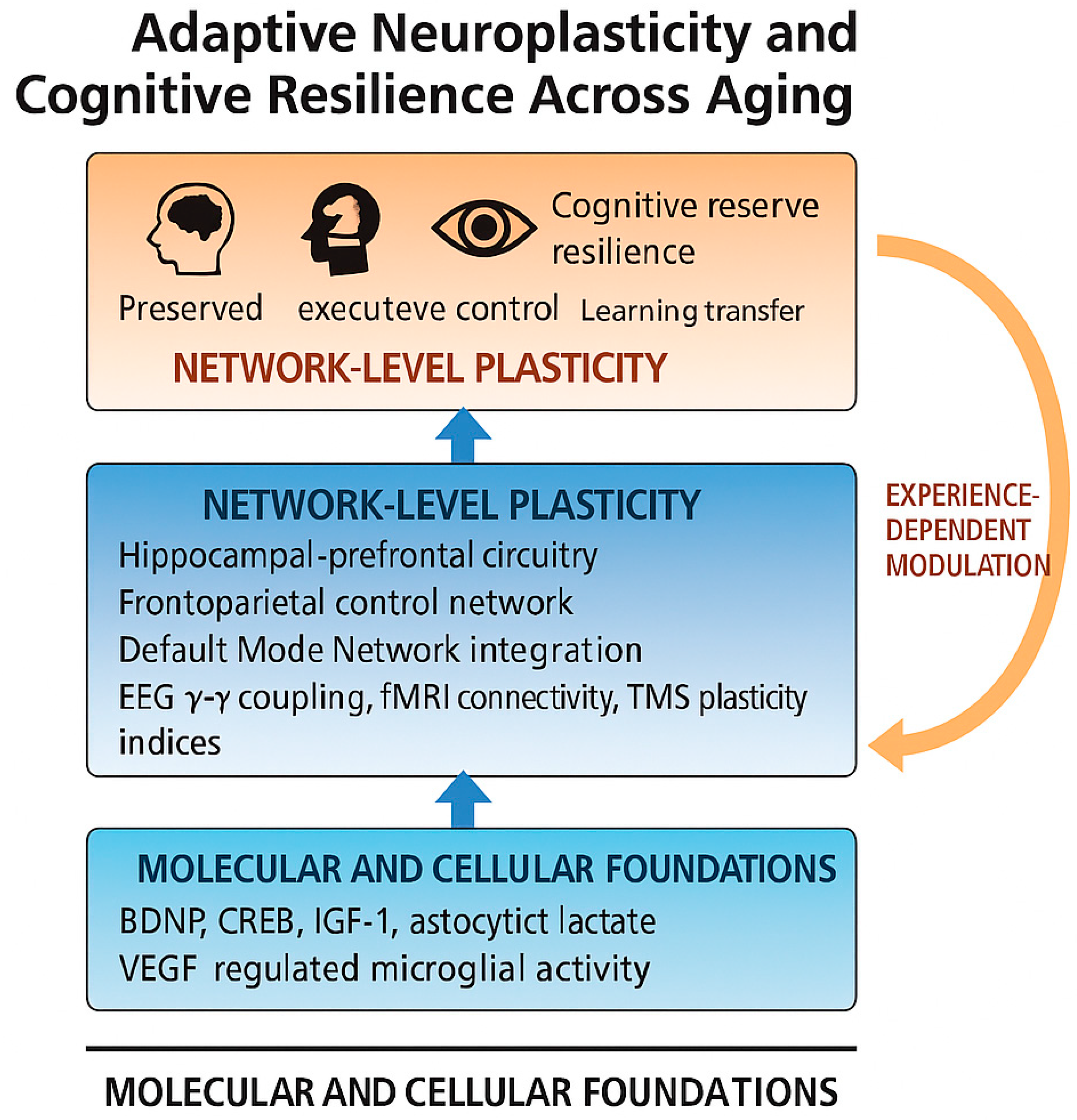

Neuromarkers of Adaptive Neuroplasticity and Cognitive Resilience Across Aging: A Multimodal Integrative Review
 ,
,
Abstract
1. Introduction
2. Methods
2.1. Literature Search Strategy
2.2. Study Selection and Screening
3. Mechanisms of Adaptive Neuroplasticity in the Aging Brain
3.1. Molecular Mediators of Adaptive Plasticity
3.2. Glial and Metabolic Contributions
3.3. Synaptic and Network-Level Reorganization
3.4. Neurovascular and Inflammatory Modulation

| Neuromarker | Primary Function | Mechanistic Role in Adaptive Plasticity | Interpretation/Relevance to Cognitive Resilience |
|---|---|---|---|
| BDNF (Brain-Derived Neurotrophic Factor) | Neurotrophic support, synaptic maintenance | Activates TrkB signaling, enhances LTP and dendritic spine growth | Higher BDNF levels correlate with preserved learning and memory in aging; biomarker of plastic potential |
| CREB (cAMP Response Element-Binding Protein) | Transcription factor regulating plasticity genes | Coordinates gene expression for LTP, neurogenesis, and metabolic adaptation | Sustained CREB phosphorylation reflects long-term adaptive remodeling and preserved cognition |
| Synapsin I | Synaptic vesicle regulation | Facilitates neurotransmitter release and vesicle recycling | Indicates synaptic efficiency; reduced loss linked to functional compensation |
| IGF-1 (Insulin-like Growth Factor 1) | Neurotrophic and metabolic regulation | Promotes neuronal survival, myelination, and glucose metabolism | Supports energy–plasticity coupling; low levels associate with frailty and cognitive decline |
| Astrocytic Lactate | Metabolic coupling between neurons and glia | Acts as both energy substrate and signaling molecule via CREB activation | High astrocytic metabolic responsiveness enhances synaptic maintenance and recovery |
| GFAP (Glial Fibrillary Acidic Protein) | Structural astrocytic integrity | Reflects astrocyte reactivity and remodeling capacity | Mild elevations may indicate adaptive gliosis; excessive values suggest neurodegeneration |
| Microglial Activity (regulated state) | Immune modulation and synaptic pruning | Controlled microglial activation releases BDNF and cytokines supporting synapse remodeling | Balanced activation denotes protective neuroinflammation; chronic activation impairs adaptation |
| VEGF (Vascular Endothelial Growth Factor) | Angiogenesis and vascular remodeling | Stimulates neurovascular coupling and oxygen delivery to active synapses | Elevated VEGF linked to enhanced cerebral perfusion and support of neural plasticity |
| Nitric Oxide (endothelial) | Vasodilation and perfusion homeostasis | Maintains cerebrovascular reactivity and neurovascular synchronization | Serves as vascular biomarker of metabolic readiness for plastic activity |
4. Multimodal Neuromarkers of Plasticity
4.1. Functional and Structural Neuroimaging Markers
4.2. Electrophysiological Signatures of Plasticity
4.3. Integrative Multimodal Approaches
| Modality | Neuromarker/Measure | Functional Interpretation | Relevance to Cognitive Resilience |
|---|---|---|---|
| fMRI | Bilateral prefrontal activation (PASA pattern) | Recruitment of alternative cortical areas | Reflects compensatory reorganization during task performance |
| fMRI (resting-state) | DMN–FPCN functional coupling | Network-level integration and efficiency | Predicts preserved executive control and memory |
| DTI | Fractional anisotropy of frontoparietal tracts | Microstructural integrity of white matter | Indicates maintained long-range connectivity supporting compensation |
| PET (FDG) | Regional glucose metabolism | Energetic support for network activity | Increased prefrontal metabolism relates to maintained performance |
| PET ([11C]UCB-J) | Synaptic vesicle density (SV2A binding) | Synaptic integrity | Decline in SV2A correlates with reduced plasticity capacity |
| EEG/MEG | Theta–gamma coupling | Coordination of hippocampal–cortical communication | Enhanced coupling linked to efficient cognitive control |
| TMS | LTP-like plasticity response (paired associative stimulation) | Cortical excitability and synaptic responsiveness | Serves as in vivo biomarker of preserved plastic potential |
| Multimodal Integration | Combined EEG–fMRI coherence | Synchronization across scales | Captures individualized adaptive patterns of network resilience |
5. Cognitive and Behavioral Correlates of Resilience
5.1. Cognitive Reserve and Compensatory Recruitment
5.2. Neural Efficiency and Reorganization
5.3. Behavioral Markers of Adaptive Plasticity
5.4. Toward a Multidimensional Model of Resilience
6. Translational Perspectives and Interventions
6.1. Physical Exercise
6.2. Cognitive and Multimodal Training
6.3. Neuromodulation and Pharmacological Support
6.4. Clinical Implications and Personalized Interventions
7. Challenges and Future Directions
7.1. Methodological Limitations
7.2. Integration Across Biological Scales
7.3. Individual Variability and Personalization
7.4. Ethical and Translational Considerations
7.5. Future Perspectives
8. Discussion
9. Conclusions
Author Contributions
Funding
Institutional Review Board Statement
Informed Consent Statement
Data Availability Statement
Acknowledgments
Conflicts of Interest
References
- Kolb, B.; Whishaw, I.Q. Brain plasticity and behavior. Annu. Rev. Psychol. 1998, 49, 43–64. [Google Scholar] [CrossRef] [PubMed]
- Sala-Llonch, R.; Bartrés-Faz, D.; Junqué, C. Reorganization of brain networks in aging: A review of functional connectivity studies. Front. Psychol. 2015, 6, 663. [Google Scholar] [CrossRef] [PubMed]
- Benito, E.; Barco, A. CREB’s control of intrinsic and synaptic plasticity: Implications for CREB-dependent memory models. Trends Neurosci. 2010, 33, 230–240. [Google Scholar] [CrossRef] [PubMed]
- Pascual-Leone, A.; Amedi, A.; Fregni, F.; Merabet, L.B. The plastic human brain cortex. Annu. Rev. Neurosci. 2005, 28, 377–401. [Google Scholar] [CrossRef]
- Park, D.C.; Reuter-Lorenz, P. The adaptive brain: Aging and neurocognitive scaffolding. Annu. Rev. Psychol. 2009, 60, 173–196. [Google Scholar] [CrossRef]
- Cabeza, R.; Anderson, N.D.; Locantore, J.K.; McIntosh, A.R. Aging gracefully: Compensatory brain activity in high-performing older adults. Neuroimage 2002, 17, 1394–1402. [Google Scholar] [CrossRef]
- Reuter-Lorenz, P.A.; Cappell, K.A. Neurocognitive aging and the compensation hypothesis. Curr. Dir. Psychol. Sci. 2008, 17, 177–182. [Google Scholar] [CrossRef]
- Burke, S.N.; Barnes, C.A. Neural plasticity in the ageing brain. Nat. Rev. Neurosci. 2006, 7, 30–40. [Google Scholar] [CrossRef]
- Morrison, J.H.; Hof, P.R. Life and death of neurons in the aging brain. Science 1997, 278, 412–419. [Google Scholar] [CrossRef]
- Peters, A. The effects of normal aging on myelin and nerve fibers: A review. J. Neurocytol. 2002, 31, 581–593. [Google Scholar] [CrossRef]
- Draganski, B.; Gaser, C.; Busch, V.; Schuierer, G.; Bogdahn, U.; May, A. Neuroplasticity: Changes in grey matter induced by training. Nature 2004, 427, 311–312. [Google Scholar] [CrossRef] [PubMed]
- Lövdén, M.; Wenger, E.; Mårtensson, J.; Lindenberger, U.; Bäckman, L. Structural brain plasticity in adult learning and development. Neurosci. Biobehav. Rev. 2013, 37, 2296–2310. [Google Scholar] [CrossRef] [PubMed]
- Bishop, N.A.; Lu, T.; Yankner, B.A. Neural mechanisms of ageing and cognitive decline. Nature 2010, 464, 529–535. [Google Scholar] [CrossRef] [PubMed]
- Vance, D.E.; Kaur, J.; Fazeli, P.L.; Talley, M.H.; Yuen, H.K.; Kitchin, B.; Lin, F. Neuroplasticity and successful cognitive aging: A brief overview for nursing. J. Neurosci. Nurs. 2012, 44, 218–227. [Google Scholar] [CrossRef]
- Mattson, M.P. Neuroprotective signaling and the aging brain: Take away my food and let me run. Brain Res. 2000, 886, 47–53. [Google Scholar] [CrossRef]
- Tucker, A.M.; Stern, Y. Cognitive reserve in aging. Curr. Alzheimer Res. 2011, 8, 354–360. [Google Scholar] [CrossRef]
- Stern, Y. Cognitive reserve in ageing and Alzheimer’s disease. Lancet Neurol. 2012, 11, 1006–1012. [Google Scholar] [CrossRef]
- Nyberg, L.; Lövdén, M.; Riklund, K.; Lindenberger, U.; Bäckman, L. Memory aging and brain maintenance. Trends Cogn. Sci. 2012, 16, 292–305. [Google Scholar] [CrossRef]
- Cabeza, R.; Albert, M.; Belleville, S.; Craik, F.I.M.; Duarte, A.; Grady, C.L.; Lindenberger, U.; Nyberg, L.; Park, D.C.; Reuter-Lorenz, P.A.; et al. Maintenance, reserve and compensation: The cognitive neuroscience of healthy ageing. Nat. Rev. Neurosci. 2018, 19, 701–710. [Google Scholar] [CrossRef]
- Grady, C. The cognitive neuroscience of ageing. Nat. Rev. Neurosci. 2012, 13, 491–505. [Google Scholar] [CrossRef]
- Lu, B.; Nagappan, G.; Guan, X.; Nathan, P.J.; Wren, P. BDNF-based synaptic repair as a disease-modifying strategy for neurodegenerative diseases. Nat. Rev. Neurosci. 2013, 14, 401–416. [Google Scholar] [CrossRef]
- Bath, K.G.; Lee, F.S. Neurotrophic factor control of adult SVZ neurogenesis. Dev. Neurobiol. 2010, 70, 339–349. [Google Scholar] [CrossRef] [PubMed]
- Erickson, K.I.; Miller, D.L.; Roecklein, K.A. The aging hippocampus: Interactions between exercise, depression, and BDNF. Neuroscientist 2012, 18, 82–97. [Google Scholar] [CrossRef] [PubMed]
- Tapia-Arancibia, L.; Aliaga, E.; Silhol, M.; Arancibia, S. New insights into brain BDNF function in normal aging and Alzheimer disease. Brain Res. Rev. 2008, 59, 201–220. [Google Scholar] [CrossRef] [PubMed]
- Sakamoto, K.; Karelina, K.; Obrietan, K. CREB: A multifaceted regulator of neuronal plasticity and protection. J. Neurochem. 2011, 116, 1–9. [Google Scholar] [CrossRef]
- Miranda, M.; Morici, J.F.; Zanoni, M.B.; Bekinschtein, P. Brain-Derived Neurotrophic Factor: A Key Molecule for Memory in the Healthy and the Pathological Brain. Front. Cell. Neurosci. 2019, 13, 363. [Google Scholar] [CrossRef]
- Duman, R.S.; Voleti, B. Signaling pathways underlying the pathophysiology and treatment of depression: Novel mechanisms for rapid-acting agents. Trends Neurosci. 2012, 35, 47–56. [Google Scholar] [CrossRef]
- Vecsey, C.G.; Hawk, J.D.; Lattal, K.M.; Stein, J.M.; Fabian, S.A.; Attner, M.A.; Cabrera, S.M.; McDonough, C.B.; Brindle, P.K.; Abel, T.; et al. Histone deacetylase inhibitors enhance memory and synaptic plasticity via CREB:CBP-dependent transcriptional activation. J. Neurosci. 2007, 27, 6128–6140. [Google Scholar] [CrossRef]
- Holtmaat, A.; Svoboda, K. Experience-dependent structural synaptic plasticity in the mammalian brain. Nat. Rev. Neurosci. 2009, 10, 647–658. [Google Scholar] [CrossRef]
- Chen, M.K.; Mecca, A.P.; Naganawa, M.; Finnema, S.J.; Toyonaga, T.; Lin, S.-F.; Najafzadeh, S.; Ropchan, J.; Lu, Y.; McDonald, J.W.; et al. Assessing synaptic density in Alzheimer disease with synaptic vesicle glycoprotein 2A positron emission tomographic imaging. JAMA Neurol. 2018, 75, 1215–1224. [Google Scholar] [CrossRef]
- Finnema, S.J.; Nabulsi, N.B.; Eid, T.; Detyniecki, K.; Lin, S.-F.; Chen, M.-K.; Dhaher, R.; Matuskey, D.; Baum, E.; Holden, D.; et al. Imaging synaptic density in the living human brain. Sci. Transl. Med. 2016, 8, 348ra96. [Google Scholar] [CrossRef] [PubMed]
- Mosconi, L. Brain glucose metabolism in the early and specific diagnosis of Alzheimer’s disease. Eur. J. Nucl. Med. Mol. Imaging 2005, 32, 486–510. [Google Scholar] [CrossRef] [PubMed]
- Villemagne, V.L.; Ong, K.; Mulligan, R.S.; Holl, G.; Pejoska, S.; Jones, G.; O’KEefe, G.; Ackerman, U.; Tochon-Danguy, H.; Chan, J.G.; et al. Amyloid imaging with (18)F-florbetaben in Alzheimer disease and other dementias. J. Nucl. Med. 2011, 52, 1210–1217. [Google Scholar] [CrossRef] [PubMed]
- Leeuwis, A.E.; Benedictus, M.R.; Kuijer, J.P.A.; Binnewijzend, M.A.; Hooghiemstra, A.M.; Verfaillie, S.C.; Koene, T.; Scheltens, P.; Barkhof, F.; Prins, N.D.; et al. Lower cerebral blood flow is associated with impairment in multiple cognitive domains in Alzheimer’s disease. Alzheimers Dement. 2017, 13, 531–540. [Google Scholar] [CrossRef]
- Biswal, B.; Yetkin, F.Z.; Haughton, V.M.; Hyde, J.S. Functional connectivity in the motor cortex of resting human brain using echo-planar MRI. Magn. Reson. Med. 1995, 34, 537–541. [Google Scholar] [CrossRef]
- Buckner, R.L.; Andrews-Hanna, J.R.; Schacter, D.L. The brain’s default network: Anatomy, function, and relevance to disease. Ann. N. Y. Acad. Sci. 2008, 1124, 1–38. [Google Scholar] [CrossRef]
- Raichle, M.E.; Snyder, A.Z. A default mode of brain function: A brief history of an evolving idea. Neuroimage 2007, 37, 1083–1099. [Google Scholar] [CrossRef]
- El Hayek, L.; Khalifeh, M.; Zibara, V.; Abi Assaad, R.; Emmanuel, N.; Karnib, N.; El-Ghandour, R.; Nasrallah, P.; Bilen, M.; Ibrahim, P.; et al. Lactate Mediates the Effects of Exercise on Learning and Memory through SIRT1-Dependent Activation of Hippocampal Brain-Derived Neurotrophic Factor (BDNF). J. Neurosci. 2019, 39, 2369–2382. [Google Scholar] [CrossRef]
- Andrews-Hanna, J.R.; Smallwood, J.; Spreng, R.N. The default network and self-generated thought: Component processes, dynamic control, and clinical relevance. Ann. N. Y. Acad. Sci. 2014, 1316, 29–52. [Google Scholar] [CrossRef]
- Klimesch, W. EEG alpha and theta oscillations reflect cognitive and memory performance: A review and analysis. Brain Res. Rev. 1999, 29, 169–195. [Google Scholar] [CrossRef]
- Ziemann, U.; Ilić, T.V.; Pauli, C.; Meintzschel, F.; Ruge, D. Learning modifies subsequent induction of long-term potentiation-like and long-term depression-like plasticity in human motor cortex. J. Neurosci. 2004, 24, 1666–1672. [Google Scholar] [CrossRef]
- Fries, P. Rhythms for cognition: Communication through coherence. Neuron 2005, 88, 220–235. [Google Scholar] [CrossRef] [PubMed]
- Lisman, J.E.; Jensen, O. The theta-gamma neural code. Neuron 2013, 77, 1002–1016. [Google Scholar] [CrossRef] [PubMed]
- Buzsáki, G.; Draguhn, A. Neuronal oscillations in cortical networks. Science 2004, 304, 1926–1929. [Google Scholar] [CrossRef] [PubMed]
- Cavanagh, J.F.; Frank, M.J. Frontal theta as a mechanism for cognitive control. Trends Cogn. Sci. 2014, 18, 414–421. [Google Scholar] [CrossRef]
- Valenzuela, M.J.; Sachdev, P. Brain reserve and cognitive decline: A non-parametric systematic review. Psychol. Med. 2006, 36, 1065–1073. [Google Scholar] [CrossRef]
- Sala-Llonch, R.; Junqué, C.; Arenaza-Urquijo, E.M.; Vidal-Piñeiro, D.; Valls-Pedret, C.; Palacios, E.M.; Domènech, S.; Salvà, A.; Bargalló, N.; Bartrés-Faz, D. Changes in whole-brain functional networks and memory performance in aging. Neurobiol. Aging 2014, 35, 2193–2202. [Google Scholar] [CrossRef]
- Park, H.J.; Friston, K. Structural and functional brain networks: From connections to cognition. Science 2013, 342, 1238411. [Google Scholar] [CrossRef]
- Nyberg, L.; Lövdén, M.; Riklund, K.; Lindenberger, U.; Bäckman, L. Memory aging: Performance, maintenance, and compensation. Curr. Opin. Behav. Sci. 2015, 4, 20–25. [Google Scholar] [CrossRef]
- Erickson, K.I.; Voss, M.W.; Prakash, R.S.; Basak, C.; Szabo, A.; Chaddock, L.; Kim, J.S.; Heo, S.; Alves, H.; White, S.M.; et al. Exercise training increases size of hippocampus and improves memory. Proc. Natl. Acad. Sci. USA 2011, 108, 3017–3022. [Google Scholar] [CrossRef]
- Raz, N.; Rodrigue, K.M. Differential aging of the brain: Patterns, cognitive correlates and modifiers. Neurosci. Biobehav. Rev. 2006, 30, 730–748. [Google Scholar] [CrossRef] [PubMed]
- Fjell, A.M.; Walhovd, K.B. Structural brain changes in aging: Courses, causes and cognitive consequences. Rev. Neurosci. 2010, 21, 187–221. [Google Scholar] [CrossRef] [PubMed]
- Park, D.C.; Bischof, G.N. The aging mind: Neuroplasticity in response to cognitive training. Dialogues Clin. Neurosci. 2013, 15, 109–119. [Google Scholar] [CrossRef] [PubMed]
- Pisani, A.; Paciello, F.; Del Vecchio, V.; Malesci, R.; De Corso, E.; Cantone, E.; Fetoni, A.R. The Role of BDNF as a Biomarker in Cognitive and Sensory Neurodegeneration. J. Pers. Med. 2023, 13, 652. [Google Scholar] [CrossRef]
- Ashpole, N.M.; Sanders, J.E.; Hodges, E.L.; Yan, H.; Sonntag, W.E. Growth hormone, insulin-like growth factor-1 and the aging brain. Exp. Gerontol. 2015, 68, 76–81. [Google Scholar] [CrossRef]
- Trejo, J.L.; Carro, E.; Torres-Aleman, I. Circulating insulin-like growth factor I mediates exercise-induced increases in hippocampal neurogenesis. J. Neurosci. 2001, 21, 1628–1634. [Google Scholar] [CrossRef]
- Molinari, C.; Morsanuto, V.; Ruga, S.; Notte, F.; Farghali, M.; Galla, R.; Uberti, F. The Role of BDNF on Aging-Modulation Markers. Brain Sci. 2020, 10, 285. [Google Scholar] [CrossRef]
- Magistretti, P.J.; Allaman, I. A cellular perspective on brain energy metabolism and functional imaging. Neuron 2015, 86, 883–901. [Google Scholar] [CrossRef]
- Peterson, A.R.; Binder, D.K. Astrocyte Glutamate Uptake and Signaling as Novel Targets for Antiepileptogenic Therapy. Front. Neurol. 2020, 11, 1006. [Google Scholar] [CrossRef]
- Pellerin, L.; Magistretti, P.J. Glutamate uptake into astrocytes stimulates aerobic glycolysis: A mechanism coupling neuronal activity to glucose utilization. Proc. Natl. Acad. Sci. USA 1994, 91, 10625–10629. [Google Scholar] [CrossRef]
- Suzuki, A.; Stern, S.A.; Bozdagi, O.; Huntley, G.W.; Walker, R.H.; Magistretti, P.J.; Alberini, C.M. Astrocyte-neuron lactate transport is required for long-term memory formation. Cell 2011, 144, 810–823. [Google Scholar] [CrossRef]
- Newman, L.A.; Korol, D.L.; Gold, P.E. Lactate produced by glycogenolysis in astrocytes regulates memory processing. PLoS ONE 2011, 6, e28427. [Google Scholar] [CrossRef] [PubMed]
- Iadecola, C. The neurovascular unit coming of age: A journey through neurovascular coupling in health and disease. Neuron 2017, 96, 17–42. [Google Scholar] [CrossRef] [PubMed]
- Calvo, P.M.; Hernández, R.G.; de la Cruz, R.R.; Pastor, A.M. Role of vascular endothelial growth factor as a critical neurotrophic factor for the survival and physiology of motoneurons. Neural Regen. Res. 2023, 18, 1691–1696. [Google Scholar] [CrossRef] [PubMed]
- Toda, N.; Okamura, T. The pharmacology of nitric oxide in the peripheral nervous system of blood vessels. Pharmacol. Rev. 2003, 55, 271–324. [Google Scholar] [CrossRef]
- Tremblay, M.E.; Stevens, B.; Sierra, A.; Wake, H.; Bessis, A.; Nimmerjahn, A. The role of microglia in the healthy brain. J. Neurosci. 2011, 31, 16064–16069. [Google Scholar] [CrossRef]
- Colonna, M.; Butovsky, O. Microglia function in the central nervous system during health and neurodegeneration. Annu. Rev. Immunol. 2017, 35, 441–468. [Google Scholar] [CrossRef]
- Schulte, T.; Müller-Oehring, E.M.; Chanraud, S.; Rosenbloom, M.J.; Pfefferbaum, A.; Sullivan, E.V. Age-related reorganization of functional networks for successful conflict resolution: A combined functional and structural MRI study. Neurobiol. Aging 2011, 32, 2075–2090. [Google Scholar] [CrossRef]
- Yeo, X.Y.; Choi, Y.; Hong, Y.; Kwon, H.N.; Jung, S. Contemporary insights into neuroimmune interactions across development and aging. Front. Neurol. 2025, 16, 1611124. [Google Scholar] [CrossRef]
- Calhoun, V.D.; Sui, J. Multimodal fusion of brain imaging data: A key to finding the missing link(s) in complex mental illness. Biol. Psychiatry Cogn. Neurosci. Neuroimaging 2016, 1, 230–244. [Google Scholar] [CrossRef]
- Smith, S.M.; Nichols, T.E. Statistical challenges in “big data” human neuroimaging. Neuron 2018, 97, 263–268. [Google Scholar] [CrossRef] [PubMed]
- Woo, C.W.; Chang, L.J.; Lindquist, M.A.; Wager, T.D. Building better biomarkers: Brain models in translational neuroimaging. Nat. Neurosci. 2017, 20, 365–377. [Google Scholar] [CrossRef]
- Barulli, D.; Stern, Y. Efficiency, capacity, compensation, maintenance, plasticity: Emerging concepts in cognitive reserve. Trends Cogn. Sci. 2013, 17, 502–509. [Google Scholar] [CrossRef] [PubMed]
- Grossman, E.J.; Inglese, M.; Bammer, R. Mild traumatic brain injury: Is diffusion imaging ready for primetime in forensic medicine? Top. Magn. Reson. Imaging 2010, 21, 379–386. [Google Scholar] [CrossRef] [PubMed]
- Vernooij, M.W.; Ikram, M.A.; Vrooman, H.A.; Wielopolski, P.A.; Krestin, G.P.; Hofman, A.; Niessen, W.J.; Van der Lugt, A.; Breteler, M.M.B. White matter microstructure and cognitive function in a general elderly population. Arch. Gen. Psychiatry 2009, 66, 545–553. [Google Scholar] [CrossRef]
- Fjell, A.M.; McEvoy, L.; Holland, D.; Dale, A.M.; Walhovd, K.B.; Alzheimer’s Disease Neuroimaging Initiative. What is normal in normal aging? Effects of aging, amyloid and Alzheimer’s disease on the cerebral cortex and the hippocampus. Prog. Neurobiol. 2014, 117, 20–40. [Google Scholar] [CrossRef]
- Nitsche, M.A.; Paulus, W. Transcranial direct current stimulation: Update 2011. Restor. Neurol. Neurosci. 2011, 29, 463–492. [Google Scholar] [CrossRef]
- Davila-Pérez, P.; Pascual-Leone, A.; Cudeiro, J. Effects of Transcranial Static Magnetic Stimulation on Motor Cortex Evaluated by Different TMS Waveforms and Current Directions. Neuroscience 2019, 413, 22–30. [Google Scholar] [CrossRef]
- Freitas, C.; Farzan, F.; Pascual-Leone, A. Assessing brain plasticity across the lifespan with transcranial magnetic stimulation: Why, how, and what is the ultimate goal? Front. Neurosci. 2013, 7, 42. [Google Scholar] [CrossRef]
- Rossini, P.M.; Burke, D.; Chen, R.; Cohen, L.G.; Daskalakis, Z.; Di Iorio, R.; Di Lazzaro, V.; Ferreri, F.; Fitzgerald, P.B.; George, M.S.; et al. Non-invasive electrical and magnetic stimulation of the brain, spinal cord, roots and peripheral nerves: Basic principles and procedures for routine clinical and research application. An updated report from an I.F.C.N. Committee. Clin. Neurophysiol. 2015, 126, 1071–1107. [Google Scholar] [CrossRef]
- Li, L.M.; Uehara, K.; Hanakawa, T. The contribution of interindividual factors to variability of cortical plasticity induced by tDCS. Front. Cell Neurosci. 2015, 9, 181. [Google Scholar] [CrossRef]
- Babiloni, C.; Del Percio, C.; Caroli, A.; Salvatore, E.; Nicolai, E.; Marzano, N.; Lizio, R.; Cavedo, E.; Landau, S.; Chen, K.; et al. Cortical sources of resting state EEG rhythms are related to brain hypometabolism in subjects with Alzheimer’s disease: An EEG-PET study. Neurobiol. Aging 2016, 48, 122–134. [Google Scholar] [CrossRef] [PubMed]
- Daffner, K.R. Promoting successful cognitive aging: A comprehensive review. J. Alzheimers Dis. 2010, 19, 1101–1122. [Google Scholar] [CrossRef] [PubMed]
- Scarmeas, N.; Stern, Y. Cognitive reserve and lifestyle. J. Clin. Exp. Neuropsychol. 2003, 25, 625–633. [Google Scholar] [CrossRef]
- Voytek, B.; Knight, R.T. Dynamic network communication as a unifying neural basis for cognition, development, aging, and disease. Biol. Psychiatry 2015, 77, 1089–1097. [Google Scholar] [CrossRef]
- Ewers, M.; Sperling, R.A.; Klunk, W.E.; Weiner, M.W.; Hampel, H. Neuroimaging markers for the prediction and early diagnosis of Alzheimer’s disease dementia. Trends Neurosci. 2011, 34, 430–442. [Google Scholar] [CrossRef]
- Cabeza, R.; Moscovitch, M. Memory Systems, Processing Modes, and Components: Functional Neuroimaging Evidence. Perspect. Psychol. Sci. 2013, 8, 49–55. [Google Scholar] [CrossRef]
- Reuter-Lorenz, P.A.; Lustig, C. Brain aging: Reorganizing discoveries about the aging mind. Curr. Opin. Neurobiol. 2005, 15, 245–251. [Google Scholar] [CrossRef]
- Grady, C.L. Functional brain imaging and age-related changes in cognition. Biol. Psychol. 2000, 54, 259–281. [Google Scholar] [CrossRef]
- Colcombe, S.; Kramer, A.F. Fitness effects on the cognitive function of older adults: A meta-analytic study. Psychol. Sci. 2003, 14, 125–130. [Google Scholar] [CrossRef]
- Nagamatsu, L.S.; Handy, T.C.; Hsu, C.L.; Voss, M.; Liu-Ambrose, T. Resistance training promotes cognitive and functional brain plasticity in seniors with probable mild cognitive impairment. Arch. Intern. Med. 2012, 172, 666–668. [Google Scholar] [CrossRef] [PubMed]
- Kramer, A.F.; Erickson, K.I.; Colcombe, S.J. Exercise, cognition, and the aging brain. J. Appl. Physiol. 2006, 101, 1237–1242. [Google Scholar] [CrossRef] [PubMed]
- Cotman, C.W.; Berchtold, N.C. Exercise: A behavioral intervention to enhance brain health and plasticity. Trends Neurosci. 2002, 25, 295–301. [Google Scholar] [CrossRef] [PubMed]
- Ball, K.; Berch, D.B.; Helmers, K.F.; Jobe, J.B.; Leveck, M.D.; Marsiske, M.; Morris, J.N.; Rebok, G.W.; Smith, D.M.; Tennstedt, S.L.; et al. Effects of cognitive training interventions on cognitive abilities in older adults: The ACTIVE study. JAMA 2002, 288, 2271–2281. [Google Scholar] [CrossRef]
- Lustig, C.; Shah, P.; Seidler, R.; Reuter-Lorenz, P.A. Aging, training, and the brain: A review and future directions. Neuropsychol. Rev. 2009, 19, 504–522. [Google Scholar] [CrossRef]
- Higgins-Chen, A.T.; Thrush, K.L.; Levine, M.E. Aging biomarkers and the brain. Semin. Cell Dev. Biol. 2021, 116, 180–193. [Google Scholar] [CrossRef]
- Pettigrew, C.; Soldan, A. Defining Cognitive Reserve and Implications for Cognitive Aging. Curr. Neurol. Neurosci. Rep. 2019, 19, 1. [Google Scholar] [CrossRef]
- Nair, P.; Prasad, K.; Balasundaram, P.; Vibha, D.; Dwivedi, S.N.; Gaikwad, S.B.; Srivastava, A.K.; Verma, V. Multimodal imaging of the aging brain: Baseline findings of the LoCARPoN study. Aging Brain 2023, 3, 100075. [Google Scholar] [CrossRef]
- Reuter-Lorenz, P.A.; Park, D.C. How does it STAC up? Revisiting the scaffolding theory of aging and cognition. Neuropsychol. Rev. 2014, 24, 355–370. [Google Scholar] [CrossRef]
- Cabeza, R. Hemispheric asymmetry reduction in older adults: The HAROLD model. Psychol. Aging 2002, 17, 85–100. [Google Scholar] [CrossRef]
- Zanto, T.P.; Gazzaley, A. Aging of the frontal lobe. Handb. Clin. Neurol. 2019, 163, 369–389. [Google Scholar] [CrossRef] [PubMed]
- Arenaza-Urquijo, E.M.; Vemuri, P. Resistance vs resilience to Alzheimer disease: Clarifying terminology for preclinical studies. Neurology 2018, 90, 695–703. [Google Scholar] [CrossRef] [PubMed]
- Price, R.B.; Duman, R. Neuroplasticity in cognitive and psychological mechanisms of depression: An integrative model. Mol. Psychiatry 2020, 25, 530–543. [Google Scholar] [CrossRef] [PubMed]
- Gazerani, P. The neuroplastic brain: Current breakthroughs and emerging frontiers. Brain Res. 2025, 1858, 149643. [Google Scholar] [CrossRef]
- Marzola, P.; Melzer, T.; Pavesi, E.; Gil-Mohapel, J.; Brocardo, P.S. Exploring the role of neuroplasticity in development, health and disease. Brain Sci. 2023, 13, 1610. [Google Scholar] [CrossRef]
- Navakkode, S.; Chiang, Q.; Maqbool, M.; Sajikumar, S. Neural ageing and synaptic plasticity: Prioritizing brain health in healthy longevity. Front. Aging Neurosci. 2024, 16, 1428244. [Google Scholar] [CrossRef]
- Gaspar-Silva, F.; Trigo, D.; Magalhães, J. Ageing in the brain: Mechanisms and rejuvenating strategies. Cell Mol. Life Sci. 2023, 80, 190. [Google Scholar] [CrossRef]
- Zhang, F.; Han, Y.; Wang, H.; Li, Y.; Tang, D. Effects of transcranial direct current stimulation on motor learning in healthy elderly individuals: A systematic review and meta-analysis. Somatosens. Mot. Res. 2025, 42, 17–27. [Google Scholar] [CrossRef]
- Warpechowski, M.; Warpechowski, J.; Kulczyńska-Przybik, A.; Mroczko, B. Biomarkers of Activity-Dependent Plasticity and Persistent Enhancement of Synaptic Transmission in Alzheimer Disease: A Review of the Current Status. Med. Sci. Monit. 2023, 29, e938826. [Google Scholar] [CrossRef]
- Vemuri, P.; Knopman, D.S.; Lesnick, T.G.; Przybelski, S.A.; Mielke, M.M.; Graff-Radford, J.; Murray, M.E.; Roberts, R.O.; Vassilaki, M.; Lowe, V.J.; et al. Evaluation of Amyloid Protective Factors and Alzheimer Disease Neurodegeneration Protective Factors in Elderly Individuals. JAMA Neurol. 2017, 74, 718–726. [Google Scholar] [CrossRef]
- Small, S.A.; Schobel, S.A.; Buxton, R.B.; Witter, M.P.; Barnes, C.A. A pathophysiological framework of hippocampal dysfunction in ageing and neurodegenerative disease. Nat. Rev. Neurosci. 2011, 12, 585–601. [Google Scholar] [CrossRef]

Disclaimer/Publisher’s Note: The statements, opinions and data contained in all publications are solely those of the individual author(s) and contributor(s) and not of MDPI and/or the editor(s). MDPI and/or the editor(s) disclaim responsibility for any injury to people or property resulting from any ideas, methods, instructions or products referred to in the content. |
© 2026 by the authors. Licensee MDPI, Basel, Switzerland. This article is an open access article distributed under the terms and conditions of the Creative Commons Attribution (CC BY) license.
Share and Cite
Neyra Chauca, J.M.; Ornelas Sánchez, M.d.J.; García Quintana, N.; Martín del Campo Márquez, K.L.; Carvajal Juarez, B.A.; Mendoza, N.R.; Aguilar Díaz, M.A. Neuromarkers of Adaptive Neuroplasticity and Cognitive Resilience Across Aging: A Multimodal Integrative Review. Neurol. Int. 2026, 18, 10. https://doi.org/10.3390/neurolint18010010
Neyra Chauca JM, Ornelas Sánchez MdJ, García Quintana N, Martín del Campo Márquez KL, Carvajal Juarez BA, Mendoza NR, Aguilar Díaz MA. Neuromarkers of Adaptive Neuroplasticity and Cognitive Resilience Across Aging: A Multimodal Integrative Review. Neurology International. 2026; 18(1):10. https://doi.org/10.3390/neurolint18010010
Chicago/Turabian StyleNeyra Chauca, Jordana Mariane, Manuel de Jesús Ornelas Sánchez, Nancy García Quintana, Karen Lizeth Martín del Campo Márquez, Brenda Areli Carvajal Juarez, Nancy Rojas Mendoza, and Martha Ayline Aguilar Díaz. 2026. "Neuromarkers of Adaptive Neuroplasticity and Cognitive Resilience Across Aging: A Multimodal Integrative Review" Neurology International 18, no. 1: 10. https://doi.org/10.3390/neurolint18010010
APA StyleNeyra Chauca, J. M., Ornelas Sánchez, M. d. J., García Quintana, N., Martín del Campo Márquez, K. L., Carvajal Juarez, B. A., Mendoza, N. R., & Aguilar Díaz, M. A. (2026). Neuromarkers of Adaptive Neuroplasticity and Cognitive Resilience Across Aging: A Multimodal Integrative Review. Neurology International, 18(1), 10. https://doi.org/10.3390/neurolint18010010