Article

A Monetized Life Cycle Sustainability Assessment Framework for Integrating Environmental, Economic, and Social Impacts: Evidence from Electric Vehicles

1
School of Energy and Constructional Engineering, Shandong Huayu University of Technology, Dezhou 253034, China
2
Shandong Engineering Research Center of Low-Carbon Energy Internet of Things Technology, Dezhou 253034, China
3
School of Business and Economics, Universiti Putra Malaysia, Serdang 43400, Malaysia
4
Department of Environmental Management, Faculty of Forestry and Environment, Universiti Putra Malaysia, Serdang 43400, Malaysia
*
Author to whom correspondence should be addressed.
World Electr. Veh. J. 2026, 17(6), 318; https://doi.org/10.3390/wevj17060318 (registering DOI)
Submission received: 7 May 2026 / Revised: 9 June 2026 / Accepted: 16 June 2026 / Published: 19 June 2026
(This article belongs to the Section Marketing, Promotion and Socio Economics)

Abstract

Life Cycle Sustainability Assessment (LCSA) has been widely used to assess the environmental, economic, and social impacts of emerging technologies. However, its practical application in decision support remains limited due to incompatibility of units of measurement among sustainability dimensions and a lack of transparent integration mechanisms. This study constructs a monetized LCSA framework to examine how battery electric vehicles (BEVs) replacing gas-powered vehicles (GVs) in cold regions covered by carbon-intensive power systems affects overall sustainability performance. The results show that over a 15-year lifespan, BEVs reduce life cycle costs by 28.74% and carbon-related environmental costs by 25.27% compared to GVs, demonstrating significant economic and environmental advantages. However, BEVs show a 4.23% decrease in standardized socially perceived performance, primarily due to consumer concerns about transparency, privacy, and end-of-life liability. These findings suggest that incorporating social dimensions can significantly alter sustainability conclusions and reveal trade-offs that traditional single-dimensional assessments cannot capture. This study provides new empirical evidence for the comprehensive application of monetized life cycle sustainability assessment and offers valuable insights for vehicle design improvements, increased social acceptance, and low-carbon transportation policies in cold and carbon-intensive regions.

1. Introduction

Accelerating the transition to low-carbon transport is widely viewed as an essential element of climate mitigation. Battery electric vehicles (BEVs) are frequently highlighted as a promising option because of their potential to reduce greenhouse gas emissions and, over time, operating costs. But BEV adoption remains highly uneven. In regions with harsh climatic conditions and carbon-intensive electricity systems, their sustainability advantages are far less straightforward, raising doubts about whether environmental and economic performance alone can drive a successful transition.
Recent research on BEVs shows that sustainability assessment has evolved from a narrow perspective of emissions comparison to a broader systemic and user-centered perspective. Ref. [1] refers that the promotion and implementation of BEVs at the policy and urban system levels should be analyzed in a comprehensive way in terms of improvement of the emission standard, energy demand, greenhouse gas emissions, air pollutants, health expenditures and costs of the charging infrastructure. Ref. [2] found that the energy consumption of electric vehicles is dependent on the vehicle technology, the driving behavior, the way of acceleration and deceleration, and the traffic situation. Some of these factors include the availability of the charging infrastructure, range limitation, purchase price, charging time, government incentives, and reduction of air pollution [3]. The above studies conclude that the sustainability of pure electric vehicles is determined by a number of interconnected factors, such as policy parameters, operational practices, infrastructure readiness, environmental efficiency, economic costs and consumer acceptance. Therefore, a fife cycle sustainability assessment (LCSA) paradigm needs to be developed with the inclusion of economic, environmental and consumer-perceived social factors to enable a more comprehensive comparison between pure electric vehicles and conventional cars.
LCSA was developed to support more comprehensive evaluations by integrating environmental life cycle assessment (LCA), life cycle costing (LCC), and social life cycle assessment (SLCA) across product life cycles [4,5]. Rooted in the sustainability principles articulated by the Brundtland framework [6], LCSA seeks to balance environmental, economic, and social considerations [7]. Although these three dimensions are widely recognized as fundamental [8,9], empirical applications still tend to privilege one or two pillars. Fully integrated assessments therefore remain the exception rather than the norm [10].
One persistent obstacle is the lack of comparability across sustainability indicators. Environmental impacts, economic costs, and social effects are expressed in different units and often interpreted separately, which complicates decision-making [10]. Monetization has consequently been adopted as a pragmatic means of addressing this problem by translating heterogeneous impacts into a common monetary unit [11]. While monetary valuation cannot fully capture the complexity of social or environmental values, approaches based on willingness-to-pay and related social value metrics provide a transparent way to examine trade-offs that are otherwise difficult to assess [12,13]. A robust sustainability evaluation furthermore requires that all three pillars be assessed under consistent system boundaries and units [14,15,16]. Such representations have been shown to improve transparency and support policy-oriented interpretation, particularly when choices involve competing sustainability objectives [17].
How different sustainability dimensions should be weighted remains contested. Although stakeholder or expert weighting is often recommended [18], the absence of an agreed reference can introduce additional subjectivity. In this context, adopting equal weights across sustainability pillars has been suggested as a neutral and transparent option when no consensus exists [19].
In this regard, the study investigates the effect of monetization on the outcomes of sustainability when social, environmental and economic factors are considered jointly. The methodological contribution of the study does not consist of the simple use of monetization or of the direct application of existing LCSA techniques to a BEV/GV case study. Instead, this study develops an operationalized and decision-oriented monetized LCSA framework that integrates three different types of evidence within a consistent life cycle boundary: consumer-perceived social performance indicators, willingness-to-pay-based carbon valuation and life cycle ownership costs. Unlike previous monetized LCSA studies which primarily focus on economic costs and environmental externalities, the proposed paradigm explicitly incorporates consumer-centered social perception indicators into the integrated sustainability assessment. This paradigm determines the relative importance of social indicators based on their actual correlation with purchase intention, as opposed to traditional multi-criteria sustainability integration frameworks that are often based on expert judgment or stakeholder-assigned weights. Furthermore, the social results are viewed as perception indicators with reference to prices, rather than as direct monetary welfare values. Under the same geographical and life cycle assumptions, this design improves transparency, prevents overclaiming the meaning of social monetization, and enables the assessment to show whether the social concerns that consumers perceive reinforce or counteract the economic and environmental benefits of BEVs. The analysis is conducted within a regional context characterized by low ambient temperatures and a carbon-intensive electricity supply, both of which may influence environmental performance and consumer perceptions. Results are therefore not intended to be directly extrapolated to all regions, but to illustrate how monetization affects sustainability interpretation under challenging transition conditions.

2. Methodology

2.1. Analytical Framework and Study Design

This study presents a complete monetized LCSA framework to analyze the economic, environmental and socially perceived impacts of BEVs and GVs. The paradigm is built on previous findings from life cycle costing, life cycle carbon emission evaluation and consumer-centered social impact assessment. The methodological focus is not on the replication of individual evaluations but on the integration of their results into a comparable sustainability assessment.
In this study, the term “monetization” is used in a broad, integration-oriented sense. The economic dimension is the actual life cycle cost of ownership and the environmental dimension relates to the WTP-based carbon cost equivalents. The social dimension is monetized by a price-referenced approach. More concretely, consumer-perceived social performance is translated into normalized monetary-referenced indicators with vehicle price as the normalization base and correlation-based weights as behavioral anchors. Therefore, the social values reported in CNY should not be viewed as direct monetary welfare values or total perceived social performance. However, they are not direct measures of social concerns but rather monetized proxy indicators which allow consumer-perceived social concerns to be integrated into the same decision-support framework as economic costs and environmental externalities.
The framework has three main components. The economic aspect is characterized by the current value of the total cost of the vehicle in the entire stipulated service life. The environmental component is measured as the monetary value of life cycle CO2 equivalent emissions, which is estimated from the respondents’ WTP for emission reductions. The social component is exemplified by the values of social perception in terms of the prices derived from the correlations of social impact indicators with consumer buying intentions. The value of each social indicator is assessed by its association with purchase intention, and the value is adjusted according to the Social Contribution Rate.
The data for this study are derived from the prior evaluations, which were conducted within the same broader BEV/GV research program. Consequently, the study does not integrate disconnected external datasets. Instead, it uses the LCC, life cycle carbon emission and consumer-centered social assessment results that have been generated earlier, with the same regional focus on Heilongjiang Province and the same comparative objective of evaluating BEVs and GVs.
To keep the integration consistent, the three assessment modules were harmonized by the same comparative structure: BEVs vs. GVs, 15 years of service life, and 20,000 km of annual driving distance. The economic aspect was expressed as discounted life cycle ownership cost (CNY). The environmental dimension was converted into WTP-based carbon cost using life cycle CO2-eq emissions. The social dimension was expressed in terms of standardized, price-referenced consumer-perception indicators. Thus, the present study combines the dimension-specific results after harmonization and not the raw data sets, which would be incompatible.
The three characteristics are assessed in a uniform manner on the basis of vehicle comparison, service life, annual mileage and regional context for comparability. The consolidated findings are then leveraged to determine if consumer-perceived social consequences augment or impede the economic and environmental benefits of BEVs. The Heilongjiang case shows the applicability of the approach in cold temperatures and carbon-intensive electrical situations.
The proposed monetized LCSA framework differs from existing monetized LCSA and multi-criteria integration approaches in three ways. Not only does it monetize environmental externalities and life cycle costs, it also incorporates consumer-perceived social performance into the integrated assessment. The social indicators are not weighted according to predetermined preferences of experts but according to the strength of their empirical correlation with purchase intention. This is the social factor that is behaviorally anchored and directly relevant for vehicle adoption. Third, social qualities are not regarded as fixed monetary welfare benefits. They are standardized, price-referenced indices of perception that enable comparisons across sustainability dimensions while maintaining a clear distinction between monetary cost, environmental externality and perceived social performance.

2.2. Survey Design and Statistical Validation

Environmental WTP and perceived social impacts of consumers were obtained through a systematic questionnaire survey. The questionnaire was divided into three main sections. Part one collected demographic information from respondents. The second part measured five social impact categories related to consumers using a five-point Likert scale. The third section contained an open-ended contingent valuation question to elicit respondents’ willingness to pay for a carbon emissions tax.
The minimum sample size was calculated using Cochran’s technique at a 99% confidence level and 5% margin of error, which gave a minimum sample size of 666 respondents. In order to improve the representativeness of the region, a method of proportional stratified random sampling was used for all 13 cities in Heilongjiang Province.
The questionnaire’s content validity was assessed by six experts. The item-level content validity index values ranged from 0.90 to 1.00, which implies that the experts agree well on the relevance and clarity of the items in the questionnaire. Reliability was tested by Cronbach’s alpha. The Cronbach’s alpha coefficients for the five social impact categories ranged from 0.736 to 0.964, indicating acceptable to excellent internal consistency.
The survey data were generally ordinal data, thus the association between social impact indicators and purchase intention was analyzed using Spearman’s rank correlation analysis. Statistical significance was evaluated at the 0.05 level with a two-tailed test. The obtained correlation coefficients were then employed to determine the relative weights of the social impact indicators in the price-referenced monetization method.

2.3. Monetization of Sustainability Dimensions

Based on the harmonized study design (Section 2.1) and the dimension-specific monetization procedures (Section 2.2), this section explains how the economic, environmental and social results were integrated and interpreted. For the integration we used harmonized dimension-specific results instead of incompatible raw datasets. The economic dimension was expressed as the discounted life cycle ownership cost, the environmental dimension was expressed as WTP-based carbon cost and the social dimension was expressed as a price-referenced monetized perception indicator. The results were then compared between BEVs and GVs to calculate the relative sustainability performance of the substitution of GVs by BEVs. Equal weighting was used as the baseline assumption for the integration, and alternative weighting schemes from the literature were used as sensitivity tests to study the robustness of the integrated results.

2.3.1. Economic Dimension

Economic performance is represented through monetized life cycle cost estimates reflecting the total cost of vehicle ownership over the defined service life. These estimates are derived from previously published life cycle costing analyses following established LCC principles [20,21]. In the present study, economic monetization is not intended to refine cost calculations, but to provide a monetary reference against which environmental and social outcomes can be compared on equal footing.
Vehicle- and policy-specific assumptions: consistent with market practice and the Chinese NEV policy context, the battery pack replacement cost is excluded: (i) battery degradation typically becomes operationally salient when attenuation exceeds ~20–30% [22], yet (ii) major OEM and policy provisions ensure extended component coverage—Chinese NEV manufacturers provide warranties on the traction battery, drive motor, and controller for ≥8 years or 120,000 km [23], and BYD additionally offers lifetime battery replacement and home charger installation for the covered models per official terms [24]. These conditions render battery replacement economically immaterial within the modeled horizon. All remaining cost components are explicitly accounted for in the LCC.
System boundary and functional unit: the analysis covers the life cycle of purchase → use → end-of-life over a 15-year ownership period with an annual driving distance of 20,000 km·year−1, which is consistent with the study’s functional unit. Cash flows are modeled annually and discounted using a real discount rate ( r ) . All costs are denominated in Chinese Yuan (CNY) in real terms (net of inflation).
In LCC analysis, selecting an appropriate discount rate is crucial for evaluating future costs (e.g., maintenance and repair costs). The discount rate significantly affects the accuracy of the analysis: the lower the discount rate, the higher the present value of future costs, and vice versa [25]. The total cost of ownership (TCO) of battery electric vehicles (BEVs) and gasoline vehicles (GVs) over a service life of H years was calculated by summing purchase cost ( CAPEX ) and annual operating costs (energy, maintenance, repair, insurance, taxes, and other expenses) and deducting the residual value at the end-of-life. All cash flows were discounted using a real discount rate ( r ) , in line with engineering economics and project appraisal practices [26,27]. The core principle of net present value (NPV) is to discount future cash flows to their present value to account for the time value of money. The NPV-based TCO ( T C O N P V ) calculation is shown in Equation (1).
T C O N P V = CAPEX + t = 1 H C t 1 + r t R V H 1 + r H
where T C O N P V is the net present value of total cost of ownership over a service life of H years; C A P E X is Purchase cost; and H is service life (years).
Vehicles’ annual operating costs including all yearly costs such as usage of energy, maintenance, repair, insurance, taxes, and other expenses, are calculated as Equation (2).
C t = C t energy + C t maint + C t ins + C t rep + C t tax + C t other
where C t is annual operating costs (energy, maintenance, repair, insurance, taxes and other cost) and t is present year.
Residual value at the end of the vehicle’s service life is defined as the resale price minus resale costs Equation (3). This valuation method integrates basic revenue and cost approaches [28].
R V = R P R C
where RV is residual value; RP is resale price; and RC is resale cost;
Estimating vehicle trade-in or salvage value is inherently uncertain, as depreciation rates vary by model and future material prices fluctuate. The resale price was calculated as the purchase price multiplied by 1 minus the vehicle depreciation rate as Equation (4). This study referenced [29] for the depreciation rate Equation (5).
R P = P × 1 I v d
I v d = 6 × 10 5 × H 3 0.0038 H 2 + 0.093 H + 0.1384
where P is car purchase price and I v d is vehicle depreciation rate.
Resale costs include transfer fees and administrative fees (Equation (6)): the administrative fee was set at CNY58, and the transfer fee (a handling fee for vehicle ownership transfer) was calculated as 0.025 (2.5%) of the resale price.
R C = R P × 0.025 + 58
A nominal discount rate of 5% was used in this study. An escalation rate of 2% was adopted, consistent with China’s consumer price index (CPI) in 2022 [30]. The real discount rate, which links present and future monetary values on a comparable basis, was derived using Fisher’s Equation (7).
r = 1 + d r 1 + e 1
where r is real discount rate; dr is nominal discount rate (5%); and e is escalation rate (2%).

2.3.2. Environmental Dimension

Environmental performance is expressed in monetary terms by translating life cycle carbon emissions into carbon cost equivalents. This conversion enables climate-related externalities to be interpreted alongside private economic costs, thereby extending conventional cost comparisons to include environmental consequences [11]. The underlying emission inventories and characterization steps have been reported elsewhere; here, environmental monetization is used primarily to support cross-dimensional comparison within the integrated framework.
This study employs WTP elicitation for LCA, justifying primary WTP studies [31]. Although the economic and social effects of carbon taxes are widely studied, research on WTP for policy calibration is limited [32]. Tsang and Burge (2011) suggested WTP may exceed actual carbon reduction costs, creating a social benefit [33]. Countries impose fuel taxes to curb transport emissions, but China’s green tax system remains underdeveloped [34]. Effective CO2 policies must both charge for emissions and encourage behavioral change [35]. Carbon taxes are a cost-effective sustainability tool [36]. WTP remains subjective across regions and contexts [16].
Purpose and rationale: monetizing environmental impacts allows greenhouse gas (GHG) emissions to be expressed in a common monetary unit, which facilitates direct comparison with economic and social dimensions in LCSA. This study adopts a WTP approach—widely recognized in LCA for capturing the economic value individuals assign to environmental improvements—to estimate the external costs associated with CO2-eq emissions [31].
System boundary and assumptions: the functional unit is defined as 20,000 km per year over a 15-year lifetime. CO2-eq emissions for each vehicle type are derived from the life cycle inventory results obtained from SimaPro Version 9.0.0.48 simulations. Monetizing environmental externalities through revealed preferences and WTP offers a means to assess ecological effects’ societal value [16,37]. However, valuation varies by region, population, and context, reflecting its subjectivity [38,39]. Economic development influences WTP for carbon mitigation [40,41]. Carbon taxes, though not widely implemented, are seen as effective tools for GHG reduction, yet comprehensive evaluations remain scarce [42]. WTP is highly subjective, shaped by socioeconomic factors.
Methodological framework: the WTP approach quantifies how much individuals are willing to pay to reduce a unit of CO2-eq emissions, thus reflecting societal preferences and providing a basis for monetizing environmental burdens. A structured questionnaire survey was conducted to elicit respondents’ WTP for emission reductions. The survey results were used to calculate the average WTP per unit of CO2-eq, which was subsequently integrated into the environmental impact assessment.
The mean WTP can vary significantly depending on the assumed distribution endpoints [43]. To measure mean WTP, formula Equation (8) was applied, ensuring that no negative responses were recorded for the carbon emission tax [44].
WTP ¯ = 1 N i = 1 N s i w i
Let N be the sample size, s i { 0,1 } denote validity, and w i denote the respondent’s unit WTP; W T P ¯ is average unit WTP. This formula offers a clear metric for evaluating the economic value respondents assign to environmental impacts.
Let E BEV , t CO 2 e and E G V , t CO 2 e be the annual CO2-eq from SimaPro (kg), converted to the study’s functional unit where needed. The annual carbon emission tax for a BEV is calculated by multiplying the BEV’s yearly CO2-equivalent emissions by the mean WTP Equation (9).
T BEV , t CO 2 e = E BEV , t CO 2 e WTP ¯
where E t C O 2 e is SimaPro annual CO2-eq; and T , t CO 2 e is annual emission tax.
A similar calculation was applied for gasoline vehicles (GVs) using Equation (10).
T GV , t CO 2 e = E GV , t CO 2 e WTP ¯
For the full-service life of both BEVs and GVs, the carbon emission tax is derived by multiplying the annual tax by service life H (Equation (11) for BEVs, Equation (12) for GVs). These calculations aim to offer a reliable understanding of public WTP for CO2 emission reductions, providing actionable insights for policy. This information is vital for developing environmental policies that are both socially acceptable and economically viable.
T BEV , H CO 2 e = t = 1 H T BEV , t CO 2 e
T GV , H CO 2 e = t = 1 H T GV , t CO 2 e
where T , H CO 2 e is lifetime emission tax.
Overall, monetizing environmental impacts through WTP-based valuation provides a powerful mechanism for integrating climate externalities into sustainability assessments. It enables decision-makers to design more efficient carbon pricing strategies, align policy instruments with societal preferences, and enhance the credibility and effectiveness of climate policy interventions.

2.3.3. Social Dimension

The social indicators used in this study are based on the consumer stakeholder category defined in UNEP/SETAC S-LCA [45,46] recommendations. Health and safety, consumer privacy, transparency, feedback mechanisms and end of life responsibility were chosen as these are consumer-centric social issues relevant to vehicle use and uptake of low-carbon transport. The price-referenced method does not depend on the assumption that social impacts are fully expressed as welfare values. The vehicle price is used only as a normalization reference to express consumer-perceived social performance in a systematic and comparable way. Hence, the derived values should be interpreted as standardized perception indicators related to price, rather than perceived social performance expressed directly in monetary terms.
Social impacts are represented using consumer-perceived social values expressed as standardized, price-referenced perception indicators derived from questionnaire survey data [12,13]. These indicators capture aspects such as transparency, privacy, and perceived end-of-life responsibility that are frequently excluded from conventional sustainability assessments. Expressing these perceptions as standardized, price-referenced indicators allows social considerations to be explicitly integrated with economic and environmental outcomes.
Weighting methodology: this study performed an inventory analysis to integrate indicators specific to the use stage. In the use stage, WTB was distributed among each indicator to reflect its impact. Weights were applied to monetize the social impact of each indicator. The monetary value of each social impact indicator was calculated by multiplying the vehicle’s selling price by the indicator’s weight. By weighting five social well-being indicators based on correlation coefficients with purchase intention, this approach quantifies each indicator’s total impact on consumer behavior. Higher correlations result in greater weights, as consumer attitudes and satisfaction strongly influence purchase intentions and drive sustainable behavior [47,48]; this improves the behavioral relevance of the monetized results. The baseline WTB for social indicators was elicited through the same survey instrument used for environmental valuation. Respondents indicated the additional amount they were willing to pay for vehicles with improved social performance relative to current market conditions. Policy and weighting considerations: the weighting scheme described above intentionally excludes stakeholder or expert weighting to minimize bias and improve transparency [18,19].
This approach enables a nuanced understanding of how various social factors impact consumer behavior and overall vehicle market dynamics. By detailing methodology, offering practical applications, and comparing approaches, this study presents a robust framework for monetizing the social impacts of EVs and GVs. This framework aids stakeholders in making informed decisions while promoting sustainable consumer behavior in the automotive industry. First, the study calculated the correlation coefficient between each social well-being impact category and purchase decisions. This step was performed as part of the social impact assessment to determine the weight of each impact category related to purchase willingness as Equation (13).
W i = 1 C r A i × C r i
The relative weight ( W i ) of each social category is determined by its influence on consumer “purchase intention.” This is calculated by measuring the correlation coefficient ( C r i ) for each impact category ( i ) against the “purchase intention” variable, and then normalizing it against the total correlation of all categories C r A i . The relative weight of each social impact category was calculated by dividing its correlation coefficient by the overall social impact correlation coefficient.
The vehicle’s selling price ( P V ) is allocated among the five categories based on their relative weights ( W i ) . The “Partial Value” represents the portion of the vehicle’s price attributed to each social category by consumers as Equation (14).
P v × W i = P i
where P i is the Partial Value of social impact category i.
The average score of social impact category calculated is by Equation (15).
X ¯ = X i N
where X ¯ is the average impact score of social impact category i; X i is the total score of social impact category i; and N is the total number of respondents;
Social Contribution Rate ( I D i ) refers to the rate that determines whether the vehicle’s performance in a category is perceived positively or negatively. It is calculated by dividing the average score ( X i ) by 3, which is the neutral midpoint of the 5-point Likert scale as Equation (16).
I D i = X i ¯ 3 × 100 %
where I D i is the Social Contribution Rate of category i.
Finally, the “Real Monetized Value” of each social impact is calculated by adjusting its “Partial Value” ( P i ) by the “Social Contribution Rate” ( I D i ). This final figure represents the monetized result of each social impact category as Equation (17).
X ¯ × P i = R e a l   P i
where R e a l   P i is the real monetized value.
By calculating the “Real Monetized Value” ( R e a l   P i ), the actual monetary contribution of each social category to the vehicle’s perceived social welfare is obtained. This allows for a clear interpretation. If the Real Monetized Value ( R e a l   P i ) > Partial Value ( P i ), it indicates a positive social impact (consumers perceive the performance as better than neutral). If the Real Monetized Value ( R e a l   P i ) < Partial Value ( P i ), it indicates a negative social impact (consumers perceive the performance as worse than neutral). The sum of all “Real Monetized Values” (Total Real Monetized Value) represents the total monetized social value of the vehicle. If this total is greater than the vehicle’s selling price, it indicates that the vehicle generates a net positive perceived social performance for its stakeholders. In other words, the more EVs sold, the greater the positive social impact. Conversely, if the total real value is less than the selling price, it indicates that EVs do not contribute positively to social welfare.
It should be noted that the social values derived in this study are not intended to represent monetary measures of social welfare or true monetary perceived social performance. Instead, they are standardized, price-referenced perception indicators constructed to reflect the relative importance that consumers assign to different social attributes of vehicles. The monetary unit is therefore used as a normalization reference to facilitate a structured comparison with economic and environmental dimensions, rather than as a measure of social welfare in the strict economic sense.

2.4. Integration and Interpretation

Following monetization, economic, environmental, and social outcomes are integrated using a mixed monetary–indicator scale, where economic and environmental dimensions are expressed in monetary units and social outcomes are expressed as standardized price-based perception indicators. This integration addresses the long-standing challenge of multi-criteria trade-offs in LCSA, where different units and valuation approaches have hindered comparability [14,15,16]. Equal weighting across the three sustainability dimensions is adopted as a neutral and transparent assumption in the absence of a consensual basis for differential weighting [19]. Although stakeholder- or expert-based weighting schemes are often advocated [18], they may introduce additional subjectivity when applied without broad agreement.
Integration focuses on relative differences between GVs and BEVs rather than on absolute standardized perception values. This step is explicitly interpretive: the objective is not to identify a single optimal technology, but to examine how sustainability rankings and perceived trade-offs change once heterogeneous impacts are expressed and considered jointly.
Integration principle, each sustainability pillar represents a distinct contribution to the total life cycle performance of the vehicle. The economic dimension reflects ownership cost savings obtained through LCC. The environmental dimension expresses avoided externalities in monetary terms using the WTP for emission reductions. The social dimension represents monetized social benefits derived from consumers’ WTB for improved safety, transparency, and social performance. Integrating these dimensions into a single indicator supports unified decision-making and facilitates comparison between BEVs and GVs.
Despite their comprehensiveness, endpoint metrics are difficult to integrate due to interdependencies, making interpretation challenging for decision-makers [49]. Weightings in LCA, LCC, and S-LCA are often contentious. Ekener et al. (2018) suggest using stakeholder profiles from cultural theory to determine sustainability weights instead of assuming equal distribution [50]. Tarne et al. (2018) found that German automotive decision-makers assigned weights of 0.352 (environmental), 0.335 (economic), and 0.312 (social) [51]. Wulf (2018) reported that energy system modelers prioritized environmental sustainability (0.385) significantly higher than social (0.320) and economic (0.295) factors [18]. However, some studies advocate for equal weighting [52]. Others argue that environmental concerns should be prioritized to safeguard future generations, aligning with the Brundtland principle [53]. Weighting and normalization: to ensure methodological neutrality and avoid bias toward any particular dimension, this study applies equal weighting across the three sustainability pillars—economic, environmental, and social—following the balanced principle in the LCSA literature [18,19]. Therefore, the main analytical framework employed equal weighting, but we used different weighting schemes to check robustness.
Economic sustainability was calculated by subtracting the NPV of BEVs from the NPV of GVs (based on LCA for 15 years for both BEVs and GVs), dividing the result by the NPV for GVs, and then multiplying by 100 to express it as a percentage as Equation (18).
E C O S = G V T O C N P V 15 B E V T O C N P V 15 / G V T O C N P V 15 × 100 %
where E C O S is economic sustainability; G V   L C C N P V   15 is the NPV of GVs based on 15 years’ LCA; and B E V   L C C N P V   15 is the NPV of BEVs based on 15 years’ LCA.
Environmental sustainability ( E n v s ) was calculated by subtracting the environmental tax for BEVs from those for GVs, dividing the result by the tax for GVs, and then multiplying by 100 to convert this figure into a percentage as Equation (19).
E n v s = ( T GV , H CO 2 e T BEV , H CO 2 e ) / T GV , H CO 2 e × 100 %
Social impact (SI) was measured by summing up the real monetized value of impact categories and subtracting the vehicle selling price as Equation (20).
S I = R e a l   P P V
Social sustainability ( S c o s ) was assessed by subtracting the social impact of BEVs from that of GVs, dividing by the social impact of GVs, and multiplying by 100 to convert it into a percentage as Equation (21).
S c o s = S I G V S I B E V / S I G V × 100 %
where S I G V is the social impact of GVs; and S I B E V is the social impact of BEVs.
This integration further allows policymakers, manufacturers, and consumers to interpret sustainability outcomes in monetary terms, bridging the gap between scientific assessment and real-world economic understanding. To enable the public or policymakers to make better use of this research, this research monetized sustainability and used radar charts to visualize sustainability.

3. Results and Discussion

3.1. Life Cycle Costing

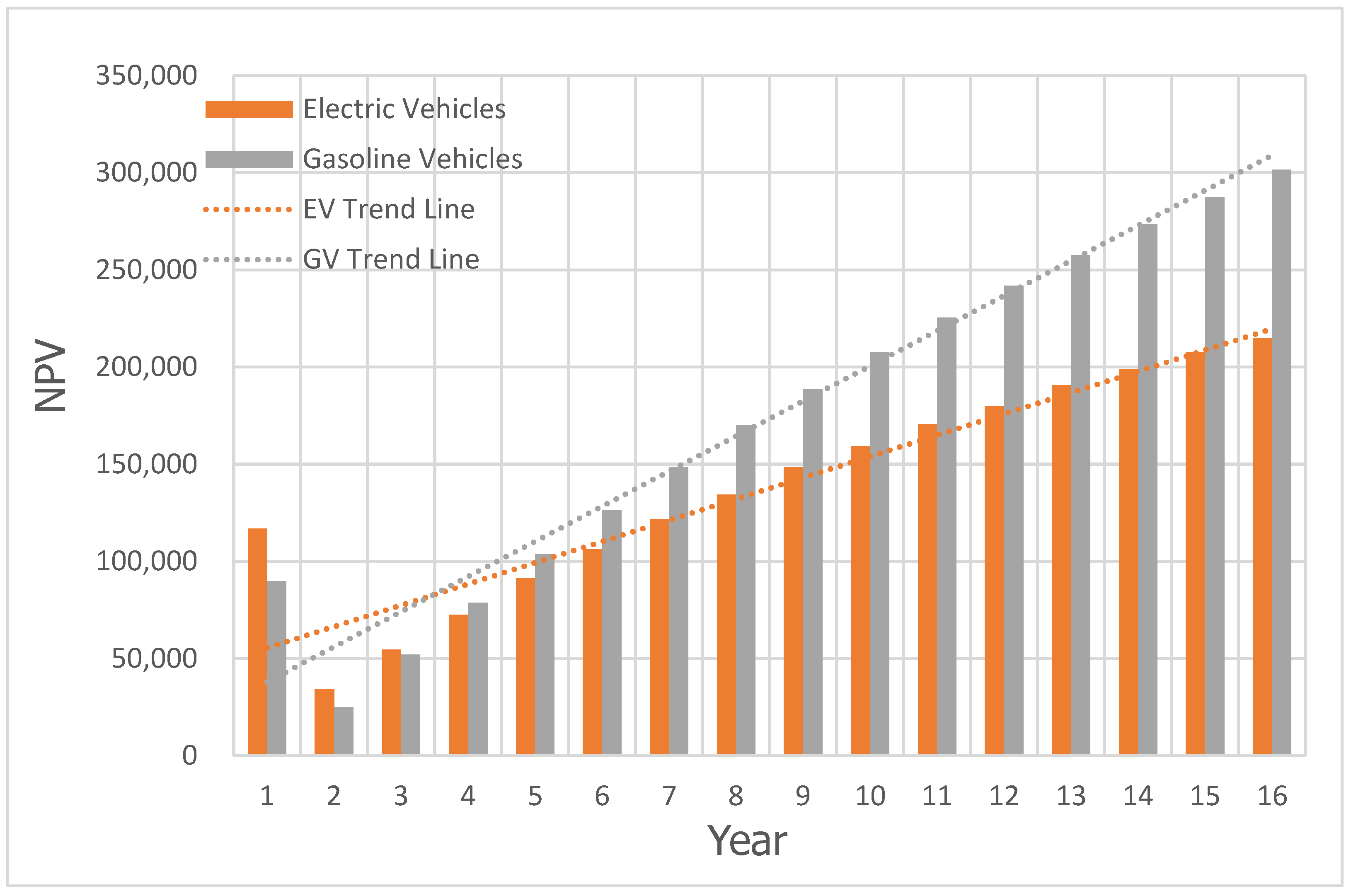
The LCC analysis quantifies the total ownership cost of the two vehicle technologies—BEVs and GVs—over a 15-year service life and an annual driving distance of 20,000 km. All cost components were discounted to present values using the real discount rate applied in Section 2.3.1. Figure 1 illustrates the NPV trajectories of BEVs and GVs over the vehicle lifetime. Net present value (NPV) represents the sum of all present values (PVs) of future cash flows determined using the discount rate. Future cash flows include both inflows and outflows [54]. BEVs exhibit higher initial costs due to greater purchase prices, whereas GVs appear more cost-effective in the early years of ownership. Higher upfront cost difference may be more quickly compensated by lower operating costs for short-range BEVs [55,56]. However, this initial advantage diminishes as operating and maintenance costs accumulate. Under the assumed regional conditions, the NPV trajectories intersect after approximately 2.5 years, beyond which BEVs exhibit lower cumulative ownership costs.
The result that BEVs are cheaper than GVs after about 2.5 years, and realize a 28.74% reduction in discounted ownership cost, is in line with the expectation that higher initial purchase costs can be compensated by lower energy and maintenance costs. The magnitude and timing of this advantage, however, is context dependent. The total cost of ownership of electric vehicles can vary significantly between locations because of differences in petrol and electricity prices, charging access, local temperature, driving cycles, annual mileage and purchase incentives [57]. Lower operating costs and potentially higher resale values for BEVs were also identified by [58], but higher upfront costs could restrict the overall economics compared to internal combustion engine vehicles (ICEVs). Although, BEVs can deliver significant private and perceived social performance in terms of fuel savings and the reduction of environmental impacts [59].
The mixed results show that the economic benefits of BEVs are not unconditional but contextualized by the vehicle attributes, operating conditions, energy prices, technological development and policy regulations. Thus, the current result should be interpreted as a regional result—given annual driving distance, vehicle lifetime, local energy prices, discount rate and battery replacement assumptions—rather than as a general cost advantage of BEVs.

3.2. Monetization of Environmental Impact

Environmental impacts associated with vehicle use are expressed in monetary terms using a willingness-to-pay (WTP)-based valuation of carbon emissions. This approach converts life cycle CO2-eq emissions into carbon cost equivalents, enabling direct comparison with economic and social cost components within a unified monetary framework.
Consumer WTP for carbon emission reduction has been widely applied as a proxy for valuing climate-related externalities [14,15,16]. Previous studies indicate that WTP estimates may vary across regions and socioeconomic contexts [39,40,41]. Within this literature, WTP-based carbon valuation has also been discussed in relation to carbon pricing mechanisms and mitigation incentives [42].
The average WTP was CNY2.67 per 10 kg CO2-eq, or approximately CNY0.267 per kg CO2-eq. According to a past study’s findings, 1 L of gasoline emits 3.47 kg CO2-eq, while 1 kWh of electricity emits 1.45 kg CO2-eq. Thus, with a carbon emission tax, 1 L of gasoline would incur an additional cost of CNY0.93, and 1 kWh of electricity would cost an extra CNY0.39. Previous research indicates that the monthly WTP for 30% carbon mitigation in Suzhou, China, is CNY26.20 [60]. However, this study views monthly WTP as inequitable for lower-emission individuals and less effective in encouraging the public to adopt sustainable lifestyles. Additionally, Suzhou’s monthly WTP is considerably lower than that in Chongqing (CNY37), Beijing (CNY130), and Jiujiang (CNY130) [41], but higher than Seoul’s (approximately CNY19.60) [40]. Shenzhen’s WTP for carbon emissions is estimated at CNY37.96 per ton CO2-eq [61]. As a large city, Shenzhen likely has a population with higher income and education levels than Heilongjiang Province. However, since Wang et al.’s study was conducted in 2018, the slightly higher WTP observed in this study appears reasonable.
Applying this valuation to life cycle emission results yields differentiated environmental costs for gasoline vehicles (GVs) and BEVs. Table 1 summarizes the monetized environmental impacts over both annual use (20,000 km) and the full 15-year service life. Over one year of operation, monetized carbon costs amount to CNY 1107.95 for GVs and CNY 827.95 for BEVs. When extended over the full vehicle lifetime, cumulative carbon costs reach CNY 16,619.27 for GVs and CNY 12,419.18 for BEVs.
Expressed in relative terms, BEVs exhibit an approximate 25.3% reduction in monetized environmental costs compared with GVs. These monetized environmental outcomes provide the environmental component for subsequent integration with the economic and social dimensions within the life cycle sustainability assessment framework.
BEVs reduce CO2-eq emissions and achieve a 25.27% reduction in monetized carbon-related environmental costs compared to GVs over a 15-year operational period. This result suggests that BEVs have a climate-related advantage even when considering the carbon-intensive energy scenarios discussed in this study. The magnitude of this benefit, however, is highly dependent on the composition of the electricity. A past study shows large differences in the life cycle global warming impacts of BEVs for developing countries with different electricity generation systems [62]. Changes in electricity supply, vehicle technology, and battery technology can affect environmental impacts over time and across different impact categories [63]. In this study a fixed grid emission factor and a region-specific willingness-to-pay value is used, so the monetized environmental outcome should be seen as an estimate for the specific context.
Sensitivity analyses were conducted to test the robustness of the monetized LCSA results. The WTP coefficient used for environmental monetization, as WTP directly determines the monetary value of carbon-related environmental impacts (Table 2).
A sensitivity analysis of WTP was conducted to evaluate the effect of WTP uncertainty on environmental valuation results by varying the baseline WTP value by ±10% and ±20%. The results indicate that the absolute monetized carbon costs and carbon-cost savings are directly proportional to the estimated WTP value. When the WTP value decreases by 20%, the carbon-cost savings of BEVs decline from CNY 4200.08 to CNY 3360.06. The savings increase to CNY 5040.10 when the WTP value increases by 20%. The absolute reduction depends on the scenario, but the relative reduction is always 25.27% because the same WTP coefficient is used for BEVs and GVs (shows in Table 2). This suggests that the absolute monetary value of the environmental benefit is sensitive to WTP assumptions, but the relative carbon-related benefit of BEVs is robust across the WTP scenarios examined.

3.3. Monetization of Social Impacts

Social impacts are quantified by translating consumer-perception scores into standardized price-based indicators associated with vehicle purchase decisions. Five social impact categories—health and safety, consumer privacy, transparency, feedback mechanisms, and end-of-life concerns—are evaluated for their statistical association with purchase intention. The strength and direction of these associations are assessed using Spearman’s rank correlation coefficients, which provide a non-parametric measure suitable for ordinal survey data [64]. The reported values are expressed in monetary units as a price-based normalization device and should be interpreted as relative perception indicators rather than welfare-based monetary valuations. The reported values are expressed in monetary units as a price-based normalization device and should be interpreted as relative perception indicators rather than welfare-based monetary valuations.
Previous studies have identified some social issues related to consumers that may hinder the adoption of electric cars. Ref. [58] identified the problems of the driving range, the accessibility of the charging stations, and the after-purchase support. Ref. [65] stated that the waiting time of chargers and the availability of charging facilities will affect consumer choices. The lack of public charging infrastructure may discourage potential buyers from purchasing electric vehicles [66] and the limited driving range of battery electric vehicles is still a major barrier to adoption [67].
Furthermore, the price of the batteries is still unknown, which is leading to a loss of confidence in electric cars among customers [68]. However, electric vehicles are generally cheaper to maintain and operate than petrol vehicles because of technology developments and beneficial laws [69]. In China, governments have adopted policies to encourage the substitution of petrol vehicles for electric vehicles [70]. Ref. [71] pointed out that the adoption of electric mobility should be in line with the infrastructure readiness and be incentivized with free parking, free charging, lower registration fees, and financial subsidies, considering social factors. Environmentally, increasing concerns about car emissions may increase the perceived cost of using GV per kilometer [72].
Table 3 summarizes the monetization of social impacts for BEVs based on a vehicle price of CNY 123,800. Correlation coefficients are used to derive relative weights for each social impact category, which are then applied to allocate the vehicle price into Partial Values. These Partial Values are adjusted using category-specific Social Contribution Rates to derive standardized perception value. Under the applied valuation framework, the total standardized perception value for BEVs exceeds the corresponding Partial Value by CNY 12,696.
Table 4 applies the same procedure to GVs using a base price of CNY 110,000. The resulting total standardized perception value exceeds the Partial Value by CNY 13,256, indicating a higher standardized social perception value for GVs under the same methodological assumptions.
Comparison of the correlation structures reveals that the sum of the correlation coefficients associated with purchase intention is higher for BEVs (1.047) than for GVs (0.841), suggesting stronger statistical associations between social indicators and purchase intention for BEVs. At the same time, the aggregated standardized social perception value is lower for BEVs than for GVs when expressed in monetary terms.
Taken together, these results illustrate a key trade-off revealed through monetization. While social indicators are more strongly associated with consumer purchase intention for BEVs, their standardized social perception contribution does not exceed that of GVs under the applied valuation framework. This divergence highlights how monetary integration can alter the relative interpretation of social performance compared with assessments based solely on association strength or qualitative indicators.
Consumer challenges in the adoption of electric vehicles such as driving range, charging infrastructure and after-sales services [58]. The availability of charging stations and the waiting time for consumers to get a charger also affect consumers’ decisions [65]. The absence of public charging infrastructure may deter consumers from buying electric vehicles [66]. One of the main concerns is the limited range of BEVs [67]. The cost of batteries for electric cars is not certain [68]. Furthermore, due to current policies and technology advances, the operating and maintenance costs of EVs are worse than GVs [69]. Chinese policy makers have taken measures to promote GVs [70]. Ref. [71] point out the significance of social factors in the EV transition. They recommend motivational strategies such as financial incentives, free parking, free charging and reduced registration fees to smooth the transition and to ensure alignment with infrastructure readiness. Environmental consequences are becoming a concern [72] and this may also increase the penalty cost per km of GV use.

3.4. Integrated LCSA Results Under the Monetized–Indicator Framework

This section addresses the research question of how economic, environmental, and social impacts—quantified through monetization and standardized perception indicators—differ between GVs and BEVs, and how these differences collectively influence the overall sustainability assessment of replacing GVs with BEVs in Heilongjiang Province.
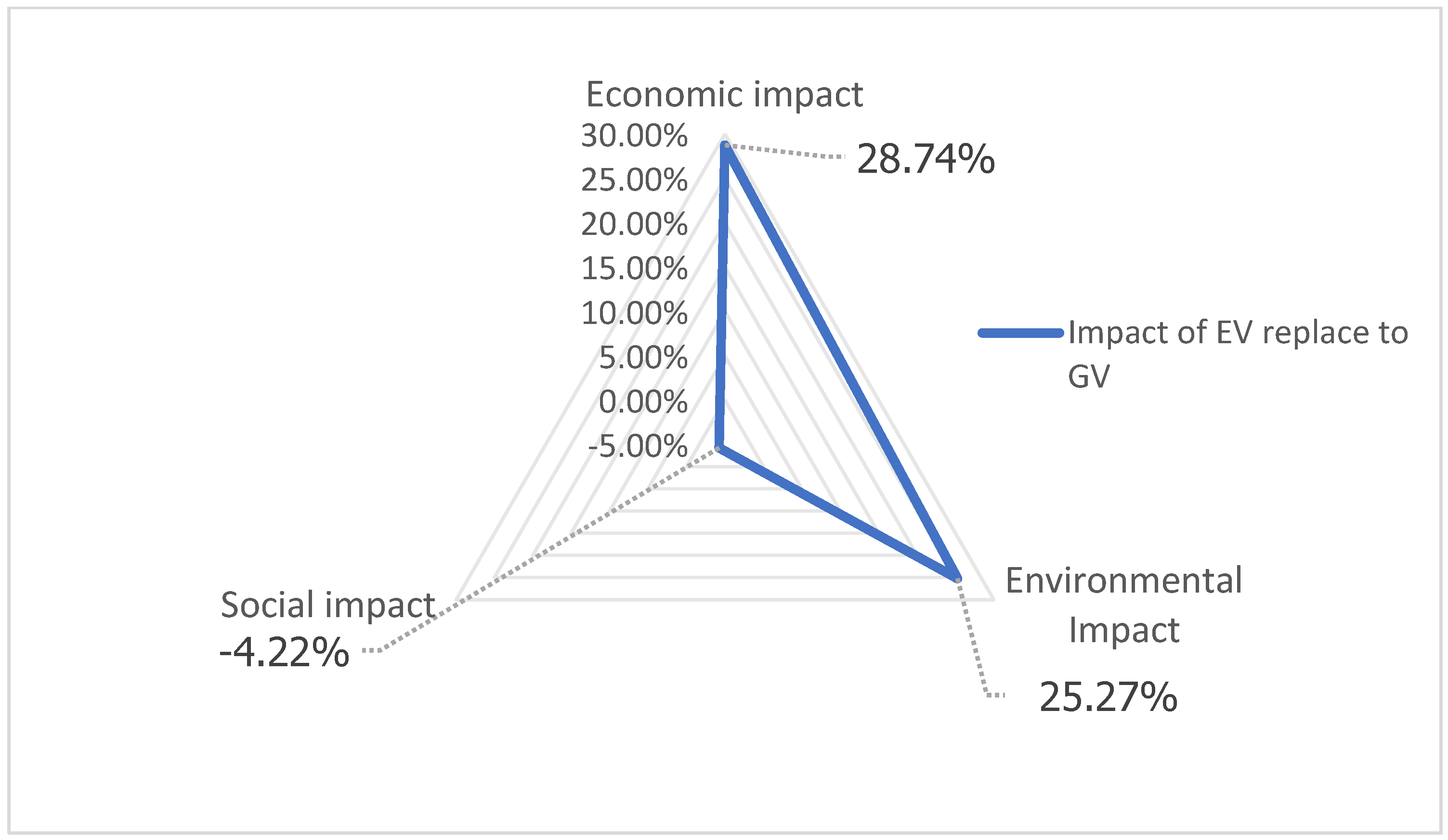
Differences in monetized sustainability outcomes between GVs and BEVs are summarized in Table 4. From an economic perspective, LCC results indicate that BEVs incur substantially lower discounted ownership costs than GVs over a 15-year service life, yielding a total cost saving of CNY 86,653.47, corresponding to a relative reduction of 28.74%. This result reflects the dominant contribution of reduced energy and maintenance costs in the long term.
From an environmental perspective, monetized carbon emission results show that BEVs generate lower CO2-equivalent emissions than GVs under the regional electricity and usage conditions considered. Over the full-service life, the monetized environmental cost associated with BEVs is CNY 4200.08 lower than that of GVs, corresponding to a 25.27% reduction in carbon-related costs (Table 5).
In contrast, the social perception dimension exhibits an opposite pattern. The standardized social perception value associated with BEVs (CNY 12,696) is lower than that calculated for GVs (CNY 13,256), resulting in a net difference of –CNY 560, equivalent to a –4.22% change in relative social performance indicator. This outcome indicates that, under the applied valuation framework, the replacement of GVs with BEVs is associated with a modest reduction in standardized social perception performance.
German automotive decision-makers assigned weights of 0.352 (environmental), 0.335 (economic), and 0.312 (social) [51]. Energy system modelers prioritized environmental sustainability (0.385), significantly higher than social (0.320) and economic (0.295) factors [18].
Taken together, these results highlight the trade-offs revealed through monetary integration. While BEVs demonstrate clear advantages in economic and environmental dimensions, these gains are partly offset by lower monetized social outcomes. Figure 2 visualizes the relative contributions of the three sustainability dimensions, illustrating how monetary aggregation alters the overall interpretation of sustainability performance compared with assessments based on individual indicators.
These findings align with previous studies, such as [58,73,74], which also highlight that BEVs become more cost-effective over time due to lower operational and maintenance costs; the economic viability of BEVs improves significantly beyond five years of ownership, even in regions with higher electricity prices. Additionally, ref. [75] emphasizes that policy interventions, including taxation and infrastructure development, play a crucial role in enhancing BEV adoption. The results are also in line with [76], who found that a reward–penalty mechanism is more effective than direct subsidies in increasing adoption rates. Within this study, monetization serves to make these multidimensional trade-offs explicit, providing an integrated perspective on sustainability outcomes without privileging any single dimension.
A sensitivity analysis of weighting was performed to assess whether the integrated result is dependent on the assumption of equal weighting. The equal-weighting baseline scenario assigned a third of the total weight to each sustainability pillar (0.333 in the table, rounded). In the base case with equal weights, the integrated sustainability score is 16.59%. The result remains positive when alternative weighting techniques from the literature are used. The automotive decision-maker and the energy system modeler scenario give 17.20% and 16.85%, respectively. The results indicate that the main conclusion is robust to alternative weighting assumptions. The negative social perception score reduces the overall sustainability benefit of BEVs, but does not eliminate the positive integrated outcome of economic and environmental benefits. Sensitivity analysis under alternative weighting schemes shows in Table 6.
The proposed paradigm can be applied to several geographical locations, but the numerical sustainability outputs should not be directly transferred without recalibrating the regional inputs. With cleaner power grids, BEVs are expected to have lower life cycle CO2 emissions and lower monetized environmental costs, and thus an increased environmental superiority over GVs. By contrast, car electrification might offer fewer environmental benefits if coal power generation continues to dominate the electricity grid.
Climatic conditions may also play a role in the results. According to study [77,78], reduced battery efficiency and increased heating requirements in cold climates can offset the economic and environmental benefits of BEVs by increasing electricity consumption. In temperate climates, these penalties are expected to be smaller. However, higher temperatures can increase the amount of energy needed for air conditioning and decrease the efficiency of batteries. Thus, temperature-sensitive vehicle energy usage should be incorporated when applying the framework in various climatic locations.
The framework is methodologically transportable as it maintains the same structure for economic, environmental and social assessments. However, the composition of the electricity generation, grid emission variables, fuel and electricity pricing, annual driving distance, car lifetime, policy incentives, charging infrastructure, environmental willingness to pay and consumer views should be region-specific. The present conclusions are limited by the reliance on stated-preference survey data, a static grid emission factor, selected car types, and a consumer-oriented social evaluation [77,78]. The paradigm is transportable but the importance and ranking of sustainability outcomes is situation-dependent.

4. Conclusions, Limitations and Implications

In this study, a monetized LCSA framework was developed and applied to evaluate the economic, environmental and social impacts of replacing GVs with BEVs in Heilongjiang, China Province. Under this framework, the economic and environmental dimensions are expressed in monetary form based on WTP, while the social dimensions are reflected by standardized and price-referenced perception indicators, thus achieving comprehensive comparison.
The results show that in the service life of 15 years, compared with GVs, the total cost of ownership of BEVs is reduced by 28.74%, and the equivalent carbon dioxide emission is reduced by 25.27%, which is equivalent to saving the carbon emission cost of CNY4200.08. These findings show that BEVs still have obvious economic and environmental advantages even in the coal-dominated power system. However, compared with GVs, the standardized social perception of BEVs has decreased by 4.22%, which is mainly due to consumers’ concerns about privacy protection, information transparency and end-of-life responsibility. In the comprehensive evaluation, these social concerns offset the economic and environmental benefits of BEVs to some extent.
Overall, under the valuation framework adopted in this study, BEVs outperform GVs in the economic and environmental dimensions but underperform in the social perception dimension. This finding suggests that cost reduction and emission mitigation alone may not be sufficient to ensure a socially robust low-carbon transport transition. Policies aimed at strengthening consumer trust, improving data governance, enhancing information transparency, and reinforcing end-of-life responsibility are therefore particularly important, especially in cold regions with carbon-intensive electricity systems.
Several limitations should also be acknowledged. First, the environmental assessment is limited to airborne emissions. Second, the WTP value adopted in this study is context-specific and subject to regional variation. Third, grid emission factors are assumed to remain constant over time. Fourth, equal weighting is applied across the sustainability dimensions. Finally, social preferences are inferred primarily from stated intentions rather than revealed behavior. Future research could further refine the framework through multi-regional comparisons, dynamic electricity-mix modeling, uncertainty analysis, and the incorporation of revealed-preference data. Environmental assessment is limited to airborne emissions of carbon and does not include wider environmental burdens such as resource depletion, battery production impacts, toxicity, acidification, particulate matter formation, water use or end-of-life battery treatment. Thus, the environmental advantage of BEVs found in this study should be understood as a carbon-related advantage, not an overall environmental superiority in all impact categories. The study addresses only the stakeholder group of consumers, although the indicators chosen are based on UNEP/SETAC S-LCA guidance. This study does not consider other stakeholder groups and broader societal issues, such as labor, local communities, supply-chain accountability and institutional governance. Therefore, social outcomes should be considered as context-specific indicators of consumer perception, not as complete monetary valuations of social welfare. Methodologically, this study shows how to integrate consumer-perceived social repercussions with economic and environmental outcomes into a single monetized LCSA framework.

Author Contributions

Conceptualization, S.M. and Z.H.; methodology, S.M., Z.H. and A.H.S.; software, H.C.; validation, Y.L. and H.C.; resources, S.M. and Z.H.; writing—original draft preparation, S.M. and Z.H.; writing—review and editing, S.M., Z.H. and A.H.S.; visualization, Y.L. and H.C.; supervision, A.H.S.; project administration, H.C.; funding acquisition, S.M. and Z.H. All authors have read and agreed to the published version of the manuscript.

Funding

This work was supported by the grants from project of Shandong Province Higher Educational Youth Innovation Team Development Program (No. 2025KJH148). Shandong Engineering Research Center of Low-Carbon Energy Internet of Things Technology (PT2025KJS004).

Institutional Review Board Statement

The study was conducted in accordance with the Declaration of Helsinki, and approved by the Ethics Committee of Universiti Putra Malaysia (protocol code JKEUPM-2023-1319 and date of approval 11 July 2024).

Informed Consent Statement

Informed consent was obtained from all individual participants included in the study.

Data Availability Statement

The datasets produced in this study are available from the corresponding author upon reasonable request. However, respondent data contains personal privacy information and was used under license for this study but making it unavailable to the public.

Conflicts of Interest

The authors declare no conflicts of interest.

References

  1. Serrato, D.A.; Tibaquirá, J.E.; López, J.C.; Castillo, J.C.; Giraldo, M.; Quirama, L.F. Evaluating Electric Vehicle and Emission Standards Improvement in a Latin American City. Green Energy Intell. Transp. 2025, 4, 100284. [Google Scholar] [CrossRef]
  2. Zhang, H.; Luo, Y.; Ding, N.; Yamamoto, T.; Fan, C.; Yang, C.; Xu, W.; Wu, C. Evaluation of Eco-Driving Performance of Electric Vehicles Using Driving Behavior-Enabled Graph Spectrums: A Naturalistic Driving Study in China. Green Energy Intell. Transp. 2025, 4, 100246. [Google Scholar] [CrossRef]
  3. Pamidimukkala, A.; Kermanshachi, S.; Rosenberger, J.M.; Hladik, G. Barriers and Motivators to the Adoption of Electric Vehicles: A Global Review. Green Energy Intell. Transp. 2024, 3, 100153. [Google Scholar] [CrossRef]
  4. Souza, R.G.; Rosenhead, J.; Salhofer, S.P.; Valle, R.A.B.; Lins, M.P.E. Definition of Sustainability Impact Categories Based on Stakeholder Perspectives. J. Clean. Prod. 2015, 105, 41–51. [Google Scholar] [CrossRef]
  5. Kurka, T. Application of the Analytic Hierarchy Process to Evaluate the Regional Sustainability of Bioenergy Developments. Energy 2013, 62, 393–402. [Google Scholar] [CrossRef]
  6. Oxford University. WCED: Our Common Future; Oxford University: Oxford, UK, 1987. [Google Scholar]
  7. Pintarič, Z.N.; Kravanja, Z. Selection of the Economic Objective Function for the Optimization of Process Flow Sheets. Ind. Eng. Chem. Res. 2006, 45, 4222–4232. [Google Scholar] [CrossRef]
  8. Chang, Y.-J.; Schau, E.M.; Finkbeiner, M. Application of Life Cycle Sustainability Assessment to the Bamboo and Aluminum Bicycles in Surveying Social Risks of Developing Countries. In Proceedings of the 2nd World Sustainability Forum, Online, 1–30 November 2012. [Google Scholar]
  9. Omran, N.; Sharaai, A.H.; Hashim, A.H. Visualization of the Sustainability Level of Crude Palm Oil Production: A Life Cycle Approach. Sustainability 2021, 13, 1607. [Google Scholar] [CrossRef]
  10. Guinée, J. Life Cycle Sustainability Assessment: What Is It and What Are Its Challenges? In Taking Stock of Industrial Ecology; Springer International Publishing: Cham, Switzerland, 2015; pp. 45–68. [Google Scholar]
  11. Morel, S.; Traverso, M.; Preiss, P.; Morel, S.; Traverso, M.; Preiss, P. Discussion Panel—Assessment of Externalities: Monetisation and Social LCA. In Designing Sustainable Technologies, Products and Policies; Springer: Cham, Switzerland, 2018; pp. 391–396. [Google Scholar] [CrossRef]
  12. Malandrino, O.; Rapa, M.; Ruggieri, R.; Vinci, G. Is the Electric Mobility Really Green? A Life Cycle Thinking Approach. In Proceedings of the 2020 IEEE International Conference on Environment and Electrical Engineering and 2020 IEEE Industrial and Commercial Power Systems Europe (EEEIC/I&CPS Europe), Madrid, Spain, 9–12 June 2020; IEEE: Piscataway, NJ, USA, 2020; pp. 1–4. [Google Scholar]
  13. Rosenfeld, D.C.; Lindorfer, J.; Fazeni-Fraisl, K. Comparison of Advanced Fuels—Which Technology Can Win from the Life Cycle Perspective? J. Clean. Prod. 2019, 238, 117879. [Google Scholar] [CrossRef]
  14. Klöpffer, W. Life-Cycle Based Methods for Sustainable Product Development. Int. J. Life Cycle Assess. 2003, 8, 157–159. [Google Scholar] [CrossRef]
  15. Kloepffer, W. Life Cycle Sustainability Assessment of Products. Int. J. Life Cycle Assess. 2008, 13, 89–95. [Google Scholar] [CrossRef]
  16. Reap, J.; Roman, F.; Duncan, S.; Bras, B. A Survey of Unresolved Problems in Life Cycle Assessment. Int. J. Life Cycle Assess. 2008, 13, 374–388. [Google Scholar] [CrossRef]
  17. Gan, Y.; Wang, M.; Lu, Z.; Kelly, J. Taking into Account Greenhouse Gas Emissions of Electric Vehicles for Transportation De-Carbonization. Energy Policy 2021, 155, 112353. [Google Scholar] [CrossRef]
  18. Wulf, C.; Haase, M.; Baumann, M.; Zapp, P. Weighting Factor Elicitation for Sustainability Assessment of Energy Technologies. Sustain. Energy Fuels 2023, 7, 832–847. [Google Scholar] [CrossRef]
  19. Wilken, D.; Oswald, M.; Draheim, P.; Pade, C.; Brand, U.; Vogt, T. Multidimensional Assessment of Passenger Cars: Comparison of Electric Vehicles with Internal Combustion Engine Vehicles. Procedia CIRP 2020, 90, 291–296. [Google Scholar] [CrossRef]
  20. Kneifel, J.; Webb, D. Natinal Institute of Standards and Technology. In Life Cycle Costing Manual for the Federal Energy Management Program, 2022 Edition; National Institute of Standards and Technology: Gaithersburg, MD, USA, 2022. [Google Scholar]
  21. ISO 15686-5:2017(En); Buildings and Constructed Assets—Service Life Planning—Part 5: Life-Cycle Costing. International Organization for Standardization: Geneva, Switzerland. Available online: https://www.iso.org/obp/ui/#iso:std:iso:15686:-5:ed-2:v1:en (accessed on 17 June 2021).
  22. Zhou, B. Electric Vehicle Lifespan and Healthy Driving Habits 2020. Available online: https://www.cnr.cn/gsgb/2015yw/20201226/t20201226_525375131.shtml (accessed on 25 May 2026).
  23. Ministry of Industry and Information Technology of the People’s Republic of China. Notice on the Financial Support Policy for the Promotion and Application of New Energy Vehicles from 2016 to 2020; Ministry of Industry and Information Technology of the People’s Republic of China: Beijing, China, 2015. [Google Scholar]
  24. BYD Auto official website BYD Auto-the Leader in New Energy Vehicles. Available online: https://www.byd.com/cn (accessed on 19 November 2023).
  25. Biolek, V.; Hanák, T. LCC Estimation Model: A Construction Material Perspective. Buildings 2019, 9, 182. [Google Scholar] [CrossRef]
  26. Ross, S.A. Uses, Abuses, and Alternatives to the Net-Present-Value Rule. Financ. Manag. 1995, 24, 96–102. [Google Scholar] [CrossRef]
  27. Gallo, A. A Refresher on Net Present Value. Harvard business review. 2014. Available online: https://hbr.org/2014/11/a-refresher-on-net-present-value</b><b> (accessed on 25 May 2023).
  28. Kupec, J.; Dlask, P. Residual Method Used for Commercial Real Estate Valuation and Its Sensitivity. Bus. IT 2020, X, 12–21. [Google Scholar] [CrossRef]
  29. Dunn, D. Electric Vehicle Life Cycle Cost Analysis; Bureau of Transportation Statistics: Research and Innovation Administration: Washington, DC, USA, 2017. [Google Scholar]
  30. Xinhua China’s CPI Up 2% in 2022. Available online: http://english.scio.gov.cn/pressroom/2023-01/12/content_85055550.htm (accessed on 17 November 2023).
  31. Hofstetter, P.; Müller-Wenk, R. Monetization of Health Damages from Road Noise with Implications for Monetizing Health Impacts in Life Cycle Assessment. J. Clean. Prod. 2005, 13, 1235–1245. [Google Scholar] [CrossRef]
  32. Rotaris, L.; Danielis, R. The Willingness to Pay for a Carbon Tax in Italy. Transp. Res. Part D. Transp. Environ. 2019, 67, 659–673. [Google Scholar] [CrossRef]
  33. Tsang, F.; Burge, P. Paying for Carbon Emissions Reduction. Available online: https://www.rand.org/pubs/occasional_papers/OP312.html (accessed on 12 January 2024).
  34. Kong, X.Q. Research on the Health Damage Assessment Model of Building During the Life Cycle. Master’s thesis, Tsinghua University, Beijing, China, 2010. [Google Scholar]
  35. Gupta, M. Willingness to Pay for Carbon Tax: A Study of Indian Road Passenger Transport. Transp. Policy 2016, 45, 46–54. [Google Scholar] [CrossRef]
  36. Carattini, S.; Carvalho, M.; Fankhauser, S. Overcoming Public Resistance to Carbon Taxes. Wiley Interdiscip. Rev. Clim. Change 2018, 9, e531. [Google Scholar] [CrossRef] [PubMed]
  37. Finnveden, G.; Eldh, P.; Johansson, J. Weighting in LCA Based on Ecotaxes: Development of a Mid-Point Method and Experiences from Case Studies. Int. J. Life Cycle Assess. 2006, 11, 81–88. [Google Scholar] [CrossRef]
  38. Baracskay, D. Cost-Benefit Analysis: Concepts and Practice. Public Choice 1998, 96, 417–423. [Google Scholar]
  39. Fenwick, E.; O’Brien, B.J.; Briggs, A. Cost-Effectiveness Acceptability Curves–Facts, Fallacies and Frequently Asked Questions. Health Econ. 2004, 13, 405–415. [Google Scholar] [CrossRef] [PubMed]
  40. Lee, J.-S.; Yoo, S.-H.; Kwak, S.-J. Public’s Willingness to Pay for Preventing Climate Change. Appl. Econ. Lett. 2010, 17, 619–622. [Google Scholar] [CrossRef]
  41. Zeng, X. China Urban Resident’s Willingness to Pay for Carbon Dioxide Emission Reductions. Zhongguo Huanjing Kexue/China Environ. Sci. 2011, 31, 346–352. [Google Scholar]
  42. Baranzini, A.; Carattini, S. Global Environmental Change. In Handbook of global environmental pollution; Chapter 25: Taxation of Emissions of Greenhouse Gases; Freedman, B., Ed.; Springer: Dordrecht, The Netherlands, 2014; pp. 543–560. [Google Scholar]
  43. Li, H.; Jenkins-Smith, H.C.; Silva, C.L.; Berrens, R.P.; Herron, K.G. Public Support for Reducing US Reliance on Fossil Fuels: Investigating Household Willingness-to-Pay for Energy Research and Development. Ecol. Econ. 2009, 68, 731–742. [Google Scholar] [CrossRef]
  44. Honu, B. Contingent Valuation Method for General Practitioners: A Cookbook Approach. Lesotho Soc. Sci. Rev. 2007, 11, 83–96. [Google Scholar]
  45. UNEP/SETAC. The Methodological Sheets for Subcategories in Social Life Cycle Assessment (S-LCA); United Nations Environment Programme and Society of Environmental Toxicology and Chemistry (UNEP/SETAC): Paris, France, 2013. [Google Scholar]
  46. UNEP/SETAC. Guidelines for Social Life Cycle Assessment of Products; United Nations Environment Programme and Society of Environmental Toxicology and Chemistry (UNEP/SETAC): Paris, France, 2009. [Google Scholar]
  47. Roth, S.; Bösener, K. The Influence of Customer Satisfaction on Customer Price Behavior: Literature Review and Identification of Research Gaps. Manag. Rev. Q. 2015, 65, 1–33. [Google Scholar] [CrossRef]
  48. Ahamad, N.R.; Ariffin, M. Assessment of Knowledge, Attitude and Practice towards Sustainable Consumption among University Students in Selangor, Malaysia. Sustain. Prod. Consum. 2018, 16, 88–98. [Google Scholar] [CrossRef]
  49. Valdivia, S.; Backes, J.G.; Traverso, M.; Sonnemann, G.; Cucurachi, S.; Guinée, J.B.; Schaubroeck, T.; Finkbeiner, M.; Leroy-Parmentier, N.; Ugaya, C.; et al. Principles for the Application of Life Cycle Sustainability Assessment. Int. J. Life Cycle Assess. 2021, 26, 1900–1905. [Google Scholar] [CrossRef]
  50. Ekener, E.; Hansson, J.; Larsson, A.; Peck, P. Developing Life Cycle Sustainability Assessment Methodology by Applying Values-Based Sustainability Weighting-Tested on Biomass Based and Fossil Transportation Fuels. J. Clean. Prod. 2018, 181, 337–351. [Google Scholar] [CrossRef]
  51. Tarne, P.; Lehmann, A.; Finkbeiner, M. Introducing Weights to Life Cycle Sustainability Assessment—How Do Decision-Makers Weight Sustainability Dimensions? Int. J. Life Cycle Assess. 2018, 24, 530–542. [Google Scholar] [CrossRef]
  52. Pope, J.; Annandale, D.; Morrison-Saunders, A. Conceptualising Sustainability Assessment. Environ. Impact Assess. Rev. 2004, 24, 595–616. [Google Scholar] [CrossRef]
  53. Kuhlman, T.; Farrington, J. What Is Sustainability? Sustainability 2010, 2, 3436–3448. [Google Scholar] [CrossRef]
  54. Bora, D.B. Comparison Between Net Present Value and Internal Rate of Return. Int. J. Res. Financ. Mark. 2015, 5, 61–71. [Google Scholar]
  55. Weldon, P.; Morrissey, P.; O’Mahony, M. Long-Term Cost of Ownership Comparative Analysis between Electric Vehicles and Internal Combustion Engine Vehicles. Sustain. Cities Soc. 2018, 39, 578–591. [Google Scholar] [CrossRef]
  56. Liu, Z.; Song, J.; Kubal, J.; Susarla, N.; Knehr, K.W.; Islam, E.; Nelson, P.; Ahmed, S. Comparing Total Cost of Ownership of Battery Electric Vehicles and Internal Combustion Engine Vehicles. Energy Policy 2021, 158, 112564. [Google Scholar] [CrossRef]
  57. Woody, M.; Adderly, S.A.; Bohra, R.; Keoleian, G.A. Electric and Gasoline Vehicle Total Cost of Ownership across US Cities. J. Ind. Ecol. 2024, 28, 194–215. [Google Scholar] [CrossRef]
  58. Wang, Y.; Zhou, G.; Li, T.; Wei, X. Comprehensive Evaluation of the Sustainable Development of Battery Electric Vehicles in China. Sustainability 2019, 11, 5635. [Google Scholar] [CrossRef]
  59. Iken, N.; Morel, S.; Aggeri, F. Towards a Sustainable Material Use in the Automotive Industry: Life Cycle Costing and Socio-Technical Approach to Material Use. Matériaux Tech. 2019, 107, 504. [Google Scholar] [CrossRef]
  60. Yang, J.; Zou, L.; Lin, T.; Wu, Y.; Wang, H. Public Willingness to Pay for CO2 Mitigation and the Determinants under Climate Change: A Case Study of Suzhou, China. J. Environ. Manag. 2014, 146, 1–8. [Google Scholar] [CrossRef] [PubMed]
  61. Wang, T.; Wang, J.; Wu, P.; Wang, J.; He, Q.; Wang, X. Estimating the Environmental Costs and Benefits of Demolition Waste Using Life Cycle Assessment and Willingness-to-Pay: A Case Study in Shenzhen. J. Clean. Prod. 2018, 172, 14–26. [Google Scholar] [CrossRef]
  62. Aryan, Y.; C K, A.; Dikshit, A.K.; Shinde, A.M. Comparative Life Cycle Assessment of Battery Electric Vehicles in Developing Countries under Current and Future Electricity Mix Scenarios. Discov. Sustain. 2025, 6, 675. [Google Scholar] [CrossRef]
  63. Sánchez, A.; Benveniste, G.; Ferreira, V.J.; Bulfaro, I.; Igualada, L.; Corchero, C. Methodology for Social Life Cycle Impact Assessment Enhanced with Gender Aspects Applied to Electric Vehicle Li-Ion Batteries. Int. J. Life Cycle Assess. 2025, 30, 1229–1245. [Google Scholar] [CrossRef]
  64. Mukaka, M. A Guide to Appropriate Use of Correlation Coefficient in Medical Research. Malawi Med. J. 2012, 24, 69–71. [Google Scholar] [PubMed]
  65. Xie, F.; Liu, C.; Li, S.; Lin, Z.; Huang, Y. Long-Term Strategic Planning of Inter-City Fast Charging Infrastructure for Battery Electric Vehicles. Transp. Res. Part E Logist. Transp. Rev. 2018, 109, 261–276. [Google Scholar] [CrossRef]
  66. Mortimer, B.J.; Hecht, C.; Goldbeck, R.; Sauer, D.U.; De Doncker, R.W. Electric Vehicle Public Charging Infrastructure Planning Using Real-World Charging Data. World Electr. Veh. J. 2022, 13, 94. [Google Scholar] [CrossRef]
  67. Jiang, N.; Xie, C.; Duthie, J.C.; Waller, S.T. A Network Equilibrium Analysis on Destination, Route and Parking Choices with Mixed Gasoline and Electric Vehicular Flows. EURO J. Transp. Logist. 2014, 3, 55–92. [Google Scholar] [CrossRef]
  68. Inkpen, R.; Baily, B. Environmental Beliefs and Their Role in Environmental Behaviours of Undergraduate Students. J. Environ. Stud. Sci. 2020, 10, 57–67. [Google Scholar] [CrossRef]
  69. Bessenbach, N.; Wallrapp, S. Why Do Consumers Resist Buying Electric Vehicles? An empirical Study of Innovation Perception and the Effect of Consumer Characteristics, Innovation Exposure, and Buying Incentives; Copenhagen Business School: Frederiksberg, Denmark, 2013. [Google Scholar]
  70. Hu, X.; Yang, Z.; Sun, J.; Zhang, Y. Exempting Battery Electric Vehicles from Traffic Restrictions: Impacts on Market and Environment under Pigovian Taxation. Transp. Res. Part A Policy Pract. 2021, 154, 53–91. [Google Scholar] [CrossRef]
  71. Al-Buenain, A.; Al-Muhannadi, S.; Falamarzi, M.; Kutty, A.A.; Kucukvar, M.; Onat, N.C. The Adoption of Electric Vehicles in Qatar Can Contribute to Net Carbon Emission Reduction but Requires Strong Government Incentives. Vehicles 2021, 3, 618–635. [Google Scholar] [CrossRef]
  72. Cordera, R.; dell’Olio, L.; Ibeas, A.; Ortúzar, J.d.D. Demand for Environmentally Friendly Vehicles: A Review and New Evidence. Int. J. Sustain. Transp. 2019, 13, 210–223. [Google Scholar] [CrossRef]
  73. Guo, Z.; Li, T.; Peng, S.; Zhang, H. Environmental and Economic Consequences of the Incentive Policy on Electric Vehicle Industry: A CGE Based Study in China. Resour. Conserv. Recycl. 2021, 169, 105542. [Google Scholar] [CrossRef]
  74. Zhou, B.; Hu, H.; Dai, L. Assessment of the Development of Time-Sharing Electric Vehicles in Shanghai and Subsidy Implications: A System Dynamics Approach. Sustainability 2020, 12, 345. [Google Scholar] [CrossRef]
  75. Nonaka, T.; Nakano, M. Carbon Taxation Using LCCO 2 and LCC for Clean Energy Vehicles. Nihon Kikai Gakkai Ronbunshu C Hen/Trans. Jpn. Soc. Mech. Eng. Part C 2011, 77, 4024–4033. [Google Scholar] [CrossRef][Green Version]
  76. Tang, Y.; Zhang, Q.; Li, Y.; Li, H.; Pan, X.; Mclellan, B. The Social-Economic-Environmental Impacts of Recycling Retired EV Batteries under Reward-Penalty Mechanism. Appl. Energy 2019, 251, 113313. [Google Scholar] [CrossRef]
  77. Ma, S.; He, Z.; Sharaai, A.H.; Matthew, N.K.; Zainordin, N.S. Life Cycle Assessment of Electric and Gasoline Vehicles Considering Grid Differences and Cold Climate in China. Sci. Rep. 2026, 16, 7010. [Google Scholar] [CrossRef] [PubMed]
  78. Ma, S.; Sharaai, A.H.; He, Z.; Matthew, N.K.; Zainordin, N.S. Life Cycle Cost and Environmental Performance of Electric and Gasoline Vehicles in Cold Climate and Coal-Dependent Regions: A Case Study of Heilongjiang Province, China. Sustainability 2025, 17, 4554. [Google Scholar] [CrossRef]
Figure 1. NPV trajectory of life cycle cost for BEVs vs. GVs (15-year service life, 20,000 km/year).
Wevj 17 00318 g001
Figure 2. Visualization of the sustainability of replacing GVs with EVs in Heilongjiang Province, China.
Wevj 17 00318 g002
Table 1. Monetization of environmental impacts of GVs and BEVs.
GVBEV
CO2 eq emission per year4149.63 kg CO2-eq3100.92 kg CO2-eq
Usage (15 year) CO2-eq emission62,244.45 kg CO2-eq46,513.80 kg CO2-eq
CO2 eq emission tax per year1107.95 CNY827.95 CNY
Usage (15 year) CO2-eq emission tax16,619.27 CNY12,419.18 CNY
Table 2. WTP sensitivity analysis for carbon-related environmental costs.
WTP ScenarioWTP Value CNY/10 kg CO2-eqGV Carbon Cost, 15 Years CNYBEV Carbon Cost, 15 Years CNYBEV Carbon-Cost Saving CNYRelative Reduction
−20% WTP2.13613,295.429935.343360.0625.27%
−10% WTP2.40314,957.3411,177.263780.0725.27%
Baseline WTP2.67016,619.2712,419.184200.0825.27%
+10% WTP2.93718,281.2013,661.104620.0925.27%
+20% WTP3.20419,943.1214,903.025040.1025.27%
Table 3. Standardized perception-based analysis of social impacts and price-related indicators for EVs.
Electric Vehicle WeightElectric Vehicle Price (CNY 123,800)
Social IndicatorCorrelation CoefficientCorrelation WeightPartial ValueSocial Contribution RateStandardized Perception Value
Health and Safety 0.32831%38,784110.15%42,722
Consumer privacy 0.110%11,824117.28%13,868
Transparency 0.26525%31,334106.89%33,493
Feedback mechanism 0.13913%16,436111.66%18,353
End of life and future concern 0.21521%25,422110.38%28,061
Total1.047100%123,800110.26%136,496
Note: Relative social performance indicator = standardized perception value − total Partial Value = CNY 12,696.
Table 4. Standardized perception-based analysis of social impacts and price-related indicators for GVs.
Gasoline Vehicle WeightGasoline Vehicle Price (CNY 110,000)
Social IndicatorCorrelation CoefficientCorrelation WeightPartial Value Social Contribution RateStandardized Perception Value
Health and Safety 0.23428%30,606112.85%34,539
Consumer privacy 0.12615%16,480118.75%19,571
Transparency 0.26832%35,054107.46%37,670
Feedback mechanism 0.0799%10,333114.15%11,795
End of life and future concern 0.13416%17,527112.30%19,682
Total0.841100%110,000112.05%123,257
Note: Relative social performance indicator = total standardized perception value − total Partial Value = CNY 13,256.
Table 5. Sustainability impact analysis of replacing GVs with EVs.
Impact Category Economic ImpactEnvironment ImpactSocial Impact
Difference value between EV replaces GV 86,653.47 4200.08 −560
Percentage of sustainability perspective impact between EV replace GV 28.74%25.27%−4.22%
Table 6. Sensitivity analysis under alternative weighting schemes.
Weighting SchemeEconomic WeightEnvironmental WeightSocial WeightIntegrated Score
Equal weighting0.3330.3330.33316.59%
Tarne et al. (2018) [51]0.3350.3520.31217.20%
Wulf (2018) [18]0.2950.3850.32016.85%
Disclaimer/Publisher’s Note: The statements, opinions and data contained in all publications are solely those of the individual author(s) and contributor(s) and not of MDPI and/or the editor(s). MDPI and/or the editor(s) disclaim responsibility for any injury to people or property resulting from any ideas, methods, instructions or products referred to in the content.