Article

Performance Optimization of External Rotor Permanent Magnet Synchronous Motor Based on Electromagnetic Noise Analysis


1
College of Vehicle and Traffic Engineering, Henan University of Science and Technology, Luoyang 410305, China
2
Corporation of Zhejiang Yilida Ventilator Co., Ltd., Taizhou 331004, China
*
Authors to whom correspondence should be addressed.
World Electr. Veh. J. 2026, 17(3), 158; https://doi.org/10.3390/wevj17030158
Submission received: 7 February 2026 / Revised: 11 March 2026 / Accepted: 18 March 2026 / Published: 20 March 2026
(This article belongs to the Section Propulsion Systems and Components)

Abstract

This paper proposes a multi-objective optimization method based on response surface methodology and genetic algorithm to address the electromagnetic noise issue in external rotor permanent magnet synchronous motors. Theoretical analysis and 2D finite element simulation of electromagnetic force were conducted to identify the main orders of electromagnetic force; subsequently, through motor load and no-load tests, it was determined that the 6th-order radial electromagnetic force is the primary source of electromagnetic noise. Taking the 6th-order radial electromagnetic force, average torque, and torque ripple as optimization objectives, three key structural parameters were selected from eight optimization variables to construct a response surface model. The structural parameter optimization scheme for the motor was then obtained using a genetic algorithm. Finally, the optimization scheme obtained by the response surface method was validated under motor load conditions using two-dimensional finite element simulation; simulation results indicate that, compared to the original design, the optimized motor, exhibits a reduction in torque ripple by 65%, with the harmonic content of the radial air-gap flux density at the 1st, 3rd, 5th, and 7th orders decreasing by 8.7%, 6.4%, 12.5%, and 10.7%, respectively, and the 6th-order radial electromagnetic force reduced by 16.4%. Based on experimental identification of the dominant noise source, this reduction is expected to effectively suppress electromagnetic noise, which will be validated on a prototype in future work.

1. Introduction

In the pursuit of high efficiency, energy savings, and compactness in modern electric drive systems, the permanent magnet synchronous motor (PMSM), thanks to its high power density, outstanding operational efficiency, and excellent speed regulation performance, has become a core power choice across numerous fields such as industrial drives, new energy vehicles, and household appliances [1,2]. Among these, the external rotor permanent magnet synchronous motor, with its unique topology, further extends the advantages of traditional permanent magnet motors. It integrates the permanent magnets and rotor yoke into a rotating shell, achieving greater rotational inertia, more direct torque transmission, and a more compact axial space layout. This makes it particularly suitable for applications requiring high torque density and structural integration, such as hub drives, direct-drive fans, and electric tools [3,4,5].
Noise is a crucial criterion in motor performance research. According to its generation mechanism, motor noise can be categorized into three types: aerodynamic noise, mechanical noise, and electromagnetic noise. Among these, electromagnetic noise, which originates from structural vibrations induced by electromagnetic excitation, constitutes the primary source of motor noise [6]. Currently, methods for suppressing electromagnetic vibration and noise primarily include adding auxiliary slots to the stator or rotor, applying segmented skew to the rotor or permanent magnets, and optimizing stator slot dimensions, among others. Reference [7] proposed a rotor slotting optimization method by analyzing the characteristics of radial electromagnetic force harmonics. Reference [8] employed multi-parameter scanning combined with response surface methodology to collaboratively optimize the auxiliary stator slots, resulting in a 91.2% reduction in cogging torque and a 5.1 dB decrease in sound pressure level. Reference [9] proposed a combined optimization method using stepped magnetic poles and auxiliary stator slots, reducing torque ripple from 25.27% to 9.79%. Reference [10] conducted a hierarchical optimization of the stator slot structural parameters in the motor using a multi-objective genetic algorithm, finding that both the radial electromagnetic force and electromagnetic noise intensity achieved better results compared to single-level optimization. Reference [11] established an improved prediction and optimization model for electromagnetic noise in cage induction motors. Both simulation and experimental results have verified that appropriately selecting a larger slot opening size can also effectively reduce magnetic noise.
Reference [12] investigated the effects of three different skewing schemes—linear skewing, V-shaped skewing, and staggered skewing—on the vibration and noise characteristics of the motor. Reference [13] conducted a comparative analysis of the differences in effectiveness between the zigzag pole structure and the skewed slots approach in suppressing vibration for a 4-pole 24-slot external rotor permanent magnet motor. Reference [14] proposed a novel segmented rotor structure utilizing an unequal pole width design, which can effectively reduce electromagnetic vibration in electric vehicle drive motors. Reference [15] studied an in-wheel motor for vehicles and proposed the use of rotor unilateral skewing to reduce the amplitude of radial electromagnetic force density, thereby achieving vibration and noise suppression. Reference [16] proposed a holistic method to optimize rotor skewing in IPM motors for traction, balancing torsional excitations, axial forces, and back-EMF harmonics while considering cost, performance, and NVH in both rotating directions. Reference [17] significantly enhanced the comprehensive performance indices of an interior permanent magnet synchronous motor for electric vehicle applications by introducing a ship-shaped notch structure and a robust combinatorial optimization method based on the Kriging model combined with the MOGA-SQP algorithm. Reference [18] analyzed electromagnetic vibration in a surface-mounted permanent magnet synchronous motor using analytical and finite element methods, incorporating an equivalent curved-beam model for tooth-modulation effects. The findings identify major harmonics near natural frequencies as key vibration sources, supporting early-stage motor design to quickly detect resonance points.
The performance optimization of electromagnetic vibration and noise in motors often involves multiple interdependent design parameters, necessitating the use of advanced optimization algorithms to achieve multi-objective collaborative optimization. Reference [19] addressed the vibration and noise issues induced by cogging torque in permanent magnet synchronous motors, proposing a local optimization approach that integrates sensitivity analysis, response surface methodology, and NSGA-II. This method effectively reduces cogging torque while maintaining the average torque unchanged. Reference [20] focused on a V-shaped interior permanent magnet synchronous motor for electric vehicle drives. It established a multi-objective optimization framework combining parametric finite element modeling with a surrogate model, employing the NSGA-II algorithm. The effectiveness of this framework was subsequently validated through prototype testing. Reference [21] addressed the external rotor brushless DC motor, proposing an integration method that combines three-dimensional end effects into a two-dimensional equivalent analysis. The NSGA-II algorithm was then employed for multi-objective optimization of efficiency and power density. Reference [22] addressed the issue of uneven contact between the stator and rotor in a rotary ultrasonic motor by proposing an optimization method that integrates a Kriging response surface model with a multi-objective genetic algorithm, significantly improving contact uniformity and stress distribution.
This paper investigates a 10-pole 12-slot external rotor permanent magnet synchronous motor. First, a two-dimensional finite element model is established, and the correctness of the simulation model is validated through experiments. Then, from the perspectives of vibration/noise reduction and ensuring favorable motor performance, the topology of the motor stator and rotor is targeted for optimization. Multiple parameters, including the stator slot opening, magnet shape, air-gap length, and the addition of auxiliary stator slots, are simultaneously optimized. Combined with comprehensive sensitivity analysis, several key parameters are then screened out. Subsequently, a collaborative optimization design method integrating response surface methodology and a multi-objective genetic algorithm is employed for the multi-objective optimal design of the motor. Finally, a comparative analysis of the output torque performance and electromagnetic characteristics before and after optimization is conducted, demonstrating the feasibility of the proposed optimization method.
Although response surface methodology and genetic algorithms have been individually applied in motor optimization, their combined use in a systematic framework for electromagnetic noise reduction in external rotor PMSMs remains underexplored. In this paper, we propose a hybrid optimization approach that first employs comprehensive sensitivity analysis to screen key design variables, then constructs accurate RSM surrogate models to replace time-consuming finite element simulations, and finally applies NSGA-II to obtain the Pareto-optimal trade-offs among conflicting objectives. This framework not only improves optimization efficiency but also ensures global optimality without subjective weight assignment, offering a clear advancement over traditional single-objective or weighted-sum methods.

2. Motor Model

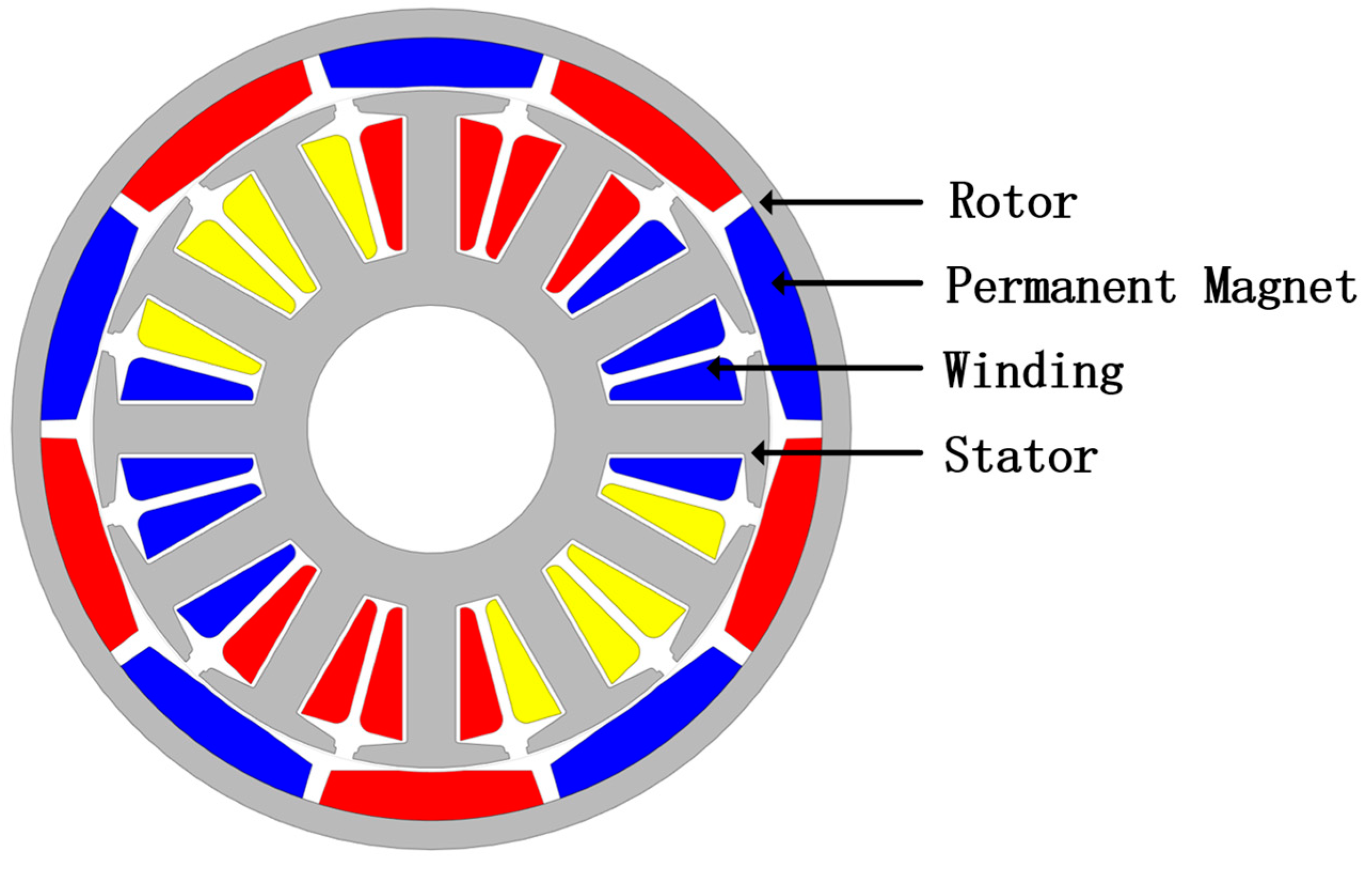
The motor studied in this paper is a 12-slot 10-pole fractional-slot external rotor permanent magnet synchronous motor designed for fan drive applications. Key parameters of the motor are listed in Table 1. This paper employs a two-dimensional finite element method to model and analyze the permanent magnet motor, based on the motor’s structural parameters and electromagnetic design scheme, a two-dimensional cross-sectional geometric model of the motor was established in finite element software. During modeling, the stator, coils, permanent magnets, and rotor were constructed sequentially from the inside out. Based on the pole–slot configuration relationship of the motor, the installation positions of the permanent magnets and the distribution angles of the stator slots were precisely positioned. The two-dimensional geometric model of the motor is shown in Figure 1.

3. Analysis of Radial Electromagnetic Force in Motors

3.1. Definition of Order Terminology

To avoid ambiguity, this paper adopts the following definitions for the term ‘order’.
Mechanical Order: Refers to multiples of the rotor’s mechanical rotational frequency. Commonly used in noise and vibration analysis. For your motor running at 2400 rpm, the mechanical rotational frequency is 40 Hz.
Electrical Order: Refers to multiples of the fundamental current frequency. Your motor has 10 poles (5 pole pairs); therefore, the electrical frequency = Mechanical frequency × 5 = 200 Hz.

3.2. Analytical Calculation of Radial Electromagnetic Force in Motors

According to Maxwell’s stress tensor method, under the assumption that the tangential component of the air-gap magnetic flux density is neglected [23], the radial electromagnetic force waves generated by the harmonic magnetic fields of the stator and rotor are expressed as:
p r = 1 2 μ 0 ( B r 2 B t 2 ) B r 2 2 μ 0 = 1 2 μ 0 ( B R B S ) 2
In the formula: p r represents the radial electromagnetic force density; B r represents the radial magnetic flux density; B t represents the tangential magnetic flux density; B R and B S represent the radial components of the rotor permanent magnet magnetic field and the armature reaction magnetic field in the air gap, respectively; μ 0 represents the vacuum permeability.
When the rotor permanent magnets are divided into n segments, with each segment offset by the same angle circumferentially, γ , the magnetomotive force generated by the i - t h permanent magnet segment can be expressed as:
F R = μ = 1 F μ cos μ ( p θ p γ ( i 1 ) ω t )
The magnetomotive force produced by stator armature reaction can be expressed as:
F S = ν = 1 F ν cos ( ν p θ ω t + φ ν )
In the formula: F μ and F ν represent the harmonic amplitudes of the magnetomotive force of the permanent magnet and the armature reaction, respectively; μ represents the spatial order of the permanent magnet magnetomotive force; ν represents the spatial order of the armature reaction magnetomotive force; θ represents the rotor mechanical angle; p represents the number of pole pairs in the motor; t represents time; φ ν represents phase angles.
For the sake of simplified analysis, neglecting the influence of skew on the air-gap permeance, the air-gap permeance function per unit area is expressed as:
λ = λ 0 + k = 1 λ k cos ( k Z θ )
In the formula: λ 0 and λ k represent the average permeance and the stator slot-modulated permeance, respectively; k represents the harmonic order of the air-gap permeance; Z represents the number of stator slots.
Therefore, considering the slotting effect, the rotor air-gap magnetic flux density can be obtained by multiplying the rotor air-gap magnetomotive force by the air-gap permeance expression.
B R = μ = 1 F μ λ 0 cos μ ( p θ p γ ( i 1 ) ω t ) + μ = 1 k = 1 F μ λ 0 2 cos μ ( p θ ± k Z θ p γ ( i 1 ) ω t )
Similarly, the air-gap magnetic flux density due to armature reaction can be expressed as:
B S = ν = p F ν λ 0 cos ( ν p θ ω t + φ ν ) + ν = p k = 1 F ν λ k 2 cos ( ν p θ ± k Z θ ω t + φ ν )
By superposing and averaging the electromagnetic force wave density of each segment, the average value of the radial electromagnetic force wave density after rotor segment skewing can be obtained. Based on Equations (1), (5) and (6), the average value of the radial electromagnetic force wave after rotor segment skewing can be derived:
F r e q = 1 n sin ( n g p γ / 2 ) sin ( n p γ / 2 ) r = 1 F r cos ( r θ n 1 2 g p γ μ ω t + φ r )
In the formula: sin ( n g p γ / 2 ) / sin ( n p γ / 2 ) = K s k , K s k is defined as the skew factor; r , ω and F r represent the order, mechanical angular frequency and amplitude of the radial electromagnetic force wave, respectively; φ r represents the phase angle; g = μ 1 + μ 2 . From Equation (7), it can be observed that when g p γ 2 π , 4 π , 6 π , , the electromagnetic force wave induced by specific harmonic orders can be attenuated.
For the 10-pole 12-slot fractional-slot permanent magnet synchronous motor studied in this paper, the number of pole pairs is 5, the number of slots is 12, and the number of phases is 3. The number of slots per pole per phase is expressed as follows:
q = Z 2 m p = c d = 2 5
When c / d is in its simplest fractional form, where q is a fraction, d is an odd number, the harmonic pole pairs of the resultant stator magnetomotive force are expressed as follows:
ν = ( 6 k + 1 ) p d
In the formula: k = 0 , ± 1 , ± 2 ,
The harmonic pole pairs of the magnetomotive force generated by the rotor magnetic field are given by:
μ = ( 2 u + 1 ) p
In the formula: u = 0 , 1 , 2 ,
From the above analysis, it is evident that the magnetomotive forces of the stator and rotor, both individually and through their interaction, generate abundant harmonic components in the air-gap magnetic flux density. This, in turn, leads to complex radial electromagnetic forces. Table 2 lists the harmonic orders ν and μ of the stator and rotor magnetic fields, as well as the space order and time order (expressed as space order/time order) of the radial electromagnetic forces resulting from their interaction, where the fundamental current frequency is f = 200   Hz .

3.3. Finite Element Analysis of Radial Electromagnetic Force in the Motor

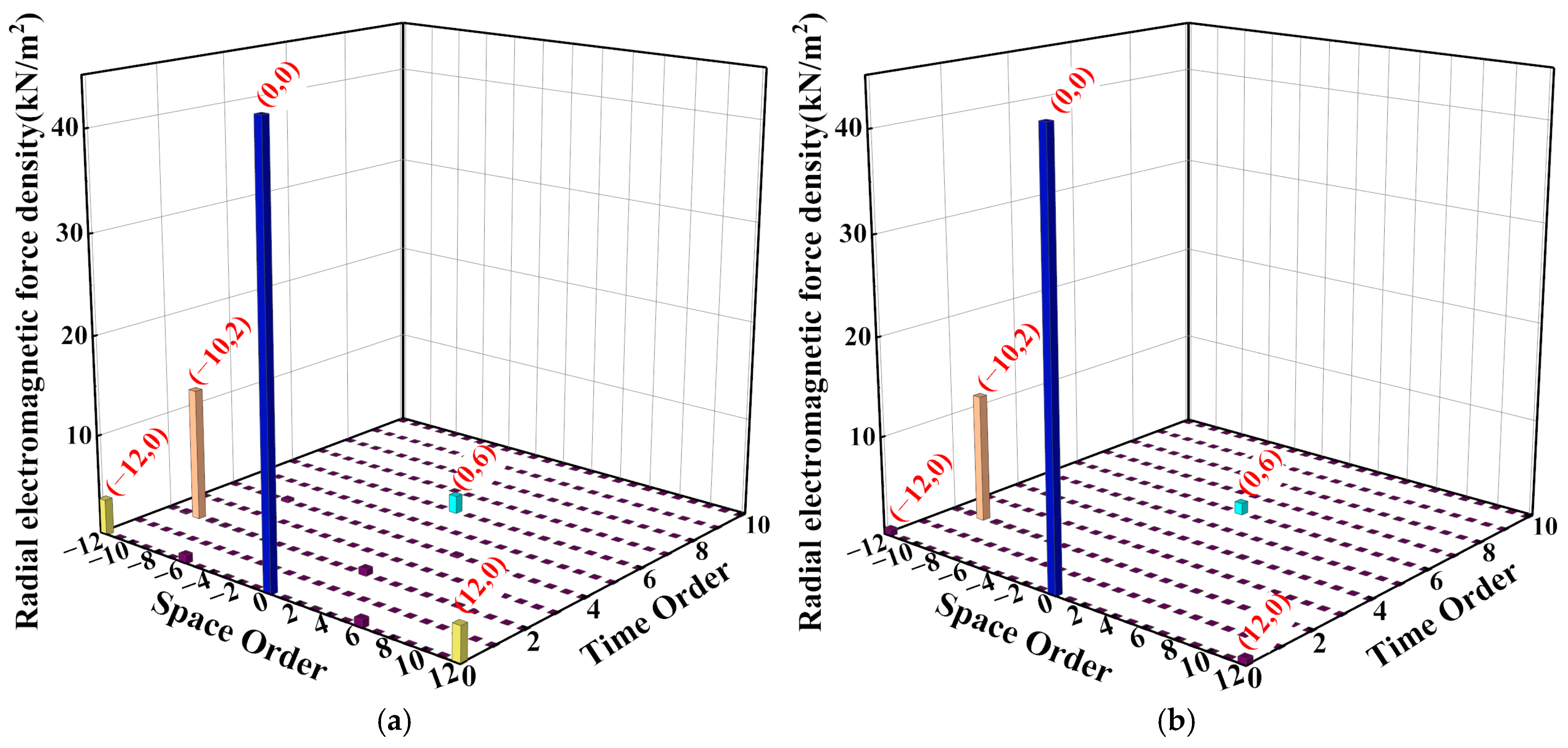
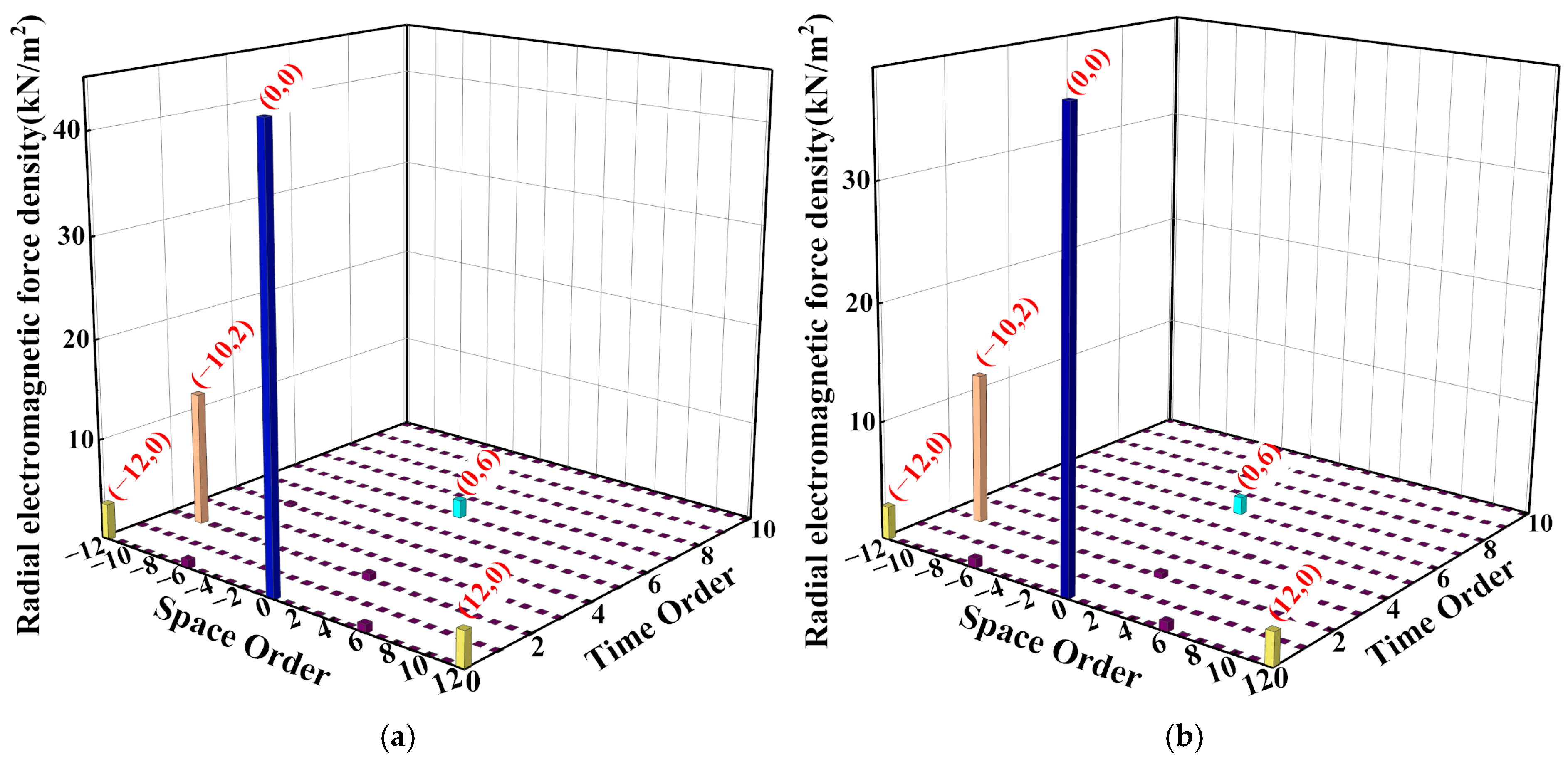
The two-dimensional Fast Fourier Transform (FFT) results of the radial electromagnetic force density in the low-order, low-frequency harmonic range under both no-load and rated-load conditions are shown in Figure 2. It can be observed that when the motor speed is 2400 rpm, the corresponding electrical frequency is f = 200   Hz , the radial electromagnetic force density is relatively high at the following five orders: ( 0 , 0 f ) , ( 12 , 0 f ) , ( 12 , 0 f ) , ( 10 , 2 f ) , and ( 0 , 6 f ) . The ( 0 , 0 f ) order corresponds to the DC component of the radial electromagnetic force [24], which does not cause structural vibration in the motor and thus has no impact on motor vibration and noise. Since the vibration amplitude of the motor is proportional to the amplitude of the electromagnetic force density and approximately inversely proportional to the fourth power of the spatial order of the electromagnetic force [25], the radial electromagnetic forces of orders ( 0 , 6 f ) and ( 10 , 2 f ) require particular attention.
Although this paper does not include a detailed structural modal analysis, according to motor vibration theory, the excitation effect of radial electromagnetic forces on the structure depends not only on their amplitude but also closely on the spatial order and frequency of the force. For small- and medium-sized motors, electromagnetic force waves with low spatial orders are more likely to induce significant vibration responses because the structure exhibits lower stiffness against low-order forces. Therefore, it is reasonable for this paper to focus on low-order electromagnetic forces. Furthermore, through the noise experiments in Section 4, it was found that the prominent 30th-order component (corresponding to six times the fundamental electrical frequency) in the noise spectrum corresponds exactly in frequency to the dominant 6th-order radial force identified in the electromagnetic force analysis. This directly validates that this specific order of electromagnetic force is the primary source of the noise. The subsequent optimization design was also carried out targeting this dominant order, thereby achieving effective noise suppression.

4. Experiment

To investigate the mechanism of electromagnetic noise generation in the motor, both loaded and no-load noise experiments were conducted. It should be noted that the experiments described in this section are aimed at identifying the dominant noise orders and validating the simulation model, rather than optimizing design parameters. Therefore, standard noise test procedures were followed, and no statistical design of experiments was applied here. The BBD method will be used later in Section 5.4 for the design of simulation experiments in the response surface modeling stage.

4.1. Motor Load Experiment

The loaded experiment was conducted in a semi-anechoic chamber in accordance with GB/T 2888-2008, “Methods of noise measurement for fans and blowers”. During the experiment, the motor drove a six-blade impeller mounted on its shaft and was assembled with the original fan casing, forming a complete fan unit. The entire assembly was fixed to the laboratory wall via rigid brackets to simulate actual operating conditions. Prior to testing, the measurement system was calibrated using a sound level calibrator, and the background noise level was more than 10 dB below the measured noise level, satisfying the requirements of the standard. The experimental procedures were established according to the specifications of GB/T 2888 to ensure comparability and repeatability of the results. Each set of experiments was repeated three times, and the average value was taken as the final result.
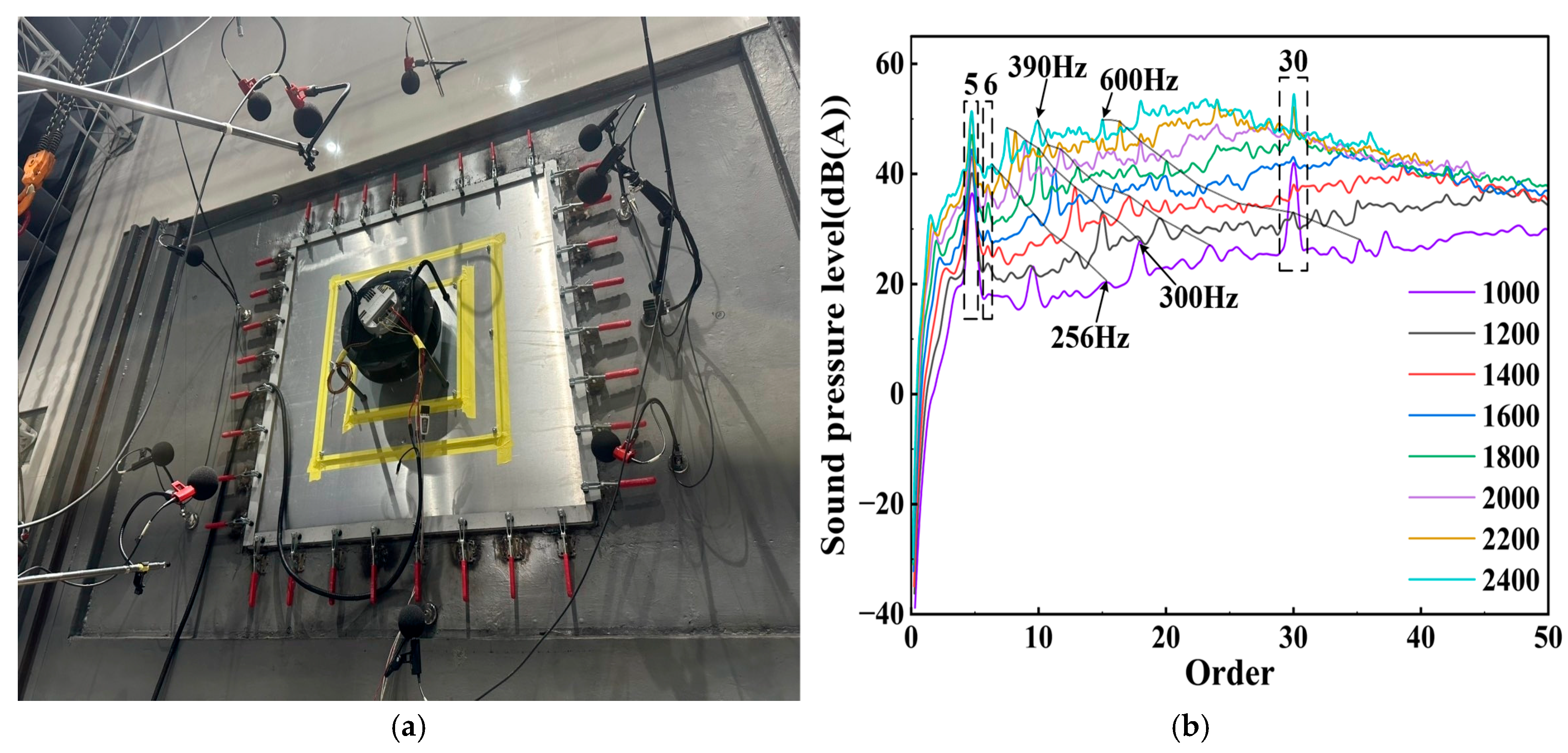
Noise experiments were conducted on the motor equipped with a six-blade impeller under rated load conditions. The on-site noise test under motor load conditions is shown in Figure 3a, and the experimental results of the noise frequency order analysis are presented in Figure 3b. It can be observed from Figure 3b that the noise is determined by both the excitation source and structural resonance. (1) Structural resonance noise: as shown in Figure 3b, there are four distinct fixed-frequency structural modes. These structural resonance noises will be addressed through the optimization of the mechanical structures of the stator and rotor.
(2) Order noise: the 5th-order noise is electromagnetic noise caused by mechanical eccentricity in the motor structure after impeller installation. This order of noise will be suppressed by improving the manufacturing process in the future. The noise component at the 6th mechanical order is aerodynamic noise generated by the blade passing frequency of the six-blade impeller. The noise component at the 30th mechanical order results from the superposition of the motor’s 6th electrical order radial electromagnetic force and the 5th harmonic of the impeller at the same order. The ( 10 , 2 f ) electromagnetic force identified in the previous theoretical analysis and simulation of electromagnetic forces did not induce significant noise at the corresponding frequency.

4.2. Motor No-Load Experiment

The no-load experiment was conducted in a semi-anechoic chamber in accordance with GB 10069.3, “Measurement of airborne noise emitted by rotating electrical motors and the noise limits”, to measure the noise of the motor alone. During the experiment, the impeller and casing were removed, and only the motor itself was operating. The motor was placed on vibration isolation pads to isolate external vibrations. Prior to testing, the measurement system was calibrated using a sound level calibrator, and the background noise level was more than 10 dB below the measured noise level, satisfying the requirements of the standard. The experimental procedures were established according to the specifications of GB 10069.3 to ensure comparability and repeatability of the results. Each set of experiments was repeated three times, and the average value was taken as the final result.
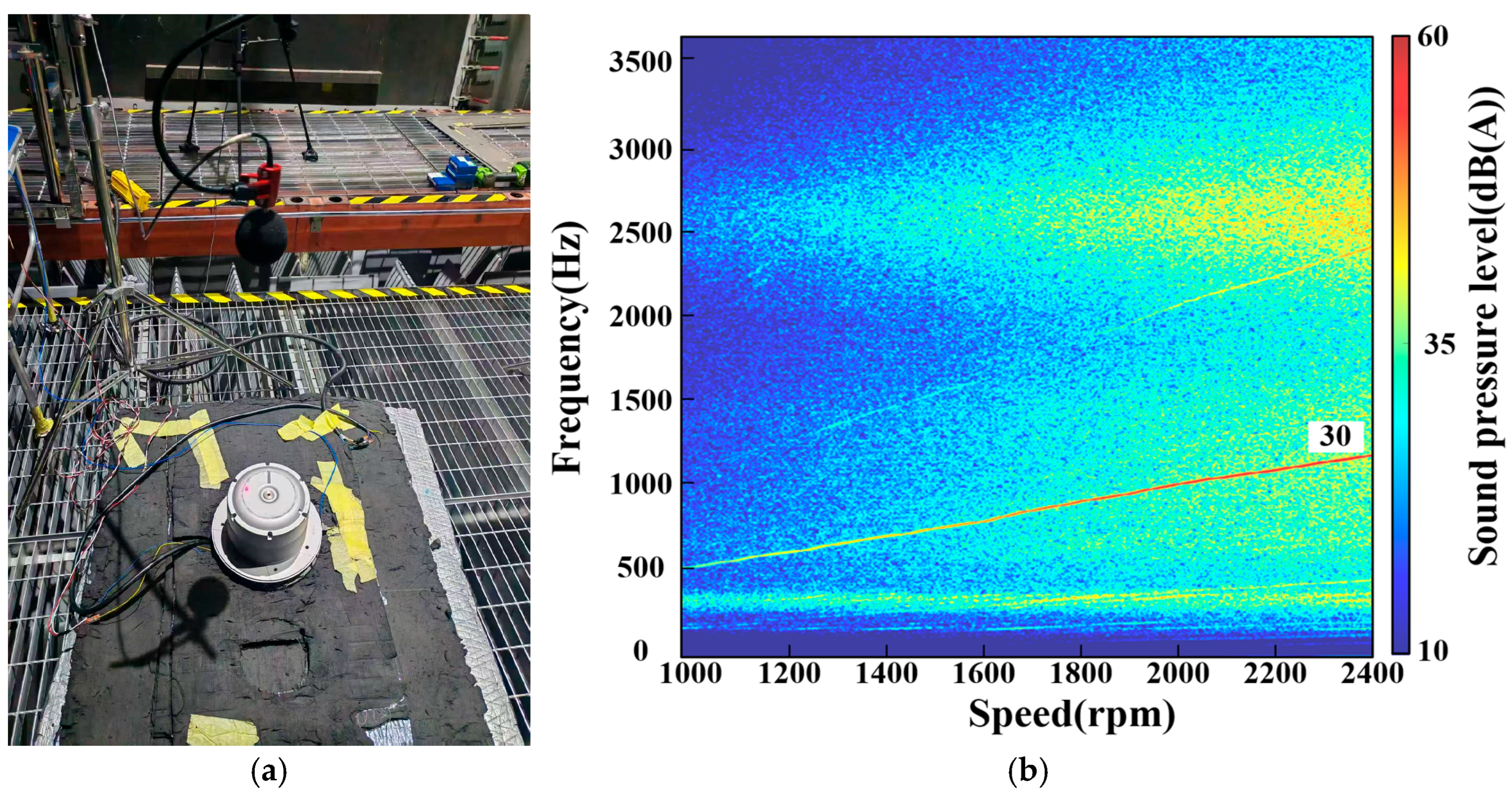
A no-load noise experiment was conducted on the motor without an impeller. The on-site noise test under no-load conditions is shown in Figure 4a, and the experimental results are presented in Figure 4b. From Figure 4b, it is clearly evident that the radial electromagnetic force of the motor exhibits a distinct peak at the 30th mechanical order, which corresponds to 6 times the fundamental electrical frequency. This component will hereafter be referred to as the ‘6th electrical order radial electromagnetic force’ when discussing its electromagnetic origin. The 6th electrical order radial electromagnetic force of the motor is the primary target for electromagnetic optimization and suppression.

4.3. Discussion of Experimental Results

By comparing the noise spectra from the loaded and no-load experiments, it was found that the amplitude of the 30th mechanical order noise is significantly higher under loaded conditions, which originates from the superposition of the 6th-order radial force and the blade passing frequency, whereas under no-load conditions, this order is contributed solely by the electromagnetic force. The 30th mechanical order noise persists under both operating conditions and coincides in frequency with the 6th-order radial force identified in the electromagnetic force analysis, validating the dominant role of electromagnetic force in noise generation. The no-load experiment eliminated aerodynamic and structural noise interference, and the prominent peak at the 30th order (six times the fundamental electrical frequency) in its spectrum directly corresponds to the 6th-order radial force. This confirms that this order is the primary source of electromagnetic noise, providing a clear causal basis for subsequent optimization.
It should be noted that the noise measured under loaded conditions (Figure 3b) represents a superposition of electromagnetic, aerodynamic, and structural-borne components. By comparing the loaded results with the no-load results (Figure 4b), we were able to qualitatively distinguish the sources: the 6th-order component, present only under loaded conditions, is primarily attributed to aerodynamic effects of the six-blade impeller; whereas the 30th-order component, which persists in both loaded and no-load tests, is confirmed as the dominant electromagnetic noise order. Although this comparative approach helps identify the primary electromagnetic source, it does not fully quantify the contribution of electromagnetic excitation to the overall SPL under actual operating conditions.

5. Multi-Objective Optimization of Motor Structural Parameters

5.1. Optimization Objectives

While ensuring the motor maintains good output performance, suppress the electromagnetic noise. This paper takes reducing the 6th-order radial electromagnetic force (which manifests as the 30th mechanical order noise) as the optimization objective to achieve effective suppression of the motor’s electromagnetic noise F r e q 6 , torque ripple V T , and average torque T a v g of the motor as the optimization objectives, and sets the objectives as minimizing the 6th-order radial electromagnetic force and torque ripple while maximizing the average torque. For the coherence of subsequent paper writing, let f 1 represent F r e q 6 , f 2 represent T a v g , and f 3 represent V T .
The expression for motor torque ripple is commonly expressed as:
V T = T max T min T a v g × 100 %
In the formula: T max represents the maximum output torque of the motor; T min represents the minimum output torque of the motor; and T a v g represents the average output torque of the motor.

5.2. Design Variables

In the study of electromagnetic noise optimization for motors, modifying the air-gap magnetic field distribution serves as an effective technical approach to suppress electromagnetic excitation sources. Usually, optimization on the rotor side can directly modify the air-gap flux density waveform, but it is prone to introducing uneven mass distribution in the rotor, leading to rotor dynamic imbalance, which in turn causes additional mechanical vibration and noise. Therefore, this paper prioritizes symmetric structure optimization on the stator side to avoid affecting the rotor’s mechanical balance. By opening double auxiliary slots symmetrically along the centerline of the stator teeth, this symmetric structure does not introduce additional harmonics, nor does it affect the rotor dynamic balance, and it can effectively improve the air-gap flux density waveform [7,8,9]. Additionally, as the primary excitation source of electromagnetic noise, the amplitude of the radial electromagnetic force can be effectively suppressed by appropriately adjusting the geometric parameters of the stator slot openings. This directly reduces the level of electromagnetic noise [10,11]. Meanwhile, the magnet pole-shaping technique can significantly reduce the harmonic amplitude of the radial electromagnetic force waves by smoothing the distribution of the air-gap flux density waveform. This approach lowers the vibrational excitation intensity directly at its source, thereby achieving indirect optimization of the motor’s electromagnetic noise [26,27].
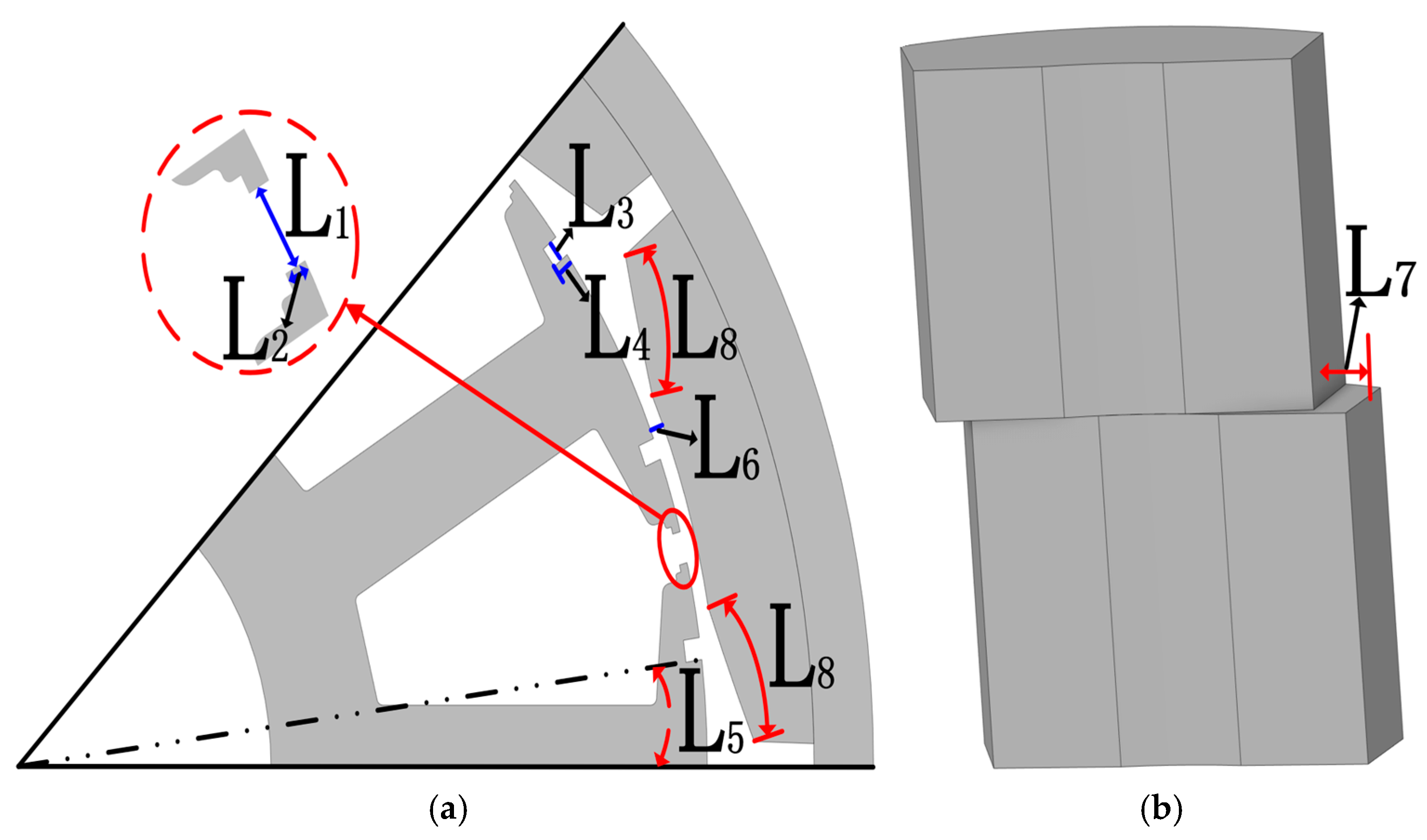
Based on the above analysis, this paper selects the following eight key parameters as optimization variables: stator slot width L1, stator slot height L2, auxiliary slot width L3, auxiliary slot height L4, auxiliary slot angle L5, air-gap length L6, skew angle L7, and pole arc length L8. The geometric positions of each optimization parameter in the motor model are annotated in Figure 5, and the corresponding parameter constraint ranges are listed in Table 3.

5.3. Sensitivity Analysis

Weight coefficient is applied to evaluate each variable, comprehensively considering three optimization goals. A comprehensive sensitivity index G ( x i ) [28] is introduced and can be described as:
G ( x i ) = λ 1 S f 1 + λ 2 S f 2 + λ 3 S f 3
In the formula: S f 1 , S f 2 , S f 3 represent the sensitivity of the 6th electrical order radial electromagnetic force, average torque and torque ripple, respectively; λ 1 , λ 2 , λ 3 represent the weight of the 6th electrical order radial electromagnetic force, average torque and torque ripple, respectively, and satisfy λ 1 + λ 2 + λ 3 = 1 . The weight factors can be selected reasonably based on the different degrees of demand for the optimization objectives. In the process of multi-objective optimization, the selection of weight factors is very important [29]. However, there is no single criterion to determine the values of weight factors. The primary objective of this study is to suppress the electromagnetic noise of the motor while maintaining good output performance. Therefore, the value of λ 1 is selected as 0.6, which is higher than the others. Also, the value of λ 2 and λ 3 are selected to be 0.2, which are less required.
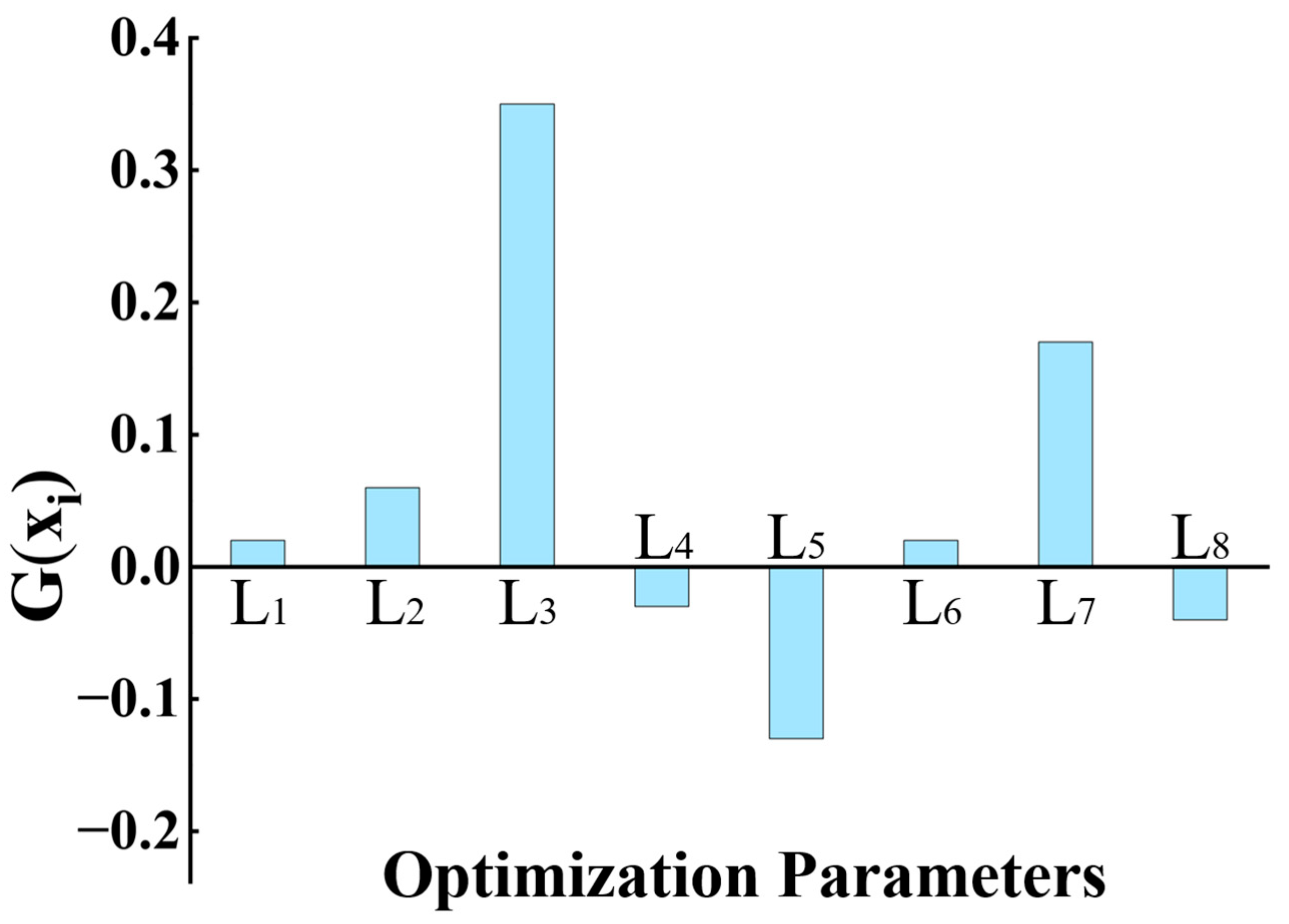
To clearly identify the importance of each variable, a histogram is used as shown in Figure 6. A positive sensitivity index indicates that the optimization objective will increase with an increase in the design variable, while a negative sensitivity index indicates that the optimization objective will decrease with a decrease in the design variable. Design variables with relatively high absolute values of sensitivity factors indicate that they have a greater influence on the optimization objective than other variables. According to Figure 6, compared with other variables, L3, L5, and L7 are significant design variables for optimization. It should be noted that this sensitivity analysis is a local sensitivity analysis and cannot be applied to the global space of the input design variables.

5.4. RSM-Based Genetic Algorithm Optimization

(1)
Establish BBD mathematical model
Response surface methodology (RSM) is an optimization strategy that integrates experimental design with mathematical modeling. This approach selects a limited number of sample points within a predefined design space for experimental design, constructing a surrogate model to approximate the actual response surface. Thereby, it reveals the intrinsic relationships between response objectives and design variables. The experimental design method employed in this study is the Box–Behnken Design (BBD) [8]. Compared to other experimental design methods, it requires fewer experimental runs under the same number of experimental factors while strictly constraining the factor levels within the design range. The BBD method assigns three levels to each optimization variable, encoding them as 0, 1, and −1, where 0 represents the center point, 1 the highest value, and −1 the lowest value, as shown in Table 4.
According to the BBD principle, for a 3-factor, 3-level configuration, the number of required experiments is 13, which is significantly fewer than that of a full factorial design and does not include additional residual points, thereby reducing the time required for optimization design. The response values for the 6th-order radial electromagnetic force F r e q 6 , average torque T a v g , and torque ripple V T obtained from the experimental design are presented in Table 5.
(2)
Response Surface Analysis
Based on the optimization variables and the corresponding response values, a fitting model is established. The fitting polynomial for the objective function and the optimization variables can be expressed as:
Y = β 0 + i = 1 k β i X i + i k β i i X i 2 + i = 1 k 1 j = 1 k β i j X i X j + ε
In the formula: Y represents the response value, β 0 , β i , β j represent the regression coefficient, β i i represents the coefficient of the square term of the variable, β i j represents the coefficient of the product term of different variables, X i and X j represent design variables, ε represents the fitting residual, and k = 1 , 2 , 3 , .
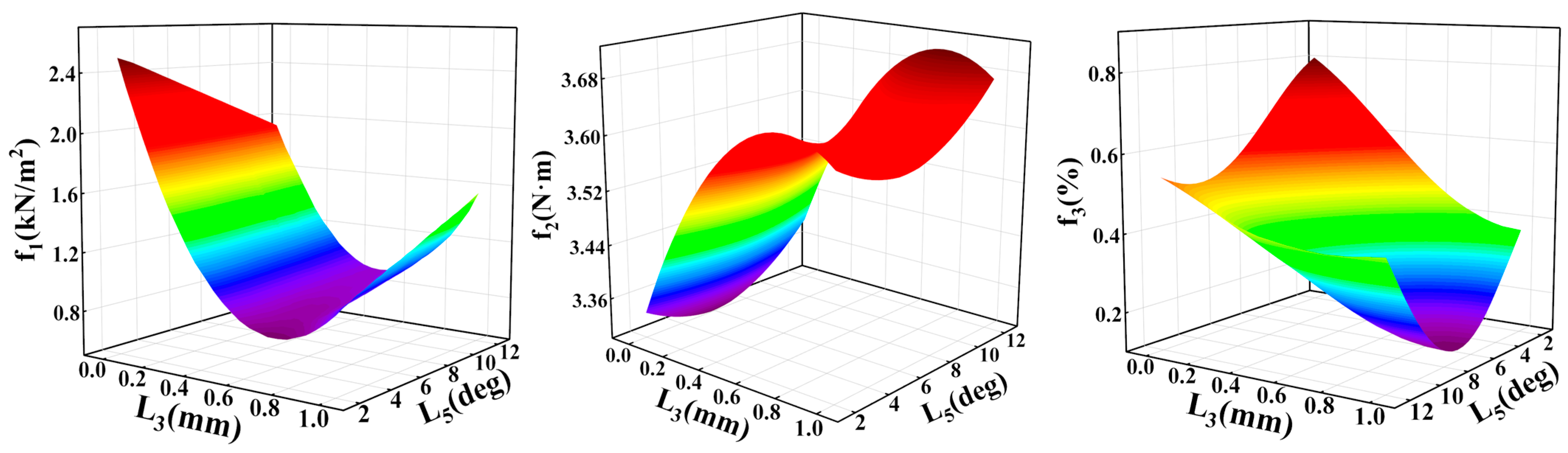
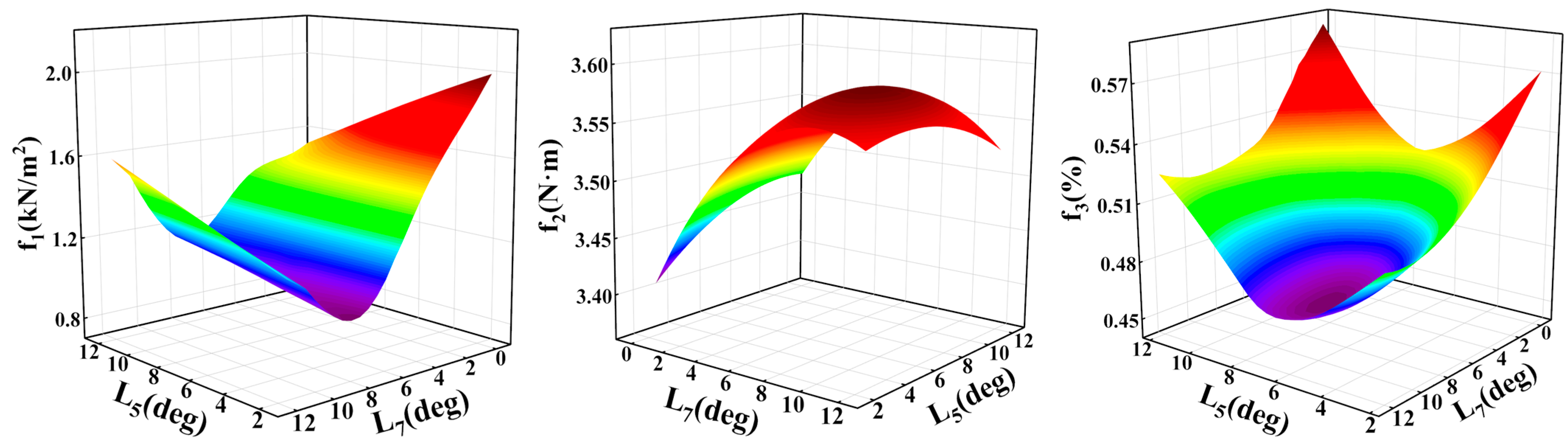
The response surfaces of the 6th-order radial electromagnetic force, average torque, and torque ripple versus the optimization parameters L3 and L5 are shown in Figure 7. From the three response surfaces in Figure 7, it can be observed that the 6th-order radial electromagnetic force first decreases and then increases as L3 increases; the average torque increases with L3 and is relatively less affected by L5; torque ripple decreases as L3 increases and also shows a decreasing trend with the increase in L5. Thus, when L3 ranges between 0.2 and 0.8 mm and L5 ranges between 4 and 10 degrees, it yields significant electromagnetic noise optimization in motors.
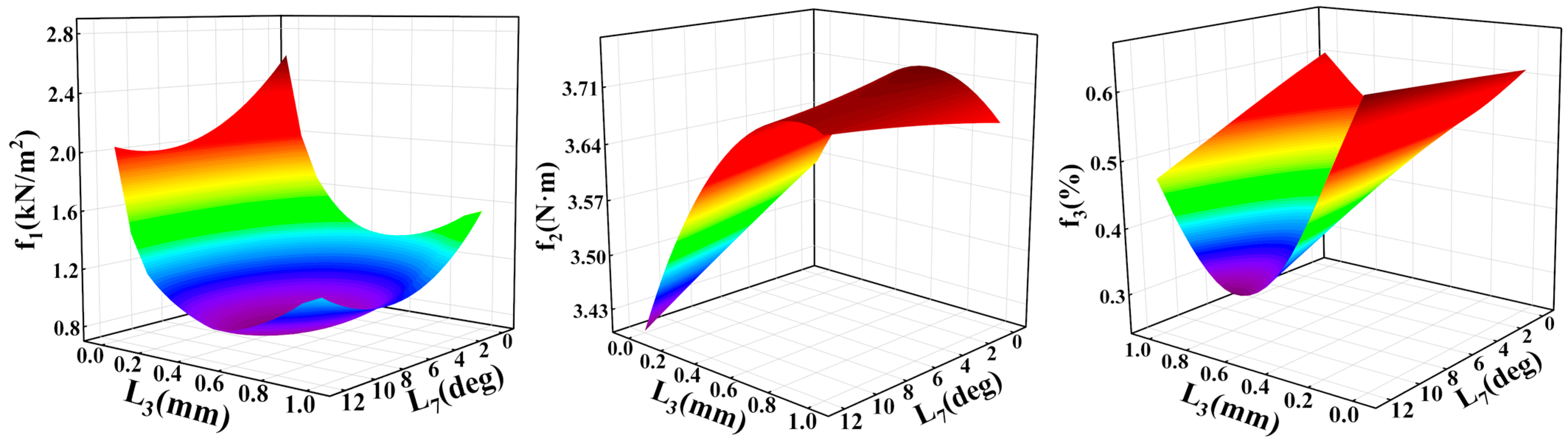
The response surfaces of the 6th-order radial electromagnetic force, average torque, and torque ripple versus the optimization parameters L3 and L7 are shown in Figure 8. From the three response surfaces in Figure 8, it can be observed that the 6th-order radial electromagnetic force shows a decreasing trend as L3 increases, while it first decreases and then increases with the rise in L7; the average torque increases with L3; the torque ripple first decreases and then increases as L3 increases, while it shows a decreasing trend with the increase in L7. Thus, when L3 ranges between 0.2 and 0.8 mm and L7 ranges between 8 and 12 degrees, it yields significant electromagnetic noise optimization in motors.
The response surfaces of the 6th-order radial electromagnetic force, average torque, and torque ripple versus the optimization parameters L5 and L7 are shown in Figure 9. From the three response surfaces in Figure 9, it can be observed that the 6th-order radial electromagnetic force decreases with the increase in L5 and also exhibits a decreasing trend with the rise in L7; the average torque exhibits non-monotonic characteristics with changes in L5 and L7, being higher near the intermediate values of both parameters and lower at the boundaries; torque ripple exhibits a decreasing trend with the increase in both L5 and L7. Thus, when L5 ranges between 2 and 6 degrees and L7 ranges between 4 and 10 degrees, it yields significant electromagnetic noise optimization in motors.
Using the constructed response surface model, the optimization objectives were fitted, and the fitting equations of the optimization variables with respect to the optimization objectives were obtained.
The fitting equation for f 1 is:
f 1 = 1.4 0.22 L 3 + 0.15 L 5 0.39 L 7 0.1 L 3 L 5 + 0.09 L 3 L 7 + 0.1 L 5 L 7 + 0.05 L 3 2 + 0.04 L 5 2 + 0.06 L 7 2
The fitting equation for f 2 is:
f 2 = 3.67 0.01 L 3 + 0.01 L 5 0.1 L 7 0.02 L 3 L 5 + 0.05 L 3 L 7 0.03 L 5 L 7 0.02 L 3 2 + 0.02 L 5 2 0.03 L 7 2
The fitting equation for f 3 is:
f 3 = 0.6 + 0.01 L 3 0.07 L 5 0.05 L 7 + 0.06 L 3 L 5 + 0.2 L 3 L 7 0.08 L 5 L 7 + 0.04 L 3 2 0.03 L 5 2 0.05 L 7 2
To evaluate the goodness-of-fit of the established response surface, the evaluation metric is related to the coefficient of determination R 2 [30]. The closer the coefficient of determination R 2 is to 1, the higher the accuracy of the fitted response surface. The R 2 values of the response surface models for the three optimization objectives are all greater than 0.9, indicating a good fit. Generally, when the Root Mean Square Error (RMSE) of the model is less than 1%, it indicates that the model is sufficiently accurate and the prediction error is negligible [31]. The RMSE of all polynomials (14)–(16) is less than 1%, all meeting the accuracy requirements.
The formulas for R 2 and RMSE are expressed as:
R 2 = 1 i = 1 n ( y i y ^ i ) 2 i = 1 n ( y i y ¯ i ) 2
R M S E = 1 n i = 1 n ( y i y ^ i ) 2
In the formula: y i represents the value of the output parameter at the i-th sampling point; y ¯ i represents the arithmetic mean of the y i values; y ^ i represents the value given by the regression model at the i-th sampling point; n represents the number of sampling points.
(3)
Genetic Algorithm Optimization
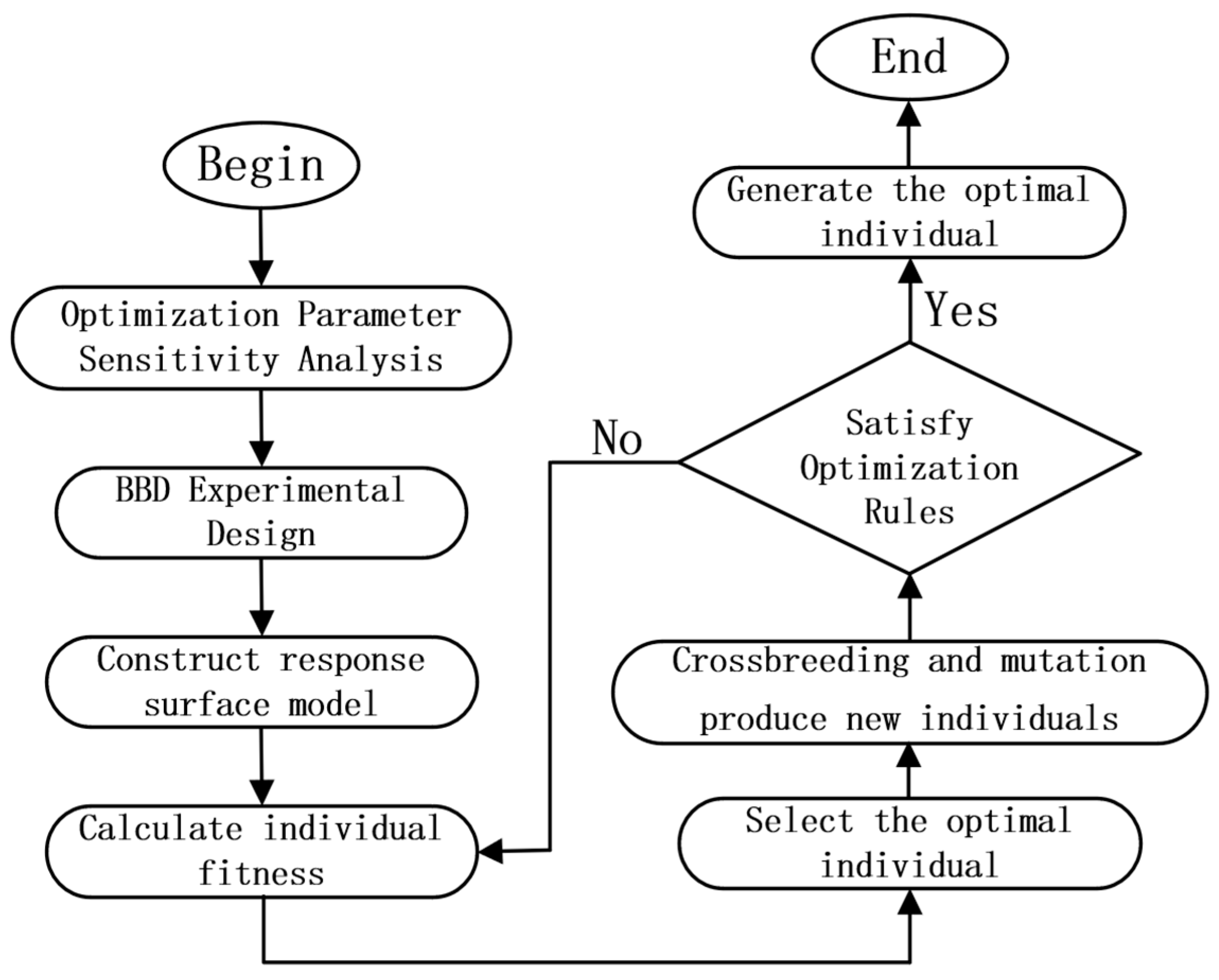
This study employs the Non-dominated Sorting Genetic Algorithm II (NSGA-II) to optimize the response surface model [19]. NSGA-II is a widely used multi-objective evolutionary algorithm characterized by fast non-dominated sorting, an elitist preservation strategy, and the advantage of not requiring pre-specified weights. The algorithm flowchart is shown in Figure 10. In the optimization process, minimizing the 6th-order radial electromagnetic force and torque ripple, as well as maximizing the average torque, are set as the optimization objectives. The value ranges of each design variable, as shown in Table 3, are directly imposed on the population as boundary constraints. The algorithm parameters are set as follows: the initial population size is 100, randomly distributed within the optimization intervals; the maximum number of generations is 100; the crossover probability is 0.8; the mutation probability is 0.2. The termination condition is reaching the maximum number of generations or the hypervolume indicator of the Pareto front changing by less than 0.1% for 20 consecutive generations.
During the optimization process, the change in the hypervolume indicator was monitored, and the population stabilized after about 85 generations, indicating effective convergence of the algorithm. In this optimization process, the genetic algorithm evaluated the objective function a total of 100 × 100 = 10,000 times on the response surface model. By replacing finite element simulations with a high-precision response surface model, the computational cost was significantly reduced while ensuring calculation accuracy, shortening the optimization time from an estimated several weeks to a few hours. After the optimization, three typical candidate schemes were selected, as shown in Table 6.
It should be noted that the original motor design does not include auxiliary slots on the stator teeth. Therefore, the parameters L3 and L5 are not applicable to the original motor and are denoted by “/” in Table 6. The skew angle L7 of the original motor is 3 deg, as listed in the table. This baseline information allows readers to fully understand the geometric changes introduced by the optimization.
Compared to the other two options, option one exhibits the lowest amplitude of radial electromagnetic force and the best electromagnetic noise performance while maintaining favorable motor output performance; furthermore, the motor studied in this paper is intended for industrial drive applications, where demands for performance, vibration, and noise are relatively high. After comprehensive consideration of all optimization objectives, option one is ultimately selected as the optimal solution.

6. Comparative Analysis of Motor Performance Before and After Optimization

6.1. Analysis of Motor Output Torque

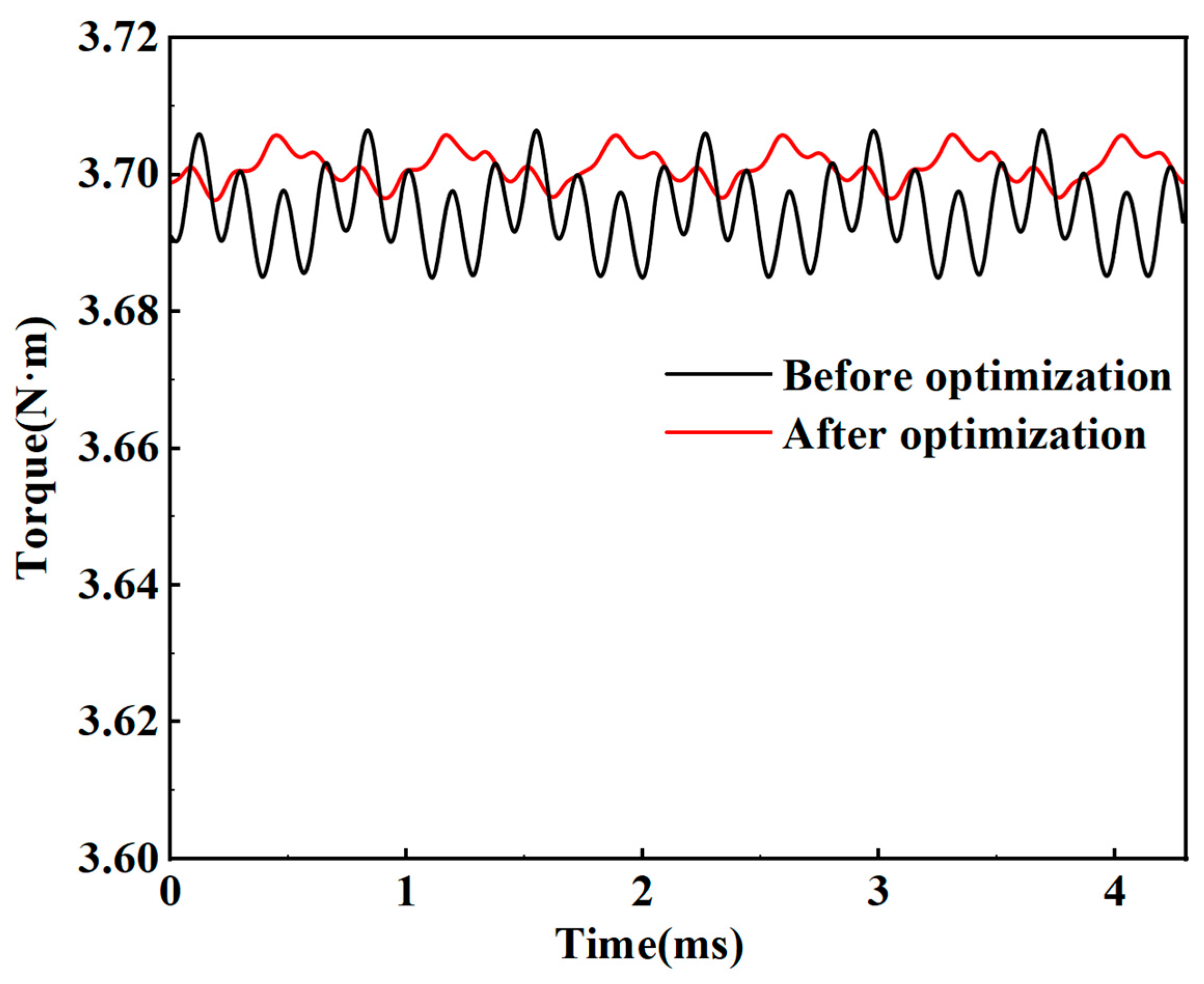
A two-dimensional transient time-stepping finite element model was established for both the initial and optimized motor designs. Torque simulation was performed under rated load operating conditions. A comparison of the output torque under loaded conditions before and after optimization is shown in Figure 11; it can be observed that the torque curve before optimization exhibits significant fluctuations. After optimization, while maintaining the output torque level, the torque ripple is reduced from 0.7% to 0.247%, representing a decrease of 65%.

6.2. Analysis of Radial Electromagnetic Force in the Motor

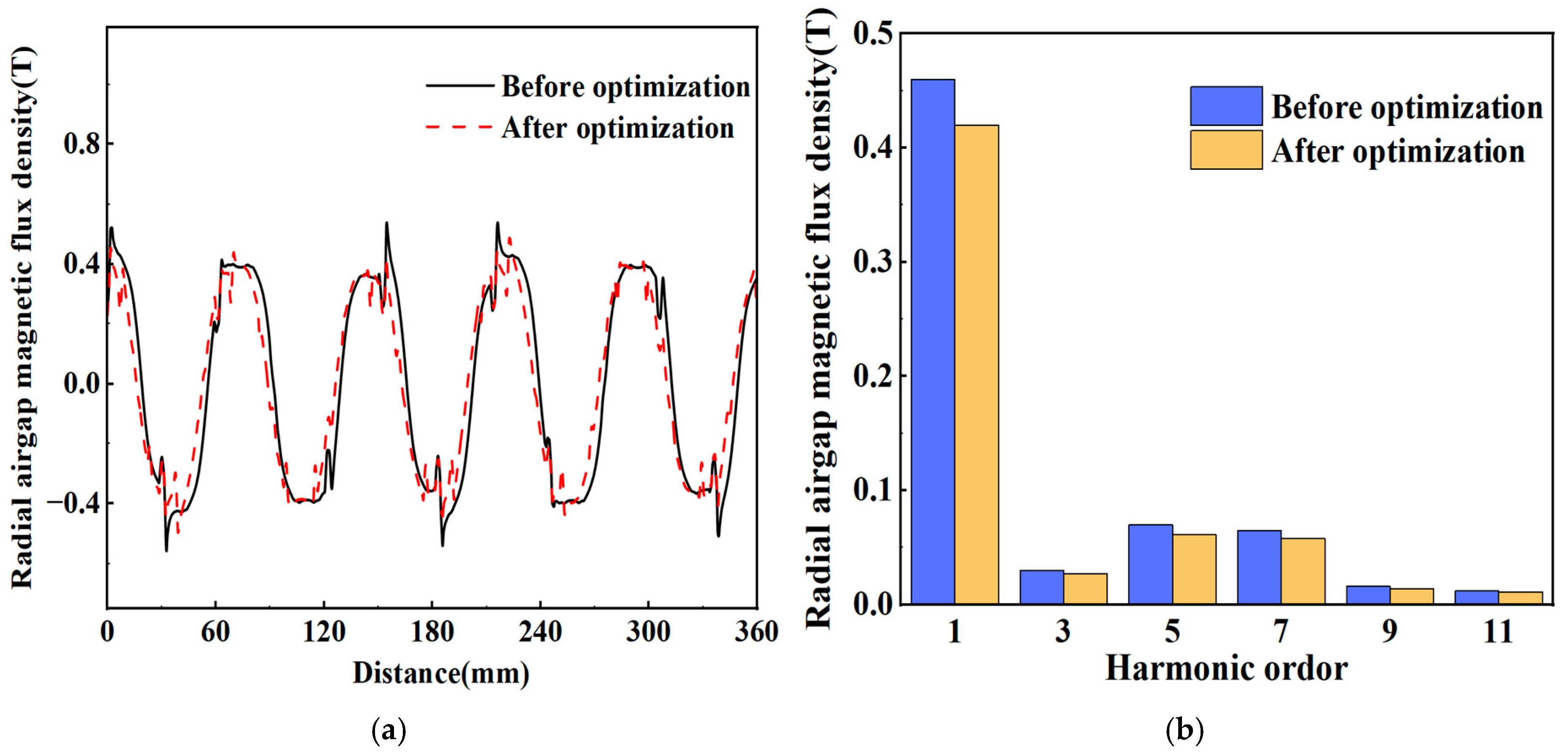
A two-dimensional transient time-stepping finite element model was established for both the initial and optimized motor designs, and electromagnetic simulation under rated load operating conditions was performed. The radial air-gap flux density curves and their harmonic decomposition under loaded conditions before and after optimization are shown in Figure 12. Figure 12a shows that, before the motor structure was optimized, the radial air-gap flux density exhibited noticeable waveform distortion and significant fluctuations. After multi-objective optimization, the distortion in the originally problematic regions is reduced, effectively improving the sinusoidal nature of the waveform. From Figure 12b, it can be observed that after the multi-objective optimization of the motor, the contents of the 1st, 3rd, 5th, and 7th harmonics in the air-gap flux density are significantly reduced, with calculated decreases of 8.7%, 6.4%, 12.5%, and 10.7%, respectively. According to Equation (1), the radial electromagnetic force density of the motor is proportional to the square of the radial air-gap flux density. When the harmonic content of the radial air-gap flux density is reduced, the radial electromagnetic force density of the motor will consequently decrease.
The two-dimensional FFT decomposition plots of the radial electromagnetic force density before and after multi-objective optimization under loaded motor conditions are shown in Figure 13. Figure 13 shows that, after multi-objective optimization, the radial electromagnetic force density at the ( 0 , 6 f ) harmonic order is reduced by 16.4% compared with the pre-optimization state, while the force densities at other harmonic orders also exhibit varying degrees of reduction. Therefore, the effectiveness of this method in suppressing the radial electromagnetic force density is validated.
Although a quantitative comparison with other algorithms is not performed due to computational constraints, the advantages of NSGA-II over traditional weighted-sum methods have been well documented in the literature [19,20]. By generating a Pareto front, NSGA-II provides a set of optimal trade-offs without requiring subjective weights, which is particularly beneficial for multi-objective problems like motor optimization.

6.3. Discussion on Noise Source Isolation

The simulation results in Section 6.1 and Section 6.2 demonstrate that the proposed optimization method effectively reduces the 6th-order radial electromagnetic force by 16.4% and significantly improves the harmonic characteristics of the air-gap flux density. This provides strong evidence that the electromagnetic excitation source itself has been suppressed.
However, it is important to acknowledge that the experimental validation under loaded conditions does not perfectly isolate this electromagnetic reduction from other noise sources. The measured SPL includes contributions from the impeller’s aerodynamic noise, structural resonances, and mechanical eccentricity. While the no-load test helped identify the electromagnetic order, a direct quantitative correlation between the simulated 16.4% reduction in electromagnetic force and a specific reduction in overall SPL remains challenging due to these confounding factors.
Future work will focus on more rigorous isolation methods, such as using the simulated electromagnetic forces as excitation inputs for a structural-acoustic finite element model of the motor housing, or employing advanced measurement techniques like near-field acoustic holography to spatially separate noise sources in experimental setups.

7. Conclusions

This study focuses on an external rotor permanent magnet synchronous motor used for fan drive applications. Based on the generation mechanism of electromagnetic vibration and noise in the motor, a multi-objective optimization method is proposed, which combines symmetrical auxiliary slots on the stator teeth with multidimensional parameter optimization of the stator–rotor structural topology. This approach is further integrated with response surface methodology and a multi-objective genetic algorithm to effectively mitigate the radial electromagnetic force. The main conclusions are summarized as follows:
  • Theoretical analysis of electromagnetic forces and experimental results from fan noise tests demonstrate that the electromagnetic noise of the motor is most significantly influenced at the 6th-order radial electromagnetic force.
  • Taking the 6th-order radial electromagnetic force, average torque, and torque ripple as optimization objectives, a comprehensive sensitivity analysis method was applied to evaluate the initially selected eight optimization parameters. Through this analysis, three parameters—auxiliary slot width L3, auxiliary slot angle L5, and skew angle L7—were selected as the optimization design variables.
  • The response surface surrogate model analysis method was employed to establish a response surface model relating these parameters to the three optimization objectives. The fitting accuracy of the response surface was evaluated by calculating the coefficient of determination R 2 . The calculation results show that the coefficients of determination for the 6th-order radial electromagnetic force, average torque, and torque ripple are 0.997, 0.994, and 0.993, respectively. Since all values exceed 0.9, the established response surface surrogate model demonstrates sufficient accuracy for multi-objective optimization calculations. The finite element simulation results indicate that, compared to the original design, the optimized motor exhibits a reduction in torque ripple by 65%, with the harmonic content of the radial air-gap flux density at the 1st, 3rd, 5th, and 7th orders decreasing by 8.7%, 6.4%, 12.5%, and 10.7%, respectively, and the 6th-order radial electromagnetic force reduced by 16.4%. Although the reduction in torque ripple appears relatively small in absolute terms, it, along with the decrease in the 6th-order radial electromagnetic force, serves as further evidence of improved electromagnetic performance. Based on the experimentally verified causal relationship between the 6th-order radial electromagnetic force and electromagnetic noise (Section 4.2), this reduction is expected to effectively suppress the motor’s electromagnetic noise. Experimental validation on a prototype will be conducted in future work.
Although this study successfully demonstrates a reduction in the primary electromagnetic force through simulation, the experimental verification was subject to the limitations of source superposition. Therefore, future research will aim to develop a more decoupled experimental validation framework, such as using a dummy impeller or conducting pure electromagnetic vibration tests on a dedicated test bench without aerodynamic loading, to quantitatively assess the contribution of electromagnetic optimization to overall noise reduction, and conduct experimental testing and verification on the optimized motor.

Author Contributions

Conceptualization, L.Y. and M.L.; methodology, K.L. and J.L.; validation, X.Y. and M.L.; formal analysis, H.H. and K.L.; investigation, L.Y.; resources, M.L. and J.L.; data curation, H.H. and X.Y.; writing—original draft preparation, L.Y.; writing—review and editing, L.Y. and M.L.; visualization, H.H. and X.Y.; supervision, M.L., K.L., and J.L.; project administration, M.L. All authors have read and agreed to the published version of the manuscript.

Funding

This research was jointly supported by the National Natural Science Foundation of China (Nos. 52378094; 52376005), project of Science and Technology Development of Henan Province of China (No. 252102320164), project of Science and Technology Development Program of Luoyang City (No. 2302035A).

Data Availability Statement

The original contributions presented in this study are included in the article. Further inquiries can be directed to the corresponding author.

Conflicts of Interest

Authors Jinglong Liu, Haijiang He and Xinxue Ye were employed by the company Zhejiang Yilida Ventilator Co., Ltd. The remaining authors declare that the research was conducted in the absence of any commercial or financial relationships that could be construed as a potential conflict of interest.

References

  1. Wu, Z.; Fan, Y.; Lee, C.H.T.; Gao, D.; Yu, K. Vibration Optimization of FSCW-IPM Motor Based on Iron-Core Modification for Electric Vehicles. IEEE Trans. Veh. Technol. 2020, 69, 14834–14845. [Google Scholar] [CrossRef]
  2. Zhang, W.; Shi, L.; Liu, K.; Li, L.; Jing, J. Optimization Analysis of Automotive Asymmetric Magnetic Pole Permanent Magnet Motor by Taguchi Method. Int. J. Rotating Mach. 2021, 2021, 6691574. [Google Scholar] [CrossRef]
  3. Kou, S.; Kou, Z.; Wu, J.; Wang, Y. Novel Magnetic Field Modeling Method for a Low-Speed, High-Torque External-Rotor Permanent-Magnet Synchronous Motor. Electronics 2023, 12, 5025. [Google Scholar] [CrossRef]
  4. Lei, K.; Li, H.; Li, S.; Xu, T. Design and Electromagnetic Performance Optimization of a MEMS Miniature Outer-Rotor Permanent Magnet Motor. Micromachines 2025, 16, 815. [Google Scholar] [CrossRef]
  5. Sohel, R.M.; Shen, Y.; Ji, R.; Liu, K. Design and Analysis of Low-Speed External Frame Motors with Halbach-Type and Olive-Shaped Magnet Structures. World Electr. Veh. J. 2025, 16, 350. [Google Scholar] [CrossRef]
  6. Yang, Z.; Li, W.; Gou, Y.; Cai, T. Research on Radial Force of Permanent Magnet Synchronous Motor Based on Maxwell. J. Electr. Eng. Technol. 2020, 15, 2601–2608. [Google Scholar] [CrossRef]
  7. Wang, Y.; Gao, H.; Wang, H.; Ma, W. NVH Optimization Analysis of Permanent Magnet Synchronous Motor by Rotor Slotting. Vehicles 2020, 2, 287–302. [Google Scholar] [CrossRef]
  8. Li, G.; Guo, X.; Yu, X.; Zhao, M.; Wang, S. Study on Multi-Parameter Collaborative Optimization of Motor-Pump Stator Slotting for Cogging Torque and Noise Suppression Mechanism. World Electr. Veh. J. 2026, 17, 39. [Google Scholar] [CrossRef]
  9. Guo, T.; Cao, Y.; Qian, Z.; Xia, J.; Kang, X.; Xia, G.; Yang, Y.; Zhang, W.; Wang, Y.; Wu, G. Influence of Magnetic Pole Stepping Combined with Auxiliary Stator Slots on the Stability of Dual-Rotor Disc Motors. Energies 2023, 16, 7512. [Google Scholar] [CrossRef]
  10. Luo, Y.; Lu, R. Hierarchical Optimization of Structural Parameters for Motor Electromagnetic Noise Suppression. Trans. China Electrotech. Soc. 2021, 36, 2957–2970. [Google Scholar]
  11. Chen, H.; Zhao, J.; Xiong, Y.; Luo, X.; Zhang, Q. An Improved Model for Five-Phase Induction Motor Based on Magnetic Noise Reduction Part I: Slot Opening Width. Processes 2022, 10, 1496. [Google Scholar] [CrossRef]
  12. Hong, J.; Wang, S.; Sun, Y.; Sun, X.; Cao, H. Piecewise Stagger Poles with Continuous Skew Edge for Vibration Reduction in Surface-Mounted PM Synchronous Machines. IEEE Trans. Ind. Electron. 2021, 68, 8498–8506. [Google Scholar] [CrossRef]
  13. Wang, S.; Hong, J.; Sun, Y.; Cao, H. Effect Comparison of Zigzag Skew PM Pole and Straight Skew Slot for Vibration Mitigation of PM Brush DC Motors. IEEE Trans. Ind. Electron. 2020, 67, 4752–4761. [Google Scholar] [CrossRef]
  14. Peng, C.; Wang, D.; Wang, B.; Li, J.; Wang, C.; Wang, X. Different Rotor Segmented Approaches for Electromagnetic Vibration and Acoustic Noise Mitigation in Permanent Magnet Drive Motor: A Comparative Study. IEEE Trans. Ind. Electron. 2024, 71, 1223–1233. [Google Scholar] [CrossRef]
  15. Jung, J.-W.; Kim, D.-J.; Hong, J.-P.; Lee, G.-H.; Jeon, S.-M. Experimental Verification and Effects of Step Skewed Rotor Type IPMSM on Vibration and Noise. IEEE Trans. Magn. 2011, 47, 3661–3664. [Google Scholar] [CrossRef]
  16. Cawkwell, T.; Haris, A.; Gonzalez, J.M.; Rodrigues, L.K.; Shirokov, V. A Methodology for Applying Skew in an Automotive Interior Permanent Magnet Rotor for Robust Electromagnetic and Noise, Vibration and Harshness Performance. World Electr. Veh. J. 2023, 14, 350. [Google Scholar] [CrossRef]
  17. Amini, A.; Farrokh, F.; Mahmouditabar, F.; Baker, N.J.; Vahedi, A. Enhanced Interior PMSM Design for Electric Vehicles Using Ship-Shaped Notching and Advanced Optimization Algorithms. Energies 2025, 18, 4527. [Google Scholar] [CrossRef]
  18. Kim, Y.-S.; Lee, H.-K.; Yang, J.-W.; Jung, W.-S.; Choi, Y.-T.; Jang, J.-H.; Kim, Y.-J.; Shin, K.-H.; Choi, J.-Y. Electromagnetic Noise and Vibration Analyses in PMSMs: Considering Stator Tooth Modulation and Magnetic Force. Electronics 2025, 14, 2882. [Google Scholar] [CrossRef]
  19. Yu, Y.; Pan, Y.; Chen, Q.; Zeng, D.; Hu, Y.; Goh, H.-H.; Niu, S.; Zhao, Z. Cogging Torque Minimization of Surface-Mounted Permanent Magnet Synchronous Motor Based on RSM and NSGA-II. Actuators 2022, 11, 379. [Google Scholar] [CrossRef]
  20. Sun, C.; Li, Q.; Fan, T.; Wen, X.; Li, Y.; Li, H. Multi-Objective Optimal Design of 200 kW Permanent Magnet Synchronous Motor Based on NSGA-II. World Electr. Veh. J. 2025, 16, 299. [Google Scholar] [CrossRef]
  21. Kim, T.-S.; Yang, J.-W.; Shin, K.-H.; Jang, G.-H.; Han, C.; Choi, J.-Y. Analysis of Electromagnetic Characteristics of Outer Rotor Type BLDC Motor Based on Analytical Method and Optimal Design Using NSGA-II. Machines 2025, 13, 440. [Google Scholar] [CrossRef]
  22. Chen, B.; Yang, J.; Tang, H.; Wu, Y.; Zhang, H. Optimization of Flexible Rotor for Ultrasonic Motor Based on Response Surface and Genetic Algorithm. Micromachines 2025, 16, 54. [Google Scholar] [CrossRef] [PubMed]
  23. Qian, Z.; Tang, G.; Wang, Q.; Li, D.; Cheng, Y. Vibration and Noise Reduction of Vehicle Permanent Magnet Synchronous Motor by Rotor Structure Optimization. Electr. Mach. Control 2021, 25, 122–129. [Google Scholar]
  24. Yang, T.; Chen, X.; Liu, Y.; Luo, L.; Wang, Y.; Miao, Y.; Bin, S. Research on Electromagnetic Noise Suppression Methods for Vehicle-Mounted Induction Motors. Energies 2025, 18, 5430. [Google Scholar] [CrossRef]
  25. Bian, X.; Ji, Y.; Liang, Y. Analysis and Suppression of Radial Electromagnetic Force of External Rotor Permanent Magnet Synchronous Motor. Electr. Mach. Control 2022, 26, 74–80. [Google Scholar]
  26. Hu, P.; Wang, D.; Jin, S. Sinusoidal Optimization Model for Air Gap Magnetic Field of Eccentric Magnetic Pole Permanent Magnet Motor. Trans. China Electrotech. Soc. 2019, 34, 3759–3768. [Google Scholar]
  27. Lin, Y.; Zheng, X.; Chen, C. Model and Data Complementary Optimization Design of Surface Mounted Multiphase Permanent Magnet Motors Based on Sinusoidal Poling Modified Model. Proc. CSEE 2024, 44, 296–305. [Google Scholar]
  28. Zhao, W.; Ma, A.; Ji, J.; Chen, X.; Yao, T. Multiobjective Optimization of a Double-Side Linear Vernier PM Motor Using Response Surface Method and Differential Evolution. IEEE Trans. Ind. Electron. 2020, 67, 80–90. [Google Scholar] [CrossRef]
  29. Lei, G.; Xu, W.; Hu, J.; Zhu, J.; Guo, Y.; Shao, K. Multilevel Design Optimization of a FSPMM Drive System by Using Sequential Subspace Optimization Method. IEEE Trans. Magn. 2014, 50, 685–688. [Google Scholar] [CrossRef]
  30. Tian, W.; Zhang, C.; Mao, Z.; Cheng, B. Optimization of a Dual-Channel Water-Cooling Heat Dissipation System for PMSM in Underwater Unmanned Vehicles Using a Multi-Objective Genetic Algorithm. J. Mar. Sci. Eng. 2024, 12, 2133. [Google Scholar] [CrossRef]
  31. Han, B.; Xu, Q.; Yuan, Q. Multiobjective Optimization of a Combined Radial-Axial Magnetic Bearing for Magnetically Suspended Compressor. IEEE Trans. Ind. Electron. 2016, 63, 2284–2293. [Google Scholar]
Figure 1. Maxwell 2D PMSM model.
Wevj 17 00158 g001
Figure 2. Two-dimensional FFT decomposition plot of the radial electromagnetic force density under loaded and no-load conditions: (a) loaded condition; (b) no-load condition.
Wevj 17 00158 g002
Figure 3. Motor load noise experiment: (a) loaded noise test setup; (b) experimental results.
Wevj 17 00158 g003
Figure 4. Motor no-load noise experiment: (a) no-load noise test setup; (b) experimental results.
Wevj 17 00158 g004
Figure 5. Schematic diagram of the geometric locations of the optimization parameters: (a) schematic diagram of the motor stator, rotor; (b) schematic diagram of magnet skew structure.
Wevj 17 00158 g005
Figure 6. Comprehensive sensitivity of optimization parameters.
Wevj 17 00158 g006
Figure 7. Response surfaces of the three optimization objectives with respect to L3 and L5.
Wevj 17 00158 g007
Figure 8. Response surfaces of the three optimization objectives with respect to L3 and L7.
Wevj 17 00158 g008
Figure 9. Response surfaces of the three optimization objectives with respect to L5 and L7.
Wevj 17 00158 g009
Figure 10. Standard procedure based on NSGA-II.
Wevj 17 00158 g010
Figure 11. Optimized output torque curve chart.
Wevj 17 00158 g011
Figure 12. Waveform and harmonic decomposition plot of the radial air-gap flux density under load: (a) before optimization; (b) after optimization.
Wevj 17 00158 g012
Figure 13. Two-dimensional FFT decomposition plot of the radial electromagnetic force density before and after optimization: (a) before optimization; (b) after optimization.
Wevj 17 00158 g013
Table 1. The main parameters of the designed motor for PMSM.
Structural ParameterValueStructural ParameterValue
Rated power/kW1.5Stator inner diameter/mm50
Rated voltage/V400Stator outer diameter/mm116
Speed/rpm2400Rotor inner diameter/mm135
Number of stator slots12Rotor outer diameter/mm146
Number of pole pairs5Axial length of the stator/mm64
Table 2. Space order and time order of radial electromagnetic force.
μ ν
−15−711−1317−1923−25
56/0
4/2
0/0
10/2
12/0
2/2
6/0
16/2
18/0
8/2
12/0
22/2
24/0
14/2
18/0
28/2
30/0
20/2
1516/2
14/4
10/2
20/4
22/2
8/4
4/2
26/4
28/2
2/4
2/2
32/4
34/2
4/4
8/2
38/4
40/2
10/4
2526/4
24/6
20/4
30/6
32/4
18/6
14/4
36/6
38/4
12/6
8/4
42/6
44/4
6/6
2/4
48/6
50/4
0/6
3536/6
34/8
30/6
40/8
42/6
28/8
24/6
46/8
48/6
22/8
18/6
52/8
54/6
16/8
12/6
58/8
60/6
10/8
Table 3. Optimized parameters variation range.
VariableRange
Stator slot width L1/mm1~3.2
Stator slot height L2/mm0.3~1
Auxiliary slot width L3/mm0~1
Auxiliary slot height L4/mm0~3
Auxiliary slot angle L5/deg2~12
Air-gap length L6/mm0.6~1.6
Skew angle L7/deg0~12
Pole arc length L8/mm10~14
Table 4. Optimization parameter level 3 parameter table.
Optimization ParametersLevel
−101
Auxiliary slot width L3/mm00.51
Auxiliary slot angle L5/deg2712
Skew angle L7/deg0612
Table 5. Calculation results of optimization variables.
NumberLevelOptimization Objective
L3/mmL5/degL7/deg f 1 (kN/m2) f 2 (N × m) f 3 (%)
1−1−101.463.650.73
21−101.223.670.63
3−1101.963.710.47
41101.323.650.61
5−10−12.213.780.83
610−11.593.660.45
70001.403.670.60
8−1011.253.480.33
91010.993.560.75
100−1−11.843.720.56
1101−11.943.800.58
120−110.863.580.62
130111.363.540.32
Table 6. Comparison before and after motor optimization.
ParametersOriginal MotorOption OneOption TwoOption Three
L3/mm/0.280.710.41
L5/deg/6.77.59.6
L7/deg35.310.78.74
f 1 (kN/m2)1.81.511.571.64
f 2 (N · m)3.7043.713.693.72
f 3 (%)0.70.250.480.63
Disclaimer/Publisher’s Note: The statements, opinions and data contained in all publications are solely those of the individual author(s) and contributor(s) and not of MDPI and/or the editor(s). MDPI and/or the editor(s) disclaim responsibility for any injury to people or property resulting from any ideas, methods, instructions or products referred to in the content.