1. Introduction
The rapid adoption of electric mobility is forcing engineers to push propulsion and onboard power systems to rely on battery-based architectures, and these battery architectures need to function safely and efficiently across diverse climates, duty cycles, and charging behaviors [
1]. Because of this impending reliance on battery-based architectures, observing battery SoH has become important as SoH provides important details on the irreversible degradation processes in the battery system and directly provides information about energy, power capability, and safety margins [
2,
3]. Accurate SoH estimation, therefore, leads to proper warranty enforcement, information-based predictive maintenance, charging control that is done on the knowledge of the state-of-health of the battery, and precise optimization at fleet-level [
4,
5]. Despite these advantages offered by monitoring SoH, it is not possible to continuously observe and record SoH during operation using non-data-based techniques without conducting cumbersome, intrusive and time-consuming tests. Therefore, it has become important for the design of estimation techniques that can be used for onboard measurements and feature extraction for SoH modeling [
6,
7].
Thus, data-driven SoH estimation methods have rapidly matured in the last few years, supported by the advances in deep temporal representation learning and the budding availability of aging datasets. The advent of transformer-based techniques has resulted in models that have the ability to capture long-range degradation dependencies and global context [
8,
9]. Simultaneously, the use of convolutional neural networks (CNNs) and TCNs leads to stable training and multi-scale receptive models suitable for mapping nonstationary battery signatures. Despite the genesis of robust data-based models, there still remains a challenge of distribution shift, which stands as a hindrance to the practical deployment of these models in the Battery Management System (BMS) [
10,
11,
12,
13]. Models trained on controlled laboratory aging experiments fail to operate as they should when used in field fleets due to the differences between the lab and field domains. The domain mismatch is mainly because of differences in operating conditions, sampling regimes, feature engineering pipelines, and sensor noise [
14]. The mismatches lead to systematic prediction bias even when relative ordering is preserved, which is particularly problematic in safety- and warranty-critical workflows [
15,
16,
17].
One of the most common manifestations of this shift is output distortion, where the estimator rank cycles correctly, that is, higher SoH earlier and lower SoH later, but the predicted SoH values become mis-scaled and unreliable later on. This is the case because predictions may be globally shifted, suffering systematic bias, compressed, which is reduced dynamic range, and nonlinearly warped, yielding over-optimistic or over-conservative health levels despite preserved monotonic degradation. Downstream policies depend on calibrated SoH values and not just rankings, for example, derating thresholds, warranty triggers, and safety margins. Therefore, correcting output distortion is a separate deployment requirement beyond representation alignment [
18,
19].
Transfer learning and domain adaptation have been proposed to mitigate this mismatch by reusing source-domain representations and aligning latent distributions. For instance, domain adaptation frameworks have demonstrated cross-domain benefits for health-related estimation when the training objective explicitly reduces distribution discrepancy [
20]. Transfer learning has also been used to accelerate battery assessment and reduce testing burden by exploiting shared degradation structure across cells and protocols [
21,
22]. Yet, two deployment gaps remain. First, many pipelines stop at fine-tuning and do not specify a full inference strategy that outputs stable and row-level health trajectories from streaming field records. Second, even after adaptation, field deployment frequently fails because outputs are mis-scaled (compressed, shifted, or nonlinear-warped) under domain shift; this failure mode is not reliably addressed by training-time alignment alone [
23,
24,
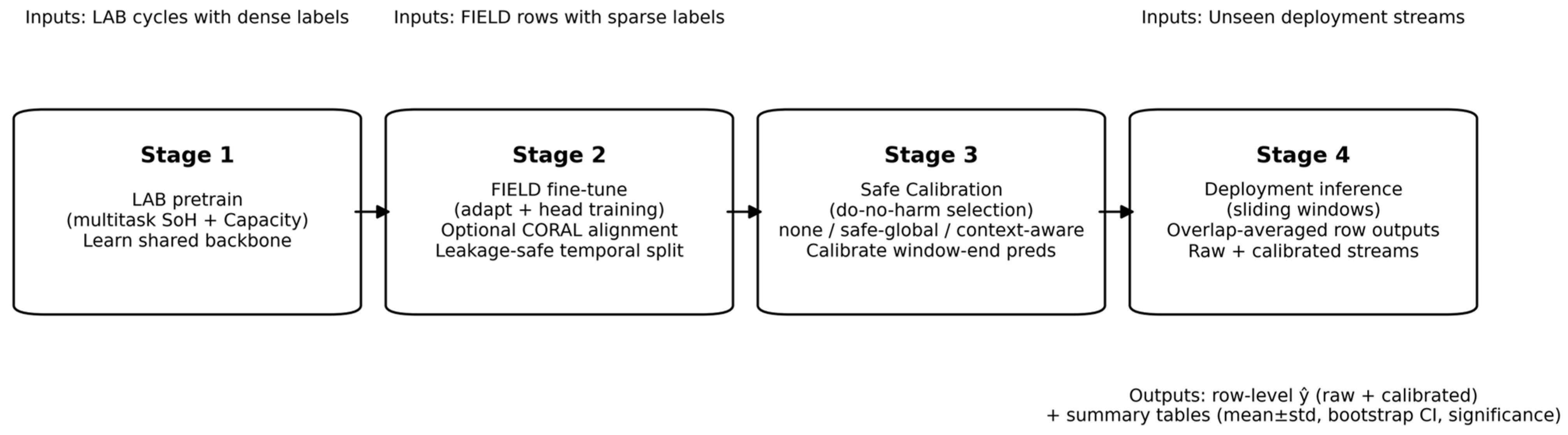
25]. Even when degradation ordering is preserved, L2F shift can induce systematic output distortion (scale compression/shift/nonlinear warping), which causes large errors in absolute SoH despite correct ranking. This motivates a deployment-complete pipeline as shown in
Figure 1, that (i) aligns representations (CORAL) and (ii) applies an auditable post hoc Safe Calibration stage with do-no-harm selection and robust pair filtering [
26].
This paper targets these gaps by proposing a deployment-complete Lab-to-Field pipeline shown in
Figure 1, that combines a TCN–Transformer fusion backbone with adapters/heads for heterogeneous inputs, alignment-regularized fine-tuning, streaming-compatible overlap-averaged inference, and a Safe Calibration module that corrects systematic output distortion under a strict do-no-harm rule. The safe selection principle is motivated by the broader calibration literature, where post hoc calibration can improve reliability but may also harm performance if fitted on noisy or unrepresentative pairs [
27,
28,
29]. Here, calibration is designed as a controlled and auditable step for SoH regression under shift, with robust pair filtering and a selection criterion that prevents regression in holdout error. Furthermore, Deployment evaluation is extended beyond a single run/stream by reporting repeated-seed performance (four seeds) and multi-deployment-stream results under a leakage-safe temporal split. The comparison set is expanded to include architecture baselines (Fusion, TCN-only, Transformer-only, GRU, LSTM), an explicit CORAL on/off alignment ablation, a calibration ablation (none vs. Safe-Global vs. Context-Aware), and a classical Ridge baseline. Statistical reporting is strengthened using mean ± std over seeds and bootstrap confidence intervals (CIs) for MAE/RMSE computed from per-example absolute errors, enabling uncertainty-aware model comparison under deployment-realistic overlap-averaged inference.
The main contributions of this paper are as follows:
A deployment-complete Lab-to-field transfer learning framework is proposed for battery SoH estimation, integrating domain-specific adapters, alignment-regularized fine-tuning, and overlap-averaged inference to produce stable and row-level predictions suitable for BMS deployment.
A gated TCN–Transformer fusion backbone is developed to jointly capture local degradation patterns and long-range temporal dependencies, enabling effective representation transfer across heterogeneous laboratory and field data.
A Safe Calibration strategy is introduced based on monotonic post hoc recalibration with robust pair filtering and a strict do-no-harm selection criterion, correcting systematic distortion under domain shift while preserving degradation ordering.
Effectiveness is demonstrated on multiple unseen deployment streams with repeated-seed evaluation, showing substantial improvements in MAE/RMSE/R2 and indicating that deployment errors are primarily driven by miscalibration rather than loss of health ordering.
Expanded baseline and ablation suite: Fusion vs. TCN-only vs. Transformer-only vs. GRU vs. LSTM; Ridge baseline (raw + calibrated); calibration ablation (none, Safe-Global, Context-Aware); alignment ablation (CORAL off/on), all under identical leakage-safe splits and identical deployment inference operator for fairness.
Statistical validation: mean ± std over four seeds and bootstrap CIs for MAE/RMSE (computed from saved per-example absolute error arrays) aggregated across multiple deployment streams.
Related Works
Deep learning for battery health estimation has evolved from feature-based regression to representation learning, which consumes charging/discharging trajectories or their engineered summaries. Researchers have demonstrated that transformer-based methods possess the ability to map long-range dependencies and global context. These transformer methods include incremental-capacity-informed Transformer models and hybrid sequence learners designed for fast-charging and constrained measurement windows [
30,
31]. At the same time, the emergence of transfer learning has provided engineers with the ability to reduce labeling and testing burdens by utilizing knowledge from different battery types and operating protocols [
32].
Many works are reported in the literature that address cross-domain performance by relying on explicit alignment mechanisms. Particle Swarm Optimization (PSO) has been demonstrated and used to achieve deep domain adaptation. PSO has been applied to reduce cross-domain discrepancy while tuning adaptation-relevant hyperparameters [
33]. On the other hand, CCN-Transformer fusion methods have been shown. These form platforms that provide local and global mapping abilities of battery features through better generalization across operating conditions by aligning multi-modal and multi-scale representations [
34]. This motivates a complementary focus on output reliability that ensures that predicted SoH values remain well-scaled and decision-consistent under field conditions. In practice, this means the model should not only preserve the degradation trend but also produce numerically trustworthy health levels with minimal systematic bias, stable dynamic range, and predictable error behavior. Such reliability is essential because BMS actions are typically threshold-driven—small mis-scaling can shift derating, maintenance, or safety triggers even when the ordering of cycles is correct [
26,
35].
Post hoc calibration is a research-approved technique that allows for the mapping of raw model scores and predictions into better-aligned values without changing the underlying feature extractor. Regression and uncertainty estimation research show that calibration methods possess the ability to improve reliability while still requiring careful validation. The validation is necessary since calibration is not uniform across datasets and is not beneficial [
36,
37]. Isotonic recalibration, in particular, has been studied as a monotonic post-processing step that can restore calibration properties under challenging signal-to-noise regimes [
38]. These insights motivate the Safe Calibration selection rule proposed here, which applies calibration only when it demonstrably improves a held-out criterion.
A summary of the qualitative approach to related works is presented in
Table 1. Studies between 2023 and 2026 demonstrate that transfer learning and domain adaptation materially improve SoH estimation when the training and deployment distributions differ, but they typically emphasize representation transfer rather than deployment reliability under systematic output distortion. PSO-assisted domain adaptation methods explicitly reduce cross-domain mismatch at the feature/latent level [
33], while vehicle-oriented multi-source DA frameworks leverage heterogeneous sources and real-vehicle data to improve generalization across operational regimes [
15,
16]. In parallel, transfer learning SoH models have been tailored to challenging regimes such as fast charging, where degradation signatures and measurement constraints differ from conventional cycling [
31], and to protocol-induced shifts such as cross-formation transfer, where the same chemistry can present meaningfully different early-life trajectories [
32]. Alignment-heavy architectures (e.g., local–global CNN–Transformer designs) further strengthen invariance by fusing multi-scale/multi-modal cues and aligning representations across conditions [
34], and ensemble-style modeling (multi-expert fusion) improves accuracy by combining complementary predictors [
9]. Collectively, these works establish that cross-condition generalization benefits from stronger representations and explicit discrepancy reduction, yet they often report performance primarily in curated cross-split settings and do not fully specify a deployment-complete inference pipeline that produces stable row-level trajectories from streaming windows.
In contrast to approaches that primarily target absolute laboratory accuracy, the present work focuses on the dominant L2F deployment failure mode in which predictions remain strongly monotonic yet become mis-scaled (compressed/warped) under shift. This motivates an explicitly deployment-complete four-stage pipeline: (i) lab pretraining to learn transferable degradation ordering; (ii) field fine-tuning with domain-specific adapters and optional CORAL alignment to regularize representation mismatch; (iii) Safe Calibration as an auditable reliability layer, where calibration pairs are robustly filtered (quantile clipping and median-absolute-deviation (MAD)-based residual screening) and a monotonic recalibration mapping is selected only if it improves a held-out criterion under a strict do-no-harm rule; (iv) deployment inference via overlap-averaged sliding windows to produce smooth row-level SoH trajectories suitable for Battery Management System consumption. This separation between learning transferable ordering (transfer/alignment) and repairing deployment-scale distortion (safe calibration and deployment inference) is central when domain shift preserves ranking but violates the SoH scale.
The evaluation protocol is correspondingly framed around robustness under domain shift rather than peak-score reporting from a single run. Experimental scope is extended to multi-deployment-stream testing and repeated-seed reporting (four seeds), and the comparison set is broadened to include architecture baselines (Fusion, TCN-only, Transformer-only, GRU, LSTM), a Ridge regression baseline (raw and calibrated), an explicit alignment ablation (CORAL off/on), and a calibration ablation (none vs. Safe-Global vs. Context-Aware), all under identical leakage-safe temporal splitting and the same overlap-averaged inference operator for fair comparison. Statistical uncertainty is summarized using mean ± std across seeds and bootstrap confidence intervals (CIs) for MAE/RMSE computed from per-example absolute errors aggregated across runs.
The article is organized as follows. Section I motivates reliable battery SoH estimation for transportation electrification and highlights the Lab-to-field generalization challenge. Section II reviews recent SoH estimation, transfer/domain-adaptation, and calibration literature to position the work. Section III formulates the problem under deployment distribution shift and describes the dataset setting and protocols, including the laboratory source corpus, the field-like EOCV2 streams used for adaptation/calibration and for unseen deployment testing, and the leakage safeguards. Section IV details the proposed methodology, including the gated TCN–Transformer fusion backbone, domain-specific adapters/heads, alignment-regularized fine-tuning, and Safe Calibration under a do-no-harm selection criterion. Section V presents the deployment inference procedure based on overlap-averaged sliding windows to generate stable row-level SoH trajectories. Section VI reports quantitative and qualitative results on the fully unseen deployment stream, including calibration-label efficiency and drift-stability analyses. Section VII discusses the implications, limitations, and how the approach compares with recent transfer learning and CNN–Transformer alignment methods, and Section VIII concludes with key findings and directions for future work.
2. Materials and Methods
2.1. Problem Formulation and Dataset Setting
Let
denote the input at time index
, and let
denote the corresponding SoH label (normalized capacity-based SoH). The objective is to learn a predictor
that generalizes to an unseen deployment distribution
despite L2F domain shift. The source domain
consists of laboratory sequences collected under controlled cycling and temperature conditions. The target domain
consists of field sequences where inputs are engineered, features are aggregated over operational windows, and observations may include categorical context variables and non-uniform sampling. Because
and
differ structurally and statistically, the direct application of a laboratory-trained model can be brittle. Given training data from
and limited labeled data from
, the parameter vector
is estimated by minimizing deployment risk, as modeled by Equation (1).
where
is the learned predictor,
is the loss function, and the expectation is taken over the unseen deployment distribution
,
θ is the trainable model parameters,
is the expectation (average) over data drawn from a distribution, (
x,
y),
is the new/target data distribution representing the deployment domain,
L(·) is the loss function,
(
x) is the model evaluated on input
x, and
y is the ground-truth label/target for x, that is, the true SoH.
In practice, learning uses supervised prediction loss on available labeled data together with an alignment regularizer that reduces latent distribution mismatch. Outputs are constrained to preserve physical plausibility and prevent pathological extrapolation beyond meaningful SoH ranges.
2.2. Datasets and Protocols
Source (lab) data are drawn from the NASA battery aging set (cells B0005, B0006, B0007, B0018) [
39], merged into a unified table of 185,721 time-sampled records spanning 4 cells and 636 charge/discharge cycles (per-cell coverage: B0005: 168 cycles, B0006: 168 cycles, B0007: 168 cycles, B0018: 132 cycles). Each cycle is represented by the measured voltage, current, and temperature trajectories, and is resampled to a fixed length (N_POINTS_LAB = 128) after constructing three physics-derived channels (cumulative charge q, cumulative energy e, and dv/dt). Laboratory SoH supervision is capacity-based, computed as SoH = Capacity(Ah)/C_ref, where C_ref is the maximum observed capacity in the lab corpus (global-max normalization as in the implementation). The observed laboratory temperature range is 22.35–42.33 °C. Target (field) data use an engineered EOCV2 representation in which each row comprises aggregated electrical/thermal descriptors (e.g.,
,
, duration, OCV/SOC estimates, and context/aging tags) derived from periodic checkup records. Field adaptation and calibration use stream P001_1_S01_C10_MULTIPLE (
;
labeled via soh_cap, with
labels in
, range
–
). Deployment evaluation is performed on multiple unseen streams excluded from all training/validation/calibration and used only at inference time: P076_1_S15_C04 (
;
labeled;
–
), P073_2_S12_C02 (
;
labeled;
in
,
–
), and P073_3_S14_C01 (
;
labeled;
in
,
–
) [
39,
40]. To prevent optimistic bias, the protocol enforces strict cross-stream isolation, leakage-safe temporal splitting with scalers fit on training partitions only, and calibration hygiene using temporally held-out selection with quantile clipping and MAD filtering together with a do-no-harm criterion.
Table 2 summarizes the key properties of the lab, field, and deployment streams.
2.3. Proposed Methodology
The proposed pipeline consists of four interconnected stages. First, a shared temporal backbone is pretrained on laboratory data to learn degradation-sensitive representations. Second, the model is adapted to field data using domain-specific adapters and heads combined with an alignment-regularized objective. Third, Safe Calibration selects a post hoc calibrator from a candidate set using robust filtering and a do-no-harm selection criterion. Finally, deployment inference generates row-level SoH trajectories through sliding-window overlap averaging, which stabilizes predictions and reduces window-boundary artifacts.
2.3.1. TCN–Transformer Fusion Backbone
The backbone fuses two complementary temporal pathways. The TCN pathway captures local and multi-scale patterns through stacked dilated causal convolutions, while the Transformer encoder captures long-range dependencies via self-attention [
42]. For a TCN layer
with dilation
and kernel size
k, the causal convolution output is obtained by Equation (2):
where
is the current layer index,
is the previous layer index,
is a kernel index ranging from 0 to
,
is the kernel size, also referred to as filter length,
is the convolution weight,
is the input activation from the previous layer,
is the dilation factor, and
is the bias term for the layer
, it shifts the output up and down.
Residual connections and normalization stabilize optimization and expand receptive fields without the training instabilities often encountered in recurrent networks. In the attention pathway shown in Equation (3) [
43]. Multi-head self-attention is computed as follows:
where
is the matrix of queries,
is a matrix of key vectors,
V represents a matrix of values,
is the matrix multiplication that results in attention scores,
is the square root of the key/value dimensionality,
is the scaled attention, H is the input–representation matrix,
is the learnable projection matrix that maps H into queries,
is the learnable projection matrix that maps H into keys,
is the learnable projection matrix that maps
H into values.
Positional encodings preserve temporal ordering [
44,
45]. To combine the complementary features, a learnable gate produces a fused representation as in Equation (4),
is the gate vector or gate scalar,
is the sigmoid function,
is the learnable weight matrix for the gate,
is a concatenation of the two feature vectors and
is the learnable bias vector for the gate layer. The subscripts
TCN and
ATT are features produced by a
TCN branch and features produced by an attention/Transformer branch, respectively. Equation (5) illustrates the feature fusion between the two branches,
h is the fused output feature vector,
is the elementwise (Hadamard) multiplication and
is the complement gate, which dictates how much should be taken from the attention branch. Equations (4) and (5) define a gate that allows the model to emphasize local convolutional cues or global attention context, depending on the operating regime and the signal quality [
42]. In the L2F setting, the fusion is valuable because field features can be smoother and more aggregated than laboratory waveforms, shifting the relative importance of local versus global cues [
34].
2.3.2. Domain-Specific Adapters and Heads
Because laboratory and field inputs are heterogeneous, a shared backbone alone is insufficient. The pipeline, therefore, uses domain-specific adapters that map domain-dependent features into a shared latent dimension before the fusion backbone. Separate prediction heads are used for source and target supervision during training to reduce negative transfer. At deployment, the field adapter and shared backbone are used with the selected calibrator to produce final SoH estimates [
15,
22].
2.3.3. Alignment-Regularized Fine-Tuning
To reduce L2F discrepancy, an alignment regularizer is introduced that encourages the covariance structure of latent representations to match between source and target mini-batches. Let
and
denote latent feature matrices for the source (lab) and target (field) batches, respectively, and let
and
denote their sample covariance matrices. A CORAL-style loss [
46], is defined in Equation (6) by penalizing the Frobenius norm of the covariance mismatch:
Here, denotes the Frobenius norm, is a batch feature matrix ( and ), is the batch mean vector, and is an all-ones vector used to broadcast across rows.
The complete training objective couples supervised prediction with alignment and regularization as shown in Equation (7),
where
is the prediction loss,
is the alignment loss,
is the weight for the alignment loss,
is the weight for the regularization term,
is the model parameters (weights), and
is the squared
norm of the parameters.
Alignment is particularly relevant for regression tasks such as SoH estimation because feature scale differences can induce systematic output distortion. Domain adaptation methods have demonstrated this sensitivity and the importance of explicit discrepancy reduction in cross-domain battery health settings [
16,
33].
2.3.4. Safe Calibration (Isotonic-Balanced Selected)
Even after adaptation, deployment errors may be dominated by systematic output distortion that preserves ordering [
35]. The observed results are consistent with this scenario: raw predictions are strongly monotonic but exhibit nonlinear scaling. In this work, calibration is learned from validation pairs
, which can contain leverage points due to sparse labels, noise, or rare regimes. Even after adaptation, deployment error can be dominated by systematic output distortion that preserves ordering. In the present setting, raw predictions remain strongly monotonic but exhibit nonlinear scaling under domain shift. Calibration pairs are formed from validation predictions and robustly filtered before fitting to improve stability. Specifically, extreme predicted values are trimmed using low/high quantiles, and residual outliers are removed using MAD filtering; these steps reduce the influence of leverage points and heteroskedastic tails that can otherwise induce step artifacts or spurious extrapolation in monotone calibrators. Candidate calibrators include the identity mapping, ridge-linear mapping, and isotonic regression. Isotonic regression is used as the primary nonparametric option because it enforces monotonicity (preserving degradation ordering) while correcting arbitrary nonlinear distortions without assuming a parametric error model. To mitigate overfitting and plateauing in dense SoH regions, bin–balanced weighting is applied (Isotonic-Balanced), and the final mapping is selected under a strict do-no-harm rule evaluated on an internal calibration holdout set. The selected calibrator
is defined as
where
is the set of candidate calibration mappings,
denotes the uncalibrated predictions,
denotes the ground-truth targets, and
are the calibrated predictions.
is computed on the internal holdout set, and the constraint enforces that calibration does not degrade RMSE relative to the original model.
This criterion ensures the calibration is applied only when it improves the chosen held-out metric, reflecting the broader calibration research that post hoc calibration can help reliability, but should be validated to avoid degradation [
25]. In the reported experiments, Safe Calibration selected the Isotonic-Balanced mapping.
2.3.5. Implementation Outline
Stage 1 pretraining uses a multi-task objective that predicts SoH and an auxiliary capacity proxy, with the auxiliary term downweighted to regularize the backbone without dominating SoH learning. Laboratory sequences are formed from cycle-resolved voltage-current traces by constructing physics-derived channels (cumulative charge q, cumulative energy e, and time-derivative (slope) (dv/dt) and resampling each cycle to a fixed length before ingestion by the TCN–Transformer fusion backbone. In Stage 2, field prediction is performed by a domain-specific head that augments the shared latent representation with compact categorical embeddings of operational context (e.g., checkup ID and condition ID) to absorb discrete protocol or measurement effects. In Stage 3, alignment is applied as a CORAL-style covariance penalty with a warm-up ramp, optionally combined with exponential moving average stabilization and bin-weighted supervision to reduce edge-region bias. In Stage 4, Safe Calibration evaluates multiple lightweight mappings (including identity, ridge-linear, isotonic, and hybrid iso-linear candidates) and applies the selected mapping only when held-out error improves, after which deployment uses overlap-averaged sliding-window inference to yield stable row-level trajectories. The above discussion can be summarized into a deployment-complete L2F SoH pipeline pseudocode in Algorithm 1, with the Training and adaptation hyperparameters listed in
Table 3.
2.3.6. L2F SoH Pipeline Pseudocode
Algorithm 1 shows Leakage-Aware, Calibrated, and Deployment-Complete L2F SoH Estimation Pipeline.
| Algorithm 1: Leakage-Aware, Calibrated, and Deployment-Complete L2F SoH Estimation Pipeline
|
| Inputs: |
| Lab dataset (cycle waveforms); |
| Field dataset (engineered rows with sparse labels); |
| Deployment streams (unseen at train time); |
| Window length , stride ; leakage-safe gap ; |
| Backbone set ; |
| Calibration modes ; |
| Alignment flag ; seeds . |
| Outputs: |
| Row-level deployed predictions (raw) and (calibrated) for each stream; |
| Summary metrics (MAE/RMSE/) with mean ± std over seeds and bootstrap CIs. |
| Procedure: |
| 1: For each backbone do7; |
| 2: For each calibration mode do; |
| 3: For each alignment flag do; |
| 4: For each seed do; |
| 5: Set random seed to . |
| 6: Stage 1 (lab pretrain): |
| 7: Resample each lab cycle waveform to length ; derive physics channels , , and . |
| 8: Train backbone and lab head on by minimizing |
|
| 9: Save , , and lab normalizer fitted on lab-train only. |
| 10: Stage 2 (field windowing + leakage-safe split): |
| 11: Form field windows of length with stride , indexed by window-end . |
| 12: Construct leakage-safe temporal splits on : Train/Val/Test with enforced gap between consecutive splits. |
| 13: Fit field scaler on field-train only; transform field-val/test and all deployment streams with the same scaler. |
| 14: Stage 2a (field head warm-up): |
| 15: Initialize field adapter and field head ; freeze . |
| 16: Train on field-train windows using supervised loss . |
| 17: Stage 2b (field fine-tune with optional alignment): |
| 18: Unfreeze (optionally partial unfreeze for Fusion); continue training with |
|
| where if , otherwise ramped in early epochs. |
| 19: Apply fixed stabilizers (held constant across baselines): EMA updates, gradient clipping, early stopping on field-val MAE/RMSE. |
| 20: Save , , , and the fitted field scaler. |
| 21: Stage 2.5 (Safe Calibration; field-val only): |
| 22: Compute validation predictions at window ends and form calibration pairs . |
| 23: Robustly filter pairs: (i) trim extreme prediction quantiles; (ii) remove residual outliers via MAD filtering. |
| 24: Fit candidate calibrators . |
| 25: If Context-Aware, fit context-conditioned isotonic using valid context IDs (e.g., checkup/condition); otherwise fall back to Safe-Global. |
| 26: Select using a do-no-harm holdout rule on an internal calibration holdout; if none set . |
| 27: Stage 3 (Deployment inference; inference-only streams): |
| 28: For each deployment stream do; |
| 29: Slide windows of length over rows; compute window-end predictions . |
| 30: Convert to row-level prediction by overlap averaging: |
|
| 31: Apply calibration (if enabled): (or equivalently calibrate then overlap-average, matching implementation). |
| 32: Evaluate metrics on labeled rows only (MAE/RMSE/); store per-example absolute errors for bootstrap. |
| 33: End for. |
| 34: Stage 4 (Statistical reporting): |
| 35: Aggregate results over seeds and streams; report mean±std over . |
| 36: Compute bootstrap confidence intervals for MAE/RMSE from saved per-example absolute errors; optionally compute paired significance tests over matched runs. |
| 37: End for; |
| 38: End for; |
| 39: End for; |
| 40: End for. |
2.4. Deployment Inference
In real-world BMS deployment, SoH must be estimated continuously from streaming data without introducing jitter, boundary artifacts, or latency that could affect control decisions. To obtain stable row-level trajectories suitable for threshold-based actions, sliding-window inference with overlap averaging is applied. For a sequence of length
, windows of length
are extracted with stride
, each window yields a window-end prediction, and the row-level estimate at index
is computed as the average of all window-end predictions whose corresponding windows cover
, as defined in Equation (9).
where
ŷ is predicted SoH estimate,
t is the row/time index,
W(
t) is a set of window indices whose predictions contribute to index
t, |
W(
t)| is the number of windows in
W(
t) (cardinality), w is an index of a particular window in
W(
t), and
ŷw is the window-level prediction for window
w.
Overlap averaging behaves like a temporal smoother while preserving responsiveness, and it produces row-level trajectories aligned with deployment expectations. The computational cost scales linearly with the number of windows and is practical for moderate L and s = 1 in offline processing or larger strides for embedded settings.
The following section reports expanded baselines and ablations under deployment-realistic overlap-averaged inference, including repeated-seed robustness, bootstrap uncertainty, and multi-deployment evaluation.
2.5. Baselines, Ablations, and Statistical Analysis
The evaluation includes five neural backbones—Fusion (proposed), TCN-only, Transformer-only, GRU, and LSTM—trained with identical optimization schedules and identical preprocessing. A classical Ridge baseline is added using standardized window-end features derived from the same leakage-safe split as the neural models. Alignment is ablated by toggling CORAL during field fine-tuning (off vs. on). Calibration is applied over three modes: no calibration (identity), Safe-Global calibration (do-no-harm selection among candidate calibrators), and Context-Aware calibration (condition/checkup-aware isotonic when context identifiers are valid and non-degenerate, otherwise safe global fall back).
All baselines use the same leakage-safe temporal split strategy, the same feature scaling policy, and the same deployment inference operator (overlap-averaged sliding-window inference). This ensures that differences are attributable to modeling choices (architecture/alignment/calibration) rather than evaluation artifacts.
Robustness is assessed over four random seeds and multiple deployment streams. Results are summarized using mean ± std over seeds and bootstrap confidence intervals (CIs) for MAE/RMSE computed from per-example absolute error arrays saved per run.
3. Results
Evaluation is first summarized on a completely unseen deployment stream with 2154 labeled rows. Mean absolute error (MAE), root-mean-square error (RMSE), and the coefficient of determination () are reported. Under overlap-averaged sliding-window inference, raw (uncalibrated) predictions achieve MAE , RMSE , and . After Safe Calibration (Isotonic-Balanced selected under the do-no-harm criterion), performance improves to MAE , RMSE , and , indicating that systematic output distortion (mis-scaling under L2Fshift) is a dominant contributor to deployment error. Beyond single-stream reporting, robustness is assessed across four random seeds and multiple unseen deployment streams, with statistical uncertainty summarized via mean std and bootstrap confidence intervals for MAE/RMSE computed from per-example absolute errors.
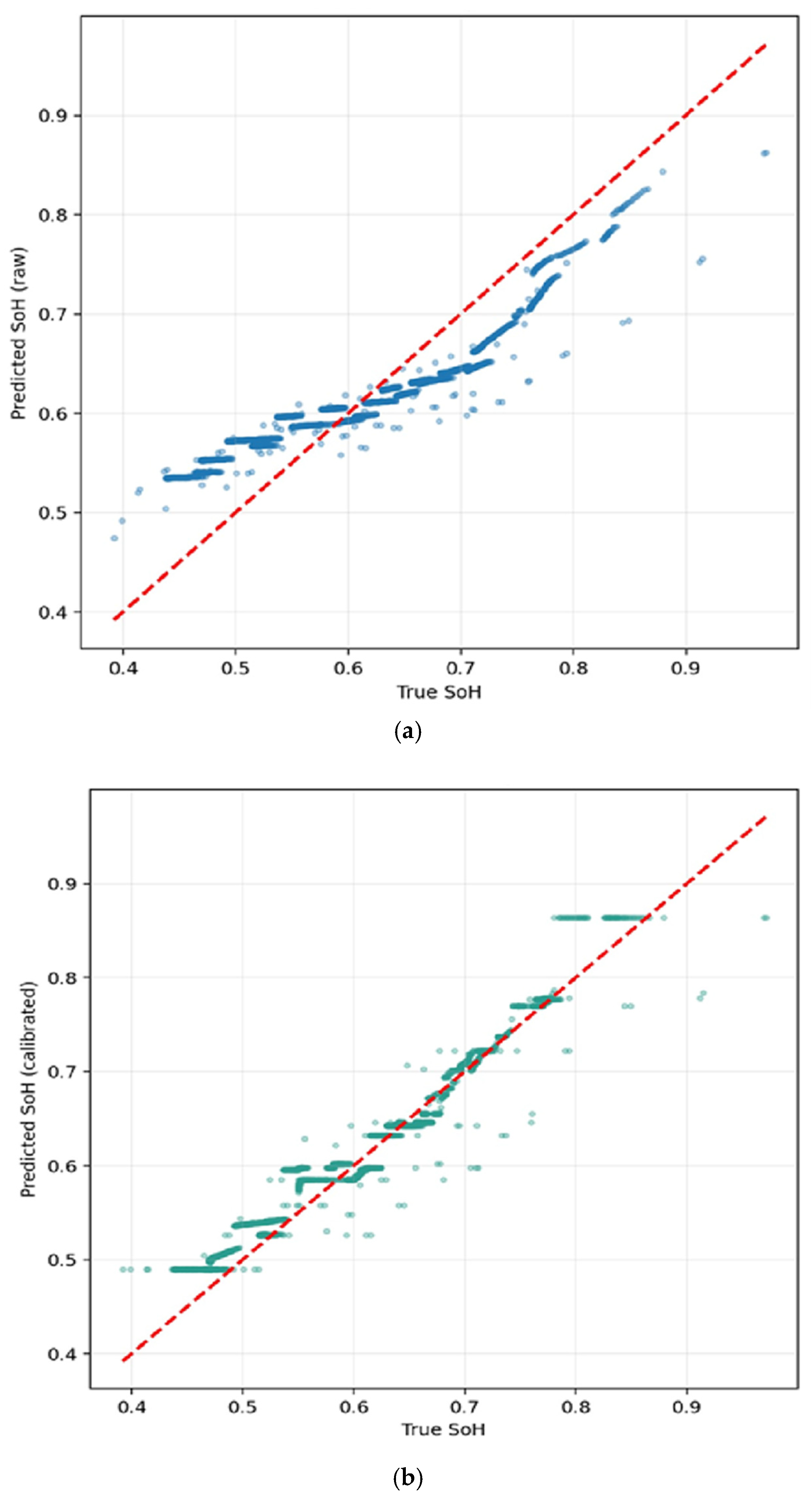
Figure 2a,b diagnose and correct the dominant L2F deployment failure mode in which predictions remain strongly monotonic yet become mis-scaled under shift. In
Figure 2a, raw predictions exhibit a clear monotonic dependence on the ground-truth, indicating that the backbone retains degradation ordering in the deployment domain. However, the scatter deviates systematically from the identity line
, consistent with nonlinear scaling bias (range compression), leading to overestimation in lower-to-mid SoH and underestimation at higher SoH. These results show that the most dominant error component is miscalibration (output warping) rather than loss of discriminative ordering.
Figure 2b shows the corresponding calibrated outputs, where the selected monotone mapping yields improved alignment with
across the SoH range, demonstrating that Safe Calibration restores deployment-scale consistency while preserving the physically meaningful monotonic structure. This directly motivates Safe Calibration as an auditable reliability layer under domain shift by showing that calibration targets a specific, deployment-relevant failure mode rather than serving as unverified post-processing.
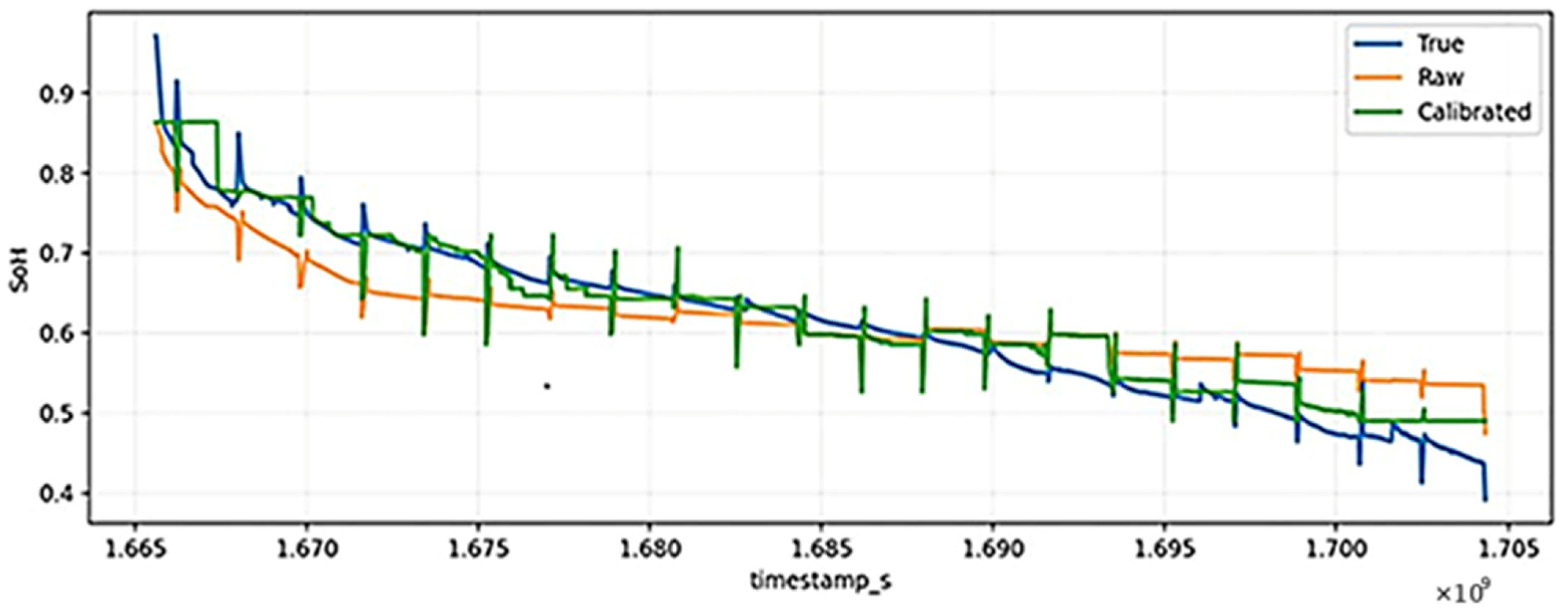
Ground-truth SoH (True) is plotted on the same axis with overlap-averaged raw predictions (Raw) and overlap-averaged calibrated predictions (Calibrated) and analyzed over the deployment timestamp axis. Safe Calibration is employed as a technique to reduce systematic scale distortion, while overlap averaging leads to temporally stable row-level estimates that can be used in BMS.
Figure 3 shows the deployment stage plotting the ground-truth SoH trajectory with row-level predictions produced by overlap-averaged sliding-window inference, before and after Safe Calibration for comparison purposes. True SoH exhibits an expected decrease over time in a manner that is physically consistent with a degradation pattern that has short transients attributable to operational variability and measurement noise. The raw deployed trajectory follows the overall trend but exhibits a persistent scale bias consistent with L2F mis-scaling and range compression, which manifests as sustained estimation error across extended intervals. Safe Calibration is employed to ensure that the deployed trajectory aligns more closely with the ground-truth throughout the timestamp axis, thereby showing that the dominant deployment error component is systematic output distortion rather than loss of degradation ordering.
3.1. Baselines and Ablations
Table 4 reports results of controlled ablations that are designed to isolate (i) the contribution of the deployment inference operator, that is, window-end only versus overlap-averaged sliding-window inference, and (ii) Safe Calibration design choices, which are a choice of Safe-Global and Context-Aware. These ablations are then evaluated on the labeled subset of a completely unseen deployment data stream, P076_1_S15_C04. This dataset has been excluded from training, validation, and calibrator fitting, thereby enforcing strict cross-stream isolation. Overlap averaging yields a modest but consistent improvement, with the MAE improving from
and RMSE from
, indicating reduced window-boundary artifacts and improved row-level stability, but it does not resolve the dominant failure mode under L2F shift. In contrast, Safe Calibration provides the most noticeable correction, that is, Safe-Global isotonic improves the performance of MAE
and RMSE
), while the proposed Context-Aware Safe Calibration achieves the largest gain, MAE
and RMSE
, consistent with the correction of systematic output-scale warping while preserving monotonic degradation ordering [
29]. The row containing MAE
and RMSE
corresponds to the calibrated outputs saved by the run configuration and is retained to document reproducibility of the pipeline outputs.
Table 4 is intentionally a single-stream controlled ablation with broader robustness evidence being provided by the expanded evaluation protocol, which additionally reports repeated-seed statistics and results on two further unseen deployment streams.
3.2. Architecture Baselines: Fusion vs. TCN-Only vs. Transformer-Only vs. GRU vs. LSTM
Across the aggregated multi-stream, repeated-seed evaluation, the architecture comparison indicates that the Fusion backbone is competitive relative to recurrent and attention-only baselines under matched training and inference conditions. For the Fusion configuration with Context-Aware calibration (CORAL off), the aggregated row-level deployment MAE is , and the field test window MAE after Context-Aware calibration is . The strongest aggregated deployment MAE among evaluated backbones is observed for GRU with Safe-Global calibration (CORAL off), achieving , while TCN-only remains less competitive under the same evaluation protocol. These results indicate that the end-to-end pipeline is not dependent on a single backbone choice and that architectural differences are comparatively smaller than the calibration effect under the present domain-shift regime. The Fusion design is retained because it provides consistently strong performance across streams while offering complementary inductive biases (local multi-scale dynamics via TCN and long-range dependencies via attention). Qualitative alignment between predicted and true trajectories across backbones is illustrated using synchronized time-series overlays, where Fusion (raw/calibrated) is shown against thin reference curves from other backbones under the same inference operator, highlighting systematic bias reduction after calibration.
3.3. Classical Baseline: Ridge (Basic) Raw vs. Calibrated
A Ridge regression baseline is included to test whether post hoc calibration alone can account for the observed gains. Without calibration, Ridge can exhibit strong global mis-scaling under L2F shift (offset/gain errors), yielding high window-level MAE ( in the aggregated evaluation) despite partial preservation of degradation ordering. After Safe/Context-Aware calibration, Ridge improves substantially ( window-level MAE), demonstrating that monotone post hoc mapping can correct severe systematic scale distortion when the predictor preserves ranking. However, the deployed objective in this work is row-level trajectory stability under overlap-averaged inference on unseen streams, and the deep pipeline remains the primary method because it learns sequence-conditioned representations and produces deployment-consistent outputs under the same overlap-averaging operator used for evaluation, whereas a window-end linear baseline is more sensitive to feature-definition mismatch and does not encode temporal context.
3.4. Calibration Ablation: None vs. Safe-Global vs. Context-Aware
Calibration is the dominant contributor to accuracy gains under shift. For Fusion (CORAL off), calibration reduces field test window-level MAE from (raw) to (Context-Aware calibrated), while the row-level deployment MAE reduces from (raw) to (Context-Aware calibrated). Safe-Global and Context-Aware modes yield similar aggregate deployment performance, with Context-Aware providing additional benefit when context identifiers are valid and sufficiently populated; otherwise, the method falls back to Safe-Global selection to avoid degradation under the do-no-harm rule.
3.5. Alignment Ablation: CORAL off vs. on
The CORAL on/off ablation isolates alignment effects from calibration. On average, enabling CORAL yields modest improvements in field window-level error, while the row-level deployment metric shows limited sensitivity and can vary by backbone. This indicates that, under the present dataset conditions and leakage-safe split, calibration and the deployment inference operator contribute more strongly to final deployment accuracy than second-order alignment alone. CORAL is retained as an optional regularizer because it can stabilize transfer when the second-order mismatch is larger, when target supervision is sparser, or when operating conditions induce stronger covariance shift.
3.6. Robustness: Repeated Seeds and Bootstrap Confidence Intervals
Robustness is quantified using four random seeds and multiple deployment streams. Mean std values summarize optimization variability across seeds, and bootstrap confidence intervals (CIs) for MAE/RMSE are computed from per-example absolute error arrays saved per run and aggregated within each stream/configuration to quantify uncertainty in error estimates. This reporting supports conclusions about effect consistency across deployment streams beyond single-run outcomes and directly addresses statistical rigor requirements under domain shift.
3.7. Analysis of Sliding-Window Inference and Safe Calibration
Raw row-level predictions on the deployment stream are compressed relative to the labeled SoH range, consistent with the curvature observed in
Figure 2a. This behavior indicates that the transfer-learned representation retains degradation ordering under L2F shift, but the output scale is systematically distorted (nonlinear warping/range compression). Safe Calibration directly targets this distortion. On the 2154 labeled deployment rows, overlap-averaged raw inference achieves MAE
, RMSE
, and
, whereas Safe Calibration (Isotonic-Balanced selected) improves MAE
, RMSE
, and
, consistent with the improved diagonal alignment from
Figure 2a to
Figure 2b. Importantly, the selection rule applies calibration only if it reduces held-out error (do-no-harm), reflecting established cautions that post hoc mappings can degrade performance if fitted on unstable pairs or leverage-point outliers. The result, therefore, addresses the concern that “calibration dominates improvement” by demonstrating that calibration is used as an auditable reliability layer correcting a specific deployment-relevant failure mode (systematic mis-scaling under shift) while preserving monotonic degradation structure.
3.8. Label-Efficiency of Safe Calibration
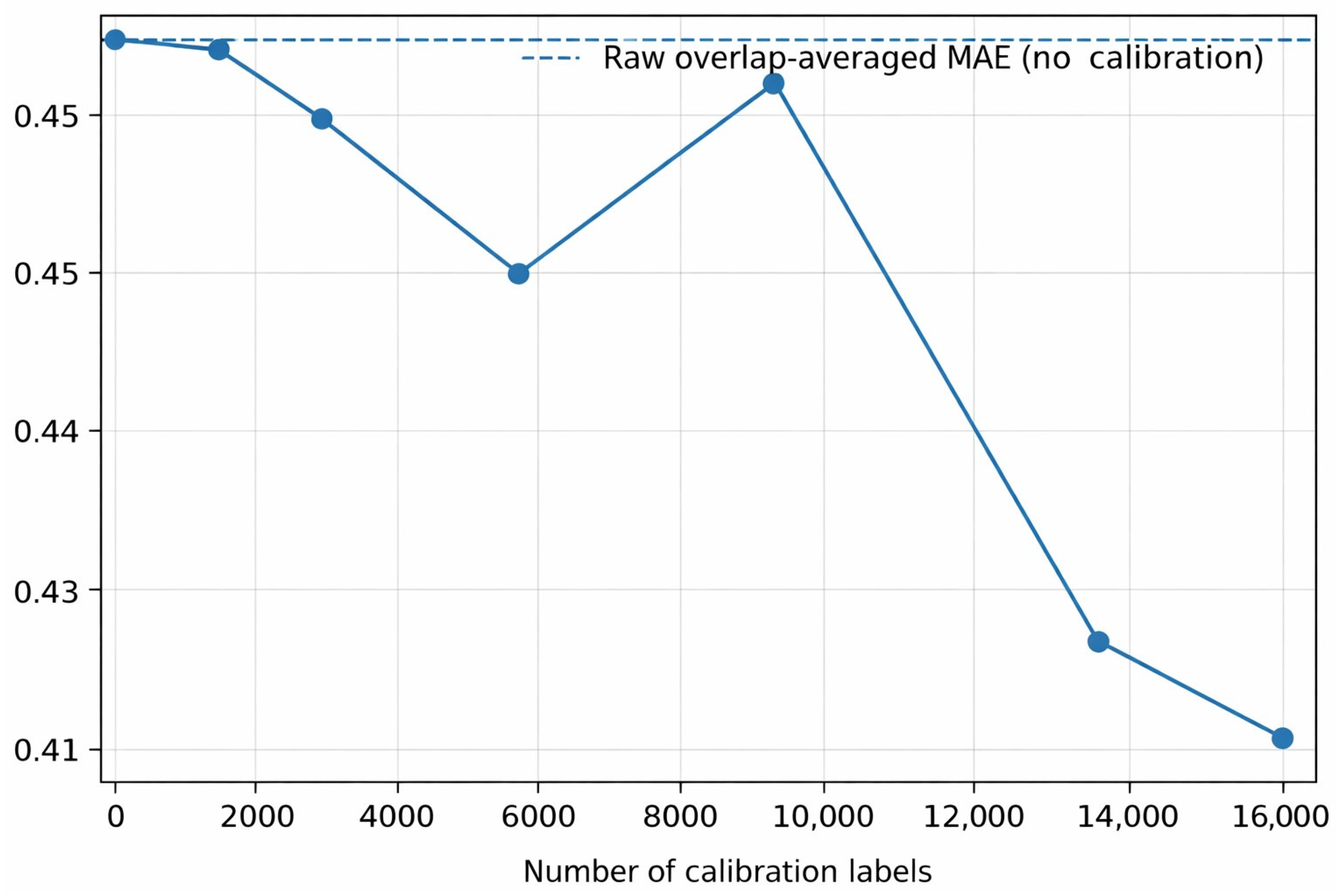
Calibration-label efficiency is evaluated by fitting Safe Calibration using an increasing number of labeled calibration pairs from stream P001_1_S01_C10_MULTIPLE (chronological prefixes) and measuring MAE on labeled deployment rows. The dashed line in
Figure 4 denotes the raw (uncalibrated) overlap-averaged MAE computed on the same evaluation subset.
3.9. Drift Stability of the Calibrator
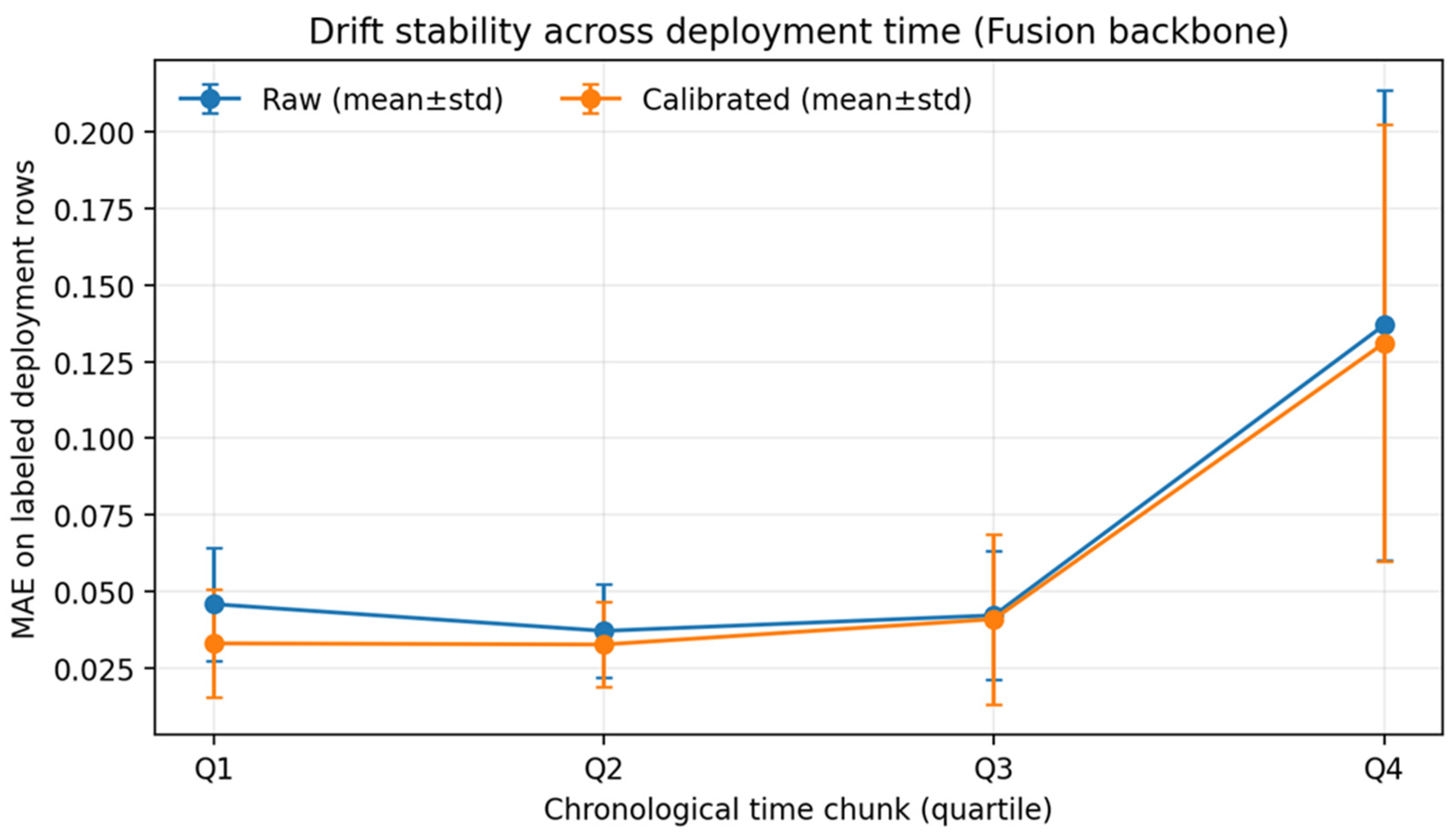
Figure 5 evaluates drift stability for the Fusion backbone by partitioning each deployment stream’s labeled rows into four chronological quartiles and reporting performance within each time chunk. The raw overlap-averaged predictor exhibits time-varying error, consistent with gradual distribution shift and operating-regime changes along the deployment horizon. After Safe Calibration, MAE is reduced in each quartile, and the calibrated curve remains below the raw reference level, indicating that the monotone mapping does not over-correct early segments at the expense of later segments (or vice versa). The plot aggregates results across multiple deployment streams and four random seeds, with uncertainty shown as the mean
std; the persistence of calibrated improvement across quartiles supports the claim that Safe Calibration functions as a robust reliability layer under realistic drift rather than as a stream-specific post-processing fit.
Labeled deployment rows are partitioned into four (4) separate chronological quartiles, that is, Q1 to Q4, using timestamp, and the MAE is reported using the mean std across deployment streams and random seeds under overlap-averaged inference. The dashed horizontal line denotes the raw overlap-averaged MAE (no calibration) computed on the same evaluation subset.
Table 5 shows the corresponding time-quartile error breakdown for the Fusion backbone, that is, the mean
std across deployment streams and random seeds. It also shows that quartile variability increases, reflecting harder regimes and cross-stream heterogeneity, while the calibrated metric remains consistently improved relative to raw outputs.
3.10. Sliding-Window Geometry Across Streams
In
Table 6, a summary of sliding-window inference geometry and labeled evaluation subsets results is reported. These results are reported across the calibration stream and all deployment streams used for row-level reporting, where, for each stream, a length-
window with stride,
, and overlap averaging yields near-uniform interior coverage close to
contributions per row, with short ramp-up and ramp-down regions at stream boundaries. Overlap-averaged sliding-window inference acts as a parameter-free temporal smoother, reducing per-window prediction jitter by averaging multiple overlapping estimates for each time step. We use window length
and stride
with the mean overlap (coverage) per time step as
where
is the number of windows and
is the number of samples (rows).
3.11. Error Distribution Across Runs
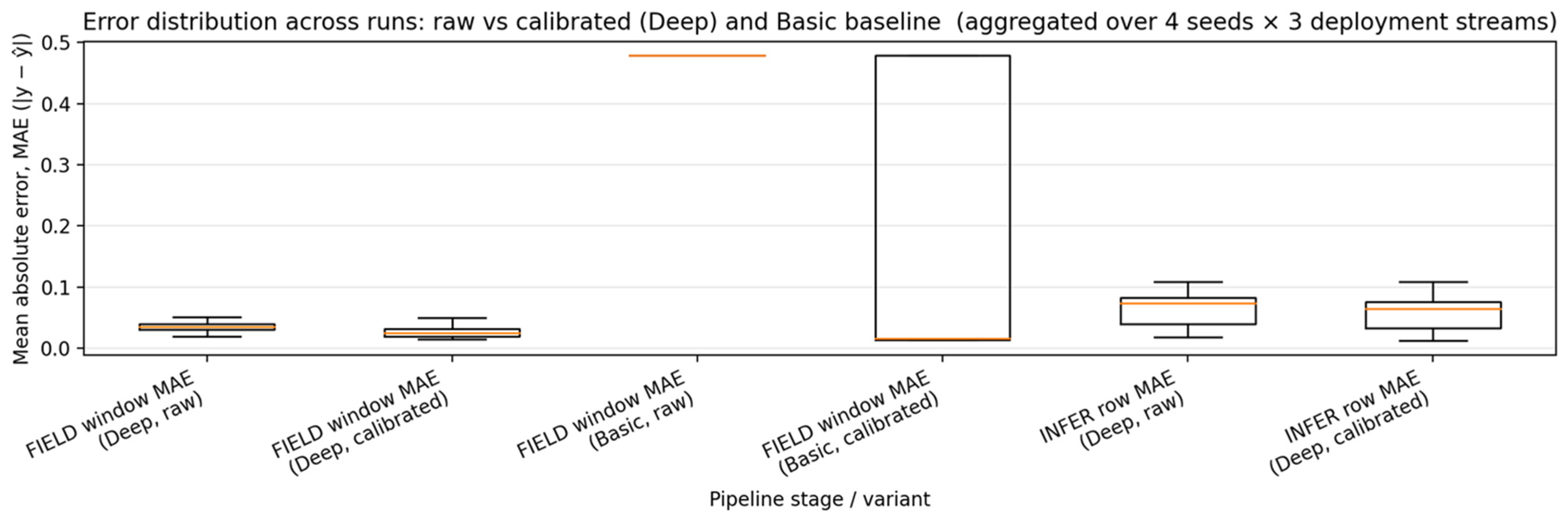
Figure 6 is a summary of the results of the distribution of per-example absolute errors
. These errors are aggregated across the full experimental grid that includes four random seeds and multiple deployment streams. Both field evaluation (window-level) and deployment-style infer evaluation, which is row-level and overlap-averaged, are reported. Safe Calibration shifts the deep model’s error distribution downward and reduces dispersion relative to uncalibrated outputs, indicating improved accuracy and improved run-to-run stability under L2F shift. When compared to the classical Ridge baseline, the calibrated deep pipeline maintains lower central error and a tighter spread, while the baseline exhibits substantially higher error and variability, consistent with stronger systematic distortion under shift. Overall, the distributional view corroborates the mean
std and bootstrap CI summaries by showing that gains persist across seeds and deployment streams rather than being driven by isolated runs.
3.12. Multi-Stream Deployment Evaluation
Table 7 reports the per-stream mean
standard deviation over four random seeds for deep architecture baselines (Fusion, TCN-only, Transformer-only, GRU, and LSTM) evaluated under identical leakage-safe temporal splitting, identical preprocessing/scaling, and the same deployment-realistic overlap-averaged inference operator. Results are reported for field test windows (window-level) and deployment-style inference (row-level). Across streams, calibration reduces error and typically reduces dispersion, indicating that the dominant failure mode is systematic output warping rather than loss of monotonic ordering. Differences between backbones are present but generally secondary to calibration under the present domain-shift regime, supporting the interpretation that deployment reliability is not dependent on a single architecture choice.
Table 8 summarizes the classical Ridge regression baseline trained on standardized window-end features derived from the same leakage-safe field split, reported in raw and calibrated forms. This baseline evaluates the “basic model + calibration” hypothesis by isolating the role of post hoc monotone mapping. While calibration substantially improves Ridge at the window level, the deep pipeline remains the primary method because it learns sequence-conditioned representations compatible with overlap-averaged deployment inference and demonstrates robustness across multiple deployment streams under repeated seeds.
Table 9 reports bootstrap 95% confidence intervals (CIs) for MAE and RMSE on both field test (window-level) and deployment inference (row-level) evaluations. CIs are computed by resampling the saved per-example absolute error arrays within each deployment stream and configuration, aggregated over repeated seeds. Across streams, Safe Calibration consistently shifts the intervals downward relative to raw predictions, indicating that reported gains persist under seed variability and stream-to-stream heterogeneity. Remaining CI overlap among backbones in some streams suggests that architectural differences are secondary to the calibration effect under the present domain-shift conditions.
To complement the repeated-seed mean ± standard deviation and bootstrap confidence intervals, a standalone paired significance analysis as shown in
Table 10 was performed on calibrated row-level deployment MAE and RMSE using matched seed–stream evaluations. The results indicate that Fusion performs significantly better than TCN, while GRU performs significantly better than Fusion. In contrast, Transformer and LSTM do not differ from Fusion in a statistically reliable manner. Specifically, relative to Fusion, TCN exhibited significantly higher error on both MAE and RMSE, whereas GRU exhibited significantly lower error. The LSTM comparison was not statistically conclusive, and the Transformer comparison, although showing a small mean advantage in ΔMAE, was not supported by the paired sign-test
p-values. Taken together, these results show that the statistical evaluation in this study extends beyond descriptive performance summaries by incorporating repeated-seed variability, cross-stream robustness, bootstrap confidence intervals, and explicit pairwise significance testing.
Across the multi-deployment evaluation (
Table 7,
Table 8 and
Table 9), shows that performance is not uniform across streams, and at least one stream exhibits materially higher row-level error and lower
than the others. Such heterogeneity is expected under deployment because labeled rows can be sparse and regime-dependent, the effective SoH dynamic range can differ by stream, and label noise and feature/label-definition drift can be stream-specific. In this setting,
is particularly sensitive to reduced label variance and may decrease even when absolute error metrics remain informative for deployment. The repeated-seed, multi-stream protocol therefore functions as a robustness stress test: all configurations are evaluated under identical leakage-safe splits, identical preprocessing, and the same overlap-averaged inference operator, while mean
std and bootstrap confidence intervals quantify both central tendency and uncertainty across operating conditions. Importantly, Safe Calibration consistently reduces systematic bias and error dispersion relative to raw outputs across streams, while cross-stream variability highlights intrinsically harder regimes and motivates stream-aware monitoring and periodic recalibration in practice.
3.13. Practical Deployment Implications
In practical battery-management workflows, SoH estimates are consumed by threshold-based decision logic (e.g., decreasing policies, maintenance scheduling, and warranty triggers), where systematic bias under distribution shift can be more consequential than random error. The multi-stream, repeated-seed results indicate that L2Fshift often preserves degradation ordering while distorting output scale, producing range compression that accumulates into sustained underestimation in row-level trajectories. The pipeline, therefore, combines overlap-averaged inference, which stabilizes row-level trajectories and mitigates window-boundary artifacts, with Safe Calibration, which targets deployment-induced mis-scaling via a monotone mapping selected under a do-no-harm criterion. Cross-stream variability, quantified through the mean ± std and bootstrap confidence intervals, highlights the expected heterogeneity of deployment regimes and motivates stream-aware monitoring and periodic recalibration as part of operational governance rather than reliance on a single best-case score.
4. Discussion
The results support a consistent interpretation of L2F transfer under domain shift. Across streams, raw predictions preserve a strong monotonic relationship with ground-truth SoH, indicating that the backbone with alignment-regularized adaptation retains transferable degradation ordering in the deployment domain. However, the raw scaling plots and time-series traces show systematic output mis-scaling (range compression/warping), which is a deployment-critical failure mode because SoH is typically consumed through thresholds and margins in BMS logic. In such settings, systematic bias can be more operationally harmful than zero-mean noise: persistent underestimation can trigger overly conservative derating or premature maintenance actions, while overestimation risks unsafe operation and incorrect warranty accounting.
Safe Calibration is introduced specifically to target this dominant failure mode, rather than as an unverified post-processing step. Calibration pairs formed from held-out field validation predictions, are robustified before fitting by (i) trimming extreme predicted-value quantiles and (ii) removing residual outliers using MAD filtering. These steps reduce leverage points and heteroskedastic tails that can otherwise force unstable monotone fits (e.g., stepwise plateaus or spurious extrapolation), thereby improving mapping stability under realistic label sparsity and noise. Isotonic regression is used as the primary nonparametric calibrator because it enforces monotonicity—consistent with physically meaningful degradation ordering—while correcting arbitrary nonlinear distortions without assuming a parametric error model. To further reduce overfitting in dense SoH regions and mitigate plateau artifacts, the isotonic fit is bin-balanced (Isotonic-Balanced), and the final mapping is selected under a strict do-no-harm criterion evaluated on an internal calibration holdout. This combination yields an auditable reliability layer: the mapping is applied only when it measurably improves held-out error, limiting the risk of calibration-induced degradation.
The empirical pattern observed here is that domain shift often preserves ranking while distorting scale; consequently, a monotone calibrator can recover substantial accuracy when the representation already encodes transferable ordering. This is not a weakness of the backbone, but evidence that the dominant residual error under shift is systematic mis-scaling rather than loss of discriminative temporal structure. The baseline suite (Fusion, TCN-only, Transformer-only, GRU, LSTM) and the classical Ridge comparator further clarify this point: calibration can correct large global bias for models that preserve ordering, but the deep pipeline remains preferable for deployment because it produces sequence-conditioned representations and stable row-level outputs under overlap-averaged inference, which is the operational operator used for evaluation and BMS consumption. In addition, the alignment ablation (CORAL on/off) indicates that second-order alignment can provide modest improvements depending on stream conditions, but the largest and most consistent deployment benefit in this dataset arises from the reliability layer (Safe Calibration) combined with a deployment-realistic inference operator (overlap averaging).
Robustness and statistical validity under deployment variability are emphasized rather than peak single-stream . Repeated-seed reporting (mean ± std) quantifies optimization variability, and bootstrap confidence intervals for MAE/RMSE quantify uncertainty using per-example absolute error arrays aggregated across runs. The multi-stream evaluation reveals non-uniform difficulty across deployment streams, which is expected in practice because labeled rows can be sparse and regime-dependent, the effective SoH dynamic range can differ by stream, and label noise or feature/label-definition drift can be stream-specific. In such settings, can decrease sharply when label variance is reduced, even when MAE/RMSE remain deployment informative. Reporting uncertainty and cross-stream breakdowns, therefore, provides a reviewer-proof basis for claims about reliability under L2F shift, and it identifies intrinsically harder regimes where monitoring and periodic recalibration are operationally warranted.
Several limitations remain. First, the current study evaluates a specific lab source (NASA cells) and engineered field-like EOCV2 descriptors, and performance can be constrained by feature-definition mismatch and label sparsity in certain operating regimes. Second, although the pipeline is deployment-complete and leakage-safe, it remains an offline calibration approach; continuous drift may require periodic recalibration or online updates with explicit safeguards. Third, context variables used for conditioning can be imbalanced, which can limit the effectiveness of context-aware calibration in rare regimes. Finally, while the target application is transportation electrification, the same reliability-oriented pipeline structure—transfer with alignment, deployment-realistic inference, and auditable monotone calibration—can extend to other storage settings (e.g., stationary energy storage systems, UPS, solar storage) provided that domain-specific feature engineering, leakage-safe splitting, and calibration hygiene are maintained under the relevant operating profiles and sensing constraints.
5. Conclusions
This paper presented a deployment-complete L2F transfer learning framework for battery SoH estimation in transportation electrification. The proposed pipeline integrates a gated TCN–Transformer fusion backbone, domain-specific adapters and heads, alignment-regularized adaptation (optional CORAL), streaming-compatible overlap-averaged inference, and Safe Calibration (Isotonic-Balanced selected under a strict do-no-harm rule). The results confirm that, under L2F shift, predictors can preserve degradation ordering yet become mis-scaled, and that correcting this systematic output distortion through an auditable monotone calibration layer is critical for trustworthy SoH estimation suitable for BMS consumption.
Across a comprehensive evaluation grid of 360 runs (=5 backbones × 3 calibration modes × 2 alignment settings (CORAL off/on) × 4 random seeds × 3 unseen deployment streams), consistent deployment-oriented improvements are observed when Safe Calibration and overlap-averaged sliding-window inference are enabled. In particular, Safe Calibration yields a marked reduction in window-level field test error, with representative configurations reducing RMSE from approximately 0.043–0.047 (raw) to approximately 0.027–0.030 (calibrated) when aggregated across seeds and deployment streams (mean ± std reported). At the row-level deployment inference stage (overlap-averaged), calibration yields smaller but consistent gains, reducing aggregated RMSE from approximately 0.087–0.089 (raw) to approximately 0.079 (calibrated), indicating that (i) calibration improves the mapping from model score to SoH under domain shift and (ii) overlap averaging stabilizes row-level outputs under sequential inference.
Robustness is explicitly quantified via mean ± std over repeated seeds and bootstrap confidence intervals for MAE/RMSE, reported both per deployment stream and aggregated across streams, enabling direct assessment of variability under stochastic optimization and heterogeneous deployment conditions. The bootstrap confidence intervals indicate that calibrated error reductions are not isolated to a single run, while cross-stream summaries reveal non-trivial deployment heterogeneity, motivating reporting aggregated performance alongside per-stream breakdowns rather than relying on single-stream conclusions. Architecture-level comparisons under the same training, calibration, and inference protocol further indicate that performance differences between backbones are generally smaller after calibration than before calibration, consistent with Safe Calibration acting as a dominant reliability layer under the present shift regime.
Future work will investigate online calibration updates under continuous drift and extend the framework to multi-cell pack SoH estimation. The proposed Safe Calibration principle is also applicable to other regression tasks under domain shift in safety-critical systems, where monotonic structure is preserved, but output scaling becomes unreliable.