
Article

Trajectory Tracking of Intelligent Sweeping Vehicles Based on Adaptive Strong Tracking EKF and Laguerre MPC

1
School of Vehicle and Traffic Engineering, Henan University of Science and Technology, Luoyang 471000, China
2
School of Automotive Engineering, Huanghe Jiaotong University, Jiaozuo 454950, China
3
Henan Kairui Vehicle Inspection and Certification Center Co., Ltd., Jiaozuo 454000, China
*
Author to whom correspondence should be addressed.
World Electr. Veh. J. 2026, 17(3), 139; https://doi.org/10.3390/wevj17030139
Submission received: 22 January 2026 / Revised: 3 March 2026 / Accepted: 6 March 2026 / Published: 8 March 2026
(This article belongs to the Section Automated and Connected Vehicles)

Abstract

To improve the accuracy and real-time performance of trajectory tracking control for a four-wheel differential drive intelligent sweeping vehicle, a trajectory tracking control method based on an adaptive strong tracking extended Kalman filter (ASTEKF) state estimator and a Laguerre-based model predictive controller (LMPC) is proposed. Based on the kinematic model of the intelligent sweeping vehicle, an ASTEKF state estimator is designed for vehicle state estimation, and a Laguerre-function-based model predictive controller is developed for trajectory tracking control, thereby enhancing the control accuracy and stability of the vehicle. Simulation results demonstrate that compared with the conventional MPC algorithm, the proposed ASTEKF–LMPC algorithm reduces the maximum lateral error by 44.65% and the maximum heading angle error by 40.96% during sweeping operations, while under normal driving conditions, the maximum lateral error and maximum heading angle error are reduced by 36.27% and 40.03%, respectively. Furthermore, experimental tests conducted on an intelligent sweeping vehicle platform show that the proposed method reduces the maximum lateral error by 34.25% and the maximum heading angle error by 23.18%, thereby validating the effectiveness of the proposed algorithm in intelligent sweeping operations.

1. Introduction

The application of electric intelligent vehicles in the fields of autonomous driving and intelligent sanitation continues to grow. As the core of autonomous navigation and high-precision path following, its trajectory tracking control technology directly affects vehicle operation efficiency, energy consumption and operation safety [1,2]. Therefore, trajectory tracking control has become a research topic of significant interest in systems such as electric sweepers, autonomous vehicles, and mobile robots [3,4,5]. Paden et al. [6] pointed out that the motion control system of autonomous vehicles usually consists of three parts, perception, decision-making and control, among which high-performance controllers are crucial to deal with nonlinear vehicle dynamics and external disturbances.
Classical trajectory tracking methods, including PID, Stanley and Pure Pursuit Stanley methods, have been the subject of extensive research due to their straightforward implementation, but their control performance under nonlinear dynamics, state constraints and complex path conditions is often insufficient [7,8,9]. In order to improve the tracking accuracy, researchers have proposed a variety of optimization-based control strategies. In the domain of intelligent vehicle trajectory tracking control, model predictive control (MPC) has been a prevalent approach due to its capacity to address system constraints explicitly and predict future system behavior [10,11,12,13]. Aiming at the problem of insufficient prediction ability and real-time performance of traditional MPC under different working conditions, researchers have undertaken a lot of improvement research on the prediction time domain and control structure. For example, Du et al. [14] developed a model predictive control strategy with a variable prediction horizon, leading to a notable improvement in the trajectory tracking performance of autonomous vehicles. By introducing the variable control time domain step strategy, Xie et al. [15] effectively decreased the dimensionality of the online optimization problem, thereby improving the real-time capability of the control algorithm. On this basis, some studies further introduce learning methods or multi-objective optimization ideas to expand MPC. Han et al. [16] developed a learning-based model predictive path tracking approach that achieves a balance between prediction accuracy and computational complexity while maintaining tracking performance. Zhao et al. [17] constructed a multi-objective explicit model predictive control framework, which improved the lateral stability and driving comfort of the vehicle while improving the trajectory tracking accuracy. To further reduce the online computational complexity associated with model predictive control under a long prediction horizon, Zhang et al. [18] introduced the Laguerre orthogonal basis function to parameterize the control sequence, and developed an MPC approach that markedly reduced the number of optimization variables while maintaining trajectory tracking performance. Although the above methods have made some progress in trajectory tracking accuracy or real-time performance, the robustness of the system still faces challenges under actual working conditions with model uncertainties and external disturbances. To solve this problem, Mayne et al. [19] introduced the tube-based model predictive control (Tube-MPC) framework, which ensures robust stability and constraint satisfaction under bounded disturbances through contraction constraints and error tube design and has become a representative approach in robust MPC. However, Tube-MPC often trades for robustness at the expense of certain conservatism and high computational complexity, which still has limitations in the application of intelligent sweeper trajectory tracking with high real-time requirements.
To address the above challenges, this paper proposes a trajectory tracking framework for intelligent sweeping vehicles based on an adaptive strong tracking extended Kalman filter (ASTEKF) and a Laguerre-based model predictive control (LMPC) scheme. The ASTEKF enhances state estimation accuracy under model uncertainties by adaptively adjusting the filtering gain, thereby improving robustness against disturbances [20,21]. Meanwhile, the Laguerre function parameterization reduces the computational burden of traditional MPC while preserving control performance, making it suitable for real-time low-speed vehicle applications. The effectiveness of the proposed method is validated through comprehensive simulations under different operating scenarios, and comparative studies with conventional MPC, EKF + MPC and Tube-MPC are conducted to demonstrate the individual and combined contributions of the proposed estimation and control strategies. Statistical performance metrics, including maximum error, RMS error, integral absolute error, and steady-state bias, are analyzed to evaluate tracking accuracy and repeatability. The results show that the proposed approach achieves improved tracking precision and robustness with reduced computational complexity.

2. Kinematics Modeling of Intelligent Sweeper

In accordance with the objective of facilitating the controller design, the subsequent reasonable hypotheses are proposed for the four-wheel drive differential steering intelligent sweeper, under the supposition that the engineering accuracy requirements are to be fulfilled.
  • Vehicles move on a flat road without considering pitch and roll;
  • Wheel and ground pure rolling, ignoring the longitudinal slip;
  • In the process of turning, the tire cornering angle is ignored and the lateral slip velocity of the vehicle is approximately 0;
  • The four drive wheels are symmetrically arranged, with identical linear velocities for wheels on the same side.
Under the above assumptions, the four-wheel differential drive chassis can be equivalent to a two-wheel differential drive model for kinematic modeling.
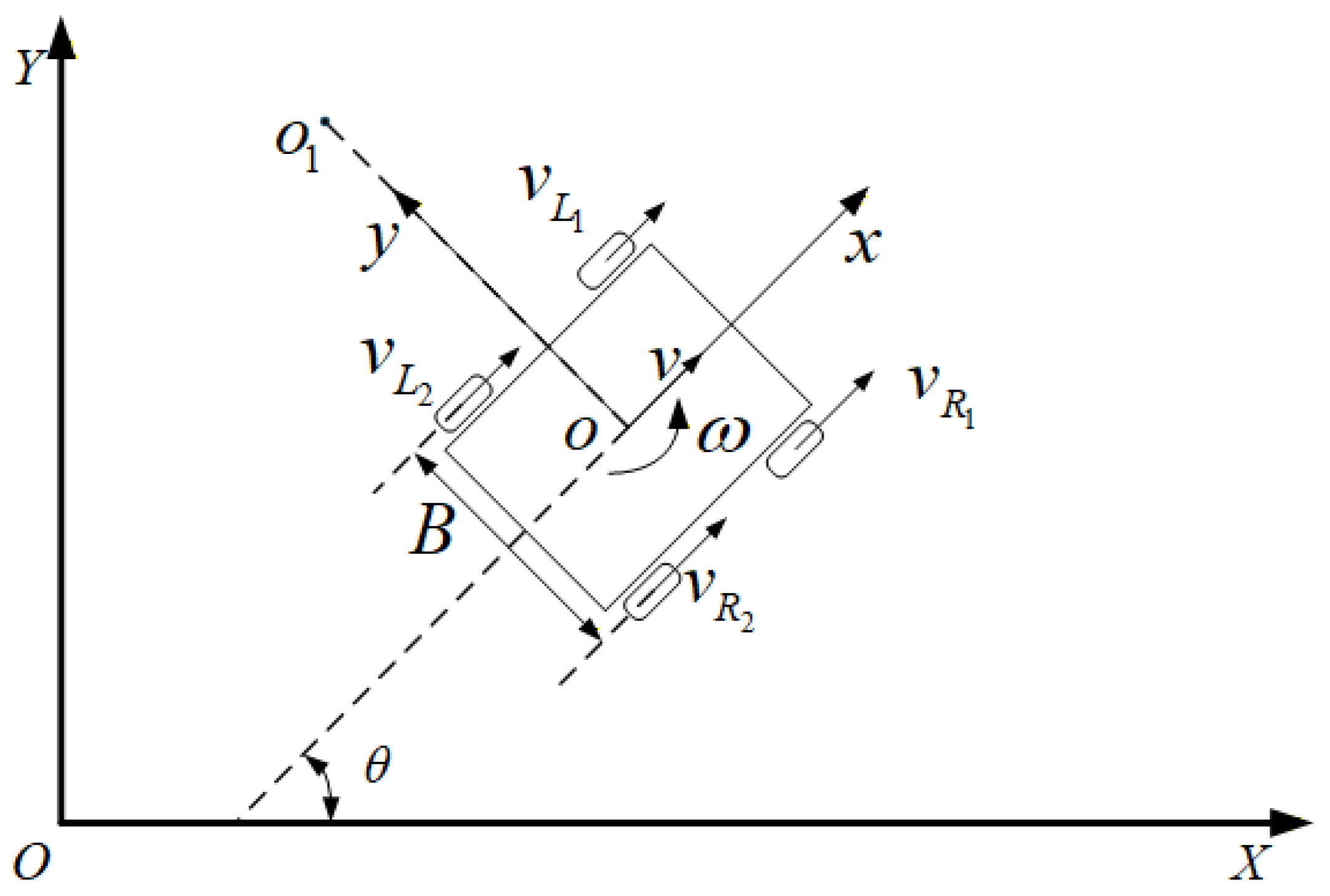
To establish a three-degree-of-freedom kinematic model of the intelligent sweeper, a global inertial coordinate system {O-XYZ} and a body-fixed coordinate system {o-xyz} are defined. The global coordinate system {O-XYZ} is fixed relative to the Earth, where the X- and Y-axes denote the eastward and northward directions, respectively. This system provides an absolute reference for describing the vehicle’s position and trajectory, which is essential for path planning and interaction with external environmental features. Meanwhile, the body-fixed coordinate system {o-xyz} is attached to the vehicle, with its origin located at the center of mass. The x-axis is aligned with the longitudinal direction of motion, and the y-axis is perpendicular to it, pointing toward the left side of the vehicle. Compared with the global frame, this local coordinate system more conveniently characterizes the vehicle’s dynamic behaviors, such as longitudinal motion and turning. The distinction between the fixed axes (X, Y) and the rotated axes (x, y) arises from the need to describe vehicle motion in both global and local contexts. Establishing these two coordinate systems enables coordinate transformation between global positioning for navigation purposes and local motion representation for control design. The relative rotation between (x, y) and (X, Y) therefore facilitates controller development and sensor data interpretation. The vehicle kinematics model is shown in Figure 1.
In our problem, a lateral velocity refers to the velocity component of the vehicle’s motion along the y-axis in the vehicle body coordinate system {o-xyz}. This is the velocity that represents the vehicle’s movement perpendicular to its forward direction, typically caused by steering or turning. If the lateral velocity is assumed to be zero, this implies that the vehicle is not experiencing any lateral movement, i.e., it is not slipping or sliding sideways. In this case, the vehicle’s motion is constrained to a pure rotational movement around the origin ( o 1 ), which is the center of rotation of the vehicle. This means that, with zero lateral velocity, the vehicle can only rotate around its central point without any side-to-side motion or deviation from its forward path. This scenario can be considered as a perfect turning condition, where the vehicle is rotating but not translating laterally.
The position of the intelligent sweeper in the geodetic coordinate system is set as x , y , θ T , the speed of the intelligent sweeper in the body coordinate system is set as v , ω T , and T represents the transpose operator of a vector or matrix.
The equivalent speed relationship of four-wheel differential drive is as follows:
ω = θ ˙ = v R v L B v = v R + v L 2
In this formulation, v L and v R denote the linear velocities of the left-side and right-side driving wheels of the intelligent sweeper, respectively, while B represents the wheelbase, defined as the distance between the centers of the left and right wheels.
Under the condition of ignoring the lateral velocity, the continuous-time nonlinear kinematic model of the vehicle can be expressed as follows:
x ˙ = ν cos θ y ˙ = ν sin θ θ ˙ = ω
where v denotes the translational velocity of the intelligent sweeper at its center of mass, ω is the yaw rate of the vehicle around the center of mass, and θ is the vehicle heading angle (yaw angle).
Write it into a compact state-space form to obtain the following:
x ˙ = cos θ 0 sin θ 0 0 1 v ω
The system state vector and control input vector are defined as follows:
x = x y θ , u = v ω
The nonlinear state equation of intelligent sweeper can be expressed as follows:
x ˙ = f ( x , u )
where the function f x , u represents the nonlinear state transition function of the intelligent sweeping vehicle derived from its kinematic model. Specifically, based on the global coordinate system and the body-fixed coordinate system, under the assumptions of pure rolling and negligible lateral slip velocity, the continuous-time nonlinear kinematic model of the vehicle is expressed as: x ˙ = f x , u , where the state vector is defined as x = x , y , θ T , representing the vehicle position in the global coordinate system, and u = v , ω T is the control input vector. The nonlinear function f x , u is explicitly determined from the following kinematic relationships: f x , u = v cos θ , v sin θ , ω T .

3. Trajectory Tracking Control Strategy

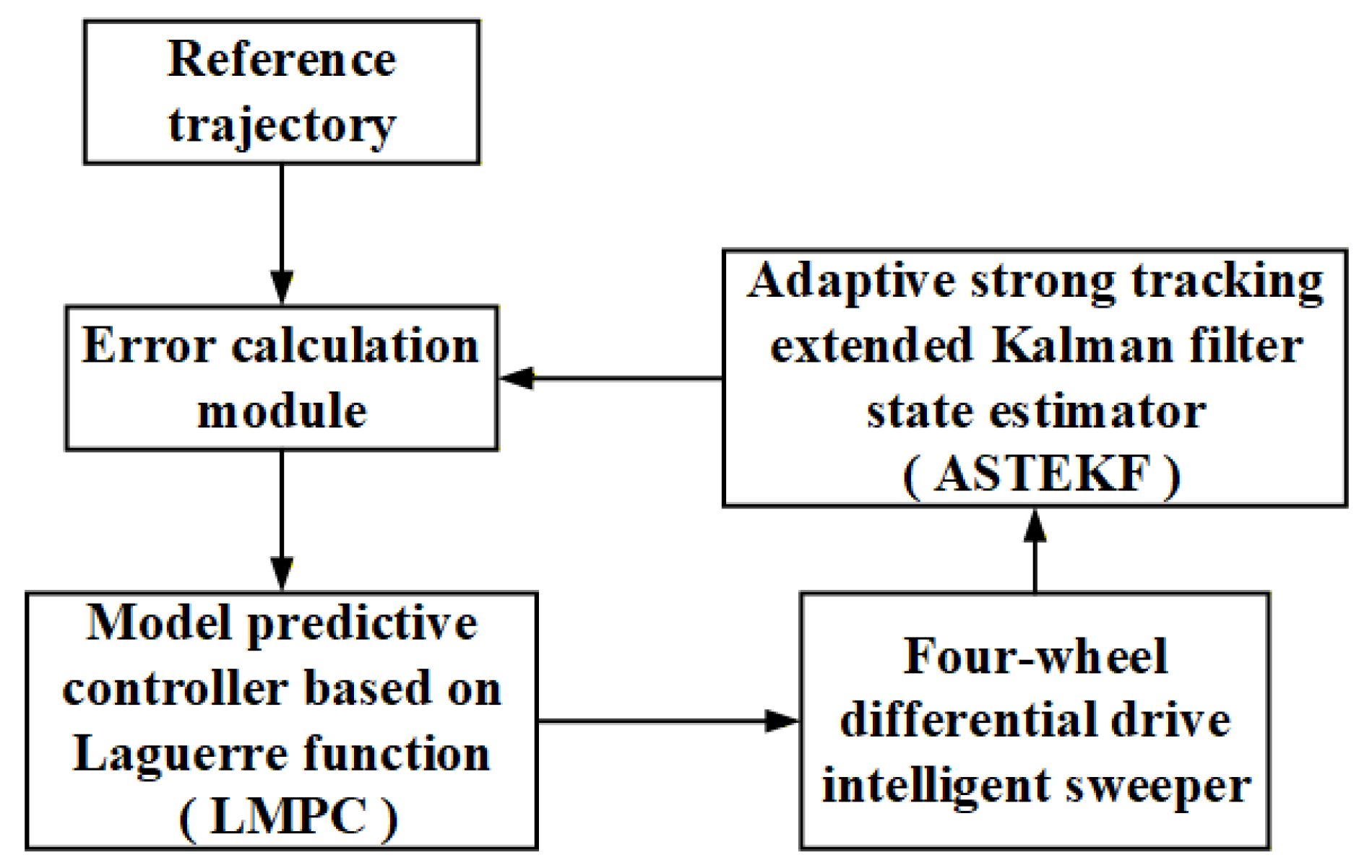
Aiming to improve the tracking precision and real-time capability of a four-wheel differential drive intelligent sweeper, a novel trajectory tracking scheme is constructed by combining an adaptive strong tracking extended Kalman filter with a Laguerre-function-parameterized model predictive control approach. The structure of the proposed system is depicted in Figure 2.

3.1. Kalman Filter State Estimator

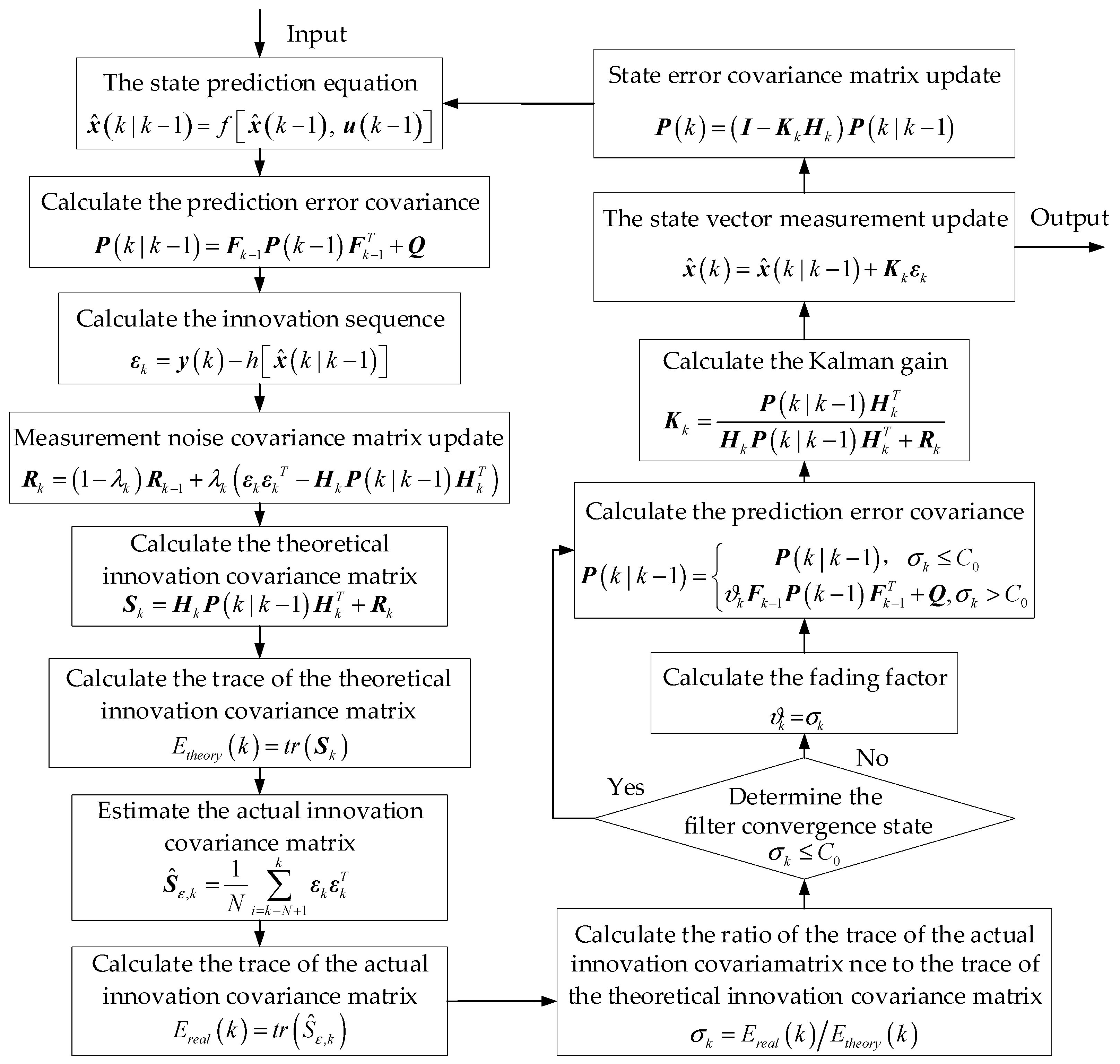
In conventional Kalman filtering, equal weighting is assigned to historical measurement data, which may result in significant estimation errors when the vehicle state varies rapidly [20]. To address this issue, an adaptive strong tracking extended Kalman filter (ASTEKF) is employed in this study. The Sage–Husa algorithm is incorporated to construct a time-varying noise statistical model, enabling online adjustment of the measurement noise covariance matrix within the filtering process. Furthermore, filter divergence is evaluated by comparing the trace of the actual innovation covariance matrix with that of the theoretical innovation covariance matrix. When divergence is detected, an adaptive fading factor is introduced to regulate the prediction error covariance matrix. The control block diagram is shown in Figure 3.
This mechanism enhances the filter’s capability to handle time-varying systems, while effectively suppressing estimation fluctuations and reducing errors caused by large noise levels or modeling inaccuracies. The resulting system model is given as follows:
x ( k ) = f x ( k 1 ) , u ( k 1 ) + w ( k 1 ) y ( k ) = h x ( k ) + v ( k )
where w denotes process noise, with its corresponding covariance matrix denoted as Q ; v denotes observation noise, with its corresponding covariance matrix denoted as R ; and the function f is the state transition function of the continuous-time kinematic model after discretization of the sampling period.
The state prediction equation is as follows:
x ^ k | k 1 = f x ^ k 1 , u k 1
Calculate the prediction error covariance using the following:
P k | k 1 = F k 1 P k 1 F k 1 T + Q
where F denotes the Jacobian matrix derived from the linearization of the state transition function with respect to the state vector:
F k 1 = f x , u x x ^ k 1 , u k 1 = 1 0 T v k 1 sin θ k 1 0 1 T v k 1 cos θ k 1 0 0 1
Calculate the innovation sequence as follows:
ε k = y k h x ^ k | k 1
The measurement Jacobian matrix is as follows:
H k = h x x x ^ k | k 1 = I 3
In the proposed nonlinear kinematic model, the state vector is defined as x = x , y , θ T , which includes only the vehicle pose (global position and heading angle). The longitudinal velocity v and yaw rate ω are not included as states. Instead, they are treated as the following known control inputs: u = v , ω T , where v is obtained from wheel odometry and ω is measured directly by the IMU gyroscope. Therefore, the filter estimates only the vehicle pose, while velocity and angular rate are directly measured inputs.
It should be emphasized that the expression H k = I 3 in Equation (11) is adopted for notational simplicity in the innovation formulation. In practice, the measurement vector corresponds only to the physically measurable variables, while the remaining states are estimated by the filter. Therefore, the formulation does not imply full-state direct measurement.
Regarding observability, the nonlinear kinematic model with IMU and wheel odometry measurements is locally observable under normal vehicle motion conditions (i.e., nonzero longitudinal velocity and yaw rate excitation). The coupling between translational and rotational motion enables reconstruction of the full state vector. This property is consistent with standard vehicle state estimation theory. Even though a full nonlinear observability rank analysis is beyond the scope of this study, the system satisfies local weak observability under persistent excitation conditions, which are naturally fulfilled during typical vehicle operation.
The measurement noise covariance matrix update is as follows:
R k = 1 λ k R k 1 + λ k ε k ε k T H k P k | k 1 H k T
where 0 < λ k < 1 . The parameter λ k is the forgetting factor in the Sage–Husa adaptive noise estimation framework, controlling the weighting between historical covariance and innovation-based instantaneous estimation [20].
Calculate the theoretical innovation covariance matrix using the following:
S k = H k P k | k 1 H k T + R k
Calculate the trace of the theoretical innovation covariance matrix using the following:
E t h e o r y k = t r S k
The following sliding window method is used to estimate the actual innovation covariance matrix:
S ^ ε , k = 1 N i = k N + 1 k ε k ε k T
where N denotes the number of innovation samples within the sliding window, and N is set to 20 in this study.
Calculate the trace of the actual innovation covariance matrix using the following:
E r e a l k = t r S ^ ε , k = 1 N i = k N + 1 k ε k ε k T
Calculate the ratio of the trace of the actual innovation covariance matrix to the trace of the theoretical innovation covariance matrix at time k using the following:
σ k = E r e a l k / E t h e o r y k
Establish a filter divergence judgment basis to determine whether the filter state is truly divergent at this moment, that is:
If σ k C 0 , then the filter converges (normal);
If σ k > C 0 , the filter diverges.
To detect potential filter divergence, an innovation consistency index is constructed as the ratio between the actual innovation covariance and its theoretical prediction. Under ideal filtering conditions, this ratio should approach unity. Therefore, the theoretical consistency boundary corresponds to C 0 = 1 . However, in practical applications, stochastic disturbances, sensor noise fluctuations, and modeling inaccuracies may cause transient deviations of the innovation statistics. To avoid excessive sensitivity to such random variations, a tolerance margin is introduced by selecting C 0 > 1 . The choice of C 0 reflects a trade-off between sensitivity and stability. If C 0 is chosen too close to 1, the filter may frequently activate the fading factor mechanism, leading to excessive covariance inflation and degraded estimation stability. Conversely, if C 0 is too large, divergence may not be detected in time, reducing the strong tracking capability. Empirical studies in the strong tracking filtering literature suggest that values in the range of 1.2–1.5 provide a good trade-off [20]. In this study, the value C 0 = 1.3 is adopted to provide a robustness buffer that balances false divergence alarms and delayed detection. Numerical experiments indicate that moderate variations of C 0 do not significantly affect the overall estimation performance, demonstrating that the proposed framework is not overly sensitive to this parameter.
After the time update, the state prediction covariance matrix can be expressed as follows:
P k | k 1 = P k | k 1 , σ k C 0 ϑ k F k 1 P k 1 F k 1 T + Q , σ k > C 0
In the formula, ϑ k is the fading factor, which is expressed as follows:
ϑ k = σ k
Calculate the Kalman gain K k using the following:
K k = P k | k 1 H k T H k P k | k 1 H k T + R k
The state vector measurement update is the observer state output value, which is as follows:
x ^ k = x ^ k | k 1 + K k ε k
The state error covariance matrix P k update is as follows:
P k = I K k H k P k | k 1

3.2. Model Predictive Controller Design Based on Laguerre Function

Model predictive control (MPC) performs a forward-looking estimation of system state evolution over a finite prediction horizon based on a system model and generates control commands in real time through a receding optimization scheme. In trajectory tracking problems, improving dynamic performance typically relies on the adoption of a longer control horizon; however, the resulting increase in computational complexity can significantly impair the real-time control capability of the system.
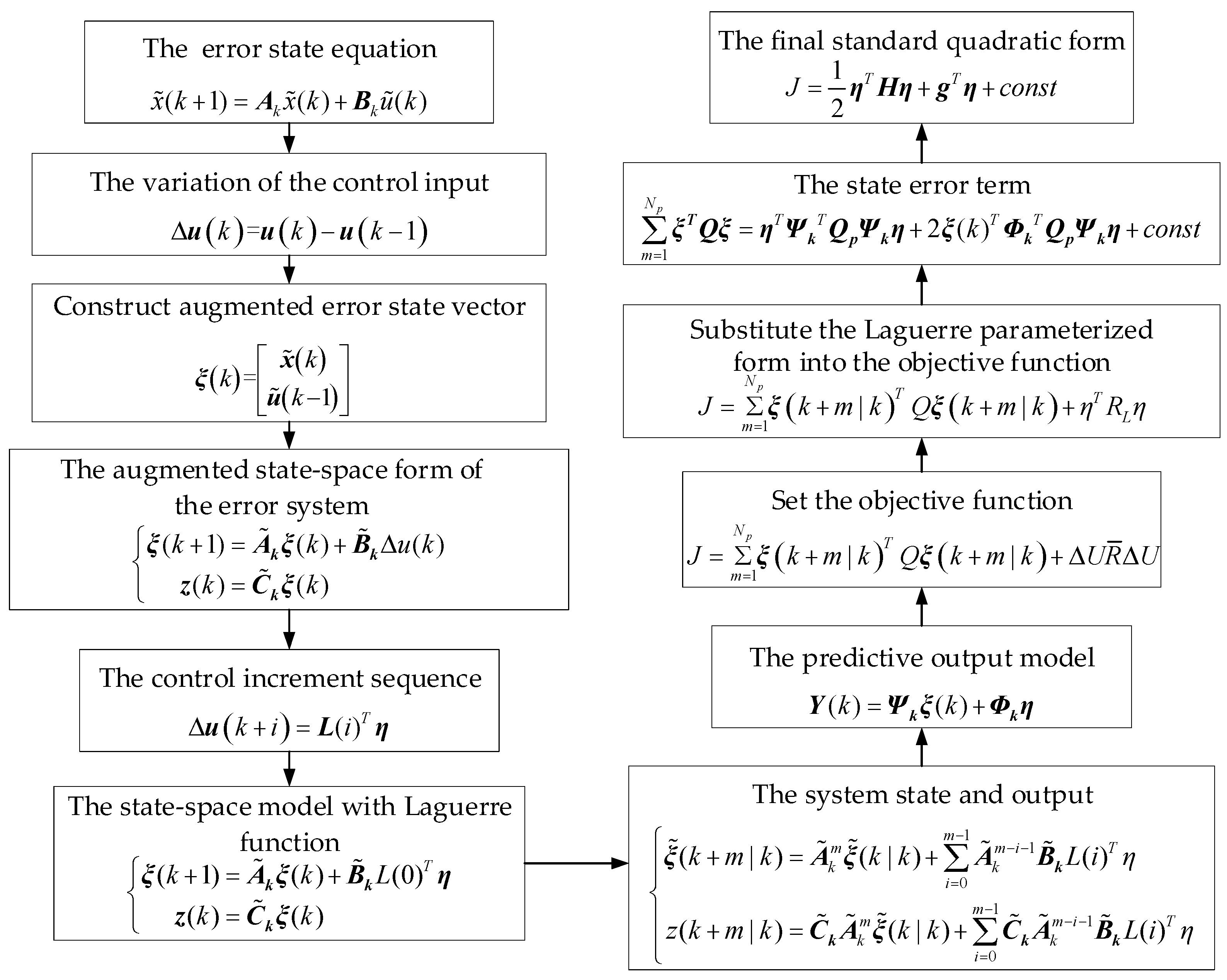
Aiming at the trajectory tracking problem of a four-wheel differential drive intelligent sweeper, this paper constructs an MPC controller based on a vehicle kinematics error model and further introduces the Laguerre function to parameterize the control increment sequence, so as to effectively reduce the online optimization calculation amount in the long prediction time domain. The block diagram of model predictive control based on the Laguerre function is shown in Figure 4.
The discrete Laguerre function sequence is defined as follows:
L i = l 1 i l 2 i l N i T
where N is the Laguerre order (number of basis functions), and l j i is the j-th Laguerre basis function at step i . Thus, L i represents the temporal basis vector that shapes how the control increment evolves at future time step i . It determines how the optimization coefficients influence the control action at each prediction step.
Its recursive form is as follows:
L i + 1 = A l L i
In the following formula:
A l = α 0 0 0 β α 0 0 α β β α 0 α N 2 β α N 3 β α N 4 β α ; α is the pole of the discrete Laguerre network, and 0 α 1 ; and β = 1 - α 2 .
The Laguerre pole α determines the decay rate of the basis functions and thus governs the temporal distribution of control effort within the prediction horizon. In the adopted kinematic modeling framework, α is tuned to balance tracking responsiveness and control smoothness rather than to match a specific physical bandwidth. From a frequency-domain interpretation, α affects the effective spectral content of the control sequence by attenuating high-frequency components in the parameterized representation. After comparative evaluation, α = 0.8 was selected as it achieves satisfactory tracking performance while maintaining smooth control inputs.
The initial conditions are as follows:
L 0 = β 1 α α N 1 T
where L 0 denotes the Laguerre basis function vector at the initial prediction step (i = 0). It is computed from the initial condition of the Laguerre network and depends on the chosen Laguerre pole α . Therefore, L 0 defines the starting shape of the exponentially decaying basis functions across the prediction horizon.
The Laguerre function is orthogonal and is as follows:
k = 0 l i k l j k = 0 , i j k = 0 l i k l j k = 1 , i = j
For a given reference trajectory, it can be regarded as a trajectory curve generated by the vehicle motion process, and any point along the trajectory satisfies the kinematic model described above. The reference quantities are denoted by r , and their general form is expressed as follows:
x ˙ r = f ( x r , u r )
Equation (27) describes the nonlinear kinematic model governing the reference trajectory. The reference state vector is defined as x r = x r y r θ r T , where x r and y r denote the reference position coordinates in the global frame, and θ r represents the reference heading angle. The reference control input is given by u r = v r ω r T , where v r is the reference linear velocity and ω r is the reference angular velocity. The function f ( x r , u r ) represents the nonlinear kinematic relationship of the vehicle, which ensures that the reference trajectory satisfies the system motion constraints.
Therefore, the state error vector and the control error vector are defined as follows:
x ˜ ( k ) = x ^ ( k ) x r ( k )
u ˜ ( k ) = u ( k ) u r ( k )
According to the nonlinear model, the following error propagation relationship can be obtained:
x ˜ ˙ = f ( x , u ) f ( x r , u r )
Under the assumption of small angle error, the error dynamics are linearized and discretized, and the following error state equation is obtained:
x ˜ ( k + 1 ) = A k x ˜ ( k ) + B k u ˜ ( k )
In the equation, A k = 1 0 v r sin θ r T 0 1 v r cos θ r T 0 0 1 , and B k = cos θ r T 0 sin θ r T 0 0 T .
In order to constrain the change rate of control quantity in adjacent control periods, the variation in the control input is introduced as follows:
Δ u k = u k u k 1
where u k is the control input at the current sampling instant, u k 1 is the control input at the previous sampling instant, and Δ u k represents the control increment. This is the standard incremental control formulation used in MPC to constrain the rate of change in the control input.
Construct the augmented error state vector, which is as follows:
ξ k = x ˜ k u ˜ k 1
where ξ k combines the system state error with the previous control error to form a new state variable. This facilitates modeling and constraining the control increment Δ u k in MPC. x ˜ k denotes the state error vector, as defined by Equation (28). u ˜ k 1 denotes the control error at the previous time step, as defined by Equation (29).
Accordingly, the augmented state-space form of the error system is given by the following:
ξ ( k + 1 ) = A ˜ k ξ ( k ) + B ˜ k Δ u ( k ) z ( k ) = C ˜ k ξ ( k )
where A ˜ k = A k B k 0 m × n I m , B ˜ k = B k I m , C ˜ k = H k 0 , n is the state quantity dimension, and m is the control dimension.
To mitigate the increase in computational complexity resulting from a long control horizon, it is assumed that the control increment sequence in the future prediction time domain can be approximated by a linear combination of the following finite Laguerre orthogonal basis functions:
Δ u k + i = L ( i ) T η
where L ( i ) T is the Laguerre basis function vector, and η is the Laguerre coefficient vector to be optimized (optimization variable).
Substituting the above formula into the augmented state-space model Formula (34), the following state-space model with a Laguerre function is obtained:
ξ ( k + 1 ) = A ˜ k ξ ( k ) + B ˜ k L ( 0 ) T η z ( k ) = C ˜ k ξ ( k )
Thus, the system state and system output at the future k + m time can be predicted according to the state and output at the current k sampling time, which is shown as follows:
ξ ˜ ( k + m | k ) = A ˜ k m ξ ˜ ( k | k ) + i = 0 m 1 A ˜ k m i 1 B ˜ k L ( i ) T η z ( k + m | k ) = C ˜ k A ˜ k m ξ ˜ ( k | k ) + i = 0 m 1 C ˜ k A ˜ k m i 1 B ˜ k L ( i ) T η
Therefore, the predictive output model is as follows:
Y ( k ) = Ψ k ξ ( k ) + Φ k η
where Y ( k ) = z ( k + 1 ) z ( k + 2 ) z ( k + N p ) T , Ψ k = C ˜ k A ˜ k C ˜ k A ˜ k 2 C ˜ k A ˜ k N p T , and Φ k = C ˜ k B ˜ k L ( 0 ) T C ˜ k A ˜ k B ˜ k L ( 0 ) T + B ˜ k L ( 1 ) T C ˜ k A ˜ k 2 B ˜ k L ( 0 ) T + A ˜ k B ˜ k L ( 1 ) T + B ˜ k L ( 2 ) T C ˜ k i = 0 N c 1 A ˜ k N p 1 i B ˜ k L ( i ) T .
Set the objective function to be the following:
J = m = 1 N p ξ k + m | k T Q ξ k + m | k + Δ U R ¯ Δ U s . t . U min U U max   Δ U min Δ U Δ U max
where Δ U R ¯ Δ U = m = 0 N p Δ u k + m T r w Δ u k + m , r w is the control increment weight, and Δ u k + m = l 1 m l 2 m l N m η , R ¯ = b l k d i a g R , , R is the control incremental weight matrix in the predictive time domain, which is used to constrain the control variation range. For clarity, the operator “ b l k d i a g ” denotes a block diagonal matrix construction.
Substitute the Laguerre parameterized form into the objective function to obtain the following:
J = m = 1 N p ξ k + m | k T Q ξ k + m | k + η T R L η s . t . M L η Δ U max M L η Δ U min   M η U max u k 1 M η u k 1 U min
where R L = m = 0 N p L m R L m T ; Δ U max , Δ U min , U max , and U min are the maximum and minimum constraints of control increment and control quantity, respectively; and M L = L 0 T L 1 T L N c 1 T , M = L 0 T L 0 T + L 1 T j = 0 N p 1 L j T .
Although the state and input constraints are explicitly formulated in Equation (40) and incorporated into the Laguerre-based MPC optimization, their activation is not dominant in the presented simulations. This is mainly because the intelligent sweeping vehicle operates under low-speed conditions and follows feasible reference trajectories designed within physical limits. The imposed constraints mainly represent actuator saturation and safety bounds on longitudinal velocity and yaw rate. During nominal trajectory tracking, the control inputs remain within the admissible region for most time instants, indicating that the optimization problem is not effectively unconstrained but operates with sufficient feasibility margin. Nevertheless, the inclusion of constraints ensures that physical limitations are respected under all operating conditions, and their enforcement provides robustness against unexpected disturbances or aggressive maneuvers. It should be noted that the primary objective of the constraints is to guarantee feasibility and safety, rather than to intentionally drive the system into constraint-saturated regimes.
The state error term is expanded as follows:
m = 1 N p ξ T Q ξ = η T Ψ k T Q p Ψ k η + 2 ξ ( k ) T Φ k T Q p Ψ k η + c o n s t
where Q p = b l k d i a g Q , , Q is the error weight block diagonal matrix in the prediction time domain.
Therefore, the final standard quadratic form is as follows:
J = 1 2 η T H η + g T η + c o n s t
where H = 2 Ψ k T Q p Ψ k + R L is a symmetric positive definite Hessian matrix, g = Ψ k T Q p Φ k ξ ( k ) is the coefficient vector of linear term, and c o n s t is a constant term independent of the optimization variables.
In conventional MPC, the number of optimization variables grow linearly with the control horizon N c . By introducing Laguerre function parameterization, the number of decision variables is reduced from m N c to m N , where N N c . (In this paper, the prediction horizon is set to N p = 30 , the control horizon in conventional MPC is set to N c = 20 , and the Laguerre order is selected as N = 4 .) This dimensionality reduction significantly decreases the computational burden of the quadratic programming problem, improving real-time feasibility compared to the standard MPC and Tube-MPC formulations. The specific computational complexity comparisons are shown in Table 1.
Here, m denotes the number of control inputs, N c is the control horizon, N is the number of Laguerre basis functions (with N N c ), and n represents the system state dimension. Compared with conventional MPC, the proposed Laguerre-based MPC reduces the number of optimization variables from m N c to m N . Since N is typically much smaller than N c , the dimension of the quadratic programming problem is significantly reduced.
In Tube-MPC, additional variables and constraint-tightening mechanisms are introduced to guarantee robustness, further increasing computational complexity. In contrast, the proposed ASTEKF–LMPC framework enhances robustness through adaptive state estimation rather than enlarging the optimization problem.

4. Simulation Analysis and Experimental Verification

A MATLAB/Simulink-based simulation environment is developed to assess the robustness of the proposed control strategy against modeling inaccuracies and external perturbations. Considering the real-world application of the intelligent sweeper, a double-lane-change trajectory is employed for tracking evaluation. The corresponding vehicle parameters are listed in Table 2.

4.1. Simulation Under Different Operating Conditions

Before presenting the simulation results, the compared control strategies are briefly introduced. The first baseline method is the conventional model predictive control (MPC) [10], which is designed based on the linearized vehicle kinematic error model without Laguerre function parameterization or adaptive state estimation. The second method is the extended Kalman filter with model predictive control (EKF + MPC), which integrates traditional state estimation via the extended Kalman filter (EKF) with a standard model predictive control (MPC) controller. The EKF provides estimated states, while the MPC generates optimal control actions within a limited field of view. The third method is the tube-based model predictive control (Tube-MPC), a robust MPC framework that ensures constraint satisfaction under bounded disturbances through the construction of invariant error tubes [19]. The proposed method, denoted as ASTEKF–LMPC, integrates an adaptive strong tracking extended Kalman filter (ASTEKF) for robust state estimation with a Laguerre-function-parameterized MPC (LMPC) to reduce online computational complexity while maintaining tracking performance.

4.1.1. Cleaning Operation Conditions

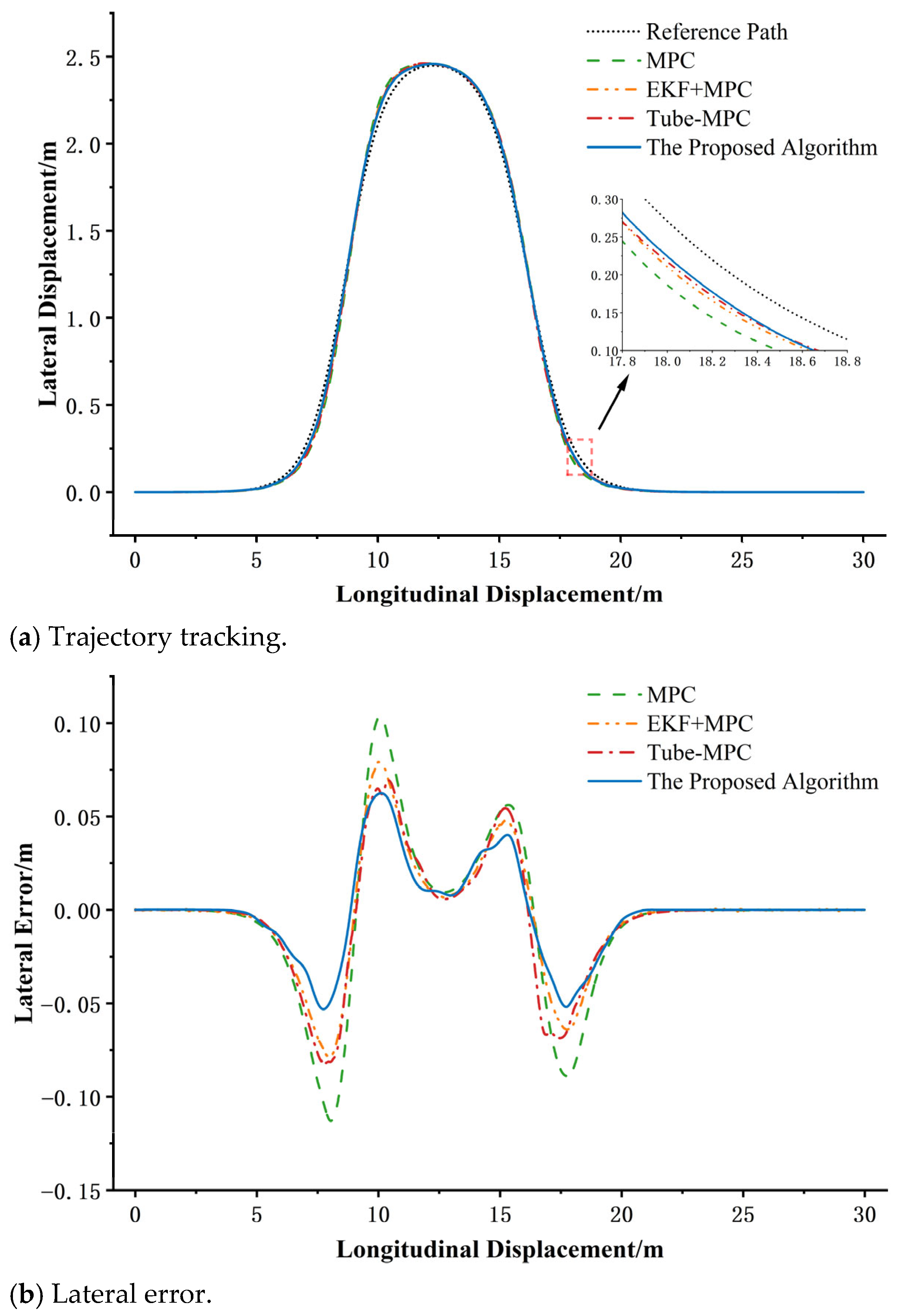
Condition 1 is a driving speed of 3.6 km/h under the cleaning operation condition, and the simulation outcomes obtained are depicted in Figure 5.
To prevent the randomness of test results caused by a single trial, each controller was tested 20 times to ensure the accuracy of the results. For each performance metric (maximum error, RMS error, IAE, and steady-state bias), the mean value and standard deviation were computed. The reported values are expressed as mean ± standard deviation. The relatively small standard deviations indicate good repeatability and robustness of the proposed method. A comprehensive comparison of tracking performance can be seen in Table 3.
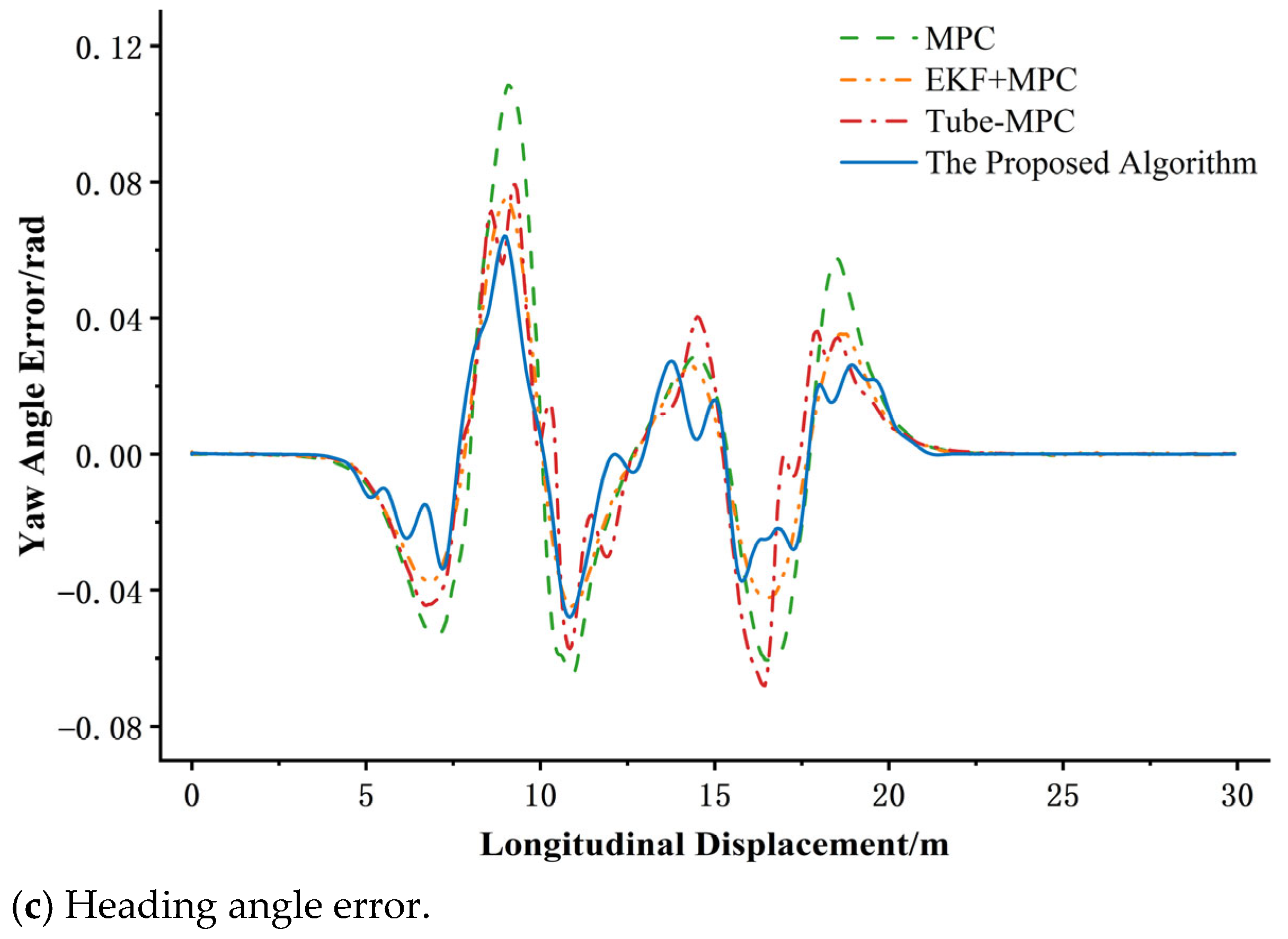
Figure 5a compares the trajectory tracking performance of different control strategies. It can be observed that the proposed method achieves a closer agreement with the reference trajectory than the MPC, EKF + MPC and Tube-MPC algorithms. The lateral deviation comparison is presented in Figure 5b, where the proposed algorithm exhibits a maximum deviation of 0.0625 m, whereas the corresponding values for the MPC, EKF + MPC and Tube-MPC approaches are 0.1129 m, 0.0791 m and 0.0822 m, respectively. Figure 5c illustrates the heading angle error results, indicating that the proposed method limits the maximum heading angle error to 0.0640 rad, compared with 0.1084 rad for the MPC controller, 0.0755 rad for the EKF + MPC controller and 0.0792 rad for the Tube-MPC controller.
Under the cleaning operation scenario and with the intelligent sweeper operating at a speed of 3.6 km/h, the experimental results demonstrate that the proposed control strategy can effectively enhance trajectory tracking accuracy. Specifically, in terms of the maximum lateral deviation, the proposed approach improves tracking accuracy by 44.65%, 20.99% and 23.97% relative to the MPC, EKF + MPC and Tube-MPC algorithms, respectively. Similarly, for the maximum heading angle error, accuracy improvements of 40.96%, 15.23% and 19.19% are achieved, respectively. These results confirm that the proposed method provides a clear advantage in trajectory tracking performance.

4.1.2. Non-Cleaning Operation Conditions

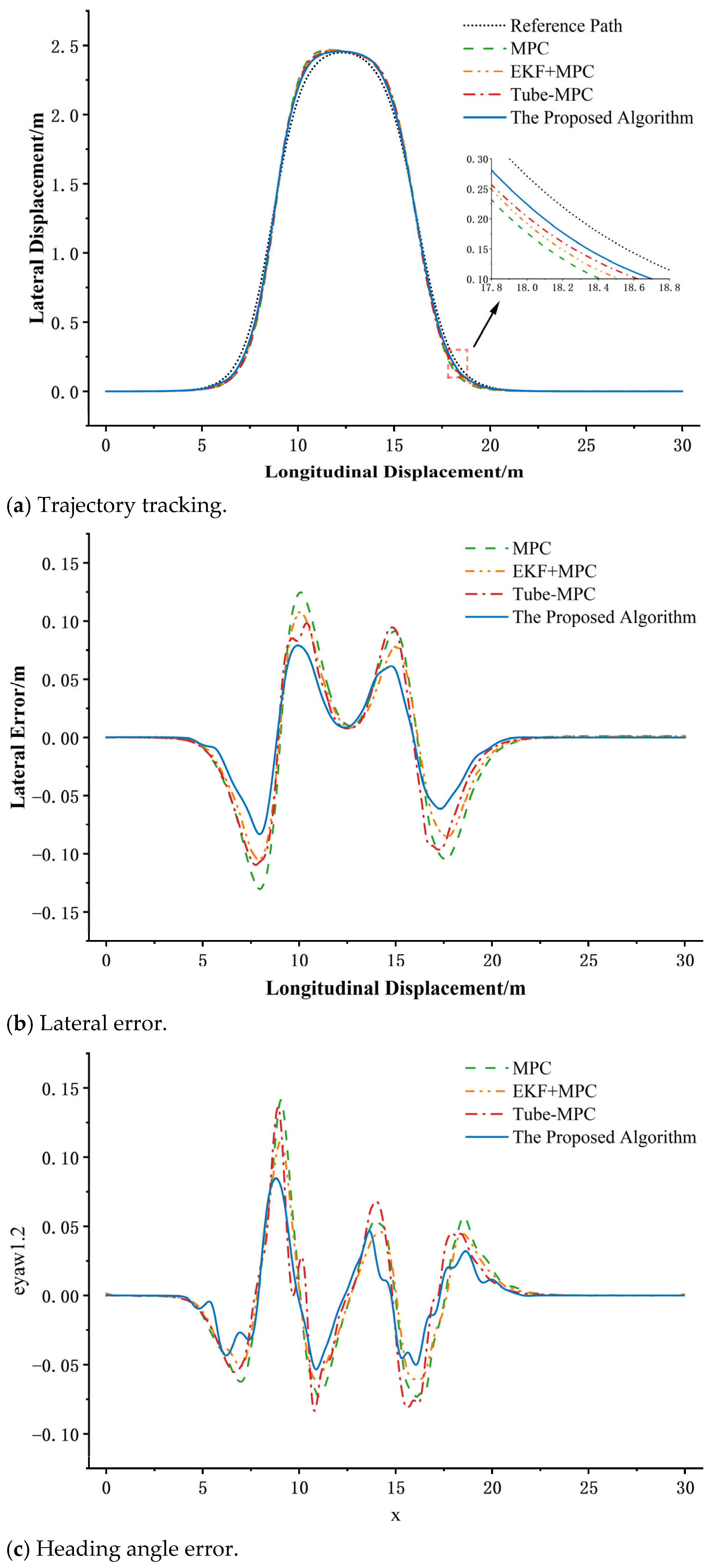
Condition 2 is a driving speed of 10.8 km/h under the non-cleaning operation condition, and the simulation outcomes obtained are depicted in Figure 6.
To prevent the randomness of test results caused by a single trial, each controller was tested 20 times to ensure the accuracy of the results. For each performance metric (maxi-mum error, RMS error, IAE, and steady-state bias), the mean value and standard deviation were computed. The reported values are expressed as mean ± standard deviation. The relatively small standard deviations indicate good repeatability and robustness of the pro-posed method. A comprehensive comparison of tracking performance can be seen in Table 4.
Figure 6 provides a comparative evaluation of trajectory tracking performance under non-cleaning operating conditions. As illustrated in Figure 6a, the proposed control strategy maintains superior tracking behavior relative to the MPC, EKF + MPC and Tube-MPC algorithms, with the vehicle trajectory closely following the reference path. The lateral deviation comparison in Figure 6b shows that the maximum deviation produced by the proposed algorithm is 0.0831 m, which is noticeably lower than the values of 0.1304 m, 0.1076 m and 0.1096 m obtained using the MPC, EKF + MPC and Tube-MPC algorithms, respectively. The heading angle error results depicted in Figure 6c indicate that the proposed approach achieves a maximum error of 0.0848 rad, compared with 0.1414 rad for the MPC controller, 0.1117 rad for the EKF + MPC controller and 0.1363 rad for the Tube-MPC controller.
From a quantitative perspective, the proposed method improves the accuracy of maximum lateral deviation by 36.27%, 22.77% and 24.18% relative to the MPC, EKF + MPC and Tube-MPC algorithms, respectively. In addition, improvements of 40.03%, 24.08% and 37.79% are achieved in terms of the maximum heading angle error. These results confirm that the proposed method provides a clear advantage in trajectory tracking performance.

4.1.3. Actuator Smoothness Analysis

In addition to tracking accuracy, actuator smoothness is an important performance metric for intelligent sweeping vehicles. Excessive variations in control inputs may lead to increased mechanical wear and unnecessary actuation effort.
In the proposed Laguerre-based MPC framework, a control increment penalty term is introduced in the cost function to suppress abrupt changes in longitudinal velocity and yaw rate, thereby improving actuator smoothness.
To quantitatively evaluate control smoothness, the root mean square (RMS) values of control increments are calculated as follows:
R M S Δ v = 1 N k = 1 N Δ v k 2
R M S Δ ω = 1 N k = 1 N Δ ω k 2
where Δ v k and Δ ω k denote the longitudinal velocity increment and yaw rate increment at time step k , respectively.
Table 5 presents the comparison results under cleaning operation conditions. It can be observed that the proposed algorithm achieves smaller control variations than conventional MPC, EKF + MPC and Tube-MPC, indicating improved actuator smoothness.
Although an explicit energy consumption model is not included in the present kinematic framework, reduced control variation generally corresponds to lower actuation effort in practical implementations.

4.1.4. Computational Performance Analysis

To validate the real-time feasibility of the proposed control strategy, a computational performance comparison was conducted among conventional MPC, EKF + MPC, Tube-MPC, and the proposed algorithm (ASTEKF–LMPC) under cleaning operation conditions.
The benchmarking was performed over 100 consecutive control iterations in MATLAB (Intel i5 CPU, MATLAB R2023b). The average and maximum CPU times per sampling step were recorded, and the results are summarized in Table 6.
As shown in Table 6, the proposed algorithm significantly reduces the number of decision variables by parameterizing the control sequence using Laguerre basis functions. The decision variable dimension decreases from 20 to 4, which leads to a substantial reduction in optimization time. The average computational time of the proposed method is 2.4 ms, which is considerably lower than that of conventional MPC and Tube-MPC. Considering that the sampling period of the control system is 50 ms, the proposed approach occupies only 4.8% of the available computation time. Therefore, sufficient computational margin is reserved for other auxiliary tasks. These results demonstrate that the proposed control strategy achieves improved real-time capability while maintaining superior tracking performance.

4.1.5. Weight Selection and Sensitivity Analysis

The following weighting matrices in the cost function are selected: Q = d i a g 100 , 20 , 50 and R = d i a g 0.5 , 0.2 . The three diagonal elements of Q correspond to longitudinal tracking error, lateral tracking error, and heading error, respectively. The diagonal elements of R penalize the increments of longitudinal velocity and yaw rate. The weights are determined through empirical tuning to achieve a balance between tracking accuracy and actuator smoothness. To evaluate parameter sensitivity, the weighting matrices were varied within ±30% of their nominal values. The simulation results show that the tracking performance and control smoothness remain stable, indicating that the proposed method is not overly sensitive to moderate weight variations.

4.2. Experimental Verification

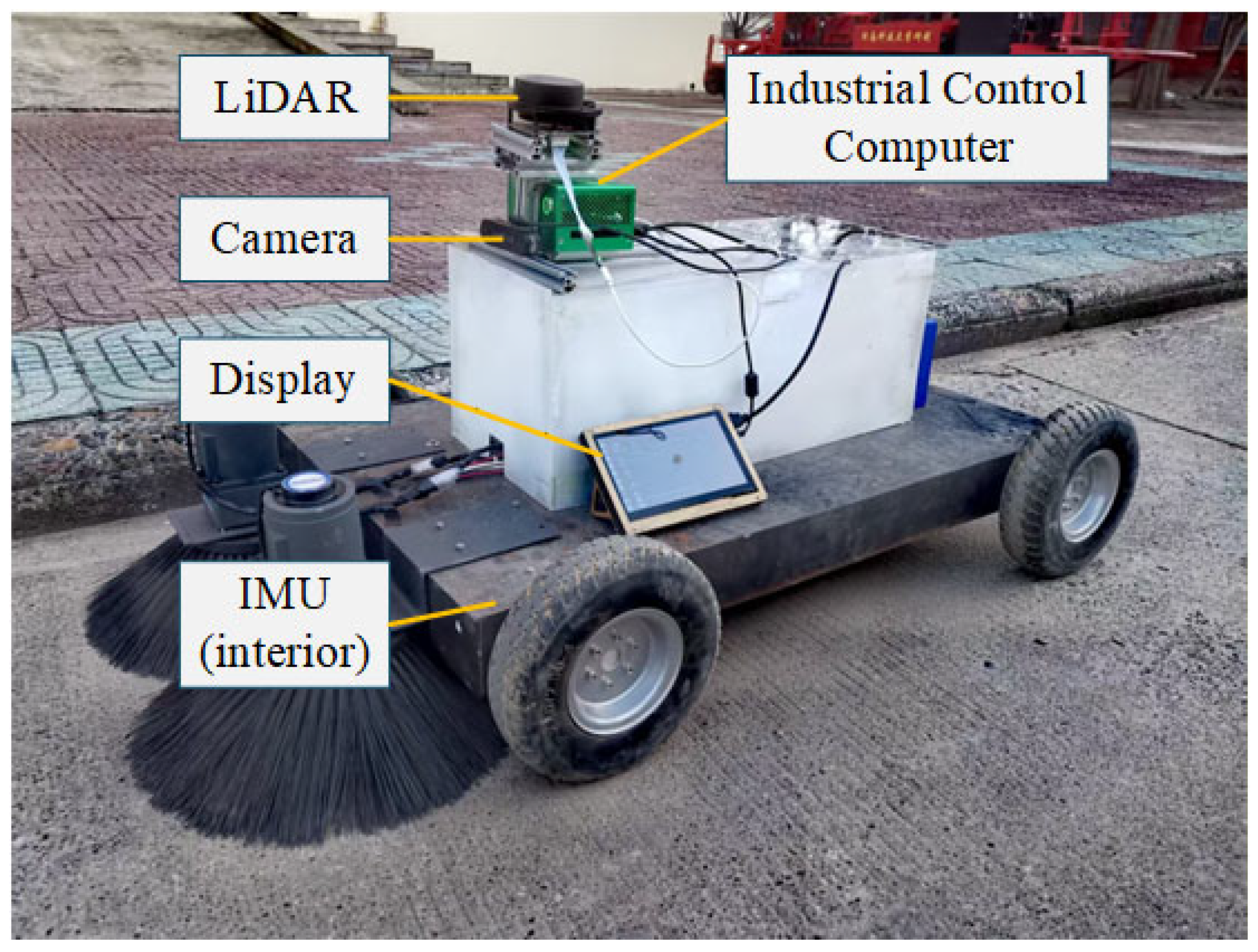
To further validate the practical effectiveness of the proposed algorithm on a real vehicle platform, field experiments were conducted using an intelligent sweeping vehicle, the overall structure of which is illustrated in Figure 7, and the key parameters are summarized in Table 7. The intelligent sweeping vehicle adopts a fully drive-by-wire chassis with four-wheel independent drive and integrates multiple sensing and control components, including an STM32C50C microcontroller, an inertial measurement unit (IMU), and wheel odometry, thereby providing reliable support for vehicle state perception and control command execution. The real-vehicle experiments were carried out on a campus concrete road to evaluate the trajectory tracking performance of the proposed algorithm under practical road conditions. The corresponding experimental results are presented in Figure 8.
The experimental platform integrates an IMU and wheel encoders. The IMU is subject to measurement noise and bias drift, while wheel odometry may suffer from slip-induced errors on concrete surfaces. Although a detailed statistical uncertainty analysis is beyond the scope of this study, these practical sensor imperfections are inherently reflected in the experimental results. The ASTEKF framework is designed to adaptively adjust noise covariance and mitigate the influence of such time-varying uncertainties. The noise characteristics of the sensors used in the experimental platform are shown in Table 7.
The above noise statistics represent the typical uncertainty levels of low-cost industrial sensors deployed on intelligent sweeping vehicles. The noise is assumed to follow zero-mean Gaussian distributions and is incorporated into the state estimation model through the process noise covariance matrix Q and measurement noise covariance matrix R .
For real-vehicle experiments, 10 repeated trajectory tracking trials were performed under the same reference path and operating speed. A comprehensive comparison of tracking performance can be seen in Table 8.
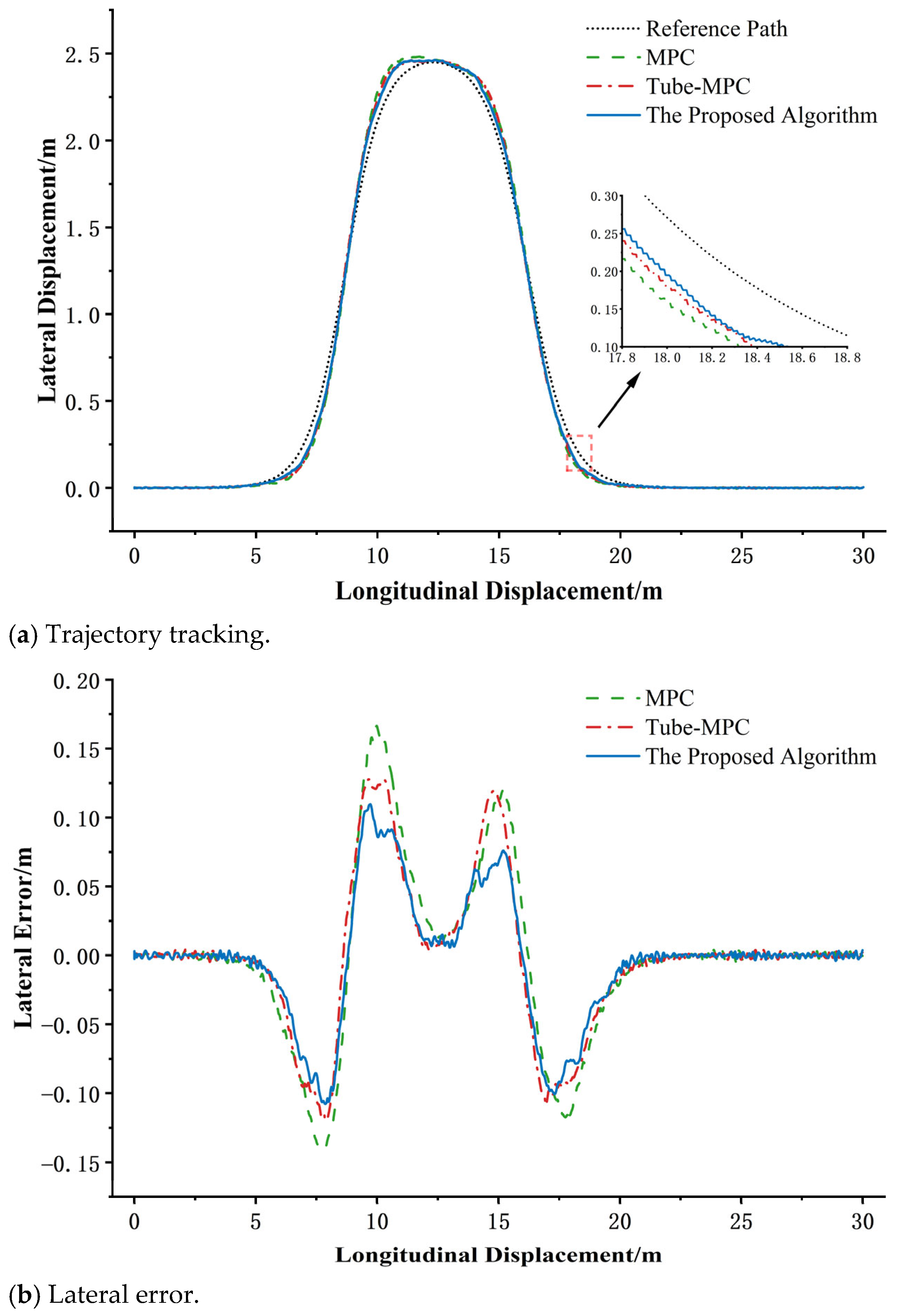
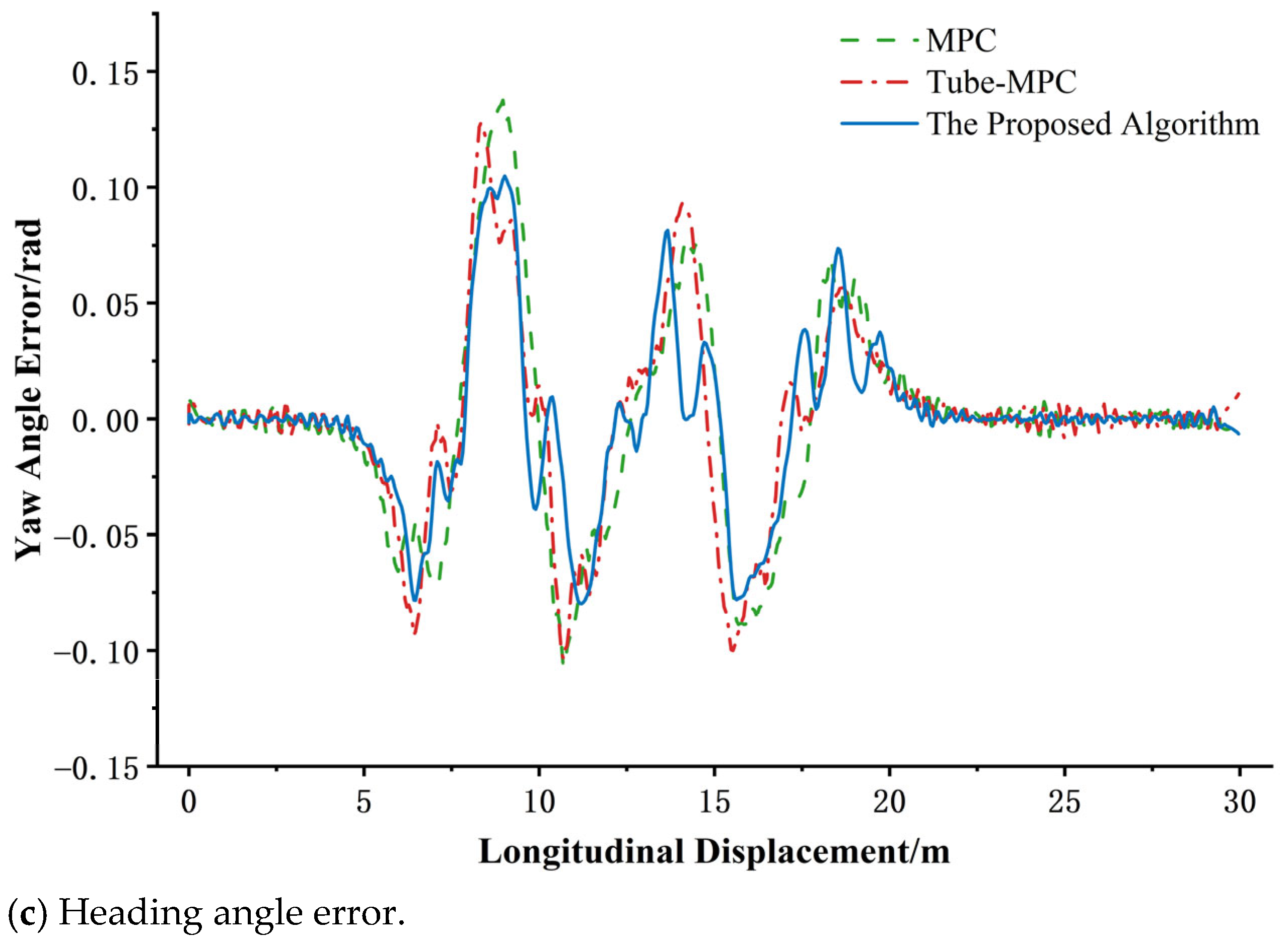
Figure 8 compares the trajectory tracking results obtained on the actual vehicle platform. As shown in Figure 8a, the proposed method continues to outperform the MPC and Tube-MPC algorithms in terms of tracking accuracy. The lateral deviation comparison in Figure 8b shows that the maximum deviation produced by the proposed algorithm is 0.1095 m, which is noticeably lower than the values of 0.1665 m and 0.1277 m obtained using the MPC and Tube-MPC algorithms, respectively. The heading angle error results depicted in Figure 8c indicate that the proposed approach achieves a maximum error of 0.1057 rad, compared with 0.1376 rad for the MPC controller and 0.1280 rad for the Tube-MPC controller.
From a quantitative perspective, the proposed method improves the accuracy of maximum lateral deviation by 34.25% and 14.25% relative to the MPC and Tube-MPC algorithms, respectively. In addition, improvements of 23.18% and 17.42% are achieved in terms of the maximum heading angle error. These results demonstrate that, on the actual vehicle platform, the proposed control strategy exhibits a marked advantage in terms of trajectory tracking accuracy.

5. Conclusions

This paper proposes a trajectory tracking control framework for intelligent sweeping vehicles by integrating an adaptive strong tracking extended Kalman filter (ASTEKF) with a Laguerre-based model predictive controller (LMPC). The effectiveness of the proposed method has been validated through comparative simulations with conventional MPC and Tube-MPC under low-speed operating conditions.
In terms of tracking accuracy, the proposed method achieves significant quantitative improvements. The maximum lateral deviation is reduced to 0.0831 m, which corresponds to reductions of 36.27% and 24.19% compared with conventional MPC (0.1304 m) and Tube-MPC (0.1096 m), respectively. Meanwhile, the maximum heading angle error is reduced to 0.0848 rad, achieving performance improvements of 40.02% and 37.79% relative to MPC (0.1414 rad) and Tube-MPC (0.1363 rad). These results demonstrate that the incorporation of the ASTEKF enhances state estimation accuracy and effectively improves closed-loop tracking performance.
Regarding control smoothness, the introduction of control increment regularization together with Laguerre function parameterization significantly reduces actuator variation. The root mean square (RMS) values of the control increments in both longitudinal velocity and yaw rate are lower than those obtained using MPC and Tube-MPC, indicating smoother control actions. This improvement contributes to reduced mechanical wear and potentially lower energy consumption during long-term sweeping operations.
From the perspective of computational efficiency, the Laguerre parameterization substantially reduces the dimensionality of the optimization problem. In conventional MPC, the number of decision variables is proportional to the control horizon. In this study, with a control horizon of 20 and a two-dimensional control input, the number of optimization variables is 40. By introducing a Laguerre order of four, the number of decision variables is reduced to eight, representing an 80% reduction in optimization dimension. This reduction significantly decreases the computational burden of the quadratic programming problem. Under a sampling period of 50 ms, the proposed method satisfies real-time execution requirements, demonstrating its practical feasibility for embedded implementation.
Furthermore, input and input-increment constraints are explicitly incorporated into the optimization formulation. Simulation results confirm that all control inputs remain within prescribed bounds throughout the tracking process, ensuring safe and physically feasible vehicle operation.
Overall, the proposed ASTEKF + LMPC framework achieves higher tracking accuracy, smoother control performance, reduced computational complexity, and guaranteed constraint satisfaction compared with conventional MPC and Tube-MPC. These advantages demonstrate that the proposed method provides an effective balance between robustness, real-time feasibility, and control performance, making it well suited for intelligent low-speed sweeping vehicles.

Author Contributions

Conceptualization, Z.G. and H.S.; methodology, H.S.; software, H.S.; validation, H.S. and Z.G.; formal analysis, T.Z.; investigation, M.P., Y.T. and Y.L.; resources, M.P., Y.T. and Y.L.; data curation, H.S.; writing—original draft preparation, H.S. and T.Z.; writing—review and editing, H.S. and Z.G. All authors have read and agreed to the published version of the manuscript.

Funding

This research was funded by the National Natural Science Foundation of China, grant number 51675163.

Data Availability Statement

The data that support the findings of this study are available from the corresponding author upon reasonable request.

Conflicts of Interest

Authors Y.T. and Y.L. were employed by the company Henan Kairui Vehicle Inspection and Certification Center Co., Ltd. The remaining authors declare that the research was conducted in the absence of any commercial or financial relationships that could be construed as a potential conflict of interest.

References

  1. Yang, B. Research on Trajectory Planning and Tracking Control of Autonomous Cleaning Vehicles in the Park. Doctoral Dissertation, Jilin University, Changchun, China, 2023. [Google Scholar]
  2. Kong, F.X. Research on Path Planning and Trajectory Tracking Control of 4WIDS Cleaning Robot. Master’s Thesis, Beijing University of Posts and Telecommunications, Beijing, China, 2024. [Google Scholar]
  3. Zhu, C.; Li, B.; Zhao, C.; Wang, Y. Trajectory Tracking Control of Car-like Mobile Robots Based on Extended State Observer and Backstepping Control. Electronics 2024, 13, 1563. [Google Scholar] [CrossRef]
  4. Huang, X.T. Design and Implementation of Autonomous Sweeping Vehicle for Factory. Master’s Thesis, Beijing Forestry University, Beijing, China, 2020. [Google Scholar]
  5. Mao, Z.B.; Suzuki, S.; Nabae, H.; Miyagawa, S.; Suzumori, K.; Maeda, S. Machine learning-enhanced soft robotic system inspired by rectal functions to investigate fecal incontinence. Bio-Des. Manuf. 2025, 8, 482–494. [Google Scholar] [CrossRef]
  6. Paden, B.; Čáp, M.; Yong, S.Z.; Yershov, D.; Frazzoli, E. A survey of motion planning and control techniques for self-driving urban vehicles. IEEE Trans. Intell. Veh. 2016, 1, 33–55. [Google Scholar] [CrossRef]
  7. Shiller, Z.; Sundar, S. Emergency maneuvers of autonomous vehicles. IEEE Trans. Robot. Autom. 1998, 14, 469–480. [Google Scholar] [CrossRef]
  8. Coulter, R.C. Implementation of the Pure Pursuit Path Tracking Algorithm. Master’s Thesis, Carnegie Mellon University, Pittsburgh, PA, USA, 1992. [Google Scholar]
  9. Thrun, S.; Montemerlo, M.; Dahlkamp, H.; Stavens, D.; Aron, A.; Diebel, J.; Fong, P.; Gale, J.; Halpenny, M.; Hoffmann, G.; et al. Stanley: The robot that won the DARPA Grand Challenge. J. Field Robot. 2006, 23, 661–692. [Google Scholar] [CrossRef]
  10. Chen, J.; Xu, X.; Yang, J. Adaptive Model Predictive Control for Autonomous Vehicle Trajectory Tracking. Vehicles 2025, 7, 114. [Google Scholar] [CrossRef]
  11. Zhang, Q.; Zhang, Y. Trajectory Tracking Control of Intelligent Vehicles with Adaptive Model Predictive Control and Reinforcement Learning Under Variable Curvature Roads. Technologies 2025, 13, 394. [Google Scholar] [CrossRef]
  12. Chen, W.; Liu, F.; Zhao, H. Trajectory-Tracking Control of Unmanned Vehicles Based on Adaptive Variable Parameter MPC. Appl. Sci. 2024, 14, 7285. [Google Scholar] [CrossRef]
  13. Kumar, N.; Pachamuthu, R. Real-Time LPV-Based Non-Linear Model Predictive Control for Robust Trajectory Tracking in Autonomous Vehicles. Intl. J. Automotive Technol. 2024, 25, 1361–1376. [Google Scholar]
  14. Du, R.; Hu, H.; Gao, K.; Zhang, Y. Trajectory tracking control of autonomous vehicles based on model predictive control with variable prediction horizon. J. Mech. Eng. 2022, 58, 275–285. [Google Scholar] [CrossRef]
  15. Xie, X.; Wang, Y.; Jin, L.; Zhao, X.; Guo, B.; Liao, Y.; Zhou, B.; Li, K. Trajectory Tracking Control of Intelligent Vehicles Based on Variable Control Horizon Time Step. J. Jilin Univ. (Eng. Technol. Ed.) 2024, 54, 620–630.15. [Google Scholar] [CrossRef]
  16. Han, M.; He, H.; Shi, M.; Liu, W.; Cao, J.; Wu, J. Learning-Based Model Predictive Path Tracking Control for Autonomous Vehicles. Automot. Eng. 2024, 46, 1197–1207. [Google Scholar]
  17. Zhao, S.; Wang, S.; Leng, Y. Multi-Objective Explicit Model Predictive Control for Trajectory Tracking of Intelligent Vehicles. Automot. Eng. 2024, 46, 784–794. [Google Scholar]
  18. Zhang, B.; Zong, C.; Chen, G.; Zhang, B. Electrical Vehicle Path Tracking Based Model Predictive Control with a Laguerre Function and Exponential Weight. IEEE Access 2019, 7, 17082–17097. [Google Scholar] [CrossRef]
  19. Mayne, D.Q.; Seron, M.M.; Raković, S.V. Robust model predictive control of constrained linear systems with bounded disturbances. Automatica 2005, 41, 219–224. [Google Scholar] [CrossRef]
  20. Li, K.; Luo, Y.; Chen, H. Advanced State Estimation and Identification of Electric Vehicles, 1st ed.; China Machine Press: Beijing, China, 2019. [Google Scholar]
  21. He, Y.; Li, G.; Ji, F.; Zhou, J. Trajectory Tracking Control Method for Intelligent Vehicles Based on Variable Universe Fuzzy Adaptive Model Predictive Control. Acta Armamentarii 2025, 46, 93–108. [Google Scholar] [CrossRef]
Figure 1. Kinematics model of the vehicle: v L 1 and v R 1 denote the left and right front wheel speeds of the vehicle, respectively; v L 2 and v R 2 denote the left and right rear wheel speeds of the vehicle, ω is the yaw rate of the vehicle around the center of mass, θ is the vehicle heading angle.
Wevj 17 00139 g001
Figure 2. Trajectory tracking control block diagram.
Wevj 17 00139 g002
Figure 3. Adaptive strong tracking extended Kalman filter control block diagram.
Wevj 17 00139 g003
Figure 4. Block diagram of model predictive control based on Laguerre functions.
Wevj 17 00139 g004
Figure 5. Operating conditions for intelligent sweeping vehicles.
Wevj 17 00139 g005aWevj 17 00139 g005b
Figure 6. Non-sweeping operational conditions for intelligent sweeping vehicles.
Wevj 17 00139 g006
Figure 7. Intelligent sweeper experimental platform.
Wevj 17 00139 g007
Figure 8. Experimental result.
Wevj 17 00139 g008aWevj 17 00139 g008b
Table 1. Computational complexity comparison of MPC-based methods.
MethodDecision VariablesOptimization DimensionAdditional Robustness VariablesRelative Computational Burden
MPC m N c m N c NoneMedium
Tube-MPC m N c + n Larger than MPCError tube/tightened constraintsHigh
The proposed algorithm m N m N NoneLow
Table 2. Vehicle parameters.
Parameter NameUnitValue
Vehicle Masskg37.2
Wheelbasem0.8
Track Widthm0.6
Tire Rolling Radiusm0.11
Moment of Inertiakg·m27.39
Gravitational Accelerationm·s−29.8
Table 3. Comprehensive tracking performance comparison.
SymbolMPCEKF + MPCTube-MPCThe Proposed
Algorithm
Lateral Max (m)0.1129 ± 0.00450.0791 ± 0.00300.0822 ± 0.00320.0625 ± 0.0020
Lateral RMS (m)0.0394 ± 0.00140.0293 ± 0.00100.0308 ± 0.00110.0231 ± 0.0007
Lateral IAE (m·s)1.2895 ± 0.0500.9791 ± 0.0351.0220 ± 0.0380.7827 ± 0.025
Lateral Steady-state Bias (m)−7.88 × 10⁻³ ± 9.0 × 10⁻⁴−4.33 × 10⁻³ ± 7.0 × 10⁻⁴−7.16 × 10⁻³ ± 8.0 × 10⁻⁴−1.02 × 10⁻³ ± 3.0 × 10⁻⁴
Heading Max (rad)0.1084 ± 0.00400.0755 ± 0.00280.0792 ± 0.00300.0640 ± 0.0020
Heading RMS (rad)0.0311 ± 0.00110.0219 ± 0.00080.0241 ± 0.00090.0179 ± 0.0006
Heading IAE (rad·s)1.0307 ± 0.0400.7413 ± 0.0250.7906 ± 0.0300.6041 ± 0.020
Heading Steady-state Bias (rad)−5.43 × 10⁻³ ± 8.0 × 10⁻⁴−2.51 × 10⁻³ ± 6.0 × 10⁻⁴−3.93 × 10⁻⁴ ± 2.0 × 10⁻⁴−3.19 × 10⁻⁴ ± 1.5 × 10⁻⁴
Table 4. Comprehensive tracking performance comparison.
SymbolMPCEKF + MPCTube-MPCThe Proposed
Algorithm
Lateral Max (m)0.1304 ± 0.00650.1076 ± 0.00500.1096 ± 0.00520.0831 ± 0.0035
Lateral RMS (m)0.0510 ± 0.00220.0423 ± 0.00180.0448 ± 0.00190.0319 ± 0.0012
Lateral IAE (m·s)0.5812 ± 0.0280.4824 ± 0.0210.5044 ± 0.0230.3293 ± 0.012
Lateral Steady-state Bias (m)−8.04 × 10⁻³ ± 1.2 × 10⁻³−5.29 × 10⁻³ ± 9.0 × 10⁻⁴−7.98 × 10⁻³ ± 1.1 × 10⁻³−1.81 × 10⁻³ ± 5.0 × 10⁻⁴
Heading Max (rad)0.1414 ± 0.0060.1117 ± 0.0050.1363 ± 0.0060.0848 ± 0.003
Heading RMS (rad)0.0374 ± 0.00160.0312 ± 0.00130.0347 ± 0.00140.0243 ± 0.0009
Heading IAE (rad·s)0.4276 ± 0.0180.3595 ± 0.0150.3775 ± 0.0160.2686 ± 0.010
Heading Steady-state Bias (rad)−5.83 × 10⁻³ ± 1.0 × 10⁻³−3.97 × 10⁻³ ± 8.0 × 10⁻⁴−2.92 × 10⁻³ ± 7.0 × 10⁻⁴−3.05 × 10⁻³ ± 6.0 × 10⁻⁴
Table 5. Comparison of actuator smoothness.
MethodRMS (Δv) (m/s)RMS (Δω) (rad/s)
MPC0.04120.0835
EKF + MPC0.03870.0772
Tube-MPC0.03560.0718
The proposed algorithm0.02490.0524
Table 6. Computational performance comparison.
MethodDecision VariablesAvg CPU Time (ms)Max CPU Time (ms)
MPC206.99.2
EKF + MPC207.810.5
Tube-MPC209.412.6
The Proposed Algorithm42.43.2
Table 7. Sensor noise characteristics used in the experimental platform.
SensorMeasured QuantityNoise TypeVariance (Typical)
IMU (Gyroscope)Yaw rate r Gaussian white noise σ r 2 = 1.0 × 10 4 (rad/s)2
IMU (Accelerometer)Longitudinal accelerationGaussian white noise σ a 2 = 5.0 × 10 3 (m/s2)2
Wheel EncoderVehicle velocity v Quantization + slip noise σ v 2 = 2.5 × 10 3 (m/s2)2
Position (Integrated) x , y Accumulated driftTime-varying
Table 8. Comprehensive tracking performance comparison.
SymbolMPCTube-MPCThe Proposed
Algorithm
Lateral Max (m)0.1665 ± 0.0120.1277 ± 0.0090.1095 ± 0.006
Lateral RMS (m)0.0594 ± 0.00380.0520 ± 0.00290.0433 ± 0.0018
Lateral IAE (m·s)2.0346 ± 0.101.7606 ± 0.081.4732 ± 0.06
Lateral Steady-state Bias (m)−5.45 × 10⁻³ ± 1.2 × 10⁻³−2.76 × 10⁻³ ± 8.0 × 10⁻⁴−2.33 × 10⁻³ ± 6.0 × 10⁻⁴
Heading Max (rad)0.1376 ± 0.0100.1280 ± 0.0090.1057 ± 0.006
Heading RMS (rad)0.0437 ± 0.00250.0395 ± 0.00200.0341 ± 0.0015
Heading IAE (rad·s)1.5700 ± 0.081.3414 ± 0.061.1455 ± 0.05
Heading Steady-state Bias (rad)−9.07 × 10⁻³ ± 1.5 × 10⁻³−5.10 × 10⁻³ ± 1.0 × 10⁻³−4.67 × 10⁻³ ± 8.0 × 10⁻⁴
Disclaimer/Publisher’s Note: The statements, opinions and data contained in all publications are solely those of the individual author(s) and contributor(s) and not of MDPI and/or the editor(s). MDPI and/or the editor(s) disclaim responsibility for any injury to people or property resulting from any ideas, methods, instructions or products referred to in the content.