1. Introduction
1.1. Background and Motivation
Battery electric vehicles (BEVs) have become the dominant type of road transport vehicles in China [
1,
2], and their rapid development illustrates China’s transition toward green energy. Behind this remarkable achievement, a growing number of studies are beginning to focus on the indirect energy and environmental impacts resulting from the development of BEVs. As the industry approaches a phase of transformation in scale, a thorough assessment of its environmental benefits is particularly crucial. According to International Energy Agency (IEA) statistics, EV sales in China reached 1.1 million units in 2020, of which BEVs accounted for 0.92 million units [
3]. Only one year later, in 2021, China’s EV sales surged by 185.0% to 3.2 million units, with BEVs showing an even more notable growth rate of 193.4%, reaching 2.7 million units [
3]. This explosive growth provides key momentum for achieving the national “dual carbon” goals. As an important component of the “3060 plan” [
4], the rapid development of the BEV industry plays a significant role in this strategic framework.
Life-cycle assessment (LCA) provides an effective analytical framework for quantifying the environmental impacts of a product by systematically delineating its distinct life-cycle stages [
5]. Studies applying LCA to BEVs have consistently revealed significant differences in their carbon emissions across these phases. Most existing studies, including recent research, focus on four conventional phases: manufacturing, energy production, use, and end-of-life treatment [
6,
7,
8], However, an emerging and critical gap exists. With increasing consumer propensity for battery replacement [
9] and the substantial environmental footprint associated with battery manufacturing [
10], the battery replacement phase merits recognition as a distinct and consequential stage within a comprehensive BEV life-cycle carbon accounting framework. Furthermore, BEVs are deeply embedded within complex domestic industrial chains. Their life-cycle emissions are shaped not only by an intricate domestic supply network that spans processes from mineral extraction to vehicle assembly, but are also characterized by pronounced regional heterogeneity, driven largely by provincial disparities in grid carbon intensity, which in turn reflects geographic variations in the low-carbon electricity mix used for charging [
11]. In summary, holistic research of BEV carbon emissions in China must integrate a complete life-cycle framework that includes the battery replacement phase, account for complex supply-chain effects, and incorporate regional heterogeneities in the low-carbon electricity mix. Such comprehensive research is essential for developing policy strategies aligned with the dual carbon targets [
4].
1.2. Literature Review
Compared to conventional fuel vehicles (CFVs), BEVs have been widely recognized as a key pathway for decarbonizing the transport sector [
12,
13]. For instance, Lyu et al. (2024) found through empirical monitoring that BEVs can achieve an average monthly carbon emission reduction of 9.47% during the driving phase, significantly outperforming comparable CFVs [
14]. Liu et al. (2021) further found that BEVs in China might reduce carbon emissions by approximately 4.15 million tons annually compared to CFVs [
15]. However, as research develops, the limitation of focusing solely on the operation phase has become apparent. The assessment of BEVs’ carbon benefits is gradually shifting towards a life-cycle perspective, with growing attention paid to the embodied carbon emissions from the manufacturing phase, particularly battery production [
16,
17]. This stage involves coordination across multiple industrial sectors, and its carbon intensity is often influenced by factors such as the energy mix, production technologies, and supply chain layouts [
18]. Some studies have confirmed that the cumulative emissions from manufacturing could even become the largest source within the entire life cycle [
19,
20]. Kong et al. (2012) found that if BEVs were powered primarily by coal-based electricity, replacing CFVs entirely could increase life-cycle emissions by 25.1% [
21]. Conversely, other research that incorporates scenarios like renewable energy generation and battery recycling continue to support BEVs’ long-term emission reduction potential [
22,
23]. The core of the controversy lies in the fact that BEVs’ carbon emissions do not disappear but are transferred upstream to production stages via the supply chain [
23]. This reality is driving the evaluation of BEV carbon benefits to evolve from a singular focus on the use phase towards a systematic, multi-dimensional perspective covering multiple life-cycle stages. Comparable carbon accounting has thus become a crucial prerequisite for scientifically assessing the sustainable, low-carbon development potential of the electric vehicle industry.
It is also noteworthy that China’s vehicle industry possesses distinct spatial characteristics. Differences in regional industrial division of labor, resource endowments, and development levels further complicate the study of carbon emissions in the BEV sector [
24,
25,
26]. Research by Cao et al. (2022) reveals that China’s new energy vehicle (NEV) industry exhibits a “T-shaped” spatial distribution, with core industrial clusters concentrated in eastern coastal provinces and along the Yangtze River Economic Belt [
27]. Mao et al. (2024) further confirmed that central and eastern regions, leveraging technological advantages and industrial agglomeration effects, demonstrate the highest carbon emission efficiency of the transportation sector, achieving a synergy between industrial scale expansion and low-carbon transition [
28]. Dong et al. (2022) found that the new energy vehicle industry in eastern regions is more sensitive to policy changes than in central and western regions [
29]. In summary, the differences between western provinces and eastern provinces are essentially a manifestation of disparities in regional industrial roles and energy structures. Discussions on these characteristics urgently require support through empirical, province-level, whole-industry-chain data from China. While prior research has laid a foundation for assessing BEV carbon emissions, studies focusing on China can be further extended in regional, sectoral, and equity dimensions. Consequently, there is often a lack of a unified analytical framework which systematically integrates regional heterogeneity, sectoral granularity, and distributional equity considerations.
1.3. Contribution
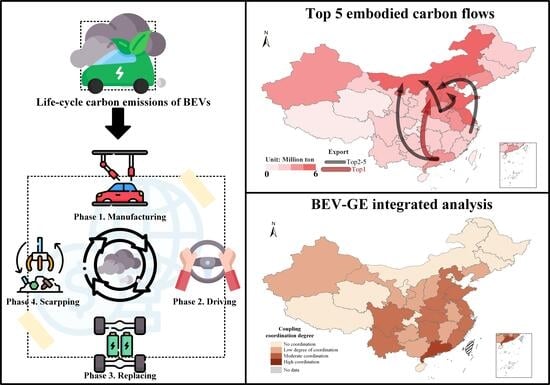
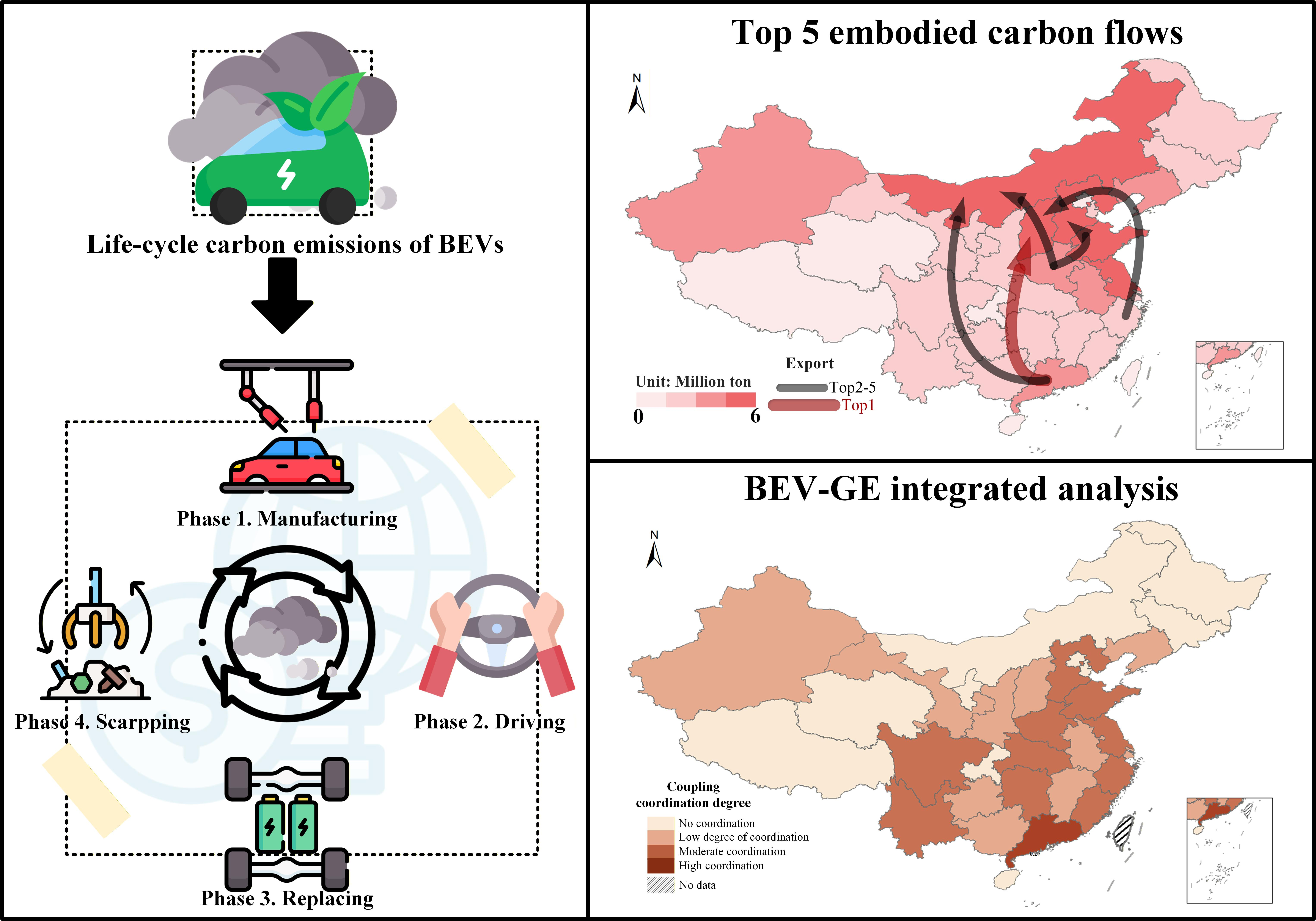
This research selects 2020, a period prior to the rapid expansion of China’s BEV industry, as the target year. Taking the best-selling BEV model of that year as a representative case, we quantify the life-cycle carbon emissions of BEVs at the provincial level across China, incorporating four key phases: manufacturing, driving, battery replacement, and scrapping. From an interprovincial perspective, we reveal the spatial characteristics of BEV emissions, evaluate provincial equity, and trace key carbon flow pathways. Furthermore, we innovatively develop a battery electric vehicle–green electricity (BEV–GE) integrated analysis framework covering China’s 31 provinces, which enables an assessment of the coordinated development status between the regional BEV industry and the local low-carbon electricity system in each province.
The main contributions of this study are threefold. (1) A multi-regional input-output-based life-cycle assessment (MRIO-based LCA) carbon quantification model was established from the perspective of 31 provinces and 42 sectors. (2) The interprovincial equity of life-cycle carbon emissions from BEVs was assessed in phases across the 31 provinces. (3) An innovative “BEV–GE” integration analysis framework was used to assess the interprovincial characteristics of China’s BEV industry.
2. Materials and Methods
2.1. Development of an MRIO-Based LCA Model for Battery Electric Vehicles in China
The multi-regional input-output (MRIO) method provides a macro-level perspective to examine the interactions of a target across different regions and systems [
30,
31]. However, for objects involving multiple sectors, such as BEVs, relying solely on MRIO may overlook detailed processes, potentially leading to an underestimation of carbon emissions. As an extended application of MRIO, the MRIO-based LCA approach preserves carbon emission details of BEVs from a holistic life-cycle perspective, thereby offering a more comprehensive analytical framework. The BEV life cycle is divided into four stages: (i) Manufacturing phase, (ii) driving phase, (iii) battery replacing phase, and (iv) scrapping phase. The final demand diagonal matrix
for each stage is denoted as
,
,
and
, respectively. The number of newly registered medium-sized vehicles in 2020 across China’s 31 provinces, denoted as
, is introduced to determine the final demand
for each BEV life-cycle stage:
Here,
represents the province code. The total final demand,
, generated by BEVs in the year 2020 can thus be derived. The total output matrix
is calculated using the core MRIO formula Equation (2):
where
represent the identity matrix,
denotes the Leontief inverse matrix and
is the technical coefficient matrix. To compute the output for each life-cycle phase, the final demand diagonal matrix
in Equation (2) is successively replaced by
,
,
and
, while the final demands of the other phases are set to zero. This approach yields the total output matrix
corresponding to each individual life-cycle stage. Subsequently, carbon emission intensity factors are incorporated to extend the MRIO model into an environmentally extended framework, enabling the calculation of carbon emissions for each BEV life-cycle stage as shown in Equations (3) and (4).
Here,
is the carbon emission vector corresponding to different BEV life-cycle stages, and
denotes the vector of carbon emission intensity. Using the data of total carbon emissions and corresponding total input for 42 sectors across 31 provinces from the 2020 MRIO table in the CEADs database, the vector of
is calculated by dividing the total carbon emissions of each sector by its corresponding total input [
32]. The direct carbon emission (
) refers to carbon emissions directly generated by the activities of the target sector. In contrast, the indirect carbon emission (
) represents carbon emissions induced by the target sector’s activities that result from subsequent activities in downstream sectors. The carbon emission vector
can be further decomposed into the direct carbon emission vector
and the indirect carbon emission vector
, with their relationship expressed in Equation (5).
By distinguishing between direct (
) and indirect carbon emissions (
), it becomes possible to assess the impacts of both direct emission pathways and embedded emission pathways more accurately [
32].
2.2. Provincial Equity Assessment Based on Gini Coefficient
The Gini coefficient is applied to quantify interprovincial equity in the life-cycle carbon emissions of BEVs. It is used to reveal spatial disparities in carbon emission intensity across stages, thereby addressing the regional equity gap often overlooked by conventional aggregate analyses. The Gini coefficient was proposed to quantify the degree of income distribution differences [
33]. It has been extensively employed to assess disparities across diverse socioeconomic indicators [
34] and is similarly applied to analyze environmental challenges, including resource distribution and pollution [
35]. The Gini coefficient measures inequality through a geometric comparison based on the Lorenz curve. Internationally, a Gini coefficient of 0.4 is commonly adopted as the critical threshold for excessive inequality [
36]; it quantifies the degree of deviation from a state of perfect equality by calculating the ratio of the area between the Lorenz curve and the line of perfect equality to the total area under that line. This can be expressed as Equation (6):
In the formula,
represents the Gini coefficient,
represents the proportion of province
in the total number of provinces,
represents the proportion of the emission intensity per unit of total output value in province
, and
represents the cumulative proportion of the emission intensity per unit of total output value of province
. According to previous studies, Gini coefficient values are interpreted as follows:
≤ 0.2 denotes absolute equality; 0.2 <
≤ 0.3 signifies low inequality; 0.3 <
≤ 0.4 indicates medium inequality; 0.4 <
≤ 0.5 represents high inequality; and a value greater than 0.5 suggests very high inequality [
37,
38,
39].
2.3. Entropy Weighting Method
Entropy weight method can eliminate the bias caused by subjective weighting and enhance the accuracy of evaluation results across indicators [
40]. This study employed the entropy weight method to assign weights to each indicator in the BEV–GE integration analysis framework. The specific calculation procedure is as follows.
Utilizing the min-max scaling method for standardizing the judgment matrix, the normalized matrix, named
, is obtained. The standardized values are denoted as Equations (7) and (8).
Here, is the original value of the evaluation object on the indicator; and represent the maximum and minimum values of indicator in 31 provinces, respectively. is the standardized value, ranging from 0 to 1.
Then, the proportion of the
indicator of the
sample within this indicator is calculated as Equation (9).
Finally, the information entropy
of the
indicator is calculated, and the weight
of each indicator is also calculated as Equations (10) and (11).
2.4. Coupling Coordination Degree Model
The coupling coordination degree (CCD) evaluates the extent to which multiple systems interact with each other [
41]. This study identifies the regional coupling coordination status based on the evaluation indices of the BEV–GE integration analysis framework to reflect the provincial differences in the comprehensive development of the BEV–GE integration analysis framework. The formula for this model is provided in Equations (12) and (14).
Here,
and
are the weighted composite scores derived from the BEV–GE system, respectively [
42].
is the coupling degree, and
is the coupling coordination degree, which ranges within the interval 0–1. The closer the value of
is to 1, the better the coupling effect of the system. T is the comprehensive evaluation indicator of the two major systems; α and β are undetermined coefficients. This study posits that BEV adoption and GE development form a tightly interdependent system. Large-scale BEV deployment relies on a decarbonized grid to achieve its full environmental potential, while GE systems require BEVs as a crucial flexible load and storage resource to enhance grid stability and renewable integration. Given this fundamental interdependence, both subsystems are afforded equal weight (α = β = 1/2 [
43]) in the CCD model to reflect their symbiotic importance. Drawing on the research of Jiang et al., the CCD are separated into four intervals—the division standards are shown in
Table 1 [
44].
3. Data
3.1. Multi-Regional Input-Output Table
This study utilizes the latest China-scale multi-regional input-output (MRIO) tables for 42 industries across 31 provinces in China for 2020, sourced from China Emission Accounts and Datasets [
45,
46]. The MRIO framework delineates interprovincial supply chain links between sectors, capturing their economic balances and interactions. Furthermore, within this structured framework, the table systematically traces corresponding carbon-related data for each economic activity. The sectoral and provincial classifications are detailed in
Table A1 and
Table A2, respectively.
3.2. MRIO-Based LCA for Four Phases and the Details of Battery Electric Vehicles
In accordance with the Industrial Classification for National Economic Activities (GB/T 4754-2017) [
47], the four stages of the BEV life cycle were mapped to the 42 economic sectors within the 2020 CEADs MRIO table. This study divides the full life-cycle of BEVs into four phases [
20,
48], namely manufacturing, driving, battery replacement, and scrapping. Based on the correspondence shown in
Table 2, the final demand vectors
,
,
and
for Manufacture of Transport Equipment (S18), Production and Distribution of Electric Power and Heat Power (S25), Resident, Repair and Other Services (S38), and Comprehensive Use of Waste Resources (S23) in the MRIO table were set as the life-cycle demand of BEVs. Accordingly, an MRIO-based LCA model for BEVs in China was constructed.
Regarding BEV selection, data on newly registered medium-sized vehicles were sourced from the 2021 China’s Auto Market Almanac compiled by the National Bureau of Statistics of the People’s Republic of China [
49]. To identify a specific model, the sales ranking of new energy vehicles from January to December 2020, as published by the China Passenger Car Association (CPCA), was referenced. As shown in
Table S2, the Tesla Model 3 was the top-selling BEV in China during this period [
50]. Consequently, the Tesla Model 3 was selected as the representative mid-size vehicle for this study. Its key parameters are listed in
Table 2.
Table 2.
Detailed data sources, life-cycle phase division and corresponding sectors of the target vehicle.
Table 2.
Detailed data sources, life-cycle phase division and corresponding sectors of the target vehicle.
| Phase | Source | Description | Parameter | Sector |
|---|
| Manufacturing | [51] | Target BEV price | 251,740 CNY | S18. Manufacture of transport equipment |
| Driving | [48] | Full-life mileage | 150,000 km | S25. Production and distribution of electric power and heat power |
| [52] | Electricity consumption per 100 km | 12.6 kWh |
| [53] | 2020 charging cost per unit | 0.79 CNY Per kWh |
| Battery replacing * | [51] | The price of the BEV’s battery | 80,000 CNY | S38. Resident, repair and other services |
| Scrapping | [54] | 2020 net profit from vehicle recycling | 29.68 billion CNY | S23. Comprehensive use of waste resources |
| [54] | Number of vehicles scrapped in 2020 | 2,153,000 set |
| [54] | Recycled EV volume in 2020 | 15,000 set |
| [3] | BEV share in among EVs | 78% |
3.3. The Data Source of Battery Electric Vehicle–Green Electric Integration Analysis Framework
This study establishes two subsystems, the battery electric vehicle (BEV) system and the green electricity system, which are integrated to form the “BEV–GE” system. The BEV system is designed to characterize the adoption level of BEVs across different provinces. It is assumed that the number of BEVs is positively correlated with four provincial-level indicators: public charging pile inventory, automobile sales volume, private BEV ownership, and BEV production value. Higher values of these indicators in a province therefore reflect greater BEV adoption, and they are thus treated as positive indicators for the BEV subsystem. The green electricity subsystem aims to analyze the proportion of low-carbon electricity in the total electricity mix of each province. Hydropower generation [
57], solar power generation [
58], as well as wind and nuclear power generation [
58] are recognized as common low-carbon electricity sources and are therefore selected as positive indicators for this subsystem. In contrast, thermal power generation, which has a relatively higher carbon emission intensity, is treated as a negative indicator. The relevant detailed data sources for the construction of the BEV–GE integration analysis framework are shown in
Table 3.
Table 3.
Evaluation indicator system for battery electric vehicle–green electric integration analysis framework.
Table 3.
Evaluation indicator system for battery electric vehicle–green electric integration analysis framework.
| Subsystem | Indicator | Unit | Attributes | Reference |
|---|
| Battery electric vehicle system | Public charging pile inventory | units | + ** | [59] |
| Automobile sales volume | 104 vehicles | + | [49] |
| Private BEV ownership * | 104 vehicles | + | Derived in this study |
| BEV production value | 104 yuan | + | Derived in this study |
| Green electric system | Thermal power generation | 109 kWh | − *** | [60] |
| Hydropower generation | 109 kWh | + | [60] |
| Solar power generation | 109 kWh | + | [60] |
| Wind and nuclear power generation | 109 kWh | + | [60] |
4. Result
4.1. Regional and Sectoral Characteristics of Battery Electric Vehicle Carbon Emissions in China
In 2020, the total life-cycle carbon emissions of BEVs in China reached 48.95 million tons. Structurally, as shown in
Table 4, the manufacturing phase was the primary source, accounting for 58.4% of the total, followed by the driving phase, which contributed 33.4%. The battery replacing phase represented 8.05%, while the scrapping phase had the smallest share, merely 0.08%. This distribution highlights that manufacturing and driving together account for over 90% of total emissions, identifying them as key phases for emission reduction.
Table 5 further presents a comparative analysis of BEV life-cycle carbon emissions per vehicle across different studies. After accounting for yearly variations, the total carbon emissions per BEV (across all life-cycle stages) show relatively minor differences. A comparison between China and Japan reveals that the manufacturing phase and the driving phase dominate emissions in each country respectively, a divergence that likely stems from differences in national energy structures and industrial profiles. When compared with China’s own BEV industry in 2021, the rapid market expansion in that year was accompanied by significant carbon emission pressures. Moreover, the global carbon emissions attributed to China’s BEVs in 2021 (37.4 million tons) were approximately twice the level of domestic emissions from China’s BEVs in 2020 (14.0 million tons). This underscores the critical and often overlooked role of indirect emissions embedded in the global supply chain.
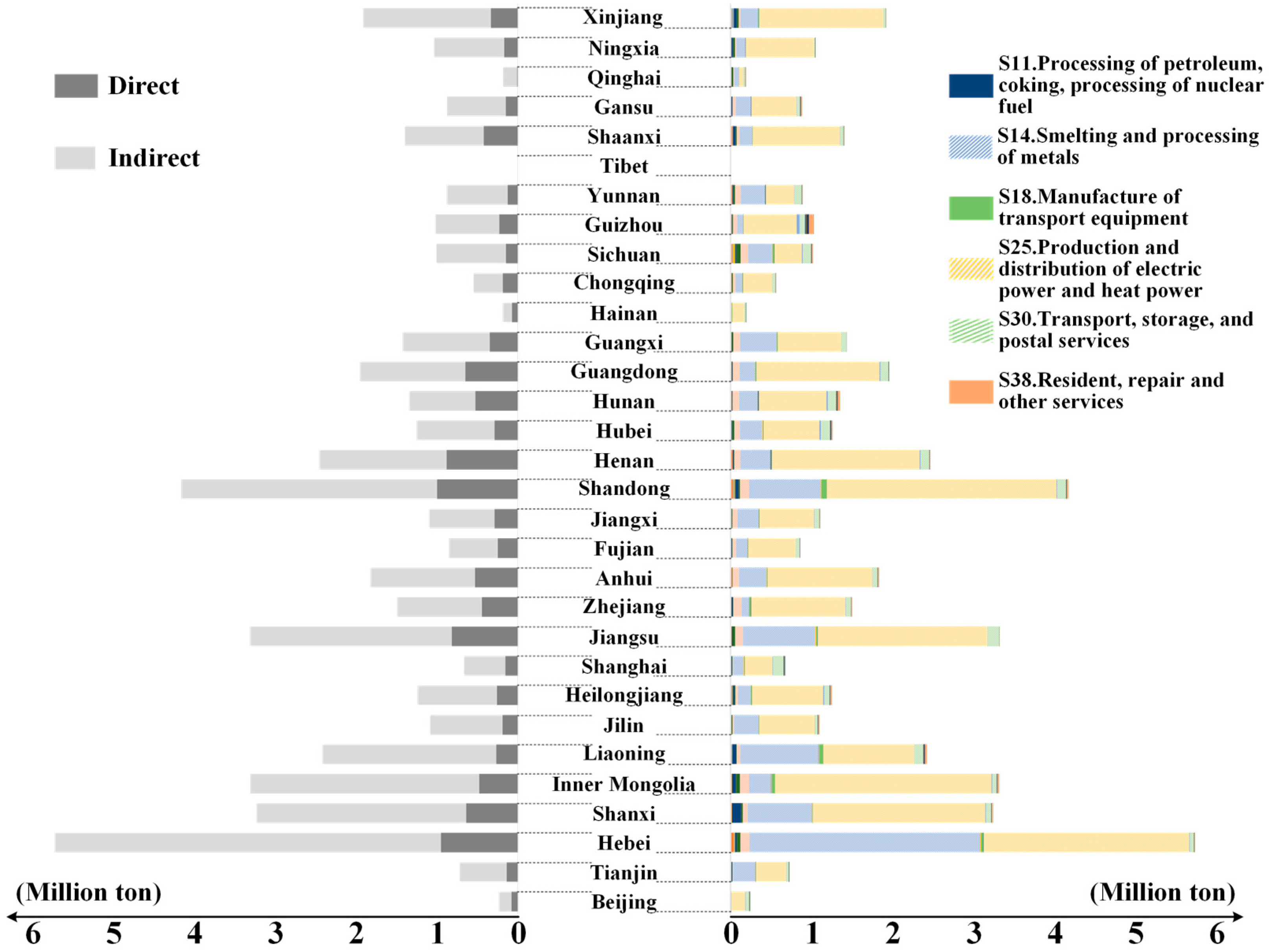
As shown in
Figure 1, Hebei and Shandong were the top two provinces in China in terms of life-cycle carbon emissions from BEVs, accounting for 11.7% and 8.5% of the national total, respectively. These provinces exhibited highly consistent emission structures, with embodied emissions dominating their overall carbon emissions. Specifically, the share of embodied emissions reached 83.3% in Hebei and 75.9% in Shandong, averaging 79.6% across the two provinces. This pattern might underscore the central role of industrial transfer, supply-chain links, and upstream energy consumption in driving regional carbon emissions. Further analysis across provinces reveals that the dominance of embodied emissions is not confined to these high-emission regions but is widely representative. For instance, in Liaoning (88.7%) and Qinghai (92.0%), embodied emissions exceeded 85% of the total, reflecting higher carbon intensity in upstream industrial segments. This pattern aligns with the industrial composition of these provinces, which is typically dominated by the heavy and energy industries. In contrast, provinces like Beijing (34.7%) and Hainan (40.6%) showed relatively higher shares of direct emissions. These regions serve as economic and high-tech industrial hubs, where a greater proportion of direct emissions often reflects higher adoption and utilization rates of BEVs.
The sectoral analysis further reveals that the carbon emission structures of Hebei and Shandong exhibit both notable commonalities and distinct interprovincial variations. The key sectors are highly consistent across the two provinces: the smelting and pressing of metals (S14) and the production and supply of electric power and heat power (S25) are the top two contributors to carbon emissions in each case. This pattern underscores the dominant role of upstream energy production and raw material processing in the BEV industrial chain in shaping regional emission profiles. Nevertheless, the sectoral composition varies at the provincial level. Shandong and Jiangsu show similar structures, with the S25 accounting for significantly higher shares than the S14, which is 68.1% and 63.1% of their respective provincial emission totals. In contrast, Hebei presents a more balanced distribution between the two sectors, with S14 slightly higher at 49.6%, compared to 44.3% for S25. These structural differences stem fundamentally from each province’s industrial positioning and energy endowments. Shandong, as a major electricity exporter and energy-intensive industrial hub, exhibits higher carbon intensity in power generation. Hebei, relying on its iron and steel industrial cluster, shows more pronounced emissions from metal smelting.
4.2. Provincial Inequality in Battery Electric Vehicles Life-Cycle Carbon Intensity
The provincial inequality in carbon emission per unit value across the four phases of the BEV’s full life-cycle are analyzed in
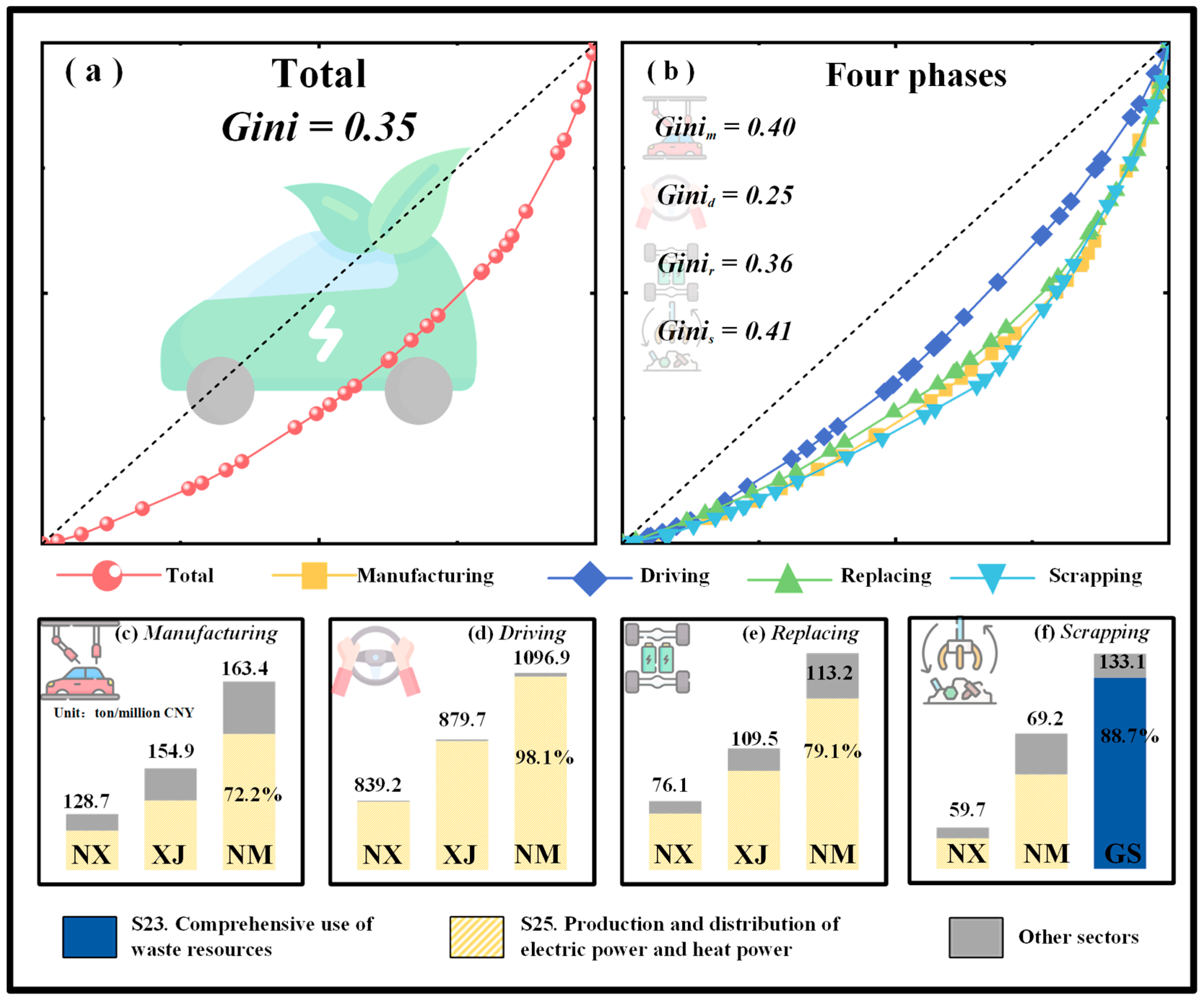
Figure 2. The overall Gini coefficient of carbon emission intensity for the entire life cycle is 0.35 (
Figure 2a), indicating a medium level of provincial inequality in carbon emission intensity at the national scale. When disaggregated by phase, the manufacturing phase (Gini
m = 0.40) and scrapping phase (Gini
s = 0.41) exhibit higher Gini coefficients than the overall level, reflecting more pronounced interprovincial disparities in carbon emission intensity during these two phases. In contrast, the driving phase has the lowest Gini coefficient (Gini
d = 0.25), suggesting a relatively balanced distribution of carbon emission intensity across provinces in this phase. The inequality in the battery replacement phase (Gini
r = 0.36) is close to the overall level (
Figure 2b). Some potential factors might affect this provincial inequality (
Tabe S1). Provinces with high carbon emission intensity, such as Ningxia, Xinjiang, and Inner Mongolia, have relatively low BEV stock, small output value, and a moderate number of drivers. In contrast, eastern provinces with large BEV holdings, high output values, and more drivers show lower carbon emission intensity. This indicates that interprovincial inequality is not mainly driven by BEV market scale or geographic area but is closely related to regional energy structures.
The top three provinces in the manufacturing, driving, and battery replacement phases are consistently Ningxia (NX), Xinjiang (XJ), and Inner Mongolia (NM), indicating a spatial consistency in provincial carbon emission intensity distribution across these three phases. However, the top three provinces in the scrapping phase are Ningxia, Inner Mongolia, and Gansu (GS), revealing a distinct interprovincial pattern compared to the other three phases. Further analysis of sectoral contributions shows that the production and distribution of electric power and heat power (S25) dominate carbon emissions in the manufacturing, driving, and battery replacement phases. Specifically, the production and distribution of electric power and heat power sector contribute 98.1% of emissions in the driving phase, 72.2% in the manufacturing phase, and 79.1% in the battery replacement phase (
Figure 2c–e). Notably, in the scrapping phase, the comprehensive use of waste resources (S23) sector accounts for 88.7% of carbon emissions in Gansu (
Figure 2f), highlighting regional heterogeneity in sectoral contributions during the scrapping phase.
These findings underscore the heterogeneous nature of provincial carbon emissions over the BEV life cycle, with regional disparities most acute in the upstream manufacturing and downstream scrapping phases. The persistent dominance of provinces such as Ningxia, Xinjiang, and Inner Mongolia across multiple phases highlights the critical influence of regional energy structures, particularly reliance on carbon-intensive power generation, on life-cycle emissions. Meanwhile, the shift in leading provinces and the sectoral emphasis on waste resource utilization in the scrapping phase suggest that life-cycle management is shaped more by localized recycling infrastructures and industrial policies.
4.3. Interprovincial Carbon Flows of Battery Electric Vehicles by Life-Cycle Phase
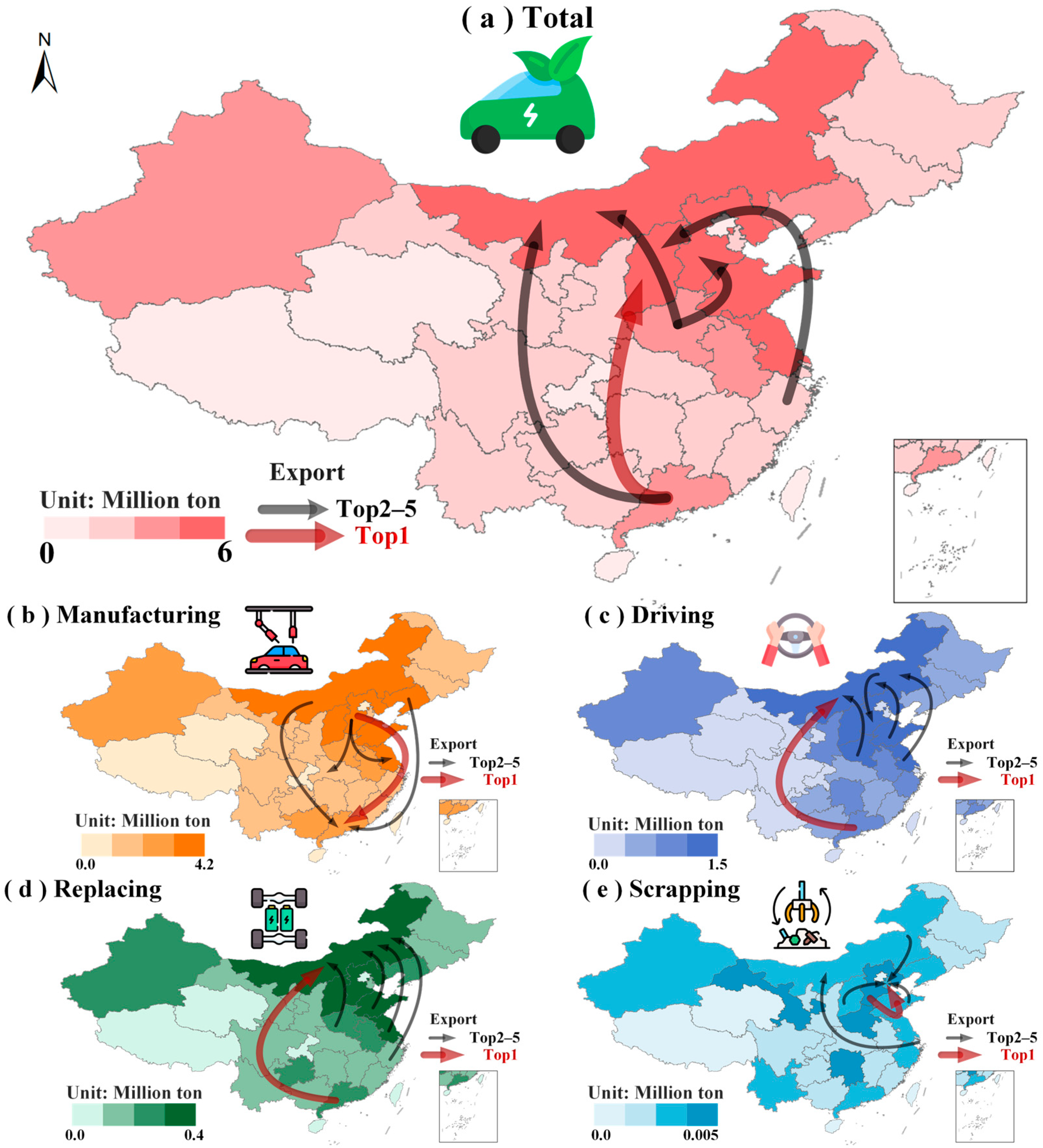
The interprovincial carbon emission flows associated with BEVs exhibited a high degree of spatial concentration (
Figure 3). As shown in
Figure 3a and
Table S3, the top five flow paths were primarily characterized by net carbon inflows from Inner Mongolia and Hebei into Henan, Guangdong and Zhejiang, totaling 1.03 million tons and collectively accounting for approximately 2.1% of the total life-cycle interprovincial carbon flow. This pattern underscores Hebei and Inner Mongolia as core net outflow regions, highlighting their close carbon linkage with major eastern economic provinces. The total net carbon emissions of these key pathways amounted to about 1.03 million tons, with individual key flows mostly ranging between 0.1 and 0.3 million tons.
The manufacturing phase displayed a north-to-south transfer pattern (
Figure 3b). The top five emission export pathways originated mainly from industrial-intensive provinces such as Hebei, Inner Mongolia, and Liaoning, and were directed toward key BEV assembly and consumption hubs like Guangdong, Zhejiang, and Henan. The total carbon emissions from these major export pathways reached 0.89 million tons (
Table S4), aligning closely with regional industrial layouts. The high contribution of the manufacturing phase to the total life-cycle emissions largely explains why this phase dominates the overall direction of net carbon flows. Both the driving phase and the battery replacement phase exhibited similar flow characteristics, with all net flows originating from Inner Mongolia (
Figure 3c,d). Jiangsu, Shandong, and Henan were identified as net carbon recipients in both phases (
Tables S5 and S6), indicating that electricity production in Inner Mongolia plays a crucial supporting role for the national BEV industry, especially in central and eastern provinces. The scrapping phase was marked by a distinct spatial focus on Tianjin (
Figure 3e). The top four transfer pathways mainly represented carbon flows from Hebei, Shaanxi, Inner Mongolia, and Shandong into Tianjin (
Table S7). This pattern reflects Tianjin’s role as a regional hub for end-of-life resource recycling and processing. Overall, electricity supply from northern provinces, particularly Inner Mongolia, exerts considerable influence on the development of the national BEV industry. This also implies that greening the power supply in key energy-exporting provinces would yield significant carbon reduction benefits for the BEV industry.
These results are closely tied to regional industrial structures, energy mixes, and consumption hubs, underscoring the importance of a stage-specific and regionally differentiated approach in designing decarbonization policies for the electric vehicle sector. The findings provide a granular spatial foundation for understanding the embodied carbon transfers associated with BEV adoption, which can inform strategies for more coordinated regional climate mitigation.
4.4. The Coupling Coordination Degree Characteristics Between China’s Battery Electric Vehicle Industry and Green Electric
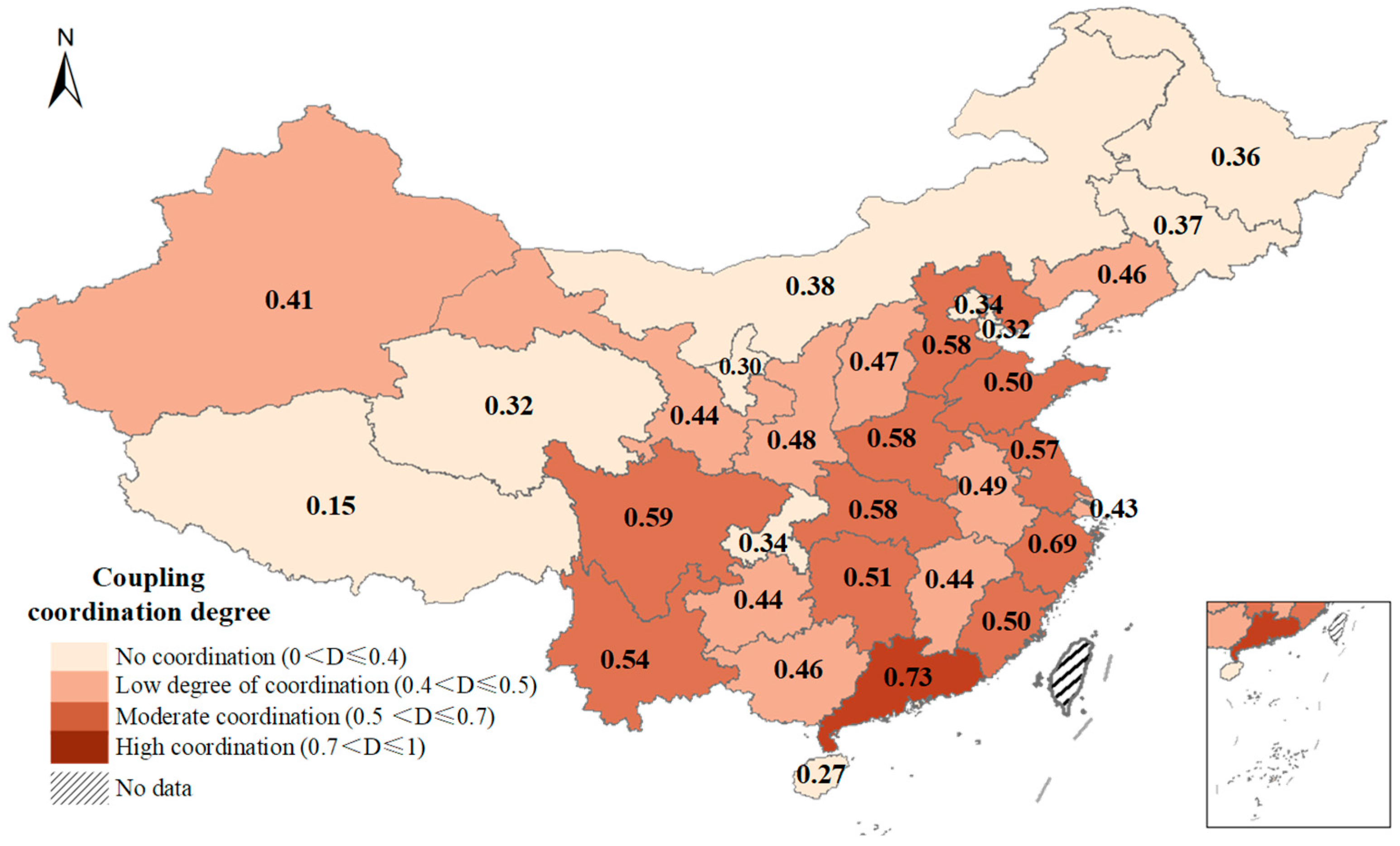
This study develops a BEV–GE integration analysis framework to examine the coupling coordination characteristics between the BEV industry and green power system across 31 Chinese provinces (
Figure 4). In general, as China’s BEV industry enters a phase of rapid expansion, the coupling coordination degree of the BEV–GE framework across 31 provinces in 2020 was generally at a low-to-medium level, with notable disparities among provinces. The average coupling coordination degree is 0.4580, with a standard deviation of 0.1250, indicating significant unevenness in regional development.
From the perspective of China’s three major regions (eastern, central, and western), the coupling coordination degree follows a pattern where the east leads, the central region follows, and the west lags. The eastern region has the highest average coordination degree of 0.4952 and contains Guangdong, the only province with high coordination. This advantage stems from the region’s strong economic foundation, concentrated BEV industry clusters, and advanced green energy infrastructure. It is worth noting that Tianjin and Beijing exhibit clear characteristics of low-degree coordination, which may be attributed to their heavy reliance on thermal power generation. According to the 2021 China Energy Statistical Yearbook [
60], thermal power accounts for over 95% of the total electricity generation in these two provinces. The central region reaches medium-level coordination. This reflects the region’s gradual progress in balancing BEV industry development with green power construction. The western region has the lowest average coordination degree. This is mainly due to the weak BEV industry foundations, dependence on coal-fired power in the electricity system, and limited development of renewable energy.
At the provincial level, Guangdong demonstrates outstanding high-level coordinated development, with strong integration between its BEV industry and green power system. This success is supported by its complete BEV industrial chain built on a solid manufacturing base and a dense public charging pile network. Most provinces in China lack complementary development between the BEV industry and green power system. The advantage of eastern provinces is closely linked to their technical resources and economic strength, while the western region faces the dual constraints of insufficient industrial foundation and outdated energy structures. The 2020 analysis emphasizes that BEV industry growth must align with green power system optimization. Reducing regional development gaps, especially strengthening the western region’s BEV infrastructure and renewable energy construction, is essential for the high-quality development of China’s BEV industry.
5. Discussion
Compared to CEVs, BEVs can reduce carbon emissions by approximately 40% [
63]. Under current technological conditions, over 70% of their energy can be directly used for driving, significantly reducing energy losses and thereby indirectly lowering total life-cycle carbon emissions. Thus, the carbon benefits of BEVs during the use phase have been relatively well quantified [
64,
65]. However, the BEV industry integrates advanced technologies across regions, sectors, and production phases. Therefore, assessing its carbon emissions throughout the entire chain is crucial [
66]. In this study, through comparison with previous research, it was found that although quantification methods for BEV carbon emissions vary, the overall distribution of the LCA reveals notable regional differences. Unlike Japan, where the driving phase dominates carbon emissions (32.1%) [
56], China exhibits a distinct profile with the manufacturing phase contributing the majority (58.5%). This pattern suggests China’s high level of raw material self-sufficiency, which, while supporting the rapid development of the domestic BEV industry, also entails significant carbon emission burdens. A similar trend is observed in the 2021 global-scale assessment of China’s BEV life-cycle carbon emissions. Notably, however, the global-scale estimate derived using the same MRIO-based LCA method (37.4 million tons) is more than double the national-scale estimate presented in this study (14.0 million tons) [
20]. Beyond objective factors such as economic development differences between 2020 and 2021, this notable divergence suggests that China may bear substantial carbon emission pressure from other countries. This pressure is largely due to exports of vehicles or components, stemming from its prominent position in the global BEV supply chain.
From the perspective of China’s industrial chain, about 77.1% of carbon emissions are embedded in complex supply networks and transferred as carbon outputs across different upstream and downstream industries. This phenomenon is particularly prominent in provinces such as Inner Mongolia, Shandong, and Hebei, where industrial structures rely heavily on heavy industry and primary energy production. The rapid expansion of the BEV market may directly intensify resource and environmental pressures in these regions. Analysis of carbon flow pathways further reveals significant carbon linkages between northern and southern provinces, with a dominant flow from north to south. This pattern reflects differences in resource endowments as well as interactions between industrial layout and consumer markets. These findings suggest that future research on BEV carbon emissions should incorporate indirect emissions from supply chains into systematic assessment frameworks to more fully capture their actual environmental impacts.
Although carbon emissions from BEVs vary significantly across provinces, where the highest value is about 30 times the lowest, fairness assessment results show that the provincial distribution has not yet reached a highly imbalanced state (Gini = 0.4), indicating room for policy adjustment. It must be noted that regional grid structures significantly influence the carbon break-even point of electric vehicles in China [
67]. According to China’s National Bureau of Statistics [
68], thermal power still accounted for about 68.5% of electricity generation in 2020, indicating that the energy mix remains a key factor determining provincial carbon emission intensities. Therefore, promoting BEV adoption must be accompanied by accelerated replacement of conventional energy with renewables to achieve greater carbon reduction.
By comparing coupling coordination degree assessments with carbon emission distribution results, this study finds that Guangdong Province exhibits both relatively high BEV-related carbon emissions and a high BEV–GE coordination degree. This apparent contradiction reflects the dynamic balance the province maintains between clean energy transition and industrial scale expansion. As a major national hub for BEV consumption and manufacturing, Guangdong’s high carbon emissions largely stem from its large industrial-scale and concentrated supply chains. Its high green electricity coordination, however, benefits from early investments in renewable energy integration and grid optimization. This case illustrates that even in regions with high total carbon emissions, strengthening low-carbon energy supply and promoting industrial green transformation can align economic growth with carbon reduction. Hence, future policymaking should account for regional disparities, encouraging high-emission provinces to optimize their energy structures while supporting advanced provinces in piloting coordinated decarbonization pathways between electric vehicles and the power system.
6. Conclusions
This study reveals the multi-dimensional characteristics of carbon emissions throughout the life cycle of China’s BEVs and their coupling coordination with green power, providing insights for sectoral decarbonization. In 2020, the carbon emissions throughout the full life cycle of China’s BEVs reached 48 million tons. Manufacturing and driving phases account for over 90% of total emissions, becoming the core for emission reduction. Hebei and Shandong are high-emission provinces, dominated by embodied emissions. This pattern is widespread in heavy industry and energy intensive regions like Liaoning and Qinghai yet reversed in economic hubs such as Beijing and Hainan due to higher BEV utilization. The S14 (smelting and processing of metals) and S25 (production and distribution of electric power and heat power) are dominant, but provincial differences exist due to industrial positioning. Provincial inequality in carbon intensity is medium overall, with more pronounced disparities in the manufacturing and scrapping phases. Interprovincial carbon flows also show spatial concentration, with north-to-south transfers in manufacturing and convergence toward specific hubs in other phases. The overall BEV–GE coupling coordination in China is at a low-to-medium level, exhibiting an east-central-west gradient pattern. Guangdong achieves high coordination via a complete industrial chain and green energy infrastructure, while most provinces lack complementary development. Western regions are constrained by weak industries and coal-dependent energy structures, and even eastern hubs like Beijing face bottlenecks from thermal power reliance. These findings highlight the need for stage-specific and regionally differentiated policies, focusing on upstream industrial optimization, green power expansion, and regional coordination to advance BEV sector decarbonization.
7. Policy Implications
In terms of technology, innovations in battery materials are crucial for reducing emissions in the manufacturing phase. Some studies indicate that lead-acid and nickel-metal hydride batteries may have a lower environmental impact compared to lithium iron phosphate and lithium manganese oxide batteries [
69]; meanwhile, material selection must balance multiple factors such as resource availability. Simultaneously, establishing efficient battery recycling and reuse systems is essential, as optimized processes can achieve net-negative carbon emissions while ensuring effective recovery [
70].
In terms of policy, the significant spatial heterogeneity of BEV impacts across Chinese provinces underscores the need for differentiated regulatory approaches [
71]. For instance, provinces like Hebei and Shandong, with dominant heavy industries, should implement phased carbon emission controls tailored to key local enterprises [
72]. Meanwhile, in major consumption and assembly hubs like Beijing and Zhejiang, policies should promote green supply chains and incentivize low-carbon component procurement through life-cycle assessment guidance [
73], which can effectively reduce embodied carbon emissions. China’s coal-dominated power structure remains a major constraint on BEV carbon reduction [
74]. To decouple BEV emissions from grid structure limitations, a universal transition toward renewable-dominated power systems is imperative, a principle applicable beyond China to all markets with high fossil fuel reliance [
75]. Provinces with developed BEV industries should accelerate the construction of green electricity infrastructure to enable synergistic growth of both sectors. Additionally, a provincial green-credit mechanism could be introduced [
76], whereby credits are earned for outperforming sector-specific emission benchmarks, thereby stimulating coordinated interprovincial abatement efforts.
8. Limitations
This study investigated the carbon emission characteristics of BEVs across 31 Chinese provinces on the eve of the industry’s rapid expansion, utilizing the latest China-scale MRIO table. It provides a foundational perspective for subsequent research on China’s BEV development. Nevertheless, several limitations should be acknowledged. First, due to the complexity of compiling MRIO tables, the table employed in this study is not available for consecutive years. Future research could quantify the carbon benefits associated with China’s BEV development over equal time intervals by utilizing updated versions of such tables. Furthermore, although the scrapping phase of BEVs was considered, the quantification could be refined. Given the multitude of BEV brands in China and the fact that uniform recycling standards are yet to be established, particularly as the BEV and battery recycling industries evolve, future studies could further disaggregate different stages within the scrap process based on life-cycle assessment to improve the accuracy of carbon emission accounting for this phase. Third, this study selected eight foundational variables based on the BEV–GE analysis framework, and subsequent studies may expand the analytical framework by adding socio-cultural and other relevant dimensions to conduct a more systematic and in-depth investigation and improve the comprehensiveness of CCD. Finally, given China’s strong policy push for BEV adoption, future research should also incorporate scenario analysis aligned with the dual carbon goals (peak carbon by 2030, carbon neutrality by 2060) to assess the carbon-reduction outcomes of different policy pathways.
Supplementary Materials
The following supporting information can be downloaded at:
https://www.mdpi.com/article/10.3390/wevj17030137/s1, Table S1: Data on BEVs and area by 31 Provincial-level regions in China; Table S2: Top 10 NEVs by sales volume, January–December 2020; Table S3: Origins, destinations and corresponding values of Total carbon emission flow paths; Table S4: Origins, destinations and corresponding values of the Manufacturing phase carbon emission flow paths; Table S5: Origins, destinations and corresponding values of the Driving phase carbon emission flow paths; Table S6: Origins, destinations and corresponding values of the Replacing phase carbon emission flow paths; Table S7: Origins, destinations and corresponding values of the Scrapping phase carbon emission flow paths; Figure S1: Monte Carlo simulation of BEVs’ four phases; (a) The carbon emissions of Manufacturing phase; (b) The carbon emissions of Driving phase; (c) The carbon emissions of Replacing phase; (d) The carbon emissions of Scrapping phase; Figure S2: Carbon emission simulations of China’s BEVs under different grid optimization scenarios from 2020 to 2030. Reference [
77] is cited in the Supplementary Material.
Author Contributions
Conceptualization, Y.W. and L.-C.L.; methodology, X.Y. and L.-C.L.; software, X.Y., Z.L. and C.F.; validation, X.Y., Z.L. and C.F.; formal analysis, X.Y., Z.L. and C.F.; investigation, Y.Z.; resources, X.Y.; data curation, X.Y. and L.-C.L.; writing—original draft preparation, X.Y., L.-C.L., Z.L. and C.F.; writing—review and editing, Y.W., A.C.-O., Y.Z. and L.-C.L.; visualization, X.Y., Z.L. and C.F.; supervision, L.-C.L. and X.Y.; project administration, L.-C.L. and X.Y.; funding acquisition, L.-C.L. All authors have read and agreed to the published version of the manuscript.
Funding
This research has been supported by the Talent Introduction Project of Hubei Polytechnic University and the Science and Technology Projects of Xizang Autonomous Region, China (XZ202501ZY0138).
Data Availability Statement
The original contributions presented in this study are included in the article. Further inquiries can be directed to the corresponding author.
Conflicts of Interest
The authors declare no conflicts of interest.
Abbreviations
The following abbreviations are used in this manuscript:
| BEV | Battery Electric Vehicle |
| BEV–GE | Battery Electric Vehicle–Green Electric integration analysis framework |
| CCD | Coupling Coordination Degree |
| CEAD | China Emission Accounts and Datasets |
| CFV | Conventional Fuel Vehicles |
| Ginim | The manufacturing phase’s Gini coefficient |
| Ginid | The driving phase’s Gini coefficient |
| Ginir | The replacing phase’s Gini coefficient |
| Ginis | The scrapping phase’s Gini coefficient |
| IEA | International Energy Agency |
| LCA | Life-Cycle Assessment |
| MRIO | Multi-Regional Input-Output |
| MRIO-based LCA | Multi-Regional Input-Output based Life-Cycle Assessment |
| NEV | New Energy Vehicle |
| The final demand of the manufacturing phase |
| The final demand of the driving phase |
| The final demand of the replacing phase |
| The final demand of the scrapping phase |
Appendix A
The sectoral and provincial classifications are detailed as follows.
Table A1.
Sectoral classification of the MRIO Table.
Table A1.
Sectoral classification of the MRIO Table.
| Code | Sector | Code | Sector |
|---|
| S1 | Agriculture, forestry, animal husbandry and fishery | S24 | Repair of metal products, machinery and equipment |
| S2 | Mining and washing of coal | S25 | Production and distribution of electric power and heat power |
| S3 | Extraction of petroleum and natural gas | S26 | Production and distribution of gas |
| S4 | Mining and processing of metal ores | S27 | Production and distribution of tap water |
| S5 | Mining and processing of nonmetal and other ores | S28 | Construction |
| S6 | Food and tobacco processing | S29 | Wholesale and retail trades |
| S7 | Textile industry | S30 | Transport, storage, and postal services |
| S8 | Manufacture of leather, fur, feather and related products | S31 | Accommodation and catering |
| S9 | Processing of timber and furniture | S32 | Information transfer, software and information technology services |
| S10 | Manufacture of paper, printing and articles for culture, education and sport activity | S33 | Finance |
| S11 | Processing of petroleum, coking, processing of nuclear fuel | S34 | Real estate |
| S12 | Manufacture of chemical products | S35 | Leasing and commercial services |
| S13 | Manufacture of non-metallic mineral products | S36 | Scientific research and polytechnic services |
| S14 | Smelting and processing of metals | S37 | Administration of water, environment, and public facilities |
| S15 | Manufacture of metal products | S38 | Resident, repair and other services |
| S16 | Manufacture of general purpose machinery | S39 | Education |
| S17 | Manufacture of special purpose machinery | S40 | Health care and social work |
| S18 | Manufacture of transport equipment | S41 | Culture, sports, and entertainment |
| S19 | Manufacture of electrical machinery and equipment | S42 | Public administration, social insurance, and social organizations |
| S20 | Manufacture of communication equipment, computers and other electronic equipment | | |
| S21 | Manufacture of measuring instruments | | |
| S22 | Other manufacturing | | |
| S23 | Comprehensive use of waste resources | | |
Table A2.
Province classification and regional division of the MRIO Table.
Table A2.
Province classification and regional division of the MRIO Table.
| Abbreviation | Province | Region | Abbreviation | Province | Region |
|---|
| BJ | Beijing | Eastern | HuN | Hunan | Central |
| TJ | Tianjin | Eastern | GD | Guangdong | Eastern |
| HE | Hebei | Eastern | GX | Guangxi | Western |
| SX | Shanxi | Central | HN | Hainan | Eastern |
| NM | Inner Mongolia | Western | CQ | Chongqing | Western |
| LN | Liaoning | Eastern | SC | Sichuan | Western |
| JL | Jilin | Central | GZ | Guizhou | Western |
| HL | Heilongjiang | Central | YN | Yunnan | Western |
| SH | Shanghai | Eastern | XZ | Tibet | Western |
| JS | Jiangsu | Eastern | SN | Shannxi | Western |
| ZJ | Zhejiang | Eastern | GS | Gansu | Western |
| AH | Anhui | Central | QH | Qinghai | Western |
| FJ | Fujian | Eastern | NX | Ningxia | Western |
| JX | Jiangxi | Central | XJ | Xinjiang | Western |
| SD | Shandong | Eastern | | | |
| HA | Henan | Central | | | |
| HB | Hubei | Central | | | |
References
- Wei, Y.; Han, X.; Lu, L.; Wang, H.; Li, J.; Ouyang, M. Technology prospects of carbon neutrality-oriented new-energy vehicles and vehicle-grid interaction. Automot. Eng. 2022, 44, 450–464. [Google Scholar]
- Shi, L.; Ou, S.S.; Zhou, Y.; Wu, Y.; Tan, X.; He, X.; De Castro Gomez, D.J.; Lin, Z. Assessing Chinese user satisfaction with electric vehicle battery performance from online reviews. Transp. Res. Part D Transp. Environ. 2025, 141, 104644. [Google Scholar] [CrossRef]
- International Energy Agency (IEA). Global EV Data Explorer; International Energy Agency: Paris, France, 2025; Available online: https://www.iea.org/data-and-statistics/data-tools/global-ev-data-explorer (accessed on 20 January 2026).
- The State Council the People’s Republic of China. Carbon Peaking Action Plan Before 2030; Government of the People’s Republic of China: Beijing, China, 2021. Available online: https://www.gov.cn/zhengce/content/2021-10/26/content_5644984.htm (accessed on 20 January 2026).
- Liu, H.; Hu, D.; Kelleher, L. Synergistic and substitutive pathways for sustainable production and consumption in China’s passenger vehicle transition: A dynamic multi-life-cycle assessment. Sustain. Prod. Consum. 2026, 23, 221–236. [Google Scholar] [CrossRef]
- Guo, X.; Zhang, D.; Li, M.; Chang, L.; Wang, M.; Zhang, L. Decarbonizing transportation through electric vehicles: A life cycle perspective across China, Europe, and the USA. J. Environ. Manag. 2026, 401, 128932. [Google Scholar] [CrossRef]
- Chen, Q.; Lai, X.; Gu, H.; Tang, X.; Gao, F.; Han, X.; Zheng, Y. Investigating carbon footprint and carbon reduction potential using a cradle-to-cradle LCA approach on lithium-ion batteries for electric vehicles in China. J. Clean. Prod. 2022, 369, 133342. [Google Scholar] [CrossRef]
- Feng, T.; Guo, W.; Li, Q.; Meng, Z.; Liang, W. Life cycle assessment of lithium nickel cobalt manganese oxide batteries and lithium iron phosphate batteries for electric vehicles in China. J. Energy Storage 2022, 52, 104767. [Google Scholar] [CrossRef]
- He, J.; Chen, X.; Ma, M.; Gao, M. Electric vehicle rental battery replacement and maintenance decisions. Energy 2025, 333, 137460. [Google Scholar] [CrossRef]
- Zhang, Y.; Wu, D.; Luo, G.; Lv, H.; Yang, P.; Zhou, J.; Liu, L. The impact of BEV manufacturing on China’s economy and environment: An input–output perspective. J. Clean. Prod. 2025, 490, 144773. [Google Scholar] [CrossRef]
- Ding, D.; Wu, X.Y. Evaluating the economic and carbon emission reduction potential of fuel cell electric vehicle-to-grid. DeCarbon 2025, 7, 100096. [Google Scholar] [CrossRef]
- Gao, Z.; Xie, H.; Yang, X.; Zhang, L.; Yu, H.; Wang, W.; Liu, Y.; Xu, Y.; Ma, B.; Liu, X.; et al. Electric vehicle lifecycle carbon emission reduction: A review. Carbon Neutralization 2023, 2, 528–550. [Google Scholar] [CrossRef]
- Liu, X.; Zhao, F.; Hao, H.; Liu, Z. Opportunities, challenges and strategies for developing electric vehicle energy storage systems under the carbon neutrality goal. World Electr. Veh. J. 2023, 14, 170. [Google Scholar] [CrossRef]
- Lyu, W.; Hu, Y.; Liu, J.; Chen, K.; Liu, P.; Deng, J.; Zhang, S. Impact of battery electric vehicle usage on air quality in three Chinese first-tier cities. Sci. Rep. 2024, 14, 21. [Google Scholar] [CrossRef]
- Liu, D.; Xu, L.; Sadia, U.H.; Wang, H. Evaluating the CO2 emission reduction effect of China’s battery electric vehicle promotion efforts. Atmos. Pollut. Res. 2021, 12, 101115. [Google Scholar] [CrossRef]
- Yang, Z.; Huang, H.; Lin, F. Sustainable electric vehicle batteries for a sustainable world: Perspectives on battery cathodes, environment, supply chain, manufacturing, life cycle, and policy. Adv. Energy Mater. 2022, 12, 2200383. [Google Scholar] [CrossRef]
- Joshi, A.; Sharma, R.; Baral, B. Comparative life cycle assessment of conventional combustion engine vehicle, battery electric vehicle and fuel cell electric vehicle in Nepal. J. Clean. Prod. 2022, 379, 134407. [Google Scholar] [CrossRef]
- Wang, S.; Yu, J. A comparative life cycle assessment on lithium-ion battery: Case study on electric vehicle battery in China considering battery evolution. Waste Manag. Res. 2021, 39, 156–164. [Google Scholar] [CrossRef]
- Peng, T.; Ren, L.; Ou, X. Development and application of life-cycle energy consumption and carbon footprint analysis model for passenger vehicles in China. Energy 2023, 282, 128412. [Google Scholar] [CrossRef]
- Yuan, X.; Lee, L.-C.; Zhu, Y.; Wang, Y.; Zhang, H.; Zheng, H.; Chicaiza-Ortiz, C.; Liu, Z. Unveiling the inequality and embodied carbon emissions of China’s battery electric vehicles across life cycles by using a MRIO-based LCA model. Transp. Policy 2025, 174, 103827. [Google Scholar] [CrossRef]
- Kong, W.Z.; Li, Q.H.; Wang, X.L. Analysis on energy saving and emission reduction of electric vehicles based upon life-cycle energy efficiency. Electr. Power 2012, 45, 64–67. [Google Scholar]
- Manousakis, N.M.; Karagiannopoulos, P.S.; Tsekouras, G.J.; Kanellos, F.D. Integration of renewable energy and electric vehicles in power systems: A review. Processes 2023, 11, 1544. [Google Scholar] [CrossRef]
- Guo, X.; Sun, Y.; Ren, D. Life cycle carbon emission and cost-effectiveness analysis of electric vehicles in China. Energy Sustain. Dev. 2023, 72, 1–10. [Google Scholar] [CrossRef]
- Chen, D.; Wang, G.; Yuan, Z.; Zhang, E. Study on the spatial pattern and influencing factors of China’s New Energy Vehicle Industry—Based on data of relevant listed companies from 2008–2021. Sustainability 2023, 15, 3058. [Google Scholar] [CrossRef]
- Petti, C.; Spigarelli, F.; Lv, P.; Biggeri, M. Globalization and innovation with Chinese characteristics: The case of the automotive industry. Int. J. Emerg. Mark. 2021, 16, 303–322. [Google Scholar] [CrossRef]
- Li, Z.; Liu, T.; Dai, S. Understanding Chinese automobile firms: Past, present and path to be world class. Chin. Manag. Stud. 2022, 16, 787–802. [Google Scholar] [CrossRef]
- Zhao, M.; Sun, T. Dynamic spatial spillover effect of new energy vehicle industry policies on carbon emission of transportation sector in China. Energy Policy 2022, 165, 112991. [Google Scholar] [CrossRef]
- Mao, Y.; Li, X.; Jiao, D.; Zhao, X. Characterizing the spatial correlation network structure and impact mechanism of carbon emission efficiency: Evidence from China’s transportation sector. Energy 2024, 313, 133886. [Google Scholar] [CrossRef]
- Dong, F.; Zheng, L. The impact of market-incentive environmental regulation on the development of the new energy vehicle industry: A quasi-natural experiment based on China’s dual-credit policy. Environ. Sci. Pollut. Res. 2022, 29, 5863–5880. [Google Scholar] [CrossRef] [PubMed]
- Lenzen, M.; Kanemoto, K.; Moran, D.; Geschke, A. Mapping the structure of the world economy. Environ. Sci. Technol. 2012, 46, 8374–8381. [Google Scholar] [CrossRef]
- Lenzen, M.; Sun, Y.Y.; Faturay, F.; Ting, Y.P.; Geschke, A.; Malik, A. The carbon footprint of global tourism. Nat. Clim. Change 2018, 8, 522–528. [Google Scholar] [CrossRef]
- Lee, L.C.; Wang, Y.; Zhang, L.; Ping, L.; Zuo, J.; Zhang, H. Impact of COVID-19 on the economic loss and resource conservation of China’s tourism industry from the supply chain perspective. Cities 2024, 144, 104633. [Google Scholar] [CrossRef]
- Dorfman, R. A formula for the Gini coefficient. Rev. Econ. Stat. 1979, 61, 146–149. [Google Scholar] [CrossRef]
- Li, Q.; Li, M.; Zhao, J.; Mishu, R.A.; Hu, Z.; Hasan, M.; Kamruzzaman, M.; Bhattacharjee, A.; Rahman, M.; Kabir, Z.; et al. Future spatiotemporal inequality of precipitation extreme in monsoon-driven country using Gini coefficient and random forest model. Theor. Appl. Climatol. 2025, 156, 382. [Google Scholar] [CrossRef]
- Wang, S. Differences between energy consumption and regional economic growth under the energy environment. Energy Rep. 2022, 8, 10017–10024. [Google Scholar] [CrossRef]
- Freire, A.R.; Freire, D.E.W.G.; de Araújo, E.C.F.; Carrer, F.C.d.A.; PuccaJúnior, G.A.; de Sousa, S.A.; de Lucena, E.H.G.; Cavalcanti, Y.W. Socioeconomic indicators and economic investments influence oral cancer mortality in Latin America. BMC Public Health 2021, 21, 377. [Google Scholar] [CrossRef] [PubMed]
- Chang, D.F.; Chen, C.C. Mining world talent indicators among oecd economies based on gini index. ICIC Express Lett. Part B Appl. Int. J. Res. Surv. 2019, 10, 971–977. [Google Scholar]
- Lorenz, M.O. Methods of measuring the concentration of wealth. Publ. Am. Stat. Assoc. 1905, 9, 209–219. [Google Scholar] [CrossRef]
- Ultsch, A.; Lötsch, J. A data science based standardized Gini index as a Lorenz dominance preserving measure of the inequality of distributions. PLoS ONE 2017, 12, e0181572. [Google Scholar] [CrossRef]
- Liu, L.; Lei, Y.; Zhuang, M.; Ding, S. The impact of climate change on urban resilience in the Beijing-Tianjin-Hebei region. Sci. Total Environ. 2022, 827, 154157. [Google Scholar] [CrossRef]
- Jiang, B.; Zhang, C.; Liu, Z.; Wen, J.; Zhu, J.; Xu, L.; Wang, F. Tailoring an economic-ecological-tourism coupling framework for arid-region ski resorts: A PSR model-based case study of Xinjiang, China. Ecol. Indic. 2025, 178, 113881. [Google Scholar] [CrossRef]
- Pei, X.; Wu, J.; Li, Y. Spatiotemporal assessment of heatwaves adaptation in Chinese cities and urban agglomerations: An integrated ND-GAIN framework and multi-model approach. J. Clean. Prod. 2025, 520, 146150. [Google Scholar] [CrossRef]
- Zhang, Q.; Kong, Q.; Zhang, M.; Huang, H. New-type urbanization and ecological well-being performance: A coupling coordination analysis in the middle reaches of the Yangtze River urban agglomerations, China. Ecol. Indic. 2024, 159, 111678. [Google Scholar] [CrossRef]
- Jiang, J.; Zhu, S.; Wang, W.; Li, Y.; Li, N. Coupling coordination between new urbanisation and carbon emissions in China. Sci. Total Environ. 2022, 850, 158076. [Google Scholar] [CrossRef]
- China Emission Accounts and Datasets (CEADs). Available online: https://www.ceads.net.cn/data/input_output_tables/ (accessed on 22 January 2026).
- Li, J.; Zhang, Z.; Liang, D.; Ouyang, Q.; Tian, P.; Guan, D.; Zheng, H. China’s Provincial Multi-Regional Input-Output Database for 2018 and 2020. Sci. Data 2026, 13, 222. [Google Scholar] [CrossRef]
- Ministry of Civil Affairs of the People’s Republic of China (MCA). Industrial Classification for National Economic Activities; Ministry of Civil Affairs of the People’s Republic of China: Beijing, China, 2017. Available online: https://www.mca.gov.cn/images3/www/file/201711/1509495881341.pdf (accessed on 22 January 2026).
- Kawamoto, R.; Mochizuki, H.; Moriguchi, Y.; Nakano, T.; Motohashi, M.; Sakai, Y.; Inaba, A. Estimation of CO2 emissions of internal combustion engine vehicle and battery electric vehicle using LCA. Sustainability 2019, 11, 2690. [Google Scholar] [CrossRef]
- National Bureau of Statistics of the People’s Republic of China (NBS). National Data: Beijing, China. 2024. Available online: https://data.stats.gov.cn/easyquery.htm?cn=E0103 (accessed on 12 January 2026).
- China Passenger Car Association (CPCA). Sales Ranking Express Report for December 2020 and the Whole Year; China Passenger Car Association: Shanghai, China, 2021; Available online: https://www.cpcaauto.com/newslist.php?types=csjd&id=2144 (accessed on 20 January 2026).
- Tesla, Inc. Electric Vehicles, Solar Energy and Clean Energy; Tesla China: Shanghai, China; Available online: https://www.tesla.cn/ (accessed on 20 January 2026).
- Dongchedi. Detailed Specifications and Configurations of Tesla Model 3 2020 Facelift Standard Range Rear-Wheel Drive Upgrade Version; Dongchedi: Chongqing, China, 2020; Available online: https://www.dongchedi.com/auto/params-carIds-49207 (accessed on 20 January 2026).
- State Grid Fujian Electric Power Company. Information Disclosure; State Grid Fujian Electric Power Company: Fujian, China, 2026; Available online: http://www.fj.sgcc.com.cn/html/main/col2823/column_2823_1.html (accessed on 5 January 2026).
- China Automotive Technology and Research Center (CATRC). China Automotive Market Yearbook 2021; China Automotive Technology and Research Center: Tianjin, China, 2021; Available online: https://data.cnki.net/yearBook/single?id=N2022010189 (accessed on 2 January 2026).
- Zhu, J.; Xu, W.; Knapp, M.; Darma, M.S.D.; Mereacre, L.; Su, P.; Hua, W.; Liu-Théato, X.; Dai, H.; Wei, X.; et al. A method to prolong lithium-ion battery life during the full life cycle. Cell Rep. Phys. Sci. 2023, 4, 101464. [Google Scholar] [CrossRef]
- Nakamoto, Y.; Tokito, S.; Kito, M. Impact of vehicle electrification on global supply chains and emission transfer. Environ. Res. Lett. 2023, 18, 054021. [Google Scholar] [CrossRef]
- Zhang, J.; Wang, Y.; Guo, A.; Chang, J.; Wang, X.; Meng, X.; Niu, C.; Li, Z. Comparative analysis of multi-mode operation for cascade hydropower plants and assessment of carbon reduction benefits. Renew. Energy 2025, 256, 124667. [Google Scholar] [CrossRef]
- van Eldik, R.; van Sark, W. Firm wind and solar photovoltaic power with proactive curtailment: A European analysis. Energy Convers. Manag. 2026, 347, 120399. [Google Scholar] [CrossRef]
- Electric Vehicle Charging Infrastructure Promotion Alliance of China (EVCIPA). Public Charging Pile Inventory; EVCIPA: Beijing, China, 2025; Available online: https://www.evcipa.org.cn/sy (accessed on 2 January 2026).
- China Energy Statistical Yearbook (CECY): Beijing, China. 2022. Available online: http://60.16.24.131/CSYDMirror/area/Yearbook/Single/N2022060061?z=D15 (accessed on 19 January 2026).
- Qiao, Q.; Zhao, F.; Liu, Z.; Jiang, S.; Hao, H. Comparative study on life cycle CO2 emissions from the production of electric and conventional vehicles in China. Energy Procedia 2017, 105, 3584–3595. [Google Scholar] [CrossRef]
- Brousek, J.; Petr, T.; Brabec, P. Comparative analysis of CO2 emissions from conventional internal combustion engine vehicles, battery electric vehicles, and fuel cell electric vehicles in selected Central European countries. J. Clean. Prod. 2026, 544, 147706. [Google Scholar] [CrossRef]
- Wu, Z.; Wang, C.; Wolfram, P.; Zhang, Y.; Sun, X.; Hertwich, E. Assessing electric vehicle policy with region-specific carbon footprints. Appl. Energy 2019, 256, 113923. [Google Scholar] [CrossRef]
- Li, W.; Ding, H.; Xu, N.; Zhang, J. Toward carbon-neutral transportation electrification: A comprehensive and systematic review of eco-driving for electric vehicles. IEEE Trans. Transp. Electrif. 2023, 10, 6340–6360. [Google Scholar] [CrossRef]
- Togun, H.; Basem, A.; Abdulrazzaq, T.; Biswas, N.; Abed, A.M.; Dhabab, J.M.; Chattopadhyay, A.; Slimi, K.; Paul, D.; Barmavatu, P.; et al. Development and comparative analysis between battery electric vehicles (BEV) and fuel cell electric vehicles (FCEV). Appl. Energy 2025, 388, 125726. [Google Scholar] [CrossRef]
- Zhang, B.; Zhang, Y.; Cao, L.; Sun, C. Mandatory Cleaner Production Audit and Enterprise Carbon Emission Intensity: An Examination under Whole-Chain Governance. Econ. Anal. Policy 2025, 89, 178–195. [Google Scholar] [CrossRef]
- Lai, X.; Zhang, W.; Chen, J.; Chen, Q.; Zheng, Y. Carbon breakeven analysis of electric versus internal combustion engine vehicles in China: A life cycle assessment. Sustain. Energy Technol. Assess. 2026, 85, 104821. [Google Scholar] [CrossRef]
- National Bureau of Statistics of the People’s Republic of China (NBS). Electric Power Balance Table. Available online: https://data.stats.gov.cn/easyquery.htm?cn=C01 (accessed on 12 January 2026).
- El Fadar, A.; Ait Taleb, H.; Mortadi, M. Transition to electric vehicles: Economic and environmental analysis based on battery technology and energy mix. Energy Convers. Manag. 2026, 348, 120709. [Google Scholar] [CrossRef]
- Shen, K.; Zhang, T.; Zhang, Y.; Tang, W.; Dai, W.; Zhang, W. A sustainable net-negative carbon recycling strategy for spent batteries enabled by paired electrolysis. Chem. Eng. J. 2025, 516, 164000. [Google Scholar] [CrossRef]
- Pipitone, E.; Caltabellotta, S.; Occhipinti, L. A life cycle environmental impact comparison between traditional, hybrid, and electric vehicles in the European context. Sustainability 2021, 13, 10992. [Google Scholar] [CrossRef]
- Shamsuzzaman, M.; Shamsuzzoha, A.; Maged, A.; Haridy, S.; Bashir, H.; Karim, A. Effective monitoring of carbon emissions from industrial sector using statistical process control. Appl. Energy 2021, 300, 117352. [Google Scholar] [CrossRef]
- Liu, A.; Yang, Y.; Miao, J.; Li, Z.; Lu, H.; Li, F. Pricing research for automotive supply chains considering low-carbon consumer preferences under a dual policy. Kybernetes 2023, 52, 1976–1998. [Google Scholar] [CrossRef]
- International Energy Agency (IEA). Supply: Renewables Grow the Most, Followed by Gas and Nuclear; International Energy Agency: Paris, France, 2025; Available online: https://www.iea.org/reports/electricity-mid-year-update-2025/supply-renewables-grow-the-most-followed-by-gas-and-nuclear (accessed on 22 January 2026).
- Ocean, S.I.; Cantley, K.; Hossain, E. Quantifying power system strength to identify unique credible contingencies in renewable-dominated power systems. Int. J. Electr. Power Energy Syst. 2025, 172, 111271. [Google Scholar] [CrossRef]
- Li, Y.; Chen, X.; Liu, S. The Impact of ESG News Sentiment on Green Bond Credit Spreads: Signal Transmission and Market Response. Res. Int. Bus. Financ. 2026, 84, 103332. [Google Scholar] [CrossRef]
- Kodors, S.; Zvaigzne, A.; Litavniece, L.; Lonska, J.; Silicka, I.; Kotane, I.; Deksne, J. Plate waste forecasting using the Monte Carlo method for effective decision making in Latvian schools. Nutrients 2022, 14, 587. [Google Scholar] [CrossRef] [PubMed]
| Disclaimer/Publisher’s Note: The statements, opinions and data contained in all publications are solely those of the individual author(s) and contributor(s) and not of MDPI and/or the editor(s). MDPI and/or the editor(s) disclaim responsibility for any injury to people or property resulting from any ideas, methods, instructions or products referred to in the content. |
© 2026 by the authors. Published by MDPI on behalf of the World Electric Vehicle Association. Licensee MDPI, Basel, Switzerland. This article is an open access article distributed under the terms and conditions of the Creative Commons Attribution (CC BY) license.




 ,
,