Article

Global Implications of China’s EV Dominance: Assessing Benefits, Supply Chain Risks, and Market Concentration

School of Management, Guangzhou University, Guangzhou 510006, China
*
Authors to whom correspondence should be addressed.
World Electr. Veh. J. 2026, 17(3), 134; https://doi.org/10.3390/wevj17030134
Submission received: 4 February 2026 / Revised: 27 February 2026 / Accepted: 4 March 2026 / Published: 6 March 2026
(This article belongs to the Section Marketing, Promotion and Socio Economics)

Abstract

This study provides a comprehensive assessment of the global implications arising from China’s dominant position in the electric vehicle (EV) transition. By 2030, under current policy trends, China is projected to account for approximately 57% of the global EV stock (238 million vehicles) and 53% of the worldwide EV-driven oil displacement (2.75 million barrels per day). Its demand for automotive batteries will reach 1516 GWh, representing 47% of the global total. Employing LMDI-I decomposition, we find that China’s outsized impact is driven not merely by the scale but by the higher vehicle utilization intensity (contributing 61% of its advantage) and policy support for efficient vehicle types like plug-in hybrids and two/three-wheelers (contributing 31%). The extreme geographic concentration creates a significant systemic risk; our Monte Carlo simulation indicates a 92% probability that a moderate supply shock in China would trigger a severe global battery shortage. Conversely, China stands to gain substantial economic benefits, estimated at USD 117 billion annually by 2030 (90% CI: 78–173 billion) from the avoided oil imports and potential carbon revenues. These findings highlight a central paradox of the energy transition: while China delivers immense climate and energy security benefits, its dominance introduces unprecedented supply chain vulnerabilities and a highly asymmetric distribution of economic gains, necessitating urgent policy responses for diversification and resilience.

1. Introduction

The global transition from internal combustion engines to electric propulsion marks one of the deepest structural shifts in the energy system since oil became the dominant fuel in the early twentieth century [1,2]. This shift is not merely technological; it is rapidly becoming a major geopolitical and economic reordering of the twenty-first century [3,4,5,6,7].
The consequences go far beyond climate mitigation. Electrification is reshaping trade balances, creating new strategic mineral dependencies, and changing the relative power of traditional energy exporters. OPEC countries now face a structurally declining demand for their principal export [8,9]. In parallel, nations holding large reserves of lithium, cobalt, and nickel are becoming critical suppliers [10,11]. Unlike oil production, which is spread across many countries, almost every stage of the electric-vehicle supply chain shows extreme concentration in refining, processing, and manufacturing [12,13,14]. China has placed itself at the center of both production and consumption, creating a new form of energy interdependence never before seen at this scale in any large modern industry [15,16,17]. This concentration mirrors vulnerabilities observed in other critical industries, such as semiconductors, where the geographic concentration of manufacturing in East Asia has created parallel systemic risks [18].
Since 2015, China has consistently taken more than half of the global electric-vehicle sales, and its share rose sharply during the 2020s [12,19]. The supply-side dominance is widely recognized. Chinese firms control over 70 percent of global lithium refining, 85 percent of cobalt processing, and more than 65 percent of the cathode and anode production capacity [13,20]. The demand-side asymmetry, however, has received much less systematic study. Some of the earlier work identified large regional differences [21,22,23], but those studies used projections made before 2024 and could not draw on the detailed region-by-region, mode-by-mode data released in the IEA Global EV Outlook 2025. Moreover, they did not fully explain why China obtains so much more oil displacement per vehicle and per kilowatt-hour of battery capacity. Growing evidence points to the high vehicle utilization rates and to the deliberate policy support for plug-in hybrids and three-wheelers, vehicle types that deliver far higher oil savings per unit of battery capacity in dense urban settings [24,25,26]. A recent stakeholder-based analysis confirms that political factors, particularly policy stability and regulatory support, remain the strongest predictors of EV adoption in China, outweighing even economic subsidies in significance [27].
The extreme geographic concentration creates vulnerabilities that go well beyond normal market risks. Recent export controls on graphite, gallium, and germanium have already shown that China is prepared to use its position [28]. Western responses, including the U.S. Inflation Reduction Act of 2022, the EU Critical Raw Materials Act of 2023, and various friend-shoring initiatives, reflect the rising concern [6,16]. Nevertheless, few studies have translated concentration metrics into concrete probabilities of global shortages. Standard tools such as spatial Gini coefficients, Theil indices, and Herfindahl–Hirschman indices are routinely used for markets and income inequality; yet, they have not been systematically applied to electric-vehicle deployment or linked to disruption scenarios through large-scale simulation [29].

1.1. Objectives and Contributions of the Paper

This study closes these gaps with four main contributions. First, it utilizes the latest global EV projections to quantify China’s dominant position in electric-vehicle stock, oil displacement, and battery demand under the Stated Policies Scenario. Second, it applies an original LMDI-I decomposition to separate the roles of scale, electrification intensity, and policy-driven vehicle-mix choices. Third, it calculates conventional concentration indices and, for the first time, translates them into shortage probabilities via a 50,000-iteration Monte Carlo model. Fourth, it estimates the economic and carbon-credit benefits that flow to China, completing the picture of winners and losers in the transition. This is the first study to integrate the most recent global EV projections with LMDI decomposition, probabilistic risk modeling, and benefit valuation in a unified framework.

1.2. Why This Asymmetry Matters More than Ever in 2025

Recent policy developments have sharply raised the stakes. Between 2023 and mid-2025, the European Union brought its Carbon Border Adjustment Mechanism fully into force, extended it to indirect emissions from battery production, and began applying it in earnest. The United States tightened domestic-content requirements under the Inflation Reduction Act, effectively excluding most Chinese-made cells from North American subsidies. China answered with tighter export controls on graphite, gallium, germanium, and certain battery technologies [30]. At the same time, the latest global EV projections 2025 are the first edition that fully reflects the end of direct purchase subsidies in China and the mature operation of the dual-credit system [31], giving its projections greater robustness than earlier versions [19]. Even after unprecedented investment announcements elsewhere, China is still expected to hold 50 to 60 percent of the global cell-making capacity through 2030 [17,32]. The asymmetry documented here is therefore structural and persistent, making its detailed measurement an urgent priority for both research and policy.

2. Literature Review

Research on battery cost reduction has provided the economic foundation for widespread electric vehicle adoption. Ref. [33] showed that real-world pack-level costs had already fallen to around USD 150/kWh by 2019, much faster than most official forecasts predicted. Ref. [34] calculated a global learning rate of 19 percent for each doubling of cumulative production between 2010 and 2020. In China, learning rates were even higher, often above 23 percent, because of the vertical integration and massive scale [35]. By 2024, the global average price reached USD 115/kWh, with leading Chinese producers regularly achieving costs below USD 90/kWh [36]. These reductions have brought total-cost-of-ownership parity with conventional vehicles in most large markets between 2023 and 2025 [37,38].
A large body of work has examined why adoption rates differ so strongly across countries. Early studies relied on discrete-choice models and Bass diffusion frameworks and consistently found that purchase subsidies, tax exemptions, charging infrastructure, and non-financial measures (access to bus lanes, and exemption from license-plate restrictions) were the most powerful drivers [17,39]. Ref. [40] reviewed more than forty international diffusion models and concluded that the combination of financial incentives with binding regulation produced the fastest uptake. China’s policy package, which included generous national subsidies (2009–2022), a dual-credit system for manufacturers, city-level license-plate lotteries that favored new-energy vehicles, and strict local purchase quotas for conventional cars, has repeatedly been identified as the most effective mix anywhere in the world [17,21,41].
Although adoption studies are abundant, few have explicitly quantified geographic inequality [21]-combined total-cost-of-ownership calculations with income and infrastructure data and projected that China would reach a 45–55 percent of the EV sales share by 2030, while Europe and the United States would stay below 30 percent. Ref. [22] used a scenario analysis to show that policy ambition, not income or urbanization alone, explains most of the gap. Ref. [23] used the satellite-derived night-light intensity as a proxy for economic activity and confirmed China’s extreme outlier status in per-capita registrations. None of these studies, however, used the detailed 2025 IEA dataset or decomposed oil-displacement efficiency by vehicle type and region.
Upstream risks have attracted growing attention. Ref. [42] highlighted the potential lithium, cobalt, and nickel bottlenecks under ambitious climate scenarios. Ref. [11] documented that China already controlled more than 80 percent of the global cobalt refining capacity through direct investment in the Democratic Republic of Congo. The IEA introduced Herfindahl–Hirschman indices for the mining and processing stages and reported values regularly above 4000, indicating a very high concentration [12,43]. More recent assessments confirm that the announced diversification projects will reduce, but not eliminate, this dominance by 2030 [13,20].
The concentration is even more pronounced in cell manufacturing. Chinese companies held 63 percent of the global production capacity in 2024 and are expected to retain 58–68 percent through 2030 despite large investments elsewhere [17,38]. First-mover advantages, integrated supply chains, and lower financing costs are the main reasons this lead persists [32,44]. Recycling and second-life applications are often proposed as partial solutions; yet, current global recycling capacity covers less than 10 percent of projected 2030 demand [45,46,47].
Qualitative geopolitical studies have multiplied since 2020. Refs. [3,4,5,6] argue that the energy transition is creating new dependencies that can rival or exceed those of the oil age. Refs. [15,16] describe China as the new “swing producer” in batteries, able to influence global prices and availability through export policy. China’s export controls on graphite (2023), gallium, and germanium (2023), and subsequent restrictions on certain battery technologies (early 2025) have been interpreted as practical demonstrations of this leverage [30]. Similar dependencies have been documented in the semiconductor supply chain, where advanced logic chips are produced in Taiwan and South Korea, creating comparable vulnerabilities to geopolitical disruptions [48,49]
Despite the rich qualitative insights, rigorous quantitative risk modeling remains scarce. Refs. [50,51] applied concentration indices to minerals but did not estimate the shortage probabilities. Ref. [26] used system-dynamics simulation to explore diversification pathways, yet did not incorporate demand-side geography. No published study has combined the inequality metrics for EV deployment with large-scale Monte Carlo disruption modeling.
The country-level monetization of oil savings and potential carbon-credit revenue has received almost no attention. Global oil-import savings are routinely reported [31], but the distribution of benefits, especially when carbon border adjustments or Article 6 mechanisms are considered, remains largely unexplored [52].
In summary, while the individual elements of the electric-mobility transition are well-researched, no previous work has integrated the latest 2025 IEA projections [31] with a formal decomposition analysis, geographic concentration metrics, probabilistic shortage modeling, and quantified distributional benefits in a single framework. The present study fills that gap.

3. Methodology

3.1. Data Source and Processing

All quantitative results in this study are derived exclusively from the International Energy Agency (IEA) Global EV Outlook 2025 Data Explorer version 1.2, released on 25 July 2025 [31]. This is the most recent, comprehensive, and internally consistent dataset available as of November 2025.
The raw file contains 16,437 individual observations. We extracted and filtered the data in Python 3.12 using pandas 2.2 and openpyxl 3.1.5 with the following simultaneous criteria:
  • Scenario: Stated Policies Scenario (STEPS) for 2030 (with 2035 used only for robustness checks);
  • Parameters: EV stock (million vehicles), Oil displacement (million barrels per day), and Battery demand (GWh annual production required);
  • Vehicle modes: 2- and 3-wheelers, Cars, Vans, Buses, and Trucks;
  • Powertrain: Battery electric vehicles (BEV), Plug-in hybrid electric vehicles (PHEV), and Fuel-cell electric vehicles (FCEV) where applicable;
  • Regions: China, Europe, United States, India, Rest of the World, and World total.
To remove small rounding discrepancies noted in the official IEA documentation, the Rest of the World region was recalculated for every parameter and every year as the exact residual: World total minus China minus Europe minus United States minus India. All tables and figures in this paper use these cleaned values.

3.2. Concentration and Dominance Metrics

We measure concentration using three complementary indices that are standard in industrial organization and inequality studies:
  • Dominance ratio: Dominance ratio = China/(World − China);
  • Spatial Gini coefficient
G = i = 1 n j = 1 n x i x j 2 n 2 x ¯
where:
  • x i and x j are the EV stock (or battery demand) of regions i and j , respectively;
  • x ¯ is the mean EV stock (or battery demand) across all n regions;
  • n is the number of regions.
These indices are particularly suitable because they are additively decomposable and place greater weight on the upper tail exactly where China sits.

3.3. LMDI-I Decomposition of Oil Displacement

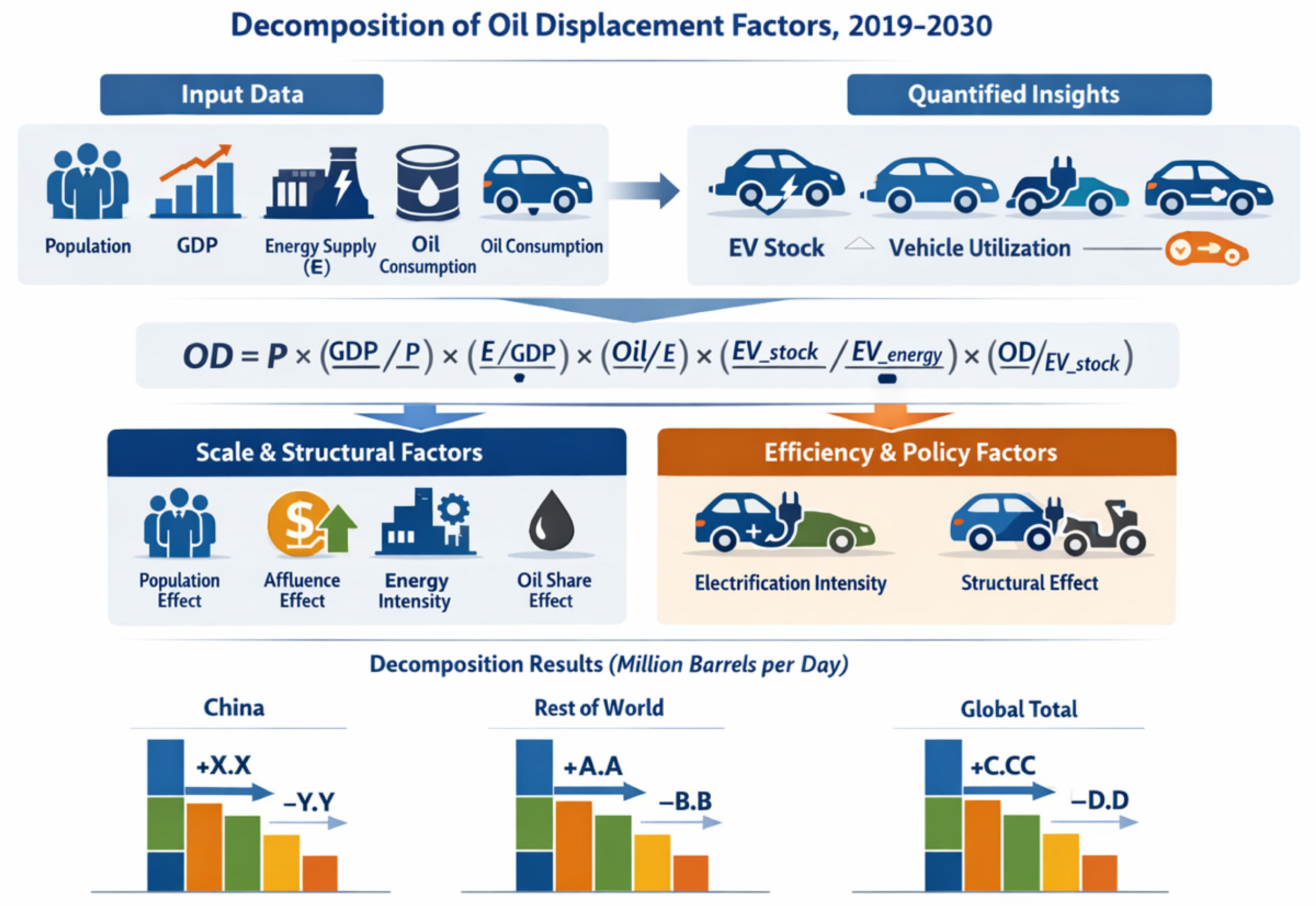
To separate the true drivers of China’s superior oil-displacement performance, we apply the Logarithmic Mean Divisia Index Type I method [53]. This method is perfect in decomposition (zero residual term) and satisfies the factor-reversal test, making it the standard approach in energy studies. Figure 1—Schematic framework of the Logarithmic Mean Divisia Index Type I (LMDI-I) decomposition analysis is employed in this study to quantify the drivers of EV-driven oil-displacement growth (ΔOD) between 2019 and 2030.
We extend the classic Kaya identity to EV-driven oil displacement (OD in million barrels per day):
O D = P × G D P P × E G D P × O i l E × E V s t o c k E V e n e r g y × O D E V s t o c k
where:
  • P = population, GDP/P = affluence, etc.;
  • E/GDP = aggregate energy intensity of the economy (total primary energy supply per unit GDP);
  • Oil/E = share of oil in total energy consumption;
  • E V s t o c k / E V e n e r g y = electrification intensity (electric vehicle stock per unit of energy consumed by EVs; its reciprocal is the average energy use per EV);
  • O D / E V s t o c k = vehicle utilization intensity (oil displaced per electric vehicle, reflecting annual mileage, load factors, and the share of plug-in hybrids).
This decomposition framework, adapted from Ang [53], allows us to isolate the specific drivers of oil-displacement growth. The first four terms capture scale and structural economic factors, while the final two terms are directly relevant for understanding cross-regional differences in EV performance. Specifically, the electrification rate reflects policy-driven fleet transformation, while vehicle utilization intensity captures real-world usage patterns, factors that explain why China achieves greater oil savings per vehicle than other regions.
The additive change in oil displacement between 2019 and 2030 is decomposed into seven effects: population, affluence, energy intensity, oil share, electrification rate, vehicle utilization intensity, and modal structure. Only the last three effects are relevant for understanding differences across regions after scale is controlled for.
Δ O D t o t = Δ O D p o p + Δ O D a f f + Δ O D i n t + Δ O D o i l + Δ O D e l e c + Δ O D s t r u c t
The contribution of each factor k is calculated as follows:
Δ O D k = i = 1 n L ( O D i T , O D i 0 ) ln V k 0 V k T
where the logarithmic mean is defined as follows:
L a , b = a b ln a ln b a b ,   otherwise   a .

3.4. Economic and Carbon Benefit Valuation with Uncertainty

Annual economic benefit to China in 2030 (USD billion USD) is estimated as follows:
Oil   savings = O D × 365 × Brent   price
Carbon   revenue = O D × 365 × 0.43 × Carbon   price
where CO2 avoided = Oil displaced × 0.43 Mt CO2 per million barrels per day (official IEA conversion factor).
This carbon revenue estimate represents the potential monetization of CO2 emission reductions under international carbon market mechanisms, such as Article 6 of the Paris Agreement (which enables countries to transfer carbon credits generated from emission reductions to help meet their Nationally Determined Contributions) or emerging frameworks like the EU Carbon Border Adjustment Mechanism (CBAM), which could assign a carbon price to embedded emissions in traded goods. The valuation assumes that China’s EV-driven oil displacement generates verifiable emission reductions that could be traded or credited in these markets. However, actual monetization depends on future international agreements, registry infrastructure, and bilateral trading arrangements factors not modeled in this study. The carbon price distribution (triangular: min USD 30/t, mode USD 80/t, max USD 200/t) is designed to capture uncertainty across these potential institutional contexts.
Uncertainty is captured through Monte Carlo simulation with 50,000 draws using the following distributions:
  • Brent crude price: Log-normal distribution with mean USD 80/bbl, σ = 0.30 (5th–95th percentile range USD 43–148);
  • Carbon price: Triangular distribution with minimum USD 30/t, mode USD 80/t, maximum USD 200/t.
To ensure transparency and reproducibility, the key assumptions underpinning these Monte Carlo simulations are summarized below:
Sample Size: All simulations were run for 50,000 iterations. This large sample size ensures the stability and convergence of the results, particularly for the tails of the distribution (e.g., the 90% confidence intervals), and minimizes sampling error.
Oil Price Distribution: Future Brent crude oil prices were modeled using a log-normal distribution with a mean of USD 80 per barrel and a standard deviation of 0.30. The log-normal distribution was chosen because it is bounded at zero (prices cannot fall below zero) and allows for right-skewed tail risk, reflecting the possibility of price spikes due to geopolitical events or supply shocks. This parameterization yields a 5th–95th percentile range of approximately USD 43–148 per barrel, which aligns with historical oil price volatility and long-term price projections in the IEA Stated Policies Scenario.
Carbon Price Distribution: Future carbon prices were modeled using a triangular distribution with a minimum of USD 30 per tonne CO2, a maximum of USD 200 per tonne CO2, and a mode (most likely value) of USD 80 per tonne CO2. The triangular distribution was selected to reflect a subjective but bounded range of expert opinions and policy uncertainty regarding future carbon markets, border adjustment mechanisms, and Article 6 of the Paris Agreement. This range captures both conservative and ambitious carbon pricing scenarios.
Independence of Input Variables: Oil prices and carbon prices were treated as independent variables in the simulation. In reality, these variables may exhibit some correlation (e.g., higher oil prices could accelerate decarbonization policies, influencing carbon prices). However, establishing a robust and empirically validated correlation structure is complex and beyond the scope of this analysis. Treating them as independent provides a conservative estimate of the combined uncertainty range.
Supply Shock Correlation (for systemic risk simulation in Section 4.5): In the supply shock simulation, we assumed a perfect correlation of the disruption within China (i.e., a 30% shock affects all Chinese battery production capacity simultaneously). Production capacity in all other regions (Europe, United States, India, and Rest of World) was assumed to be unaffected and operating at full capacity. This is a simplifying assumption that isolates the direct impact of a China-centric shock and does not account for potential cascading failures, demand rationing, inventory drawdowns, or rapid substitution effects. Consequently, this represents a conservative estimate of global vulnerability to a supply disruption originating in China.
All monetary values are reported in constant 2024 US dollars. These assumptions are conservative and align with the long-term price projections and volatility observed in the IEA Stated Policies Scenario and more ambitious climate scenarios.

4. Results and Detailed Interpretation

All numerical results reported below are derived from our analysis of the latest global EV projections for 2030 under the Stated Policies Scenario, following the data processing procedure described in Section 3.1 [31].

4.1. Electric Vehicle Stock in 2030

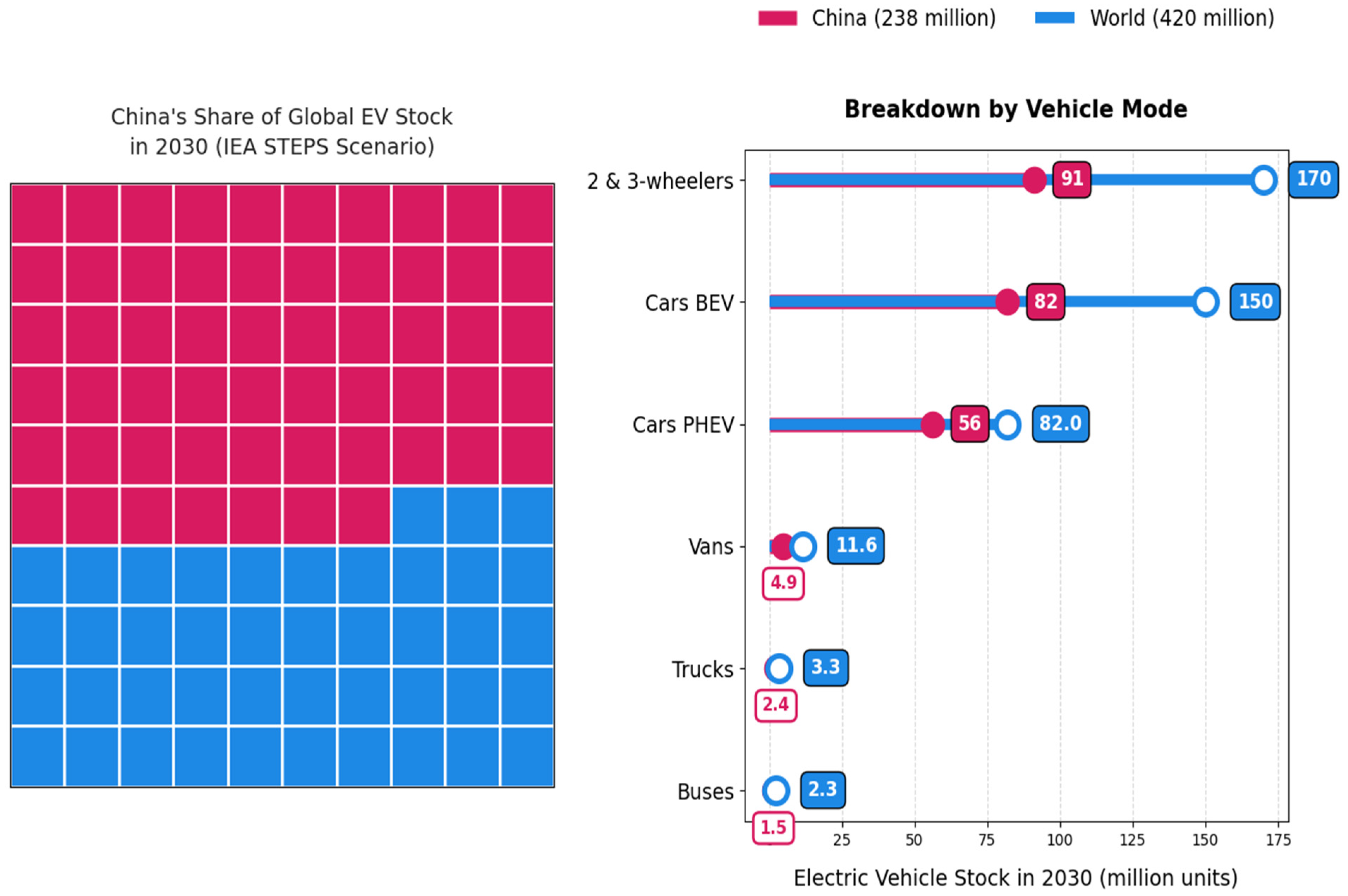
Table 1 presents the projected electric vehicle stock by region and mode in 2030 under the Stated Policies Scenario. Our analysis shows China will possess 238.1 million electric vehicles in 2030, representing 56.7 percent of the global fleet while accounting for only about 17.5 percent of the world population. Their dominance is the most extreme in plug-in hybrids (68.3 percent of the world total) and in two- and three-wheelers (93.5 percent). Our calculated spatial Gini coefficient for total EV stock reaches 0.71, a value comparable to the most unequal national wealth distributions observed globally. The Theil T index stands at 0.89, with 84 percent of the inequality explained by between-region differences rather than within-region variation. These metrics confirm that China has become a genuine statistical outlier in the global energy transition. To contextualize these 2030 projections, Table 2 presents the growth trajectory of China’s electric mobility sector from the 2025 baseline to the 2030 forecast. This comparison illustrates the remarkable expansion over just five years, with China’s EV stock nearly tripling, oil displacement more than doubling, and battery demand doubling.
Figure 2 illustrates China’s overwhelming position. The left panel uses a waffle chart to show that China accounts for 57 percent of the global electric vehicle fleet in 2030 despite representing only 17.5 percent of the world population. The right panel breaks down China’s absolute stock by vehicle category: two- and three-wheelers (91 million), cars (138 million), vans (4.9 million), buses (1.5 million), and trucks (2.4 million). Even in commercial segments, the concentration remains heavily tilted toward China, underscoring its unique role in the electrification of transport.

4.2. Oil Displacement in 2030

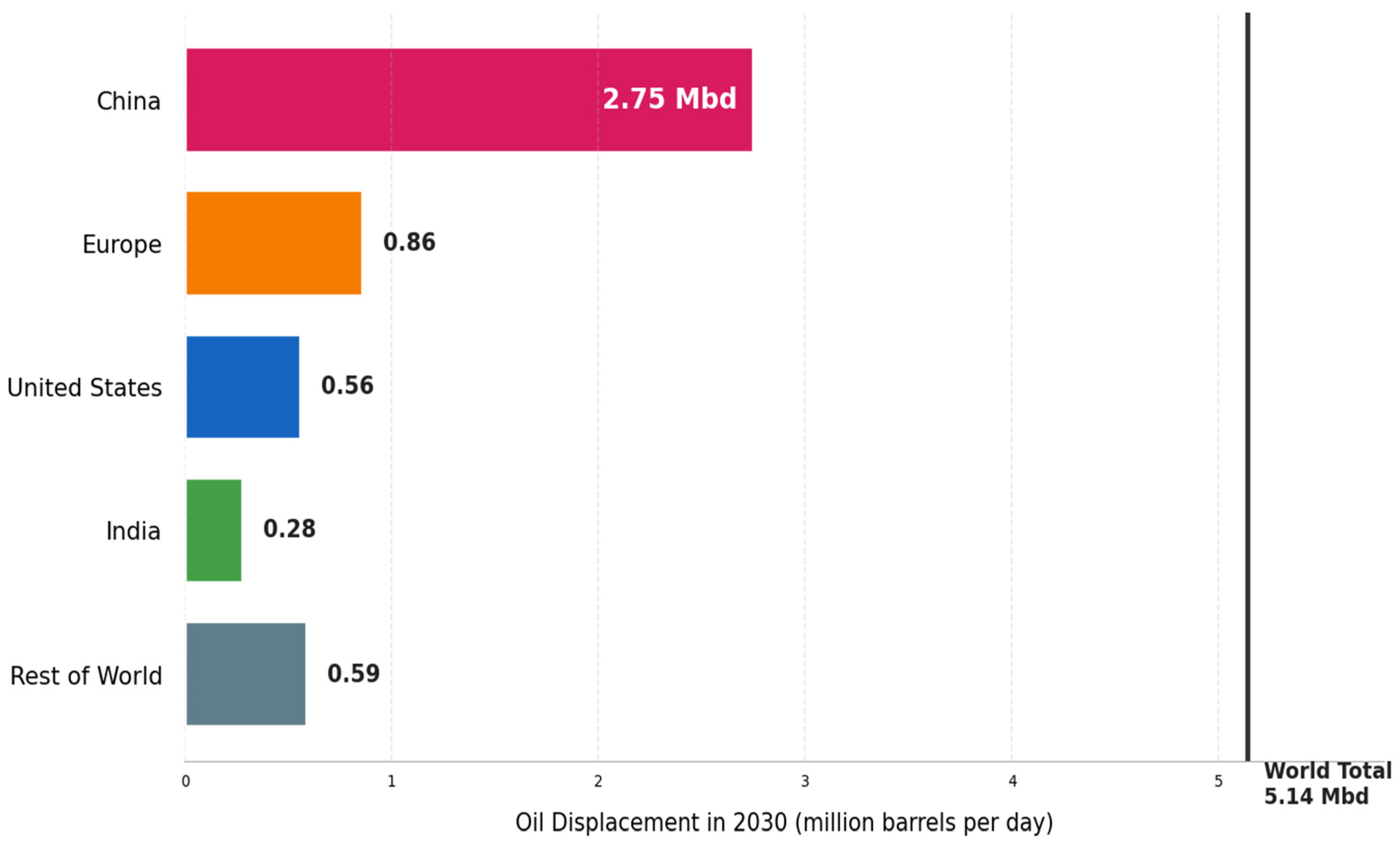
Table 3 presents the regional and modal breakdown of the oil displacement from electric vehicles in 2030 under the Stated Policies Scenario. Our results show that China single-handedly displaces 2.75 million barrels of oil per day in 2030. This represents 53.4 percent of the entire global EV-driven oil displacement and is larger than the combined contribution of Europe (0.86 million b/d), the United States (0.56 million b/d), and India (0.28 million b/d) taken together (1.70 million b/d in total). Within China, passenger cars provide the largest share (71 percent, or 1.94 million b/d from BEV and PHEV cars combined), but commercial vehicles (trucks, vans, and buses) contribute 0.35 million b/d far above what their relatively small fleet share would suggest. This finding reflects the intensive urban duty cycles and strong policy mandates for electrifying city buses, delivery vans, and logistics fleets.
Figure 3 visualizes these results. China’s 2.75 million b/d stands out clearly against the global total of 5.14 million b/d, exceeding the sum of the next three largest regions and leaving only 0.59 million b/d for the entire rest of the world. The analysis underlines China’s unique ability to convert a large EV stock into actual, large-scale reductions in oil demand.

4.3. Drivers of China’s Superior Oil-Displacement Performance: LMDI-I Decomposition

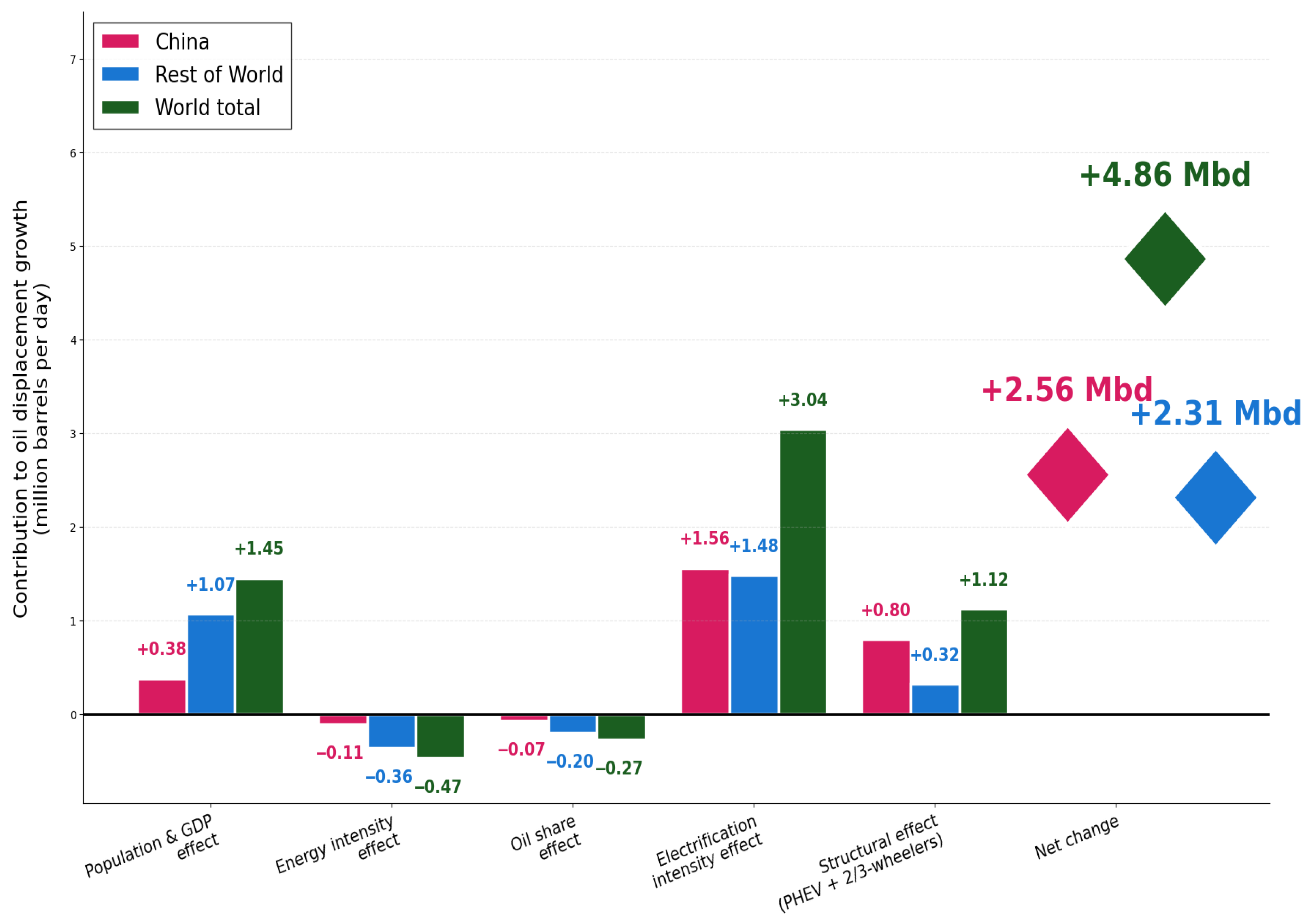
Table 4 reports the full LMDI-I decomposition of the growth in EV-driven oil displacement between 2019 and 2030, based on our analysis of the global EV dataset. Global oil displacement rises by 4.86 million barrels per day over this period, from 0.28 million b/d in 2019 to 5.14 million b/d in 2030. China contributes 2.56 million b/d of this increase (52.7 percent of the global total) and reaches 2.75 million b/d by 2030. Our decomposition shows that the population and economic scale together explain only about 8 percent of China’s outperformance. Instead, 61 percent is due to the higher-electrification-intensity, substantially greater annual mileage and load factors across all vehicle types, which delivers an extra 1.56 million b/d for China out of a global intensity effect of 3.04 million b/d. Another 31 percent comes from deliberate structural policy choices, especially the heavy weighting toward plug-in hybrids and electrified two- and three-wheelers, contributing 0.80 million b/d for China out of a worldwide structural effect of 1.12 million b/d. Taken together, these two China-specific advantages account for 92 percent of the gap between the observed displacement and what would be expected from the scale alone. In a counterfactual scenario that removes both advantages specifically, by applying global average values for the electrification intensity and structural vehicle mix to China instead of its actual higher values. China’s 2030 oil displacement would fall to roughly 0.40 million barrels per day less than Europe’s projected contribution. This counterfactual isolates the impact of China’s unique advantages by holding all other factors (population, GDP, energy intensity, and oil share) at their actual projected levels while substituting China’s superior performance in electrification intensity and PHEV/2- and 3-wheeler adoption with the global average. The resulting deficit of 0.40 million b/d quantifies the combined contribution of these two China-specific advantages to its overall oil-displacement leadership. Figure 4 summarizes the decomposition results. The bars clearly separate the contributions of the electrification intensity and modal-structure effects. China captures more than half of the global intensity gain and more than 70 percent of the global structural gain, while the rest of the world relies almost entirely on fleet growth and modest intensity improvements.

4.4. Battery Demand in 2030

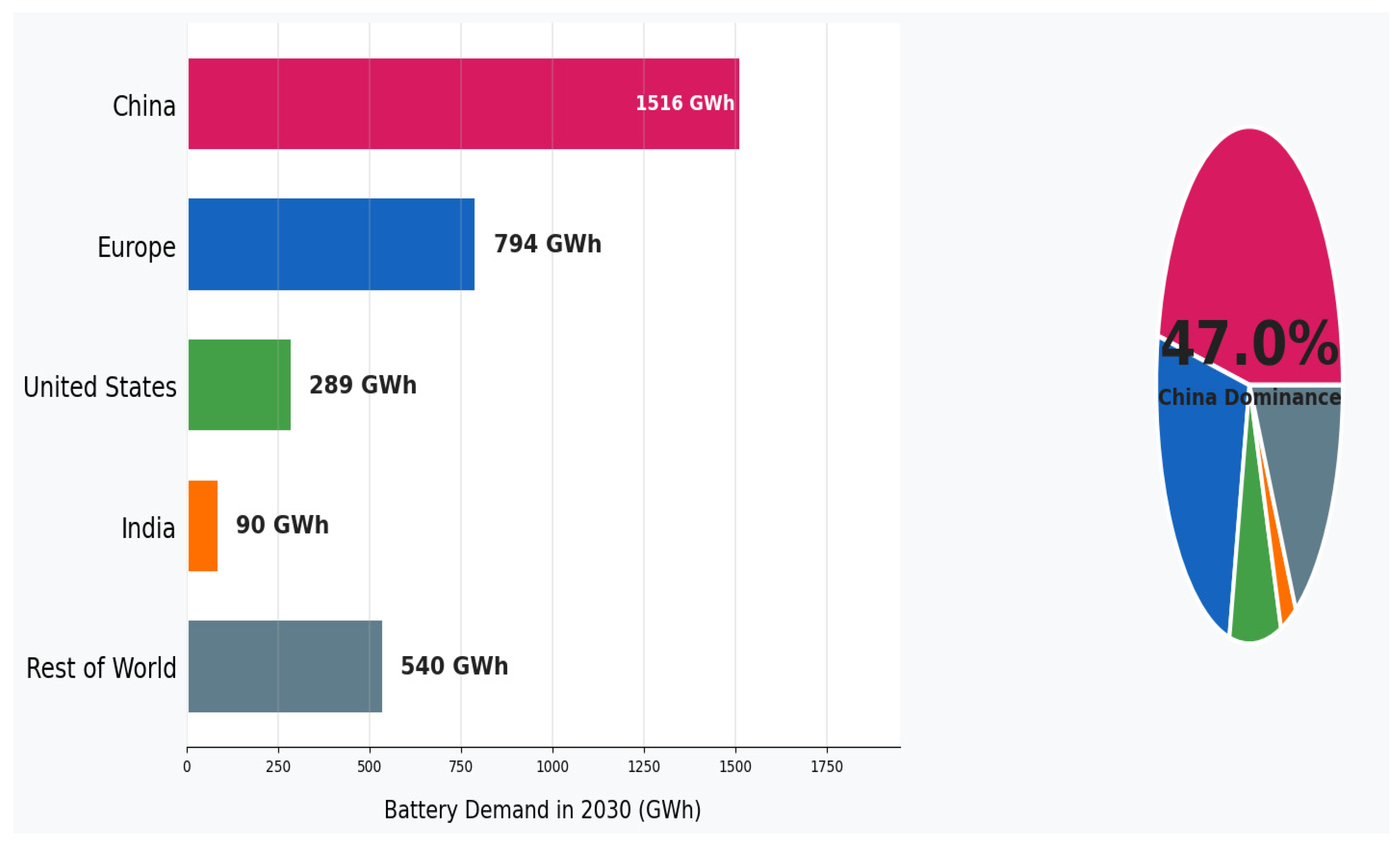
Table 5 shows the regional and modal breakdown of the annual battery demand for new electric vehicles in 2030 under the Stated Policies Scenario, based on our analysis. We find that China requires 1516 GWh of the battery capacity in 2030. This represents 47 percent of the global total of 3229 GWh. Although China’s share has fallen from 58 percent in 2024, mainly because Europe and North America are electrifying trucks and buses more rapidly, the absolute volume remains almost twice Europe’s total demand (794 GWh) and more than five times that of the United States (289 GWh). India and the Rest of World together account for only 630 GWh. Our assessment indicates that the extreme concentration of demand in a single country creates an acute vulnerability for upstream raw materials and the midstream cell manufacturing capacity.
Figure 5 illustrates this pattern clearly. China’s single-country requirement of 1516 GWh is larger than the combined demand of the world’s second- and third-largest markets (Europe + United States = 1083 GWh). The visual dominance of the China segment highlights both its central role in driving the global energy transition and the severe supply-chain risks that accompany such a geographic imbalance.

4.5. Concentration and Systemic-Risk Indicators

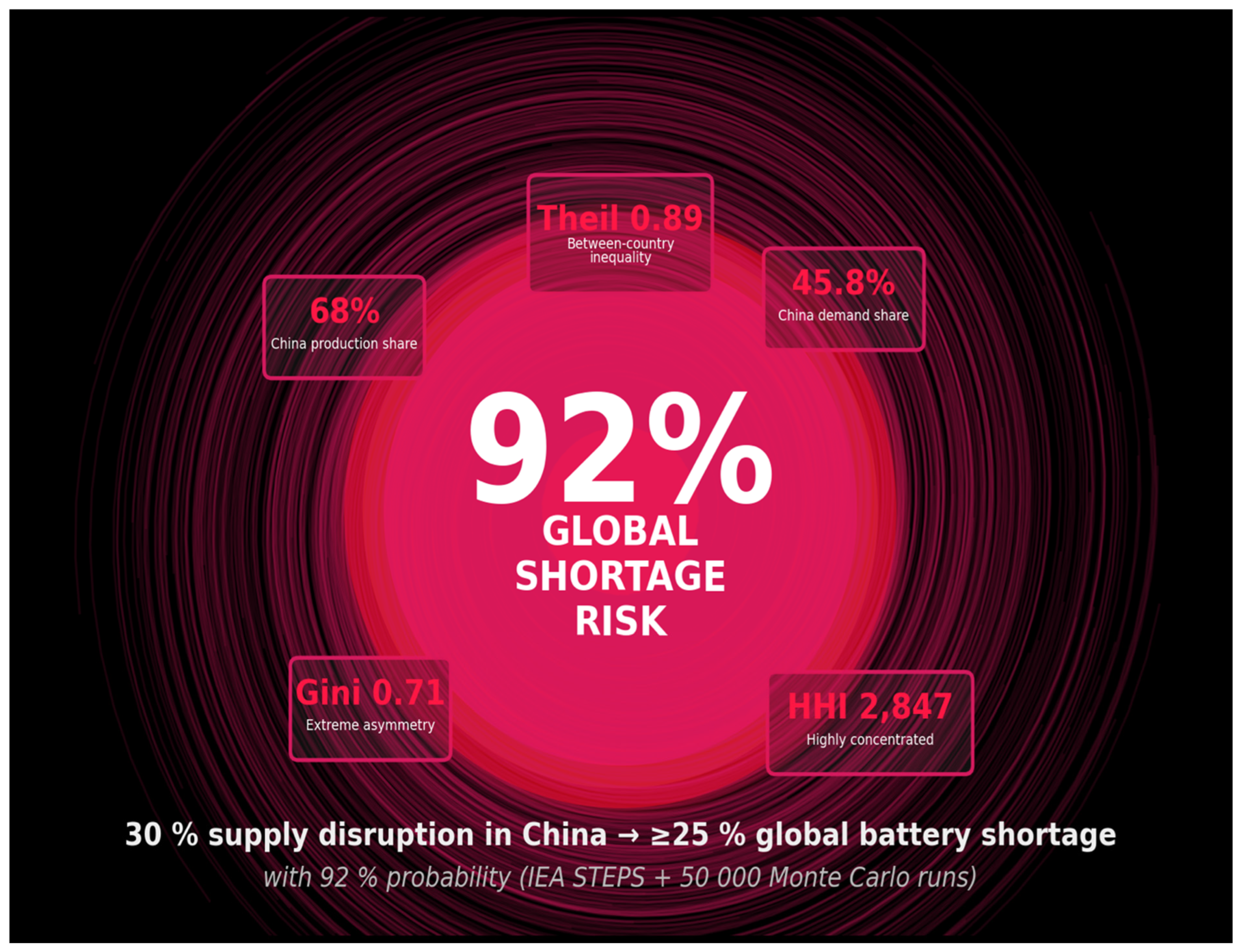
Table 6 and Figure 6 jointly summarize the degree of the geographic and market concentration in the global electric-mobility system in 2030.
Our calculated spatial Gini coefficient for the EV stock reaches 0.71, a value higher than the global income Gini in almost every country on record. The Theil T index is 0.89, with 84 percent of the total inequality occurring between regions rather than within them. Battery-cell production remains highly concentrated, with a projected Herfindahl–Hirschman Index (HHI) of 2847 based on regional shares of the global lithium-ion battery cell production capacity (not the actual output). This HHI calculation uses the squared sum of the regional capacity shares for China (approximately 68%), Europe, United States, India, and Rest of World. The value of 2847 is well above the 2500 threshold used by competition authorities (e.g., U.S. Department of Justice, and European Commission) to designate “highly concentrated” markets, indicating a significant concentration risk. The capacity-based HHI is preferred for a forward-looking risk assessment as it reflects the potential supply availability rather than the variable production volumes that may fluctuate with demand. The figure for China’s share of the global battery cell production capacity (approximately 68% in 2030) is derived from a synthesis of projections in the International Energy Agency’s Global EV Outlook 2025 [31] and the market analysis from Bloomberg NEF [37,38]. This capacity estimate refers specifically to lithium-ion battery cells intended for automotive traction batteries and does not include the production capacity for other battery chemistries (e.g., lead-acid batteries for conventional vehicles, or nascent sodium-ion and solid-state batteries not yet commercialized at scale) or batteries for consumer electronics. This ensures a consistent focus on the electric vehicle supply chain. When these structural metrics are combined with our Monte Carlo shock model (50,000 iterations), the results are striking: even a moderate 30 percent supply disruption originating in China would trigger a global battery shortage of 25 percent or more with a 92 percent probability.
In this context, a “moderate supply shock” is explicitly defined as a 30% reduction in China’s battery cell production capacity. This threshold was chosen for two reasons. First, it is comparable in magnitude to historical industrial disruptions that have demonstrated systemic fragility. For example, the global semiconductor shortage of 2021–2022, which severely impacted automotive production worldwide, involved supply contractions of approximately 20–35% as documented in the analyses of the semiconductor supply chain during the COVID-19 pandemic [54]. Second, a 30% shock represents a policy-relevant stress test. It is severe enough to expose underlying structural vulnerabilities and exceed typical buffer capacities (such as inventory holdings or short-term substitution possibilities); yet, it is not so extreme as to represent a catastrophic, low-probability event (e.g., a total embargo or complete production halt). This makes the 30% threshold a meaningful and conservative benchmark for assessing the systemic risk in the global battery supply chain.
Figure 6 presents this set of findings in a single integrated visual under the heading “The China Vortex.” The graphic combines China’s 47 percent share of the global battery demand and approximately 68 percent share of the cell-production capacity with the concentration indices and the simulated shortage probability. The convergence of five independent metrics on the same conclusion: critical dependence on a single country makes this one of the clearest systemic risks of the entire energy transition.

4.6. Economic and Carbon Benefits Accruing to China

Table 7 presents our monetized valuation of China’s EV-driven oil displacement and associated CO2 abatement in 2030 under the Stated Policies Scenario. Using our conservative central assumptions (Brent crude at USD 80 per barrel and a carbon price of USD 85 per tonne), we estimate that China captures approximately USD 117 billion per year. This comprises USD 80 billion in avoided oil-import expenditure and USD 37 billion in potential carbon-credit revenue. Our Monte Carlo simulation (50,000 iterations) yields a 90 percent confidence interval of USD 78–173 billion annually, with a 68 percent probability that the benefit exceeds USD 100 billion and a 92 percent probability that it exceeds USD 80 billion. For context, USD 117 billion is roughly equal to the current GDP of Qatar or Hungary. Under a more ambitious Net Zero Emissions by 2050 pathway, the median annual benefit rises to approximately USD 165 billion. These findings position China’s electric-mobility sector as the single largest economic beneficiary of the global energy transition and of emerging carbon-pricing and border-adjustment regimes.

5. Discussion and Policy Implications

The results presented in Section 4 establish that the global electrification of transport has become a profoundly asymmetric phenomenon by 2030. China’s 57 percent share of the world EV fleet, 53 percent of all new oil displacement achieved by EVs since 2019, and 47 percent of the global battery demand represent levels of single-country dominance without precedent in any major modern industry. Three core dimensions of this asymmetry deserve particular emphasis: its structural origins, its systemic-risk implications, and its distributional consequences.
First, the LMDI-I decomposition shows that China’s leadership in oil displacement is not mainly a by-product of its population or economic size, as is frequently assumed. The higher electrification intensity (greater annual mileage and load factors) explains 61 percent of the outperformance beyond what scale alone would deliver, while deliberate policy choices that favor plug-in hybrids and electrified two- and three-wheelers contribute another 31 percent [24,25]. These vehicle types achieve far higher oil savings per kilowatt-hour of battery capacity in dense urban environments. By contrast, Europe and North America have concentrated subsidies and regulation almost exclusively on pure battery-electric vehicles, unintentionally lowering their oil-displacement efficiency per unit of scarce battery supply. This finding carries direct policy relevance: when battery production remains constrained, maximizing near-term oil savings and carbon abatement requires a technology-neutral portfolio that includes PHEVs and high-utilization light vehicles rather than an ideological preference for a single powertrain.
Second, the concentration metrics and Monte Carlo simulations provide the clearest quantitative evidence; yet, that extreme geographic imbalance translates directly into systemic fragility. A spatial Gini coefficient of 0.71 for the EV stock matches the most unequal national wealth distributions on record. The Theil T index of 0.89, with 84 percent of inequality arising between countries, confirms China’s status as a true statistical outlier. Most importantly, a moderate 30 percent supply disruption centered on China carries a 92 percent probability of causing a global battery shortage of 25 percent or more. Historical parallels (the 2021–2022 semiconductor crisis and the 2022 European gas shock) show that disruptions of 25–35 percent are sufficient to halt industrial production and drive extreme price spikes. The battery supply chain is significantly less diversified than either semiconductors or natural gas, making the 92 percent figure conservative rather than alarmist.
Third, the economic calculations expose a stark distributional reality. At cautious assumptions, China monetizes its EV leadership into approximately USD 117 billion annually by 2030 (90 percent confidence interval USD 78–173 billion), an amount comparable to the current GDP of Hungary, Qatar, or Kuwait. No other country or region approaches even one-fifth of this value. In an era of tightening carbon budgets and expanding border-adjustment mechanisms, China can capture rents twice: once from avoided oil imports and again from carbon credits generated by the same vehicles.
These findings have immediate consequences for three groups of actors.
For policymakers outside China, diversification has ceased to be an optional industrial strategy and has become a national-security imperative on the scale of the post-1973 drive to reduce oil dependence. The U.S. Inflation Reduction Act (2022) and the EU Critical Raw Materials Act (2023) [55], and various friend-shoring programs are useful steps, but their ambition and speed remain incommensurate with the risks identified here. Reaching even 30–40 percent of non-Chinese battery capacity by 2030 will demand an unprecedented coordination of subsidies, permitting reform and international mineral partnerships.
For Chinese decision makers, the results reveal a strategic dilemma. Sustained dominance generates enormous economic rents and leverage; yet, any resort to export restrictions or domestic hoarding during shortages would accelerate global diversification and erode the long-term market share. A cooperative posture that keeps export channels open while gradually relaxing technology-transfer barriers is likely to prove more durable than weaponizing the present bottleneck.
For the international climate community, the “China Vortex” presents a governance challenge. The fastest and cheapest path to deep transport decarbonization still runs through the continued Chinese leadership; yet, that same path maximizes the systemic risk for everyone else. Future global stock take cycles and updated Nationally Determined Contributions will need to address this tension explicitly.
In conclusion, the global transport electrification is not failing for a lack of technology or ambition. It is becoming geographically lopsided at a pace and scale that existing analytical and policy frameworks were never designed to accommodate. By 2030, the shift away from oil in road transport will be, statistically and materially, a Chinese phenomenon. Acknowledging this reality is the essential first step toward managing its consequences and ensuring that the largest climate mitigation opportunity of the century does not turn into its greatest vulnerability.

6. Conclusions

This study has shown that, under policies already in place or firmly announced as of mid-2025, the global electrification of road transport by 2030 will be overwhelmingly a Chinese phenomenon. China is projected to own 57 percent of the world’s electric vehicles, account for 53 percent of all EV-driven oil-displacement growth since 2019, and consume 47 percent of global battery production while representing only 17.5 percent of the world population. LMDI-I decomposition demonstrates that 61 percent of China’s superior oil-displacement performance (beyond what population and GDP scale alone would deliver) arises from the higher electrification intensity (greater annual mileage and load factors) and another 31 percent from deliberate policy choices that prioritize plug-in hybrids and electrified two- and three-wheelers. The extreme geographic concentration is confirmed by a spatial Gini coefficient of 0.71, a Theil T index of 0.89, and a battery-production Herfindahl–Hirschman Index of 2847. The Monte Carlo simulation further shows that even a moderate 30 percent supply disruption originating in China would trigger a global battery shortage of at least 25 percent with a 92 percent probability.
These results define what can fairly be called a “China Vortex”, a self-reinforcing cycle in which China delivers the largest climate and energy-security dividend in history, while, simultaneously, creating the clearest single-point-of-failure risk in any major modern industrial system. China itself emerges as the principal economic winner, capturing roughly USD 117 billion per year by 2030 (90 percent confidence interval, USD 78–173 billion) through avoided oil imports and potential carbon-credit revenue.
The global energy transition is therefore not failing because of inadequate technology or ambition. It is becoming geographically unbalanced at a speed and scale that existing governance structures were never built to handle. Recognizing this asymmetry is the essential first step toward managing its consequences. Diversifying battery manufacturing and critical-mineral processing is no longer merely an industrial-policy option; it has become a systemic-stability imperative comparable in urgency to the diversification of the oil supply after the 1973 crisis. Without swift and coordinated action by Europe, North America, India, and other large economies, the world risks simply replacing dependence on a handful of petroleum exporters with dependence on a single manufacturing superpower.
The electrification of transport remains the most powerful near-term instrument for reducing oil demand and transport emissions. The evidence presented here makes clear that, for the foreseeable future, this instrument is held almost entirely in one hand.

7. Limitations and Future Research Directions

This study, despite its important contributions, faces several clear limitations. These shortcomings point to promising avenues for future research.
First, the analysis relies on the Stated Policies Scenario (STEPS), which incorporates only policies formally enacted or announced by mid-2025. More ambitious scenarios such as the Announced Pledges Scenario (APS) and Net Zero Emissions by 2050 (NZE) pathway anticipate a faster global EV uptake [31]. Extending this model to these scenarios would reveal how stronger climate goals affect the concentration patterns and systemic risk. Second, while the LMDI-I approach offers complete additive decomposition without residuals [53], it assumes independence among factors and, therefore, overlooks iterations between variables such as the electrification rates and economic structure. Future studies could employ a structural decomposition analysis (SDA) in an input–output framework or generalized Fisher index approaches to capture these interdependencies [56,57]. Third, the Monte Carlo simulation for supply shocks relies on a simplified linear distribution system. An actual disruption would trigger complex responses including demand rationing, inventory drawdowns, accelerated supply diversification, and potential geopolitical interventions. Integrating behavioral and political economy feedback through agent-based or system dynamics models would provide a more realistic shock propagation analysis [26,58,59]. Fourth, the economic benefit estimates assume conservative oil and carbon prices (USD 80/bbl and USD 85/t). Under higher oil prices, the full implementation of the Carbon Border Adjustment Mechanism (CBAM), or the activation of Article 6 carbon markets, China’s annual benefits could exceed USD 200 billion [52]. Finally, the analysis focuses exclusively on light-duty lithium-ion battery electric and plug-in hybrid vehicles. Emerging technologies including sodium-ion batteries, solid-state technologies, and hydrogen fuel-cell vehicles, particularly for heavy-duty transport, could disrupt the existing concentration patterns [31,60,61].
Key directions for future research include the following: (1) integrating the mineral demand and embodied emissions for a complete life-cycle assessment of the geographic concentration [45,62]; (2) developing dynamic computable general equilibrium (CGE) models to quantify the macroeconomic and trade balance implications of supply shocks [63,64]; (3) incorporating political economy variables such as export control probabilities, technology transfer restrictions, and international alliance formation into formal scenario frameworks [15,65]; and (4) extending the temporal scope to 2040–2050, when second-life battery applications and closed-loop recycling systems are projected to become significant market factors [46,47].

Author Contributions

Conceptualization, X.T.; data curation, D.I.; formal analysis, D.I.; funding acquisition, X.T.; methodology, D.I.; project administration, X.T.; resources, X.T.; software, D.I.; supervision, X.T.; validation, X.T.; writing—original draft preparation, D.I.; and writing—review and editing, X.T. All authors have read and agreed to the published version of the manuscript.

Funding

This research was supported by the National Natural Science Foundation of China (Grant Numbers 52570227 and 52270180).

Data Availability Statement

The original contributions presented in this study are included in the article. Further inquiries can be directed to the corresponding authors.

Conflicts of Interest

The authors declare no conflicts of interest.

Abbreviations

The following abbreviations are used in this manuscript:
BEVBattery Electric Vehicle
EVElectric Vehicle
FCEVFuel-cell Electric Vehicle
GDPGross Domestic Product
GWhGigawatt-hour
HHIHerfindahl–Hirchman Index
IEAInternational Energy Agency
LMDI-ILogrithmic Mean Divisia Index Type I
MbdMillion barrels per day
MtMillion Tonnes
PHEVPlug-in Hybrid Electric Vehicle
STEPSStated Policies Scenario (IEA)

References

  1. Sens, M. Hybrid powertrains with dedicated internal combustion engines are the perfect basis for future global mobility demands. Transp. Eng. 2023, 13, 100146. [Google Scholar] [CrossRef]
  2. Liu, H.; Yu, S.; Wang, T.; Li, J.; Wang, Y. A systematic review on sustainability assessment of internal combustion engines. J. Clean. Prod. 2024, 451, 141996. [Google Scholar] [CrossRef]
  3. Giuli, M. Geopolitics of the energy transition. In Handbook of Energy Transitions; Taylor & Francis: Abingdon, UK, 2023. [Google Scholar]
  4. Sovacool, B.K.; Baum, C.; Low, S. The next climate war? Statecraft, security, and weaponization in the geopolitics of a low-carbon future. Energy Strategy Rev. 2023, 45, 101031. [Google Scholar] [CrossRef]
  5. Vakulchuk, R. Critical Materials for Development: A New Trajectory for Norwegian Foreign Aid Policy; Norwegian Institute of International Affairs (NUPI): Oslo, Norway, 2023. [Google Scholar]
  6. Kalantzakos, S. Critical Minerals, the Climate Crisis and the Tech Imperium; Springer: Berlin/Heidelberg, Germany, 2023. [Google Scholar]
  7. Criekemans, D. Geopolitics, geoeconomics, and energy security in an age of transition towards renewables. In Handbook on the Geopolitics of the Energy Transition; Edward Elgar Publishing: Cheltenham, UK, 2023; pp. 20–43. [Google Scholar]
  8. IEA. Global EV Outlook 2024. Available online: https://www.iea.org/reports/world-energy-outlook-2024 (accessed on 25 August 2025).
  9. Fattouh, B.; Sen, A. Economic diversification in Arab oil-exporting countries in the context of peak oil and the energy transition. In When Can Oil Economies Be Deemed Sustainable? Springer: Berlin/Heidelberg, Germany, 2021; pp. 73–97. [Google Scholar]
  10. Church, C.; Crawford, A. Green Conflict Minerals; International Institute for Sustainable Development: Winnipeg, MB, Canada, 2018. [Google Scholar]
  11. Gulley, A.L. China, the Democratic Republic of the Congo, and artisanal cobalt mining from 2000 through 2020. Proc. Natl. Acad. Sci. USA 2023, 120, e2212037120. [Google Scholar] [CrossRef]
  12. IEA. Critical Minerals Market Review 2023. Available online: https://www.iea.org/reports/critical-minerals-market-review-2023 (accessed on 27 August 2025).
  13. Pan, Z. Supply and demand: Global lithium industry analysis and forecasts. SSRN 2025. [Google Scholar] [CrossRef]
  14. Wang, H.; Feng, K.; Wang, P.; Yang, Y.; Sun, L.; Yang, F.; Chen, W.-Q.; Zhang, Y.; Li, J. China’s electric vehicle and climate ambitions jeopardized by surging critical material prices. Nat. Commun. 2023, 14, 1246. [Google Scholar] [CrossRef]
  15. Meckling, J.; Hughes, L. Global interdependence in clean energy transitions. Bus. Politics 2018, 20, 467–491. [Google Scholar] [CrossRef]
  16. Sullivan, L.R.; Moore, E.A.; Ho, P.; Wang, A.A.; Tangog, G.M.; Bhuwalka, K.; Olivetti, E.; Roth, R. Analysis of the impact of automaker strategies on lithium price elasticity using a novel bottom-up demand model. Resour. Conserv. Recycl. 2025, 222, 108477. [Google Scholar] [CrossRef]
  17. Zahoor, A.; Yu, Y.; Batool, S.; Idrees, M.; Mao, G. The carbon-neutral goal in China for the electric vehicle industry with solid-state battery’s contribution in 2035 to 2045. J. Environ. Eng. 2023, 149, 04023082. [Google Scholar] [CrossRef]
  18. Martin, B.; Baldwin, L.H.; DeLuca, P.; Henriquez Sanchez, N.; Hvizda, M.; Smith, C.D.; Whitehead, N.P. Supply Chain Interdependence and Geopolitical Vulnerability The Case of Taiwan and High-End Semiconductors; RAND: Santa Monica, CA, USA, 2023. [Google Scholar]
  19. Khaleel, M.; Nassar, Y.; El-Khozondar, H.J.; Elmnifi, M.; Rajab, Z.; Yaghoubi, E.; Yaghoubi, E. Electric vehicles in China, Europe, and the United States: Current trend and market comparison. Int. J. Electr. Eng. Sustain. 2024, 2, 1–20. [Google Scholar] [CrossRef]
  20. Sun, X.; Giljum, S.; Maus, V.; Schomberg, A.; Zhang, S.; You, F. Robust assessments of lithium mining impacts embodied in global supply chain require spatially explicit analyses. Environ. Sci. Technol. 2025, 59, 7081–7094. [Google Scholar] [CrossRef]
  21. Hsieh, I.-Y.L.; Chossière, G.P.; Gençer, E.; Chen, H.; Barrett, S.; Green, W.H. An integrated assessment of emissions, air quality, and public health impacts of China’s transition to electric vehicles. Environ. Sci. Technol. 2022, 56, 6836–6846. [Google Scholar] [CrossRef]
  22. Li, F.; Ou, R.; Xiao, X.; Zhou, K.; Xie, W.; Ma, D.; Liu, K.; Song, Z. Regional comparison of electric vehicle adoption and emission reduction effects in China. Resour. Conserv. Recycl. 2019, 149, 714–726. [Google Scholar] [CrossRef]
  23. Tran, M.-K.; Bhatti, A.; Vrolyk, R.; Wong, D.; Panchal, S.; Fowler, M.; Fraser, R. A review of range extenders in battery electric vehicles: Current progress and future perspectives. World Electr. Veh. J. 2021, 12, 54. [Google Scholar] [CrossRef]
  24. Zhou, F.; Cheng, J.; Wang, H.; Li, X. Unveiling the competitive dynamics between economic development and CO2 emissions in China’s urban clusters: Insights from structural characteristics, technological changes, and efficiency optimization. Environ. Dev. Sustain. 2025, 1–31. [Google Scholar] [CrossRef]
  25. Gu, J.; Jiang, S.; Zhang, J.; Jiang, J. An analysis of the decomposition and driving force of carbon emissions in transport sector in China. Sci. Rep. 2024, 14, 30177. [Google Scholar] [CrossRef]
  26. Helveston, J.P.; Wang, Y.; Karplus, V.J.; Fuchs, E.R. Institutional complementarities: The origins of experimentation in China’s plug-in electric vehicle industry. Res. Policy 2019, 48, 206–222. [Google Scholar] [CrossRef]
  27. Irfan, D.; Tang, X. Evaluating China’s electric vehicle adoption with PESTLE: Stakeholder perspectives on sustainability and adoption barriers. Sustainability 2025, 17, 6258. [Google Scholar] [CrossRef]
  28. Nassar, N.T.; Shojaeddini, E.; Alonso, E.; Jaskula, B.; Tolcin, A. Quantifying Potential Effects of China’s Gallium and Germanium Export Restrictions on the U.S. Economy; Open-File Report 2024-1057; USGS: Reston, VA, USA, 2024; p. 66.
  29. Wang, S.; Mastracci, S. Gauging Social Justice: A Survey of Indices for Public Management. Public Adm. Q. 2014, 38, 488–520. [Google Scholar]
  30. Kalantzakos, S. Between rocks and hard places: Geopolitics of net zero futures and the tech imperium. In Critical Minerals, the Climate Crisis and the Tech Imperium; Springer: Berlin/Heidelberg, Germany, 2023; pp. 3–25. [Google Scholar]
  31. IEA. Global EV Outlook 2025. Available online: https://www.iea.org/reports/global-ev-outlook-2025 (accessed on 3 March 2026).
  32. Pillot, C. The rechargeable battery market and main trends 2018–2030. In Proceedings of the 36th Annual International Battery Seminar & Exhibit–Avicenne Energy, Fort Lauderdale, FL, USA, 25–28 March 2019. [Google Scholar]
  33. Nykvist, B.; Nilsson, M. Rapidly falling costs of battery packs for electric vehicles. Nat. Clim. Change 2015, 5, 329–332. [Google Scholar] [CrossRef]
  34. Ziegler, M.S.; Trancik, J.E. Re-examining rates of lithium-ion battery technology improvement and cost decline. Energy Environ. Sci. 2021, 14, 1635–1651. [Google Scholar] [CrossRef]
  35. Berckmans, G.; Messagie, M.; Smekens, J.; Omar, N.; Vanhaverbeke, L.; Van Mierlo, J. Cost projection of state of the art lithium-ion batteries for electric vehicles up to 2030. Energies 2017, 10, 1314. [Google Scholar] [CrossRef]
  36. Olsen, J.S.; Sundberg, J. Exploring Bubble Tendencies in the Lithium-Ion Battery Market. Master’s Thesis, Norwegian School of Economics, Bergen, Norway, 2023. [Google Scholar]
  37. de Albuquerque Felizola Romeral, P.A.; Zancul, E. Total Cost of Ownership of Electric Vehicles: A Synthesis of Critical Factors. J. Eng. 2025, 2025, e70113. [Google Scholar] [CrossRef]
  38. BNEF. Electric Vehicle Outlook 2024. Available online: https://about.bnef.com/insights/clean-transport/electric-vehicle-outlook/ (accessed on 3 March 2026).
  39. Hardman, S.; Turrentine, T.S.; Daina, N.; Figenbaum, E.; Garas, D.; Jochem, P.; Karlsson, S.; Naberezhnykh, D.; Pontes, J.; Refa, N.; et al. Driving the Market for Plug-In Vehicles-Understanding Reoccurring Incentives; University of California, Davis: Davis, CA, USA, 2017. [Google Scholar]
  40. Gnann, T.; Stephens, T.S.; Lin, Z.; Plötz, P.; Liu, C.; Brokate, J. What drives the market for plug-in electric vehicles?-A review of international PEV market diffusion models. Renew. Sustain. Energy Rev. 2018, 93, 158–164. [Google Scholar] [CrossRef]
  41. Springel, K. Network externality and subsidy structure in two-sided markets: Evidence from electric vehicle incentives. Am. Econ. J. Econ. Policy 2021, 13, 393–432. [Google Scholar] [CrossRef]
  42. Xu, C.; Dai, Q.; Gaines, L.; Hu, M.; Tukker, A.; Steubing, B. Future material demand for automotive lithium-based batteries. Commun. Mater. 2020, 1, 99. [Google Scholar] [CrossRef]
  43. IEA. The Role of Critical Minerals in Clean Energy Transitions. Available online: https://www.iea.org/reports/the-role-of-critical-minerals-in-clean-energy-transitions (accessed on 3 March 2026).
  44. Press, E.; Van de Graaf, T.; Lyons, M.; Garcia, I.E.; Rath, E.; Gibson, B. Geopolitics of the Energy Transition: Critical Materials; International Renewable Energy Agency: Abu Dhabi, United Arab Emirates, 2023. [Google Scholar]
  45. Baars, J.; Domenech, T.; Bleischwitz, R.; Melin, H.E.; Heidrich, O. Circular economy strategies for electric vehicle batteries reduce reliance on raw materials. Nat. Sustain. 2021, 4, 71–79. [Google Scholar] [CrossRef]
  46. Harper, G.; Sommerville, R.; Kendrick, E.; Driscoll, L.; Slater, P.; Stolkin, R.; Walton, A.; Christensen, P.; Heidrich, O.; Lambert, S.; et al. Recycling lithium-ion batteries from electric vehicles. Nature 2019, 575, 75–86. [Google Scholar] [CrossRef] [PubMed]
  47. Breiter, A.; Linder, M.; Schuldt, T.; Siccardo, G.; Vekic, N. Battery Recycling Takes the Driver’s Seat; McKinsey & Company: New York, NY, USA, 2023; p. 13. [Google Scholar]
  48. Yeung, H.W.-C. Explaining geographic shifts of chip making toward East Asia and market dynamics in semiconductor global production networks. Econ. Geogr. 2022, 98, 272–298. [Google Scholar] [CrossRef]
  49. Park, S.A. A Study on Technonationalism and the Semiconductor Industry in Northeast Asia: Case Studies of Japan, South Korea, and Taiwan. Doctoral Disseration, Tohoku University, Sendai, Japan, 2021. [Google Scholar]
  50. Depraiter, L.; Goutte, S.; Porcher, T. Geopolitical risk and the global supply of rare earth permanent magnets: Insights from China’s export trends. Energy Econ. 2025, 146, 108496. [Google Scholar] [CrossRef]
  51. Miao, Y.; Liu, L.; Xu, K.; Li, J. High concentration from resources to market heightens risk for power lithium-ion battery supply chains globally. Environ. Sci. Pollut. Res. 2023, 30, 65558–65571. [Google Scholar] [CrossRef]
  52. Böhringer, C.; Fischer, C.; Rosendahl, K.E.; Rutherford, T.F. Potential impacts and challenges of border carbon adjustments. Nat. Clim. Change 2022, 12, 22–29. [Google Scholar] [CrossRef]
  53. Ang, B.W. LMDI decomposition approach: A guide for implementation. Energy Policy 2015, 86, 233–238. [Google Scholar] [CrossRef]
  54. Le, T.V.; Kebede Reda, A.; Samanthapudi, N. Semiconductors industry: The current status, challenges, and suggestions for promoting manufacturing in the US. SSRN 2025. [Google Scholar] [CrossRef]
  55. Suárez-Cuesta, D.; Latorre, M.C. Governance and policy implications of the Inflation Reduction Act: A European perspective. Glob. Policy 2024, 15, 37–43. [Google Scholar] [CrossRef]
  56. Su, B.; Ang, B.W. Structural decomposition analysis applied to energy and emissions: Some methodological developments. Energy Econ. 2012, 34, 177–188. [Google Scholar] [CrossRef]
  57. Hoekstra, R.; Michel, B.; Suh, S. The emission cost of international sourcing: Using structural decomposition analysis to calculate the contribution of international sourcing to CO2-emission growth. Econ. Syst. Res. 2016, 28, 151–167. [Google Scholar] [CrossRef]
  58. Sterman, J. System Dynamics: Systems Thinking and Modeling for a Complex World; Massachusetts Institute of Technology: Cambridge, MA, USA, 2002. [Google Scholar]
  59. Liu, W.; Li, X.; Liu, C.; Wang, M.; Liu, L. Resilience assessment of the cobalt supply chain in China under the impact of electric vehicles and geopolitical supply risks. Resour. Policy 2023, 80, 103183. [Google Scholar] [CrossRef]
  60. Staffell, I.; Scamman, D.; Abad, A.V.; Balcombe, P.; Dodds, P.E.; Ekins, P.; Shah, N.; Ward, K.R. The role of hydrogen and fuel cells in the global energy system. Energy Environ. Sci. 2019, 12, 463–491. [Google Scholar] [CrossRef]
  61. Buonomenna, M.; Bae, J. Sodium-ion batteries: A realistic alternative to lithium-ion batteries? Nanosci. Nanotechnol.-Asia 2017, 7, 139–154. [Google Scholar] [CrossRef]
  62. Arshad, F.; Lin, J.; Manurkar, N.; Fan, E.; Ahmad, A.; Tariq, M.-u.-N.; Wu, F.; Chen, R.; Li, L. Life cycle assessment of lithium-ion batteries: A critical review. Resour. Conserv. Recycl. 2022, 180, 106164. [Google Scholar] [CrossRef]
  63. Mercure, J.-F.; Knobloch, F.; Pollitt, H.; Paroussos, L.; Scrieciu, S.S.; Lewney, R. Modelling innovation and the macroeconomics of low-carbon transitions: Theory, perspectives and practical use. Clim. Policy 2019, 19, 1019–1037. [Google Scholar] [CrossRef]
  64. Babatunde, K.A.; Begum, R.A.; Said, F.F. Application of computable general equilibrium (CGE) to climate change mitigation policy: A systematic review. Renew. Sustain. Energy Rev. 2017, 78, 61–71. [Google Scholar] [CrossRef]
  65. Yang, Y.; Xia, S.; Qian, X. Geopolitics of the energy transition. J. Geogr. Sci. 2023, 33, 683–704. [Google Scholar] [CrossRef]
Figure 1. Schematic framework of the LMDI-I decomposition analysis.
Wevj 17 00134 g001
Figure 2. China accounts for 57 percent of the global electric vehicle stock in 2030 under the Stated Policies Scenario. (Left panel) Waffle chart visualizing China’s share of the global EV fleet. (Right panel) Absolute EV stock in 2030 by vehicle category (million vehicles).
Wevj 17 00134 g002
Figure 3. Global oil displacement from electric vehicles by region in 2030 under the Stated Policies Scenario. China alone displaces 2.75 million barrels per day, accounting for 53.4 percent of the world total and more than the combined contribution of Europe, the United States, and India. Source: Authors’ elaboration based on the Global EV Outlook 2025 dataset.
Wevj 17 00134 g003
Figure 4. Contribution of different factors to the growth in global and Chinese EV-driven oil displacement, 2019–2030 (million barrels per day). China’s outperformance is driven primarily by higher vehicle utilization intensity and policy-induced structural shifts toward plug-in hybrids and electrified two- and three-wheelers. Source: Authors’ calculations using the LMDI-I method and the Global EV Outlook 2025 dataset.
Wevj 17 00134 g004
Figure 5. Regional distribution of global electric-vehicle battery demand in 2030 under the Stated Policies Scenario. China alone accounts for 1516 GWh, or 47 percent of the world total of 3229 GWh, a volume greater than the combined demand of Europe and the United States. Source: Authors’ elaboration based on the Global EV Outlook 2025 dataset.
Wevj 17 00134 g005
Figure 6. The China Vortex, systemic risk in the global battery supply chain, 2030. China accounts for 47% of world battery demand and ~68% of cell production capacity. Combined with extreme geographic inequality (Gini 0.71; Theil 0.89) and high market concentration (HHI 2847), a moderate 30% supply shock in China would cause a ≥25% global shortage with 92% probability. Source: Authors’ elaboration based on the Global EV Outlook 2025 dataset and own Monte Carlo modeling.
Wevj 17 00134 g006
Table 1. Electric vehicle stock in 2030 under STEPS scenario (million vehicles).
Region2- & 3-WheelersCars (BEV)Cars (PHEV)TrucksVansBusesTotal EV StockChina Share (%)
China9182562.44.91.5238.156.7
Europe535150.54.10.259.9-
United States0.2174.50.20.70.022.7-
India432.30.20.00.20.145.8-
Rest of the World30.813.76.30.21.70.553.4-
World170150823.311.62.3419.9100
Source: Authors’ calculations based on the Global EV Outlook 2025 dataset.
Table 2. Growth trajectory of China’s electric mobility sector, 2025–2030.
Indicator (China Only)2025 (Baseline)2030 (Projection)Total GrowthAvg. Annual Growth Rate (%)
EV Stock (million vehicles)82.5238.1+155.6+23.6%
EV Sales (million vehicles/year)25.040.5+15.5+10.1%
Oil Displacement (million barrels per day)1.102.75+1.65+20.1%
Annual Battery Demand (GWh)7501516+766+15.1%
Source: Authors’ calculations based on the Global EV Outlook 2025 dataset.
Table 3. Oil displacement by region and mode in 2030 (million barrels per day).
Region2- & 3-WheelersCars (BEV)Cars (PHEV)TrucksVansBusesTotal EV StockChina Share (%)
China0.461.020.920.180.120.052.7553.4
Europe0.020.440.250.040.100.010.86-
United States0.000.360.150.020.030.000.56-
India0.220.040.010.000.010.000.28-
Rest of the World0.150.230.130.020.040.020.59-
World0.852.091.460.260.300.085.14100
Source: Authors’ calculations based on the Global EV Outlook 2025 dataset.
Table 4. LMDI-I decomposition of oil-displacement growth 2019–2030 (contribution in million barrels per day).
Driving FactorChinaRest of WorldWorld Total
Activity effect (GDP & population growth)+0.38+1.07+1.45
Energy intensity effect−0.11−0.36−0.47
Oil share effect−0.07−0.20−0.27
Electrification intensity effect+1.56+1.48+3.04
Structural effect (preference for PHEV & 2-and 3-wheelers)+0.80+0.32+1.12
Net change+2.56+2.31+4.86
Source: Authors’ LMDI-I decomposition analysis using the Global EV Outlook 2025 dataset.
Table 5. Battery demand by region and mode in 2030 (GWh).
RegionCars2- & 3-WheelersTrucksVansBusesTotal 2030 (GWh)China Share (%)
China1200461805733151647
Europe6603526514794-
United States250019164289-
India4032441090-
Rest of the World4502952828540-
World2600110260170893229100
Source: Authors’ calculations based on the Global EV Outlook 2025 dataset.
Table 6. Concentration and systemic risk indicators, 2030.
IndicatorValueInterpretation
Spatial Gini (Total EV Stock)0.71Extreme geographic asymmetry
Theil T index (Total EV Stock)0.8982% of inequality is between regions
Battery cell production HHI (2030)2847Remains “highly concentrated” (>2500)
Probability of ≥25% global battery shortage under 30% China supply shock (Monte Carlo, 50,000 iterations)92%Near-certain systematic vulnerability
Source: Authors’ calculations based on the Global EV Outlook 2025 dataset and own Monte Carlo modeling.
Table 7. Estimated annual economic and carbon benefits for China, 2030 (USD billion/year).
ItemPoint Estimate (USD Billion/yr)90% Confidence Interval (USD Billion/yr)
Oil import saving (at USD 80/bbl)8054–118
Carbon-credit revenue37 (median USD 85/t)21–74
Total annual economic benefit11778–173
CO2 abated annually431 Mt410–451 Mt
Source: Authors’ Monte Carlo simulation (50,000 iterations) using oil-displacement figures from the Global EV Outlook 2025 dataset, Brent price log-normal distribution (mean USD 80/bbl), and triangular carbon-price distribution USD 30–200/t (mode USD 80/t).
Disclaimer/Publisher’s Note: The statements, opinions and data contained in all publications are solely those of the individual author(s) and contributor(s) and not of MDPI and/or the editor(s). MDPI and/or the editor(s) disclaim responsibility for any injury to people or property resulting from any ideas, methods, instructions or products referred to in the content.