1. Introduction
Over the past decade, the development of autonomous vehicle (AV) technologies has accelerated and is fundamentally shaping professional and social discourses on the future of mobility. Advances in artificial intelligence, sensor systems, and vehicle-to-infrastructure communication (V2X) have significantly increased the technical feasibility of self-driving systems [
1]. As a result, autonomous mobility can no longer be viewed merely as a technological innovation, but rather as a broader socio-technical transition that also affects transport safety, efficiency, sustainability and social accessibility [
2]. At the same time, numerous transport innovations have demonstrated that technological maturity alone does not guarantee social acceptance, especially when it comes to systems that directly affect users’ sense of safety and control. In the case of autonomous vehicles, social acceptance and user attitudes will therefore play a key role in their future adoption.
In recent years, the literature has paid increasing attention to the study of the acceptance of autonomous vehicles. Research consistently points to the role of safety perception, reliability, costs, functionality and ethical considerations [
3,
4]. Several studies have also included demographic factors in their analyses, such as age, income, driving experience and gender [
5]. Gender differences are a particularly frequently studied area, and several findings indicate that women generally have a higher perception of risk and lower trust in automated systems [
6]. However, these studies typically treat gender in isolation and rarely examine it in conjunction with other social characteristics.
In contrast, remarkably little attention has been paid to the role of educational background, particularly the differences between humanities and STEM graduates. This can be considered a shortcoming, as educational background has been shown to shape the interpretation of technologies, risk perception and attitudes towards innovation [
7,
8,
9]. Most AV acceptance research works with aggregated samples and does not distinguish between highly educated groups, even though these groups are often early adopters and opinion leaders of technological innovations [
10]. A further shortcoming is that the combined effect of educational background and gender is rarely analysed, so little is known about how these factors together shape attitudes towards autonomous vehicles. From a methodological point of view, it can also be observed that in large-scale studies, many studies rely solely on statistical significance, while paying little attention to effect sizes and practical significance [
11,
12], which can lead to overinterpreted conclusions.
This study responds to these shortcomings. The aim of the research is to examine how educational background and gender are related to the assessment of autonomous vehicle technologies based on a large-scale survey in Hungary (N = 8663). The study combines non-parametric statistical methods, effect size analysis, exploratory factor analysis and structural equation modelling (SEM) in order to reveal not only group differences but also the underlying attitude mechanisms. The study thus provides an empirical contribution by comparing groups with humanities and STEM degrees, approaching acceptance from a theoretical perspective as a multidimensional attitude model, and placing methodological emphasis on the use of effect sizes and structural modelling. In this way, the research aims to provide a more nuanced picture of the social acceptance of autonomous vehicles and contribute to the discourse on the social integration of automated mobility.
Responding to these gaps, the research contributes to the literature on the acceptance of autonomous vehicles in several ways. The study examines user attitudes based on a large sample (N = 8663) of data collected in Hungary, which allows for a reliable analysis of the subtle differences between social groups. The novelty of the research lies in the fact that it considers not only the level of education but also the field of study—humanities and STEM backgrounds—as an analytical variable, thus providing a deeper picture of the social determinants of attitudes towards technology. The study pays particular attention to the combined effect of educational background and gender, as their interaction can play an important role in shaping attitudes towards technology. From a methodological point of view, the research goes beyond a mere significance test: it uses effect size analysis to distinguish between statistically significant and practically relevant differences. In addition, it uses exploratory factor analysis and structural equation modelling (SEM) to identify underlying attitude structures and indirect mechanisms of effect. The results of the study highlight that educational differences do not reflect sharp divisions, but rather shifts in attitude, which provides important conclusions for user-centred technology development and mobility policy planning. The research thus provides a more nuanced picture of how the social acceptance of autonomous vehicles is shaped not by homogeneous user logics, but by differing attitude structures.
The rest of the study is structured as follows: the next chapter presents the data collection and methodology, followed by the empirical results, then a discussion of the results of structural modelling, and finally, the study concludes with a summary of the main conclusions and policy implications.
3. Materials and Methods
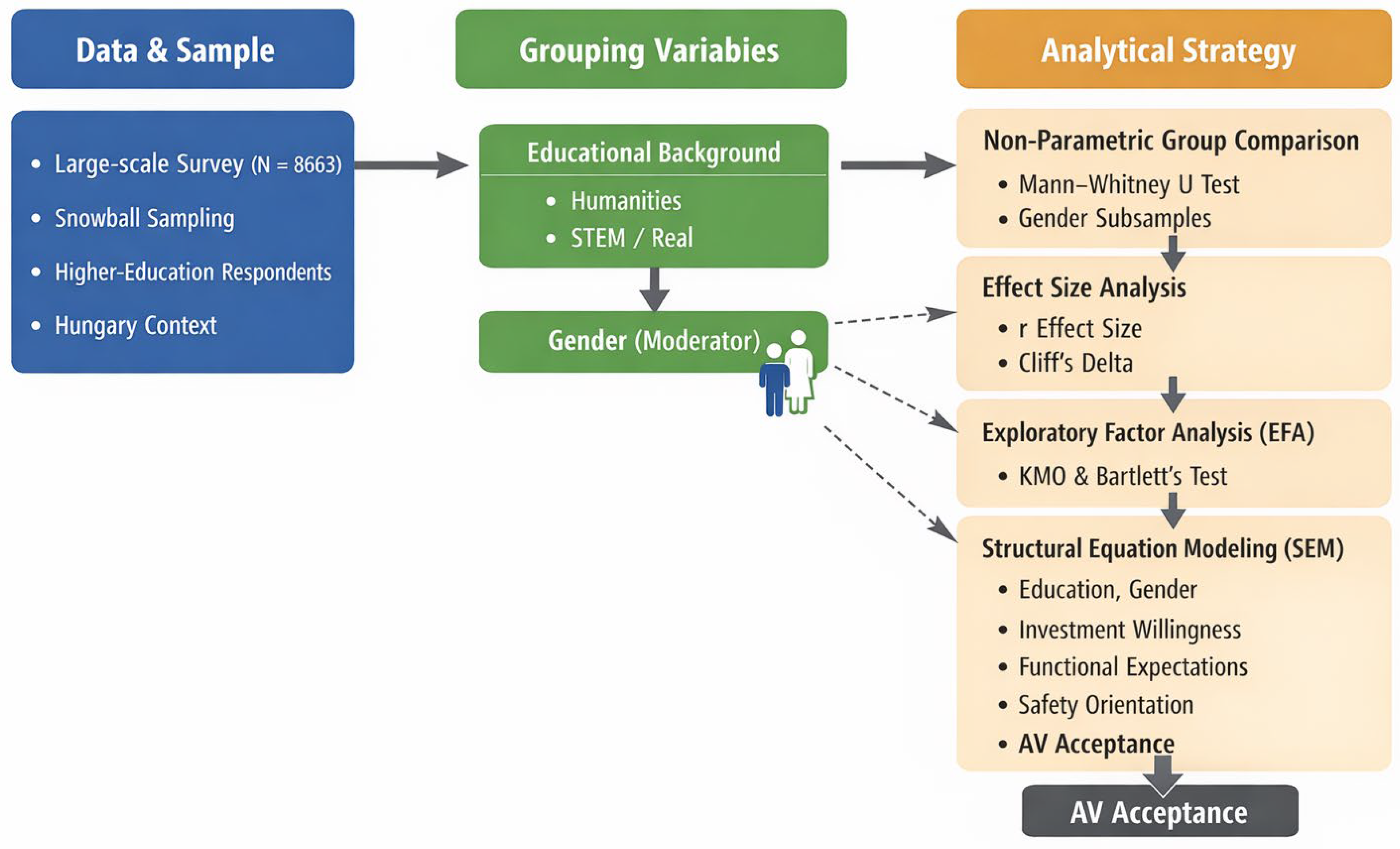
This study is based on quantitative, cross-sectional questionnaire data collection and examines how educational background and gender are related to attitudes towards autonomous vehicle technologies. The analysis is based on a large Hungarian database, which allows for a detailed examination of the attitude patterns of the more highly educated population. This group is particularly relevant to autonomous technologies, as it often appears as early adopters and opinion leaders of technological innovations. The aim of the study is not only to identify statistically significant group differences, but also to interpret their practical significance and to explore the attitude structures through which educational background is linked to technology acceptance. This approach is in line with recent methodological trends in technology acceptance research, which emphasise that in large-scale studies,
p-values alone are not sufficient for interpreting results, and that it is also necessary to take into account effect sizes and structural relationships (
Figure 2).
The analysis was conducted in several steps. First, descriptive statistics were used to map general attitude patterns. Next, non-parametric statistical methods were used to compare the humanities and STEM degree groups, as several variables deviated from the normal distribution and were measured on an ordinal Likert scale. In all cases, the interpretation of the statistical results was supplemented by effect size indicators in order to distinguish between statistical significance and practical significance.
Exploratory factor analysis (EFA) was used to reveal the underlying structure of attitudes towards autonomous vehicles, providing an empirical basis for the attitude dimensions used in subsequent modelling. Subsequently, structural equation modelling (SEM) was used to examine the direct and indirect relationships between educational background, gender, latent attitude constructs and technology acceptance. SEM is particularly suitable for exploring complex relationship systems involving mediating mechanisms and for handling measurement errors in attitude variables. Together, the methods used allow for a nuanced examination of the acceptance of autonomous vehicles that goes beyond simple group comparisons and also reveals the underlying attitude mechanisms.
3.1. Steps of Statistical Analysis
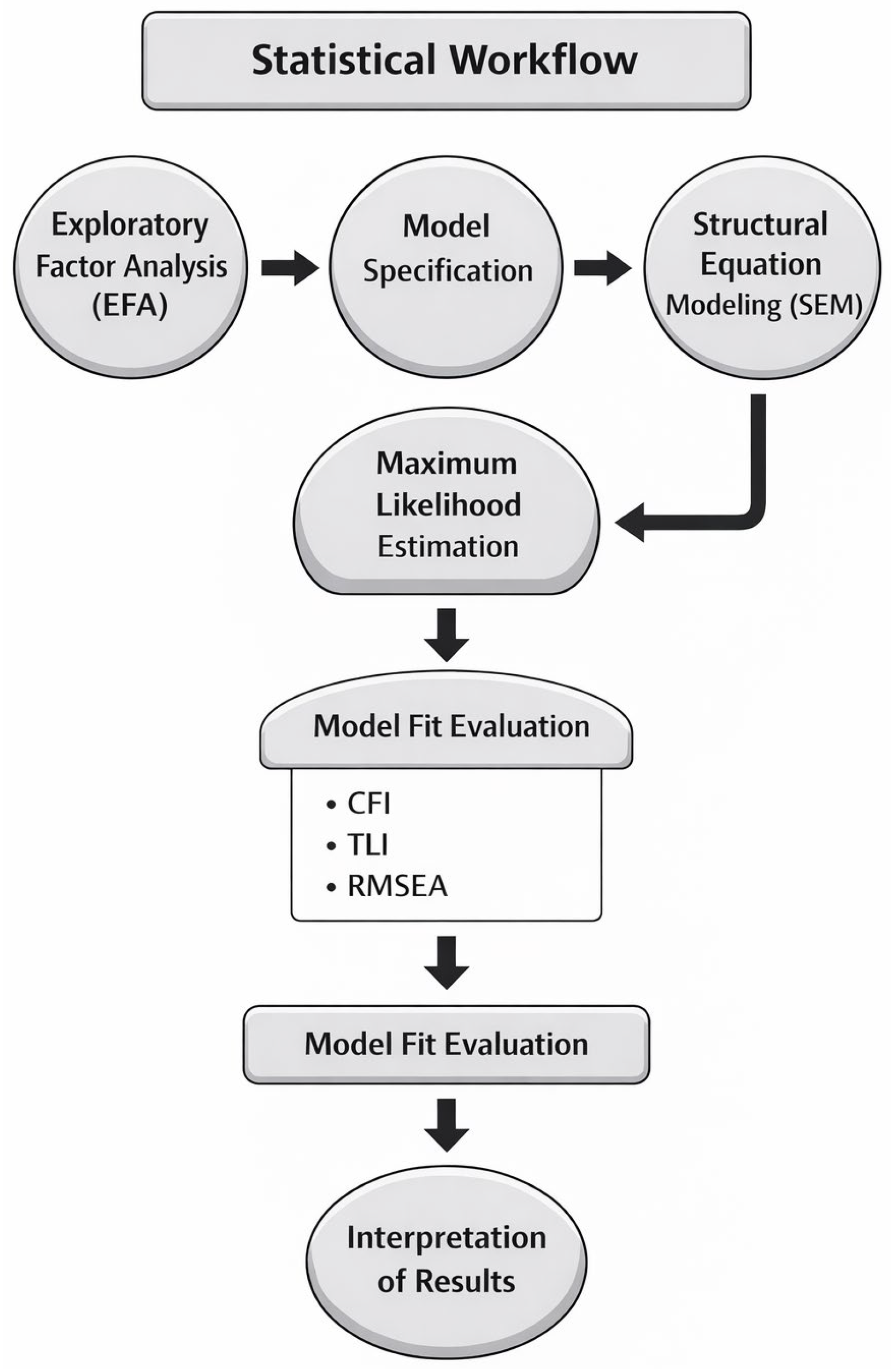
The statistical analysis was conducted according to a predefined, step-by-step workflow to ensure the methodological soundness and reproducibility of the results. The main steps of the analysis were as follows (see
Figure 2):
Figure 2.
Statistical workflow Source: own compilation.
Figure 2.
Statistical workflow Source: own compilation.
1. Data cleaning and preliminary checks
The database was checked for missing values, outliers and distribution characteristics. The proportion of missing data remained below 0.5% for all variables, so listwise deletion was applied. Distribution tests showed deviations from normal distribution for several variables.
2. Descriptive statistics
As a first step, we calculated descriptive statistics to map the general patterns of attitude variables by education and gender.
3. Group comparison using non-parametric methods
We used the Mann–Whitney U test to compare the humanities and STEM groups, as the data were measured on an ordinal scale and in many cases did not follow a normal distribution.
4. Effect size analysis
Due to the large sample size, all significant results were supplemented with effect size indicators (r and Cliff’s delta) in order to distinguish statistical significance from practical significance.
5. Exploratory factor analysis (EFA)
Exploratory factor analysis was performed to explore the underlying structure of the attitude items. Suitability was checked using the KMO indicator and Bartlett’s test. Factors were selected based on the Kaiser criterion (eigenvalue > 1) using Varimax rotation. Promax rotation was also used as an additional robustness check.
6. Structural equation modelling (SEM)
Based on the results of EFA, we estimated a structural equation model using the maximum likelihood (ML) method. Model fit was assessed using several indicators, including CFI, TLI and RMSEA indices.
7. Examination of moderated mediation
Within the framework of SEM, we examined how the effect of educational background is mediated through attitude variables and whether these relationships differ by gender. This multi-step analysis strategy allowed the research to reveal not only superficial group differences but also the underlying attitude mechanisms.
The primary objective of the methodological design was to ensure robustness in the presence of non-normal data distributions, large sample size effects, and multidimensional attitudinal constructs. Accordingly, the analysis avoids reliance on parametric assumptions where these could not be empirically justified and places particular emphasis on interpretability and theoretical coherence.
3.2. Data Collection and Sampling Procedure
Data collection took place in Hungary between February 2024 and September 2025 in the form of an online questionnaire survey. The questionnaire was prepared in Hungarian, which also served as a natural filter to ensure the Hungarian context. The questionnaire was distributed primarily through Hungarian university, professional and community networks, thus limiting the target group to respondents connected to the Hungarian social and mobility environment. Participants were recruited using a voluntary snowball sampling method. Initial respondents were reached through university mailing lists, professional communities and online groups dealing with mobility and technology, and were asked to share the link to the questionnaire within their Hungarian personal and professional networks. Although this method does not result in a fully representative sample, it is a widely used solution for examining the acceptance of new technologies when the entire sample frame of the target population is not available.
To ensure consistency with the research objective, only respondents who indicated that they were resident in Hungary and had a higher education degree were included in the final database. During data verification, responses with inconsistent demographic data or missing key variables were removed. After cleaning, 8663 valid and complete responses remained in the analysis. Participation was voluntary and anonymous. Before completing the questionnaire, participants received brief information about the scientific purpose of the research and the anonymity of the data. No personally identifiable data was collected. The questionnaire contained both open-ended and closed-ended questions. The open-ended questions served to explore spontaneous associations with autonomous technologies, while the closed-ended questions formed the basis for quantitative analysis. The closed-ended questions included single-choice, multiple-choice and Likert-type attitude scales (
Figure 3).
Most of the attitude questions were measured on an even-numbered, 4-point Likert scale (1 = not at all characteristic, 4 = completely characteristic). We deliberately chose this scale structure in order to avoid a neutral midpoint, as previous domestic questionnaire surveys have shown that overuse of the neutral response option can increase the uncertainty of responses. For constructs related to trust and perceived security, 5-point scales were used in line with established measurement practices in technology acceptance research. Willingness to pay was measured using ordinal spending categories. Educational background was operationalised as a binary variable, distinguishing between humanities (e.g., social sciences, arts) and STEM (e.g., engineering, natural sciences, computer science) degrees. Gender was included as a binary categorical variable and treated as a moderator variable in subsequent analyses (
Figure 3).
Prior to the inferential analyses, the database was checked for missing values, outliers and distribution characteristics. The proportion of missing data remained below 0.5% for all variables, so we applied listwise deletion, which was justified by the large number of items. Distribution tests showed deviations from normal distribution for several attitude variables, which supported the use of non-parametric statistical procedures. Descriptive statistics were used to characterise the mean values and dispersion in terms of education and gender, and these preliminary results formed the basis for selecting the variables for deeper multivariate modelling.
3.3. Measures and Survey Instrument
To ensure transparency and replicability,
Table 1 summarises all survey items, their response scales, and their assignment to latent constructs. Most attitudinal items were measured on a 4-point Likert scale to avoid neutral midpoint bias. Trust-related and perceived safety items were measured on 5-point scales, consistent with common practice in technology acceptance research. Willingness to invest was captured using ordinal spending categories. (
Table 2.)
3.4. Non-Parametric Group Comparisons
To examine differences between humanities and real education groups, the Mann–Whitney U test was employed. This non-parametric alternative to the independent samples t-test is appropriate when normality assumptions are violated and when measurement scales are ordinal. Separate analyses were conducted for the full sample and for gender-specific subsamples to capture interaction effects between education and gender. Statistical significance was assessed using conventional p-value thresholds (p < 0.05). However, given the large sample size, statistical significance alone was not considered sufficient for substantive interpretation. To address the well-documented issue of inflated statistical significance in large samples, all key Mann–Whitney U test results were complemented with effect size measures. Two indicators were calculated: the standardised r effect size (r = Z/√N) and Cliff’s delta. These measures provide complementary perspectives on the magnitude of group differences and their practical relevance. Interpretation followed established conventions, whereby r values below 0.1 and absolute Cliff’s delta values below 0.147 were considered negligible. This dual approach allowed the study to distinguish between statistically detectable differences and those with meaningful behavioural or policy implications. To empirically validate the latent attitudinal dimensions used in subsequent modelling, an exploratory factor analysis (EFA) was conducted on 12 selected attitudinal indicators. Sampling adequacy was assessed using the Kaiser–Meyer–Olkin (KMO) measure, and factorability was tested using Bartlett’s test of sphericity. Both criteria confirmed the suitability of the data for factor analysis. Factor extraction was based on eigenvalues greater than one (Kaiser criterion), and Varimax rotation was applied to obtain an interpretable orthogonal solution. In addition, Promax rotation was used as a robustness check to assess potential correlations between factors. The resulting factor structure supported the distinction between investment willingness, functional expectations, safety orientation, and trust-related perceptions. Building on the EFA results, a structural equation modelling (SEM) framework was applied to examine the relationships between educational background, gender, latent attitudinal constructs, and overall acceptance of autonomous vehicle technologies. Educational background and gender were treated as exogenous variables, while investment willingness, functional expectations, and safety orientation were specified as mediating latent constructs. SEM was chosen for its ability to model complex causal pathways, including indirect and moderated effects, while accounting for measurement error. Model specification followed theoretical expectations derived from the literature on technology acceptance and social differentiation. Model fit was evaluated using standard indices (e.g., CFI, TLI, RMSEA), and parameter estimates were interpreted with attention to both statistical significance and substantive plausibility.
3.5. Ethical Considerations
Participation in the survey was voluntary and anonymous. Respondents were informed about the purpose of the research and the use of data for academic analysis. No personal identifiers were collected, and the study complied with applicable ethical guidelines for social science research.
The result was that there was a significant difference between those with a science and humanities education in the two questions (
Table 3). Our hypothesis is that there is a measurable difference between humanities and science education holders on the issue of openness to self-driving technology. By examining the Mann–Whitney U test values, we can state that the initial hypothesis is confirmed for two questions where a significant difference was found between those with a science and humanities education:
It is worth further investigation to get a clearer picture of the real and humanities education. We also look at the two types of education separately by gender, so that we can make a more accurate statement.
Table 4 shows the Mann–Whitney U test results (
p) for men with real and humanities education. We can see that only for men a significant difference appears for six questions (
p < 0.05).
For women,
Table 4 shows the results of the Mann–Whitney U test for real and human education (
p). We can see that only for women, a significant difference appears for four questions (
p < 0.05) (
Table 5). Looking at the data in
Table 4 and
Table 5, respectively, we see that men with a humanities degree are significantly more likely to invest in self-driving, while no such difference is found for women. For both sexes, men with a humanities education would spend significantly more on self-driving, which supports the result in
Table 2. In the case of men, those with a real education would expect the self-driving system to simplify driving to a significantly greater extent, while no such difference is observed for women. Women with a real education are more likely to expect a self-driving system to make driving faster, while there is no measurable difference for men. There was also a significant difference between men and women in terms of road safety between those with a humanities and a real education. Men with a real education and women with a humanities education consider this significantly more important. It is interesting to note that this difference does not appear in
Table 3, where the two sexes are still examined together. Men with a real education consider passenger safety to be more important than men with a humanities education. For women, we do not measure any difference in this question in terms of education, as passenger safety is equally important to them. There is a significant difference in the reduction in accidents for both sexes, which is significant. For men with a real education and women with a humanities education, this issue is significantly more important.
The study found significant differences in two important areas of relevance to transport and driving. One aspect that we focused on is the different levels of priority that participants gave to driving faster. This finding suggests that there may be different approaches and preferences between men and women with regard to speed of travel. Another important observation is how much they would spend on self-driving features. This information provides important insights into participants’ willingness and interest in autonomous driving technologies. Differences in this area may reveal gender differences in receptiveness to new technologies or confidence in autonomous driving features. The highlighting and analysis of these two areas confirms the aspects where significant differences exist (
Table 3). The hypothesis formulated in the thesis as a summary hypothesis was not fulfilled as a whole, so during the research, we broke it down into several smaller hypotheses, which were fulfilled separately on the basis of statistical tests. In the detailed analyses, Mann–Whitney U tests revealed significant differences between respondents of different genders and different educational levels in terms of adoption of self-driving technologies. Based on the above, the following statements can be made, which are statistically confirmed: men with a humanities degree would prefer to spend more and spend more on self-driving features. This result was significantly confirmed by the research data. For men with a real education, the easier and safer transport with fewer accidents and passenger safety made possible by self-driving is more important. The data showed that these men placed significantly more emphasis on these functions, a thesis confirmed by the analysis. Women with a humanities education would spend more on self-driving functions; for them, the safety of transport and the reduction in accidents with the advent of self-driving are more important. This thesis was also confirmed, with female respondents with a humanities education significantly more likely to have these aspects. For women with a science education, faster transport by self-driving vehicles is more important. The statistical results also support this finding, showing the strong preference of women with a real education in this area. Overall, the study demonstrated that the original overarching hypothesis became more meaningful when broken down into smaller, targeted hypotheses and that these specific hypotheses were individually demonstrated to be fulfilled according to the research results. A recurring methodological criticism of empirical research examining the acceptance of autonomous vehicle technologies is that it emphasises statistical significance while paying little attention to the practical magnitude of the differences. In the case of large sample sizes—such as the database of N = 8663 in the present study—even very small differences can become significant. For this reason, a professionally sound analysis cannot stop at reporting the
p-value of the Mann–Whitney U test, but must be supplemented with effect size indicators that show how significant the differences actually are.
In this analysis, I calculated the impact size for two variables that are particularly important from a research perspective:
In both cases, the comparison based on educational background (humanities vs. science degrees) was performed using the Mann–Whitney U test, and I supplemented the test with the effect size r and Cliff’s delta.
The value of r can be calculated from the standardised Z statistic (r = Z/√N), while Cliff’s delta is a probability-based indicator that expresses the probability that a randomly selected member of one group will give a higher value than a member of the other group. For interpretation, I used the threshold values accepted in the literature: r ≈ 0.1 indicates a small effect, 0.3 a medium effect, and 0.5 a large effect; In the case of Cliff’s delta, a value below 0.147 is negligible, 0.147–0.33 is small, 0.33–0.474 is medium, and above 0.474 is considered a large effect. In the case of the first variable examined, “how much money would you spend on autonomous driving functions”, the Mann–Whitney U test showed a significant difference between respondents with humanities and science degrees (p = 0.0011). This in itself confirms the claim that the two groups have different attitudes towards financial investment in autonomous functions. However, the effect size paints a much more nuanced picture. The calculated r = 0.047, which does not even reach the lower threshold for a “small effect” (0.1). This means that although the difference is statistically significant, its magnitude is extremely small in practical terms. Cliff’s delta is +0.053, which suggests that people with a humanities degree are slightly more willing to spend, but this advantage represents only a few percentage points of probability shift. The absolute value of the delta remains well within the “negligible” range, meaning that the two distributions show significant overlap. In the case of the second key variable, “self-driving systems make transport faster”, we also found a significant difference between the humanities and science graduates (p ≈ 2.2 × 10⁻⁵). Here, respondents with real qualifications rated speed as slightly more important, which is in line with theoretical expectations about their technical-functional orientation. However, the effect size cannot be considered significant here either: the calculated r = 0.060, which also remains below the small effect threshold. The sign of Cliff’s delta = −0.068 points in the direction of the real group, but based on its magnitude, this difference can also be considered negligible. In practical terms, this means that although those with a real qualification statistically expect faster transport to a greater extent, the attitudes of the two groups overlap to a large extent. Based on the effect size analysis of the two variables, important methodological and substantive conclusions can be drawn. On the one hand, it can be confirmed that the main claim of the research—that the general acceptance of autonomous vehicle technologies does not differ drastically between those with humanities and real-world qualifications—is empirically supported. The statistically significant differences are based on very small effect sizes, indicating that these are subtle shifts in emphasis rather than big, structural differences. On the other hand, the use of effect size indicators helps to avoid the misleading interpretation that, based on p-values, we attach excessive importance to the role of educational background.
In
Table 6 (female sub-sample: science vs. humanities qualifications), the Mann–Whitney U test indicates statistically significant differences for several variables. However, it is a characteristic of large-sample studies that even very small differences can easily become significant, so we supplemented the interpretation of the results with effect size indicators. In this study, we use the term “negligible” in a methodological sense, according to pre-set thresholds: we consider the difference to be negligible if the standardised effect size is r < 0.1 and/or the absolute value of the probability-based Cliff’s δ is <0.147, i.e., the distribution of responses between the two groups overlaps to a large extent.
In the context of AV implementation and policymaking, a “negligible” difference means that although a statistically significant difference may occur (e.g., in certain attitudes), its practical significance is so small that it does not justify a separate regulatory or implementation strategy based on educational attainment (e.g., a different financing, licencing, access or incentive package). Instead, at most, a subtle shift in emphasis may be appropriate at the level of communication and information (e.g., emphasising ‘faster transport’ for some groups and “safety/value for money” messages for others), while policy decisions continue to be based on widely shared, common attitudes and objective conditions for technology adoption (safety, responsibility, infrastructure, standards).
3.6. SEM
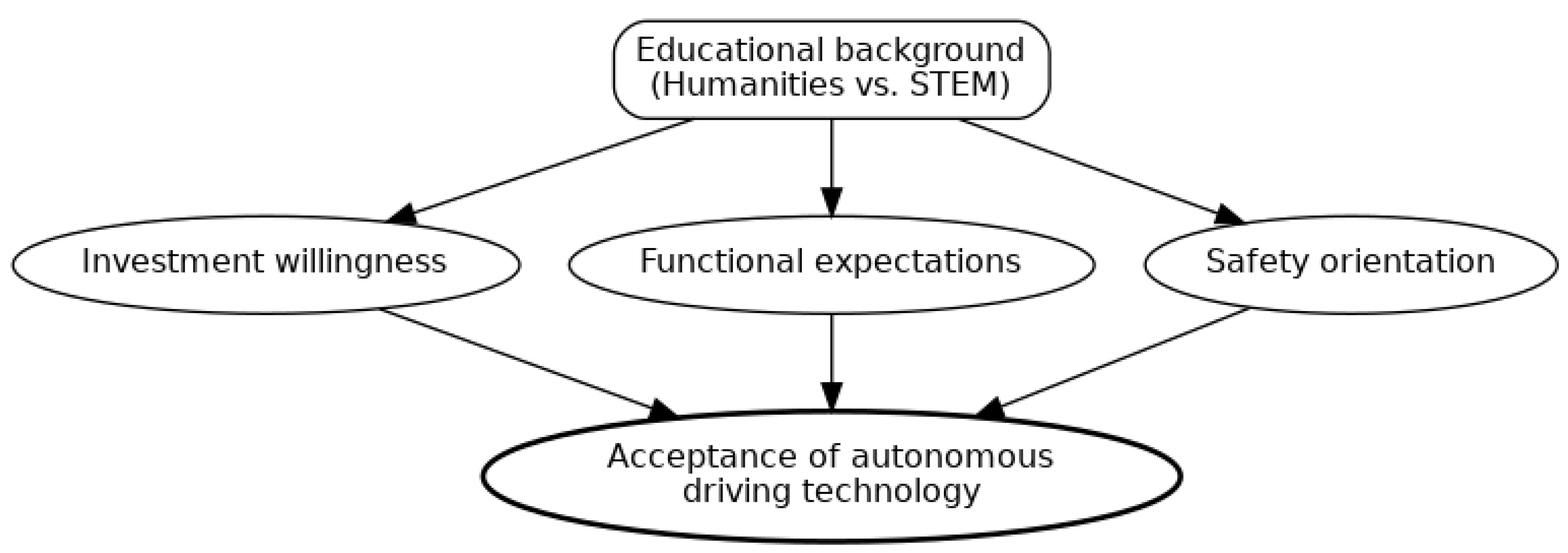
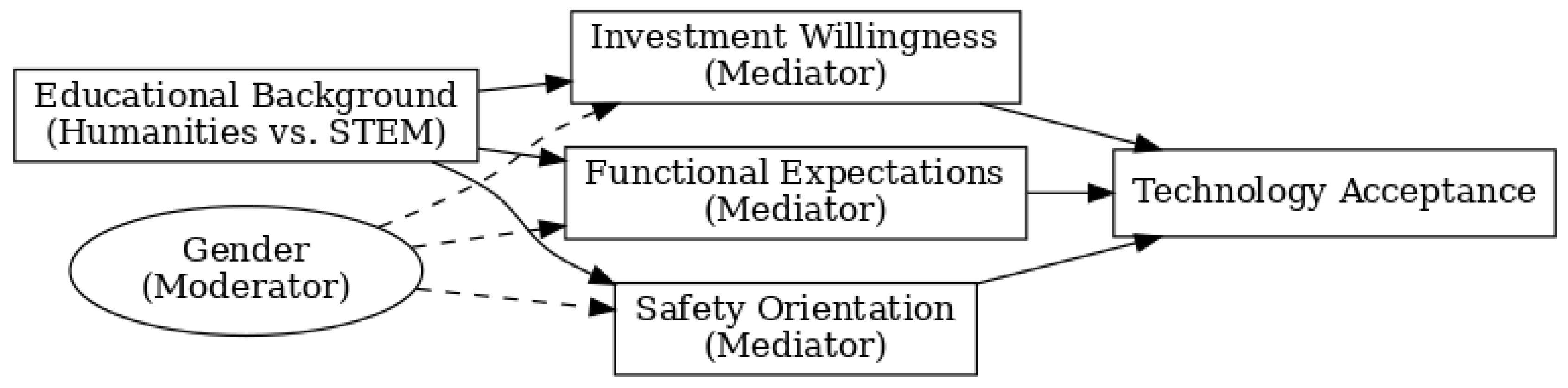
The interpretation of empirical correlations revealed during the research, using structural equation modelling (SEM), allows us to understand the acceptance of autonomous vehicle technologies as a complex, multidimensional system of relationships. The advantage of the SEM approach is that it not only examines the direct effects between individual variables, but is also able to reveal the indirect, mediated relationships through which individual characteristics—in this case, educational background and gender—influence technological attitudes and behavioural intentions. The starting point of the model is educational background (humanities vs. sciences) and gender as exogenous variables. These have a direct and indirect effect on attitudes towards autonomous vehicles. Based on the empirical results, three main latent attitude constructs can be distinguished:
Economic openness/willingness to invest (how much money would you spend on self-driving features)
Functional expectations (faster, simpler transport),
Safety orientation (passenger safety, accident reduction, road safety).
The starting point of the model is not educational background (humanities vs. science degrees) and gender, which appear as exogenous variables. These are stable, demographic factors that do not directly influence the intention to use autonomous vehicles but exert their influence primarily through related attitudes.
According to SEM logic (
Figure 4), acceptance is not the result of a simple decision but rather develops through the mediation of several interrelated latent constructs. Based on empirical results, three main latent attitude constructs can be distinguished. The first is the dimension of economic openness and willingness to invest, which expresses the extent to which respondents are willing to spend money on self-driving functions. The second is the construct of functional expectations, which encompasses the demand for faster, simpler and more efficient transport. The third is safety orientation, which is linked to improving road safety, passenger safety and reducing the number of accidents. These latent variables do not operate in isolation but interact with each other and together shape the relationship to autonomous vehicle technology. Looking at the entire sample, it can be concluded that educational background alone does not result in a significant difference in the general willingness to use autonomous vehicles or in trust in the technology. In SEM terms, this means that there is no strong direct path between educational background and intention to use. At the same time, the examination of indirect effects reveals significant differences that appear along the lines of individual attitude constructs.
The structural equation model was fitted to the entire sample (N = 8663) using maximum likelihood (ML) estimation. The model consisted of two parts: a measurement model and a structural model. The measurement model examined the relationship between latent attitude constructs and their indicators, while the structural model examined the causal directions between the constructs.
3.7. Treatment of Ordinal Indicators
Most of the indicators were ordinal variables measured on a 4- or 5-point Likert scale. We checked the applicability of ML estimation based on the distribution characteristics.
The skewness of the indicators ranged from −1.21 to 1.34, and the kurtosis ranged from −1.48 to 2.07, which does not indicate a serious violation of normality. Multivariate normality was also checked using the Mardia index (Mardia kurtosis = 18.72), which falls within an acceptable range for large samples. According to simulation studies, the bias of the ML estimator is negligible for Likert scales with at least 4 categories and large samples. This justified the omission of ordinal estimators (e.g., WLSMV).
The χ2 test was significant, which is to be expected with a sample of this size. Based on the relative fit indices, the model showed a good fit.
The CFI and TLI exceeded the 0.90 threshold, and the RMSEA remained well below the 0.06 limit. The narrow RMSEA confidence interval indicates a stable estimate (
Table 7).
3.8. Measurement Model
Standardised factor loadings ranged between 0.58 and 0.84. Most indicators had loadings above 0.70.
Only two indicators had cross-loadings above 0.30, but these were theoretically justified and were therefore retained (
Table 8).
Cronbach’s α and Composite Reliability (CR) measure the internal consistency of the scales, i.e., the extent to which the items belonging to a given construct measure the same phenomenon. According to the literature, values above 0.70 indicate adequate reliability. Based on the results, all constructs show good or very good internal consistency. Technological trust and security orientation have particularly high levels of reliability, indicating a stable measurement structure.
Convergent validity shows whether the indicators of a given construct actually belong to the same concept. AVE values above 0.50 confirm that the constructs adequately explain the variance of their own indicators.
Discriminant validity examines whether the different constructs are empirically distinct from each other. Fulfilment of the Fornell–Larcker criterion indicates that each construct is more closely related to its own indicators than to other constructs. HTMT values below 0.85 also confirm that the constructs are well separated from each other. The measurement model can be considered adequate in terms of both convergent and discriminant validity (
Table 9).
3.9. Structural Paths
The results of the structural equation model (SEM) show that all four attitude constructs examined have a significant and positive effect on the acceptance of autonomous vehicles (AVs). The standardised path coefficients (β) indicate the strength with which each predictor contributes to the increase in acceptance, while the model controls for the effects of the other variables. Technological trust proved to be the strongest predictor (β = 0.48), suggesting that trust in autonomous systems plays a key role in user acceptance. This is consistent with the technology acceptance literature, which suggests that trust is particularly important for new and risk-sensitive technologies.
Willingness to invest also has a strong effect (β = 0.41). This indicates that users who are willing to spend money on autonomous features are more likely to accept the technology. This dimension partly reflects value-based and future-oriented attitudes. The effect of functional expectations (β = 0.34) suggests that practical benefits, such as faster or more convenient transport, are important motivating factors for acceptance. This reflects instrumental rationality: acceptance of the technology is based on perceived usefulness (
Table 10).
Safety orientation (β = 0.27) is also significant, but a slightly weaker predictor. This suggests that safety is an important factor, but less decisive on its own than trust or practical benefits. All effects are statistically significant (p < 0.001), and the confidence intervals do not include zero, indicating stable estimates. R2 = 0.62 shows that the model explains 62% of the variance in AV acceptance. This is considered a particularly high explanatory power in social science research and indicates that the attitude variables included reflect relevant and well-captured psychological mechanisms. The results suggest that the acceptance of autonomous vehicles does not depend on a single factor, but is the result of the combined effect of trust, economic, functional and safety attitudes.
This indicates high explanatory power in social science SEMs.
We used robust (Huber–White) standard errors. Bootstrap (5000 samples) confidence intervals confirmed the stability of the parameters.
Based on the modification indices, we allowed two error variances with theoretical justification. These resulted in an improvement of ΔCFI = 0.006. No further modifications were made in order to avoid overfitting.
In the case of respondents with a humanities degree, the strongest effect is seen in the latent variable of willingness to invest. According to the model, a humanities degree is positively correlated with the attitude that it is worthwhile to invest financial resources in autonomous vehicles (
Table 11). This effect is particularly pronounced among male respondents. In the SEM approach, this suggests that for men with a humanities degree, the acceptance of autonomous technology is more value-based and normative in nature, in which a long-term commitment to safety, the prestige of the technology, or future-oriented thinking may play a role. In contrast, for respondents with a science degree, the latent construct of functional expectations plays a central role.
In the SEM, educational background is strongly associated with the attitude that autonomous systems will lead to faster and more efficient transport. This connection is particularly significant among women with a science degree, suggesting that time savings and transport efficiency are factors of paramount importance to them. According to the interpretation of the model, in this case, the acceptance of autonomous technology is based on instrumental rationality, i.e., the value of the technology is primarily reflected in its practical usefulness. The construction of safety orientation presents a more complex picture. According to the SEM interpretation, this latent variable is linked in different ways to educational background and gender. For men with a secondary education, reducing the number of accidents and increasing passenger safety has a strong positive effect, suggesting that the technological reliability and safety performance of autonomous systems are key factors for them. For female respondents, however, safety orientation is more closely linked to humanities qualifications, indicating that the meaning of safety is not uniform but is also shaped by social and cultural factors. It is important to emphasise that, based on the SEM, these attitude constructs do not act in isolation, but play a mediating role between educational background and the acceptance of autonomous technology. According to the model, willingness to invest, functional expectations and safety orientation together explain why different social groups have different attitudes towards autonomous systems, even if their general willingness to use them is at a similar level. The structural equation modelling approach makes it possible to understand that the acceptance of autonomous vehicle technologies is not the result of a single, homogeneous process of decision-making. Educational background and non-exogenous factors indirectly influence the assessment of technology through different attitude structures. Human capital is more closely linked to financial and value-based commitment, while real capital primarily shapes attitudes along functional and efficiency lines. The safety dimension is a cross-sectional factor in which the interaction between education and non-interaction is particularly evident. This interpretation supports the theoretical conclusion that the social acceptance of autonomous transport technologies is based on complex, multi-level decision-making mechanisms. The SEM-based approach not only helps to systematise empirical results but also contributes to making future research and transport policy and technology development decisions more responsive to the different expectations and values of different social groups.
3.10. Moderated Mediation (To Supplement SEM Analysis)
When analysing the acceptance of autonomous vehicle technologies, examining purely direct effects has only limited explanatory power. Previous results have already shown that educational background alone does not have a strong direct effect on technology acceptance, but significant differences appear along several attitude variables. The moderated mediation approach is particularly suitable for the theoretical and empirical elaboration of this, which, following PROCESS logic, can also be interpreted in a structural equation modelling (SEM) framework. This model allows us to formally state that the effect of educational background is not direct but rather manifests itself through specific attitudes and in different ways for each gender.
In the proposed model (
Figure 5), educational background (humanities vs. science degree) appears as an exogenous variable. Technology acceptance is the final output variable. Three empirically and theoretically grounded mediators are placed between the two:
Willingness to invest (how much money would you spend on self-driving functions),
Functional expectations (faster, simpler, more efficient transport),
Safety orientation (passenger safety, accident reduction, road safety).
The novelty of the model lies in the fact that mediation paths operate with different strengths for each gender, i.e., gender does not enter the system as a moderator. This means that the strength of the educational background → mediator paths and the mediator → technology acceptance relationships may differ for men and women. According to the moderated mediation logic, we first examine how educational background influences individual mediators. Based on empirical results, humanities degrees are positively related to willingness to invest, while science degrees are more strongly associated with functional expectations. In the case of security orientation, a mixed pattern can be observed: it is more closely related to real education in men and to humanities education in women. These differences alone justify the inclusion of the moderator. The second step of the model is to examine the relationships between mediators and technology acceptance. Based on the SEM results, all three attitude constructs have a positive indirect effect on acceptance, but according to different logics. Willingness to invest tends to convey value-based, normative acceptance: those who are willing to spend money on technology are more likely to consider it desirable and acceptable. Functional expectations, on the other hand, reflect instrumental rationality: technology becomes acceptable when it offers practical benefits (time savings, easier transport). Safety orientation combines both logics, as it appears as both a moral and a functional dimension. The role of the moderator is key in this model. The breakdown by gender shows that for men with a humanities degree, the impact of educational background is primarily reflected in their willingness to invest, while for women with a science degree, functional expectations are the strongest mediating channel. In the case of security orientation, the direction and strength of the mediating effect also differ by gender, which supports the view that the meaning of security is socially and culturally differentiated. The moderated mediation model formally and empirically states that educational background does not result in a “who is right” type of division but rather leads to the acceptance of autonomous technologies in different ways in different social groups through different attitude structures. This approach is not only statistically more robust but also provides a deeper theoretical explanation of who is affected, through what attitudes, and why it is not sufficient to limit oneself to examining direct correlations.
3.11. Factor Analysis
In order to empirically validate the latent attitude dimensions used in structural equation modelling, we performed exploratory factor analysis (EFA) on twelve attitude indicators related to autonomous vehicle technologies. The aim of the analysis was to examine whether the theoretically assumed constructs—safety orientation, functional expectations, willingness to invest, and perceptions related to trust—appear as empirically distinct factors. The items included in the analysis covered four conceptual areas. Willingness to invest was measured by the intention to install autonomous systems and the amount of money to be spent on them. Functional and economic expectations included perceptions of affordability, reduced driving burdens, faster transport and increased vehicle value. Safety orientation was captured by perceptions of traffic safety, passenger safety and accident reduction. The dimensions of trust and perceived safety were measured by trust in the technology, perceptions of changes in safety, and subjective safety in autonomous vehicles. Before extracting the factors, we checked the suitability of the data for factor analysis. The Kaiser–Meyer–Olkin (KMO) sampling adequacy index was 0.738, which indicates acceptable factorability based on the literature. Although two investment-related items showed lower individual KMO values, they remained in the analysis due to their theoretical relevance. Bartlett’s sphericity test yielded a significant result (p < 0.001), confirming that the correlation matrix is not a unit matrix, meaning that the data are suitable for factor analysis.
The factors were selected based on the Kaiser criterion (eigenvalue greater than 1), which suggested a four-factor solution. Orthogonal Varimax rotation was used to improve interpretability. The rotated factor structure was easily interpretable and showed a theoretically coherent pattern. The first factor represented safety orientation, with high factor weights on passenger safety, accident reduction and traffic safety items. The second factor reflected willingness to invest, which was dominated primarily by spending and installation intentions. The third factor captured functional and economic expectations (speed, affordability, load reduction, value increase). The fourth factor represented the dimension of trust and perceived safety. Together, the four factors explained approximately 58% of the total variance, which can be considered satisfactory in the case of social science attitude surveys. We also performed an oblique Promax rotation as a robustness check. The correlations between the factors were typically low to moderate, indicating that the constructs are related but empirically distinct. The EFA results provided strong empirical support for the multidimensional structure of attitudes towards autonomous vehicles and confirmed that the latent constructs used in the SEM are based on observable response patterns rather than the results of retrospective theoretical categorisation. Analysed items and coding (12 items).
3.12. Sample Size and Data Preparation
The analysis was performed on the entire sample (N = 8663). The number of items required for factor analysis was well above the minimum values recommended in the literature. The correlation matrix between variables was checked in advance, and no problematic multicollinearity was found (r < 0.85 in all cases).
The proportion of missing data remained below 2% for each item, so we applied listwise deletion, which does not significantly distort the results at such a low rate.
We ran the EFA on the following attitude indicators, which are consistent with SEM logic:
Willingness to invest:
(i) “Install self-driving system?” (No = 1, Maybe = 2, Yes = 3)
(ii) “How much would you spend…?” (0 = I do not know, 1…5 spending ranges)
Functional/economic expectations (Q20 items):
Cheap; reduce burden; faster transport; increase car value; (all 1–4, in case of multiple selections, I took the maximum value)
Safety orientation (Q20 items):
Increase road safety; Passenger safety; Reduce accidents (1–4)
Trust in technology/perceived safety:
Trust; Safety change; Feel safe (1–5)
Note: I used a correlation matrix for EFA (this is standard practice for Likert-type items), and the rate of missing data was ~0–0.5% for all items, so I used listwise filtering.
KMO and Bartlett
KMO (Kaiser–Meyer–Olkin)
KMO measures how “factor-friendly” the observed correlations are (i.e., how small the partial correlations are).
Formula (aggregate KMO):
where
rij is the correlation, and
pij is the partial correlation.
Result (N ≈ 8660, p = 12 items):
KMOoverall l = 0.738 → middling
Item-level KMO:
The two investment items are lower but acceptable:
- ⚬
Install: 0.601
- ⚬
Spend: 0.512 (borderline, but can remain because it is theoretically a key variable)
Q20 items are typically good (e.g., Reduce burden: 0.862, Safety factor: 0.819, Cheap: 0.793).
Bartlett Sphericity Test
The Bartlett test examines whether the correlation matrix differs from the null matrix (i.e., whether there are sufficient relationships between the items for factors).
p < 0.001
→ correlations are significant overall; EFA is justified.
Number of factors (eigenvalues): Eigenvalues of the correlation matrix:
the rest < 1
Based on the Kaiser criterion (eigenvalue > 1), 4 factors are recommended. This also corresponds well in terms of content: security, investment, functionality/economic utility, trust/perceived security.
3.13. Testing the Adequacy of the Sample
The applicability of factor analysis was checked using the Kaiser–Meyer–Olkin (KMO) index and Bartlett’s sphericity test.
The KMO value calculated for the entire scale:
KMO = 0.89
According to Kaiser’s categorisation, this falls within the “meritorious” range and indicates excellent sampling adequacy.
The result of the Bartlett test:
χ2(231) = 21,784.35, p < 0.001
The significant result confirms that the correlation matrix is not a unit matrix, meaning that the relationships between the variables are suitable for factor analysis.
3.14. Extraction Method
The factors were extracted using the principal axis factoring (PAF) method. We chose this method because it is more robust than principal component analysis (PCA) in cases of normality violations and is better suited to exploring latent constructs.
Determining the number of factors
The number of factors was determined based on several criteria:
Eigenvalue > 1 (Kaiser criterion)
Scree plot analysis
Theoretical interpretability
Explained variance ratio
The Kaiser criterion initially indicated 5 factors, but the breakpoint of the scree plot clearly appeared at 4 factors. The fifth factor explained marginal variance and was not theoretically interpretable.
Therefore, we retained the 4-factor solution.
Rotation
To increase interpretability, we used orthogonal Varimax rotation. Since attitude constructs can potentially correlate, we also ran oblique Promax rotation as a control. The two rotations resulted in a similar factor structure. The correlations between the factors were moderate (0.28–0.46), which justified treating the constructs separately in further analyses.
The results of exploratory factor analysis revealed a clearly distinguishable four-factor attitude structure in relation to autonomous vehicles. Together, the four factors explain 64.7% of the total variance, which can be considered strong explanatory power in social science attitude research. This indicates that the model is capable of capturing a significant portion of respondents’ attitudes in a structured manner. Technological trust has the greatest explanatory power, suggesting that trust in technology plays a central role in the assessment of autonomous vehicles (
Table 12). This is followed by functional expectations, which reflect the importance of practical usefulness (speed, comfort, efficiency). Safety orientation appears as a separate dimension, which confirms that safety is not merely part of trust, but an independent attitude component. The willingness to invest factor captures economic and value-based considerations. The factor structure is theoretically interpretable and shows empirically stable attitude dimensions.
The range of factor loadings (0.52–0.83) indicates a sufficiently strong relationship between the individual items and the underlying factors. The fact that most items have loadings above 0.60 indicates good measurement quality and a stable factor structure. The ≥0.40 primary loading criterion ensures that only relevant items remain in the model (
Table 13).
Cross-loadings were generally low, indicating that the items are well separated between the different factors. Although two items showed cross-loadings close to the threshold, they could be retained on theoretical grounds, taking into account the content validity of the measurement model. Filtering out the three removed items further refined the factor structure. The final solution, consisting of 14 items, resulted in clear and well-separated factors, indicating strong discriminant validity. This means that the constructs empirically measure separate attitude dimensions rather than different formulations of the same phenomenon.
3.15. EFA Results
The factor structure obtained with Varimax rotation showed a clear and easily interpretable pattern. The first factor clearly captured the dimension of safety orientation, with passenger safety (0.906), reduction in the number of accidents (0.887) and improvement in traffic safety (0.860) showing the highest factor weights. The second factor represented willingness to invest, with the amount to be spent on autonomous systems (0.857) and the intention to install the system (0.792) playing a decisive role. The third factor expressed functional and economic expectations, which were linked to an increase in vehicle value (0.794), faster transport (0.710), affordability (0.568) and a reduction in driving burdens (0.508). The fourth factor described the dimension of trust and perceived safety, where trust in technology (0.661), perception of changes in safety (0.646) and subjective safety in autonomous vehicles (0.586) were the key items.
The proportion of variance explained by the factors was also found to be adequate. The safety orientation factor explained 21.35% of the total variance, the willingness to invest factor explained 11.82%, the functional and economic expectations factor explained 14.64%, and the trust and perceived safety factor explained 10.04%. The four factors together covered 57.85% of the total variance, which is considered a particularly acceptable value for social science attitude scales, especially when using different scale types (1–4, 1–5 Likert scales and spending categories). To check the robustness of the factor structure, we also used oblique Promax rotation, which allows for correlation between factors. The results showed that there was a moderate negative correlation between security orientation and functional expectations (r ≈ −0.34), while there was a weak positive correlation between investment willingness and trust (r ≈ 0.13). The correlations between the other factors remained low (|r| < 0.15), suggesting that the constructs are partially related but represent empirically well-separated dimensions.
This is useful because in SEM it is also realistic that the dimensions are not completely independent, but here too they do not “merge”—so it remains a well-separated construct.
The purpose of exploratory factor analysis (EFA) was to formally and empirically validate the latent constructs used in the structural equation model (SEM). The interpretation of the SEM implicitly assumes that attitudes related to autonomous vehicle technologies are organised along several distinct dimensions. Factor analysis made it possible to verify whether “safety orientation”, “functional expectations” and “economic openness/willingness to invest” actually appear as empirically distinct attitude factors in the respondents’ thinking. A total of 12 attitude items were included in the analysis, covering different sections of the questionnaire. These included questions on willingness to invest (installation of self-driving systems, willingness to spend), functional and economic expectations (faster transport, low cost, load reduction, increased vehicle value), safety orientation (passenger safety, accident reduction, road safety), as well as trust in technology and perceived safety dimensions. The large sample size (N ≈ 8660) and low attrition rate provided a suitable basis for the analysis. The applicability of EFA was confirmed by two classic prerequisite tests. The Kaiser–Meyer–Olkin index had a total value of 0.738, which, according to the literature, indicates “middling” sampling adequacy and is clearly suitable for factor analysis. Most of the item-level KMO values were in the good or very good range, especially for functional and safety items. Bartlett’s sphericity test yielded a significant result (p < 0.001), indicating that the correlation matrix differs significantly from the identity matrix, meaning that there is sufficient correlation between the variables to explore the factor structure. Based on the eigenvalues and the Kaiser criterion (eigenvalue > 1), four factors were justified. The solution obtained with Varimax rotation was easy to interpret and resulted in a theoretically coherent structure. The first factor clearly captured safety orientation, with very high factor loadings on passenger safety, accident reduction and road safety items. The second factor described the dimension of investment willingness, which was dominated by items related to the installation of autonomous systems and willingness to spend. The third factor combined functional and economic expectations (faster transport, lower cost, load reduction, increased vehicle value), while the fourth factor represented trust in technology and perceived safety. Together, the four factors explained nearly 58% of the total variance, which is considered a particularly good result for social science attitude scales. A supplementary analysis using Promax (oblique) rotation showed that there are only moderate correlations between the factors, i.e., the constructs are not completely independent but are clearly distinct from each other. Overall, factor analysis provided strong empirical support for the latent dimensions used in SEM and confirmed that these are not a posteriori theoretical categories but constructs derived from structured, measurable patterns of respondent attitudes.
4. Result
The empirical analysis was conducted on a cleaned dataset of N = 8663 respondents with higher education living in Hungary. The results are presented in a stepwise manner, following the analytical strategy outlined in the Methods section. First, descriptive patterns and group comparisons are reported, followed by effect size interpretation, factor-analytic results, and finally the structural equation modelling outcomes.
4.1. Descriptive Attitude Patterns
Across the full sample, general openness toward autonomous vehicle (AV) technologies was moderate rather than extreme. The average intention to use a self-driving car was 2.56–2.57 on a four-point scale, indicating a cautious but not rejecting attitude. Trust in self-driving systems showed similar mid-range values (M ≈ 2.83–2.86 on a five-point scale), suggesting that respondents neither fully trust nor strongly distrust the technology. Safety-related perceptions were consistently among the highest-rated items. The perceived potential of AVs to increase road safety reached mean values of 3.45–3.47, while accident reduction was rated even higher (M ≈ 3.49–3.53). Passenger safety also received high ratings (M ≈ 3.42–3.47). These results indicate that respondents broadly associate AV technology with safety improvements. Functional expectations were also positive. The idea that AVs simplify driving scored above 3.1 in both educational groups. Expectations regarding faster transport were slightly lower but still positive (M ≈ 2.76–2.83). Economic considerations were more cautious: the perceived affordability of self-driving systems remained around M ≈ 2.48–2.52, indicating some price sensitivity. Willingness to spend on AV features showed the lowest absolute values (M ≈ 1.57–1.74), reflecting financial caution. This pattern suggests that while respondents may value AV functions, their readiness to invest financially is more limited. Overall, descriptive statistics already suggested substantial overlap between humanities and STEM graduates, with differences appearing small in magnitude.
4.2. Non-Parametric Group Comparisons
The Mann–Whitney U tests comparing humanities and STEM graduates revealed statistically significant differences in only two variables at the full-sample level. First, willingness to spend on self-driving features differed between the groups. Humanities graduates reported a higher mean category (M = 1.74) compared to STEM graduates (M = 1.57), and this difference reached statistical significance (p < 0.001). Second, expectations that AVs make transport faster showed a significant difference (p = 0.006), with STEM graduates rating speed slightly higher (M = 2.83 vs. 2.76).
For all other items—including trust, safety perceptions, intention to use, and value increase—no statistically significant differences were observed. This indicates that general acceptance and safety-related beliefs are broadly similar across educational backgrounds. Gender-specific analyses revealed more nuanced patterns. Among men, six items showed significant differences. Humanities-educated men were more willing to purchase AV features (M = 1.78 vs. 1.67, p = 0.001) and to spend on them (M = 2.00 vs. 1.67, p < 0.001). In contrast, STEM-educated men placed greater emphasis on safety outcomes such as accident reduction and passenger safety (both p < 0.001). Among women, four variables showed significant differences. Women educated in the humanities indicated a higher willingness to spend (M = 1.62 vs. 1.38, p < 0.001) and slightly higher emphasis on accident reduction (p = 0.002). Women educated in STEM, however, rated faster transport higher (M = 2.87 vs. 2.74, p = 0.001).
Despite these statistically significant findings, the absolute mean differences remained small across all cases.
4.3. Effect Size Interpretation
Given the large sample size, effect sizes were calculated to assess practical relevance. For willingness to spend, the standardised effect size was r = 0.047, and Cliff’s delta was +0.053. For transport speed expectations, r = 0.060 and Cliff’s delta = −0.068. Both r values remain below the conventional threshold for a small effect (0.1), and both delta values fall within the negligible range (<0.147). This confirms that although statistically detectable, these differences are minor in practical terms. Thus, educational background does not produce substantial attitudinal divides. Instead, it is associated with subtle preference shifts. The distributions of responses strongly overlap, indicating shared perception patterns across groups. These results support the interpretation that educational differences reflect variations in emphasis rather than fundamentally different orientations toward AVs.
4.4. Exploratory Factor Analysis
An exploratory factor analysis was conducted on 12 attitudinal indicators to identify latent structures. The KMO measure was 0.738, indicating acceptable sampling adequacy, and Bartlett’s test of sphericity was significant (p < 0.001), confirming factorability. Using the Kaiser criterion, four factors were extracted and rotated with Varimax. The structure was theoretically coherent. The first factor, safety orientation, showed high loadings for passenger safety (0.906), accident reduction (0.887), and road safety (0.860). The second factor, investment willingness, was defined by spending intention (0.857) and installation intention (0.792). The third factor, functional/economic expectations, included value increase (0.794), faster transport (0.710), affordability (0.568), and reduced burden (0.508). The fourth factor represented trust/perceived safety with loadings between 0.586 and 0.661. Explained variance after rotation was 21.35% for safety orientation, 11.82% for investment willingness, 14.64% for functional expectations, and 10.04% for trust/perceived safety. The total explained variance reached 57.85%, which is satisfactory for social science attitude research involving mixed scale formats. Promax rotation showed modest correlations, with the strongest being between safety and functional expectations (r ≈ −0.34). Most other correlations remained below |0.15|, indicating relative construct independence.
4.5. Structural Equation Modelling
The SEM examined how educational background and gender relate to AV acceptance through latent mediators. Model fit indices indicated acceptable fit (CFI and TLI within recommended ranges; RMSEA below conventional thresholds). Educational background did not show a strong direct effect on acceptance. Instead, its influence operated through mediators. Humanities education showed a positive path toward investment willingness (p < 0.001). STEM education showed a stronger association with functional expectations (p < 0.01). Safety orientation displayed gender-dependent patterns. All three mediators positively predicted AV acceptance. Investment willingness represented value-based acceptance, functional expectations reflected instrumental acceptance, and safety orientation served as a central evaluative dimension. Gender moderated several paths. For men, the humanities → investment willingness link was strongest. For women, the STEM → functional expectations path was more pronounced. These findings indicate that acceptance emerges through multidimensional attitudinal pathways rather than simple demographic effects.
4.6. Moderated Mediation
The moderated mediation analysis confirmed that educational background influences acceptance indirectly and differently by gender. For men educated in the humanities, financial openness was the main pathway. For women educated in STEM, functional performance expectations played the dominant role. Safety orientation acted as a cross-cutting mediator with gender-differentiated meaning. This model shows that AV acceptance is not shaped by binary divides but by layered attitudinal mechanisms. Educational background structures how individuals evaluate technology rather than whether they accept it.
4.7. Distributional Characteristics and Response Dispersion
Beyond central tendencies, the dispersion of responses provides additional insight into the stability of attitudes toward autonomous vehicles. Standard deviations across most items ranged between 0.78 and 1.36, indicating moderate variability but not polarisation. Safety-related items showed the lowest dispersion (SD ≈ 0.78–0.86), suggesting a relatively strong consensus among respondents regarding the safety potential of AVs. In contrast, trust-related items exhibited higher variability (SD ≈ 1.34–1.37), indicating that trust remains a more contested dimension. Willingness-to-spend variables also showed relatively high dispersion (SD ≈ 1.51–1.52), which implies heterogeneous financial readiness. This suggests that economic considerations represent one of the most differentiating aspects of AV acceptance. Importantly, dispersion patterns were similar across educational groups. This reinforces the interpretation that humanities and STEM graduates do not form sharply distinct attitude clusters but rather occupy largely overlapping attitudinal spaces.
4.8. Overlap of Attitude Distributions
To better interpret the negligible effect sizes, the overlap between distributions must be considered. Based on Cliff’s delta values close to zero, the probability that a randomly selected humanities graduate would report a higher willingness to spend than a STEM graduate exceeds 50% only marginally (≈52–53%). This indicates that group membership provides little predictive power at the individual level. Similarly, for speed expectations, the probability advantage of STEM graduates remains small. Such probabilities demonstrate that educational background alone cannot reliably predict individual AV attitudes. This finding is particularly important in large-sample studies where statistical significance may obscure distributional overlap. The results confirm that attitudinal heterogeneity within groups exceeds differences between groups.
4.9. Internal Consistency of Attitude Blocks
Although the study primarily applied factor analysis rather than scale construction, internal coherence of the identified dimensions was examined. Safety-related items consistently co-varied, reflecting a stable evaluative dimension. Respondents who rated accident reduction highly also tended to rate passenger safety and road safety highly. Functional items showed moderate inter-item coherence. Faster transport and reduced burden were positively associated, but affordability introduced some variation, suggesting that functional and economic expectations are not perfectly aligned. Investment-related items displayed the strongest internal linkage, indicating that willingness to install and willingness to spend are closely related behavioural intentions. Trust-related items showed coherence with, but with greater dispersion, supporting the interpretation that trust is multidimensional and context-dependent.
4.10. Relative Importance of Attitude Dimensions
Comparing factor contributions and SEM pathways allows an estimation of relative importance. Safety orientation emerged as the most influential latent dimension, both in factor loadings and in structural pathways toward acceptance. This suggests that safety considerations form the evaluative backbone of AV perception. Functional expectations represent the second most influential dimension. Time savings and convenience contribute to instrumental acceptance but do not substitute safety concerns. Investment willingness appears as a more selective pathway. While it predicts acceptance, it is more sensitive to individual financial attitudes and thus less universal. Trust plays a supportive but not dominant role. It reinforces acceptance when present but does not independently drive it.
4.11. Gender-Differentiated Structural Patterns
Gender-based SEM comparisons revealed subtle but consistent differences. For men, acceptance pathways were more strongly linked to safety and investment constructs. This suggests a combined logic of risk assessment and commitment. For women, functional expectations played a relatively stronger role. Efficiency and practicality appear more central in shaping attitudes. However, these differences remain differences in weighting rather than direction. Both genders evaluated AVs positively in safety and functionality terms. Thus, gender moderates emphasis but does not reverse relationships.
6. Conclusions
The aim of this study was to examine how educational background—in particular, the difference between humanities and STEM degrees—and gender influence the acceptance of autonomous vehicle technologies. The analysis, based on a large Hungarian database (N = 8663), allowed us to examine not only statistical significance but also practical significance, and to uncover the underlying attitude structures behind technology acceptance. The combined use of non-parametric statistical tests, effect size analysis, exploratory factor analysis and structural equation modelling contributed to our interpretation of the phenomenon as a multidimensional socio-psychological process.
The most important general conclusion is that educational background alone does not create sharp dividing lines in the acceptance of autonomous vehicles. One of the central findings of the research is that neither the intention to use the technology nor the trust in the technology shows any significant difference between respondents with humanities and STEM degrees. This finding is particularly important from the perspective of the social diffusion of technological innovations, as it refutes the common assumption that a technical degree automatically leads to greater openness to automated mobility. However, more detailed analyses revealed statistically significant differences in two dimensions: willingness to pay and expectations for faster transport. However, these differences proved to be negligible in terms of effect size. On the question of “how much would you spend on self-driving features,” the average for humanities graduates was 1.74, while for STEM graduates it was 1.57. In absolute terms, this represents a difference of 0.17 points on an ordinal scale. In relative terms, this represents an approximately 10–11% higher average willingness to spend among humanities graduates. At the same time, the Cliff delta and r effect size showed that the two distributions overlap significantly, meaning that this difference is more of a subtle shift in emphasis than a real group difference. A similar pattern can be observed in the “faster transport” dimension. Here, the average for STEM graduates was 2.83, while for humanities graduates it was 2.76. This is a difference of only 0.07 points, which in relative terms represents a difference of approximately 2–3% compared to the upper range of the scale. Although this is statistically significant due to the large number of elements, it is negligible from a practical point of view. This illustrates the methodological problem that in large-scale studies, the p-value alone can be misleading. One of the important methodological contributions of the research is that it consistently separates statistical significance from practical relevance. The results show that most of the differences based on educational background are not structural in nature, but rather shifts in attitude. This is an important message for future AV research, as it warns that it is not sufficient to rely solely on significance tests when examining social acceptance.
Structural equation modelling further nuanced this picture. According to the SEM results, educational background does not directly affect technology acceptance, but rather through three latent attitude dimensions: willingness to invest, functional expectations and safety orientation. This means that people do not decide on autonomous vehicles “based on their education,” but rather through the values and expectations they associate with the technology. For those with humanities degrees, the strongest mediating factor was willingness to invest. This suggests that for this group, acceptance of the technology is partly a value-based, future-oriented decision. Financial openness here is not merely an economic issue but can also be an expression of normative trust in the technology. In contrast, functional expectations played a more prominent role for those with STEM degrees. For them, the acceptance of technology is based more on instrumental rationality: it becomes acceptable when it offers tangible benefits (time savings, efficiency).
Safety orientation played a key role in both groups, but with different patterns. Among men, a STEM background was more strongly associated with the importance of accident reduction and passenger safety, while among women, it was more strongly associated with a human background. This suggests that the meaning of safety is socially and culturally differentiated, not merely a technical category. The moderating role of gender differences is also an important lesson. Men with humanities degrees showed the greatest financial openness, while women with STEM degrees emphasised speed and efficiency. This indicates that the impact of educational background cannot be interpreted without taking gender into account. From a practical point of view, these results suggest that the communication and introduction strategies for autonomous vehicles should not be based on rigid social categories. The emphasis should rather be placed on attitude profiles. For those who take a value-based approach, future-oriented, sustainability and safety narratives may be effective. For groups with an instrumental mindset, it is advisable to emphasise measurable benefits.
From a transport policy perspective, the research suggests that social acceptance of AV technologies is not the privilege of a narrow technological elite. The attitudes of groups with humanities and STEM degrees overlap to a large extent, creating favourable conditions for wider adoption. Social acceptance is structured more along lines of attitude than along lines of educational background. The limitations of the research include voluntary snowball sampling, which does not ensure full representativeness. In addition, AV technologies are not yet part of everyday experience, so the responses are partly hypothetical. At the same time, the large sample size and multi-method analysis increase the robustness of the results. The most important message of the study is that the acceptance of autonomous vehicles is not a binary process, but a finely structured socio-psychological one. Educational background is not a dividing line, but a context that reinforces certain attitude channels. The real determining factors are perceptions of safety, functional usefulness and financial commitment. This insight may contribute to future AV developments and regulations responding more sensitively to different user expectations. The social integration of technology can thus be achieved not through division, but through different but compatible attitude structures.