1. Introduction
The focus of decarbonization of road transport, sustained by the European Green Deal [
1] and the Fit-for-55 program [
2], has accelerated the development of high-efficiency electric powertrains and distributed propulsion concepts [
3,
4]. Within the context of advances in SiC (Silicone Carbide) inverters, AFPM (Axial Flux Permanent Magnet) maturity, IWMs (In-Wheel Motors) have re-emerged as a viable architecture because they simplify the drivetrain, reduce parasitic losses, act as an architectural enabler for precise wheel-torque control for stability, safety, and performance [
5,
6,
7,
8,
9], and are increasingly relevant for FCEVs (Fuel Cell Electric Vehicles), as they can support modular powertrain layout that can accommodate complex hydrogen storage systems and energy management strategies [
10]. When coupled with modern traction control and torque-vectoring strategies, IWMs improve vehicle dynamics and energy efficiency while enabling alternative vehicle-level architectures [
11,
12], consistent with experimental and numerical studies on distributed propulsion architectures [
13,
14,
15].
The practical feasibility of IWMs has been largely enabled by the evolution of AFPM motors [
16,
17]. Their compact “pancake” geometry and high torque density are uniquely suited to the spatial constraints of a wheel rim [
18,
19], as corroborated by recent literature reviews of direct-drive motor architectures for EVs (Electric Vehicles) [
20,
21]. However, this high level of integration gives rise to two tightly coupled, fundamental challenges: a significant increase in unsprung mass, which can detrimentally impact ride comfort and tire-road contact [
22,
23], and the critical need for robust thermal management within a high-vibration environment [
24,
25,
26].
These challenges directly affect the integration of ancillary systems, making the positioning of the disk brake a first-order architectural decision in IWM applications [
27,
28]. Two main architectures can be identified:
The outboard brake architecture, where the disk is positioned between the wheel and motor, preserves conventional serviceability but risks exacerbating brake-to-motor heat conduction [
23].
The inboard brake architecture, where the disk is relocated toward the chassis, can improve thermal behavior by enabling less restricted airflow paths, but introduces complexity in suspension geometry and caliper mounting, potentially increasing unsprung mass [
29,
30].
While the literature provides a strong foundation in individual domains such as IWM vehicle dynamics [
30,
31], thermal management [
32,
33], and control [
5,
34], a clear gap remains. There is a lack of a systematic, space-constrained comparison of inboard versus outboard brake placements within a modern IWM system, using identical chassis hard point location and standardized kinematics and compliance procedures, while prior studies focus on either dynamics or thermal aspects separately [
35]. Such a study is necessary to evaluate the brake positioning on vehicle dynamics, constrained by the other geometric variables.
This paper closes that gap by providing a quantitative and qualitative comparison of the two brake architectures integrated into a MacPherson strut suspension with a virtual pivot, a layout chosen for its relevance to IWM packaging. We hypothesize that the inboard architecture will yield superior dynamic stability and linear K&C behavior due to a more symmetrical weight distribution, while the outboard layout will exhibit sharper responses, due to design constraints of shorter strut and shorter suspension arms, at the cost of increased compliance and nonlinearities [
29,
34,
35,
36].
The objective of this study is not to create a kinematically optimized suspension for each powertrain architecture, but to quantify the first-order effects induced by brake disk relocation under fixed chassis fixation points. The imposed constraints retained realistic production packaging limitations without compensatory re-tuning suspension, in order to preserve comparability and reveal intrinsic architectural trade-offs.
To evaluate this, detailed three-dimensional models of both architectures in CATIA V5 were developed, and a set of multibody dynamics K&C simulations was executed in Altair Motion 2025. The results provide a crucial framework for assessing IWM-based vehicle architectures, offering clear guidance on the trade-offs between dynamic performance, mechanical complexity, and cost.
The novelty of this work lies in the evaluation of inboard and outboard brake architectures coupled effects within an identical MacPherson suspension with identical chassis fixation, without compensatory re-tuning. This approach isolates the intrinsic architectural effects of brake placement on K&C behavior, bearing loads, and system complexity on a fixed suspension topology in a defined space constraint.
The paper is structured as follows:
Section 2 details the methodological approach, including geometric modeling and simulation setup.
Section 3 presents the comparative results of the K&C analysis.
Section 4 discusses the broader implications, including mechanical and cost trade-offs. Finally,
Section 5 concludes with design recommendations and outlines directions for future work.
2. Materials and Methods
This section details the systematic approach employed to model, simulate, and analyze the two IWM architectures. The methodology encompasses geometric modeling in CAD, with the input parameters defined in
Table 1 and
Table A1, the definition of multibody dynamics parameters, which can be found through
Appendix A Table A2,
Table A3,
Table A4,
Table A5 and
Table A6, and the specific K&C simulation protocol.
Table 1 summarizes the input data used for the 3D modeling and multibody simulations. A rigid wheel representation was adopted to avoid confounding effects from tire compliance and to isolate suspension and packaging constraints geometric effects.
Multibody dynamics simulation is a time-dependent kinematic and dynamic analysis that determines the response of a system under time-dependent loading [
39]. In this study, the elements of the suspension are considered rigid, except for joints/bushings, spring, and shock absorber of the MacPherson strut, which are defined in
Appendix A. Also, the vertical rate of the wheel is defined in
Appendix A.
The governing equations of motion for the multibody system are expressed as follows:
where
is the mass matrix, the vector
is the vector of external forces, and the vector
represents the generalized coordinates.
Stiffness, damping, constraint forces, external loads, and gravity are all included in the external force vector
. An initial and maximum integration time step, an end time, and integrator tolerance need to be defined [
39].
The time step definition follows the standard K&C simulation protocol, a set of tests defined into Altair MotionSolve library, presented below.
Both models were subjected to a standardized set of K&C tests to evaluate suspension behavior under controlled conditions. The simulation sequence included:
Ride (0–10 s): Assessed vertical jounce and rebound.
Roll (10–20 s): Analyzed behavior during opposing wheel displacement.
Contact Forces (20–80 s): Measured responses to lateral, aligning, braking, and acceleration forces.
Steering (80–90 s): Evaluated input-induced toe variation.
2.1. IWM Model Overview and Technology Background
The core of the assembly is an AFPM motor, selected for its high torque density and short axial length, which are critical for integration within the wheel rim envelope. The motor design is based on the principles of YASA (Yokeless and Segmented Armatures), which shorten thermal paths to the coolant and reduce axial length [
16,
17,
18,
25,
37,
38,
40,
41]. The model incorporates integrated power electronics, integrating the inverter with the motor within the same housing to reduce DC-link inductance and improve power density, though concentrating heat sources in the wheel rim [
42].
To address thermal and fault-tolerance challenges, a redundant sub-motor and sub-inverter segmentation strategy is employed, inspired by commercial implementations. This design allows for selective torque derating and limp-home functionality but increases connector count, influencing the overall packaging constraints [
43].
2.2. Geometric Modeling and Design Constraints
A key challenge addressed in this study is the geometric packaging of an axial-flux electric motor within the wheel envelope. The motor construction and design fill the confined space in the wheel rim, making it unavailable for classic knuckle and lower ball joints. This fundamental constraint led to the development of two distinct architectures for integrating the disk brake components:
Outboard Architecture: The disk brake is placed in the same position as on a classic suspension design.
Inboard Architecture: The electric motor is placed nearest to the wheel, and the disk brake is positioned inboard of the motor.
Both architectures were developed using a classic MacPherson suspension, selected for its wide availability, cost efficiency, and the design space it allows for other drivetrain components [
44].
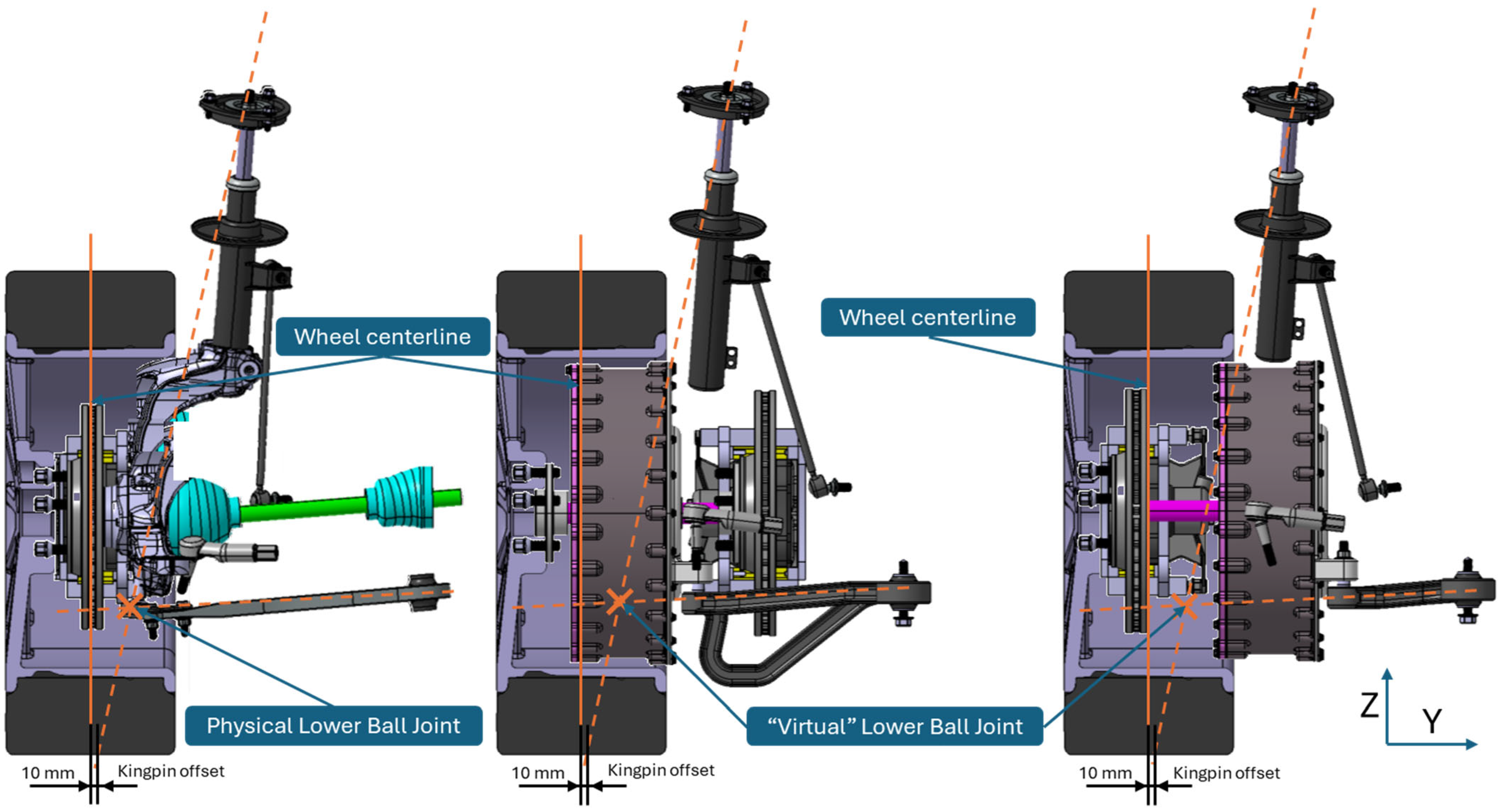
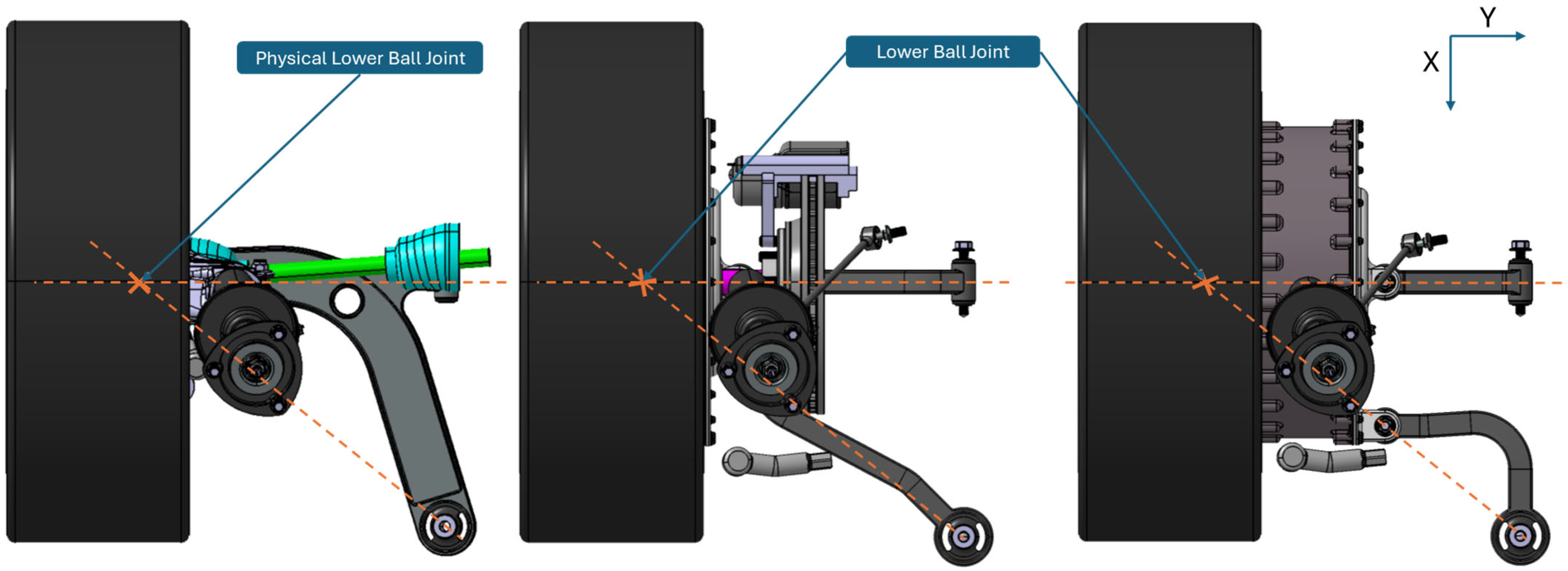
A critical packaging constraint was imposed by the position of the lower ball joint, which was limited by physical interference with the motor housing. To address this limitation while preserving a conventional MacPherson suspension geometry, a “virtual” ball joint concept was implemented by dividing the single lower arm into two separate arms, front and back, thereby defining a virtual pivot point, as illustrated in
Figure 1 and
Figure 2. This solution enabled the steering axis to closely replicate that of classic MacPherson suspension used in ICE (Internal Combustion Engine) architecture, maintaining an identical kingpin offset of 10 mm and avoiding detrimental effects on steering feel and straight-line stability [
45,
46].
The kingpin offset, defined as the lateral distance in the ground plane between the projection of the steering axis and the wheel centerline, is therefore identical for all shown architectures. With a rigid tire model employed, the kingpin offset directly characterizes the effective steering geometry without confounding effects from tire compliance.
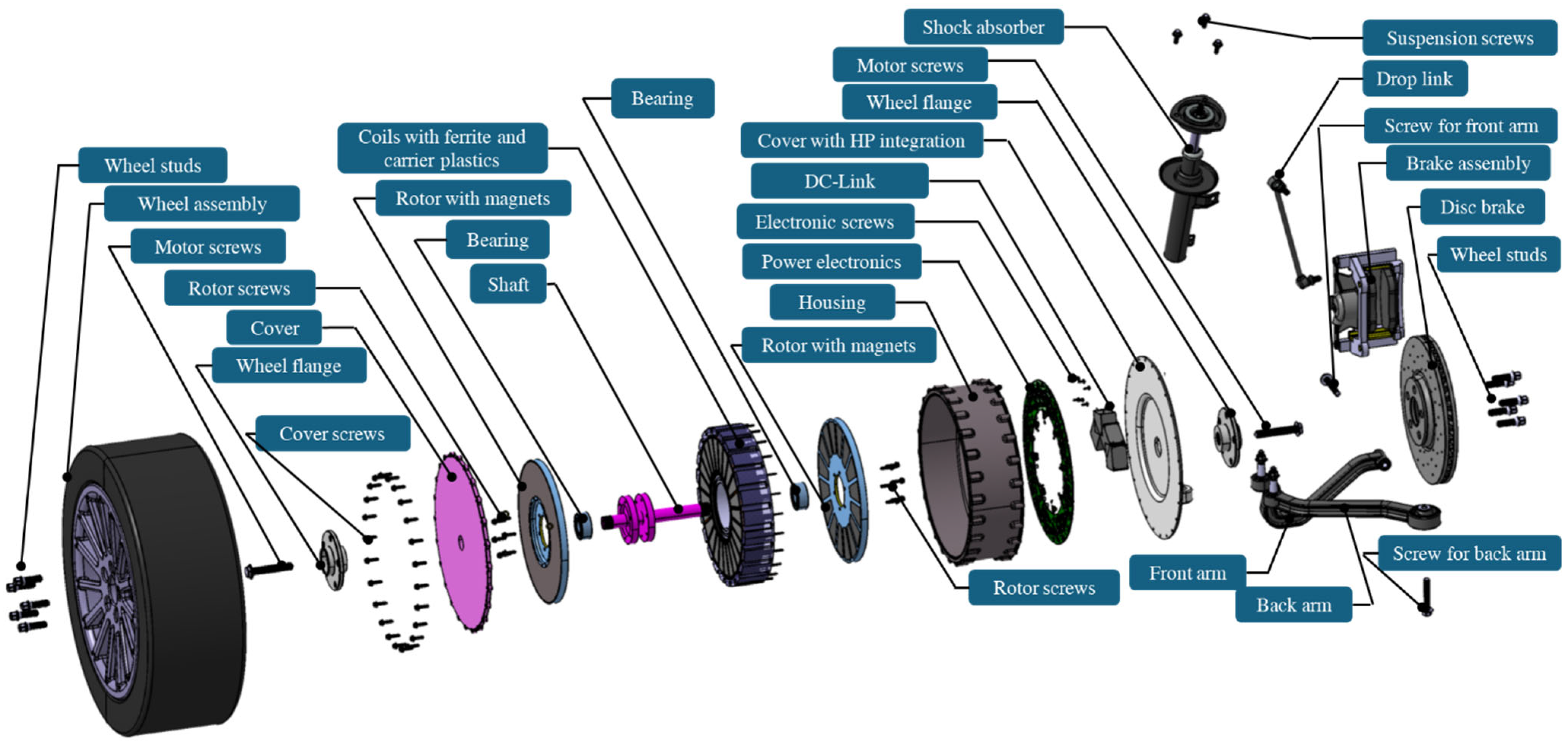
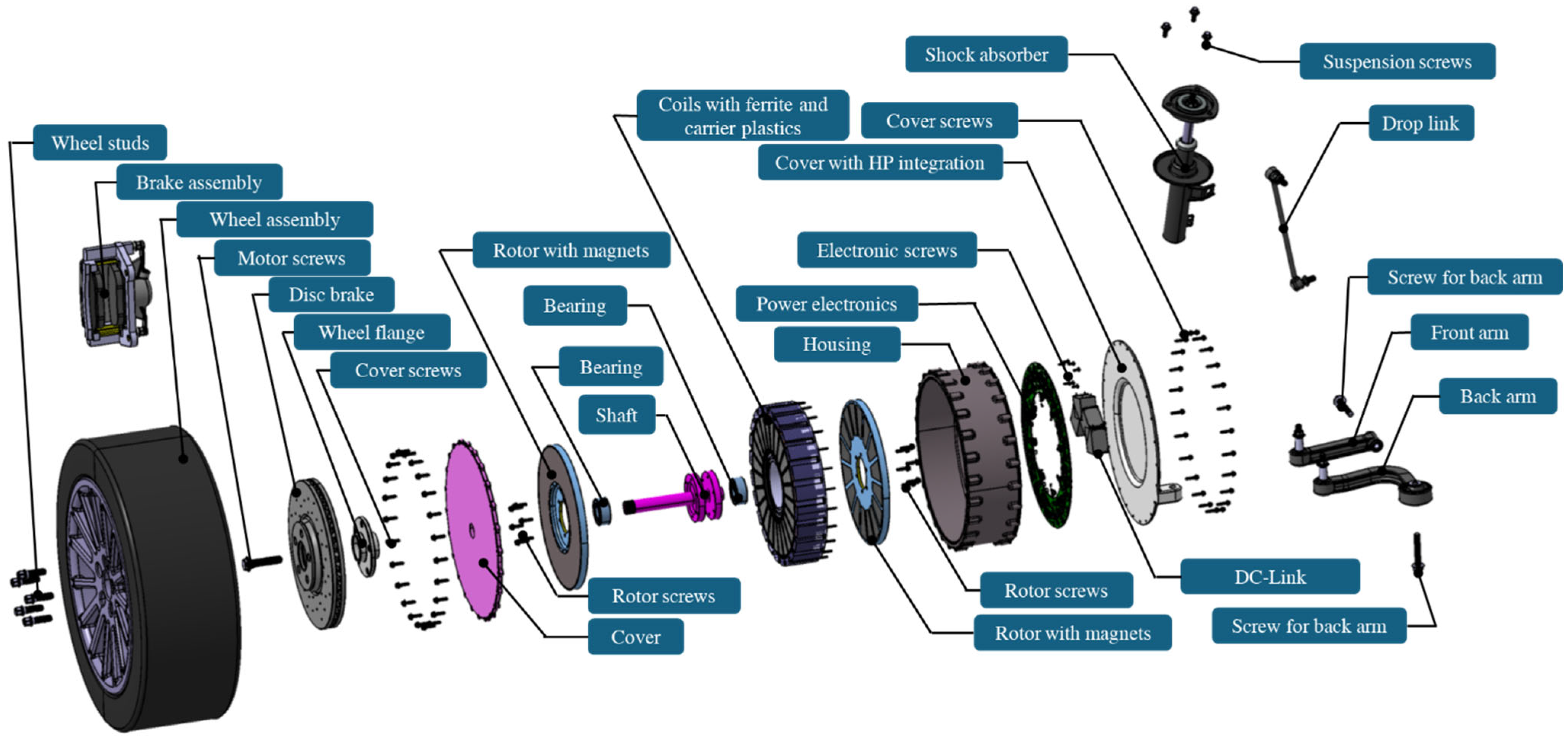
A key aspect of both architectures is the integration of the fixation points for the suspension strut and the arm ball joints into the motor interior cover or motor housing. Components used for both architectures are presented in
Table 2 with different numbers in each architecture construction.
To ensure a straight and accurate comparison, both suspension architectures, shown in
Figure 3 and
Figure 4, were designed using the same fixation points on the chassis level with specific constraints given by the architecture or design. One fundamental difference was the strut length and the suspension arm length; due to packaging constraints, the outboard solution required a 30 mm shorter strut than the inboard solution.
The applied K&C test is a standard test from Altair MotionSolve library, which perform ride test simulating a 100 mm vertical displacement for the inboard solution and 70 mm for the outboard solution, due to the design constraint mentioned above, over 10 s to assess jounce and rebound characteristics. The roll test applied ±50 mm, respectively, ±35 mm, again due to strut constraint, opposing displacements to the wheels to evaluate camber and toe changes during cornering. Contact force tests included lateral forces up to 3000 N and longitudinal forces up to 4000 N to replicate braking and acceleration scenarios. Steering tests measured toe-angle variation under a 360° steering wheel input to quantify responsiveness.
Afterwards, for inboard and outboard architecture, the mechanical challenges derived from the design and constraints established previously will be addressed.
Although the outboard architecture requires a strut that is 30 mm shorter than the inboard configuration, this difference is a direct consequence of brake placement under fixed chassis hard-point constraints rather than an independent design choice. No compensatory suspension re-tuning or geometric optimization was applied in order to preserve identical chassis fixation points and ensure architectural comparability. As a result, the observed differences reflect coupled architectural effects due to shorter suspension arms associated with brake and IWM placement, rather than optimized suspension performance.
3. Results
The K&C simulations revealed distinct dynamic profiles for each proposed architecture.
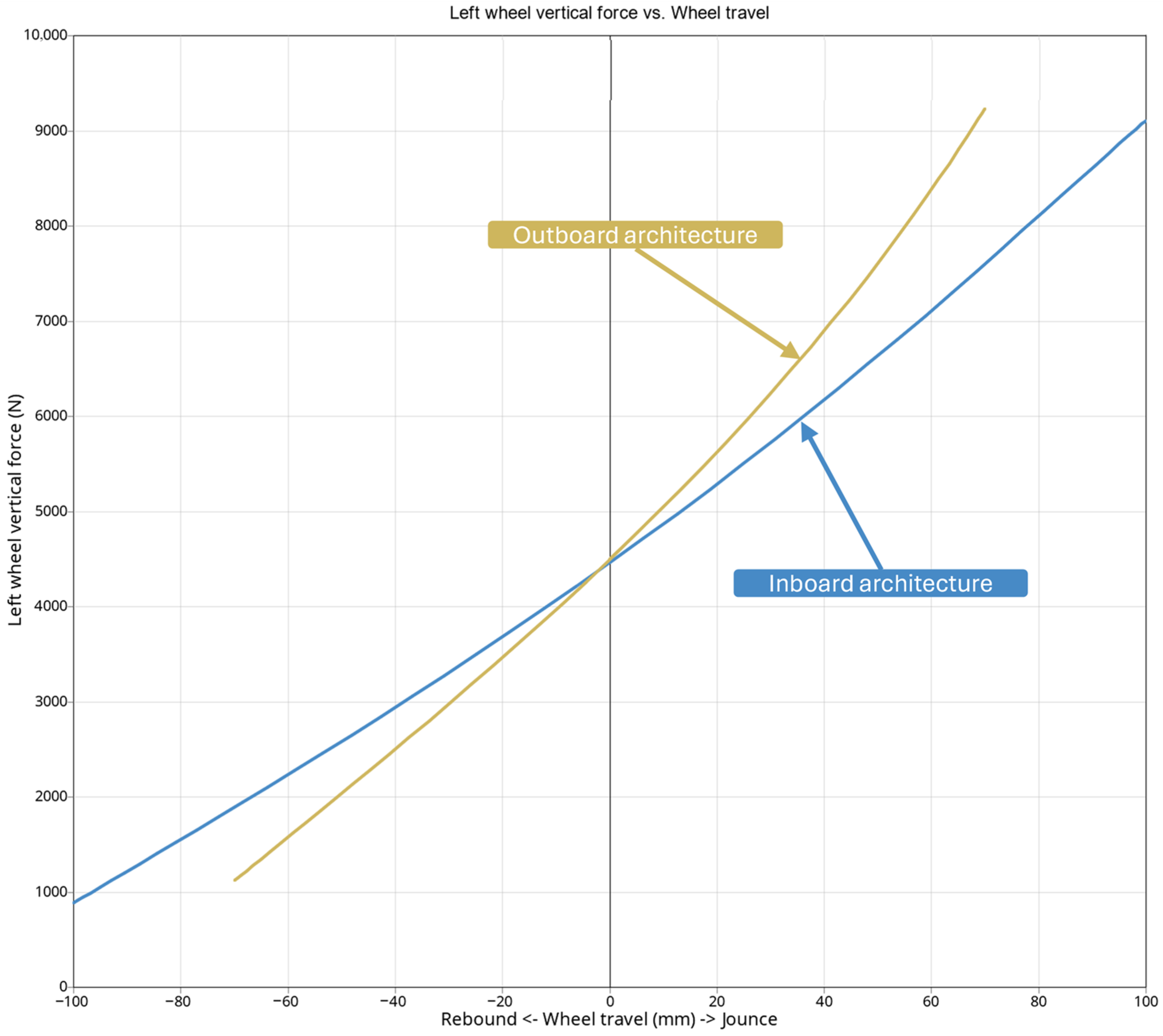
The ride test demonstrated fundamentally different vertical force characteristics between the two architectures. As shown in
Figure 5 and
Table A7, the inboard architecture exhibits an approximately linear vertical-force trend over the investigated travel range, whereas the outboard configuration shows a more progressive (nonlinear) rate in jounce, which correlates with the shorter effective control arm geometry imposed by packaging constraints.
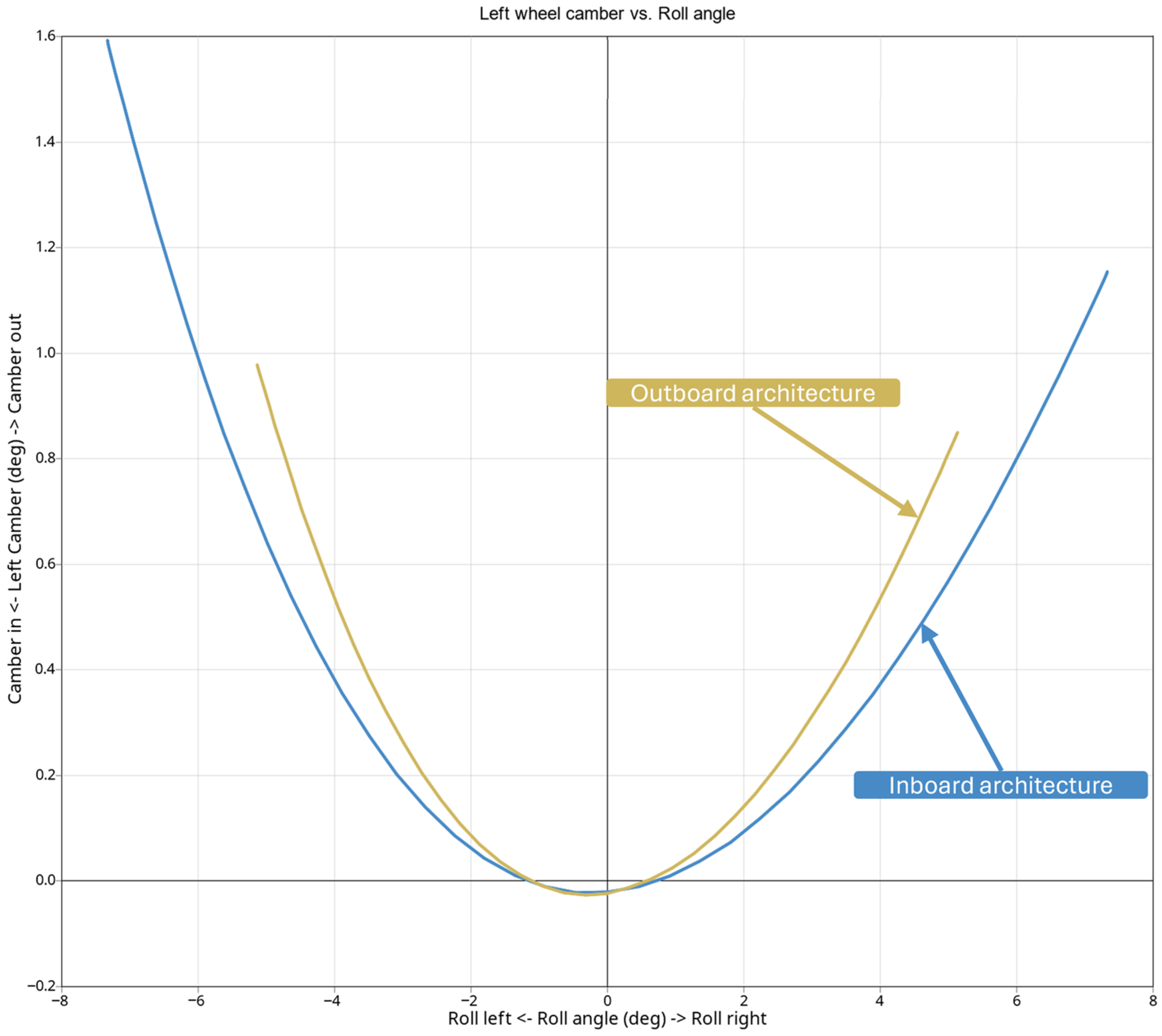
Roll test outcomes, summarized in
Figure 6 and
Table A8, revealed significant differences in camber gain. The inboard solution produced a wider, more gradual camber curve, promoting consistent tire contact patch retention. Conversely, the outboard architecture exhibited a sharper, parabolic camber response, reaching a higher peak camber angle under maximum roll.
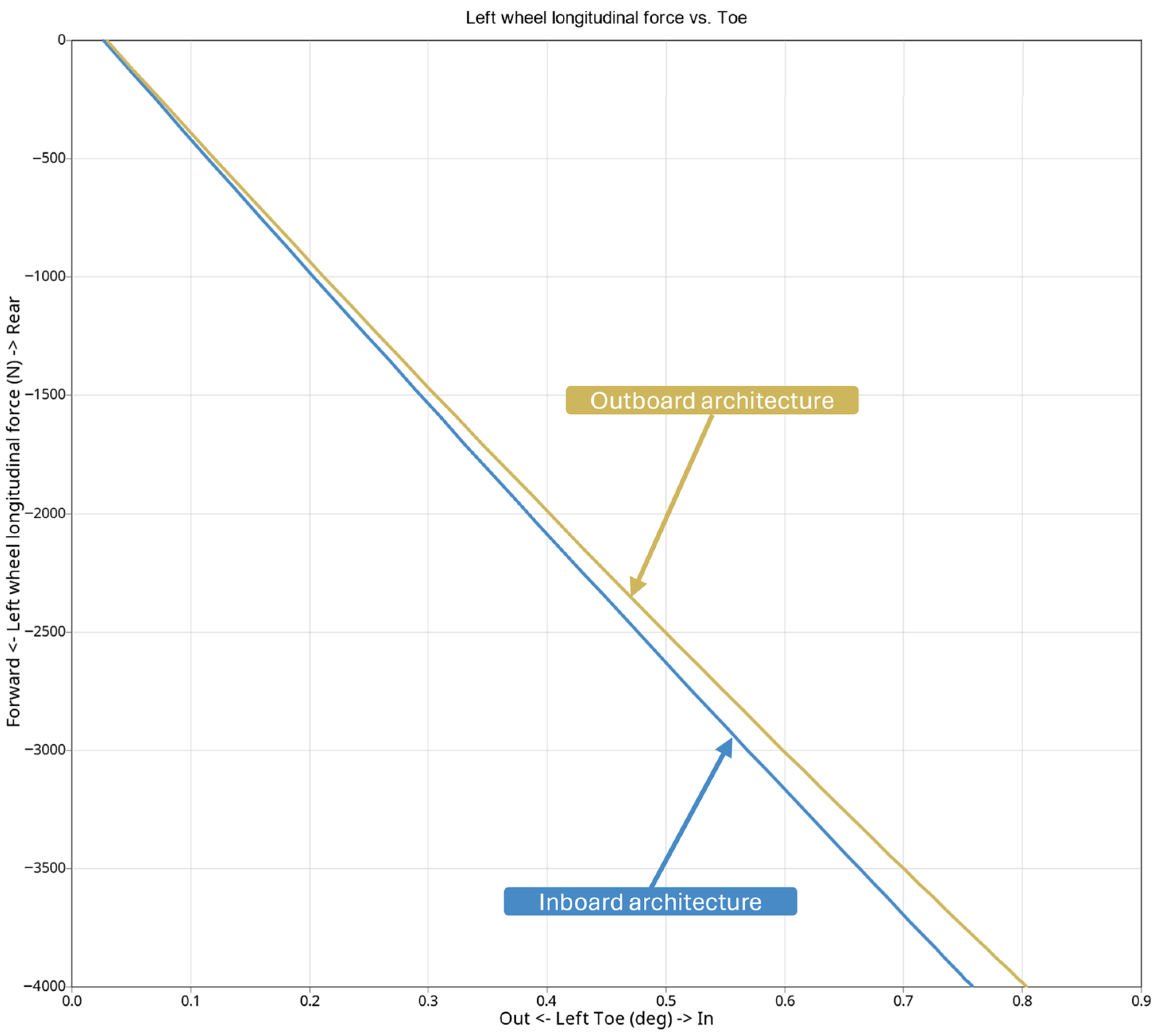
The response to braking and acceleration forces highlighted a critical divergence in longitudinal compliance. As shown in
Figure 7, the inboard architecture exhibited minimal toe change, with less than 0.75° deviation under a 4000 N braking force. This stability is attributed to its symmetrical load paths. The outboard design demonstrated progressive toe-out behavior, reaching 0.8° at peak load, indicating geometric compliance that could affect straight-line tracking during hard deceleration.
The toe compliance,
, is defined as the rate of change in the toe angle,
, with respect to the applied force,
, [
47]:
The variation trends shown in
Figure 6 correspond to the analytical definition of toe compliance provided in (3).
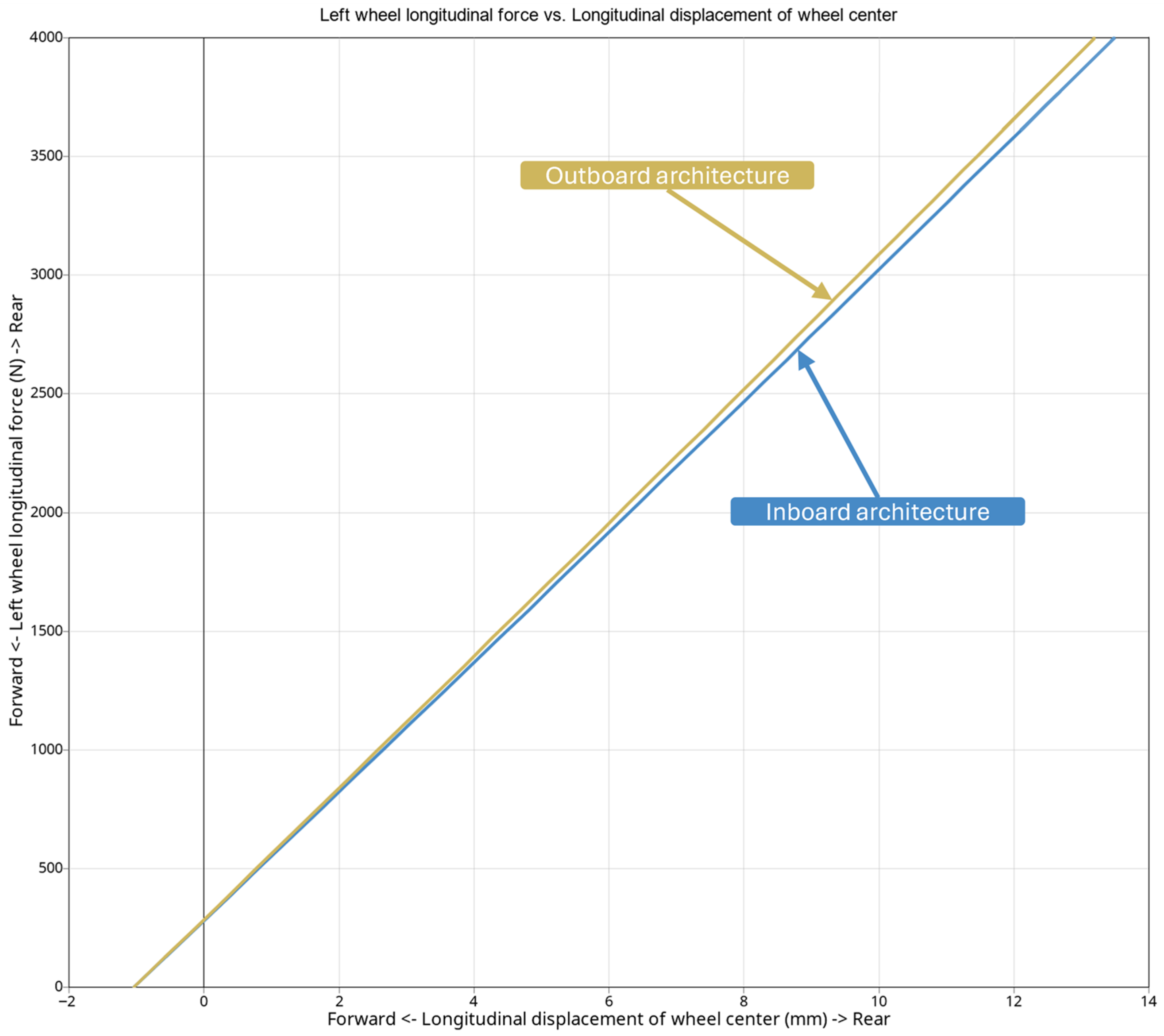
Longitudinal displacement measurements during braking tests, presented in
Figure 8, further underscored this difference. While both systems behaved similarly up to 1500 N, the outboard design exhibited 15% less wheel center movement at the 4000 N peak load. This nonlinear divergence correlates with the shorter effective length of the outboard control arms, which amplifies elastic deformations under high stress. The inboard architecture displacement curve remained linear, confirming its superior stiffness in resisting brake torque reactions.
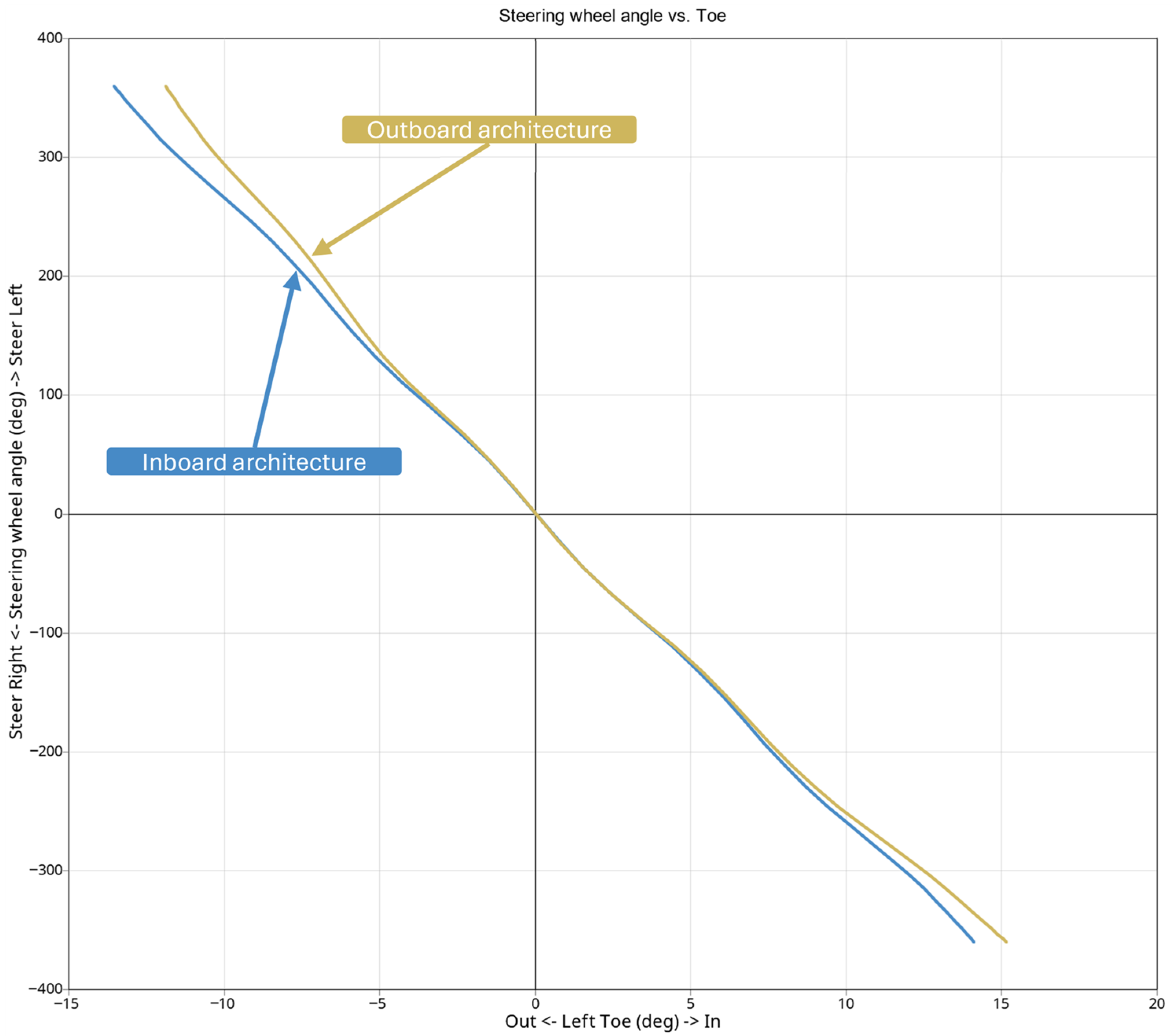
Steering response analysis uncovered fundamental differences in handling linearity.
Figure 9 illustrates that the inboard architecture keeps a near-linear relationship between steering wheel input and toe angle across the full ±360° range, conceptually defined as a function of
—steering rack travel,
—vertical wheel travel, and
—compliance of the elastic elements, with a maximum variation of ~15°:
The outboard design, however, displayed pronounced nonlinearity, with toe changes accelerating beyond ±200 steering wheel input. This behavior stems from the compromised Outer Tie Rod Ball Joint (OTRB) position, a direct consequence of the outboard brake packaging constraints.
The qualitative summary of the K&C tests is presented in
Table 3, highlighting the fundamental trade-off between stability and responsiveness. −, °, and + indicate undesired, moderate, and desired behavior, respectively.
In summary, despite its geometric constraints, the outboard architecture exhibited toe compliance under braking similar to the inboard design, as shown in
Table 4. However, its significantly higher vertical wheel rate and camber gain during ride are direct consequences of the shorter suspension arms and strut.
4. Discussion
4.1. Vehicle Dynamics
This study provides a systematic, simulation-driven comparison of inboard versus outboard disk brake architectures for an AFPM-based IWM system [
48]. The results reveal a fundamental trade-off between dynamic performance, mechanical feasibility, and economic viability, with direct implications for the practical implementation of IWM vehicle architectures.
The analysis indicates that neither architecture represents a universally optimal solution. Instead, each architecture offers specific advantages while introducing specific drawbacks, resulting in a design compromise that must be resolved at each vehicle design level.
The inboard architecture exhibits superior dynamic stability, characterized by its linear K&C behavior, minimal compliance steer, and symmetrical bearing loads, establishing it as the superior dynamic linearity and stability within the investigated constraints. This aligns with classical vehicle dynamics theory, where predictable responses are paramount for stability and comfort. Furthermore, its layout may offer potential thermal advantages, subject to dedicated thermal validation, by distancing the motor from the primary brake heat source.
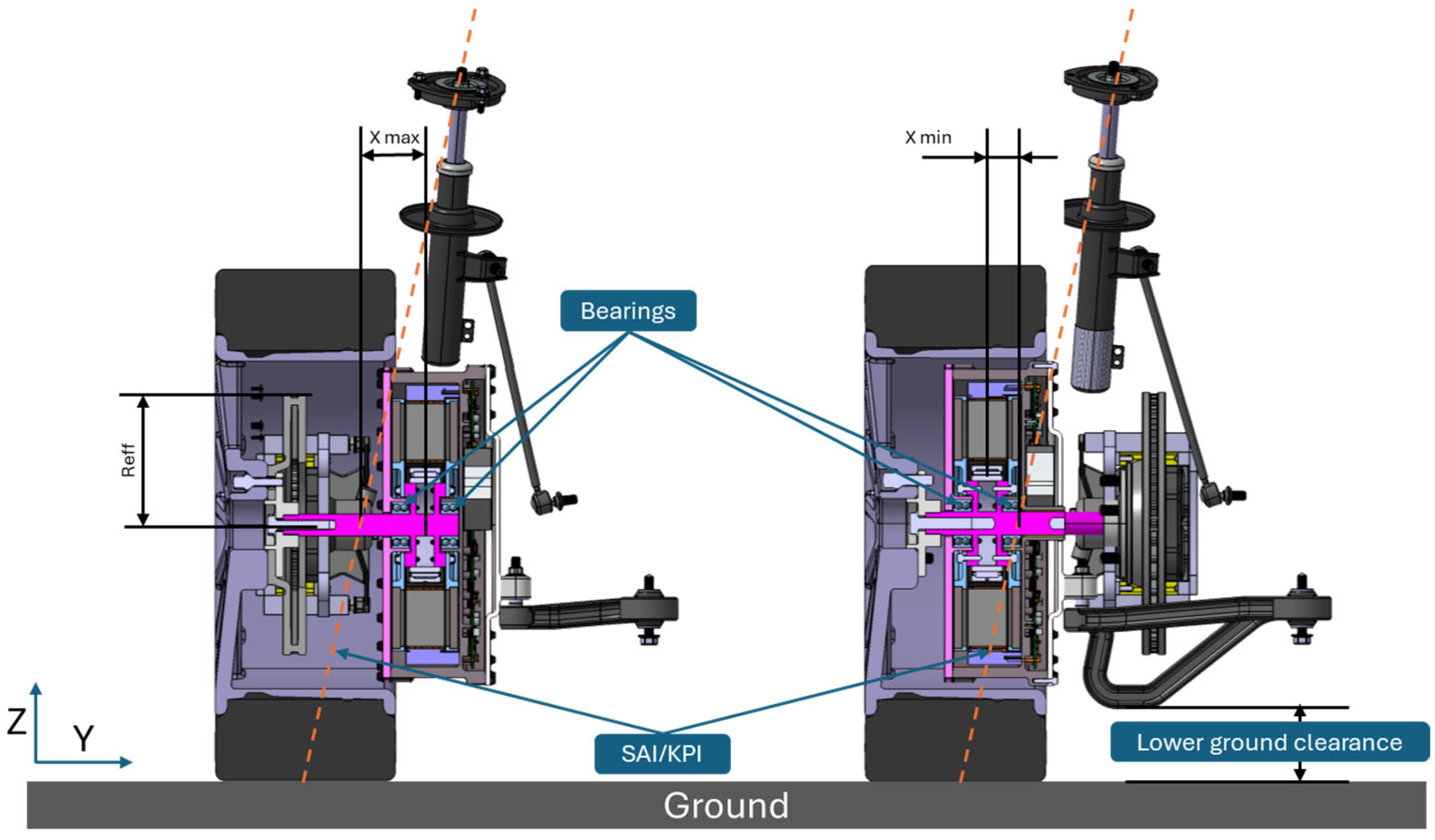
This analysis highlights a critical downside of the outboard architecture, due to the placement of the IWM and its size, the required shorter suspension arm compared with the inboard architecture. This constraint is shown in
Figure 10, which is the main contributor of the nonlinearities from K&C, surpassing the shorter strut implied by the space and interference constraint.
Figure 11 illustrates the stress induced into the system through the position of the disk brake. For the outboard architecture, on the left-hand side, bearings are placed at
, and in the inboard architecture, bearings are placed at
.
Brake moment,
, will be the same for both cases:
but, the difference will be in the force on the bearing,
:
where
is the tangential braking force at the disk’s effective radius,
is the effective radius of the disk brake,
is the friction coefficient of braking,
is the span between the bearings,
is the vertical force, and
is the distance between the SAI (steering axis)/KPI (kingpin inclination) of the wheel and the middle plane of the bearing package.
Due to , the in the outboard architecture will be proportionally larger than in the inboard architecture.
To evaluate bearing durability, the lever arm in the outboard architecture, which is larger due to positing of the disk brake, amplifies the reaction forces under combined vertical and braking loads. Conversely, the inboard architecture allows the bearings to be positioned closer to the steering axis, , minimizing the bending moments and ensuring a more symmetrical load distribution.
4.2. Complexity and Serviceability Considerations
These performance benefits are accompanied by notable mechanical complexity and serviceability penalties. The BOM (Bill of Materials), presented in
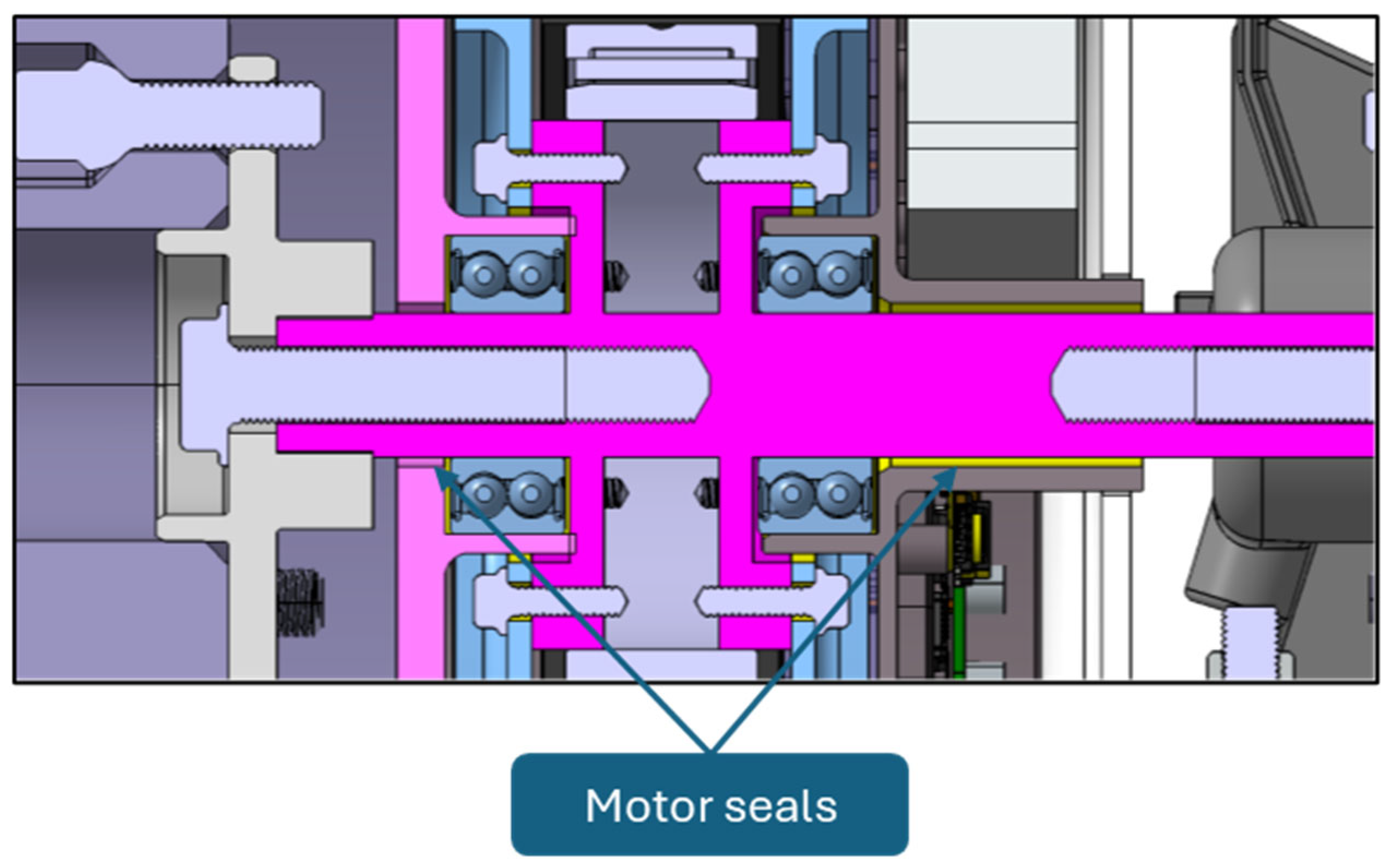
Table 2, is significantly larger, requiring an additional wheel flange, extra fastening elements, and, most critically, a second rotational shaft sealing, shown in
Figure 11. This dual-seal requirement is not merely an added component; it introduces significant manufacturing complexity and potential points of failure, and is a direct driver of increased assembly complexity and cost [
49]. Consequently, while dynamically preferable for a premium passenger vehicle, its high complexity and severe maintenance challenges (likely requiring full IWM disassembly for brake service) make it a difficult solution for mass production [
49,
50].
The primary advantage of the outboard architecture lies in its simple BOM and preserved serviceability, making it initially attractive from a complexity and assembly perspective. It avoids the complex dual-sealing system of the inboard design.
However, this apparent complexity is offset when lifecycle effects and mechanical limitations are considered. The asymmetrical bearing loads, presented in
Figure 11, suggest an increased risk of accelerated wear, requiring durability validation, potentially necessitating the use of higher-capacity and more costly bearing solutions [
26,
51]. Simultaneously, the high bushing stress from the short control arm geometry, directly evidenced by the large compliance steer in the results, suggests an increased risk and inconsistent long-term handling, requiring durability validation. These factors imply increased durability risk and lifecycle cost, partially negating the initial BOM advantage. This configuration also introduces ground clearance constraints between the suspension arm and the ground.
Equations (1)–(4) are introduced to support the physical interpretation of the multibody dynamics results rather than to replace numerical simulation. In particular, Equation (4) provides a conceptual explanation for the higher toe compliance observed in the outboard configuration under longitudinal loading, while Equations (5) and (6) illustrate the amplification of bearing reaction forces due to reduced effective lever arms.
Equation (6) represents a quasi-static approximation intended to explain the observed trends in bearing loading. Dynamic bearing reaction forces were not explicitly extracted from the multibody solver and will be addressed in future work.
The presented findings provide a quantitative foundation for previously qualitative discussions in the literature [
12,
16,
20,
26]. By directly correlating brake placement with measurable compliance behavior and identifiable cost drivers, this study establishes a structured decision-making framework for early-stage vehicle architecture development.
For premium vehicle segments, the inboard solution may justify its higher complexity due to its superior refinement and potential thermal stability.
For well-known solutions and high-volume production, the outboard solution is a feasible starting point; however, the results clearly indicate that substantial geometric and component-level optimization would be required to achieve acceptable durability and dynamic performance, thereby reducing its initial BOM and assembly advantage.
4.3. Limitations and Future Work
Several limitations of this study must be acknowledged. First, the exclusive reliance on multibody dynamics simulation incorporates simplifications that may influence the dynamic behavior of the vehicle. Validation using a physical prototype is therefore required.
Second, this study focused on dynamics, qualitative complexity, and serviceability considerations. Potential thermal advantages of the inboard layout and the NVH (Noise, Vibration and Harshness) implications of both architectures, while logically deduced, require quantitative verification through coupled multiphysics simulations [
25,
26,
28,
52].
No direct thermal, NVH, or fatigue simulations were conducted; all related implications should therefore be interpreted as hypotheses derived from mechanical load paths.
Third, the geometric constraints, such as shorter strut (30 mm) and shorter suspension arms, imposed on the outboard architecture are a direct consequence of the chosen fixed hardpoint methodology and significantly impact the results. Future work should explore compensation within these constraints.
Furthermore, extracting dynamic bearing reaction forces from the multibody model will enable precise durability analysis and bearing selection.
5. Conclusions
This study systematically evaluated the influence of disk brake placement on the performance and viability of an In-Wheel Motor system for Electric Vehicles, FCEVs, or other suitable vehicles. Through a detailed multibody dynamics analysis of inboard and outboard architecture, a clear and consequential trade-off has been quantified, revealing that the optimal choice is not a technical absolute, but a strategic compromise defined by the vehicle target application.
The inboard brake architecture was confirmed as the dynamically superior solution, offering linear and predictable handling, enhanced stability, and favorable mechanical load distribution. However, these advantages are critically offset by a more complex BOM, a challenging dual-shaft sealing requirement, and reduced serviceability, rendering it a high-complexity option difficult to justify for mass-market applications.
Conversely, the outboard brake architecture, while simpler to service and, initially, a more established architecture, was found to be fundamentally constrained by packaging geometry. Its geometry leads to significant dynamic drawbacks, including nonlinear steering response and excessive compliance steer, and poses a risk of premature failure due to asymmetrical bearing loads. Without a significant redesign, it cannot be considered a direct replacement for conventional suspension layouts.
The main contribution of this work is the provision of a holistic decision-making framework that requires the simultaneous consideration of dynamic performance, mechanical durability and complexity, and serviceability viability.
There is no universal solution; the inboard architecture caters to premium segments where refinement justifies complexity, while the outboard layout requires significant geometric and component-level adjustment to become a robust solution for volume production.
Additional future work must focus on bridging this gap. The main priority is the geometric optimization of the outboard solution, through the exploration of geometric compensation (suspension arm length), spring-damper retuning, OTRB adjustment to fix the nonlinearity after 200°, and changes on the chassis fixation points level with emphasis on complexity and serviceability, to mitigate its shortcomings.
Furthermore, comprehensive thermal, NVH, and total cost-of-ownership analyses are the essential next steps to fully inform the development of next-generation EVs equipped with a high-performance IWM system.
Author Contributions
Conceptualization, V.P. and E.R.; methodology, V.P. and E.R.; validation, V.P., E.R., T.M.U. and G.M.; formal analysis, V.P. and I.R.G.; investigation, V.P.; data curation, V.P., A.G.P. and Ș.P.; writing—original draft preparation, V.P.; writing—review and editing, V.P., E.R., T.M.U. and G.M.; visualization, V.P., A.G.P. and Ș.P.; supervision, E.R., T.M.U. and G.M.; project administration, E.R., T.M.U. and G.M. All authors have read and agreed to the published version of the manuscript.
Funding
This research received no external funding.
Data Availability Statement
The original contributions presented in this study are included in the article. Further inquiries can be directed to the corresponding author.
Acknowledgments
The authors are very thankful to Simart3D for providing the Altair (2025) suite of simulation software.
Conflicts of Interest
The authors declare no conflicts of interest.
Abbreviations
The following abbreviations are used in this manuscript:
| IWM | In-Wheel Motor |
| AFPM | Axial Flux Permanent Magnet Motor |
| CAD | Computer-Aided Design |
| K&C | Kinematics and Compliance |
| YASA | Yokeless and Segmented Armatures |
| OTRB | Outer Tie Rod Ball Joint |
| BOM | Bill of Materials |
| NVH | Noise, Vibration and Harshness |
| FCEVs | Fuel Cell Electric Vehicles |
| SiC | Silicon Carbide |
| EV | Electric Vehicle |
| SAI/KPI | Steering Axis Inclination/Kingpin Inclination |
| DC-link | Direct Current link |
Appendix A
Input data used for creating the 3D model and subsequently the multibody dynamics model for Altair MotionView/Solve.
Table A1.
Position for MacPherson suspension elements of the two architectures.
Table A1.
Position for MacPherson suspension elements of the two architectures.
| Position of | Inboard Placement | Outboard Placement |
|---|
| | X-dir. [mm] | Y-dir. [mm] | Z-dir. [mm] | X-dir. [mm] | Y-dir. [mm] | Z-dir. [mm] |
|---|
| Wheel center | 905 | 792 | 334.35 | 905 | 792 | 334.35 |
| Outer tire rod ball joint motor fixation | 1137 | 636 | 330 | 1137 | 616 | 330 |
| Inner tie rod ball joint rack steering fixation | 1105 | 256 | 284.35 | 1105 | 256 | 284.35 |
| Back arm chassis fixation | 1232 | 342.5 | 224.35 | 1232 | 342.5 | 224.35 |
| Back arm motor fixation | 998.195 | 928.5 | 214.34 | 1090.16 | 516 | 218.27 |
| Front arm chassis fixation | 905 | 334.9 | 228.95 | 905 | 334.9 | 228.95 |
| Front arm motor fixation | 905 | 628.5 | 214.34 | 905 | 516 | 218.27 |
| Strut upper chassis fixation | 1017 | 588 | 912 | 1017 | 588 | 912 |
| Strut lower motor fixation | 911.4 | 618 | 508.8 | 922 | 615 | 552 |
| Disk brake position fixation | 905 | 570 | 334.35 | 905 | 841 | 334.35 |
| Drop link attached to strut | 971 | 543 | 670 | 971 | 543 | 670 |
| Drop link attached to anti-roll bar | 840 | 450 | 400 | 840 | 450 | 400 |
| IWM center | 905 | 751 | 334.35 | 905 | 636 | 334.35 |
Table A2.
Weights and inertia of the components of the two architectures.
Table A2.
Weights and inertia of the components of the two architectures.
| Position of | Inboard Placement | Outboard Placement |
|---|
| | M [kg] | Ixx [kg·m2] | Iyy
[kg·m2] | Izz [kg·m2] | M [kg] | Ixx [kg·m2] | Iyy [kg·m2] | Izz [kg·m2] |
|---|
| IWM | 37.63 | 5 | 5 | 5 | 37.63 | 5 | 5 | 5 |
| Disk brake | 10.7 | 5 | 5 | 5 | 10.7 | 5 | 5 | 5 |
| Front lower control arm | 1.25 | 2081 | 2081 | 2081 | 2 | 2081 | 2081 | 2081 |
| Back lower control arm | 1 | 2081 | 2081 | 2081 | 2 | 2081 | 2081 | 2081 |
| Wheel | 24 | 17,500 | 17,500 | 30,000 | 24 | 17,500 | 17,500 | 30,000 |
| Wheel hub | 0.5 | 70,000 | 70,000 | 100,000 | 1 | 70,000 | 70,000 | 100,000 |
| Strut tube | 4.56 | 655.3 | 655.3 | 655.3 | 4.56 | 655.3 | 655.3 | 655.3 |
| Strut rod | 1 | 655.3 | 655.3 | 655.3 | 1 | 655.3 | 655.3 | 655.3 |
| Drop link | 0.578 | 88.11 | 88.11 | 88.11 | 0.578 | 88.11 | 88.11 | 88.11 |
| Tie rod | 0.5 | 30,000 | 30,000 | 300 | 0.5 | 30,000 | 30,000 | 300 |
| Rack | 2 | 30,000 | 300 | 30,000 | 2 | 30,000 | 300 | 30,000 |
| Rack assembly | 8 | 200,000 | 200 | 200,000 | 8 | 200,000 | 200 | 200,000 |
| Subframe body | 15 | 59,790 | 59,790 | 59,790 | 15 | 59,790 | 59,790 | 59,790 |
| Vehicle total weight | 2270 | - | - | - | 2270 | - | - | - |
Table A3.
Stiffness of the bushing elements used on inboard architecture.
Table A3.
Stiffness of the bushing elements used on inboard architecture.
| | Inboard Placement |
|---|
| Stiffness | Kx [N/mm] | Ky
[N/mm] | Kz
[N/mm] | KTx
[N·mm/rad] | KTy [N·mm/rad] | KTz [N·mm/rad] |
|---|
| Front subframe mount | 6000 | 6000 | 1000 | 450,000 | 450,000 | 60,000 |
| Rear subframe mount | 6000 | 6000 | 1000 | 450,000 | 450,000 | 60,000 |
| Front arm chassis bushing | 6000 | 6000 | 1000 | 450,000 | 450,000 | 60,000 |
| Back arm chassis bushing | 6000 | 6000 | 1000 | 450,000 | 450,000 | 60,000 |
| Back arm IWM bushing | 6000 | 6000 | 1000 | 450,000 | 450,000 | 60,000 |
| Strut upper bushing | 6000 | 6000 | 1000 | 450,000 | 450,000 | 60,000 |
Table A4.
Damping effect of the bushing elements used on inboard architecture.
Table A4.
Damping effect of the bushing elements used on inboard architecture.
| | Inboard Placement |
|---|
| Dampening | Cx [N·s/mm] | Cy
[N·s/mm] | Cz [N·s/mm] | CTx [N·mm·s/rad] | CTy [N·mm·s/rad] | CTz [N·mm·s/rad] |
|---|
| Front subframe mount | 60 | 60 | 10 | 4500 | 4500 | 600 |
| Rear subframe mount | 60 | 60 | 10 | 4500 | 4500 | 600 |
| Front arm chassis bushing | 60 | 60 | 10 | 4500 | 4500 | 600 |
| Back arm chassis bushing | 60 | 60 | 10 | 4500 | 4500 | 600 |
| Back arm IWM bushing | 60 | 60 | 10 | 4500 | 4500 | 600 |
| Strut upper bushing | 60 | 60 | 10 | 4500 | 4500 | 600 |
Table A5.
Stiffness of the bushing used on outboard architecture.
Table A5.
Stiffness of the bushing used on outboard architecture.
| | Inboard Placement |
|---|
| Stiffness | Kx
[N/mm] | Ky [N/mm] | Kz [N/mm] | KTx [N·mm/rad] | KTy [N·mm/rad] | KTz [N·mm/rad] |
|---|
| Front subframe mount | 6000 | 6000 | 1000 | 450,000 | 450,000 | 60,000 |
| Rear subframe mount | 6000 | 6000 | 1000 | 450,000 | 450,000 | 60,000 |
| Front arm chassis bushing | 6000 | 6000 | 1000 | 450,000 | 450,000 | 60,000 |
| Back arm chassis bushing | 6000 | 6000 | 1000 | 450,000 | 450,000 | 60,000 |
| Back arm IWM bushing | 6000 | 6000 | 1000 | 450,000 | 450,000 | 60,000 |
| Strut upper bushing | 6000 | 6000 | 1000 | 450,000 | 450,000 | 60,000 |
Table A6.
Damping effect of the bushing elements used on outboard architecture.
Table A6.
Damping effect of the bushing elements used on outboard architecture.
| | Inboard Placement |
|---|
| Dampening | Cx [N·s/mm] | Cy [N·s/mm] | Cz [N·s/mm] | CTx [N·mm·s/rad] | CTy [N·mm·s/rad] | CTz [N·mm·s/rad] |
|---|
| Front subframe mount | 60 | 60 | 10 | 4500 | 4500 | 600 |
| Rear subframe mount | 60 | 60 | 10 | 4500 | 4500 | 600 |
| Front arm chassis bushing | 60 | 60 | 10 | 4500 | 4500 | 600 |
| Back arm chassis bushing | 60 | 60 | 10 | 4500 | 4500 | 600 |
| Back arm IWM bushing | 60 | 60 | 10 | 4500 | 4500 | 600 |
| Strut upper bushing | 60 | 60 | 10 | 4500 | 4500 | 600 |
The following data were used in the simulation for defining and constraining the vehicle’s suspension geometry: a vehicle CG height of 1000 mm, a wheelbase of 2841 mm, an axle ratio of 3, a coil spring of K = 30, a strut damper of C = 1, and a tire vertical spring rate = 250 N/mm.
Appendix B
Detailed results from the K&C simulation performed in Altair MotionSolve.
Table A7.
Comparative ride test results.
Table A7.
Comparative ride test results.
| Test Type | Measurement | Inboard Architecture | Outboard Architecture |
|---|
| Ride test | Toe | −33.1°·10−3/mm to 64°·10−3/mm | −19.2°·10−3/mm to 62°·10−3/mm |
| Caster | 88.1°·10−3/mm to 117°·10−3/mm | 13.2°·10−3/mm to 16°·10−3/mm |
| Camber | 16.4°·10−3/mm to 1.3°·10−3/mm | 14.7°·10−3/mm to 11.7°·10−3/mm |
| Longitudinal displacement of WC | 47.6·10−3 to −89.7·10−3 | 9.2·10−3 to −135.7·10−3 |
| Lateral displacement of the WC | −105·10−3 to −196.7·10−3 | −130·10−3 to −220·10−3 |
| Vertical force | 888 N/−100 mm to 9709.7 N/100 mm | 1120.6 N/−70 mm to 9237 N/70 mm |
Table A8.
Comparative roll results.
Table A8.
Comparative roll results.
| Test Type | Measurement | Inboard Architecture | Outboard Architecture |
|---|
| Roll test | Toe | −33.5°·10−3/mm to 45.9°·10−3/mm | 32.8°·10−3/mm to −20°·10−3/mm |
| Caster | 87.8°·10−3/mm to 117.4°·10−3/mm | 131°·10−3/mm to 160°·10−3/mm |
| Camber | 15.8°·10−3/mm to 11.5°·10−3/mm | 12.1°·10−3/mm to 13.8°·10−3 |
| Longitudinal displacement of WC | −8550·10−3 to 4650·10−3 | −9215·10−3 to 623·10−3 |
| Lateral displacement of WC | 19,720·10−3 to 10,064·10−3 | 16,013·10−3 to 8549·10−3 |
| Vertical force | 77.1782 N/−100 mm to 10,073.5 N/100 mm | 611.545 N/−70 mm to 9856.67 N/70 mm |
| | Toe vs. Roll Angle | −1596.9·10−3 to −2188·10−3 | 1198·10−3 to −302·10−3 |
| | Caster vs. Roll Angle | 622.9·10−3 to −834.8·10−3 | 455.5·10−3 to −555.7·10−3 |
| | Camber vs. Roll Angle | 4639.2·10−3 to −20,450·10−3 | 5288·10−3 to −10,660·10−3 |
Table A9.
Comparative lateral force test results.
Table A9.
Comparative lateral force test results.
| Test Type | Measurement | Inboard Architecture | Outboard Architecture |
|---|
| Lateral Force Test | Parallel test |
| Toe | −27.5°·10−6/N to −42.5°·10−6/N | −27.5°·10−6/N to 35°·10−6/N |
| Caster | −32.5°·10−6/N to −22.5°·10−6/N | −32.5°·10−6/N to −22.5°·10−6/N |
| Camber | −292.5·10−6 mm/N to 297.5·10−6 mm/N | 290·10−6 mm/N to 295·10−6 mm/N |
| Lateral displacement of the WC | −27.5°·10−6/N to −42.5°·10−6/N | −27.5°·10−6/N to 35°·10−6/N |
| Opposing test |
| Toe | −34.25°·10−6/N to −48.25°·10−6/N | −33°·10−6/N to 48.75°·10−6/N |
| Camber | −17.5°·10−6/N to 8°·10−6/N | −20°·10−6/N to 7.5°·10−6/N |
| Lateral displacement of WC | 162.5·10−6 mm/N to 170·10−6 mm/N | 162.5·10−6 mm/N to 170·10−6 mm/N |
| Aligning torque |
| Toe vs. Torque | −0.42°·10−6/N·mm to 0.99°·10−6/N·mm | −0.5°·10−6/N·mm to −1°·10−6/N·mm |
| Camber vs. Torque | −0.27°·10−6/N·mm to0.15°·10−6/N·mm | −0.3°·10−6/N·mm to 0.2°·10−6/N·mm |
| Lateral displacement of WC vs. Torque | −0.82 mm·10−6/N·mm to −1.07 mm·10−6/N·mm | −0.8 mm·10−6/N·mm to 1·10−6 mm/N·mm |
| Aligning torque opposite |
| Toe vs. Torque | 0.055°·10−6/N·mm to 0.62°·10−6/N·mm | 0.03°·10−6/N·mm to 0.7°·10−6/N·mm |
| Camber vs. Torque | 0.222°·10−6/N·mm to −0.209°·10−6/N·mm | 0.243°·10−6/N·mm to 0.226°·10−6/N·mm |
| Lateral displacement of WC vs. Torque | −0.62·10−6 mm/N·mm to 0.88·10−6 mm/N·mm | −0.64 mm·10−6/N·mm to 0.87·10−6 mm/N·mm |
Table A10.
Comparative braking and acceleration test results.
Table A10.
Comparative braking and acceleration test results.
| Test Type | Measurement | Inboard Architecture | Outboard Architecture |
|---|
| Braking test | Toe | −0.66°/4000 N to 0.029°/0 N | −0.67°/4000 N to 0.032°/0 N |
| Caster | 8.7°/4000 N to 9.99°/0 N | 8.7°/4000 N to 9.99°/0 N |
| Camber | −0.021°/0 N to 0.002°/4000 N | −0.023°/0 N to 0.0065°/4000 N |
| Longitudinal displacement of WC | −1.04 mm/0 N to 13.5 mm/4000 N | −1.04 mm/0 N to 13.2 mm/4000 N |
| Acceleration test | Toe | 0.028°/0.01 N to 0.765°/−4000 N | 0.032°/0.01 N to 0.81°/−4000 N |
| Caster | 9.99°/0.01 N to 11.37°/−4000 N | 9.99°/0.01 N to 11.35°/4000 N |
| Camber | −0.0216°/0.01 N to −0.0215°/−4000 N | −0.023°/0.01 N to −0.02°/4000 N |
| Longitudinal displacement of WC | −16.3 mm/4000 N to −1.04 mm/−4000 N | −16.15 mm/4000 N to −1.04 mm/0.01 N |
Table A11.
Comparative steering test results.
Table A11.
Comparative steering test results.
| Test Type | Measurement | Inboard Architecture | Outboard Architecture |
|---|
| Steering test | Toe | 14.09°/360° to −13.55°/−360° | 14.94°/360° to −11.87°/−360° |
| Caster | −1.5°/360° to 2.8°/−360° | −0.53°/360° to 2.62°/360° |
References
- Communication from the Commission to the European Parliament, the European Council, the Council, the European Economic and Social Committee and the Committee of the Regions the European Green Deal. Available online: https://eur-lex.europa.eu/legal-content/EN/TXT/?uri=celex:52019DC0640 (accessed on 11 January 2026).
- Communication from the Commission to the European Parliament, the council, the European Economic and Social Committee and the Committee of the Regions “Fit for 55”: Delivering the EU’s 2030 Climate Target on the Way to Climate Neutrality. Available online: https://eur-lex.europa.eu/legal-content/EN/TXT/?uri=celex:52021DC0550 (accessed on 11 January 2026).
- Conway, G.; Joshi, A.; Leach, F.; García, A.; Senecal, P.K. A Review of Current and Future Powertrain Technologies and Trends in 2020. Transp. Eng. 2021, 5, 100080. [Google Scholar] [CrossRef]
- Chan, C.C. The State of the Art of Electric, Hybrid, and Fuel Cell Vehicles. Proc. IEEE 2007, 95, 704–718. [Google Scholar] [CrossRef]
- Liu, C.; Chau, K.T.; Lee, C.H.T.; Song, Z. A Critical Review of Advanced Electric Machines and Control Strategies for Electric Vehicles. Proc. IEEE 2021, 109, 1004–1028. [Google Scholar] [CrossRef]
- Deepak, K.; Frikha, M.A.; Benômar, Y.; Baghdadi, M.E.; Hegazy, O. In-Wheel Motor Drive Systems for Electric Vehicles: State of the Art, Challenges, and Future Trends. Energies 2023, 16, 3121. [Google Scholar] [CrossRef]
- Burke, R. Compact In-Wheel Motor for Passenger Cars and Light Commercial Vehicles. MTZ Worldw. 2023, 84, 16–23. [Google Scholar] [CrossRef]
- Jneid, M.S.; Harth, P.; Ficzere, P. In-wheel-motor electric vehicles and their associated drivetrains. Int. J. Traffic Transp. Eng. 2020, 10, 415–431. [Google Scholar] [CrossRef]
- Liu, X.; Che, J.; Wu, J.; Jiang, W.; Liu, R.; Zhao, Y. Integrated Dynamic Modeling and Simulation of Wheeled Vehicle with Outer-Rotor In-Wheel Motors and Key Units. Machines 2024, 12, 624. [Google Scholar] [CrossRef]
- Jia, C.; Liu, W.; Chau, K.T.; He, H.; Zhou, J.; Niu, S. Passenger-Aware Reinforcement Learning for Efficient and Robust Energy Management of Fuel Cell Buses. eTransportation 2026, 27, 100537. [Google Scholar] [CrossRef]
- Bie, N.D.; Geysen, J.; Westerhof, B.E.; Smet, J.D. Improved Vehicle Dynamics Performance Using In-Wheel Motor Torque Vectoring and Electromechanical Active Suspension Roll Damping. In Proceedings of the Vehicle Power and Propulsion Conference, Merced, CA, USA, 1–4 November 2022. [Google Scholar] [CrossRef]
- Murata, S. Innovation by In-Wheel-Motor Drive Unit. Veh. Syst. Dyn. 2012, 50, 807–830. [Google Scholar] [CrossRef]
- Soltani, A.; Bagheri, A.; Azadi, S. Integrated Vehicle Dynamics Control Using Semi-Active Suspension and Active Braking Systems. Proc. Inst. Mech. Eng. Part K J. Multi-Body Dyn. 2018, 232, 314–329. [Google Scholar] [CrossRef]
- Ahmed, A.A.; Eissa, H.A.; Faraj, A.M.; Albagul, A.; Belrzaeg, M.; Alsharif, A. Suspension System Modelling And Control For An Electric Vehicle Driven by In-Wheel Motors. In Proceedings of the 2021 IEEE International Conference on Robotics, Automation, Artificial-Intelligence and Internet-of-Things (RAAICON), Dhaka, Bangladesh, 3–4 December 2021. [Google Scholar] [CrossRef]
- Jandura, P.; Břoušek, J.; Bukvic, M. The Concept of a Highly Efficient Powertrain for an Electric Vehicle with Respect to Vehicle Driving Dynamics. In Proceedings of the 2015 International Conference on Electrical Drives and Power Electronics (EDPE), Tatranska Lomnica, Slovakia, 21–23 September 2015. [Google Scholar] [CrossRef]
- Credo, A.; Tursini, M.; Villani, M.; Lodovico, C.D.; Orlando, M.; Frattari, F. Axial Flux PM In-Wheel Motor for Electric Vehicles: 3D Multiphysics Analysis. Energies 2021, 14, 2107. [Google Scholar] [CrossRef]
- Cai, S.; Kirtley, J.L.; Lee, C.H.T. Critical Review of Direct-Drive Electrical Machine Systems for Electric and Hybrid Electric Vehicles. IEEE Trans. Energy Convers. 2022, 37, 2657–2668. [Google Scholar] [CrossRef]
- Jenkins, C.; Jones-Jackson, S.; Zaher, I.; Pietrini, G.; Rodriguez, R.; Cotton, J.S.; Emadi, A. Innovations in Axial Flux Permanent Magnet Motor Thermal Management for High Power Density Applications. IEEE Trans. Transp. Electrif. 2023, 9, 4380–4405. [Google Scholar] [CrossRef]
- Yeşilbağ, E.; Ertugrul, Y.D.; Ergene, L.T. Axial Flux PM BLDC Motor Design Methodology and Comparison with a Radial Flux PM BLDC Motor. Turkish J. Electr. Eng. Comput. Sci. 2017, 25, 3455–3467. [Google Scholar] [CrossRef]
- Li, L.; Dai, L.; Niu, S.; Fu, W.N.; Chau, K.T. Critical Review of Direct-Drive In-Wheel Motors in Electric Vehicles. Energies 2025, 18, 1521. [Google Scholar] [CrossRef]
- Jneid, M.S.; Harth, P. Radial Flux In-Wheel-Motors for Vehicle Electrification. Cogn. Sustain. 2024, 3. [Google Scholar] [CrossRef]
- Anderson, M.J. Unsprung Mass with In-Wheel Motors-Myths and Realities. 2010. Available online: https://www.semanticscholar.org/paper/Unsprung-Mass-with-In-Wheel-Motors-Myths-and-Anderson/898c4429e58a1bdeff89c5a25eaa3ac8f214fd1c (accessed on 11 January 2026).
- Cuadrado, J.; Vilela, D.; Iglesias, I.; Martín, A.; Peña, A. A Multibody Model to Assess the Effect of Automotive Motor In-Wheel Configuration on Vehicle Stability and Comfort. In Proceedings of the ECCOMAS Multibody Dynamics 2013, Zagreb, Croatia, 1–4 July 2013. [Google Scholar]
- Lindh, P.; Petrov, I.; Jaatinen-Värri, A.; Grönman, A.; Martinez-Iturralde, M.; Satrústegui, M.; Pyrhönen, J. Direct Liquid Cooling Method Verified With an Axial-Flux Permanent-Magnet Traction Machine Prototype. IEEE Trans. Ind. Electron. 2017, 64, 6086–6095. [Google Scholar] [CrossRef]
- Zhu, L.; Zhu, L.; Wang, S. Experimental Investigation on Rotational Oscillating Heat Pipe for In-Wheel Motor Cooling of Urban Electric Vehicle. Int. Commun. Heat Mass Transf. 2024, 151, 107209. [Google Scholar] [CrossRef]
- Tuononen, A.; Lajunen, A. Modal Analysis of Different Drivetrain Configurations in Electric Vehicles. J. Vib. Control 2018, 24, 126–136. [Google Scholar] [CrossRef]
- Biček, M.; Connes, R.; Omerović, S.; Gündüz, A.; Kunc, R.; Zupan, S. The Bearing Stiffness Effect on In-Wheel Motors. Sustainability 2020, 12, 4070. [Google Scholar] [CrossRef]
- Drexler, D.; Hou, Z. Simulation Analysis on Vertical Vehicle Dynamics of Three In-Wheel Motor Drive Configurations. Proc. Inst. Mech. Eng. Part D J. Automob. Eng. 2024, 238, 2105–2119. [Google Scholar] [CrossRef]
- Tan, D.; Lu, C. The Influence of the Magnetic Force Generated by the In-Wheel Motor on the Vertical and Lateral Coupling Dynamics of Electric Vehicles. IEEE Trans. Veh. Technol. 2016, 65, 4655–4668. [Google Scholar] [CrossRef]
- Zhang, L.; Zhang, S.; Zhang, W. Multi-Objective Optimization Design of in-Wheel Motors Drive Electric Vehicle Suspensions for Improving Handling Stability. Proc. Inst. Mech. Eng. Part D J. Automob. Eng. 2019, 233, 2232–2245. [Google Scholar] [CrossRef]
- Nie, S.; Zhuang, Y.; Chen, F.; Wang, Y.; Liu, S. A Method to Eliminate Unsprung Adverse Effect of In-Wheel Motor-Driven Vehicles. J. Low Freq. Noise Vib. Act. Control 2018, 37, 955–976. [Google Scholar] [CrossRef]
- Luo, Y.; Tan, D. Study on the Dynamics of the In-Wheel Motor System. IEEE Trans. Veh. Technol. 2012, 61, 3510–3518. [Google Scholar] [CrossRef]
- Frajnkovic, M.; Omerović, S.; Rozic, U.; Kern, J.; Connes, R.; Rener, K.; Biček, M. Structural Integrity of In-Wheel Motors; SAE Technical Paper Series; SAE International: Warrendale, PA, USA, 2018. [Google Scholar] [CrossRef]
- Ammari, O.; Majdoub, K.E.; Giri, F.; Baz, R. Comprehensive Modeling and Simulation of Longitudinal Dynamics in Electric Vehicles with In-Wheel BLDC Motors: Integration of Chassis, Motor, Inverter, and Tire-Pacejka Model. J. Control Autom. Electr. Syst. 2024, 36, 147–164. [Google Scholar] [CrossRef]
- Parra, A.; Rodríguez, A.J.; Zubizarreta, A.; Rastelli, J.P. Validation of a Real-Time Capable Multibody Vehicle Dynamics Formulation for Automotive Testing Frameworks Based on Simulation. IEEE Access 2020, 8, 213253–213265. [Google Scholar] [CrossRef]
- Suzuki, T.; Chauvicourt, F.; Fujimoto, H. High-Bandwidth Suspension Resonance Analysis of In-Wheel Motor Vehicle Using Multibody Dynamics. In Proceedings of the International Congress of Mathematicans, Kashiwa, Japan, 7–9 March 2021. [Google Scholar] [CrossRef]
- YASA P400R & 750R|YASA Axial Flux Motors|YASA Ltd. Available online: https://yasa.com/yasa-p400-r/ (accessed on 28 January 2026).
- YASA 750 R Electric Motors. Available online: https://yasa.com/media/2021/05/yasa-750rdatasheet-rev-11.pdf (accessed on 11 January 2026).
- Abebe, R.; Vakil, G.; Calzo, G.L.; Cox, T.; Lambert, S.; Johnson, C.M.; Gerada, C.; Mecrow, B.C. Integrated Motor Drives: State of the Art and Future Trends. IET Electr. Power Appl. 2016, 10, 757–771. [Google Scholar] [CrossRef]
- Gillespie, T.D. Fundamentals of Vehicle Dynamics; SAE International: Warrendale, PA, USA, 1992. [Google Scholar] [CrossRef]
- Multibody Dynamics Simulation. Available online: https://help.altair.com/hwsolvers/os/topics/solvers/os/mbd_simulation_r.htm (accessed on 11 January 2026).
- Winterborne, D.; Stannard, N.; Sjöberg, L.E.; Atkinson, G. An Air-Cooled YASA Motor for in-Wheel Electric Vehicle Applications. IEEE Trans. Ind. Appl. 2020, 56, 6448–6455. [Google Scholar] [CrossRef]
- Utomo, S.B.; Irawan, J.F.; Hadi, W.; Sastiko, B. Design of 6S8P Axial Flux Permanent Magnet Brushless DC Motor with Double-Sided Rotor. IOP Conf. Ser. Mater. Sci. Eng. 2021, 1034, 012053. [Google Scholar] [CrossRef]
- Ifedi, C.J.; Mecrow, B.C.; Brockway, S.T.M.; Boast, G.S.; Atkinson, G.J.; Kostic-Perovic, D. Fault-Tolerant In-Wheel Motor Topologies for High-Performance Electric Vehicles. IEEE Trans. Ind. Appl. 2013, 49, 1249–1257. [Google Scholar] [CrossRef]
- Popovici, V.; Grigoraş, I.R.; Popa, A.; Rakoşi, E. The Weight Influence of In-Wheel Motor on Macpherson Suspension Hard Points. Bul. Institutului Politeh. Din Iaşi. Secţia Construcţii Maşini/Bul. Institutului Politeh. Din Iaşi Secţia Construcţii Maşini 2025, 71, 115–125. [Google Scholar] [CrossRef]
- Genta, G. Motor Vehicle Dynamics: Modeling and Simulation; World Scientific: Singapore, 1997. [Google Scholar] [CrossRef]
- Dixon, J.C. Suspension Geometry and Computation; John Wiley & Sons, Ltd.: Hoboken, NJ, USA, 2009. [Google Scholar] [CrossRef]
- Zhang, W.; Zhao, C.; Chen, P.; Chen, E.; Lei, T.; Zhang, W.; Zhao, C.; Chen, P.; Chen, E.; Lei, T. Numerical Simulation and Experimental Research on Mechanical Behaviour of Hydraulic Disc Brakes Based on Multi-Body Dynamics. Sci. Rep. 2022, 12, 18594. [Google Scholar] [CrossRef]
- Biček, M.; Pepelnjak, T.; Pušavec, F. Production Aspect of Direct Drive In-Wheel Motors. Procedia CIRP 2019, 81, 1278–1283. [Google Scholar] [CrossRef]
- Lučić, M.; Lukić, J.; Grujić, I. Statistical Analysis of Trends in Battery Electric Vehicles: Special Reference to Vehicle Weight Reduction, Electric Motor, Battery, and Interior Space Dimensions. Arch. Automot. Eng./Arch. Motoryz. 2024, 104, 63–96. [Google Scholar] [CrossRef]
- Biček, M.; Kunc, R.; Zupan, S. Mechanical Impact on In-Wheel Motor’s Performance. J. Mech. 2017, 33, 607–618. [Google Scholar] [CrossRef]
- Meng, X.; Rong, Y.; Ding, R.; Liu, W.; Sun, D.; Wang, R. Research on Suppression of Negative Effects of Vibration in In-Wheel Motor-Driven Electric Vehicles Based on DMPC. Processes 2025, 13, 3081. [Google Scholar] [CrossRef]
Figure 1.
Back view of classic MacPherson suspension physical ball joint, on the left-hand side, and construction “virtual” lower ball joint for inboard architecture, in the middle, and outboard architecture, on the right-hand side. Dashed lines shows the geometrical construction of suspension geometry and the line show the middle of the tyre.
Figure 1.
Back view of classic MacPherson suspension physical ball joint, on the left-hand side, and construction “virtual” lower ball joint for inboard architecture, in the middle, and outboard architecture, on the right-hand side. Dashed lines shows the geometrical construction of suspension geometry and the line show the middle of the tyre.
Figure 2.
Top view of classic MacPherson suspension physical ball joint, on the left-hand side, and a virtual ball joint construction of the MacPherson suspension for inboard architecture, in the middle, and outboard architecture, on the right-hand side. Dashed lines shows the geometrical construction of suspension geometry.
Figure 2.
Top view of classic MacPherson suspension physical ball joint, on the left-hand side, and a virtual ball joint construction of the MacPherson suspension for inboard architecture, in the middle, and outboard architecture, on the right-hand side. Dashed lines shows the geometrical construction of suspension geometry.
Figure 3.
MacPherson suspension with disk brake inboard architecture.
Figure 3.
MacPherson suspension with disk brake inboard architecture.
Figure 4.
MacPherson suspension with disk brake outboard architecture.
Figure 4.
MacPherson suspension with disk brake outboard architecture.
Figure 5.
Comparison of evolution of vertical wheel force during jounce and rebound between inboard architecture and outboard architecture.
Figure 5.
Comparison of evolution of vertical wheel force during jounce and rebound between inboard architecture and outboard architecture.
Figure 6.
Camber angle as a function of roll angle during the standardized roll test.
Figure 6.
Camber angle as a function of roll angle during the standardized roll test.
Figure 7.
Toe angle variation on longitudinal acceleration test.
Figure 7.
Toe angle variation on longitudinal acceleration test.
Figure 8.
Longitudinal displacement of the wheel center during the longitudinal braking test.
Figure 8.
Longitudinal displacement of the wheel center during the longitudinal braking test.
Figure 9.
Toe angle variation under steering test.
Figure 9.
Toe angle variation under steering test.
Figure 10.
Left-hand side—outboard architecture with asymmetrical loading of the bearing. Right-hand side—inboard architecture with symmetrical loading of the bearing.
Figure 10.
Left-hand side—outboard architecture with asymmetrical loading of the bearing. Right-hand side—inboard architecture with symmetrical loading of the bearing.
Figure 11.
Cross-section view of inboard architecture with two rotational seals. One towards the wheel and the second one towards the disk brake, closer to the power electronics.
Figure 11.
Cross-section view of inboard architecture with two rotational seals. One towards the wheel and the second one towards the disk brake, closer to the power electronics.
Table 1.
Vehicle data used as input for 3D and simulation.
Table 1.
Vehicle data used as input for 3D and simulation.
| Parameter | Value | Comment |
|---|
Vehicle weight
(static load equivalent) | 22,250 N | Direct measurement on D-segment ICE vehicle |
| Motor torque | 400 Nm (continuous)
790 Nm (peak @450ARMS) | Use data from available mass market AFPM available into data sheet specification [37,38] |
| Tire model | Rigid | Used for K&C isolated suspension geometry and compliance |
| Wheel size | 235/45 R18 | Direct measurement on D-segment ICE vehicle |
Table 2.
Bill of Materials for both architectures.
Table 2.
Bill of Materials for both architectures.
| Component | No. of Components |
|---|
| | Outboard
Architecture | Inboard
Architecture |
|---|
| Motor housing | 1 | 1 |
| Rotor with magnets | 2 | 2 |
| Coils | 24 | 24 |
| Ferrite of coils | 24 | 24 |
| Power electronics | 1 | 1 |
| Shaft | 1 | 1 |
| Bearings for shaft | 1 | 1 |
| Carrier plastic for holding the coils on the shaft | 1 | 1 |
| Carrier plastic for holding the coils on the housing | 1 | 1 |
| O-ring seal | 1 | 2 |
| Cover (wheel side) | 1 | 1 |
| Cover (suspension side) | 1 | 1 |
| Screws for fixing the carrier plastic to the housing | 24 | 24 |
| Screws for fixing the electronics | 36 | 36 |
| Screws for fixing the rotor to the shaft | 12 | 12 |
| Screws for fixing the covers | 48 | 48 |
| Screws for shock absorber | 1 | 1 |
| Flange for wheel/disk brake | 1 | 2 |
| Screw for fixing the flange | 1 | 2 |
| Studs for wheel/disk brake fixation | 5 | 10 |
Table 3.
Overview of test results outcome.
Table 3.
Overview of test results outcome.
| Performance Metric | Inboard | Outboard |
|---|
| Straight-Line Stability | Lower bump steer and less wheelbase change + | Quicker yaw response in bumps − |
| Cornering and Turn-In | Lower camber gain for even tire wear ° | Higher camber gain improves cornering grip, but increases wear + |
| Braking and Acceleration | Smaller toe changes lead to a more stable line under acceleration or braking + | Larger toe changes can cause more yaw on acceleration or braking − |
| Steering Feel | Smoother toe progression and consistent torque ° | Stronger toe variation gives sharper, more sensitive feedback − |
Table 4.
Normalized K&C gradients.
Table 4.
Normalized K&C gradients.
| Metric | Inboard Architecture | Outboard Architecture |
|---|
| Vertical wheel rate | ≈97 N/mm | ≈132 N/mm |
| Camber gain (ride) | ≈0.008 deg/mm | ≈0.017 deg/mm |
| Toe gradient (ride) | ≈0.64·10−4 deg/mm | ≈0.62·10−4 deg/mm |
| Camber gain (roll) | ≈0.01 deg/mm | ≈0.015 deg/mm |
| Toe compliance (braking) | ≈1.9·10−4 deg/N | ≈2·10−4 deg/N |
| Longitudinal wheel center compliance | ≈34·10−4 mm/N | ≈33·10−4 mm/N |
| Disclaimer/Publisher’s Note: The statements, opinions and data contained in all publications are solely those of the individual author(s) and contributor(s) and not of MDPI and/or the editor(s). MDPI and/or the editor(s) disclaim responsibility for any injury to people or property resulting from any ideas, methods, instructions or products referred to in the content. |
© 2026 by the authors. Published by MDPI on behalf of the World Electric Vehicle Association. Licensee MDPI, Basel, Switzerland. This article is an open access article distributed under the terms and conditions of the Creative Commons Attribution (CC BY) license.




 ,
,