Article

Sustainable Port Horizontal Transportation: Environmental and Economic Optimization of Mobile Charging Stations Through Carbon-Efficient Recharging


by
Jie Qiu
1,
Wenxuan Zhao
2,
Hanlei Tian
1,
Minhui Li
3 and
Wei Han
1,*
1
Sustainable Energy and Environment Thrust, Hong Kong University of Science and Technology (Guangzhou), Guangzhou 511453, China
2
School of New Media Art and Design, Beihang University, Beijing 100191, China
3
Bay Area International Business School, Beijing Normal University at Zhuhai, Zhuhai 519087, China
*
Author to whom correspondence should be addressed.
World Electr. Veh. J. 2025, 16(12), 681; https://doi.org/10.3390/wevj16120681
Submission received: 24 October 2025 / Revised: 8 December 2025 / Accepted: 12 December 2025 / Published: 18 December 2025

Abstract

Electrifying port horizontal transportation is constrained by downtime and deadheading from fixed charging/swapping systems, large battery sizes, and the lack of integrated decision tools for life-cycle emissions. This study develops a carbon-efficiency-centered bi-objective optimization framework benchmarking Mobile Charging Stations (MCSs) against Fixed Charging Stations (FCSs) and Battery Swapping Stations (BSWSs). The framework integrates operational parameters such as charging power, range, dispatch, and non-operational mileage, along with grid carbon intensity, battery embodied emissions, and carbon-market factors. It generates Pareto fronts using the NSGA-II algorithm with real port data. Port horizontal transportation refers to the movement of goods within the port area, typically involving the use of specialized vehicles to transport containers short distances across the terminal. Results show that MCSs can reuse idle windows to reduce deadheading and infrastructure demand, yielding significant economic improvements. The trade-off between emissions and profitability is context-dependent: at low-to-moderate reuse levels, low-carbon and profitable solutions coexist; beyond a threshold of approximately 0.5–0.75, the Pareto fronts shift to high emissions and high profits, highlighting the context-specific advantages of MCSs for port-infrastructure planning. MCSs thus provide context-dependent advantages over FCSs and BSWSs, offering practical guidance for port infrastructure planning and carbon-informed policy design.

1. Introduction

As port electrification expands, horizontal transportation systems encounter significant challenges, including high infrastructure and battery costs [1], limited energy density [2], and persistent inefficiencies in fleet utilization [3]. Although advances in fast-charging technology have been made, charging remains slower than conventional refueling, affecting productivity and energy management [4]. In this study, port horizontal transportation involves electric vehicles (EVs), including Intelligent Guided Vehicles (IGVs) and yard tractors (known as container trucks), which move containers between quay cranes and yard blocks. These systemic barriers highlight the need for holistic, carbon-efficient strategies that reconcile economic viability, environmental sustainability, and operational efficiency in the transition toward fully electrified ports. Specifically, the transformation from fossil-fuel-based to electric horizontal transportation faces several interconnected core challenges: (1) Grid capacity issues from simultaneous high-power charging; (2) Operational inefficiency due to charging-related detours and downtime, reducing vehicle utilization; (3) High capital cost and land scarcity for deploying sufficient fixed charging/swapping infrastructure; (4) Range anxiety that limits operational flexibility; (5) Balancing lifecycle carbon emissions with economic profitability. These challenges, particularly (1) to (3), are well-documented in studies of existing FCS and BSWS deployments, as discussed below. Addressing such challenges further requires multi-stakeholder collaboration and institutional innovation, in line with broader perspectives on sustainability transitions and the triple helix framework [5].
Fixed Charging Stations (FCSs) and Battery Swapping Stations (BSWSs), though widely deployed, continue to face major operational and economic barriers. Charging-based EVs suffer from utilization loss due to detours and prolonged charging times, a problem exacerbated by battery-preserving policies that limit deep discharging [6]. Similarly, battery-swapping EVs require detours to geographically sparse stations, which also reduces service time and utilization [7]. At a macro scale, such detours can increase travel time by up to 40% [8]. In port operations, these issues manifest as frequent micro-detours for charging, significantly curtailing effective service time [9]. Sadati et al. [10] point out that the charging process for electric vehicles itself takes a long time, and although fast charging can shorten the time, it still cannot wholly avoid interruptions. BSWSs provide sub-5 min replenishment [11]. Capital expenditure is 30–50% higher than for fast-charging stations [12], driven by 20–40% additional spare-battery inventory [13] and elevated maintenance/balancing costs from multi-cycle operation [14]. Consequently, FCS downtime (about 1 h) versus BSWS downtime (about 4 min) disrupts efficiency [15], with cases such as at Shenzhen Mawan Port requiring 2 km detours that further increase non-productive travel [16]. High-capacity batteries (>200 kWh) drive up acquisition costs, while poor FCSs allocation risks over-investment or congestion [17]. Land and grid constraints ultimately restrict large-scale electrification, making both models technically and economically challenging [18].
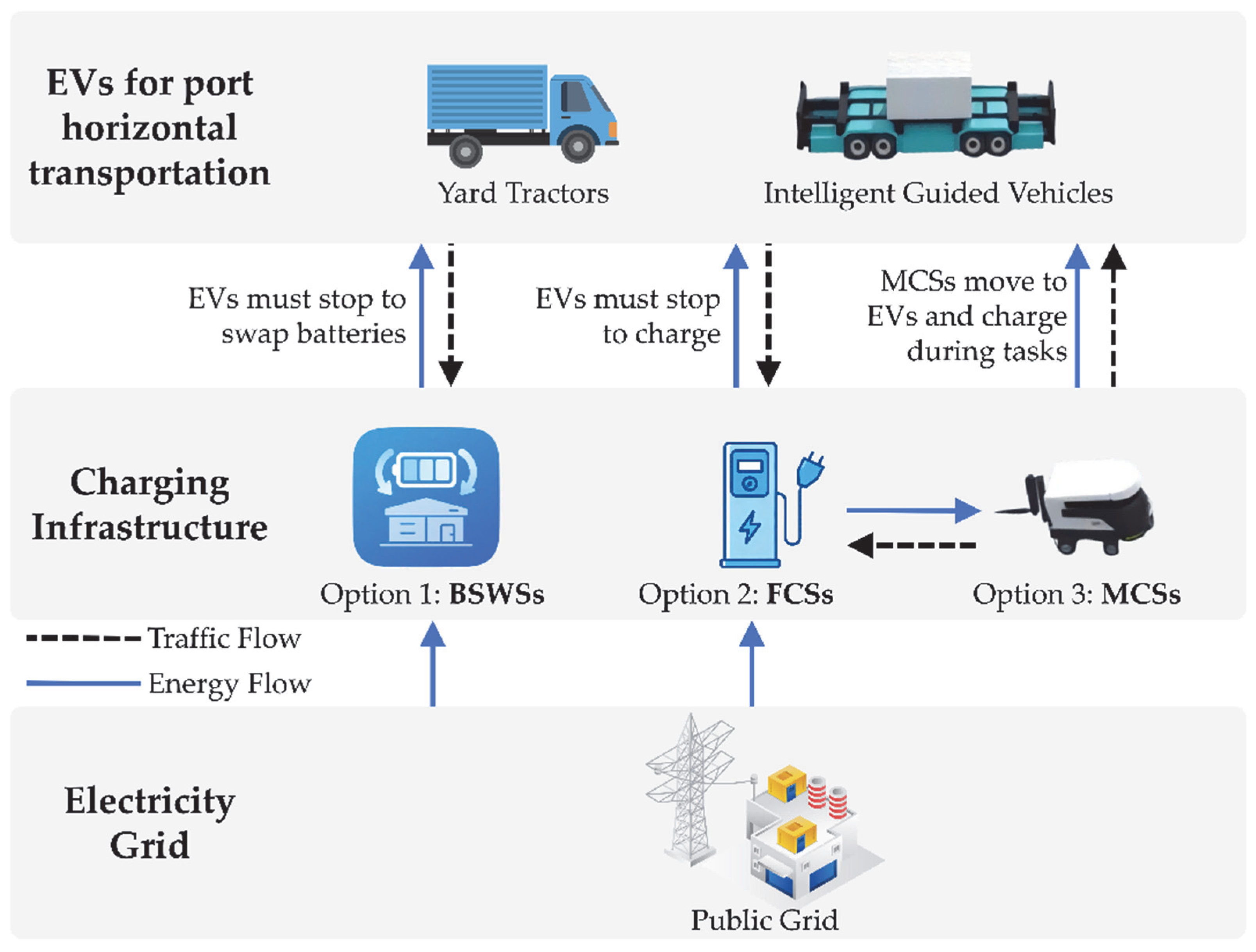
In contrast, Mobile Charging Stations (MCSs), typically trucks or vans equipped with energy storage systems, provide a flexible, on-site alternative [19]. As illustrated in Figure 1, conventional systems, i.e., Option 1 (BSWSs) and Option 2 (FCSs), require EVs to stop for battery swapping or charging, whereas Option 3 (MCSs) enables on-site charging, reducing both idle time and dependence on fixed infrastructure. By charging IGVs directly at operation sites, MCSs reduce unproductive travel, enhance utilization, and mitigate both infrastructure and battery costs. Leijon et al. [20] highlight their benefits for congestion relief, infrastructure savings, and grid efficiency during peak demand. Optimized scheduling strategies, such as mixed-integer linear programming, can further enhance efficiency and reduce costs [21]. Integration of FCSs with MCSs through facility layout optimization increases service flexibility and coverage while reducing construction costs [22]. Optimized allocation of mobile and fixed stations has been shown to lower investment while improving service performance [23]. Collaborative charging strategies combining FCSs and MCSs reduce overall costs by 12.6% compared to FCSs alone and 14.9% compared to MCSs alone [24]. Moreover, MCSs can significantly decrease EV waiting times and enhance charging efficiency, particularly when optimized charging and discharging strategies are applied [25].
Nevertheless, most MCS research has focused on urban EV systems rather than ports. Port electrification still emphasizes shore power, FCSs, and BSWSs deployment, with MCSs treated mainly as backup or emergency support [24]. Although valued for mobility and demand responsiveness, ports follow predictable charging patterns that favor fixed infrastructure: truck-mounted mobile chargers are dispatched to fixed windows of morning and evening peaks [26], while optimal scheduling still allocates the bulk of charging power to permanent 11 kW AC posts rather than to vehicle-to-grid or mobile units [27]. Land scarcity further constrains the expansion of fixed charging, making MCSs advantageous for flexible siting [28]. Moreover, repetitive charging cycles suggest greater cost-effectiveness for MCSs in ports [23]. Charging interruptions can delay ships, increase reliance on fuel-based equipment, and intensify localized emissions, whereas MCSs provide responsive, low-emission solutions that support port-wide electrification.
In light of these challenges, an optimal port horizontal electrification system should aim to fulfill several integrated requirements: (1) seamless operational continuity with minimal charging-induced downtime; (2) grid-friendly integration to avoid peak load stress; (3) spatial and infrastructure efficiency to conserve scarce port land; (4) lifecycle economic viability competitive with conventional systems; and (5) flexibility to adapt to operational fluctuations. Achieving all these goals simultaneously is inherently challenging, as they often involve trade-offs.
To address these gaps and navigate the aforementioned trade-offs, this study develops a bi-objective optimization model that evaluates economic, land-use, and carbon-efficiency dimensions to maximize fleet utilization, reduce grid load, and align operations with sustainability goals.
The main contributions of this work are summarized as follows:
i.
A unified carbon-efficiency framework: We develop a novel bi-objective framework for directly comparing Mobile Charging Stations (MCSs), Fixed Charging Stations (FCSs), and Battery Swapping Stations (BSWSs). Unlike studies that evaluate these technologies in isolation, our model integrates both operational electricity use and embedded battery carbon emissions under a carbon-efficiency paradigm.
ii.
Operational realism with real-world validation: The model incorporates critical operational factors often overlooked in strategic planning, such as vehicle detours, non-operational mileage, and the reuse of crane idle time for charging. It is calibrated and validated using real-world data from Shenzhen Mawan Port, including vehicle routes, energy consumption, and task schedules.
iii.
Identification of a critical operational threshold: Our analysis reveals a key nonlinear threshold (0.5–0.75) in the reuse ratio, defining a shift from carbon-conserving to profit-maximizing regimes. This finding provides actionable insights for port operators to balance environmental and economic objectives.
iv.
Practical decision support for infrastructure planning: The framework generates deployable configurations and offers clear guidance for port planners to select among MCSs, FCSs, and BSWSs based on specific priorities, including carbon-profit trade-offs, land constraints, and achievable reuse levels.
The remainder of this paper is organized as follows. Section 2 (Materials and Methods) formulates the carbon-efficiency-centered bi-objective optimization model and details the key assumptions, parameters, and data sources. Section 3 (Results) presents the simulation outcomes, including the derived Pareto fronts and the comparative analysis of MCSs, FCSs, and BSWSs. Section 4 (Discussion) interprets the broader implications of the results, focusing on the critical reuse ratio threshold and its significance for operational strategy. Finally, Section 5 (Conclusions) summarizes the main findings and proposes directions for future research.

2. Materials and Methods

This section outlines the hybrid modeling framework, data sources, and simulation protocols employed to evaluate the carbon-efficient-driven performance of MCSs in port horizontal transportation systems. The methodology integrates operational efficiency, cost-effectiveness, and carbon-efficient metrics, building on empirical insights from prior research on MCSs [14].

2.1. MCSs Solution

To maintain continuous operations with minimal investment, the MCSs model is introduced as a more flexible alternative to FCSs and BSWSs. A MCS, typically a truck or van equipped with an energy storage system, offers a mobile, efficient solution for rapid charging of EVs, such as Intelligent Guided Vehicles (IGVs). MCSs can deliver charging services directly to EVs while they are in use. During idle times, such as when vehicles are queuing or waiting under cranes for container handling, the MCSs efficiently recharge the operating vehicles. Once a MCS’s battery is depleted, it autonomously returns to a fast-charging station to recharge itself.
To define the operational boundaries for uninterrupted horizontal transportation vehicle workflows, this study adopts the following simplifications: (1) Exogenous disturbances, including ad hoc tasks, equipment failures, and traffic congestion, are excluded to isolate charging system performance. (2) Vehicle energy consumption is modeled as a constant rate, independent of cargo weight variations. (3) Technical complexities in MCS–vehicle charging interfaces are abstracted to a fixed preparation time. (4) Additional assumptions include a stable grid power supply (i.e., port-wide power failures and backup systems are not modeled), instantaneous MCSs dispatch availability, negligible battery degradation, and uniform environmental conditions. (5) A charging efficiency of 95% is assumed for both φ fcs and φ mcs (see Table 1), based on typical industry standards for mobile charging systems, such as those described in Jahnes et al. [29], which reports a peak efficiency of 99.5% for a transformerless EV charger. This value is adjusted to account for operational conditions and energy losses during power conversion and transmission.

2.2. Data Sources

The data utilized in this study are derived from multiple sources, encompassing operational, technical, and carbon-efficient-related parameters. Operational data was obtained from real-world logistics operations at Shenzhen Mawan Port, including vehicle routes (with an average cycle range of 2.6 km), hourly energy consumption (ranging from 10 to 15 kWh per vehicle), and task schedules, which account for 24 h operations. Although the port operates 24 h per day, the model uses an average of 12 effective operational hours per day to account for variations in vehicle utilization, idle time, and lower nighttime activity. This averaged value ensures the model reflects typical daily energy consumption and charging demands. Empirical trials informed the technical parameters, including charging efficiencies (4 kWh/min for FCSs and 4 min for BSWSs), battery capacities (280 kWh for vehicles with FCSs and 210 kWh for BSWSs), and downtime intervals (e.g., 5 min for recharging preparation).
Finally, carbon-efficient metrics were sourced from industry reports and lifecycle assessments, covering the carbon intensity of battery production (55–77.4 CO2 eq/kWh) [31], safety risk indices (such as traffic accident rates near fixed stations), and governance costs (including infrastructure permits and grid upgrade expenses). The carbon emission price in this study is calculated using a baseline price of 100 CNY per ton, which is set with reference to the closing price of the Chinese national carbon market at the end of 2024 (97.49 CNY/ton) [30]. The port, as a nationwide carbon-emission control enterprise, adopts the electricity grid carbon emission factor of 0.57 kg CO2/kWh from the Chinese regional grid benchmark.
It is important to note that while the simulation model is based on real operational data from Shenzhen Mawan Port, including vehicle energy consumption, charging power, battery size, vehicle speed, and other operational parameters, cross-validation with actual MCS performance data was not conducted. This is because MCSs are not yet deployed in the port, and thus, real-world performance data for MCSs is unavailable. Future validation of the model will be possible once MCSs are operational at the port.
A number of technical and operational parameters in this model (e.g., charging power, energy consumption coefficients, as listed in Table 1) are based on commercially sensitive data that is not publicly disclosed by individual ports or equipment manufacturers. Therefore, all such values are set as estimated industry benchmarks, derived from a synthesis of typical technical specifications and operational patterns reported in the sector literature and industry analyses. These representative values are utilized to ensure the general applicability and reproducibility of the model’s scenario analysis.

2.3. Carbon-Efficient-Driven Multi-Objective Optimization Model

The Environment, Social, and Governance (ESG) performance evaluation of the port-level transportation system requires integrating these dimensions. However, the focus of this study is on quantifying the impact of MCSs on port operational efficiency and total life-cycle costs. The innovative mechanisms of MCSs, such as dynamic energy replenishment and flexible battery capacity configuration, directly influence environmental benefits (E) and economic feasibility. In contrast, social (S) and governance (G) indicators, such as health impacts and stakeholder engagement, rely on long-term operational data or policy frameworks, which fall beyond the scope of this empirical analysis. Accordingly, the Carbon-Efficient index system proposed in this study is based on a “dual-core” framework that integrates environmental and economic factors, as outlined below. The Carbon-MCS optimization model developed in this study includes two types of decision variables, two objective functions, and two types of constraints.

2.3.1. Carbon-Efficient Metrics

This study aims to minimize the carbon emissions (including non-operational transportation energy consumption and battery production-related pollution) and energy consumption:
i.
E1: Direct carbon emissions refer to physical emissions within a defined boundary, such as tailpipe emissions during vehicle operation or grid-based emissions during charging. For electric vehicles, this primarily involves emissions from electricity production during charging. Activity-Based Accounting is used to quantify CO2-equivalent emissions throughout the entire horizontal transportation process.
ii.
E2: Embedded carbon emissions include greenhouse gas emissions from battery production and recycling, covering indirect emissions from raw material extraction, manufacturing, transportation, and recycling processes.

2.3.2. Definition of Decision Variables

There are three continuous variables:
i.
Bev ∈ (0, 300]: Battery capacity for the operating EV fleet (e.g., 210 kWh for battery-swapped EVs, 280 kWh for charging EVs [16]). The battery capacity must meet the EV range requirements to ensure they can complete tasks between charging sessions. Increasing the battery capacity significantly raises vehicle acquisition costs, necessitating a balance between range requirements and cost considerations.
ii.
Pmcs ∈ [100, 600]: Charging power of the MCSs, in kilowatts (kW). Higher charging power can reduce charging time, improving equipment utilization and lowering operational costs. However, the purchase and operational expenses of high-power charging equipment are also higher.
iii.
Bmcs ∈ (0, 1500]: The battery capacity of one MCS (in kWh). The battery capacity must be sufficient to meet the operational range requirements of MCSs, ensuring they can charge EVs during their operation without needing to return to the FCSs for recharging.
Two discrete variables are defined:
i.
Nmcs ∈ R+: The quantity of MCSs deployed, which must be determined based on the port’s operational and charging demands. The quantity of MCSs should strike a balance among acquisition, operating, and land opportunity costs, while ensuring sufficient scheduling flexibility to adapt to dynamic changes in port operations.
ii.
Nev ∈ R+: The quantity of operating EVs. This refers to the total quantity of electric vehicles actively operating at the port. The quantity of EVs influences charging service demand and should be optimized to ensure sufficient charging capacity while minimizing idle time and improving operational efficiency across both EVs and MCSs.
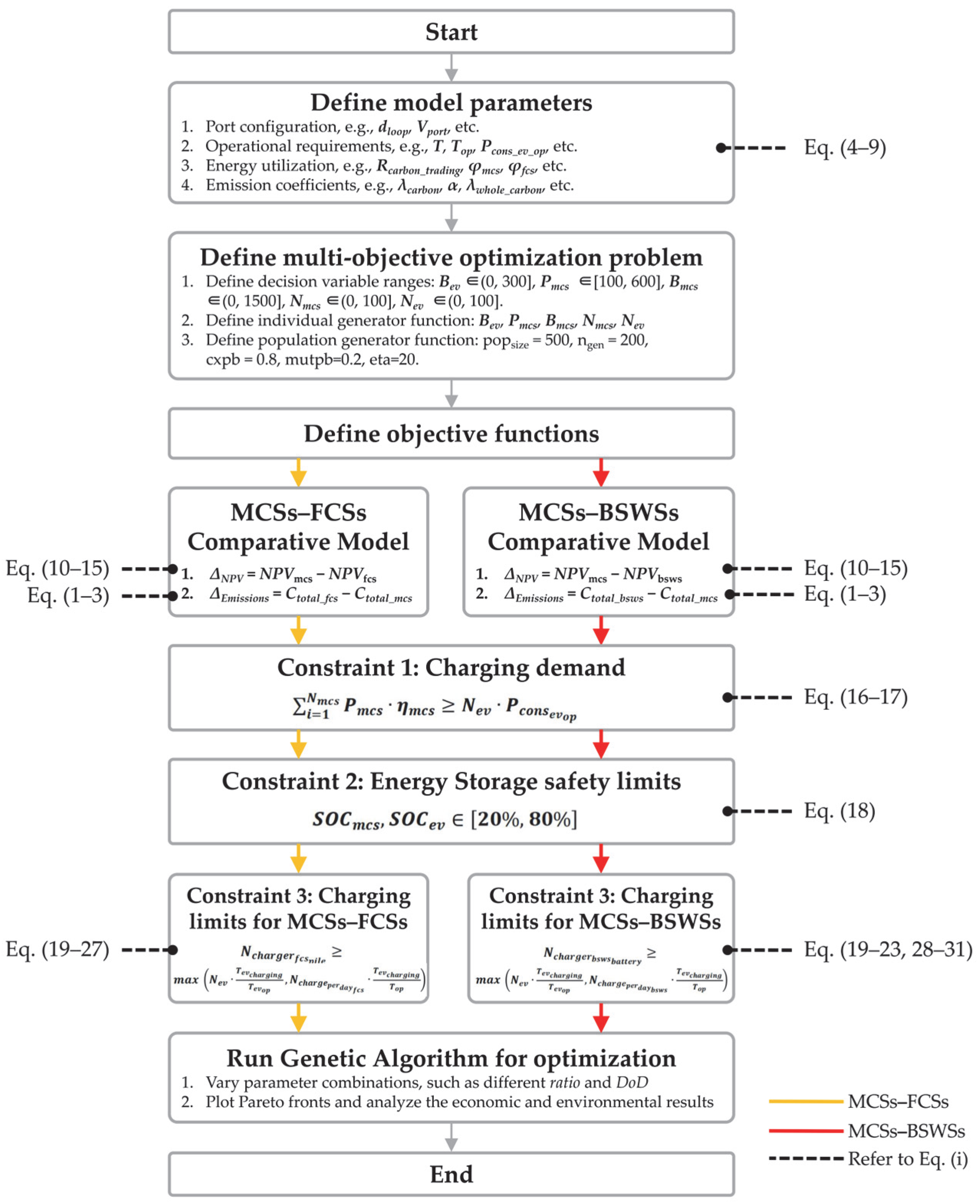
To better illustrate the logical relationships between these variables, the objectives, and the corresponding constraints, an integrated optimization framework is presented in Figure 2.

2.3.3. Objective Function Framework

i.
Environmental Objective Function (Minimizing Total Life-Cycle Carbon Emissions)
M i n   C t o t a l = i = 1 T ( E 1 ( i ) + α · E 2 ( i ) )
E 1 = ( N e v · B e v · S O C e v · T o p T e v o p + T e v e m p t y + T e v c h a r g i n g + N m c s · B m c s · S O C m c s · T o p T m c s o p + T m c s e m p t y + T m c s c h a r g i n g ) · λ c a r b o n
E 2 = N e v · B e v + N m c s · B m c s · λ w h o l e c a r b o n
T e v o p = B e v · S O C e v P c o n s e v o p
MCSs move to charge IGVs on-site, so we have
T e v e m p t y = d e m p t y V p o r t , f o r   F C S s / B S W S s   m o d e l 0 , f o r   M C S s   m o d e l
BSWSs have fixed swapping times, so we have
T e v c h a r g i n g = 4   min ,   f o r   B S W S s   m o d e l φ m c s · B e v · S O C e v P f c s ,   f o r   F C S s   m o d e l φ m c s · B e v · S O C e v P m c s ,   f o r   M C S s   m o d e l
For the MCSs model, the operation time, empty moving time, and charging time are as follows:
T m c s o p = φ m c s · B m c s · S O C m c s P m c s
T m c s e m p t y = d e m p t y V p o r t
T m c s c h a r g i n g = φ f c s · B m c s · S O C m c s P f c s
This framework aims to minimize the total carbon emissions by considering both direct emissions during vehicle operation (E1) and embedded emissions associated with battery production and lifecycle (E2).
ii.
Economic Objective Function to maximize Net Present Value (NPV)
To assess the economic sustainability of the MCSs solution, this study develops a dynamic programming model that integrates three key components: operational revenue (Rop), initial capital expenditure (CAPEX, which is the Ccap), and operational expenditure (OPEX, which is the Cop). The objective is to maximize the NPV over the system’s entire life cycle:
M a x   N P V = t = 1 T R o p C o p 1 + r t C c a p
where r is the discount rate (5%), it is used to calculate the present value of future cash flows, accounting for the time value of money in financial assessments and cost–benefit analyses.
The interplay of decision variables in the economic model is as follows:
i.
As the quantity of MCSs (Nmcs) increases, the acquisition cost (Ccap) rises linearly due to the higher quantity of units, while operational costs (Cop) may decrease. This is because more MCSs improve scheduling efficiency, reducing the frequency of individual MCS usage and maintenance costs.
ii.
As battery capacity (Bev) decreases, Ccap decreases due to lower battery capacity and thus lower initial costs. However, Cop may increase due to more frequent charging, leading to higher energy and maintenance costs.
iii.
As charging power (Pmcs) increases, Ccap may rise due to the higher expense of high-power charging equipment. However, Cop may decrease because the reduced charging time enhances equipment utilization.
Calculated based on port operations and transportation contracts. Assuming the revenue per twenty-foot equivalent unit (TEU) is Rteu, and the annual quantity of TEUs handled by the operating EV fleet is Nteu, transportation revenue is given by:
R o p = R t e u · N t e u + R c a r b o n
N t e u = 365 · d d a y d l o o p = 365 · T o p T e v o p + T e v e m p t y + T e v c h a r g i n g · N e v · B e v · S O C e v · V p o r t P c o n s e v o p d l o o p
The reduced carbon emissions can be monetized through carbon trading. The calculation formula is as follows:
R c a r b o n = C t o t a l f c s C t o t a l m c s · R c a r b o n t r a d i n g
In this study, the carbon emission quota is calculated using the FCSs scheme’s carbon emissions as the baseline (Ctotal_fcs). The deployment of MCSs can increase the utilization of electric vehicles, thereby improving port transport efficiency and growing revenue. Therefore, the quantity of MCSs (Nmcs) and charging power (Pmcs) influence the transportation revenue.
C c a p = N e v · C e v + N m c s · C m c s + N e v · B e v + N m c s · B m c s · C b a t t e r y + C c h a r g e r
Maintenance cost assessments for different charging solutions reveal significant variations. FCSs incur maintenance costs primarily from the wear and tear of charging equipment, stability checks of grid interfaces, and anti-corrosion treatments for fixed infrastructure. These stations have a low maintenance frequency but higher unit costs, especially for high-voltage equipment. BSWSs involve higher costs due to the wear and tear on robotic arms and conveyors, health management of spare batteries (including capacity balancing and thermal runaway protection), and maintenance of specialized storage environments. The technological complexity of these systems results in maintenance costs that are considerably higher than those of FCSs, particularly for updates to battery management systems. MCSs, on the other hand, face maintenance costs for vehicle components, such as tires and power systems; optimizing onboard energy storage systems for seismic resilience; and frequent wear on charging interfaces. While maintenance occurs more frequently, the cost per maintenance session tends to be lower, focusing primarily on routine vehicle upkeep.
C o p = β · C c a p
where β is the weighting coefficient, reflecting the maintenance costs differentiated across charging modalities, with FCSs, BSWSs, and MCSs assigned annual coefficients of 5%, 8%, and 6% of infrastructure investment, respectively. These values are assumed based on expected differences in maintenance complexity and operational requirements for each system.

2.3.4. Normalization of Output Metrics

In order to facilitate fair and transparent comparison between different configurations (MCSs, FCSs, BSWSs), the output metrics—specifically Net Present Value (NPV) and carbon emissions—are normalized based on the total TEU handling capacity. This ensures that the performance of each configuration is assessed on a per-unit basis (per TEU), allowing for more meaningful comparisons in large-scale port operations.
i.
Normalized NPV: This is computed by dividing the NPV by the total TEU throughput, yielding a normalized value that reflects the economic efficiency per unit of cargo handled.
ii.
Normalized Carbon Emissions: Similarly, carbon emissions are normalized by dividing total emissions by the total TEU throughput, enabling a fair comparison of carbon efficiency across different system configurations.
By normalizing these metrics, the study can objectively compare the trade-offs between environmental and economic performance in a consistent manner.

2.3.5. Constraints Decomposition

The model includes three types of physical and operational constraints to ensure the feasibility of the solution.
i.
Satisfying Charging Demand
i = 1 N m c s P m c s · η m c s N e v · P c o n s e v o p
where ηmcs represents the proportion of the total output power of MCSs that can cover the real-time charging power demand, i.e., the proportion of the MCSs’ own operational time.
η m c s = T m c s o p T m c s o p + T m c s e m p t y + T m c s c h a r g i n g
ii.
Satisfying Energy Storage Safety Limits
S O C m c s ,   S O C e v 20 % ,   80 %
SOCmcs and SOCev are the state of charge (SOC) of MCSs/EVs batteries, constrained to 20–80% to prevent deep discharge or overcharging. According to [32], adjusting the charging strategy, such as avoiding overcharging (limiting SOC below 80%) and preventing overdischarge (keeping SOC above 20%), can significantly reduce battery degradation.
iii.
Satisfying Charging Pile and Battery Capacity Limits
To achieve the rational allocation of charging infrastructure, the model introduces dual charging pile capacity constraints (Charging turnover rate constraint and Concurrent charging constraint) for the three types of solutions to ensure that the technical solution meets the physical limitations of actual operation: (1) Charging pile/battery turnover rate constraint (Strong constraint, severe penalty): The charging capacity must meet the daily maximum charging demand, with consideration given to redundancy design (redundancy coefficient 10%). (2) Concurrent charging constraint (Weak constraint, low penalty): To avoid charging queue congestion, the quantity of simultaneous charging devices during peak periods must not exceed the available charging pile capacity.
i.
For the MCSs solution
The operational energy consumption of EVs, Pcons_ev_op_mcs, is scaled from the baseline consumption Pcons_ev_op by a comparative ratio λ1 (Equation (19)).
P c o n s e v o p m c s = P c o n s e v o p · λ 1
In Equation (19), λ1 is assumed to be 0.9, reflecting the operational energy consumption reduction due to the lighter vehicle mass in the MCSs configuration. This value is a simplifying assumption based on the relationship between vehicle weight and energy consumption, and it approximates a 10% reduction in energy consumption compared to FCSs and BSWSs. In Equation (20), the ‘np.ceil’ function rounds up to the nearest integer, ensuring the calculated quantity of daily charges is sufficient for operations.
T c y c l e m c s = B e v · S O C e v P c o n s e v o p m c s
N c h a r g e p e r d a y m c s = n p . c e i l T o p T c y c l e m c s
N c h a r g e r m c s p i l e 1 + 10 % · N m c s · N c h a r g e p e r d a y m c s 24 B m c s · S O C m c s P f c s
N c h a r g e r m c s p i l e m a x   N m c s · T m c s c h a r g i n g T m c s o p , N c h a r g e p e r d a y m c s · T m c s c h a r g i n g T o p
ii.
For the FCSs charging pile:
T c y c l e f c s = B e v f c s · S O C e v P c o n s e v o p
N c h a r g e p e r d a y f c s = n p . c e i l T o p T c y c l e f c s
N c h a r g e r f c s p i l e 1 + 10 % · N e v · N c h a r g e p e r d a y f c s 24 B e v f c s · S O C e v P f c s
N c h a r g e r f c s p i l e m a x   N e v · T e v c h a r g i n g T e v o p , N c h a r g e p e r d a y f c s · T e v c h a r g i n g T o p
iii.
For the BSWSs Charging Battery:
T c y c l e b s w s = B e v b s w s · S O C e v P c o n s e v o p
N c h a r g e p e r d a y b s w s = n p . c e i l T o p T c y c l e b s w s
N c h a r g e r b s w s b a t t e r y 1 + 10 % · N e v · N c h a r g e p e r d a y b s w s 24 B e v b s w s · S O C e v P b s w s
Pbsws is the charging power provided by BSWSs to EVs, which is the same value as Pfcs.
N c h a r g e r b s w s b a t t e r y m a x   N e v · T e v c h a r g i n g T e v o p , N c h a r g e p e r d a y b s w s · T e v c h a r g i n g T o p
For the bi-objective optimization problem, the Non-dominated Sorting Genetic Algorithm II (NSGA-II) performs exceptionally well. Wietheger et al. [33] demonstrate its effectiveness in solving bi-objective problems, while Rahimi et al. [34] highlight its strong performance in multi-objective scheduling tasks, including production and personnel scheduling. Therefore, this model framework employs NSGA-II to efficiently solve the bi-objective optimization problem.

2.4. Model Solution Process

The solution process for the model involves several key steps to efficiently optimize both economic and environmental objectives. Initially, the relevant parameters, such as vehicle operational characteristics, charging station capacities, and emission factors, are defined. Next, NSGA-II is employed to solve the bi-objective optimization problem. This algorithm iteratively evaluates potential solutions, ranks them based on Pareto dominance, and selects the best trade-offs between carbon emissions and NPV. The process is repeated across multiple generations, with the algorithm refining the solutions until the Pareto fronts are fully optimized. The result is a set of Pareto-optimal solutions that balance the trade-off between environmental impact and economic viability, enabling informed decision-making regarding the deployment of mobile charging stations.
The framework operates through two distinct comparative models:
i.
MCSs–FCSs Comparative Model: Evaluates MCSs against FCSs by calculating the relative Net Present Value (ΔNPV = NPVmcsNPVfcs) and carbon emission differentials (ΔEmissions = Ctotal_fcsCtotal_mcs);
ii.
MCSs–BSWSs Comparative Model: Assesses MCSs’ performance relative to BSWSs through analogous relative metrics (ΔNPV = NPVmcsNPVbsws; ΔEmissions = Ctotal_bswsCtotal_mcs).
Initially, the relevant parameters are defined through scenario-specific configurations:
i.
For MCSs–FCSs comparisons: Vehicle dwell time patterns, fixed infrastructure CAPEX, and grid emission intensity;
ii.
For MCSs–BSWSs comparisons: Battery inventory costs, swapping time thresholds, and lithium-ion degradation factors.
The NSGA-II is then independently applied to both comparative models to solve their respective bi-objective optimization problems. This dual implementation enables parallel exploration of MCSs’ competitiveness relative to different baseline technologies. The algorithm iteratively evaluates potential solutions through three-phase optimization:
i.
Scenario Encoding: Generates population matrices representing charging station deployment schemes, with distinct gene structures for FCSs and BSWSs comparison scenarios;
ii.
Fitness Evaluation: Calculates ΔNPV using discounted cash flow analysis and ΔEmissions through life-cycle assessment (LCA) coefficients;
iii.
Constraint Handling: Applies dynamic penalty functions to maintain feasible solutions across both models’ operational constraints.
Dual Pareto fronts emerge from the optimization process: one quantifying the trade-offs between MCSs and FCSs, and another mapping the compromises between MCSs and BSWSs. The optimization employs the NSGA-II algorithm with a population size of 500 evolved over 200 generations. This study used simulated binary crossover with a probability of 0.8 and distribution index of 20.0, and polynomial mutation with a probability of 0.2, distribution index of 20.0, and independent mutation probability per attribute of 0.1. The evolutionary strategy follows the eaMuPlusLambda variant with μ = λ = 500. These parameter settings were determined through preliminary sensitivity analysis across adaptive crossover (0.6–0.9) and mutation rates (0.01–0.2) to maintain solution diversity and convergence. The models converge to optimized solution sets in which no objective (ΔNPV or ΔEmissions) can be improved without degrading the other.
To verify the stability of the optimization results, this study performed multiple independent runs of the NSGA-II algorithm with different random seeds. Across these runs, the overall shape, extent, and key trade-off characteristics of the obtained Pareto fronts were found to be consistent. While minor stochastic variations in the exact positioning of individual non-dominated solutions were observed, they did not alter the fundamental conclusions regarding the performance comparison of MCSs, FCSs, and BSWSs, or the identification of the critical reuse ratio threshold.
Cross-model validation is subsequently performed by comparing the relative positioning of MCSs in both Pareto spaces. This dual perspective enables a comprehensive assessment of MCSs deployment strategies across varying port operational paradigms, ultimately providing decision-makers with quantified evidence for technology selection based on specific environmental and economic priorities.

3. Results

The simulation results, derived from real-world operational data from Shenzhen Mawan Port, demonstrate the environmental and economic superiority of the MCSs system over FCSs and BSWSs. The ecological and economic performance of the MCSs system was evaluated under varying parameter combinations for both the MCSs–FCSs and MCSs–BSWSs comparative models. Key parameters, including the MCSs deployment ratio (ratio), MCSs unit cost (Cmcs), revenue per TEU (Rteu), and carbon trading price (Rcarbon_trading), were systematically adjusted to assess their impacts on carbon emissions and net present value (NPV). Key findings are summarized below, supported by quantitative analysis and verification of Pareto optimality.

3.1. For the MCSs–FCSs Model

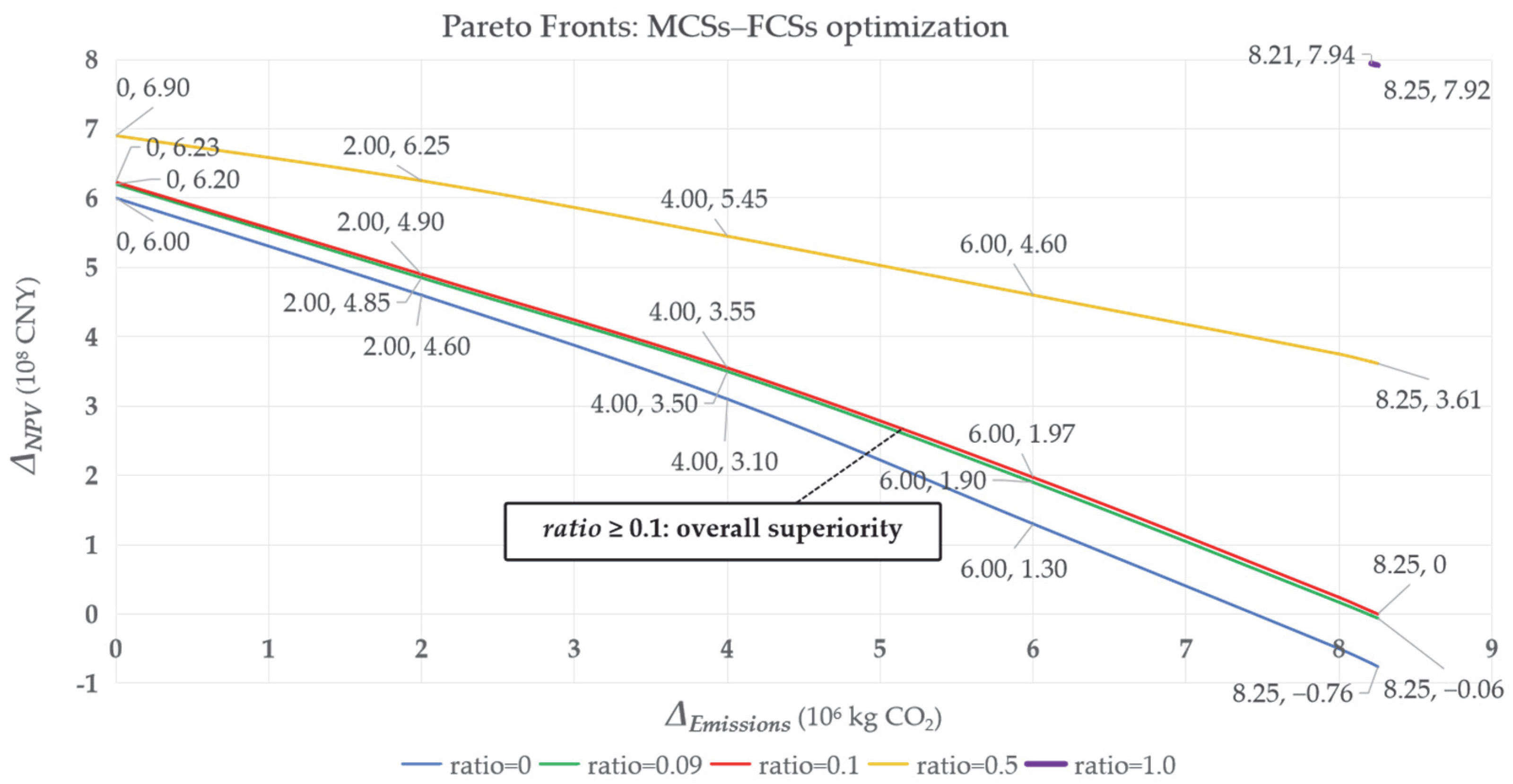
The shape of each front in Figure 3 is a downward-sloping trade-off between emissions and NPV. At low ratios (0–0.1), the front is long, allowing significant reductions in emissions at the expense of NPV. As the ratio increases, the front shifts upward (to a higher NPV for a given emission) and shortens. In particular, the ratio of 1.0 front collapses into a small set of high-NPV, high-emission points. This indicates that higher reuse tends to dominate lower-ratio solutions in a Pareto sense: for any given emission level within their overlap, a higher-ratio solution yields greater NPV. For example, at zero emissions, increasing the ratio from 0.1 to 0.5 raises the NPV from 6.6 × 10⁸ to 7.0 × 10⁸ CNY. Thus, the higher-ratio fronts enclose or outrank the lower ones in the trade-off space, except that full reuse yields no low-emission alternatives. In essence, increasing the ratio improves Pareto-optimal NPV across the board, demonstrating a substantial efficiency gain at the cost of higher emissions.
When the ratio is ≥10%, the optimal solution set for MCSs compared to the FCSs solution is positive in both NPV and carbon emission reduction, demonstrating overall superiority. Even when the ratio is zero (i.e., no reuse of queuing time for charging), most optimal MCSs solutions still show a positive NPV compared to the FCSs solution. This suggests that MCSs solution has a clear economic and carbon advantage.

3.2. For the MCSs–BSWSs Model

The simulation results are as follows:
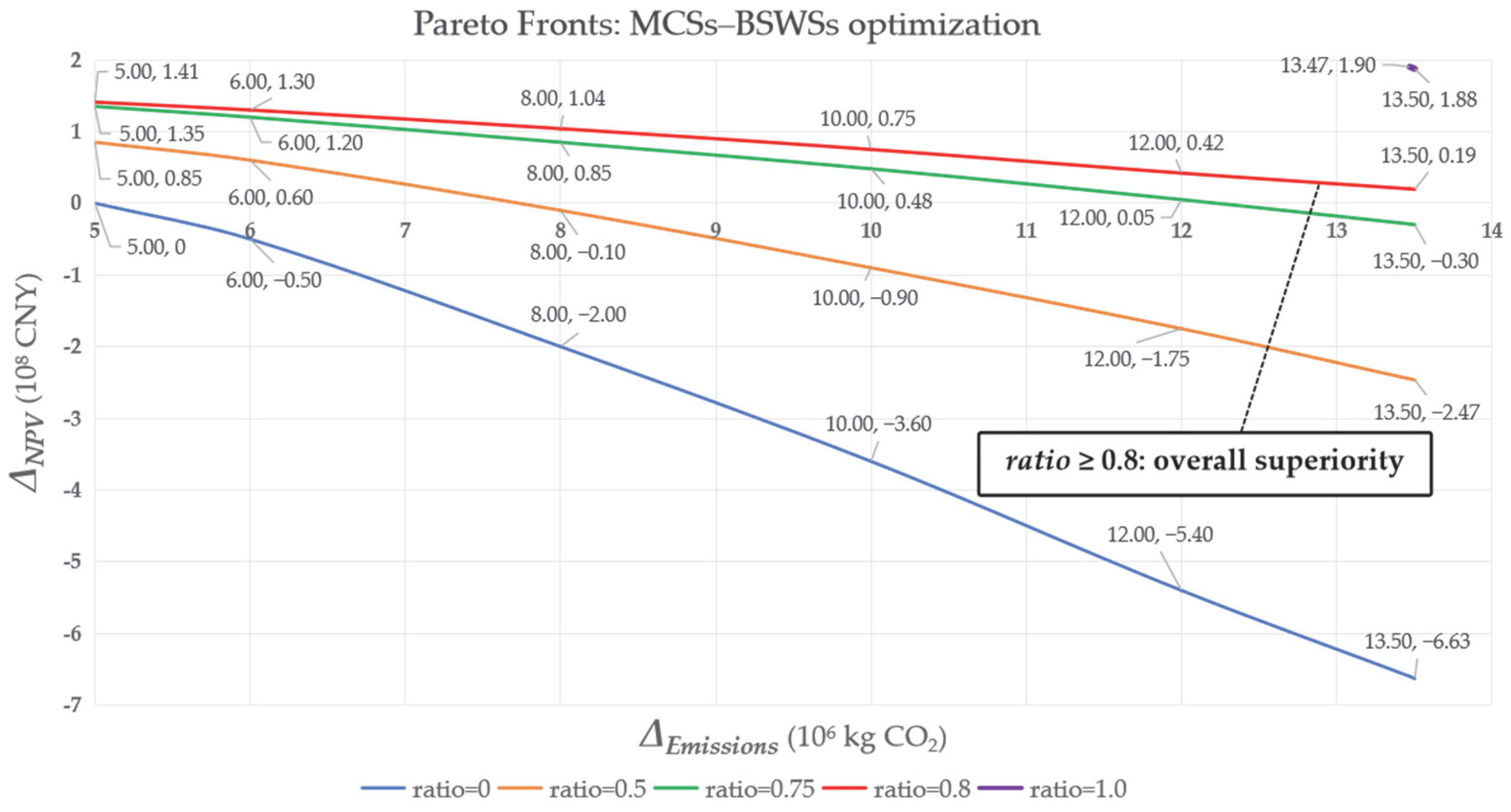
As shown in Figure 4, the BSWSs fronts depicted in Figure 4 exhibit a consistent decrease. The fronts for 0.75–0.8 enclose those for 0–0.5: at any fixed emissions level, the higher-ratio front attains a higher NPV. The 1.0 ratio case again forms a tight cluster of high-emission, high-NPV points, effectively eliminating the trade-off. The shapes are comparable, though the BSWSs’ fronts are steeper due to the smaller NPV range. Overall, in both models, the Pareto fronts for larger ratios consistently dominate those for smaller ratios, indicating that reusing idle time is Pareto-improving for the economic objective (given higher emissions).
When the ratio is 80% or higher, the optimal MCSs solution outperforms the BSWSs solution across both NPV and carbon emission reduction, indicating overall superiority. When the ratio is 0 (meaning no reuse of queuing time for charging), most optimal MCSs solutions, compared to the BSWSs solution, display negative NPVs, suggesting their profitability is relatively limited.

3.3. Normalized Output Metrics

To facilitate a fair and transparent comparison between different configurations (MCSs, FCSs, BSWSs), the output metrics—specifically Net Present Value (NPV) and carbon emissions—are normalized based on the total TEU handling capacity. This ensures that the performance of each configuration is assessed on a per-unit basis (per TEU), providing more meaningful comparisons in large-scale port operations (see Table 2). By normalizing these metrics, the study allows for an objective evaluation of the trade-offs between environmental and economic performance across different system configurations.
The analysis of the normalized outputs reveals distinct trade-off patterns. In the MCSs vs. FCSs comparison, a critical finding is that prioritizing the maximum decarbonization benefit (Max Normalized ΔEmissions) consistently yields a positive ΔNPV across all reuse levels (0.82 to 6.12 CNY/TEU). This indicates that the operational configuration which makes MCSs most superior to FCSs in emission reduction is also economically beneficial, presenting a strong case for synergistic environmental and economic gains. When prioritizing maximum economic performance (Max Normalized ΔNPV), MCSs maintain a decarbonization advantage (positive ΔEmissions) only at the highest reuse level (ratio = 1). At lower reuse levels, maximum economic gain involves a slight emission penalty versus FCSs, though the economic benefit remains substantial.
The MCSs vs. BSWSs comparison demonstrates that MCSs hold a consistent and significant decarbonization advantage, with all Max Normalized ΔEmissions values being strongly positive (~10.26–10.28 kg/TEU). However, achieving concurrent economic superiority is contingent upon the reuse level. A clear threshold exists between ratio 0.5 and 0.75. Below this threshold, the configuration yielding the greatest emission reduction results in a negative ΔNPV, indicating an economic trade-off. Above this threshold, specifically at ratio = 1, the system achieves solutions where both primary objectives are positively met (e.g., ΔEmissions = 10.27 kg/TEU, ΔNPV = 6.93 CNY/TEU), enabling MCSs to outperform BSWSs comprehensively.
To assess the robustness of the model and identify key leverage points, a sensitivity analysis was performed to evaluate the influence of key economic and policy parameters on the relative performance of MCSs. The analysis focused on the capital expenditure (Ccap), the daily operational time of EVs (Top), and the carbon trading price (Rcarbon_trading). The results, presented in Table 3, quantify the impact of a ±50% variation in each parameter on the normalized ΔNPV and ΔEmissions of MCSs relative to the FCS baseline.
The analysis reveals distinct response patterns. The model exhibits low sensitivity to the capital expenditure (Ccap). A substantial ±50% change in upfront costs results in minimal fluctuations (≤1%) in both economic and environmental performance metrics. This suggests that the long-term viability and competitive advantage of MCSs are not predominantly determined by the initial investment but are more dependent on operational factors.
Conversely, the system demonstrates moderate sensitivity to operational intensity and carbon policy. A 50% increase in daily EV operational time (Top) reduces the relative economic benefit (ΔNPV) of MCSs by 6.45% and slightly diminishes their emission advantage (ΔEmissions changes by +3.65%, indicating a reduction in the emission reduction benefit). This highlights that under extremely high utilization scenarios, the operational efficiency gains of MCSs may be partially offset. Most notably, the model is significantly responsive to the carbon trading price (Rcarbon_trading). A 50% increase in the carbon price enhances the relative economic attractiveness of MCSs (ΔNPV) by 6.05%, concurrently strengthening their emission reduction advantage (ΔEmissions increases by 3.65%). This symmetric response confirms that carbon pricing mechanisms effectively internalize the environmental benefit of MCSs, translating lower emissions directly into improved financial performance.
In summary, the normalized metrics and sensitivity analysis collectively demonstrate the context-dependent advantages of MCSs. Compared to FCSs, MCSs can achieve both decarbonization and economic gains, especially under configurations that prioritize emission reduction. Against BSWSs, MCSs consistently offer a definitive emissions reduction benefit, with economic competitiveness becoming robust once operational reuse efficiency exceeds a critical threshold. Furthermore, the economic-environmental performance of MCSs shows low sensitivity to capital cost variations but is significantly influenced by operational parameters and carbon pricing. These quantified insights provide a clear, scenario-aware evidence base for port infrastructure planning.

4. Discussion

The findings demonstrate that the reuse ratio of crane idle time emerges as a decisive factor shaping both environmental and economic outcomes of MCSs deployment. On the one hand, higher reuse consistently improves financial performance, particularly in the MCSs–FCSs model, where net present values are maximized under full utilization. On the other hand, the same strategy drives the systems into a high-emission regime, eliminating low-carbon alternatives and reducing operational flexibility. This dual effect highlights a fundamental trade-off: efficiency gains and profitability are achieved at the expense of sustainability. Moreover, the nonlinear response, where system performance changes little at low reuse ratios but shifts dramatically once reuse exceeds 50%, underscores the importance of careful calibration rather than simple reuse maximization.

4.1. Main Findings and Mechanism Explanation

Across both models (MCSs–FCSs and MCSs–BSWSs), a clear trade-off emerges between environmental and economic performance as the reuse ratio of crane idle time increases. On the ecological side, higher reuse ratios consistently increase total carbon emissions. For MCSs–FCSs, emissions range from 4.23 × 10⁶ kg CO2 at low reuse (0–0.1) to a uniform level of about 8.24 × 10⁶ kg CO2 at full reuse, eliminating low-emission solutions. A similar trend appears in MCSs–BSWSs: emissions increase from nearly zero to 1.10 × 10⁷ kg CO2 at low reuse, rising to approximately 1.38 × 10⁷ kg CO2 at full reuse. In both cases, greater reuse compresses the Pareto fronts into a high-emission region.
Economically, the opposite pattern holds. For MCSs–FCSs, NPV increases substantially with reuse: from a maximum of 6.60 × 10⁸ CNY at low ratios to 7.94 × 10⁸ CNY at full reuse. At the same time, the minimum attainable NPV also rises, indicating consistently more substantial returns. The MCSs–BSWSs model shows the same direction of change, though at much lower magnitudes: from 0.30 × 10⁸ CNY at a ratio of 0 to 1.88 × 10⁸ CNY at full reuse. The scale difference is striking: even with full reuse, BSWSs’ NPVs remain one order of magnitude smaller than FCSs-based outcomes.
Taken together, these findings indicate a fundamental mechanism: maximizing idle-time reuse drives the system toward uniformly higher emissions while yielding larger and more stable economic gains. Between the two designs, MCSs–FCSs is markedly more profitable than MCSs–BSWSs at comparable environmental cost. This trade-off motivates the sensitivity analysis that follows.
The binding constraints within the system shift distinctly with the reuse ratio. At low reuse ratios (e.g., <0.5), the limiting factor is the available charging time during vehicle queues, activating the charging demand coverage constraint. In this scenario, more MCS units or larger EV batteries are often needed to meet the charging demand. In contrast, at high reuse ratios (e.g., >0.75), the system becomes constrained by the MCS’s own energy supply. The battery capacity and charging power limits of the MCS become the bottleneck, as MCSs must frequently return for recharging, limiting their ability to continue servicing EVs despite the improved scheduling efficiency.

4.2. Sensitivity Analysis

4.2.1. Small vs. Large Changes

The Pareto fronts are largely insensitive to small changes in the ratio. In MCSs–FCSs, increasing the ratio from 0 to 0.10 scarcely alters the frontier: the three curves almost coincide, indicating that performance remains essentially unchanged until the ratio rises substantially. A similar pattern appears in MCSs–BSWSs: the fronts for ratios of 0 and 0.5 are still comparable. However, once the ratio crosses a threshold (0.5–0.75), the fronts shift noticeably upward.

4.2.2. Nonlinear Effect

The jump from medium ratios (0.5–0.8) to full reuse (1.0) is dramatic. The diversity of solutions collapses, and NPV peaks sharply. This suggests a diminishing sensitivity in the mid-range: most of the gain occurs after a certain point. Thus, the objectives exhibit a nonlinear response: small increases in reuse have little effect, but high reuse greatly improves NPV (and raises emissions). Decision-makers should note this threshold effect.
Cross-Model Comparison: Both models exhibit this sensitivity, where low ratios (0–0.1) and high ratios (0.5–1.0) produce two distinct regimes. However, MCSs–FCSs shows a larger absolute jump in NPV as the ratio increases. The BSWSs model exhibits a steady rise from 0.5 to 0.8, followed by a spike at 1.0. In summary, Pareto fronts are relatively stable at low reuse levels but become much more favorable (economically) once reuse exceeds 50–75%.

4.2.3. Depth-of-Discharge (DoD) Sensitivity

To assess the robustness of MCSs’ performance, a sensitivity analysis was conducted by varying the allowable Depth-of-Discharge (DoD) from 40% to 60%. This analysis examines how DoD influences the relative economic and environmental advantages of MCSs over FCSs and BSWSs under five reuse-ratio scenarios (0, 0.25, 0.5, 0.75, and 1). Results are summarized in Table 4 and Table 5.
In the MCSs–FCSs comparison (shown in Table 4), increasing DoD from 40% to 60% has mixed effects on ΔNPV. At lower ratios (0, 0.25), ΔNPV fluctuates, while at higher ratios (0.5, 0.75, 1), ΔNPV increases, especially at ratio = 1.0 (7.54 × 10⁸ to 7.94 × 10⁸ CNY, a 5.3% improvement). In contrast, ΔEmissions consistently increase with higher DoD values. For example, at ratio = 0.5, emissions rise from 4.00 × 10⁶ kg (DoD = 40%) to 4.30 × 10⁶ kg (DoD = 60%), indicating a 7.5% increase.
In the MCSs–BSWSs comparison (shown in Table 5), a clear inverse relationship is seen between DoD and ΔNPV. As DoD increases, ΔNPV decreases, with a 52% drop at ratio = 0.5 (from 2.14 × 10⁸ to 1.03 × 10⁸ CNY). However, it is important to note that while ΔNPV does decrease, MCSs still outperform BSWSs economically at all DoD levels, but the magnitude of this advantage narrows as DoD increases. For instance, at ratio = 0, emissions rise from 8.00 × 10⁶ kg (DoD = 40%) to 9.30 × 10⁶ kg (DoD = 60%), reflecting a 16% increase, indicating that deeper discharge cycles impact environmental outcomes more strongly than economic ones in this scenario.
The negative impacts of higher DoD are partially mitigated by increasing reuse ratios. For instance, in the MCSs–BSWSs model, at DoD = 60%, increasing the ratio from 0 to 1.0 improves ΔNPV from 0.30 × 10⁸ CNY to 1.88 × 10⁸ CNY, demonstrating that optimal time utilization can compensate for the negative economic effects of deeper discharge cycles.
This analysis suggests that the optimal DoD setting depends on the specific context and objectives. In the MCSs–FCSs context, DoD = 60% generally improves both economic and environmental outcomes, particularly at higher reuse ratios. In contrast, in the MCSs–BSWSs context, lower DoD values (40–50%) tend to favor economic performance (ΔNPV), while DoD = 60% may be acceptable when the priority is carbon reduction (ΔEmissions), although it results in a decrease in economic advantage.
Overall, this sensitivity analysis highlights the importance of considering both economic and environmental trade-offs when selecting DoD values, as well as the role of higher reuse ratios in mitigating some of the economic impacts associated with deeper discharge cycles.

4.3. Limitations and Social-Governance Aspects

This study focused on the environmental and economic dimensions of port electrification, establishing a carbon-efficiency trade-off framework. A recognized limitation is the exclusion of social (S) and governance (G) assessments from the ESG triad, due to current data and modeling scope constraints. A qualitative consideration of these dimensions suggests potential influences on our findings:

4.3.1. Social (S) Factors

Social factors, such as the health benefits from reduced local emissions and improved worker safety, could be monetized as positive externalities. If incorporated, they would enhance the economic attractiveness of low-carbon MCSs solutions, potentially shifting the Pareto frontier in their favor.

4.3.2. Governance (G) Factors

Governance factors, such as stakeholder coordination costs and new regulatory compliance, could introduce additional implementation burdens. Internalizing these costs may marginally increase the upfront cost of MCSs adoption, possibly affecting short-term technology choices.
While these S&G factors could modulate the precise position of the critical reuse ratio threshold identified in this study, the fundamental trade-off structure remains robust. Future research should aim to integrate quantified S&G indicators to provide a holistic sustainability assessment of port electrification pathways.

5. Conclusions

This study proposes a unified bi-objective framework that compares MCSs, FCSs, and BSWSs under a carbon-efficient recharging paradigm, integrating operational electricity and embedded battery emissions with NPV within a single port-specific decision system. The analysis shows that MCSs outperform FCSs once idle-time reuse is available and rises quickly with higher reuse; against BSWSs, MCSs deliver conditional advantages that emerge only at sufficiently high reuse. A salient, nonlinear threshold around reuse 0.5–0.75 shifts the system from carbon-conserving to profit-maximizing regimes, where low-emission solutions rapidly disappear, revealing an intrinsic efficiency-carbon trade-off that should be tuned rather than maximized.
Furthermore, the sensitivity analysis underscores that key parameters like the Depth-of-Discharge (DoD) introduce additional trade-offs, emphasizing the need for context-specific calibration of operational strategies.
To provide actionable decision rules for port authorities, this study defines the reuse ratio thresholds at which MCSs deliver superior performance on both economic (ΔNPV > 0) and environmental (ΔEmissions > 0) fronts compared to baseline solutions. Against FCSs, MCSs achieve dual-objective dominance at a reuse ratio of ≥10%. At and above this threshold, the Pareto-optimal solutions for MCSs yield both higher NPV and greater carbon reduction than FCSs. For instance, at a reuse ratio of 0.5, typical ΔNPV and ΔEmissions values are on the order of 7.0 × 10⁸ CNY and 4.0 × 10⁶ kg CO2, respectively (see Section 4.2.3). Against BSWSs, a higher reuse ratio of ≥80% is required for MCSs to dominate on both objectives. As the results indicate, beyond this point, MCSs outperform BSWSs in both net present value and emissions reduction. At a reuse ratio of 0.8, representative ΔNPV and ΔEmissions can reach ~2.5 × 10⁸ CNY and ~8.2 × 10⁶ kg CO2, respectively. These specific thresholds (10% and 80%) offer clear operational guidance: ports capable of reusing even a small fraction (≥10%) of crane idle time for charging should prefer MCSs over FCSs; to also surpass BSWSs, a greater commitment to operational integration (≥80% reuse) is needed.
In practice, our framework produces deployable configurations. It provides a clear basis for selecting among MCSs/FCSs/BSWSs based on priorities of carbon versus profit, land/grid constraints, and achievable reuse. It can be ported to other terminals to support transparent, carbon-informed electrification decisions.
To support the practical application and portability of this framework, it is important to acknowledge its principal abstractions, which include assuming a stable grid supply, simplified vehicle energy consumption profiles, and the exclusion of stochastic operational disturbances. To rerun the NSGA-II optimization experiments for another port terminal and obtain site-specific insights, key inputs are required: (1) operational data (e.g., vehicle routes, speeds, task schedules, and effective daily hours); (2) technical parameters (e.g., EV energy consumption, available battery capacities, and charging efficiencies); and (3) local economic and environmental factors (e.g., equipment costs, electricity price, grid carbon factor, and carbon trading price). Providing these inputs enables the reproduction of the Pareto-front analysis and the generation of deployable configurations, thereby offering a transparent and adaptable decision-support tool for carbon-efficient electrification planning across diverse port environments.
Looking ahead, this research opens several pathways for extension. Future work could explore hybrid infrastructures that incorporate direct grid-connected charging systems (e.g., overhead catenaries or conductive rails), which theoretically enable in-motion or queue-time charging. Evaluating the trade-offs between such capital-intensive fixed infrastructures and the flexible MCSs solution presented here, particularly in terms of upfront investment, operational adaptability, and integration into existing port ecosystems, represents a critical next step for the field of port electrification.

Author Contributions

Conceptualization, J.Q. and W.Z.; methodology, J.Q. and M.L.; software, J.Q.; validation, J.Q., W.Z. and H.T.; formal analysis, J.Q. and M.L.; investigation, W.Z.; resources, J.Q. and W.H.; data curation, J.Q.; writing—original draft preparation, J.Q. and H.T.; writing—review and editing, J.Q., W.Z., H.T. and W.H.; visualization, J.Q. and M.L.; supervision, W.H.; project administration, W.H.; funding acquisition, W.H. All authors have read and agreed to the published version of the manuscript.

Funding

This work was supported by the Project of Hetao Shenzhen-Hong Kong Science and Technology Innovation Cooperation Zone (Grant No. HZQB-KCZYB-2020083). Support was also received from the Wilson Tang Brilliant Energy Science and Technology Lab at the Hong Kong University of Science and Technology (Guangzhou).

Data Availability Statement

The original contributions presented in this study are included in the article. Further inquiries can be directed to the corresponding author(s).

Conflicts of Interest

The authors declare no conflicts of interest.

References

  1. Williamsson, J.; Costa, N.; Santén, V.; Rogerson, S. Barriers and Drivers to the Implementation of Onshore Power Supply—A Literature Review. Sustainability 2022, 14, 6072. [Google Scholar] [CrossRef]
  2. Suvvala, J.; Kumar, K.S. Implementation of EFC Charging Station by Multiport Converter with Integration of RES. Energies 2023, 16, 1521. [Google Scholar] [CrossRef]
  3. Olivari, E.; Gurrì, S.; Caballini, C.; Carotta, T.; Chiara, B.D. Ports Go Green: A Cost-Energy Analysis Applied to a Case Study on Evaluating the Electrification of Yard Tractors. Open Transp. J. 2024, 18, e26671212308027. [Google Scholar] [CrossRef]
  4. Aoun, A.; Adda, M.; Ilinca, A.; Ghandour, M.; Ibrahim, H. Dynamic Charging Optimization Algorithm for Electric Vehicles to Mitigate Grid Power Peaks. World Electr. Veh. J. 2024, 15, 324. [Google Scholar] [CrossRef]
  5. Li, M.; Ruan, N.; Ma, J. Organizational Innovation of Chinese Universities of Applied Sciences in Less-Developed Regional Innovation Systems. Sustainability 2022, 14, 16198. [Google Scholar] [CrossRef]
  6. Cataldo-Díaz, C.; Linfati, R.; Escobar, J.W. Mathematical Model for the Electric Vehicle Routing Problem Considering the State of Charge of the Batteries. Sustainability 2022, 14, 1645. [Google Scholar] [CrossRef]
  7. Zhang, Y. Analysis of Battery Swapping Technology for Electric Vehicles—Using NIO’s Battery Swapping Technology as an Example. SHS Web Conf. 2022, 144, 02015. [Google Scholar] [CrossRef]
  8. Honma, Y.; Toriumi, S. Mathematical Analysis of Electric Vehicle Movement with Respect to Multiple Charging Stops. J. Energy Eng. 2017, 143, F4016007. [Google Scholar] [CrossRef]
  9. Han, H.; Chen, L.; Fang, S.; Liu, Y. The Routing Problem for Electric Truck with Partial Nonlinear Charging and Battery Swapping. Sustainability 2023, 15, 13752. [Google Scholar] [CrossRef]
  10. Sadati, M.E.H.; Akbari, V.; Çatay, B. Electric Vehicle Routing Problem with Flexible Deliveries. Int. J. Prod. Res. 2022, 60, 4268–4294. [Google Scholar] [CrossRef]
  11. Tarar, M.O.; Hassan, N.U.; Naqvi, I.H. On the Economic Feasibility of Battery Swapping Model for Rapid Transport Electrification. In Proceedings of the 2021 IEEE PES Innovative Smart Grid Technologies Europe (ISGT Europe), Espoo, Finland, 18–21 October 2021; pp. 1–5. [Google Scholar] [CrossRef]
  12. Patel, M.; Singh, R.; Arora, P.; Mahapatra, D. Assessment of Total Cost of Ownership for Electric Two-Wheelers with Point Charging and Battery Swapping in the Indian Scenario. In Proceedings of the 2022 International Conference and Utility Exhibition on Energy, Environment and Climate Change (ICUE), Pattaya, Thailand, 26–28 October 2022; pp. 1–6. [Google Scholar] [CrossRef]
  13. Zhang, F.; Yao, S.; Zeng, X.; Yang, P.; Zhao, Z.; Lai, C.S.; Lai, L.L. Operation Strategy for Electric Vehicle Battery Swap Station Cluster Participating in Frequency Regulation Service. Processes 2021, 9, 1513. [Google Scholar] [CrossRef]
  14. Cheng, Y.; Zhang, C. Configuration and Operation Combined Optimization for EV Battery Swapping Station Considering PV Consumption Bundling. Prot. Control. Mod. Power Syst. 2017, 2, 1–18. [Google Scholar] [CrossRef]
  15. Mak, H.-Y.; Rong, Y.; Shen, Z.-J.M. Infrastructure Planning for Electric Vehicles with Battery Swapping. Manag. Sci. 2013, 59, 1557–1575. [Google Scholar] [CrossRef]
  16. Qiu, J.; Han, W.; Tian, H.; Huang, J. Empirical Analysis of the Benefits of Intelligent Mobile Recharging Solution for Port Horizontal Transportation Vehicles. In Proceedings of the 2024 IEEE 8th Conference on Energy Internet and Energy System Integration (EI2), Shenyang, China, 29 November–2 December 2024; pp. 1646–1651. [Google Scholar] [CrossRef]
  17. Fang, L.; Hua, G. A Location-Sizing Model for Electric Vehicle Charging Station Deployment Based on Queuing Theory. In Proceedings of the 2015 International Conference on Logistics, Informatics and Service Sciences (LISS), Barcelona, Spain, 27–29 July 2015. [Google Scholar] [CrossRef]
  18. Shahriar, S.; Al-Ali, A.R.; Osman, A.H.; Dhou, S.; Nijim, M. Machine Learning Approaches for EV Charging Behavior: A Review. IEEE Access 2020, 8, 168980–168993. [Google Scholar] [CrossRef]
  19. Cho, S.; Lim, J.; Won, W.; Kim, J.; Ga, S. Design and Optimization of Energy Supplying System for Electric Vehicles by Mobile Charge Stations. J. Ind. Eng. Chem. 2024, 138, 481–491. [Google Scholar] [CrossRef]
  20. Leijon, J.; Boström, C. Charging Electric Vehicles Today and in the Future. World Electr. Veh. J. 2022, 13, 139. [Google Scholar] [CrossRef]
  21. Răboacă, M.-S.; Băncescu, I.; Preda, V.; Bizon, N. An Optimization Model for the Temporary Locations of Mobile Charging Stations. Mathematics 2020, 8, 453. [Google Scholar] [CrossRef]
  22. Wang, F.; Chen, R.; Miao, L.; Yang, P.; Ye, B. Location Optimization of Electric Vehicle Mobile Charging Stations Considering Multi-Period Stochastic User Equilibrium. Sustainability 2019, 11, 5841. [Google Scholar] [CrossRef]
  23. Hua, G.; Xu, Y. Optimal Deployment of Charging Stations and Movable Charging Vehicles for Electric Vehicles. J. Syst. Manag. Sci. 2019, 9, 105–116. [Google Scholar] [CrossRef]
  24. Luo, Q.; Ye, Z.; Jia, H. A Charging Planning Method for Shared Electric Vehicles with the Collaboration of Mobile and Fixed Facilities. Sustainability 2023, 15, 16107. [Google Scholar] [CrossRef]
  25. Aktar, A.K.; Tascikaraoglu, A.; Catalao, J.P.S. Optimal Charging and Discharging Operation of Mobile Charging Stations. In Proceedings of the 2022 International Conference on Smart Energy Systems and Technologies (SEST), Eindhoven, The Netherlands, 5–7 September 2022; pp. 1–6. [Google Scholar] [CrossRef]
  26. Jeon, S.; Choi, D.-H. Optimal Energy Management Framework for Truck-Mounted Mobile Charging Stations Considering Power Distribution System Operating Conditions. Sensors 2021, 21, 2798. [Google Scholar] [CrossRef] [PubMed]
  27. Jozwiak, D.; Pillai, J.R.; Ponnaganti, P.; Bak-Jensen, B.; Jantzen, J. Optimal Charging and Discharging Strategies for Electric Cars in PV-BESS-Based Marina Energy Systems. Electronics 2023, 12, 1033. [Google Scholar] [CrossRef]
  28. Huang, P.; Li, P. Politics of Urban Energy Transitions: New Energy Vehicle (NEV) Development in Shenzhen, China. Environ. Politics 2019, 29, 524–545. [Google Scholar] [CrossRef]
  29. Jahnes, M.; Zhou, L.; Preindl, M. Design of a 22-kW Transformerless EV Charger with V2G Capabilities and Peak 99.5% Efficiency. IEEE Trans. Ind. Electron. 2022, 69, 789–797. [Google Scholar] [CrossRef]
  30. National Carbon Market Trading Price Rises Steadily [N/OL]. China Energy News. 13 January 2025. Available online: http://paper.people.com.cn/zgnyb/pad/content/202501/13/content_30052542.html (accessed on 24 October 2025).
  31. Llamas-Orozco, J.A.; Meng, F.; Walker, G.S.; Abdul-Manan, A.F.N.; MacLean, H.L.; Daniel Posen, I.; McKechnie, J. Estimating the Environmental Impacts of Global Lithium-Ion Battery Supply Chain: A Temporal, Geographical, and Technological Perspective. PNAS Nexus 2023, 2, pgad361. [Google Scholar] [CrossRef]
  32. Rahman, T.; Alharbi, T. Exploring Lithium-Ion Battery Degradation: A Concise Review of Critical Factors, Impacts, Data-Driven Degradation Estimation Techniques, and Sustainable Directions for Energy Storage Systems. Batteries 2024, 10, 220. [Google Scholar] [CrossRef]
  33. Wietheger, S.; Doerr, B. A Mathematical Runtime Analysis of the Non-Dominated Sorting Genetic Algorithm III (NSGA-III). In Proceedings of the Genetic and Evolutionary Computation Conference Companion, Melbourne, Australia, 14–18 July 2024; pp. 63–64. [Google Scholar] [CrossRef]
  34. Rahimi, I.; Gandomi, A.H.; Deb, K.; Chen, F.; Nikoo, M.R. Scheduling by NSGA-II: Review and Bibliometric Analysis. Processes 2022, 10, 98. [Google Scholar] [CrossRef]
Figure 1. Traffic and Energy Flow in Port Horizontal Transportation under Different Charging Options.
Wevj 16 00681 g001
Figure 2. Schematic flow of the MCSs’ optimization model. Key formulas are embedded in the process boxes to illustrate the relationships between inputs, decision variables, constraints, and outputs. For full formulas and variable definitions, see Section 2.3.3.
Wevj 16 00681 g002
Figure 3. Simulation results for the MCSs–FCSs model with ratios from 0 to 1.
Wevj 16 00681 g003
Figure 4. Simulation results for the MCSs–BSWSs model with ratios from 0 to 1.
Wevj 16 00681 g004
Table 1. Variables and parameters with descriptions.
SymbolDescriptionUnitData Source/Value
αWeighting coefficient for carbon emissions /Equal-weight aggregation, α = 1 for simplicity (no separate weighting of direct/embedded emissions)
βWeighting coefficient for maintenance costs differentiated across charging modalities (FCSs, BSWSs, MCSs)/Assumed values based on operational complexity: 5% for FCSs, 8% for BSWSs, 6% for MCSs
BevBattery capacity for the operating EV fleetkWh280 for FCSs and 210 for BSWSs [16]
BmcsThe battery capacity of one MCSkWhDecision Variable (0–300)
CbatteryThe cost of battery acquisition per kWhCNY/kWh1000 [16]
CcapInitial acquisition cost (including MCSs, batteries, and charging equipment)CNYCalculated, Equation (14), using Nev, Cev, Nmcs, Cmcs, Bev, Bmcs, Cbattery, Ccharger
CchargerThe cost of the charging infrastructure for EVsCNY150,000 [16]
CevThe cost of one EV without batteryCNY550,000 (Based on typical market values for EVs in port operations)
CmcsThe cost of one MCS without battery CNY500,000 [16]
CopThe operational costs (including energy costs, maintenance fees, etc.)CNYCalculated, Equation (15), using β, Ccap
Ctotal_bswsThe total life-cycle carbon emissions of BSWSs solutionkg CO2Calculated, Equation (1), using T, E1, α, E2
Ctotal_fcsThe total life-cycle carbon emissions of FCSs solutionkg CO2Calculated, Equation (1), using T, E1, α, E2
Ctotal_mcsThe total life-cycle carbon emissions of MCSs solutionkg CO2Calculated, Equation (1), using T, E1, α, E2
ΔEmissionsDifference in total carbon emissions between MCS and BSWS/FCSkg CO2Calculated from Ctotal_bsws, Ctotal_fcs, Ctotal_mcs
ΔNPVRelative Net Present ValueCNYCalculated from NPVbsws, NPVfcs, NPVmcs
ddayThe total distance traveled by one EV during one operational daykmCalculated, Equation (12), using Top, Tev_op, Tev_empty, Tev_charging, Nev, Bev, SOCev, Vport, Pcons_ev_op
demptyRound-trip distance to charging station km2 [16]
dloopAverage distance for EVs to load/unload one TEUkm2 [16]
DoDDepth of Discharge (percentage of battery discharge)/Calculated, Equation (18), using SOCmcs, SOCev
E1Direct carbon emissionskg CO2Calculated, Equation (2), using Top, Nev, Pcons_ev_op, ɛev_op, Pcons_ev_empty, εev_empty, Nmcs, Pcons_mcs_op, εmcs_op, Pcons_mcs_empty, εmcs_empty, λcarbon
E2Embedded carbon emissions kg CO2Calculated, Equation (3), using Nev, Bev, Nmcs, Bmcs, λwhole_carbon
η mcsProportion of MCSs’ output covering charging demand/Calculated, Equation (17), using Tmcs_op, Tmcs_empty, Tmcs_charging
φ fcsCharging conversion efficiency of FCSs to EVs or MCSs /0.95 [29]
φ mcsCharging conversion efficiency of MCSs to EVs/0.95 [29]
λ1Comparative ratio for MCS energy consumption (see Equation (19))/0.9 (Assumed to reflect a ~10% reduction due to lighter vehicle mass)
λcarbonGrid carbon emission factorkg CO2/kWh0.57 kg CO2/kWh (Chinese regional grid benchmark)
λwhole_carbonLife-cycle carbon intensity of the battery kg CO2/kWh65 (based on industry reports and lifecycle assessments [29])
Ncharger_bsws_batteryThe quantity of BSWSs’ charging batteries/Calculated, Equation (30), using Nev, Ncharger_per_day_bsws, Bev, SOCev, Pbsws
Ncharger_fcs_pileThe quantity of FCSs’ charging piles/Calculated, Equations (26) and (27), using Nev, Ncharger_per_day_fcs, Bev, SOCev, Pfcs, Tev_charging, Tev_op, Top
Ncharger_mcs_pileThe quantity of MCSs’ charging piles/Calculated, Equations (22) and (23), using Nmcs, Ncharger_per_day_mcs, Bmcs, SOCmcs, Pfcs, Tmcs_charging, Tmcs_op, Top
Ncharger_per_day_bswsThe daily charging frequency of BSWSs/Calculated, Equation (29), using Top, Tcycle_bsws
Ncharger_per_day_fcsThe daily charging frequency of FCSs/Calculated, Equation (25), using Top, Tcycle_fcs
Ncharger_per_day_mcsThe daily charging frequency of MCSs/Calculated, Equation (21), using Top, Tcycle_mcs
NevThe quantity of operating EVs/Decision Variable (Nev ∈ R+)
NmcsThe quantity of MCSs deployed/Decision Variable (Nmcs ∈ R+)
NPVbswsNet Present Value of BSWSs solutionCNYCalculated, Equation (10), using T, Rop, Cop, r, Ccap
NPVfcsNet Present Value of FCSs solutionCNYCalculated, Equation (10), using T, Rop, Cop, r, Ccap
NPVmcsNet Present Value of MCSs solutionCNYCalculated, Equation (10), using T, Rop, Cop, r, Ccap
PbswsCharging power from BSWSs to EVskW200 (Estimated industry benchmark)
Pcons_ev_emptyDriving energy consumption coefficient of EVs under non-operationkW15 (Estimated industry benchmark)
Pcons_ev_opDriving energy consumption coefficient of EVs under operationkW30 (Estimated industry benchmark)
Pcons_ev_op_mcsOperative driving energy consumption coefficient of EVs (MCSs solution)kWCalculated, Equation (19), using Pcons_ev_op, λ1
PfcsCharging power supplied by FCSs to EVs or MCSskW200 (Estimated industry benchmark)
PmcsCharging power of the MCSskWDecision Variable (100–600)
rDiscount rate for NPV calculations/5% (Assumed for financial assessments)
ratioMCS deployment ratio (proportion of charging time during EVs’ waiting for quay and yard cranes)/Parameter for sensitivity analysis, tested in the range 0–1
RcarbonThe carbon emission benefit from carbon trading for port enterprisesCNYCalculated, Equation (13), using Ctotal_fcs, Ctotal_mcs, Rcarbon_trading
Rcarbon_tradingThe carbon emission priceCNY/ton100 (baseline carbon price assumed for the model; the official closing price on 31 December 2024 was 97.49 CNY/ton [30])
RopThe operational revenueCNYCalculated, Equation (12), using Rteu, Nteu, Rcarbon
RteuThe revenue per twenty-foot equivalent unit CNY/TEU20 (Estimated industry benchmark)
SOCevState of charge of EVs/Parameter for constraints in Equation (18)
SOCmcsState of charge of MCSs/Parameter for constraints in Equation (18)
TLifecycle duration (consistent with EVs’ service life and battery lifespan)year8 (Typical EV/battery service life)
Tcycle_bswsThe interval between single charges of BSWSshourCalculated, Equation (28), using Bev, SOCev, Pcons_ev_op
Tcycle_fcsThe interval between single charges of FCSshourCalculated, Equation (24), using Bev, SOCev, Pcons_ev_op
Tcycle_mcsThe interval between single charges of MCSshourCalculated, Equation (20), using Bev, SOCev, Pcons_ev_op_mcs
Tev_chargingCharging interval between successive EVs charging sessionshour Calculated ,   Equation   ( 6 ) ,   using   φ mcs, Bev, SOCev, Pfcs, Pmcs
Tev_emptyNon-operational interval between successive EVs charging sessionshourCalculated, Equation (5), using dempty, Vport
Tev_opOperational interval between successive EVs charging sessionshourCalculated, Equation (4), using Bev, SOCev, Pcons_ev_op
Tmcs_chargingCharging interval between successive MCSs charging sessionshour Calculated ,   Equation   ( 9 ) ,   using   φ fcs, Bmcs, SOCmcs, Pfcs
Tmcs_emptyNon-operational interval between successive MCSs charging sessionshourCalculated, Equation (8), using dempty, Vport
Tmcs_opOperational interval between successive MCSs charging sessionshour Calculated ,   Equation   ( 7 ) ,   using   φ mcs, Bmcs, SOCmcs, Pmcs
TopPort operation duration per dayhour12 (Estimated industry benchmark)
VportAverage vehicle speed in portkm/h15 [16]
Table 2. Normalized Results: MCSs–FCSs and MCSs–BSWSs.
System ComparisonratioMax Normalized ΔNPV (CNY/TEU)Corresponding
ΔEmissions (kg/TEU)
Max Normalized ΔEmissions (kg/TEU)Corresponding
ΔNPV (CNY/TEU)
MCSs vs. FCSs05.4440−0.08841.36250.9630
0.255.4456−0.08701.37830.8226
0.55.7380−0.08581.36992.6790
0.756.0083−0.07551.36254.5226
16.45921.34161.38336.1218
MCSs vs. BSWSs00.98893.600310.2675−26.2053
0.252.31523.622110.2621−17.8831
0.53.71493.615510.2765−9.7459
0.755.11603.608110.2557−1.2597
17.063910.252510.27186.9267
Table 3. Sensitivity analysis of Ccap Top and Rcarbon_trading for the MCSs–FCSs model.
ParameterSensitivity LevelNormalized ΔNPV (CNY/TEU)Normalized ΔEmissions (kg/TEU)
Ccap (+50%)Low impact−0.27%+0.43%
Ccap (−50%)Low impact+0.74%−0.03%
Top (+50%)Medium impact−6.45%+3.65%
Top (−50%)Medium impact+11.52%−9.49%
Rcarbon_trading (+50%)Medium impact+6.05%+3.65%
Rcarbon_trading (−50%)Medium impact−6.10%−4.58%
Table 4. Sensitivity analysis of DoD (40–60%) for the MCSs–FCSs model.
DoD (%)ratioΔNPV (×108 CNY)ΔEmissions (×106 kg)
4005.953.92
0.256.303.96
0.506.664.00
0.757.034.08
17.547.70
5005.204.15
0.255.564.19
0.505.924.21
0.756.294.25
16.818.02
6006.334.23
0.256.704.26
0.507.064.30
0.757.434.35
17.948.24
Table 5. Sensitivity analysis of DoD (40–60%) for the MCSs–BSWSs model.
DoD (%)ratioΔNPV (×108 CNY)ΔEmissions (×106 kg)
4001.408.00
0.251.778.03
0.502.148.18
0.752.508.20
13.0112.20
5000.858.75
0.251.238.77
0.501.588.80
0.751.958.92
12.4613.00
6000.309.30
0.250.669.31
0.501.039.32
0.751.399.40
11.8813.80
Disclaimer/Publisher’s Note: The statements, opinions and data contained in all publications are solely those of the individual author(s) and contributor(s) and not of MDPI and/or the editor(s). MDPI and/or the editor(s) disclaim responsibility for any injury to people or property resulting from any ideas, methods, instructions or products referred to in the content.