


Abstract
To address the challenges to driving stability caused by large-curvature steering of wire-controlled mining vehicles in narrow tunnels, a fused four-wheel steering (4WS) control strategy based on real-time estimation of vehicle state parameters is proposed. A comprehensive longitudinal–lateral–yaw dynamics model for 4WS is established, and a comparative study is conducted on three control methods: proportional feedforward control, yaw rate feedback control, and fused control. Expressions for steady-state yaw rate gain under different control modes are derived, and the stability differences in 4WS characteristics among these strategies are thoroughly analyzed. To overcome the difficulty in directly acquiring state information for chassis steering control, a vehicle state parameter estimator based on the unscented Kalman filter (UKF) is designed. To enhance the robustness to noise and computational real-time performance of vehicle state estimation in complex environments, a method for real-time estimation of noise covariance matrices using innovative sequences is adopted, improving the estimation accuracy of the algorithm. To validate the effectiveness of the control strategies, a co-simulation platform integrating Carsim and Matlab/Simulink is developed to simulate the performance of the three 4WS control methods under step steering and sinusoidal steering input conditions. The results show that, under low-speed conditions, 4WS strategies increase the yaw rate by approximately 50% and reduce the turning radius by over 45%, significantly enhancing steering maneuverability. Under medium-high speed conditions, 4WS strategies decrease the yaw rate by up to 68% and increase the turning radius by 17–29%, effectively suppressing oversteering tendencies to comprehensively improve stability, with the integrated control strategy demonstrating the best performance. Under both test conditions, the fused feedforward and feedback control strategy reduces the steady-state yaw rate by approximately 12.7% and 48.7%, respectively, compared to other control strategies, demonstrating superior stability.
1. Introduction
The technological intelligence of coal mines is the core technical support for the high-quality development of the coal industry, and underground trackless rubber wheeled vehicles are one of the key pieces of transportation equipment for underground coal mines. With the expansion of mining scale and the improvement of technology, the demand for them has been increasing year by year. However, due to various uncertain factors such as a harsh underground environment, low lighting, complex road conditions, and confined space operations in coal mines, the workload of drivers is high, which can easily lead to misjudgment and improper operation by drivers, leading to driving safety issues. Moreover, harsh environments such as darkness, humidity, harmful gases, and dust in mines pose a threat to drivers’ health, further leading to difficulties in recruiting workers. Therefore, the research on automated driving of mining auxiliary transport vehicles is of great significance in improving the safety of underground transportation in coal mines. X-by-wire chassis is an important carrier for autonomous driving of vehicles. By transmitting control commands through electronic signals, it achieves precise control of multiple wire-controlled subsystems such as chassis wire controlled steering, wire-controlled drive, and wire-controlled braking [1], fully leveraging the performance advantages of each wire-controlled subsystem, improving and enhancing the safety and stability of the vehicle during driving. Therefore, research on control methods for each wire-controlled subsystem of the X-by-wire chassis has become a current hot topic.
The technological intelligence of coal mines puts forward an urgent demand for the autonomous driving of auxiliary transportation vehicles, and the development of X-by-wire chassis technology has also provided the possibility to achieve this goal. Therefore, it is crucial to develop a specialized X-by-wire chassis technology that can adapt to the special operating environment of mines [2,3]. At the same time, regarding the practical problems of limited space and complex environment for auxiliary transportation operations in underground coal mines, the traditional front-wheel steering system has been exposed to have many limitations and shortcomings in dealing with flexible operations in complex terrains and confined spaces. Therefore, the X-by-wire chassis adopts a four-wheel steering mechanical architecture, and how to coordinate and control the front and rear dual axle four-wheel steering angles and improve the maneuverability and stability of the X-by-wire chassis have become key research areas [4].
Four-wheel steering (4WS) can reduce the turning radius of a vehicle and improve its maneuverability at low speeds. At high speeds, it can accelerate the vehicle’s yaw rate and lateral acceleration response, improving transient performance [5]. Nagia et al. found that 4WS not only improves a vehicle’s low-speed maneuverability and high-speed stability but also actively adjusts the load distribution between its inner and outer wheels, thereby enhancing active safety controls under extreme driving conditions [4]; Sano et al. proposed an open-loop proportional control strategy to achieve a steady-state sideslip angle of zero at the vehicle’s center of mass. However, this method is susceptible to external disturbances [6]. To mitigate the impact of external disturbances on the stability of 4WS control, Inoue et al. proposed a yaw rate feedback control strategy [7]. Building upon feedback control, researchers have proposed various 4WS control strategies, including Linear Quadratic Regulator (LQR) control [8] and variable-coefficient LQR [9,10,11] methods, among others.
In order to further improve the control performance of four-wheel steering, scholars have begun to adopt a feedforward and feedback control structure to improve the response speed, robustness, and anti-interference ability of the control.
The typical feedforward and feedback control concept is a combination of proportional feedforward control and yaw rate control [12]. Tian et al. developed a sliding mode feedback controller with model-following as the control objective, which significantly enhanced system robustness [13]; Ye et al. employed a robust H∞ control approach, which not only enhanced the disturbance rejection capability of the active 4WS system but also improved its active safety performance [14]. Zhang et al. applied an optimal control methodology to the active 4WS system, successfully eliminating oscillations and overshoot in the system response. This approach effectively improved the vehicle’s transient response while ensuring driving stability at high speeds, maneuverability at low speeds, and smoothness during cornering [15]. Yu et al. proposed an integrated control strategy combining feedforward control, linear–quadratic optimal control, and disturbance observers for active four-wheel steering (4WS) systems. This approach effectively compensates for uncertainties, including external disturbances and higher-order unmodeled dynamics [16].
The integrated control of 4WS requires real-time acquisition of vehicle state information, such as vehicle speed and yaw rate. However, due to the unique operational constraints of coal mine auxiliary transport vehicles working in underground environments—including the absence of GPS signals, complex road conditions, and low-speed heavy-load operations—it is challenging to directly obtain accurate vehicle state information through sensors for 4WS control. To address this challenge, estimation algorithms have been widely adopted, with the extended Kalman filter (EKF) and unscented Kalman filter (UKF) techniques being the most prevalent. These methods iteratively update the filter gain at each time step to approximate the true state parameter distribution [17]. To further enhance estimation accuracy and noise immunity, the development of adaptive Kalman filtering algorithms has emerged as the current mainstream approach. These methods dynamically adjust the noise covariance matrices to cope with time-varying or unknown sensor characteristics. For instance, in the closely related field of vehicle positioning, Park successfully applied an AUKF for sensor fusion between GPS and IMU, demonstrating high robustness against GPS signal outages by adaptively estimating the measurement noise covariance matrix in real time [18]. This approach effectively mitigates the limitation of standard UKF, whose performance may degrade under uncertain noise statistics. Inspired by these advancements, and to overcome the challenges of complex mining environments.
In recent years, besides the widely adopted Kalman filtering techniques, other advanced strategies have been developed for vehicle state and uncertainty estimation. These include model-based approaches such as sliding mode observers, which are known for their robustness against parameter variations and external disturbances. For instance, Acosta Lúa et al. proposed a nonlinear observer-based adaptive control scheme using high-order sliding mode estimators to achieve finite-time convergence in the presence of uncertainties. On the other hand, data-driven and model-free approaches leveraging artificial intelligence have also gained prominence [19]. Napolitano Dell’Annunziata et al. developed a dual-neural network architecture for real-time estimation of the sideslip angle and longitudinal velocity, demonstrating the effectiveness of machine learning in creating virtual sensors without relying on complex physical models [20]. These methods offer complementary advantages: while model-based observers provide theoretical guarantees under defined dynamics, data-driven approaches excel in handling nonlinearities and unmodeled effects through learning from experimental data.
Analysis of the literature reveals that there are relatively few studies on four-wheel steering (4WS) control for mining vehicles with by-wire chassis, and no systematic theoretical comparison or analysis has been conducted on control strategies such as proportional feedforward and feedback control. Meanwhile, in practice, the direct measurement of key state variables (e.g., vehicle sideslip angle) via sensors in 4WS feedback control is susceptible to interference from dust and vibration in mining environments, along with issues such as high cost and unstable accuracy.
In summary, this article proposes a comprehensive control strategy for four-wheel steering based on state estimation, using a comprehensive control method, to address the flexible and stable control problem of four-wheel steering in complex environments of mining X-by-wire chassis. Firstly, a dynamic model of four-wheel steering for mining X-by-wire chassis was established, and then the steady-state response characteristics under proportional feedforward control, yaw rate feedback control, and comprehensive control were compared and analyzed through theoretical derivation. To improve the anti-interference ability and computational real-time performance of vehicle state estimation in complex environments, an adaptive unscented Kalman filtering (AUKF) using minimum skewness simplex sampling strategy was proposed. Finally, a co-simulation platform integrating Carsim and Matlab/Simulink was established to verify the effectiveness of the comprehensive control strategy for four-wheel steering based on state estimation.
2. Dynamic Model of 4WS X-by-Wire Chassis
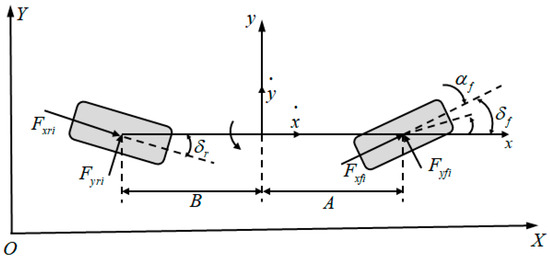
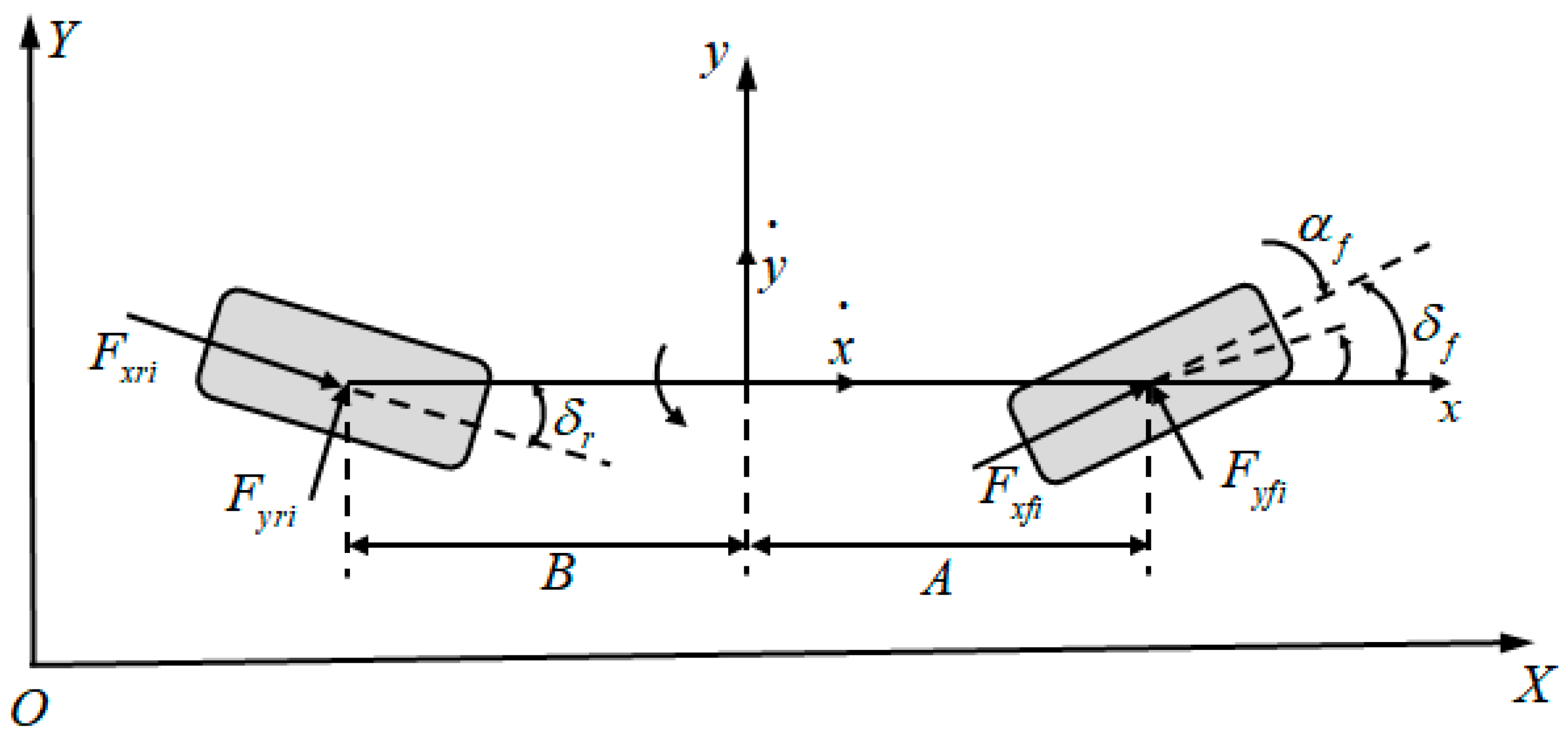
The working characteristics of mining X-by-wire chassis are low speed and heavy load, so the influence of aerodynamics can be ignored. In order to study and analyze the basic motion control characteristics of mining X-by-wire chassis, the premise of model simplification is to accurately characterize the dynamic steering characteristics of the X-by-wire chassis. The simplified four-wheel steering X-by-wire chassis dynamics model in this article is shown in Figure 1 and mainly considers the lateral- and yaw-direction motion states of the chassis.
Figure 1.
X-by-wire chassis dynamics model.
According to Newton’s law, a force analysis was conducted on the dynamic model in Figure 1 based on three degrees of freedom in the lateral, longitudinal, and lateral directions. The nonlinear three-degree of freedom model equation of the vehicle was obtained as follows:
Longitudinal dynamic equation:
Lateral dynamics equation:
Yaw dynamics equation:
where and represent the lateral force on the front and rear tires, respectively; ax and ay are the longitudinal acceleration and lateral acceleration of the chassis; wr is the chassis yaw rate feedback control; Iz is the rotational inertia of the vehicle around the Z-axis; tf is the track width; and are the tire angles of the front and rear wheels, respectively; and a and b are the distances from the center of mass of the chassis to the front and rear axles, respectively.
According to the coordinate system, the lateral deviation angles of the front and rear wheels can be expressed as follows:
where is the deviation angle of the center of mass, ; u and v represent the longitudinal and lateral speeds of the chassis, respectively.
Assuming that the tires are in a linear region and the sideslip angles of both the front and rear wheels are small, then the following are true:
where and are the lateral stiffnesses of the front and rear wheels.
According to , joint Equations (1)–(5), the differential equation of the 2-degree motion of the four-wheel steering X-by-wire chassis, can be expressed as
3. Four-Wheel Steering Control Strategy
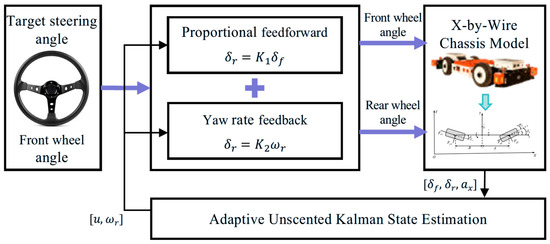
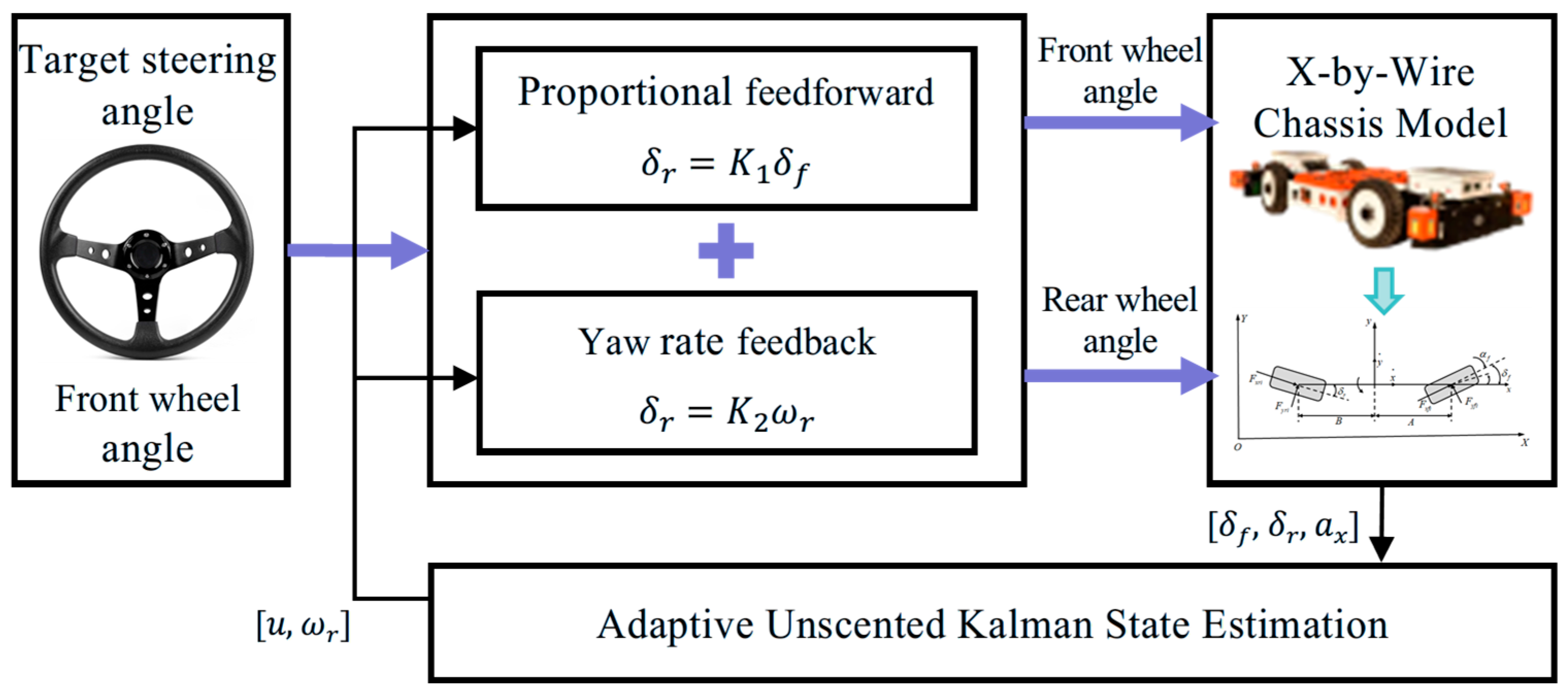
The research object of this article is the mining X-by-wire chassis, which has limited space in its working environment. Therefore, when designing the steering system, multiple considerations were taken into account. When the vehicle is running at low speeds, it needs to have a smaller steering transmission ratio to improve the steering sensitivity under low-speed conditions. When running at high speeds, it is necessary to increase the steering transmission ratio to improve the operational stability of the vehicle. After analyzing four-wheel steering control strategies of feedforward proportional control and yaw rate feedback control and considering their respective advantages and disadvantages, a comprehensive control strategy was proposed, as shown in Figure 2.
Figure 2.
Block diagram of a 4ws control system based on condition estimation.
3.1. Proportional Feedforward Control
Proportional control is a classic control strategy in four-wheel steering control, which means that, during the four-wheel steering control process, the front and rear vehicle corners should follow a proportional relationship, which can be expressed as follows:
where is the ratio coefficient of front- and rear-wheel steering. Substituting Equation (7) into Equation (6):
According to the literature [6], it can be seen that, when the four-wheel steering control takes a center of mass sideslip angle of zero as the control objective (β = 0), upon reaching steady-state steering conditions, the time derivatives of the states become zero (). By eliminating the variable from Equation (8), the value can be obtained from the vehicle dynamics model as follows:
where L is the wheelbase.
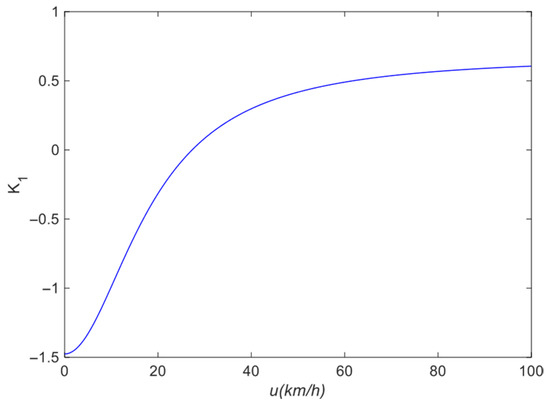
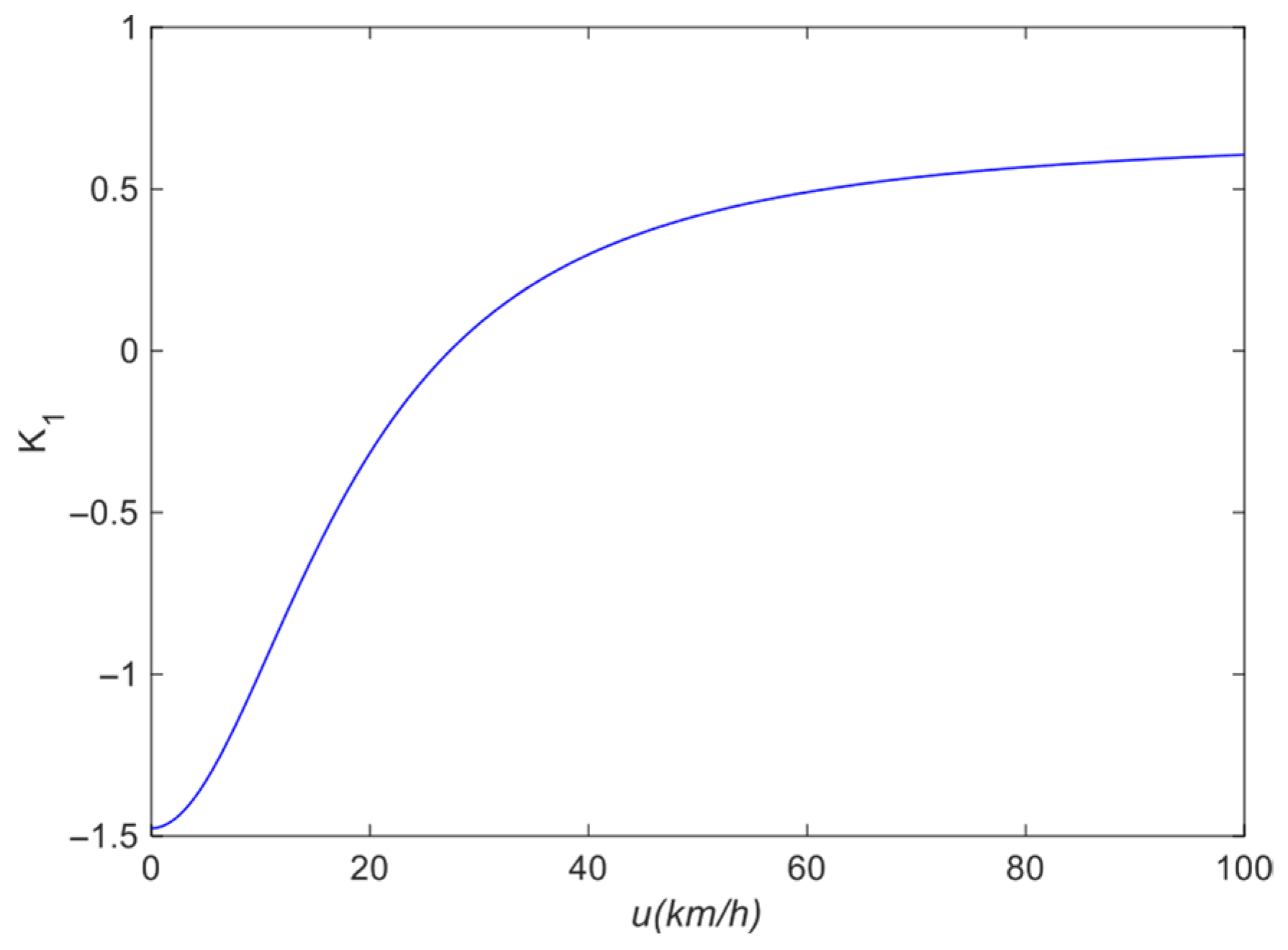
From Equation (9), it can be seen that the proportion coefficient under proportional control varies with the change in vehicle speed when the sideslip angle is zero, as shown in Figure 3.
Figure 3.
The scale factor varies with vehicle speed.
From Figure 3, it can be seen that the proportional control coefficient for achieving a sideslip angle of zero in the four-wheel steering process of the X-by-wire chassis varies at different vehicle speeds. As the vehicle speed increases, the proportional feedforward control coefficient tends to stabilize, infinitely approaching , which is 0.6774 in this paper. In the low speed range of 0–40 km/h, the feedforward proportional coefficient changes more significantly with the change in vehicle speed. The vehicle speed is , which is 27.3 km/h in this paper; the feedforward ratio coefficient = 0, and the rear-wheel angle is zero, that is, four-wheel steering degenerates into front-wheel steering. When the vehicle speed is below 27.3 km/h, takes a negative number, meaning that the front- and rear-wheel angles are at opposite directions. When the vehicle speed is above 27.3 km/h, takes a positive number, meaning that the front- and rear-wheel angles are in the same direction.
3.2. Yaw Rate Feedback Control
Yaw rate feedback control dynamically adjusts the rear-wheel angle based on the feedback of changes in yaw rate during vehicle operation to suppress drastic changes in yaw rate, thereby improving vehicle stability [7]. Therefore, the control amount of rear-wheel angle in feedback control is
where is the feedback control coefficient.
Under steady-state steering conditions, the lateral velocity and yaw rate are fixed values, ; the control target is still a center of mass sideslip angle of zero. The feedback control coefficient can be obtained as follows:
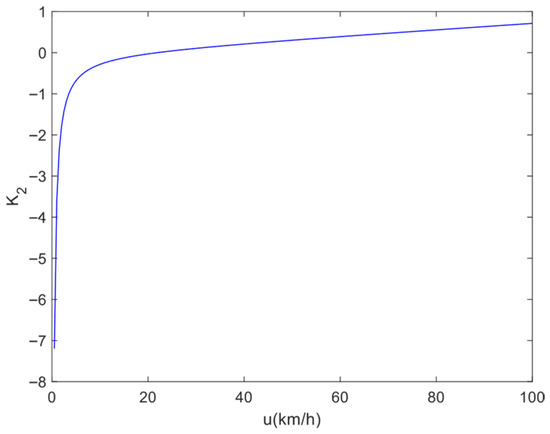
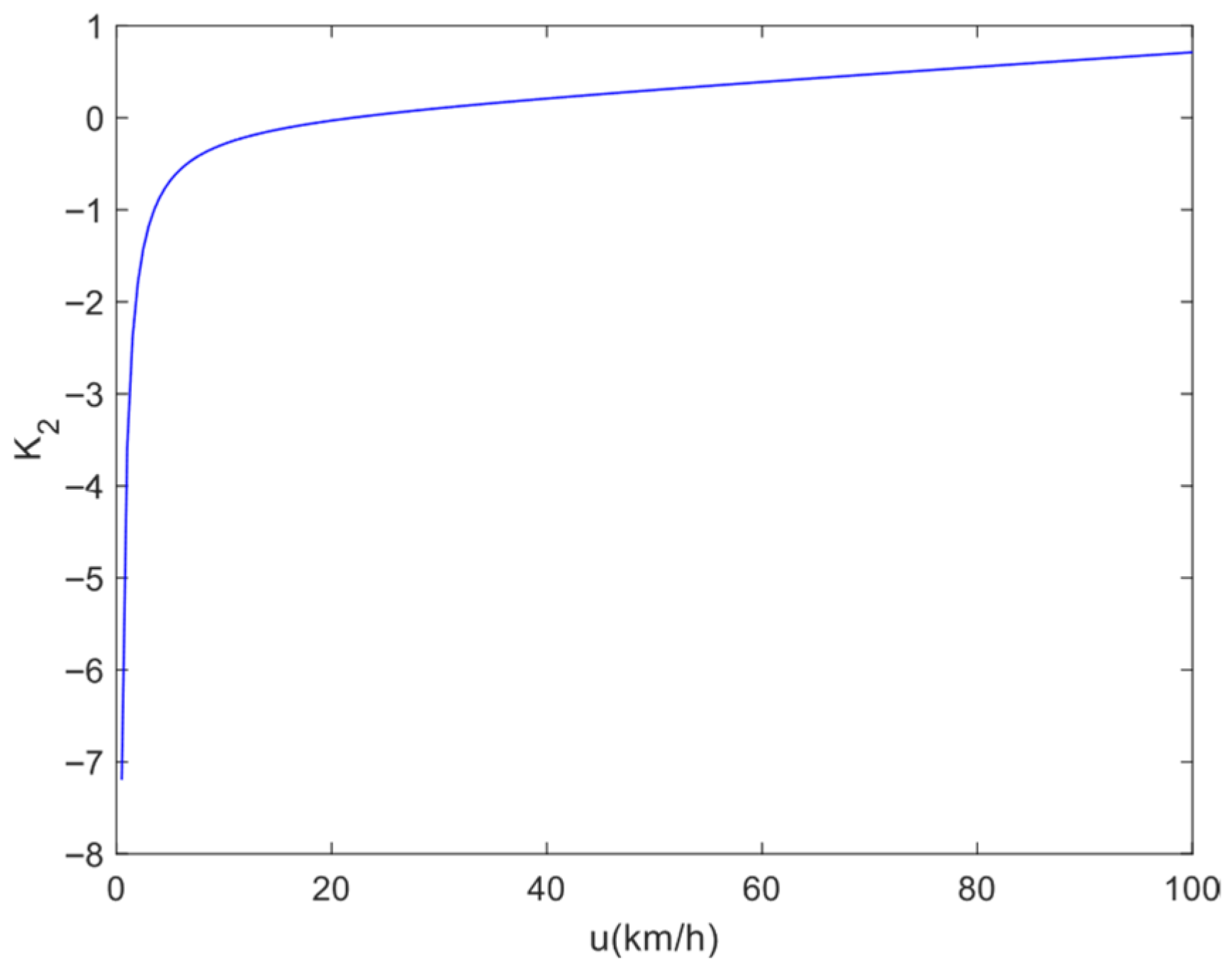
We drew the yaw rate feedback control gain variation curve under different vehicle speeds according to Equation (11), as shown in Figure 4.
Figure 4.
Feedback control coefficient with vehicle speed.
As shown in Figure 4, the feedback control gain coefficient monotonically increases with the increase in vehicle speed, and there is also a zero crossing point. Moreover, in the low-speed range, the feedback control gain coefficient changes rapidly with vehicle speed. When the vehicle speed is above 20 km/h, the gain coefficient shows an approximate linear relationship with the change in vehicle speed, and the change is relatively slow.
3.3. Comprehensive Control
Comprehensive control is the comprehensive utilization of the advantages of both proportional feedforward control and yaw rate feedback control strategies for four-wheel steering rear-wheel angle control, providing more accurate and stable rear-wheel angle control. When turning at low speeds or driving in a straight line, proportional control is mainly used to maintain the basic stability of the vehicle. However, in situations such as high-speed turning or encountering external interference, the stability of rear-wheel angle control is improved through yaw rate feedback control, which enhances the dynamic performance of the vehicle.
The control amount of rear-wheel angle in comprehensive control is
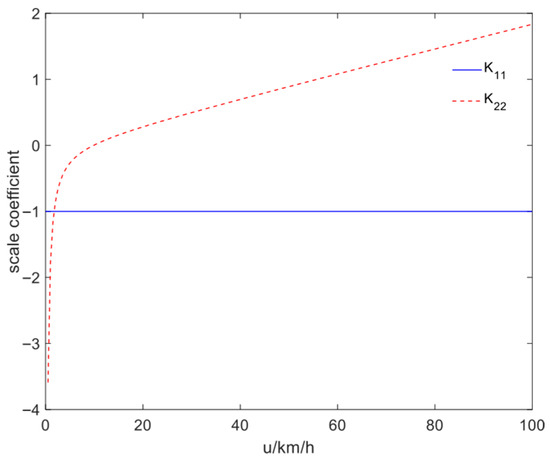
Under steady-state steering conditions, at this time, the lateral velocity and yaw rate are fixed values , and at the same time, the control target is still a center of mass sideslip angle of zero. The comprehensive control coefficients K11 and K22 can be obtained as follows:
We drew the gain variation curve under different vehicle speeds according to Equation (13), as shown in Figure 5.
Figure 5.
Steady-state yaw angular velocity gain.
From Figure 5, it can be seen that the comprehensive control coefficient K11 is always −1, which is because the lateral stiffness values of the front and rear tires in this article are equal. K22 increases with the increase in vehicle speed, and there is a zero crossing point. The trend of change is similar to that of the individual yaw rate feedback control.
3.4. Analysis of Response Characteristics of Four-Wheel Steering
The operational stability evaluation index of the X-by-wire chassis is not only the center of mass sideslip angle, but also the yaw rate, which is an important evaluation index. Its value reflects the steering and handling performance of the vehicle. According to Equations (6) and (12), the two-degree of freedom motion differential equation for the comprehensive control of the four-wheel steering X-by-wire chassis can be obtained as follows:
From the second equation in Equation (14), the following can be concluded:
Differentiation yields:
From Equations (12)–(16), the following can be concluded:
The lateral velocity and yaw rate under steady-state response are fixed values, that is, ; by substituting them into Equation (17), the expression of the yaw rate for steady-state response of four-wheel steering under comprehensive control is obtained as follows:
According to Equation (18), when the comprehensive control coefficients K11 and K22 are both zero, the steady-state response characteristics of the comprehensive control degenerate into the steady-state response expression under front-wheel steering.
When K11 = 0, the steady-state response characteristic is the response expression for four-wheel steering yaw rate feedback control:
When K22 = 0, the steady-state response characteristic is the response expression for four-wheel steering proportional feedforward control:
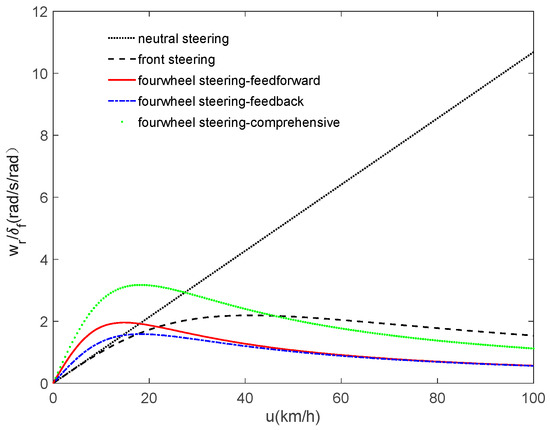
According to Equations (18)–(21), we plotted the curve of yaw rate gain with vehicle speed under steady-state response, as shown in Figure 6.
Figure 6.
Steady-state yaw rate gain under different control strategies.
According to Reference [21], the further the yaw rate gain response curve deviates from the neutral steering curve, the higher the steering stability and the lower the steering sensitivity. As shown in Figure 5, at high speeds, the yaw rate gain of four-wheel steering is smaller than that of front-wheel steering vehicles, indicating that its steering stability is superior to that of front-wheel steering. However, this also results in lower steering sensitivity for the four-wheel steering system compared to the front-wheel steering system, leading to a slower steering response. To achieve the same lateral displacement, a larger steering angle input or a longer response time is required. Therefore, the four-wheel steering control strategy should not overly prioritize reducing steering sensitivity under high-speed conditions.
Simultaneously, reducing the yaw rate gain difference between four-wheel steering and front-wheel steering under high-speed conditions can mitigate the discomfort caused by the discrepancy in the feeling of dynamic steering experienced by the driver.
Under low-speed conditions, the vehicle’s stability margin is large, thereby reducing the demands on the control system for stability. Based on this, the design objective of four-wheel steering control can shift from the stability coordination emphasized in high-speed conditions to prioritizing the improvement of the vehicle’s steering response characteristics. This enhances the vehicle’s steering sensitivity, reduces the minimum turning radius, and lowers the required steering angle input, thereby achieving improved low-speed maneuverability in terms of driving feel.
Considering the three four-wheel steering control strategies comprehensively, Figure 5 shows that, compared to feedforward control and feedback control, integrated control can improve steering agility at low speeds and reduce the discrepancy in the feeling of driving compared to front-wheel steering characteristics at high speeds.
The further the yaw rate gain response curve is from the neutral steering curve, the higher the stability. As shown in Figure 6, the stability of four-wheel steering at high speeds is much greater than that of front-wheel steering. However, a small gain can also lead to sluggish steering response. The same lateral displacement requires a larger angle input or longer response time. Therefore, four-wheel steering control strategies should not overly pursue reducing steering sensitivity at high speeds, reducing the difference in steering between the driver and the front wheel, thereby reducing the discomfort caused by the difference in steering between the driver and the front wheel during four-wheel steering. Under low-speed conditions, the stability margin of the vehicle is large, so four-wheel steering control prioritizes improving the vehicle’s steering sensitivity and improving maneuverability under low-speed conditions. Taking into account three four-wheel steering control strategies, it can be seen from Figure 6 that, compared to feedforward control and feedback control, comprehensive control can further improve maneuverability at low speeds and reduce differences in front-wheel steering characteristics at high speeds.
3.5. The Influence of Vehicle Load on Steady-State Response Characteristics
This section focuses on exploring the influence of vehicle mass variation on the steady-state steering characteristics under different control strategies. Four typical load conditions are designed in this paper, namely Unloaded, Standard Load, Full Load, and Overload. The vehicle mass corresponding to each load condition is shown in Table 1.
Table 1.
The vehicle mass under each load condition.
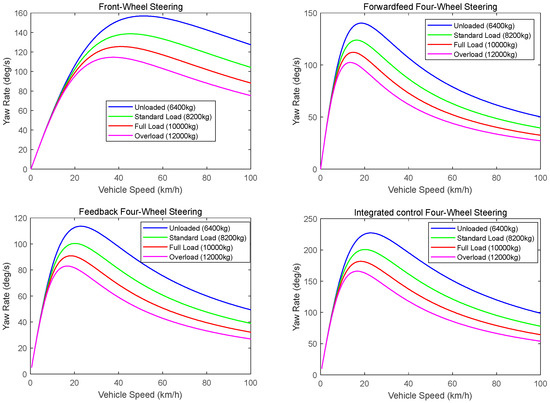
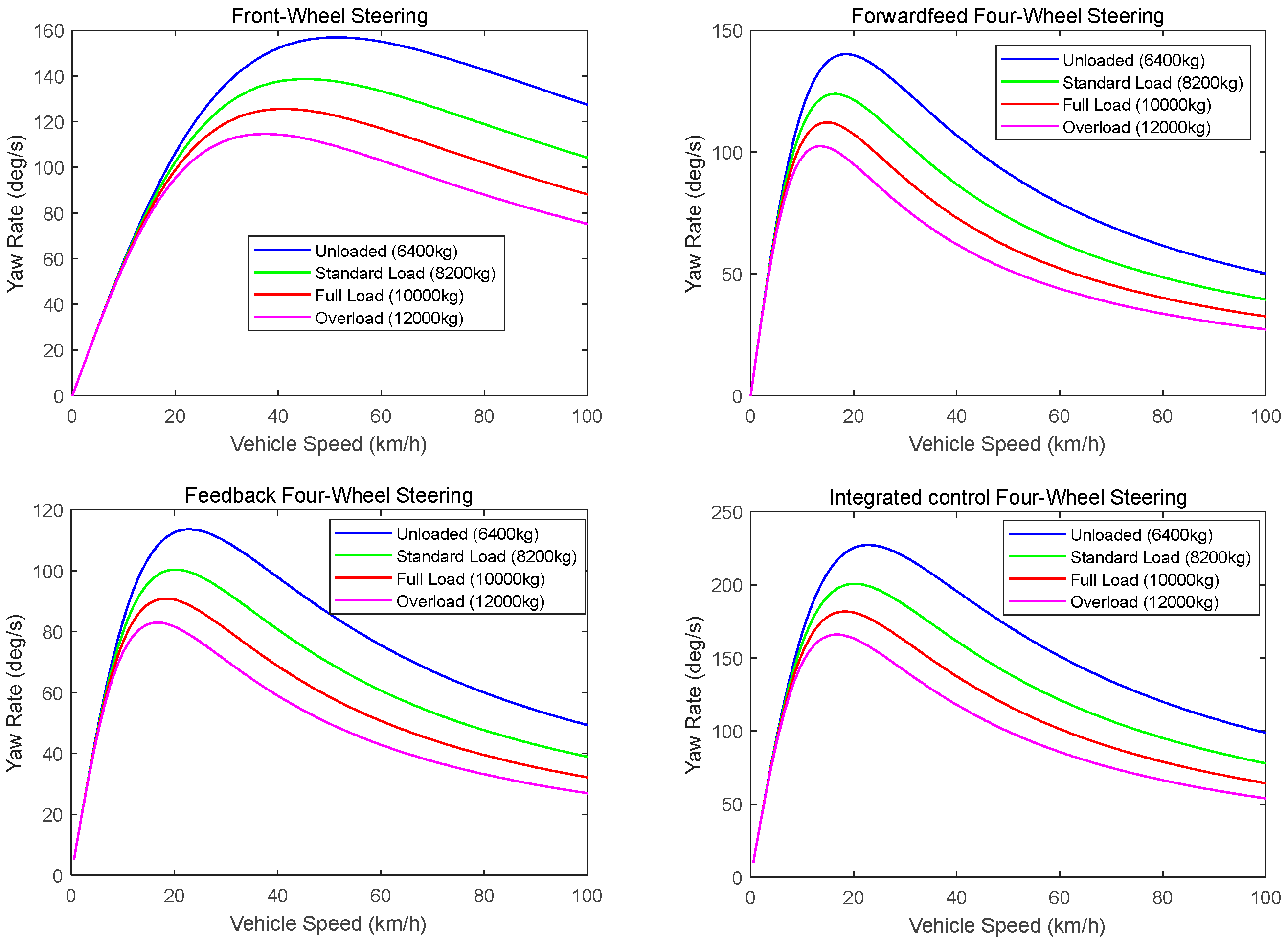
The simulation comparison results are shown in Figure 7.
Figure 7.
The influence of mass variation.
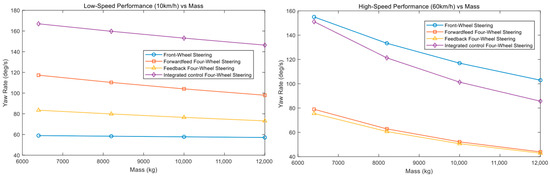
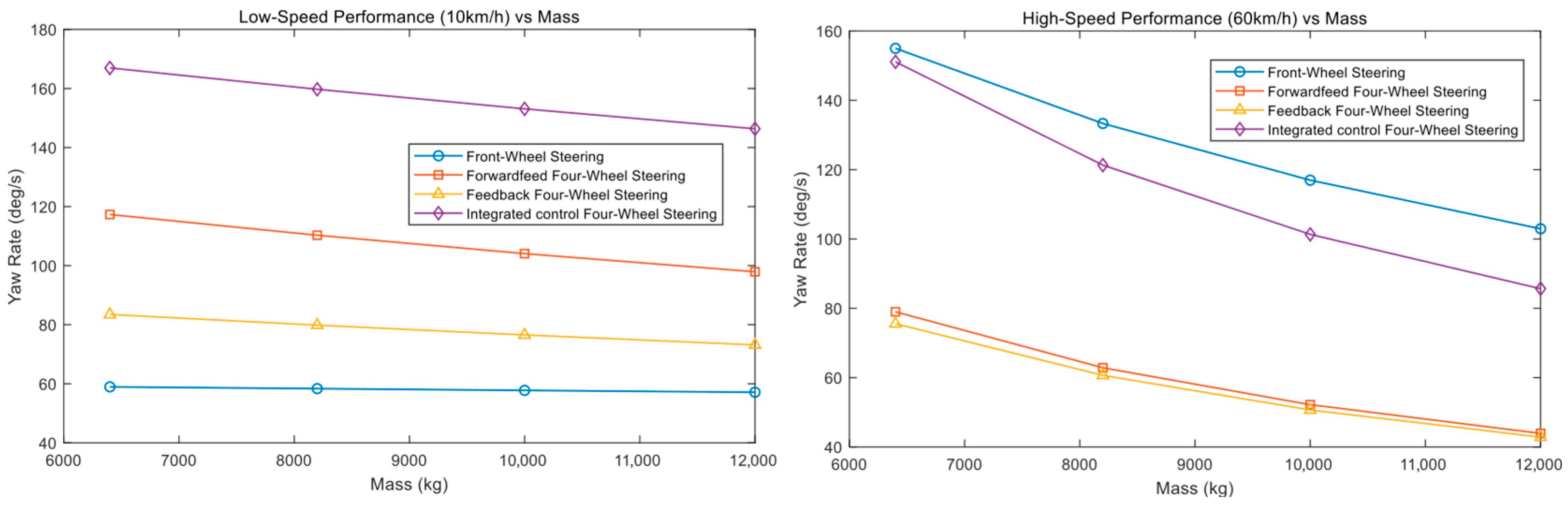
It can be seen from Figure 7 that, with the increase in vehicle load, the yaw rate of the vehicle shows a decreasing trend. For further comparison of the variation trend of vehicle yaw rate with the change in load mass under different vehicle speeds, see Figure 8.
Figure 8.
Peak yaw rate variation with load under different vehicle speeds.
It can be seen from Figure 8 that, under different vehicle speeds, the yaw rate shows a decreasing trend with an increase in load. Specifically, at low speeds (10 km/h), the yaw rate decreases slowly as the load increases, while at medium-high speeds (60 km/h), the yaw rate decreases significantly with the increase in load. Further analysis reveals that, at low speeds, the yaw rate under four-wheel steering (4WS) control strategies is higher than that under front-wheel steering, among which the peak value of the comprehensive control is the largest. At high speeds, the yaw rate under 4WS control strategies is lower than that under FWS, and the yaw rate curve of the comprehensive control is close to that of front-wheel steering.
4. Design of State Estimator
4.1. A Design of Vehicle State Estimation Algorithm
The estimator takes the longitudinal acceleration and front- and rear-wheel angles of the vehicle as input variables and the lateral acceleration as observation variables. The state variables of the estimator are the vehicle’s yaw rate, longitudinal velocity, and center of mass sideslip angle. Combining Equations (1) and (5), the estimator state equation is obtained as follows:
The deformation of the state equation can be written as the following expression:
The deformation of the measurement equation can be written as the following expression:
4.2. AUKF Algorithm Process
The unscented Kalman filter (UKF) algorithm determines the statistical characteristics of various onboard sensors in advance, and the disturbance of the chassis motion process will inevitably have a certain impact on the sensors, making it difficult to accurately estimate the statistical characteristics of the sensors. There is a large randomness, that is, the statistical characteristics of measurement noise are time-varying and unknown [22], which can cause estimation errors to increase or even filter divergence. To address this issue, an adaptive unscented Kalman filter (AUKF) algorithm is designed using the innovative sequence of the UKF algorithm to adaptively estimate the statistical characteristics of measurement noise. Although the computational complexity of the adaptive unscented Kalman filter (AUKF) is higher than that of linear algorithms, it primarily involves matrix operations related to the state dimension, and its memory requirements remain at the kilobyte (KB) level. Given that current embedded platforms for mining vehicles generally feature clock frequencies in the hundreds of megahertz, hardware floating-point units, and ample on-chip memory, this paper selects the Huahai S1 platform, which is equipped with the functionally safe S32K344 quad-core microcontroller operating at up to 4 × 160 MHz and offers abundant hardware interface resources. The computational load of this algorithm within conventional control cycles is acceptable. This algorithm achieves online estimation of the statistical characteristics of measurement noise, improves the adaptive ability of UKF, and avoids the problem of decreased or even divergent UKF estimation accuracy under time-varying or unknown sensor noise statistical characteristics [23]. AUKF dynamically adjusts the covariance Q of process noise and the covariance R of observation noise, enabling the filter to adapt to the actual behavior of the system.
The discretization of the four-wheel steering dynamics model established in Section 1 above resulted in a nonlinear system model, as follows:
Among them, x is the state variable x(t) = [ωr, ß, vx]T, Y is the observed measurement, y(t) = [ay]; U is the input variable ; is the process noise, which has a mean of 0, and the Gaussian white noise sequence, whose variance is Qt; v(t) is the Gaussian white noise with a mean of 0 and a variance of Rt, where the measurement noise and process noise are independent of each other. Equation (26) represents the equation of the state, and Equation (27) represents the observation equation.
We defined the measurement’s innovation sequence as follows:
The real-time estimated covariance of the innovation sequence is
where M is the window size in the window opening method.
The estimated value of the measurement noise covariance matrix Rt can be obtained as follows:
The UKF does not need to linearize the nonlinear system but instead approximates the probability density function distribution of the state vector of the nonlinear system using Sigma sampling points [24] and ultimately obtains the estimated value of the state. From this, it can be seen that the sampling strategy of Sigma sampling points directly affects the computational efficiency and estimation accuracy of the algorithm. Common Sigma sampling strategies based on symmetric sampling have a large computational load and are not suitable for use in vehicle state estimation systems during four-wheel steering control. Therefore, the minimum deviation simplex sampling strategy proposed in this paper can effectively reduce the number of sampling points and improve the real-time performance of the algorithm. The n-dimensional minimum deviation simplex sampling strategy is as follows [25]:
First, select the initial weight W0, with 0 ≤ W0 ≤ 1.
- (1)
- The calculation formula for the Sigma point weights is as follows:
- (2)
- Initialize the iterative vector (corresponding to the sampling points in the one-dimensional case).
- (3)
- For input dimensions j = 2, …, n, the iteration formula is
- (4)
- Augment the generated Sigma point set with mean x and covariance matrix information.where Pxx is the covariance matrix between x and x.
- (5)
- The weight coefficients for the mean and variance are given bywhere a is a small positive scaling factor that can take values within the interval [1 × ,1], and β is used to incorporate prior information about the distribution of the random variable x. If the distribution follows a Gaussian distribution, β = 2 is optimal.
Based on the UT, using the minimum skewness simplex sampling strategy and Equations (26)–(28) to adaptively adjust the measurement noise equation, the AUKF algorithm process is as follows:
- (1)
- Initialize
- (2)
- Calculate Sigma points.
- (3)
- Time update phase.
The Sigma point calculated from step 2 is used to calculate the state prediction value and error covariance matrix using the nonlinear state equation.
Next, replace and with and , and return to step (2) to recalculate the Sigma point. By propagating the nonlinear measurement function to , the output prediction and error covariance matrix are obtained.
- (4)
- Measurement update.where and are the covariance matrices between x and y, and y and y, respectively; K is the Kalman filtering gain.
5. Simulation Verification
5.1. Simulation Platform Construction
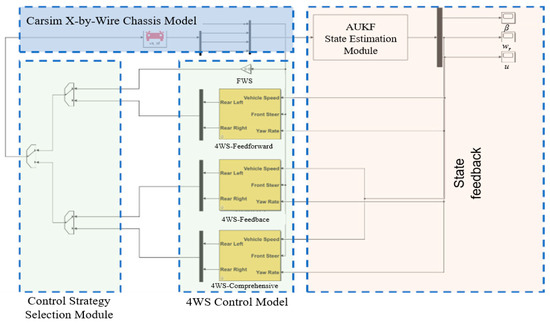
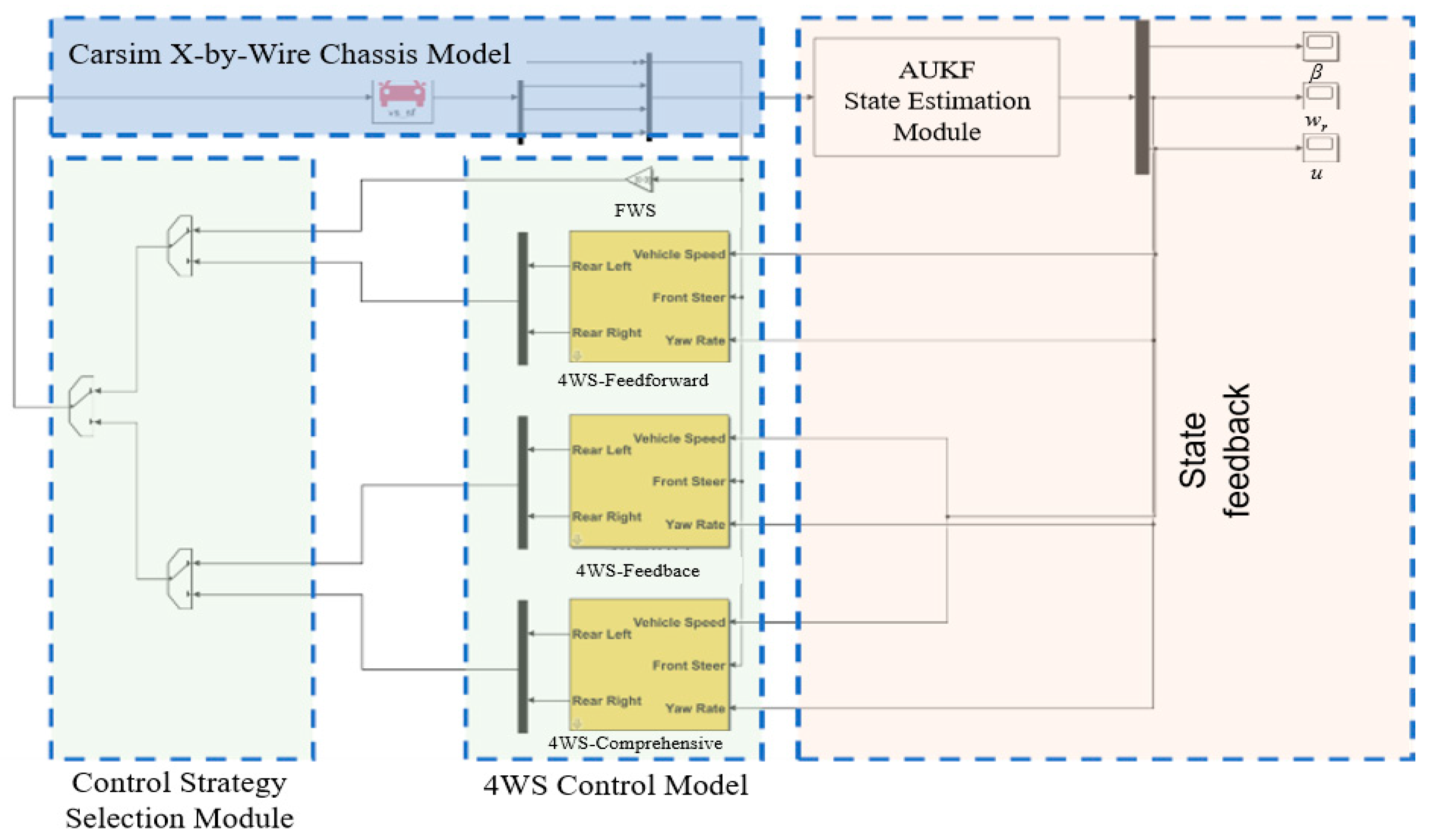
To verify the effectiveness of the simulation strategy, this article uses Matlab/Simulink 2020a and Carsim 2019.0 to build a joint simulation test platform. Carsim is used to establish an X-by-wire chassis dynamics model, and Matlab/Simulink is used to design a four-wheel steering control strategy. The dynamic performance of the mining X-by-wire chassis under front-wheel steering, feedforward four-wheel steering, feedback four-wheel steering, and comprehensive control four-wheel steering is comprehensively compared. The co-simulation model is shown in Figure 9.
Figure 9.
Co-simulation model.
Two typical steering conditions were selected for joint simulation, namely, front-wheel angle step and front-wheel angle sine. The vehicle speed was set to 10 km/h and 60 km/h, respectively, and the simulated road was set to a dry and good concrete road surface with a adhesion coefficient of 0.85. The sampling period was 0.001 s. The initial process noise covariance matrix was Q0 = diag (0.01,0.01,0.01), the initial measurement noise covariance was R0 = 0.01, and the initial mean values of both the process noise and measurement noise were set to zero. The parameters of the X-by-wire chassis vehicle model are shown in Table 2.
Table 2.
Chassis parameters controlled by wire.
5.2. Comparison of Four-Wheel Steering Control Results
5.2.1. 10 km/h Speed Simulation
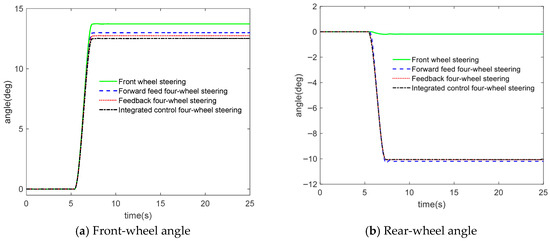
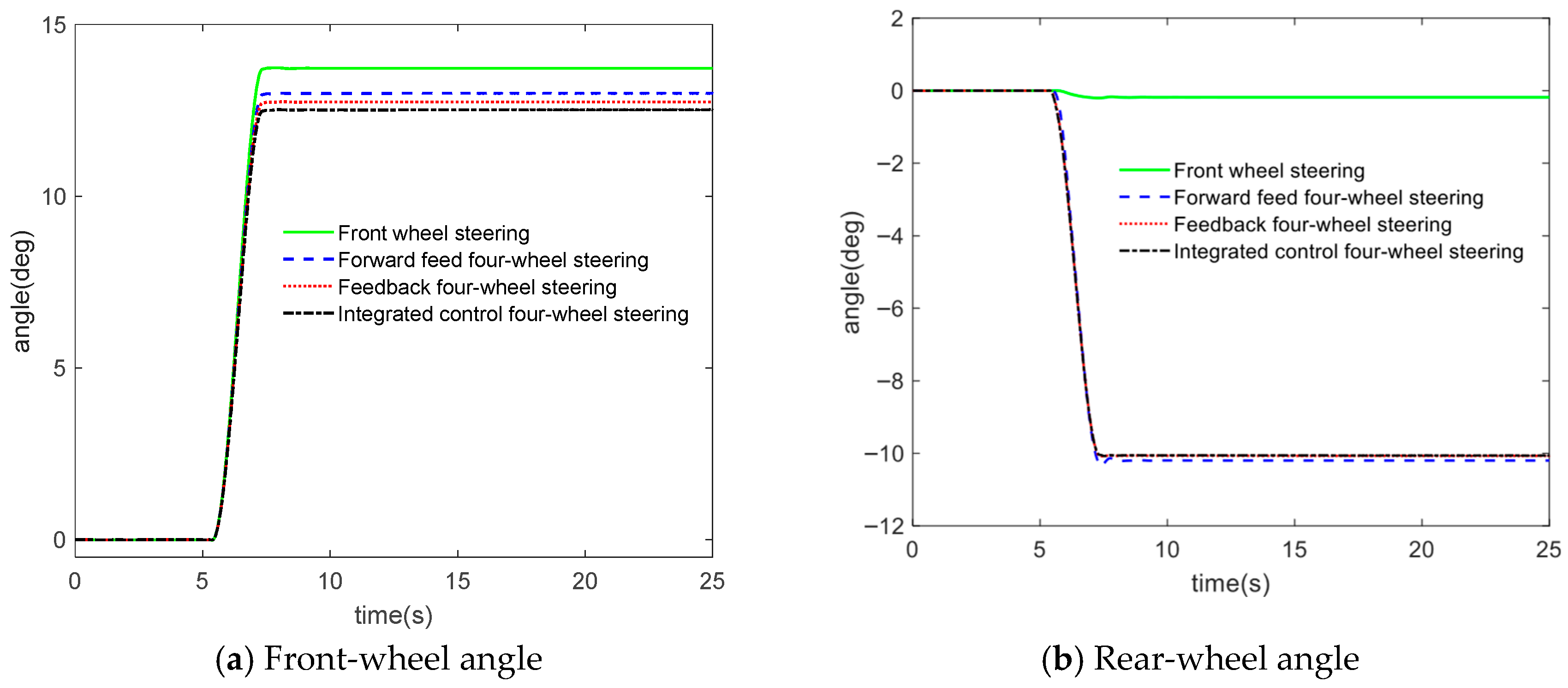
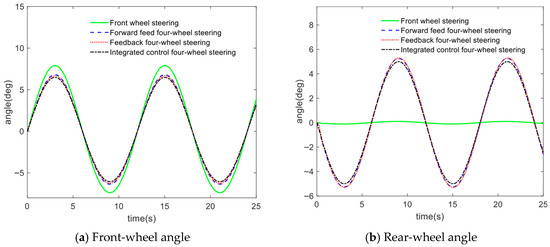
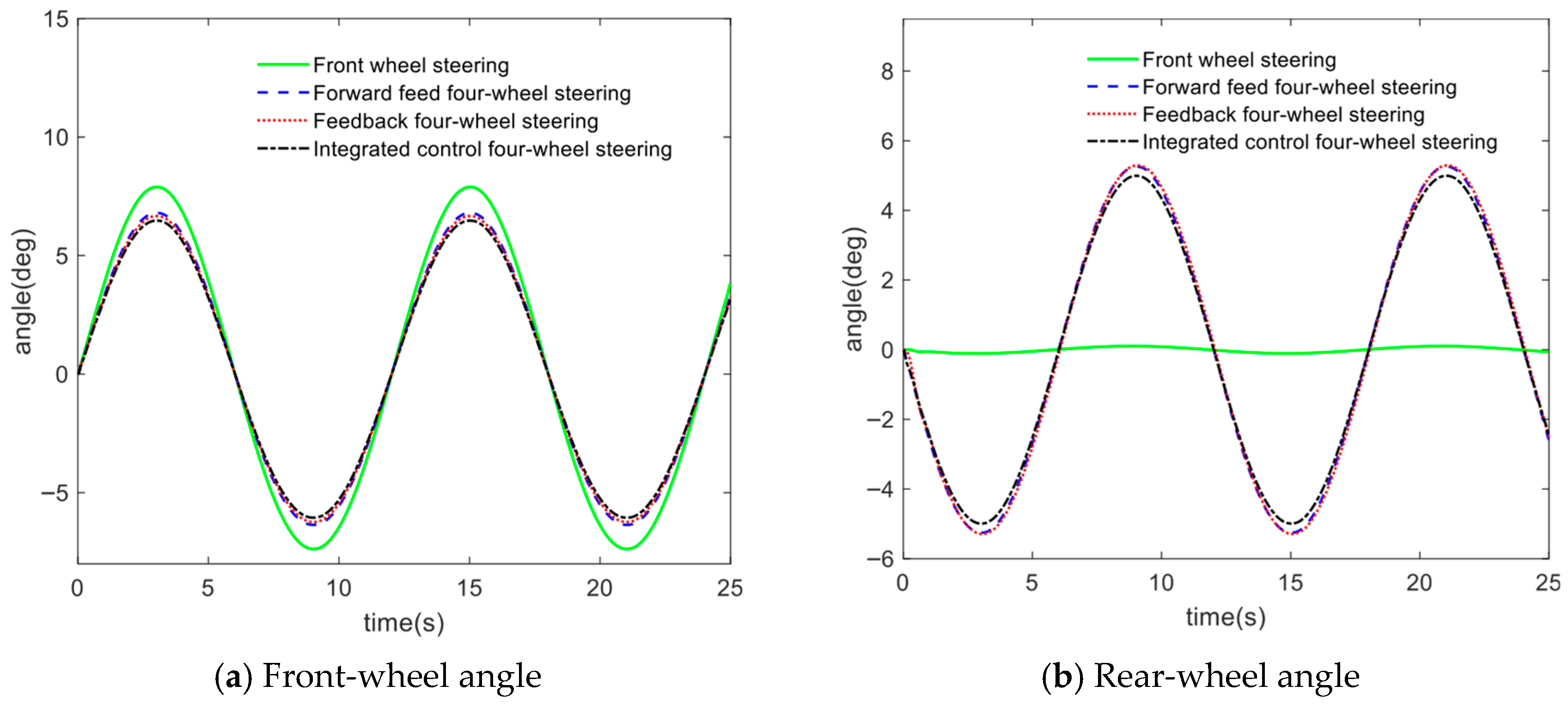
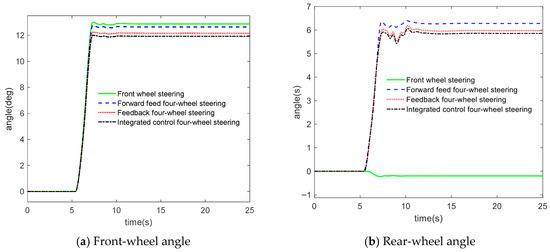
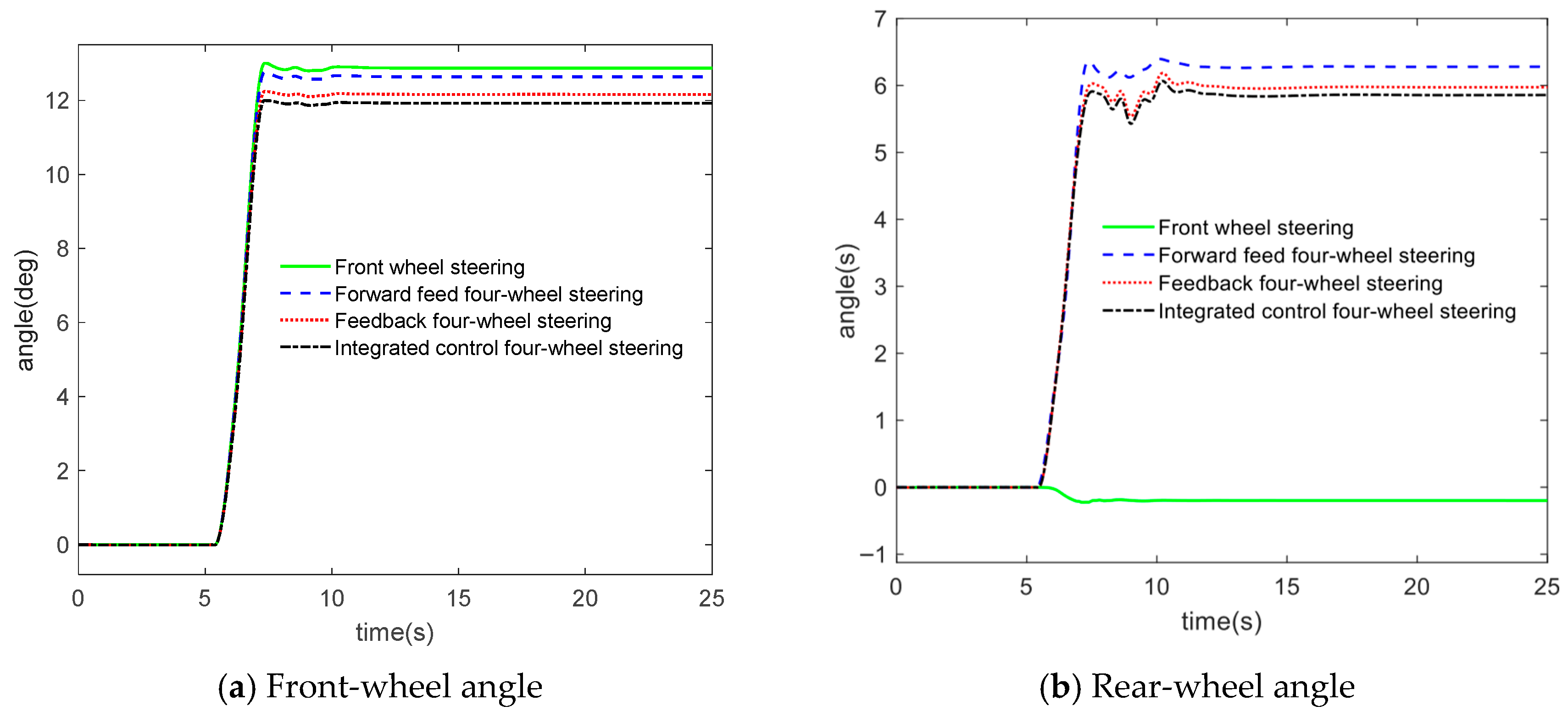
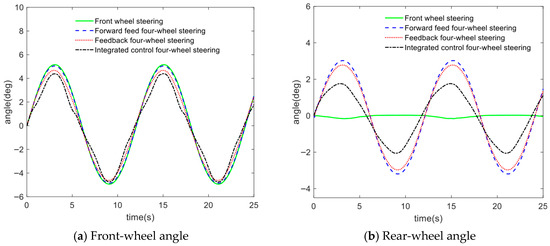
From Figure 10 and Figure 11, it can be seen that, when performing four-wheel steering at low speeds, the front-wheel angle is opposite to the rear-wheel angle. This is because, in low-speed conditions, the vehicle has better stability. The opposite direction of the front- and rear-wheel angles can improve the maneuverability of the vehicle while driving, reduce the external tilt and swing of the body, and make the vehicle turn more flexibly. At the same time, the opposite direction of the front- and rear-wheel angles can also reduce the sliding of the front and rear wheels during steering, reducing tire wear.
Figure 10.
Four-wheel steering under 10 km/h step condition.
Figure 11.
Four-wheel steering angle under 10 km/h sinusoidal conditions.
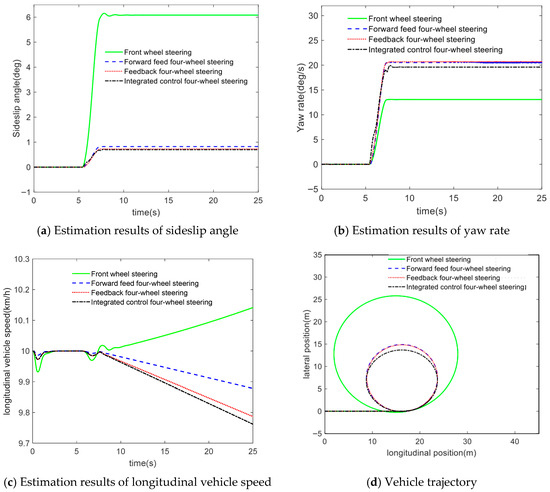
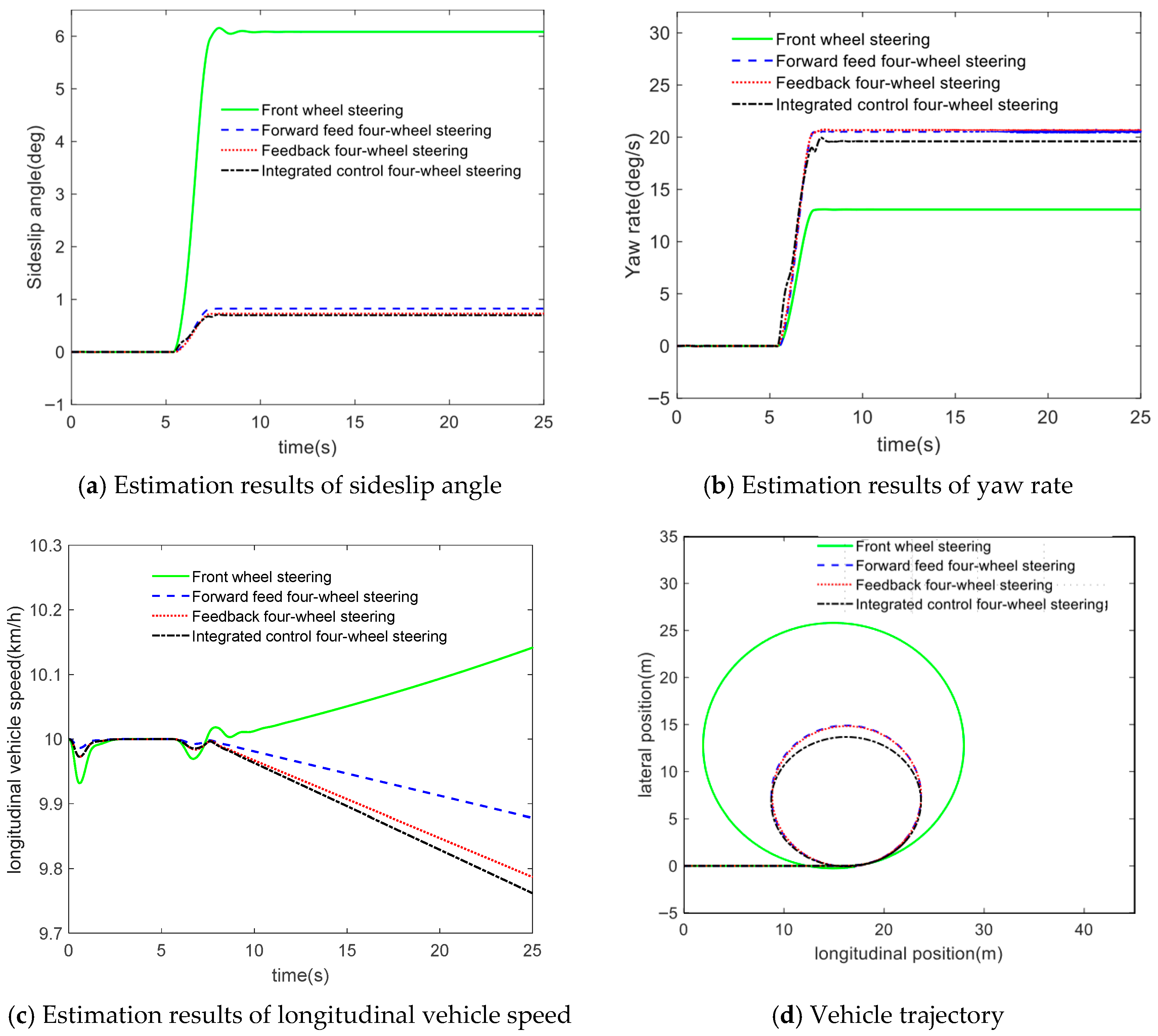
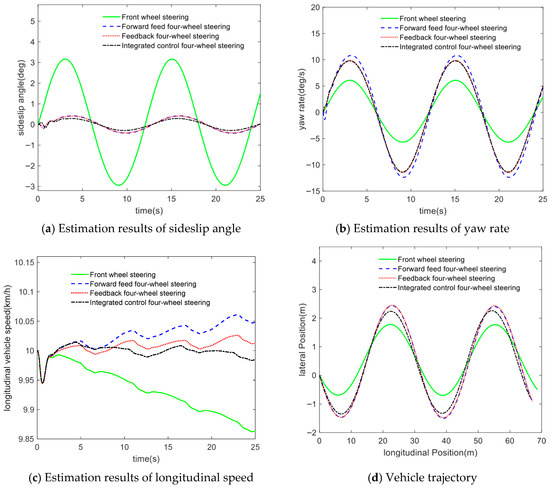
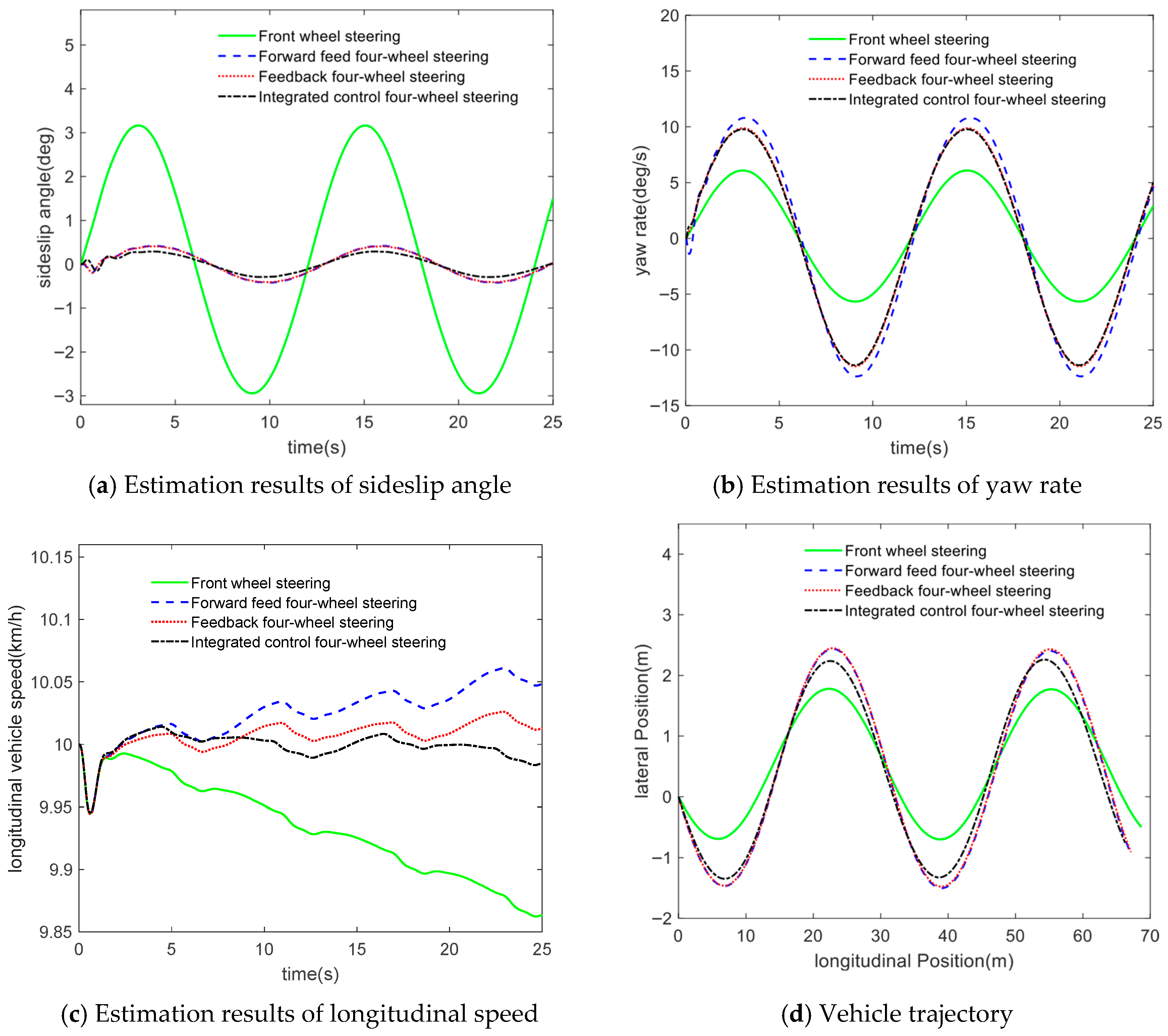
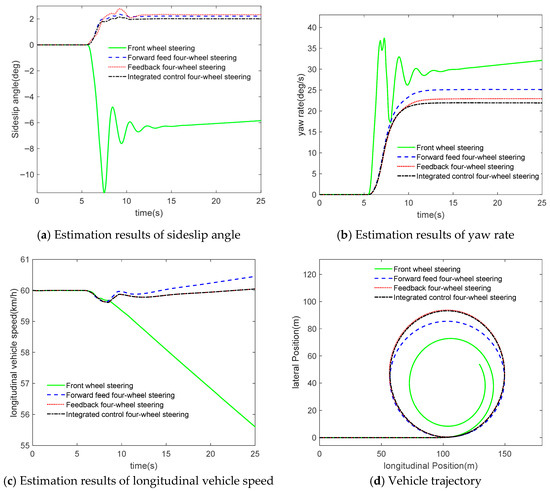
From Figure 12a and Figure 13a, it can be seen that when a vehicle turns at low speeds, the center of mass sideslip angle of the front-wheel steering vehicle is relatively large. This is because the response speed and sensitivity of the front-wheel steering are relatively low. In order to maintain the lateral force required for steering, the center of mass sideslip angle of the vehicle is often large. The intervention of four-wheel steering technology allows the rear wheels of the vehicle to also participate in the steering process, making the steering response more sensitive. Therefore, the roll and center of mass sideslip angle of the vehicle during turning are relatively small, which leads to better stability.
Figure 12.
Vehicle state response under 10 km/h step condition.
Figure 13.
Vehicle state response under 10 km/h sinusoidal condition.
From Figure 12b and Figure 13b, it can be seen that the yaw rate of a vehicle with front-wheel steering is smaller than that with four-wheel steering. This is because the steering intervention of the rear wheels during four-wheel steering can help the vehicle adjust its angle better, reduce the demand for lateral force, and result in a higher yaw rate, thereby improving the maneuverability of the vehicle while driving.
From Figure 12c and Figure 13c, it can be seen that under low-speed conditions, both front-wheel steering vehicles and four-wheel steering vehicles have high estimation accuracy in estimating vehicle speed, with a maximum estimation error of only 0.023 km/h.
From Figure 12d, it can be seen that in the low-speed front-wheel angle step condition, the turning radius of a two-wheel steering vehicle is larger than that of a four-wheel steering vehicle. This is because the vehicle has better stability under low-speed conditions. Therefore, in order to improve the maneuverability of the vehicle during driving, the rear-wheel angle direction of a four-wheel steering vehicle is opposite to the front-wheel angle direction. Therefore, at the same time, a four-wheel steering vehicle has a larger turning angle compared to a front-wheel steering vehicle, resulting in a smaller turning radius of the vehicle. Similarly, in Figure 13d, under the sinusoidal working condition of the front wheels, due to the intervention of rear-wheel steering, the four-wheel steering vehicle becomes more flexible and can rotate through larger angles at the same time.
To facilitate comparative analysis, this study quantifies the dynamic performance differences in yaw rate by calculating the following performance indicators under different steering inputs: peak yaw rate, steady-state value, overshoot, steady-state response time, and turning radius for step steering input; peak yaw rate and peak lateral displacement for sinusoidal steering input. The detailed results are presented in Table 3 and Table 4.
Table 3.
Vehicle state response under 10 km/h step condition.
Table 4.
Vehicle state response under 10 km/h sinusoidal condition.
As shown in Table 3 and Table 4, under the 10 km/h step steering condition, all four-wheel steering control strategies achieve significantly higher steady-state yaw rates compared to the front-wheel steering scheme, with an improvement of approximately 50%. The turning radius is reduced from 12.9 m for front-wheel steering to approximately 7 m, with the integrated control strategy yielding the smallest turning radius (6.87 m), corresponding to a reduction of over 45%. Specifically, the feedforward control demonstrates the highest peak response (20.80 deg/s) but the largest overshoot (0.29 deg/s), indicating its rapid response at the expense of slightly compromised stability. In contrast, the feedback control exhibits minimal overshoot (0.05 deg/s), reflecting its superior stability performance. Although the integrated control achieves the best turning radius, its response time is slightly longer (2.26 s). Under the 10 km/h sinusoidal steering condition, all four-wheel steering strategies show significantly higher peak yaw rates than front-wheel steering, with the feedforward control reaching the highest value (10.80 deg/s), while the integrated control performs best in terms of lateral displacement (2.26 m). Overall, under low-speed conditions, the three four-wheel steering control methods show no significant differences in control effectiveness, with consistent trends and nearly identical steady-state values.
5.2.2. 60 km/h Speed Simulation
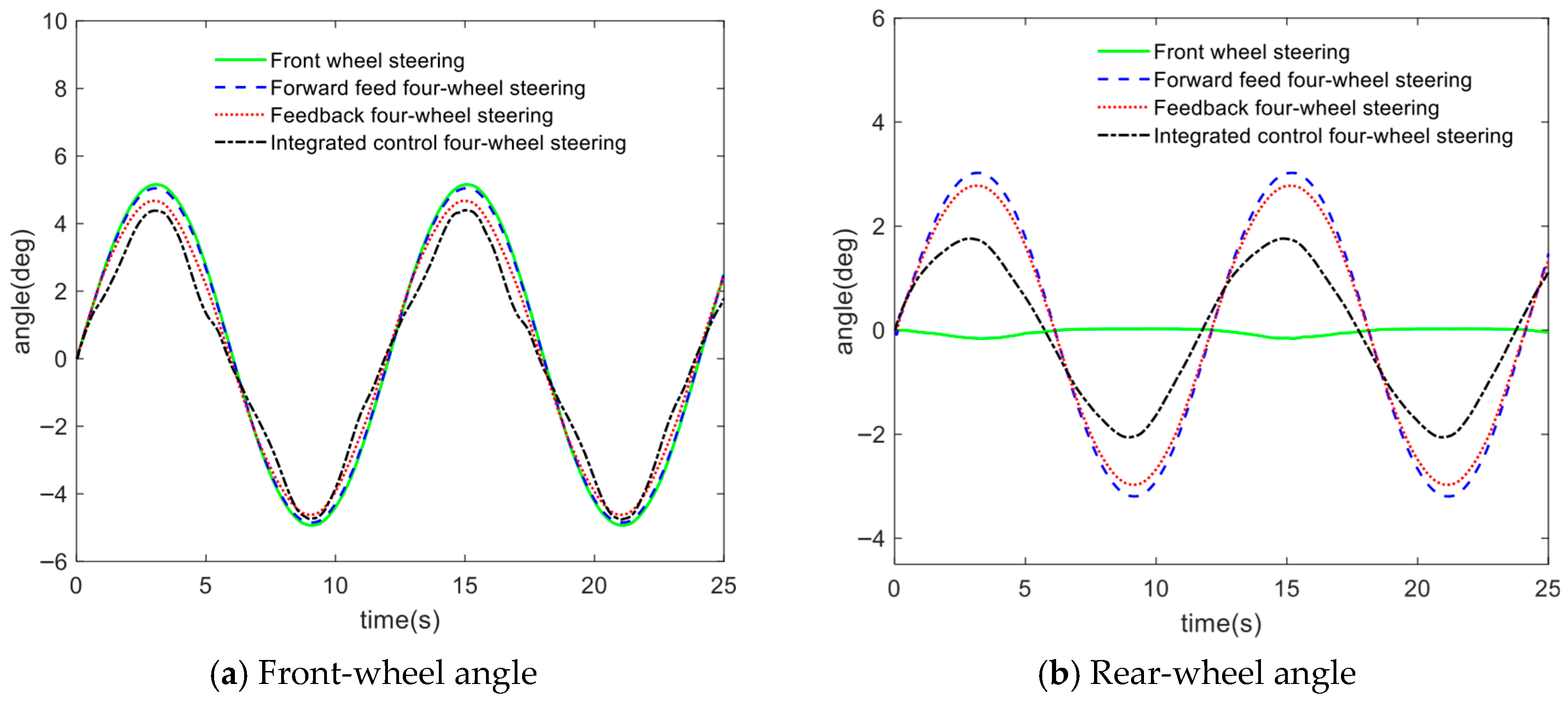
It can be seen from Figure 14 and Figure 15 that, under high-speed conditions, the fundamental purpose of having the rear wheels turn in the same direction as the front wheels in a four-wheel steering system is to suppress the vehicle’s yaw motion, thereby significantly enhancing driving stability and handling safety. This in-phase steering strategy facilitates a smoother lateral translation of the vehicle body, effectively mitigating potential risks such as tail slippage or loss of control during rapid lane changes or cornering maneuvers.
Figure 14.
Four-wheel steering under 60 km/h step condition.
Figure 15.
Four-wheel steering angle under 60 km/h sinusoidal conditions.
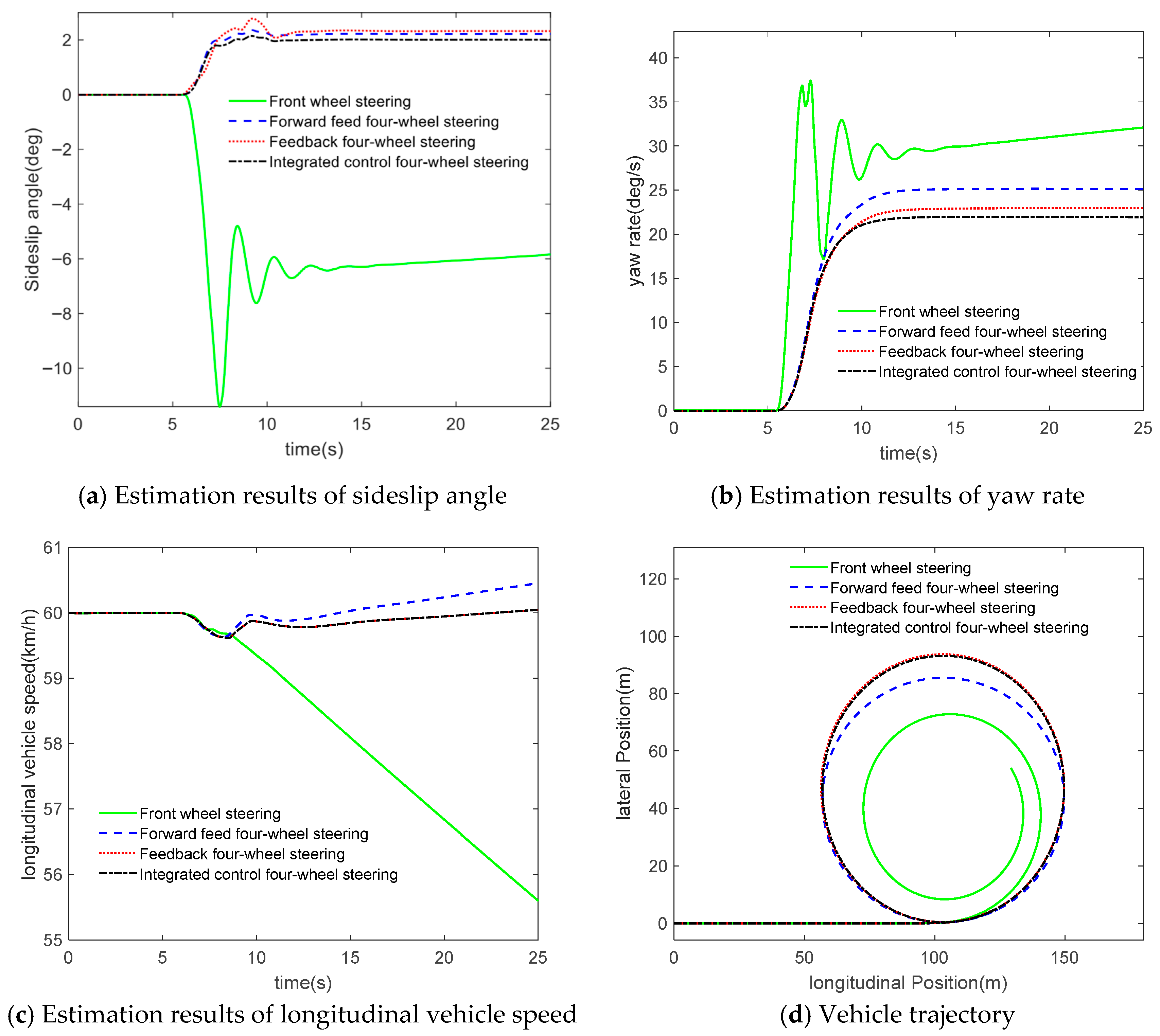
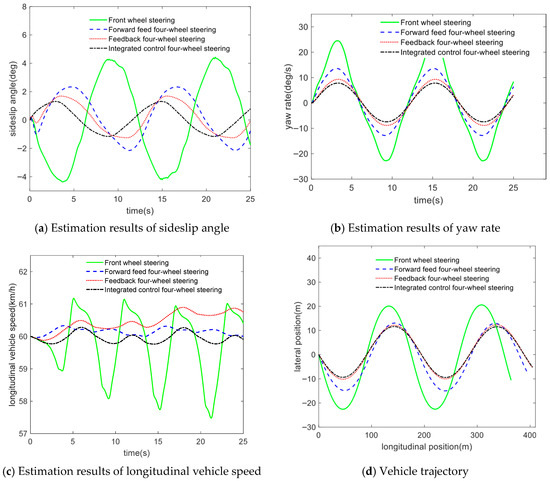
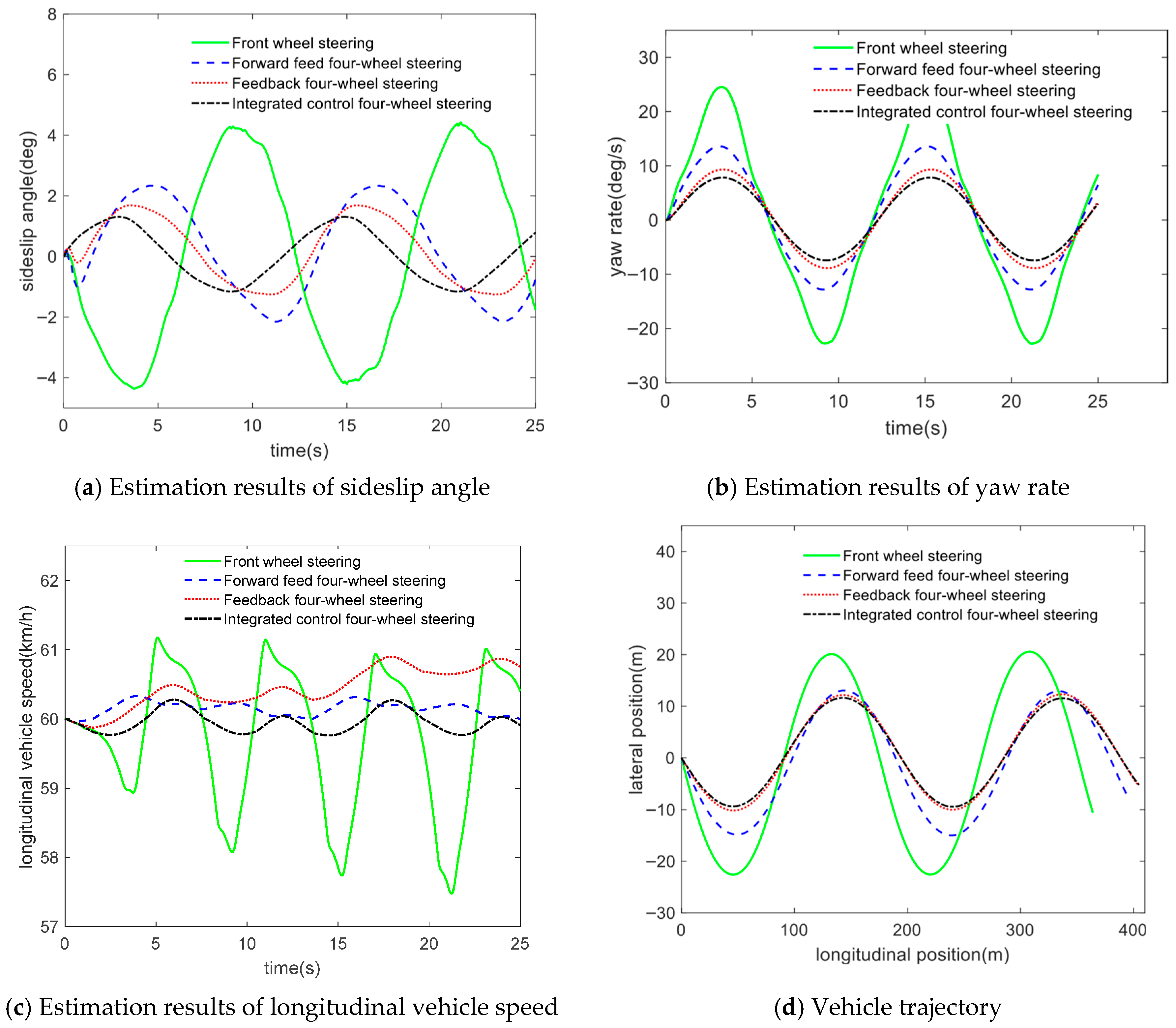
From Figure 16a and Figure 17a, it can be seen that, during high-speed conditions, the center of mass sideslip angle of front-wheel steering is significantly higher than that of four-wheel steering. This is because, under high-speed conditions, four-wheel steering vehicles can better distribute vehicle lateral force, resulting in a smaller tire sideslip angle, resulting in a smaller center of mass sideslip angle and more stable vehicle. At the same time, during the front-wheel angle step working condition, there is an obvious buffeting phenomenon within 6 s to 11 s, indicating that the stability of the vehicle is poor at this time and there is a significant sideslip phenomenon.
Figure 16.
Vehicle state response under 60 km/h step condition.
Figure 17.
Vehicle state response under 60 km/h sinusoidal condition.
From Figure 16b and Figure 17b, it can be seen that the yaw rate during front-wheel steering is higher than that during four-wheel steering. This is because, during four-wheel steering at high speeds, in order to improve the stability of the vehicle and prevent dangerous situations such as sideslip and instability, the direction of the rear-wheel corner is often the same as that of the front-wheel corner, which leads to poor maneuverability and a decrease in yaw rate.
From Figure 16c and Figure 17c, it can be seen that, under high-speed conditions, the estimation effect of vehicle driving speed during front-wheel steering is poor. The maximum estimation error can reach 4.4 km/h and 2.5 km/h, respectively, in the step and sine conditions of the front-wheel angle. However, four-wheel steering vehicles greatly reduce the estimation error due to the intervention of rear-wheel steering excitation, making the estimation results more accurate.
From the driving trajectory of the vehicle in Figure 16d, it can be seen that four-wheel steering vehicles have a larger turning radius compared to front-wheel steering vehicles. This is because at high speeds, in order to maintain vehicle stability, the front- and rear-wheel angles of the vehicle are often in the same direction, which leads to a significant decrease in vehicle maneuverability. Specifically, at the same time, the steering angle of four-wheel steering vehicles is smaller. Similarly, in Figure 17d, due to the poor mobility of four-wheel steering vehicles, the turning radius of the vehicle increases and the steering sensitivity decreases.
In Figure 16 and Figure 17, a comprehensive comparison of the three four-wheel steering control methods proposed in this article under high-speed conditions shows that the control effects of the three control methods are slightly different. Among them, the comprehensive control of four-wheel steering has the best control effect. The steady-state values of the center of mass sideslip angle, center of mass sideslip angle, and yaw rate under the front-wheel angle step condition decrease by about 13.4% and 12.7%, respectively, and decrease by about 42.4% and 47.8%, respectively, under the front-wheel sine condition, indicating that the stability of the vehicle is better at this time.
The calculated performance metrics of different steering control strategies under the 60 km/h driving condition are presented in Table 5 and Table 6.
Table 5.
Vehicle state response under 60 km/h step condition.
Table 6.
Vehicle state response under 60 km/h sinusoidal condition.
As shown in Table 5 and Table 6, under the 60 km/h step steering condition, all four-wheel steering control strategies demonstrate significantly lower peak and steady-state yaw rates compared to the front-wheel steering scheme (37.42 deg/s). It should be noted that the steady-state value for front-wheel steering is not provided in the table, as its yaw rate response shows a continuously increasing trend, indicating pronounced oversteering characteristics that may lead to vehicle instability and prevent the attainment of a steady state. In terms of turning radius, the four-wheel steering strategies exhibit larger turning radii (42.75–46.86 m) compared to those of front-wheel steering (36.42 m), with an increase of approximately 17–29%. Among these, the feedforward control achieves the smallest turning radius (42.75 m). Specifically, the feedforward control yields the highest peak response (25.15 deg/s) with minimal overshoot (0.05 deg/s), while the feedback and integrated controls further reduce yaw rates, reflecting enhanced stability. All three four-wheel steering strategies exhibit extended steady-state response times of 7.0 s, indicating a more gradual steering process. Under the sinusoidal steering condition, four-wheel steering strategies achieve significantly lower peak yaw rates than front-wheel steering, with the integrated control yielding the lowest value (7.82 deg/s), representing a 68% reduction. Simultaneously, the lateral displacements of the four-wheel steering strategies are substantially smaller, with the integrated control performing best (11.62 m), corresponding to a 44% reduction compared to front-wheel steering. In summary, under medium-high speed conditions, all three proposed four-wheel steering control methods effectively suppress oversteering tendencies, improving vehicle stability and path-tracking accuracy. The integrated control demonstrates optimal performance across multiple metrics, exhibiting the best comprehensive performance.
6. Experimental Verification
6.1. Experimental Platform
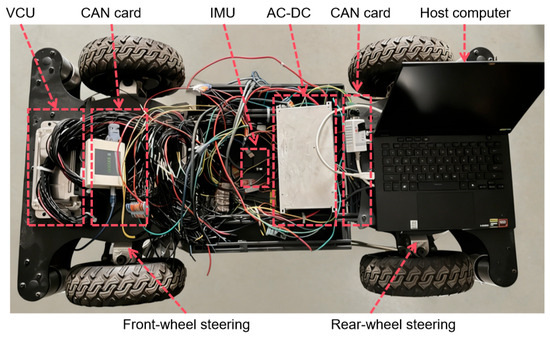
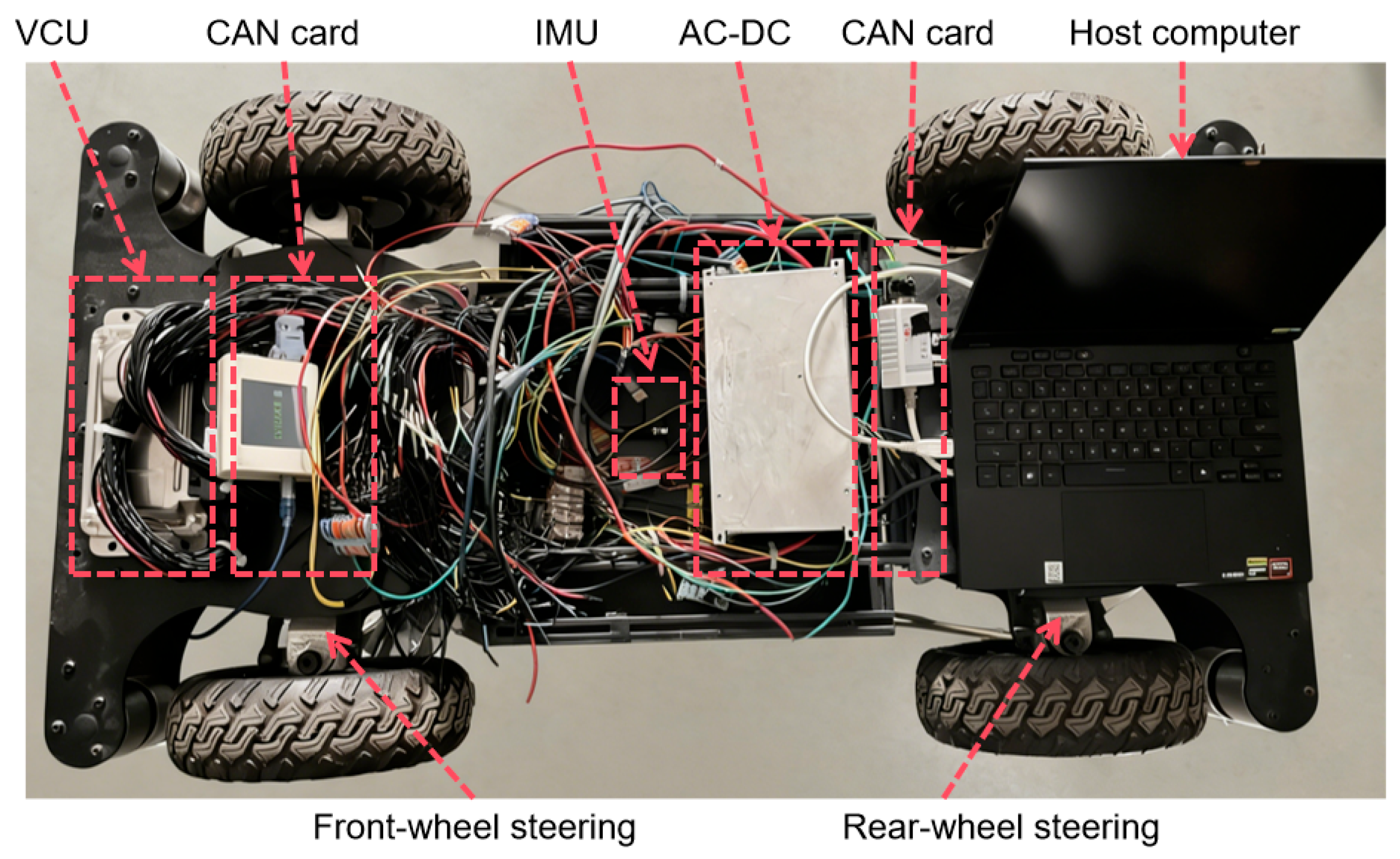
According to the experimental verification requirements, this paper establishes a four-wheel steering physical vehicle test platform as shown in Figure 18. The front and rear wheels employ a motor-driven rack and pinion steer-by-wire system, equipped with rotation angle sensors. These sensors are used to measure the steering angles of the front and rear steering systems, outputting analog signals of 0~5 V. The analog steering angle signals are converted into digital signals by an A/D converter mounted on the vehicle controller’s data acquisition module and then transmitted to the host computer via the CAN bus. The vehicle controller utilizes the Huahai U34 controller (Huahai Technologies Co., Ltd., Beijing, China). Simultaneously, based on real-time feedback signals and the four-wheel steering control strategy, the vehicle controller calculates the required control current for the front and rear steering systems and issues control commands to the steering motors via PWM. The steer-by-wire system controller, according to the received steering control signals and commands, drives the steering motors to adjust the steering wheel angles toward the target angles. P-CAN is used to collect and record the vehicle status signals in real time. Matlab/Simulink code generation technology is employed to generate the code for the vehicle control system, and dynamic response tests under sinusoidal steering angle inputs are designed.
Figure 18.
Vehicle test platform.
6.2. Experimental Validation
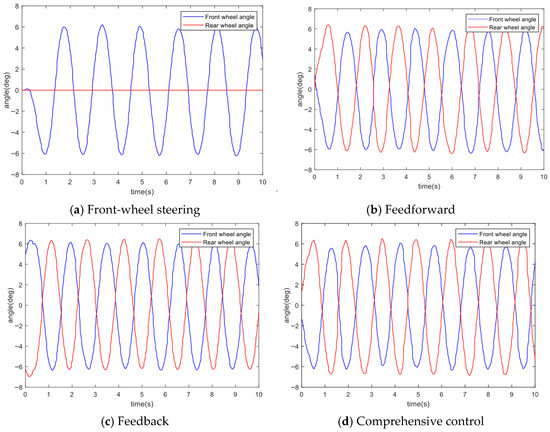
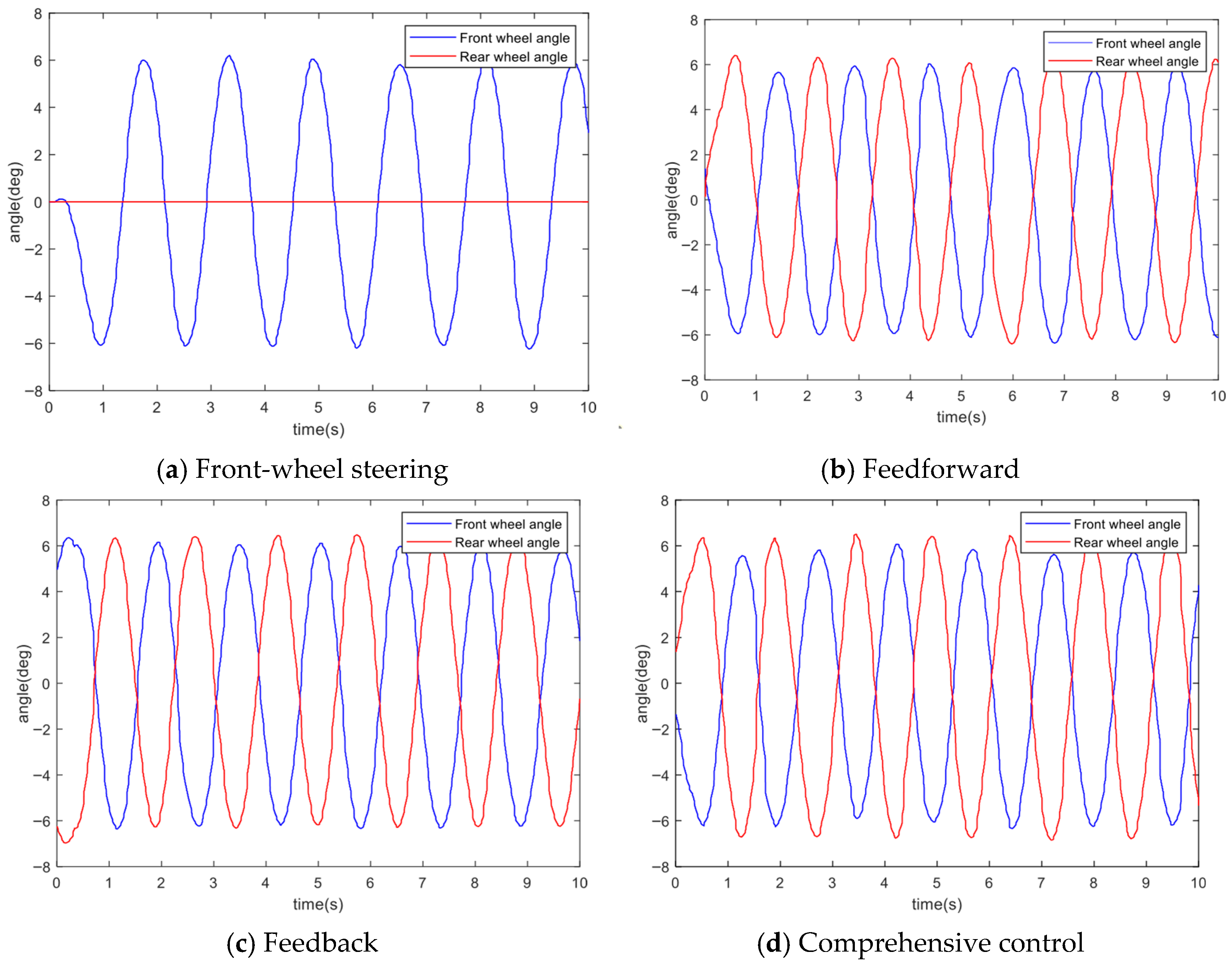
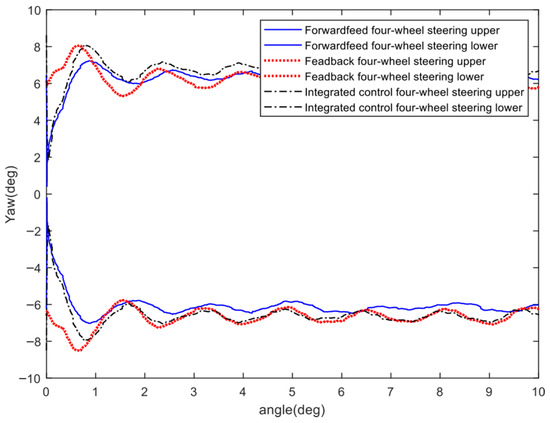
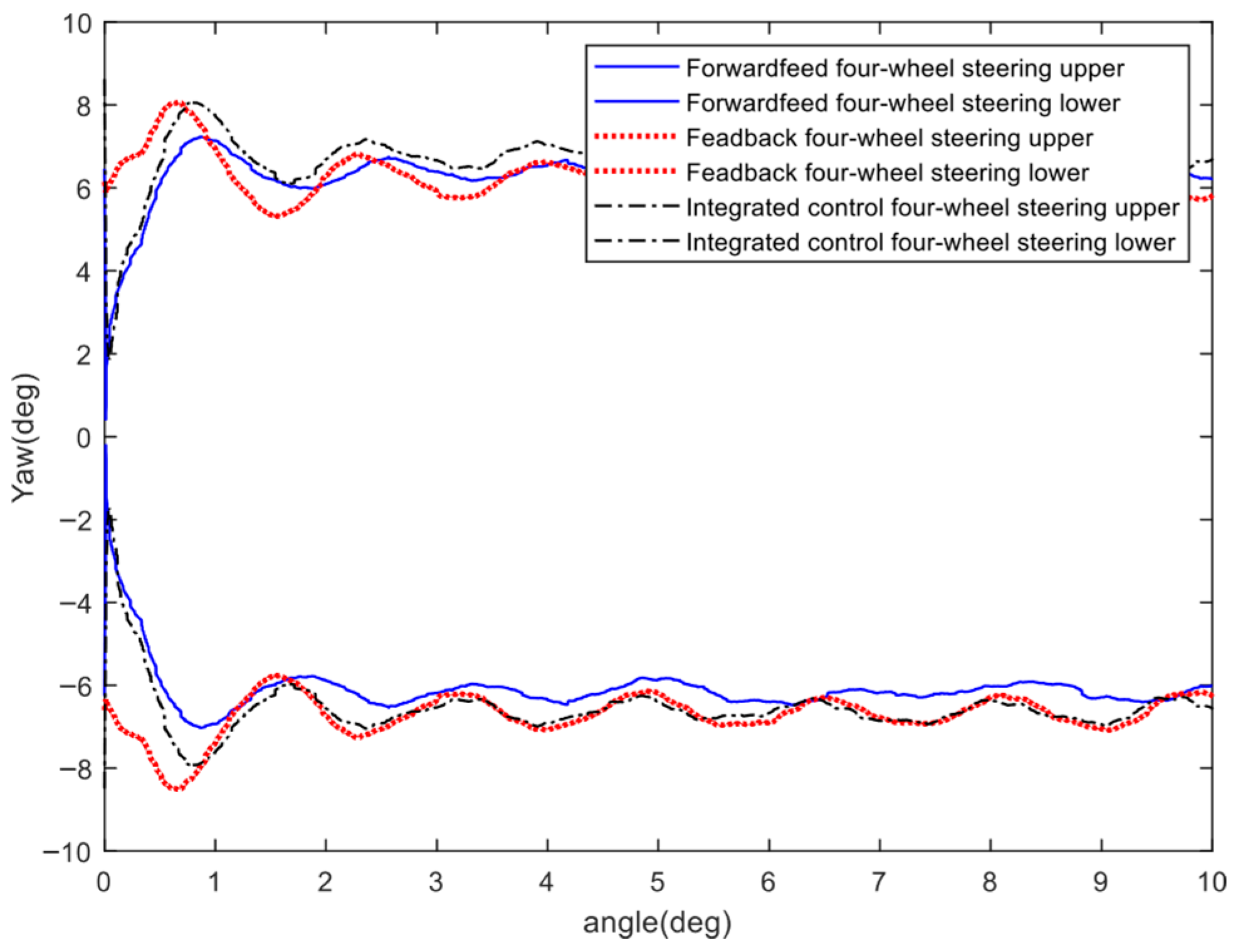
The target steering angle was set as a sinusoidal signal with an amplitude of 6° and a period of 2 s, while the vehicle speed was maintained at 5 km/h. Tests were designed for the following control modes: front-wheel steering, feedforward four-wheel steering, feedback four-wheel steering, and integrated four-wheel steering. The experimental results are shown in Figure 19, Figure 20 and Figure 21.
Figure 19.
Steering angle test results for front and rear wheels.
Figure 20.
Rear-wheel steering angle envelope.
Figure 21.
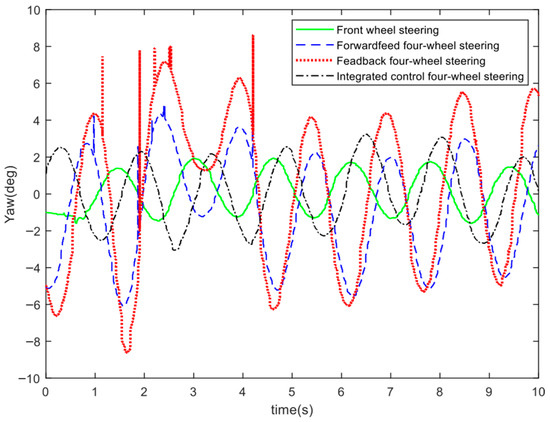
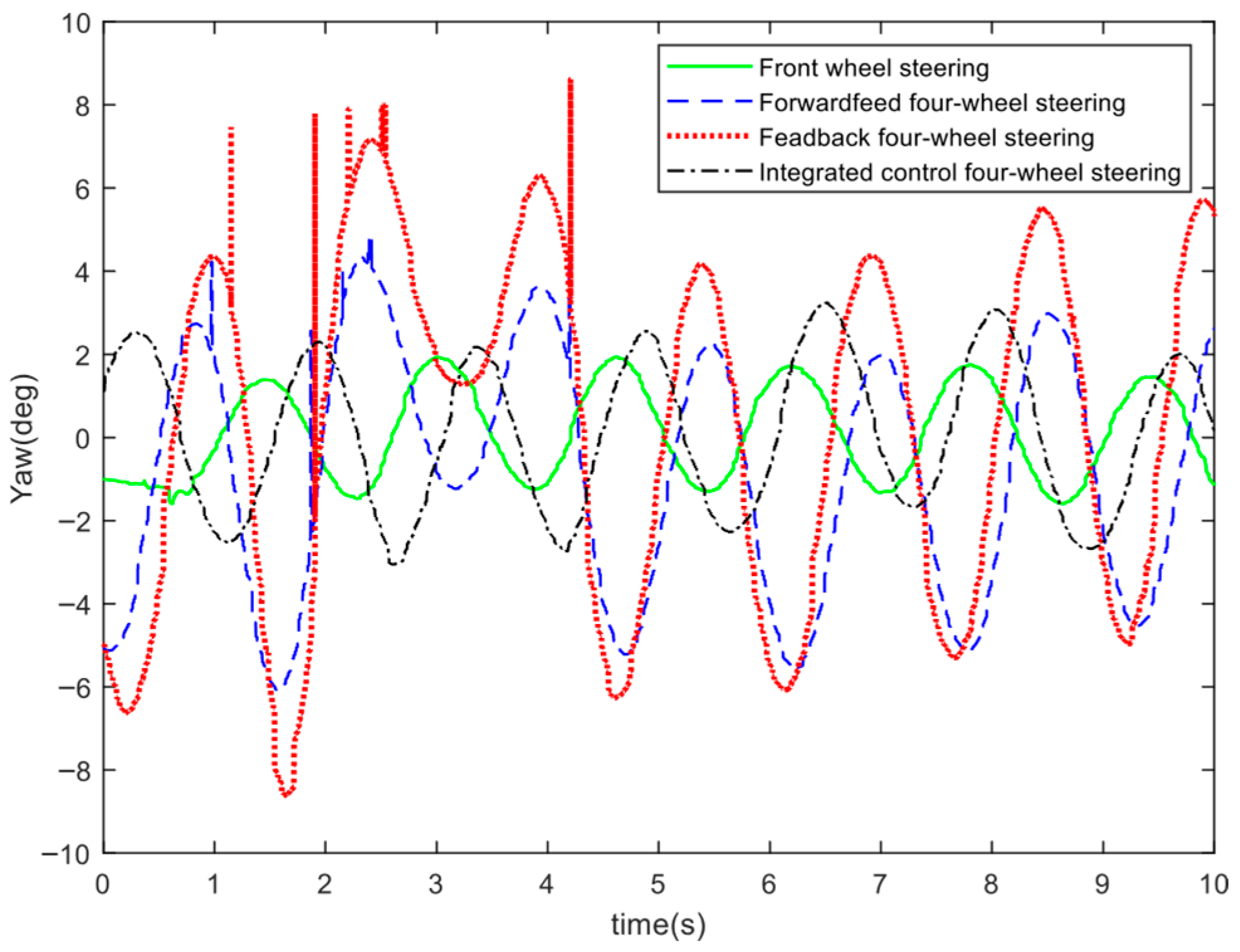
Yaw test results.
The experimental results show a high degree of consistency with the simulation outcomes. As illustrated in Figure 19, the rear-wheel steering angle remains zero under front-wheel steering conditions. At low speeds, the rear wheels under four-wheel steering control operate in counter-phase to the front wheels, thereby enhancing vehicle maneuverability. A comparison of different four-wheel steering control strategies reveals that, under identical front-wheel steering inputs, the rear-wheel angles generated by feedback and integrated control strategies are slightly larger than those produced by the feedforward strategy. This difference is reflected in the yaw rate oscillations, as shown in Figure 20. The data in Figure 21 indicates that under low-speed conditions, the front-wheel steering mode exhibits the smallest yaw rate fluctuation amplitude, while the integrated control strategy demonstrates the least yaw rate variation among the three four-wheel steering control approaches. The physical vehicle tests further validate the effectiveness of the simulation results.
7. Discussion
This section systematically compares the proposed four-wheel steering (4WS) control strategy based on AUKF state estimation with existing relevant research, elaborating on the innovations, engineering advantages, and application potential of this scheme, while objectively analyzing its current limitations.
Classical 4WS control studies have primarily focused on improving high-speed stability and low-speed maneuverability, with feedback control often relying directly on high-precision yaw rate sensors and lateral acceleration sensors. For instance, the LQR-based control proposed by Pang et al. [8] heavily depends on accurate full-state measurements. In contrast, this study explicitly proposes eliminating reliance on yaw rate measurements and instead employs multi-sensor information fusion estimation based on AUKF. This scheme maintains comparable control performance (e.g., yaw rate gain adjustment capability) while reducing the cost and precision requirements for underlying sensing hardware, making it more suitable for cost-sensitive engineering vehicles operating in harsh environments.
The core advantage of this scheme lies in proposing a complete “AUKF state estimator + feedforward-feedback fusion controller” solution. This architecture couples the accuracy of state estimation with the superiority of control decisions in a closed-loop manner, enabling the system to make control decisions that approach the ideal state even under conditions of incomplete sensor information.
Although this scheme demonstrates promising performance, several limitations remain:
- (1)
- Model Dependency and Parameter Uncertainty
The accuracy of the dynamic model remains the foundation for state estimation and controller design. While the current model accounts for longitudinal–lateral–yaw coupling, the tire model is still linear. Under extreme conditions such as very low adhesion coefficients or large slip angles, estimation and control performance may degrade. Future work could integrate more accurate tire models or explore data-driven model compensation methods.
- (2)
- Neglect of Extreme Conditions and Actuator Response
The study does not account for the response characteristics of steering actuators. Subsequent work should explicitly incorporate actuator dynamics and constraints into the controller design and conduct hardware-in-the-loop (HIL) tests with complete actuator models.
- (3)
- Limitations of Validation Scenarios
Current validation is based on Carsim–Simulink co-simulation. Although the model is highly credible, it cannot fully replace real physical systems. Electromagnetic interference, severe vibrations, and temperature/humidity variations in tunnels are not reflected in the simulations. The next step must involve constructing a physical test platform for mining vehicles and conducting closed-loop validation in real or near-real tunnel environments.
- (4)
- Potential for Coordination with Other Chassis Systems
This study focuses solely on a four-wheel steering system. However, mining vehicles are typically equipped with other systems such as all-wheel drive and electronically controlled wet braking systems. Future work could integrate this 4WS control architecture as a subsystem in a global chassis domain controller framework, enabling coordinated optimization with drive and brake systems to achieve global vehicle-level optimization in safety, energy consumption, and efficiency.
This study addresses the challenge of driving stability in mining vehicles in narrow tunnels by proposing and validating a state estimation-based four-wheel steering control scheme, offering a new technical approach to enhance the maneuverability and safety of special-purpose vehicles in extreme environments. At the same time, the identified limitations provide clear directions for subsequent academic research and engineering development.
8. Conclusions
This paper proposes a four-wheel steering (4WS) control strategy based on real-time vehicle state estimation to enhance maneuverability and stability of the X-by-wire chassis during driving in mine tunnels. The main conclusions are as follows:
- (1)
- Through steady-state response analysis of different steering control strategies, it is demonstrated that at low speeds, priority should be given to improving steering sensitivity to enhance vehicle maneuverability, while at high speeds, it is essential to balance stability with appropriate steering sensitivity to avoid control discomfort caused by excessive differences between the driver’s input and front-wheel steering characteristics. Simulation results confirm that, compared to standalone feedforward or feedback control, the integrated control strategy effectively achieves both low-speed maneuverability and high-speed stability.
- (2)
- Under low-speed conditions, the 4WS vehicle exhibits superior steering flexibility and maneuverability compared to the front-wheel steering (FWS) vehicle. Simultaneously, under high-speed conditions, the application of 4WS technology can significantly mitigate buffeting phenomena during large and abrupt steering angle changes, thereby improving driving safety.
- (3)
- By designing a vehicle state parameter estimator based on the adaptive unscented Kalman filter (AUKF), real-time state information during vehicle operation is integrated into the four-wheel steering control strategy, and the feasibility of the method is verified through simulation.
The strategy proposed in this paper is designed to prioritize computational efficiency and engineering practicality while ensuring control performance, offering a practical solution for mining vehicles with four-wheel steering. However, it is necessary to explicitly acknowledge several limitations of this study. These include the lack of real-time experimental validation, potential performance degradation of the state estimator under conditions of sensor noise or latency, and unmodeled dynamics such as tire compliance. Future research will focus on real vehicle testing, hardware-in-the-loop validation, and robustness enhancement.
Author Contributions
Conceptualization, Q.J., Y.B., M.H., J.L. and L.C.; methodology, Q.J. and Y.B.; validation, Y.B. and M.H.; formal analysis, Y.B.; investigation, M.H.; writing—original draft preparation, Q.J.; writing—review and editing, Q.J., Y.B., M.H. and J.L.; project administration, L.C.; funding acquisition, Q.J. and L.C. All authors have read and agreed to the published version of the manuscript.
Funding
This research is support from National Key Research and Development Program (grant no. 2022YFB4703600), Open Project of National Engineering Laboratory (grant no. GCZX 2023-02), the Science and Technology Innovation and Entrepreneurship Fund of China Coal Technology & Engineering Group (CCTEG) (grant no. 2025-QZ002), Shanxi Provincial Basic Research Program (grant no.20210302124119).
Data Availability Statement
The original contributions presented in this study are included in the article. Further inquiries can be directed to the corresponding author.
Conflicts of Interest
Authors Q.J., Y.B., M.H., J.L., and L.C. were employed by the company China Coal Technology & Engineering Group Taiyuan Research Institute Co., Ltd. The remaining authors declare that the research was conducted in the absence of any commercial or financial relationships that could be construed as a potential conflict of interest.
Nomenclature
| 4WS | four-wheel steering |
| UKF | unscented Kalman filter |
| EKF | extended Kalman filter |
| AUKF | adaptive unscented Kalman filter |
| KB | kilobyte |
| UT | Unscented Transform |
| LQR | Linear Quadratic Regulator |
| Fyf | the lateral force on the front tires |
| Fyr | the lateral force on the rear tires |
| ax | the longitudinal acceleration |
| ay | the lateral acceleration |
| wr | the chassis yaw rate feedback control |
| Iz | the rotational inertia of the Z-axis |
| tf | the track width |
| δr | the tire angles of the rear wheels |
| δf | the tire angles of the front wheels |
| a | the distance from the center of mass of the chassis to the front axles |
| b | the distance from the center of mass of the chassis to the rear axles |
| β | the deviation angle of the center of mass |
| u | the lateral speeds of the chassis |
| v | the longitudinal speeds of the chassis |
| Cyf | the lateral stiffness of the front wheels |
| Cyr | the lateral stiffness of the rear wheels |
| K1 | the ratio coefficient of front- and rear-wheel steering |
| L | the wheelbase |
| K2 | the feedback control coefficient |
| x | the state variable |
| y | the observed measurement |
| U | the input variable |
| w(t) | the process noise |
| v(t) | the Gaussian white noise |
| M | the window size in the window opening method |
| Pxx | the covariance matrix between x and x |
| Pyy | the covariance matrix between y and y |
References
- Kim, M.; Chung, I.; Choi, J.; Nam, K. High-Order Model-Based Robust Control of a Dual-Motor Steer-by-Wire System with Disturbance Rejection. Actuators 2025, 14, 322. [Google Scholar] [CrossRef] [Scilit]
- Huang, Z.; Ge, S.; He, Y.; Wang, D.; Zhang, S. Research on the Intelligent System Architecture and Control Strategy of Mining Robot Crowds. Energies 2024, 17, 1834. [Google Scholar] [CrossRef] [Scilit]
- Du, Y.; Zhang, H.; Liang, L.; Zhang, J.; Song, B. Applications of machine vision in coal mine fully mechanized tunneling faces: A review. IEEE Access 2023, 11, 102871–102898. [Google Scholar] [CrossRef] [Scilit]
- Nagai, M. The perspectives of research for enhancing active safety based on advanced control technology. Veh. Syst. Dyn. 2007, 45, 413–431. [Google Scholar] [CrossRef] [Scilit]
- Wang, Y.; Zhou, J.; Zhang, T.; Chen, G.; Cui, Y.; Qiu, R. Fuzzy Logic-Based 4WS-4WID Vehicles Longitudinal and Lateral Coordination Control Strategy. Int. J. Automot. Technol. 2025, 1–14. [Google Scholar] [CrossRef] [Scilit]
- Sano, S.; Furukawa, Y.; Shiraishi, S. Four wheel steering system with rear wheel steer angle controlled as a function of steering wheel angle. SAE Trans. 1986, 95, 880–893. [Google Scholar]
- Inoue, H.; Sugasawa, F. Comparison of feedforward and feedback control for 4ws. Veh. Syst. Dyn. 1993, 22, 425–436. [Google Scholar] [CrossRef] [Scilit]
- Pang, H.; Chen, Q.; Cai, Y.; Gong, C.; Jiang, Z. Research on the Stability Control of Four-Wheel Steering for Distributed Drive Electric Vehicles. Symmetry 2025, 17, 732. [Google Scholar] [CrossRef] [Scilit]
- Gao, L.; Jin, L.; Wang, F.; Zheng, Y.; Li, K. Genetic algorithm–based varying parameter linear quadratic regulator control for four-wheel independent steering vehicle. Adv. Mech. Eng. 2015, 7, 1–14. [Google Scholar] [CrossRef] [Scilit]
- Wang, R.; Zhang, H.; Wang, J. Linear Parameter-Varying Controller Design for Four-Wheel Independently Actuated Electric Ground Vehicles with Active Steering Systems. IEEE Trans. Control Syst. Technol. 2013, 22, 1281–1296. [Google Scholar] [CrossRef] [Scilit]
- Xie, X.; Jin, L.; Jiang, Y.; Guo, B. Integrated dynamics control system with ESC and RAS for a distributed electric vehicle. IEEE Access 2018, 6, 18694–18704. [Google Scholar] [CrossRef] [Scilit]
- Furukawa, Y.; Yuhara, N.; Sano, S.; Takeda, H.; Matsushita, Y. A Review of Four-wheel-steering Studies from the Viewpoint of Vehicle Dynamics and Control. Veh. Systym Dyn. 1989, 18, 151–186. [Google Scholar] [CrossRef] [Scilit]
- Tan, L.; Yu, S.; Guo, Y.; Chen, H. Sliding mode control of four wheel steering systems. In Proceedings of the 2017 IEEE International Conference on Mechatronics and Automation, Takamatsu, Japan, 6–9 August 2017; pp. 1250–1255. [Google Scholar]
- Ye, M.; Wang, Q.; Jiao, S. Robust H2/H∞ control for the electrohydraulic steering system of a four-wheel vehicle. Math. Probl. Eng. 2014, 2014, 8019. [Google Scholar] [CrossRef] [Scilit]
- Zhang, Z.; Huang, M.; Ji, M.; Zhu, S. Design of the linear quadratic control strategy and the closed loop system for the active four-wheel-steering vehicle. SAE Int. J. Passeng. Cars Mech. Syst. 2015, 8, 354–363. [Google Scholar] [CrossRef] [Scilit]
- Yu, S.; Wang, J.; Wang, Y.; Chen, H. Disturbance observer based control for four wheel steering vehicles with model reference. IEEE/CAA J. Autom. Sin. 2018, 5, 1121–1127. [Google Scholar] [CrossRef] [Scilit]
- Shao, L.; Jin, C.; Lex, C.; Eichberger, A. Robust road friction estimation during vehicle steering. Veh. Syst. Dyn. 2019, 57, 493–519. [Google Scholar] [CrossRef] [Scilit]
- Park, G. Optimal vehicle position estimation using adaptive unscented Kalman filter based on sensor fusion. Mechatronics 2024, 99, 103144. [Google Scholar] [CrossRef] [Scilit]
- Lúa, C.A.; Bianchi, D.; Di Gennaro, S. Nonlinear observer-based adaptive control of ground vehicles with uncertainty estimation. J. Frankl. Inst. 2023, 360, 14175–14189. [Google Scholar] [CrossRef] [Scilit]
- Dell’annunziata, G.N.; Ruffini, M.; Stefanelli, R.; Adiletta, G.; Fichera, G.; Timpone, F. Four-Wheeled Vehicle Sideslip Angle Estimation: A Machine Learning-Based Technique for Real-Time Virtual Sensor Development. Appl. Sci. 2024, 14, 1036. [Google Scholar] [CrossRef] [Scilit]
- Liao, L.; Sun, G.; Cai, S.; Wang, C.; Zheng, J. Stable High-Speed Overtaking with Integrated Model Predictive and Four-Wheel Steering Control. Electronics 2025, 14, 1133. [Google Scholar] [CrossRef] [Scilit]
- Wang, Y.; Li, Y.; Zhao, Z. State Parameter Estimation of Intelligent Vehicles Based on an Adaptive Unscented Kalman Filter. Electronics 2023, 12, 2079–9292. [Google Scholar] [CrossRef] [Scilit]
- Chen, Y.; Yan, H.; Li, Y. Vehicle State Estimation Based on Sage–Husa Adaptive Unscented Kalman Filtering. World Electr. Veh. J. 2023, 14, 167. [Google Scholar] [CrossRef] [Scilit]
- Julier, S.; Uhlmann, J.; Durrant-Whyte, H.F. New Method for the Nonlinear Transformation for Means and Covariances in Filters and Estimators. IEEE Trans. Autom. Control 2000, 45, 477–482. [Google Scholar] [CrossRef] [Scilit]
- Julier, S.J.; Uhlmann, J.K. Reduced Sigma Point Filters for the Propagation of Means and Covariances through Nonlinear Transformations. In Proceedings of the 2002 American Control Conference, Anchorage, AK, USA, 8–10 May 2002; Volume 2, pp. 887–892. [Google Scholar]

Disclaimer/Publisher’s Note: The statements, opinions and data contained in all publications are solely those of the individual author(s) and contributor(s) and not of MDPI and/or the editor(s). MDPI and/or the editor(s) disclaim responsibility for any injury to people or property resulting from any ideas, methods, instructions or products referred to in the content. |
© 2025 by the authors. Published by MDPI on behalf of the World Electric Vehicle Association. Licensee MDPI, Basel, Switzerland. This article is an open access article distributed under the terms and conditions of the Creative Commons Attribution (CC BY) license (https://creativecommons.org/licenses/by/4.0/).